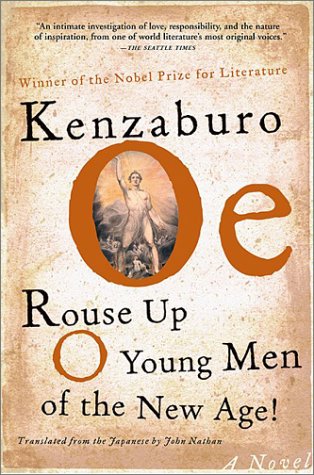
Rouse Up O Young Men of the New Age!

Thanks to Bellezza’s Japanese Literature Challenge 4, I have the chance to explore the intricate world of Kenzaburo Oe (pronounced ‘oh-ay’, 大江 健三郎 ), Japan’s second Nobel Laureate for Literature (1994), after Yasunari Kawabata (川端 康成) received the Prize in 1968.

Like his earlier work A Personal Matter*, Rouse Up O Young Men of the New Age! is an autobiographical novel dealing with the author’s experiences of raising a handicapped child.  A Personal Matter was written when Oe was young, describing an ordeal still raw from the initial shock of the birth of his brain-damaged child. Rouse Up was published in 1983, almost twenty years after A Personal Matter.

Rouse Up chronicles a more mature protagonist, the writer K, who has gone past the stage of denial and escape, to come to terms with the reality of fathering a handicapped child. Through the arduous journey, the writer has gained insights and pleasure from his relationship with his son Hikari, whom he nicknamed Eeyore in his novels.

Oe starts off the book with K’s plan to write a dictionary of terms for his now maturing son, to prepare him for his entry into the real, adult world.  This turns out to be a learning task in itself.  How do you explain to a brain-damaged person what the word ‘foot’ means?  Or ‘river’, ‘life’, or ‘death’?  He needs to deconstruct the realities of his everyday life before he can grasp the essence and meaning of his encounters.

It’s interesting to see how K get through to his son in defining ‘foot’. Eeyore understands it in relation to ‘gout’ from which his father once suffered. After the healing of the pain and swelling of the gout, it has turned into ‘a nice foot’.  So, the understanding of ‘foot’ comes in light of the pain it had experienced. K soon realizes that the definitions are more for himself as for Eeyore.

The author’s long journey of acceptance and self-discovery owes mostly to his love for the works of William Blake.  Rouse Up is a smorgasbord of selections if you are a Blake scholar. So admittedly, I have had a hard time ploughing through Oe’s use of parallels from Blake’s poetic and artistic symbolisms to reflect on his own predicament.  In certain parts, Oe’s writing is just as esoteric as Blake’s mythical depictions.  However, one thing is clear.  My enjoyment of this novel is no less, and the poignancy of a father-son relationship no weaker as I find my way through the Blake maze.  The book requires and deserves multiple reading.
Despite its complexity and denseness, the essence filters through Oe’s meticulous descriptions.  Further, John Nathan’s translation navigates effectively through Oe’s nuanced and sensitive narratives.  I’m just curious as to what the original Japanese version looks like since there are numerous references and quotes from Blake.  Are they in English or in Japanese translation?

Two lines from The Four Zoas seem to have outlined K’s personal journey:

“That Man should Labour & sorrow & learn & forget, & return
To the dark valley whence he came to begin his labours anew.”

It’s a perpetual striving, not unlike Sisyphus’s effort, and yet still leads from one path to the next, prompting a renewed acceptance and offering novel discoveries on the way.

Aside from the esoteric passages of Blake’s visions, some very simple lines shine through, and they are the ones that are most moving for me:

… healing the rift with my son, I became aware of his grief through the agency of a Blake poem, “On Another’s Sorrow,” which includes this stanza:

Can I see a falling tear,
And not feel my sorrows share,
Can a father see his child,
Weep, nor be with sorrow fill’d.

One of the “Songs of Innocence,” the poem concludes with the following verse:

O! he gives to us his joy,
That our grief he may destroy
Till our grief is fled & gone
He doth sit by us and moan.

In his attempt to know more about Eeyore, K explores the power of dreams and the imagination. Using Blake’s mythological poetry and artwork, he tries to understand Eeyore’s internal world. Both he and his wife know Eeyore does not dream, but that does not preclude he does not have imagination.

Subscribing to Blake’s conviction that: “The Imagination is not a State:  It is the Human Existence itself.”, K strives in earnest to cultivate Eeyore’s imagination. Eeyore has an almost instinctive response to bird calls, distinguishing them even before he adopts human language.  As he grows older, he is drawn towards the music of Bach and Mozart.  His imagination soon finds a channel of expression in composing, an amazing accomplishment nurtured by a highly supportive and loving family.  In real life, Oe’s son Hikari is a composer.

Adopting Blake’s vision, K sees a future for father and son together in a state of grace, from Blake’s Jerusalem:

“Jesus replied Fear not Albion unless I die thou canst not live
But if I die I shall arise again & thou with me
This is friendship & Brotherhood without it Man is Not

So Jesus spoke! The Covering Cherub coming on in darkness
Overshadowed them & Jesus and Thus do Men in Eternity
One for another to put off by forgiveness, every sin.”

From coming to terms with the tragic reality of fathering a brain-damaged child, to ultimately, almost symbiotically, sharing his life with his son, is a process not short of a personal epiphany.  At the end of the novel, Eyeore has grown to be a twenty-year-old man. While still having a limited mental capacity, Eeyore has his way of exuding his own humor, love and care for those around him.  The story is a poignant tapestry weaving real-life and the visionary, through which an imagined world of reality is beautifully conceived.

As for the source of the book title, it comes as a moving episode at the end of the book.  I should keep that for you to discover.  A heart-warming finish to a poignant chronicle.

John Nathan’s Afterword is an eloquent tribute to the father, son, and the nurturing family. It is also a helpful annotation of the novel.

Rouse Up O Young Men of the New Age! by Kenzaburo Oe, translated by John Nathan, published by Grove Press, NY, 2002.  259 pages.

***

* A touching review of A Personal Matter has been posted recently by Claire at Kiss A Cloud.  Also, Mel U’s A Reading Life has posted extensively on Oe and other Japanese writers.  Of course, there’s Bellezza at Dolce Bellezza, who has hosted Japanese Literature Challenge all these years, now in its fourth term.  I thank them all for their inspiration.

eReaders, iPad, and Home Literacy

“If a cluttered desk is a sign of a cluttered mind, of what then, is an empty desk?” — Albert Einstein

.

eReaders and the iPad could well be the best house-cleaning appliances ever invented. All the clutter on your bookshelves, magazines and newspapers strewn everywhere, and even those ubiquitous household bills can all be swept under the eCarpet. Yes, even flyers, ads, and coupons, they are now online or in apps… and maps? Just bring your iPhone.

But wait, what’s with this study done by Dr. Mariah Evans, sociologist at the University of Nevada, Reno, recently published in the journal Research in Social Stratification and MobilityAccording to its abstract, the study found that:

Children growing up in homes with many books get 3 years more schooling than children from bookless homes, independent of their parents’ education, occupation, and class.

Together with her colleagues at the University of Nevada, UCLA and Australian National University, Evans studied 70,000 children in 27 countries over a span of 20 years, one of the largest and most comprehensive studies ever conducted on what influences the level of education a child will attain. The difference between a bookless home and a home with 500 books amounts to an average of 3.2 years of further education. In China, the difference is 6.6 years.

As a sociologist, Dr. Evans is concerned with helping children of rural communities in Nevada to achieve higher education. Regardless of parents’ socio-economic and educational levels, the number of books at home is the single most significant correlate of educational attainment.

I know what’s on your mind… how many families have more than 500 books in their home. Well the idea is, the more the better:

Even a little bit goes a long way,” in terms of the number of books in a home. Having as few as 20 books in the home still has a significant impact on propelling a child to a higher level of education, and the more books you add, the greater the benefit.

You get a lot of ‘bang for your book’,” she said. “It’s quite a good return-on-investment in a time of scarce resources.

In an interview which is available on MP3, Evans explains:

When you have very highly educated parents, you still get some result of additional books in the home. But you get much more of what you might call ‘bang for your book’ for parents who have little education.

So now, back to our house-cleaning issue. How would home literacy be affected if more and more books are being swept away and stored in electronic devices and less and less on our shelves and strewn on the floor? Can the neat and tidy Kindle or iPad have the same effects as a real home library or ‘literacy mess’ for a child? Can 500 books in the eReader influence a child as much as 500 books around the home? Just some thoughts for future research.

.

.

You might ask what good do mere numbers do if you don’t use them. You can’t assume usage with presence, right? Well the question is, how can you use them if they are not around?  Evans claimed that just having them there, and watching a parent read a book is significant enough. If you’re caught reading a book, you are reading a book. But if you’re caught using an iPad, you may not be reading, you could be shopping, checking your stocks, or playing video games.

As for usage, electronic gadgets tend to promote individualized activities. The traditional ways of using books just might not be as compatible with these devices, like the cuddly moments of mother and child sharing a book at bedtime (see those teeth marks on the board books), the intimacy between book and reader, the appreciation and touch, the joy their aesthetics could bring, the picking up of a pen or pencil and marking and doodling around the pages, the practice of real life literacy activities with them, both personal and communal. And oh, the pleasure of browsing in a bookstore and the excitement of looting in a book sale.

Further, home literacy is more than just books. I was involved in an ethnographic study on language learning several years ago. I spent hours in several homes of young children, observing their literacy environment. My observations included materials that could foster language development. I noted, other than books, alphabet magnets on the fridge, newspapers, magazines, calendars, recipes, personal notes, notice boards, TV guides, shopping lists, food packaging, flyers, coupons, and ‘junk mails’, any print materials exposing a child to words and writing. One parent I observed had purposely placed newspapers in the bathroom, making the printed word more accessible to her child.  The rationale behind the study was that preschool children growing up in a home milieu rich in print materials are primed for language and literacy learning long before they even begin formal schooling.

With the arrivals of eBooks and eEverything else, printed matters are on the decline. Sure, it’s not all or nothing. Printed books will still be around.  But with eBook sales now surpassing hard copies at Amazon, the trend is obvious. eReaders and iPads are definitely ingenious and convenient devices, but how would home literacy change with these gadgets? And, how would we change as a human reader? It’s not about holding on to the archaic or being a Luddite, it’s all about our future, our very human future.

Of course, I’d appreciate a clean house. But hey, please don’t touch that pile. I know exactly where to find what under which. Thanks.

***

*And, to satisfy your curiosity, how many families Evans found to have 500 or more books in their homes? In the U.S., 18%.

“Family scholarly culture and educational success: Books and schooling in 27 nations” by M. D. R. Evans, Jonathan Kelley, Joanna Sikora, and Donald J. Trelman. Published in Research In Social Stratification and Mobility, Volume 28, Issue 2, June 2010, Pages 171 – 197. Click Here to go to the article.

WALL-E (2008, DVD)

Continuing with my review of  ‘hopeful movies’ for the new year,  this is a must-see… for your whole family.

wall-e

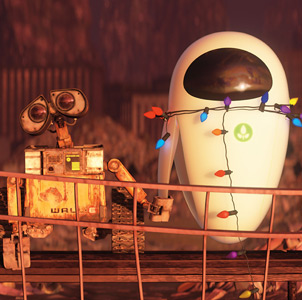
WALL-E has re-defined for me what makes a good movie.  It doesn’t need human actors, doesn’t even need dialogues.  Its visuals are stunning and thought-provoking, and the silent scenes speak volumes. Especially the first part of the movie, I’m fascinated by how human meanings and sentiments are conveyed with almost no dialogues yet with such eloquence.  It is ironic, I know, that it takes an animated robot, or two, to bring out what is important for us humans: The need to connect, the joy of simplicity, the power of a tiny green sapling bursting with life, and love, the essence of being human.  The creators of WALL-E have invented a fresh and entertaining way to send these age-old messages back to us humans, with grace, humor, and wonderment.  Now that’s creativity.

The time is post-apocalyptic, some time in the future where Earth is no longer habitable because its junks are piled up higher than sky scrappers.  WALL-E is a robot with one directive: garbage compacting.   Earth is no man’s land now.  One ‘human remains’ that WALL-E treasures is an old video tape of “Hello Dolly”.  WALL-E plays it constantly to admire that very human act and emotion:  courtship and love.  One day, he witnesses the landing of a spacecraft, from which comes Eve, an exploratory robot.  Now WALL-E has a chance to practice what he has learned.

As Earth is no longer viable for life, humans, ever ingenious, especially when it comes to their own enjoyment and gratuitous consumerism, have branched out into space, the final frontier.  They have created for themselves a utopia in a cruise ship, perpetually holidaying in space.  Their pastime is lounging on a couch, being served by automated robots.  Due to lack of use, their limbs have shrunk while their bodies have bloated.  No matter, they only need one finger to press buttons to eat, drink, and be merry.  WALL-E’s adventures begin as he follows Eve back to this ultra high-tech space station.

wall-e-and-eve

But Earth is home for humans, not a cruise ship in space.  Earth is meant for us to cultivate, to nurture, and to enjoy.  So, that’s the ultimate epiphany for all these perpetual space vacationers.  Herein lies the miniscule hope, symbolized by the tiny sapling of green, that there’s still a chance to return home and set roots once again, to live and grow.  The movie ends with all the right notes without being preachy or turning into a propaganda, nor does it wake us up by scare tactics.  It leads you on a pleasant ride and brings you to its intended destination without coercion or didactics.

The DVD has some excellent special features including a couple of animated short films, deleted scenes, and many more.  But my favorite part is ‘Animation Sound Design: Building Worlds From the Sound Up”, in which the legendary sound designer Ben Burtt shares secrets of creating the sounds of WALL-E. Credited by writer/director Andrew Stanton as the genius behind WALL-E, Burtt has won Oscars for his sound effects in E.T. The Extra-Terrestrial, Star Wars, and Indiana Jones movies.

Teach your children well… while there’s still time,  that’s the underlying axiom (the name of the cruise ship) of the movie.  An animation more relevant for adults than kids. After all, who are in a better position to bring hope to the next generation other than parents themselves?

~ ~ ~ ½ Ripples


Flight of the Red Balloon (2007, France, DVD)

flight-of-the-red-balloon

In celebration of its 20th anniversary, the Musée d’Orsay in Paris has commissioned four notable directors to create a series of commemorative films. One of them is Olivier Assayas with his Summer Hours (l’Heure d’été) which I have reviewed.  Another is the highly acclaimed Taiwanese auteur Hou Hsiao-hsien. Flight of the Red Balloon is a unique piece of film art gently crafted by Hou in homage to Albert Lamorisee’s Oscar winning short Le Ballon Rouge (1956). Hou has long been garnering awards in international film festivals throughout Europe and Asia since the 1980’s, albeit relatively unknown in North America. Flight of the Red Balloon is his first French language film.

The little boy in this 2007 rendition is Simon (Simon Iteanu), a child growing up in the hustle and bustle of Paris. With an absentee father somewhere in Montreal pursuing his writing, and a frantically busy mother Suzanne (Juliette Binoche), Simon is alone in an adult world. Overloaded with her work as a voice-over artist in a puppet production plus other personal matters, Suzanne hires Song (Fang Song), a film student from Beijing, to look after Simon for her.

Suzanne is the embodiment of urban frenzy. As a single mother, she has to shuttle between home and work, deal with the eviction of a bad tenant in her lower apartment, confront her non-committal husband on the phone to Montreal, and connect with her daughter in Brussel, all in a day’s work. Simon is most perplexed.  “Why are you so busy, Mama?”, he asks.

song-and-simon

Song, on the other hand, offers the tranquility that is needed to balance life in the midst of chaos. As a film student, she uses her hand-held camera to record Simon’s activities, and by her quiet demeanor and calm observing, she reflects pleasure in the mundane, everyday trivialities called life. This is reality show without sensationalism.  Hou has ingeniously conveyed his perspective of realism with artistic overtone. No doubt, there is a lack of plot, suspense, or climax, but there is character contrasts, cinematic offerings in sights and sounds, and realistic, natural performance. Juliette Binoche has once again assured me why she is one of my favorite actresses. And no, you are not watching paint dry, you are watching life unplugged.

The red balloon forms the focal point of Hou’s signature long take. The almost God-like omnipresence hovering over buildings in the Paris skyline is a joyful symbol of childhood. Its silent drifting is as elusive as the fleeting memories of happiness. Even little Simon achingly remembers the pleasant days he had shared with his much older sister, who is now living in Brussel. We are all trying to catch and hold on to fond memories and meaningful relationships. Yet as the busyness of urban living numb our senses, we ignore and shove away what we think is a hindrance to our time, just like the people rushing out of the subway station, shoving away the red balloon. Only a child would try to catch and befriend it.

Complementing the cinematic artistry is the equally mesmerizing piano music, meditative, serene and restoring, setting the mood and the preamble of the film.  Other musical numbers are equally soulful. Click here for the official IFC site where you can have a taste of the sights and sounds of the film.

felix-vallotton-le-ballon-1899I particularly enjoy the ending. As Simon goes on a school trip to the art gallery of the Musée d’Orsay, the children gather on the floor to talk about Félix Vallotton’s 1899 painting Le Ballon, he leans back, slightly removes himself from his school mates, and lays on his back. As he looks up to the glass canopy of the museum ceiling, he sees it again, the red balloon, watching over him, removed yet engaged, far away, yet ever so near.

~ ~ ~ Ripples


The Glass Castle: Book Review

For my 100th post, I’d like to share an extraordinary personal narrative by writer Jeannette Walls.

The opening of the book grabbed me right away as I was browsing in a bookstore. The author, a successful journalist and writer, was in a taxi, all dressed up for an evening event in New York City. As she glanced out the window, she saw a homeless woman scavenging a garbage bin. A closer look made her realize that was her own mother.

That is one dramatic opening of a book. Knowing that it is the telling of a real-life story intrigued me all the more.

Since its publication in 2005, the award-winning childhood memoir of Jeannette Walls has garnered high acclaims and been on the New York Times Best-Seller List for 100 weeks.

Growing up nomadic is a succinct description of Walls’ childhood. At age four, she had already moved eleven times. Upon the direction of her eccentric father and idealistic mother, and often to escape debts or consequences of misdeeds, the four Walls children were herded across the United States from Arizona to California, across mining towns and even living out open in the Mojave Desert, moving on a whim and often given just minutes to pack up whatever meager possessions they had.

Afflicted with alcoholism, dad Rex had trouble holding down a job. But he was a man with a brilliant mind and a wealth of knowledge which he readily passed to his favorite daughter Jeannette. She learned from him science and engineering, mathematics and history. The glass castle is his promise to her, assuring her one day he would strike gold with the Prospector he had invented, and build the family a glass castle they could all live in. The glass castle remained a glimpse of hope, yet sadly proven to be one illusive dream.

Mom Rose Mary was an idealistic artist and writer. Besides teaching her children to appreciate nature, art and literature, she had taught them adaptability and instilled in them the spirit of resilience. Once driving through the Mojave Desert, they saw an ancient Joshua tree. Growing through the wind swept years, the tree was permanently bent and yet was still firmly rooted. Later, Walls found a sapling growing not far from the old tree and wanted to dig it up and replant it near their home:

I told Mom that I would protect it from the wind and water it every day so that it could grow nice and tall and straight.

Mom frowned at me. ‘You’d be destroying what makes it special,’ she said. “It’s the Joshua tree’s struggle that gives it its beauty.

This book could well be named The Joshua Tree.

Rex’s alcoholism left the family in dire poverty. In this candid and personal account, Walls remembers that often she had to go without food for days. While in school, she would scavenge garbage cans for leftovers after lunch. Often they would have no electricity in the makeshift shack they called home, and took a shower once a week.

Mom was plagued by depression and often lived in a world of her own ideals. Her laissez-faire style of child-rearing often left her kids to fend and provide for themselves. Even if she found a job as a school teacher, she would soon grow tired of it and wouldn’t get up in the morning. The kids would have to drag her up, usually in vain.

I’m surprised the term “Dysfunctional” never occurred in my mind as I read the book. The Walls children were tenacious, resourceful, bold and confident. They were avid readers and did well in school.  What more, they were devoted to each other and loyal to the family. From an early age, they had to learn to handle an alcoholic father, a moody and depressed mother, and mediate their occasional fights and conflicts. The kids had to parent their own misfit mother and father. The Walls might be financially crippled, they were able to maintain strong relationships and an exuberant zest for life.

Walls’ account is candid and personal, poignant with cutting humor. One time in winter, when icicles were formed in their kitchen ceiling because the roof was not insulated and there was no electricity in their home, Walls describes her mom’s response:

All seasons have something to offer,” she said. “Cold weather is good for you. It kills the germs.

How we view the Walls parents of course depends solely on how their daughter presents them in her memoir. And this is precisely my point. Jeannette Walls has painted a loving picture of her parents depsite their failings. She is sympathetic to their struggles with their own demons. Through out the book, I am touched by her capacity to forgive, to persevere, to hope, and to plan for a better future, not only for herself, but for all her siblings.

The last chapters of the book detail how the author and her siblings pursued a new beginning by establishing an independent life in New York City, while still as teenagers. The story of resilience moved on to another phase. Readers are gratified to see a rewarding end to Walls’ years of perseverance.

Film rights have been optioned for the book.  If it is ever turned into a movie, from a visual sense, it is easy to illustrate the hilarious and sensational parts. However, my sincere hope is that the film will keep the integrity and poignancy of the memoir. Often, it is not what has happened that is worth telling, but how the narrator sees what has happened that makes the storytelling moving and memorable. In this case, both the what and the how are extraordinary and uplifting.

The following is a video clip of Jeannette Walls and her mother talking about The Glass Castle.

~ ~ ~½ Ripples

The Glass Castle by Jeannette Walls, published by Scribner, NY. 2005. 288 pages.

NOTE: Here is the latest (April 23, 2012) regarding the film adaptation of the book. Lionsgate has bought the rights and Jennifer Lawrence is in talk for the lead. CLICK HERE to read more.

FOR A LIST OF UPCOMING BOOKS INTO FILMS, CLICK HERE.

***

Motherhood and Music

This just happened over the weekend…

It was your typical wedding banquet. The elegant ballroom, the thirty some round tables tastefully decorated, the introduction of the wedding party, the welcoming of out-of-town guests, the buffet, the clinking of glasses…

All the usual stuff at your usual wedding celebration…until…the mother of the groom played Tchaikovsky at the piano.

As a promising, award-winning pianist in the then North Vietnam years back, her talent and future were stifled under the harsh political climate. Thanks to the sponsorship of a Canadian church, the family immigrated to Canada, starting a new life in freedom.

Not long after that, a tragic work-related accident claimed the life of the father. The mother continued to run the family business and raised her young children all by herself, instilling in them the love of music, while laying aside her own musical career…

Until, as a most moving gift of love, she practiced again for her son. On his wedding day, as the lights dimmed, she walked over to the grand piano in the banquet hall, and played with such depth of expression and poignancy, two selections from Tchaikovsky’s The Seasons, May: White Night, and June: Barcarolle. The 300 guests were silent, mesmerized, deeply moved…then the standing ovation.

The love of a mother, the power of music … what a wonderful way to bring up a child, what a remarkable beginning of a marriage.

***

Nim’s Island (2008)

I don’t want to miss any Jodie Foster movies.  She’s one of my all time favorites.  I’m also eager to watch Abigail Breslin again after her Little Miss Sunshine.  Further, after reading Annie Dillard’s novel, I just need something light and mindless.  Coincidentally, between these two, I only have to change lenses, for the view is more or less the same: the beauty and wonder of nature. 

Nim’s Island is a mixture of Swiss Family Robinson, Home Alone, Stranger Than Fiction, and Mr. Brooks.  Based on the popular children’s book of the same name by Wendy Orr, it’s about a girl called Nim who lives an idyllic life on a pristine island with her scientist dad Jack.  The island’s rich natural resources and wildlife are the sources of Jack’s research and Nim’s pleasure.  Her friends are Selkie the sea lion, Fred the iguana, Galileo the frigate bird, and the giant sea turtle…what’s his name? … Anyway, it’s a zoo out there on Nim’s island, but Nim and Jack keep it real organized, educational, and fun.

One of Nim’s favorite past time is reading the stories of her adventure hero Alex Rover (Gerard Butler, P.S. I Love You, 2007).  So, when a huge tropical storm hits the island, and her dad hasn’t come home for a few days collecting protozoa samples out in the open sea, she calls to Alex Rover for help.  Actually, it is the creator of Alex Rover that emails Nim first, asking about information to write the next novel, mistakenly thinking Nim is Jack’s research assistant. 

Far from being an adventure hero, Alexandra Rover, the author, is a recluse suffering from agoraphobia, whose best friend is her Purell hand sanitizer. She hasn’t been out of her San Francisco apartment for months. But knowing Nim is all alone on an island needing help, and prodded by her own adventure hero, she ventures out against her fears.  So there’s the interesting set up of the plot, the rest of the story is the adventures of Alex Rover the writer heading to the island to help out Nim, the real heroine.

The film suffers from some scenes and dialogues that appear to be banal and trite.  With its interesting storyline I think it can be done better with more creativity and imagination.  Having said that, I must say that the movie is beautifully shot on location in Queensland, Australia.  In a day and age when kids, and parents, for that matter, find it impossible to have fun outside of video games and electronic gadgets, this movie and the book can offer a wholesome alternative.

There is a new edition of the book that’s a movie tie-in, including 8 pages of color pictures from the film. It is illustrated whimsically by Kerry Millard.  A fun read.  And for all the budding biologists, zoologists, oceanographers, and for that matter, environmentalists in your home, this is a must-read. 

The intended age group I feel should be a bit lower for both the movie and the book.  I’d say a target audience and reader Age 6 – 10 would be more appropriate than the now 9 – 12.  

The best combination:  Go see the movie and then to the bookstore.

Now with that combination, I’ll have to give it

                  ~ ~ ~ Ripples 

Enchanted (2007, DVD)

I consider myself a rational person.  As an armchair critic, you have to, right?  Analytical, critical, not easily moved… But when it comes to humor, I just can’t resist.  I have to admit, I tried to control myself from laughing out loud many times, and not embarrass myself among all the preschool kids and their parents in that matinee show, even though it was dark there in the theatre.

Note to myself:  get the DVD when it’s out.  And so I did.

Why am I enchanted?  First of all the movie.  It’s loaded with smart dialogues, humorous parodies, seamless fusion of animation and real characters, and an old-fashioned and yet still wise message for today.  And the cast,  sure looks like they are having the time of their life making the movie. And the Oscar nominated songs by Menken and Schwartz, with the huge conglomeration of dancers, a delightful revival of the old musicals of the heydays.

Enchanted is a classic fairy tale: An evil queen, afraid of being dethroned, tries in all her power to prevent her stepson from marrying his true love by banishing her to the real world of modern day New York City, where there are no “happily ever afters”, a punishment indeed.  While there, the fairytale maiden meets her real life prince…and so on and so forth…But, what’s not typical is that it’s being handled intelligently, thanks to an excellent script, and the talented technical support it receives.

Amy Adams, Patrick Dempsey,  James Marsden, and Timothy Spall all deliver lively and very gratifying performances. Also, Susan Sarandon as the wicked Queen Narissa…I say, she’s in character.  And the then 8-year-old Rachel Covey, the cutest child star I’ve seen in movies these years. This is only her second movie, but she’s a natural, that is, she doesn’t need to act. She can just stand there and be adored.

The DVD is packed full of fun and information. We have a Carrie Underwood music video “Ever Ever After”, an additional animated story, bloopers, and director Kevin Lima commenting on the deleted scenes. I’m most fascinated by the behind the scene look at how the songs and the musical scenes are produced.  It’s fascinating to watch how choreographers have to coordinate hundreds of performers involving gymnastic troops, stilt walkers, eclectic groups of dancers and multicultural musicians in the “That’s How You Know” scene in Central Park.  I’m most impressed to find a few of them are veteran dancers who had appeared in the classic movie West Side Story (1961) and one was a chimney sweeper in Mary Poppins (1964)!  I’m thinking…Can I even get out of my bed when I’m at their age?

Great family entertainment for the Easter break coming up.  In a world of dysfunctional relationships, no wonder I am enchanted by a movie painting couples reconciled, yes right in the divorce lawyer office, and lovers united after swashbuckling adventures in the hustle and bustle of New York City. 

Just don’t remind me it’s only a fairy tale.

~ ~ ~ Ripples

To Read or Not To Read: A Personal Response


It looks like my last post has stirred up some ripples. I thank you all for your input to a very complex topic.  Your comments certainly make an interesting forum, where there’s the exchange of ideas and the sharing of opposing views.  That this is even possible is basically because we all read and write.  It’s not too late to thank our teachers for this.

Indeed, the issue of reading is a complicated one.  On the outset, and from your comments, we see aspects dealing with the skill, the form, and the content of reading.  While at the same time, underlying are the very values we hold towards this seemingly simple act: What is reading after all?  How should it be taught in our schools and transmitted (or not) in our homes?  And, what should the content be in order to classify the act as such?

As someone who has involved in literacy research, I have seen recent academic studies taken the perspective of re-defining reading and writing not as a skill but a social practice. Our values sustain the act, or transform it. As we see the ubiquitous usage of the internet and digital communication, we are witnessing the power of technology changing our social values, lifestyle, interests, and how we spend our time.

The NEA surely had the effects of our technological age in mind, thus, an update on the reading habits of Americans.  The last one they did was in 2004.  As with any survey, the NEA Study has its limitations and confined by its own perspective and contextual stance.  And, within the parameters of the present study, they did not go into details the causes, but they did present the correlations of variables.  The results can be considered as reflections of our contemporary society.  The correlations of factors and the implications of the findings are significant enough for us to ponder.  Again, you can download the 98-page report in pdf format here (3.32 MB).

I welcome the progress we have made in digital and internet technology, bringing the world closer at the twitch of our finger, feeding us with instant knowledge and information. I congratulate those who attempt to bring the world of print to their readers by more convenient modes of delivery, such as transmitting reading materials in digital mode, and others who attempt to attract young readers through the creation of new kinds of books, such as graphic novels and manga’s. 

And yet…I lament the erosion of a part of our culture and civilization, the form of reading and writing as we still know it.  I’m concerned about the gradual obliteration of the “classics”, or the dying of the literary form. I lament to see the decline of appreciation and comprehension of literature, for I believe the humanity and universality in many of these works still speak in our world today.  I believe there’s an urgent need to create even more literary works in the face of technological domination.  There may not be a golden age of reading, but there has been a heritage of writing.

I worry about our next generation replacing the art and pleasure of book reading with offerings from other media. I’m also concerned about the English language disintegrating into cyber lingos, or replaced by sensational, action-packed anime. It is a phenomenon graver than just seeing the puzzled faces of our young as they look at an analog clock or try to use a dial phone. 

The progress we have made in technology does not mean that we should downplay the loss of a heritage.  That we can artificially make ice should not trivialize the disappearance of glaciers. The ushering in of electronic music should not obliterate the works of Mozart.  The two can co-exist…isn’t that the postmodern promise? 

No doubt, reading and writing will survive, since we still need to look up information, make lists, chat on-line…and blog.  But I regret to see the erosion of literary reading and the appreciation of literature, classic or contemporary, and may it not come to pass, the termination of its creation in the future, near or distant.

As another year draws to a close,  we may need to take stock of both our progress and our loss.  I’m not a doomsayer, but surveys like the NEA’s point to what seems like an irreversible trend.  While some may not see it as a gloomy path but just a shift of social practices and lifestyle, the survey results reflect our priorities and the shifting values in this day and age. 

Or, is it really irreversible? 

Maybe all is not lost.  At the start of a new year, I’d like to remain optimistic.  Maybe it begins with…yes, a New Year’s resolution on reading… 

A Happy New Year to All!

The Message of Christmas

Hopefully by now, the dust has settled, and frantic frenzies can now be turned into some placid ponderings…

A Charlie Brown Christmas (1965 TV) remains my all time favorite Christmas special.  Charles Schulz has wittingly shrunk all humanity into his pint-sized Peanuts gang.  Aren’t we all but tiny specks in the vast universe, and yet our strives and questions are ever so close and immediate.

And for Charlie Brown, little did he know that by throwing up his arms and ranting his disappointment and frustration, had asked the existential question for us all:  “Isn’t there anyone who knows what Christmas is all about?”

And for Linus, little did he know that by answering this question, had delivered not only the Message of Christmas, but the crux of Christianity, pointed us all, the peanuts of the universe, to the way of reconciliation and redemption.

…Out of the mouth of babes (Psalm 8:2)…

A blessed Christmas to all!

Miss Potter for Christmas

It’s not too early to make up a Christmas gift list, or actually start some Christmas shopping. I’ve a recommendation here for a DVD that you can safely watch with your children. But you’d also want to watch it by yourself too, because then you can savour in solitude the touching moments an adult can appreciate, and yes, shed a private tear, and let the movie work its magic freely in your heart.

Miss Potter (2006) is the story of Beatrix Potter, the creator of Peter Rabbit, one of the best loved children icons of all times. The film is a gem glittering with acting talents. As Beatrix, Renée Zellweger (Oscar for Cold Mountain 2003) brings to the screen a most delightful character, her genuine and innocent demeanor captures the audience’s heart the very moment she appears. She receives nominations this year for a Golden Globe and a Saturn Award for her role in Miss Potter, and well deserved.

Ewan McGregor (of Star Wars and Moulin Rouge fame, no relation to farmer McGregor) plays the slightly comical first-time publisher who has made history with his appreciation and confidence in the talents of Beatrix. The two naturally fall in love. Like a Jane Austen novel, such a relationship is frowned upon by Beatrix’s upper-middle class family and openly forbidden. But this time, a hundred years after Jane, Beatrix boldly confronts the inequitable and restrictive Victorian values and norms.

Emily Watson, herself an Oscar nominee for her role in Gosford Park, (and she is excellent in Angela’s Ashes), plays a lively supporting role as McGregor’s unmarried sister. The social issue of the unmarried female in a male-dominated society is freely explored through her outspoken character, but not without poignancy.

I must mention the song written for the movie, which has won the 2007 World Soundtrack Award for Best Original Song Written for Film. “When You Taught Me How To Dance” is sung by Ewan McGregor in the film during a mesmerizing and moving scene. As the credit rolls in the end, this touching tune is heard again, this time in its entirety performed by Katie Melua. Now, she’s another story to write about.

The captivating soundtrack matches the beautifiul scenery and period costume, together with the excellent script and the whimsical animation of Beatrix’s animal friends, make the movie utterly enjoyable and gratifying, but still delivering effectively the depth of sentiments and the dramatic twists and turns.

The DVD includes background on Beatrix Potter, commentary by director Chris Noonan and a making-of documentary with extensive interview with Renee Zellweger, plus a music video performed by Katie Melua singing “When You Taught Me How To Dance”. A valuable collection and I’m sure, a welcomed gift.

~ ~ ~ Ripples

Beatrix Potter: A Journal (2006)

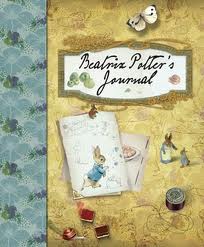
Beatrix Potter A Journal Book Cover

As a companion to the movie, and another great gift idea, is the book Beatrix Potter: A Journal which came out last year. A visual journal in the vein of Nick Bantock, the book is an imaginary scrapbook Beatrix would have made to chronicle her own life, with handwritten entries and notes, amusing drawings, little attached booklets, photo albums, and letters that can be taken out from envelopes. The book corresponds amazingly well with the movie, like a visual commentary.

Here are a couple sample pages from the journal:

webpage-beatrix-journal-3.jpg

webpage-beatrix-journal-4.jpg

~~~3 Ripples for both Movie and Book

Adora Svitak: “Tiny Literary Giant”

“Knights!  Clear the square of townsfolk!” the Duke cried.  Within a few moments, the square was empty except for the Duke, the Duchess, Myles, Didoni, and the large, burly knights who were guarding the Duke.  The men put the litter down, and the Duchess lay down to rest.  The Duke was telling Didoni what he wanted on his portrait.

“Make me look strong and majestic. I want no one to think that I am a weakling, like my soft older brother the King,” the Duke said imperiously.

“Knights! Clear the square of townsfolk!” the Duke cried. Within a few moments, the square was empty except for the Duke, the Duchess, Myles, Didoni, and the large, burly knights who were guarding the Duke. The men put the litter down, and the Duchess lay down to rest. The Duke was telling Didoni what he wanted on his portrait.  

“Why not paint a suit of armor?” Myles suggested before he could stop himself.

“Yes! The lad has quite the idea!” the Duke exclaimed. “Paint me in a suit of armor, with nothing amiss. Make my eyes as sharp as an eagle’s, and my nose straight and curved at the end. My lips I care for not— but make them solemn.”

Didoni nodded.

“It shall be done of course, your Grace,” Didoni said, already beginning to sketch on his canvas.

                                —- Excerpt from Adora Svitak’s Historical Fiction


 Adora Svitak Website

Just as I was saying in my last post that I’d never come across any literary prodigy, the name Adora Svitak came up on my computer screen last night.  The above excerpt is one of the sample writings from her website,  where you can also find her poems and fantasy writing.  Adora is a 10 year-old girl from Redmond, Washington.  Whether you want to label her a prodigy or not really does not change what has taken place in her life.  Here are the milestones so far:

Age 2.5: 

Could read and write simple words.

Age 3.5:

Read her first chapter book.

Age 4:

Started writing short stories.

Age 6:

Got a laptop from her Mom, writing began to take off.

Age 7:

Published 296-page Flying Fingers, a collection of her own fiction and writing tips for others (with her Mom).  Appeared on Good Morning America, interviewed by Diane Sawyer, who called her “Tiny Literary Giant”.  Met Peter Jennings and was given his book The Century For Young People, which remained her favorite.  Started Adora’s Blog.  http://www.adorasvitak.com/Blogger.html

Age 8:

Had written over 400 short stories and 100 poems, typed 60-80 words per minute, read 3 books at a time, 18 books a week.  Oh, that’s nothing, you might say, “My kid could do that.”  Just wait, Voltaire’s Candide?

Another book in the work, a collection of her poems called Dancing Fingers.

Promoted literacy to children in the UK.  Here’s The Guardian report: http://books.guardian.co.uk/news/articles/0,,1713183,00.html

Age 9:

Completing her first full-length novel Yang in Disguise,  serving as a spokesperson for Verizon Reads campaign for literacy, working on an animated computer program to help develop childhood literacy.

Montel Interview: http://www.metacafe.com/watch/439176/adora_svitak_9_year_old_author_criticize_george_bushs_iraq_pol/

Note: According to her interview on Montel, the proceeds of her book Flying Fingers will be going to the National Education Association and she would auction off some of her works to raise money for the victims of hurricane Katrina, rebuilding libraries in schools.

All in all, I feel that this gifted little girl doesn’t really care whether you label her “literary prodigy” or not.  She’s having the time of her life in her reading, writing, cooking, playing, and helping others how to read and write…  And, how many 10 year-olds can have the terms “Writer, Poet, Humanitarian” to describe themselves on their website?   http://www.adorasvitak.com/Main.html