Of Words and Spring

April is the month of empty dreams
Half the days gone
waiting for words and spring
still frozen ground
and on the screen
a frigid page as white as snow.

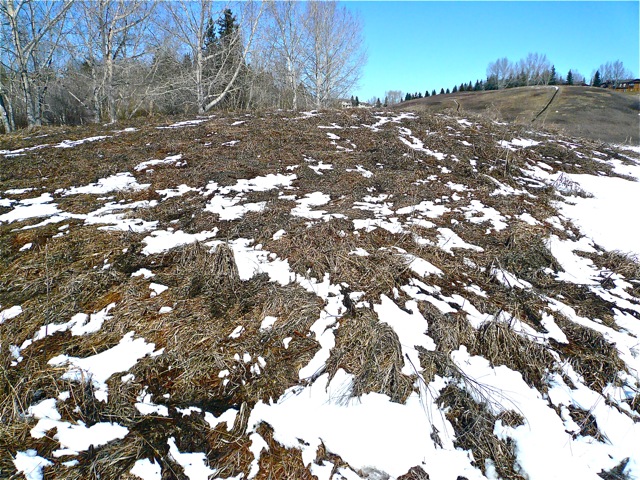
Brown could be the color of hope
After the white
for all I know
green is too much to wish for
I’m contented to see a patch
of dry and withered brown.

The sun is a perpetual sign
that there’s still hope
But it’s no herald of the seasons
for its presence comforts all year long
warming my blank and barren state
as I await for words and spring.

But Easter is an apt reminder
that The Word had come
spoken clear to half-frozen ears
His body hung on a lifeless tree
Blood and water flowed
onto parched and dusty earth

So what if no words come to me
That dreaded writer’s block
reigning the winter of sterility
numbing senses,
snatching thoughts,
seizing any sign of spring.

It’s not about a post or a blog,
Or even buds and melting snow.
The Word had come
lived and loved among us,
broken, bled, died and rose,
melting frozen hearts to greet
a new Spring and eternal growth.

Poem and Photos by Arti of Ripple Effects, April 2011. All Rights Reserved.


Reading Snow Country in Snow Country

The first ‘Snow Country’ in the title refers to the 1968 Japanese Nobel Laureate Yasunari Kawabata’s (川端 康成 1899-1972) seminal novel Snow Country (雪鄉); the second refers to Arti’s neck of the woods here north of the 49th parallel in mid December.

Written in the 1930’s through to the 1940’s, Snow Country was later translated into English and published in 1956.  It is probably Kawabata’s most well-known work.  Translator Edward G. Seidensticker had been credited for leading Kawabata’s work to the ultimate accolade, the Nobel Prize of Literature in 1968, a first for a Japanese writer.

The haiku-like simplicity so pervasive in the book is most apt for the Season. Firstly, its meditative descriptions and imagery offer a respite in the midst of our frantic pace.  And secondly, it points to certain relevance during this Christmas time, which I find surprising.

Translator Seidensticker writes in the introduction that the haiku is a juxtaposition of incongruous terms, such as motion and stillness. Within such contradictions sparks “a sudden awareness of beauty.”  Relax in the following poetic imageries:

They came out of the cedar grove, where the quiet seemed to fall in chilly drops.

or this:

[Her voice] seemed to come back like an echo of distilled love.

or this:

The field of white flowers on red stems was quietness itself.

Or savor the interplay of light and shadow, which evokes the poignancy of decayed beauty. This could well be the summing up of the human condition in Kawabata’s novel.

The sky was clouding over.  Mountains still in the sunlight stood out against shadowed mountains.  The play of light and shade changed from moment to moment, sketching a chilly landscape.  Presently the ski grounds too were in shadow.  Below the window Shimamura could see little needles of frost like ising-glass among the withered chrysanthemums, though water was still dripping from the snow on the roof.

The protagonist Shimamura, ‘who lived a life of idleness’ from inherited wealth, would leave his wife and children in Tokyo and go alone to the snow country every year, the mountain region of central Japan, to meet Komako, a young geisha at a hot spring village.  The love affair between the two is starkly off-balanced.  Despite her work in the pleasure quarters, entertaining parties of men, Komako is deeply devoted to Shimamura. Like her meager dwelling in the shabbiness of all, her room is spotlessly clean: “I want to be as clean and neat as the place will let me…”

Sadly, Komako realizes it is but a doomed unrequited love that she has invested in.  Shimamura too is aware of his own coldness.  Even though he is drawn back to Komako by making these trips to the snow country, he feels no obligation at all:

All of Komako came to him, but it seemed that nothing went out from him to her.

Of course, it could well be guilt and a sense of moral ground, albeit his loyalty to his wife and children rarely comes to mind.

Shimamura does not understand the purity Komako seeks in her love for him, and her desire not to be treated as a geisha.  And that is why his nonchalant statement hits Komako so hard. In the climatic scene of the story, he utters, though not without affection: “You are a good woman.”

Instead of taking his words as an endearment, Komako is deeply hurt. Despite having to work as a geisha due to her circumstance, thus selling herself as an outcast, she longs to be removed from her predicament and be transported to a new life. Shimamura’s repeated words “You are a good woman” fall upon her like the gavel of final judgement laden with biting sarcasm.

Kawabata’s characters cry out for redemption, to be delivered from their precarious state. Komako is seeking saving grace in Shimamura, and desperately hoping for a way out of the “indefinable air of loneliness” shrouding her.  But her search is in vain for the man is incapable of love:

He was conscious of an emptiness that made him see Komako’s life as beautiful but wasted, even though he himself was the object of her love; and yet the woman’s existence, her straining to live, came touching him like naked skin.  He pitied her, and he pitied himself.

Shimamura knows deep down that he needs cleansing as much as or even more than Komako.

The snow country of Japan is also the land of the Chijimi.  It is an old folk art of weaving where a certain kind of long grass is cut and treated, finally transformed into pure white thread.  The whole process of spinning, weaving, washing and bleaching is done in the snow.  As the saying goes, “There is Chijimi linen because there is snow.”  After the linen is made into kimonos, people still send them back to the mountain regions to have the maidens who made them rebleach them each year.  And this is where the universal appeal of snow as a metaphor for purity and cleansing so powerfully depicted by Kawabata, as Shimamura ponders:

The thought of the white linen, spread out on the deep snow, the cloth and the snow glowing scarlet in the rising sun, was enough to make him feel that the dirt of the summer had been washed away, even that he himself had been bleached clean.

When I came to this description towards the end of the book, a starkly similar image conjured up in my mind:

Though your sins are like scarlet, they shall be as white as snow; though they are red as crimson, they shall be like wool.”              —- Isaiah 1:18

And like the doomed ending of their love affair, death comes as a certainty to all, insects or humans alike.  Shimamura has observed how a moth “fell like a leaf from a tree… dragonflies bobbing about in countless swarms, like dandelion floss in the wind.”  The poetic descriptions do not make death any more appealing.  Kawabata uses insects as a metaphor for the frailty of life and the chilling finality awaiting:

Each day, as the autumn grew colder, insects died on the floor of his room.  Stiff-winged insects fell on their backs and were unable to get to their feet again.  A bee walked a little and collapsed, walked a little and collapsed.  It was a quiet death that came with the change of seasons.  Looking closely, however, Shimamura could see that the legs and feelers were trembling in the struggle to live.
It is pure serendipity that I picked up this book to read at this time of the year.  The Christmas story too has also cast a vivid interplay between darkness and light.  I was reminded of this reference:

The people walking in darkness have seen a great light; on those living in the land of the shadow of death a light has dawned.”            — Isaiah 9:2

There is reason to rejoice, for the Able Deliverer had come… He too had lived a life of paradoxes and contradictions: born to die, life through death, strength through weakness.  And beneath the surface of jollity of the Season and the superficial exchanges of good will, there lies deep and quiet, the source of joy and inner fulfillment, and Life’s ultimate triumph over death.

I heard a small voice echo as I treaded on the snowy path alone in my snow country.

It said: “For this reason I came.”

***

Snow Country by Yasunari Kawabata, translated by Edward G. Seidensticker. Published by Vintage International, 1996. 175 pages.

This concludes my final entry to meet Dolce Bellezza’s Japanese Literature Challenge 4 before the end of 2010.

My other JLC posts:

Never Let Me Go by Kazuo Ishiguro

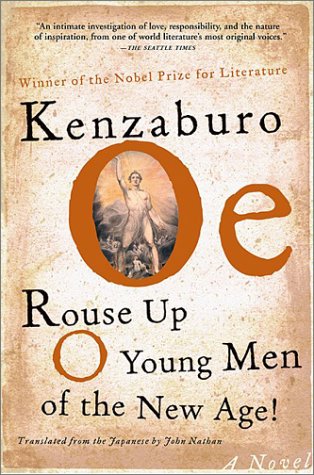
Rouse Up O Young Men of the New Age! by Kenzaburo Oe
Reading the Season: Luci Shaw

Every year around this time, I try to stay afloat in the sea of chaos and consumerism.  My method of survival has been to seek a quiet haven where I can dwell upon the meaning of the Season.  I entitled my annual December post on this theme ‘Reading the Season’.

This year, watching the daring flash mob singing of Hallelujah Chorus in a shopping mall food court has jump started my quest for a spiritual respite.  In a time where the legitimate word is Jollity over Jesus, where Christ has been declared politically incorrect at Christmas, and where God is denounced together with Bigfoot and the tooth fairy in ads on buses, I want to mull on some subversive counter-reflections.

This time, I’ve steered my search towards poetry and found this collection edited by Luci Shaw.  It is the 1984 Regent College Publication of  A Widening Light: Poems of the Incarnation. (Click on link to read excerpts from Google Books.)


Luci Shaw has partnered with Madeleine L’Engle on her literary journey, including being her publisher, co-author, fellow poet and close writer-friend.  For years, I have enjoyed Luci Shaw’s poetry and her other works, and one time, had sat in her workshop learning the art and craft of journal writing.

A Widening Light is a collection of poetry by some of twentieth century prominent Christian writers and scholars, including C. S. Lewis, Eugene Peterson, Mark Noll, as well as lesser known but just as inspiring contributors.  My favourite in the collection are those from Madeleine L’Engle and Luci Shaw.

As a meager attempt to stoke the flame of faith and keep the Reason in the Season,  I’d like to share some excerpts from this collection here.

Made flesh
After the bright beam of hot annunciation
Fused heaven with dark earth
His searing sharply-focused light
Went out for a while
Eclipsed in amniotic gloom:
His cool immensity of splendor
His universal grace
Small-folded in a warm dim
Female space—
The Word stern-sentenced to be nine months dumb—
Infinity walled in a womb
Until the next enormity—the Mighty,
After submission to a woman’s pains
Helpless on a barn-bare floor
First-tasting bitter earth.

Now, I in him surrender
To the crush and cry of birth.
Because eternity
Was closeted in time
He is my open door
To forever.
From his imprisonment my freedoms grow,
Find wings.
Part of his body, I transcend this flesh.
From his sweet silence my mouth sings.
Out of his dark I glow.
My life, as his,
Slips through death’s mesh,
Time’s bars,
Joins hands with heaven,
Speaks with stars.

Luci Shaw


Some Christmas stars
Blazes the star behind the hill.
Snow stars glint from the wooden sill.
A spider spins her silver still

within Your darkened stable shed:
in asterisks her webs are spread
to ornament your manger bed.

Where does a spider find the skill
to sew a star?  Invisible,
obedient, she works Your will

with her swift silences of thread.
I weave star-poems in my head;
the spider, wordless, spins instead.

Luci Shaw


After annunciation

This is the irrational season
When love blooms bright and wild.
Had Mary been filled with reason
There’d been no room for the child.

Madeleine L’Engle

.

.

The risk of birth

This is no time for a child to be born.
With the earth betrayed by war and hate
And a nova lighting the sky to warn
That time runs out and the sun burns late.

That was no time for a child to be born.
In a land in the crushing grip of Rome;
Honour and truth were trampled by scorn—
Yet here did the Saviour make his home.

When is the time for love to be born?
The inn is full on the planet earth,
And by greed and pride the sky is torn—
Yet Love still takes the risk of birth.

Madeleine L’Engle


‘Reading The Season’ Posts over a Decade:

2020: Jack by Marilynne Robinson

2019: ‘A Hidden Life’ – A Film for the Season

2018: A Verse from Madeleine L’Engle’s The Irrational Season

2017: A Wrinkle in Time by Madeleine L’Engle

2016: Silence by Shusaku Endo

2015: The Book of Ruth

2014: Lila by Marilynne Robinson

2012: Surprised by Joy by C. S. Lewis

2011: Walking on Water by Madeleine L’Engle 

2010: A Widening Light by Luci Shaw

2009: The Irrational Season by Madeleine L’Engle

2008: The Bible and the New York Times by Fleming Rutledge 

2008: A Grief Observed by C. S. Lewis

***

Photos:  All photos in this post except “Water drops on spider web” are taken by Arti of Ripple Effects, All Rights Reserved.

‘Water drops on spider web’ is in the public domain, please refer to Wikimedia Commons for further  details.  CLICK HERE to go there.

A Late Summer Hiatus

As the holidays draw to an end ever so quickly, and before I take off for a couple of weeks to recharge, it’s time to take stock and wrap up for the summer of 2010.

After watching 56 films in two months as a previewer for an upcoming international film festival, I don’t miss the cineplex for this summer’s offering. Yes, I’ve seen Inception.  And no, I didn’t dream that I saw it… although I remember waking up a couple of times. Anyway, its effect on me is quite similar to Avatar‘s, something I wouldn’t rave about except just say: ‘Been there, done that’.  The Girl With The Dragon Tattoo may well be the best summer movies in my opinion.

As for books, I’ve read a few, not a long list, but enough to keep me busy, relaxed, informed, and inspired. I’m glad I’ve discovered Tim Keller, pastor of the vibrant Redeemer Presbyterian Church of Manhattan.  His Reason For God has restored hope in me that it’s possible to embrace both faith and reason.  Seldom have I come across such an intellectual and sensible approach to the seeming dichotomy.

I must also mention Somewhere Inside: One Sister’s Captivity In North Korea and the Other’s Fight to Bring Her Home by Laura and Lisa Ling.  The book is a riveting account of journalist Laura Ling’s harrowing ordeal as a captive of the North Korean regime, and her remarkable release back to freedom together with her translator Euna Lee.  A testament of hope, resilience, the power of love, and the humanity we all share. An absorbing read, well told inside out.

Also, Bellezza’s Japanese Literature Challenge 4 has really done its job.  For it was a challenge indeed reading Kenzaburo Oe’s Rouse Up O Young Men of the New Age! Another more leisurely but no less intense work is Kazuo Ishiguro’s Never Let Me Go. I’ve purposely delayed posting about it until I’ve seen its movie adaptation coming out in September.  I’m looking forward to the film version, with Carey Mulligan as Kathy, Keira Knightly as Ruth, and Andrew Garfield (our new Spider-Man) as Tommy.  That would be for my commitment to C. B. James’s Read the Book/See the Movie Challenge over at Ready When You Are, C.B.

So now, my two weeks of late summer hiatus.  Just for fun, here’s Arti’s Cryptic Challenge… some hints as to where I’ll be in the next little while …  and most likely what you’ll see posted on Ripple Effects comes September.

1.  Don’t mind the gap:  risky when boarding, but good pointer for parenting.

2.  “I am not yet so much changed…”  Upon this re-visit, I don’t expect much change either, for it has kept quite the same for hundreds of years.

3.  From “Lost Generation” to “Beat Generation”, Beach to Whitman, it has much to offer other than curb appeal.

4.  And finally, this little clip on YouTube is my best prep:

Enjoy what’s left of your summer.  I’ll be happy to hear from you about your summer reads, movies, and wrap-up.  Feel free to leave your comments here and I’ll try to read and reply them whenever I find a free WiFi hot spot.

Rouse Up O Young Men of the New Age!

Thanks to Bellezza’s Japanese Literature Challenge 4, I have the chance to explore the intricate world of Kenzaburo Oe (pronounced ‘oh-ay’, 大江 健三郎 ), Japan’s second Nobel Laureate for Literature (1994), after Yasunari Kawabata (川端 康成) received the Prize in 1968.
Like his earlier work A Personal Matter*, Rouse Up O Young Men of the New Age! is an autobiographical novel dealing with the author’s experiences of raising a handicapped child.  A Personal Matter was written when Oe was young, describing an ordeal still raw from the initial shock of the birth of his brain-damaged child. Rouse Up was published in 1983, almost twenty years after A Personal Matter.

Rouse Up chronicles a more mature protagonist, the writer K, who has gone past the stage of denial and escape, to come to terms with the reality of fathering a handicapped child. Through the arduous journey, the writer has gained insights and pleasure from his relationship with his son Hikari, whom he nicknamed Eeyore in his novels.

Oe starts off the book with K’s plan to write a dictionary of terms for his now maturing son, to prepare him for his entry into the real, adult world.  This turns out to be a learning task in itself.  How do you explain to a brain-damaged person what the word ‘foot’ means?  Or ‘river’, ‘life’, or ‘death’?  He needs to deconstruct the realities of his everyday life before he can grasp the essence and meaning of his encounters.

It’s interesting to see how K get through to his son in defining ‘foot’. Eeyore understands it in relation to ‘gout’ from which his father once suffered. After the healing of the pain and swelling of the gout, it has turned into ‘a nice foot’.  So, the understanding of ‘foot’ comes in light of the pain it had experienced. K soon realizes that the definitions are more for himself as for Eeyore.

The author’s long journey of acceptance and self-discovery owes mostly to his love for the works of William Blake.  Rouse Up is a smorgasbord of selections if you are a Blake scholar. So admittedly, I have had a hard time ploughing through Oe’s use of parallels from Blake’s poetic and artistic symbolisms to reflect on his own predicament.  In certain parts, Oe’s writing is just as esoteric as Blake’s mythical depictions.  However, one thing is clear.  My enjoyment of this novel is no less, and the poignancy of a father-son relationship no weaker as I find my way through the Blake maze.  The book requires and deserves multiple reading.

Despite its complexity and denseness, the essence filters through Oe’s meticulous descriptions.  Further, John Nathan’s translation navigates effectively through Oe’s nuanced and sensitive narratives.  I’m just curious as to what the original Japanese version looks like since there are numerous references and quotes from Blake.  Are they in English or in Japanese translation?

Two lines from The Four Zoas seem to have outlined K’s personal journey:

“That Man should Labour & sorrow & learn & forget, & return
To the dark valley whence he came to begin his labours anew.”

It’s a perpetual striving, not unlike Sisyphus’s effort, and yet still leads from one path to the next, prompting a renewed acceptance and offering novel discoveries on the way.

Aside from the esoteric passages of Blake’s visions, some very simple lines shine through, and they are the ones that are most moving for me:

… healing the rift with my son, I became aware of his grief through the agency of a Blake poem, “On Another’s Sorrow,” which includes this stanza:

Can I see a falling tear,
And not feel my sorrows share,
Can a father see his child,
Weep, nor be with sorrow fill’d.

One of the “Songs of Innocence,” the poem concludes with the following verse:

O! he gives to us his joy,
That our grief he may destroy
Till our grief is fled & gone
He doth sit by us and moan.

In his attempt to know more about Eeyore, K explores the power of dreams and the imagination. Using Blake’s mythological poetry and artwork, he tries to understand Eeyore’s internal world. Both he and his wife know Eeyore does not dream, but that does not preclude he does not have imagination.

Subscribing to Blake’s conviction that: “The Imagination is not a State:  It is the Human Existence itself.”, K strives in earnest to cultivate Eeyore’s imagination. Eeyore has an almost instinctive response to bird calls, distinguishing them even before he adopts human language.  As he grows older, he is drawn towards the music of Bach and Mozart.  His imagination soon finds a channel of expression in composing, an amazing accomplishment nurtured by a highly supportive and loving family.  In real life, Oe’s son Hikari is a composer.

Adopting Blake’s vision, K sees a future for father and son together in a state of grace, from Blake’s Jerusalem:

“Jesus replied Fear not Albion unless I die thou canst not live
But if I die I shall arise again & thou with me
This is friendship & Brotherhood without it Man is Not

So Jesus spoke! The Covering Cherub coming on in darkness
Overshadowed them & Jesus and Thus do Men in Eternity
One for another to put off by forgiveness, every sin.”

From coming to terms with the tragic reality of fathering a brain-damaged child, to ultimately, almost symbiotically, sharing his life with his son, is a process not short of a personal epiphany.  At the end of the novel, Eyeore has grown to be a twenty-year-old man. While still having a limited mental capacity, Eeyore has his way of exuding his own humor, love and care for those around him.  The story is a poignant tapestry weaving real-life and the visionary, through which an imagined world of reality is beautifully conceived.

As for the source of the book title, it comes as a moving episode at the end of the book.  I should keep that for you to discover.  A heart-warming finish to a poignant chronicle.

John Nathan’s Afterword is an eloquent tribute to the father, son, and the nurturing family. It is also a helpful annotation of the novel.

Rouse Up O Young Men of the New Age! by Kenzaburo Oe, translated by John Nathan, published by Grove Press, NY, 2002.  259 pages.

***

* A touching review of A Personal Matter has been posted recently by Claire at Kiss A Cloud.  Also, Mel U’s A Reading Life has posted extensively on Oe and other Japanese writers.  Of course, there’s Bellezza at Dolce Bellezza, who has hosted Japanese Literature Challenge all these years, now in its fourth term.  I thank them all for their inspiration.

Bernini’s Corpus and Modern Movies

The Art Gallery of Ontario holds more than 79,000 items in its collection, from 100 A.D. to the present. I’d just seen a tiny fraction of them during the six hours I was there. But if I’m to say which one has stirred the most ripples, it would be the bronze sculpture by Bernini, Corpus (The Crucified Christ), ca. 1655.

Successor of Michelangelo, the Italian Baroque architect and artist Gian Lorenzo Bernini had produced many famous Papal works. I’m impressed by how contemporary this 17th C. sculpture looks with its silvery-bronze color and its minimalist styling. Further, I’m amazed that it has been in private hands all the years… Like you might hear at a party, “Oh, I just happen to own a Bernini.” Having been ‘lost’ and then ‘found’, the sculpture was last in the possession of the Frum family who donated it to the AGO in 2007, estimated value at that time was $50 million.

Murray Frum, real estate developer and philanthropist, had earlier donated an entire African art collection to the AGO. To the general public, probably the most well-known member of his family is his late wife who died of cancer in 1992, the prominent CBC news journalist Barbara Frum.

Unlike the other art works of the crucifix that I’ve seen, the Bernini Corpus has no cross. Its 5 foot 6 inches life-size body hung in midair, supported only at the base.  There it is, right in the middle of the darkened gallery room displayed at eye-level, the suffering Christ suspended in silence. You can get near to the outstretched arms, you can see the loincloth blown to the side, and every minute detail on the body.

Without the backing of the cross, the image gives a weightier impression. You can go right up to the work, except of course you can’t touch it or take a picture, even though both were what I actually wanted to do… But at least, I could look and wonder in nearness.

The cruciform pose of Christ being hung on an invisible cross turns the literal event into a symbolic timelessness. The mere posture of two outstretched arms has long been associated with the essence of the cross: suffering, sacrifice, redemptive salvation. Such a visual icon has been used in many movies effectively. Whether you agree with the director’s message or parallel is another matter. Nonetheless, the archetypal cruciform pose is a powerful image when aptly embedded in a visual context.

Here are a few movies that I can think of where the cruciform pose vividly depicts a memorable moment. (Warning: The following section carries Spoilers.)

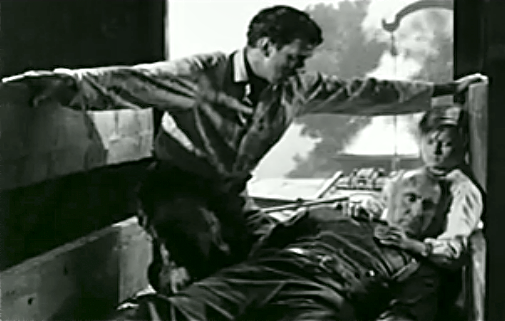
How Green Was My Valley (1941): John Ford’s visually contemplative work. When the shaft comes up from the underground mine carrying survivors of the explosion, you can see the rescuer Mr. Gruffydd in the cruciform pose. What’s more, you can even see the Pieta image:

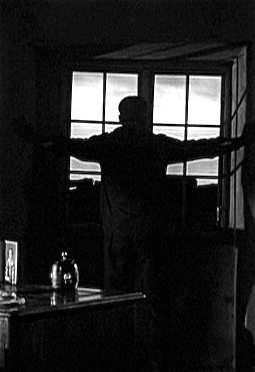
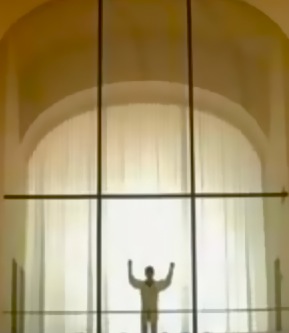
Through a Glass Darkly (1961): Ingmar Bergman’s classic. The estranged father David stretching his arms out in front of the window, sobbing and seeking redemption through family relationship: Cool Hand Luke (1967): After eating 50 eggs, it’s enough suffering for Luke (Paul Newman), a determined radical fighting a callous system in a hopeless prison. His graceful form is a clear contrast to the stark surroundings: The Graduate (1967): Ben (Dustin Hoffman) cries from above: “Elaine! Elaine! Elaine! …” Which yearning heart would not respond to such a passionate cry and be delivered in the nick of time out of a loveless union: Dances With Wolves (1990): Only when you’re not afraid to die, then can you live.  Lieutenant Dunbar (Kevin Costner) embraces death only to be ushered into a new life and adventure:

Shawshank Redemption (1994): Andy Dufresne (Tim Robbins) literally digs out a new path to salvation. This is the iconic scene of freedom and cleansing after climbing out from the sewage line: Superman Returns (2006): Superman (Brandon Routh) returning from Krypton to save the world. His famous line to Lois: “You wrote that the world doesn’t need a savior, but everyday I hear someone crying for one.” Gran Torino (2008): Walt Kowalski (Clint Eastwood) laying down his life to save his young friends from a neighborhood gang, in search of self-redemption: … I’m sure you can think of more.

***

Related Posts you might enjoy:

Alex Colville and the Movies

The Art Gallery of Ontario

***

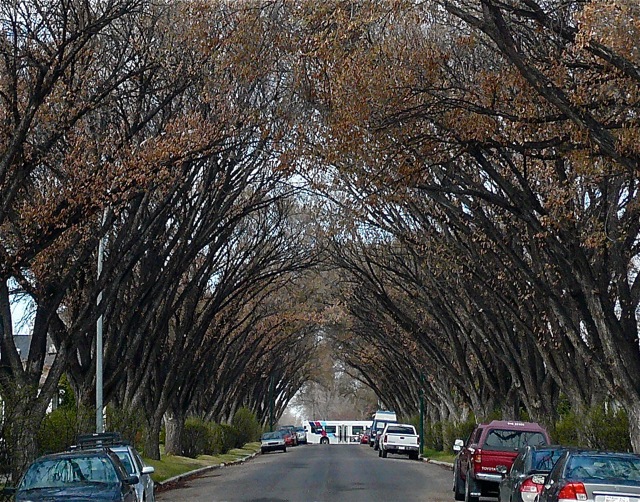
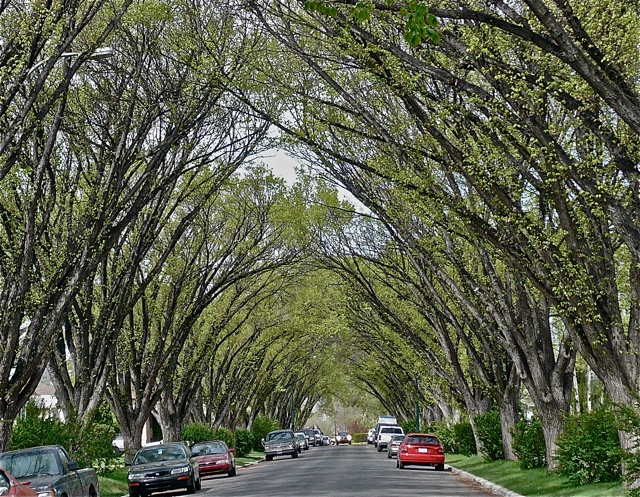
Greening of a Calgary Street

April 23

.

May 23

.

June 23

.

Waiting

He could have said
Let there be life
As in the beginning
But He made me wait.
For three months
I went back to the same spot
and watched
slowly
green bursting out from bare branches
fighting storms and snow
into full bloom.

.

I had waited before
Nine years, nine months
He could have said
Let there be…
But He had made me wait
and watch
slowly
like time-lapse photography
the gestation of a miracle.
He could have just said,
But He made me wait
and watch.

***

Pictures and poem by Arti of Ripple Effects, June 2010.  ALL RIGHTS RESERVED.

The Power of Aloneness

.

Before the resurrection was the death.
Before the death, the long path of suffering.
Before the suffering, the lonely struggle,
Agonizing solitude.

The Garden of Gethsemane,
Epitome of aloneness.
Even the closest would fall asleep
But one kept watch, awake for all.

Sweat dropped like blood
A heart pierced before nails were hammered in.
The soul cried out no, not this cup
But oh, not my will.

Not fear of sinews tearing from the joints
But the searing pain of separation
A Father who would leave totally alone
the tainted Son of Sin.

A prostrating prayer, a yielding spirit
The power of aloneness thus transformed.
As He got up from that rock, He had risen
Ready to accept the kiss of death.

I would never know the nailing pain
nor the bitter taste of that dreadful cup
But let me feel the power of solitary rest
To stay awake and rise and conquer death.

.

***

Poem by Arti of Ripple Effects
On the Eve of Good Friday, 2010.

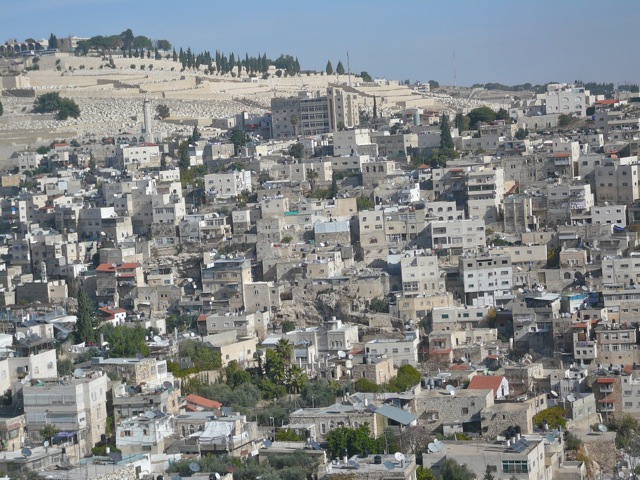
Photos taken by Arti in Israel, 2007.
Top: Via Dolorosa, Bottom: A Garden in Jerusalem

All Rights Reserved.

Haiti Benefit Concert

There was no U2, Bono, or Sir Paul, no Clooney or other big stars answering phone lines, just our own local musicians from Western Canada pitching in to raise funds for earthquake-stricken Haiti. While the Olympic torch had just passed by our city and moved on to cheering crowds in Banff, the flame of compassion burned bright here at the amazing concert last night in Calgary’s Centre Street Church.

Partnered with the Christian relief organization Samaritan’s Purse, the benefit concert was organized on short notice.  With just a few days to prepare, some of Canada’s top Christian musicians and recording artists gathered, together with the Centre Street Church orchestra and choir, to deliver a moving, high-calibred performance.  All funds raised will be sent to Haiti for urgently needed relief work.

I’ve long wanted to hear Juno Award winner, singer songwriter Steve Bell in person, and I had the chance last night.  But I was much more gratified to discover other singers that I would never have known if not for an occasion like this.  For I’m a sporadic listener of Christian music, have not been a fan of the genre, I admit.  But last night I had an altered view and gained a new appreciation for Christian artists and their music.

Steve Bell and Carolyn Arends opened the concert.  Bell had that amazing voice and musicianship.  From his guitar, I could hear chords that seemed to be created new and yet so natural in their progression. From Surrey, B.C., award-winning singer and songwriter Carolyn Arends wrote on her blog about this concert. And there I discovered some inspiring posts.  I was captured by her voice, her lyrics, piano and guitar playing, and now from her blog, her writing.

The spoken words written for the occasion were delivered rap-style, backed by the rhythms of a djembe drum, riveting and forceful. Other musicians came up one after another, among them were Jason Zerbin, Dan Nel, recording artists Raylene Scarrott, John Bauer, the humorous ‘hip hop artist for the night’, Corey Doak, and the group ‘Junkyard Poets’, just love that name.  Brad McGillvrey, with the choir harmonizing, gave a touching rendition of Lenard Cohen’s ‘Hallelujah’.

They came up one after the other, quietly, low-key and unpretentious.  That in itself was moving, for this was not a show for the musicians themselves.  There was no limelight; their performance had only one purpose, to draw our attention to the devastated victims in Haiti.

It wasn’t just music, of course.  A group from Compassion Canada shared their harrowing experience as they arrived Haiti one hour before the earthquake hit.  Their lives were spared as they were tied up with some VIP protocols and were delayed reaching their hotel.  Hotel Montana was crumbled by the quake an hour later.  Spared for what?  Brent Trask of the group shared his insight from the ordeal using Psalm 116.  Spared to fulfill one’s vows to the Lifegiver, to make one’s life count, to serve, to praise.

The finale is a moving sight with all performers coming on stage to wrap up with Carolyn Arends’ ‘Seize The Day’.

We were excited to hear that the effort of the night was well rewarded as we raised $115,000.  With the Canadian government matching the amount, a total of $230,000 will be sent to relieve the urgently waiting victims in devastated Haiti.  No big Hollywood stars, no international phenom’s, just plain local musicians with a heart, and a community of united spirit.  Steve Bell added an apt reminder. Don’t say ‘pray for Haiti’, he urged us, but ‘pray with Haiti’.  We are all in it together, our shared humanity, one communal spirit.  Something worthwhile to ponder as we drove back to our warm and secure homes.

Update Jan. 24, 2010:  Since the concert, more donations have been pouring in.  As of today, the amount is at $134,000. With the government’s matching funds, $268,000… so far.

*****

** All photos taken by Arti, seated in the eighth row from the stage, using a pocket-sized digital camera.  The actual scene was much more impressive than these blurry photos show. **

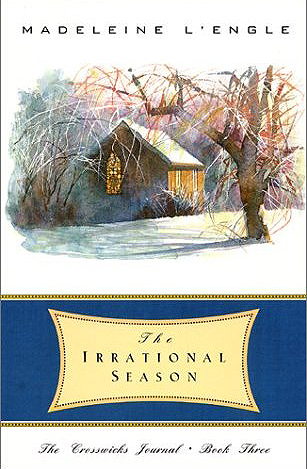
Reading The Season: The Irrational Season by Madeleine L’Engle

Striving to maintain some inner quiet, I casually took from the shelf a book by Madeleine L’Engle. Pure serendipity.  It’s one of The Crosswicks Journals, which I’ve shoved to the back of my mind for years, albeit they’ve been my all time favorite reads.  But how apt it is to flip through The Irrational Season, the third installment of The Crosswicks Journals, at this Christmas time.  Oh what joy to discover Madeleine L’Engle all over again.

Famous for her Newbery Award winning young adult novel A Wrinkle In Time, L’Engle was a prolific writer who had 63 publications to her credits.  Her works span from young adults to adults, fiction, science fiction, memoir, journals and poetry, with non-fiction books on faith, art, family, and humanity.  Yes, I say humanity, because L’Engle’s essays depict her strive to be human, and how her faith has defined the essence in her quest.

The Irrational Season comprises L’Engle’s ruminations on the significant events in the liturgical calendar.  And of course, it is Advent and Christmas that I dwell upon for my seasonal read.  This time, my reading has stirred in me a deeper appreciation of her insight and eloquence.

Art is for me the great integrater, and I understand Christianity as I understand art.  I understand Christmas as I understand Bach’s Sleepers Awake or Jesu, Joy of Man’s Desiring; as I understand Braque’s clowns, Blake’s poetry.  And I understand it when I am able to pray with the mind in the heart… I am joyfully able to affirm the irrationality of Christmas.

…  Christmas evoked in me that response with makes me continue to struggle to understand, with the mind in the heart, the love of God for his creation, a love which expressed itself in the Incarnation.  That tiny, helpless baby whose birth we honor contained the Power behind the universe, helpless, at the mercy of its own creation.

Cribb’d, cabined, and confined within the contours of a human infant.  The infinite defined by the finite?  The Creator of all life thirsty and abandoned?  Why would he do such a thing?  Aren’t there easier and better ways for God to redeem his fallen creatures?

And yet, in His most inscrutable, incomprehensible move, the One who called forth the universe from nothing, the Light and the Word, became flesh and drew near to us, to partake life as mortals knew it, and at the end, willingly go through an excruciating experience no mortals had ever known.  Impossible!  Utterly irrational!  And yet L’Engle embraces such an unimaginable scenario:

I live by the impossible… How dull the world would be if we limited ourselves to the possible.

And how grateful we ought to be, that such an accepting spirit pervaded in Mary’s heart and mind as well…

This is the irrational season
When love blooms bright and wild.
Had Mary been filled with reason
There’d had been no room for the child.

.

.

But now is the hour
When I remember
An infant’s power
On a cold December.
Midnight is dawning
And the birth of wonder.

*****

‘Reading The Season’ Posts over a Decade:

2020: Jack by Marilynne Robinson

2019: ‘A Hidden Life’ – A Film for the Season

2018: A Verse from Madeleine L’Engle’s The Irrational Season

2017: A Wrinkle in Time by Madeleine L’Engle

2016: Silence by Shusaku Endo

2015: The Book of Ruth

2014: Lila by Marilynne Robinson

2012: Surprised by Joy by C. S. Lewis

2011: Walking on Water by Madeleine L’Engle 

2010: A Widening Light by Luci Shaw

2009: The Irrational Season by Madeleine L’Engle

2008: The Bible and the New York Times by Fleming Rutledge 

2008: A Grief Observed by C. S. Lewis

*****

Photos: Except the book cover, all photos taken in Israel by Arti of Ripple Effects, November, 07. All Rights Reserved.

Season’s Musings

At this time of the year I always have a struggle, a fight against numbness.  The hustle and bustle of the Season leaves me striving to grasp something authentic and meaningful.  I have a hard time staying afloat the flood of packaged cheeriness, muzak in jingles or bells, ephemeral Santa’s and reindeer.   With the word “Hallelujah” almost becoming a laughable cliché, an ordinary expression for scenarios from finally finding the right gift for the family pet to paying up the Visa bill,  soon it would take a history lesson to clarify the origin of this festival called Christmas.

Intentionally or not, the Reason of the Season has been masked so not to offend, the birth of Christ replaced by themes acceptable to most cultures, like gift-giving, family reunion, ornaments, decorations, and good will towards all.  ‘Season’s Greetings’ has become the politically correct sign of the time.

On that winter night in Bethlehem, the shepherds bore no gifts. Indeed, their very presence and worship could well be the gift they offered.  Yes, the several wise men brought along gold, frankincense, and myrrh for the Christ child only, not to share among all.  For these gifts symbolized the very reason for His Advent, the infinite King debased, the lowly birth was just the beginning of a short and misconstrued life that ultimately ended in a horrific death.

The Advent, the few weeks before Christmas, is the best time for me to ponder again such a paradox.  If there is any joy or cheeriness, it comes from the initial degradation and ultimate agony of One.  It is from that vicarious suffering with humanity and the offering of substitutional death that Christmas derives its meaning for me.

A few weeks ago during a Sunday message, the name Joni Eareckson re-emerged in my mind.  I was a young teenager when I first read her tragic story.  At 17, she dove into shallow water and broke her neck, and remained a quadriplegic ever since.  I cannot imagine myself paralyzed from the neck down, having had to be lifted from bed to wheelchair for 37 years.

But what she has done sitting in that wheelchair has surpassed many able bodies. Her international ministry to people with disabilities is still thriving after 30 years.  The paintings which she has labored over inch by inch with a paintbrush between her teeth have become a testimony of perseverance, every stroke an ode to life.  Through her writing and broadcasting, Joni has become a voice and inspiration for the disabled and their families, all because she knows her suffering had been vicariously borne by the One who came just to share that pain, and redefine the meaning of life.

The hymn (Phillip Bliss, 1875) that had uplifted Joni in her most despondent hours painted not a cheery figure but a suffering Christ who came with no jingles or bells, and utterly devoid of packaging:  “Man of sorrows, what a name, for the Son of God who came…”

If you have a few minutes in this busy Christmas season, pause and take a look at this short clip.  Of all interviewers, I found Joni talking to Larry King, dated June, 2009.