Lion: From Personal Memoir to the Big Screen

The memoir A Long Way Home by Saroo Brierley, first published in 2014, has officially changed its name to Lion. This may well be a metaphor for its author. Only a change in the name, but everything inside remains intact. From a child lost on the streets in Calcutta, India, to a man grown up in Hobart, Tasmania, Saroo remains who he is. He writes in his memoir: “I now have two families, not two identities. I am Saroo Brierley.”

lion-movie-tie-in-edition

Lion (previously titled A Long Way Home) the memoir by Saroo Brierley

5 year-old Saroo was lost in a Calcutta (now Kolkata) train station, almost a thousand miles away from his home in a small village, Ganesh Talai. With no language (a different dialect), not clear of the name of the place he calls home (mispronounced by him as “Ginestlay”) or even his own last name, Saroo is utterly alone and helpless. Living dangerously on the streets of Calcutta for some weeks, he was picked up and sent to a youth detention centre, which was only a tiny bit safer from the streets. Subsequently Saroo was sent to an orphanage, Nava Jeevan (“new life”), run by the benevolent Mrs. Sood. There she arranged for his adoption by a loving Australian couple, John and Sue Brierley.

That could have been the happy ending of a tumultuous experience for Saroo, as he grew up in calm and beautiful Hobart, Tasmania, well adjusted and dearly loved by his adoptive parents. But for twenty-five years, Saroo has not forgotten his first home. As he grew, he was all the more tormented by the memory of his birth mother, and the brothers and sisters who had shared the first five years of his life. An important message he has always wanted to convey to them is that he’s ok, and that they need not worry about him. For years he has been haunted by the thoughts that his mother and older brother Guddu must have been devastated with losing him without a trace, as it was Guddu who had left him alone on a bench at the train station near his home, telling him to stay put as Saroo was too sleepy to tag along on that fateful night.

With the help of Google Earth twenty years later, and vague memories of the physical features of his home surrounding, Saroo finally located his village and flew back to India to search for his mother. They reunited a few doors down from his old home, as his mother had persisted all these years to not move away but stay there to wait for him, hoping against hope that her son would come back to her. The photo inserts in the book add even more poignancy as we see the Brierleys meet Saroo’s birth mother Kamla in India.

Utterly moving, authentic, genuine and real. While Slumdog Millionaire may be entertaining and eye-opening for those of us who are not familiar with Indian’s millions of children living on the streets, Lion is a true portrayal of one lost child, determined to find his way back home twenty-five years later across the oceans.

**

Lion the Movie

Is the movie any good? For those who think it’s always the book that’s better, here’s my answer: Yes, very good. Premiered at TIFF16 last September, Lion has since garnered awards and nominations, including young Sunny Pawar, his debut performance as an actor. Kudos to all those involved in transporting this story from a personal memoir onto the big screen for international viewers. If not for the movie, even though it has been reported in India and Australia, I for one in North America would not have known about this real life miracle.

So, hats off to Australian director Garth Davis, screenwriter, the acclaimed Australian  poet/writer Luke Davies, and the cast, Sunny Pawar as young Saroo, Dev Patel (Slumdog Millionaire, 2008) as the adult, Nicole Kidman and David Wenham the adoptive parents, Rooney Mara the girlfriend, and the cast of Saroo’s Indian family. They have delivered an authentic and moving real-life story.

Basically structured into three parts, the first focuses on five year-old Saroo, living in poverty but is loved by his mother and siblings. One night he pleads with his older brother Guddu to go with him to his night work, salvaging garbage left on trains. After reaching the closest station from his home village, Saroo is too tired, so he stays behind sleeping on a bench to wait for Guddu. He wakes up in the middle of the night to find himself all alone. He gets on one of the parked train to look for Guddu but falls asleep again in there. He wakes to his horror as he finds he is being transported in the speeding train further and further away from his home.

Cinematographer Greig Fraser (Zero Dark Thirty, 2012; Bright Star, 2009) uses his camera effectively showing some haunting images, a horrified 5 year-old, alone on a train speeding to the unknown. Throughout the film as well, he tells the story poignantly with his camera. Scores composed by Volker Bertelmann and Dustin O’Halloran add power in eliciting emotions, taking us closely with Saroo on his incredulous life journey.

Second part we see Saroo grown up in Australia, having a good relationship with his adopting parents but troubled nonetheless by his past. The frustration of having only vague memories of the physical features of the train station near his home makes it an impossible task to search for an unknown town in the vast land of India. Thanks to Google Earth and his unyielding perseverance, the adult Saroo was rewarded with a dream come true.

While the physical locales might be distant and vague, memories of his childhood experiences are lucid and close. In the second part, the director and screenwriter have deftly inserted Saroo’s memories of his childhood days in India, enriching the screen story of his intimate relationships with his family. These inclusions add to the texture and are placed aptly to enhance the continuity of the child and the man. Very effective.

I welcome the quiet and slower pace in Part Two, and appreciate Patel’s portrayal of inner turmoils. Kidman has done an amiable job as the adoptive mother trying to hold the family together, with two Indian boys, now grown men, both deeply troubled by their past in different ways. If Part One is about the outward dangers of a lost child, Part Two illustrates the internal turmoils one still wages into adulthood.

Part three is that triumphant and exhilarating reunion. How we want to see a happy ending by then. Although we know that is forthcoming, it is still exciting and gratifying to embrace the uplifting end. Lion is a story well told cinematically, and worth every minute of a viewer’s attention. Do wait till the very end before you leave the theatre, the photos at the closing credits make a beautiful wrap. And why the title Lion? That’s for you to find out.

~ ~ ~ ~ Ripples 

for both Book and Movie

***

Related Reviews on Ripple Effects:

Slumdog Millionaire

The Best Exotic Marigold Hotel

The Second Best Exotic Marigold Hotel

The Lunchbox

100 Greatest Films of the 21st Century

The editors of BBC Culture had commissioned film critics all over the world to arrive at this list, polling “every continent except Antarctica.”  They received responses from 177 film critics. The list was published yesterday.

Sounds like a formidable task, albeit in actuality, the critics only had to look at 17 years of cinematic works (including the year 2000). Nevertheless, the titles are self evident of the positive effects of globalization, for the critics’ choices are markedly diverse.

You can check out the whole list here. I’ll just excerpt the top 50. Here, you can find directors from Africa, Asia, Australia, the Middle East, Europe, North America, South America. What a fantastic representation. I’ve no apology for using the #2 film image here instead of the top one; with Wong Kar-wai’s “In The Mood for Love”, I’m totally partial and very glad it reached this spot.

in-the-mood-for-love

No matter how you look at it, don’t get blown away by blockbuster mega productions. The independent cinema still remains the imaginary window to look into ourselves as well as out to the world, expanding our point of view with old tales to current issues.

50. The Assassin (Hou Hsiao-hsien, 2015)
49. Goodbye to Language (Jean-Luc Godard, 2014)
48. Brooklyn (John Crowley, 2015)
47. Leviathan (Andrey Zvyagintsev, 2014)
46. Certified Copy (Abbas Kiarostami, 2010)
45. Blue Is the Warmest Color (Abdellatif Kechiche, 2013)
44. 12 Years a Slave (Steve McQueen, 2013)
43. Melancholia (Lars von Trier, 2011)
42. Amour (Michael Haneke, 2012)
41. Inside Out (Pete Docter, 2015)
40. Brokeback Mountain (Ang Lee, 2005)
39. The New World (Terrence Malick, 2005)
38. City of God (Fernando Meirelles and Kátia Lund, 2002)
37. Uncle Boonmee Who Can Recall His Past Lives (Apichatpong Weerasethakul, 2010)
36. Timbuktu (Abderrahmane Sissako, 2014)
35. Crouching Tiger, Hidden Dragon (Ang Lee, 2000)
34. Son of Saul (László Nemes, 2015)
33. The Dark Knight (Christopher Nolan, 2008)
32. The Lives of Others (Florian Henckel von Donnersmarck, 2006)
31. Margaret (Kenneth Lonergan, 2011)
30. Oldboy (Park Chan-wook, 2003)
29. WALL-E (Andrew Stanton, 2008)
28. Talk to Her (Pedro Almodóvar, 2002)
27. The Social Network (David Fincher, 2010)
26. 25th Hour (Spike Lee, 2002)
25. Memento (Christopher Nolan, 2000)
24. The Master (Paul Thomas Anderson, 2012)
23. Caché (Michael Haneke, 2005)
22. Lost in Translation (Sofia Coppola, 2003)
21. The Grand Budapest Hotel (Wes Anderson, 2014)
20. Synecdoche, New York (Charlie Kaufman, 2008)
19. Mad Max: Fury Road (George Miller, 2015)
18. The White Ribbon (Michael Haneke, 2009)
17. Pan’s Labyrinth (Guillermo Del Toro, 2006)
16. Holy Motors (Leos Carax, 2012)
15. 4 Months, 3 Weeks and 2 Days (Cristian Mungiu, 2007)
14. The Act of Killing (Joshua Oppenheimer, 2012)
13. Children of Men (Alfonso Cuarón, 2006)
12. Zodiac (David Fincher, 2007)
11. Inside Llewyn Davis (Joel and Ethan Coen, 2013)
10. No Country for Old Men (Joel and Ethan Coen, 2007)
9. A Separation (Asghar Farhadi, 2011)
8. Yi Yi: A One and a Two (Edward Yang, 2000)
7. The Tree of Life (Terrence Malick, 2011)
6. Eternal Sunshine of the Spotless Mind (Michel Gondry, 2004)
5. Boyhood (Richard Linklater, 2014)
4. Spirited Away (Hayao Miyazaki, 2001)
3. There Will Be Blood (Paul Thomas Anderson, 2007)
2. In the Mood for Love (Wong Kar-wai, 2000)
1. Mulholland Drive (David Lynch, 2001)

Which ones have you seen? What do you think of the list? Mulholland Drive #1? You might ask.

***

Click on the link in the title to read Arti’s review.

‘Our Little Sister’: A Respite from Summer Superhero Movies

The following is my review of the film “Our Little Sister” by the acclaimed Japanese director Hirokazu Kore-eda, published in Asian American Press. I thank aapress.com for allowing me to post it here on my blog.

For those who might think a Japanese film would never make it to your local cinema, check this list of U.S. screenings:

http://sonyclassics.com/ourlittlesister/dates.html

***

our-little-sister

Premiering last year at Cannes, and later screened at other international film festivals the world over, Hirokazu Kore-eda’s “Our Little Sister” finally trickles into the local theatres of North American cities, which is timely. In a world rocked by tumultuous strife and unrests, this latest from Kore-eda makes a quiet solace, offering a taste of the ideal in human relationships and harmony despite brokenness.

“Our Little Sister” is Kore-eda’s most recent work after his 2013 Cannes Jury Prize winning “Like Father Like Son”. Following his usual subject of relationships in various family situations, “Our Little Sister” sees Kore-eda at the helm as director, writer, and editor of this production based on the popular Japanese graphic novel “Umimachi Diary” by Yoshida Akimi.

The three Koda sisters have not seen their estranged father for fifteen years. Sachi (Haruka Ayase), Yoshino (Masami Nagasawa) and Chika (Kaho) are now adults, living in the family’s traditional home his father had long deserted in the seaside town of Kamakura. His recent death sends the sisters to his funeral, awkwardly, meeting the woman who had stolen their father’s heart. But it is an inciting incident that changes all their lives. They meet their half sister, 15 year-old Suzu (Suzu Hirose). Herein lies the turning point for the four sisters. Moved by her little step-sister’s mature and quiet demeanor, or maybe stirred by her own older-sister instinct, Sachi invites Suzu to come away and live with them in Kamakura. Suzu gladly agrees.

The new Koda household now is a haven of happy sisterhood. Living under one roof, we see minimal conflicts and constant congeniality. Viewers from a different culture may find the saccharine relationships unrealistic. Are there not any conflicts at all? Of course there are. Kore-eda deftly leads us to some slow revealing. After three quarters of the 120-minute film, we begin to see inner turmoil rise to the surface.

Suzu had to take care of her father in his illness and seeing him to his last breath due to the incompetence of her mother; here is a young teenager bearing the burden of an adult. Now living with three older sisters, Suzu can finally enjoy the childhood she has missed. She quickly captures the attention of other students in her new school with her soccer skills, congeniality and maturity.

In the Koda household, Suzu is the angel of harmony, stirring up love and life. Kore-eda may have spent too much time on the leisurely-paced, day-to-day living such that viewers might feel the lack of conflicts to move the story along. I credit the style to Kore-eda’s realism and a candid camera focusing on the subtleties of nuanced interplay among the characters. Like his previous films “I Wish” (2011), the yearning for family connections of a young boy is shown by his actions and not so much by words, or in “Like Father Like Son” (2013), wherein conflicts are portrayed by contrasts and parallels. Here, while still nursing a deep resentment towards her father for deserting them years ago, Sachi struggles with the moral parallel now as she carries on a relationship with a married doctor at the hospital where she works.

Moral dilemmas, what to choose, how to live, and the search for identity are the issues Kore-eda’s characters have to deal with, but in a way that is quiet and gentle. He introduces us to other endearing characters in the town, adding numerous episodes to build up a human mosaic of harmony in the presence of brokenness and even death.

The scenic seaside town of Kamakura provides a beautiful backdrop for cinematographer Mikiya Takimoto (“Like Father, Like Son”) to shoot the film, reflective of the idyllic life that can be had, even in an imperfect world. The arching branches of the cherry blossoms, landscapes and seascapes mark the healing power of nature. But also like the petals of the cherry blossoms, which third sister Chika likes to pick up and gather in her palm, life is ephemeral.

Reminiscent of Ozu’s films, the passing train is a visual metaphor for the passage of time, changes, and the transience of life. To enrich the visuals, Yoko Kanno’s original score sweeps us through with warmth and tenderness, as a supporting voice telling the story. “Our Little Sister” is a heartwarming film for the unhurried heart to savor.


~ ~ ~ Ripples

***

Related Posts on Ripple Effects:

‘Like Father Like Son’: A Parent and Child Reunion

Yasujiro Ozu and the Art of Aloneness

Words Without Music by Philip Glass

“For me music has always been about lineage. The past is reinvented and becomes the future. But the lineage is everything.”    — Philip Glass

This 400 plus page memoir by Philip Glass (1937 -), with 14 pages of photos and 20 pages of index, is nothing short of epic. Glass has not only told us the story of his life so far, but chronicling a generation of American arts and music from an insider’s perspective. The zeitgeist of the Beat Generation and the preoccupation of Eastern philosophy with its search for transcendental experiences make the memoir an interesting and informative read.

Pertaining to Glass’s innovative musical style, I’ve experienced the book in several ways: reading the first half in hardcopy, listening to the latter part in audiobook format via hoopla, superbly performed by narrator Lloyd Jones, and listening to Glass’s works available on hoopla. Hoopla, btw, is wonderful.

Words Without Music Cover

Born 1937 to a secular Jewish family in Baltimore, Glass’s father Ben was a record store owner, mother Ida a librarian. The flute and the violin were his first instruments. Bursting with potentials ready to be unleashed, he left home to attend The University of Chicago at merely 15 years of age majoring in philosophy and mathematics. At Chicago, he’d decided what he wanted to do after graduation, to pursue a career in music, albeit the realization of which was still a blurry vision.

As a young college grad, Glass worked at a steel mill to save enough money to head to NYC for Juilliard, a decision that was against the wish of his mother: “If you go to New York City to study music, you’ll end up like your Uncle Henry, spending your life traveling from city to city and living in hotels.” His uncles also frowned on such an idea. They wanted him to take over the family’s building supplies business.

But the teenaged Glass was determined, only to face a closed door upon audition at Juilliard. No, he wasn’t qualified as a flute player, but, he was given the chance at the extension program to learn composition. Only a detour. Once he’d become a full-fledged student in Juilliard, he devoured all opportunities to learn. You’d think such a talent would become a young success soon after? Well, that wouldn’t have been as interesting a story as real life.

Philip Glass is classified as a ‘minimalist’, a label which he frowns upon. Reading the memoir, I can only say what’s minimal is the material means, money, while all else, passion, intellect, talents, cultural milieu, internal space, and the prolific output of works have been abundant throughout his life journey.

It would be decades later that Glass could earn enough to make a living by only composing. Along the way, he was contented with his day jobs in NYC, including being a furniture mover, plumber, and taxi driver. He nearly got killed driving a cab in NYC, albeit he does recall more pleasant excitement like the time he picked up Salvador Dali from 57th Street to the St. Regis Hotel. During that short trip, he was, alas, tongue-tied. Yes, the word is “contented”, for no matter what he had to do to earn a living—at first just for himself, later a family of four—he seemed happy to be on the right course striving for the ultimate goal. That in itself is inspiring. The tone of the book reflects a quiet and humble soul, reflective and personal.

Glass’s contact list is a who’s who of the Beat Generation and cultural icons in the following decades. He was a contemporary with Jack Kerouac, Jackson Pollack, John Cage, friend with Alan Ginsberg, Doris Lessing, Richard Serra, collaborator with Ravi Shankar, Leonard Cohen, wrote music for the works by Jean Cocteau, Samuel Beckett, composed for Martin Scorsese, Steven Daldry, Woody Allen, studied with Nadia Boulanger as an American in Paris, journeyed to the East to find enlightenment in New Delhi, Katmandu, Darjeeling, explored and created global music with musicians from India, Himalaya, Chinese, Australia, Africa, and South America. Just a few names. The 20 page index is a definite asset.

“I have come to understand that all music, without exception, is ethnic music.”

As for his own music, people always say it’s like “the needle is stuck in the groove.” To understand this, of course, you’ll have to know the operation of a vinyl record. To counteract the general public impression of repetition to no end of his music, he explains in details the Glass music theory. That I let you to explore for yourself.

But here are some passages that I’ve particularly noted with low tech stickies on the side of the page:

About John Cage’s famous piece 4′ 33″, wherein the pianist sits at the piano for four minutes and thirty-three seconds without touching any keys, whatever sound the audience hears during that time lapse becomes the piece, Glass writes:

“… a work of art has no independent existence… What Cage was saying is that there is no such thing as an independent existence. The music exists between you—the listener—and the object that you’re listening to. The transaction of it coming into being happens through the effort you make in the presence of that work. The cognitive activity is the content of the work.” (p. 95)

What goes on internally in the listener is what the piece is about. Makes me think of Roland Barthes’s “The Death of the Author” notion.

So do we have “the death of the composer” now?  Wait, actually, no. You see, Glass has this brilliant point. The composer still lives in that the performer interacts with and interprets his works, thus becoming a co-creator:

“… the performer has a unique function in terms of what I call this transactional reality which comes from being in the presence of the work: that the interpreter/player of the music becomes part of that. Until then, I had really thought of the interpreter as a secondary creative person. I never thought he was on the same level with Beethoven or Bach. But after I had spent some time thinking about all that and began playing myself, I saw that the activity of playing was itself a creative activity… ” (p. 96)

And how should the performer play the music? By listening intently and purposefully:

“The ideal way of performing, to my way of thinking, would be when the performer allows the activity of playing to be shaped by the activity of listening, and perhaps even by the activity of imagining listening.” (p. 97)

In 1957, Jack Kerouac’s On the Road had just been published and “everybody had read it”. With the $750 prize money he received from Juilliard at the end of his third academic year, he bought a motorcycle, probably an unintended item on which the music school would like to see the scholarship spent. Off he went on a cross-country road trip. But what’s the difference between he and his friends and the Kerouac’s clan? Glass writes:

“His [Kerouac’s] book is full of interesting characters, but that’s not what happened for us. We weren’t interested in having those kinds of experiences, we were out and abroad in America, consuming the country visually and experientially by driving through it…. (p. 102)

The renowned sitar virtuoso Ravi Shankar, or Raviji as he was known to friends and colleagues, at that time started collaborating with George Harrison. Glass notes that “The casual drug use by young people particularly upset him. Sometimes he would lecture me about drugs, and I had to remind him that I was drug-free.” Ummm, wonder if Raviji had lectured George Harrison on same.

In 1964, with a Fulbright Scholarship, Glass went to Paris to study with the eminent music guru Nadia Boulanger. For two years, she inspired and led Glass to higher grounds of musical epiphanies. One of the crucial lessons he took away after two years with Boulanger was the route to innovation. First, learn the conventional theoretical foundation, then you diverge and create your own:

“… an authentic personal style cannot be achieved without a solid technique at its base. That in a nutshell is what Madame Boulanger was teaching.” (p. 145)

His mother Ida went by train from Baltimore to NYC for her son’s first concert at Queens College on April 13, 1968. There were only six people in the audience including herself. As Glass drove her back to the train station after the concert, the only comment she made was that his hair was too long.

The second time Ida attended her son’s concert was eight years later in November 1976. This time, she was in the full house audience of four thousand people at the Metropolitan Opera for the performance of his first opera, Einstein on the Beach.

Glass movingly recalls his conversation with his mother at her death bed. She was in and out of a coma. She whispered two last words to him: “The copyrights”. Mother and son came to a perfect understanding. He reassured her, “It’s all taken care of, Mom. I’ve registered them all.”

He’d better.

Glass has composed more than twenty operas, eight symphonies, two piano concertos and concertos for violin, piano, timpani, and saxophone quartet and orchestra, soundtracks to films, 125 credits on IMDb for all sorts: full features, doc, shorts, TV. And more to come.

***


In Other Words: Lahiri’s Reconstruction of Self

In Other Words book cover

A couple of years ago, I was surprised to read about Jhumpa Lahiri moving to Italy to live, even just for a few years. Author of four works of fiction – Interpreter of Maladies, The Namesake, Unaccustomed Earth, and The Lowland – at the prime of her writing and teaching career, having received the O. Henry Award in 1999, the Pulitzer in 2000, and her latest The Lowland shortlisted for the Booker in 2013, Lahiri decided to uproot her family and move to Italy to totally immerse in the Italian language. That means speaking, reading and writing in Italian.

In Other Words is Lahiri’s brave and candid account as a language learner. It compiles twenty-one essays and two short stories which she wrote in Italian. She uses the metaphor of swimming out into the lake instead of safely hugging the shore to refer to her Italian language learning experience. From her descriptions of the challenges and risks, the loss of anchor, the inability to express herself and be literate, let alone literary, the disorientation, the total humbling, her Italian venture is more like jumping off a precipice to billowy waters of unfathomable depth.

My hat off to Lahiri’s honest revealing of her frustrations and strive for a new identity; yes, after all, language is a major determinant of identity, one which is, unfortunately, superseded by one’s outer appearance and racial features. So it is heart-wrenching to read that despite her love of the Italian language, her total devotion to adopt it not just to live but as a tool of her trade as a writer, she is often seen as an outsider, a foreigner, barred from acceptance. Even when she speaks to Italians fluently in their language, they would respond to her in English.

English, that’s the rub. I was surprised to read that, while the author had achieved so much in her literary career as a writer in English, she chose to discard it to totally immerse in Italian. In the chapter entitled “The Metamorphosis”, she candidly admits that her writing in Italian (which she had been learning in America for some twenty years before) is a flight:

“Why am I fleeing? What is pursuing me? Who wants to restrain me?
The most obvious answer is the English language. But I think it’s not so
much English in itself as everything the language has symbolized for me…
It has represented a culture that had to be mastered, interpreted. I was
afraid that it meant a break between me and my parents. English denotes
a heavy, burdensome aspect of my past. I’m tired of it….”

Of course, that’s also the language that she loved, and succeeded with. The conflict in identity, first as an Indian immigrant with Bangali as her mother tongue, then as a writer in English who had garnered the Pulitzer Prize – an award that she felt she did not deserve – had shrouded her with unresolved tensions. Lahiri had felt deeply the tug of war between her parental heritage and adopted land. A rejection of both had silently crept in. Italian provides a way out:

“Italian offers me a very different literary path. As a writer I can demolish
myself, I can reconstruct myself, I can join words together and work on
sentences without ever being considered an expert. I’m bound to fail when
I write in Italian, but, unlike my sense of failure in the past, this doesn’t
torment or grieve me.”

Unbelievably surprising and honest, written in Italian and translated by The New Yorker editor Ann Goldstein, the bilingual book opens up to a dual English and Italian version. The short essays chronicle the progress of not only an insightful identity search and reconstruction of selfhood, but an invaluable personal documentation of second – no, additional – language learning journey. If this book was published a couple of decades earlier, I would likely have another topic for my thesis in my graduate work on second language learning; not only that, my view of English being the lingua franca, the language holding linguistic hegemony, would have completely changed as well.

After reading In Other Words and my surprising discovery of Lahiri’s ‘tormenting sense of failure’ with the English language (for all its symbolic meaning) or even her ‘undeserving’ feeling towards her award in her writing, I am relieved of a hidden burden. I don’t feel so badly about having had to constantly check and re-check my English: prepositions, idiomatic expressions, phrasal verbs usage, subject verb agreement… All the hurdles that confront me every time I write a post or an article. If Lahiri can be so candid about her frustrations and errors when it comes to language learning, why can’t I?

~ ~ ~ ~ Ripples 

***

My thanks to Asian American Press for allowing me to post my book review here on Ripple Effects. The last paragraph is added in just for my Ripple readers.

Related Posts on Ripple Effects:

 The Namesake by Jhumpa Lahiri: Book Review

The Namesake (2006, DVD): Movie Review

Unaccustomed Earth by Jhumpa Lahiri


Orange is the Primary Colour

Driving from coastal Maine westward to New Hampshire, the foliage colours began to change a bit more. Even though I was totally enjoying myself along the coast, I did look forward to seeing some fall foliage as I moved inland.

I drove from Rockport to Maine’s capital Augusta, then continued on some small country roads towards Bethel and Gilead before crossing the State line to Gorham, New Hampshire. It was a pleasure driving through these more remote parts of the country, for the routes offer some gratifying scenery:

Driving thru MaineCountry road in MaineBut it was the colour orange on the ground that caught my eyes. From afar, they were tiny orange dots in the field:

Tiny orange dots on the groundA bit closer I knew, of course, that was a pumpkin patch. And it was orange that would be the predominant colour everywhere, in towns and in the country.

On flatbeds and wagons:

DSC_0501

DSC_0509

wagonfull

Or laid out neatly in arrays on grass:

DSC_0870

arrays

In various shapes and forms:

DSC_0508At door fronts, entrances, in hanging baskets and shop windows:

EntrancesHanging Basket

DSC_0544 (1)

DSC_0420

DSC_0549

DSC_0555

DSC_0620

Or in the form of pumpkin people:

DSC_0552DSC_0784Or as pumpkin elves like these two sitting outside Elf Academy:

DSC_0617

No wonder there’s a shortage of pumpkins in the U.S. as the demand is so high. With recent crops diminished by record rain, there arose a pumpkin shortage. Help is on the way though. Here’s a recent headline on CBC News Business section:

“Canadian pumpkin patches poised to fix U.S. lack-o’-lanterns problem.”

What are neighbors for?

***

This is my Saturday Snapshot October 17 entry. Saturday Snapshot is hosted by West Metro Mommy Reads. CLICK HERE to see what others have posted.

Follow my New England series:

Like Father, Like Son (2013)

In honour of Father’s Day tomorrow, I’m re-posting my review of the acclaimed Japanese film Like Father, Like Son. (Update: Director Hirokazu Koreeda’s most recent work Our Little Sister is a Palme d’Or nominee at Cannes 2015.)

***

I had wanted to see this Japanese film since it came out last year. Missed it at TIFF13 last September, its North American premiere after winning the Cannes Film Festival’s Jury Prize in May. Glad it has finally arrived on Netflix, reaching a much wider audience than just festival goers, deservedly.

Like Father Like Son

Director Hirokazu Koreeda wrote the screenplay based on a disturbing premise: what if after six years of raising your son, the hospital where he was born contacted you and told you that your child was switched at birth, and of course, they sent their apology.

The hospital officials do not take this lightly. DNA tests are done to confirm. They have a lawyer with them, arrange to have you meet the other parents, mediate and ease the proposed switch back, which they recommend with a six-month preparation period, preferably before the boys start grade one in school. They even find out who the nurse is that made the error; due to her own frustrations at the time she knowingly made the switch. Of course, she is deeply sorry for what she had done and duly prosecuted. Monetary compensations are arranged.

But all the above have absolutely nothing to do with easing the shock and alleviating the trauma afflicted upon the families. Formality and legality do not soothe the pain; apologies and money cannot compensate for the abrupt termination of relationships.

Director Kore-eda has treated the subject matter with much tenderness and charm. The cinematography is stylish, the children and adults are all captured in a realistic manner with splashes of endearing humour.

The two families come from very different social strata, and the two boys have been raised in opposite parenting styles. Interestingly, only one of the families seems to take this news much harder. Ryota Nonomiya (Masaharu Fukuyama) is a successful professional who spends most of his time in the glass towers of Tokyo busy at work. His son Keita (Keita Nonomiya), an only child, is raised in a protective environment. Mother Midori (Machiko Ono) is loving but also ambivalent about a husband who puts his career over his family.

The other family is a shop owner in a rural part of the country, their son Ryusei (Shôgen Hwang) is the eldest of three children. Father Yudai Saiki (Rirî Furankî) is every child’s dream. He spends his days playing with his children, fixes their toys, and exerts no rules, albeit Mom Yukari (Yoko Maki) might wish he could have spent more time working.

What makes a father? What makes a son? Fatherhood and bloodline tend to supersede all other factors in a patriarchal society like Japan. But the film reflects the point of view that not all families necessarily embrace such a value. Further, apparently there are different parenting styles even in a homogeneous Japanese society.

If there is ever a Japanese version of the movie Boyhood as we have seen from Richard Linklater, Hirokazu Kore-eda would be the ideal person to direct it. Like Father Like Son follows his previous work I Wish (2011) in its sensitive and incisive depiction of a boy’s heart and yearning. He can tear apart the facade of societal formality – but in a most tender way – and lay bare the hopes and needs, the essence of parents child relationships.

I must give credits to Johann Sebastian Bach, and the late Canadian pianist Glenn Gould. The beginning of Bach’s Goldberg Variations had been used in numerous films, but every time the soulful slow moving piano melody comes on, I am moved, no matter how many times I’ve heard it, and in so many different genres of films. Just from memory, I can think of The English Patient (1996), Hannibal (2001), Shame (2011)… It is so effective in augmenting cinematic moments without becoming clichéd.

Here, the Aria is well placed as director Kore-eda uses it as a motif to spur us into deeper thoughts. What makes a father; what makes a son? What is more important, blood or relationships? What is the role of a wife and mother in a patriarchal society? What is the purpose of giving birth and bringing up a child? What is fulfilling and meaningful to us as human beings? Indeed, a motif that can strike a universal chord of resonance that transcends cultures.

~ ~ ~ 1/2 Ripples

***

While We’re Young: Wearing the Hat of Authenticity

The discussion that follows involves major plot points. Spoiler Alert. If you have watched the movie, you’re welcome to share your views in the comment section.

**

The film begins with an excerpt from Henrik Ibsen’s play The Master Builder. In the context of the play, Solness, the Master Builder, is fearful of the young, specifically, the draftsman he has taken under his wings, Ragnar. Solness’ anxiety lies in his apprehension that one day, soon, the young Ragnar would open shop on his own as a full-fledged builder, surpassing him and rendering his life work obsolete. He has the following exchange with a young lady friend Hilda:

Solness: … Wait and see, the young will come here, thundering at the door! Breaking in on me!
Hilda: Then I think you should go out and open your door to the young.
Solness: Open the door?
Hilda: Yes. Let them come in to you – as friends.

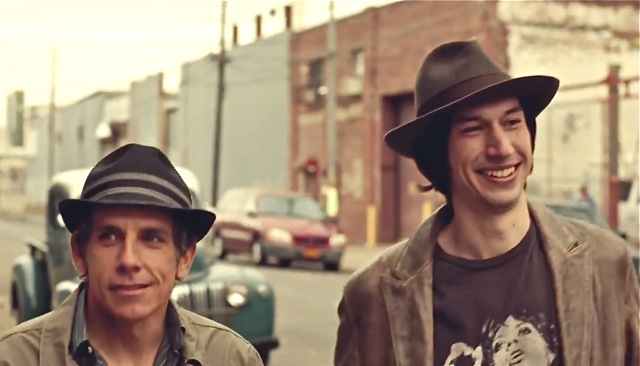
Writer/director Noah Baumbach sets the stage for a contemporary story with the parallel of Solness in his main character Josh Shrebnik, 44, aptly played by Ben Stiller. Josh is a documentary filmmaker who may have passed the peak of his career, his latest project dragging on for ten years without new grant money coming in. In the continued education class where he teaches documentary filmmaking, he meets a hipster couple in their 20’s, Jamie (Adam Driver) and Darby (Amanda Seyfried). Jamie expresses great admiration for Josh, feeding him what he needs. Soon, Josh and his wife Cornelia (Naomi Watts) become fast friends with them, and begin to drift away from their peers, new parents Marina (Maria Dizzia) and Fletcher (Adam Horrovitz).

In Frances Ha (2012), Baumbach brought us a positive profile of youth embodied in co-writer and star Greta Gerwig. Gerwig grasped the gist of youth beautifully by portraying an aspiring young dancer in NYC finding her way to a career and to her own true self. In Frances we see a delightful image of the young. Here in While We’re Young, Baumbach presents another view on youth. He does it by juxtaposing hipsters with the middle-aged, leading the audience through a revealing and interesting story. While the brunt of the laughs falls on the older pair Josh and Cornelia, the ultimate revealing is on the younger generation.

While We're Young

What makes the movie rich and intriguing is that what looks like a simple, single storyline embeds multi-layered thematic materials. On the surface, Baumbach lets us laugh at Josh and Cornelia, forty-something, childless, needing to come to terms with aging but not until one last attempt at rejuvenation. Hanging out with Jamie and Darby makes them feel young again. Josh dons a fedora hat, wears hipster shoes, rides a bike to keep up with Jamie. Cornelia goes with Darby to a hip hop dance class, and stressed herself out with the moves. For more flavour, both try the new experience of detoxing through a vomit inducing potion in a shaman party. Watts sure can keep up in her comedic act with Stiller, just right in juggling between depth of emotions and light-hearted fun. After St. Vincent, where she plays a small, funny role alongside Bill Murray, Watts has proven once again that she can wear the comic hat suitably.

On another level, we see Baumbach contrasting the ironic lifestyle choices in a sequence of fast cuts. We see the middle-aged couple using iPhone to Google once something comes up, while Jamie and Darby just try to remember and recall the info. Googling is too easy; they don’t want instant answers. If they can’t recall, they’re contented with not knowing. I can’t get enough of these subtly planted Baumbach jokes. As Josh listens to CD’s on his laptop, Jamie enjoys his wall to wall collection of vinyl records, played on a turntable. Jamie makes his own table, Darby makes ice cream from scratch. They ride a bike to get around. Their hipster lifestyle totally grabs Josh as genuine and cool; impressing him even more is their generous and open demeanour. A budding documentary filmmaker, Jamie invites Josh to co-direct his film. Josh is totally sold.

Ben Stiller is a natural when it comes to playing a clueless, de-valued character like this one. In Greenberg (2010), his previous collaboration with Baumbach, he plays a similar role, middle-aged and lost in the flow of life, also touched and changed by a youthful character (Greta Gerwig). It’s easy for us to laugh at Stiller, a greying forty-four-year-old hipster-wanna-be trying hands-free cycling following Jamie but only for a short two seconds before he twisted his back. The back will soon heal, but it’s “Arthritis” on the knees that the doctor is more concerned about. The joke there in the doctor’s office is just too good for me to include here. And, when did he last have his eyes checked?

As the story develops however, we begin to see Josh having second thoughts. Maybe Jamie’s work isn’t as authentic and spontaneous as it looks. Adam Driver is perfect in projecting a fused expression of innocence and mischief. His calculated moves startle Josh. Herein lies a crucial, contentious thematic element. There’s a fundamental breach of integrity. Is Jamie ignorant about ethics or is he simply amoral? Isn’t a documentary supposed to present truths? To what extent can it be staged or its ‘facts’ twisted? Nil, according to old-schooled Josh; such methods are fraudulent, crossing ethical boundaries, inexcusable. To Jamie, it’s no big deal, “it doesn’t matter that it’s fake.” To us the viewers, this third act is the juice in the meat. Josh’s indignation is justified.

But then, Baumbach pulls back, as if being too harsh on young Jamie. As I think about the notion of authenticity in the movie, I realize it comes in different forms, not only in documentary filmmaking, but with the actual life these characters are living. A love for retro and owning a collection of vinyl records don’t mean Jamie has real experience living in the 60’s. Or for Josh, imitating hipster fashion doesn’t make him young, as his friend Fletcher says: “You’re just an old man with a hat.” Taking an example from a recent real-life happening: when we see a veteran news anchor faking accounts to add glamour and self-importance to his reporting we know age is not the dividing line for authenticity. So maybe Baumbach has a point there by cutting Jamie some slack at the end. In the last scene, Josh, wiser now, utters: “He’s not evil; he’s just young.”

Let’s hope authenticity won’t become a dismissible fashion trend like a hat.

~ ~ ~ 1/2 Ripples

***

Other Ripple Reviews you may like to read:

The Secret Life of Walter Mitty (2013)

Force Majeure (2014)

The Grand Budapest Hotel (2014)

Inside Llewyn Davis (2014)

McFarland, USA (2015): A Worthy Winner

The reason I waited till now to see McFarland, USA is plainly because I thought it would be just another cliché movie on teacher inspiring students, and specifically here, a white teacher coming into a hispanic community, changing their youngsters to what they’re not, the white knight of condescension.

I’m glad that’s all a misconstrued perception. True, there’s a white teacher coming into the poorest town in the USA, McFarland, CA, where most of its population is hispanic, Mexican immigrants labouring in the open fields from morn till dusk picking produce. The hope of the parents’ – if there is any – is for their sons to continue picking produce so they can earn a living for themselves.

What’s best about this movie is that it’s a true story. The script is well-written and the production helmed by a competent director Niki Caro (North Country, 2005; Whale Rider, 2002). While its elements seem like the ingredients of a formulaic teacher changing students feel-good movie, it is surprisingly moving and exceeds my expectation.

Sure, the coach can’t be more white… a Mr. Jim White (Kevin Costner) from Idaho. You can’t find a whiter name. The school is McFarland High School, with low morales and expectations, students from blue-collar Mexican immigrant families. We see Mr. White come to McFarland after some unsuccessful employment at another school. Bringing his wife Cheryl (Maria Bello) and two daughters Julie (Morgan Saylor) and Jamie (Elsie Fisher) with him, White soon finds they are a misfit and maybe even unsafe in the town. Yet, he has no choice; this is his only job offer.

McFarland 1

Hired as a biology and gym teacher, White one day discovers some of his boys are fast long-distance runners. There are the Diaz boys, David (Rafael Martinez), Damacio (Michael Auguero), and Danny (Ramiro Rodriguez, well, maybe not all of them fast) who are waken up by their mother every morning before dawn to go work in the fields before they head to school. Their only way to get to school on time from the field is by running fast. And then there’s Carlos Valles (Carlos Pratts), whose athletic talent is marred by family and personal conflicts.

White sees the potentials in these boys. With no experience whatsoever, he asks for permission to set up a seven-member cross country running team and train the boys for competition. Being the newest team, they have to compete against well-trained and formidable upper-middle-class schools from areas such as Palo Alto. Physical endurance comes much easier than when the McFarland boys have to deal with low self-image and discouragement.

Kevin Costner is the key to the success of the movie. I can’t think of any other actor who is more suitable for the role. Costner is a natural, even without the chance of him pitching a baseball, even having him ride a girl’s Barbie bike (White’s daughter’s apparently) to keep up with the boys in their practice, as he’s just a bit over-the-hill to run with them. A charmer and very convincing here, Costner shows genuine concern for the welfare of his students, even going to the fields to pick produce with them to make up for the time when he takes them out for practice. He soon wins the hearts of the parents and their community.

The movie captures my attention from the very start, any resistance is soon melted by Costner’s performance, and the natural appearance of the students and their families. Most of them are first time actors, and some are residents of McFarland. One soon finds that it’s not a white knight rescuing the underprivileged, but life-changing for them all. The movie sheds no traces of racism or condescension, but paints a realistic picture of family, community and the humanity that binds.

If you want to avoid spoilers here we have the historical facts in the following:

The triumph comes in the final act of the movie when the McFarland Cross Country Team The Cougars won the California States championship in 1987, and subsequently, a total of nine wins over the next fourteen years. And to his credit, White turned down an offer from a Palo Alto high school to stay where he was, at McFarland.

What is most moving is the final text shown on screen telling how the boys had turned out in real life. All of them have no family member who had gone past a grade 9 education, but all seven of them in the cross country team graduated from college. Some of them had gone back to teach at McFarland High School, one became a police detective, one a writer for the L.A. Times. We see their faces as adults, the fruits of everyone’s labour at McFarland.

The triumph of the movie is in its authenticity and uplifting ending. Uplifting because it’s a true story. Of course, the filmmakers have to tweak and add in dramatic elements to turn it into a watchable movie, but the basic facts remain intact. I can’t remember being so moved by a Disney movie. Kudos to the McFarland community for the inspiration.

~ ~ ~ Ripples

***

CLICK HERE to watch a featured video of the movie.

Here’s a “History vs. Hollywood” comparison.

Like Father, Like Son (2013): Parent and Child Reunion

I had wanted to see this Japanese film since it came out last year. Missed it at TIFF13 last September, its North American premiere after winning the Cannes Film Festival’s Jury Prize in May. Glad it has finally arrived on Netflix, reaching a much wider audience than just festival goers, deservedly.

Like Father Like Son

Director Hirokazu Kore-eda wrote the screenplay based on a disturbing premise: what if after six years of raising your son, the hospital where he was born contacted you and told you that your child was switched at birth, and of course, they sent their apology.

The hospital officials do not take this lightly. DNA tests are done to confirm. They have a lawyer with them, arrange to have you meet the other parents, mediate and ease the proposed switch back, which they recommend with a six-month preparation period, preferably before the boys start grade one in school. They even find out who the nurse is that made the error; due to her own frustrations at the time she knowingly made the switch. Of course, she is deeply sorry for what she had done and duly prosecuted. Monetary compensations are arranged.

But all the above have absolutely nothing to do with easing the shock and alleviating the trauma afflicted upon the families. Formality and legality do not soothe the pain; apologies and money cannot compensate for the abrupt termination of relationships.

Director Kore-eda has treated the subject matter with much tenderness and charm. The cinematography is stylish, the children and adults are all captured in a realistic manner with splashes of endearing humour.

The two families come from very different social strata, and the two boys have been raised in opposite parenting styles. Interestingly, only one of the families seems to take this news much harder. Ryota Nonomiya (Masaharu Fukuyama) is a successful professional who spends most of his time in the glass towers of Tokyo busy at work. His son Keita (Keita Nonomiya), an only child, is raised in a protective environment. Mother Midori (Machiko Ono) is loving but also ambivalent about a husband who puts his career over his family.

The other family is a shop owner in a rural part of the country, their son Ryusei (Shôgen Hwang) is the eldest of three children. Father Yudai Saiki (Rirî Furankî) is every child’s dream. He spends his days playing with his children, fixes their toys, and exerts no rules, albeit Mom Yukari (Yoko Maki) might wish he could have spent more time working.

What makes a father? What makes a son? Fatherhood and bloodline tend to supersede all other factors in a patriarchal society like Japan. But the film reflects the point of view that not all families necessarily embrace such a value. Further, apparently there are different parenting styles even in a homogeneous Japanese society.

If there is ever a Japanese version of the movie Boyhood as we have seen here from Richard Linklater, Hirokazu Kore-eda would be the ideal person to direct it. Like Father Like Son follows his previous work I Wish (2011) in its sensitive and incisive depiction of a boy’s heart and yearning. He can tear apart the facade of societal formality–but in a most tender way–and lay bare the hopes and needs, the essence of parents child relationships.

I must give credits to Johann Sebastian Bach, and the late Canadian pianist Glenn Gould. The beginning of Bach’s Goldberg Variations has been used in numerous films, but every time the soulful slow moving piano melody comes out, I am moved, no matter how many times I’ve heard it, and in so many different genres of films. Just from memory, I can think of The English Patient (1996), Hannibal (2001), Shame (2011). It is so effective in augmenting cinematic moments without becoming clichéd.

Here, the Aria is well placed as director Kore-eda uses it as a motif to spur us into deeper thoughts. What makes a father, a son? What is more important, blood or relationships? What is the role of a wife and mother in a patriarchal society? What is the purpose of giving birth and bringing up a child? What is fulfilling and meaningful to us as human beings? Indeed, a motif that can strike a universal chord of resonance that transcends cultures.

~ ~ ~ 1/2 Ripples

The Gone Girl Phenom: A Reality Show in the Making?

NOTE: It is my full intention to drop NO SPOILERS in this post. Can one write a review but save the spoilers? Yes, but difficult. I’ll try to do that. What’s more, take this as an ‘op-ed’ on a book-to-film phenom, and a small commentary on our contemporary media-driven culture.

**

Let me cut to the chase. To answer the question that a lot of you may have, no need to crack open my head: If you have already read the book, will that hinder you from fully enjoying the film?

The answer is yes. For a film that predicates on the twists and turns in the plot line, where suspense is built on keeping the audience in the dark, a person having read the book before seeing the movie has to be amnesic to be surprised. As in my case, my suspense is more like “will Gillian Flynn throw us a curve ball here?” That’s why by the time the third act comes, with its slightly altered storyline, it then began to pique my curiosity more.

However, and this is a big However, Gone Girl is many things. Above all, it is pure Fincher entertainment. Following his Social Network (2010) and Girl with the Dragon Tattoo (2011), Gone Girl is stylish, slick, absorbing and contemporary. It depicts adults behaving badly like a Hitchcock thriller. It is a modern film noir where, albeit not in black and white, the mostly dim, sepia tone, together with the numbing electronic pulses of the music combine to elicit mystery and suspense. A hyperbole of a marriage gone wrong, it is about the knowable and unknowable of ourselves and others, even those close to us. It is about violence in our thoughts and actions, and the fronts we put up to cover the deviance.

But then, don’t read too much into it. This is not a philosophical quest in finding who we are, albeit the question has been asked in the film, nor is it a diatribe on our social condition, the marriage institution, or domestic violence. This movie is simply as it is, pure entertainment.

For me, the most crucial issue it touches on has to do with our mass, popular culture, our media-driven, insatiable thirst for sensational headlines, or hashtags for that matter, and our crowd-sourcing way in forming opinion. Like a satire, it points to the influence of our TV personalities, the link between popularity and credibility, the follower and fan-based momentum.

A former Entertainment Weekly writer, Gillian Flynn’s third novel Gone Girl debuted in the New York Times Bestseller list in 2012 and has been there for 91 weeks. The two weeks before the film premieres, its sales has doubled.

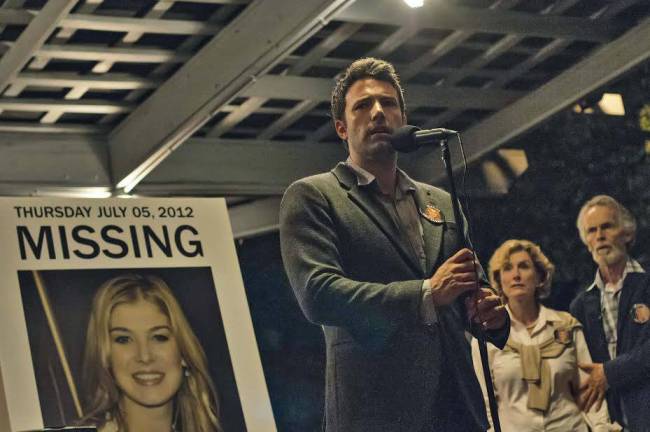
Gone Girl Movie Still

The story seems straight forward enough. Amy Dunn, a New Yorker transplanted in Missouri after she follows her husband Nick to move back to his hometown as his mother is diagnosed with cancer. On their fifth anniversary, Amy is gone missing. Nick soon becomes the prime suspect in the case. Although a body has not been found, murder is on everyone’s mind. With this premise the story unfolds, and we are off to a ride of twists and turns all the way to the end.

Ben Affleck and Rosamund Pike are convincing as the troubled couple. Affleck, who is not known as a superb character actor, is above his previous level here. Although I must say, having read the book could affect how we judge his performance. As for Rosamund Pike, I have no doubt this is her breakout role. Glad to see she finally get this golden opportunity after her supporting parts in An Education (2009), and in Pride and Prejudice (2005) playing Jane, the eldest Bennet sisters, overshadowed by Keira Knightly’s Lizzy.

However for me, I’m most impressed by Kim Dickens in her portrayal of the thinking detective Rhonda Boney perfectly, a role that usually falls upon a male star, like Columbo, or the doubting, persistent detective that looks at evidence and not dwell on prejudice. Her character is the one I like the best in the movie.

The production also benefits from supporting roles from Carrie Coon playing Nick’s twin sister Margo, Neil Patrick Harris as Amy’s former boyfriend Desi Colling, Tyler Perry as defence lawyer Tanner Bolt, although more screen time and story could have been written for him.

If you have read the book, what’s in it for you in the movie? Several things. First off, watch for how the savvy former Entertainment Weekly writer Gillian Flynn transforms her novel into a screenplay, and how a talented director in turn crafts a stylish and absorbing film out of Flynn’s script, from mere words on the page. While you’re at it, watch how a cast of actors interpret their roles (with many cues from the director I’m sure) and make the characters come to life. How do they compare with your imagination while reading the book?

The director of photography plays a dominant role in styling the visual, the light and shadow, the overall tone. Together with the suspenseful, numbing and electrifying music and the smooth editing, the 149 minutes feel like 90. Likely awards nominations for several categories, in particular adapted screenplay, editing, and acting categories. But Best Picture? I have major reservations about that.

Treat this as a modern day Hitchkock movie, a contemporary Film Noir that’s slick and teasing. Fincher’s Girl With A Dragon Tattoo may be the warm-up task, a borrowed source. But here is an authentic American book-to-movie success story. The trend from this day on could well be authors writing more ‘ready-for-movie’ novels.

Now, to the media frenzy. The surge in Gone Girl sales and all the hype pushed the movie in this past opening weekend to the number one spot in box office sales, an impressive $38 million, doubled that of Ben Affleck’s own Best Picture Oscar Argo (2012).

The product may be good, but still a movie needs a strong marketing end. So, all the buzz are the generated effects from a successful marketing campaign, and a large fan base sure is a major asset. All indications point to the Gone Girl phenom could well send the movie to hit targets in profits and Oscar noms.

According to Variety, Chris Aronson, president of domestic distribution at Fox, had said, “we did an excellent job of marketing the movie and making it a cultural event where people had to see it in order to be part of the conversation.”

“That’s a testament to the film becoming a zeitgeisty film,” he said.

Exactly. Nowadays, looks like there’s a more acute pressure for one to be part of the conversation at parties or the Friday social, and especially, on social media. And zeitgeist is just the right word to describe a phenom. I’ll be harsh to say it’s a ploy, but the fan-based momentum is just the right fuel to ignite a trend like a wildfire. But amidst the rave, judge for yourself the worth of the movie and decide if you want to be in this reality show or not.

This may be the very issue satirized in the film. View the production for what it’s worth, seek the evidence, and think for yourself how many ripples you’ll give it. Then decide if you ‘like’ it or not.

~ ~ ~ Ripples

Your comment is most welcome. By all means, share your opinion on the movie, the book, or my post. But while you’re at it, for the pleasure of those who have not read the book or seen the movie, please observe the NO SPOILER intention here.

***

Awards Update:

Jan. 15, 2015: Rosamund Pike nominated for an Oscar for Best Actress

Dec. 11: 4 Golden Globes noms: Best Director David Fincher, Best Actress (Drama) Rosamund Pike, Best Screenplay Gillian Flynn, Trent Reznor, Atticus Ross for Best Original Score

Dec. 10: Rosamund Pike gets SAG nom for Best Female Actor

The Hundred-Foot Journey: A Delicious Fusion

Oscar-nominated director Lasse Hallström serves us a tasty treat in the fairy-tale style of his previous, acclaimed Chocolat (2000). The underlying ingredient that spices up the story this time is more than just dainty sweets. This one is surprisingly gratifying.

Produced by Steven Spielberg and Oprah Winfrey, “The Hundred-Foot Journey” is adapted from the light-hearted novel of the same name by Richard C. Morais. Oscar nominated screenwriter Steven Knight (Eastern Promises, 2007) has done a marvelous job in turning the cartoonish style of a book into a robust and more complex cinematic parable, with dashes of humor and clever dialogues for added delights.

THFJ Movie Poster

The story is most relevant today in our world overwhelmed by warring differences and conflicts. It is an immigrant story. It also presents an ideal case of how cultures can coexist and harmony can be found in diversity.

The Kadam family leaves India after the tragic loss of their mother and their family restaurant in a fire caused by an angry mob. After a short stay in London, Papa (Om Puri) leads his family to settle in the picturesque village of Saint-Antonin-Noble-Val in Southern France. The first few minutes of back story is concise and captivating.

Papa soon finds a derelict restaurant for sale. His own Maison Mumbai, the first Indian restaurant in the vicinity is subsequently opened, a seemingly arduous venture. Papa is a headstrong patriarch, undeterred by the initial protests of his sons, and the Michelin starred Le Saule Pleureur across the street. The proprietor of that haute cuisine establishment is the formidable Madam Mallory (Helen Mirren), who is determined to drive her competitor out.

On opposite sides of this one-hundred-foot wide roadway thus rage the battle of sights, sounds, and aromas, of spices and sauces, ambiance and costumes, an all-out war of clashing cultures.

Indian spices

Hassan (Manish Dayal) is the head cook of the Kadam family. He has learned the skills from his late mother; loving memories of her cooking fuel his gastronomic passion. Furthermore, Hassan is endowed with a distinct talent for the culinary art. He is most ready to explore brave new tastes.

The young sous chef across the street, Marguerite (Charlotte Le Bon), plays no small part in Hassan’s curiosity of French cooking. The two strike up an ambivalent relationship as both friends and foes.

After Madam Mallory discovers the gift in Hassan, she offers to take him under her wings. Such a proposition is, expectedly, rejected by Papa. However, it is Hassan’s decision and passion after all. His determination soon overrides the objection from Papa.

By taking his first step to cross the great hundred-foot divide, Hassan turns the page of both parties in the cuisine conflicts. His journey ultimately leads to an additional Michelin star for Le Saule Pleureur and fame for himself. Hassan’s excelling and competing in the qualifying challenge in Paris is the bridge reconciling the two sides of the road.

It is fun to see the hostile rivals Madam Mallory and the patriarch of the Kadam family coming together. Their changed demeanor brings out the latent, better qualities of each other, offering us some nuanced performance and heart-warming scenes. I must note that there were constant, spontaneous laughs and even restrained applause in the theatre of the preview screening I was in.

Peace offering

The film itself is a smorgasbord of international talents. Acclaimed Swedish director Lasse Hallström takes the helm. English Screenwriter Steven Knight adapts a novel by Richard C. Morais, an American born in Portugal and raised in Switzerland. English star Dame Helen Mirren masters some French accented English dialogues, her previous Oscar winning role as The Queen is amusingly embedded. Papa Om Puri is a veteran Indian actor with a British OBE honor. Mandish Dayal who plays Hassan is American born of Indian descent; his love interest is the up-and-coming actress Charlotte Le Bon (also in Yves Saint Laurent, 2014), a French-Canadian from Montreal.

Director of photography Linus Sandgren (American Hustle, 2013, Swedish born BTW) entices viewers with his close-ups of fresh fruits, vegetables, spices, and market offerings. For those who may wonder, those spiked, round objects are sea urchins. The agile and well-paced sequences of food being prepared are most effective. In contrast, the wide-angle, bird’s eye views of the picturesque Southern France countryside are equally mesmerizing.

Music is an important ingredient in the film. Composed by the prolific A. R. Rahman, who won two Oscars for his work in Slumdog Millionaire, the score adds a distinguished Indian flare. With the lively Indian music juxtaposed against the backdrop of serene Southern France, the film offers viewers some interesting mixes of sights and sounds.

There are times when the editing could be tighter, scenes that need to be made clearer and more coherent, especially in the last third of the film. However, the overall production is a delicious offering. The gratifying finish serves the idea that, apart from the Michelin, home is where the ultimate star is to be found, a thought to savor and an enticement for tasting it all over again. I know I will go for a second helping.

~ ~ ~ Ripples

***

Awards Update:

Dec. 11: Helen Mirren gets a Golden Globe nom for Best Performance by an Actress in a Motion Picture – Comedy or Musical

Other Related Posts on Ripple Effects:

My book review of The Hundred-Foot Journey by Richard C. Morais

Haute Cuisine Movie Reivew

Gourmet Rhapsody by Muriel Barbery