WALL-E (2008, DVD)

Continuing with my review of  ‘hopeful movies’ for the new year,  this is a must-see… for your whole family.

wall-e

WALL-E has re-defined for me what makes a good movie.  It doesn’t need human actors, doesn’t even need dialogues.  Its visuals are stunning and thought-provoking, and the silent scenes speak volumes. Especially the first part of the movie, I’m fascinated by how human meanings and sentiments are conveyed with almost no dialogues yet with such eloquence.  It is ironic, I know, that it takes an animated robot, or two, to bring out what is important for us humans: The need to connect, the joy of simplicity, the power of a tiny green sapling bursting with life, and love, the essence of being human.  The creators of WALL-E have invented a fresh and entertaining way to send these age-old messages back to us humans, with grace, humor, and wonderment.  Now that’s creativity.

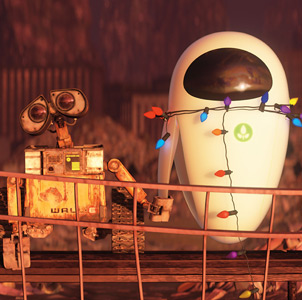
The time is post-apocalyptic, some time in the future where Earth is no longer habitable because its junks are piled up higher than sky scrappers.  WALL-E is a robot with one directive: garbage compacting.   Earth is no man’s land now.  One ‘human remains’ that WALL-E treasures is an old video tape of “Hello Dolly”.  WALL-E plays it constantly to admire that very human act and emotion:  courtship and love.  One day, he witnesses the landing of a spacecraft, from which comes Eve, an exploratory robot.  Now WALL-E has a chance to practice what he has learned.

As Earth is no longer viable for life, humans, ever ingenious, especially when it comes to their own enjoyment and gratuitous consumerism, have branched out into space, the final frontier.  They have created for themselves a utopia in a cruise ship, perpetually holidaying in space.  Their pastime is lounging on a couch, being served by automated robots.  Due to lack of use, their limbs have shrunk while their bodies have bloated.  No matter, they only need one finger to press buttons to eat, drink, and be merry.  WALL-E’s adventures begin as he follows Eve back to this ultra high-tech space station.
wall-e-and-eve

But Earth is home for humans, not a cruise ship in space.  Earth is meant for us to cultivate, to nurture, and to enjoy.  So, that’s the ultimate epiphany for all these perpetual space vacationers.  Herein lies the miniscule hope, symbolized by the tiny sapling of green, that there’s still a chance to return home and set roots once again, to live and grow.  The movie ends with all the right notes without being preachy or turning into a propaganda, nor does it wake us up by scare tactics.  It leads you on a pleasant ride and brings you to its intended destination without coercion or didactics.

The DVD has some excellent special features including a couple of animated short films, deleted scenes, and many more.  But my favorite part is ‘Animation Sound Design: Building Worlds From the Sound Up”, in which the legendary sound designer Ben Burtt shares secrets of creating the sounds of WALL-E. Credited by writer/director Andrew Stanton as the genius behind WALL-E, Burtt has won Oscars for his sound effects in E.T. The Extra-Terrestrial, Star Wars, and Indiana Jones movies.

Teach your children well… while there’s still time,  that’s the underlying axiom (the name of the cruise ship) of the movie.  An animation more relevant for adults than kids. After all, who are in a better position to bring hope to the next generation other than parents themselves?

~ ~ ~ ½ Ripples


Rachel Getting Married (2008)

“I think families are weird and insane…

They are the best source material.”

Jenny Lumet Interview with L.A. Times

I can’t agree with Lumet more… well, maybe not the insane part.  As screenwriter (daughter of director Sydney Lumet), she must have pondered the facts that the family is the first point of social contact a newborn is introduced to, the hotbed of human relationships from jealousy to rivalry, and the school of harsh lessons, learning to love amidst hate, forgive despite hurt.  That is the scenario in her script Rachel Getting Married.

And usually it’s at weddings that the raw emotions are exposed and where conflicting sentiments are so intense that they become unmanageable, hence, the source materials for many of our films…

It was full house again at The Calgary International Film Festival’s screening of Rachel Getting Married. First time screenwriter Jenny Lumet has crafted a realistic family portrait.  Director Jonathan Demme (of The Silence of the Lambs fame) uses roving camera work to effectively capture the naturalistic look, giving me the impression that I’m watching the home-made video of another family.  This film is definitely not for those with weak stomach or who are easily nauseated.

The movie is about Kym (Anne Hathaway) returning home for her sister Rachel’s (Rosemarie DeWitt) wedding.  Kym has been in rehab for some years, trying to deal with substance abuse.  Coming home is bitter sweet for all. First, Kym’s father has remarried and a wedding means the re-appearance of Kym’s mother (Debra Winger), and the re-opening of old wounds.  Further, the jealousy and sibling rivalries are still intense, albeit hidden within a facade of good will most of the time. As the story unfolds, we see the tragic past of the family, its emotional residue still spilling out to the present.

Shot in a naturalistic style (Robert Altman is acknowledged in the end credits), with a hand-held camera jolting its way through family gatherings, punctuated with non-script-like casual and spontaneous talks, the film makes us feel like we’re secretly prying into another family’s affairs.  But herein lies the merit of such an incisive look.  The truth is, if we get the chance to peep behind the curtains into other people’s homes, we would probably find how similar they are with our own.   We may not have to deal with a substance abuser, or have gone through similar tragedies, but we have to live with the common human emotions of hurt and disappointment, rivalries and anger.  We are encouraged when we see how others find redemption, and from the pit of negativism, rise up and go forward.

Anne Hathaway has shown that she can act outside of the sweet and charming feminine roles as in The Devil Wears Prada (2006) and Becoming Jane (2007).  Here in Rachel Getting Married, she has effectively delivered an excellent performance as a messed up substance abuser struggling to redeem herself.  The film could well lead her to other more character-driven roles in the future, or maybe even an acting nomination.

As for the film itself, the roving camera work is not for everybody.  With its almost 2 hours running time, seems like it needs a bit more work on editing and pacing to make it more appealing.  Do we need so many musical numbers?  Overlooking the melodramatic parts, the film is still effective in delivering a very human story.

~ ~ ~ Ripples

Update December 11:  Anne Hathaway has just been nominated for a Best Actress Award at the 2009 Golden Globes for her role in Rachel Getting Married.

*****

COPYRIGHT WARNING:

Arti of Ripple Effects is the writer of the above original review, posted on September 30, 2008, here at https://rippleeffects.wordpress.com   ALL RIGHTS RESERVED.

If you see this article on some other blogs or websites (as I have) without acknowledgment, citing, or linking back to Ripple Effects, then you know it has been copied without permission from the author.

First Blogaversary and Summer Wrap-up

Last year on this day, August 29, 2007, I began my blogging journey on WordPress.  One year and 104 posts later, this sputtering engine is still chugging along.  I’d like to think of my blogging experience as a road trip.  The kind of vehicle I have in mind is the VW van in the movie Little Miss Sunshine.  Almost an obsolete wreck and yet still functioning, just needs a little running push.   

It has been an eventful summer for me.  Having had to move twice and living out of a suitcase, sustaining the horrors of home renos, tending illness in the family, and caring for two elderly parents have put my life on hold…or maybe this is life.  All this time, I didn’t have easy access to the internet, no TV, or other high tech luxuries.  While my posts have been more sparse than I’d like, blogging, even though infrequent, has at least kept some kind of normalcy for me during this unsettling and chaotic period.

While I’ve missed many important events during these two months, such as Hilary’s concession speech, and the Olympics… I’ve been able to catch some summer flicks and read a few books.  As I take stock of this summer’s entertainment consumption, I’m surprised to find that my list is long despite the interruptions:

The following are straight from memory, in no particular order:

Movies seen at theatres:

  • Mamma Mia! 
  • The Dark Knight
  • Swing Vote
  • Brideshead Revisited

Live Musical:

  • Spamalot

DVD’s watched or re-watched:

  • Persuasion (1996)
  • Persuasion (2008)
  • Sketches of Frank Gehry (2005)
  • Life As A House (2001)
  • Eternal Sunshine of the Spotless Mind (2004)
  • Vantage Point (2008)
  • The Bank Job (2008)
  • Miss Pettigrew Lives for a Day (2008)
  • Plus about 25 titles previewed for a Film Festival

Books read or re-read:

  • Persuasion by Jane Austen
  • Then She Found Me by Elinor Lipman
  • The Savior by Eugene Drucker
  • The Glass Castle by Jeannette Walls
  • Up Till Now by William Shatner
  • Lady Killer by Lisa Scottoline

So this is the summer of 2008.  Will be leaving for Ontario tomorrow to take our son back to university, Arti is wrapping up another summer, and the first year of blogging. 

What’s your blogging trip been like this summer?   And your list of books and entertainment?

                                                                           *****

The Glass Castle: Book Review

For my 100th post, I’d like to share an extraordinary personal narrative by writer Jeannette Walls.

The opening of the book grabbed me right away as I was browsing in a bookstore. The author, a successful journalist and writer, was in a taxi, all dressed up for an evening event in New York City. As she glanced out the window, she saw a homeless woman scavenging a garbage bin. A closer look made her realize that was her own mother.

That is one dramatic opening of a book. Knowing that it is the telling of a real-life story intrigued me all the more.

Since its publication in 2005, the award-winning childhood memoir of Jeannette Walls has garnered high acclaims and been on the New York Times Best-Seller List for 100 weeks.

Growing up nomadic is a succinct description of Walls’ childhood. At age four, she had already moved eleven times. Upon the direction of her eccentric father and idealistic mother, and often to escape debts or consequences of misdeeds, the four Walls children were herded across the United States from Arizona to California, across mining towns and even living out open in the Mojave Desert, moving on a whim and often given just minutes to pack up whatever meager possessions they had.

Afflicted with alcoholism, dad Rex had trouble holding down a job. But he was a man with a brilliant mind and a wealth of knowledge which he readily passed to his favorite daughter Jeannette. She learned from him science and engineering, mathematics and history. The glass castle is his promise to her, assuring her one day he would strike gold with the Prospector he had invented, and build the family a glass castle they could all live in. The glass castle remained a glimpse of hope, yet sadly proven to be one illusive dream.

Mom Rose Mary was an idealistic artist and writer. Besides teaching her children to appreciate nature, art and literature, she had taught them adaptability and instilled in them the spirit of resilience. Once driving through the Mojave Desert, they saw an ancient Joshua tree. Growing through the wind swept years, the tree was permanently bent and yet was still firmly rooted. Later, Walls found a sapling growing not far from the old tree and wanted to dig it up and replant it near their home:

I told Mom that I would protect it from the wind and water it every day so that it could grow nice and tall and straight.

Mom frowned at me. ‘You’d be destroying what makes it special,’ she said. “It’s the Joshua tree’s struggle that gives it its beauty.

This book could well be named The Joshua Tree.

Rex’s alcoholism left the family in dire poverty. In this candid and personal account, Walls remembers that often she had to go without food for days. While in school, she would scavenge garbage cans for leftovers after lunch. Often they would have no electricity in the makeshift shack they called home, and took a shower once a week.

Mom was plagued by depression and often lived in a world of her own ideals. Her laissez-faire style of child-rearing often left her kids to fend and provide for themselves. Even if she found a job as a school teacher, she would soon grow tired of it and wouldn’t get up in the morning. The kids would have to drag her up, usually in vain.

I’m surprised the term “Dysfunctional” never occurred in my mind as I read the book. The Walls children were tenacious, resourceful, bold and confident. They were avid readers and did well in school.  What more, they were devoted to each other and loyal to the family. From an early age, they had to learn to handle an alcoholic father, a moody and depressed mother, and mediate their occasional fights and conflicts. The kids had to parent their own misfit mother and father. The Walls might be financially crippled, they were able to maintain strong relationships and an exuberant zest for life.

Walls’ account is candid and personal, poignant with cutting humor. One time in winter, when icicles were formed in their kitchen ceiling because the roof was not insulated and there was no electricity in their home, Walls describes her mom’s response:

All seasons have something to offer,” she said. “Cold weather is good for you. It kills the germs.

How we view the Walls parents of course depends solely on how their daughter presents them in her memoir. And this is precisely my point. Jeannette Walls has painted a loving picture of her parents depsite their failings. She is sympathetic to their struggles with their own demons. Through out the book, I am touched by her capacity to forgive, to persevere, to hope, and to plan for a better future, not only for herself, but for all her siblings.

The last chapters of the book detail how the author and her siblings pursued a new beginning by establishing an independent life in New York City, while still as teenagers. The story of resilience moved on to another phase. Readers are gratified to see a rewarding end to Walls’ years of perseverance.

Film rights have been optioned for the book.  If it is ever turned into a movie, from a visual sense, it is easy to illustrate the hilarious and sensational parts. However, my sincere hope is that the film will keep the integrity and poignancy of the memoir. Often, it is not what has happened that is worth telling, but how the narrator sees what has happened that makes the storytelling moving and memorable. In this case, both the what and the how are extraordinary and uplifting.

The following is a video clip of Jeannette Walls and her mother talking about The Glass Castle.

~ ~ ~½ Ripples

The Glass Castle by Jeannette Walls, published by Scribner, NY. 2005. 288 pages.

NOTE: Here is the latest (April 23, 2012) regarding the film adaptation of the book. Lionsgate has bought the rights and Jennifer Lawrence is in talk for the lead. CLICK HERE to read more.

FOR A LIST OF UPCOMING BOOKS INTO FILMS, CLICK HERE.

***

From a Country Garden

Finding Internet access has not been easy.  But I have to post these pictures.  The log home has been vacant for almost 10 months.  So when I found what were in the garden, I was pleasantly surprised.  With the temperature reaching 30C here in southern Alberta, and the amount of rain we’ve been getting in the last month, the garden has started to grow, albeit with all the unwanted weeds as well.

I can tell from the design and the variety, this country garden wrapping around the log home was once cultivated with much TLC.  Even among the thorns and thistles now, and without human maintenance, I can see beautiful flora, ferns, and bushes blooming in resilience.  Here are a few samples from this once glorious garden.  I also must admit my ignorance in naming some of them…although the Alberta wild rose I can readily recognize…No, that wasn’t the Alberta wild rose as one commenter corrected me. These must be some kind of cultivated garden roses.

All you green thumbs, nature lovers, bird watchers, and naturalists, please help me out here.  I’d appreciate if you’d identify these other beautiful flowers and creatures:

another view here:

These look like lilacs, but I’ve always seen purple, not white:

And these lovely ones with blue petals:

Forgot its name:

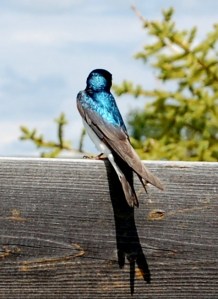
And this creature…with it’s black stripes on a brown body, and the buzzing sound it gave out, I thought I was photographing a wasp of some kind.  So after a few quick shots, I stepped out of its way.  But when I saw it on my computer, I was amazed it had such beautiful wings…is it just a moth?

And this bird that gets so attached to the feeder on the fence…first the front view:

and the back:

Looking at the exuberance and beauty of life here in this derelict patch, I’m reminded of a precious quote:

Consider the ravens: They do not sow or reap, they have no storeroom or barn; yet God feeds them.  And how much more valuable you are than birds!

……….

Consider how the lilies grow.  They do not labor or spin.  Yet I tell you, not even Solomon in all his splendor was dressed like one of these.  If that is how God clothes the grass of the field, which is here today, and tomorrow is thrown into the fire, how much more will he clothe you, O you of little faith!

*****

Motherhood and Music

This just happened over the weekend…

It was your typical wedding banquet. The elegant ballroom, the thirty some round tables tastefully decorated, the introduction of the wedding party, the welcoming of out-of-town guests, the buffet, the clinking of glasses…

All the usual stuff at your usual wedding celebration…until…the mother of the groom played Tchaikovsky at the piano.

As a promising, award-winning pianist in the then North Vietnam years back, her talent and future were stifled under the harsh political climate. Thanks to the sponsorship of a Canadian church, the family immigrated to Canada, starting a new life in freedom.

Not long after that, a tragic work-related accident claimed the life of the father. The mother continued to run the family business and raised her young children all by herself, instilling in them the love of music, while laying aside her own musical career…

Until, as a most moving gift of love, she practiced again for her son. On his wedding day, as the lights dimmed, she walked over to the grand piano in the banquet hall, and played with such depth of expression and poignancy, two selections from Tchaikovsky’s The Seasons, May: White Night, and June: Barcarolle. The 300 guests were silent, mesmerized, deeply moved…then the standing ovation.

The love of a mother, the power of music … what a wonderful way to bring up a child, what a remarkable beginning of a marriage.

***

Then She Found Me (2007)


Then She Found MeLet me guess, movie making is as demanding and draining as child rearing…and, if you’re doing both together, well…kudos to you.  Case in point, a gaunt and much thinner Helen Hunt.  Well, maybe that was on purpose for her role.  Anyway, after some intermittent hiatus since her second marriage in 2001 and the birth of her daughter in 2004, the Oscar winning actress (As Good As It Gets, 1997) comes out with a film that she co-writes, directs, and stars in.  Then She Found Me shows that Hunt is alive and well, and that she certainly can multi-task.

As a directorial debut, Then She Found Me is a gem of a film. Based on the novel of the same name by Elinor Lipman, TSFM has been on the drawing board for a long ten years.  To read NY Times’ Interview with Helen Hunt, Click Here. Hunt adapted the book into screenplay with Alice Arlen and Victor Levin throughout a few years’ period. 

Dramedy is the word for this genre of film.  The drama component of the movie spurs on some meaningful exploration:  of motherhood, adoption, marriage, parenting, faith, and God… But it’s a comedy, first and foremost, and we’re rewarded by its remaining so.  The movie is funny, smart, warm-hearted and entertaining…and best of all, we’re spared all the possible preachy sessions that could have come out from dealing with its subject matters.

Juggling motherhood and movie-making could have explained Hunt’s tired and thinner look.  On screen, such an appearance is suitably in character, for she portrays a 39 year-old kindergarten teacher April Epner, newly married, and in a desperate rush to become pregnant before time runs out.  As an adopted child, April is all the more longing for a baby of her own, thinking of the deeper relationship, bonding and meaning that can naturally come out from giving birth to and raising her own child as opposed to adopting one. To this view, her step-brother, the natural son of her Jewish adoptive mother responds, “No, it’s the same”.

Well, she soon finds out.  Her excitement of finally getting pregnant is not shared by new husband Ben (Matthew Broderick).  It is obvious that he is not eager to become a parent, or a husband, for that matter.  Actually, this news comes to him after he feels that he has made a mistake in getting hitched for life, and has moved back to live with his mother.  Sadly, Ben is still a boy, donning a baseball cap and expects everyone, especially his wife, to accept his Peter Pan confusion.

But that’s not all.  Just after her husband has left her, April’s Jewish adoptive mother dies.  And to top it all off, April encounters her birth mother Bernice (Bette Midler).  Well to be exact, her mother has found her.  But at this chaotic point in her life, April is ambivalent about coming face to face with her birth mother, especially one who is so brassy, imposing and self absorbed.  Bernice is a local TV talk show host.  After 39 years of absence, she suddenly decides she wants to find her daughter.  But upon questioning by April why she had given her up after a short parenting gig, Bernice may have understood April’s ambivalence.  And I like it when the film leaves the queries as queries… simple answers to questions like these are never easy to find.

Helen Hunt and Colin Firth

Confused and emotionally fragile, April finds new romance and support in Frank (Colin Firth), the recently divorced father of a student in her class.  His artist wife has left him for another guy and at the moment, she’s travelling the world with him. Underneath Frank’s calm and affable demeanor is a very hurt, confused, and anguished man.  If Colin Firth thinks he still has not shed his stereotyped Darcy image, this is the time to do it.  His versatility as an actor just shines through in this conflicting character.  Once bitten, twice shy.   Frank is emotionally vulnerable, yet he also yearns to establish a meaningful and loving relationship with April.  The intermingling of two fragile and affable characters is the springboard to some amusing and poignant moments.

As a first time director of a full length movie, Hunt has done a proficient job, despite some minor problems with pacing and congruence of scenes.  Certain shots could have been shortened to maximize the intended humor while some scenes ought to be connected more smoothly.  The audience may need to fill in the blanks at times.  Having said that, I feel that my enjoyment is not tampered a bit.  One note of caution though, the language is part of the reason it gets an R rating, and that might turn away some viewers.  

Kudos should go to the admirable acting by Hunt herself, as well as Firth and Midler.  Midler is effective as a self-serving intruder at first, yet is sensitive enough to change, especially as she empathizes with April’s anxiety … learning to be a mother after all these years.  And I must mention Salman Rushdie, yes, the Salman Rushdie, who plays a supportive role as the obstetrician.  He has effectively sprinkled in some subtle humor.

Further, I admire Hunt for not shying away from the problem of faith, loss, and God.  The plot lends itself naturally to the exploration of these complex issues, and Hunt has boldly dealt with them directly. The religious expressions and prayers uttered might be in Hebrew, but the yearning, and the angst, is poignantly human and universal. 

Well, Mother’s Day has come and gone, but motherhood lasts a lifetime.  As a devoted single-parent to his children, Frank in the movie has demonstrated that the marriage vow “for better or for worse, in sickness and in health” can aptly apply to parenting.  And for all mothers, birth, adoptive, as well as those like Frank, who has to bear the responsibilities as one, it is in the nitty gritty of everyday realities that motherhood, or parenthood for that matter, finds its meaning and fulfillment. 

(The indie film is currently being screened on limited engagement in North America. It’s rated R in the U.S. for language and sexual content. In Canada, it’s rated from 14A to G, depending on the Province where it’s shown.)

To read my review of the book Then She Found Me, click here.


  ~ ~ ~ Ripples


And When Did You Last See Your Father? Book Review

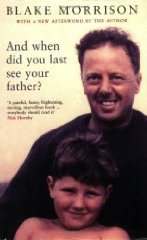
when-did-you-last-see-your-father-book-cover2I saw the movie When Did You Last See Your Father? at the Toronto International Film Festival last September, twice. I didn’t have the chance to read the book until a couple of days ago, about 7 months later. But as I read, all the scenes came back to me, and I appreciate the film even more than before. Yes, this is definitely a successful attempt at turning Book Into Film…and a hugely impressive one at that. The stellar cast with Jim Broadbent as the father and Colin Firth as the adult son, plus the exceptional supporting roles have brought out the spirit and the essence of the book poignantly, thanks to the very artistic and sensitive treatment by director Anand Tucker. To read my review of the movie, click here.

Blake Morrison is a contemporary British poet and writer. He was literary editor of The Observer and the Independent on Sunday before writing full time in 1995. AWDYLSYF is a memoir of his relationship with his father, Arthur Morrison, who died of cancer at age 75. Published in 1993, the book has won literary awards, and has been translated into many languages, from Japanese to Syrian.

The name of the book has its source in a painting of the same title by the Victorian artist W. F. Yeames. Yeames depicted an imaginary scene during the English Civil War. The young son of a Cavalier (Royalist) was questioned publicly by the enemy, the Roundheads (Parliamentarian), as to the whereabouts of his father. The question posed a serious dilemma for the boy. If he answered truthfully, he would endanger his father. If not, he would be commiting the immoral act of lying. Click here to read the story behind the painting.

And Painting by W. F. Yeames, When Did You Last See Your Father

Such a dilemma finds a parallel in the book. And it is apparent that Morrison has chosen to do the former, for the story he tells is incredibly candid, up-close and personal. As a reader, I’m glad he has done that. Eulogies are sometimes euphemism honoring the dead in order to please the living. But what Morrison has delivered is a courageously honest narrative of a precarious father-son relationship marked by ambivalence and love-hate sentiments. I can sense the pain such exposure could bring to the people involved, his mother, his sister, close family and friends. But I feel Morrison has burst the romantic bubble of the naturally congenial relationships we assume as we look at other people’s family portraits, or see families depicted in movies and novels. Love does not come naturally because of the tie that binds. Respect still needs to be earned, and loving acts need to be learned, for both parent and child.

The 20 independent, short chapters darting back and forth across the landscape of memory record the poignant reminiscence of a son living under the shadow of a powerful father. Arthur Morrison was a revered doctor in the town of Earby, in the County of Yorkshire…revered because of his imposing, domineering and callous demeanor. He could always get his way, and get out of troubles. In his recalling of childhood episodes, son Blake has aptly intermingled humor with pathos, all the more bringing out the complexity of character, and the ambivalence we sometimes feel towards our loved ones.  And to be fair, Arthur had cared for his family, albeit in his own patriarchal and egotistic manner.

He was gregarious.  In all social situations, he was the one leading the conversation and successfully avoiding topics that he was ignorant about…and was sure to stay away from games like Trivial Pursuit.

He hates feeling fallible: ‘I may not be right but I’m never wrong’ is the motto on a horrible brass wall-plate he has. He isn’t a vain man, but he is a proud, even bumptious one, a man with a puffed chest who learnt to water-ski in his fifties and thought he could go on forever.

How can such a character be brought to face his own imminent demise? Blake Morrison describes his father’s fast deterioration after diagnosed with cancer. The preparation though seemed to be harder for those who were going to be left behind than the patient himself. There was a relationship that needed mending, and, there were truths to be revealed. For years, Morrison had suspected the intimate relationship between his father and Auntie Beaty, a family friend. It had affected his perspective on his father, and on himself as a son. But he wasn’t given such a privilege. Other people’s secrets are theirs to own, even though that person is your father. And the living won’t tell: “Please leave me one last small piece–it’s mine” Auntie Beaty pleaded.

So the pressing question is: How is a son to prepare for the imminent demise of his own father, having lived in such a precarious relationship? The revelation comes at the end of the book. Death and mortality has a way of helping us put things in perspective:

Don’t underestimate filial grief, don’t think because you no longer live with your parents, have had a difficult relationship with them, are grown up and perhaps a parent yourself, don’t think that will make it any easier when they die.

Faced with the finality of death, all grievances one has towards the dying seem minute in comparison. As a son now, Blake has to learn to let go of his father, ironically, a lesson his father had failed to learn in the raising of his own son. Grievances give way to caring, to the consoling of the living, to the respect of a life lived on its own terms, to forgiveness, to closure.

In his Afterword, Morrison writes:

When young, we were impatient with our parents: now we want to atone for our callowness, and to acknowledge what they were and all they did.

Poignant words for us to ponder.


And when did you last see your father? by Blake Morrison is published by Granta Books, London. 1993. 230 Pages.

A movie tie-in edition by Granta Books is published October 2007.
~ ~ ~ ½ Ripples

Nim’s Island (2008)

I don’t want to miss any Jodie Foster movies.  She’s one of my all time favorites.  I’m also eager to watch Abigail Breslin again after her Little Miss Sunshine.  Further, after reading Annie Dillard’s novel, I just need something light and mindless.  Coincidentally, between these two, I only have to change lenses, for the view is more or less the same: the beauty and wonder of nature. 

Nim’s Island is a mixture of Swiss Family Robinson, Home Alone, Stranger Than Fiction, and Mr. Brooks.  Based on the popular children’s book of the same name by Wendy Orr, it’s about a girl called Nim who lives an idyllic life on a pristine island with her scientist dad Jack.  The island’s rich natural resources and wildlife are the sources of Jack’s research and Nim’s pleasure.  Her friends are Selkie the sea lion, Fred the iguana, Galileo the frigate bird, and the giant sea turtle…what’s his name? … Anyway, it’s a zoo out there on Nim’s island, but Nim and Jack keep it real organized, educational, and fun.

One of Nim’s favorite past time is reading the stories of her adventure hero Alex Rover (Gerard Butler, P.S. I Love You, 2007).  So, when a huge tropical storm hits the island, and her dad hasn’t come home for a few days collecting protozoa samples out in the open sea, she calls to Alex Rover for help.  Actually, it is the creator of Alex Rover that emails Nim first, asking about information to write the next novel, mistakenly thinking Nim is Jack’s research assistant. 

Far from being an adventure hero, Alexandra Rover, the author, is a recluse suffering from agoraphobia, whose best friend is her Purell hand sanitizer. She hasn’t been out of her San Francisco apartment for months. But knowing Nim is all alone on an island needing help, and prodded by her own adventure hero, she ventures out against her fears.  So there’s the interesting set up of the plot, the rest of the story is the adventures of Alex Rover the writer heading to the island to help out Nim, the real heroine.

The film suffers from some scenes and dialogues that appear to be banal and trite.  With its interesting storyline I think it can be done better with more creativity and imagination.  Having said that, I must say that the movie is beautifully shot on location in Queensland, Australia.  In a day and age when kids, and parents, for that matter, find it impossible to have fun outside of video games and electronic gadgets, this movie and the book can offer a wholesome alternative.

There is a new edition of the book that’s a movie tie-in, including 8 pages of color pictures from the film. It is illustrated whimsically by Kerry Millard.  A fun read.  And for all the budding biologists, zoologists, oceanographers, and for that matter, environmentalists in your home, this is a must-read. 

The intended age group I feel should be a bit lower for both the movie and the book.  I’d say a target audience and reader Age 6 – 10 would be more appropriate than the now 9 – 12.  

The best combination:  Go see the movie and then to the bookstore.

Now with that combination, I’ll have to give it

                  ~ ~ ~ Ripples 

CBC Disbands Radio Orchestra

Update April 1:  Reader Tom has alerted me to the site for online petition to save the CBC Radio Orchestra.  http://www.savecbcorchestra.com  Please sign the petition and spread the word. 

Another shocking news:  The CBC Radio executives have just decreed that The CBC Radio Orchestra is to be dismantled as of November, 2008, on the heels of Cutting Classical Music Programs on Radio 2. 

What a swift one-two punch!

Formed in 1938, mandated “to make engaging musical radio programs, commission and perform works by Canadian composers, showcase Canadian performers and conductors, and discover and expose Canadian excellence”, the orchestra has been a Canadian cultural and musical tradition for 70 years.

 Click here for the news coverage in the Globe and Mail of March 27, 2008.

Click here for the Vancouver Sun article on Canada.com: CBC Kills Radio Orchestra

Click here for the article:  The Day The Music Died in The McGill Daily.

Does the CBC management even have the right to do that?  I thought this is a publicly-owned national radio station.  A cultural and arts institution with 70 years of history can be chopped off the Canadian landscape by a few executives like a branch off an old tree in the backyard? 

With this executive order, the CBC has finished off a piece of North American history, disbanding the last radio orchestra in the continent.

Again, I was alerted to this piece of appalling news by my teenaged son…talking about axing classical music to attract younger audiences.  CBC has gravely miscalculated the musicality of our youth and done an utter disservice to them, depriving them of knowing and appreciating a heritage dating back to hundreds of years of human civilization.

To save Classical Music from being axed off the cultural tree, Click here for the Online Petition.

BTW, the Facebook Group ‘Save Classical Music on the CBC’ now has over 8,000 members…I’m not trying to stereotype, but would these not be some of the ‘younger audiences’ CBC is trying to woo?

                                                            ******

CBC Cutting Classical Music Programs

What a shock it is for me to learn that our national radio station CBC Radio 2, is choosing to axe more classical music programs to appeal to a ‘wider audience’.  Why, aren’t we who have been enjoying the arts and music, who have cherished the long tradition of these CBC productions, who have raised our children on them, teaching and nurturing them to appreciate their content, not a part of the general public? 

Click here for Russell Smith’s article in The Globe and Mail on March 13, 2008, “No classical?  Then kill Radio 2 and get it over with.”  Just let me try to fathom the motives behind these further cuts:

1.  Diversity.  If it’s diversity they are aiming at,  they should all the more leave the classical edge in because CBC Radio 2 is the only nation-wide English radio station in Canada that offers classical music.  Which station can I tune in for such extensive and in-depth coverage of the arts and artists, classical music and musicians, live concerts, commentaries, CD reviews and even an audience requests program? What alternative do I have when the only classical music station in Canada decides to go with the flow and become just another dial for easy listening or contemporary pop?  I feel like I’m a CBC copywriter doing a promo for the station…but why would they need me to tell them this?   To CBC Radio: Respect your role in the Canadian cultural landscape.  What ‘diversity’ are you offering if there are no choices in genre? If ‘diversity’, and ‘choice’ are such powerful words nowadays, honor the real meaning of these terms and not just utter them for political correctness. 

2.  Multicultural. The term “Classical Music” has often been misconstrued as being monocultural.  Are CBC program researchers and management not aware that many so called “classical” composers, especially the more contemporary ones, are from a diverse cultural background including not only Western European, but Central and southern European, Scandinavian, Russian, North American, South American, and Asian?  And do they not know that for this last group here, Asian-Canadians, especially appreciate classical music and particularly in the teaching of their young, the next generation of music lovers?  I for one can speak out on this issue where I personally and know and have come into contact with countless parents of Asian descent who have involved their children in the learning of classical music, and have nurtured numerous talented young classical musicians here in Canada.  Jan Wong in her recent book Beijing Confidential notes that there are 30 million piano students and 10 million violin students in China today.  Two of the most popular music icons among the young are Lang Lang and Yundi Li, both world renowned classical pianists in their 20’s. Wouldn’t it be odd that one can enjoy classical music on radio in China but not be able to in Canada?

3.  Education. If it’s just for the sake of our young, we owe them a great heritage if we do not nurture them to appreciate the roots of modern music. Without going deep into music theory, isn’t it true that our contemporary music evolves from classical foundations?  Calling it ‘classical’ sounds so politically incorrect, as it wrongly conveys ‘elitism’ or simply connotations of being passé. But, would you avoid teaching our next generation Canadian history just because history is passé? 

4.  Business. If it’s for marketing reasons, why add one more ‘easy listening’, ‘pop’, ‘jazz’ or ‘contemporary’ station to the already competitive business, why fight for market share while you can distinctly offer something very different and unique, a real alternative to the radio audience in Canada.  If you wish to morph into a more hip mode to appeal to the young, look for younger DJ’s for your classical music programs. If George Stroumboulopoulos (previously of MuchMusic) can become a Canadian news icon on CBC Television, I’m sure you can find young blood equally well versed in the classical music sector.  

5.  Identity. And if it’s Canadian identity they are seeking, trying to appease the ‘general public’ (as if we are not), then CBC Radio 2 should all the more realize, as a publicly owned radio station and a national institution, the classical music they are eliminating is not just a part of Canadian identity, but human civilization…and I suppose western or eastern, old or young, we are a part of that.

Enough said here.  My teenaged son who alerted me to this piece of incredulous news has sent me a link to the on-line petition.  Click here to sign.

Other reactions to this announcement:

 http://www.cbc.ca/arts/media/story/2008/03/04/radio-two.html

http://www.friends.ca/News/Friends_News/archives/articles03200802.asp

A Facebook group has already been formed:  “Save Classical Music on the CBC”, has gathered more than 8,000 members and counting.

Enchanted (2007, DVD)

I consider myself a rational person.  As an armchair critic, you have to, right?  Analytical, critical, not easily moved… But when it comes to humor, I just can’t resist.  I have to admit, I tried to control myself from laughing out loud many times, and not embarrass myself among all the preschool kids and their parents in that matinee show, even though it was dark there in the theatre.

Note to myself:  get the DVD when it’s out.  And so I did.

Why am I enchanted?  First of all the movie.  It’s loaded with smart dialogues, humorous parodies, seamless fusion of animation and real characters, and an old-fashioned and yet still wise message for today.  And the cast,  sure looks like they are having the time of their life making the movie. And the Oscar nominated songs by Menken and Schwartz, with the huge conglomeration of dancers, a delightful revival of the old musicals of the heydays.

Enchanted is a classic fairy tale: An evil queen, afraid of being dethroned, tries in all her power to prevent her stepson from marrying his true love by banishing her to the real world of modern day New York City, where there are no “happily ever afters”, a punishment indeed.  While there, the fairytale maiden meets her real life prince…and so on and so forth…But, what’s not typical is that it’s being handled intelligently, thanks to an excellent script, and the talented technical support it receives.

Amy Adams, Patrick Dempsey,  James Marsden, and Timothy Spall all deliver lively and very gratifying performances. Also, Susan Sarandon as the wicked Queen Narissa…I say, she’s in character.  And the then 8-year-old Rachel Covey, the cutest child star I’ve seen in movies these years. This is only her second movie, but she’s a natural, that is, she doesn’t need to act. She can just stand there and be adored.

The DVD is packed full of fun and information. We have a Carrie Underwood music video “Ever Ever After”, an additional animated story, bloopers, and director Kevin Lima commenting on the deleted scenes. I’m most fascinated by the behind the scene look at how the songs and the musical scenes are produced.  It’s fascinating to watch how choreographers have to coordinate hundreds of performers involving gymnastic troops, stilt walkers, eclectic groups of dancers and multicultural musicians in the “That’s How You Know” scene in Central Park.  I’m most impressed to find a few of them are veteran dancers who had appeared in the classic movie West Side Story (1961) and one was a chimney sweeper in Mary Poppins (1964)!  I’m thinking…Can I even get out of my bed when I’m at their age?

Great family entertainment for the Easter break coming up.  In a world of dysfunctional relationships, no wonder I am enchanted by a movie painting couples reconciled, yes right in the divorce lawyer office, and lovers united after swashbuckling adventures in the hustle and bustle of New York City. 

Just don’t remind me it’s only a fairy tale.

~ ~ ~ Ripples