Heading to Cannes… in my mind 

I’m watching closely the Cannes Film Festival taking place right now. While my tour is virtual and imaginary, I look forward to TIFF in September when I go to Toronto, as some of these Cannes selections might reprise there.

So, if I were in Cannes now, this would be my list of films to watch (links for related films in the list below are to my Ripple reviews):

TÔI YAMANAMINO HIKARI (A PALE VIEW OF HILLS) directed by Ishikawa Kei 

The English translation quickly draws me in: A PALE VIEW OF HILLS is the first novel (1982) by Nobel Laureate Kazuo Ishiguro. An introspection of a Japanese woman living alone in England, spanning decades of life from post-WWII Japan to her resettling in a foreign country. Past memories intermingle with present day reality. Ishiguro is adroit in psychological narratives. I’m curious to see if the film lives up to his credit. Time to reread.

ELEANOR THE GREAT directed by Scarlett Johansson 

Scarlett Johansson’s directorial debut. Eleanor moves to New York City at age 90 for a fresh start and befriends a 19-year-old student. What an idea: A fresh start at 90. Even more amazing in real life, for 95 year-old June Squibb could well be the oldest actor still working, and just recently acclaimed for her performance in Thelma (2025). For those with a longer memory, Squibb was an Oscar nominee for best supporting actress playing Kate Grant in Alexander Payne’s Nebraska (2013). 

THE MASTERMIND directed by Kelly Reichardt

Kelly Reichardt is one of my all-time favourite directors. A look back at her works Wendy and Lucy (2008), Certain Women (2016)First Cow (2019), has piqued my curiosity in how she’d handle this art heist movie, Reichardt’s sensitive rendering of a more popular themed, mainstream subject. And the cast here is a huge attraction: Gaby Hoffman (Field of Dreams, 1989), Josh O’Connor (The Crown, 2020; Emma, 2020), and John Magaro (First Cow, 2019; Past Lives, 2023). 

Nouvelle Vague (NEW WAVE) directed by Richard Linklater

I was captivated by Linklater’s Before trilogy back in the days… Before Sunrise (1995), Before Sunset (2004), and Before Midnight (2013). But he’d shown his versatility by other more subsequent titles such as Boyhood (2014), and Hit Man (2023). Now in 2025, he dives into the French New Waves, his first French language film, creating a making-of feature in black and white to chronicle the shooting of Jean-Luc Godard’s classic Breathless (À Bout De Souffle), which premiered at Cannes in 1960. I anticipate an articulate and adroit handling of this homage to the French cinematic legacy. 

VIE PRIVEE (A PRIVATE LIFE) directed by Rebecca Zlotowski

We know Jodie Foster can speak French, but can she master the language in a full feature film showcased in Cannes, France. I sure hope so because the audience there can be very direct and umm… expressive in showing their love or disapproval. Foster plays a renowned psychiatrist investigating the death of one of her patients. The French cast includes Mathieu Amalric (The Diving Bell and the Butterfly, 2007; The Grand Budapest Hotel, 2014) and Virginie Efira (2023 César Awards Best Actress winner for Revoir Paris

Sentimental Value directed by Joachim Trier

Four years after The Worst Person in the World with which his star Renate Reinsve won Best Actress at Cannes and Trier went on to be nominated at the Oscars for his screenplay and his film representing Norway for Best International Feature Film, now director and star reunite to bring us a story exploring family, memories, and the power of art. Cast includes Stellan Skarsgard and Elle Fanning. 

Left-Handed Girl directed by Shi-Ching Tsou

What attracts me to this film, first is the title, then is the face of the little girl. What’s more intriguing is that Tsou’s directorial debut is produced, edited and co-written by Sean Baker, the US director who won the Palme d’Or last year with Anora, a feature that later went on to win five Oscars. The Left-handed Girl follows a single mother and her two daughters striving to adapt to a new environment in bustling Taipei as they open a stall at a night market.

Renoir directed by Chie Hayakawa

Hayakawa’s first feature film Plan 75 (2022) premiered at Cannes and won the Golden Camera award. It was Japan’s official entry to the Best International Feature Film at the Oscars in 2023. Renoir is Hayakawa’s second film, a coming-of-age story of a sensitive eleven year-old girl growing up in 1980’s Tokyo, living with a stressed-out mother and a terminally ill father. Cast includes Hirokazu Koreeda’s favourite actor Lily Franky (2018 Palme d’Or winner Shoplifters, Like Father, Like Son, 2013)

***

‘The Only Girl in the Orchestra’ is a Passionate Production

This 34 minute documentary short is a tribute to Orin O’Brien, the first female musician hired full time by the New York Philharmonic in 1966 under the directorship of Leonard Bernstein. The trailblazing, unsung hero is spotlighted, albeit reluctantly, by her niece, filmmaker Molly O’Brien, who had looked up to her aunt as someone to emulate ever since she was a child. The 34 minute screen time, however, reveals a humble character who refuses to be called ‘an artist’, and looks at her achievements as ‘accidental,’ rather, seeing her life as one who has simply enjoyed the experience of playing her beloved double bass and making music together with other musicians.

I find what’s inspiring throughout the documentary is Orin’s humility. She could have boasted about many things, including her parental heritage of early Hollywood, the old-time movie stars George O’Brien (the classic Sunrise, 1927) and Marguerite Churchill, or her own self-propelled motivation to reach her musical goal. It was her deep desire to play in an orchestra that led her to learn the double bass in high school, read all she could get her hands on about the subject, later entering Juilliard and becoming not just a female trailblazer in a male dominated arena but further expanding her influence as an acclaimed teacher mentoring numerous young musicians. Yet she offers these words that impress me the most:

This is my theory of how to enjoy your life incredibly. You don’t mind playing second fiddle… I think it’s better to love something so much you do it for its own sake and also for the wonderful people that you’re playing with. You’re creating something together, which is better than something alone.

After 55 years in the New York Philharmonic, Orin retired at age 86 in 2021. She keeps on going with her passion in teaching and mentoring. The documentary follows her as she turns a new page in her life. Retirement doesn’t mean ending a musical career.

The other prominent character in this short feature is Orin’s instrument, the double base. Positioned at the back of the orchestra, often unnoticed, the double base plays a supporting role in the background, nonetheless is essential for producing the foundational rhythm and creating the deepest resonance in a piece of music. The score throughout the film is a case in point. Orin’s double basses are like pets to her. The ‘Orin’s Duke’ is a double bass made in the 1750’s, with a history of playing for George III.

A trailblazer that deserves more than 34 minutes of tribute to her life and career, this gem of a documentary could well reflect what Orin stands for, a pure joy, passionate in its production, unassuming but inspiring in essence.

The 95th Academy Awards nominations were announced a few days ago. The Only Girl in the Orchestra is given the nod deservedly as a nominee in the Best Documentary Short Film category. Before the March 2 awards show, don’t miss Orin’s documentary now streaming on Netflix.

~ ~ ~ ~ Ripples

***

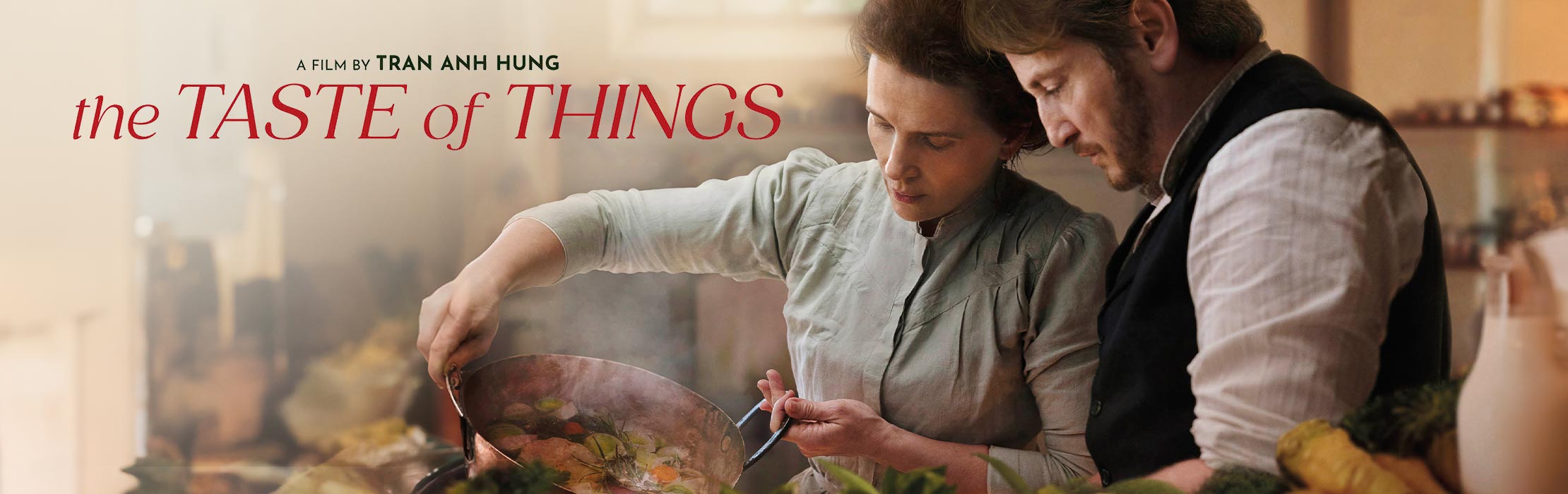
‘The Taste of Things’: the Country Kitchen as Vermeer’s Studio

At last year’s Oscar time, I was a little surprised that the buzzy Anatomy of a Fall wasn’t selected as the official entry by France to enter the race for Best International Feature Film. Instead, it was The Taste of Things. Now that I have the chance to watch it, I can understand why it was the choice and I totally agree with it. That it did not win seems immaterial, for its aesthetic value and the honour of being chosen to represent France make it a worthy accolade.

The Taste of Things is a delectable feature, a celebration of French gastronomy and its historic, culinary traditions, an exquisite and aesthetically riveting period film set in a country house. Vol-au-vent, pot-au-feu, roast rack of veal with braised vegetables… To say it’s a delicious food movie is just lowering the level of enjoyment, like eating an ice cream cone compared to being served baked alaska prepared by a gourmet. The film is not just about the taste of food, but of love, beauty, sensuality, and human connection, offering a deeply gratifying viewing experience.

Directed by the Vietnamese-French filmmaker Anh Hung Tran––whose first film The Scent of Papaya won a César Award in 1994 as well as accolades at Cannes––The Taste of Things sent Tran to Cannes again in 2023 and this time a Palme d’Or nominee and winning Best Director.

Tran reunited Juliette Binoche with her ex Benoît Magimel for the film. The two were divorced twenty years ago. Maybe a past relationship had some bearings on stirring up fond memories, for the pair exudes admirable chemistry on screen. Magimel plays the fictional gourmet Dodin Bouffant, nickname ‘Napoleon of gastronomy’, who resides in a country house during the late 19th century. His cook for twenty years has been Eugénie, superbly portrayed by Binoche, ethereal even in a rustic kitchen.

While Babette’s Feast (1988 Oscar’s Best Foreign Language Film) comes to mind readily, it’s the visual memory of Girl with a Pearl Earring (2004) that enhances my appreciation of The Taste of Things. Indeed, Dodin’s kitchen is like Vermeer’s studio, large window allowing natural light to pour in, the colour scheme of period costume and set design (Tran’s wife Nu Yên-Khê Tran), the naturalistic capturing of characters and their movement make it an exquisite, artistic production.

Inspired by Marcel Rouff’s novel La vie et la passion de Dodin-Bouffant, Gourmet (The Life and Passion of Dodin-Bouffant, Gourmet), writer director Tran wrote the screenplay of The Taste of Things as a prequel to Rouff’s novel, imagining the bond of love between Dodin and his longtime cook Eugénie. Dodin has proposed marriage to Eugénie time and again but is turned down every time. The twist comes when Eugénie falls ill and the reversal of roles emerges. Dodin begins to cook for her––love expressed through the ingenuity of new dishes meticulously prepared and the enjoyment of watching her savour his handiwork.

It’s interesting to note that there’s no music in the whole film. Massenet’s Méditation in piano version comes on only when the end credits roll. With no soundtrack, the essence is in the ambient sounds of nature, bird songs outside the country kitchen, and inside, the sounds of cooking, the crackling of the fire, and the gentle conversations among the characters as they prepare meals. In an interview, Tran mentions that: “The sound is the flavour of the picture. The picture has the beauty; the flavour of it comes from the sound.” 

Another crucial ingredient is the camerawork. Cinematography (Jonathan Ricquebourg) is the key in capturing the overall aesthetics and mood of the film. The camera is like a quiet observer, moving gently, often in long takes, following the characters in the kitchen, their movement like a choreographed sequence, smooth, seamless, serene and subtle. While the food preparation may seem complicated and time-pressed, the overall mood in the kitchen is always harmonious. The would-be apprentice, fourteen-year-old Pauline (Bonnie Chagneau-Ravoire) is particularly impressive. A tidbit: The French chef Pierre Gagnaire, owner and head chef of his eponymous restaurant, is the consultant for the movie. He himself has a role in there as well.

Overall, an artistic achievement to savour. Vermeer’s kitchen or Dodin’s studio? A fitting fusion of imaginary connections.

~ ~ ~ 1/2 Ripples

***

Thanks to Words and Peace for hosting Paris in July 2024

Note: All posts on Ripple Effects written by Arti, the real person.

***

Related Posts on Ripple Effects:

Anatomy of a Fall or how to dissect a marriage

Paris in July 2022: A Culinary Sojourn

Girl with a Pearl Earring: the painting, the novel, and the movie

TIFF 2023 Lineups and my TBW List

While Barbenheimer is dominating the box office, a phenomenon that coins a new word in our vernacular thanks to the simultaneous release of the two movies Barbie and Oppenheimer, my attention, however, is drawn to the lineups in the film festivals beginning the end of August with Venice and then the Toronto International Film Festival in September. All others follow in the fall.

I won’t be heading to TIFF this year but I do have a To Be Watched list after browsing through their lineups if any of these films ever show up in my city or for streaming. Do watch for these titles, as I’m sure you’d find some that pique your interest… and might show up in the Awards Seasons later this year. Here’s my list:

NYAD 
International Premiere. True story of Diana Nyad, at age 64, became the first person to swim 110 miles from Cuba to Florida without a shark cage. Starring Jodie Foster and Annette Bening, directed by the Oscar winning husband and wife adventure team Jimmy Chin and Elizabeth Chai Vasarhelyi (Free Solo, 2019). Now, you might ask … who’s playing the swimmer Nyad?

Anatomy of a Fall
Winner of the Palme d’Or at Cannes this year, a French film directed by Justine Triet and starring German actress Sandra Hüller. A man is found dead and his wife is put on trial for his murder while their visually impaired son faces a moral dilemma as the sole witness. Sounds most intriguing. Other than Cannes, the film has also won the Audience Award at the Sydney Film Festival.

In Restless Dreams: The Music of Paul Simon 
World Premiere. Documentary following America’s music icon Paul Simon into the studio making his new album Seven Psalms while looking back on his six-decade career from Sounds of Silence to Graceland.

North Star 
World Premiere. Directorial debut of veteran British star Kristin Scott Thomas (The English Patient, 1996) A family drama about three sisters returning home for the third wedding of their twice-widowed mother. The past and the future converge as mother and daughters reunite with some unexpected guests. Could be autobiographical.

The Critic 
World Premiere. Adaptation of the 2015 novel Curtain Call by Anthony Quinn. A mystery thriller storyline driven by ambitions and deceits in the theatre world. Directed by Anand Tucker (Girl with a Pearl Earring, 2003) with a wonderful UK cast including Lesley Manville, Gemma Arterton, Mark Strong, Ben Barnes, Romola Garai, and Ian McKellen.

Monster 
The North American Premiere of acclaimed Japanese auteur Hirokazu Koreeda, who is a master of family drama such as Shoplifters (2018), Our Little Sister (2015), and Like Father, Like Son (2013) From TIFF’s webpage, Monster is “a delicate story of love and humanity, a moral tale about school bullying, scored by the late Ryuichi Sakamoto.”

Wildcat
Ethan Hawkes explores the life and art of writer Flannery O’Connor and featuring his daughter Maya Hawks as the titular character. Laura Linney in supporting role.

The Zone of Interest 
Adaptation of Martin Amis’s 2015 Walter Scott Prize winning novel directed by Jonathan Glazer. Premiered at Cannes in May, garnering the Grand Prix and the FIPRESCI Prize. The story is a macabre juxtaposition of horror and a love affair between a Nazi officer the wife of the commandant of the Auschwitz concentration camp.

Maestro
I placed it last on this list because it’s not at TIFF but in Venice, just a week before TIFF kicks off. The Maestro refers to the American legendary composer and conductor Leonard Bernstein, played by Bradley Cooper. The story explores his complex relationship with his wife Felicia, played by Carey Mulligan. High on my anticipation list. Bradley Cooper directs his second musician-based feature after A Star is Born (2018)

***

‘Past Lives’ and the Road not Taken

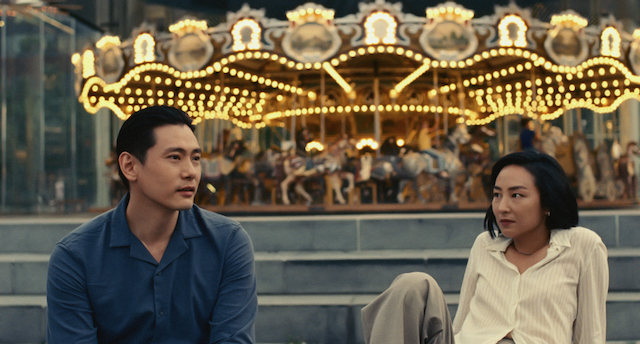
Hae Sung (Teo Yoo) visits Nora (Greta Lee) in New York, a scene from “Past Lives”. Photo courtesy of Elevation Pictures

“Past Lives” is a meticulously crafted feature that is autobiographical in nature, naturalistic in style, and far-reaching in its resonance. The directorial debut of Korean-Canadian playwright Celine Song who is now based in the US, it premiered at Sundance early this year and subsequently was nominated for a Golden Berlin Bear at the 73rd Berlinale. Most recently on July 2, its accolades continued at the Hollywood Critics Association Midseason Awards winning Best Indie Film, Best Actress for Greta Lee and Best Screenplay for Song.

Nora (Greta Lee), immigrated to Canada from South Korea when she was twelve, following her parents’ decision. As a child, she has always been Na Young (Moon Seung-ah), now given a new name, Nora, by her father as they prepare to leave. Her departure severs a close tie with her childhood sweetheart Hae Sung (Seung Min Yim).

Twelve years later, Nora makes a move to New York City from Canada in pursuit of a career in writing, a decision this time of her own choosing. While there, she happens to come into contact with Hae Sung (Teo Too) online. The two meet again via texts and Skype but that connection is short-lived as Nora initiates a termination, for she wants to focus on her writing career and setting roots in her newly adopted home. Fast forward some more years, Hae Sung comes to New York in person to seek her out. Nora’s past thus re-emerges. 

In a writer’s retreat, Nora meets Arthur (John Magaro) and they soon fall in love. When Hae Sung comes to New York, Nora has been married to Arthur for seven years. Despite being in a secure and loving marriage, Nora feels the conflicts of navigating between two men from the present and the past, as well as choosing a path for the future. ‘Yet knowing how way leads on to way’ as the poet Robert Frost poignantly utters, she laments the loss that comes with only one path to tread, one road to take. 

While it may sound like a typical immigrant story–the ambivalence of losing and gaining as one makes decisions about leaving one’s homeland to start a new life in a foreign country–Nora’s narrative ripples out beyond the immigrant experience. We are all constrained by time and space. Somewhere in our life, we are bound to have left behind a part of ourselves, our childhood, our roots as we move forward to another stage of life.

In the opening bar scene where Nora sits in between her husband and her childhood sweetheart, she is the interpreter of two languages, navigating between cultures, and juggling two identities of self. Nora finds herself acting as an intermediary between two men who love her but in different ways and as a different persona, Nora and Na Young. This is a real-life scenario Song had once found herself in and which became the initial spark of the making of “Past Lives.”

Arthur is in an awkward situation. In one of the pivotal scenes, an intimate husband and wife conversation in bed, he tells Nora that she speaks Korean in her dreams, “there’s a part in you that I won’t be able to know.” That part is the first twelve years of Nora’s life where Arthur was absent and which Hae Sung longs to recapture. Arthur admits, “I can’t compete.” However, instead of handling the conflict as a clichéd love triangle, Song has turned it into a cinematic pondering of life choices, what one leaves behind and what one gains in a new chapter of life. 

Magaro delivers a superb portrayal of the ambivalence in Arthur’s predicament. His screen presence and dialogues with Nora offer much clarity. As well, his is a character that has the power to elicit deep empathy from viewers, on top of adding some subtly humorous moments. I wish there is more of such screen time for this admirable role. Arthur’s mature love for Nora overrides any jealousy or traces of inferiority complex when Nora casually compares the two men, effectively shifting viewers’ attention from the reunion of childhood sweethearts to this third party, the loving and silent husband stepping aside to let his wife dwell on her past. 

And Nora appreciates Arthur’s love, albeit it doesn’t eliminate the lament she feels about the loss of a former self. Having transplanted in New York City, she has gained a new cultural identity as a ‘Korean-American.’ After meeting Hae Sung again, she finds him firmly rooted as a ‘Korean-Korean.’ Song’s dialogues are astute. Lee’s screen presence is affable and nuanced, a pleasant character with whom viewers can readily empathize. Hae Sung seems to subscribe firmly in In-Yun, the Korean concept of predestined fate.

Young Hae Sung (Seung Min Yim) and young Nora (Moon Seung-ah) part ways. Photo courtesy of Elevation Pictures

There is a recurring shot which speaks volume. A fork in the alley where young Hae Sung and Na Young walk home after school in Seoul. Two roads diverge. On the left is the boy continuing his way, on the right is his sweetheart, walking up the steps, two separate paths, two life trajectories. It’s not about taking the road less travelled as Frost would tell with a sigh, but the road not taken that keeps the traveller thinking what could have been. While such is a typical existential pondering of the immigrant experience as one leaves one’s homeland to start another life, it is also a universal question as we concede our limitation as humans, feeling the loss of opportunities or the what if’s with the road not taken. Song’s feature is like a visual depiction of Frost’s poem, illustrating a real life scenario. 

Song excels here in elliptical storytelling. Some sequences are almost dreamlike with blocked-out dialogues, or a still camera pointing at Hae Sung and Nora gazing at each other in silence; viewers are free to imagine what’s going through their minds.

However, with the short 105 minutes film duration, I feel more time could have been spent on a deeper characterization of Hae Sung in Korea. What kind of a man has he grown into other than merely the soju drinking young man or later just the outward changes in appearance; and how he still clings to a childhood image of Na Young now that they are adults. If Hae Sung can be developed into a more solid, three-dimensional character instead of like a ghost of Nora Past, the conflicts could have a more powerful impact. 

Surely, this is Nora’s story, and Lee has delivered effectively with pathos and realism. Further, Song has proven herself to be a filmmaker to watch in the future. 

~ ~ ~ Ripples

___________________________

I thank Asian American Press for the permission to repost my review here in full.

Glass Onion: A Knives Out Mystery with a Magic Fugue

Even before we see anything with the screen black, we hear the subject melody, the quiet and ponderous single line of piano music. What piece is this? One might ask. Eight minutes into the movie, in a convivial house party, we get the answer.

Fashion icon Birdie Jay (Kate Hudson) is intrigued by the tune as well when she tries to open a mystery box sent to her by the tech mogul Miles Bron (Edward Norton). Before she can Shazam it, the answer is given by none other than the renowned cellist Yo-Yo Ma himself. That’s Bach’s ‘Little Fugue’ in G minor, he explains to Peg (Jessica Henwick) while munching on some sort of finger food in her house party.
“A fugue is a beautiful musical puzzle based on just one tune. And when you layer this tune on top of itself, it starts to change and turn into a beautiful new structure,” the virtuoso casually points out. An apt description of what’s to come.

And, of course, Birdie Jay can’t get her answer, for she’s talking to a lamp to Shazam the tune thinking it’s Alexa.

Writer/director Rian Johnson’s sequel to Knives Out (2019) is a totally different offering in sight and sound. A comedic murder mystery in the vein of an Agatha Christie novel with the Knives Out detective Benoit Blanc (Daniel Craig, never mind his accent), a dapper Columbo, a sunny locale, striking set design, a well-written screenplay and seamless editing, and not least, an animated ensemble cast, we get an entertaining feature.

The connections are multiple, watching it viewers become sleuths themselves to decipher the associations and allusions, visually, musically, and cinematically. Spotting all those cameos is fun too: Angela Lansbury, Stephen Sondheim, Kareem Abdul-Jabbar, Serena Williams. Or check out what’s Ethan Hawke and Hugh Grant are doing there.

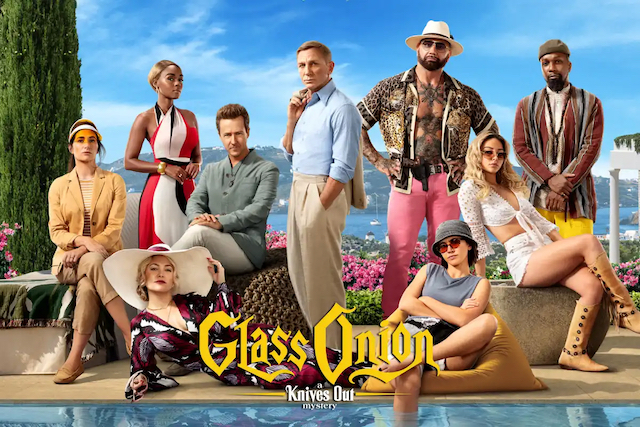
Miles is a friendly egotist, seen as a genius by some, extreme danger by others, probably knowing his personal philosophy is “fake it till you make it.” The tech titan has invited his insider group of ‘Disruptors’ to an annual reunion weekend. This time the event takes place on his private Greek island in the form of a murder mystery party; his guests are to solve his own murder. The Disruptors are fashionista Birdie Jay, social media influencer Duke Cody (Dave Bautista), politician Claire Debella (Kathryn Hahn), and scientist Lionel Toussaint (Leslie Odom Jr.)

The key person to show up shocking them all is Andi Brand (Janelle Monáe) who used to be Miles’s business partner. So, some background story needs to be peeled off. Miles’s home on the island is the Glass Onion, a spectacle of an architecture that looks exactly as its name denotes, a metaphor for the core truth actually is hidden in plain sight through visible layers.

The sounding of the hourly dong that echoes through the island (voice of Joseph Gordon-Levitt) is one of those moments in the movie that evokes a chuckle, especially when we hear Miles say he got Phil Glass to compose that. Yes, that’s Philip Glass, the minimalist composer creating that one note sound of the gong for Miles. No, not a joke on Glass but more on the self-importance of the tech mogul himself.

Same with the Mona Lisa encased in a sensitive glass protective display case. More chuckles from that too. The world famous painting is on loan to Miles from the Louvre via the French government during the pandemic when all arts venues are closed and revenues lost. Miles is pleased that the art world, even government, bows to his whims, “I wanna be responsible for something that gets mentioned in the same breath as the Mona Lisa. Forever.” And now he has it in his palm, no, not the Mona Lisa, but a little solid hydrogen fuel crystal which will be a gamechanger in global energy source. His plan is to invite national leaders to the Glass Onion to unveil it.

As the story begins to peel off layer by layer, we know each of these Disruptors have their reasons to be loyal to Miles as their personal interest depends on his patronage. Ironically, they also harbour resentment towards him.

Half way into the movie an important layer peels off, revealing the backstory. I have no issue with such a twist, for now I anticipate new conflicts on a different level, heightening the tension. From here on, viewers are shown the point of view of Andi’s character. Reminiscence of Kurosawa’s Rashomon, we can now see more clearly what actually happened in the previous sequence of events, this time, from the perspective of Andi’s; now we understand her as our reluctant heroine.

Repeating the scenes isn’t necessarily redundant, Bach would have said. That’s exactly what he did with the fugue, the same tune appearing in a different context in the contrapuntal composition. While he would probably have found the movie ending shocking, he’d likely be curious to hear songs by singing groups called The Beatles, Red Hot Chili Peppers, The Bee Gees… among others, or listen to the harpsichord and orchestral theme by a 21st century composer called Nathan Johnson (Rian’s cousin).

From Bond to Blanc, Craig’s collaboration with the Johnsons has made the Knives Out movies a promising and entertaining franchise.

~ ~ ~ Ripples

‘Minari’: The Little Seed that Could

Minari is a semi-autobiographical narrative based on director Lee Isaac Chung’s childhood experience. It tells the story of a Korean immigrant father striving to succeed in America while his wife strains to keep their family together. In the midst of the struggle for a better life, two children watch and learn and grow. 

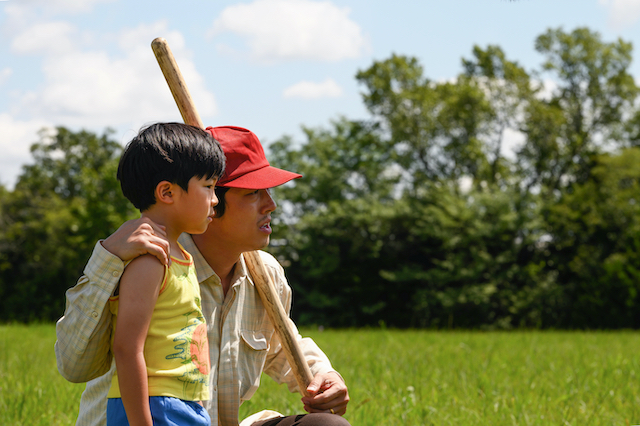
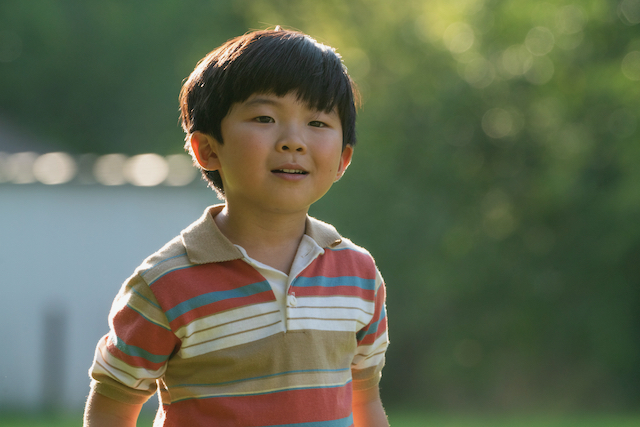
Chung’s counterpart in the movie, seven-year-old David (Alan Kim), follows his parents Jacob Yi (Steven Yeun) and Monica (Yeri Han), together with his older sister Anne (Noel Kate Cho), to relocate from California to rural Arkansas in the 1980’s. Driven by the ambition to be successful, especially in the eyes of his children, Jacob has purchased 50 acres of land to start a farm growing Korean produce. With the influx of Korean immigrants coming into the country during that time, Jacob sees a wealth of opportunity.

MINARI_00195_R Alan S. Kim, Steven Yeun Director Lee Isaac Chung Credit: Melissa Lukenbaugh/A24

Jacob and Monica still hold a day job at a hatchery doing chicken sexing, separating the male chicks from the female, but Jacob sees no future in the routine work. The farm is his dream. In the sexing process, the male chicks are discarded, for they don’t taste as good and can’t lay eggs. A ready object lesson for him to teach his young son: be useful. And when he digs a well, he dismisses the dowsing method offered to him. “Koreans use their heads,” he tells David.

Monica, however, sees a very different picture. The dream home in the country for Jacob is for her, realistically, a trailer on wheels held up by cinder blocks. Water is from a well which later is drained dry to the crops. There’s no community nearby. Her main concern is living far from a hospital as David has a life-threatening heart murmur. “Don’t forget to keep praying,” she tells David. The couple’s opposing views lead to frequent conflicts in front of the children.

The tipping point comes when Monica’s mother is recruited to help with the kids. Arriving from Korea, Grandma Soonja (Youn Yuh-jung) brings with her Korean spices and rarity not found in America, as well as Korean songs, memory of courtship that has long been buried by her daughter and son-in-law.

For David, Grandma is far from what he has expected. She is a raucous card player, swears, doesn’t cook or bake, uses half his room and, aggravating his annoyance, snores. The interplay between grandma and grandson make up some light-hearted scenes which elicit from Kim performance in his natural poise alongside the veteran, seasoned Youn. The key element in their eventual bonding is love. Kudos to Chung for his screenplay and directing.

MINARI_02405_R Alan S. Kim Director Lee Isaac Chung Credit: Josh Ethan Johnson

Another supporting role that has added spice to the film is Paul (Will Patton), a practical farm help to Jacob. A devout Pentecostal, Paul’s eccentricity is a laughing stock even with church kids. Jacob does not subscribe to his beliefs. Admirably, the two can still work in harmony.

Premiered at the 2020 Sundance Film Festival and winning both its Audience Award and the Grand Jury Prize, Minari has come a long way this past year garnering accolades. The film is now an Oscar nominee in six categories including Best Picture, Best Director and Original Screenplay for Chung. Yeun becomes the first actor of Asian descent to be nominated for Best Actor. Youn gets a nod for Best Supporting Actress and composer Emile Mosseri for Best Original Score.

Compared to his acclaimed debut feature Munyurangabo (2007), an arthouse, experimental film about two youths in post-genocide Rwanda, Minari is a conventional take on a personal, family story. The storytelling is linear and captured in realism, as we follow the Yi family’s first arrival to rural Arkansas and the daily struggles as an immigrant, farm family. The film’s subject matter and Chung’s handling is deceivingly simple.

Thanks to the eponymous vegetable, the minari, Lee transfers the specific to a wider scope in different layers. Minari is a Korean watercress that grows hardily in wet soil. Grandma has brought some minari seeds with her from Korea and sows them beside the creek near their home. As days go by, the plants thrive on their own, an apt metaphor for the resilience and adaptability of immigrants taking roots in a new soil. 

In contrast to a grim lesson of discarding the male chicks at the hatchery David learns from his father, the minari along the creek is a visual reminder of being alive and useful. Grandma sings its praises, for the versatile vegetable can be put in kimchi, stew, and soup, and used as medicine when sick. “Minari, Wonderful.” Grandma and David burst out in an impromptu song. A delightful scene is captured by the camera. As the wind blows, the plants bow as if acknowledging their praises. A moment of magical realism.

As time goes by, the minari plants thrive, and David’s heart condition has improved on its own such that surgery is no longer needed. In the climactic scene and its fallout, a contrast is particularly notable. Jacob sweats and labors on his crops which can be gone in an instant, but the minari grows naturally in the wild and David’s illness healed, pointing to a harvest of transcending grace that is beyond human efforts. The denouement is a gratifying close to a chapter of childhood memory.

~ ~ ~ 1/2 Ripples

***

I thank Asian American Press for allowing me to post my review here in full.

Ripples from the history-making 78th Golden Globes

Last night I dreamt I was interviewing Chloé Zhao. Not just a sit-down interview, but I actually hung out with her as buddies. That was a dream, and that much is true.  

Before the dream, I was watching the 78th Golden Globes Awards show aired live last Sunday night. This year, it’s a much scaled down, stripped to the minimal, virtual event. The show must go on, as they say. So, we have Amy Poehler from the Beverly Hilton in Los Angeles and Tina Fey from the Rainbow Room in New York being pulled together on one screen as if they were standing side-by-side for the fourth time hosting. A technical marvel.

Nominees were at home or wherever they were at that moment, wearing whatever they felt like, watching and giving acceptance speech via their own small screen. A few of them were at the Beverley Hilton adorning glamorous, designer gowns, a reminder of previous Globe glitters and the red carpet.

Other than the unprecedented format, history was made last Sunday night.

Chloé Zhao became the second woman to win the Best Director Golden Globe award in the 78-year history of the Hollywood Foreign Press Association’s annual extravaganza. She is also the first Asian woman to do so. What more, her film Nomadland won the top prize, Best Motion Picture – Drama. As a co-producer, she became the first woman producer of Asian descent to receive that accolade.

For a historical reference, Barbra Streisand was the first female to win a Best Director Golden Globe with Yentl in 1984. Taiwanese-American Ang Lee claimed that honor twice with Crouching Tiger, Hidden Dragon in 2001 and Brokeback Mountain in 2006, the only other Asian American to take that award.  

If it’s not due to Covid 19, never could there be a Best Director and Best Motion Picture winner accept the Golden Globe dressed in an olive color t-shirt, hair in pigtails. She probably might not be at home, maybe at work on location. But still, I remember the Cannes controversy where female stars were frowned upon––no they didn’t outright say ban––for not wearing heels on the red carpet.

It’s in this unassuming manner that Chloé (I’m sure she wouldn’t mind me calling her by her first name) picked up her color-matching mug to toast everyone and gave her virtual acceptance speech. Quoting the ‘guru’ among the nomads, Bob Wells, she said:  

“Compassion is the breakdown of all the barriers between us. A heart-to-heart bonding. Your pain is my pain. It’s mingled and shared between us.” She then went on to say, “this is why I fell in love with making movies and telling stories cause it gives us the chance to laugh and cry with each other, to learn from each other, to have more compassion for each other.”

An iconoclast, no doubt. If not because of the pandemic, I can’t imagine a female Globe winner in a t-shirt and I assume, no make-up, and speaks from her heart, not to shun the glitter of the gold but just to be her normal self of a human being, most likely here too, as an identification with the nomads in her film.

Accepting the Best Motion Picture – Drama award, she said about Nomadland:

“At its core, for me, it’s a pilgrimage through grief and healing. So, for everyone who has gone through their difficult and beautiful journey at some point in their lives, this is for you. We don’t say goodbye, we say see you down the road.”

Maybe that image rippled in my mind as I went to sleep and conjured up that dream…

Well, see you down the road, Chloé. And hopefully then, not in a dream, but for real.

***

Related Ripple Posts:

Nomadland Book Review

The Rider is Poetry on Screen

Top Ripples 2020

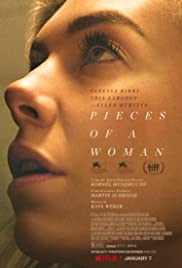
‘Pieces of a Woman’ Review

For the first 30 minutes before the title comes out on screen, viewers follow almost in real time a home birth gone awry. They witness the intense moments of Martha (Vanessa Kirby) giving birth, the contractions, the unbearable pain, the difficult labor, the birth, the joy, and then the tragedy. That first section is absorbing and the shaky handheld camera increases the intensity.

The movie is inspired by screenwriter Kata Wéber and director Kornél Mundruczó’s real-life experience of losing a baby during pregnancy. In Pieces of a Woman, the duo depict not just the court of legal proceedings, but the court of public opinion, and within the family, generational and relational adversary when faced with the loss of a baby.

Martha and her partner Sean (Shia Labeouf) maintains a precarious relationship to start. She dresses chicly, works in a modern tower and has her own office; he works in construction outdoor building a bridge. It’s not so much their jobs but the incompatible personalities between them. Martha is soft spoken and reflective; Sean, sporting a bushy beard, is boorish (his own word, albeit sarcastically) and physically abusive. The dashed hope of a child tears apart an already fragile relationship.

Kirby doesn’t let her previous role as Princess Margaret in The Crown S1 & 2 define her. Here as Martha, she is everywoman expecting her first baby, mixing hope with trepidation. Reticent in her demeanour, after the death of her newborn, she withdraws deeper into her own self, grieving in her own way, picking up the pieces of what’s left of a woman. She is the main attraction of the movie.

Labeouf’s psyche is a mixed bag too, but with different elements. His hopeful excitement of imminent fatherhood is obvious, but is it another aspect of domination? Considering Labeouf’s real-life legal charges against him of domestic violence and sexual battery, it’s eery to watch him befitting the role of a needy abuser.

It is the veteran actor Ellen Burstyn’s performance as the overbearing mother of Martha’s that bring out the two main characters. Burstyn plays Elizabeth, domineering and combative. The beginning scene sets the tone as she buys a minivan for Martha and Sean. Not a good thing to let your mother-in-law buy you a new car, or the mother of your girlfriend, same thing. Elizabeth despises Sean and belittles her own daughter. So much for the symbol of the big gift.

Elizabeth’s reaction to the tragic home birth is to push Martha to sue the midwife Eva (Molly Parker) for negligence. In her view, that’s the way to get justice and compensation. While the legal trial leads to an unexpected resolution at the end, the climax of the movie comes a little earlier, in Elizabeth’s classy, tastefully decorated home. It highlights the court of domestic interactions, setting up a scene reminiscence of August: Osage County (2013). Elizabeth’s survival and combative instinct challenges Martha’s reticence. This is one of the two best scenes of the whole movie. The other during the court recess of the trial, but I won’t elaborate or it will be a spoiler.

Here in Elizabeth’s home where the family has gathered, the camera follows Martha in a long take as she moves agitatedly around the living and dining room, a woman reacting to pieces of casual conversations aiming at making the mood light, but which soon crescendos into a full blown mother-daughter confrontation.

Well acted and absorbing. A takeaway could be that, experience is subjective and personal; what one generation has gone through and even lessons learned can best be shared and hopefully inspire but can’t be transferred or expected to elicit the same results in the next generation. Amidst the tension, Elizabeth relays her wartime moment of resilience when as a young child, how a doctor held her weak body up by her feet and said, “if she tries to lift her head, then there’s hope.” And, she did. Now that she’s an ageing mother, a new lesson to learn might be to realize that such an experience cannot be imposed on her daughter, for Martha has her own way to deal with grief and ‘lift her head’, as shown at the conclusion of the trial.

~ ~ ~ Ripples

___________________________

Pieces of a Woman won the Arca Cinema Giovani Award and Vanessa Kirby Best Actress at the Venice Film Festival 2020. Now streaming on Netflix.

‘Downhill’: Faux Majeure

Here’s a quote I’ll use again and again, from South-Korean director Bong Joon Ho’s acceptance speech for Parasite winning Golden Globe’s Best Foreign Language Film award in January:

“Once you overcome the one-inch-tall barrier of subtitles, you will be introduced to so many more amazing films.”

Downhill

Downhill is a case in point. If one is willing to overcome the one-inch tall barrier called subtitles (they are in English, mind you), one will be amazed how true and powerful and entertaining the Swedish film Force Majeure (2014) is, and that watching the Ruben Östlund directed original would likely reap the most enjoyment and provoke some deep thoughts. Maybe an American version isn’t needed to begin with.

Written and directed by Nat Faxon and Jim Rash, with the Oscar nominated Jesse Armstrong as co-writer, if they’re to make an American version, there could have been potential for a fresh take. Force Majeure‘s literal meaning is a superior force, an unavoidable, overtaking power. Here’s the premise of the movie, which in itself is an interesting case for discussion:

A well-intentioned family holiday at a ski resort for bonding is shattered as the result of an instinctive reaction on the part of the husband/father. It happens when a controlled avalanche strikes a little too close to his family sitting at an outdoor dining table, he runs for his life while his wife huddles and protects their two boys. What follows is the underlying current of discontent and anger of the wife’s surfacing like a geyser. 

The producers must have seen the potential comedy in such a scenario. One of them is Julia Louis-Dreyfus, the Emmy and Golden Globe winning comedy actor, and a fan of the original Swedish film. Playing the wife Billie, Dreyfus shows she has her heart in it. In several scenes, she’s effective in bringing out Billie’s frustration. However, the issues of the movie are beyond her control, a real case of force majeure?

First is the casting of the husband Pete with Will Ferrell. Surely, for a comedy, Ferrell would be a natural choice. Call it irony, the indifferent demeanor Ferrell gives out as an actor in this movie actually parallels the husband Pete’s attitude, as if he’s being dragged up the ski hill. Have cell, will travel. His phone is what he’s resorted to as companion on a family holiday that he’s not ready to go on.

Pete’s work friend Zach (Zach Woods) and his girl friend Rosie (Zoe Chao) happen to be near where they vacation, so Pete secretly texts them to come over to their hotel in the guise that it’s their initiative to drop in. Here’s a pair of supporting roles if given more to play can add substance and context to the thin storyline, but they don’t have the chance. In the original Force Majeure, this couple plays a crucial part, especially with Kristofer Hivju’s performance as Mats, who’s full of humor. Hivju is also in Downhill, but only with a very minor role as the ski hill manager.

Other issues pervade, the script could well be a major one. As a comedy, there’s not much for laughs. It presents a problem but doesn’t delve into it; a comedy doesn’t mean superficial treatments. As a film that’s supposed to capture a sporting vacation, it lacks energy. No wonder the kids are so bored. The title is prophetic; I’m sure that’s unintentional. 

If an American version is the intent, then make it truly American, tell an American marriage story with this scenario. With Downhill, however, the European location, the ski resort surroundings, the actual scene of the controlled avalanche mishap, the set design, even the teeth-brushing moments in the hotel bathroom look almost the same as the Swedish original, other than the fact that the actors speak English. With its loose editing and scattered thematic matters, Downhill looks more like a parody of Force Majeure than a stand-alone comedy on its own.


~ ~ Ripples 


***


CLICK HERE to read my review of Force Majeure


‘A Hidden Life’: A Film for the Season

For over 10 years at Ripple Effects around this time, I’ve a Christmas post entitled Reading the Season. That’s when I post a book or collection of poetry that I find relevant for Christmas. This year I’ve something different. It’s a film that could offer some quietude among the cacophony of the season.

I first saw A Hidden Life at the Toronto International Film Festival in September. It’s now showing in selective cities.

**

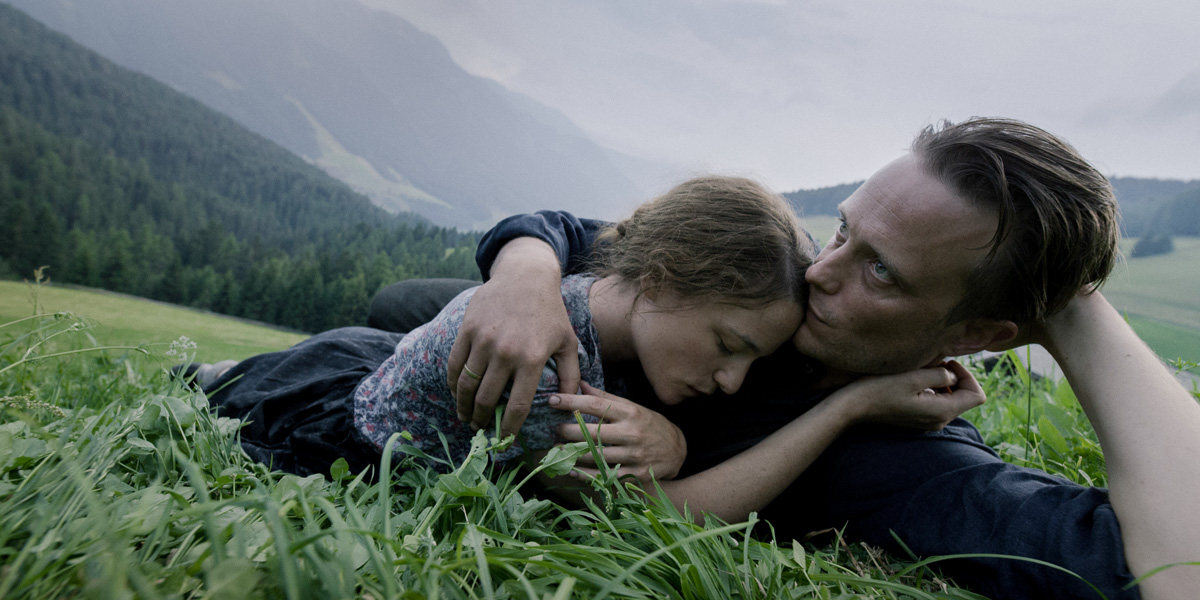
Written and directed by Terrence Malick, A Hidden Life is the story of an unsung hero, Austrian farmer Franz Jägerstätter (August Diehl), a conscientious objector who refused to take the oath of loyalty to Adolf Hitler to fight for the Nazis in World War II, for he saw Hitler’s war unjust and evil.

A Hidden Life
Valerie Pachner and August Diehl in the film A HIDDEN LIFE. Photo Courtesy of TIFF.

The title alludes to George Eliot’s ending of Middlemarch:

…for the growing good of the world is partly dependent on unhistoric acts; and that things are not so ill with you and me as they might have been, is half owing to the number who lived faithfully a hidden life, and rest in unvisited tombs.

A quest for spiritual meaning is the signature of the reclusive director’s works. They are often expressed in whispered voiceovers from the characters, revealing their doubts and questions, anguish and insights.

Days of Heaven (1978) establishes Malick’s aesthetic style of using natural light to shoot his films, every frame exudes cinematic poetry. The Thin Red Line (1998) begins his signature whispering voiceovers to express inner thoughts and spiritual quests. But it’s The Tree of Life (2011) that makes such whispers monumental as Malick situates the microcosm of a Texan family within the cosmos, and asks questions of the Creator the problem of pain and death, the struggle with human nature, with love and hate, and despite all human failings, the presence of grace.

Since The Tree of Life, Malick has produced several ‘misses’, films that are not well received as they are elliptical and experimental but visionary no less. To the Wonder (2012), Knight of Cups (2015) and Song to Song (2017) all point to one common quest: in the materialistic world of the rich and famous, what makes life meaningful? And, can true love be found?

A Hidden Life is Terrence Malick back to his form in a more traditional style of filmmaking, and more explicitly spiritual as he tells the story of a faithful, historic figure, Austrian farmer Franz Jägerstätter of St. Radegund, a village in Upper Austria. Before Germany’s ‘annexation’ (Anschluss) of his country, family life is blissful and easy for Franz. He farms the land among natural vistas, stays rooted in a close-knit community, happily fathers three young daughters, and is deeply in love with his wife Fani (Valerie Pachner). The arrival of a conscription letter in 1943 changes everything.

Franz knows he cannot join Hitler’s military, but the refusal to do so means certain death and the risk of endangering his family. He struggles hard to deal with the dilemma and seeks guidance from his Catholic church, but his priest tells him patriotism is what’s demanded of him. His village folks ostracize him; the mayor urges him to comply with Hitler’s demand, for one traitor among them can endanger them all. But Franz stands his ground even with the consequence of execution, a stance reminiscent of the Christian pastor Dietrich Bonhoeffer who died under Nazis hands for refusing to let Hitler’s doctrine to supplant his church.

In this way, A Hidden Life offers an opposite stance different from Martin Scorsese’s Silence (2016), adaptation of Shusaku Endo’s novel. Here we have a courageous conscientious objector willing to suffer the loss of everything and the risk of harm to his family and kinsfolks in defying a ruthless ruler. A Hidden Life is a real-life testimonial of a believer while in the face of persecution, still refuses to step on the Nazi fumie to renounce his faith.

After incarcerated in the German military prison near Linz then transferred to Berlin to await trial, Franz is allowed to write one letter to Fani every month. The love the couple share in the film has its basis on these poignant letters which have since been compiled and published by Orbis Books. Franz’s absence from home brings Fani back-breaking hardships on top of social ostracizing. Her mother and sister come to live with her to offer whatever support they can give.

Capturing mainly natural light for his filming, Malick contrasts the idyllic family life in the beauty of the natural landscape of Franz’s home setting with the harshness of his imprisoned existence. What’s more tortuous though is his internal struggle. While in prison, his captor Captain Herder (Matthias Schoenaerts) says to him: “What purpose does your defiance serve? No one knows about you.” Yet Franz is convinced that his action isn’t to please others or to glorify himself, but to do what’s right in the eyes of his God. Franz’s own hidden spiritual life empowers him to stay strong.

In his trial, again he is being challenged: “Will anyone outside this court hear you? No one will be changed.” Yet he says nothing in his own defence, an allusion to the One who had stood trial in front of a ruler and said nothing in the face of death.

In a voiceover we hear these inner thoughts, Franz’s words to Fani:

“Time will come when we’ll know what all this is for, and why we live.”

There are plenty of quiet moments, long takes and slow pacing for viewers to think and ponder. The 174 minutes of screen time offers an opportune respite from the hustle and bustle of the Season, a quietude to evaluate, if you will, now that we’re at the end of another decade and in a time of tumultuous change.

The soul-stirring music is another reason to sit down in the theatre and quietly let the story unfold. Film composer James Newton Howard has created a full orchestral score complementing the cinematography, not only in capturing the beauty of the vistas but in his own words: “… to focus on the emotional journeys and crises of conscience of the characters—writing music to reflect their story.” Listen for the solo violin representing the sentiments of Franz and Fani, masterfully played by the Canadian violin virtuoso James Ehnes.

What’s hidden could be more precious, like treasure in jars of clay. And these words came to mind as I give A Hidden Life further thoughts:

… we look not at the things which are seen, but at the things which are not seen: for the things which are seen are temporal; but the things which are not seen are eternal.

~ ~ ~ ~ Ripples


***


Reading the Season Posts:

2018: Madeleine L’Engle’s Poem The Irrational Season

2017: A Wrinkle In Time by Madeleine L’Engle

2016:  Silence by Shusaku Endo

2015: The Book of Ruth

2014: Lila by Marilynne Robinson

2013: Poetry by Madeleine L’Engle

2012: Surprised by Joy by C. S. Lewis

2011: Walking on Water by Madeleine L’Engle

2010: A Widening Light, Luci Shaw

2009: The Irrational Season by Madeleine L’Engle 

2008: The Bible and the New York Times by Fleming Rutledge

2008: A Grief Observed by C. S. Lewis

For my review of The Tree of Life and Silence, click on the links embedded in the titles.


‘Faces Places’ with Agnès Varda and JR

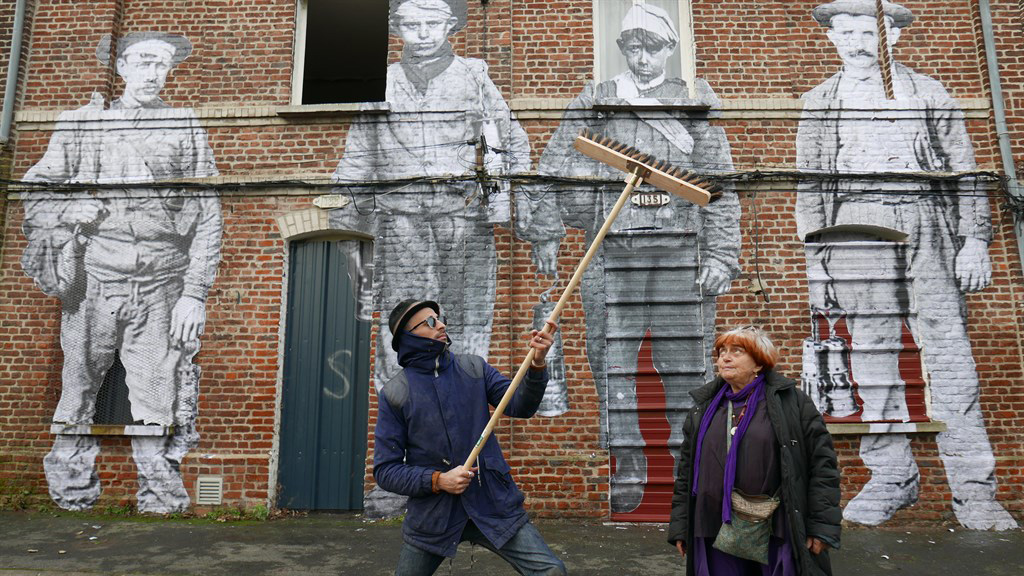
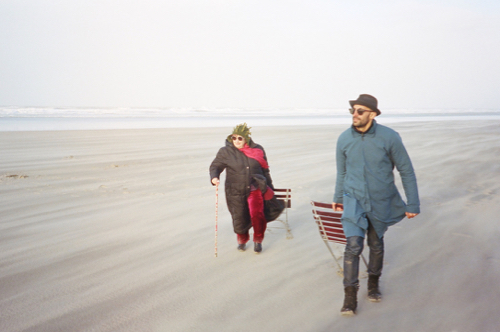
From high art in the gallery (my last post) to street art, here catching the last chance for a Paris in July entry, I’m presenting the fascinating documentary, a road movie of making art in the open milieu of villages and among the working populace. Faces Places (2017) is an account of the venerable auteur of the Nouvelle Vague (The French New Wave: Goddard, Truffaut…) Agnès Varda (1928-2019), then at 89, going on a road trip with photographer and artist JR to scout for ordinary people to photograph in various obscure locales in France.

the world's longest baguette .jpg

Their larger than life photo prints are then pasted onto buildings or open places for everyone to view, evoking the shared joy of living, working, and the collective memory of a meaningful past. Like this one with photos of pioneer miners pasted on a row of dilapidated homes slated for demolition in a miners’ community. The one remaining homeowner who refused to vacate her house was moved to tears upon seeing the completion of the project.

Miners from days past.jpg

Art undefined and unconfined, once pasted onto these surfaces, JR’s black-and-white photographic images convert the whole building or structure into an art form. The world is his canvas. Unlike Banksy, JR is transparent with his creative process, and lets the public view his work in progress. A TED Prize winner (2011), his large-scale, participatory art projects are installed all over the world, albeit sometimes illegally according to local laws, but the people welcomed him.

At age 89, Agnès Varda became the oldest nominee in Oscar history when Faces Places was nominated for Best Documentary for the 2018 Academy Awards. It’s now on DVD and Blu-ray. Her numerous older works may not be accessible for us so readily. Check your streaming or on demand services. I was able to watch two of her excellent films Vagabond (1985) and Cleo from 5 to 7 (1962, click on link to my review). Don’t miss this short clip on IMDb “Agnès Varda in Memoriam”.

The soul-stirring original music by Matthieu Chedid complement the meaningful duo collaboration. At the beginning, JR talks with Varda to organize the making of their joint project. We see them exchange the following dialogues:

AV:  What I like was meeting amazing people by chance.

JR:  So you want to carry on that way, with no plan or itinerary?

AV:  Yes. Chance has always been my best assistant.

JR:  Do you think chance will work for both of us?

AV:  Maybe.

From the film, we can see chance had worked for both of them marvellously.


AVJR-Chairs-on-the-beach-Normandy (2).jpg


~ ~ ~ ~ Ripples


***


Paris in July is hosted by Tamara at Thyme for Tea

PIJ2019 Tamara

Other Paris in July 2019 Posts on Ripples:

Pictures at an Exhibition 

‘Coco Before Chanel’ directed by Anne Fontaine

‘Gemma Bovery’ to cool your summer day

‘A Sunday in the Country’ is an Impressionist Cinematic Painting