Paterson: Of Pug and Poetry

Some movies are like the roaring ocean, waves mounting upon waves rousing up excitement, eliciting continuous, sensational reactions. Some are like a bubbling brook, smaller but still boisterous, teeming with life and sounds. The film Paterson is a quiet stream, water gently flows along, seemingly uneventful, and yet, you can sit there by its side and just watch its quiet swirling.

Paterson has been screened at many film festivals this year. I missed it at TIFF, glad I could catch it when I came home to CIFF. For a film about poetry and a loving couple (not dysfunctional, for a change) with a British bulldog named Marvin, a character in his own right, and helmed by a Palm d’Or winning director, it’s got to be a unique experience.

Director Jim Jarmusch has been garnering accolades at the Cannes Film Festival since 1984, with his early feature Stranger Than Paradise. His most commercially known work probably is Broken Flowers (Cannes Grand Prize of the Jury, 2005) with Bill Murray and Julie Delpy. This year, Paterson has once again brought the director to Cannes as a nominee for the prestigious Palme d’Or. 

Jarmusch ought to be applauded for making a film on poetry, for who in this day of mega explosive, blockbuster productions would think of turning Williams Carlos Williams’ poetic notion into a movie. Yes, WCW himself was a resident of Paterson, New Jersey, and his 5-volume epic poem Paterson must have been the source inspiration for Jarmusch.

paterson

The movie Paterson is about an admirer of WCW and an aspiring poet whose occupation may be furthest from the creative process. But that’s exactly the point. Where do we get inspirations and ideas? What kickstarts our creative process? Do we need to climb to the top of the mountain, soak up a magnificent sunrise to unleash our creativity? Apparently not.

We see in the film that the most mundane of everyday objects, like, a box of matches, can spark off a new poem. Jarmusch has his own style of cinematic poetry making: the deadpan, casual expressions of his main character, thus, embedding humour in the serious. Adam Driver (While We Were Young, 2014) is probably the best person to star in this film, not only in name, but in his demeanour. He is Paterson, a bus driver with a daily route of driving bus route no.23 around the small town of Paterson, New Jersey.

We follow Paterson for a week. He gets up at the same time, around 6:20 am, plus or minus 5 minutes, eats his breakfast cereal, carries his lunch box and goes to work. He drives his no. 23 route around town, overhearing passengers’ small talks, brewing in his mind thoughts and ideas, writing down lines in a note book when he has a chance, has his lunch sitting on a bench overlooking the Great Falls of the Passaic River, then back to work. After work he goes home, has dinner with his loving wife Laura (Golshifteh Farahani), walks the pug Marvin, ties him outside the bar, goes in and have his beer, chats with bartender Doc (Barry Shabaka Henley), meets the regulars Everett (William Jackson Harper) and Marie (Chasten Harmon) and listens to their stories, then walks Marvin back home and sleep.

As viewers we see this seven times over. Reminds me of Groundhog Day (1993). But Jarmusch is clever in sprinkling subtle humour and surprises, quite like life. Paterson is a contented soul, driving a bus may be as fulfilling as writing poetry. Wife Laura is more experimental, and takes charge of her creative expressions more explicitly, like learning the guitar to reach her dream of being a country singer, like interior decorating her home according to her obsession with black and white, or baking cupcakes in her own signature style as a step to opening her own cupcake store. Whatever, the two are a loving, contented couple. Creativity manifests in various ways.

Marvin.jpg

And then there’s Marvin, who may be the best pug in pictures. He has a role to play too in this mundane plot. His story line is, again, life as well.

That’s about all I’ll reveal about the movie without giving out the spoiler, yes, even for this seemingly uneventful film. But as I write, I’m thinking of another matter. This film is probably screened only at very limited cities, at arthouse, independent cinemas. So, why am I writing about a film that not many of you will actually be able to see? What exactly is the relevance of writing something that few may relate to? Or… is the review a piece of writing that readers can respond to despite not experiencing the film itself?

If you have some thoughts on this, I’d appreciate your input. Throw your two pebbles into the Pond and create some ripples so I’d have an idea.

Having poured out this puzzling thought that has been troubling me for some time, I’m reminded of Paterson’s poetry writing in the basement of his home, his notebook filled with his private thoughts and lines, which nobody has ever or will ever read. What’s his purpose then?

~ ~ ~ 1/2 Ripples

***

Other Related Reviews on Ripple Effects:

Silence the Movie Arrives in the Most Unwelcome Time

While We Were Young: Wearing the Hat of Authenticity 

A Quiet Passion (2016) at TIFF16

TIFF16 Review: After The Storm

“After the Storm” was screened at TIFF in September. Next week, it will be at BFI London FF and after that, the Chicago IFF. My review was first published on Asian American Press. I thank the editor for allowing me to post my review here on Ripple Effects.

***

Japanese auteur Koreeda Hirokazu graced the Toronto International Film Festival once again this year with his new feature, “After the Storm”. Since 1995, with his multiple award-winning feature “Maborosi”, Koreeda has been a staple at TIFF, which has screened every one of his feature films. His recent works are still fresh in many viewers’ minds, “Still Walking” (2008), “Like Father, Like Son” (2013), and “Our Little Sister” (2015).

With all the avant garde and experimental, new waves of filmmaking bursting out at film festivals every year, Koreeda’s traditional style of storytelling offers a fine balance and an affirming voice. His films focus on the contemporary Japanese family, bringing out themes arising from the individual and extending to the universal. Humanity is what Koreeda is interested in, and his treatment of human foibles and failures is kind and forgiving. “After the Storm” is no exception.

Ryota (Abe Hiroshi) used to be an award-winning author. But for years he has not produced any more works. Divorced from his wife Kyoko (Maki Yoko) and sorely missing his 9 year-old son Shingo (Yoshizawa Taiyo), Ryota is at the bottom of his life. Months behind in his child support payments, he is laden with debt, entrapped by a gambling habit that’s hard to kick. It runs in the family it seems, for his late father had also been a gambler. With his work at a detective agency, Ryota would try all means to squeeze extra cash out of his clients, including deception and even extortion.

Koreeda’s dealing of Ryota is gentle and sympathetic. While he may look unkempt, the six-foot-two actor Abe Hiroshi has his charm and charisma. We see the nasty side of Ryota as he slips into his mother’s cramped unit in a housing project, looking for anything of value he could lay his hands on for pawning. A moment later, Koreeda lets us have a glimpse too of the other side of Ryota, that of a son to an ageing mother Yoshiko (Kiki Kilin). The mother-son portrait is witty and tactful, punctuated with heartwarming humour. It is a reunion of the two actors, also as mother and son, from Koreeda’s 2008 feature film “Still Walking”.

Mother knows best, even when your son doesn’t live with you any more. Deep in her heart, Yoshiko wishes to see her son reunite with her daughter-in-law Kyoko whom she is very fond of. She also treasures the affectionate bonding with grandson Shingo. If only they could get back together as a family, that would be a big relief and comfort, growing old can then be much bearable.

One evening, a passing storm keeps them together in Yoshiko’s home for the night. The impromptu reunion, though awkward, is probably gratifying for every one of them. Koreeda is, alas, a realist. Life is full of disappointments. However close they have come to bonding once again, the moment is short-lived. But the reminiscence and dynamics of the small family’s once intimate relationship regurgitates enough to spark off a renewal for Ryota. While they may continue on with their own separate ways, a new perspective has subtly wiggled in. Perhaps, there’s hope after all. The young, green grass covered with raindrops the morning after the storm is a refreshing metaphor.

koreeda

The film was shot in the housing project where Koreeda had spent his youthful years. That was where his mother lived after his father had passed away. In the Q & A session, Koreeda admitted that certain incidents in the film did happen in the director’s own family. When writing the script though, once he has created his characters, Koreeda would let them run free and so they would develop themselves. Their stories just came out naturally.

Answering questions in Japanese with a translator beside him, Koreeda humbly thanked his Toronto audience, whom he had in mind when he made his films, as TIFF had screened every one of his features. He noted that as we grew older, we had to deal with disappointments, for life often didn’t turn out to be what we’d like to see. “After the Storm” shows us that Koreeda has dealt with his characters’ life disappointments with a forbearing spirit. As for viewers of his films, Koreeda does not disappoint.

~ ~ ~ 1/2 Ripples

***

Other reviews of Koreeda films on Ripple Effects:

Our Little Sister: A Respite from Summer Superhero Movies

Like Father, Like Son: Parent and Child Reunion 

A Quiet Passion at TIFF16

“A Quiet Passion” is a biopic of the reclusive 19th century American poet Emily Dickinson. It is written and directed by the esteemed English auteur Terence Davies, who brought us the adaptation of Edith Wharton’s novel “The House of Mirth” in 2000, “The Deep Blue Sea” based on Terence Rattigan’s play in 2011, and last year’s “Sunset Song”, a beautiful cinematic rendition of Scottish writer Lewis Grassic Gibbon’s work.

Literary filmmaking is Davies’ repertoire. If a movie is about a poet, under his helm, it is only natural that it would be crafted like poetry. In this sense, “A Quiet Passion” is a fine example. Every frame is meticulously composed and lit, the atmosphere dense with meaning. We also hear lines from Dickinson’s poems read out as voiceover. We experience poetry in sight and sound.

However, not all poetry is of the Romantics, roaming vales and hills, dancing with the daffodils. Davies’s Emily Dickinson (Cynthia Nixon) is confined in her father Edward’s (Keith Carradine) Amherst house. Her main human interactions are with her immediate family, a stern father, a depressed mother (Emily Norcross), an attorney brother Austin (Duncan Duff), and her younger sister (Jennifer Ehle). If she ever felt claustrophobic, there’s her sister-in-law Susan Gilbert (Jodhi May) and her close friend Vryling Buffam (Catherine Bailey). Too narrow a social circle? Not really, for they are all responsible for sharpening her views and words. And they make a wonderful cast.


a-quiet-passion
Terence Davies, Cynthia Nixon, Jennifer Ehle, Jodhi May, Catherine Bailey
Under the direction of Davies, Cynthia Nixon (of ‘Sex and the City’ fame) portrays Emily Dickinson with an austere persona restrained by social mores and troubled by unrequited romantic pursuit. She might have been a rebel with a just cause in confronting restrictive societal norms, but I was surprised to see Dickinson here as a verbal combatant, a bitter and belligerent soul. Somehow from my limited reading of her poetry, that image has not set in my mind.

“A Quiet Passion” is a mixed bag of oxymoron. In an austere setting, characters deliver ornate speeches like you only hear in a stage play. Shrouded in a confining milieu, you hear comedic exchanges and humorous, deadpan facial expressions, even LOL moments. While the cinematography is meditative and calm (as in Davies’ last work “Sunset Song”), the feeling evoked is unsettling anticipation.

Emily’s supportive and devoted sister Lavinia (Vinnie), well played by Jennifer Ehle (of Elizabeth Bennet fame), gives me a breath of fresh air, for often she is the quiet passion supporting the poet, a gentle strength and a moral compass. Vinnie is the pragmatic and rational voice, like reminding Emily that Rev. Wadsworth—on whom Emily has a romantic crush—is a married man. But she is ever so sweet and pleasant as Jennifer Ehle is, even when admonishing.

The sisterhood between Nixon’s Emily and Ehle’s Vinnie makes me think of another literary sisterhood, that of Jane and Cassandra Austen. But what a difference. I long for Jane’s joie de vivre, something that’s missing here in this relatively harsh portrayal of Emily Dickinson. Further, I couldn’t help but compare this film with another that’s also about a poet: Jane Campion’s “Bright Star” (2009), a beautiful cinematic rendering of the English Romantic poet John Keats (Ben Whishaw) and his muse Fanny Brawne (Abbie Cornish).

The last scenes are as severe as they are heart breaking. Death may be a frequent motif in Dickinson’s poetry, as Emily had experienced the passing of her parents, but the constant pounding of her own illness makes me think of another oxymoron: superfluous suffering. The repeated scenes of seizures Emily goes through in the last section of the film may be a bit too much to watch for some, although Nixon has certainly given us a true-to-life performance. I can’t imagine all the takes she had to repeat, acting out those excruciating seizures on her bed.

When asked about the seizures in the Q & A after, Nixon replied that she had not done any research or specifically prepared; she just went ahead and did it. All the research had been done by Davies. He had read up on volumes of Dickinson’s biographies for the film.

What “A Quiet Passion” has done for me is stirring up my curiosity in finding out what Emily Dickinson the person was really like, and, I want to delve into more of her poetry. I have to remind myself though that the cinematic portrayal here is only Davies’ own interpretation and personal response to her poetry. I just like to explore on my own.

~ ~ ~ Ripples


‘Our Little Sister’: A Respite from Summer Superhero Movies

The following is my review of the film “Our Little Sister” by the acclaimed Japanese director Hirokazu Kore-eda, published in Asian American Press. I thank aapress.com for allowing me to post it here on my blog.

For those who might think a Japanese film would never make it to your local cinema, check this list of U.S. screenings:

http://sonyclassics.com/ourlittlesister/dates.html

***

our-little-sister

Premiering last year at Cannes, and later screened at other international film festivals the world over, Hirokazu Kore-eda’s “Our Little Sister” finally trickles into the local theatres of North American cities, which is timely. In a world rocked by tumultuous strife and unrests, this latest from Kore-eda makes a quiet solace, offering a taste of the ideal in human relationships and harmony despite brokenness.

“Our Little Sister” is Kore-eda’s most recent work after his 2013 Cannes Jury Prize winning “Like Father Like Son”. Following his usual subject of relationships in various family situations, “Our Little Sister” sees Kore-eda at the helm as director, writer, and editor of this production based on the popular Japanese graphic novel “Umimachi Diary” by Yoshida Akimi.

The three Koda sisters have not seen their estranged father for fifteen years. Sachi (Haruka Ayase), Yoshino (Masami Nagasawa) and Chika (Kaho) are now adults, living in the family’s traditional home his father had long deserted in the seaside town of Kamakura. His recent death sends the sisters to his funeral, awkwardly, meeting the woman who had stolen their father’s heart. But it is an inciting incident that changes all their lives. They meet their half sister, 15 year-old Suzu (Suzu Hirose). Herein lies the turning point for the four sisters. Moved by her little step-sister’s mature and quiet demeanor, or maybe stirred by her own older-sister instinct, Sachi invites Suzu to come away and live with them in Kamakura. Suzu gladly agrees.

The new Koda household now is a haven of happy sisterhood. Living under one roof, we see minimal conflicts and constant congeniality. Viewers from a different culture may find the saccharine relationships unrealistic. Are there not any conflicts at all? Of course there are. Kore-eda deftly leads us to some slow revealing. After three quarters of the 120-minute film, we begin to see inner turmoil rise to the surface.

Suzu had to take care of her father in his illness and seeing him to his last breath due to the incompetence of her mother; here is a young teenager bearing the burden of an adult. Now living with three older sisters, Suzu can finally enjoy the childhood she has missed. She quickly captures the attention of other students in her new school with her soccer skills, congeniality and maturity.

In the Koda household, Suzu is the angel of harmony, stirring up love and life. Kore-eda may have spent too much time on the leisurely-paced, day-to-day living such that viewers might feel the lack of conflicts to move the story along. I credit the style to Kore-eda’s realism and a candid camera focusing on the subtleties of nuanced interplay among the characters. Like his previous films “I Wish” (2011), the yearning for family connections of a young boy is shown by his actions and not so much by words, or in “Like Father Like Son” (2013), wherein conflicts are portrayed by contrasts and parallels. Here, while still nursing a deep resentment towards her father for deserting them years ago, Sachi struggles with the moral parallel now as she carries on a relationship with a married doctor at the hospital where she works.

Moral dilemmas, what to choose, how to live, and the search for identity are the issues Kore-eda’s characters have to deal with, but in a way that is quiet and gentle. He introduces us to other endearing characters in the town, adding numerous episodes to build up a human mosaic of harmony in the presence of brokenness and even death.

The scenic seaside town of Kamakura provides a beautiful backdrop for cinematographer Mikiya Takimoto (“Like Father, Like Son”) to shoot the film, reflective of the idyllic life that can be had, even in an imperfect world. The arching branches of the cherry blossoms, landscapes and seascapes mark the healing power of nature. But also like the petals of the cherry blossoms, which third sister Chika likes to pick up and gather in her palm, life is ephemeral.

Reminiscent of Ozu’s films, the passing train is a visual metaphor for the passage of time, changes, and the transience of life. To enrich the visuals, Yoko Kanno’s original score sweeps us through with warmth and tenderness, as a supporting voice telling the story. “Our Little Sister” is a heartwarming film for the unhurried heart to savor.


~ ~ ~ Ripples

***

Related Posts on Ripple Effects:

‘Like Father Like Son’: A Parent and Child Reunion

Yasujiro Ozu and the Art of Aloneness

Thoughts on Terrence Malick’s Knight of Cups

In the beginning was The Tree of Life.

That was the first work of divergence in the enigmatic director Terrence Malick’s body of work. His first four films spanned three decades–Badlands (1973), Days of Heaven (1978), The Thin Red Line (1998), The New World (2005)–productions that adhered to a relatively conventional storytelling approach, albeit still marching to the beat of his own drum. Then came six years of silence.

In 2011, we saw a new cinematic form come out. The Tree of Life emerged like a new life after a long metamorphosis. It was genre defying, with real and imaginary visuals replacing narrative plots, voiceover replacing dialogues. Dually cosmic and realistic, it boldly explored subjects that spanned eternity, from the Creation to the Afterlife. The story focused on a small Texan family during the 1950’s. The latent conflicts and tensions in the family’s relationships, father, mother, husband, wife, sons, brothers, brought forth a series of existential questions. Whispers of inner anguish, doubts, faith, and the search for redemption fill the movie theatre.

I was stunned by Malick’s audacity. This wouldn’t sit well with critics or viewers alike.

Apparently the thought of rejection didn’t bother the auteur, for the next year saw a repeat of the style. For those who thought The Tree of Life was only a one-time experiment were met with the confirmation that yes, this is Malick’s new cinematic style. To the Wonder is another film seemingly devoid of plot, a visual poetry of love, loss, and the human soul. We see again more voiceovers replacing dialogues, characters drifting through dreamscapes. The Tree of Life was only the beginning. Malick has created a new form of cinematic storytelling.

Then came Knight of Cups in 2015. The director that had taken thirty-two years to make his first four films gives us a trilogy of thought-provoking, genre-defying features in just four years. Knight of Cups is slowly trickling into limited screens this spring, but only an ephemeral appearance. In selective cities, it came quickly and was gone. The movie industry is big business, and box office sales is the bottom line, a fact that doesn’t seem to be a concern for Malick.

Knight of Cups.jpg

Knight of Cups starts off with a parable. A knight sent by his father, the King of the East, went into Egypt to find a pearl from the depths of the sea. But when the prince arrived the people poured him a cup that took away his memory. He soon forgets his identity and his mission to look for the pearl.

The allusion to Pilgrim’s Progress is also invoked. From that, we know the tale of one man’s escape from the City of Destruction and his quest to search for the Celestial City.

Visually on screen, an earthquake shakes up a sleeping man. We later learn that he is Rick (Christian Bale), a successful screenwriter in L.A., well networked with the rich and famous of Hollywood. Rick is roused up from the quake, tiptoes barefoot through shattered glass to get out into the street, an apt metaphor of his life, fragmented, broken like the debris on the ground.

Thus sets the stage as we follow Rick into the high life of Hollywood: parties, night clubs, Gatsby-esque wildness of L.A. and Las Vegas. The film cast interestingly is made up of well-known names from Hollywood (bravo at the parallel). Through all these, Rick appears aloof, a stranger in his own land.

Ummm, not unlike Camus’s outsider.

His agent tells him: “I want to make you rich. All you need to do is say yes. Who do you want to meet? I can arrange.”

Almost as close as another such luring promise… “all this I will give you, if you bow down and worship me.”

 But the outsider is a tormented soul desperately seeking meaning, not riches or fame. Ambivalent relationships with a skid row brother and a father (Brian Dennehy) who is in turmoil living through the suicide of another son are the slings and arrows hurled at Rick. “I died a different way, “ we hear him say.

Women? Six of them, at one time or another. Played by Cate Blanchett, Natalie Portman, Freda Pinto, Imogen Poots, Teresa Palmer, Isabel Lucas. They appear as vignettes, drifting in and out of his life; not all in waste, each has something to offer. One of them has uttered:

“We’re pilgrims on this earth. We’re not leading the life we’re meant for. We’re meant for something else.”

Or take his ex-wife Nancy (Cate Blanchett), a benevolent doctor who works with the poor. She could have been an inspiring figure, but they had to part. “I just want to be loved,” she says.

Of course, Rick can’t give what he doesn’t have. He too is searching for that powerful love that can complete him.

“Redeem my life… Justify me,” we hear Rick’s voiceover, a thirst which no human can quench.

He must rouse up from his sleep. Remember who you are and your mission. Remember the pearl? Go look for it. “How do I reach you? How do I find my way there?”

I’m glad from the fragments of internal dialogues, I can hear some positive words: “God shows His love through suffering… He leads you through. Regard them as gifts… more precious than happiness… Be thankful for suffering.”

Who would have thought? The reverse of common sense? But then again, how true. 

“You gave me peace, mercy, love, joy. You gave me what the world can’t give.”

Accompanying all these voiceovers is the captivating cinematography. It is interesting to see how three consecutive Oscar-winning cinematographer Emmanuel Lubezki (The Revenant 2015, Birdman 2014, Gravity 2013) converts soulful anguish onto the screen with lyrical, visual metaphors and well-paced changes of scenes. Faster paced for the ephemeral hedonism, slower for the meditative and transcendent.

The transporting effects are made complete by the musical score. Yes, that’s one of the main reasons I’m so mesmerized by Malick’s recent films. Knight of Cups has a long and expansive playlist with over 50 titles. Among them are these stirring pieces that capture my full attention, Wojciech Kilar ‘s “Exodus”, Arvo Pärt’s “Symphony No. 4 Los Angeles” and the film composer for Malick’s previous two works, the New Zealand born Hanan Townshend’s musical creations.

But one melody stands out and with the scenery on screen stirred me the deepest.

Now what’s the name of that piece? The music overwhelms me with a kind of existential longing, pathos, and deep resonance. 

Yes, got it. I later found out from the movie soundtrack, it was Solveig’s Song from Grieg’s “Peer Gynt”. I made a quick purchase and downloaded the tune and have been listening to it ever since. Like the effect of Smetana’s “The Moldau” in The Tree of Life, I know it will remain in my mind for some time to come.

That’s the reason I still go to the cinema. In that pitch-dark and relatively empty (what do you expect) theatre, I can sit quietly, watch, listen, and think.

~ ~ ~ 1/2 Ripples

***

Related Posts on Ripple Effects:

The Tree of Life Movie Review

Days of Heaven


Brooklyn: From Book to Film

Director John Crowley’s movie adaptation of Brooklyn by Colm Tóibín has aptly answered my query (last post): what elements in the book make movie materials? Potentially, a lot. The trick is not to turn them into cliché moments on screen, for this isn’t an unusual story: a young woman leaving home and finding independence and love in a new land. While the film has its flaws, Crowley has crafted a beautiful and stylish transposition.

Author Nick Hornby has done it again following his Oscar nominated screenplay for An Education (2009) adapted from Lynn Barber’s memoir, a film that launched Carey Mulligan’s breakout role and Oscar nod, also a coming-of-age story.

Here in Brooklyn, Hornby tells his story by linking up succinct scenes that just about cover all key episodes in the book. They are short, to the point, and well-paced. The editing too is seamless, driving the film on without delay. After all, they only have about 120 minutes, and they’ve done a smooth job doing that.

Brooklyn Movie Poster

Tóibín’s seemingly simple narration of young Eilis Lacey’s journey of emigration from Ireland to America in the 1950’s is transposed onto film with sensitivity and nuance. The ‘mundaneness’ of daily living – working in a department store, dinner back at the boarding house, night class several days in the week – is transformed into vivid scenes by a lively cast of actors. To their credits, the already animated dinner table banters at Mrs. Kehoe’s (Julie Walters) rooming house as described by Tóibín have now come to life. Indeed, Julie Walters embodies Mrs. Kehoe, and Jim Broadbent as Father Flood is well cast.

Crowley, or is it Hornby, had softened Tóibín’s shrewd descriptions of some of his characters, presenting them in a sympathetic light, making them more likeable. The mood is less serious than the book but evoking empathy just the same. Although two weak spots I find. First is the glamorous and confident older sister Rose (Fiona Glascott) is not depicted as such, lessening the effect that is to come later. Secondly, Jim Farrell (Domhnall Gleeson) is absent at the beginning but appears only in the last part of the film, hence there is not much for character contrast or development.

While most of the supporting characters are well played, the film belongs to Saoirse Ronan, the young Irish actor who first drew notice from Joe Wright’s adaptation of Ian McEwan’s Atonement (2007). Her performance as 13 year-old Briony sent chills up my spine. With that role Ronan became one of the youngest Academy Awards nominees. In the most recent Wes Anderson’s The Grand Budapest Hotel (2014) she sends out very different vibes. As of now for Brooklyn, Ronan has a Golden Globe Best Actress nom. I anticipate she will go all the way to the Oscars.

Cinematographer Yves Bélanger is apt to let the camera linger on Ronan close-up many times, for she acts without speaking. Her facial expressions representing the spectrum of Eilis’s emotions and thoughts are spot on. It is a delight to watch her.

Another animated scene is dinner at Tony’s (Emory Cohen) Italian family home. Here, we see the characters jump out of the book, especially the kid brother, 8 year-old Frankie (James DiGiacomo), whose infamous line is “We don’t like Irish people.” But of course, the whole family welcomes Eilis and supports Tony, who has interpreted his literary version well: respectful, authentic and transparent, as Tóibín writes,”he was as he appeared to her; there was no other side to him.”

Domhnall Gleeson as Jim Farrell has a hard role to play for its very short appearance in the last part. He has not much material to work from but just hangs around with Nancy (Eileen O’Higgins) and George (Peter Campion) who try to set him up with Eilis. Not much to launch a lightning courtship.

Colours play a major role in the film, albeit I feel a pinch of contrivance; watching the colourful 1950’s costumes is like looking into the window of a candy shop with all kinds of macaroons. However, the colours may well set the mood and setting for the film: The overall greenish tone of the first part in Ireland, to the stark green coat Eilis wears as she leaves home on board the ocean liner to the cheery bright yellow cardigan after she has met Tony. Towards the last part, it’s back to the greenish hue of Enniscorthy, only the newly returned Irish/American gal wearing her bright colours. Too explicit a visual translation? Maybe, but I like macaroons, and I won’t hold a Ripple against the colour treatment.

Another visual imagery is at the beginning, right after Eilis has landed in America and gone past the immigration line, she opens the door to head out. We see her step out into an overwhelming brightness of white. Too heavenly? Or maybe just the right sign to boost the confidence of our seasick and insecure heroine?

How do you translate Tóibín’s quiet descriptions on screen? His signature depictions of a calm surface that hides tumultuous billows of emotions? Crowley gives us silence. Indeed, there are cinematic moments that are devoid of sound; the most memorable one is close to the ending when Eilis reveals her secret to her mother (Jane Brennan), sending shock waves and despondence on her face. Yet she restrained her emotions. Mother and daughter embrace in utter silence with tears flowing, saying possibly a last goodbye to each other in their lives and releasing a determined letting go for both.

Brooklyn is a beautiful adaptation worthy of its literary source, among one of the best films I’ve seen in 2015.

~ ~ ~ ~ Ripples 

***

Update Jan. 14, 2016:
3 Oscar Nominations – Best Picture, Best Actress, Best Adapted Screenplay

***

Related Review Posts:

Brooklyn by Colm Tóibín Book Review

Atonement: Book Into Film

The Budapest Hotel: A Grand Escape

Ex Machina (2015) 

November Wrap: East Meets West at the Pond

November is an eclectic month of reading and viewing for me. I’ve watched films ranging from a Chinese wuxia legend from the Tang Dynasty, to the English suffrage movement, to the scandal in the Catholic Church in Boston… and read books from crime thrillers to Westerns to the Gilded Age to India before and after independence.

Arti is a hybrid after all, constantly navigating between cultures and languages. When it comes to books and films, dashing between genres, periods and styles only adds spice to life.

Here’s the list of my November books and films.

Films

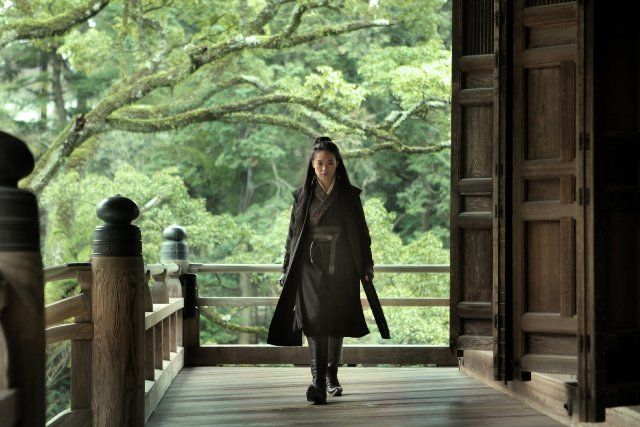
The Assassin

The Assassin

Acclaimed Taiwanese director Hou Hsiao-Hsien’s genre-defying wuxia epic earned him Best Director at Cannes this May. Hailed as the most beautiful film at the Festival, this adaptation of a 9th century Tang Dynasty Chinese legend may not be as easily grasped in terms of its storyline as its visual appeal. The film is recently voted #1 on the reputable Sight and Sound Magazine‘s Best Films of 2015 list, that’s the result of a poll gathering the views of 168 international film critics. It is a rare gem indeed. My full review at Asian American Press.  ~ ~ ~ ~ Ripples

(BTW, Hou’s last film? The Musée d’Orsay commissioned French feature on the Museum’s 20th anniversary: Flight of the Red Balloon.)

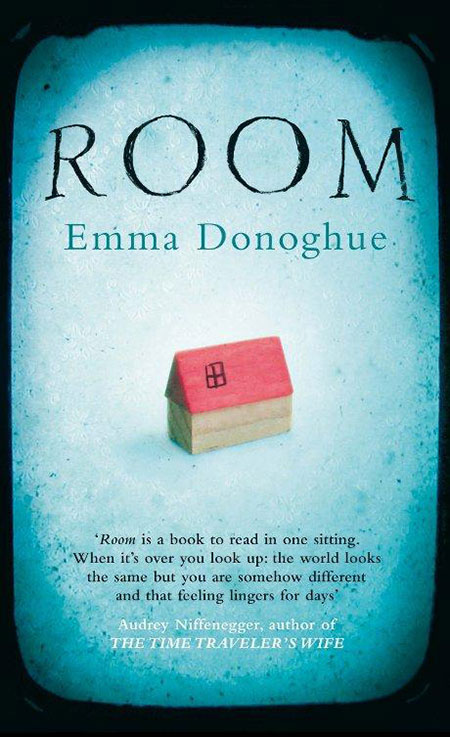
Room

A highly watchable adaptation of Emma Donoghue’s 2010 Booker Prize shortlisted novel. Kudos to the actors Brie Larson as Ma, Jacob Tremblay as 5 yr-old Jack, and yes, to Donoghue herself for writing the screenplay. One of those titles that I’ve enjoyed watching more than the literary source. My review on Ripple Effects.  ~ ~ ~ 1/2 Ripples
Update Jan. 14, 2016: 4 Oscar Nominations including Best Picture

Suffragette

Carey Mulligan has put forth a nuanced performance as the laundry gal turned suffragette in this Sarah Gavron (Brick Lane, 2007) directed historical drama. It’s worthwhile to watch the informative depiction of the actual events woven with fictional personal stories, especially Mulligan’s riveting portrayal of Maud, how her beginning naivety is forged into committed devotion to the suffrage movement. Prolific screenwriter Abi Morgan (Irony Lady, 2011, just to name one of her works) has laid out a fact-based drama with a heart-wrenching climatic scene. The sacrifice these voiceless, working women were willing to lay down is inspiring.
~ ~ ~ 1/2 Ripples

Secret in their Eyes

The Hollywood re-make of Argentine author Eduardo Sacheri’s crime thriller is a tall order, for its previous film adaptation is the Oscar winner of 2009 Best Foreign Language Film. My post on the book, original film, and Hollywood version is here. ~ ~ ~ Ripples

Spotlight

One of the best films I’ve seen this year, detailing the sequences of how the Boston Globe’s ‘Spotlight’ team of investigative journalists uncovered the systemic cover-up of child sexual abuse among Catholic priests. The Pulitzer winning reporting is presented in the film as painstaking procedurals in matter-of-fact dramatizing. For those who may be a bit worried about the subject matter, there is no sensationalized scenes of abuse, and on the part of the reporters, no portrayal of heroism. Such may well be the praise-worthy elements of this production. The cast’s performance is convincing, in particular, Liev Schreiber as the soft-spoken but motivating, no-nonsense editor Marty Baron. Come Awards time, I trust the production, its cast and crew, and director Tom McCarthy (The Visitor, 2007) will be duly recognized.    ~ ~ ~ ~ Ripples
Update Jan. 14, 2016: 6 Oscar Nominations including Best Picture

Fireflies in the Garden

My guess is, you haven’t heard of this 2008 movie. Neither have I until I saw it on TV a few days ago. The story about a father-son’s love-hate relationship from childhood to adulthood is realistically depicted. Caught in between the straining conflicts between the always angry and harsh father and a sensitive, vulnerable son, is the mother, always loving and protecting, something like the family dynamics in Terrence Malick’s The Tree of Life. It also echoes the Oscar winning Ordinary People (1981), the small-scaled, Bergman-esque chamber film of deep entanglement of unresolved parent-child conflicts. Another film just popped into mind and that’s Colin Firth, Jim Broadbent’s When Did You Last See your Father.

Fireflies has a well-selected cast with Ryan Reynolds, Willem Dafoe and Julia Roberts. I’m surprised to see the low rating the film received among critics. Disappointed really that it wasn’t well received. What’s that to me, and why am I  concerned? There’s a half-baked screenplay in my closet that’s something along that line. I know, more rewrites.  ~ ~ ~ Ripples

**

Books (Click on links to my Goodreads reviews)

It’s all a chain reaction started with …

The Burning Room by Michael Connelly (Audiobook)

I’ve not missed a single one of Connelly’s Detective Bosch novels. This time I listened to the audiobook and was much impressed by the voice of its narrator Titus Welliver.

Appaloosa by Robert B. Parker (Audio MP3)

So I checked about Welliver’s other audio works, and found Appaloosa by Robert B. Parker. I’d seen the 2008 film adaptation with Ed Harris and Viggo Mortensen and quite enjoyed it. So I jumped right in and found it to be a very well-written book, one of the few Westerns I’ve read.

And from this Robert B. Parker, I went on to explore more about him and learned that he was the ‘Dean of American Crime Fiction’. Here are two of his works crime stories I followed up with:

Promised Land  (Audio MP3)
The Godwulf Manuscript  (Audio MP3)

The Custom of the Country by Edith Wharton
From crime fiction to the Gilded Age. I bought this book at Edith Wharton’s home at The Mount during my New England road trip, during which I learned that Julian Fellowes was much influenced by Wharton and especially this title.

The Secret in their Eyes by Eduardo Sacheri (Audio MP3)

Plato and a Platypus Walk into a Bar: Understanding Philosophy through Jokes by Thomas Cathcart and Daniel Klein (eBook) – click on link to read my one-line review of this title on Goodreads.

The Boston Girl by Anita Diamant
Makes me think of Colm Tóibín’s Brooklyn which I’m rereading to prep for the upcoming film adaptation.

Heat and Dust by Ruth Prawer Jhabvala
Shifting between the English in India before independence and later the 70’s, a clash in cultures and the human toll of unfulfilled marriages. I reread this to prepare for the James Ivory Retrospective this coming weekend right here in my City, with the legendary director (now 87) attending. Yes, really looking forward to this event.

**

Currently Reading / Listening

In the Heart of the Sea by Nathaniel Philbrick (for the upcoming film)

Brooklyn by Colm Tóibín (reread for the upcoming film)

Parade’s End by Ford Madox Ford (Audiobook)

***

Related posts you may like:

Flight of the Red Balloon (2007)

The Tree of Life (2011) by Terrence Malick

When Did you Last See your Father?

Appaloosa (2008)

Books to Films at TIFF15

September kicks off Film Festival Season, a prequel to all the movie nominations coming up at the end of the year. First there’s Venice, Telluride, and Sept. 10 begins the 10-day celebration of films from over 70 countries at the Toronto International Film Festival.

The following are several of the premieres at TIFF15 that are adaptations from literary sources. Just to throw some more reading ideas out in case you’re not already overwhelmed with book suggestions.

***

The Dressmaker by Rosalie Ham

The Dressmaker Movie-tie-in CoverAustralian author Rosalie Ham’s debut novel (2000) is divided into four sections named after four different kinds of fabric: gingham, shantung, felt and brocade. The historical, gothic novel has received several nominations and shortlisted for the Book of the Year Award (2001) by the Australian Booksellers Association. The film adaptation stars Kate Winslet as the dressmaker Tilly Dunnage who returns to her hometown seeking revenge on her being expelled years before, with a sewing machine as her accomplice. Sounds interesting? What more, she is a Titanic survivor (of course she is) and the plot thickens with a hearing on the doomed maiden voyage. Australian director Jocelyn Moorhouse wrote the screenplay and shot the film in Victoria. Liam Hemsworth and Judy Davis also star.

High-Rise by J. G. Ballard

HighRise(1stEd)J. G. Ballard’s most well-known novel probably is Empire of the Sun (1984) thanks to Steven Spielberg’s movie adaptation. That is a semi-autobiographical account of Ballard’s childhood years in a Shanghai internment camp during the Japanese invasion of China. The production is one of the better WWII, Pacific War movies, splashed with some surreal styling. Now High-Rise (1975) looks like a totally imaginative work. An ultra-modern high-rise apartment (hopefully with some updated renos from its inception in 1975) with all its conveniences and amenities only lead to the isolation of its tenants, dividing them into different classes and eventually, to rivalry and extreme violence. The high-rise is a self-contained microcosm of our civilized society, perhaps Lord of the Flies of the concrete jungle. An acerbic satire of our human condition, the film is directed by Ben Wheatley and stars Tom Hiddleston and Jeremy Irons.

Into the Forest by Jean Hegland

Into the ForestThis is Hegland’s debut novel (1996), and had been translated into eleven languages. Set in Northern California in the near future when a massive continental power outage causes the total shutdown of technology, subsequently, the total collapse of human society. The apocalyptic scenario unfolds as two teenaged sisters – at first living in an idyllic, remote forest – now have to fend for themselves, find food at the brink of starvation, secure safety in the wild, and in the process, grow in their relationship with each other and learn more about their world. A coming-of-age story as well as an allegory of our technologically dependent society. The film is shot in British Columbia where, yes, there are beautiful forests. Canadian director Patricia Rozema writes the screenplay and helms the production. Rozema is the one who brought us Jane Austen’s Mansfield Park the movie in 1999. Popular Canadian actress Ellen Page joins hands with Evan Rachel Wood to play the roles of the sisters.

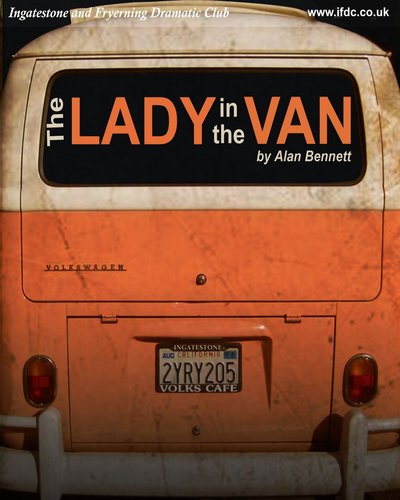
The Lady In the Van by Alan Bennett

The Lady in the VanThanks to the film adaptation, or I wouldn’t have known about this amazing story. Acclaimed English playwright Alan Bennett’s play is not fiction but a memoir. Bennett saw a transient woman living in a van on the street. Trying to help her out, he let her park on his own driveway for three weeks so she could sort things out and move on. Well, Miss Shepherd stayed for 15 years. Not surprisingly, she and the playwright form an unlikely bond of friendship. This ‘mostly true’, incredulous story needs to be told for its unique human scenario. From play to film is probably the best route to reach many more viewers. Who else other than Maggie Smith best fit the role as Miss Shepherd? And so she did, with Alex Jennings as Alan Bennett. Supporting cast includes Jim Broadbent, Dominic Cooper, and James Cordon. The is the third film wherein director Nicholas Hytner and playwright Alan Bennett team up. Their previous collaborations are The History Boys (2006) and The Madness of King George (1994).

The Martian by Andy Weir

The Martian movie tie in editionHere’s a Cinderella story that all bloggers can cheer for. In 2009, Andy Weir started posting on his personal blog as a post-by-post serial his well-researched sic-fi story about an astronaut stranded on Mars. Chapter by chapter he attracted numerous readers who, after the story was finished, suggested he publish it as an eBook so people could read it online as a whole. Weir did that and his eBook soon hit the top of Amazon’s best selling sic-fi list. Not long after, Random House stepped in and took it from there, from e to reality. Four days later, “Hollywood called for the movie rights,” Weir recalled. As I type, on this second week of September, Weir’s book is number one on the New York Times Best Sellers Trade Paperback Fiction list. And the movie? The legendary Ridley Scott takes the helm, with NASA consulting, Matt Damon stars, and an A-list supporting cast includes Jessica Chastain, Chiwetel Ejiofor, and Jeff Daniels. World premiere at TIFF before a general release later in October. And it all started with a blog post.

Room by Emma Donoghue

roomThe 2010 Booker-prize shortlisted novel by Irish-Canadian author Emma Donoghue reads like you’d want to see it visualized. Indeed, hearing constantly the voice of a 5 year-old could have that effect on you. So here we are. A movie adaptation. Locked in a room and made captive by a psychotic abuser, a young mother gives birth and for the next five years raises her child Jack in a shed. At 5, Jack has known no other worlds, but now begins to ask questions. Ma cannot contain the make-believe anymore so she tells Jack there’s a world out there, and starts to prepare him for a possible escape. The multiple-award winning novel is written from the child’s perspective. It depicts the power of love and the indomitable spirit of resilience and hope, but maybe not for the claustrophobic. The movie trailer is impressive; the 1.5 minute clip is powerful, consuming, and very moving. The film premiered at Telluride International Film Festival in early September and stunned the audience, drawing multiple standing ovations. Donoghue wrote the screenplay herself, that could well be a definite asset. Lenny Abrahamsson directs, with Brie Larson as Ma, Jacob Tremblay as Jack, Joan Allen and William H. Macy supporting.

UPDATE Sept. 20, 2015: ROOM has just won the Grolsch People’s Choice Award at TIFF15 tonight. FYI, a few of TIFF’s previous winners had gone on to win the Oscar Best Picture including 12 Years A Slave (2013), The King’s Speech (2010), Slumdog Millionaire (2008), American Beauty (1999).

***

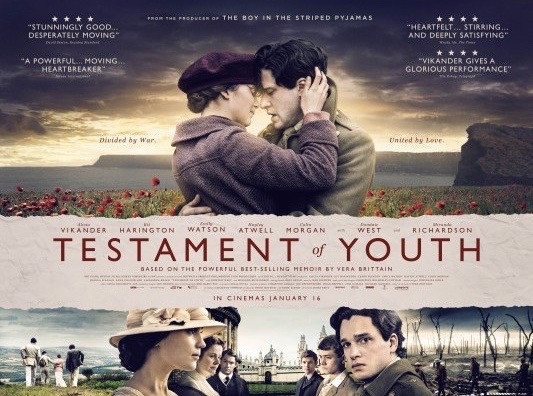
Testament of Youth

Premiered at the London Film Festival in October, 2014, Testament of Youth finally arrived to our city here in Western Canada in late August, and only for a week or so. It came quietly to our age-old indie theatre, nearly slipped by without my noticing it; if so, that would have been a loss for me.

I admit I haven’t read Vera Brittain’s acclaimed, 600 plus page memoir. I admit too that before watching Downton Abbey Seasons 1 and 2, the subject of WWI, its direct hits and collateral damages, had not piqued my interest that much. Now, even saying ‘piqued my interest’ trivializes the devastation – as this film has so poignantly shown us – the tragic loss of a generation of youth.

The beginning of the film, which is elegantly shot, shows us succinctly Vera Brittain’s (Alicia Vikander) well-to-do family. Vera and her brother Edward (Taron Egerton) are endearingly close. While their intention is good, their parents (Dominic West, Emily Watson) are protective and traditional: Edward has the chance to go to Oxford, Vera is meant for marriage. On this issue, Vera protests and argues with her father; eventually, her determination and intellectual vigour win through. A dream comes true when Vera enters the women’s Somerville College Oxford to study English Literature.

Testament of Youth Poster (1)

From her brother, Vera gets to know a few good Oxford men: Victor Richardson (Colin Morgan), Geoffrey Thurlow (Jonathan Bailey), and Roland Leighton (Kit Harington). Roland subsequently wins her heart with his sensitive, poetic inclination; the two soon are engaged. The winds of war blow callous and indiscriminate. As Britain is drawn into the fight, all these young men heed the call to enlist. Vera too decides to forsake her hard-earned Oxford education to join the Voluntary Aid Detachment as a nurse.

The saddest and most ironic notion about WWI is perhaps that it was first thought to be a fast and triumphal war. Surely, Britain came out a victor, but not before ringing up a horrific number of casualties and sending back home – for those fortunate enough – a permanently damaged generation. As the military struggle wained through four long years, Vera would ultimately lose all who are dearest to her: her brother Edward, her fiancé Roland, and their two close friends Victor and Geoffrey. After the war, Vera goes back to Oxford. Later, a disillusioned Vera becomes a vocal pacifist and an advocate of women’s rights.

This is British director James Kent’s full feature debut after years of helming TV productions. His effort is conscientious and serious, and for that, I’d much appreciated.  The film is beautifully shot and carefully crafted. The camera work, while giving us a traditional look, is agile and stylish; the editing succinct. I have not read the memoir so cannot offer comparison, but judging the film on its own, the screenplay is well written and the overall production, a captivating execution.

Kent has an excellent cast to work with, and that adds to the quality of the production. Vera Brittain is well portrayed by the nowadays ubiquitous, Swedish actress Alicia Vikander. She is in some very diverse roles, from Kitty in Anna Karenina (2012) to an AI robot in Ex Mechina (2015), to the witty British agent Gaby in The Man from U.N.C.L.E. (2015), and in several highly anticipated upcoming films.

Vikander is versatile, and her best quality is probably the intelligent and unsentimental mastery of her character. Here, she is a living testament to the devastation of war. For a witness to testify effectively, the most important element has to be clarity and not be overcome by emotions. She has delivered her message poignantly.

Other actors are just as competent in their roles, and a pleasure to watch, despite all their tragic end. Aaron Egerton as Edward, what a change from the street punk under Colin Firth’s mentoring in Kingsman: The Secret Service (2014). Kit Harington’s (Game of Throne fame) performance is effective, particularly in a scene where he comes home the first time from the trenches, a changed man. Veteran actors Dominic West and Emily Watson are excellent supports, especially West as the father torn by grief and ambivalence.

I have seen several WWI and II films in recent years: Sarah’s Key, The Book Thief, The Monuments Men, Suite Française, I have to place Testament of Youth above all of them. Visceral but not sentimental, the film communicates with painful clarity the devastation of war, the traumatic experiences in the trenches, and the cold, hard fact of a testimonial: the loss of a generation.

~ ~ ~ 1/2 Ripples

***

Other related Ripple Reviews:

Suite Française

The Book Thief

Sarah’s Key

Kingsman: The Secret Service

Ex Machina

Anna Karenina 

***


Irrational Man (2015): A Teaser for Sartre

Can a director who churns out a movie every year continuously over the past four decades bring us anything new at age 79?

Yes, and no. But here’s the thing with Woody Allen’s annual offering, a summer treat in recent years, the answer is… does it matter?

Before you read on, be warned that the following discussion contains, no, implies, Spoilers.

Unlike his recent films – Magic In the Moonlight, Blue Jasmine, To Rome With Love, and Midnight In Paris – Irrational Man is not a comedy. It is a semi-serious drama carrying some signature WA thematic materials. Those familiar with his Match Point (2005) and Crimes and Misdemeanors (1989) will find Irrational Man a variation on the same theme, but this time with a twist. So there you go, the old has become new.

Here again, the writer/director is toying with Dostoevsky’s Crime and Punishment, Raskolnikov’s idea of getting away with crime for those who are superior. What if one commits a crime out of a superior motive, purely altruistic and benevolent? If a crime is committed with the full intention to rescue someone from a miserable predicament, shouldn’t the criminal be thanked rather than punished?

Interesting premise, and when the idea is embodied in Joaquin Phoenix, the character actor who is beyond categorization, here’s the attraction. First time in a WA film, Phoenix has prepared well with the right physique – an obvious paunch – to show his method immersion. He plays a listless philosophy professor Abe, who has no life purpose, no drive even when starting a new position or finish writing his book, but just passing his summer teaching hours with easy chats on Kant, Kierkegaard, and Sartre, while still attracting students and colleagues alike.

Irrational Man's pivotal scene

One day in a coffee shop, upon overhearing a woman talk to her friends about her desperate child custody case, Abe is overcome with empathy. (Photo above: a pivotal scene.) He is ready to live out an existential choice: by taking actions in his owns hands in committing a crime to help the woman, he in turn discovers the purpose for his own existence. Did I say this is not a comedy? Well, let me qualify that. There’s no laughter in the theatre. However, Phoenix’s character and action is inherently an ironic jest; the story we see on screen works like an object lesson on the freedom of choice, and a teaser for Sartre.

I look forward to these annual WA productions, even when I hear dialogues that sound like I’ve heard them before. Why? Where else would one find nowadays philosophical chitchats on screen for our entertainment? Philosophical chitchats, the term itself is an oxymoron; here lies the fun of a WA film. Allen doesn’t take his characters seriously, so we have light characters engaged in serious talks.

The psuedo-intellectual screen talks are humour in themselves. Just because we can’t spot a Marshall McLuhan in a theatre line-up anymore to clarify his own ideas as in Annie Hall, let alone get Sartre to referee the on-screen discourses, so we can sit back leisurely and be amused at Allen’s characters delving in philosophical problems, while their life and fate collide in twists and turns.

The is Emma Stone’s second WA movie back-to-back with her Magic in the Moonlight in 2014. As a college student falling for her philosophy prof sounds more convincing a role for Stone than as a young medium with telepathic ability to contact the dead. What’s interesting about these annual WA productions are the interesting combinations of A-listers being cast in some wacky roles. Something new, something old… thought you’ve seen it before? Just wait till the end.

To kick off your Philosophy 101 class, Irrational Man could be a lively visual aid to hold your students’ interest. Breezy, entertaining, lines to discuss and dispel, with an ending that long-time WA watchers could well interpret as the director redeeming himself from creating those in Match Point and Crimes and Misdemeanors in his younger days. Turning 80 the end of this year, maybe Allen has finally decided to lean towards the side that says, yes, there’s poetic justice after all.

~ ~ ~ Ripples

Other Related Ripple Reviews:

Magic In The Moonlight (2014)

Blue Jasmine (2013)

To Rome With Love (2012)

Midnight In Paris (2011)

***

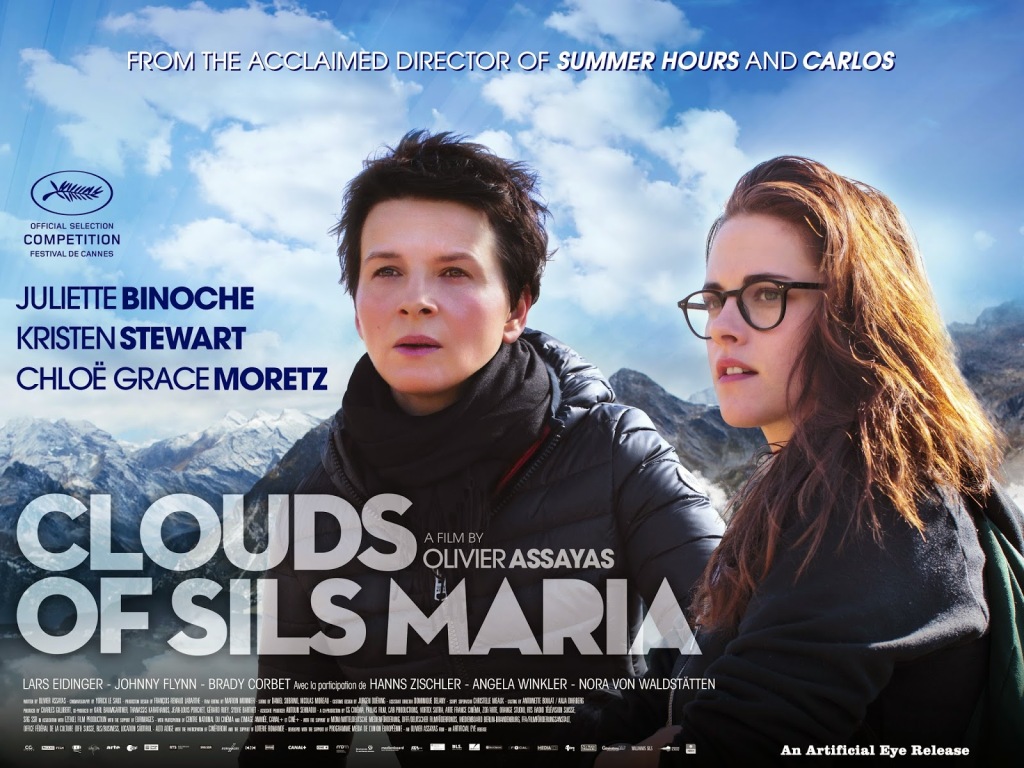
Clouds of Sils Maria Movie Review

Clouds of Sils Maria is an intricately conceived rumination on the passage of time, ageing, being female, being famous, and for that matter, being gradually becoming obsolete. The newest film from the prominent, Paris born, French director Olivier Assayas, it was nominated for numerous awards at film festivals, including the Palme d’Or at the Cannes Film Festival in 2014. I watched it at TIFF last September, and gladly again at the indie theatre when the film came to our city a few months ago.

Clouds of Sils Maria

A middle-aged celebrated screen and stage actress Maria Enders (Juliette Binoche) is on a train to Zurich with her personal assistant Valentine (Kristen Stewart) to attend a tribute to the playwright Wilhelm Melchior, who had cast her in her breakout role in one of his plays Maloja Snake some twenty years ago. At that time, Maria played a manipulative young office girl Sigrid who had an emotive relationship with her older office boss Helena, driving her to commit suicide.

While on the train to Zurich, Maria gets the news that Melchior has died, an apparent suicide due to a terminal illness. When arriving Switzerland, Melchior’s widow Rosa (Angela Winkler) lets Maria and Valentine stay in her idyllic house in the Swiss Alps, in the Sils Maria locale, while she tries to get away from the sad memories of her late husband. In that serene natural setting, Valentine helps Maria practice her lines for a revival of the play Maloja Snake, re-mounted as a tribute to the late playwright. But this time, Maria is to play the older character Helena, while a wildly popular, scandalous young star Jo-Ann Ellis (Chloë Grace Moretz, the rising star in real life) is to play Sigrid.

If you have the patience to read up to here, you likely can see the parallels: Maria and Valentine – Helena and Sigrid, as well you probably can guess the feelings Maria goes through in this role reversal, for now she is twenty plus years older, and the loss of Melchior could well be the foreshadow of an imminent path everyone has to trod, famous or not. The film is an intricately woven, multi-layered construct, with thought-provoking dialogues and incisive subtexts; the mirroring effect is brilliant especially the scenes when Valentine helps Maria practice her lines and accept the role reversal, from the young to the older.

If you appreciate the characterization and the superb performance of the actresses, you would not only bear with but savour the complexity of the dialogues and scenes. Instead of a litmus test for the viewer’s patience, the complications and layered meaning are a testament of some fine screenwriting and directing. Assayas’ signature realism and naturalistic style works marvellously well; in some scenes towards the end, the honesty is harsh and biting. 

Juliette Binoche always delivers. Here she is an ageing celebrity and star, her outward coolness masks tumultuous insecurities. She is totally natural in her role. Viewers may even feel she’s not acting at all.

But my highest praise has to go to Kristen Stewart. I admit I’m probably one of the few who have not watched, or read, any of the Twilight movies or books. So this is my first Stewart film, and I’m most impressed. She lives and breathes her character Valentine, assistant to Maria Enders. From juggling several smart phones while balancing herself on a moving train, to helping Maria practice her lines adjusting to the older role, Stewart has shown she has mastered the needed nuance, intelligence and sensitivity for her character. She has portrayed convincingly a complex female who, despite her efficiency and strength at her job as assistant to a famous but fast fading star, is herself vulnerable as a female with deep, inner yearnings and conflicts muffled only by her outward sensibility.

With her role as Valentine, Stewart went on to win the 2015 César Award for Best Supporting Actress this February in Paris, the first American actress to win the prestigious French acting award which is equivalent to the Oscar here.

Chloë Grace Moretz aptly plays the youthful, and bratty, rising star Jo-Ann Ellis. She embodies the young and famous, a celeb whom Valentine admires, but whom Maria can never understand as to how the young measures talent or shoots to the peak of popularity despite (or maybe because) of scandals. I’m sure what’s mind boggling to her could well be the thoughts in many a mind of the, alas, fading bunch of old school, superbly trained actors and iconic performers of our days.

The Largo from George Frideric Handel’s opera Serse is poignant, a solemn and grand diction of existential angst as Maria confronts the loss of her beloved and respected artistic mentor, and her own fading glory. Interestingly, the music reminds me of Kon Ichikawa’s The Makioka Sisters (1983), wherein this piece of music also appears, bringing out the poignancy of the passage of time, the erosion of the familiar, the end of an era, of traditions, and of treasured values.

This brings us to the very title of the film. The clouds of the Sils Maria mountain range in the Swiss Alps is famous for their sudden appearance like a snake curling and weaving around the mountains. Many have climbed the peaks only to be disappointed as the clouds may not appear while they are there. In the scene towards the end, just as Maria turns and walks away, the clouds come into view for us audience but not her, indeed, like a snake slithers silently in and in a few seconds, moves out of sight again. Ah… the ephemeral of it all. The ultimate mirroring of nature and life.

Probably the best film I’ve seen so far this year. A film that deserves – and requires – multiple viewings.

~ ~ ~ ~ Ripples

***

This is my last entry to Paris in July 2015 blogging event hosted by Tamara of Thyme for Tea.

Paris in July 2015 Icon***

Other Related Ripple Effects Posts:

Conversation with Juliette Binoche

Summer Hours by Olivier Assayas

My Old Lady 

Suite Française: From Book to Film

Flight of the Red Balloon 

My Old Lady (2014) Movie Review

Among the dozen films I’d watched at the Toronto International Film Festival last September, two are apt selections for the annual Paris In July blogging event hosted by Tamara in Thyme for Tea, now in its sixth year. Recently I have re-watched both, one at an indie theatre, the other on Blu-ray. Here’s my first entry to Paris In July 2015.

Paris in July 2015 Icon

***

My Old Lady (2014)

Just when voices had been raised in recent months from female stars against the sexist domination in Hollywood, and lamenting the lack of significant female leading roles, another issue pops up. Well, the problem has been there all along, but who would speak for those who are…. getting old? The peril of Agism in the movie industry. And, if you’re female and aging, confronting Hollywood is a losing battle.

I’m glad there are filmmakers who consider film as an art form, and in its essence, conveys the meaningful and universal that make us human. Kudos to all who attempt to break the barrier. Here we have a directorial debut from 75 year-old Isaac Horowitz. As he had noted, which first-time film director would talk about his five grandchildren?

Horowitz is an author of more than 50 produced plays. Several of his works have been translated and performed in as many as 30 languages worldwide. This is his first time directing a film, adapting his own play onto the big screen. My Old Lady is a delightful debut. I’ve watched it three times, so far, and liked it more each time.

My Old Lady Poster

In an after screen talk, Horowitz shared that he had heeded one advice from the iconic director Sydney Lumet: “Cast the best actors in the world and then get out of their way.” In his debut movie, his cast is first-rate, and allow me to show their age when they made this movie, just to prove a point: Maggie Smith, 80, Kristin Scott Thomas, 54, and Kevin Kline, 67. How much the director had left them to their own I don’t know, but sure looks easy for these veteran actors to take on this one. Such natural ease comes from decades of experience, expertise honed as innate skills.

That’s the advantage of ageing. Let’s drink to that.

Kevin Kline plays Mathias Gold, a down-and-out, thrice divorced, alcohol dependent, penniless middle-aged American who is relieved to inherit from his late father an apartment in the Marais district of Paris. Going there to claim his rightful ownership and aiming at a quick sale, he learns a French lesson in property transfers instead: En Viager. When his father purchased the apartment 43 years ago – now worth over 10 million Euros – he was under the contracted stipulation of a Viager.

This is the issue Mathias faces: Instead of a lump sum payment made for a clear purchase, his father, the buyer, had contracted to put down a cheap amount and then pay the rest as viager, a monthly fee of 2,400 Euro to the vendor and occupant of the apartment, Mathilde Girard (Maggie Smith), until she dies. Now at 90, Mathilde is in good health, thanks to her daily sustenance of red wine and precise meal times. Not only that, Mathilde has a daughter living with her, headstrong and vocal to defend their property against any potential profit-driven redevelopment plans.

That’s the story. It is not hard to predict the ending, with Kline and Scott Thomas together, albeit fiery and combative to start with. But what is harder to foresee is the story within the story at the outset. Everyone has a past. This is one of the best performance I’ve seen with Kline, for he carries the whole film and delivers with just the right touch of humour and pathos. The first time the two were co-stars was in Life As A House (2001), interestingly, another story based on a domicile. Life as a house indeed.

Scott Thomas as always is a pleasure to watch. No matter what role she takes up, her communication is crisp and clear even without having had to say a word. The last scene is a prime example. But of course, you don’t have to wait till the last. As for Maggie Smith, at 80, she is as strong as ever, even when she is playing one who is ten years older.

When it comes to plays turned into films, one should expect the prolific dialogues. Not a perfect fit all the time, there are moments where I as a movie viewer expect better lines, and more than stage-like scenes. But overall, the three characters are a delight to watch.

The few external Parisian street scenes with their fine matching music score instil longing. Yes, this is the kind of films that work best to lure you to Paris, not to the hot tourist sites, but to the streets where Parisians actually live. Subliminal seduction registering in my mind that next time I must go to those districts which are less trodden by tourists but equally representative of the historic city. Maybe a B&B right there in the Marais instead of a boutique hotel.

My Old Lady is a light comedy with a heart, bringing out an issue that, alas, could not be fully resolved, for what’s done cannot be undone. Offsprings inherit from their parents not only the physical properties but often the emotional baggages and their consequences. As a dramedy, Horowitz has brought us not only the drama but the happy ending, the best case scenario that can come out of human failings. That could well be a reason why we go see movies.

~ ~ ~ Ripples

***

Related Posts on Ripple Effects:

The Second, Best Exotic Marigold Hotel

Tuffing It Out At TIFF14

For a list of Paris in July Posts from previous years, CLICK HERE.