Robert Bresson’s Au Hasard Balthazar (1966): A Timeless Parable

Surely he has borne our griefs
and carried our sorrows;
yet we esteemed him stricken,
    smitten by God, and afflicted. 

— Isaiah 53:4 ESV

Several days before He is crucified, Jesus enters Jerusalem riding on a donkey. I love this scene. If there’s any cognitive dissonance in the crowd, here’s the stark message for their bewilderment. The King for whom they are cheering is not to be a glamorous celebrity. Rather, like the donkey, He comes as a humble servant, one who carries their load, and ultimately, even lays down his life for them. His kingdom belongs to another world.

Marie and Balthazar


As with my Easter viewing from previous years, I watch a film by the French auteur Robert Bresson. Bresson’s work has a transcending and spiritual quality that is deeply moving. In Au Hasard Balthazar, he creates an unusual metaphor using a donkey as his protagonist. We follow Balthazar as a young colt, loved by his first owner Marie. We see him grow up, weaving his life among different owners. We also see Marie grow up. Despite her love for Balthazar, she cannot stop the encroachment of evil, or maybe she is simply powerless. She does not defend Balthazar when a gang of young men abuse the donkey, tormenting him, whipping, mocking.

The gang leader is Gérard, whose sadistic, mean streak speaks for human depravity. He would pour gasoline on the road to cause unsuspecting drivers to skid and crash. He and his gang would watch nonchalantly from a distance, gratified that their prank has worked. He steals and deceives. What is a donkey to him if he does not even have the slightest respect for other humans. Once, to prod Balthazar to move forward, Gérard ties a newspaper to his tail and light it on fire.
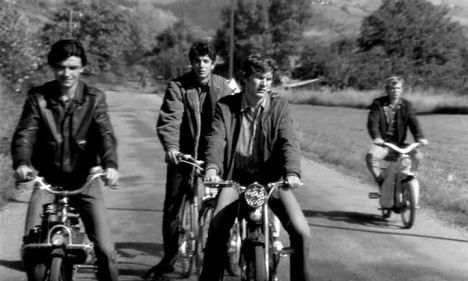
The Gang

Throughout, Balthazar lives his life quietly in a parallel course to the growing depravity of the humans he serves. He suffers their cruelty in silence, occasionally he would bray in pain, but he continues to bear his load, pull a cart, or do whatever he is prodded to do, even a circus act. Due to neglect and maltreatment, he often becomes ill.

As she grows up, Marie discards childhood innocence and seeks to gratify her sensual pleasures. Against the protest of her parents, she falls for Gérard. She could have another choice, one who offers her genuine love, Jacques, the son of the owner of the farm where Marie and her parents reside. Jacque would come by every summer from the city with his father and sister to stay on the farm. When they were still children, they had spent endearing moments together with Balthazar. Jacques has declared lifelong commitment to Marie. But Gérard is a more instant and attractive outlet for Marie. Ultimately, she is dealt the harshest blow and most degrading abuse from Gérard and his gang as they rape her. Bresson spares us the ugly scene, but in the chilling aftermath, we see the young men walk away, nonchalant, throwing her garments on the ground behind them. After that tragic incident, Marie runs away. Her father is grief stricken, and soon falls ill and dies.

Gérard is unrepentant. After all, it’s self-serving lust he seeks; his callousness is most disturbing. In the last scene, we see he uses Balthazar to do one more job for his gang. They are to smuggle goods across the mountainous border. At night, he loads up his goods on the donkey and leads him to the border. From a distance, he hears gun shots from armed customs police. Gerard and his gang flee, abandoning Balthazar on the mountain. But it’s too late for Balthazar, he has been shot.

The final scene is most moving. In the open field, Balthazar walks slowly, haggard, blood streaming from his leg. He finally lies down, still carrying the goods Gérard has put on him, the load of sin. He breathes his last and quietly dies, alone.

Like Bresson’s Diary of a Country Priest, Au Hasard Balthazar is an apt meditation for Good Friday. But not just for this one day, their timeless message is like the Easter Season itself, a moveable feast.

~ ~ ~ ~ Ripples

***

Related Posts and Links:

Diary of a Country Priest: A Book For Easter
Diary of a Country Priest: Film Adaptation

Video of Robert Bresson on Au Hasard Balthazar

The Budapest Hotel: A Grand Escape

“But it doesn’t mean anything.”
“So we put in words. One word for every note, like this…”

— ‘Do-Re-Mi’ from The Sound of Music

Does music need words to make it meaningful? Do we have to find a message in a work of art before we can appreciate it?

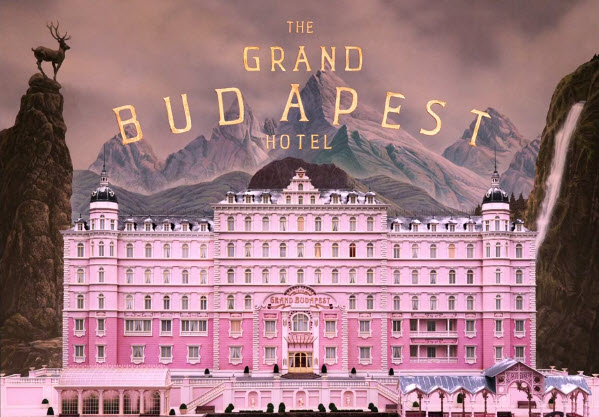
the-grand-budapest-hotel movie poster

Here we are with a cinematic piece that can’t be ‘explained’. What genre? What theme? What purpose? I’m not going to bother. As with my experience of watching previous Wes Anderson movies, somehow, I feel I need to let my rational side relax and just enjoy the ride. Rushmore probably has more of a traditional storytelling mode and thematic content. But with The Royal Tenenbaums, I have to adjust the quirky frequency to high, it’s a totally different kind of viewing experience. Fantastic Mr. Fox, I was mesmerized by the stop-motion animation and humour, great voices add to the lively adaptation of Roald Dahl’s story. Moonrise Kingdom, I wasn’t fully gratified but by then, I was used to the Wes Anderson style of ‘magical realism’.

That ‘magical realism’ strikes again in The Grand Budapest Hotel. Not my favourite colour palette, red and pink, by I was totally captivated as soon as the film began. I was being led into a fairytale world of real life people. From the cinematic framing, it aptly demonstrates the idea of symmetry. In many frames, the subject is right in the centre, almost perfect symmetry on both sides of the screen. But does it mean anything? One might ask. If we have to be rational about it, shall we just say, for the effects of a neat and tidy piece of the old world. Framing nostalgia before the world becomes too distorted, too inhumane. This is, after all, 1930’s Europe. And we can see the parallels in signs and symbols especially towards the end of the movie when uniformed men take over the Hotel.

Grand Budapest Signs & Symbols

Wes Anderson credits Stefan Zweig in creating The Grand Budapest Hotel. The Austrian writer’s name is shown at the very beginning of the end credits. In numerous interviews, Anderson pays tribute to Zweig’s whole collection of works, a writer who is noted as once ‘the world’s most translated author’. Zweig is a relatively new discovery for Anderson but so deeply has the writer inspired the filmmaker that ‘it’s basically plagiarism’, Anderson joked at the news conference when the film premiered at the Berlin Film Festival.

As someone who is much intrigued by the creative process of adapting books into films, I did read some Zweig before watching Budapest. I must be reading the wrong works though, I’d thought. From the novella Chess Story, to a few of the stories I read in the new collection recently translated into English, all tell very gloomy tales. The writings almost exude a sense of despair, as the characters are mostly running away from persecutions and ethnic cleansing, or memories thereof, even driven to madness as the chess champion Czentovic in Chess Story, albeit some descriptions embed a subtle trace of humour.

Maybe along the notion of ‘Wabi-sabi“, beauty and sadness, what Zweig has done subtly and now Anderson explicitly is to extract and fuse “humor and sadness”. Here in Budapest, writer/director Anderson has freely utilized the element of fantasy and fun to paint the passing of an old world, a realism too sad for millions in 1930’s Europe, Zweig being one of the subsequent victims. To escape the incendiaries of Nazism, Zweig and his second wife moved to England, then to the U.S., and finally to Brazil in 1940 where he ultimately committed suicide together with his wife in 1942, leaving a note of utter despair as he saw Nazism dominating Europe and his former homeland Austria.

In this fictitious Republic of Zubrowka, where The Grand Budapest Hotel is situated, Anderson offers us a great escape despite setting his story within the brewing tension of 1930’s Europe. The story begins with a closer to present day author (Tom Wilkinson) reminiscing upon an extraordinary experience which has inspired his book The Grand Budapest Hotel.

The Concierge Desk and Main Staircase

Years ago when he was still a young writer (Jude Law), in finding cures for writer’s block, he had retreated to a mountain hotel The Grand Budapest and in there met its owner, Mr. Moustafa (F. Murray Abraham). Known as Zero when he  himself was just a lobby boy in an age long passed, the owner told the writer his story of how he came to inherit this grand piece of property, albeit in a run-down shape now. Someone volunteering an extraordinary life story to an author in an exotic locale, the beginning of Budapest reminds me of Life of Pi, another great tale of magical realism.

But the movie belongs to Ralph Fiennes as the hotel Concierge and go-to person for all sorts of favours, M. Gustave. The death of long time patroness of the Hotel Madame D. (Tilda Swinton) has dragged M. Gustave and his protégé, the new lobby boy Zero, down a rabbit hole of misadventures and fortunes. Fiennes has proven that he is a versatile actor that can be as evil as Amon Goeth in Schindler’s List, or as madly romantic as Count Almasy in The English Patient, or as charming and fun here in Budapest. His comic timing is first-rate, his expressions, spot-on. My long-range forecast, an Oscar nom awaits him next year for his role in Budapest.

Gustave & Zero

The line-up of talents is long, not just in acting, where we find the usuals of Wes Anderson movies like Edward Norton, Tilda Swinton, Bill Murray, Owen Wilson, Adrien Brody, Willem Dafoe, Jeff Goldblum. Saoirse Ronan (breakout role as young Briony in Atonement) as Agatha the pastry maker is adroit and whimsical. She’s well matched to the young lobby boy Zero, aptly played by Tony Revolori.

The movie is also marked by the delightful compositions of Alexandre Desplat, whose musical scores adorn many notable movies in recent years. A collaborator with Anderson since Rushmore but here, Desplat’s scores captivated me early on with the lively East European themes and in particular, the Russian folk melodies. Some instruments that we seldom hear in other films are distinctly alluring, such as balalaikas, zithers, dulcimers, and organ, with full orchestral rendering. Another long-range forecast, Oscar for original score.

And then there’s the make-up of Tilda Swinton, the art work and production design of the whole Budapest experience (even the parody painting “Boy with an Apple” is an original art work by English painter Michael Taylor from a real life model), the flowing editing, the original screenplay and directing, the cinematography, Budapest Hotel is going to be one grand entry in the next Academy Awards.

~ ~ ~ 1/2 Ripples

 ***

Read a related post: How Zweig Inspired Anderson’s The Grand Budapest Hotel

Awards Update:

Feb. 22, 2015: Oscars for Best Costume Design, Make-up, Production Design, Original Score.

Feb. 14, 2015: Wins Best Original Screenplay from WGA.

Feb. 8, 2015: 5 BAFTA wins, Original Screenplay, Original Music, Production Design, Make-up and Hair, Costume Design.

Jan. 15, 2015: 9 Oscar noms, Best Picture, Best Director, Best Original Screenplay, Cinematography, Editing, Production Design, Make Up and Hair-Styling, Costume Design, Original Score.

Jan. 11, 2015: Golden Globe win for Best Motion Picture – Comedy or Musical

Dec. 11: 4 Golden Globe noms for Best Motion Picture – Comedy or Musical, Wes Anderson for Best Director and Best Screenplay, Ralph Fiennes for Best Actor – Comedy or Musical

Dec. 10: SAG nom for Best Cast in a Motion Picture

Dec. 7: The Grand Budapest Hotel wins Best Screenplay and Best Production Design at the L.A. Film Critics Awards

Dec. 1: The Grand Budapest Hotel just wins Best Screenplay from the New York Film Critics Circle

Related Links:

From BBC CULTURE: The Writer Behind Budapest Hotel

From NPR: The Rise and Fall of Stefan Zweig

The Music Behind the Screen

The Untold Story Behind ‘Boy With Apple’

Homage to Flannery O’Connor: Looking for ‘Intrusions of Grace’ in Films

Today is the birthday of Flannery O’Connor. As a tribute, I’m re-posting a piece I wrote a few years ago entitled “Looking for ‘Intrusions of Grace’ in Films: Pickpocket and Drive”

**

Our age not only does not have a very sharp eye for the almost imperceptible intrusions of grace, it no longer has much feeling for the nature of the violence which precede and follow them.” — Flannery O’Connor (quoted in my post A Good Man Is Hard to Find and Other Stories)

Flannery O’Connor made this remark back in 1963. It was not only a sharp social commentary and prophetic, but to me, it also stands as one of the signs of a good film. Amidst the violence and ugliness a film may depict, the presence of grace, however small, or a mere spot of purity, could bring out a powerful contrast. Usually that is what’s needed to emit a redemptive spark, a glimpse of light pointing to the transcendent.

With this frame of grace among violence, I go back to the films I’ve watched and try to find some good examples. My task proves to be more difficult than I first thought. But after some deep searching through my mental archive, several films came to mind. I’ll just mention two for this post.

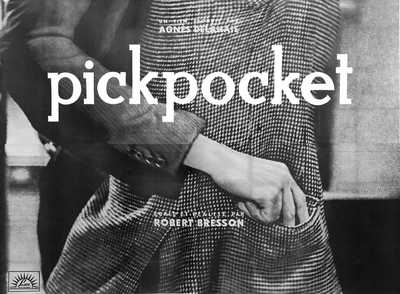
Pickpocket (1959)


pickpocket movie poster

Robert Bresson’s modern version of Dostoevsky’s Crime and Punishment. Caught in his own desensitized internal world, our protagonist Michel commits acts of theft as a desperate measure to fill the void in his existence. He goes through his days in a haunting vacuum devoid of meaning and emotions. He is unfeeling even towards his own dying mother, reminds me of Meursault in Camus’s The Stranger. Although not an axe murderer like Raskolnikov in Crime and Punishment, Michel theorizes that those with superior talents and intelligence, the supermen in society, should be free to disobey laws in certain cases. He is numbed by his own hubris, and stifled by his cold and absurd worldview. Outright violence is not visible here, but we see the battle of wits he engages with the police inspector behind his trails, and we see him struggle in an amoral and meaningless existence.

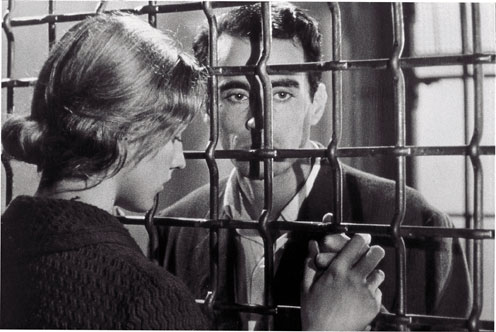
Grace comes as Jeanne, a neighbor and carer of Michel’s ailing mother. Jeanne lives on her own looking after her younger brother. Her father is a drunk and her mother has deserted them. But she continues to live and care. She accepts her circumstances calmly, and extends kindness to those unrelated to her, caring for Michel’s mother, a neighbor on another floor. She stands as a stark contrast to Michel’s aloofness. At the end of the film, Jeanne came to visit Michel in prison after he was arrested, the two separated by the cold iron bars. For the first time, Michel feels love and wants to reciprocate it. And thus the cathartic ending as he totally melts in the presence of pure love and grace, wrapping up the film with this last line:

“Oh, Jeanne, to reach you at last, what a strange path I had to take.”


Pickpocket


**

Drive (2011)

A current release that comes with high acclaims. The film was nominated for the Palme d’Or and Nicolas Winding Refn won Best Director at the Cannes Film Festival this year (2011). With slick and dashing camera work, the violence in “Drive” is visceral and graphic, a big contrast to the black and white, internal “Pickpocket”. However, I see some parallels between these two films made 50 years apart.

Ryan Gosling is “the Driver”. He does not even have a name. He is an expert stunt driver for movies and works at an autobody shop by day, drives a get-away car in the underworld of crimes by night. Like Michel in “Pickpocket”, he drifts in existence, numb and desensitized to the world around him. That is, until he meets Irene (Carey Mulligan), his neighbor.

Drive 1


Mulligan’s almost angelic presence in the film is most effective as a stark contrast to those around her. She lives alone looking after a child and works as a waitress in a diner. She appeals to the Driver by being herself, innocent, taking life as it is, responsible, caring for a child alone while his father is locked up in prison. Irene is a spot of purity in a rough environment. Her mere presence has transformed the Driver. From being aloof the Driver has become engaged emotionally, friendly and protective of both mother and son.

Drive

The plot thickens as Irene’s husband is released from prison and rejoins his family. The Driver is caught in an awkward situation. But he soon realizes that the husband’s resolve for a new start is genuine. The power of transformation is so thorough that the Driver is willing to go out on a limb to help the husband with one last heist in order to break the hold a gang has on the man, his wife and kid. While things go awry terribly and the ending is not as clean-cut as “Pickpocket”, we learn that the Driver remains a changed man from the ephemeral friendship he once had with Irene and her child.

Some might say Mulligan is a miscast, that she’s not “damaged enough”, and would prefer a ‘stronger’ character. I disagree. I feel that Mulligan has portrayed Irene’s innocent persona aptly, and yes, those ethereal dimples can just melt any heart. Hers is the perfect role for exactly the right reason. In the dark underworld of gangs, violence and crimes, she stands out as a tiny source of purity, a spark of grace. It all shows that what may look weak and vulnerable can have transformative power over the strong. A thought that may well be unpopular today.

***

Other related posts from Ripple Effects:

A Good Man Is Hard To Find and Other Stories by Flannery O’Connor

Bernini’s Corpus and Modern Movies

Notes on the Synthesis of Film, Art… Life?

***

86th Academy Awards Made History

Oscar Selfie

The following is a partial list of last night’s 86th Academy Awards winners. I’ve included Production Budget from Box Office Mojo, just for comparison:

Gravity: 7 Wins

Best Directing, Cinematography, Film Editing, Sound Mixing, Sound Editing, Visual Effects, Music (Original Score).

Production Budget: $100 Million

12 Years A Slave: 3 Wins

Best Picture, Supporting Actress, Adapted Screenplay

Production Budget: $20 Million

Dallas Buyers Club: 3 Wins

Best Actor, Supporting Actor, Make-up and Hairstyling

Production Budget: $5 Million

The Great Gatsby: 2 Wins

Best Costume Design, Production Design

Production Budget: $105 Million

Blue Jasmine: 1 Win

Best Actress

Production Budget: N/A

Her: 1 Win

Best Original Screenplay

Production Budget: $23 Million

12 Years A Slave Poster copy

The Oscars last night made history in two categories… and I don’t mean Ellen Degeneres’ star-studded group selfie setting retweeting record. First, there was Gravity’s director Alfonso Cuarón as the first Latin American to win the Best Directing Oscar. Gravity seemed to be the major winner last night with seven Oscars. Basically the 3D, sic-fi movie had snatched all technical wins, as predicted by many.

But in every Academy Awards, the top prize is Best Picture, here we see 12 Years A Slave make history with Steve McQueen becoming the first black director to garner the Best Picture Oscar honour. Lupita Lyong’o also came out victorious as this is her first feature film. I’m happy to see too that John Ridley win the Best Adapted Screenplay, the second black winner to fetch a writing Oscar, after Geoffrey Fletcher for Precious in 2009. Ridley has turned Solomon Northup’s poignant memoir into a script for an impressive visual testament. Because of the film, this eye-witness narrative of Solomon Northup hopefully will find its way into school curricula soon. This is the power of cinema in transforming society.

Cate Blanchet‘s win for her role in Blue Jasmine gives her a chance to counter a misconception: “… and perhaps, those of us in the industry who are still foolishly clinging to the idea that female films, with women at the centre, are niche experiences. They are not. Audiences want to see them, and in fact, they earn money.”

Hopefully after all the ‘history’ being made, one day we won’t have to identify the colour, ethnicity, or gender of winners in saying so-and-so is the first black, or hispanic, or woman to win this or do that.

**

The reason I’ve included the Production Budget in the above list is that I remember the ‘implosion’ of the movie industry‘ Steven Spielberg had predicted a year ago as he cited productions getting more and more costly, aiming at mega, iron-man effects to please the general public. While Gravity might fit that category with its 3D, high-tech, CGI-driven grandiosity and out-of-this-world spectacle, there are also worthy, smaller productions that cost only a fraction of a colossal budget, but still can move audiences and touch the human heart.

**

Related Posts on Ripple Effects:

History Made At The Oscars: Kathryn Bigelow Wins Best Director

Our Mega Culture

12 Years A Slave: Beauty and Sadness (Movie Review)

Narrative of Solomon Northup: A Voice that Must Be Heard (Book Review)

Nebraska: Color is Superfluous (Movie Review)

The Great Gatsby Movie Review

Blue Jasmine: Homage & Re-imagining

***

Books to Movie Adaptations Updates

Here are some updates that look promising, books that are in various stages of development into movies. For yourself or your book group, should make a good reading list:

East of Eden Book CoverEast of Eden — This just came out two days ago, Hunger Games director Gary Ross will write the screenplay of this new adaptation of John Steinbeck’s classic, with Jennifer Lawrence to star. For J. Law fans, this is good news. But for devotees of the original 1955 movie adaptation directed by the legendary Elia Kazan with the debut breakout role for James Dean, this modern version definitely is uncalled for, a rebel without a cause.

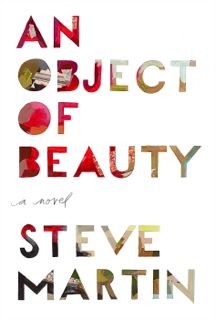
An Object of BeautyAn Object of Beauty — The movie version of Steve Martin’s novel about the NYC art gallery scene is now a project of Amy Adams’, with Ned Benson writing the screenplay. I have high expectation of this one, having seen Benson’s wonderful works The Disappearance of Eleanor Rigby: Him and Her last year at TIFF. The cast has not been announced but Amy Adams will be the producer and actor in her new project.

A Walk In the WoodsA Walk In The Woods — from the vast open sea in All Is Lost to the Appalachian Trail, Robert Redford will appear in this adaptation of the 1998 personal memoir by Bill Bryson, a walk on the Appalachian Trail to ‘rediscover America.’ Nick Nolte is also reported to be in the cast. Screenplay by Michael Arndt (Little Miss Sunshine, Toy Story 3, The Hunger Games), directed by Ken Kwapis (The Office). The movie is scheduled to come out in 2015. Enough time to read or reread, or even walk the Trail yourself. Who knows, you might see the film crew while there.

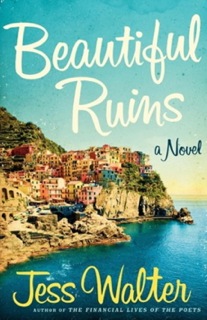
Beautiful RuinsBeautiful Ruins Author Jess Walter of this popular novel will co-write the screenplay with writer/director Todd Field. I’ve seen Field’s Oscar nominated adaptation of Little Children (2006 with Kate Winslet nom. for Best Actress), a haunting film. I trust his talents with Beautiful Ruins. Considering the Italian coastal setting of the book, the movie would likely offer some beautiful cinematography. Imogen Poots is on board, so far.

The Dinner The Dinner — Dutch author Herman Koch’s novel is like a dynamite. I’m half way through the lighted fuse as I type this post, so it’s not full-blown yet, but I’m totally engrossed in this book based on a real-life crime. The dinner menu in an elegant restaurant ingeniously parallels the plot development. I missed it at TIFF last year. And since, I’m not aware that it has made its presence on the big screens here in North America. But hopefully this year we will have the chance to see it. Even if it doesn’t show in your city, read the book still. (Update: to read my book review on Goodreads CLICK HERE.)

Hundred Foot JourneyThe Hundred-foot JourneyAnother culinary movie. This one is much lighter than the above, based on Richard C. Morais’s novel. Story is about a family from India moves to France, opening an Indian restaurant across from a Michelin-starred fine French restaurant. Cultural clashes, the reverse of The Best Exotic Marigold Hotel. The book is quite entertaining, the movie comes with some big names. Producers Steven Spielberg and Oprah Winfrey, Helen Mirren to star, and directed by the prolific Lasse Hallström (Chocolat, 2000; The Shipping News, 2001; Salmon Fishing In the Yemen, 2011)

The GiverThe Giver – The highly popular young adult book by Lois Lowry finally gets a movie appearance, over twenty years after its publication in 1993. Utopia turned bad, ideals and reality. With so many movies on a dystopia, will this still look fresh? Cast include Jeff Bridges as The Giver, and look here, Meryle Streep, Taylor Swift, Alexander Skarsgard, Philip Noyce directs. One of Noyce’s previous works is the adaptation of Graham Greene’s novel The Quiet American (2002). Many may have read this title in school. Time to reread.

The Little PrinceThe Little PrinceLots of talents are behind this newest animation based on the beloved story by French author and pilot Antoine de Saint-Exupéry. Those lending a voice include: Rachel McAdams, James Franco, Marion Cotillard, Jeff Bridges, Paul Giamatti. While I love the earlier musical version (1974, with Gene Wilder as The Fox), I welcome a new adaptation, for I know this will bring the book to the limelight for a new generation. Making a movie nowadays looks to be the most effective way to introduce literature to a younger generation (or whatever generations).

Secret ScriptureThe Secret Scripture — By the Booker Prize short-listed Irish author Sebastian Barry. The novel is an internal dialogue of a close to 100 years-old patient in a mental hospital, Roseanne McNulty, reminiscing her younger days. The older character will be played by the brilliant Vanessa Redgrave, her younger self by the talented Jessica Chastain. I last see them together in a film was in Ralph Fiennes’s directorial debut, the modern version of Shakespear’s Coriolanus. Don’t think these two ladies will appear in the same scene in The Secret Scripture since they are of different time periods, but good to know that the roles are being played by two wonderful actors.

***

Previous Books to Movies Lists:

2014 Book To Movie Adaptations

Upcoming Book to Movie Adaptations

Great Movies Expectations

Related Posts:

My book review of The Dinner posted on Goodreads

Book Review of The Hundred-Foot Journey by Richard C. Morais

Do We Need Another Rebecca Remake? Another Grapes of Wrath?

***

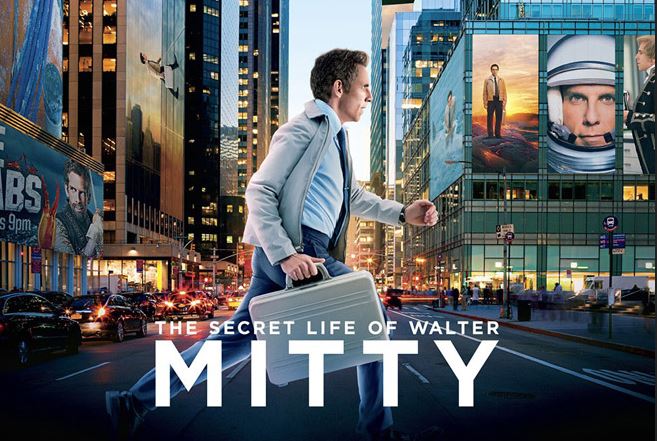
The Secret Life of Walter Mitty (2013): The Love Hate Gap

This new adaptation loosely based on James Thurber’s 1939 short story was a highly anticipated year-end movie, possibly aiming for a spot in the coming awards season. It was released on Christmas Day, 2013, only to meet with disappointing critical reviews.

The-Secret-Life-of-Walter-Mitty

Any movie version derived from James Thurber’s short story first published in the March 18, 1939, issue of The New Yorker is allowed plenty of room for reinvention, since the original story is only about 2,000 words in length. If you’re interested to read or reread it, here’s the link. The story saw its first movie adaptation in 1947, starring Danny Kaye as Walter Mitty.

In Thurber’s story, Walter Mitty is a man living with an overbearing wife. He intersperses his meagre existence with heroic daydreaming. Behind the wheel of his car driving his wife to the hair salon, he would zone-out and imagine himself a fighter pilot piercing through a storm. At another time he would cast himself as a world-renowned surgeon saving a dying patient on the operation table, or as an expert shooter, or a war hero.

Over the years, Thurber’s Walter Mitty seems to have turned from a fictional character into a concept. The daydreamer has gathered mass appeal. Walter Mitty the character unleashes the escapist in us. It takes us out of our mundane, ordinary life and catapults us to brave, new worlds. It empowers and makes a hero out of Everyman.

This recent movie version has taken up such a challenge with fine colours. Walter Mitty (Ben Stiller) works for LIFE magazine which has just been acquired, and a major downsizing ensues. The upcoming issue will be the last of its print edition. As the ‘Negative Assets Manager’, Walter Mitty is responsible for the cover. ‘Negative assets’ means, literally, the negatives of photo collection. And here’s the rub, the slide that is meant for this last cover is missing. Feeling responsible, Walter Mitty takes up the challenge to seek out its reclusive photographer Sean O’Connell (Sean Penn), who leaves his tracks in the remotest parts of the world.

Not quite a dramatic story arc, not quite a believable motive either, considering the digital age of the setting, seems an unrealistic task to conduct a real-life globetrotting search for a missing slide. But out of curiosity, I let the story lead and enjoy what comes next.

The arduous journey to find the mystical photographer offers me an array of visually stunning and surreal Walter Mitty-esques sequences. The initiation is when Walter Mitty jumps onto a moving helicopter in Greenland, upon imagining his love interest Cheryl (Kristen Wiig) singing ‘Ground Control to Major Tom’, urging him to take flight. Other breathtaking scenes that follow include longboarding by an erupting volcano in Iceland (my favourite), scaling the mountains in Afghanistan, and playing soccer with Himalayan dwellers against the setting sun.

Soccer match in the setting sun

In the office, Walter Mitty is the target of bullying from the hatchet man of the acquisition Ted (Adam Scott). Walter is also the secret admirer of coworker Cheryl. Too timid to declare his love, he hides behind eHarmony to hopefully connect with her anonymously. After Walter’s adventurous journey to find the mystic photographer, he is transformed into a braver man; ultimately, his true colours shine through, fantasy fulfilled.

Shirley MacLaine plays Walter Mitty’s supportive mother, an endearing role. Together with Kathryn Hahn as Walter’s sister, they bring some normality into our protagonist’s life. The three offer a few heart-warming moments.

Now, mind the gap. From the reviews and audience feedbacks, it looks like this is one of those ‘love-it’ or hate-it’ movies. Here are the stats of approval on Rotten Tomatoes: critics 48%, audience:76% On Metacritics it is similar: critics 54% and viewers 76%.

Why the discrepancy? I must stress that there are critics who love it, and, audience who don’t. Not that this is purely a ‘critics vs. viewers’ kind of showdown. But we do see the obvious gap between the two groups. What accounts for the gap? Here’s my analysis and speculation:

Those who hate the movie, see Ben Stiller. They see this as a self-serving project of the A-list Hollywood star directing himself in a role that sends him to all the improbable heroic scenarios. They see the production as a self-absorbed ego trip. Unrealistic storyline, much ado about nothing.

Those who love the movie, or find it entertaining and enjoyable, see Walter Mitty. They see the daydreamer, the self-defeating underdog going on a series of life-transforming adventures. They see the Wlater Mitty of today, a tiny screw in the humungous economic machine, dispensable, unappreciated, the tireless worker saving the day. They see love requited; they see dreams fulfilled.

What if… What if this whole production is Ben Stiller’s Walter Mitty fantasy realized? Why should we mind? Anyone too high on the A-list to have no need for a Walter Mitty moment?

~ ~ ~ Ripples

Related Links: 

CLICK HERE To read the short story by James Thurber, ‘The Secret Life of Walter Mitty’, published in The New Yorker, March 18, 1939.

CLICK HERE to read an article detailing the LIFE magazine covers in the movie: “Walter Mitty and the Life Magazine Covers that Never Were”. 

***

August: Osage County (2013), Ad-Lib in the Literal Sense

Tolstoy writes at the beginning of Anna Karenina this famous line: “All happy families are alike; each unhappy family is unhappy in its own way.”

That explains why we see more movies about dysfunctional families than happy ones, because there are just too many more unhappy stories to tell and countless ways to tell them.

August Osage County

Tracy Letts’s play August: Osage County was the 2008 Pulitzer Prize winner for drama. The stage production was well received as a hilarious satire and biting commentary of the contemporary, declining family. Surely, it’s ironic that we find humour in something that we ought to lament. However, it’s also true that the most accessible way for a writer to communicate is probably by means of drama, satire, humour, and entertainment.

The movie version evokes very different reactions. Reviews are mixed, and there are some harsh criticisms. One thing I find though, many of the critics admit to not having seen the stage performance. Well, I haven’t either, but I’ve at least done my due diligence, also to guard myself from A-list stars influencing my interpretation, I read the play before I went to see the movie.

First the reading experience. I’d thoroughly enjoyed it. The long quote like an epigraph at the beginning of the play prepares me for the content following. It describes parent/child relationships, from All The King’s Men by Robert Penn Warren. Let me just quote the last lines:

And the good old family reunion, with picnic dinner under the maples, is very much like diving into the octopus tank at the aquarium.

Three Weston daughters, Barbara, Ivy and Karen reunite in their childhood house outside Pawhuska, Oklahoma, in a family crisis. Their father Beverly had been missing, later found drowned, an apparent suicide. Beverly was a one-time award winning poet who in later life drenched his misery in alcohol. The matriarch is the foul-mouthed Violet Weston, a destructive roadside bomb that explodes upon the slightest human contact. What makes her even more bitter is what could well be her nemesis, mouth cancer. She is often high on prescription drugs, while she prides herself that nothing slips by her without her noticing. She’s not demeaning, just ‘truth-telling’.

There are dark secrets in that old house unknown to the daughters, exposed during this present crisis. The twists and turns in the plot only accentuate the decayed skeleton of a family. But Letts’s lines are thought-provoking, albeit well mashed-up with curses and abrasive language. But there are LOL dialogues and humorous moments, and overall, an entertaining, well crafted play. It starts off with this line: “Life is very long… T. S. Eliot”, and before the final Blackout it finishes with: “This is the way the world ends, this is the way the world ends, this is the way the world ends…” Hollow men in their precarious condition.

Intelligent lines, a far-fetched character, but not impossible situations, and yes, some nasty verbal and literal combats. I must say, having read the play helps me appreciate the movie more despite its faults.

So, here we go round the prickly pear…

Streep and Roberts in August Osage County

THE MOVIE

If you haven’t read the play or seen the stage production, you just might be in for some rude awakening. Director John Wells is known more for his TV series than his one full length feature The Company Men (2010). I’m glad though that Tracy Letts writes the screenplay himself. He keeps many of the lines intact, and adds some scenes for dramatic and cinematic effects.

While exuding fearful authority to everyone who crosses her path, Meryle Streep is fearless in adopting a vocabulary of expletives and curses playing Violet Weston. Her daughter Barabara (Julia Roberts) is more restrained and obviously exasperated to find herself slipping into similar form in relating to her recently divorced husband Bill (Ewan McGregor) and teenaged daughter Jean (Abigail Breslin).

Ivy lives close to Violet but no more as she has her exit plan. However, we know what best-laid plans often do. Youngest sister Karen changes men like wardrobes; oblivious (or maybe not) to her, her present fiancé Steve (Dermot Mulroney) looks like another disappointment. Mattie Fae (Margo Martindale) is a supportive sister to Violet, but she too has to nurse her own unspeakable past. Her husband Charlie (Chris Cooper) is probably of the soundest mind in this family. He has spoken a few admirable lines as he confronts his wife’s maltreatment of her own son, Little Charles (Benedict Cumberbatch). But of course, Mattie fae has her own Gordian knot to deal with.

The person that silently offers practical help whenever there are crashes and especially so in the last scene is the aboriginal maid hired by Beverly a few days before he disappears. Johnna (Misty Upham) cooks, serves, observes, and raises moral protest with a shovel. She is the one at the end of Letts’s play softly reciting T. S. Eliot’s lines, “This is the way the world ends…” while Violet utters: “and then you’re gone, and then you’re gone, and then you’re gone…” In the movie we hear Clapton’s ‘Lay Down Sally’: “But won’t you make yourself at home and stay with me? Don’t you ever leave…” Less literary and more obvious.

The key to enjoying the movie is to find entertainment in its dark comedy, taking misbehaviour and maltreatments as satire, overly dramatic scenes as farce, exaggerated gestures and facial expressions as comedic spasms. But of course, there are scenes that are serious, thus sending the mixed messages of an incongruent  genre. For entertainment purposes here, I think it is fine to feel poignancy through the chaos.  

Yet the movie has its faults, and it’s not hard to pick out. Inconsistency in blocking of characters is an example. One obvious scene is when Bill is driving Barbara to identify her father’s body. We see Barbara sit in the back seat with daughter Jean, delivering her ‘die after me ” plea. As the car stops, the camera points to the front of the car and we see Barbara (or her stand-in) steps out from the front passenger seat.

But overall, as a play turned movie, it is less claustrophobic than the one-room setting of Carnage (2011). And the entertainment value can be found in the acting of most of the characters, in particular, Streep and Roberts. If there are faults, they are not in over-acting. Roberts’s restrained performance is a good counter-balance to Streep’s overbearing character.  Watching the movie, I have the feeling that Wells is following Letts’s written description in the literal sense. Why, in the play, the floor wrestling between Violet and Barbara is written with these words: “ad-lib“.

~ ~ ~ Ripples

***

Saturday Snapshot January 11: Inspired by Llewyn Davis

The movie Inside Llewyn Davis strikes me with its overall atmospheric tone colour. The almost black-and-white, cyan greyness that shroud the scenes convey a pervasive sense of melancholy. While I was seized by the gloominess, I also saw the beauty in the cinematography.

And the snow. During his trip to Chicago, Llewyn has to tread through snow on the streets, without a winter coat, without proper shoes. His socks are soaked through.

I took these two snow photos just recently. At first I wasn’t pleased with their lack of colour. But after watching the movie, I’ve come to appreciate them more. These are all colour photos, not black and white:

Snowflakes

Snowflakes 2

Without any green, trees can still be beautiful.

Tree

Trees

O the beauty of greyness.

***

Saturday Snapshot is hosted by Melinda of West Metro Mommy Reads. CLICK HERE to see what others have posted.

Photos in this post taken by Arti of Ripple Effects. Do Not Copy or Reblog.

***

CLICK HERE to read my review of the movie Inside Llewyn Davis.

Inside Llewyn Davis: A Serious Man in Greenwich Village

As preparation for the movie, I bought the CD soundtrack a few weeks before. This has proven to be a mistake, for I’d been listening to it so much that when I watched the film, I wasn’t surprised by the music at all. I consider that a loss. It would have been much better that I were mesmerized by that haunting voice of Llewyn Davis (Oscar Isaac) for the first time as I watched the movie.

Inside Llewyn Davis copy

Music is a major player in many Coen brothers movies, often used to comedic and acerbic effects. The whole odyssey in O Brothers Where Art Thou (2000) comes to mind readily, or Jefferson Airplane in A Serious Man (2009) where ‘Somebody to Love’ reinvents itself, or even in True Grit‘s (2010) ‘Leaning on the Everlasting Arms’ as we see the one-arm Mattie Ross riding into the sunset.

But in Inside Llewyn Davis, music is no laughing matter. Llewyn is the serious man here, a folksinger down on his luck. T. Bone Burnett has crafted an impressive music production. It should be noted too that Marcus Mumford, lead singer of Mumford and Sons and husband of Carey Mulligan, is also involved in the song arrangement and singing, in particular, the part of Llewyn’s duo partner Mike in ‘Fare Thee Well’.

The setting is New York City’s Greenwich Village, 1961. Llewyn is a folk music purist, an idealist. All he wants is a gig to kick off as a solo performer. The backstory is that his singing duo partner had committed suicide by jumping off the George Washington Bridge. The record he has produced as a soloist isn’t selling. It’s cold in NYC, Llewyn is homeless and coatless. Maybe it’s arrogance coming from being a music purist that makes him callous and abrasive, even to fellow folk singers, or maybe he needs to have that aloof hardness as an armour to sustain the slings and arrows life hurls his way.

O, if only Llewyn’s personality were as charismatic as his voice, he probably would have done better in life. Despite his musical talents, our protagonist, like a Shakespearean tragic hero, is trapped by his own character flaws and tripped by no small amount of fate, he slips slides into the wayside. Sadly, that’s exactly where he lands at the end of the movie.

He has friends and acquaintances, but there’s not much that they can do to help. He has already made the best use of their couches, and some of their wives. The latest to get pregnant is Jean, played against type by the sweet Carey Mulligan, all wrapped up in anger, understandably so, for her friend Llewyn is more concerned about a lost cat than her upcoming abortion. Jean has a very limited vocabulary to express herself except the overused expletive. Not a pleasant role to play I’m sure. Her character could have been written with a bit more depth.

Oscar Issac, Justin Timberlake, Carey Mulligan copy 2

Jean and her husband Jim (Justin Timberlake) are also folk singers but ‘careerists’ according to Llewyn. They would one day concede to life in the suburb, settle down and have kids. ‘Is that so bad?’ Jean asks Llewyn. The answer is obvious. Llewyn is definitely not going down that path.

Talented folk singers converge at the Gaslight Café in Greenwich Village during the 1960’s. Why some succeed and others don’t, the Coen brothers seem not so much to offer rational explanations than to depict the misfortunes of one. In that dim, brick-walled and smoke-filled Café, we hear some fantastic singing. We hear Jim, Jean and their friend Troy (Stark Sands) perform ‘Five Hundred Miles’, evoking Peter, Paul and Mary. At one point, to an oblivious Llewyn, we see the silhouette of what looks like Bob Dylan and hear his voice singing ‘Farewell’.

Cinematography (Bruno Delbonnel) sets the mood from the opening scene. In that basement Café, we see the place dimly lit with spotlight on Llewyn’s face, as his ‘Hang Me, O Hang Me’ captivates us right away. We follow him later as he steps outside to a pitch-dark alley where he meets his nemesis. Even during the day, we see him walk on wind-swept streets under dull, grey sky. The overall bleakness can be soothed only when Llewyn picks up his guitar and sing. His voice seems to be able to neutralize any outrageous fortune.

Llewyn takes a surreal road trip to Chicago to try his luck with a club owner Bud Grossman (F. Murray Abraham, a double for Bob Dylan’s manager Albert Grossman?) He is stuck in the car with the old and sardonic Roland Turner (John Goodman) who wraps up his opinion in one short line: “Folk singer? I thought you said you were a musician.” If the trip seems absurd, it could well be the exact impression the directors intend. We follow one week in the life of Llewyn Davis, a week of failed attempts, gloomy encounters, and bleak prospects. The only light is the voice.

~ ~ ~ 1/2 Ripples

***

Related Reviews on Ripple Effects:

A Serious Man (2009)

True Grit (2010)

***

Top Ripples of 2013

It’s not easy to rate a whole year’s experience by Ripples, unlike a two-hour movie. However, here are some stats I’ve compiled for my own records.

Ripple Effects is all about books and movies. For me, watching a movie definitely is a much easier activity than finishing a book. So far this year, my movie number is around 100, almost three times as many as books I’ve read. They include movies I’ve watched on the big screen in theatres, at TIFF, and on DVD and Blu-ray formats at home. But I’m sure there are still a few I’d forgotten to jot down.

I’ve written 16 movie reviews on Ripple Effects this year, and they are not all 2013 releases. This number represents only a dearth of my film experience. From this small collection, there are two that I’ve given 4/4 Ripples (I’m sure I’ll add some more in this Award Season):

Nebraska 
12 Years A Slave

These two came close, with 3½ Ripples:

Before Midnight
The Disappearance of Eleanor Rigby: Her (TIFF 13)

And several more with 3 Ripples. Click here to my review list.

For my trip to Toronto to attend TIFF in September, definitely a 4-Ripple experience.

Many of the movies I watched this year are “catch-up’s”. They are cinema classics I’d missed over the past decades. These are films that I’d long wanted to see but had not the time or the chance to. Yes, this ‘catching-up’ activity is a most enjoyable time for me. They don’t make movies like these anymore. No CGI, no colours even, yet we can see a kaleidoscope of characters, fantastic scenes and poignant human conditions. So, Top Ripples go to:

Federico Fellini’s I Vitelloni (1953), La Dolce Vita (1960), 8½ (1963)
Victorio De Sica’s Bicycle Thieves (1948)
Robert Bresson’s Au Hasard Balthazar (1966)
Akira Kurosawa’s Ikiru (1952), Rashomon (1950)
Sidney Lumet’s 12 Angry Men (1957)

Some others are book-related. Before the newest remakes come into being, I’d like to experience the original version, like:

Hitchcock’s Rebecca (1940)
Elia Kazan’s East of Eden (1955)
John Ford’s The Grapes of Wrath (1940)

Still other films I watched and/or rewatched to prepare for or just to go together with what looks like is their latest version, or homage, if you will, like the following to coincide with Before Midnight (2013):

Ingmar Bergman’s Scenes from a Marriage (1973)
Woody Allen’s Husbands and Wives (1992)

Or Elia Kazan’s A Streetcar Named Desire (1951) to go with Woody Allen’s Blue Jasmine (2013)

Along the way during this rewarding movie-watching year, I’ve discovered some foreign language films, two in particular stand out: Korean director Chang-dong Lee’s Poetry (2010) and Secret Sunshine (2007)

As a freelance reviewer, I continue to be a contributor to Asian American Press as their film and arts guest columnist. Further, and this I’m really excited about, my feature article on the Canadian-Korean playwright/actor Ins Choi was published on the December 4th issue of Curator Magazine.

**

Even though I’ve only read a small number of books compared to movies watched, I’m glad I’d completed a major challenge, and that’s reading Proust. It’s definitely a 4-Ripple experience for me, despite having had to slash my way through thickets and at times, find my way out of a literary labyrinth. My post on this first taste of Proust was featured on WordPress’s ‘Freshly Pressed’. Now that’s the bonus madeleines on top of an already savory meal.

Another book I hold high esteem is Eric Metaxas’s Bonhoeffer, a Read-Along I hosted earlier in 2013. I’d enjoyed the camaraderie of reading the same book with others, and the discussion of ideas. Finishing a book or not is not as important as taking part in the journey, even for a little while, as we share our thoughts. 4 Ripples.

For old acquaintances and new friends I’ve made in the blogging world this year, I must give another 4 Ripples. This is the major reward of blogging. To all the new blogs and sites I’ve discovered, I’ve thoroughly enjoyed our mutual visits.

**

As for posts, looks like my “Quotable Quotes from Downton Abbey” has taken over “Memorable Movie Love Quotes” as the most popular these days. And I can understand why. Let’s get ready for Downton Season 4, coming up in just a few days.

And for my adventures as a nature paparazzo and bird-stalker, I give them nothing less than Top Ripples.

To 2014, I have a few ideas. This may involve a bit more individual studies, and researching into topics that have interested me for some time. Yes, films and their influence in our postmodern culture, into that topic I will continue to delve. So there you have it, more books and movies to share with you all. As always, I invite you to come by the pond and throw in your two pebbles. I cling on to my motto: “Serenity is golden, but sometimes a few ripples are needed as proof of life.”

To All, a Four-Ripple 2014!

***

Nebraska (2013): Color is Superfluous

When a director decides to shoot his film in black-and-white, he must have certain confidence in the story, characters and aesthetics that he feels color may just be a distraction or even superfluous. Alexander Payne’s Nebraska is exactly that.

I have thoroughly enjoyed this slow-paced, thoughtful, aesthetically gratifying, and deadpan funny movie. To take a break from the cacophony of festivities, the hustle and bustle of Christmas shopping, dinner planning and party hopping, Nebraska is a surprisingly fitting film to watch.

By no means is this a ‘holiday movie’, but if the season is about family, giving, and love, this is an apt offering on the big screen. There are strong thematic undercurrents that carry the quiet story from beginning to end. And I was gratified to see, once again, that visuals speak louder than words when it comes to the cinematic medium.

Nebraska - Woody & David

Woody Grant (Bruce Dern) is an old man of few words. Maybe the onset of dementia has driven him even more delusional and isolated, and alcohol doesn’t help either. Dern’s performance is spot on and totally engaging. From a marketing promo in the mail, Woody is convinced that he has won a magazine sweepstakes of one million dollars. He needs to get to Lincoln, Nebraska, to claim his prize. We see him at the beginning of the movie heading to Nebraska from Billings, Montana, on foot. He is too old to drive but not to walk.

Woody’s brash and critical wife Kate (June Squibb) calls their estranged sons David (Will Forte) and Ross (Bob Odenkirk) for help but all fail to dissuade him. Soften by the old man’s total absorption, and too kind to douse his dream, David takes a few days off work to drive his father to Nebraska. Thus begins an unlikely bonding road trip for father and son.

To quench his delusion, Kate and Ross will converge in Hawthorn, Nebraska, a town where Woody was born and spent most of his energetic years. There in Hawthorn, a fictitious town for the movie, they will meet up with Woody’s older brother Ray’s family for an impromptu reunion, hopefully to get Woody’s mind off Lincoln and the prize, and then they will return home to Montana after.

Hawthorn is the home of a younger Woody, a past that he rarely mentions, a place where his son David will come to discover a father he had never known. At Ray’s home, David meets his not-so-friendly cousins Randy (Kevin Kunkel) and Cole (Devin Ratray, remember the bad burglar from the first two Home Alone movies?) While the town folks are all congratulatory on his million-dollar win, Woody’s old auto business partner Ed Pegram (Stacy Keach) suddenly reminds him of outstanding debts.

A character whom I find the most endearing is Woody’s girl friend of his youthful past, the long time editor of the town’s newspaper Peg Nagy (Angela McEwan). She wants to run an interview with Woody about his alleged win. David meets up with her at the newspaper to clear up the misunderstanding. There we see a gentle and kind old lady who seems to have much admiration for his father, knowing him in the past as a sturdy, young man. Though now a widow, Peg is a happy and fulfilled grandmother. This is probably the most poignant scene of the movie. Through David’s learning of his Dad as a promising young man and this quiet, pleasant lady Peg, the haunting thought seeps into our mind: ‘What if things turned out differently?’ The black-and-white medium could well be the message itself. We are reminded of a past which we cannot relive. At the same time, we are provoked to think of the alternative scenarios of what could have been.

Director Payne had won two Oscars both for Best Adapted Screenplay for his previous acclaimed movies Sideways (2004) and The Descendants (2011). Nebraska is a totally different work, and one which I like the most among the three. A common thread that runs through all of them is the prominence of specific locales, the California wine country in Sideways, Hawaiian islands in The Descendants, and here the scenery flanking the long stretch of highways from Montana to Nebraska. In stirring and soulful black-and-white, the passing wide landscape of rolling hills and boundless prairies convey the existential passage of time, lost youth, and whatever memories that one accumulates or tries to forget, all immaterial as old age takes over, a soulful touch from the director of the new retiree played by Jack Nicholson in About Schmidt (2002).

But this is a comedy, and there are lots that I have responded with spontaneous chuckles and laughs. The humor is totally enjoyable, and so is the overall atmosphere. We see a change in the mood as the son begins to appreciate more about his father. The ending is affective and gratifying. A check on IMDb leads me to the tidbit that director Payne was born in Omaha, Nebraska. Ah… the river runs deep.

If I have a say, Nebraska would appear in the upcoming Oscar nominations for Best Picture, Best Director, Best Actor (Bruce Dern), Best Cinematography (Phedon Papamichael), and Best Screenplay (Bob Nelson). However, considering the black and white styling, and the quiet, low-tech and slow-paced storytelling, it just may not attract those who are spectacle-driven. But that would be their loss.

~ ~ ~ ~ Ripples

***

Other Awards Season Reviews on Ripple Effects:

12 Years A Slave: Beauty and Sadness

All Is Lost

Lee Daniel’s The Butler: The Trouble with Famous Faces

The Book Thief: From Book To Film

***

12 Years A Slave (2013): Beauty and Sadness

UPDATE Feb. 16: 12 Years A Slave just won BAFTA 2014 Best Film and Chiwetel Ejiofor, Best Actor. 

UPDATE: 12 Years A Slave is nominated for 9 Academy Awards including Best Picture, Best Director, Best Actor, Best Supporting Actor, Best Supporting Actress, Best Adapted Screenplay, Best Costume Design, Best Production Design, Best Film Editing.

Movies this season seem to come in pairs in terms of subject matter, which makes interesting viewing. Gravity and All Is Lost is a pair. Lee Daniel’s The Butler and 12 Years A Slave another. I watched them purposely back to back.

12 Years A Slave is powerful in many ways, most readily is the aesthetics and styling, both visual and audio. Before he turned to directing, Steve McQueen was a visual artist trained in fine art in London and New York, and it shows. His cinematic work is a testament to the fact that film is a mixed-media art form. More importantly, it shows that film art does not have to be esoteric, or be appreciated only by an ‘artsy’ few. 12 Years A Slave is an exemplar. It carries no elitism but speaks to all. What more, the subject matter may be ugly, but the medium depicting it can be artistically gratifying, thus, conveying the message with even greater potency and inspiration.

12 Years A Slave Poster copy

The film is an adaptation of the 1855 memoir written by Solomon Northup, a free black man, known for his skills in playing the violin. He was living happily with his wife and two children in Saratoga, New York. One day, two men came to offer him a gig to play the fiddle at a circus. Solomon was deceived, drugged, and later smuggled to Louisiana to be sold as a slave. There for twelve years, he endured insufferable hardships until he miraculously met a Canadian carpenter named Bass who stood against slavery. With his help Solomon found freedom and rejoined his family.

I disagree with some critics who assert that the film is too artfully directed, pristine and sanitized to convey the ugliness of the subject matter. One of the qualms they have is with a scene at the beginning of the movie wherein a beating is being shot with artful camera work and lighting. After he is drugged and chained in a dark holding cell, Solomon is fiercely beaten until the torturing paddle breaks in two. Amidst the total darkness in that filthy cell, we see him cower in pain, yet his white shirt literally shines. I noticed that scene too and appreciated how well it was shot. For me, I saw the glowing white garment as a powerful symbol of purity and innocence amidst utter depravity. I’m glad there’s an artist/director to helm this film. We are seeing how the cinematic medium can be sculpted to its full potential. I don’t see anything ‘art’-ificial about it or sense any contrivance.

The issue here is the paradox of conveying ugliness in a well-crafted and artful frame. I have no qualms with that. Should art capture beauty only? Or, should ugliness be depicted by casual and shoddy work in order to be ‘realistic’? The answer is elementary. A quality medium can only enhance the poignancy of the message.

On another level, the film shows us that amidst evil, beauty can still be found. It exists in the persevering spirit of Solomon Northup. Herein lies the inspiration of the story. I found this quote from an excellent interview article with director Steve McQueen. It speaks to the fact that, in the midst of utter sadness, the human spirit can still glean what’s positive and beautiful. From the memoir of Solomon Northup we read these words:

There are few sights more pleasant to the eye, than a wide cotton field when it is in the bloom. It presents an appearance of purity, like an immaculate expanse of light, new-fallen snow.

Acclaimed British actor Chiwetel Ejiofor’s performance as Solomon Northup is inspiration itself. His nuanced expressions portray clearly some very mixed and intense emotions under the most desperate of circumstances, like consoling a female slave lying next to him at night and yet keeping his integrity, or being forced by the sadistic Epps to whip another slave. Even at the point of despair, Solomon maintains his self-respect, remains upright and kind, and upholds a human spirit that no whips can break. The actor is also heading straight to the Oscars according to consensual predictions.

Glimpse of hopeThe excellent supporting cast also renders beauty to the overall production, some of whom might garner recognition of their own come Awards time. Newcomer Lupita Nyong’o is impressive as fellow slave Patsey, a desperate soul dangled on the edge of survival and despair. Paul Giamatti (who won a Golden Globe as John Adams in 2009) plays a mercenary slave trader. The excellent character actor Michael Fassbender (in both of McQueen’s previous films Hunger, 2008 and Shame, 2011) as slave breaker Epps embodies the wickedness of the system and a soul derailed. Paul Dano (There Will Be Blood, 2007; Prisoners, 2013) is within type as the murderous slave driver Tibeats. Again the paradox appears. We’re glad to see actors giving superb performance playing villainous roles.

Then there’s the versatile Benedict Cumberbatch, picking up a Southern drawl to portray the kind slave owner Ford. His scenes with Solomon offer some needed relief. Unfortunately, those better days are short-lived. The man who helps Solomon to freedom is Canadian Samuel Bass, very short screen appearance by Brad Pitt. He is an itinerant carpenter working on Epps’ land. This chance encounter makes Solomon aware of Bass’s anti-slavery stance. For the first time in all those years of captivity, he confides his true identity in someone trustworthy and pleads for Bass to contact help in his home state up north.

The music and sound, or the lack of it, are equally effective. Composer Hans Zimmer’s soundtrack ‘Solomon’ is epic and heroic. The spirituals sung by the slaves on the plantation express their deep yearnings for release and freedom. In one scene towards the end, we see other slaves singing their heart out the spiritual ‘Roll Jordan Roll’. At first Solomon listens as a bystander. After a while he can’t help but pour his soul out and join in. That’s the point he totally identifies with the others in their hopeless condition, calling out to God for deliverance.

What follows is memorable. Sometimes silence speaks louder than sound. That moment of silence marks the change of fate for Solomon. I was captivated by the lack of sound, and the camera static, closing up on Solomon’s face of apprehension and despair for a long minute. Often it is the slow, silent space a director allows us to absorb and wait that I appreciate most.

As I stepped out of the theatre, I breathed out a sigh of satisfaction. True there was much sadness in Solomon’s story, but I was relieved to see ultimately his perseverance pay off. I was gratified too that this story of the human spirit triumphant is well told in a meditative pace, sculpted artfully, and delivered by poignant performance. This is the beauty of film art.

~ ~ ~ ~ Ripples

***

Related Links:

My Review of 12 Years A Slave the memoir by Solomon Northup

Download 12 Years A Slave the book

Solomon Northup from Wikipedia

The Underground Railroad

***