‘The Holdovers’ is easy viewing for the holidays

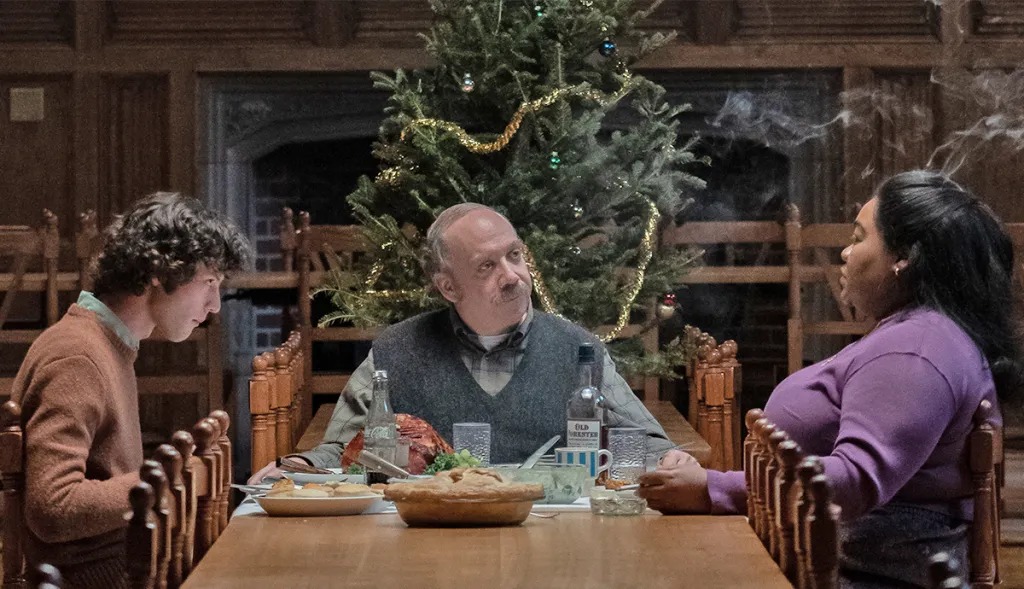
Alexander Payne’s newest feature is a pleasant dramedy for this coming holidays season. Set in a 1970 remote New England winter, boarding school history teacher Paul Hunham (Paul Giamatti) is tasked with supervising the few students who can’t go home during Christmas break, the holdovers.

When a helicopter sent by one of the students’ rich daddy comes to pick up the group, Angus Tully (Dominic Sessa) is left behind as he is just like his cranky history teacher at Barton Academy, unpopular among his peers. Angus’ pain stems more from being abandoned by his mother who wants to spend Christmas with her new boyfriend alone. Together with the chief cook of the school Mary Lamb (Da’Vine Joy Randolph), a grieving mother who has just lost his son in Vietnam, three damaged souls are left to spend their winter holidays in an empty boarding school.
Payne has won two Oscars for Best Writing, Adapted Screenplay, for The Descendants (2011) and Sideways (2004), both with which he was also nominated for Directing. His third directing Oscar nom was for the black-and-white feature Nebraska (2014). Payne’s forte of capturing the humanity in conflicting relationships is apparent in his works. Such is the main drive and the fun found in The Holdovers, where we see Payne reunites with Sideways‘s Giamatti. The idea for the film came from a 1935 French movie, but interestingly, Payne chose to have the TV writer David Hemingson do the screenplay, his debut feature.

The story idea isn’t new, misfits thrown together in reluctant circumstances starting out repelling each other but through unexpected turns of events, human decency shines through. Watching The Holdovers brings back memories of Dead Poets Society and Scent of a Woman. But this is a much lighter and warmer feature with nonetheless poignancy towards the end. Payne’s signature style of sprinkling humour with pathos is prevalent here, at times even with slapstick, Chaplain-like actions added in. Later a road trip to Boston solidifies the unlikely companionship, events leading to the triumphant transformation of self for all three characters.

The 133-minute screen time could be tightened though, especially in the first part where it feels likes the story has not started until everyone has gone and only the three remaining characters are left in the empty school. It then picks up momentum when a road trip is in gear. The first part is set up for slow-paced viewing offering scenic New England in the snow; the song selections are appealing, and maybe with a touch of sarcasm. While waiting for the inciting turn to kick start the story, viewers can sit back and maybe for some, reminisce on their own prep school experiences.

He may be pompous and grumpy, Hunham’s sadistic approach to teaching just shows that his intention is genuine in preparing his students to enter Ivy League schools by their own academic merits and not because their fathers give money for a new building or a fancy gym. He even has the gall to fail a senator’s son, hence, his unpopular status among the principal, faculty, and needless to say, his students. As a classics and ancient history teacher, Hunham’s personal vernacular is where some of the humor lies. His lines are quotable quotes. Giamatti is perfectly cast, a natural in portraying such an eccentric. Come awards time, he is likely to be noted for his performance.

Da’Vine Joy Randolph as Mary is superb. Despite nursing deep loss, she is sensitive to others’ needs, a character foil against Hungham. her quiet presence exudes a much needed sensibility to balance out the incompatible trio. It’s always heartwarming to see human decency and kindness seep through the clouds of personal pain.

Sessa is discovered from an audition at an actual New England boarding school. It’s interesting that he looks more mature than a high school student. So, in that sense, he doesn’t seem to be a fitting cast. However, to make up for his appearance, his acting is natural and in this his movie debut, has shown himself to be a pristine actor with much potential.

The Holdovers could make another crowd pleasing Christmas movie with holding power in the years to come. It’s easy viewing and inviting for rewatch, especially to catch the quotable lines, Hunham style.

~ ~ ~ Ripples

***

Related Ripple Review:

Nebraska (2013): Color is Superfluous

and a related quote from a previous post:

“Medicine, law, business, engineering, these are noble pursuits and necessary to sustain life. But poetry, beauty, romance, love, these are what we stay alive for.” — Dead Poets Society
‘NYAD’ is a movie of two heroes

Diana Nyad is the first person to swim more than 100 miles from Havana, Cuba to Key West, Florida without a protective shark cage. The date was September 2, 2013. Nyad reached Florida shore after 53 hours of swimming in open water at the age of 64.

First off, I’m aware of the controversy surrounding this achievement of Nyad’s, as well as those of her past as a marathon swimmer. However, I’m here to discuss the movie NYAD only, so that’s what this post is about. The movie is based on Diana Nyad’s memoir Find a Way: the Inspiring Story of One Woman’s Pursuit of a Lifelong Dream (2016); since I’ve not read the book, I won’t be touching on any of its content or comparing the source material with the adaptation.

NYAD is the first narrative feature of Oscar winning documentarian couple Jimmy Chin and Elizabeth Chai Vasarhelyi. Chin himself is no stranger to extreme sports. An acclaimed mountaineer and National Geographic photographer who has reached the top of Mount Everest twice and skied down its vertical surface. With Free Solo (my review), the husband-and-wife filmmakers won the Best Documentary Feature Oscar in 2019. The film chronicles rock climber Alex Honnold scaling the 3,000 feet vertical wall of El Capitan in California’s Yosemite National Park using his bare hands and feet, solo and free from ropes and safety gears.

I can see right away how this feat of Honnold’s parallels that of Nyad’s, who swam in the open ocean with no enclosed protection from sharks, albeit in her successful, final attempt, donned a jellyfish protective suit to finish her challenge. Both the mountain climber and the marathon swimmer possess the same drive: an obsessive, iron will.

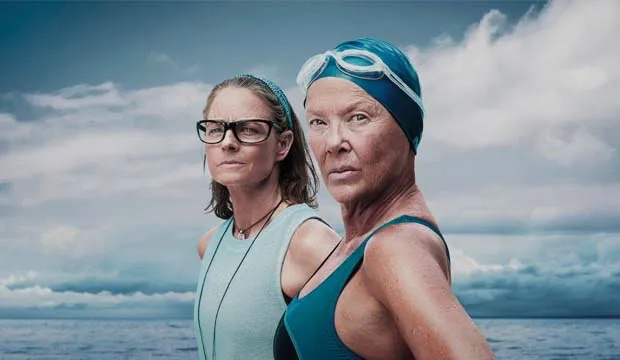
Annette Bening is perfect in her portrayal of Nyad, a determined but difficult, and sometimes abrasive character. It takes such kind of one-track stubbornness––and a whole supporting team including an expert navigator (John Bartlett, aptly played by Rhys Ifans), boat pilot, medic, jellyfish expert, shark detracting divers, and others––sailing alongside the marathon swimmer to achieve such an arduous venture.

Above all, it’s Nyad’s lifelong friend and coach Bonnie Stoll––superbly-matched casting of Jodie Foster––who supports and trains her during this grueling ordeal, albeit reluctantly at the start. Nyad might be the ultimate triumph, but it is Bonnie, the loyal friend being pushed into her own onerous hero’s journey that makes it possible, preparing the swimmer both physically and psychologically to realize her dream. Bening and Foster playing off each other is the best stroke of the movie. A moving scene towards the end shifts the focus of the motivating force, surely it requires an indomitable will, but it’s deep, genuine love that finishes the course.

As documentary filmmakers shooting their first dramatic narrative, Chin and Vasarhelyi deftly insert actual footage of Nyad’s earlier failed attempts, the first one when she was only 28, as well as her interviews and talks. Such inclusions strengthen the authenticity of the drama. It’s inspiring to see that Nyad is not afraid to look at her past failures. Ironically, it is her first failed attempt at 28 that sparks the idea to try again when she’s 60, and prods her to face the challenge head-on at 61, then tries again, and again, until she finally achieves her goal in her fifth attempt at 64. Showing such repeated efforts could make the film look redundant, but Bening and Foster’s on screen relationship captures my attention throughout.

Bening needs to be applauded for her willingness to go all out to portray Nyad in the most realistic way she could. Chin had noted in an interview that the actress spent four to eight hours a day in the water shooting the film, “and she did all the swimming.” To prepare for her role, Bening, who was well into her 60’s at the time, had to go through a year of intense training in swimming and physicality before the production. Most likely Mary Oliver had struck Bening just the same as her poetic voice had moved Nyad. In the movie, these lines from ‘The Summer Day’ were the initial motivation inspiring Nyad to take up such a Herculean challenge at 60:

“Doesn’t everything die at last, and too soon?
Tell me, what is it you plan to do
with your one wild and precious life?”

Another insertion the directors use to dramatize the seemingly monotonous swims is fantasy sequences, which are not too well received by some reviewers. Not for me. Like one lost in the desert wearing out to the brink of expiring with thirst, mirages appear in the hallucinated mind. This is a parallel situation. In the dire demand of the grueling swim in treacherous waters almost to the brink of death, disorientation could set in.

Another dramatic device are the faded flashbacks of Nyad as a young swimmer, including some hazy implications of abuse. While serving the biopic element of the feature, these flashbacks lack the significance and continuity with the present day Nyad and her goal. Tighter editing and elaboration of these scenes might serve their purpose better.

Must mention is the original score by Alexandre Desplat whose expansive repertoire include two Oscar wins (The Shape of Water, The Grand Budapest Hotel). The song selections are interesting as well, maybe only appeal to certain demographics; some of these titles must have brought back fond memories from viewers of Nyad’s generation. The opening of the film are underwater shots of Nyad swimming in the pool, and to my pleasant surprise, ‘The Sound of Silence’ comes on, reminiscence of a similar scene where a dazed Benjamin, freshly graduated from college trying to figure out his path in life. We all know where that comes from.

I’m excited to see Chin and Vasarhelyi venture out into the narrative feature genre. The fusion of dramatization with actual documentary footage is an effective transition into their new mode of storytelling. NYAD is an inspiring film not just for its subject matter but for the performance of the two lead actors which is most memorable.

~ ~ ~ Ripples

***

Anna’s Hummingbird: A Lesson in Smallness

Earlier this week I spent a few days in Vancouver, British Columbia. The Richmond Nature Park was high on my agenda since I ‘discovered’ the place last time I visited and found it to be a haven for hummingbirds. This time, I’m not disappointed as I’ve seen many albeit it’s hard to take a good photo of them, for they are small and ultra fast.

Every hummingbird is a miracle in itself. They are the smallest of birds, most species measuring 3-5 inches (7.6 -10 cm) in length and about 0.1 oz. (3 – 4 grams) in weight. The bee hummingbird of Cuba is the smallest bird in the world, only 2 inches (5 cm) in length and weighs 0.07 oz (1.95 gram).

According to World of Hummingbird, depending on their activity, hummingbirds’ wing beats can range from 70 to 200 times per second (when diving). And they can dive! Up to 60 miles per hour. Hummingbirds are the only birds that can fly forward, backward, hover and stay still in the air, fly sideway, and even upside down.

During migration, the Rufous Hummingbird fly from the Gulf of Mexico to Alaska to breed, that’s nearly 4,000 miles. These small but powerful flyers can travel as much as 23 miles in one day. As they cross the Gulf of Mexico they may cover up to 500 miles at a time. Their average speed in direct flight is in the range of 20-30 mph (32 – 48 km/hr), and up to three times that fast during courtship dives. Interesting info. here.

There are numerous fascinating facts to be found online, but nothing beats the actual experience of watching these tiny birds flapping their wings to stay still in the air like a motorized flapping cross, or see their iridescent feathers shimmering in the morning light. They are just too fast for me to take photos, especially when darting in midair. I could only capture some while they were sipping nectar from a feeder, or perching on a branch.

When I visited Richmond Nature Park earlier this week, I only found Anna’s Hummingbirds, although the signs indicate Rufous also hang out there. From the info I’ve gathered, Anna’s Hummingbirds now don’t migrate but settle in the Pacific Coast of North America, from California to B.C. in Canada. So there I was, encountering these beautiful, small miracles that morning.

Here’s a male Anna’s Hummingbird staying still:

the female or immature ones are mostly green without the fuchsia red on their head and neck, but their iridescent plumage and the colourful spots on the head are a sight to behold:

“… I have always known you are present in the… wings of birds.”
–– Mary Oliver, from the poem ‘Six Recognitions of the Lord’

***

The Netflix Diversion

As two of my highly anticipated movies (see my list here) coming out in the fall will be on Netflix: Maestro and NYAD, I just can’t resist anymore. Three days ago I decided to subscribe to Netflix. While waiting for these two movies to show up, I’ve got plenty of others to watch. These past few days, I’ve finished a few. Yes… daily life has been a bit diverted. My capsule reviews in the following. All three TV series are worth watching and the doc on Joan Didion, a must-see.

BEEF –– A road rage incident pushes two lives down the abyss of rage and revenge which ultimately torpedoes into an explosive meltdown. The fight between Amy Lau (Ali Wong), an entrepreneur, wife and mother living in an upper middle class neighborhood and her adversary Danny Cho (Steven Yeun), a handyman striving to make ends meet as a dutiful son and watchful older brother is not only a satire of the disparity between the rich and the poor, but a realistic depiction of the existential angsts shared by all regardless of social and economic status, or, as the series has effectively shown, racial background. Highly addictive, cleverly written and first-rate acting. 13 Primetime Emmy Awards nominations.

The Diplomat –– Kate Wyler (Keri Russell) is appointed by the POTUS (Michael McKean) as the new ambassador to the United Kingdom, a post she reluctantly takes up. With her previous experience in war-torn countries and Afghanistan which she expects to return, her new post in London is a major cultural clash, hence resulting in some mismatched decorum and humorous moments. Adding to her maladjustment and complicating matters when dealing with volatile, international crises is her husband Hal (Rufus Sewell), himself the former ambassador to the UK. The once political influencer now has to take up the role as a diplomat’s wife in a precarious marriage. Interesting play on gender politics, marital/power relationships, on top of intense, political chess play. Russell is nominated for Outstanding Lead Actress in a Drama Series in the upcoming Emmy Awards, deservedly. Interesting to note some of the language used here is quite similar to the rage-filled one in BEEF.

The Lincoln Lawyer –– I pick up from the current Season 3. While I like Michael Connelly’s character, former LAPD detective Harry Bosch, more than his Mickey Haller, a lawyer who works out of a Lincoln dealing with seedy clients, I’ve enjoyed the TV adaptation. Haller, aptly played by Manuel Garcia-Rulfo, is a pleasing yet complex character, resourceful, smart, an upholder of the law but has his blind spots. As a recovering addict, vulnerability coexists with his assets. Other characters are also well cast, jumping out of Connelly’s novels to become well fleshed-out and likable human beings (we just might be using this term more now to distinguish between the real and the fake), making up a lively supporting cast. Interesting to note that in the 10 episodes of S3, despite dealing with crimes and criminals, the language used is relatively free of foul play.

________________

Joan Didion: The Center Will Not Hold

Directed by Griffin Dunne, actor/director and Joan Didion’s nephew, this brief, biographical documentary of Didion follows her career and life during some of America’s tumultuous decades. Dunne’s interviews with her aunt elicit some intimate conversation and poignant memories from Didion, by now frail and with apparent impediment. An astute observer of society, Didion had given us some monumental commentaries of her times with her writings. Listening to the narration in the documentary and seeing the iconic photos and footage of significant turns of history, Didion’s analyses just as well could have applied to our world today, just as she has quoted in her Slouching Towards Bethlehem the line in Yeats’s poem: “Things fall apart; the centre cannot hold.”

The latter part of the documentary is about Didion’s own personal tragedy, chronicling the sudden death of her husband John Gregory Dunne and just months later, her daughter Quintana, her grief poured out in The Year of Magical Thinking and Blue Nights. English playwright David Hare had been her anchor in transforming mourning and loss into artistic expression on stage, giving her some sort of a closure. Hare directs the Broadway play adaptation of The Year of Magical Thinking with Vanessa Redgrave as the sole performer. Redgrave shared a similar experience as her daughter Natasha Richardson died suddenly after a ski accident. The documentary has kept a short clip from the play and presented personal recollections from Hare and those close to her life, friends and colleagues. A poignant and moving feature.

~ ~ ~ 1/2 Ripples

***

Related Posts on Ripple Effects:

Blue Nights: A Book Review

Voice of the Poet: Things Fall Apart

When the birds are gone

It may still be summer, but most of the migratory birds have started their winter journey south. My favourite avian friends seem to have departed without saying goodbye. So, I train my eyes to look at all the beauties that I haven’t noticed before when I was only focused on birding. Even the dandelions look good when contrasted with the clear, blue river, or the small butterfly, or is it a moth?

I’ve discovered a brand new interest. What are these red flying objects in front of my eyes, so many of them darting around. Red dragonflies… I haven’t noticed them before. My curiosity sent me to Google and yes, I’m sure they are dragonflies and not damselflies. The main difference is that dragonflies’ wings spread out like this when they’re at rest:

while damselflies fold up their wings at rest like this:

I’ve seen blue dragonflies before, lots of them here, but this time it’s the red dragonflies that are so abundant. I haven’t noticed them before. They are beautiful and easier to capture in photos than birds:

some intimate moments:

Of course I’ll miss my avian friends for another long absence until next spring, but there are other beauties to behold. It’s small things like these that sometimes make me jump out of bed with excitement. No, they won’t be around come winter, but I’m sure there are other blessings to explore then.

***

‘Past Lives’ and the Road not Taken

Hae Sung (Teo Yoo) visits Nora (Greta Lee) in New York, a scene from “Past Lives”. Photo courtesy of Elevation Pictures

“Past Lives” is a meticulously crafted feature that is autobiographical in nature, naturalistic in style, and far-reaching in its resonance. The directorial debut of Korean-Canadian playwright Celine Song who is now based in the US, it premiered at Sundance early this year and subsequently was nominated for a Golden Berlin Bear at the 73rd Berlinale. Most recently on July 2, its accolades continued at the Hollywood Critics Association Midseason Awards winning Best Indie Film, Best Actress for Greta Lee and Best Screenplay for Song.

Nora (Greta Lee), immigrated to Canada from South Korea when she was twelve, following her parents’ decision. As a child, she has always been Na Young (Moon Seung-ah), now given a new name, Nora, by her father as they prepare to leave. Her departure severs a close tie with her childhood sweetheart Hae Sung (Seung Min Yim).

Twelve years later, Nora makes a move to New York City from Canada in pursuit of a career in writing, a decision this time of her own choosing. While there, she happens to come into contact with Hae Sung (Teo Too) online. The two meet again via texts and Skype but that connection is short-lived as Nora initiates a termination, for she wants to focus on her writing career and setting roots in her newly adopted home. Fast forward some more years, Hae Sung comes to New York in person to seek her out. Nora’s past thus re-emerges. 

In a writer’s retreat, Nora meets Arthur (John Magaro) and they soon fall in love. When Hae Sung comes to New York, Nora has been married to Arthur for seven years. Despite being in a secure and loving marriage, Nora feels the conflicts of navigating between two men from the present and the past, as well as choosing a path for the future. ‘Yet knowing how way leads on to way’ as the poet Robert Frost poignantly utters, she laments the loss that comes with only one path to tread, one road to take. 

While it may sound like a typical immigrant story–the ambivalence of losing and gaining as one makes decisions about leaving one’s homeland to start a new life in a foreign country–Nora’s narrative ripples out beyond the immigrant experience. We are all constrained by time and space. Somewhere in our life, we are bound to have left behind a part of ourselves, our childhood, our roots as we move forward to another stage of life.

In the opening bar scene where Nora sits in between her husband and her childhood sweetheart, she is the interpreter of two languages, navigating between cultures, and juggling two identities of self. Nora finds herself acting as an intermediary between two men who love her but in different ways and as a different persona, Nora and Na Young. This is a real-life scenario Song had once found herself in and which became the initial spark of the making of “Past Lives.”

Arthur is in an awkward situation. In one of the pivotal scenes, an intimate husband and wife conversation in bed, he tells Nora that she speaks Korean in her dreams, “there’s a part in you that I won’t be able to know.” That part is the first twelve years of Nora’s life where Arthur was absent and which Hae Sung longs to recapture. Arthur admits, “I can’t compete.” However, instead of handling the conflict as a clichéd love triangle, Song has turned it into a cinematic pondering of life choices, what one leaves behind and what one gains in a new chapter of life. 

Magaro delivers a superb portrayal of the ambivalence in Arthur’s predicament. His screen presence and dialogues with Nora offer much clarity. As well, his is a character that has the power to elicit deep empathy from viewers, on top of adding some subtly humorous moments. I wish there is more of such screen time for this admirable role. Arthur’s mature love for Nora overrides any jealousy or traces of inferiority complex when Nora casually compares the two men, effectively shifting viewers’ attention from the reunion of childhood sweethearts to this third party, the loving and silent husband stepping aside to let his wife dwell on her past. 

And Nora appreciates Arthur’s love, albeit it doesn’t eliminate the lament she feels about the loss of a former self. Having transplanted in New York City, she has gained a new cultural identity as a ‘Korean-American.’ After meeting Hae Sung again, she finds him firmly rooted as a ‘Korean-Korean.’ Song’s dialogues are astute. Lee’s screen presence is affable and nuanced, a pleasant character with whom viewers can readily empathize. Hae Sung seems to subscribe firmly in In-Yun, the Korean concept of predestined fate.

Young Hae Sung (Seung Min Yim) and young Nora (Moon Seung-ah) part ways. Photo courtesy of Elevation Pictures

There is a recurring shot which speaks volume. A fork in the alley where young Hae Sung and Na Young walk home after school in Seoul. Two roads diverge. On the left is the boy continuing his way, on the right is his sweetheart, walking up the steps, two separate paths, two life trajectories. It’s not about taking the road less travelled as Frost would tell with a sigh, but the road not taken that keeps the traveller thinking what could have been. While such is a typical existential pondering of the immigrant experience as one leaves one’s homeland to start another life, it is also a universal question as we concede our limitation as humans, feeling the loss of opportunities or the what if’s with the road not taken. Song’s feature is like a visual depiction of Frost’s poem, illustrating a real life scenario. 

Song excels here in elliptical storytelling. Some sequences are almost dreamlike with blocked-out dialogues, or a still camera pointing at Hae Sung and Nora gazing at each other in silence; viewers are free to imagine what’s going through their minds.

However, with the short 105 minutes film duration, I feel more time could have been spent on a deeper characterization of Hae Sung in Korea. What kind of a man has he grown into other than merely the soju drinking young man or later just the outward changes in appearance; and how he still clings to a childhood image of Na Young now that they are adults. If Hae Sung can be developed into a more solid, three-dimensional character instead of like a ghost of Nora Past, the conflicts could have a more powerful impact. 

Surely, this is Nora’s story, and Lee has delivered effectively with pathos and realism. Further, Song has proven herself to be a filmmaker to watch in the future. 

~ ~ ~ Ripples

___________________________

I thank Asian American Press for the permission to repost my review here in full.

The Owl Family’s Debutante

Another spring brings another owl baby. While I can’t tell if it’s the same owl family, it’s interesting that a Great Horned Owl family would use the same tree cavity to make their nest every spring to welcome their newborn(s), year after year.

Here it is, about a month ago, a brand new baby peeking out of the nest. Can you spot baby owl in this picture?

And now a few weeks later, baby has grown to almost the size of mommy owl, and the family has vacated their nest. So, it’s wonderful to see them out on a tree. Baby still has the downy coat on, but what impresses me is mommy owl—I like to think it’s the mother owl staying close to baby, as father owl usually goes to find food—like a sentinel watching closely, looking noble and stoic:

But of course, a mother is always a mother, and baby is always her baby, no matter how big he or she has grown. I’m glad that I was able to capture these endearing moments, albeit a little blurry since they were very far up a tree from a distance. Baby’s on the right in these pictures:

***

(Glitches while posting this. Have to repost. Previous post entitled Baby’s Day Out. Issues with the date. This post is published on Saturday May 27, 9:40 am.)

Remembering Gordon Lightfoot: Pussy Willows, Cattails, Soft Winds and Roses

The passing of Gordon Lightfoot yesterday at the age of 84 evokes a stream of nostalgic consciousness. The following is an old post dating back to more than ten years ago. I wrote it after visiting Unionville in Ontario; the profusion of cattails by the pond stirred up memories of listening to Lightfoot’s song. As a tribute to the Canadian music legend, I’m reposting it here.

____________

Took a short trip to Ontario last week and came home overwhelmed with nostalgia. It all started when I visited the town of Unionville and saw these, crowds and crowds of cattails growing profusely at the pond, the fields, and by the footbridge:

.

For some inexplicable reasons, I’m much fond of cattails. The first time I learned about them was from listening to the song by Gordon Lightfoot… before I’d actually seen one.

Some time in the 70’s, for many afternoons I sat in the art room of a high school somewhere in Alberta, working on some art project, but mostly doing nothing at all while listening to Gordon Lightfoot.  Mr. Hannington held a laissez faire art class… we could do just about anything, or nothing.  Usually, there would only be three or four of us in the room.  We would just sit around, chat, daydream, and immerse in the voice of Gordon Lightfoot on the radio.

I didn’t turn out to be an artist, while one of us did.  But I’ve remained partial to cattails, mesmerized by the song and the singer.  Those Lightfoot afternoons in the art room emerged from the depth of hazy memories, the lyrics were the soft winds caressing naked limbs as I walked in this natural reserve in Unionville.

Pussywillows, cattails, soft winds and roses
Rainpools in the woodland, water to my knees
Shivering, quivering, the warm breath of spring
Pussywillows, cat-tails, soft winds and roses

Catbirds and cornfields, daydreams together
Riding on the roadside the dust gets in your eyes
Reveling, disheveling the summer nights can bring
Pussywillows, cattails, soft winds and roses

Slanted rays and colored days, stark blue horizons
Naked limbs and wheat bins, hazy afternoons
Voicing, rejoicing the wine cups do bring
Pussywillows, cattails, soft winds and roses

Harsh nights and candlelights, woodfires a blazin’
Soft lips and fingertips resting in my soul
Treasuring, remembering, the promise of spring
Pussywillows, cattails, soft winds and roses

(To my artist friend CD: Keep the fire burning.)

***

Some of you had left comments in that old post. If you’re interested to know what you had said, click on the link to find out.

‘Living’: The Old Becomes New

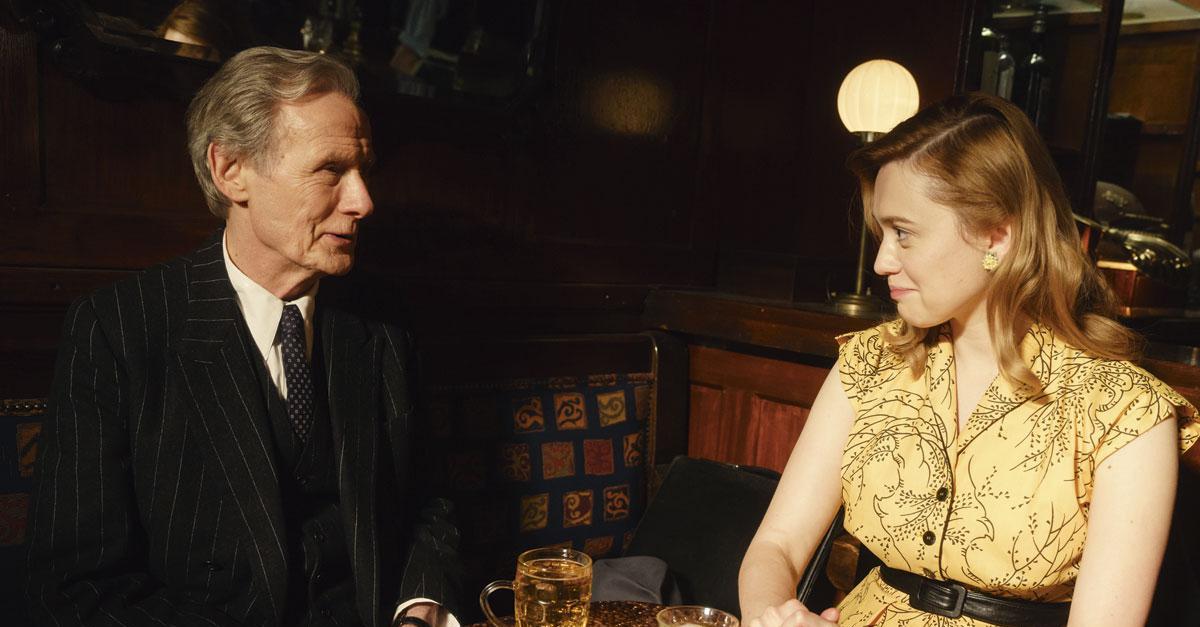
Living is based on the Japanese auteur Akira Kurosawa’s classic Ikiru (1952, meaning of title: ‘to live’). Nobel laureate Kazuo Ishiguro adapted it to make an English version with Bill Nighy in mind when he wrote the screenplay, creating a setting in 1950’s London. Interestingly, Kurosawa himself was inspired by Leo Tolstoy’s The Death of Ivan Ilyich when he made Ikiru, and with his eloquent camera, transposed the Russian master’s novella into a Japanese story on screen.

With Living, the Japanese-British novelist Ishiguro has succinctly condensed Kurosawa’s 142 minute film into a shorter feature of 102 minutes, helmed by South African director Oliver Hermanus. It’s interesting to note the cross-cultural transferral, for the film is about the universal theme that we all share as a humanity, living a meaningful life in the face of death.

This is one of the less-hyped movies during the 2022 Awards Season, despite the film getting two Oscar nominations: Best Adapted Screenplay for Ishiguro, and Best Actor for Bill Nighy, his first and long due Oscar nod.

It’s timely that I finally get the chance to watch Living now in April, a month that signifies new births. Considering the change in the main character Mr. Williams (Bill Nighy), even the idea of resurrection is apt when taken metaphorically, from death to life, ironically, for a man who has just been diagnosed with terminal illness.

As the head of the public works department at County Hall for numerous years, Williams is contented with following the bureaucratic daily routine by the clock, pushing papers to other departments, or, if the file has to stay in his, stalling it till it becomes extinct.

The camera angles give us a vivid perspective. From the overhead shot above the train station, we see a mass of uniformity, men in dark suit and bowler hat heading to work. Looking down from above, they are small and insignificant. And from the slow motion of them walking, we see the wheel of work turning, ever so slowly, in mundane routine heading to the office and the same vehicle bringing them home at the end of the day.

After Williams gets the confirmed diagnosis of cancer and that he will have just six months to live, there appears the audio motif of a clock ticking; this time, it’s not to remind him of work routine but the limited time of life remaining.

In the wake of the ominous news, Williams’ reactions change from stoically bearing the shock to actively seeking a meaningful existence, and ultimately finding a purpose that he feels can fulfill his life. Nighy’s performance is immersive, reserved, and nuanced, and at times, allowing a ray of deadpan humour to seep through. If the restrained ‘Englishness’ is what the actor naturally possesses, or one that he has fully grasped in his cultural milieu, then it has served him perfectly in this role.

In an online interview, Ishiguro explains this ‘Englishness’ as a metaphor:

A certain type of Englishness becomes a universal metaphor for something that is inside all human beings, the need to conform, perhaps a fear of emotions, the frustration of wanting to express yourself but not being able to break out of your professional role, or the role that society has given you. There were many things I thought we could talk about of the whole human condition by looking at this type of figure.

Many scenes in Living are direct parallels of Kurosawa’s Ikiru with his protagonist Kanji Watanabe (Takashi Shimura). Both men confide their terminal illness not to their son who lives with them, but to a stranger in a restaurant, sharing their last wish, that is, to live life, for a change. The sympathetic listener brings the despondent man to various places for him to ‘live it up’. In both films, we see the same places but in different cultural context, amusement parks, bars, dance hall, strip club, but what Williams and Watanabe find are but superficial, ephemeral flares.

The ultimate change in Williams is sparked by a young, female staff Margaret Harris (Aimee Lou Wood), who needs his reference as she has found a new job. Meeting her by chance on the street, Williams invites her to have a ‘simple’ lunch with him at the Fortnum, where he can write her reference letter. It’s there that we see Williams break out with a genuine smile for the first time, forty-one minutes into the movie. Harris’s youthful and vivacious spirit later inspires Williams to go back to the office as a new man after his few days of escapade, to get down to work and this time, doing something that’s meaningful and benevolent.

A crucial addition in Living, and kudos to Ishiguro, is bringing in a young, new worker, Peter Wakeling (Alex Sharp), to the public works department, first day on his job. From his fresh, untainted eyes, we see the novice civil servant being open and ready to accept whatever the bureaucratic system requires of him. His boss Williams’ new-found purpose and subsequent change at work has left him with an indelible impression. And with co-worker Miss Harris, a warm storyline of budding romance adds flavour to the film, albeit introduced a bit late towards the end.

One poignant scene in both films is the protagonist singing in a bar. For Nighy, this is probably the best cinematic moment for him to leave his mark as a soulful singer, a deep and heartfelt performance in contrast to his farcical ‘Christmas is all around’ in Love Actually (2003). The scene here in Living is when a slightly drunk Williams asks the pianist at a pub to play as he sings ‘The Rowan Tree,’ a Scottish folk song that evokes longing for the past and loved ones gone.

Later, in the remake of Kurosawa’s iconic scene from Ikiru, we see Williams sitting on a swing and hearing his moving reprise of the song, this time sober and clear of what’s waiting for him. As the final credits roll, the mesmerizing voice of Lisa Knapp stirs ripples in my heart long after the visuals end.

‘The Rowan Tree’ sung by Lisa Knapp

________________

~ ~ ~ 1/2 Ripples

Thoughts at Easter 2023

“Easter, which turns a terrible Friday into Good Friday. It is almost too brilliant for me to contemplate; it is like looking directly into the sun; I am burned and blinded by life.

There are times when I feel that He has withdrawn from me… but Easter is always the answer to My God, my God, why has thou forsaken me!

Easter is the most brilliant of all blessings.”

–––––– Madeleine L’Engle, The Irrational Season

Holy Sonnet 10

Death, be not proud, though some have called thee
Mighty and dreadful, for thou are not so;
For those whom thou think’st thou dost overthrow
Die not, poor Death, nor yet canst thou kill me.
From rest and sleep, which but thy pictures be,
Much pleasure; then from thee much more must flow,
And soonest our best men with thee do go,
Rest of their bones, and soul’s delivery.
Thou’art slave to fate, chance, kings, and desperate men,
And dost with poison, war, and sickness dwell,
And poppy’or charms can make us sleep as well
And better than thy stroke; why swell’st thou then?
One short sleep past, we wake eternally,
And death shall be no more; Death, thou shalt die.

––––––– John Donne

“Truly, truly, I say to you, unless a grain of wheat falls into the earth and dies, it remains alone; but if it dies, it bears much fruit.”

–––––––– John 12:24

“… without a few days in hell, no resurrection is possible.”

–––––––– Mary Karr, Lit

And a lighter thought, the all brilliant Madeleine L’Engle again:

Pride is heavy.
It weighs.
It is a fatness of spirit,
an overindulgence in self.
This gluttony is earthbound,
cannot be lifted up.
Help me to fast,
to lose this weight.
Otherwise, O Light one,
how can I rejoice in your
Ascension?

———————

He is risen.

Happy Easter!

***

‘The Quiet Girl’ Movie Review: From the literary to the visual

The Quiet Girl (An Cailín Ciúin) is the first Irish-language film to be nominated for an Oscar, representing Ireland in the Best International Feature category in this year’s 95th Academy Awards held on March 12th.

In this his debut feature, Irish director Colm Bairéad adapts Claire Keegan’s short story “Foster” in a style that’s akin to the literary source. Together with director of photography Kate McCullough (Normal People, 2020), Bairéad has created on screen a sparse and sensitive rendering of Keegan’s story, camera shots that are calm storytelling and restraints that convey emotional depth. The choice of the 4:3 Academy aspect ratio gives the feeling of a time past, like an old home video preserving a young girl’s memorable experience.

Cáit (Catherine Clinch) is sent away to spend the summer with her mother’s relatives, Eibhlín (Carrie Crowley) and Seán Cinnsealach (Andrew Bennett). Having lived in an impoverished household full of siblings and one more expecting, with a father who takes ‘liquid supper’ before coming home and an overburdened mother, Cáit experiences for the first time in her short stay at the Cinnsealach’s quiet and childless farm home what it means to be cared for, and towards the end, learns that keeping silent can be an act of love.

Just like Keegan’s style of using the minimal to convey much, The Quiet Girl is sparse and sensitive in its visual storytelling. Eibhlín is shown to be kind right from the beginning, Seán less so, hardly acknowledges Cáit. His reticence is nuanced though, a slight turn of his head even when he’s facing the TV and with his back to the child betrays a moment of thought, of self-reflection. Seán’s coming around is endearing, like the moment he leaves a single cookie on the table as he walks by Cáit in the kitchen. Actions speak louder than words.

In the bedroom she’s in, Cáit observes the wallpaper with train images and the boy’s clothing she now wears, as her own suitcase is still in her Da’s car trunk as he has forgotten to leave it with her in his rush to leave. She observes her new environment and the people she’s with, and gets some shocking information when a nosy neighbor spills out the Cinnsealachs’ tragic past to her.

As one who has just read Keegan’s short story and been deeply moved by her writing, I come to this review not to compare how ‘faithful’ the film adaptation is, which it is, but that how some of the ‘cinematic moments’ in the book are transposed on screen.

Writer director Bairéad has added some scenes of Cáit in school and at home at the beginning of the film, enhancing the characterization of the girl, quiet and alone, even at home. While the ponderous visual storytelling deserves praise, I do find in certain moments, Bairéad could have added just a bit more dramatic effects, not for gratuitous purpose, but to elicit a more powerful punch towards the cathartic end.

[The following contains spoiler]

Two examples I have in mind. First is when Seán decides they should stop letting the girl wear the boy’s clothes and that he’ll drive them to town to buy Cáit new clothes for herself. That’s a defining moment bringing up a painful, unspoken past, and stopping their substituting Cáit for the one they had lost. Eibhlín is picking gooseberry at the kitchen table with Cáit. Here’s the excerpt from Keegan’s story about the very moment her husband tells them to go change and get ready to go into town to buy clothes for Cáit:

The woman keeps on picking the gooseberries from the colander, stretching her hand out, but a little more slowly each time, for the next. At one point I think she will stop but she keeps on until she is finished and then she gets up and places the colander on the sink and lets out a sound I’ve never heard anyone make, and slowly goes upstairs.

That sound that the girl has ‘never heard anyone make’ is bone chilling even when I was just reading the words, and would have been a most effective cinematic moment to convey pain and grief. Unfortunately what could have been a stirring moment for viewers did not materialize in that scene.

The second is more crucial, a scene that I take as the climax of the story, the girl’s accident at the well. More intensity in visual storytelling, or even just sound instead of the subtle handling of the incident––not for the sake of mere dramatic effects but to show the gravity of the mishap and its implications–– is needed to elicit more potently the poignant act of silence later when Cáit is determined not to mention the accident to her mother who has sensed something must have happened when the girl comes home sneezing.

The cathartic ending of the film is to be applauded for it has brought out Keegan’s powerful writing most vividly. What’s more heartrending than just reading is that we can see the face of the girl running and hear the final word she utters to Seán as she flies into his embrace. That is the power of film.

~ ~ ~ Ripples

__________________________

This is my third post participating in the Reading Ireland Month hosted by Cathy 746 Books.

Previous posts:

“Foster” by Claire Keegan: Short story review

The Banshees of Inisherin: Movie review

‘Foster’ by Claire Keegan

Reading Ireland Month 2023 has led me to the short stories by Claire Keegan. I’m excited for this ‘new discovery’. Keegan’s is the kind of writing I admire, sparse but telling, simple prose revealing deep emotional undercurrents. 

“Foster” the short story written by Keegan first appeared in The New Yorker. It was later published as a standalone work in book form in 2010. Keegan in an interview had stressed that it was not a novella but a long short story. The book cover in the photo is a new edition that came out in 2022.

The story is written from the point of view of a young girl from an impoverished family, both materially and emotionally. She is sent far away to stay with her mother’s sister Edna and her husband John Kinsella for the summer to lift the burden off her busy mother who has a house full of children and one more expecting. The Kinsellas are childless and live in a farm house in rural Wexford county.

The age of the girl isn’t mentioned, most probably around eight or nine. Interesting too that her name isn’t mentioned except just a few times, Petal, maybe giving a sense of the neglect she has been having all her young life. The title is ironic, I find, for the word foster often comes in contradiction in a lesser sense, or secondary, to natural birth parents. But here during her short stay at the Kinsellas, the girl has made new discoveries she has not experienced before, what it means to be loved and cared for, and begins to learn kindness and self-worth. Moreover, she is also exposed to the complexity and the dark range in the adult world, the loss and pain that come with life.

Foster has been adapted into film with the new title The Quiet Girl. It is Ireland’s official entry to the 95thAcademy Awards held this past Sunday, a nominee in the Best International Feature category, with its language being Irish (Gaelic). I still haven’t the chance to watch it, now a must-see movie for me. Hopefully I can watch it soon before the Reading Ireland event ends.

When I read “Foster”, I noticed that Keegan’s style is an exemplar of that writing advice we hear often: show, not tell. In some passages, Keegan instills in my mind visuals like watching a scene in a good film, actions and nuanced expressions speak clearly in depicting the characters with no need for dialogues. A couple of examples:

Here’s when the girl and his father whom she calls Da have a meal with the Kinsellas after he has dropped her off before heading right back home:

When we sit in at the table, Da reaches for the beetroot. He doesn’t use the little serving fork but pitches it onto the plate with his own. It stains the pink ham, bleeds.

Here’s another example, when Edna brings into her house some fresh rhubarb stalks from her garden for the girl’s father to bring home:

My father takes the rhubarb from her, but it is awkward as a baby in his arms. A stalk falls to the floor and then another. He waits for her to pick it up, to hand it to him. She waits for him to do it. Neither one of them will budge. In the end, it’s Kinsella who stoops to lift it.

‘There now,’ he says.

Just this short description has revealed the character and the relational dynamics among the three adults. Furthermore, these two passages also tell much about the girl, deep within her reticence, she is observant, precocious, and the reader can assume too that she must be eager to experience what’s waiting for her in the days ahead living with these two ‘foster parents’ for the summer.

The Kinsellas hold a family secret, one that’s heavy in their heart and mind, albeit unspoken. Again, Keegan’s writing comes through with subtle yet powerful revealing. The girl learns of their past from a nosy neighbour, and that is a moment of awakening for her. What happens later in the climax I will not spoil anyone’s reading pleasure. However, John Kinsella’s kind words to her observing her quiet demeanour earlier in the story, we know the girl will keep close to her heart for a long time:

‘You don’t ever have to say anything,’ he says. ‘Always remember that as a thing you need never do. Many’s the man lost much just because he missed a perfect opportunity to say nothing.

As she mulls over the Kinsella’s hidden past, and her own experience while staying with them, she is now empowered by love and loyalty to keep silent that which needs to be kept in confidence. The girl might be reticent, but the single word she utters ending the story is most poignant and heart-wrenching. Again, Keegan has used the minimal to bring her readers to the depths of pathos and meaning.

~ ~ ~ ~ Ripples

This is my second post in participation in the Reading Ireland Month hosted by Cathy 746 Books.

Previous post: The Banshees of Inisherin Movie Review

***