Why We Read Jane Austen

The first challenge you face when writing about Pride and Prejudice is to get through your first sentences without saying, “it is a truth universally acknowledged…”

—–  Martin Amis

Isn’t it true that these words from the clever and satirical opening line of Jane Austen’s Pride and Prejudice [1] have been so overused that they have sadly become a cliché in our contemporary language, together with ‘zombies’ and ‘vampires’?

So what did I expect from a book entitled A Truth Universally Acknowledged:  33 Great Writers on Why We Read Jane Austen?
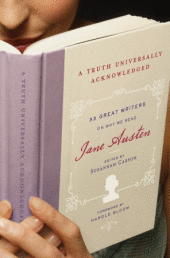
I admit, at first I thought it was a literary version of those lifetime achievement award presentations, where the honoree is showered with superfluous speeches by his/her peers, over champagne and frivolous dinner, something which Jane Austen herself would abhor.

I found out soon enough that between the modest and classic looking covers, Susannah Carson, the editor of the volume, had gathered the essays of 33 writers, not toasts or roasts, but detailed biographical notes, thoughtful musings, heartfelt admiration and in-depth analysis of Austen characters and works.  It is a collection of articles stemming from a balanced fusion of sense and sensibility, something that Austen herself would have approved.

Included are literary figures from the late 19th to 20th centuries like E. M. Forster, W. Somerset Maugham, C. S. Lewis, Eudora Welty and Virginia Woolf.  Contemporary contributors include writers, academics, Austen historian, and screenwriters.  There are views from Harold Bloom, Lionel Trilling, Janet Todd, Anna Quindlen, A. S. Byatt, Amy Bloom, to name a few.  All of them point to Austen’s inimitable humor, incisive observations of human nature and unwavering moral stance that make her works still relevant two hundred years later today.

The following are some samples from this smorgasboard of Austen delights.

Harold Bloom, writing the preface, concludes with these lines:

We read Austen because she seems to know us better than we know ourselves, and she seems to know us so intimately for the simple reason that she helped determine who we are both as readers and as human beings.

Anna Quindlen, defending the subject matter in Austen’s works being mainly about the family (it’s a pity that she even needs to do this):

…[Austen was] a writer who believed the clash of personalities was as meaningful as—perhaps more meaningful than—the clash of sabers.  For those of us who suspect that all the mysteries of life are contained in the microcosm of the family, that personal relationships prefigure all else, the work of Jane Austen is the Rosetta stone of literature.
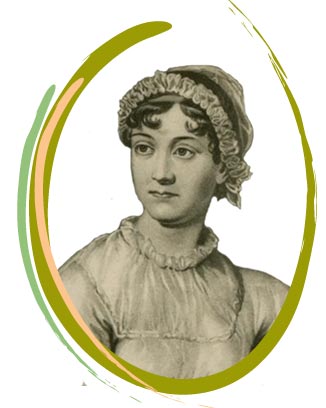
Austen once referred her own writing as “the little bit (two inches wide) of ivory on which I work with so fine a brush, as produces little effect after much labour.”  In response, screenwriter and director Amy Heckerling, who has adapted Emma into the movie ‘Clueless’, compares Austen’s writing to a Vermeer painting:

“Sometimes the finest brushes paint the biggest truths.”

James Collins, a writer and editor, and frequent contributor to The New Yorker, shares a very personal view:

I find that reading Jane Austen helps me clarify ethical choices, helps me figure out a way to live with integrity in the corrupt world, even helps me adopt the proper tone and manner in dealing with others… Reading Austen I sometimes feel as if my morals are a wobbly figurine that her hand reaches out and steadies.

But she is not all didactic and stern… far from it.  Jane Austen has long been celebrated for her animated humour and witty ironies, the essence of her writing.  I love this analogy that Collins uses:

Her ironies swirl and drop like the cast of a fly fisherman. This rhythmic motion seems to me ideal for both accepting and rejecting the ways of the wretched world while maintaining balance.

Demonstrating the relevance of her satires for today, Benjamin Nugent, the author of American Nerd: The Story of My People, discusses the nerds in Pride and Prejudice, Mary Bennett and Mr. Collins, and why they miss out on life.

If you read sci-fi novels, you’ll generally read about worlds in which scientists and the technologies they create drive the plot; if you read Austen, you’ll read about a world in which technology means nothing and the triumphs and failures of conversational agility drive everything.

His advice for modern day nerds:

Young nerds should read Austen because she’ll force them to hear dissonant notes in their own speech they might otherwise miss, and open their eyes to defeats and victories they otherwise wouldn’t even have noticed.  Like almost all worthwhile adolescent experience, it can be depressing, but it can also feel like waking up.

It takes a sharp ear and intelligence to be a good humorist, and Austen shows that she has what it takes to be one at an early age.  About her prodigious talent, Virginia Woolf praises her first work, the novella Love and Friendship, written when Austen was only 15:

an astonishing and unchildish story… Spirited, easy, full of fun, verging with freedom upon sheer nonsense–Love and Friendship is all that…  The girl of fifteen is laughing, in her corner, at the world.

Indeed, as editor Susannah Carson has stated, any hint of ‘romance’ in her novels is merely the irony of it. About the seemingly unconvincing romantic plot in Northanger Abbey, Carson asserts:

What if Austen actually intended the romance plot to be unconvincing?  … It is probable… that Austen intended the failure of the romance plot, not to sabotage her own work, but to make a point about romance plots in general… that [they] are inherently artificial.

That Northanger Abbey is a satire on the gothic novel has long been noted.  Other writers also stress that Austen should not be labelled as a ‘romance writer’ because of the satirical styling behind her writing.  W. Somerset Maugham keenly observes:  “She had too much common sense and too sprightly a humor to be romantic.”

In his essay ‘Beautiful Mind’, writer Jay McInerney bravely admits that: “If my actual romantic life has sometimes been influenced by superficial considerations, as an Austen reader the basis of my affections has been almost entirely cerebral.

Amy Bloom sums it up succinctly about this common confusion about romance and love:

Jane Austen is, for me, the best writer for anyone who believes in love more than in romance, and who cares more for the private than the public. She understands that men and women have to grow up in order to deserve and achieve great love, that some suffering is necessary (that mewling about it in your memoir or on a talk show will not help at all), and that people who mistake the desirable object for the one necessary and essential love will get what they deserve.

To master such a distinction could well be one of the main reasons why we read Jane Austen.

**

A Truth Universally Acknowledged:  33 Great Writers on Why We Read Jane Austen, edited by Susannah Carson, published by Random House, NY, 2009, 295 pages.

**

[1] The first line of Pride and Prejudice goes like this: “It is a truth universally acknowledged, that a single man in possession of a good fortune, must be in want of a wife.”

Photos Sources: Book cover randomhouse.com, Jane Austen Portrait tvo.org, Jane Austen Centre, Bath, taken by Arti of Ripple Effects, Dec. 07.

This article has recently been published in the current Jane Austen Centre Online Magazine. Click to go there for other interesting articles on Jane and the Regency world.

**

Related Posts you might enjoy:

In Praise of Austen: Virginia Woolf’s A Room Of One’s Own

A Jane Austen Education by William Deresiewicz

**

Those Magical Numbers: Year-End Musings

10

Are we coming to the end of a decade?  Or still have another year to go?  Does the new decade start with 2010, or 2011?  No matter, that debate is just academic and immaterial in light of the actual events that had taken place after we entered the new century.  From a wider perspective, it’s been a period that TIME magazine called ‘the Decade from Hell’, ‘the Reckoning’, ‘the Decade of Broken Dreams’.  Now, the new normal is recession, terrorism, climate change, pandemic.

On a personal level, a decade sounds weighty enough to send chills down the spine.  Where have all the years gone?  A decade of our life has already slipped by since the beginning of the millenium, the novelty of Y2K rubs off like the fleeting fragrance of the night-blooming flower.  Above all, how do we put into perspective a life among all the tensions on a wider scale?  Can we sculpt out a little private, inner space where peace can still thrive, and faith, hope, and love indwell despite the overwhelming odds in the outside world?

12

According to the liturgical calendar, Christmas celebration continues for 12 more days into the new year, until the Epiphany, January 6th.  With the backdrop of mostly negative global affairs, it’ll do us good to stretch the Christmas spirit a bit longer.  Let the joy and peace last for a few more days.  A reader has reminded me that Christmas Day is arbitrarily picked anyway.  True.  But since we’re given one day to ‘legitimately’ celebrate the birth of Christ, might as well make the best use of it… for I really don’t know how long such a tradition will last, or us given the ‘right’ to mention Christ publicly.  So it’s Epiphany then, 12 more days.  But… is that enough?  I mean the peace and joy, not the hustle and bustle.  Shouldn’t we extend the spirit of Christmas to all the days of the year?  Wouldn’t it be a better world if we let the Word dwell among us just a while longer, or in our wildest dream, let Truth and Grace prevail in every single day?

24

Never mind the decade, just think about the 24 hours I’m endowed with.  How should I spend my next allotment?  Not until I break down the day into 24 units can I find some pressing reality and urgency.  Years back, I used to work in a consulting firm where we had to fill in a time-sheet at the end of the day.  I had to account for my time in 15-minute units, so the firm could charge my time back to the right clients.  My boss would really frown on the category ‘general office’.  That’s what we put down when we were not actually working on a particular project, so our time is charged back to the firm.  I’m afraid it’s ‘general office’ most of the time these days… Is taking care of elderly parents ‘general office’?  umm… what about blogging?  Is it real work?  Who do I charge to?  Can I measure my time in chargeable units?

365

The most amazing site I’ve come across this year is Nina Sankovitch’s Read All Day.  On October 28, 2008 Nina embarked on the 365 Project.  She was to read one book a day and write a review on her blog for one year.  On October 28, 2009 she completed it.  What an incredible endeavour!

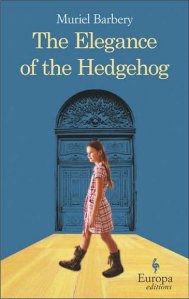
Nina lives in Westport, Connecticut, with a family of four reading boys to raise.  Incredible indeed.  Her first book in the Project?  The Elegance of the Hedgehog, one of my favorite books of the year.  Click Here to read her New York Times interview.

As a book lover, there’s nothing more she’d rather do than just to read all day. But Nina embarked on this project for some other reasons as well.  She read to learn, to find her place in the world, to seek directions on how to conduct her life, raise her children, relate to her fellow humanity. Also, four years after the death of her older sister at age 46,  she had now come to that age herself. She wrote on her site her purpose for reading with the most poignant words.  I would not paraphrase a single line:

“This year I am the age she was when she died: 46.  She was too young to die, she loved to read, I am fulfilling maybe even a fraction of the reading she should have had left to her. But I am not only reading to compensate, I am reading to endure.  Books — especially novels — offer a window into how other people deal with life, its sorrows and joys and monotonies and frustrations.  I can find empathy, guidance, fellowship, and experience through my reading.  I will never be relieved of my sorrow for my sister.  I am not looking for relief: I am looking for resilience.”

This is one of the most moving reasons for reading.  Nina Sankovitch now writes a book column for Huffington Post, and is still keeping her Read All Day site, down to maybe three books a week.  She is also preparing for publication a book on her 365 Project.

My next allotment of 365 is coming up very shortly.  I know I can’t take that for granted.  Who can guarantee 365, or even 24.  A book a day, what an inspiring concept… something I can never imagine myself doing.  What motivates me though isn’t her achieving that 365, but maintaining the momentum every 24.

It’s not so much about reaching that magical number, or completing a task, it’s all about finding a purpose, and the resilience to live it every single day.

***

Photo:  Footbridge to Bow Lake, Alberta.  Taken by Arti of Ripple Effects, August, 09. All Rights Reserved.

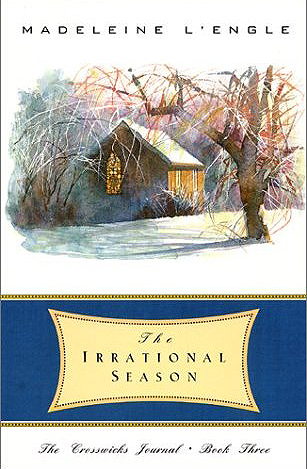
Reading The Season: The Irrational Season by Madeleine L’Engle

Striving to maintain some inner quiet, I casually took from the shelf a book by Madeleine L’Engle. Pure serendipity.  It’s one of The Crosswicks Journals, which I’ve shoved to the back of my mind for years, albeit they’ve been my all time favorite reads.  But how apt it is to flip through The Irrational Season, the third installment of The Crosswicks Journals, at this Christmas time.  Oh what joy to discover Madeleine L’Engle all over again.

Famous for her Newbery Award winning young adult novel A Wrinkle In Time, L’Engle was a prolific writer who had 63 publications to her credits.  Her works span from young adults to adults, fiction, science fiction, memoir, journals and poetry, with non-fiction books on faith, art, family, and humanity.  Yes, I say humanity, because L’Engle’s essays depict her strive to be human, and how her faith has defined the essence in her quest.

The Irrational Season comprises L’Engle’s ruminations on the significant events in the liturgical calendar.  And of course, it is Advent and Christmas that I dwell upon for my seasonal read.  This time, my reading has stirred in me a deeper appreciation of her insight and eloquence.

Art is for me the great integrater, and I understand Christianity as I understand art.  I understand Christmas as I understand Bach’s Sleepers Awake or Jesu, Joy of Man’s Desiring; as I understand Braque’s clowns, Blake’s poetry.  And I understand it when I am able to pray with the mind in the heart… I am joyfully able to affirm the irrationality of Christmas.

…  Christmas evoked in me that response with makes me continue to struggle to understand, with the mind in the heart, the love of God for his creation, a love which expressed itself in the Incarnation.  That tiny, helpless baby whose birth we honor contained the Power behind the universe, helpless, at the mercy of its own creation.

Cribb’d, cabined, and confined within the contours of a human infant.  The infinite defined by the finite?  The Creator of all life thirsty and abandoned?  Why would he do such a thing?  Aren’t there easier and better ways for God to redeem his fallen creatures?

And yet, in His most inscrutable, incomprehensible move, the One who called forth the universe from nothing, the Light and the Word, became flesh and drew near to us, to partake life as mortals knew it, and at the end, willingly go through an excruciating experience no mortals had ever known.  Impossible!  Utterly irrational!  And yet L’Engle embraces such an unimaginable scenario:

I live by the impossible… How dull the world would be if we limited ourselves to the possible.

And how grateful we ought to be, that such an accepting spirit pervaded in Mary’s heart and mind as well…

This is the irrational season
When love blooms bright and wild.
Had Mary been filled with reason
There’d had been no room for the child.

.

.

But now is the hour
When I remember
An infant’s power
On a cold December.
Midnight is dawning
And the birth of wonder.

*****

‘Reading The Season’ Posts over a Decade:

2020: Jack by Marilynne Robinson

2019: ‘A Hidden Life’ – A Film for the Season

2018: A Verse from Madeleine L’Engle’s The Irrational Season

2017: A Wrinkle in Time by Madeleine L’Engle

2016: Silence by Shusaku Endo

2015: The Book of Ruth

2014: Lila by Marilynne Robinson

2012: Surprised by Joy by C. S. Lewis

2011: Walking on Water by Madeleine L’Engle 

2010: A Widening Light by Luci Shaw

2009: The Irrational Season by Madeleine L’Engle

2008: The Bible and the New York Times by Fleming Rutledge 

2008: A Grief Observed by C. S. Lewis

*****

Photos: Except the book cover, all photos taken in Israel by Arti of Ripple Effects, November, 07. All Rights Reserved.

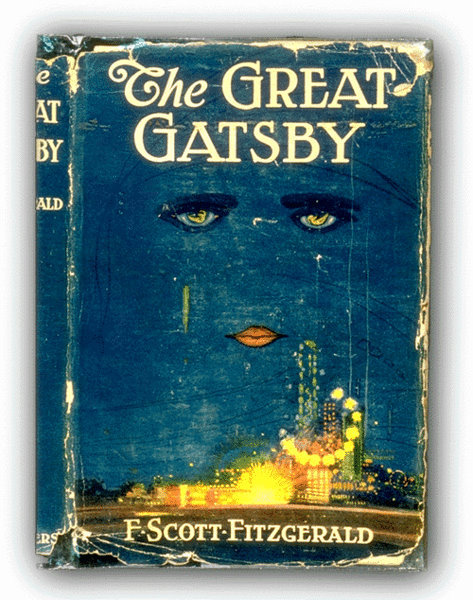
The Great Gatsby on my iPhone

Two years ago I posted about reading Pride and Prejudice on my BlackBerry.  At that time, I was receiving free installments of the book, sent to me daily via email from DailyLit.

Well, I’ve moved on since then.  I’m using an iPhone now, and with the application Stanza, I get access to several online catalogues with over 100,000 selections of classics and contemporary titles and periodicals.  I must add though while the Stanza app is free, some of the eBooks in these catalogues, especially the contemporary ones, are not.

But I’m just interested in the free ones, and there are more than enough to choose from… mainly through Project Gutenberg’s catalogue of 30,000 eBooks in the public domain, classics of over 20 languages.  Not that I’ll be reading one in Icelandic, or Portuguese, or even Esperanto, but it’s good to know that they are there in case you might need them.  All the titles are free to download due to the expiry of their copyrights.  I’ll just stick with the 22,000 English selections for now, from Austen to Zola, from anarchism to zoology… yes, they allow you to search by authors, titles, languages, genres, topics.

Regarding the concept of ‘free’, the Project Gutenberg Website has this important information: ‘Free’ here means both free of charge and freedom to use the titles in whatever way a reader chooses, teaching, adapting, distributing…

So, what has been my experience of reading The Great Gatsby on my iPhone?

First off,  unlike the Kindle, which is the size of a paperback, or larger, the iPhone screen is just 3.5 inch diagonal.  While you can adjust the font size to suit your visual comfort, it just means the inconvenience of turning the pages more often the larger the font.  Reading it horizontally, my setting is about 10 words per line, 14 lines on each page.  I can choose my own style of font and the backlit format.

Compare with reading a hard copy, the iPhone has its convenience, that being smaller, easier to carry. You have your whole library at your fingertip, literally.  But the major advantage over a hard copy, I feel, is the lighted screen.  In other words, you don’t need to turn your bedside table light on to read. In a way, it brings back that childhood experience of reading under a covered blanket with a flashlight.  Ready accessibility, even in the dark.  What a fantastic treat for insomniacs.

Now to something totally different, the affective element of the reading experience.  Strangely enough, reading on the iPhone makes Roland Barthes’ theory a step closer to reality.  Just a recap, I’ve written a post on Barthe’s ‘The Death of the Author’ idea.  The text is the thing, he argues. Let it speak without any reference to its author.  Reading digitally transported me onto that path, whether intentionally or not.

When you’re reading a book, you’re holding the physical object called a ‘book’, with all its cultural meaning and significance, the reality of print on paper, the design and aesthetics of the object itself.  More importantly, from the outset, before you dig in, you’re looking at its cover art, jacket info on the author and the work, with the sometimes additional excerpts of reviews, author bio, introduction to the work… etc. In other words, you cannot avoid knowing who wrote those words you’re reading, his or her background, literary achievement and perspective.

But reading digitally, you’re only seeing the text, unless of course you change the screen to check info about the author or the work.  If you just stay with that screen, you’re only seeing the words per se, unmoved by any of the author’s background, literary style, devoid of any context. And because of the small screen, you’re only reading a few lines at a time. Instead of a complete whole that you can hold in your hands, you are confronted with the fragments, the digitalized, desensitized, deconstructed units of a literary work.

I have read The Great Gatsby before, in hard copy format, and now in the digital mode.  Reading it on the iPhone, I sense that my imagination is more reined in.  I encounter more ‘text’ than ‘images’, and feeling less for the characters.  Interestingly, some details of the plot are clearer this time, but the emotional impact is attenuated.  Of course, one could argue it’s because this is the second time around I read the story… but then again, it has been some years between the two readings.

There’s no perfect solution for everything.  You have the convenience, but the desensitizing of the reading experience.  Nevertheless, the free downloads of world classics at your fingertip is just too good to pass.

My next read from my iPhone library?  Well, there are quite a few choices.  I’m thinking of Proust’s Swann’s Way: In Search of Lost Time Vol. 1. Reading Proust on the iPhone… how much more postmodern can you get? Roland Barthes would have been pleased.

But it might be too daunting a task to attempt, imagine reading 400 plus pages on a 3.5 inch screen, 14 lines at a time.

And for now… let me just head out to the bookstore.  Nothing can compare to the sensation of being surrounded by books, and actually feeling them in your hands, cover, spine, and all.

***

Photo Source:  The Great Gatsby book cover at artistquirk.com

Books and the Gender Issue

My review of Girl With A Pearl Earring has recently been linked to a book list. While I appreciate the link, I must admit it has stirred up in me some unintended ripples.  It’s the title of the list:  ‘101 Books Every Woman Should Read’.

Now I’m always wary about books that are labeled and geared towards one gender.  Like recently I came across a book entitled 100 Places in Italy Every Woman Should Go… makes you wonder what exactly they’re luring you into. Imagine a book called 100 Places Every Man Should Go…

Anyway, back to the list of books every woman should read.  The range is eclectic with the titles neatly categorized.

Just let me list a sample from each of the categories:

The Classics: Frankenstein by Mary Shelly, The Fountainhead by Ayn Rand, Howards End by E. M. Forster, To Kill a Mockingbird by Harper Lee, Pride and Prejudice by Jane Austen, Wuthering Heights by Emily Bronte, Middlemarch by George Eliot, Mrs. Dalloway by Virginia Woolf…

Children’s Literature:  Pippi Longstockings by Astrid Lindgren, The Wizard of Oz by L. Frank Baum, Charlotte’s Web by E. B. White, Alice’s Adventures in Wonderland by Lewis Carroll…

Books into Movies:  The English Patient by Michael Ondaatje, Beloved by Toni Morrison, Memoirs of a Geisha by Arthur Golden, Out of Africa by Isak Dinesen…

Books Featuring Familial Relationships:  The Joy Luck Club by Amy Tan, The Poisonwood Bible by Barbara Kingslover, The God of Small Things by Arundhati Roy, Away by Jane Urquhart…

Books Celebrating the Strength of Women:  Jane Eyre by Charlotte Bronte, The Bell Jar by Sylvia Plath, The Scarlet Letter by Nathaniel Hawthorn, Babette’s Feast by Isak Dinesen…

Current Literature:  Unaccustomed Earth by Jhumpa Lahiri, The Elegance of the Hedgehog by Muriel Barbery, Water for Elephants by Sara Gruen…

Books about Finding Oneself:  Bee Season by Myla Goldberg, The Heart is a Lonely Hunter by Carson McCullers…

Stories of Real Women: I Know Why the Caged Bird Sings by Maya Angelou,  Amelia: A Life of the Aviation Legend by Donald M. Goldstein and Katherine V. Dillon, Diary of a Young Girl by Anne Frank, The Story of My Life by Helen Keller, Portrait of an Artist: A Biography of Georgia O’Keeffe by Laurie Lisle…

Banned or Challenged Books:  Leaves of Grass by Walt Whitman, Fahrenheit 451 by Ray Bradbury, Of Mice and Men by John Steinback, The Kite Runner by Khaled Hosseini.

Non-Fiction: Pilgrim at Tinker Creek by Annie Dillard, Silent Spring by Rachel Carson, Gorillas in the Mist by Dian Fossey, On Death and Dying by Elisabeth Kubler-Ross,  A Room of One’s Own by Virginia Woolf

You get my point.  Sounds like any typical high school and college reading list, but why specify women?

Yes, they’re mostly written by women authors, and many with strong female protagonists.  They depict the journey of self-discovery, of overcoming odds, of seeking meaningful relationships and ideals in a hostile world.  In the non-fiction section there are influential books that have achieved significance in the area of writing, psychology, environmentalism, social justice.

But my query is:  If these books depict the inner journey of women, or portray the poignant reality of their struggles, if they have shed any light on the human race in terms of equality, justice, or existential meaning, are these not all the more reasons for men, or anyone, to read them?

Of course, for the sake of argument, one could point out that the statement “books every woman should read” doesn’t preclude that men should not.  But that’s just being contentious.

Books for women, books for men, why can’t books be just books?  Maybe it has to do with the writing of books, or, step back further, society’s view on male and female authors.

Posting on the Guardian blog, writer and editor Harriet Evans vehemently declares that:

“I’m fed up with seeing some of our best novelists written off as ‘chick lit’ — you don’t see the same belittling line taken with male writers…

It winds me up that books about young women are seen as frivolous and silly, while books about young men’s lives that cover the same topics, are reviewed and debated, seen as valid and interesting contributions to the current social and media scene.

And regarding the reading public, it has been noted that women read more than men, both in the U.S. and the U.K.  With that in mind, Evans goes on to state that:

The truth is, women happily read books (and watch films and TV) aimed primarily at men…. They read thrillers, travel books, biographies – and yet the majority of these books are marketed for men… But men rarely try women’s fiction, because they’ve been conditioned to think they can’t pick up a book with a pink cover.”

Indeed, worthy literature written by women authors are sometimes reduced to ‘romance’ or ‘chick lit’.  Jane Austen is a prime example.  Her incisive social satires, eloquent writing and sense of humor have often been swept aside while the romantic union of the protagonists at the end is given the main focus.  In this way, her work is conveniently labeled as ‘chick lit’, dreaded by male readers, until some brave souls dare to take up the challenge and are floored by her relevance and intelligence.

Virginia Woolf sharply observes in her Cambridge lecture series compiled in A Room Of One’s Own that historically, social norm has always been one that coops up women in the domestic while offering men the world.

Taking her view further, I can understand why the dichotomy, however arbitrary, in male and female writing, their difference in subject matters, subsequently, books for men and books for women.

I have a feeling that if the protagonist of The Catcher In The Rye is called Helen Caulfield, the book could well be dismissed as another trivial version of teen angst, schoolgirl blues, fussing over boys and growing up.  And likely we won’t see it on any reading list.

A Thousand Responses

In the postmodern scheme of things, the old saying ‘A picture is worth a thousand words’ takes on a whole new meaning.  It is not so much what those thousand words are that the picture intends to convey, but rather what the thousand responses it evokes.  Be it a painting, a film, or a literary work, all have the potential to elicit a myriad of responses, reactions as varied as each individual life lived.

Some ready examples can be found in Ripple Effects’ comment sections.  On a post about a movie I highly recommended, a reader responded that she had fallen asleep while watching it.  Or, take the Edward Hopper paintings.  While I found the phrase ‘existential loneliness’ to be an apt description for his works Nighthawk and Automat, a commenter expressed a sense of coziness and quiet content as her response to these paintings. Conversely, while I perceive Cape Cod Morning as anticipatory with positive excitement, the commenter sees “a woman trapped, caught in frustration or even despair, longing to move into the world but still constrained inside the structures of her life.”

magritte01

There had been readers’ responses in the past long before the computer age. But what we have now is nothing short of phenomenal.  The Internet has enabled us to share and exchange our very personal reaction to a single source material simultaneously, allowing multiple voices to resound instantaneously from all corners of the world.  Every voice has the potential to call forth attention, every subjectivity can be equally amplified.  Reader’s response is thus given a heightened significance.

From this perspective then, the reality of a piece of writing, or artwork, seems to have shifted from the author to the reader, or the artist to the viewer, for it is the recipient now that speaks to the work, giving it meaning and application.

Should we still be concerned with the original intent of the piece?  Is it mere speculation to discuss about it, while in the mean time, it is more real and substantial to talk about what our response is, our own personal engagement with it?  Further, instead of focusing on one intended interpretation, should we explore rather the multiplicity of interpretations elicited from readers’ own perspectives and experiences?

Writing before the rise of the Internet, the French literary critic Roland Barthes put it most starkly in his essay “The Death of the Author”:

“… a text is made of multiple writings, drawn from many cultures and entering into mutual relations of dialogue, parody, contestation, but there  is one place where this multiplicity is focused and that place is the reader, not, as was hitherto said, the author.  The reader is the space on which all the quotations that make up a writing are inscribed without any of them being lost; a text’s unity lies not in its origin but in its destination…”

and a warning here, the language used in the following excerpt may be objectionable to some:

“Classic criticism has never paid any attention to the reader; for it, the writer is the only person in literature.  We are now beginning to let ourselves be fooled no longer by the arrogant antiphrastical recriminations of good society in favor of the very thing it sets aside, ignores, smothers or destroys; we know that to give writing its future, it is necessary to overthrow the myth:  the birth of the reader must be at the cost of the death of the Author.”

The postmodern theorist Michel Foucault wraps it up succinctly:

“What difference does it make who is speaking?”

The listener seems to have taken up a much more significant role these days.

Our postmodern literary theorists have thus spoken: The author is dead, long live the reader, and the words.

This idea may not sound so radical, for similar notions have been expressed. Instead of an all-knowing authority, the author is more like a recorder of a tale, the scribe writing down the oracle.  The Canadian writer Michael Ondaatje’s words come to mind.  Even as an author, it seems his creative process is one that awaits the revealing of his story, capturing it in words as it unfolds itself:

“I don’t know what would happen… I don’t want to know.”

Further, Ondaatje welcomes the multiplicity of interpretations.  In his discussion with film editor Walter Murch, he addresses this issue in a positive light:

“We are not held hostage by just one certain story, or if we are, we know it is just one opinion: there are clear hints of other versions.”   — The Conversations, p. 160.

Multiplicity enhances and enriches a scene.  That is the amiable way of putting it, while Barthes is more matter-of-fact in pointing out where meaning and significance lie:

“… it is language which speaks, not the author.”

In a way, such a perspective could be a much-needed humbling reminder in our too crazed, celebrity-driven culture.

But for those of us who strive with all earnestness and honesty to instill meaning in our writing, who have been meticulous and intentional in our craft and guarding its integrity as we create, when we speak, don’t we wish someone out there would receive our message accurately, as it is intended?

Why do we write, or create anyway?  Do we want our readers to know about us or just to hear the words we happen to utter?  Further, shouldn’t we be concerned that what we elicit could well be interpretations far from what we have intended to get across?  How do we balance author’s intent with readers’ response?

Simple questions, but ones which I’m sure can elicit a thousand responses.

***

To read Roland Barthes’s essay ‘The Death of the Author’,  Click Here.

To read Michel Foucault’s essay ‘What Is an Author’,  Click Here.

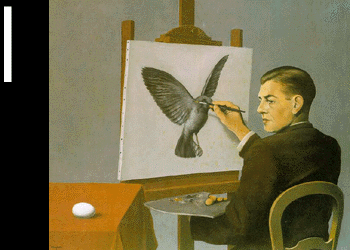
Visual: ‘Self Portrait’ by René Magritte, 1936.

Bright Star (2009)

Bright Star 1

Was it a vision, or a waking dream?

Fled is that music:– Do I wake or sleep?

— John Keats, Ode to a Nightingale (1819)

1819 was the most prolific year of the English Romantic poet John Keats.  Many of his well-known works were created then, two years before his untimely death from tuberculosis at age 25.  His muse was Fanny Brawne, his 18 year-old neighbor, a fresh and self-assured young fashion designer whom he met a year earlier. Untrained in poesy or prose, Fanny Brawne had nothing in common with the brooding poet, but Fate, cruel or kind, instilled in them a burning passion for each other.

Unable to maintain a living financially, Keats was honorable to restrain his love for Fanny, knowing marriage would never be realized.  Yet Fanny’s incessant devotion for him soon won him over.   In a short time, she devoured all of Keats’ poetry, as well as other literary works through the ages.  Their short-lived romance culminated in an engagement.  But they were never married.  Stricken by tuberculosis,  Keats left for Italy in 1820 to seek better climate for his ailing health, knowing that would be their last farewell.

When I have fears that I may cease to be

Before my pen has glean’d my teeming brain…

Nominated for a Palme d’Or at the Cannes Film Festival this year, Jane Campion’s Bright Star is a beautiful tapestry weaving together the visual and the word.  Based partly on Sir Andrew Motion’s biography on Keats, the film depicts the bittersweet romance between the poet and his muse, tragically short-lived yet ever burning bright.

Bright Star 3

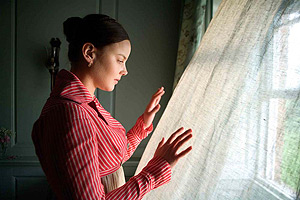
Campion has created on screen the dazzling visuals of the master painters.  There are numerous Vermeer moments in the interior shots, all done by the window with natural light seeping in as Fanny sews, makes her laces, reads love letters.  Outdoor scenes are a natural cinemascape reminiscence of impressionist vision.  Like the paintings of Monet and Seurat, hazy and dreamlike, they effectively convey the illusive union the young lovers achingly long for but is teasingly placed out of their reach.

Although never consummated, their passion for each other is no less ablaze.  The film is a clear statement that love is not synonymous with nudity and sex on screen.  Campion has depicted their passionate ardor with sensitivity and restraints.  There are moments of utter quietness, for love needs no language.  There are scenes adorned with melodious vocals and instrumentals, augmenting the yearning within.  Campion is a master of cinematic effects.

The talented Ben Whishaw (Perfume: The Story of a Murderer, 2006) is aptly cast as Keats.  Fanny Brawne is played by Abbie Cornish (Elizabeth: The Golden Age, 2007).  Both are award-winning rising stars in their homeland of England and Australia.  Bright Star could well be their breakout work in North America.

Bright Star 2

Paul Schneider (Lars and the Real Girl, 2007) is convincing as Keats’ friend Charles Brown, and what looks like Fanny’s love rival.  A stark contrast in character with the poet, Brown offers much needed tension and conflicts. Fanny’s adorable little sister Toots (Edie Martin) gets some of the best lines. Her brother and chaperone Samuel is played by Thomas Sangster.  But why Thomas Sangster?  The talented young actor who has held his own in such films as Love Actually (2003), Nanny McPhee (2005), and The Last Legion (2007) playing against such calibre actors as Liam Neeson, Ben Kingsley, Colin Firth and Emma Thompson, is put in the background only, with less than half a dozen speaking lines.  There’s definitely a miscast here. (Watch for his role as Paul McCartney in the upcoming John Lennon biopic Nowhere Boy.)

While the film is a beautiful testament of a star-crossed romance, compared to Campion’s previous works, I find it lacks the depth and complexity of The Piano (1993, Palme d’Or) and the intensity and riveting effect of The Portrait of a Lady (1996).  I have no problem with the slow pacing of Bright Star, but I do wish to see more dramatic conflicts and deeper exploration of character.  A thing of beauty should indeed bring us joy, or deep emotion, but for some reasons the visual beauty has not come across to me as affectively and engagingly as they are intended.

Nevertheless, as the only woman director to have won the Palme d’Or in the 62 years history of the Cannes Film Festival, and one of three women ever nominated for an Oscar in directing, Campion has much to offer.  I’m excited to see that it looks like the trajectory of Bright Star is one that shoots for the Academy Awards comes next March.

~ ~ ~ Ripples

(Photo Sources: canada.com, ctv.ca)

***

Gourmet Rhapsody by Muriel Barbery

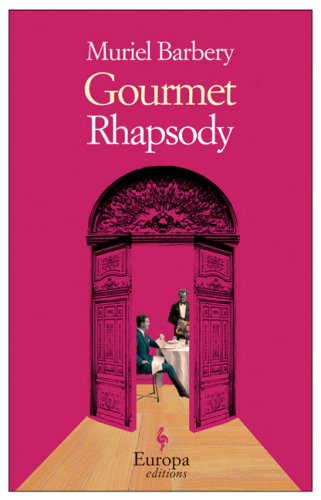
Gourmet Rhapsody

Before the French publishing sensation The Elegance of the Hedgehog, there was Gourmet Rhapsody.  We in English-speaking North America were not aware of such a delicacy until after the translation of Hedgehog was introduced to us.  Too risky to sell to a different palate?

As a first novel, Gourmet Rhapsody, the 156-page collection of short chapters, is like an appetizer to the main dish that is Hedgehog.  It is a foretaste of the more meaty philosophical pondering of the latter.  Now that we have savored the main dish first,  might as well treat Gourmet Rhapsody as the dessert.  Does the cover not make you think of a raspberry sorbet?

If food is a metaphor for life, then the food critic is almost at the status of divinity, especially ‘the greatest food critic in the world’.  That self-ascribed praise is the egotistic utterance of none other than Pierre Arthens, the celeb resident on the fourth floor of the luxury apartment at 7 Rue  de Grenelle, the setting for Hedgehog.

Pierre Arthens’ pen is indeed mightier than the sword.  The knowledgeable and merciless food critic, the ‘true genius of the food world’, is feared from all corners of the world, ‘from Paris to Rio, Moscow to Brazzaville, Saigon to Melbourne and Acapulco’.  He holds the power to exalt a chef and restaurateur to stardom or crush their ego and future like eggshells.

Between these two extremes — the rich warmth of a daube and the clean crystal of shellfish, I have covered the entire range of culinary art, for I am an encyclopedic esthete who is always one dish ahead of the game — but always one heart behind.

But what use is the allure of fame and power when one is on deathbed, at 68, given only 48 hours to live.  Alas, from the years of Epicurean pursuits of cream and butter, oil and sauces, games and other culinary delights, the world renowned food critic is dying not from liver or stomach ailments, but cardiac failure.

Gourmet Rhapsody is a collection of Arthens’ own reminiscence of a life with food and his final quest.  The vividly evoked memories are interspersed with poignant commentaries by those who have come into the path of his life, including his wife, children, nephew, granddaughter, restaurateurs, his doctor, his concierge, his mistress, and even his cat.

And alas, what pity it is to find that none of the entries from these people is positive.  His daughter Laura stays in the stairway, refuses to go into his room to see his last.  His son loathes his ego and his ruthless destruction of theirs.  His wife Anna, whom he had loved as an object of possession, is ever more ambivalent at his deathbed.

And what irony, the only positive review of his life comes from his cat Rick:

… here I am, nineteen years I’ve knocked about as head tomcat on the Persian rugs of my abode;  just me, the favorite, the master’s alter ego, the one and only, to whom he declared his thoughtful, undying love…

So, what does it profit a man if he gains the whole world but loses the love from his wife and children, or respect from those who have crossed his path?  This ultimate question belies the enticing and delicious offering described throughout the chapters.  As in Hedgehog, Barbery has cleverly created a philosophical concoction without appearing didactic.  Here in Gourmet Rhapsody, food is the delightful sauce bringing up the taste of such rumination.

As a lover of sushi and sashimi, my favorite chapter is ‘Raw’, in which Arthens reminisce on his first taste of these Japanese culinary delights:

It was dazzling… True sashimi is not so much bitten into as allowed to melt on the tongue.  It calls for slow, supple chewing, not to bring about a change in the nature of the food but merely to allow one to savor its airy, satiny texture… sashimi is velvet dust, verging on silk, or a bit of both, and the extraordinary alchemy of its gossamer essence allows it to preserve a milky density unknown even by clouds.

But the powerful food critic has but one final quest on his deathbed.  There is one particular food that he wants to taste most before his imminent demise, but which he fails to name.  No, not the coq au vin, or the extravagant pots-au-feu, or poulets chasseur, or the grilled meat of Tangiers, or the Moroccan kesra, or the velvety, melt-in-your-tongue sashimi.  Should I reveal it here?  Alright, Spoiler Alert.

It is the chouquettes, cream puffs, but not from fancy patisserie.  Pierre Arthens wants to taste those chouquettes that are stuffed in plastic bags from the supermarket.  After a life of bourgeois elegance and Epicurean odyssey, it is the mundane, ordinary thing that Arthens seeks on his deathbed.  In the face of mortality, every single moment of mundaneness is something to devour.

If only he had savored that sooner, not just food, but the people in his life, and everything else.

~ ~ ~Ripples

Gourmet Rhapsody by Muriel Barbery, translated by Alison Anderson, Europa Editions, 2009.  156 pages.         

To read my review of  The Elegance of the Hedgehog, CLICK HERE.

***

bird by bird

bird-by-bird

No, not another Twitter post… It’s the book by Anne Lamott.  Here’s what it’s all about:

“Thirty years ago my older brother, who was ten years old at the time, was trying to get a report on birds written that he’d had three months to write.  [It] was due the next day.  We were out at our family cabin in Bolinas, and he was at the kitchen table close to tears, surrounded by binder paper and pencils and unopened books on birds, immobilized by the hugeness of the task ahead.  Then my father sat down beside him, put his arm around my brother’s shoulder, and said, ‘Bird by bird, buddy.  Just take it bird by bird.’ ”

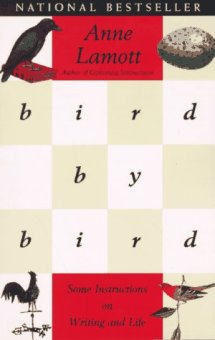
Bird by Bird: Some Instructions on Writing and Life by Anne Lamott

Bird by bird… three simple words from a writer father.  Lamott carries these words of wisdom with her as she makes her long journey of writing and life.  A past recipient of a Guggenheim, now a national bestselling author and writing instructor, Lamott in turn passes on practical advice to her readers and students.  In a writer’s symposium, it’s mentioned that The Modern Library calls her book Operating Instructions one of the most significant non-fiction work of the century.  Click here for the full hour interview.

Bird by bird is a book full of down-to-earth advice on writing and life from one who has gone through tough times.  Coming from the hippie culture, Lamott had to overcome years of drug addiction, alcoholism, and deal with eating disorder and the challenges of single parenthood.  I admire her resilience and perseverance.  Further, her ultimately finding redemption and had her life turned around was one amazing story.

I’ve enjoyed Lamott’s humour and her sensible instructions, although I admit I couldn’t fully embrace her style of word-use and the occasional trite statements. But the authenticity shines through.  You’re reading a writer who has gone through all these hurdles, not just in writing but in life, and speaking to you with genuine openness.  Her directions give you a kind of ‘eureka’ feeling: The sudden revealing of something that you thought you’ve found it for the first time.  But on second thought, it’s just that she has put it into words for you, you must have known it before, so common sense, so simple.

P1010143

Since I’ve been dwelling on quotes lately, I’ll just leave you with some of Lamott’s own words from her book.  They don’t all fit into a tweet, but just to point out that sometimes great thoughts take more than 140 characters to convey…. that’s why we have books.  But of course, you’ve known this all along.

Getting started:

The very first thing I tell my new students on the first day of a workshop is that good writing is about telling the truth.

Flannery O’Connor said that anyone who survived childhood has enough material to write for the rest of his or her life.

The problem that comes up over and over again is that these people want to be published.  They kind of want to write, but they really want to be published… Writing can give you what having a baby can give you: it can get you to start paying attention, can help you soften, can wake you up.  But publishing won’t do any of those things.

Short assignment:

E. L. Doctorow once said that “writing a novel is like driving a car at night.  You can see only as far as your headlights, but you can make the whole trip that way.”  … You just have to see two or three feet ahead of you.  This is right up there with the best advice about writing, or life, I have ever heard.

Character:

… a person’s faults are largely what make him or her likable… They shouldn’t be too perfect; perfect means shallow and unreal and fatally uninteresting.

Plot:

Plot grows out of character…. I say don’t worry about plot.  Worry about the characters.  Let what they say or do reveal who they are… The development of relationship creates plot.

Dialogue:

You listen to how people really talk, and then learn little by little to take someone’s five-minute speech and make it one sentence, without losing anything.

The Moral Point of View:

The word moral has such bad associations: with fundamentalism, stiff-necked preachers, priggishness.  We have to get past that… We like certain characters because they are good or decent–they internalize some decency in the world that makes them able to take a risk or make a sacrifice for someone else.  They let us see that there is in fact some sort of moral compass still at work here, and that we, too, could travel by this compass if we so choose.

A moral position is a passionate caring inside you… Some of us are interested in any light you might be able to shed on this, and we will pay a great deal extra if you can make us laugh about it.  For some of us, good books and beautiful writing are the ultimate solace, even more comforting than exquisite food.

Now here are some quotes you can send, tweet by tweet:

“If you’re not enough before the gold medal, you won’t be enough with it.” [quoting from the movie Cool Running]

Lighthouses don’t go running all over an island looking for boats to save; they just stand there shining.

Writing and reading decrease our sense of isolation. They deepen, widen, and expand our sense of life: they feed the soul.

*****

Bird by Bird: Some Instructions on Writing and Life by Anne Lamott, Anchor Books, NY, 1995, 238 pages.

The Humanities as an Endangered Species

While there are those who sense that the appreciation of literature and the humanities are slowly fading in our instant-messaging generation, here are some facts.  In an article entitled “The Decline of the English Department” in the current issue of The American Scholar, William M. Chace presents the following data from the academic years between 1970/71 to 2003/04, showing the change in college majors:

English: from 7.6 percent of the majors to 3.9 percent
Foreign languages and literatures: from 2.5 percent to 1.3 percent
Philosophy and religious studies: from 0.9 percent to 0.7 percent
History: from 18.5 percent to 10.7 percent
Business: from 13.7 percent to 21.9 percent

The little bio at the bottom of the article tells me that William M. Chace has taught at Berkeley, Stanford, Wesleyan, and Emory, and served as president of the last two.  So the figures here do carry some weight and urgency.

These numbers are indeed distressing.  If such a trend continues, chances are college English departments would disappear from the face of this earth faster than beluga whales, and philosophy and religious studies as an academic discipline could soon fall off like leaves in autumn.

P1010375

Chace points out that there was once a time when majoring in English literature represented an idyllic pursuit.   It used to reflect the appreciation of a historical tradition and literary culture.  It was a declaration, even a defiance, showing that education was not at all about getting a job.  It was a decision made with much self-reflection, innocence, and yes, an idealistic fervor.  Here’s his own reminiscence, an English major in the 50’s and 60’s :

With the books in front of us, we were taught the skills of interpretation. Our tasks were difficult, the books (Emerson’s essays, David Copperfield, Shaw’s Major Barbara, the poetry of Emily Dickinson, and a dozen other works) were masterly, and our teacher possessed an authority it would have been “bootless” (his word) to question.

Studying English taught us how to write and think better, and to make articulate many of the inchoate impulses and confusions of our post-adolescent minds. We began to see, as we had not before, how such books could shape and refine our thinking. We began to understand why generations of people coming before us had kept them in libraries and bookstores and in classes such as ours.

Alexander W. Astin, director of the Higher Education Research Institute at UCLA, reports that in the mid 60’s, more than 80% of college freshmen rated nothing was more important than “developing a meaningful philosophy of life”.  Less than 45% of them felt “being very well off financially’ was a priority.

The trend saw its reversal by 1977, when financial goals had surged past philosophical ones.  By 2001, more than 70% of undergraduates rated financial success as a much more important pursuit, leaving behind 40% clinging to the search for meaning as their prime objective in college.

But my concern is very simple, and it needs no statistics to sound the alarm:  Who is reading all the ‘great books’?  If the English departments are fighting for their raison d’etre, can Literature survive?

Or, can we still hold on to the idealistic view that Literature has intrinsic value of its own, that in great books, we can still find glimpses of how we should live?  Further, in the face of strangling economic reality, can we still bask in the goodness of beauty and not become a laughing stock if we insist on the pursuit of meaning?

***

To read the article ‘The Decline of the English Department’ in The American Scholar, CLICK HERE.

2nd Blogaversary and Nostalgic Musing

August 29th slipped by quietly.  Just like the first day I started, inconspicuously.  Upon a casual suggestion from my son, I set up a blog and posted my first mini movie review, oblivious to what I was venturing into, not knowing what a widget was, or how to embed a link.

Now two years and 176 posts later, I am a happy sojourner in the blogosphere.  Still, I have no idea where this will lead, but I’m not too concerned, because through these past blogging days, I’ve been enriched and gratified.

My thanks to all who have taken the time to stop by Ripple Effects.  I know a few might have just stumbled upon, your visit is just as valued.  While some bloggers might tell you they live on comments, and I don’t deny the life-sustaining power of comments, I must express my appreciation for my silent readers. A click on the readership map on the sidebar can tell where they are.  To all of you out there from all corners of the world, I want to assure you that you’re more than a red dot on the map.

These two years have seen some unexpected ripples, like a screenwriter leaving her comment in my review of her movie, or, a writer suggesting a differing opinion to a book I reviewed and pointing me to his own work. The most encouraging would be a private email from a reader who told me she had sent my post link to someone whom she thought could be comforted from a personal tragedy. The blogosphere is a virtual world of human experiences and pathos, a reality no less poignant and alive than our everyday encounters.

I’m glad to see as well that Ripple Effects has evolved into some sort of a mini forum where ideas are exchanged and experiences shared.  I’ll be all the more gratified if the trend continues, where people would come for the comments as well as the posts, or even instead of … just the same.  You are all contributors.

I’m inspired too that we can explore together the universals among us all, sentiments that connect rather than segregate, and to seek beauty in the mundane, the transcendence in the temporal.  My thanks to all of you who regularly leave thought-provoking comments to make Ripple Effects a worthwhile stop in the hustle and bustle of life.  I’d be happy if it can be a restful way station along the journey.

P1010249_2_2

I’ve been a book and movie lover since childhood.  As a young reader, I would rate the stories I’d read, putting a check mark or two by each title in the table of contents.  I remember also, for my own pleasure, I would write up chapter summaries of a book that I loved, illustrating the content with pencil crayons.

As for movies, I practically grew up with them,  both on TV and in theaters, during the pre-VCR days. I was a good re-teller of stories too, recounting in details the plot of movies that had touched me, to whomever that had patience enough to listen to a child.

Two people came to my mind as I write this.  During my childhood days growing up in Hong Kong, our family had had live-in maids helping with cooking and housekeeping.  One of them had been with us since my infancy.  I had watched her many times, peeping into her spartan sleeping quarter in her after work hours, and found her reading in bed.  She read classical Chinese literature, now that’s like reading Shakespeare without Coles Notes, or even Beowulf without translation.  Who says Renée the concierge in the Hedgehog isn’t a realistic character?

Another came at a later stage, looking after our meals. She was always the one who had patience enough to listen to me retelling stories from movies.  I would go into the kitchen and follow her around, describing to her in details the exact plot and even dialogues from movies I had seen.

I remember one time, I was especially moved by a film entitled ‘Misunderstood’, (Incompreso, Golden Palm Prize, Cannes Film Festival, 1966).  It was about a child whose mother had died.  The only memento of her was a tape recording of her voice, which he listened to frequently, until one day he accidentally erased it.  As I was telling her the story, I saw tears well up in her eyes, and she begged me for more.  That was one of the most gratified moments for me as a child… I had been heard.

I think blogging opens for us this powerful access and offers us unimaginable possibilities… every single voice can be heard, every view readily expressed and acknowledged.  Even if the feedback is an opposing opinion, it just means that the ripples have reached far or near, spurring resonance deep enough to rebound. In this world ruled by technology and bytes, blogging might well be one of the most human of modern inventions.  A voice can still be heard by those who have patience enough to hear.

***

The Elegance of the Hedgehog

To read my Movie Review of The Hedgehog (Le Hérisson, 2009), CLICK HERE.

It’s all about seeing and being seen.

the-elegance-of-the-hedgehog

Hailed as the French publishing phenomenon in recent years, The Elegance of the Hedgehog has maintained 102 weeks straight on France’s best seller lists since its publication in 2006, and sold over 1 million hardback copies in 2007.

Author Muriel Barbery has created an intellectual delicacy for us to savor.   She is a former philosophy teacher in France and is now living in Japan.   Only in France you may say, where philosophy is still a compulsory subject in schools.  But no, it’s an international sensation reaching as far as South Korea, translated into half a dozen languages, sold its film rights, and garnered several literary awards.  The ripples finally reached North America last September… why so late?

This modern tale takes place in a luxury apartment at 7 rue de Grenelle, a prestigious address in Paris.  Its eight exclusive units are home to the upper echelon of French society, the elite in politics, finance, lifestyle and education.

Renée Michel knows too well what this is like… she lives here, in the quarter especially meant for her, the concierge.   For twenty-seven years she has served the residents well.   She knows how to keep her job.  Although in her mind, she thinks of them as  “a class that reproduces itself solely by means of virtuous and proper hiccups”, she keeps her thoughts very private, sharing only with her friend Manuela, the cleaning maid.

Renée’s self description may say just about what other people see on the outside, if they even care to look at her:

I am fifty-four years old… I am a widow, I am short, ugly, and plump, I have bunions on my feet and… I have always been poor, discreet, and insignificant.  I live alone with my cat…

For some reasons, these words attracted me to buy and read this book in the first place.  Herein lies the excitement.   The reader soon discovers that Renée is an autodidact.  A devoted library user, she studies on her own, philosophy, literature, history, art, semantics,  Japanese culture…  She avidly reads Kant, Proust, and Husserl after work,  contemplates phenomenology during work, and considers it not worth her while at either.  She names her cat Leo after her favorite writer Tolstoy.  On top of her eclectic reading, she listens to Mozart, Mahler, and Eminem.  She is a fan of the Japanese director Yasujiro Ozu whose works formed the classics of Japanese cinema.  And she loves Vermeer.

To survive in the social pecking order, Renée has learned to be clandestine.

Cut to Paloma Josse who lives on the fifth floor.  She is the 12 year-old daughter of a parliamentarian and his wife, who holds a Ph. D in literature.  Paloma’s older sister is a graduate student of philosophy.   But within this cocoon of sheltered upper-class family, Paloma might well be the most lucid of them all.   Her preoccupation is with the search beyond the status quo, the quest for meaning in this whole idea called life.  Among her many profound thoughts is this one:

People aim for the stars, and they end up like goldfish in a bowl.

Alas, she concludes in her 12 year-old mind, albeit being a precocious savant, that there isn’t much for her to stay on.  To escape her fate in the fish bowl, she is contemplating committing suicide on her 13th birthday coming up in a few months.

The book alternates between the ruminations of Renée and Paloma. Their sharp commentaries present some incisive, and at times, hilarious social satires.  Their personal reflections are perceptive and poignant.

Within the confines of the luxury abode, all seems to be mundane, routine, and hierarchical.  Until one day, a new tenant moves in.  He is Kakuro Ozu.  His presence at 7 rue de Grenelle changes the lives of both Renée and Paloma in a most extraordinary way.  For the first time in their lives, they have been seen, and appreciated.

Kakuro Ozu is a Japanese gentleman in his 60’s.  From his first contact with Renée, the moment she lets the first line of Anna Karenina slip out of her tongue, Kakuro knows he has discovered a hidden treasure.  This is more than a concierge he is looking at.  No, he does not respect her more for the books she has read, but for the lucidity of her insights.

It’s all about seeking beauty in the mundane.

… like viewing a Vermeer in the hustle and bustle of the city, or listening to Bach in the subway, or watching films that evoke flashes of transcendence…. yes, we’ve all experienced those moments.

Kakuro shares with Renée the ability to notice Art in the most ordinary of life.  What does she see in Ozu’s film The Munekata Sisters?  The camellia on the moss.

True novelty is that which does not grow old, despite the passage of time.”

The camellia against the moss of the temple, the violet hues of the Kyoto mountains, a blue procelain cup — this sudden flowering of pure beauty at the heart of ephemeral passion: is this not something we all aspire to?

It’s all about beholding eternity in the temporal.

And what beauty, what fate, it is to find someone who has named his cats Kitty and Levin, from Anna Karenina, while yours is Leo, someone who appreciates the meaning behind 17th C. Dutch still-life, someone who seeks the authentic human face behind the façade of social norms… someone whose toilet, even, exuberates with Mozart’s Confutati?

And oh… what an experience in that bathroom at Kakuro’s suite.  Kudos to Alison Anderson, I’ve totally forgotten that I’m reading a translation.  Just one of the rare cases that shows humor can be translated.  And that night, how gratifying for Renée to find so much inspiration in a Dutch painting, a sliding door, a bowl of ramen noodles…

What congruence links a Claesz, a Raphael, a Rubens, and a Hopper?

Are there universals?

And 12 year-old Paloma, with her quest for meaning and authenticity, is soon confronted with something much more engrossing than she had started out to seek…

At times LOL funny, at times, absorbingly heart-breaking.  This is one of the rare occasions where I had tears welled up in my eyes as I came to the end, an ending so powerful it propelled me to start from the beginning again.

~ ~ ~½ Ripples

The Elegance of the Hedgehog by Muriel Barbery, translated by Alison Anderson, translation published by Europa Editions, 2008, 325 pages.

***

Endnote:

If there are no universals, why would we experience such delight when someone else shares our joy in discovering that same beauty?  Why would we seek beauty in the first place?

“… He has set eternity in their heart…”  — Ecclesiastes 3: 11

***

To read my review of Muriel Barbery’s Gourmet Rhapsody, CLICK HERE.