Two Fine French Films

For this week in the blogging events Paris in July 2014 and Dreaming of France, I’m sharing with you two fine, French Films. They are not new movies, but probably you had missed them when they first screened a few years ago, or they might not have screened in your area. I came across them only recently. Interestingly, they make a fine pair for they both touch on very similar themes.

My Afternoons with Margueritte (“La tête en friche”, 2010)

This comedy based on the book by French author Marie-Sabine Roger stars the famous French actor Gérard Depardieu as an uncouth, middle-aged construction worker, Germain Chazes. His lack of literacy skill is benign when compared to the low self-image he suffers as a result of the constant taunting from his teachers and classmates when he was young, and the life-long scolding from a harsh and overbearing mother (Claire Maurier). To his misfortune, Germain still has to live near her and take care of her, a woman now has senility to add to her abusive outbursts.

Germain’s life comes to a turning point when he meets Margueritte (Gisèle Casadesus, who just turned 100 in June this year!) one afternoon on a park bench. Margueritte is an elderly lady living in a retirement home, and spends her afternoons in the park. She soon engages Germain to open up. Thus begins an unlikely friendship between the two.

My Afternoons with Margueritte

More importantly, Margueritte leads Germain to a whole new world of books and literature. She reads to him The Plague by Albert Camus, going through it in ten afternoons. He listens and is totally entranced by the language and the imagery.

When she reads to him Promise At Dawn, the memoir by Romain Gary, he is absorbed by the author’s description of his late mother’s love for him, and especially moved by the imagery of Gary “howling at her grave like an abandoned dog.” He begins to see his own predicament with the lens from the books Margueritte reads to him.

Who says literature belongs to the academics, or those in the ivory tower of the intellectual and sophisticated. Why is it so incongruent to hear a construction worker quoting Camus, or his seeing the world in literary imageries, or being tender and caring for a change. Germain’s friends tease him, they want the old Germain back. But Germain knows too well that he has crossed the point of no return, and that his transformation is empowering.

Soon, with the help of his girl friend Annette (Sophie Guillemin), Germain learns to read on his own. Further, he has learned to give back to Margueritte in an endearing way. As far as the story trajectory goes, Germain could well write a book entitled How Camus Can Change Your Life (that’s mine, not in the film).

Charming performances and great screen chemistry between Depardieu and Casadesus. A heart-warming story with sprinkles of humour for added appeal. A delightful and worthwhile film to watch.

~ ~ ~ Ripples


Queen to Play (“Joueuse”, 2009)

Along the same thematic line is this quiet and stylish production set in the beautiful French island Corsica just off the mainland. From Depardieu’s construction worker we now have a middle-aged chambermaid, Hélène (Sandrine Bonnaire), who works in a seaside hotel. Hélène goes through an inner transformation even more dramatic than Germain’s. It is interesting to watch the game where the Queen is the most powerful piece is freed from its male dominance for a change.

Originally titled “Joueuse” (The Player), the film is based on the novel by French author Bertina Henrichs. Director Caroline Bottaro has  displayed an inviting game board for us viewers to interact with, for watching the film makes us witnesses to a game change.

Sandrine Bonnaire’s portrayal of Hélène is sensitive and nuanced. The turning point of her life comes one day while cleaning a room. Through the translucent curtain swayed by the soft wind, she sees the hotel guests, a couple (Jennifer Beals, Dominic Gould), playing chess out in the balcony. She is fully mesmerized. The game board, the pieces they touch, their mutual affection bonded by the game not only send out vibes of sensuality but of intellectual stimulation. (She beats him, BTW) From then on, Hélène is obsessed with chess.

She gives her husband Ange (Francis Renaud) an electronic chess set for his birthday. While he is unappreciative of the gift, many a nights Hélène would slip out of bed quietly and learn to play on her own. She now sees every piece of crumb, every salt and pepper set on the table a movable chess piece, any checkered surface a chessboard on which she can prance to her imagery delight.

Queen to play

Other than her hotel job, Hélène does cleaning for a mysterious widower, Dr. Kröger, played by Kevin Kline, his first French-speaking role. Hélène finds a chess set on his bookshelf and asks him to teach her the game. Skeptical and annoyed at first, Dr. Kröger agrees when she offers to clean his place for free in exchange for chess lessons. He soon discovers that Hélène is not only serious but gifted. After a few lessons, she begins to win repeatedly.

But Hélène keeps her pursuit secret, afraid of reverberations, and misunderstanding from her husband. Why does she need to be so sneaky? Can’t a woman desire matters of the mind? Can’t a chambermaid be absorbed by the game of chess, set foot on a male-dominated, intellectual territory? Would Hollywood make a movie like this?

Hélène’s teenaged daughter is her supporter at home when her husband finds out. He too later yields to her passion as Hélène enters her first tournament upon Dr. Kröger’s recommendation.

Oh I love these French films, for they unabashedly praise the arts, literature, and intellectual pursuits; their protagonists quietly shattering social norms and barriers to personal fulfillment. Queen to Play reminds me of Muriel Barbery’s novel The Elegance of the Hedgehog.

Do you need to know how to play chess to enjoy the film? No. Actually, the camera seldom focuses on the chessboard. Instead, we see the faces of the chess players, that is where we read all the emotions.

Intriguing as chess moves, beautiful as the crafted pieces, the film is a joy to watch, a satisfying winner.

~ ~ ~ 1/2 Ripples

Paris In July 2014Dreaming of France Meme Eiffel***

Related Posts on Ripple Effects:

The Elegance of the Hedgehog Book Review

Séraphine and the Wrought-Iron Chair: Review of the film Séraphine

Haute Cuisine Movie Review

Haute Cuisine Movie Review

My first entry for the Paris In July 2014 blogging event is a review of the 2012 French film Haute Cuisine (original name Les Saveurs du Palais, which can be translated as ‘The Taste of the Palace’ or ‘The Taste of the Palate’)


***

Haute Cuisine Movie Poster


The film begins with scenes on the remote Crozet Island in Antarctica, at the Alfred Faure Scientific Base. The cook, Hortense Laborie (Catherine Frot), is preparing dinner for the dozens of workers there. It’s a special occasion, her own farewell dinner. This is the menu she has prepared:

  • Thai clear soup with fresh foie gras
  • Sweet and sour duck with Sarlat potatoes
  • Saint-Honoré cake

Not your ordinary cafeteria food for workers in Antarctica, but then, Hortense Laborie is no ordinary cook. If her one year gig working on the Crozet island sounds extraordinary, it is yet not as remarkable when compared to her previous job. Hortense was the personal chef of the French president (Jean d’Ormesson) for two years before she quit and sought a change in venue for her talents. Her kitchen used to be in the Élysée Palace in Paris, the official residence of the French President.

Haute Cuisine is a movie based on the real-life story of Danièle Delpeuch, a Périgord farmer and renowned country cook appointed by the Palace Élysée to be the personal chef for French President François Mitterrand in 1988. She was responsible for preparing home-made, simple cooking for the President’s own private meals and his personal guests.

In the movie, as soon as she stepped into the Palace’s Main Kitchen Hortense knows what she is up against: a macho army of 24 all-male chefs who guard their territory like a castle. They serve 70,000 meals in a year, using some of the copper pots and pans dating back to Louis-Phillippe’s days. Hortense does not work right in that kitchen, but that is her source of supplies and ingredients (initially), and the battlefield for territory and sphere of culinary power and influence. The battle begins as soon as she steps on this holy ground.

The Battleground 1

Hortense works in a small, homely kitchen joined by a tunnel with the Main Kitchen. Her helper is a young pastry chef Nicholas Bauvois (Arthur Dupont). The two form an unlikely alliance and share an endearing camaraderie. Frot’s portrayal of Hortense is most amiable. She is not a harsh boss over Nicholas, but she can stand her ground and be assertive in front of the Main Kitchen chefs, and even with the President’s staff. Hortense is an iron fist inside an elegant, velvet glove.

So from the kitchen in Antarctica to Paris, the film goes back and forth to tell the story of Hortense, how she gets the Palace job and why she quits two years later. The shifting between the two time frames are smooth and seamless. With the two drastically different settings juxtaposed against each other, viewers can savour the irony: That the exquisite culinary skills and fine art of Hortense’ cooking are more appreciated by the Crozet Island workers than the Palace Élysée.

A delightful movie not just for foodies, Haute Cuisine is like a layer cake, blending multiple tastes together by tackling various issues of contention… the battle between the sexes in the work place (the kitchen is probably the most volatile), efficiency in meal preparation vs. passion for cooking, and, the dilemma of all food lovers: gratification or health (no sauces, fats, or cheeses? How can that be in French cuisine?)

A well crafted film that moves as efficiently as an experienced server, removing your empty plate as soon as the food is consumed, quietly slips in the next item for you to enjoy without a break. Yes, it’s relatively fast-paced, lean and fat-free with no wastage; to top it all off, the delightful, well-timed and orchestrated music composed by the prolific Gabriel Yared is like the light cream on the Saint-Honoré cake.

The President deeply appreciates Hortense’s home-grown culinary offerings. Her ingredients are locally grown right from the Palace garden,or nearby markets, or from her own farm, yes, truffles too. The tastes remind him of home when he was growing up as a boy. He has found a foodie soul-mate in Hortense. Here’s her first meal for him and his five guests (with two hours’ notice as to the number of guests):

Stuffed Cabbage

  • Brouillade with ceps and chervil
  • Stuffed cabbage with Scottish Salmon and Loire carrots (“I like things to come from somewhere”)
  • Saint-Honoré (her Granny’s recipe)

But I personally like this one the best:

Beef fillet pastry wrapped


  • Cream of asparagus soup with chervil
  • Fillet of beef (pastry wrapped) with Chanterelle Fricassee
  • Cream tart with fruit of the forest and pistachio nougatines

A virtual meal, so delicious and satisfying… and best of all, fat-free.

~ ~ ~ Ripples 


***


Paris In July 2014

This is my first post for the blogging event Paris in July, 2014.

This year the hosting team has expanded to four. From the original creators Karen and Tamara, we now have Adria and Bellezza. Thanks to their time and dedication, we can travel to France on a virtual flight, no need for tickets, no baggages to drag along.

Also discovered another similar blogging event and that’s a Monday Meme Dreaming of France from Paulita’s An Accidental Blog. The more the merrier I’d say.

Dreaming of France Meme Eiffel

 ***

Click Here to the New York Times’s profile of Danièle Delpeuch, the real-life personality on whom the movie is based.

Other Food Related Posts on Ripple Effects, coincidentally, all Paris-related:

Gourmet Rhapsody by Muriel Barbery

The Hundred-Foot Journey by Richard C. Morais (movie adaptation coming out in August, 2014)

***

Ida’s Choice: Thoughts on Pawlikowski’s Ida (2013)

This review is about the acclaimed Polish-born director Pawel Pawlikowski’s newest film Ida (2013)It was screened at TIFF 2013, and since then, at numerous other film festivals. Slowly, it has arrived at the big screens in our cities recently. The following post discusses crucial thematic elements. Therefore, spoiler warning.

***

What forms one’s identity? Is it nationality? Race and ethnicity? Or something that transcends these boundaries? And, does one have a choice?

IDA

At the beginning, Anna’s (Agata Trzebuchowska) Catholicism is chosen for her. Raised in a Polish convent as an orphan, Anna knows no other kind of life. As an 18 year-old novitiate on the verge of taking her vow to become a nun, her Mother Superior tells her she should meet her closest relative. The one living relative she has is her mother’s sister, her aunt Wanda (Agata Kulesza).

Wanda is a hard-drinking, life-weary and tormented soul. Having lived through the horror of the second world war, she is confronted by yet another formidable front in post-war Poland, Soviet Communism. As a state prosecutor and later a judge, Wanda survived by compromising with the oppressive regime. She rises to a respectable position while sending many to their doom.

Poland in the 1960’s saw the beginning of wavering in hardline communism, a loosening up in society. Wanda has now become disillusioned and cynical, immersing in alcohol and one-night stands. With Anna appearing at her doorstep, she has to confront with not only a family’s dreadful past but her own existential present. Her licentious lifestyle is a sharp contrast to Anna’s spiritual devotion. A foil of the sacred and the profane, but not in a dogmatic frame. We see the two learning to appreciate and understand each other in a poignant way.

The sacred and the profane

For Anna, coming out of the convent does not mean only an eye-opener of the real world. From her aunt, she learns that her real name is Ida Lebenstein, and she is a Jew. Her parents were murdered during the Nazi occupation of Poland. She was kept safe in the shelter of the Catholic nuns. Her lineage concealed. Now Anna/Ida has to face with a seemingly incompatible identity, as her aunt bluntly puts it, ‘a Jewish nun’.

Aunt and niece go on a road trip to seek out the graves of Ida’s parents and eventually discover more about their deaths. They begin to know each other in a deeper way. The knowledge and the experience they have with each other may be life affirming for Ida; unfortunately for Wanda, they lead to despair.

While on the road, Wanda picks up a hitch-hiker, a young jazz musician, saxophonist Lis (Dawid Ogrodnik). He opens up yet another window for Anna, that of jazz, Coltrane, and all the rest.

The 80-minute, visually inspiring film is shot in aesthetically stunning black and white cinematography, 1.37:1 Academy Ratio with a square frame; the medium is the message. Austere, minimal, suggestive of harsh, bygone days, and with human characters often in the bottom of the frame, small and insignificant compared to the vast landscape. What is human in the whole scheme of things? How does one define oneself?

Small characters against large landscape

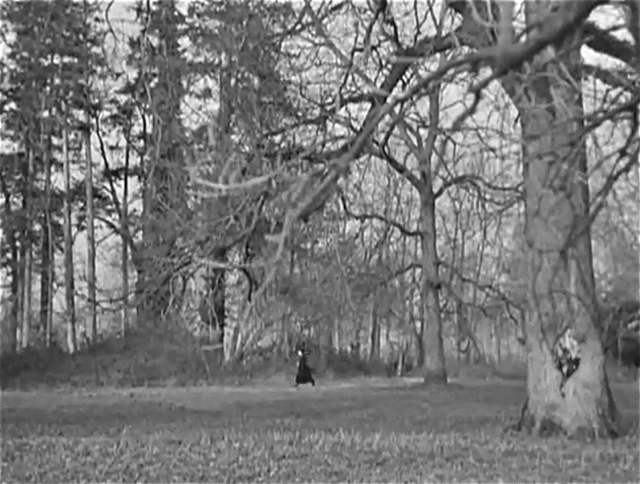
The cinematography reminds me of Robert Bresson’s Diary of a Country Priest. The young priest comes into his first parish, dwarfed and intimidated by the burden of his task, the spiritual warfare for which he is unprepared:

Walking through the woods

Like Bresson, Pawlikowski uses a non-actor for a major role. Agata Trzebuchowska plays Ida. She has never acted before. Pawlikowski found her in a coffee shop. Her portrayal of Anna/Ida is hauntingly authentic. Her face is pristine, yet her gaze is wise beyond her looks. Her aloof expression offers an unspoken evaluation of the world she sees, both in and out of the convent’s walls.

After a pivotal event, Ida tries on her aunt’s dresses, her high heels, smokes her cigarette and imagines another life. In this elegant attire she dances with the Jazz musician Lis. She listens to him play Coltrane on his sax. A whole new world awaits her if she so chooses. But it only entices for a short while. Ida yearns for something deeper, more meaningful. “And then?” she asks Lis several times in response to his offer of coming along with him.

Three characters, three different choices. Wanda chooses a way out that’s tragic.

The young musician Lis chooses jazz and whatever that path might take him. Despite his desire to have Ida come along with him, he does not, or maybe cannot, answer her two-word questions: “And then?” What’s the purpose, after all?

Ida chooses the transcendent over the secular, not that she judges the world, but that she yearns for meaning in the spiritual. It is not so much about choosing Catholicism over her Jewish lineage, but that she has made her own decision in becoming who she is. Ida’s choice is one that surpasses arbitrary, man-made boundaries of race and ethnicity, or the appeal of materials and pleasures; she chooses to devote to her Christ who had sacrificed all.

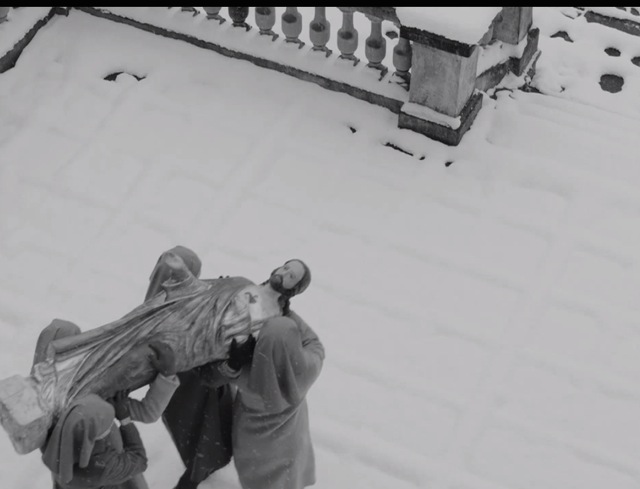
An image from the beginning of the film vividly comes back to my mind. Anna and three others carrying the Christ statue on their shoulders like a cross:

Carrying Christ

In the final shot we see Ida back in her habit attire. The moving camera captures a resolved and almost rejuvenated face, walking briskly with her little suitcase in hand, heading back to the convent. This place is now a personal choice.

~ ~ ~ 1/2 Ripples

***

Awards Update:

Feb. 22, 2015: Ida wins The Oscar for Best Foreign Language Film of the Year.

Feb. 21, 2015: Ida wins Best Foreign Language Film at the Independent Spirit Awards.

Feb. 8, 2015: Wins BAFTA Best Film not in the English Language

Jan. 15, 2015: 2 Oscar noms, Best Foreign Language Film, Best Cinematography

Dec. 11: Golden Globe nom for Best Foreign Language Film

Dec. 7: Ida wins Best Foreign Language Film and Agata Kulesza Best Supporting Actress at the L.A. Film Critics Awards

Dec. 1: Ida wins Best Foreign Language Film from the New York Film Critics Circle

Other posts you might like:

Nebraska: Colour Is Superfluous

Diary of a Country Priest: An Easter Meditation

Diary Of A Country Priest: Film Adaptation

Saturday Snapshot May 24: Yellow Bird

Here’s another encounter of the ‘ordinary’ yet not so ordinary. A yellow bird is very common for those living in warmer climates. But for me, it’s a rare sighting. I was so excited to see something bright yellow moving among the branches. Can you spot it? Something yellow among branches A better view as I quietly got closer: Getting Closer but just for a short few seconds, and then it was gone, fleeing from a lone paparazzo: Fleeing from a lone paparazzo I followed the yellow bird from tree to tree for well over a half hour. I did not know what kind of bird it was; I did not much care. That would come later when I got home. At that moment, I was too preoccupied with fixing my eyes on it, to whatever perils may come. I was stalking high and low among last year’s flood debris of fallen trees along a damaged landscape, trying not to trip without looking down at my feet.

Finally, a clearing: Caught in a clearingYellow, black and red contrasting fresh green leaves and a pale blue sky in the backdrop, a colourful picture.

Eventually, he seemed to appreciate my tenacity, and rewarded me with a couple of poses: Pose 1   Pose 2   Only after I’d uploaded my photos later and checked the features did I identify what bird it was: The Western Tanager. This one is a male in breeding season. “These birds live in open woods all over the West…” so says the Cornell Lab of Ornithology. They may be common, but this one is unique because it’s the only one I’ve seen. That makes it special for me.

***

Saturday Snapshot is hosted by West Metro Mommy Reads. Click Here to see what others have posted.

Photos in this post taken by Arti of Ripple Effects, 2014. Please DO NOT COPY or Reblog.

***

The Lunchbox (2013): A Meal that Binds

The Lunchbox premiered at Cannes last year. Since then, it had appeared in many other international film festivals, nabbing nominations and wins. I missed it at TIFF last September, so am glad I’ve the chance to watch it in the theatre recently. Here’s my review published in the May 18 issue of Asian American Press, a weekly newspaper based in Minneapolis, MN. That’s right, folks, it’s globalization.

***


The Lunchbox Movie Poster

The lunchbox, dabba, is a stackable unit of four or five round metal cans fastened by straps on the side that flip up to attach to a handle on top. Every day in Mumbai, India, five thousand dabbawallahs, or lunchbox deliverymen, would fetch the dabbas from homes after housewives have filled them with hot food and deliver the tiffin to their husbands in their offices. After lunch, they would return the empty dabbas back to each home.

In Mumbai alone, there are five thousands dabbawallahs, many of them illiterate. For one hundred and twenty years, they carry dozens of dabbas on their bicycles, negotiate the mass of humanity and impossible street traffic and railways to bring office workers a hot meal from home, or from dabba preparation outlets. Harvard University had studied their inexplicable coding and delivery system. Their finding: only one in a million of these dabbas would ever get lost.

dabbawallah

If you think the title is too mundane for a movie, then just focus on that one-in-a million lost lunchbox. It is picked up from a young housewife, Ila (Nimrat Kaur), and delivered to the wrong recipient, Saajan Fernandes (Irrfan Khan, Life of Pi, 2012), a retiring office worker who has been on the job for thirty-five years. Thus begins the exchange of short notes then letters placed inside these tiffin cans, two strangers who are socially worlds apart, but joined together by a savory meal.

The veteran actor Irrfan Khan won Best Actor at the 8th Asian Film Awards in March this year for his role in The Lunchbox, adding to his several other wins for the film. His subtle and nuanced performance requires no dialogues. Indeed, both Saajan and Ila have not shared a frame together in the movie. I would not so much call this a romantic comedy as their relationship is purely platonic. The romance could well be the ideals and dreams they stir up in each other’s mind through the exchange of written notes. If there is anything comedic it comes as finding a listening ear, a slight relief from the mundane and inescapable in life.

It is interesting to watch how writer/director Ritesh Batra reveals to us the dabba as a metaphor. Like the stackable cans, the story is multi-layered. It touches on marriage, human connections, memories, and dreams. From the mass of humanity, we focus on two individuals striving to find meaning in their daily existence. Like the fastener that strap tight the cans of the dabba, Ila is caught in a loveless marriage with her husband Rajeev (Nakul Vaid), and the aging Saajan is bound by memories of his late wife.

Ila prepares lunch

The film begins with Ila’s attempt to make a delicious meal for her husband Rajeev to win back his heart through his stomach, an advice from an upstairs neighbor Ila calls Auntie (Bharati Achrekar). Ila communicates with Auntie by talking out of her kitchen window. Herein lies the subtle humor of the movie. We do not see Auntie, except just hear her voice. She is like an invisible adviser to Ila’s love life. Poignantly, Auntie herself has been taking care of her own husband, Uncle, who is bedridden and in a comatose state for fifteen years. If life is a bondage like the dabba, Auntie doesn’t show it a bit from her cheerful voice.

Ila’s delicious meals soon get through to the heart of Saajan, the mistaken recipient. Saajan lives alone, and seems to be heading straight to even more meaningless days in his retirement. The note exchanges gradually break through his isolation. Further, albeit reluctantly, he has to train his replacement at work, the young and enthusiastic Shaikh (Nawazuddin Siddiqui). Now this is one lively character that not only offers a humorous foil to the withdrawn Saajan, but like Auntie, Shaikh is optimistic about life, even though he has grown up an orphan. Soon, Shaikh has broken down the barrier with Saajan and the two establish a kind of father/son relationship.

Saajan & Shaikh

With The Lunchbox, his debut feature, Batra has won several screenplay and directing awards. He is definitely one promising filmmaker to watch. His approach here is naturalistic. Shooting on location in Mumbai, the camera captures realistic, ethnographic street scenes and the mass on public transits, telling this Mumbai story in situ. Through the handwritten notes hidden in the mundane dabba, delivered by a traditional human service, the film vividly shows us that even in our day of emails and instant messaging, the route to connect is still through the human heart.

~ ~ ~ 1/2 Ripples 

***

Related Movie Reviews on Ripple Effects:

Life of Pi (2012): The Magical 3D Experience

English Vinglish (2012)

Slumdog Millionaire (2008)

The Namesake (2006): Movie Review

***

The Railway Man (2013) Movie Review

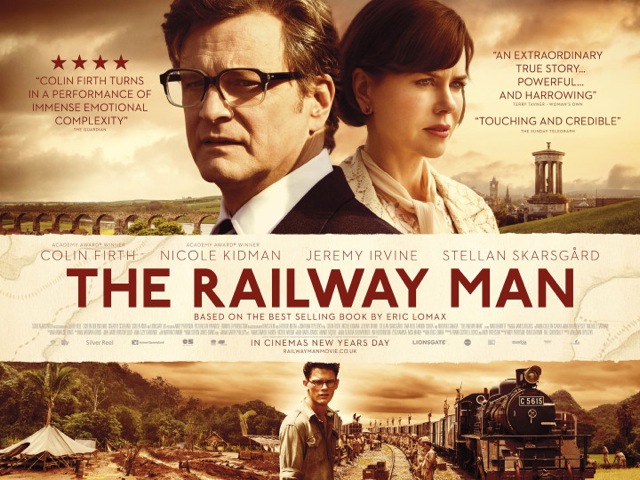
Premiered at the Toronto International Film Festival last September, ‘The Railway Man’ has only recently made its way into North American theatres, a slow train considering the story dates back to a chapter in World War II history that has generally been ignored. It had taken Eric Lomax decades to open up and tell his story as a Japanese prisoner of war. His autobiography The Railway Man was published in 1995, half a century after his ordeal.

The Railway Man


Noting the demographics of the audience in the theatre I was in, it is likely that the passing of a generation could mean the eventual silencing of eyewitnesses and victims, or those who have heard from them first-hand. While a movie adaptation of Eric Lomax’s autobiography is important for raising awareness of the events in the Pacific theatre during the War, the real difficulty is to attract younger viewers today to go into a movie theatre to watch it.

Of the numerous full-length features on WWII, only David Lean’s 1957 “The Bridge on the River Kwai” comes to mind for a movie that deals with this chapter in history. Eric Lomax was a young signals officer in Singapore when the British surrendered to the Imperial Japanese Army in 1942. He and other British soldiers were transported to Thailand to work on the Thailand-Burma Railway as slave laborers. Notoriously known as The Death Railway, the conditions there were horrendous. Many POW’s died and others were tortured. Lomax was one of them.

Having read his memoir, I find ‘The Railway Man’ a more realistic depiction of the POW’s conditions. Lean’s film where the men are portrayed in top physical shape marching to the famous whistling tune looks like a summer camp when compared to the atrocities Lomax and others had suffered. The war ended in 1945, but not the psychological torments of former POW’s.

‘The Railway Man’ begins with Lomax (Colin Firth) in 1980, a middle-aged veteran, still a railway enthusiast, encountering Patti Wallace (Nicole Kidman) while travelling on a train. This first part of the movie is the most enjoyable in that we see Colin Firth in his most natural and easiest demeanor, romantic yet reserved, with a dash of quirkiness. Nicole Kidman, with minimal make-up, gives an admirable understated performance. The two make good screen chemistry. Viewers will have more of their partnership in some upcoming productions.

Colin Firth & Nicole Kidman

As they chat on the train, David Lean’s ‘Brief Encounter’ is mentioned, a life imitating art experience thus ensues except this one leads to a long-term relationship. Eric and Patti soon get married. On their honeymoon, the nightmares of Lomax’s traumatic past begin to expose. He drops on the floor wrenching from fearful flashbacks.

Observing in anguish, Patti seeks to find out more from Lomax’s fellow veteran Finlay (Stellan Skarsgård) who cautions her of the scars of war and the never-ending torments. Thus leads to the second act where we see flashbacks into Lomax’s horrific POW experiences.

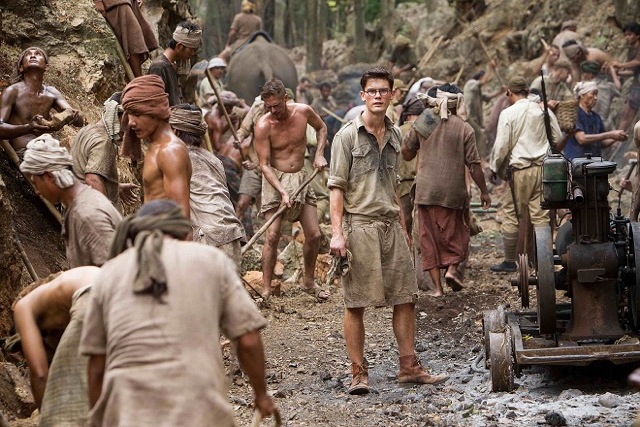
Jeremy Irvine puts forth an impressive effort in his portrayal of a courageous and decent young Lomax. After the radio he has made and his hand-drawn map of the railway line are discovered by his Japanese captors, the young Lomax bravely steps out to admit his involvement in order to spare his fellow soldiers the punishment. He is beaten, interrogated as a spy, and repeatedly tortured. Throughout, the young Japanese officer Nagase (Tanroh Ishida) is in full command.

Jeremy IrvineThe film goes back and forth in time during the bulk of the story, not roughly, but in an unbalanced way. The WWII sequences are intense, but the present day scenes exude a lethargic sense of inaction. While the talents of both Firth and Kidman can readily be tapped, the screenplay allows no further development other than the close-ups of a repressed and traumatically disturbed Lomax and a loving but exasperated Patti watching from the sideline. Here is a time when you would wish the director (Jonathan Teplitzky) and screenwriters (Frank Cottrell Boyce and Andy Paterson) had exerted more artistic freedom and creative energy into the film.

The plot turns a new direction as Finlay finds out that the Japanese officer Nagase (now played by Hiroyuki Sanada) who was involved in Lomax’s torture is still alive. Adding to Lomax’s burden, Finlay has pressured him to take revenge. Indeed, it is with a vengeful resolve that Lomax seeks Nagase out in a war museum in Thailand, where Nagase is a tour guide by the River Kwai, showing visitors the same prison camp wherein Lomax was once a captive.

As the torturer and the victim confront, tension rises. In the most critical moment, the murderous vengeance that Lomax has harbored is snapped. Nagase expresses genuine remorse and offers his apology to Lomax. Vengeance is thus dissolved into forgiveness.

This third act is supposedly the most moving section. Unfortunately it drags on too long, losing the power of the cathartic punch. While Firth’s performance is riveting as he enters the torture room and relives the past, the verbal exchanges between the adversaries and their ultimate reconciliation look contrived. As in the book, which leaves readers little explanation as to Lomax’s change of heart, I assume therein lies the difficulty for the screenwriters to invent a realistic and dramatic scenario.

Nonetheless, stories like this ought to be told for the understanding of historic truths and of the human heart. It just may sound like an over-simplification, but maybe the long road to reconciliation does start with a word of apology.

~ ~ ~ Ripples

CLICK HERE To read my book review of The Railway Man by Eric Lomax.

***

This movie review was published in the May 10 issue of Asian American Press.

Old Tales, New Takes

From the comments in my post What Maisie Knew (2012): From Book to Film, I see literature lovers, especially those who have read Henry James’s novel, are curious to watch the movie, wondering what a modern day film version could offer. Here is a good example of an adaptation exerting artistic and creative freedom to transpose while bringing out the spirit of the source material, ideas transferred as types onto the screen.

I can imagine too for literature purists, this is horror story. To them, movie adaptations are by definition a lower form of creation. They may be more acceptable if they follow exactly the same story lines and characterization. Any diversion spells disloyalty. How faithful and literal they are in the transposition is the sacred measure of their quality.

Having seen some retelling of literature effectively turned into cinematic form, I had long discarded the ‘loyalty’ criterion in my personal viewing. A ‘faithful adaptation’ doesn’t guarantee success, an example is the newest Romeo and Juliet (2013) which, using a modern day term, is pretty ‘lame’.

On the other hand, you might have enjoyed some movies without being aware of the literary source on which they are based, however loosely:

Apocalypse Now – Joseph Conrad’s Heart of Darkness

Bridget Jones’s Diary – Jane Austen’s Pride and Prejudice

The Claim – Thomas Hardy’s The Mayor of Casterbridge

Clueless – Jane Austen’s Emma

Cruel Intentions – Choderlos de Laclos’s Les Liaisons Dangereuses

Easy A – Nathaniel Hawthorne’s The Scarlet Letter

The Hours – Virginia Woolf’s Mrs. Dalloway

Jude – Thomas Hardy’s Jude the Obscure

The Lion King – Shakespeare’s Hamlet

My Fair Lady – Bernard Shaw’s Pygmalion

From Prada to Nada – A Latina version of Austen’s Sense and Sensibility

O Brother, Where Art Thou? – Homer’s Odyssey

Ran (Kurosawa’s, another evidence that literature is universal) – Shakespeare’s King Lear

West Side Story – Shakespeare’s Romeo and Juliet

Of course there are those that still use the same title without having to hide an alter ego, but have given the source material a contemporary spin. Because of their new angle to an old story, viewers can glean fresh insights and gain a deeper appreciation. Here are a few productions in recent years that are worth watching:


Coriolanus (2011)


coriolanus_03Ralph Fiennes’ directorial debut. Shakespeare’s Coriolanus is placed in present day, fictional Rome. Modern politics, urban warfare, but same old human hunger for power, the treachery of pride and the ever complex entanglements of family ties. Ralph Fiennes is superb as Coriolanus rivalling and later aligning with his archenemy Aufidius (Gerald Butler). Vanessa Redgrave and Jessica Chastain play the two significant others in the life of Coriolanus the vengeful career warrior, his mother and wife. Alas, what’s a woman to do?


Much Ado About Nothing (2012)

Much Ado About Nothing (2012)If a movie adaptation had already been made by Kenneth Branagh with Emma Thompson and all the Brits in full period costumes and a colourful set, what is one supposed to do for a remake? Joss Whedon was ingenious enough to shoot it in a couple of weeks, like on a whim, right in his own Santa Monica, California home, in black and white. Every room, furniture, wine glass, and the swimming pool is Whedon’s, but every line is Shakespeare’s. Old story, modern humour. A most creative take.


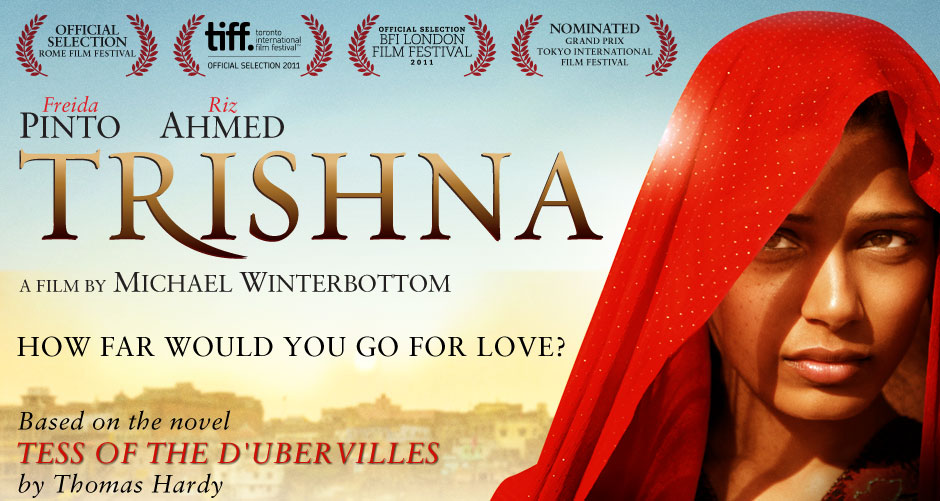
Trishna (2011)

TrishnaThis is British director Michael Winterbottom’s third adaptation of a Thomas Hardy novel, after Jude (1996, Jude the Obscure) and The Claim (2000, The Mayor of Casterbridge set in 1860’s California). This time he transports us to India. From the mass of humanity, we zoom in to one innocent girl in a poor rural area, 19 year-old Trishna. The trajectory of her fate and encounters parallel Tess of the d’Urbervilles in Thomas Hardy’s novel, equally poignant and tragic. The transposition is convincing. Freida Pinto of Slumdog Millionaire fame is perfectly cast as Trishna. Winterbottom’s naturalistic style matches the mood of the novel. Not easy to watch at times as we follow a powerless female in a class-centred, male dominated world. A beautifully shot film.


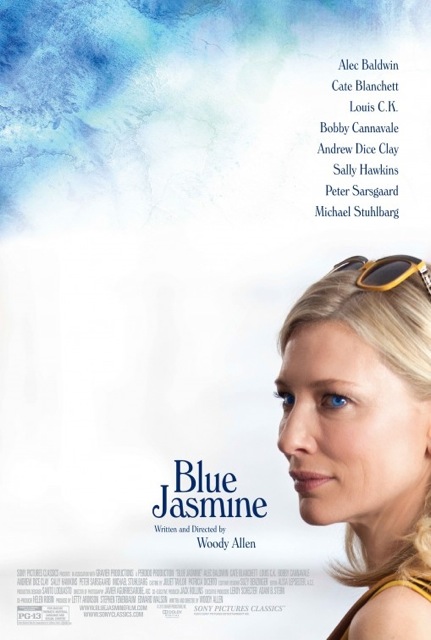
Blue Jasmine (2013)

Blue Jasmine Movie PosterI’ve written a full post on this. I see Blue Jasmine as Woody Allen’s homage to Tennessee Williams’ A Streetcar Named Desire. A different time and place, altered names and backstories, but same kind of struggles, parallel character types. Vivien Leigh won an Oscar for her role as Blanche in the 1951 movie version as a displaced, worldly older sister coming to take shelter with her younger, less well-to-do sister. Cate Blanchett won hers playing Jasmine who faces similar predicaments. In typical Woody Allen style, a pathos and humour mashup. Blue Jasmine is an excellent new take on a piece of classic literature. Of course, in this case, we only see the overarching parallels, but it does speak to the subliminal power of old tales.


***

RELATED POSTS:

Can A Movie Adaptation Ever Be As Good As the Book?

Tess of the d’Urbervilles (2008 TV): The Lite Version Part 1, Part 2

Blue Jasmine: Homage and Re-imagining 

Slumdog Millionaire (2008)

A Summer in Genoa (2008, Michael Winterbottom, Colin Firth)

Book Sale 2014: A Very Restrained Purchase

It’s that time of the year again… no, I don’t mean nesting habit of birds. I’m referring to The Crossroads Market Annual Book Sale. A diversion from my usual avian pics for Saturday Snapshot, here’s a photo of my very restrained purchase this year.

Readers familiar with my previous annual book loot will know how I’d hauled back home dozens of like-new or even unopened books at $2 each. All for the good cause of supporting Servants Anonymous Society.

Due to the boxes of still unread inventory from previous years, I’d decided to refrain from gratifying my hoarding instinct this time. The result is this minimal bagging of just four books, which I’d spent hours hand picking. Again, $2 each, all in mint condition:

Book Sale 2014


The reasons for these selections? Three had sold film rights and two of them are already in development for a movie adaptation. The fourth  one isn’t going to be a movie, but no less dramatic.

An Object of Beauty by Steve Martin 

Other than being known as the Father of the Bride, Steven Martin is also a talented banjo player. I’ve heard his banjo playing, but as for his books, quite a few of them actually, I still haven’t had the pleasure to enjoy. So here it is, a Steve Marin novel with 22 full-colour art reproductions inside. Story is set in the demanding art world of Manhattan, about Sotheby’s up-and-coming and very ambitious Lacey Yeager who has set her mind on climbing high on the career ladder. Amy Adams had bought the film rights, aiming at producing and starring in it. Who is writing the screenplay? Ned Benson, who wrote and directed The Disappearance of Eleanor Rigby Him and Her, which had me mesmerized at TIFF last year.

The Secret Scripture by Sebastian Barry

The novel won the prestigious James Tait Black Memorial Prize in the UK and the Costa Awards in 2008, Irish Book Awards’ Novel of the Year, and short-listed for the Man Booker Prize. Roseanne McNulty has lived in a mental asylum for fifty plus years. Now at the ripe old age of one hundred, she decides to write her life story. Fascinating. So the book chapters transport the character and her readers between the present and the past. I look forward to the movie adaptation, just take a look at this perfect casting: the legendary Vanessa Redgrave as the older Roseanne McNulty and the talented Jessica Chastain as the younger. Producer is Noel Pearson, the Irish theatre and film producer who brought us the Oscar winning My Left Foot (1989, Daniel Day-Lewis). The Secret Scripture film adaptation has great potentials. Shooting is reported to be starting in June this year.

The Sisters Brothers by Patrick DeWitt

Here in Canada, this is a multiple award winner: 2011 Governor General’s Literary Award, 2011 Rogers Writers’ Trust Fiction Prize, 2011 Scotiabank Giller Prize Finalist, 2011 Man Booker Prize Finalist, and selected as Amazon #1 Best Book of 2011. Film rights have been purchased by John C. Reilly’s production company… yes, the actor John C. Reilly, to turn this Western, yes, cowboy novel in the style of Elmore Leonard and True Grit into film. Should be an interesting read and movie. I don’t know about John C. Reilly, but, would he be willing to collaborate with the Coen brothers for the project?

The Film Club by David Gilmour

This is not the David Gilmour of Pink Floyd fame. Again, despite being an award-winning Canadian author, one time TV personality and CBC film critic, university lecturer, people outside of Canada upon hearing the name would likely think of someone more famous, at least Google does. Due to his recent incendiary remarks on his preferences re. writers and literature, this Canadian Gilmour just may have raised some awareness, adding notoriety to his name.

However, for me it’s not about him but about this audacious parenting experiment he conducted. At the time, his son was a 16 year-old who had an incurable avoidance of school. Watching him loiter at the edge of the cliff of boredom and aimlessness, what is a father to do? Well, Gilmour let his son drop out of school, but on two conditions: watch three movies with him every week, and, no drugs. Not a bad offer. A father and son film club instead of school… only in Canada, eh? Which titles were in his syllabus? As a film buff, I’m totally intrigued by his unorthodox parenting method, already half way through the book. Will definitely share with you eager parents when I’m done.

***

You might want to see what others have posted for their Saturday Snapshot. CLICK HERE to Melinda of West Metro Mommy Reads.

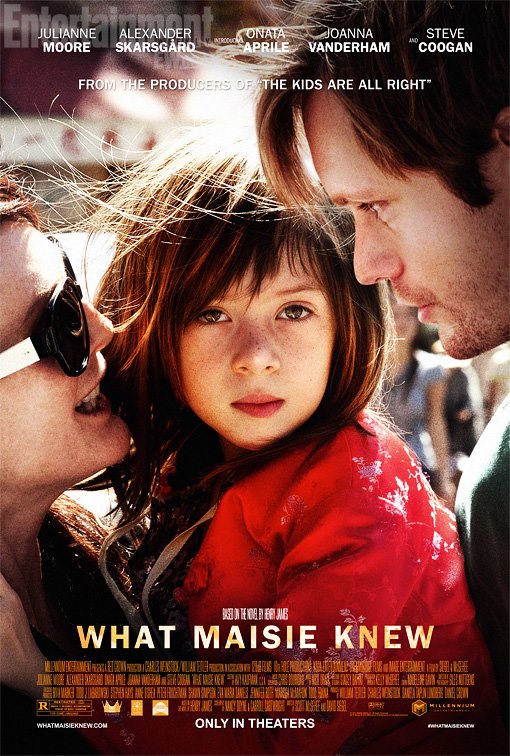
What Maisie Knew (2012): From Book to Film

With all due respect to Henry James, I’d rather be watching this contemporary adaptation of his work than slashing through the thickets of his novel. A thicket of a book, the last time I used this description was with Proust. And, if I’m to decipher long and incomprehensible sentences I’d rather be reading Proust than James. Nevertheless, James’s novel is a dense and deep psychological analysis of a dysfunctional marriage and its fallout on the child, a relevant issue today. Nobody wins in cases like that.

When published in 1897, it was probably one of the earliest fictional depictions of divorce and child-custody. Precocious Maisie knows much more than her parents could ever imagine. Like a volleyball, she is being tossed back and forth between her Mama and Papa, whichever side she lands on loses, for they both want their life to be free from child-rearing, free from ties and obligations. The notion of being ‘free’ recurs in the last chapters of the book, a key to how Maisie ends up choosing who to follow — her governess Mrs. Wix, someone who is not obsessed with being ‘free’, but who is committed to Maisie’s welfare.

What Maisie Knew


Again, may I reiterate here as in previous posts about books to movies, the two are totally different art forms. Here, one is a 300 page literary work, internal, dense and deep. The other is a 93-minute production of visual storytelling, enhanced by dialogues and musical score. To achieve this end, screenwriters Nancy Doyne and Carroll Cartwright have to pick and choose the most relevant storyline and characters, and opt out of lengthy, internal exploration of psychological entanglements, something the literary form can describe readily. The screenwriters have done a good job in their choices, keeping the story simple and relevant for viewers a hundred years after the book was published. Despite the subject matter, the movie is enjoyable and highly watchable.

Set in modern day NYC, it smoothly tells a poignant story from the child’s point of view. Six-year-old Maisie (Onata Aprile) is eyewitness and victim of her parents’ constant quarrels and later divorce, a young child caught in the thorns and thistles of adult relationships. It is unfortunate that the most sensitive and observant child is often the most vulnerable. The naturalistic capture by the camera of Maisie’s quiet observations is most heart-wrenching. Maisie learns that the adult world is a busy place, her presence, an inconvenience. Thanks to the screenwriters’ gentler treatment, the movie spares us from some cruel, hateful fights in the book. We see Maisie ultimately get a taste of what it’s like to be cared for and to have some simple, childhood joy. The ending shot is beautiful.

Unlike Maisie in the novel, there is no moral dilemma for her in the movie. No doubt, the moral element is crucial in James’s novel. Divorce and adultery must have poked deep into the heart of James’s readers in his days. But our contemporary society has, alas, evolved into a ‘morally neutral’ state of numb resistance. The screenwriters may well know too that entertainment value comes before the didactic. We see no moral choices here with Maisie in the movie. After all, a young child will readily cling to whoever that loves her in deeds rather than mere words. Kudos to the filmmakers, they know the heart of a child.

Directors Scott McGehee and David Siegel capture the story from Maisie’s viewpoint, natural and realistic, camera lens often at a lower angle. Certain shots are particularly affective, from inside a taxi, the transport of choice in Manhattan, at different times the vehicle that takes away Mama, Papa, and caring Margo. We would see from inside the taxi out to Maisie standing on the roadside, abandoned and distraught.

The wonderful cast is what makes the movie so absorbing, and at times, even heartwarming, despite its subject matter. The then seven year-old Onata Aprile is a natural. Julian Moore’s solid performance as her mother Susanna is convincing. She is a touring rock-and-roll singer who has passed her prime. Jealous and temperamental, Susanna’s love for Maisie is possessive, and often displayed in empty words. British actor Steve Coogan, known to North American viewers by his recent starring role in Philomena, plays the career-minded art dealer father Beale. Like his ex-wife, he is too busy with his own life to care for a child. They both say they love Maisie, showering bursts of affection whenever they see their child.

What saves Maisie is the awkwardly positioned step-parents, her father’s new wife and Maisie’s former babysitter Margo (Joanna Vanderham, the parallel of Ms. Overmore in the book) and her mother’s new love interest, the tall and young bartender Lincoln (Alexander Skarsgård, a Sir Claude parallel). As predicted, they soon are abandoned themselves and the two quickly form a tie that includes Maisie in their life. Diverging from James’s story, the two are genuinely loving and caring, a soothing balm to Maisie and the viewers.

Overall, a fine, contemporary adaptation of the novel. To James purists, a loose reinvention; for viewers seeking meaningful entertainment, this should be on the list of films to watch.

~ ~ ~ Ripples


 ***

Robert Bresson’s Au Hasard Balthazar (1966): A Timeless Parable

Surely he has borne our griefs
and carried our sorrows;
yet we esteemed him stricken,
    smitten by God, and afflicted. 

— Isaiah 53:4 ESV

Several days before He is crucified, Jesus enters Jerusalem riding on a donkey. I love this scene. If there’s any cognitive dissonance in the crowd, here’s the stark message for their bewilderment. The King for whom they are cheering is not to be a glamorous celebrity. Rather, like the donkey, He comes as a humble servant, one who carries their load, and ultimately, even lays down his life for them. His kingdom belongs to another world.

Marie and Balthazar


As with my Easter viewing from previous years, I watch a film by the French auteur Robert Bresson. Bresson’s work has a transcending and spiritual quality that is deeply moving. In Au Hasard Balthazar, he creates an unusual metaphor using a donkey as his protagonist. We follow Balthazar as a young colt, loved by his first owner Marie. We see him grow up, weaving his life among different owners. We also see Marie grow up. Despite her love for Balthazar, she cannot stop the encroachment of evil, or maybe she is simply powerless. She does not defend Balthazar when a gang of young men abuse the donkey, tormenting him, whipping, mocking.

The gang leader is Gérard, whose sadistic, mean streak speaks for human depravity. He would pour gasoline on the road to cause unsuspecting drivers to skid and crash. He and his gang would watch nonchalantly from a distance, gratified that their prank has worked. He steals and deceives. What is a donkey to him if he does not even have the slightest respect for other humans. Once, to prod Balthazar to move forward, Gérard ties a newspaper to his tail and light it on fire.

The Gang

Throughout, Balthazar lives his life quietly in a parallel course to the growing depravity of the humans he serves. He suffers their cruelty in silence, occasionally he would bray in pain, but he continues to bear his load, pull a cart, or do whatever he is prodded to do, even a circus act. Due to neglect and maltreatment, he often becomes ill.

As she grows up, Marie discards childhood innocence and seeks to gratify her sensual pleasures. Against the protest of her parents, she falls for Gérard. She could have another choice, one who offers her genuine love, Jacques, the son of the owner of the farm where Marie and her parents reside. Jacque would come by every summer from the city with his father and sister to stay on the farm. When they were still children, they had spent endearing moments together with Balthazar. Jacques has declared lifelong commitment to Marie. But Gérard is a more instant and attractive outlet for Marie. Ultimately, she is dealt the harshest blow and most degrading abuse from Gérard and his gang as they rape her. Bresson spares us the ugly scene, but in the chilling aftermath, we see the young men walk away, nonchalant, throwing her garments on the ground behind them. After that tragic incident, Marie runs away. Her father is grief stricken, and soon falls ill and dies.

Gérard is unrepentant. After all, it’s self-serving lust he seeks; his callousness is most disturbing. In the last scene, we see he uses Balthazar to do one more job for his gang. They are to smuggle goods across the mountainous border. At night, he loads up his goods on the donkey and leads him to the border. From a distance, he hears gun shots from armed customs police. Gerard and his gang flee, abandoning Balthazar on the mountain. But it’s too late for Balthazar, he has been shot.

The final scene is most moving. In the open field, Balthazar walks slowly, haggard, blood streaming from his leg. He finally lies down, still carrying the goods Gérard has put on him, the load of sin. He breathes his last and quietly dies, alone.

Like Bresson’s Diary of a Country Priest, Au Hasard Balthazar is an apt meditation for Good Friday. But not just for this one day, their timeless message is like the Easter Season itself, a moveable feast.

~ ~ ~ ~ Ripples

***

Related Posts and Links:

Diary of a Country Priest: A Book For Easter

Diary of a Country Priest: Film Adaptation

Video of Robert Bresson on Au Hasard Balthazar

The Budapest Hotel: A Grand Escape

“But it doesn’t mean anything.”
“So we put in words. One word for every note, like this…”

— ‘Do-Re-Mi’ from The Sound of Music

Does music need words to make it meaningful? Do we have to find a message in a work of art before we can appreciate it?

the-grand-budapest-hotel movie poster

Here we are with a cinematic piece that can’t be ‘explained’. What genre? What theme? What purpose? I’m not going to bother. As with my experience of watching previous Wes Anderson movies, somehow, I feel I need to let my rational side relax and just enjoy the ride. Rushmore probably has more of a traditional storytelling mode and thematic content. But with The Royal Tenenbaums, I have to adjust the quirky frequency to high, it’s a totally different kind of viewing experience. Fantastic Mr. Fox, I was mesmerized by the stop-motion animation and humour, great voices add to the lively adaptation of Roald Dahl’s story. Moonrise Kingdom, I wasn’t fully gratified but by then, I was used to the Wes Anderson style of ‘magical realism’.

That ‘magical realism’ strikes again in The Grand Budapest Hotel. Not my favourite colour palette, red and pink, by I was totally captivated as soon as the film began. I was being led into a fairytale world of real life people. From the cinematic framing, it aptly demonstrates the idea of symmetry. In many frames, the subject is right in the centre, almost perfect symmetry on both sides of the screen. But does it mean anything? One might ask. If we have to be rational about it, shall we just say, for the effects of a neat and tidy piece of the old world. Framing nostalgia before the world becomes too distorted, too inhumane. This is, after all, 1930’s Europe. And we can see the parallels in signs and symbols especially towards the end of the movie when uniformed men take over the Hotel.

Grand Budapest Signs & Symbols

Wes Anderson credits Stefan Zweig in creating The Grand Budapest Hotel. The Austrian writer’s name is shown at the very beginning of the end credits. In numerous interviews, Anderson pays tribute to Zweig’s whole collection of works, a writer who is noted as once ‘the world’s most translated author’. Zweig is a relatively new discovery for Anderson but so deeply has the writer inspired the filmmaker that ‘it’s basically plagiarism’, Anderson joked at the news conference when the film premiered at the Berlin Film Festival.

As someone who is much intrigued by the creative process of adapting books into films, I did read some Zweig before watching Budapest. I must be reading the wrong works though, I’d thought. From the novella Chess Story, to a few of the stories I read in the new collection recently translated into English, all tell very gloomy tales. The writings almost exude a sense of despair, as the characters are mostly running away from persecutions and ethnic cleansing, or memories thereof, even driven to madness as the chess champion Czentovic in Chess Story, albeit some descriptions embed a subtle trace of humour.

Maybe along the notion of ‘Wabi-sabi“, beauty and sadness, what Zweig has done subtly and now Anderson explicitly is to extract and fuse “humor and sadness”. Here in Budapest, writer/director Anderson has freely utilized the element of fantasy and fun to paint the passing of an old world, a realism too sad for millions in 1930’s Europe, Zweig being one of the subsequent victims. To escape the incendiaries of Nazism, Zweig and his second wife moved to England, then to the U.S., and finally to Brazil in 1940 where he ultimately committed suicide together with his wife in 1942, leaving a note of utter despair as he saw Nazism dominating Europe and his former homeland Austria.

In this fictitious Republic of Zubrowka, where The Grand Budapest Hotel is situated, Anderson offers us a great escape despite setting his story within the brewing tension of 1930’s Europe. The story begins with a closer to present day author (Tom Wilkinson) reminiscing upon an extraordinary experience which has inspired his book The Grand Budapest Hotel.

The Concierge Desk and Main Staircase

Years ago when he was still a young writer (Jude Law), in finding cures for writer’s block, he had retreated to a mountain hotel The Grand Budapest and in there met its owner, Mr. Moustafa (F. Murray Abraham). Known as Zero when he  himself was just a lobby boy in an age long passed, the owner told the writer his story of how he came to inherit this grand piece of property, albeit in a run-down shape now. Someone volunteering an extraordinary life story to an author in an exotic locale, the beginning of Budapest reminds me of Life of Pi, another great tale of magical realism.

But the movie belongs to Ralph Fiennes as the hotel Concierge and go-to person for all sorts of favours, M. Gustave. The death of long time patroness of the Hotel Madame D. (Tilda Swinton) has dragged M. Gustave and his protégé, the new lobby boy Zero, down a rabbit hole of misadventures and fortunes. Fiennes has proven that he is a versatile actor that can be as evil as Amon Goeth in Schindler’s List, or as madly romantic as Count Almasy in The English Patient, or as charming and fun here in Budapest. His comic timing is first-rate, his expressions, spot-on. My long-range forecast, an Oscar nom awaits him next year for his role in Budapest.

Gustave & Zero

The line-up of talents is long, not just in acting, where we find the usuals of Wes Anderson movies like Edward Norton, Tilda Swinton, Bill Murray, Owen Wilson, Adrien Brody, Willem Dafoe, Jeff Goldblum. Saoirse Ronan (breakout role as young Briony in Atonement) as Agatha the pastry maker is adroit and whimsical. She’s well matched to the young lobby boy Zero, aptly played by Tony Revolori.

The movie is also marked by the delightful compositions of Alexandre Desplat, whose musical scores adorn many notable movies in recent years. A collaborator with Anderson since Rushmore but here, Desplat’s scores captivated me early on with the lively East European themes and in particular, the Russian folk melodies. Some instruments that we seldom hear in other films are distinctly alluring, such as balalaikas, zithers, dulcimers, and organ, with full orchestral rendering. Another long-range forecast, Oscar for original score.

And then there’s the make-up of Tilda Swinton, the art work and production design of the whole Budapest experience (even the parody painting “Boy with an Apple” is an original art work by English painter Michael Taylor from a real life model), the flowing editing, the original screenplay and directing, the cinematography, Budapest Hotel is going to be one grand entry in the next Academy Awards.

~ ~ ~ 1/2 Ripples

 ***

Read a related post: How Zweig Inspired Anderson’s The Grand Budapest Hotel

Awards Update:

Feb. 22, 2015: Oscars for Best Costume Design, Make-up, Production Design, Original Score.

Feb. 14, 2015: Wins Best Original Screenplay from WGA.

Feb. 8, 2015: 5 BAFTA wins, Original Screenplay, Original Music, Production Design, Make-up and Hair, Costume Design.

Jan. 15, 2015: 9 Oscar noms, Best Picture, Best Director, Best Original Screenplay, Cinematography, Editing, Production Design, Make Up and Hair-Styling, Costume Design, Original Score.

Jan. 11, 2015: Golden Globe win for Best Motion Picture – Comedy or Musical

Dec. 11: 4 Golden Globe noms for Best Motion Picture – Comedy or Musical, Wes Anderson for Best Director and Best Screenplay, Ralph Fiennes for Best Actor – Comedy or Musical

Dec. 10: SAG nom for Best Cast in a Motion Picture

Dec. 7: The Grand Budapest Hotel wins Best Screenplay and Best Production Design at the L.A. Film Critics Awards

Dec. 1: The Grand Budapest Hotel just wins Best Screenplay from the New York Film Critics Circle

Related Links:

From BBC CULTURE: The Writer Behind Budapest Hotel

From NPR: The Rise and Fall of Stefan Zweig

The Music Behind the Screen

The Untold Story Behind ‘Boy With Apple’

Homage to Flannery O’Connor: Looking for ‘Intrusions of Grace’ in Films

Today is the birthday of Flannery O’Connor. As a tribute, I’m re-posting a piece I wrote a few years ago entitled “Looking for ‘Intrusions of Grace’ in Films: Pickpocket and Drive”

**

Our age not only does not have a very sharp eye for the almost imperceptible intrusions of grace, it no longer has much feeling for the nature of the violence which precede and follow them.” — Flannery O’Connor (quoted in my post A Good Man Is Hard to Find and Other Stories)

Flannery O’Connor made this remark back in 1963. It was not only a sharp social commentary and prophetic, but to me, it also stands as one of the signs of a good film. Amidst the violence and ugliness a film may depict, the presence of grace, however small, or a mere spot of purity, could bring out a powerful contrast. Usually that is what’s needed to emit a redemptive spark, a glimpse of light pointing to the transcendent.

With this frame of grace among violence, I go back to the films I’ve watched and try to find some good examples. My task proves to be more difficult than I first thought. But after some deep searching through my mental archive, several films came to mind. I’ll just mention two for this post.

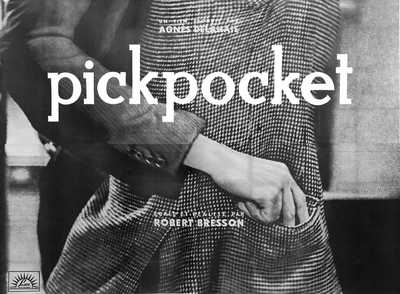
Pickpocket (1959)


pickpocket movie poster

Robert Bresson’s modern version of Dostoevsky’s Crime and Punishment. Caught in his own desensitized internal world, our protagonist Michel commits acts of theft as a desperate measure to fill the void in his existence. He goes through his days in a haunting vacuum devoid of meaning and emotions. He is unfeeling even towards his own dying mother, reminds me of Meursault in Camus’s The Stranger. Although not an axe murderer like Raskolnikov in Crime and Punishment, Michel theorizes that those with superior talents and intelligence, the supermen in society, should be free to disobey laws in certain cases. He is numbed by his own hubris, and stifled by his cold and absurd worldview. Outright violence is not visible here, but we see the battle of wits he engages with the police inspector behind his trails, and we see him struggle in an amoral and meaningless existence.

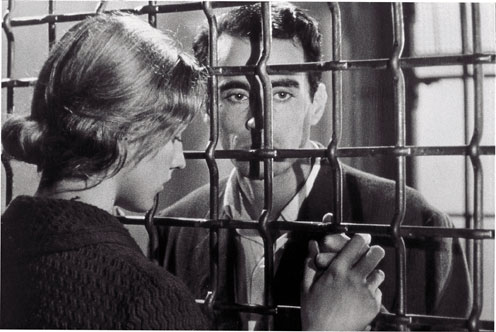
Grace comes as Jeanne, a neighbor and carer of Michel’s ailing mother. Jeanne lives on her own looking after her younger brother. Her father is a drunk and her mother has deserted them. But she continues to live and care. She accepts her circumstances calmly, and extends kindness to those unrelated to her, caring for Michel’s mother, a neighbor on another floor. She stands as a stark contrast to Michel’s aloofness. At the end of the film, Jeanne came to visit Michel in prison after he was arrested, the two separated by the cold iron bars. For the first time, Michel feels love and wants to reciprocate it. And thus the cathartic ending as he totally melts in the presence of pure love and grace, wrapping up the film with this last line:

“Oh, Jeanne, to reach you at last, what a strange path I had to take.”


Pickpocket


**

Drive (2011)

A current release that comes with high acclaims. The film was nominated for the Palme d’Or and Nicolas Winding Refn won Best Director at the Cannes Film Festival this year (2011). With slick and dashing camera work, the violence in “Drive” is visceral and graphic, a big contrast to the black and white, internal “Pickpocket”. However, I see some parallels between these two films made 50 years apart.

Ryan Gosling is “the Driver”. He does not even have a name. He is an expert stunt driver for movies and works at an autobody shop by day, drives a get-away car in the underworld of crimes by night. Like Michel in “Pickpocket”, he drifts in existence, numb and desensitized to the world around him. That is, until he meets Irene (Carey Mulligan), his neighbor.

Drive 1


Mulligan’s almost angelic presence in the film is most effective as a stark contrast to those around her. She lives alone looking after a child and works as a waitress in a diner. She appeals to the Driver by being herself, innocent, taking life as it is, responsible, caring for a child alone while his father is locked up in prison. Irene is a spot of purity in a rough environment. Her mere presence has transformed the Driver. From being aloof the Driver has become engaged emotionally, friendly and protective of both mother and son.

Drive

The plot thickens as Irene’s husband is released from prison and rejoins his family. The Driver is caught in an awkward situation. But he soon realizes that the husband’s resolve for a new start is genuine. The power of transformation is so thorough that the Driver is willing to go out on a limb to help the husband with one last heist in order to break the hold a gang has on the man, his wife and kid. While things go awry terribly and the ending is not as clean-cut as “Pickpocket”, we learn that the Driver remains a changed man from the ephemeral friendship he once had with Irene and her child.

Some might say Mulligan is a miscast, that she’s not “damaged enough”, and would prefer a ‘stronger’ character. I disagree. I feel that Mulligan has portrayed Irene’s innocent persona aptly, and yes, those ethereal dimples can just melt any heart. Hers is the perfect role for exactly the right reason. In the dark underworld of gangs, violence and crimes, she stands out as a tiny source of purity, a spark of grace. It all shows that what may look weak and vulnerable can have transformative power over the strong. A thought that may well be unpopular today.

***

Other related posts from Ripple Effects:

A Good Man Is Hard To Find and Other Stories by Flannery O’Connor

Bernini’s Corpus and Modern Movies

Notes on the Synthesis of Film, Art… Life?

***