Can a movie adaptation ever be as good as the book?

The more I watch movies and read books, the more I see the two as totally different art forms. They evoke different kinds of pleasure and enjoyment. A direct translation just may not work. I used to seek for how ‘faithful’ a movie is compared to its literary source, but more and more, I’m looking for how good it stands alone as a production in terms of cinematic elements.

A film adaptation can make an apt homage to the original literary work. It is not merely an ‘illustrated book’, but a new creation, if you will, one that offers a different experience from reading. In telling the story from a visual and sound perspective, it offers a multidimensional take on the original work. By so doing, it may need to alter the source material. But then again, how do you know the images on-screen are not those already conjured up in some readers’ minds as they interact with the text… or, theirs are not even more far-fetched?

While a film is the artistic expression of the filmmaker’s interpretation, it is also a collaboration of talents and perspectives, as cast and crew contribute their expertise, in cinematography, set design, costume, writing, sound, music, editing… all under the artistic direction and insight of the auteur. It is an alchemy of sights and sounds. On top of that, there are the key agents of delivery, the actors. An intelligent and nuanced performance can bring out the literary essence, unfurling the thematic matter, characters and conflicts, and above all, the humanity embedded in the text.

In his article entitled “Snobbery”, Ta-Nehisi Coates, senior editor for The Atlantic, says that as he reads Pride and Prejudice, Austen’s brilliant literary depiction has formed some vivid images in his mind.

I like the pictures in my head, and would not see them overthrown.

Yes, that’s usually the case with many readers who guard the ownership of their imagination as sacred territory, hence, the refusal to step out to explore other grounds of artistic expressions. So, despite hearing how splendid the BBC version of Pride & Prejudice is, Ta-Nehisi Coates has this to say:

I don’t doubt it–but I think mine is better. For right now, I’m just a snob that way. I reserve the right to change.

I’ve been mulling over this ‘snobbery’ idea after reading his article back in March, and feel that another word might be more apt to describe such a condition: “hegemony”… the claim of the literary being supreme, over other forms of artistic expression. On a personal level, it is also the hegemony of subjectivity… valuing one’s own mental images exclusively. It’s about sharing, isn’t it, seeing and experiencing what others’ imaginary worlds are like in response to a piece of literary work? I believe we are richer when we share, especially, our vision and imagination.

As a literature lover and a Janeite myself, I’m only glad to hear another high praise of Austen’s ingenuity, not that her works need any more approval to be of value. However, as a film lover I don’t want to wage war by dichotomizing the literary and the visual. They are two different art forms, two distinct vehicles of storytelling. Even though the story comes from the same source, it could be told from different perspectives, filtered through different lenses, structured in different styles, and ultimately received by interacts with the reader and the viewer in a very individual and personal way.

I’ve appreciated Kazuo Ishiguro’s openness regarding the creative process during the film adaptation of his book Never Let Me Go. According to a TIME magazine article, Ishiguro said to Alex Garland, the screenwriter:

Your only duty is to write a really good screenplay with the same title as my book.

What ended up was both the author and the screenwriter share a very similar vision. Here is what director Romanek has done to bring out the literary:

… he imparts a mood so subtle, with so many emotional cataclysms conveyed through a glance or a few tears, that the film might have been made by the Japanese master Yasujiro Ozu.  The nuance is both emotional and visual… Romanek also researched the Japanese notion of wabi-sabi, ‘which is the beauty of things that are broken and worn and rusted and imperfect. So production designer Mark Digby and I, we just wabi-sabied everything. The dried flowers are an example of that. There’s nothing new in the film. Everything shows the wear of time.

Watching a film then is like listening to another language, the language of the visual, and appreciating the significance of mise-en-scène.

***

As a language and literature lover as well as a movie buff, I’m always on the lookout for the perfect fusion. To those who insist that a movie will never be as good as the book, allow me to suggest the following sampler. No, they aren’t perfect, but some are close to it. They are all worthy of and have done justice to their source material. Just from memory I’ve made the following list. All I’ve read and watched, some several times. (click on the link to read my review). There are more good movie adaptations of course, but I’m just listing those which I’ve both read the book and seen the film, thereby able to evaluate the adaptions against their source material:

Great Expectations (1946)
Novel by Charles Dickens, directed and screenplay co-written by the legendary David Lean.

Diary of a Country Priest (1951)
Novel by Georges Bernanos, screenplay and directed by Robert Bresson

To Kill A Mockingbird (1962)
Novel by Harper Lee, Robert Mulligan director, Gregory Peck IS Atticus Finch

The Heart is a Lonely Hunter (1968)
Novel by Carson McCullers, Memorable performance by Alan Arkin

A Room With A View (1985)
Novel by E. M. Forster, a Merchant Ivory film. Helena Bonham Carter emerged.

Howards End (1992)
Another E. M. Forster/Merchant Ivory film. Ruth Prawer Jhabvala won Oscar for Best Adapted Screenplay, Emma Thompson Best Actress. Beautiful rendition of sight and sound. Helena Bonham Carter, Vanessa Redgrave, Anthony Hopkins and many more made up the talented cast.

The Music of Chance (1993)

Paul Auster’s absurdist/existential novel is hauntingly adapted into film (How can you show philosophical concepts? Here it is) perfectly interpreted by James Spader and Mandy Patinkin. Excellent cast and superbly directed by Philip Haas.

The Remains of the Day (1993)
Kazuo Ishiguro’s Booker Prize winning novel, another Merchant Ivory film. Poignant performance by Emma Thompson and Anthony Hopkins.

Pride and Prejudice (1995, BBC)
In my opinion, the definitive version of Jane Austen’s film adaptation. BBC production, Andrew Davis screenplay. Colin Firth remains the inimitable Mr. Darcy to this day.

Sense and Sensibility (1995)
Emma Thompson did justice to Jane Austen with her Oscar winning screenplay. Ang Lee directs Emma Thompson, Kate Winslet, Alan Rickman, Hugh Grant. Still my favorite version of S & S.

The English Patient (1996)
Booker Prize winning novel by Michael Ondaatje, directed and screenplay written by Anthony Minghella. Ralph Fiennes, Kristin Scott Thomas, Juliette Binoche.

Girl With A Pearl Earring (2003)
Novel by Tracy Chevalier, Peter Webber directs Colin Firth as Johannes Vermeer, Scarlett Johansson as the servant girl Griet. An artistic, nuanced production.

Bleak House (2005, BBC)
The TV mini-series that prompted me to read the 1,000 page book by Charles Dickens. Gillian Anderson, Anna Maxwell Martin, Denise Lawson, and a cast of talented actors delivered a most enjoyable and exceptional rendition.

Away From Her (2006)
Short story by Alice Munro, the young Canadian talent Sarah Polley wrote the screenplay and directed veteran actors Julie Christie and Gordon Pinsent. A moving portrait of the destruction of a marriage by Alzheimer.

3:10 to Yuma (2007)

Short story by Elmore Lenard, James Mangold directs Christian Bale and Russell Crowe. Movie captures the psychological conflicts marvellously.

Atonement (2007)
Novel by Ian McEwan, Joe Wright directs Keira Knightly and James McAvoy. Saoirse Ronan’s breakout performance.

When Did You Last See Your Father? (2007)
Memoir by Blake Morrison, David Nicholls screenplay. Anand Tucker directs Colin Firth, Jim Broadbent, Juliet Stevenson and the young rising stars Carey Mulligan and Matthew Beard.

The Diving Bell and the Butterfly (2007)
Jean-Dominique Bauby ‘wrote’ the book by blinking one eye. Julian Schnabel director. Mathieu Amalric plays Bauby, the true story of a stroke survivor who was left paralyzed except the movement of his left eye.

Never Let Me Go (2010)
Novel by Kazuo Ishiguro, Alex Garland screenplay, Mark Romanek directs the talented British trio of Carey Mulligan, Keira Knightly, and Andrew Garfield.

True Grit (2010)

Book by Charles Portis. This is an updated movie version by the Coen brothers, Hailee Steinfeld’s breakout role, deservedly garnering her an Oscar nom. Jeff Bridges is better than John Wayne I feel. 10 Oscar nominations in total.

Still more…

The Hours (2002)
Pulitzer Prize winning novel by Michael Cunningham, David Hare screenplay, Stephen Daldry directs. Homage to Virginia Woolf and Mrs. Dalloway. Nicole Kidman won Oscar Best Actress as V. Woolf. Moving performance also by Julianne Moore, Meryle Streep, and Ed Harris.

Doubt (2008)
John Patrick Shanley wrote the play, later the screenplay as well as directed the film. Engaging performance by Meryl Streep, Amy Adams, Phillip Seymour Hoffman, Viola Davis. (For this one, I’ve yet to read the play)

A Single Man (2009)
Novel by Christopher Isherwood, Tom Ford’s directorial debut. Colin Firth’s first Oscar nom. Julianne Moore, Matthew Goode, Nicholas Hoult. Heart- stirring music.

An Education (2009)
Memoir (essay) by Lynn Barber, screenplay by Nick Hornby, directed by Lone Scherfig. Carey Mulligan got her first Oscar nom. Peter Saarsgard, Dominic Cooper, Rosamund Pike, Olivia Williams.

Life of Pi (2012)

12 Years A Slave (2013)

2015 UPDATES:

45 Years (based on the short story “In Another Country” by David Constantine)

Room 

2016 UPDATES:

Love & Friendship

Arrival

Silence

2017

Lion: From Personal Memoir to the Big Screen

Certain Women

Mudbound

2018

Wildlife

2019

Little Women

2021

Nomadland

Passing

2022

The Power of the Dog

Drive My Car

2023

The Quiet Girl

**What are your favourite film adaptations of literary works?

***
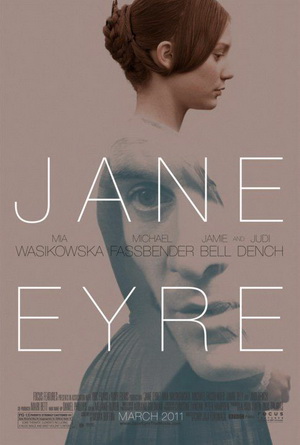
Jane Eyre (2011): Another Movie Adaptation

The perils of making a movie of a well-known literary classic that already has over 20 adaptations are: If you are faithful to your source, there bound to be scenes that look like you have just taken out from previous versions; if you are not, you risk accusations from the purists. On top of that, you will have to condense a relatively long story into two hours of screen time. So, why would anyone want to do such an arduous task? Hopefully there is an answer waiting when we come to the end of this post.

What would you do differently to appeal to 21st century viewers? A splash of defiance and independence from Jane could work. But still, even the smart and cerebral lines uttered by her we have all heard before, for they are written by Brontë. So what merits can a new adaptation claim?

Another way to retell an old tale to today’s audience is offering a fresh perspective. Here, director Cary Fukunaga (Sin Nombre, 2009) has effectively crafted a non-linear structure of storytelling. Even for those who have not refreshed their classics memory lately, the movie’s smooth time changes should not pose a problem, for they are quite well done. It begins with Jane running away from Thornfield, desolate on the moors, but fortunate enough to be rescued and cared for by the pious but stern St. John Rivers (Jamie Bell of Billy Elliot fame, 2000) and his sisters. Upon questioning, Jane’s abused childhood and her time at Thornfield are revealed through flashbacks. It picks up from the opening scene again about three-quarters of the way, and pushes towards the anticipated ending.

Mia Wasikowska (Alice In Wonderland, 2010) faces a huge challenge to portray a Jane that’s convincing, and has to be compared to so many who had attempted in the past. Now Mia is the young Australian actor who has turned down the coveted role of Lisbeth Salander in “The Girl With the Dragon Tattoo” trilogy’s English version, and opted for the role of Jane Eyre. In an interview, she reveals that it all started when she was reading Charlotte Bronte’s 1847 novel about two years ago. By Chapter 5, she talked to her agent on the phone and asked whether by any chance there was an adaptation in the works. She knew she had to be Jane. Not long after that she received the screenplay by Moira Buffini. Thus began this newest cinematic rendition of Jane Eyre.

As a 19 year-old at the time of production, Mia was the right age for the role. That’s when Jane leaves Lowood School and heads out into the world to seek her own destiny. Brontë offers us a heroine who has a firm grip of self-respect and moral direction despite an abused upbringing. This is the Jane that has captured the hearts of so many throughout the years and who still appeals to us modern readers.

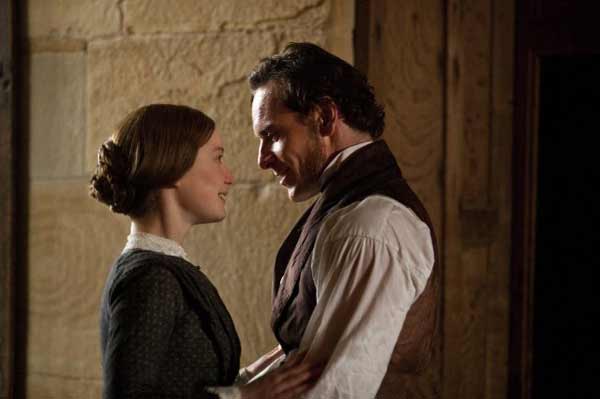
So our protagonist meets her fate as she lands a job at Thornfield as a governess to Adele, the ward of the enigmatic Edward Rochester, played by Michael Fassbender (Fish Tank, 2009). Fassbender just may have replaced Ciarán Hinds as my favorite Rochester. At 34, he might not be old enough to be faithful to the novel, but his performance is captivating and convincing. The two make a visually compatible pair. However, I have one major issue: the romance seems too restrained that it almost fails to ignite, especially on the part of Jane. With a movie like this, of course we go not so much for the Gothic, but for the passion. I wanted eagerly to be enthralled. But what I saw was a passionate Rochester wooing a repressed Jane. It’s ironic that almost throughout the film I remained emotionally disengaged, albeit thoroughly enjoying the performance of both characters.

Ultimately it comes, the scene that captures my heart. After the disclosure of the dark secret and the wedding called off, Jane desperately tries to fight off her deep yearning and love for Rochester by refusing his advance and embrace. She literally has to run away from Thornfield to uphold her moral choice and escape from her heart. And finally, for those who long for a cathartic reunion of the lovers, the ending again teases us by offering a closure that’s a bit too short and swift.

Still another and probably most effective way to appeal to modern viewers is the visuals. Kudos to both the director Fukunaga and cinematographer Adriano Goldman. They have answered the frequently asked question of “Why make another movie adaptation of a literary work?” We love to roam in our own privately constructed imaginary world when we read. A movie is the visualization of that world. It is an artistic display of a filmmaker’s interpretation and private imagination. It may not match our own, but surely can still be an enjoyment if it is presented with cinematic beauty.

We see Jane running away from Thornfield, our destitute heroine determined to make the moral choice despite the yearning of her heart. The fragile figure pitted against the harsh and barren moors, or the overhead shot of Jane standing at the crossroads … all effective visuals to present the literary, and by so doing, augment our appreciation of it. Here, you can see your own imagination realized, or see what others have conjured up in their minds. The few scenes where we have the shaky camera must be mentioned also. Generally I’m not a fan of hand-held camera work, but here in the film, such jerky moments are effective in depicting Jane’s troubled soul and inner turmoil. The camera lens following her has become the portal into her agitated and unsettling state of mind. Just another way the literary can be effectively translated into the visual.

Yet another movie adaptation of Jane Eyre? Why not… and I’m sure, there are more to come. I appreciate a filmmaker’s attempt to display the visual artistry that can be extracted from the literary. Words and visuals, they can go hand in hand in this image-driven age. And hopefully through popular screening and the viral medium, we can give recognition to the source materials that have entranced us for so long, giving credits to both the author and the writing.

~ ~ ~ Ripples

Forget About Tiger Mothering, Try Inspirational Parenting

One of the most memorable lines in last week’s Academy Awards is Tom Hooper’s: “The moral of the story is: Listen to your mother.”

What more satisfaction can a mom get than to hear her son utter these words in front of a billion viewers worldwide.

Here’s the excerpt of his speech leading to this final conclusion:

“My mum was invited to a fringe theater play-reading of an unproduced, unrehearsed play called The King’s Speech in 2007She came home, rang me up and said, ‘Tom, I think I found your next film.’

I followed The New York Times reporter/blogger Melena Ryzik’s The Carpetbagger on Twitter through the Awards Season. Of all the Oscar interview write-ups I’ve read, and there are numerous, Ryzik’s “A Chat With The Mother Who Knows Best” has left the most lasting impression on me. And it was in that article that I found these two words, “inspirational parenting”. They were nothing short of an epiphany for me, striking a chord instantly.

Photo Credit: Matt Sayles/Associated Press

Ryzik talked to “The King’s Speech” director Tom Hooper’s mother after her son’s Oscar win, calling her “an exemplar of inspirational parenting”. Meredith Hooper is an academic and author of over 60 fiction and non-fiction works for children. Here are some excerpts from Ryzik’s article:

Did she realize she’d caused worldwide guilt among children for not listening to their mothers?

“I did not!” Ms. Hooper protested. “I didn’t say it. My advice is exactly the opposite — that we should all listen to our children.”

Now isn’t that the kind of talk that can make Amy Chua cringe? The kind of parenting style that prompted her to write about her own school of tough love parenting in her memoir Battle Hymn of the Tiger Mother, now 7 weeks so far on the NYT Bestsellers List. It’s all that debate about teacher-fronted or child-centred learning all over again.

I’ve left comments on others’ blogs about my view of this current hot topic of the “Tiger Mom”, but have not posted about it here on Ripple Effects. The main reason is that I have not read the book, so I should not say too much when I haven’t heard all that Amy Chua has to say, albeit I can understand her perspective since I share similar ethnic and cultural roots.

Nevertheless, I’d rather write about ‘inspirational parenting’. It just sounds… more uplifting. Just savor the two words… aren’t they sublime? I think I just might adopt the first word as a personal axiom, ‘inspirational’ anything… in speaking, thinking, writing, being… mmm, something to aspire to.

Ok, back to “The King’s Speech”. After seeing the play, Meredith Hooper saw a great potential for a film in this story so full of human interest, irony and humor. As an Australian herself, she was bemused by Logue’s task to teach an English royal to speak:

Logue came as an Australian, and taught the king to speak. How incredible! Because we colonials — it’s assumed that the English would teach us how to speak. So I loved this reversal of roles, that this Australian would arrive in England with his democratic attitude, and no assumptions about class and society and status, all of which I’ve experienced.

Now this just might work for parenting as well. A practice of role reversal could bring about more empathy for both parents and children. Only when we listen and try to understand can we begin to deepen a relationship. I know, only as a therapy session, for kids would be more than willing to take back their role after momentary reversal. Who would want a more arduous job than they need to?

A story, a film, real life, it all boils down to…

So here it was, this simple need to communicate, in a play or in a film. Brilliant! Because it’s all about communicating, every piece of dramatic writing is all about communicating, and this was about someone who couldn’t.”

It’s interesting that Tom did not take up his mother’s enthusiasm right away. Convinced of the latent power in the story, Meredith explained to her son how the elements of effective storytelling fall naturally in place. They shared ideas. It was five months later that the initial notion began to take shape as a film project.

I must add too that the inspirational parenting ends where the creative spark ignites. A wise mother knows when to stop and allow the seed to grow into a life of its own. That’s what Meredith Hooper did… and the rest is Oscar history.

***

Click Here to read Melena Ryzik’s NYT article “A Chat With The Mother Who Knows Best”.

Related Posts on Ripple Effects:

Oscar Winners 2011

The King’s Speech (2010): Movie Review

The King’s Speech: Fact And Fiction

Oscar Winners 2011

The beginning clip was an interesting opening, with Anne Hathaway and James Franco appearing in all the nominated Best Pictures. After that, what was promoted as an Oscars with the youngest co-hosts to bring about a youthful makeover had shown to be one of the most uneventful, ok, boring, in years. The preview videos of James Franco and Anne Hathaway rehearsing were much livelier than their actual act. Franco looked like he had a term paper due the next day… or was the deadpan, sleepy look a part of the performance. If it was, then he had chosen the wrong mask. I must give credits to Hathaway for trying to compensate with so much enthusiasm. When Kirk Douglas, Robert Downey Jr. and Jude Law came up to present, and later, previous Oscar host Billy Crystal made his appearance, I could see some wisdom in ‘age before beauty’. Hopefully a lesson learned: Avoid the trap of ageism.

(Photo Source: Toronto Sun)

So here are the major results. For a full list CLICK HERE to the Oscars Official Site.

The King’s Speech: Best Picture, Best Director Tom Hooper, Best Actor Colin Firth, Best Original Screenplay David Seidler.

The Social Network: Best Adapted Screenplay Aaron Sorkin, Best editing, Best Original Score.

Black Swan: Best Actress Natalie Portman

The Fighter: Best Supporting Actor Christian Bale, Best Supporting Actress Melissa Leo

Inception: Best Cinematography, Best Sound Editing, Best Sound Mixing, Best Visual Effects

Toy Story 3: Best Animated Feature

Inside Job: Best Documentary Feature

(Photo Credit: Reuters/Gary Hershom)

All the best speeches came from The King’s Speech gang.

David Seidler At 73, Seidler’s win is an inspiration:

“I say this on behalf of all the stutterers in the world. We have a voice. We have been heard… My father always said to me I’d be a late bloomer. I believe I’m the oldest person to win this award. I hope that record is broken quickly and often.”
Definitely a boost to all would-be late bloomers in the world… just gives us hope.

CLICK HERE to view David Seidler’s Oscar Acceptance Speech.

Tom Hooper

“My mum was invited to a fringe theater play reading of an unproduced, unrehearsed play called The King’s Speech in 2007. She almost didn’t go. But thank God she did, because she came home, rang me up and said, ‘Tom, I think I found your next movie.’ So with this tonight, I honour you. And the moral of the story is: listen to your mother.”

.

Colin Firth

“I have a feeling my career’s just peaked.”

That’s the beginning of a speech expressing gratitude to many, all from memory, no cheat sheet. Those mentioned included:

“… Harvey (Weinstein, producer) who first took me on 20 years ago when I was a mere child sensation … and Livia, for putting up with my fleeting delusions as royalty…”

You must see it if you’ve missed it. For those of us who were glued to the TV screen the last 10 minutes of the Awards Show last night,  CLICK HERE to watch Colin Firth’s Oscar Acceptance Speech again.

***

Related Posts on Ripple Effects:

Forget About Tiger Mothering, Try Inspirational Parenting

The King’s Speech (2010): Movie Review

The King’s Speech: Fact And Fiction


The King’s Speech: Fact and Fiction

The line “Based On a True Story” at the bottom of the movie poster apparently is not enough as a disclaimer. Some point out the twisted historicity in the movie “The King’s Speech”. In particular, it has altered the fact that Churchill had adamantly supported the reign of Edward VIII even after he had stated his intention to marry Wallis Simpson, and evaded the early appeasement of Hitler by the British monarchy.

My view is this: The King’s Speech is not a documentary, nor even a biopic. It is a film based on a true struggle in the life of King George VI before he became King to shortly afterwards.  It spans from the closing of the Wembley Empire Exhibition in 1925 to the beginning of WWII in 1939. The focus is on a personal angle. It has taken some steps to dramatize the sequences which I must say are effective. While I agree the Churchill character in the movie could well be inconsistent with historical facts, I don’t see the production is making a political statement at all nor its intention to rewrite history. The climatic Speech at the end is a historical fact. By every measure, it is an exploration of one man’s internal conflicts and struggles, and how a trusting friendship between therapist and patient, and the support of a loving wife had helped him overcome insurmountable odds. Towards these ends, I think screenwriter David Seidler has done a marvellous job.

Further, as an ‘ex-colonial’, I don’t see the film as unfurling the Empire flag to flaunt past glory. If that was the intention, the Queen Mother would not have guarded her husband’s impediment as a painful secret all her life.

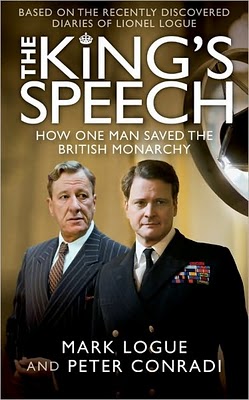
After watching the film, I came across the book. Yes, there’s a book called The King’s Speech: How One Man Saved The British Monarchy, written by Mark Logue and Peter Conradi. Mark Logue is the son of Lionel’s youngest child, Anthony. He is custodian of the Logue Archive. Conradi is an author and journalist.

The book is based on a treasure trove of family papers and diaries, letters between the King and Logue, and Lionel’s own notes on the therapy sessions, as well as photos, an invaluable source of background information for the film and a bridge of events therein. Mark Logue acted as the Logue Family Consultant for the production.

Overall, the film follows closely the facts found in Logue’s book when depicting the relationship of Logue and Bertie. Here are some facts:

It was to prepare for his Australian tour in 1927 that Bertie first went to Logue for help. The high point of the six-month world tour would be to open the new Commonwealth Parliament House in Canberra. Bertie diligently went to every appointment and practiced everyday the exercises assigned by Logue. Just between October 1926 to December 1927, the two had had eighty-two sessions.  Many more would follow in the years ahead.

Here are some quotes from several who had contact with the pre-therapy Bertie. As a navel cadet, Bertie, or Johnson to secure secrecy as mentioned in the film, was ‘plagued by shyness’. Here’s an account:

One, Lieutenant F. J. Lambert, described the Prince as a ‘small’ red-faced youth with a stutter’, and adding ‘when he reported his boat to me he gave a sort of stutter and an explosion. I had no idea who he was and very nearly cursed him for spluttering at me.’ Another, Sub Lieutenant Hamilton, wrote of his charge: ‘Johnson is very well full of young life and gladness, but I can’t get a word out of him.’ (p. 55)

And the Duchess of York had her share of distress. Helena Bonham Carter had portrayed vividly scenes such as this:

According to one contemporary account, whenever he rose from the table to respond to a toast, she would grip the edge of the table until her knuckles were white for fear he would stutter and be unable to get a word out.  This also further contributed to his nervousness which, in turn, led to outbursts of temper that only his wife was able to still. (p. 60)

And the disastrous Wembley speech at the beginning of the movie is a painful fact, an event witnessed by Logue and his son Laurie, who were among the spectators coincidentally. The closing ceremony of the Empire Exhibition in May 1925 was a live broadcast around the world. Before the event, Bertie wrote to the King his father apologetically:

I do hope I shall do it well. But I shall be very frightened as you have never heard me speak & the loudspeakers are apt to put one off as well. So I hope you will understand that I am bound to be more nervous than I usually am (p. 61)

The humiliation after that we can all see from Colin Firth’s realistic enactment. Here’s how the father put it, more generously than his usual harsher dealing with his son, nonetheless still biting:

Bertie got through his speech all right, but there were some long pauses. (p. 61)

Further, Bertie’s ill health and an operation on his ulcer had contributed to his physical and psychological torments for years to come. Logue knew it was a complex case and not merely simple speech impediment.

Bertie had problems pronouncing words beginning with ‘k’, ‘g’ or with repeated consonants. Logue’s system was to go through every one of the King’s speeches and if possible, replacing those with some other words.  He would then:

mark up the text with suggested breathing points, and the King would start practising, again and again, until he got it right — often becoming extremely frustrated in the process.

By the time of his Coronation in May 1937, King George VI had greatly improved. All the war time speeches were evidence of the benefits of Logue’s therapy. I mention this just to quench the query of some who might think that the film had grossly exaggerated the speech impediment.

Actually, the King had delivered many speeches, and for everyone of them except those overseas, Logue was beside him, giving valuable support and pointers. To the credit of screenwriter Seidler, only three occasions are highlighted: The Wembley Empire Exhibition, the coronation preparation and the call to war, from which the film title aptly derived. Here I can see the choice of a writer skillful at his craft. As always, there is much more information out there that the sheer volume could clog, drag or smother. Seidler has wisely sifted and chosen the pivotal moments and built his script around them. As a result, we have fluency and the economy of words, or word pictures in this case.

Here’s a must-see BBC news clipof an interview with David Seidler, in which we can get a glimpse of an actual recording of KGVI pausing during his speech.

Lionel George Logue was born on February 26, 1880, in Adelaide, South Australia. His grandfather came to settle in Adelaide from Dublin, Ireland, in 1850, and opened up Logue’s Brewery. Since childhood, Lionel had been a prize-winner in elocution and excelled in ‘recitals’, the recitations of literary passages, a “popular form of entertainment in an era before television, radio or the cinema.”

Lionel, his wife Mertyle and their three boys Laurie, Valentine, and Anthony moved to England in February, 1924 after forty-one days at sea. First settled in modest lodgings, Lionel soon leased a place to begin his speech therapy consultation in 146 Harley Street, an address synonymous with medicine. However, it was still a major social and class barrier to overcome for the Duke of York to personally go over there for his treatment sessions:

Gernerally speaking, the lower the number and further south towads Cavendish Square, the more prestigious the address. Logue’s building was right up towards its northern end… (p.39)

Lionel’s wife, Mertyl Gruenert, had an ‘imposing’ physique and was several inches taller than Lionel. She was German. As the children grew up in England, they had all involved in the war effort, Laurie and Tony having served in the British army over in Africa. Now to those who challenge that German music is used in the climatic call to war speech and its subsequent scene, they could just as well say the Logue children fought against their mother’s countrymen. Nationalities diminish when the overall picture is one of atrocity and aggression.

And lastly, a fact that can be turned into fiction: Logue’s method remains a mystery.  He had left no notes as to what exactly went on during his therapy sessions with Bertie. Such missing data have proven to be advantageous to Seidler, who has taken the liberty to create some lively montage in the film. Thanks to the lack of fact, we are entertained.

And, here’s one of the possible secrets: Logue’s tongue twisters. The next time you prepare for a public speaking engagement, warm up with this one:

“She sifted seven thick-stalked thistles through a strong thick sieve.”

***

The King’s Speech: How One Man Saved The British Monarchy by Mark Logue and Peter Conradi, published by Penguin Canada, 2010, 242 pages.

To read my review of the movie The King’s Speech, CLICK HERE.

To read my post Oscar Winners 2011 CLICK HERE.

CLICK HERE to view CBS 60 Minutes Overtime’s The Hidden Letters Behind “The King’s Speech”: Interview with Mark Logue and Colin Firth on the Logue Archive: the actual King’s Speech on Buckingham Palace letterhead, with Logue’s markings, handwritten letters between the King and Logue, and other personal papers and photos.

CLICK HERE to view CBS 60 Minutes’ The Story Behind “The King’s Speech”: Interview with Colin Firth, including his hometown in Hampshire, his career, his portrayal of KGVI, Geoffrey Rush, and the possible Oscar.

Remembering John Barry this Valentine’s Day

To me, John Barry (Nov. 3, 1933 – Jan. 30, 2011) would always be the romantic of screen music.

As a youngster, I was thrilled by the iconic theme and melodies from all the James Bond movies, unaware of the name John Barry, the composer. I had seen them all, beginning with “Dr. No”, “From Russia With Love”, “Goldfinger”, “Thunderball”, “You Only Live Twice”…  knowing only one name: Sean Connery.  I did not care to find out more about the creator behind the music which had invigorated a youngster’s fantasy, that of the urbane spy hero, gadget-savvy, resourceful, adroit and indomitable, the romance of a childhood.

And then there was the wild world of nature, and the romance against its backdrop to run free and uninhibited. Again, John Barry’s screen score and Don Black’s lyrics had enriched a young heart with the ideal of freedom and beauty, and instilled the notion that “life is worth living, but only worth living ’cause you’re born free”.  I was oblivious to John Barry’s winning two Oscars with his music for “Born Free” (1966).  To me, what was important was to see the lion Elsa being set free into the wild to go back to her real home.

Years later, as the child grew up to become the ever steadfast romantic, I was again mesmerized by John Barry’s melodies set to some most memorable cinematic renderings, utterly enthralled by the simple melodic lines from “Somewhere In Time” (1980). Christopher Reeve and Jane Seymour brought out the most heart-wrenching scenario of unrequited love. CLICK HERE to listen and watch on YouTube.

Again a few years later, there emerged the deep yearning and expansive orchestral score from “Out Of Africa” (1985). Another pair of star-crossed lovers entered the romantic landscape. Robert Redford and Meryl Streep poignantly portrayed the auto-biographical sketch of Danish writer Isak Dinesen (Karen Blixen). John Barry won another Oscar.  CLICK HERE to watch and listen on YouTube.

Fast forward some more, the sweeping orchestration of “Dances With Wolves” (1990) with Kevin Costner’s epic cinematic depiction of the Sioux nation presented another frame of romantic offering: a people striving to defend their raison d’être, and a man clinging to his own ideals.  John Barry’s musical creation had done it again, capturing another Oscar.  CLICK HERE to watch and listen on YouTube.

There are many more works by Barry, who at the end of a career that spanned almost 50 years, had garnered 5 Oscars and many other accolades.  Some other acclaimed film scores include Best Music Oscar for “The Lion In Winter” (1968), Best Music Oscar nomination for “Chaplin” (1992) and “Mary Queen of Scots” (1971). Still others include “Zulu” (1964), “Midnight Cowboy” (1969), “Walkabout” (1971), “King Kong” (1976), “Body Heat” (1981), “Jagged Edge” (1985)…

This Valentine, I remember John Barry as a romantic. I lament the passing of another figure among a generation of artists who worked with genuine talents and old-school creativity without massive hi-tech glamour. This Valentine, I remember also Sydney Pollack (1934-2008) and Anthony Minghella (1954-2008).

***

Somewhere (2010)… or Nowhere

I collected a few thoughts on screenwriting, or fiction writing in general, from watching Sofia Coppola’s “Somewhere” (2010).

The film was winner of the Golden Lion at Venice Film Festival last year in the ‘Emerging Film’ category.  As daughter of Francis Ford Coppola, Sofia Coppola must have breathed films from birth.  She is also an Oscar winner for Best Original Screenplay with “Lost In Translation” (2003), which also brought her an Oscar nom in the Best Director and Best Picture categories.

While I had enjoyed her “Lost In Translation”, a sensitive, existential rendering framed in the context of cultural cacophonies, I sat through “Somewhere” feeling detached and unmoved. But I did make some mental notes on how to write better… especially when I compared it with another film depicting a similar theme, Mike Leigh’s “Another Year“.

I’ve appreciated the overriding intent of “Somewhere”, the portrayal of a pointless life in the midst of Hollywood stardom. Behind the façade of glamour is a sad man, failed in his marriage, aimless, smothered with ennui. The setting of the film is significant too. From the movie poster we see the iconic Hollywood hotel Chateau Marmont, a historic landmark that’s synonymous with fame and celebrity. That is where our protagonist, actor Johnny Marco lives, at the moment.


So here are some mental notes I made on writing while watching “Somewhere”:

1.  We all know it: Show, not tell. But too much showing can be force feeding.

Case in point: The film starts off with the sound of a car engine revving, then we see a black Ferrari come on screen from the left, circling round and go off screen.  We wait for it to come back, then go round and offscreen again. This goes on for, I forgot to count, maybe four times. Then it stops, and a man gets out.  We later find out he is the main character, Johnny Marco (Stephen Dorff).  Got it… his life is going in circles, heading nowhere.

But just to confirm that we are on the right track, we’re shown some more.  We see Johnny Marco so drunk he falls down the stairs and breaks his arm.  We see him lying in bed watching exotic dancers performing in front of him, only to fall asleep before they finish their routine. We are shown again another time, another pair of exotic dancers in his room, this time he gives a bored little clap. We see him womanizing, partying, driving his Ferrari aimlessly on the road. We see him being ushered to promo sessions and photo shoots, in unfeeling mode, and answer questions from the press.  And as if not enough pounding, we hear a reporter asking the explicit question, which by now has become so contrived: ‘Who is Johnny Marco?’

This is not just the first 30 minutes to set up the mood and character, this is throughout the film.  So I noted: once you’ve got your point across, move on.

2.  Stir up empathy, not inflict vicarious suffering.  You don’t have to drag your audience to the level of boredom to depict boredom. Like, we don’t have to be turned into stutterers before we can appreciate the struggles of a stammering king.  There is a scene where Johnny has to sit down and have his face plastered with goo to make a mold of an old man. We see him plastered bit by bit until his head is covered with goo.  The static camera then stays on this plastered head, as we wait with him for the goo to dry.  Lucky we are spared after a minute and a half.  I appreciate the long take if it conveys meaning in an aesthetically pleasing way, but here it is almost didactic in its expression of tedium and ennui.

3. Bring up a contrast. Yes, in this case, Johnny Marco’s 11-year-old daughter Cleo (Elle Fanning) is a perfect foil.  Staying with her father for a short while before going to summer camp, Cleo’s life is nothing short of wholesome. She is angelic in her innocence and beauty; in contrast to her Dad, she is happy and purposeful. She figure skates, plays tennis, swims, cooks, does Sudoku, plays Guitar Hero and Wii with youthful vitality.  Johnny is mesmerized. Despite a failed marriage, Cleo is the best thing that happens in his life… and in the film as well.

4. Put the character in the context of a story, even though it is just a character study or that it is static. For the viewers to appreciate the character on a deeper level, they must see the person in various predicaments, which are missing here.  Without a story as vehicle, we only see a two dimensional character.  I thought of Mary (Lesley Manville) in “Another Year”.  Very similar to Johnny here, Mary is a sad and utterly despondent character.  Also, like Johnny, she is going nowhere even at the end, where she is spiralling further down the hole of loneliness.  Not unlike Johnny here.  Yet I found “Another Year” appealing because the other significant characters continue to show us their life story. The foil there is Tom (Jim Broadbent) and Gerri (Ruth Sheen). Through the four seasons, we see how they treat each other and deal with life, and relationships are being depicted. It is still a character study with no major dramatic climax, yet the film can hold my interest because I am watching Mary through the frame of Tom and Gerri’s story.

5.  Throw in a dash of humor, even though especially when your character is in utter sadness.  Unlike “Lost In Translation”, “Somewhere” is almost devoid of humor. A laugh or two is probably the fastest way to dissolve the audience’s aloofness. Back to “Another Year”, Mary is not a lovable character. She is delusional, dependent, aimless and weak.  As audience, we are impatient with her unhappiness, because we feel she is solely responsible for her plight. But humor disarms our critical stance and gently prods us to sympathize her.  Her character does not change and become loveable at the end, but we learn to be more gracious and give her some allowance.  We find that it is not so static after all, for we the audience, unknowingly, have been changed.

~ ~ 1/2 Ripples

***

CLICK HERE to read my review of Another Year.

CLICK HERE to read my review of The King’s Speech.


Big Movies, small films

‘Big’ and ‘small’ are relative terms.

According to Box Office Mojo, the production budgets for this year’s Oscar Best Picture nominees are as follows (in million of dollars):

Toy Story 3:  200

Inception:  160

The Social Network:  40

True Grit:  38

The Fighter:  25

127 Hours:  18

The King’s Speech:  15

The Black Swan:   13

The Kids Are All Right:  4

Winter’s Bone:  2

Strange that we call some motion pictures ‘movies’, and others ‘films’.  Other than the generic meaning which is used interchangeably, they sometimes denote certain inherent differences. The money that goes into making them just might be a factor: The higher the cost, the more likely it’s a movie… the lower, a film.  A movie is likely a Hollywood studio production, with better-known stars, big budget marketing, and aims at popularity among a wider spectrum of viewers.  A film is more or less associated with indie, art-house, and caters to a much smaller range of audience.

Such was the dichotomy between last year’s Oscars’ David and Goliath scenario: Avatar and The Hurt Locker.  And I was glad to see the little guy win.

But this year is a bit different.  Many of the Best Picture nominees are small budget productions.  They draw big buzz because of the pictures themselves, the quality of their productions, their subject matter, and the characters that drive the story.  They all depict little persons achieving big, however reluctantly.

Here’s a small glimpse of what’s big in some of these stories:

127 Hours:  The real life, harrowing ordeal of Aron Ralston, who is caught in a small crack of a big boulder and how he used a penknife to cut his arm off to free himself.  James Franco nominated for Best Actor.

True Grit:  A small, 14 year-old girl by sheer guts and determination, ventures out in the big, wild West to seek justice for her father’s death. Newcomer Hailee Steinfeld nominated for Best Supporting Actress.

Winter’s Bone: A teenaged Ozark Mountain girl trying to keep her family intact in utter poverty, and save the shack they call home by finding her father who has fled bail for drug dealing, an act that threatens the big crystal meth economy of the area. 20 year-old Jennifer Lawrence nominated for Best Actress.

The Fighter:  A down and out boxer with a small name like Micky Ward from a dysfunctional home in a drug-infested neighbourhood bounces back to win the WBU champion.

The Social Network:  A college student called Mark Zuckerberg in his little dorm room launching a big business by changing the way people in the whole wide world connect and socialize. Jesse Eisenberg nominated for Best Actor.

The King’s Speech:  A big role of a king being filled by a small, shy man hampered by a debilitating stammer big as cancer.  It could be all psychological, sure, that’s why it’s insurmountable… and overcoming it takes big courage.  Colin Firth nominated for Best Actor.

A small person overcoming big obstacles one small step at a time always makes a good story. It is so with the little character, true also with the little film.

Oscar Nominations 2011

Here are the ten movies you might like to watch before the 83rd Academy Awards on Feb. 27:

Best Picture Nominees:

  • Black Swan
  • The Fighter
  • Inception
  • The Kids Are All Right
  • The King’s Speech
  • 127 Hours
  • The Social Network
  • Toy Story 3
  • True Grit
  • Winter’s Bone

For a complete list of nominees and to watch the announcement from this morning in case you missed it at 5:30 am (PT) or 8:30 am (ET), CLICK HERE.

The nominations count are as follows: King’s Speech = 12, True Grit = 10, Social Network = 8, Inception = 8, The Fighter = 7, 127 Hours = 6

The King leads the pack.  A royal flush they say, hope that’s the hand on Oscar night.  Colin Firth, Helena Bonham Carter, Geoffrey Rush, and director Tom Hooper all get nods. Other categories include Art Direction, Cinematography, Costume Design, Editing, Original Score, Sound Mixing, Screenplay.  To read my review of The King’s Speech, CLICK HERE.

The surprise here is True Grit.  The Coen brothers’ film got snubbed at the Golden Globes and comes back with a vengeance.  Two years in a row they get the nod for Best Picture, after last year’s A Serious Man (my review here).   True Grit is a remake of the 1969 Western for which John Wayne got his Oscar.  Here we have a distinct Coen style film with smart dialogues and great acting.  “Nothing is free except the grace of God,” the beginning voice-over says, matched with the tune of the old hymn ‘Leaning on the Ever Lasting Arms’… I was amused to see how these two notions echo at the end of the film. At 13, Hailee Steinfeld beat out 15,000 other girls in the audition to get the role of tough and articulate Mattie Ross, seeking justice for her daddy’s death.  Now one year later, she has landed at the Oscars. Amazing. Also, Jeff Bridges gets the nom again, after snatching the Best Actor Oscar from Colin Firth last year.  It’s interesting to note that, while Colin Firth can act with half a voice, Jeff Bridges here shows us he can act with just one eye.

I’m excited to see Mike Leigh finally getting recognition for his poignant original screenplay for Another Year.  Unfortunately, the film does not get any more Oscar nods.  Veteran British actors Jim Broadbent, Ruth Sheen, and Lesley Manville give a performance of deep resonance.  Lesley Manville is no less deserving than anyone on the list of Best Actress nominees.  This is one of the most neglected movies of 2010.  I saw it at the Calgary Film Festivals last year.  I know some cities are just showing it now. Don’t miss it.  CLICK HERE to read my review.

Toy Story 3.  The animated feature that gets into the major league, following the only two other animations ever to be nominated in a Best Motion Picture category, Up (2009) and Beauty and the Beast (1991).  The theme of growing up and parting with your beloved and familiar finds its way into a touching animation that may well appeal to parents more than kids.  The idea of a child leaving home for college has been used in several movies in recent years, most notably, The Blind Side (2009) and The Kids Are All Right (2010).  I’ve watched all of this year’s ten Best Picture nominees. But, don’t laugh, Toy Story 3 was the only time I’d shed a few tears.

For Best Documentary Feature, I’m glad to see our notorious graffiti artist Banksy’s film Exit Through the Gift Shop has not evaded the Academy.  To read my review CLICK HERE.

The Academy Awards will take place on Sunday, Feb. 27.  This time Anne Hathaway and James Franco (a Best Actor nominee himself for 127 Hours), the youngest of Oscar hosts, are set to offer a fresh new look.  Hathaway had proven her versatility dancing and singing with Hugh Jackman two Oscars ago, and Franco has been hailed as the new Renaissance Man…  Just hope they will live up to expectations.

Austen Inspired Acceptance Speech

2011 is the 200th anniversary of the publication of Jane Austen’s Sense And Sensibility, her first published novel.  And since we are in the midst of Awards Season, inundated (or soon to be) with speeches, I’d like to join these two occasions and celebrate both Austen and fine speeches.

The 1995 film adaptation of Sense and Sensibility had received numerous awards, most notably accolades for Emma Thompson’s screenplay, which had garnered the Golden Globe, BAFTA, and ultimately, the Oscar. I have posted this before a few years ago, but think it is high time we read or reread Austen’s wonderful novel and be entertained again by the very talented Emma Thompson.

Also, I’m sure you would love to read a transcript of it, one of the most unique awards acceptance speeches of some time. Since the event occurred some fifteen years ago, I have taken the liberty to annotate (in parentheses) and format it in a way to enhance your reading pleasure.

Here it is, Emma Thompson’s Acceptance Speech at the 53rd Golden Globe, 1996, for Best Adapted Screenplay, Sense And Sensibility:

“I can’t thank you enough, Hollywood Foreign Press, for honouring me in this capacity.  I don’t wish to burden you with my debts, which are heavy and numerous, but I think that everybody involved in the making of this film knows that we owe all our pride and all our joy to the genius of Jane Austen.  And, it occurred to me to wonder how she would react to an evening like this.  This is what I came up with:

Four A.M.   Having just returned from an evening at the Golden Spheres, which despite the inconveniences of heat, noise and overcrowding, was not without its pleasures.  Thankfully, there were no dogs and no children.  The gowns were middling.  There was a good deal of shouting and behaviour verging on the profligate, however, people were very free with their compliments and I made several new acquaintances.

  • Miss Lindsay Doran (producer), of Mirage, wherever that might be, who is largely responsible for my presence here, an enchanting companion about whom too much good cannot be said.
  • Mr. Ang Lee (director), of foreign extraction, who most unexpectedly appeared to understand me better than I understand myself.
  • Mr. James Schamus (co-produceer), a copiously erudite gentleman, and
  • Miss Kate Winslet (role of Marianne Dashwood) , beautiful in both countenance and spirit.
  • Mr. Pat Doyle, a composer and a Scot, who displayed the kind of wild behaviour one has learnt to expect from that race.
  • Mr. Mark Canton, an energetic person with a ready smile who, as I understand it, owes me a vast deal of money.
  • Miss Lisa Henson — a lovely girl, and
  • Mr. Gareth Wigan — a lovely boy.

I attempted to converse with Mr. Sydney Pollack (executive producer), but his charms and wisdom are so generally pleasing that it proved impossible to get within ten feet of him.  The room was full of interesting activity until eleven P.M. when it emptied rather suddenly.  The lateness of the hour is due therefore not to the dance, but to the waiting, in a long line for a horseless carriage of unconscionable size. The modern world has clearly done nothing for transport.

P.S. Managed to avoid the hoyden Emily Tomkins who has purloined my creation and added things of her own.  Nefarious creature.

With gratitude and apologies to Miss Austen, thank you.”

***

Transcript of Emma Thompson’s speech taken from the book The Sense And Sensibility Screenplay & Diaries by Emma Thompson, published by Newmarket, 2007.

Note here on the back of the cover page these words:

ACKNOWLEDGEMENTS

“I should like to acknowledge the profoundest debt for my having developed any sense of humour to Jane Austen, Monty Python and The Magic Roundabout


The Golden Globe Speeches

While I was all eager to watch the 68th Annual Golden Globes last night, I was feeling bored from the beginning, after the first award of Best Supporting Actor was handed out. With Geoffrey Rush (The King’s speech therapist) losing the award, I will always miss the acceptance speech from him. I’m sure he had prepared something brilliant and witty to say. That would be the speech I had hoped for, but now, will never get to hear.

Most of the speeches last night were banal and uninspiring, exceptions were few. Even Robert De Niro’s for winning the Cecil B. DeMille Lifetime Achievement Award was lacklustre.  What sounded like self-deprecating humor could well have de-mythicized the acting profession and brought it down to the level of just another job to feed the kids.

Annette Bening had a sweet ending to her acceptance speech for Best Actress, comedy or musical, for The Kids Are All Right. After thanking the cast, she acknowledged “the 1962 winner of the Golden Globes for Most Promising Actor, my husband Warren Beatty.” They looked wonderful together, after all these years.

Canadian viewers must be delighted to hear Paul Giamatti, Best Actor, comedy or musical for Barney’s Version, as he acknowledged Canadian author Mordecai Richler and his family, and the film’s shooting location “up in an incredible, beautiful city, Montreal, which I dream about, an incredible place in a great nation, Canada. I salute the great nation of Canada.”

The audience stood and cheered as Michael Douglas came on stage at the end, making his first public appearance in Hollywood after receiving treatments for throat cancer: “That’s got to be an easier way to get a standing ovation,”  he quipped.  He presented the Best Movie Award to The Social Network, which won four Golden Globes last night.

.

.

The best speech of the night came from Colin Firth. Just like his role in The King’s Speech, reflecting his persona and style, his speech was an exemplar of finesse and character.

Here is Colin Firth’s acceptance speech for Best Actor, Drama, for The King’s Speech:

“Getting through the mid stage of your life with your dignity and judgement in tact can be somewhat precarious and sometimes all you need is a bit of gentle reassurance to keep on track. I don’t know if this qualifies as gentle reassurance, but right now this is all that stands between me and a Harley Davidson. I owe a very great debt to my supernaturally talented fellow cast members, my exquisite no-nonsense Queen, Helena and my wayward Royal older brother Guy [Pierce]. Geoffrey Rush and Tom Hooper, my two other sides of a surprisingly robust triangle of man love, somehow moved forward in perfect formation for the last year and a half or so… Tom with his scorching intelligence and Geoffrey who has now become my true friend and geisha girl. David Seidler, I know something of what you went through to create this…. at a time in my life when I truly appreciate the value of longevity in my relationships, Harvey Weinstein has made an improbably number of good films. We have had 20 years together, which is not bad going for a showbiz marriage. Thank you, Harvey. But the very best thing of all has been Livia [his wife] and all the beautiful things she’s given me and I think I can cope with just about any age as long as I can still see her.”

Who can be more deserving to win?

***

For a full list of Golden Globes nominees and winners, CLICK HERE to the official Golden Globe Site of the Hollywood Foreign Press Association.

To read my review of The King’s Speech, CLICK HERE.

Colin Firth’s Speech quoted from The Telegraph.

Photo source: The Telegraph http://www.telegraph.co.uk/culture/film/film-news/8260914/Golden-Globes-2011-Colin-Firth-wins-Best-Actor-as-The-Social-Network-takes-four-awards.html


More Gifts … Books and Movies

Continue from last post… succumbing to the Boxing Day craze.

Other than the art calendars, I found these bargains, books that kick off my 2011 reading plan and some DVD’s at very collectible prices:

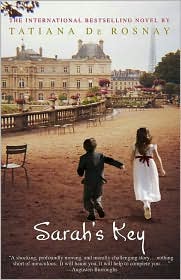
Sarah’s Key by Tatiana De Rosnay

Already made into a movie (Elle s’appelait Sarah by French director Gilles Paquet-Brenner) premiered at Cannes and TIFF last year.  A journalist discovering a holocaust story about a ten year-old Jewish girl who tried to save her younger brother from the police by locking him in a cupboard.  The key will play a major part in a moral dilemma.  This much I know and it’s already captivating, especially with Kristin Scott Thomas playing the role as the journalist in the film.


The Finkler Question by Howard Jacobson

The winner of the 2010 Man Booker Prize.  Here’s the description from the Man Booker’s official site: “a scorching story of friendship and loss, exclusion and belonging, and of the wisdom and humanity of maturity. Funny, furious, unflinching, this extraordinary novel shows one of our finest writers at his brilliant best.”  I’ve enjoyed reading some of the past winners and look forward to this one.


Extremely Loud & Incredibly Close by Jonathan Safran Foer

I got this over the holidays and have already finished reading it.  I have mixed feelings about it. The 9/11 story from the POV of a 9 year-old boy is poignant, and the way JSF presents and illustrates (the visuals) it is a new reading experience for me.  A movie is in the works with Tom Hanks and Sandra Bullock co-starring.  Mmm…


Music of Chance by Paul Auster

I have quickly devoured this one over the holidays together with the turkey.  The reason I was looking for this book is because of the movie.  I first saw the film adaptation a few years back and it stirred in me an unsettling resonance beyond words.  It’s a modern day Sisyphus story pitting man against chance, absurdity, and himself.  You must read it and then see the film, which unfortunately, is so overlooked that you’ll have a hard time finding it. But it deserves high acclaim, especially the performance by James Spader.  The film is also one of the best ‘Book Into Movie” adaptations I’ve seen.


In Search of Lost Time (Vol. 1) Swann’s Way by Marcel Proust

Translated by Moncrieff and Kilmartin.  I know many of you have read Proust and some may be Proust scholars, let me know what you think.  As for me, its attraction is simple.  How can you resist a beautiful Modern Library Classic edition with such an appealing cover?  It’s comforting just to see and touch it.  I’ve downloaded an e version into my Stanza app some time ago, but could never get into it by reading it on my iPhone.


The Early Work Of Philip K. Dick, (Vol. 1): The Variable Man And Other Stories

The main reason I got this, yes, it’s also a bargain at $5, hardcover… but the main reason is it contains a story I was looking for: ‘The Adjustment Team’, which is an upcoming movie (with Matt Damon and Emily Blunt).  I’m not a Sci-fi fan, but did enjoy some of Dick’s works adapted into films, like Minority Report (2002).  Others including Blade Runner (1982) and Total Recall (1990) are all ‘classics’ now in the Sci-fi film genre.


And some very collectible DVD’s:

When Harry Met Sally


I finished Nora Ephron’s I Remember Nothing and Other Reflections not too long ago.  It’s a revealing and amusing memoir.  That’s what prompted me to grab this DVD when I browsed the 50% off table at Chapters (Canada’s equivalent of Barnes & Nobles), about $5.  When Harry Met Sally (1989) is Ephron’s breakout screenplay in the romantic comedy genre.  After that is history… Sleepless In Seattle (1993), You’ve Got Mail (1998), and most recently, Julie and Julia (2009).  But do you know she also wrote the screenplay for Silkwood?

Children of a Lesser God


This is probably one of the most forgotten films that deserves more mention.  There is inherent difficulty in the execution of a film where one of the two major characters is a deaf-mute.  But the relationship and the communication conflicts between Marlee Matlin as a student in a deaf school and William Hurt as a speech teacher just show how realistic these obstacles are.  Marlee Matlin won the Academy Award for Best Actress in 1987 for her role, not bad for a debut. Her affective performance was made even more poignant due to her real life impediment.  It has been decades now since I first saw it in the theatre. I was delighted to be able to find a copy to keep, $4.

Scorsese: The Martin Scorsese Film Collection


A classy box set of four films:

  • Raging Bull — Special 2 Discs Edition, lots of special features. Classic Scorsese that gave Robert De Niro the Oscar, plus seven noms for the film.
  • The Last Waltz — Bob Dylan, Eric Clapton, Neil Young, Joni Mitchell, Van Morrison, Neil Diamond, Emmylou Harris… this is rock history in film.
  • New York, New York — Liza Minnelli and Robert De Niro, a spectacle.
  • Boxcar Bertha — Barbara Hershey and David Carradine… historical too.

And the best is the price: I paid $10.

***


Now let me shift gear to the 68th Golden Globes this Sunday, January 16…