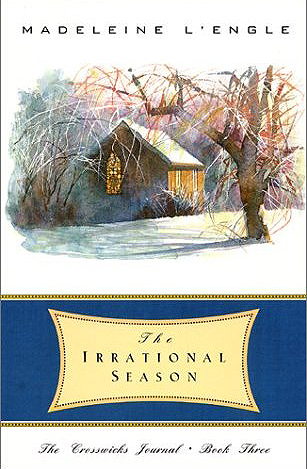
Reading The Season: The Irrational Season by Madeleine L’Engle

Striving to maintain some inner quiet, I casually took from the shelf a book by Madeleine L’Engle. Pure serendipity.  It’s one of The Crosswicks Journals, which I’ve shoved to the back of my mind for years, albeit they’ve been my all time favorite reads.  But how apt it is to flip through The Irrational Season, the third installment of The Crosswicks Journals, at this Christmas time.  Oh what joy to discover Madeleine L’Engle all over again.
Famous for her Newbery Award winning young adult novel A Wrinkle In Time, L’Engle was a prolific writer who had 63 publications to her credits.  Her works span from young adults to adults, fiction, science fiction, memoir, journals and poetry, with non-fiction books on faith, art, family, and humanity.  Yes, I say humanity, because L’Engle’s essays depict her strive to be human, and how her faith has defined the essence in her quest.

The Irrational Season comprises L’Engle’s ruminations on the significant events in the liturgical calendar.  And of course, it is Advent and Christmas that I dwell upon for my seasonal read.  This time, my reading has stirred in me a deeper appreciation of her insight and eloquence.

Art is for me the great integrater, and I understand Christianity as I understand art.  I understand Christmas as I understand Bach’s Sleepers Awake or Jesu, Joy of Man’s Desiring; as I understand Braque’s clowns, Blake’s poetry.  And I understand it when I am able to pray with the mind in the heart… I am joyfully able to affirm the irrationality of Christmas.

…  Christmas evoked in me that response with makes me continue to struggle to understand, with the mind in the heart, the love of God for his creation, a love which expressed itself in the Incarnation.  That tiny, helpless baby whose birth we honor contained the Power behind the universe, helpless, at the mercy of its own creation.

Cribb’d, cabined, and confined within the contours of a human infant.  The infinite defined by the finite?  The Creator of all life thirsty and abandoned?  Why would he do such a thing?  Aren’t there easier and better ways for God to redeem his fallen creatures?

And yet, in His most inscrutable, incomprehensible move, the One who called forth the universe from nothing, the Light and the Word, became flesh and drew near to us, to partake life as mortals knew it, and at the end, willingly go through an excruciating experience no mortals had ever known.  Impossible!  Utterly irrational!  And yet L’Engle embraces such an unimaginable scenario:

I live by the impossible… How dull the world would be if we limited ourselves to the possible.

And how grateful we ought to be, that such an accepting spirit pervaded in Mary’s heart and mind as well…

This is the irrational season
When love blooms bright and wild.
Had Mary been filled with reason
There’d had been no room for the child.

.
.

But now is the hour
When I remember
An infant’s power
On a cold December.
Midnight is dawning
And the birth of wonder.

*****

‘Reading The Season’ Posts over a Decade:

2020: Jack by Marilynne Robinson

2019: ‘A Hidden Life’ – A Film for the Season

2018: A Verse from Madeleine L’Engle’s The Irrational Season

2017: A Wrinkle in Time by Madeleine L’Engle

2016: Silence by Shusaku Endo

2015: The Book of Ruth

2014: Lila by Marilynne Robinson

2012: Surprised by Joy by C. S. Lewis

2011: Walking on Water by Madeleine L’Engle 

2010: A Widening Light by Luci Shaw

2009: The Irrational Season by Madeleine L’Engle

2008: The Bible and the New York Times by Fleming Rutledge 

2008: A Grief Observed by C. S. Lewis

*****

Photos: Except the book cover, all photos taken in Israel by Arti of Ripple Effects, November, 07. All Rights Reserved.
bird by bird

bird-by-bird

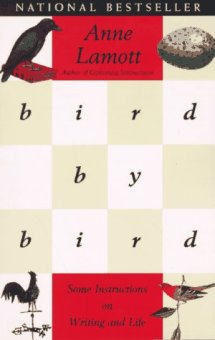
No, not another Twitter post… It’s the book by Anne Lamott.  Here’s what it’s all about:

“Thirty years ago my older brother, who was ten years old at the time, was trying to get a report on birds written that he’d had three months to write.  [It] was due the next day.  We were out at our family cabin in Bolinas, and he was at the kitchen table close to tears, surrounded by binder paper and pencils and unopened books on birds, immobilized by the hugeness of the task ahead.  Then my father sat down beside him, put his arm around my brother’s shoulder, and said, ‘Bird by bird, buddy.  Just take it bird by bird.’ ”

Bird by Bird: Some Instructions on Writing and Life by Anne Lamott

Bird by bird… three simple words from a writer father.  Lamott carries these words of wisdom with her as she makes her long journey of writing and life.  A past recipient of a Guggenheim, now a national bestselling author and writing instructor, Lamott in turn passes on practical advice to her readers and students.  In a writer’s symposium, it’s mentioned that The Modern Library calls her book Operating Instructions one of the most significant non-fiction work of the century.  Click here for the full hour interview.

Bird by bird is a book full of down-to-earth advice on writing and life from one who has gone through tough times.  Coming from the hippie culture, Lamott had to overcome years of drug addiction, alcoholism, and deal with eating disorder and the challenges of single parenthood.  I admire her resilience and perseverance.  Further, her ultimately finding redemption and had her life turned around was one amazing story.

I’ve enjoyed Lamott’s humour and her sensible instructions, although I admit I couldn’t fully embrace her style of word-use and the occasional trite statements. But the authenticity shines through.  You’re reading a writer who has gone through all these hurdles, not just in writing but in life, and speaking to you with genuine openness.  Her directions give you a kind of ‘eureka’ feeling: The sudden revealing of something that you thought you’ve found it for the first time.  But on second thought, it’s just that she has put it into words for you, you must have known it before, so common sense, so simple.

P1010143

Since I’ve been dwelling on quotes lately, I’ll just leave you with some of Lamott’s own words from her book.  They don’t all fit into a tweet, but just to point out that sometimes great thoughts take more than 140 characters to convey…. that’s why we have books.  But of course, you’ve known this all along.

Getting started:

The very first thing I tell my new students on the first day of a workshop is that good writing is about telling the truth.

Flannery O’Connor said that anyone who survived childhood has enough material to write for the rest of his or her life.

The problem that comes up over and over again is that these people want to be published.  They kind of want to write, but they really want to be published… Writing can give you what having a baby can give you: it can get you to start paying attention, can help you soften, can wake you up.  But publishing won’t do any of those things.

Short assignment:

E. L. Doctorow once said that “writing a novel is like driving a car at night.  You can see only as far as your headlights, but you can make the whole trip that way.”  … You just have to see two or three feet ahead of you.  This is right up there with the best advice about writing, or life, I have ever heard.

Character:

… a person’s faults are largely what make him or her likable… They shouldn’t be too perfect; perfect means shallow and unreal and fatally uninteresting.

Plot:

Plot grows out of character…. I say don’t worry about plot.  Worry about the characters.  Let what they say or do reveal who they are… The development of relationship creates plot.

Dialogue:

You listen to how people really talk, and then learn little by little to take someone’s five-minute speech and make it one sentence, without losing anything.

The Moral Point of View:

The word moral has such bad associations: with fundamentalism, stiff-necked preachers, priggishness.  We have to get past that… We like certain characters because they are good or decent–they internalize some decency in the world that makes them able to take a risk or make a sacrifice for someone else.  They let us see that there is in fact some sort of moral compass still at work here, and that we, too, could travel by this compass if we so choose.

A moral position is a passionate caring inside you… Some of us are interested in any light you might be able to shed on this, and we will pay a great deal extra if you can make us laugh about it.  For some of us, good books and beautiful writing are the ultimate solace, even more comforting than exquisite food.

Now here are some quotes you can send, tweet by tweet:

“If you’re not enough before the gold medal, you won’t be enough with it.” [quoting from the movie Cool Running]

Lighthouses don’t go running all over an island looking for boats to save; they just stand there shining.

Writing and reading decrease our sense of isolation. They deepen, widen, and expand our sense of life: they feed the soul.

*****

Bird by Bird: Some Instructions on Writing and Life by Anne Lamott, Anchor Books, NY, 1995, 238 pages.

If I Must Tweet

Don’t look for me on Facebook, I’m not there.  No Twitter account either.  But don’t mistake me for a Luddite, I have my iPhone as my defence… and the Apps for all the social networking sites ready to install.

Truth is, I have no need to lure a million followers.  If there isn’t such a phrase, let me coin it now: ‘Cyber Crowd Phobia’.  I think I have that… or ‘Cyber Agoraphobia’ will work too.  Why would I want to announce to the world what I have for breakfast?  No, I will not fall into the trap of offering free advertising for cereal companies.  Really, who’d care that I’m still having indigestion from last night’s chow mein?

Further, with the limit of just 140 characters to tweet, the message I send must be of prime importance, no verbiage whatsoever.  I can’t think of any such occasions where I need to reveal my predicament publicly except maybe in emergency situations like:

“Having a heart attack! Safeway check-out 5. Call 911!”

or this:

“AAAAARH! Chased by #zombie chickens! @oh dear, oh! Thanks!!”

Less than 60 characters, so I can call out twice.

Ok, seriously,  if I must tweet, I’d probably be tweeting quotes.

Quotes are one-liners, pearls of wisdom.  I know, I know… not all are pearls, but, gems can still be found.  And they fit right in the endurance level of Twitter.  Dense, sharp and swift, ideal for people on-the-go.

Thanks to Shoreacres, I’ve been thinking about quotable quotes after she left an ingenious one in her comment on my last post.  It speaks to those who fondly reminisce the good old days every time they watch the News on TV.  Here’s the line to ponder:

“Nostalgia is like a grammar lesson: you find the present tense, but the past perfect.”

Now, that gets me thinking about the future… simple quotes to tweet for all my followers.  A good quote for every hour of the day.

Let’s say, you’re struggling to get up in the morning, almost losing the battle.  Still lying in bed, you grab your iPhone and check your feeds. I have the best tweet for you, thanks to our modern sage, Woody Allen:

“80% of success is showing up.”

Hey, not bad for just 28 characters.  Showing up needs getting up… that’ll start your day.

Now you’re at the office, you just have a heated argument with your colleague.  As always, he’s wrong, and you’re  gravely mistreated.  But just at that moment, you stop and check your stream of tweets.  How timely,  there’s this piece of sound advice, yes, urging you in earnest from none other than Oscar Wilde himself:

“Always forgive your enemies, nothing annoys them so much.”

Ha… you win again.

Suddenly you hear your boss calling you.  Shucks!  You forgot all about the performance evaluation he wanted to discuss with you.  You start to panic, cold sweat, shortness of breath.  You instinctively get out your phone and check your tweets… Voila!  You’re in luck.  Here’s one just for you, from G.K. Chesterton, … no matter if you haven’t heard of him, just read this instant message:

“I believe in getting into hot water, it keeps you clean.”

Wonderful!  You’re all sweaty anyway.  Quotes on Twitter saves the day… again.

You get my idea… a timely tweet for every moment of your life.

I know how people love quotes.  The most viewed post on Ripple Effects is “Memorable Movie Love Quotes“.  That was for Valentine’s Day last year, now gathering more than 20,000 hits.  I still receive new ones every now and then from readers contributing to the list.

So this is my appeal to you all.  Send me your quotable quotes, 140 characters or less, so I can send them out should I open a Twitter account in the future.  Believe me, this could well be the most meaningful thing you do today, passing on words of wisdom.  And the world will thank you… some day.

National Poetry Month

April is National Poetry Month.  I’m glad we still celebrate poetry in this day of ephemeral twittering.  W. H. Auden once described poetry as “memorable speech”.  As millions upon millions join in on-line chats, exchanging the most trivial of their everyday life unreservedly, and even addictively all day long, how we need poetry all the more, to create lines that strive for some memorable quality worthy of keeping.

The late Canadian communication guru Marshall McLuhan was right, the medium is the message.   And such is the message of our time.  Mind you, I’m no Luddite, my iPhone is evidence.  I’ve gone through this before, so I’m not going to dwell on it here again.  It’s just that the rash and temporal nature of our medium, and mode, for that matter,  make me long for quality and permanence.

After posting an excerpt of  T.S. Eliot’s poetry in my last entry, I just didn’t have enough.  I re-read and explored more of his work and was amazed at how prophetic his vision was.  To celebrate National Poetry Month, here’s Arti’s selections of  lines from the work of T.S. Eliot, just for our post-modern, Facebook and Twitter generation.

nighthawk-by-edward-hopper

Twit twit twit

Jug jug “>jug jug jug jug jug

So rudely forc’d.

— The Waste Land (1922)


Teach us to care and not to care
Teach us to sit still.

— Ash Wednesday (1930)


There will be time, there will be time
To prepare a face to meet the faces that you meet;

….

Do I dare
Disturb the universe?
In a minute there is time
For decisions and revisions which a minute will reverse.

For I have known them all already, known them all: —
Have known the evenings, mornings, afternoons,
I have measured out my life with coffee spoons;

….

In the room the women come and go
Talking of Michelangelo.

— The Love Song of J. Alfred Prufrock (1915)


The endless cycle of idea and action,
Endless invention, endless experiment,
Brings knowledge of motion, but not of stillness;
Knowledge of speech, but not of silence;
Knowledge of words, and ignorance of The Word.

All our knowledge brings us nearer to our ignorance,
All our ignorance brings us nearer to death,
But nearness to death no nearer to God.
Where is the Life we have lost in living?
Where is the wisdom we have lost in knowledge?
Where is the knowledge we have lost in information?
The cycles of Heaven in twenty centuries
Brings us farther from God and nearer to the Dust.

— Choruses from The Rock (1934)


****

Visual: Nighthawks (1942) by Edward Hopper.  CLICK HERE FOR MORE EDWARD HOPPER.

Stream of Easter Consciousness

stained-glass-2a2So students are sent back to school this week, just in time for Easter.  Nobody wants to have a holiday right on Easter week, especially the public school board.  That’s how you survive,  by being politically correct.  And the last two weeks’ holiday is called Spring Break of course.   Easter has almost become a banned word, like Christmas.  Who wants to be rude and offend others, we’re Canadians after all.

I know,  it’s not totally a taboo yet.  It’s a much tamer word, Easter, than Christmas, just because it doesn’t have the six-lettered word in it.  You can curse with that name, but no, God forbid you should say it in a proper context.   I can see you sneer, what’s a proper context, you ask.  You’re right of course, no word or context is more proper than others, we’re egalitarians after all.  As for Easter, as long as it’s synonymous with eggs and bunnies, pastels and flowers then it’ll never die.  Who needs resurrections?

All Fridays are good.  They even have a whole restaurant chain commemorating the day.  What’s it called… yes,  T.G.I. Friday’s.  Who says we’re not religious, we thank God for happy hours.  We’re much more open-minded now,  more civilized, equal and fair, don’t want to pick one day to be better than the others.  But definitely we won’t forget Ramadan, or the Chinese New Year.

There’s probably no God,  so stop worrying and enjoy your life, the sign on the bus says.  So we’re safe?   Whew!  No God means we can now be happy, worry free, all life, no death, …  Umm just let me figure this one out.  Give me a minute, I’m just not as smart as them.

Jesus wept.  He wept at the graveside of Lazarus, brother of his dear friends Martha and Mary.  He wept at the fragility of life.  He wept at the searing pain of separation.  He wept at the hopeless and uncomprehending expression on Mary’s face, even after he said to her I am the resurrection and the life.

Fleming Rutledge said more than ten years ago:  “I am deeply convicted, more so each year, of the profound sinfulness of the human race.  Yet because of the Cross and Resurrection of Jesus Christ — because of that and nothing else, because of that and nothing less — I am also convicted of the truth of what the Bible tells us about God’s plan of salvation.  The rainbow bridge does not lead to Valhalla, where the gods quarrel so much that they destroy themselves.  The rainbow bridge leads to the Cross and to the empty tomb on Easter Day.”

Utterly politically incorrect!  Who uses the word sin anymore?  Who’s Fleming Rutledge, anyway.  Never heard of him.  No?  It’s a she?  No wonder.

Now these words echo loud and clear too, written by T. S. Eliot in… what, 1934?  Aren’t they a bit archaic now?  Or, maybe they’re really prophetic:

Where is the Life we have lost in living?
Where is the wisdom we have lost in knowledge?

Where is the knowledge we have lost in information?

The cycles of Heaven in twenty centuries

Bring us farther from God and nearer to the Dust.

We should go on living, be happy and worry-free, the sign on the bus says.

So we go on living…

and Jesus still weeps.

stained-glass-41

*****

Original photos and text copyright by Ripple Effects, https://rippleeffects.wordpress.com, April 2009.  All Rights Reserved.

No Texting for Lent and The End of Solitude

Roman Catholic Bishops in Italy have added some contemporary relevance in the fasting tradition during Lent:  High Tech Fast.  The faithful are urged to free themselves from the bondage of technology and gadgets, and refrain from surfing, emailing, twittering, texting … in order to prepare themselves for Easter.  This could prove to be a penance much harder to practice than not eating meat, even just on Fridays, for texting could well be the newest form of addiction today.

At about the same time, I heard an interview on the CBC Radio program Spark.  Host Nora Young conducted an interview with William Deresiewicz, literary critic and essayist, who has recently written an article entitled ‘The End of Solitude’.

Deresiewicz taught at Yale from 1998 to 2008.  When he asked his students what place solitude had in their lives, he got this reply: “Why would anyone want to be alone?”

With the ubiquitous use of high tech gadgets, and the torrents of Internet social networks around us, we are caught in a web of connectivity like never before:

Not long ago, it was easy to feel lonely.  Now, it is impossible to be alone.

Not only that, the goal now seems to be to gain as much self-exposure as possible, to be visible.  It seems that the number of friends we have on Facebook, and the number of hits on our blog directly leads to our self-esteem and our quality of self.  The irony is, the pseudo and the virtual are substituting the genuine and the authentic.

What does friendship mean when you have 532 “friends”?  How does it enhance my sense of closeness when my Facebook News Feed tells me that Sally Smith (whom I haven’t seen since high school, and wasn’t all that friendly with even then) ‘is making coffee and staring off into space’?

Deresiewicz notes that solitude used to be a desirable social value.  From religious sages to the Romantics like Wordsworth, solitude is the channel one hears the still, small voice of God, or heed the beckoning of Nature.  As modernism crept in,  the literati turned inward to find validation of self, like Woolf, Joyce, Proust.

Then came urbanization and suburbanization.  The generation that used to vegetate in front of the TV has given way to the child of the Internet, the networked self.  And we no longer believe in the solitary mind.

So what does it matter when we have lost the moments to be alone?  What have we lost?

First, the propensity for introspection, that examination of the self that the Puritans, and the Romantics, and the modernists (and Socrates, for that matter) placed at the center of spiritual life — of wisdom, of conduct.

Also, the urge to be instantly connected has bred a new generation of skippers and skimmers, replacing readers.

… five minutes on the same Web page is considered an eternity

No wonder we’re told to keep our blog posts short if we want to attract readership.

With the loss of the capacity for solitude, we’ve lost the ability to cultivate depth of self  and create independent thinking.  Emerson said that “Solitude is to genius the stern friend.”  Deresiewicz goes on to say:

…no real excellence, personal or social, artistic, philosophical, scientific or moral, can arise without solitude.

The irony is, the more we are connected with the virtual world out there, the less we are connected with ourselves inwardly.  But this is what’s valued nowadays, isn’t it, to be open, sociable, gregarious.  But to maintain a sense of authentic self, we may have to sacrifice popularity, to be not so polite:

Thoreau understood that securing one’s self-possession was worth a few wounded feelings.  He may have put his neighbors off, but at least he was sure of himself.

Those who would find solitude must not be afraid to stand alone.

Maybe this is one meaningful connection we should strive for: solitude, introspection, slow blogging, quality thinking, quality reading, quality writing, quality self.

****

Click here to listen to the full interview.

Click here to read the article ‘The End of Solitude’ by William Deresiewicz.

Click here to read my review of Sherry Turkle’s Alone Together

Click here to read my post on Virginia Woolf’s A Room of One’s Own in which she explored the privilege of Solitude.


Reading the Season: A Grief Observed by C. S. Lewis

c-s-lewis2To embrace the Christmas season in a more meaningful way, I’ve been trying to stay close to the heart of the matter by reading.

A Grief Observed by C. S. Lewis is one of my selections. Now, of all the wonderful books by the Oxford scholar, why would I choose this title for the Season?

From my reading of Joan Didion’s The year of Magical Thinking, I learned that during her mourning for the loss of her husband, she had read C. S. Lewis’ A Grief Observed. That sparked my curiosity. After finishing Didion, I turned right away to explore Lewis’s book about his own experience of loss.

After 58 years of bachelorhood, Lewis found the love of his life in Helen Joy Gresham, an American author who had come all the way to England in search of a genuine and credible faith. Their love story is poignantly portrayed in the movie Shadowlands (1993). In Helen Joy Gresham (‘H’ in the book),  Lewis found his equal in wit, intellect, and a faith that had endured testing and evolved from atheism to agnosticism and ultimately reaching irrevocable belief. Lewis entered into marriage with Joy at her hospital bed as she was fighting bone cancer. She did have a period of remission afterwards, during which the two enjoyed some traveling together. Regretfully, only four years into their marriage, Joy succumbed to her illness.

shadowlands

A Grief Observed is a courageous and honest disclosure of a very private pain. But what’s so different about this personal loss is that this prominent Christian apologist, acclaimed academic and writer, was willing to lay bare his questioning mind and disquiet heart to his readers. As his step-son Douglas Gresham wrote in the Introduction, the book is “a man emotionally naked in his own Gethsemane”. By crying out in anguish and exposing his torments, he shared his personal journey of painfully seeking the meaning of death, marriage, faith, and the nature of God. Lewis was brave enough to question “Where is God?” during his most desperate moments, when his heart was torn apart by searing pain and his intellect failed him with any rational answers.

Gradually he came out of despair realizing that the loudness of his screams might have drowned out the still, small voice speaking to him.

The time when there is nothing at all in your soul except a cry for help may be just the time when God can’t give it:  you are like the drowning man who can’t be helped because he clutches and grabs…

After all, you must have a capacity to receive, or even omnipotence can’t give.

After the fog of doubt has dispersed and the dust of despair has settled, Lewis saw the dawning of a gentle glimmer. He realized that he had been mourning a faint image or memory of his beloved, but not beholding the reality of her. The fickleness of his senses offered only fading fragments of her image. However, it is in praise that he could enjoy her the best.

I have discovered, passionate grief does not link us with the dead but cuts us off from them. This become clearer and clearer.  It is just at those moments when I feel least sorrow–getting into my morning bath is usually one of them–that H. rushes upon my mind in her full reality, her otherness.

Praise is the mode of love which always has some element of joy in it. Praise in due order; of Him as the giver, of her as the gift.

Further, as with God, he knew he should grasp the reality, not just the image.  He should treasure God Himself, not just the idea of Him:

I need Christ, not something that resembles Him.  I want H., not something that is like her.

Upon this revelation, Lewis powerfully points out that the Incarnation, the Word becoming flesh, is how God reveals Himself to us in His full reality.  Our ideas of God are shattered by Christ Himself.

The Incarnation… leaves all previous ideas of the Messiah in ruins.  And most are ‘offended’ by the iconoclasm; and blessed are those who are not.

As Christmas draws near, I ponder once again the humbling of the Creator God, born a babe to grow up to experience the full spectrum of being human, showing us by His life and death the reality of God, an iconoclastic act only He can perform.

Lewis has drawn me to the heart of the matter, the crux of the Season:

And the Word became flesh and dwelt among us, and we have seen his glory, glory as of the only Son from the Father, full of grace and truth.

— John 1:14

*****

‘Reading The Season’ Posts over a Decade:

2020: Jack by Marilynne Robinson

2019: ‘A Hidden Life’ – A Film for the Season

2018: A Verse from Madeleine L’Engle’s The Irrational Season

2017: A Wrinkle in Time by Madeleine L’Engle

2016: Silence by Shusaku Endo

2015: The Book of Ruth

2014: Lila by Marilynne Robinson

2012: Surprised by Joy by C. S. Lewis

2011: Walking on Water by Madeleine L’Engle 

2010: A Widening Light by Luci Shaw

2009: The Irrational Season by Madeleine L’Engle

2008: The Bible and the New York Times by Fleming Rutledge 

2008: A Grief Observed by C. S. Lewis

Two Guys Read Jane Austen: Again, the Gender Issue

two-guys-read-jane-austen 

Some guys would rather have jaw surgery than to read JA.  Steve Chandler could well have been one of them.  As an English major in college, now a successful writer in his sixties, Steve has miraculously managed to avoid reading JA all his life, until now.  On the other hand, his co-author Terrence N. Hill, an award-winning playwright and author, has read Pride and Prejudice three times, good man.  Prompted by their wives, Steve and Terry embarked on this new project in their “Two Guys” series, taking the risk of treading no man’s land.  However, considering their previous “Two Guys” titles, Two Guys Read Moby Dick and Two Guys Read the Obituaries, they are well-primed for this venture.

Thanks to blog reader Julie for sending me a copy of this book,  I’ve been thoroughly entertained.  Attaining to true Austenesque style, the two lifelong friends read two JA novels and wrote letters to each other about their thoughts over a six-month period. I must admit I’m surprised (sorry guys) at the incisive look and the fresh perspective they bring to the forefront.  Their sharp observations, humorous takes on many issues, their LOL commentaries on popular culture, and intelligent analysis on various topics make this a most gratifying read for both men and women, Janeites or would be’s.

Many do not want to read JA because they think she was just a 19th Century rural spinster awashed in naiveté, who had never heard of Napoleon or the war he was raging, ignorant about the slave trade from which England was benefiting, or couldn’t tell the difference between a country and a continent.  The most they might think of her is the mother of all modern day chick lit or the romance novel.  Well, these myths are all dispelled by two guys that have experienced Jane Austen first-hand, and lived to tell their discovery.

Here are some of their insights and words of wisdom as they read Pride and Prejudice and Mansfield Park.  I’m quoting directly from their letters to each other:

  • Jane’s got more adoring female fans than Brad Pitt, and my guess is they’re more intelligent too.
  • JA (through Elizabeth) is a witty, rebellious voice for intelligence and passion in the face of those stuffy British strictures.  I love this.  I love a woman (or a man, for that matter) who has no need to win anyone over.
  • Wasn’t Elizabeth Bennet heroic because she was such a totally self-responsible, proudly independent person?  Wasn’t Darcy the same?
  • I really enjoy how much you like Jane Austen, that you cry when reading her books, and that you can still be a man… A man not afraid of the feminine principle becomes even more of a man.
  • …elegantly cerebral.  But once you acclimate yourself to the flow of the language, it is addictive.  JA’s writing becomes more captivating with each new chapter because of how many layers of psychological posturing she strips away.
  • Men are often accused of putting their wives on a pedestal. Women build a pedestal and then spend their time trying to create something worthy of going on it.
  • I don’t think Austen ever gets proper credit for her role in the development of the comic novel.
  • Jane never attended school after the age of 11.  After that she was entirely self-taught…  S&S, P&P, NA, three of the greatest novels of all time–all written by 25.  Thinking of myself at that age.  If I had had time on my hands I could well imagine having written three novels… What I can’t imagine is that they would have been any good.  Ah, but then I had the disadvantage of an education.
  • The true measure of her characters is their hearts and minds.  What the movies cannot get to – or do justice to – is the intelligence.
  • What has excited Henry Crawford the most is Fanny’s inner strength.  On the surface she is delicate and demure.  But underneath she is power itself.  That’s what makes JA so great and so endearing.
  • Jane is all about principle.  Living true to your highest ideals, your highest self… she shows us there is a beauty to morality… there’s beauty in integrity!

Need I say more?

Two Guys Read Jane Austen by Steve Chandler and Terrence N. Hill, Robert D. Reed Publishers, Bandon OR.  2008, 126 pages.

*****

This article has been published in the Jane Austen Centre Online Magazine, where you can read more about Jane and the Regency Period.

Art Imitates Life, Life Imitates Art, or…

Neither. After reading Tomalin and Shields on the life of Jane Austen, I am inclined to draw that conclusion. The often sanguine outlook of Austen’s works is deceptive.  The seemingly jovial ending may lead some to assume they are reading the simplistic stories of a woman wrapped in romantic bliss all her life.

Reality is, that Austen could persevere, write and published is already an incredible achievement considering the confining social environment she was in. Instead of embracing the normative female role in comfort, she chose to trod the road less traveled to become a writer despite the gloomy prospect of poor spinsterhood,  enduring rejection even from her own mother. She wrote in secret and struggled in isolation. For a long period she battled depression. Upon her death, her beloved sister Cassandra could not attend her funeral because the presence of females at such events was not sanctioned, apparently for fear of any outbursts of emotion.

It is Austen’s imagination that empowers her to break free of her reality and to rise above her constraints. She has created her art from the palette of  the imaginary, as Tomalin has lucidly observed:

Hampshire is missing from the novels, and none of the Austens’ neighbours, exotic, wicked or merely amusing, makes recognizable appearance.  The world of her imagination was separate and distinct from the world she inhabited.

Austen’s contemporary, the renowned Gothic writer Ann Radcliffe, has attested that it is the imagination and not real-life experience which gives rise to story-telling. A scene in the movie Becoming Jane (2007) has vividly illustrated this point.

In the famous little book, The Educated Imagination, a must-read for any literature student, the late great Canadian literary critic Northrop Frye states that :

The world of literature is a world where there is no reality except that of the human imagination.

Austen has great proficiency in the language of imagination. In her novels, she has created a world that never was, but one that makes her readers yearn for. There is no Mr. Darcy in real life, or Elizabeth Bennet for that matter, but we could well use them as the ideal types to measure by, or, to strive for.

What about the satirist in Austen? How can the social critic be extracted from reality?  How can one write social commentaries devoid of real life input? Austen may have toiled in isolation for fear of social repercussion, she did not write in a vacuum.  While her art did not imitate her life, Austen had the chance to sharpen her observation from the very public sitting-room of her home and those of her relatives and friends, an opportunity that was conducive to her novel writing, as Virginia Woolf has pointed out.  Ever since her childhood, the Austen home was the hub of family readings and discussions.  Her brothers grew up to be men well versed in the fields of the military, clergy, and business.

In her ingenious way, by satirizing the things that ought not to be, Austen is bringing out the world that ought to be. In Frye’s words:

The fundamental job of the imagination in ordinary life, then, is to produce, out of the society we have to live in, a vision of the society we want to live in.

If art imitates life, it would be just a reproduction; if life imitates art, well… ours would be one very wacky world. But life could well be the reason for creating art, channeling our imagination to build a sublime vision of the ideal.

Visual: Starry Night by Vincent van Gogh

Update: This article has just been published in the Jane Austen Centre Online Magazine. Click here to go there for other interesting reads on Jane Austen and the Regency World.


*****


What was Jane Austen really like? Reading Tomalin and Shields

As a biographer, Tomalin’s account of Jane Austen’s life is meticulous and exhaustive.  Her analysis is critical and sharp, her writing style bold, precise and cutting.  The following excerpts are prime examples.

When speculating about the possible consequence of Mrs. Austen sending her infants away to be raised, Tomalin makes the following inference:

“The most striking aspect of Jane’s adult letters is their defensiveness.  They lack tenderness towards herself as much as towards others.  You are aware of the inner creature, deeply responsive and alive, but mostly you are faced with the hard shell; and sometimes a claw is put out, and a sharp nip is given to whatever offends.  They are the letters of someone who does not open her heart; and in the adult who avoids intimacy you sense the child who was uncertain where to expect love or to look for security, and armoured herself against rejection.”

Or this to say about mother and daughter:

Mrs. Austen had a sharp tongue for neighbours, appreciated by her daughter and passed on to her.”

Or, with the episode of Jane accepting and later recanting Harris Bigg-Wither’s marriage proposal, Tomalin’s view is clear:

We would naturally rather have Mansfield Park and Emma than the Bigg-Wither baby Jane Austen might have given the world, and who would almost certainly have prevented her from writing any further books.”

If you can appreciate such kind of abrasive commentaries, you would certainly find it entertaining to read Tomalin’s than an otherwise ordinary biographical sketch.  Ironically, I have a feeling that this is the kind of biographies Jane would have written if she could write without censure.

Putting her incisive analysis to good use, Tomalin explores Jane’s creative process, giving credits to her imaginative ingenuity.  The limitation of physical and social mobility render Jane’s world parochial, yet her characters and story lines are diverse and innovative.  Her writing are evidences of pure creative concoctions.

…essentially she is inventing, absorbed by the form and possibilities of the novel… The world of her imagination was separate and distinct from the world she inhabited.”

For Jane, it is imagination and not experience that has given her wings to soar outside of her bleak circumstances.  A vivid example is the writing of the sprightly Pride and Prejudice.  The novel was written during a time of family tragedy with the death of Cassandra’s fiancé Tom Fowle, and amidst Jane’s own disappointment with the evaporation of hope with Tom LeFroy.

All in all, Tomalin’s sharp and cutting writing style works towards Jane’s favour.  Her biography is resourceful and entertaining, her analysis incisive, and her conclusion moving.  Above all, Jane would have found it amusing and satisfying.

Jane Austen: A Life by Claire Tomalin, published by Penguin Books, 2000,  362 pages, including appendices, notes, bibliography, chart, and index.  Additional 16 pages of photos.

*****

Carol Shield’s Jane Austen is a succinct and gentler rendition of Jane’s life.  Shields and her daughter, the writer Anne Giardini, were presenters at the JASNA AGM in Richmond, Virginia in 1996.  This book came out five years after that.  Shields has crafted a highly readable literary gem, adorned by her lucid and flowing writing style.

As a novelist, Shields’ main thrust is to trace Jane’s development as a writer.  Exploring her family circumstances as she was growing up, Shields presents to us a gifted youth of exuberant spirit, one who had known the joy of theatrical performances and experienced the exhilarating power of humor.  Jane’s ingenuity lies in her parodies.  As a young contributor to her older brother James’ weekly magazine The Loiterer , she was already a skillful writer of satires.  Shield notes that:

“…it is the satirical form of her youthful writing that astonishes us today.  What makes a child of twelve or thirteen a satirist?

… Jane Austen had been nurtured, certainly, in a circle appreciative of burlesque… but she was also a small presence in a large and gifted household.  Her desire to claim the attention of her parents and siblings can be assumed.  She gave them what they wanted, that which would make them laugh and marvel aloud at her cleverness”

This yearning to entertain, influence and be acknowledged remained the motivation for Jane’s writing throughout her life. Her youthful gigs and satires transformed into full-fledged novels.   Just take Northanger Abbey for example.  It is a burlesque of the Gothic in a style which she was so familiar with since her girlhood days. And a look at the characters like Mr. Collins in Pride and Prejudice, or Mrs. Elton in Emma, readers could readily appreciate Jane’s “comic brilliance and… consummate artistry”.

Shields offers in-depth analysis of Austen’s works, exploring not just the writing but the psyche of a brilliant mind.  Like Tomalin, she dispels the myth of art imitating life, and credits Jane’s imagination as the key ingredient of her ingenuity:

“Her novels were conceived and composed in isolation.  She invented their characters, their scenes and scenery, and their moral framework.  The novelistic architecture may have been borrowed from the eighteenth-century novelists, but she made it new, clean, and rational, just as though she’d taken a broom to the old fussiness of plot and action.  She did all this alone.”

Considering the physical and social limitations confining Jane, it was her writing that transported her to brave new worlds, and the vehicle was her imagination.

As I finished reading these two biographies, Virginia Woolf’s praise of Jane Austen resonated in my mind:

“Here was a woman about the year 1800 writing without hate, without bitterness, without fear, without protest, without preaching.  That was how Shakespeare wrote.”

While we lament that Jane had left only six complete novels upon her untimely death at forty-one, we treasure these legacies of imagination and the inspiration they evoke for generations to come.

Jane Austen, a Penguin Lives series, by Carol Shields, published by Vikings, 2001,  185 pages.

Update:  This article has been published in the Jane Austen Centre Magazine, where you can read online informative articles on Jane and the Regency Period.

For more on Jane Austen’s creativity, click here to read the post “Life Imitates Art, or Art Imitates Life”.

*****


Literacy and Longing in L.A. Book Review

“Outside of a dog,  a book is Man’s best friend.

And inside of a dog, it’s too dark to read.”

— Groucho Marx (1890-1977)

There’s got to be a name for this genre of work, modern novels written by women authors, savvy, hip, like scripts for romantic comedies, featuring self-deprecating heroines at the crossroads, but alas, with a large dose of literary or scholastic flare.  Simply “Chick Lit” won’t do,  they are not giddy enough; “Intellectual Chick Lit” may sound like an oxymoron.

Well this one is a wild ride, with literary figures and quotes streaming by your window.  Authors Jennifer Kaufman, a staff writer at L.A. Times and Karen Mack, a former attorney and a Golden Globe Award winning TV and Film producer, have performed cleverly the feat of embedding over 200 authors, artists, and works in their story, from Marcel Proust to Andy Warhol, Matthew Arnold to Kurt Vonnegut. To be helpful, a 9-page Book List is included at the back.

This is the story of a bibliomaniac who uses book binges to escape from her problems, and just a little too much wine to de-stress.  As Freud would have put it, it all started with our protagonist as a child.  The fateful incident when Dora (named after Eudora Welty) and her sister Virginia (who else…) were riding in the car with their alcoholic, and literary, mother behind the wheel.  They ended up in the river.  That’s the last straw for their dad, who deserted them a few weeks later.  Ever since that accident, Dora has been using binge reading to cope with life’s disappointments and ennui.  Now as an adult, she “collects new books the way [her] girlfriends buy designer handbags.”

While separated from her second husband, Dora, a former L. A. Times writer, meets Fred in an indie bookstore in L.A.  She is attracted to his intellectual side, and just knowing he’s writing a play is appeal enough for her to fall for him.  As she gets to know more about Fred and some of his family ties, Dora is swirled into problems that her safe, upper middle class life would never come into contact with.  Here the plot thickens.

I’m ambivalent about this one.  First of all, I don’t like the book cover.  The cover directly or subliminally leads to the impression that has given “Chick Lit” its bad rap.  I know, I shouldn’t judge a book by its cover.  I’m attracted by the title, however, and am glad I’ve explored further than the cover.

I often wonder how exactly do two authors write a book together.  Do they each write different chapters?  Well, here in LALILA, it certainly reads like it.  Just as you thought it’s all about a self-deprecating female trying to stay afloat, the story peels off a few layers and reveals the courage and heart underneath the surface.  In contrast to the lighter shade, the darker chapters depict a more complex and thinking individual who is not afraid to care and embrace the pathos in life.

What I enjoy most is the clever inclusion of literary quotes and figures in the story.  Each chapter starts with one that’s pertinent to the content.  Some are funny, some thought provoking, but all smart and relevant.  And for the Janeites among us, I’m afraid the authors have taken side with Mark Twain regarding Jane Austen.  Now those parts you might just want to skim over.

I can also see the debates the book and its many literary quotes could spark in a book discussion group.  LALILA makes one enjoyable title for those looking for light, fun, and contemporary women’s writing.  The ambiguous ending may also spur lively speculations.  And for the bibliomaniacs among us, whether you agree or not with the protagonist’s decisions in life or values in love, you’re bound to empathize with the notion of book binging.  It may not be the solution to life’s problems, but reading is definitely one appealing and enjoyable thing to do in our very stressful modern day living.

The book has a website which includes book discussion questions and a lit quiz, well worth exploring.  Just Click Here to go.

Literacy and Longing in L.A. is written by Jennifer Kaufman and Karen Mack, published by Delacorte Press, 2006, 325 pages.

*******

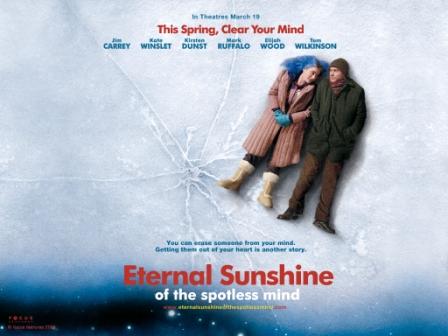
Eternal Sunshine of the Spotless Mind (2004) DVD

How happy is the blameless vestal’s lot!
The world forgetting, by the world forgot.
Eternal sunshine of the spotless mind!
Each pray’r accepted, and each wish resign’d.
          – Alexander Pope, “Eloisa to Abelard


**

Summer is the best time for me to catch up on movies I have missed in recent years.  Eternal Sunshine of the Spotless Mind is one of them.  I have long admired the title of this movie, and wondered who made it up and what it could possibly mean.  Well, I finally made the move and bought the DVD.  After watching it I gave out a sigh of contentment, “Of course!”

It is a challenge to write a review of this movie without spoiling the enjoyment of those who haven’t seen it.  But just let me say this Oscar Best Original Screenplay (2005) is one of the most ingenious in years.  Screenwriter Charlie Kaufman, of Adaptation (2002) and Being John Malkovich (1999) fame, teamed up with director Michel Gondy and screenwriter Pierre Bismuth, and created a wonderful and fresh look at a love story.

If science could allow you to erase any bad memories, which ones would you delete?  This is the premise of the film.  Two individuals, Joel Barish (Jim Carrey) and Clementine Kruczynski (Kate Winslet) met each other at a friend’s party and fell in love.  As with all relationships, they went through ups and downs, experiencing the exhilaration that love could bring, as well as the humiliation it could unleash.  Given the convenience of technological advancement, they elected to erase each other from their memories when their relationship turned sour.

What follows is nothing short of a visual treatise on the conflict between scientific advancement and what it  means to be human, but well embedded in an intelligent sci-fi comedy, evoking the minds of Nietzsche and Pope.

The fine script is augmented by the excellent acting of the cast.  I’m not a Jim Carrey fan, but I’ve particularly enjoyed his more ‘serious’ roles, like in The Truman Show (1998 ) and here in ESOTSM.  He has given a superb performance as the sullen Joel Barish.  Kate Winslet is convincing as the wild and intuitive Clementine.  Their amiable chemistry draws out some great performance from each other.

The rest of the cast is also fun to watch.  Kirsten Dunst (Marie Antoinette, 2006), Tom Wilkinson (Michael Clayton, 2007), Mark Ruffalo (Blindness, 2008 ), and Elijah Wood (The Lord of the Rings, 2001-2003), all lend exceptional support to the main characters.

Other than the acting, the movie also benefits from some excellent editing and technical expertise.  The switching back and forth in time, and the juxtaposition of memories with the present, and imagination with reality, is superbly intertwined.  On first viewing, one may find it a little confusing.  However, as the movie finishes, one would definitely want to watch the beginning again.

I was much gratified to see the story come to an ingenious end.  With love, bad memories are better than no memories.  As I was watching, a movie quote from another film came to mind:

The things that people in love do to each other they remember, and if they stay together it’s not because they forget, it’s because they forgive.

It is uplifting to be reaffirmed that being human encompasses the various subjectivity of experiences, be they sad or joyous.  And forgiveness and love may well be some of the loftiest ideals humanity could ever pursue.

The DVD comes with some excellent special features including behind-the-scenes look at the production, a conversation with Jim Carrey and director Michel Gondry, feature commentary with Michel Gondry and writer Charlie Kaufman, a music video, deleted scenes, and a neat little surprise.

~ ~ ~ Ripples