Paris in July 2025 – Delightful reads by Antoine Laurain

For Paris in July this year, I want to read an actual Parisian author writing Parisian stories. I did some digging and found Antoine Laurain. I’m late to the party, for Laurain has written more than a dozen books, which have been translated into twenty languages, an award-winning novelist whose talents are multi-faceted: author, journalist, screenwriter, film director, antique collector and dealer.

I’ve read or listened to four of Laurain’s novels in the past weeks: The Red Notebook (2014), The President’s Hat (2012), The Readers’ Room (2020), and The French Windows (2024). I still have many more to savour. These ones I’ve read are all like novellas, less than 200 pages, each unique in its storyline, very entertaining, easily accessible but not shallow. Laurain’s writing is a fusion of the literary and the popular, weaving suspense and romance, or adding a dash of magical realism as in The President’s Hat. Among these four, The Red Notebook is my favourite.
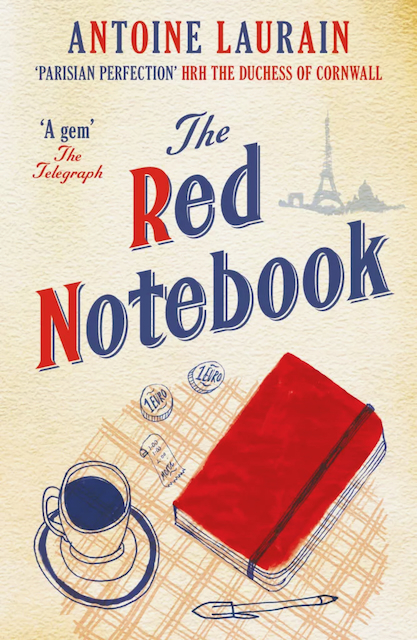
The Red Notebook by Antoine Laurain, Gallic Books (English edition), 2015,
159 pages.

Ahh… The contentment of being sought and found… and to be known.

Laurent, a bookstore owner, finds a woman’s leather handbag in good condition on top of a garbage bin on the street one morning, obviously stolen and discarded there. He takes it to the police station, but is told to wait. Doesn’t have time to spare, Laurent decides to leave it till the next day to hand it in. The mauve handbag is just too much of a lure for Laurent to keep his curiosity in check. That night at home, he opens it gingerly and explores the personal effects inside, hoping to find a name and address so he can return it to its owner.

Among the perfume, hair clip, keys, and numerous other items, there’s a red Moleskin notebook. Just too tempting, how can he not open it? The elegant and fluid handwriting records the owner’s self-reflections, her likes, her fears, her dream.

He had opened a door into the soul of the woman with the mauve bag and even though he felt what he was doing was inappropriate, he couldn’t stop himself from reading on.

It could sound creepy, but Laurain lets his readers empathize with this curious middle-age bookseller, for he is now a detective of the soul. And Laurain knows how to tell his story with humour. As he searches the bag, his girlfriend shows up, complicating matters. Later, adding zest to his quest, his daughter joins in his detective work readily and offers invaluable assistance.

Augmenting Laurent’s eagerness to find the owner of the bag himself instead of letting it go to the police is another object in the handbag, the book Accident Nocturne signed and with a line of dedication handwritten by the French author and Nobel laureate Patrick Modiano. The bookseller is overcome by a surge of passion, for Modiano is his favourite writer. Herein lies the clue to someone who shares the same mind as his. From the line of inscription, Laurent knows the first name of the owner of the bag, Laure.

While ordinary love stories might focus on a person looking for the right one to love, here in The Red Notebook, it describes the complementary side of the search as well, by revealing the one aspect which might be the most gratifying of true love: being sought and found… and to be known.

I like the idea of a man going to so much trouble to find me (no one has ever gone to so much trouble for me before)

While Laure has had men in her life before, but there has never been one who had really stepped inside her mind. Yet here is one stranger who has known and admired her inner being, and is passionate enough to go the distance to find her, and yet…

The ‘and yet…’ is purposely unwritten as I don’t want to give any spoilers. I highly recommend The Red Notebook as a light and entertaining read, one that touches that soft spot of the human heart, to be sought and found… and deeply known.

I await a filmmaker to take this up, write an English screen adaptation and set in New York City, find a perfect cast, and I’m sure it will make one marvellous rom com, or a little more serious but equally heartwarming rom dramedy.

Ah… Celine Song, would you be interested?

***

Paris in July 2025 is hosted by Words and Peace and France Book Tours
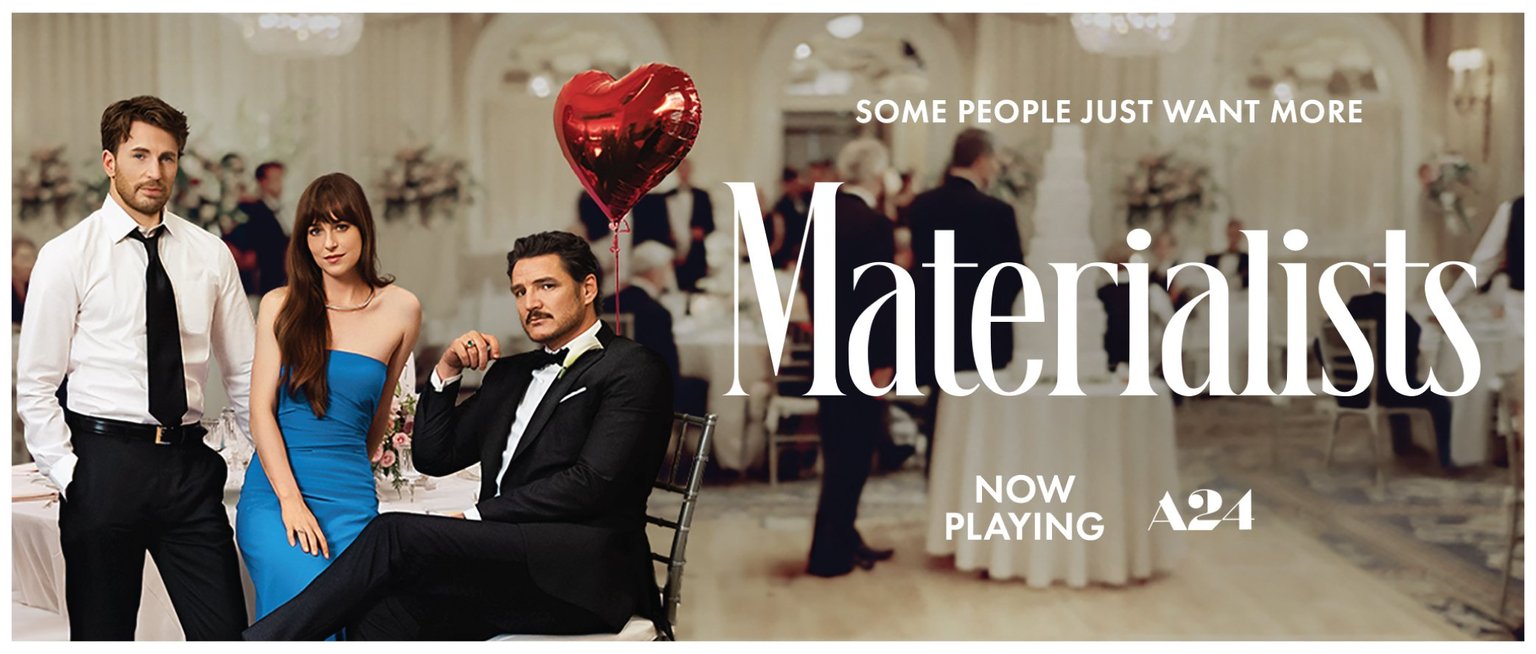
‘Materialists’ is a film Jane Austen would like

Marketed as a romantic comedy, Materialists, Celine Song’s (Past Lives, 2023) second film  defies categorization. Released by A24 just in time to greet summer viewers, the film isn’t quite like your traditional rom-coms. There are no LOL moments, but there’s humour throughout that elicits knowing chuckles. No slapstick acts, but movement made by the actors are often subtle but notable.  

The opening scene is a fitting prelude. A caveman courting his sweetheart, slipping onto her finger a ring made from the delicate stem of a tiny flower. Right after that, a stark change of scenery with a busy New York streetscape accompanied by the beat of Cat Power’s ‘Manhattan’, and the title credits begin to flash on screen. Tale as old as time… from prehistoric to modern day.

We see Lucy (Dakota Johnson) walk on in New York City with perky confidence, a successful matchmaker who has seen nine pairs of her clients tie the knot, so far. Lucy exudes such upbeat positivity that she can stop a man on the street and ask outright if he’s single, then hands him her business card. She possesses ‘an eagle eye for chemistry’, an expert in linking her clients by checking all the boxes for the right match: looks, age, height, weight, family background, education, income. Like transactions in the financial market, in Lucy’s business, people are the commodity, numbers on a spreadsheet. Materialistic measures reign supreme in a dating service. 

The satirical vibe is obvious. Isn’t that a modern-day parallel of Jane Austen’s time, where successful matrimony is dependent on financial compatibility. Pride and Prejudice (1813) is a prime example. Such is the view held by Mr. Darcy at first, and the reason why Lady Catherine de Bourgh is so furious when she sees an inferior nobody dares to compete with her own daughter. As for Mrs. Bennet, marrying up for money is what she dreams of for her five daughters. Only the heroic Elizabeth Bennet is brave enough to challenge the social norm and insists on her own criterion for marriage: love. 

Soon after the opening of Materialists, we come to the inciting incident. In her client’s wedding banquet Lucy meets Harry (Pedro Pascal), the brother of the groom. He checks every box: handsome, dripping rich, living in a $12 million Manhattan suite, 6 ft. tall, working in a family-owned private equity firm (is it still considered ‘work’?) a perfect 10 as a potential client. But Harry is not interested in Lucy as a matchmaker, but a date. 

As fate has it, in that same event, Lucy’s ex, John (Chris Evans), reappears in her life as a catering waiter. John is a struggling actor, trying to make ends meet, still sharing an apartment with roommates. Past memories flood back to them. Here we see a relational triangle similar to Song’s debut work, Past Lives. Thus kicks off the storyline, who does Lucy choose? A question as old as time. And for Lucy, the modern-day career woman who handles transactions that deal with external measures only, does love have a place? 

Song writes about what she knows, as Past Lives is autobiographical, Materialists is, interestingly, based on her stint as a matchmaker in NYC some years ago. As a director whose debut film was nominated for two Oscars, Best Picture and Best Original Screenplay, Song has proven herself to be a versatile filmmaker who can break out of the indie mode into the limelight of popular features.

The camera is a definite asset. Cinematographer Shabier Kirchner used 35mm film to shoot, bringing out cinematic aesthetics of old. Most notable is his camera work, many shots letting a still camera capture the nuances of two characters facing each other talking, maintaining a slower pace to allow the characters, and the viewers, to soak up the atmosphere and the deeper meaning of the conversations, an obvious digression from the breezy, traditional rom-coms. 

When viewers drop their own preconception of the actors’ previous roles, Evans as Captain America, Johnson her Fifty Shades sequences, and Pascal the apocalyptic survivor, the trio works well each in their own way. But the one that deserves mention is the supporting actress Zoe Winters who plays Sophie. The twists and turns of the storyline switch the second half of the movie to a different drive, one that feels like a suspense drama, and Winters delivers with heart-stirring effects.

My main issue with the movie, however, is probably related to Song being such a brilliant wordsmith in creating dialogues. In writing and especially now in a visual medium, the ‘show not tell’ axiom is all the more crucial. This is even more true when the subject matter is love. Other than hearing the word uttered, the film isn’t convincing enough to show the presence of that affective bond of passion which is so crucial in the ultimate outcome. ‘Love is a mystery,’ Song has said in her interviews. Such a mystery through the ages needs to be represented on screen by actions instead of just being mouthed in words.  

Nevertheless, overall, Song needs to be congratulated on transitioning from the indie to the mainstream arena with popular stars, and helming a production with her own style of cinematic artistry.

So what if Materialists doesn’t fit the mold of a rom-com? Why need to box it into a genre? As the opening credits state, and it’s a good description: ‘A Celine Song Film’. Let it be its own genre, the writer-director is in a class of her own. A very pleasant movie not just for the summer season, and one I’m sure Jane Austen herself would like to watch.

~ ~ ~ Ripples

***

Click here to read my Ripple Review of Past Lives

‘The Only Girl in the Orchestra’ is a Passionate Production

This 34 minute documentary short is a tribute to Orin O’Brien, the first female musician hired full time by the New York Philharmonic in 1966 under the directorship of Leonard Bernstein. The trailblazing, unsung hero is spotlighted, albeit reluctantly, by her niece, filmmaker Molly O’Brien, who had looked up to her aunt as someone to emulate ever since she was a child. The 34 minute screen time, however, reveals a humble character who refuses to be called ‘an artist’, and looks at her achievements as ‘accidental,’ rather, seeing her life as one who has simply enjoyed the experience of playing her beloved double bass and making music together with other musicians.

I find what’s inspiring throughout the documentary is Orin’s humility. She could have boasted about many things, including her parental heritage of early Hollywood, the old-time movie stars George O’Brien (the classic Sunrise, 1927) and Marguerite Churchill, or her own self-propelled motivation to reach her musical goal. It was her deep desire to play in an orchestra that led her to learn the double bass in high school, read all she could get her hands on about the subject, later entering Juilliard and becoming not just a female trailblazer in a male dominated arena but further expanding her influence as an acclaimed teacher mentoring numerous young musicians. Yet she offers these words that impress me the most:

This is my theory of how to enjoy your life incredibly. You don’t mind playing second fiddle… I think it’s better to love something so much you do it for its own sake and also for the wonderful people that you’re playing with. You’re creating something together, which is better than something alone.

After 55 years in the New York Philharmonic, Orin retired at age 86 in 2021. She keeps on going with her passion in teaching and mentoring. The documentary follows her as she turns a new page in her life. Retirement doesn’t mean ending a musical career.

The other prominent character in this short feature is Orin’s instrument, the double base. Positioned at the back of the orchestra, often unnoticed, the double base plays a supporting role in the background, nonetheless is essential for producing the foundational rhythm and creating the deepest resonance in a piece of music. The score throughout the film is a case in point. Orin’s double basses are like pets to her. The ‘Orin’s Duke’ is a double bass made in the 1750’s, with a history of playing for George III.

A trailblazer that deserves more than 34 minutes of tribute to her life and career, this gem of a documentary could well reflect what Orin stands for, a pure joy, passionate in its production, unassuming but inspiring in essence.

The 95th Academy Awards nominations were announced a few days ago. The Only Girl in the Orchestra is given the nod deservedly as a nominee in the Best Documentary Short Film category. Before the March 2 awards show, don’t miss Orin’s documentary now streaming on Netflix.

~ ~ ~ ~ Ripples

***

The Hunters: Two Novellas by Claire Messud

Always been fascinated by Claire Messud’s writing. Glad to discover a gem I’ve missed all these years, The Hunters, Two Novellas (first published 2001, this Norton edition, 2021) which I recently found in the basement of an indie bookstore, where used or overstocked books are stored.

The first novella is A Simple Tale. On the surface, it’s a Canadian immigrant story, how people came to Canada after the second World War to make a home for themselves and their future generation. But it speaks to deeper truths about belonging, hope, resilience, love and alas, family conflicts and disappointment. Immigrant or not, such are universal issues.

Maria Poniatowski was born in the Ukraine. WWII pushed her out of her village, stranded in Europe, and eventually arriving in Canada alone, having lost her family and close friends. She met Lev in the Displaced Persons camp, fell in love, married, and gave birth to baby Radek. Sounds common enough? But not in Messud’s interesting prose:

And finally there, in the Displaced Persons camp, Maria, an old maid of twenty… At long last. Dreamed, discarded, forgotten, it came to her on the sly, slowly at first, shy, and then in full torrent. That’s what the Displaced Persons camp would mean to her, in the ribbon of years: simply, love. (p. 26)

Settling in a new country doesn’t come naturally, especially when it’s totally foreign. Weeping and hardship may be for a short while, for joy soon comes. Maria receives a very Canadian welcoming at the Displaced Persons camp:

In the morning, that first September morning of 1946, there was the piercing early-autumn sunlight sifting through the pines, and the clean odor of the needles as they were trampled underfoot, and the soft damp mulch scent of the forest; and there were maples, in amongst the monstrous evergreens, turning, golden, vermilion, ochre in a riotous celebration of the Poniatowskis’ arrival. (p. 31)

Maria later found a housekeeping job with Mrs. Ellington, and became her life-long companion for decades. As little Radek grows up and Maria and Lev grow old, disappointments set in. The baby son she has raised all the years from the displacement camp to a house in Toronto is now a man with his own will but totally subdued by the girl he chooses to marry, an obvious unfit match, bringing his parents only disappointment and heartbreaks. Having endured and lived through the War and years of adjustments and finally calling a new country home, Maria, a widow now and alienated from her son and his family, watches Mrs. Ellington slip away. Alone again.

________

The second novella, The Hunters, can well be an exemplar for the now popular, contemporary genre of the psychological, suspense novels such as Before I Go to Sleep (J. S. Watson, 2011), Gone Girl (Gillian Flynn, 2012), The Girl on the Train (Paula Hawkins, 2015), The Woman in the Window (A. J. Finn, 2018)… just to name a few. An unreliable narrator, or a misleading perspective taking the story onto twists and turns until the frame of reference unraveled and truth spills out.

What Messud is doing in The Hunter, however, is a much deeper probe into the psyche of a person in solitude, blurring the imaginary with reality. How reliable is our judgement of character, or how accurate is our perception in deciphering facts from the inkling of our subjective mind? How reliable is our view on reality? Can we fully know someone?

An American academic spends a summer in London to do research on a book he or she is writing. Exactly, Messud does not specify the name or the gender of the narrator, this academic. I wonder what purpose would that serve, maybe universality. Nevertheless, Messud is an expert in psychoanalysis, and her prose, exquisite, as she describes the narrator’s state of mind and inner thoughts.

Choosing to stay in a neighbourhood away from the mainstream, academic centre of London, the narrator seeks solitude to nurse the ending of a love relation, as well, to seek refuge in the anonymity of a diverse neighbourhood where nobody knows her and no one the narrator wants to know.

Such a peaceful existence is interrupted one night by a downstairs neighbour Ridley Wandor, coming up to introduce herself and thus intrudes into the privacy and disrupt the solitude of our much annoyed narrator. Ridley Wandor would become the unwanted nemesis that summer, and months later, when a clearer view of facts is revealed, the cause of inescapable guilt.

The Hunters isn’t one of those page turners in which the plot pushes the reader to forge on, but an astute character study of both the hunter and the prey. In a deeper way, Messud challenges her narrator’s sense of reality, and just because of the lack of omniscience––our very limitation as human––shaking the narrator to the core as facts are revealed at the end. It’s hard to find an excerpt in the novella without dropping a hint as spoiler, but this famous line from Atticus Finch comes to me naturally:

You never really understand a person until you consider things from his point of view […] until you climb into his skin and walk around in it.”

For our narrator, this revelation comes a bit too late.

~ ~ ~ ~ Ripples

Novellas in November is co-hosted by 746 Books and Bookish Beck

Related posts on Ripple Effects:

Small Things Like These from novella to screen

The Quiet Girl Movie Review: From the Literary to the Visual

Passing by Nella Larsen: from Novella to Screen

The Gone Girl Phenom

Before I Go to Sleep: Movie or Book?

***

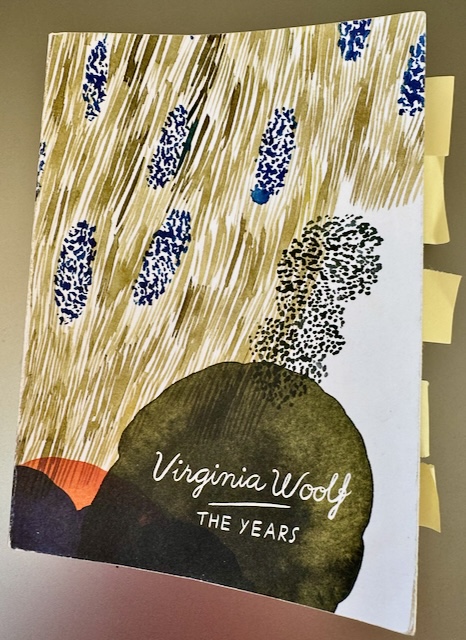
Virginia Woolf’s The Years sparks some surprising associations… Downton Abbey?

“She wanted to see the owl before it got too dark. She was becoming more and more interested in birds. It was a sign of old age, she supposed.” –––– Virginia Woolf, The Years* (186)

Finally, I finish my other 1937 Club read hosted by Kaggsy and Simon that took place in April, two months late, and that’s Virginia Woolf’s The Years, published in 1937. It sure feels like years for me to finish this book. Better late than never, for I have full intention to see what Woolf had to say in her last novel published during her lifetime (Between the Acts was published shortly after her death in 1941), specifically, what was in her mind just a few years before she took her own life.

The book follows the children of Colonel Abel Pargiter’s family as they go through the years crossing the 19th century into the 20th. It’s a family saga through chapters titled for a specific year, beginning with 1880, 1891, then into the new century 1907, 1908 and to the First World War, and finally the “Present Day” which is the 1930’s. Within each chapter the narratives are episodic, characters appear without introductions; readers would have to piece together who’s who and how they relate to each other.

A few unexpected mental associations came to me during my reading. The quote above at the beginning of this post is one of those surprises. A loud Whoa! when I read it: Interest in birds as a sign of ageing. It’s a thought in the mind of Eleanor, the eldest of the Partiger children, when she is fifty-five. She goes on to live past seventy when the book ends, and I’m sure has seen many more owls.

Another surprise for me in my reading experience of The Years is how it’s like watching an arthouse film, or any good movie for that matter. My first impression of that beginning chapter 1880 is that it reads like a script where the expressions and actions of the characters are highly nuanced and the subtext in their conversations speak volumes. Nothing much is happening but the seemingly uneventful narrative carries unsettling undercurrents.

Here’s an example. The Colonel, with his wife Rose on her death bed, is a troubled and temperamental man whom his seven children fear more than respect or love. He comes back home unexpectedly during supper time in the opening chapter and the way he drinks his tea while trying to strike up conversations in a surly manner with his children reflects his changing mood. A ready movie scene here. I’ve taken out the dialogues, but just the description of his tea-drinking actions reveal a lot about his character:

He stirred his sugar round and round in the cup as if to demolish it… ground the grains of sugar against the walls of his cup. [After some tense conversations with his children] Then he seemed to repent of his gruffness… He drank up his tea. Some drops fell on his little pointed beard. He took out his large silk handkerchief and wipe it impatiently… [Later] the Colonel took up his cup, saw there was nothing in it, and put it down firmly with a little chink. The ceremony of tea-drinking was over. (13-14)

Another surprise is that reading The Years makes me think of Downton Abbey, how a family goes through changes both in the larger socio milieu and in their personal lives through the years. The time-lapse is about the same as the six seasons of Downton, from horses to cars, from candles to electric lights, WWI and the changes it brings. The following line in Woolf’s novel makes me think of the Dowager Violet Crawley:

Then he looked at a car. It was odd how soon one got used to cars without horses, he thought. They used to look ridiculous. (215)

BTW, Edith Crawley, who breaks the mould and ventures out to live in London on her own and heads up a magazine she inherits from Michael Gregson and a London flat, has mentioned that she had met Virginia Woolf there, one of Michael’s Bloomsbury acquaintances. One can imagine the author just might have certain influence on her.

The Years is about lives lived, actions or non-actions, the regrets and the resignation of what had happened, the unchangeability of the past. Check out these lines, the introspection of Eleanor’s, just reminds me of Mary Crawley, who had uttered similar words thinking of her own past errors in judgment:

But once it’s done, there it is… How irrecoverable things are, she thought. We make our experiments, then they make theirs. (185)

Above all else, The Years is about the past and memories, and the meaning of it all. Proust’s Remembrance of Things Past comes to mind, no surprise. Both authors value the writing down of lives lived. But Woolf goes into a more depressed mode of seeing even the futility of it. As the chapters, ie, the years, move on, Woolf is more explicit about her view on life––I suppose that’s her perspective––through Eleanor’s point-of-view. Considering Woolf taking her own life just four years after this book was published, I paid attention to the reflections and internal search for existential meaning, or the failing of which, and find these passages particularly poignant. Short sentences like this: “Scenes passed over scenes; one obliterated another,” to reflection like the following, again, quite a cinematic moment:

Things can’t go on for ever, she thought. Things pass, things change, she thought, looking up at the ceiling. And where are we going? Where? Where?… The moths were dashing round the ceiling; the book slipped on to the floor. .. made an effort; turned round, and blew out the candle. Darkness reigned. (195)

to what seems like ultimate despair, take note that Woolf wrote this in the 1930’s:

But how can one be ‘happy’? she asked herself, in a world bursting with misery. On every placard at every street corner was Death; or worse––tyranny; brutality; torture; the fall of civilization; the end of freedom. (358)

I gave the book 3.5 out of 5 stars in my Goodreads review, an evaluation that’s based on my first reading, having had to figure out who’s who –– considering the Pargiters have seven children and some of them have their own children. And then there are extended family members, cousin, niece and nephew, and servants. I’m sure upon second reading, I’d be able to get a clearer picture of all the characters and would enjoy it more, for it really deserves more than one reading.

__________

* The edition that I used (photo above) is Vintage Classics, Penguin Random House UK, London. 401 pages. Introduction by Susan Hill. With this inscription before the Introduction:
“The text of this edition of The Years is based on that of the original Hogarth Press Edition, published by Leonard and Virginia Woolf on 15th March 1937.”

***

Related Post on Ripple Effects:

In Praise of Austen: Virginia Woolf’s A Room of One’s Own

In Search of Lost Time by Marcel Proust: A Movie Reviewer’s Long Take

My other 1937 Club Posts:

Out of Africa by Karen Blixen from Book to Movie

Somerset Maugham’s Theatre and Screen Adaptation

A Tribute to Canada’s Nobel Laureate Alice Munro: Munro and Movies

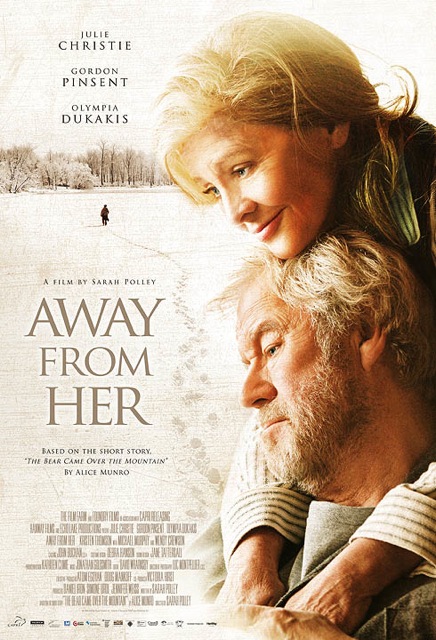
Alice Munro had died at the age of 92 on Monday, May 13, 2024, in Port Hope, Ontario. Winner of the Nobel Prize for Literature in 2013 and the Man Booker International Prize in 2009, Munro solidified her stature in literature with her mastery of the short story. As a tribute to her passing, I’m reposting something I wrote on the occasion of her Nobel Prize win back in 2013 in the following. In that article, I’d also included a short review of the film Away From Her, based on her short story “The Bear Came Over the Mountain”.

_____________

On October 12, 2013, I wrote:

Thanks to the Swedish Academy, Alice Munro doesn’t need a blockbuster movie to raise awareness of her works. Described by The New York Times as ‘Master of the Intricacies of the Human Heart’, and with her story settings mostly in rural counties and small towns, the 82 year-old writer must have known how the small and intimate can have far-reaching effects.

The short story as a literary form too must have gained importance and legitimation overnight now that Munro is honored as Nobel Laureate. The novel isn’t the only peak of the mountain of literary pursuits. Readers too, can now be totally comfortable with reading ‘just a short story’.

Back to movies, with our contemporary mega, blockbuster culture, it sure looks like the general public needs to see a movie before knowing about a literary work. While I don’t like the idea, I’ve to admit that could well be the case nowadays. But for Munro, can anyone name a full feature movie that’s based on her short stories?

Right. Actually there are four* (see correction below). Edge of Madness (2002) is relatively unknown. Another one interestingly is an Iranian film, Canaan, which won the Audience Awards–Best Film at the Fajr International Film Festival in 2008. A better known adaptation is Away From Her (2006). It remains one of my all time favorite films. The most recent completed production is Hateship Loveship which premiered at TIFF13. I regret missing it when I was there in September. A film based on her story ‘Runaway’ is currently in development.

With Munro winning the Nobel, hopefully we’ll have the chance to see a general release of Hateship Loveship. So there you go, Munro could well be helping to reverse the trend: the writer promoting the film.

To celebrate Munro’s Nobel win, I’d like to repost in the following a review of Away From Her which I wrote in 2008. The film was directed by the young and talented Canadian actor/director Sarah Polley, who was nominated for an Oscar for her adapted screenplay based on Munro’s short story ‘The Bear Came Over the Mountain’. Julie Christie received an Oscar nomination for her role as Alzheimer’s afflicted Fiona.

You can read Munro’s story ‘The Bear Came Over the Mountain’ now online, thanks to a timely reprint by The New Yorker.

Capri_AwayFromHer_PosterB

AWAY FROM HER: A Short Review

How can you turn a good short story into a full length movie without compromising its quality? By turning it into a screenplay written by an equally sensitive and passionate writer, and then, through her own talented, interpretive eye, re-creates it into a visual narrative. Along the way, throw in a few veteran actors who are so passionate about what the script is trying to convey that they themselves embody the message.

Sarah Polley has made her directorial debut with a most impressive and memorable feat that I’m sure things will go even better down her career path. What she has composed on screen speaks much more poignantly than words on a page, calling forth sentiments that we didn’t even know we had. As Alzheimer’s begins to take control over Fiona, what can a loving husband do? Julie Christie and Gordon Pinsent stir up thoughts in us that we’d rather bury: how much are we willing to give up for love? Or, how would we face the imminence of our loved ones’ and our own mental and physical demise?

Based on the story by Alice Munro, ‘The Bear Came Over the Mountain’, Polley brings out the theme of unconditional love not with your typical Hollywood’s hot, young, and sexy on screen, but aging actors in their 60’s and 70’s. It may not be as pleasurable to watch wrinkled faces hugging and kissing, or a man and a woman in bed, bearing age spots and all, but such scenes effectively beg the question: why feel uncomfortable?

Why does love has to be synonymous with youth, beauty, and romance? It is even more agonizing to watch how far Grant is willing to go solely for love of Fiona. Lucky for us, both writers spare us the truly painful at the end. It is through persistent, selfless giving that one ultimately receives; however meager and fleeting that reward may seem, it is permanence in the eyes of love. And it is through the lucid vision of a youthful 28-year-old writer/director that such ageless love is vividly portrayed…. Oh, the paradoxes in life.

~ ~ ~ Ripples

* Correction: According to IMDb, there are 14 screen adaptations of Munro’s work, both in movies and TV. Runaway is in production currently.

The 1937 Club: ‘Out of Africa’ Book to Movie

Twice a year, Simon at Stuck in a Book and Karen at Kaggsy’s Bookish Ramblings host an interesting reading event, the year club. We read books published in that year indicated by the number and write our reviews. This time, from April 15-21, we are doing the year 1937.

Many fine titles were published in 1937, but for me, it’s an easy choice: Out of Africa, the memoir of Danish author and baroness Karen Blixen (1985-1962). Interesting to note that she had several pen names. In the English speaking countries, she was Isak Dinesen.

Ever since watching the 1985 movie Out of Africa, I’ve always wanted to read the source material, Blixen’s autobiography about her seventeen years (1914-1931) living in Kenya operating a coffee farm. In a way, I want to cast aside the image from the movie, however romantic, of Meryl Streep and Robert Redford sitting in green pastures picnicking, with Mozart’s Clarinet Concerto coming out from a gramophone, the music sweeping serenely across the pristine African landscape.

Blixen’s life in Kenya was no small venture: a pioneer woman operating a coffee farm situated in the six thousand acres of her land at the foothills of the Ngong Mountains. She rode horses, went on safaris, shot lions to defend her oxen, herself and others. When in the capital, Nairobi, she was a business woman; when on her farm, she was doctor to those lined up to see her with their sickness and ailments. She sent those that she couldn’t handle to the hospital and visited them, seeing to their recovery.

Blixen’s chronicles of her life in Africa intertwine objective observations and intimate thoughts. When describing the different ethnic groups in the land, the Natives Kikuyu, or her neighbours the Masai, or the immigrants the Somali… her writing is like an astute anthropologist, always with admiration. When referring to the Somali women, she writes:

There was no ignorance in their innocence. They had all assisted at childbirths and death-beds… Sometimes to entertain me, they would relate fairy tales in the style of the Arabian Nights, mostly in the comical genre, which treated love with much frankness. It was a trait common to all these tales that the heroine, chaste or not, would get the better of the male characters and come out of the tale triumphant… I felt the presence of a great ideal… the idea of a Millennium when women were to reign supreme in the world. (131)

Considering the above was noted earlier than 1931 (the year she left) in Africa, was Blixen a visionary ahead of her times, or… was it the Somali women?

When describing those close to her, like her invaluable assistant Farah, she presents a character study with free flowing, deep feelings of love and respect. In the essay collection at the back of this book, Shadow on the Grass, she has a whole chapter on Farah, of whom she describes a special relationship of Unity, that of Master and Servant, in no subordinate sense but an indispensable bond of loyalty and mutual respect. Blixen gives a few examples of such Unity, like Don Quixote and Sancho Panza. For contemporary readers like us, maybe the Downton relationship between Robert Crawley and John Bates would be a more visible example.

[Spoiler Warning here] Unlike the movie, Blixen mentions her friend Denys Finch-Hatton (Robert Redford in the movie) only sporadically in the first half of the book. Towards the end she devotes a few chapters on him upon his tragic plane crash. The two chapter titles are indicative of his character: ‘The Noble Pioneer’ and ‘Wings.’ Denys had almost become a Native himself, knowing the people of the land thoroughly, having had spent decades there, his love for them is reciprocal. His bi-plane is an apt metaphor for his courage and unbound spirit of exploration. His gramophone is an object of desire as the music it plays is a shared joy between him and Blixen, as well as a novel attraction mesmerizing all those on the farm. Of Denys, Blixen writes:

What they really remembered in him was his absolute lack of self-consciousness, or self-interest, and unconditional truthfulness which outside of him I had only met in idiots. (247)

Kudos to film director Sydney Pollack, the movie shows what’s unsaid between the lines. Blixen had deep feelings for Denys, but from the text, she’s restrained and devoid of sentimentality. That’s what makes the final chapters so poignant. Unlike the movie, there’s no romance depicted, just friendship and mutual admiration. There are letters and other writings of Blixen’s which I’m sure the filmmakers had researched on, and thus the more intimate dramatization of them as lovers in the movie. Furthermore, the aerial shots of Deny’s bi-plane over the African landscape, hills and valleys, plains and waters, spurring flocks of shore birds to soar to the sky, our reading imagination visualized; John Barry’s heart-stirring, expansive score complements the mesmerizing cinematography. And yet, I’ve fully enjoyed Blixen’s writing as well, intimate and poignant.

The farm eventually failed financially and Blixen had to move back to Denmark. Selling it out and bidding farewell is like leaving her soul there. She describes her last safari at dusk:

The plains with the thorn-trees on them were already quite dark, but the air was filled with clarity – and over our heads, to the west, a single star which was to grow big and radiant in the course of the night was now just visible, like a silver point in the sky of citrine topaz. The air was cold to the lungs, the long grass dripping wet, and the herbs on it gave out their spiced astringent scent. In a little while on all sides the cicadas would begin to sing. The grass was me, and the air, the distant invisible mountains were me, the tired oxen were me. I breathed with the slight night-wind in the thorn-trees. (191)

This is one of those books that will linger in my heart long after I finish and to which I know I will return.

***

Related Post on Ripple Effects:

‘Flappers and Philosophers’ by F. Scott Fitzgerald: My entry into the 1920 Club

The Zone of Interest and the Banality of Evil

How does a German family spend their summer holidays? Imagine this one with mom and dad and their five children in a country house. Family picnic by the river, dad fishing, mom admiring her large and impressive garden, children splashing in the pool. Dad got a surprise birthday present, a canoe, which he takes to the quiet stream with two of his older children surrounded by bird songs. Dad not only loves his family, but his horse, his dog, and those lilac bushes.

A picture of an idyllic and peaceful family life. Zoom out a bit, the country house is right adjacent to the Auschwitz concentration camp, separated by just a wall, barbed wire on top. We can only see the top of the prison buildings. Yes, we also see heavy smoke shooting out from tall chimneys.

This is an actual, historic setting. The master of the household is Rudolf Höss (Christian Friedel), commandant of the Auschwitz concentration camp. He rides to work on his beloved horse, doesn’t have far to go, only next door. An idyllic family life and the horrors of genocide co-exist side by side, the Garden of Eden and Hell separated by just one wall. As for the wall, Rudolf’s wife Hedwig (Sandra Hüller) is thinking of growing some vine to cover it, making it disappear altogether.

Writer-director Jonathan Glazer’s Zone of Interest is a macabre juxtaposition of normality and atrocity, a cinematic representation of what the political thinker and philosopher Hannah Arendt calls the banality of evil. It doesn’t take a monster to commit monstrous acts. Ordinary people had committed them without questioning, as Judith Butler wrote about Arendt’s book on the trial of Adolf Eichmann, one of the organizers of the Holocaust:

In a sense, by calling a crime against humanity ‘banal’, [Arendt] was trying to point to the way in which the crime had become for the criminals accepted, routinised, and implemented without moral revulsion and political indignation and resistance.

The Guardian, Aug. 29, 2011

Glazer’s ingenuity in depicting the ‘horror next door’ is by not showing us visually but audibly. While we see the Höss family going about their daily life, we can hear constant gunshots, dogs barking, guards yelling, furnace rumbling, and anguished cries. Indeed, the whole Höss family have learned to ignore such ‘disturbances.’ Their callousness is chilling. When Rudolf received the order to transfer from Auschwitz to Oranienburg, Hedwig tells him that she wants to stay right there with the children while Rudolf can attend his new post alone. Their rationale: “The life we enjoy is very much worth the sacrifice.” Hedwig adds in, “this is the way Hitler would want us to live.” Here is their dream home.

If such a normal family can be complicit to evil without questioning, Arendt’s implication is that we who consider ourselves ordinary folks can also be susceptible to commit criminal wrongdoings out of the desire for group conformity or self-interest. It doesn’t take a villainous monster to commit atrocious acts, we all have the propensity for evil. That wall separating the garden and hell could be the metaphoric, thin line between good and evil within ourselves. Another chilling thought, this time much closer in our own backyard.

Two-time Oscar nominated cinematographer Lukasz Zal (Cold War, 2019; Ida, 2015) placed cameras in and outside of the house unobtrusively to capture the actors in their natural way. Shot in natural lighting, with no camera people on set, the film is a raw depiction of the behavior of a family in their mundane mode of living, a heartless picture of irony to what’s taking place on the other side of the wall.

Two scenes particularly stand out for me. Hedwig tries on a long fur coat––loot from the prisoners next door––looking into a full-length mirror, clutching the collars and posing from side to side as if trying it in a boutique shop. Another scene is one of the older boys using his flashlight to examine something while in bed at night. An insert shot shows what he’s studying: teeth with gold trims; not hard to figure out where they come from.

Any relief from such insensitivity? Glazer has inserted some fairytale-like sequences in reverse black and white of a girl hiding food in the bushes, for the prisoners we presume, that’s when we hear the voice-over of Rudolf reading to his children the story of Hansel and Gretel in their bed. Fairytale or dream sequence, or for real, is that one of the Höss girls? No matter, that’s the humanity we seek.

Loosely based on Martin Amis’ novel, Zone of Interest is an ‘arthouse’ style of filmmaking that offers a unique perspective of the Holocaust without showing any of the prisoners, except the one that works in the Höss garden. Sounds elicit unseen implications. The film starts and ends with a long, eerie cacophony of anguish and squeals with the screen a blurry mass of grey. The effects evoked are none less haunting than actual shots of the concentration camp. The ending scene comes back to today and the way the camera captures the people there is most effective in wrapping up this retelling of history.

With its one hour and forty-five minutes duration, the film is succinct, well-paced and edited, naturalistic in its styling, and leaves viewers with haunting ponderings after. Winner of four Cannes Prizes, The Zone of Interested is nominated in five categories in this coming Academy Awards on March 10: Best Picture, Best International Feature Film, Director, Adapted Screenplay, and Sound. Hope it could get some worthy recognition on this side of the Atlantic.

~ ~ ~ ~ Ripples

Related Ripple Reviews:

Anatomy of a Fall

Ida’s Choice: Thoughts on Pawlikowski’s Ida

Japanese Literature Challenge 17: Keigo Higashino’s Latest, ‘The Final Curtain’

Keigo Higashino is a prolific writer, more than sixty novels published and not only in the mystery genre, yet only thirteen have been translated into English. The Final Curtain is his latest, albeit it was published in Japan in 2014. English version by Giles Murray in 2023.

Thanks to Bellezza for hosting Japanese Literature Challenge for the seventeenth year, I get the chance to read this book with her. Yes, she has been my read-along pal all through my blogging years, dating way back to Midnight’s Children in 2012, and later Anna Karenina, Middlemarch, just to name a few.

Now, to Higashino. In The Final Curtain, something hits home for Detective Kaga, for it involves the death of his mother, who had deserted his father and him when he was a teenager. We learn that years ago Kaga knows of his mother’s mysterious death in the city of Sendai from an unknown woman who opens a bar there. That begins the rich and multi-layered story. As it turns out, the person that secretly releases the information to the bar owner is tied to at least two deaths in Tokyo in present day, weaving up a complex net of stories and family relations.

Yes, it’s sometimes confusing trying to figure out which character is which, for the names can be hard to distinguish. Be glad that the translator has a list of characters in the first page of the book where you can always turn to refresh your memory. The middle part could make a reader feel sluggish somewhat, but don’t get bogged down by it because this part sets the stage for a page-turning last section. Beginning with Chapter 22, there’s a dramatic switch in character description and perspective, you’ll be hooked to find out what had happened years ago that had led to the present day behaviour and demeanor of the characters.

Once again, Kaga comes through as a deep thinking, rational, and very clever young man. I don’t think of him as “A modern-day Poirot” as the description says on the book cover. Why, Kaga is a broad shouldered man with an impressive physique and in this book, a notable point and a crucial thread to the mystery is that Kaga is a kendo (Japanese sword) champion.

Every time I read Higashino I’m not only intrigued by the interwoven plot and the connections of characters, but the cultural aspects he presents during his storytelling. One notable point here is the importance of early school life has on the characters, and how readily old school mates are able to recall past events of students and teachers. People do have great memory power in Higashino’s novels.

Another aspect of Japanese culture I specifically look for is what the characters eat and drink. I’ve always had my eyes peeled to note Higashino’s description of Japanese food. Kaga and his detective cousin Matsumiya like to exchange info over beer. And what goes with it? “Matsumiya popped a few beans into his mouth and took a swig of beer as he contemplated his cousin.” And Kaga “shoveled some simmered burdock into his mouth with his chopsticks.” I admit I’ve to Google what burdock is. Other culinary delights mentioned are sashimi, grilled fish, tofu and rolled omelet.

I’d rate The Final Curtain to be one of my favourite Higashino mysteries, together with The Devotion of Suspect X. While it reveals the causes of the three major deaths in Tokyo, the ending of The Final Curtain gives me a feeling of ‘to be continued’, as the mystery of Kaga’s mother still lingers in my mind. I look forward eagerly to more Higanshino to be translated soon.

~ ~ ~ Ripples

Other Keigo Higashino Ripple reviews:

JLC16: The Swan and The Bat

The Devotion of Suspect X

Newcomer

‘American Symphony’ is a Must-See 2023 Documentary

While waiting for Maestro to come to our city’s theatres, serendipity strikes. I found this newly released documentary on Netflix. Two classical music features coming out at the same time, I thought. But to my surprise, American Symphony isn’t about a classical music icon like Leonard Bernstein in Maestro but––it would make an interesting contrast–– Jon Batiste, the Louisiana born and Juilliard trained musician, singer, songwriter, composer, pianist and bandleader on The Late Show with Stephen Colbert.

Directed by Matthew Heineman, a multiple award-winning and Oscar nominated director, who has brought us an intimate and moving love story. I knew nothing about Batiste before watching this doc, only seen him on Stephen Colbert, the bandleader that gives an assured, warm smile when the camera focuses on him. American Symphony showcases Batiste’s new composition of the same name, as well as following his celebrated rise to the summit of musical stardom in 2022 when he garnered eleven Grammy nominations across genres and winning five including Album of the Year.

What captivates me is not only Batiste’s talents or his music. Surely these as well as his process of creativity are what make this doc highly entertaining, but what’s inspirational is the focus of his relationship with his wife, writer Suleika Jaouad, whose myeloid leukemia has returned after years of dormancy. In the midst of jubilation and career honors, there’s the searing pain of seeing his wife suffer in hospital. Batiste stays by her side as she goes through bone marrow transplant, and lovingly supports her through the whole treatment.

What is soul-stirring is the inward revealing of Batiste’s faith in his God, his humility in the midst of career wins and recognitions, and his readiness to accept whatever that could come his way. The doc is an intimate look into the duality of triumph and suffering, the vibrancy and the vulnerability of life, a candid and endearing love story.

As for the eponymous ‘American Symphony’, Batiste’s new composition, we get to see its rehearsal process throughout the feature, and savor excerpts of it towards the end. This last section is a revelation. The work had its world premiere in Carnegie Hall to a full house in September 2022. An innovative symphony encompassing tributes to jazz icons and the Black cultural roots, Batiste at the piano, a full orchestra, vocals from classical and gospel traditions, and including Native Americans in their own costumes and with their drums and songs, yearnings of human voices in cacophony, a moving experience. It would be interesting to see Maestro after watching American Symphony.

~ ~ ~ 1/2 Ripples

***

‘The Holdovers’ is easy viewing for the holidays

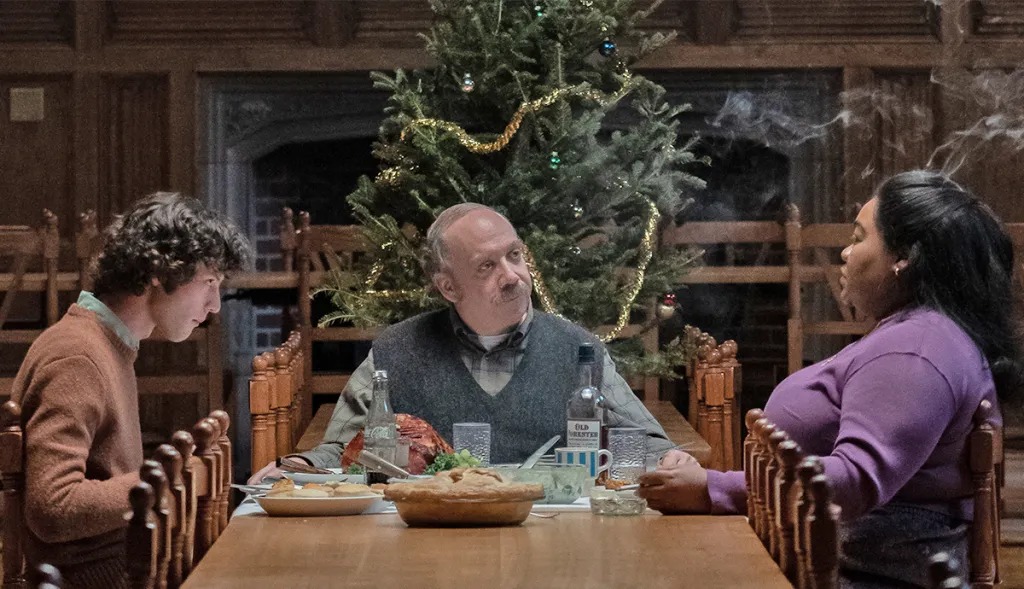
Alexander Payne’s newest feature is a pleasant dramedy for this coming holidays season. Set in a 1970 remote New England winter, boarding school history teacher Paul Hunham (Paul Giamatti) is tasked with supervising the few students who can’t go home during Christmas break, the holdovers.

When a helicopter sent by one of the students’ rich daddy comes to pick up the group, Angus Tully (Dominic Sessa) is left behind as he is just like his cranky history teacher at Barton Academy, unpopular among his peers. Angus’ pain stems more from being abandoned by his mother who wants to spend Christmas with her new boyfriend alone. Together with the chief cook of the school Mary Lamb (Da’Vine Joy Randolph), a grieving mother who has just lost his son in Vietnam, three damaged souls are left to spend their winter holidays in an empty boarding school.

Payne has won two Oscars for Best Writing, Adapted Screenplay, for The Descendants (2011) and Sideways (2004), both with which he was also nominated for Directing. His third directing Oscar nom was for the black-and-white feature Nebraska (2014). Payne’s forte of capturing the humanity in conflicting relationships is apparent in his works. Such is the main drive and the fun found in The Holdovers, where we see Payne reunites with Sideways‘s Giamatti. The idea for the film came from a 1935 French movie, but interestingly, Payne chose to have the TV writer David Hemingson do the screenplay, his debut feature.

The story idea isn’t new, misfits thrown together in reluctant circumstances starting out repelling each other but through unexpected turns of events, human decency shines through. Watching The Holdovers brings back memories of Dead Poets Society and Scent of a Woman. But this is a much lighter and warmer feature with nonetheless poignancy towards the end. Payne’s signature style of sprinkling humour with pathos is prevalent here, at times even with slapstick, Chaplain-like actions added in. Later a road trip to Boston solidifies the unlikely companionship, events leading to the triumphant transformation of self for all three characters.

The 133-minute screen time could be tightened though, especially in the first part where it feels likes the story has not started until everyone has gone and only the three remaining characters are left in the empty school. It then picks up momentum when a road trip is in gear. The first part is set up for slow-paced viewing offering scenic New England in the snow; the song selections are appealing, and maybe with a touch of sarcasm. While waiting for the inciting turn to kick start the story, viewers can sit back and maybe for some, reminisce on their own prep school experiences.

He may be pompous and grumpy, Hunham’s sadistic approach to teaching just shows that his intention is genuine in preparing his students to enter Ivy League schools by their own academic merits and not because their fathers give money for a new building or a fancy gym. He even has the gall to fail a senator’s son, hence, his unpopular status among the principal, faculty, and needless to say, his students. As a classics and ancient history teacher, Hunham’s personal vernacular is where some of the humor lies. His lines are quotable quotes. Giamatti is perfectly cast, a natural in portraying such an eccentric. Come awards time, he is likely to be noted for his performance.

Da’Vine Joy Randolph as Mary is superb. Despite nursing deep loss, she is sensitive to others’ needs, a character foil against Hungham. her quiet presence exudes a much needed sensibility to balance out the incompatible trio. It’s always heartwarming to see human decency and kindness seep through the clouds of personal pain.

Sessa is discovered from an audition at an actual New England boarding school. It’s interesting that he looks more mature than a high school student. So, in that sense, he doesn’t seem to be a fitting cast. However, to make up for his appearance, his acting is natural and in this his movie debut, has shown himself to be a pristine actor with much potential.

The Holdovers could make another crowd pleasing Christmas movie with holding power in the years to come. It’s easy viewing and inviting for rewatch, especially to catch the quotable lines, Hunham style.

~ ~ ~ Ripples

***

Related Ripple Review:

Nebraska (2013): Color is Superfluous

and a related quote from a previous post:

“Medicine, law, business, engineering, these are noble pursuits and necessary to sustain life. But poetry, beauty, romance, love, these are what we stay alive for.” — Dead Poets Society

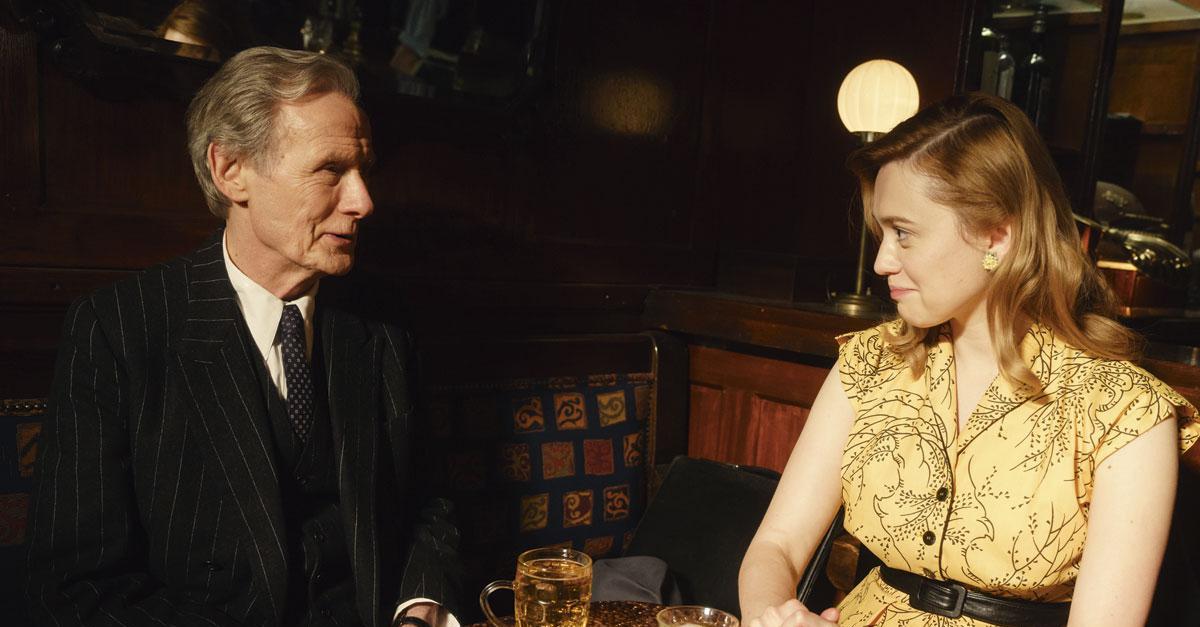
‘Living’: The Old Becomes New

Living is based on the Japanese auteur Akira Kurosawa’s classic Ikiru (1952, meaning of title: ‘to live’). Nobel laureate Kazuo Ishiguro adapted it to make an English version with Bill Nighy in mind when he wrote the screenplay, creating a setting in 1950’s London. Interestingly, Kurosawa himself was inspired by Leo Tolstoy’s The Death of Ivan Ilyich when he made Ikiru, and with his eloquent camera, transposed the Russian master’s novella into a Japanese story on screen.

With Living, the Japanese-British novelist Ishiguro has succinctly condensed Kurosawa’s 142 minute film into a shorter feature of 102 minutes, helmed by South African director Oliver Hermanus. It’s interesting to note the cross-cultural transferral, for the film is about the universal theme that we all share as a humanity, living a meaningful life in the face of death.

This is one of the less-hyped movies during the 2022 Awards Season, despite the film getting two Oscar nominations: Best Adapted Screenplay for Ishiguro, and Best Actor for Bill Nighy, his first and long due Oscar nod.

It’s timely that I finally get the chance to watch Living now in April, a month that signifies new births. Considering the change in the main character Mr. Williams (Bill Nighy), even the idea of resurrection is apt when taken metaphorically, from death to life, ironically, for a man who has just been diagnosed with terminal illness.

As the head of the public works department at County Hall for numerous years, Williams is contented with following the bureaucratic daily routine by the clock, pushing papers to other departments, or, if the file has to stay in his, stalling it till it becomes extinct.

The camera angles give us a vivid perspective. From the overhead shot above the train station, we see a mass of uniformity, men in dark suit and bowler hat heading to work. Looking down from above, they are small and insignificant. And from the slow motion of them walking, we see the wheel of work turning, ever so slowly, in mundane routine heading to the office and the same vehicle bringing them home at the end of the day.

After Williams gets the confirmed diagnosis of cancer and that he will have just six months to live, there appears the audio motif of a clock ticking; this time, it’s not to remind him of work routine but the limited time of life remaining.

In the wake of the ominous news, Williams’ reactions change from stoically bearing the shock to actively seeking a meaningful existence, and ultimately finding a purpose that he feels can fulfill his life. Nighy’s performance is immersive, reserved, and nuanced, and at times, allowing a ray of deadpan humour to seep through. If the restrained ‘Englishness’ is what the actor naturally possesses, or one that he has fully grasped in his cultural milieu, then it has served him perfectly in this role.

In an online interview, Ishiguro explains this ‘Englishness’ as a metaphor:

A certain type of Englishness becomes a universal metaphor for something that is inside all human beings, the need to conform, perhaps a fear of emotions, the frustration of wanting to express yourself but not being able to break out of your professional role, or the role that society has given you. There were many things I thought we could talk about of the whole human condition by looking at this type of figure.

Many scenes in Living are direct parallels of Kurosawa’s Ikiru with his protagonist Kanji Watanabe (Takashi Shimura). Both men confide their terminal illness not to their son who lives with them, but to a stranger in a restaurant, sharing their last wish, that is, to live life, for a change. The sympathetic listener brings the despondent man to various places for him to ‘live it up’. In both films, we see the same places but in different cultural context, amusement parks, bars, dance hall, strip club, but what Williams and Watanabe find are but superficial, ephemeral flares.

The ultimate change in Williams is sparked by a young, female staff Margaret Harris (Aimee Lou Wood), who needs his reference as she has found a new job. Meeting her by chance on the street, Williams invites her to have a ‘simple’ lunch with him at the Fortnum, where he can write her reference letter. It’s there that we see Williams break out with a genuine smile for the first time, forty-one minutes into the movie. Harris’s youthful and vivacious spirit later inspires Williams to go back to the office as a new man after his few days of escapade, to get down to work and this time, doing something that’s meaningful and benevolent.

A crucial addition in Living, and kudos to Ishiguro, is bringing in a young, new worker, Peter Wakeling (Alex Sharp), to the public works department, first day on his job. From his fresh, untainted eyes, we see the novice civil servant being open and ready to accept whatever the bureaucratic system requires of him. His boss Williams’ new-found purpose and subsequent change at work has left him with an indelible impression. And with co-worker Miss Harris, a warm storyline of budding romance adds flavour to the film, albeit introduced a bit late towards the end.

One poignant scene in both films is the protagonist singing in a bar. For Nighy, this is probably the best cinematic moment for him to leave his mark as a soulful singer, a deep and heartfelt performance in contrast to his farcical ‘Christmas is all around’ in Love Actually (2003). The scene here in Living is when a slightly drunk Williams asks the pianist at a pub to play as he sings ‘The Rowan Tree,’ a Scottish folk song that evokes longing for the past and loved ones gone.

Later, in the remake of Kurosawa’s iconic scene from Ikiru, we see Williams sitting on a swing and hearing his moving reprise of the song, this time sober and clear of what’s waiting for him. As the final credits roll, the mesmerizing voice of Lisa Knapp stirs ripples in my heart long after the visuals end.

‘The Rowan Tree’ sung by Lisa Knapp

________________

~ ~ ~ 1/2 Ripples