What Maisie Knew (2012): From Book to Film

With all due respect to Henry James, I’d rather be watching this contemporary adaptation of his work than slashing through the thickets of his novel. A thicket of a book, the last time I used this description was with Proust. And, if I’m to decipher long and incomprehensible sentences I’d rather be reading Proust than James. Nevertheless, James’s novel is a dense and deep psychological analysis of a dysfunctional marriage and its fallout on the child, a relevant issue today. Nobody wins in cases like that.

When published in 1897, it was probably one of the earliest fictional depictions of divorce and child-custody. Precocious Maisie knows much more than her parents could ever imagine. Like a volleyball, she is being tossed back and forth between her Mama and Papa, whichever side she lands on loses, for they both want their life to be free from child-rearing, free from ties and obligations. The notion of being ‘free’ recurs in the last chapters of the book, a key to how Maisie ends up choosing who to follow — her governess Mrs. Wix, someone who is not obsessed with being ‘free’, but who is committed to Maisie’s welfare.
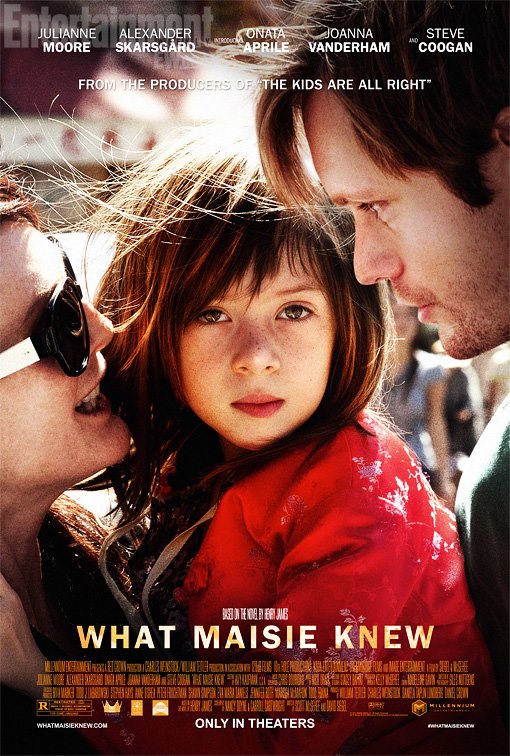
What Maisie Knew


Again, may I reiterate here as in previous posts about books to movies, the two are totally different art forms. Here, one is a 300 page literary work, internal, dense and deep. The other is a 93-minute production of visual storytelling, enhanced by dialogues and musical score. To achieve this end, screenwriters Nancy Doyne and Carroll Cartwright have to pick and choose the most relevant storyline and characters, and opt out of lengthy, internal exploration of psychological entanglements, something the literary form can describe readily. The screenwriters have done a good job in their choices, keeping the story simple and relevant for viewers a hundred years after the book was published. Despite the subject matter, the movie is enjoyable and highly watchable.

Set in modern day NYC, it smoothly tells a poignant story from the child’s point of view. Six-year-old Maisie (Onata Aprile) is eyewitness and victim of her parents’ constant quarrels and later divorce, a young child caught in the thorns and thistles of adult relationships. It is unfortunate that the most sensitive and observant child is often the most vulnerable. The naturalistic capture by the camera of Maisie’s quiet observations is most heart-wrenching. Maisie learns that the adult world is a busy place, her presence, an inconvenience. Thanks to the screenwriters’ gentler treatment, the movie spares us from some cruel, hateful fights in the book. We see Maisie ultimately get a taste of what it’s like to be cared for and to have some simple, childhood joy. The ending shot is beautiful.

Unlike Maisie in the novel, there is no moral dilemma for her in the movie. No doubt, the moral element is crucial in James’s novel. Divorce and adultery must have poked deep into the heart of James’s readers in his days. But our contemporary society has, alas, evolved into a ‘morally neutral’ state of numb resistance. The screenwriters may well know too that entertainment value comes before the didactic. We see no moral choices here with Maisie in the movie. After all, a young child will readily cling to whoever that loves her in deeds rather than mere words. Kudos to the filmmakers, they know the heart of a child.

Directors Scott McGehee and David Siegel capture the story from Maisie’s viewpoint, natural and realistic, camera lens often at a lower angle. Certain shots are particularly affective, from inside a taxi, the transport of choice in Manhattan, at different times the vehicle that takes away Mama, Papa, and caring Margo. We would see from inside the taxi out to Maisie standing on the roadside, abandoned and distraught.

The wonderful cast is what makes the movie so absorbing, and at times, even heartwarming, despite its subject matter. The then seven year-old Onata Aprile is a natural. Julian Moore’s solid performance as her mother Susanna is convincing. She is a touring rock-and-roll singer who has passed her prime. Jealous and temperamental, Susanna’s love for Maisie is possessive, and often displayed in empty words. British actor Steve Coogan, known to North American viewers by his recent starring role in Philomena, plays the career-minded art dealer father Beale. Like his ex-wife, he is too busy with his own life to care for a child. They both say they love Maisie, showering bursts of affection whenever they see their child.

What saves Maisie is the awkwardly positioned step-parents, her father’s new wife and Maisie’s former babysitter Margo (Joanna Vanderham, the parallel of Ms. Overmore in the book) and her mother’s new love interest, the tall and young bartender Lincoln (Alexander Skarsgård, a Sir Claude parallel). As predicted, they soon are abandoned themselves and the two quickly form a tie that includes Maisie in their life. Diverging from James’s story, the two are genuinely loving and caring, a soothing balm to Maisie and the viewers.

Overall, a fine, contemporary adaptation of the novel. To James purists, a loose reinvention; for viewers seeking meaningful entertainment, this should be on the list of films to watch.

~ ~ ~ Ripples


 ***

Robert Bresson’s Au Hasard Balthazar (1966): A Timeless Parable

Surely he has borne our griefs
and carried our sorrows;
yet we esteemed him stricken,
    smitten by God, and afflicted. 

— Isaiah 53:4 ESV

Several days before He is crucified, Jesus enters Jerusalem riding on a donkey. I love this scene. If there’s any cognitive dissonance in the crowd, here’s the stark message for their bewilderment. The King for whom they are cheering is not to be a glamorous celebrity. Rather, like the donkey, He comes as a humble servant, one who carries their load, and ultimately, even lays down his life for them. His kingdom belongs to another world.

Marie and Balthazar


As with my Easter viewing from previous years, I watch a film by the French auteur Robert Bresson. Bresson’s work has a transcending and spiritual quality that is deeply moving. In Au Hasard Balthazar, he creates an unusual metaphor using a donkey as his protagonist. We follow Balthazar as a young colt, loved by his first owner Marie. We see him grow up, weaving his life among different owners. We also see Marie grow up. Despite her love for Balthazar, she cannot stop the encroachment of evil, or maybe she is simply powerless. She does not defend Balthazar when a gang of young men abuse the donkey, tormenting him, whipping, mocking.

The gang leader is Gérard, whose sadistic, mean streak speaks for human depravity. He would pour gasoline on the road to cause unsuspecting drivers to skid and crash. He and his gang would watch nonchalantly from a distance, gratified that their prank has worked. He steals and deceives. What is a donkey to him if he does not even have the slightest respect for other humans. Once, to prod Balthazar to move forward, Gérard ties a newspaper to his tail and light it on fire.

The Gang

Throughout, Balthazar lives his life quietly in a parallel course to the growing depravity of the humans he serves. He suffers their cruelty in silence, occasionally he would bray in pain, but he continues to bear his load, pull a cart, or do whatever he is prodded to do, even a circus act. Due to neglect and maltreatment, he often becomes ill.

As she grows up, Marie discards childhood innocence and seeks to gratify her sensual pleasures. Against the protest of her parents, she falls for Gérard. She could have another choice, one who offers her genuine love, Jacques, the son of the owner of the farm where Marie and her parents reside. Jacque would come by every summer from the city with his father and sister to stay on the farm. When they were still children, they had spent endearing moments together with Balthazar. Jacques has declared lifelong commitment to Marie. But Gérard is a more instant and attractive outlet for Marie. Ultimately, she is dealt the harshest blow and most degrading abuse from Gérard and his gang as they rape her. Bresson spares us the ugly scene, but in the chilling aftermath, we see the young men walk away, nonchalant, throwing her garments on the ground behind them. After that tragic incident, Marie runs away. Her father is grief stricken, and soon falls ill and dies.

Gérard is unrepentant. After all, it’s self-serving lust he seeks; his callousness is most disturbing. In the last scene, we see he uses Balthazar to do one more job for his gang. They are to smuggle goods across the mountainous border. At night, he loads up his goods on the donkey and leads him to the border. From a distance, he hears gun shots from armed customs police. Gerard and his gang flee, abandoning Balthazar on the mountain. But it’s too late for Balthazar, he has been shot.

The final scene is most moving. In the open field, Balthazar walks slowly, haggard, blood streaming from his leg. He finally lies down, still carrying the goods Gérard has put on him, the load of sin. He breathes his last and quietly dies, alone.

Like Bresson’s Diary of a Country Priest, Au Hasard Balthazar is an apt meditation for Good Friday. But not just for this one day, their timeless message is like the Easter Season itself, a moveable feast.

~ ~ ~ ~ Ripples

***
Related Posts and Links:

Diary of a Country Priest: A Book For Easter

Diary of a Country Priest: Film Adaptation

Video of Robert Bresson on Au Hasard Balthazar

The Budapest Hotel: A Grand Escape

“But it doesn’t mean anything.”
“So we put in words. One word for every note, like this…”

— ‘Do-Re-Mi’ from The Sound of Music

Does music need words to make it meaningful? Do we have to find a message in a work of art before we can appreciate it?

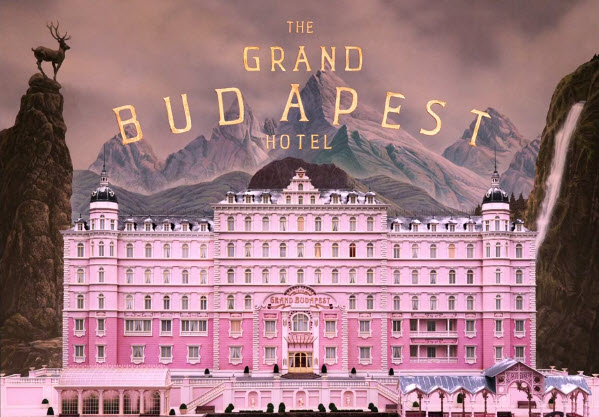
the-grand-budapest-hotel movie poster

Here we are with a cinematic piece that can’t be ‘explained’. What genre? What theme? What purpose? I’m not going to bother. As with my experience of watching previous Wes Anderson movies, somehow, I feel I need to let my rational side relax and just enjoy the ride. Rushmore probably has more of a traditional storytelling mode and thematic content. But with The Royal Tenenbaums, I have to adjust the quirky frequency to high, it’s a totally different kind of viewing experience. Fantastic Mr. Fox, I was mesmerized by the stop-motion animation and humour, great voices add to the lively adaptation of Roald Dahl’s story. Moonrise Kingdom, I wasn’t fully gratified but by then, I was used to the Wes Anderson style of ‘magical realism’.

That ‘magical realism’ strikes again in The Grand Budapest Hotel. Not my favourite colour palette, red and pink, by I was totally captivated as soon as the film began. I was being led into a fairytale world of real life people. From the cinematic framing, it aptly demonstrates the idea of symmetry. In many frames, the subject is right in the centre, almost perfect symmetry on both sides of the screen. But does it mean anything? One might ask. If we have to be rational about it, shall we just say, for the effects of a neat and tidy piece of the old world. Framing nostalgia before the world becomes too distorted, too inhumane. This is, after all, 1930’s Europe. And we can see the parallels in signs and symbols especially towards the end of the movie when uniformed men take over the Hotel.

Grand Budapest Signs & Symbols

Wes Anderson credits Stefan Zweig in creating The Grand Budapest Hotel. The Austrian writer’s name is shown at the very beginning of the end credits. In numerous interviews, Anderson pays tribute to Zweig’s whole collection of works, a writer who is noted as once ‘the world’s most translated author’. Zweig is a relatively new discovery for Anderson but so deeply has the writer inspired the filmmaker that ‘it’s basically plagiarism’, Anderson joked at the news conference when the film premiered at the Berlin Film Festival.

As someone who is much intrigued by the creative process of adapting books into films, I did read some Zweig before watching Budapest. I must be reading the wrong works though, I’d thought. From the novella Chess Story, to a few of the stories I read in the new collection recently translated into English, all tell very gloomy tales. The writings almost exude a sense of despair, as the characters are mostly running away from persecutions and ethnic cleansing, or memories thereof, even driven to madness as the chess champion Czentovic in Chess Story, albeit some descriptions embed a subtle trace of humour.

Maybe along the notion of ‘Wabi-sabi“, beauty and sadness, what Zweig has done subtly and now Anderson explicitly is to extract and fuse “humor and sadness”. Here in Budapest, writer/director Anderson has freely utilized the element of fantasy and fun to paint the passing of an old world, a realism too sad for millions in 1930’s Europe, Zweig being one of the subsequent victims. To escape the incendiaries of Nazism, Zweig and his second wife moved to England, then to the U.S., and finally to Brazil in 1940 where he ultimately committed suicide together with his wife in 1942, leaving a note of utter despair as he saw Nazism dominating Europe and his former homeland Austria.

In this fictitious Republic of Zubrowka, where The Grand Budapest Hotel is situated, Anderson offers us a great escape despite setting his story within the brewing tension of 1930’s Europe. The story begins with a closer to present day author (Tom Wilkinson) reminiscing upon an extraordinary experience which has inspired his book The Grand Budapest Hotel.

The Concierge Desk and Main Staircase

Years ago when he was still a young writer (Jude Law), in finding cures for writer’s block, he had retreated to a mountain hotel The Grand Budapest and in there met its owner, Mr. Moustafa (F. Murray Abraham). Known as Zero when he  himself was just a lobby boy in an age long passed, the owner told the writer his story of how he came to inherit this grand piece of property, albeit in a run-down shape now. Someone volunteering an extraordinary life story to an author in an exotic locale, the beginning of Budapest reminds me of Life of Pi, another great tale of magical realism.

But the movie belongs to Ralph Fiennes as the hotel Concierge and go-to person for all sorts of favours, M. Gustave. The death of long time patroness of the Hotel Madame D. (Tilda Swinton) has dragged M. Gustave and his protégé, the new lobby boy Zero, down a rabbit hole of misadventures and fortunes. Fiennes has proven that he is a versatile actor that can be as evil as Amon Goeth in Schindler’s List, or as madly romantic as Count Almasy in The English Patient, or as charming and fun here in Budapest. His comic timing is first-rate, his expressions, spot-on. My long-range forecast, an Oscar nom awaits him next year for his role in Budapest.

Gustave & Zero

The line-up of talents is long, not just in acting, where we find the usuals of Wes Anderson movies like Edward Norton, Tilda Swinton, Bill Murray, Owen Wilson, Adrien Brody, Willem Dafoe, Jeff Goldblum. Saoirse Ronan (breakout role as young Briony in Atonement) as Agatha the pastry maker is adroit and whimsical. She’s well matched to the young lobby boy Zero, aptly played by Tony Revolori.

The movie is also marked by the delightful compositions of Alexandre Desplat, whose musical scores adorn many notable movies in recent years. A collaborator with Anderson since Rushmore but here, Desplat’s scores captivated me early on with the lively East European themes and in particular, the Russian folk melodies. Some instruments that we seldom hear in other films are distinctly alluring, such as balalaikas, zithers, dulcimers, and organ, with full orchestral rendering. Another long-range forecast, Oscar for original score.

And then there’s the make-up of Tilda Swinton, the art work and production design of the whole Budapest experience (even the parody painting “Boy with an Apple” is an original art work by English painter Michael Taylor from a real life model), the flowing editing, the original screenplay and directing, the cinematography, Budapest Hotel is going to be one grand entry in the next Academy Awards.

~ ~ ~ 1/2 Ripples

 ***

Read a related post: How Zweig Inspired Anderson’s The Grand Budapest Hotel

Awards Update:

Feb. 22, 2015: Oscars for Best Costume Design, Make-up, Production Design, Original Score.

Feb. 14, 2015: Wins Best Original Screenplay from WGA.

Feb. 8, 2015: 5 BAFTA wins, Original Screenplay, Original Music, Production Design, Make-up and Hair, Costume Design.

Jan. 15, 2015: 9 Oscar noms, Best Picture, Best Director, Best Original Screenplay, Cinematography, Editing, Production Design, Make Up and Hair-Styling, Costume Design, Original Score.

Jan. 11, 2015: Golden Globe win for Best Motion Picture – Comedy or Musical

Dec. 11: 4 Golden Globe noms for Best Motion Picture – Comedy or Musical, Wes Anderson for Best Director and Best Screenplay, Ralph Fiennes for Best Actor – Comedy or Musical

Dec. 10: SAG nom for Best Cast in a Motion Picture

Dec. 7: The Grand Budapest Hotel wins Best Screenplay and Best Production Design at the L.A. Film Critics Awards

Dec. 1: The Grand Budapest Hotel just wins Best Screenplay from the New York Film Critics Circle

Related Links:

From BBC CULTURE: The Writer Behind Budapest Hotel

From NPR: The Rise and Fall of Stefan Zweig

The Music Behind the Screen

The Untold Story Behind ‘Boy With Apple’

The Railway Man by Eric Lomax: Book Review

This is an important book in that it chronicles the real-life experience of a prisoner of war in the hands of the Japanese army after the British surrendered in Singapore during WWII. The Pacific War is a part of WWII history that has often been ignored, other than the Pearl Harbour chapter. The British Empire in the Far East was dealt a deadly blow by Japanese invasions, and, British POW’s suffered not a bit less than those in Hitler’s death camps.

Japanese atrocities and war crimes have often been muffled in this our North American society. I don’t want to speculate why but yes, I do have an inkling which I will not discuss here. But as someone who had grown up in Hong Kong and came to Canada as a teenager, I can tell the difference in knowledge and perceptions when I compare the generally uninformed public of the West and those who themselves or their elders’ generation had lived through in Asia during the war.

Because of the general lack of knowledge on the Far East during WWII, Eric Lomax’s first person narrative as a POW in a Japanese labour camp and later military prison is all the more valuable. The memoir starts off with his love for the railways in childhood and how it turned into a youthful passion for engineering and radios that later led him to the Royal Signals Corp of the British army during the war in Singapore. As the colony fell to Japanese hands, Lomax’s life was torturously demented in subsequent decades until the very end.

The Railway Man Book Cover

Eric Lomax was a young 22 year-old when he was captured and moved with tens of thousands of POW’s to Kanchanaburi, Thailand, to build the notorious ‘Death Railway’ in 1943. It was a passage way for military transport from Thailand to Burma, and the route of a possible Japanese invasion of India. The conditions of forced labour were horrendous. Many POW’s died building the railway. This part of the world was the subject of the famous movie Bridge on the River Kwai, an unrealistic (even farcical now that I’ve read Lomax’s memoir) depiction of British POW’s inside Japanese military camps.

With his skills, Lomax and several others built a radio secretly to get news of the war. The radio was later discovered, together with a map Lomax had carefully drawn up of the railway line. Six of them were interrogated and savagely beaten by The Kempetai, or goon squad, as Lomax described them. Both his arms, wrist, several ribs, teeth, and his hip were broken. Two died from the beatings. While Lomax survived, more tortures and horrendous treatments followed in the days after. The experiences had left him permanently damaged psychologically for the rest of his life. Decades after the war, Lomax was still being tortured by terrifying flashbacks. The nightmares continued until he met his tormentor and forgiveness replaced hatred and vengeance.

So all in all, a significant story to tell. But while the book’s description is straight forward and clear, it leaves me ungratified as to its writing style and lack of deeper exploration, with all due respect to the author and his horrific, nightmares of ordeals. Yes, he had done a detailed job in reporting his personal journey from childhood to the war, the tortures and his suffering, other victims and their fate. As well, he recorded the aftermath of his horrific experiences as he re-entered ‘normal’ society, and sadly still, to a family that he no longer knew. His mother had died of a broken heart and his father had remarried. I was particularly engrossed with the after war effects in the last chapters.

However, the internal change of heart for the reconciliation with the Japanese interpreter had not been explored. After the bulk of the book describing his painful ordeals, the very last chapter of a happy ending looks off-balanced. It all started with the Japanese officer and interpreter, Takashi Nagase, who was present at Lomax’s torture, publishing his autobiography in his seventies. In there, he even mentioned the torture of Lomax, but due to his remorse, he felt he had been ‘forgiven’. Lomax’s second wife Patti, upon reading the English translation of the book, decided to write to Nagase regarding her husband. Patti’s letter opened up a chance for the later meeting between the tormentor and the victim.

Nagase had shown deep remorse, and dedicated his life after the war to help the Allies locate graves of POW’s, to ‘make-up’ for the wrongs the Japanese army had done. In his meeting with Lomax fifty years later, both in their seventies, near the bridge on the River Kwai, Nagase offered his visibly acute and sincere regrets for what the Japanese army had done to the British soldiers. A forgiving spirit suddenly took hold of Lomax and the two became friends. However, Lomax did not go deep into how his ingrained hatred and vengeance were alleviated, except noting that Nagase was a changed man now.

Further, the book had not answered a question I’ve always pondered. No, I understand it was never intended to delve into that issue as it is a personal memoir and not a political or philosophical treatise. But this question has been unsettling for me. What if the tormentor had no remorse, could reconciliation be possible? Other than Nagase, we know that many in Japan today still worship their dead WWII soldiers including war criminals as national heroes, unlike Germany’s denunciation of the Nazi regime. History textbooks had even been changed to tone down Japan’s aggression in the war. Even as recent as January 2014, Japanese Prime Minister Shinzo Abe visited and paid his pilgrimage at the Yasukuni Shrine in Tokyo. The controversial Shrine is a clear symbol of, in Lomax’s words, “an unashamed celebration of militarism”. In the book, we also read that Nagase had taken the unpopular and even dangerous stance of denouncing this war monument. To victims and their descendants of Japanese wartime atrocities, the chapter has not ended; in international politics, the issue remains.

It is always a triumph to see true remorse and subsequent reconciliation. Lomax’s personal story is extraordinary for both himself and Nagase. In that sense, readers are gratified with a light at the end of a long, dark chapter of one life, a bright stroke on the large canvas of WWII history.

***

The Railway Man by Eric Lomax, first published in Great Britain, 1995 by Jonathan Cape. Movie tie-in edition by Vintage Books, London, 2014, 322 pages.

** Movie Adaptation: I saw The Railway Man the movie at the Toronto International Film Festival in 2013. So far, there has not been a general, major release of the film here in North America. As much as I’d like to share my view on the film, with Colin Firth as Eric Lomax, Nicole Kidman as his wife Patti, and Jeremy Irvine as young Lomax, I intend to wait till there is a public release of the film before I post my review. Let’s hope I don’t have to wait much longer.

Related Links:

Pride and Pain of Patti Lomax

Railway Man’s Forgotten Family

What Japanese History Lessons leave out by Mariko Oi 

More Downton Ripples

Two years ago, some time after Downton Abbey Season 2 had finished airing on PBS, I wrote my first “Downton Ripples” post. I subtitled it “How I Overcome Downton Abbey Withdrawal Syndrome”. In that post, I’d listed some books and movies/TV productions that relate to the setting similar to Downton Abbey, for I was fascinated by the Great War period after watching Downton.

Some of the authors I read included Robert Graves, Hemingway, Evelyn Waugh, and watched Brideshead Revisited, A Handful of Dust, Easy Virtue and discovered Lost Empires, the TV series with a young Colin Firth together with Laurence Olivier, amazing.

This time, after Season 4, the withdrawal syndrome seems to have numbed a bit, but the ripples continue to spread. Again, Downton has prodded me to seek out the literature around the time between WW1 and WW2 Europe. While there are many present day authors writing about that era, I’d like to hear more authentic voices. I went looking for writers actually living in that period of history to hear their stories.

The following is a list of titles I’ve gone through this time, some I have finished, some still on my ‘To be’ agenda:

Parade’s End (2012, BBC/HBO co-production)

Parade's End Blu-Ray Cover

This series complements Downton Abbey perfectly. While Downton is light and heart-warming, soapy in its feel, Parade’s End is cerebral and literary, its social commentary of the time harsher and more incisive. I think the difference is, Julian Fellowes creates as a contemporary screenwriter, and knowing what modern day viewers want, he caters to their desire. Yes, he has offered us charming entertainment, and for the stars and the show, opportunities for Emmy and Golden Globe noms and wins.

Parade’s End is another story. Playwright Tom Stoppard (Emmy and BAFTA nom for this) adapts from Ford Madox Ford, a writer during WWI period, contemporary of Hemingway, Fitzgerald, the Lost Generation after The Great War, and witness to the destruction of the old world order and individual lives. Sure social barriers were dismantled, but together with such collapse came the shattering of long-held values and beliefs. Through the protagonist Christopher Tietjens, we can feel the intense struggles and poignancy of a man caught in such desolation.

I first saw Parade’s End on HBO when there was a window of free viewing. After watching one episode, I knew I must subscribe to continue with the rest of the series, and so I did. Effective advertising indeed. That was last year, and I recently just finished re-watching Parade’s End on Blu-Ray.

Parade’s End is the first time I watch Benedict Cumberbatch in a leading role (Emmy nom), an impressive performance as Christopher Tietjens, one of the last remaining honourable men struggling to stay afloat in the drowning waves of social change and ideals. Rebecca Hall (BAFTA nom) is effective as the scheming and seductive wife Sylvia. The young, almost ethereal Adelaide Clemens as suffragette Valentine Wannop is perfect. She makes me think of Carey Mulligan. And what a wonderful connection — Mulligan will be the star of the new film Suffragette, which I highly anticipate.

Parade’s End by Ford Madox Ford

Parade's End BBC Book Cover copy

This will be my major challenge in TBR books this year. Image here is the BBC Book edition I bought in a book sale a few years back. It has 906 pages, and is made up of four novels — Some Do Not, No More Parades, A Man Could Stand Up, and The Last Post. A more recent edition is the reissue of Penguin Modern Classic, with a new introduction written by Booker Prize winner Julian Barnes (The Sense of an Ending). You can read the intro here.

Parade’s End by Tom Stoppard

Parade's End Script by Tom Stoppard

I enjoy reading the scripts of productions I like. It’s a kind of deconstruction, if you will, demythisizing of sort. I’m fascinated by the skills of a screenwriter who uses words to elicit images for the director to execute, translating the literary into the visual using words. To write for the screen almost sounds like an oxymoron. I’ve read Julian Fellowe’s Downton Abbey scripts and found it most interesting. I’d like to explore Tom Stoppard’s journey of adaptation. But first, I need to tackle Ford Madox Ford’s original texts.

T. S. EliotT. S. Eliot — After Downton and Parade’s End, I’m all geared up to explore deeper into the the psyche and spirituality of the time. Why, after all, what had lost in a generation was not just the physical bodies or social structures, but the internal, the destruction of a value and belief system. I’d like to read and reread Eliot’s works, delve into a time that prompted the poet to see hollow men, and women come and go, talking of Michelangelo. What’s underneath the façade of human progress?

The Europeans by Henry JamesThe Europeans by Henry James — A voice from the dawn of the 20th Century. I have finished listening to the amusing auidiobook of The Europeans. Yes, unlike many readers’ impression of James’ works, The Europeans is a delightful read (listen). It is like a medley of E. M. Forster and Jane Austen. Humorous depiction of the different POV’s between a pair of European sister/brother coming to visit their American cousins residing in the outskirt of Boston. With some LOL moments. My next James read is The Ambassadors.

The Collected Stories of Stefan ZweigStefan Zweig — While Lady Edith’s love Michael Gregson headed to Germany and mysteriously gone missing, the then famous (real life) writer Stefan Zweig in Austria was lamenting the spread of anti-semitism in the continent. It’s interesting that Downton has led me to connect, at least in historical timeline, with an author I’ve just recently discovered, thanks to Wes Anderson’s The Grand Budapest Hotel, to which he has credited the works of Stefan Zweig. I’ve recently read Zweig’s Chess Story, and now delving into his short stories.

***

The Dinner by Herman Koch: A Timely Read, for Lent?

Why is this book compared to Gone Girl? It’s nothing like it. The Dinner belongs to a totally different calibre. If I have to compare it to something, then I’d say, reading it conjures up Dostoevsky’s Crime and Punishment. Are there really some in our society who think themselves so superior that they ought to be above the law? The law, after all, is a human construct. Can we not bend it to serve our own interest, when the interest is out of love for our son, or wife, or husband?

The Dinner

The Dinner is Dutch writer Herman Koch’s sixth novel. It has sold over a million copies and translated into twenty-one languages. The book deals with subjects that are soul-searching: The dichotomy between nature and nurture; how much of our being and psyche is hereditary? What portions of our actions are a result of our own waywardness as lost souls? As I was reading, the movie “We Need to Talk About Kevin” (2011) came to mind. However, what is not present at least in the Kevin movie is the accessory after the fact component.

The Dinner starts off with quite an original concept. The author parallels the story development with a gourmet dinner two couples are having in an upscale restaurant. The Apéritif and the Appetizer are the foretaste of what we will get for the Main Course. What appears to be petty, disgruntled complaints and personal biases of the narrator’s in the early chapters turn out to be only a light appetizer, for the main course is when a horrific crime is revealed. The ‘horror’, though, isn’t limited to the crime per se, for it is chilling to read how everyone involved deals with the aftermath.

The main course is a gripping thriller based on a real-life crime. After reading the novel, I googled and did find the report on it. Koch tells the story effectively with his straight-forward descriptions written with journalistic detachment, and incisive observation as the notes of a perceptive psychoanalyst. Further, he informs us with the detailed thought process of his narrator. Here is a disturbing look at someone who is capable to love his wife and son deeply but hates everyone else that crosses his path. This is more than a thriller though, for the moral dilemma or rather, its characters’ lack of sensitivity to it, is what makes the book provocative.

I don’t think we are expected to ‘like’ or even ‘identify’ with any of the characters. The book is effective in that we are left as observers. And with that, hopefully, we just might think a little deeper into issues concerning our humanity, and in the next generation of humans we bring up. How much are our children a result of our parenting and examples, how much are they a result of their own choosing and decisions? Can nature or nurture excuse us from our errors? If Freud were around today, The Dinner just might be on his reading list. But, would he be able to offer a remedy to save us from ourselves?

The ending shares a similar thought with the Woody Allen movie Crimes and Misdemeanours (1989). Now, as soon as I said this, some of you familiar with the movie might think I’ve dropped a spoiler in here. So, that’s the farthest I’ll go in describing the plot and details of The Dinner. The aftertaste may be haunting, but it is something that we should face as a human society.

Today is the beginning of Lent. I always feel such is an opportune time not so much about refraining from pleasure like abstaining from going to fancy restaurants for gourmet dinners, but in dwelling on the meaning of Easter. The Dinner may just have, inadvertently, reinforced the notion that we as individuals in a human society do need some form of saving grace after all.

~ ~ ~ ~ Ripples

The Dinner by Herman Koch, translated by Sam Garrett, published by Hogarth, 2012, 320 pages.

86th Academy Awards Made History

Oscar Selfie

The following is a partial list of last night’s 86th Academy Awards winners. I’ve included Production Budget from Box Office Mojo, just for comparison:

Gravity: 7 Wins

Best Directing, Cinematography, Film Editing, Sound Mixing, Sound Editing, Visual Effects, Music (Original Score).

Production Budget: $100 Million

12 Years A Slave: 3 Wins

Best Picture, Supporting Actress, Adapted Screenplay

Production Budget: $20 Million

Dallas Buyers Club: 3 Wins

Best Actor, Supporting Actor, Make-up and Hairstyling

Production Budget: $5 Million

The Great Gatsby: 2 Wins

Best Costume Design, Production Design

Production Budget: $105 Million

Blue Jasmine: 1 Win

Best Actress

Production Budget: N/A

Her: 1 Win

Best Original Screenplay

Production Budget: $23 Million

12 Years A Slave Poster copy

The Oscars last night made history in two categories… and I don’t mean Ellen Degeneres’ star-studded group selfie setting retweeting record. First, there was Gravity’s director Alfonso Cuarón as the first Latin American to win the Best Directing Oscar. Gravity seemed to be the major winner last night with seven Oscars. Basically the 3D, sic-fi movie had snatched all technical wins, as predicted by many.

But in every Academy Awards, the top prize is Best Picture, here we see 12 Years A Slave make history with Steve McQueen becoming the first black director to garner the Best Picture Oscar honour. Lupita Lyong’o also came out victorious as this is her first feature film. I’m happy to see too that John Ridley win the Best Adapted Screenplay, the second black winner to fetch a writing Oscar, after Geoffrey Fletcher for Precious in 2009. Ridley has turned Solomon Northup’s poignant memoir into a script for an impressive visual testament. Because of the film, this eye-witness narrative of Solomon Northup hopefully will find its way into school curricula soon. This is the power of cinema in transforming society.

Cate Blanchet‘s win for her role in Blue Jasmine gives her a chance to counter a misconception: “… and perhaps, those of us in the industry who are still foolishly clinging to the idea that female films, with women at the centre, are niche experiences. They are not. Audiences want to see them, and in fact, they earn money.”

Hopefully after all the ‘history’ being made, one day we won’t have to identify the colour, ethnicity, or gender of winners in saying so-and-so is the first black, or hispanic, or woman to win this or do that.

**

The reason I’ve included the Production Budget in the above list is that I remember the ‘implosion’ of the movie industry‘ Steven Spielberg had predicted a year ago as he cited productions getting more and more costly, aiming at mega, iron-man effects to please the general public. While Gravity might fit that category with its 3D, high-tech, CGI-driven grandiosity and out-of-this-world spectacle, there are also worthy, smaller productions that cost only a fraction of a colossal budget, but still can move audiences and touch the human heart.

**

Related Posts on Ripple Effects:

History Made At The Oscars: Kathryn Bigelow Wins Best Director

Our Mega Culture

12 Years A Slave: Beauty and Sadness (Movie Review)

Narrative of Solomon Northup: A Voice that Must Be Heard (Book Review)

Nebraska: Color is Superfluous (Movie Review)

The Great Gatsby Movie Review

Blue Jasmine: Homage & Re-imagining

***

Downton Abbey Season 4 Episode 8: The London Season

This final two-hour ending reminds me of the beginning two-hour opener of Season 4, fast paced, short scenes, too busy to dwell deep. But here we have a plethora of characters and grander moments, the Prince of Wales with his parents King George V and Queen Mary joining the cast? A bit surreal I feel.

Rose meets King & Queen

Interesting too that despite the spectacular scenes, these final two hours are relatively uneventful, not many threads leading to new story ideas. Mary will keep on being pursued. Now that she has found out Charles Blake is a much more eligible bachelor than she first thought, will that make a difference to her? That heart-to-heart talk between Mary and Tony, with her hand gently placed on his arm, welcoming whatever future life might bring is one of my favourite moments.

And Rose, after her débutante ball, will pursue even more.

Bates’s status quo will remain the same too. He won’t be investigated further as far as Mary is concerned. Mrs. Hughes has already released him. Bates’ loyalty to The Crawley family has exchanged a pardon from Mary, whereby she burns the train ticket, evidence proving his presence in London on the day Green was accidentally killed. So far of course. All things are in the hands of the powerful Julian Fellowes, who BTW, has thrown us a case of debatable ethics.

Bates has proven himself to be more resourceful than we first thought. Why am I not surprised? Now… that makes me think of Michael Gregson winning back all the poker money from Sampson in one night. Sampson should have learned his lesson by now. The Crawley household is his nemesis, even their guests and servants .

Eight months after Edith has gone to Switzerland and come home more tired than ever, she begins to have second thoughts. Having given birth to a baby girl and weaning her, she has put her up for adoption in Geneva with the Schroeders upon the persuasion of Aunt Rosamund. Back home, Edith misses her daughter and revives her initial idea of asking the tenant farmer Mr. Drewe to raise the baby incognito, to which Drewe agrees. But why would he agree though, and to keep it a secret just between the two of them? Now this could be the beginning of a dramatic storyline in Season 5.

Michael Gregson is still nowhere to be found, although we know what has taken place before his disappearance. And that just makes me tip my hat and raise a little respect for him. Although in Rosamund’s eyes, he’s just plain stupid. Why, to ‘take exception’ to what some men are saying, men wearing ‘brown shirts’? If he had known they were, exactly, ‘The Brownshirts’ (Sturmabteilung), Nazi goons, would he have shown his opposition so readily? But I say, kudos to him. Another case of debatable ethics thrown to us by Julian Fellowes.

Sarah Bunting turns out to be much more annoying. Her insistence to visit the Crawley home in their absence and going upstairs is more than a little imprudent. She sure has made a huge leap from Elizabeth Bennet in terms of social courtesy. Remember how uncomfortable Lizzy is in visiting Pemberley in the absence of its host. I sure hope Tom can stand his ground with this gal. Her seemingly innocent and assertive demeanour just may hide a more malicious intent. After all, Downton represents the aristocracy that she loathes.

London Season

The main attraction of this finale is of course Martha Levinson and his son Harold sailing the ocean blue to Downton Abbey. I first had high expectations for Paul Giamatti. MacLaine we had seen her in Season 3, so she keeps the critical face towards the British aristocracy, that’s consistent. Hers and Violet’s harsh and honest exchanges against each other add colours to the gentility that has prevailed the night of the ball.  

But I must say, Giamatti’s constipated (can’t think of another word) performance is a surprise and disappointment. I had expected a much more animated screen presence. Even Daisy saying: ‘I’m never excited’ is funnier. BTW, that’s got to be one of my favourite lines in this episode. Back to Harold, he and his initial qualm with Madeleine Asslop is fine, having many fathers ‘shoving their daughters’ at him. But falling for her right after? Julian Fellowes is a master matchmaker, but we all hope to see compatibility, at least just in appearance.

Like, ah… Isobel and Lord Merton. Isobel is not interested, at this stage. When he asks her to dance and she says “I’m really not much of a dancer,” I like his prompt reply: “O all right. So we’re a perfect match.”

The most cinematic scene has to be the seaside relaxation for the staff. There are very few scenes in all Downton Seasons that are just composed of the downstairs characters alone in the great outdoor. Here by the seaside, mood changes. We love to see them enjoy themselves for a change, like Mrs. Patmore buying an ice cream cone, Molesley playing football, Anna and Bates finally taking a relaxing stroll (love their hats), and Baxter becoming brave. Daisy is sweet even when she turns down Levinson (ok, Ethan Slade); Ivy is excited to have the chance to go to America. But the final scene belongs to Mrs. Hughes and Mr. Carson:

“We can afford to live a little.”

At the seaside

Season 5: Something to look forward to. Just another year, that’s all.

***

Downton Abbey Season 4 Recaps:

Episode 7

Episode 6

Episode 5

Episode 4

Episode 3

Episode 2

Opening 2-hour Special

***

Downton Abbey Season 4: Episode 7 (PBS)

I’ve thoroughly enjoyed this captivating episode. All its conflicts seem to have derived from the notion of ‘truth’: truth telling, truth hiding, truth seeking. I’m beginning to sense that Julian Fellowes is telling us that, Happiness is … not having had to hide any secrets and having no reasons to. But then, where’s the drama?

But first, the race to Mary’s heart is clearly a tight one between two rivals, Tony Gillingham and Charles Blake, the pig expert. You can add in Napier, standing afar and looking aloof, only sending out helpless vibes. Bravo to Mary for being true to her feelings, at least for now, as she declares in no obscure terms: ‘I’m not on the market, Tony. I’m not free.’ And later to Charles with a similar message in the bazaar. Didn’t you hear, guys? Sure, but they are not the type to give up easily, ‘not without a fight’.

I like the changed man Molesley has become. He’s not afraid to show his fondness for Baxter, who remains aloof and full of secret past and present agendas. But Molesley is, well, Molesley, oblivious, self-deprecating, ‘felt fragile his whole life’, but true. In response to Baxter declining his offer of a cup of coffee, his reply is one of the lines that made me LOL in this episode:

“It’s just coffee. You won’t have to surrender any of your independence.”

Molesley could well pull Baxter out of Thomas’s grasp: “I wish you’d give us credits for making our own minds about you.” Well done.

Serendipity is the word for Tom and Sarah Bunting with their accidental encounters. So now he finds out she’s a school teacher, and, quite a progressive and opinionated woman too, definitely not a fan of the aristocracy. But Tom revealing his past life as a chauffeur and now fixing her stranded car on a country road add a lot of credits, a true spokesman for the Crawleys. And for a line like this one, you have to give the man extra kudos, speaking like a fine political candidate: ‘I don’t believe in types. I believe in people.’ Will they be a good match? That fully depends on matchmaker Julian Fellowes.

Rosamund is so supportive of Edith. Is this even within her nature? Going to Switzerland to learn French as a guise, bringing Edith with her for a few months so she can give the baby up for adoption after its birth. Violet is always on top of things. Even she has to agree with Rosamund this time, giving her approval after finding out the plan.

Julian Fellowes is busy with another prospective match-making, and that’s Isobel and Lord Merton. I’m most amused by Violet’s surprised glances back and forth following the fond conversations between the two. They take a stroll after the luncheon. Conversation goes well until Lord Merton asks about Matthew unaware. Now that only gives him opportunity to send flowers the next day to amend his ‘tactlessness’.

And then there’s the mirage of Rose and Ross, about to set an engagement date. Mary aptly steps in to stop a ‘guess-who’s-coming-to-dinner’ prank Rose has intended maliciously on her mother. So this is not so much about equality or free love, but using the race card for one’s private end. Jack Ross’s mother suspects her motive too. She apparently has raised a good son, who for consideration of Rose, decides to end the relationship. However, ‘in a better world’, the card Rose plays just might be a joker, with no face value… in a better world. Maybe it’s Rose who needs to go to Switzerland to learn French, or about herself, anything.

The Daisy-Ivy-Alfred conflict comes to a very moving conclusion. Kudos to Julian Fellowes. Alfred proposes to Ivy, who courteously declines. Daisy comes to realization upon the wise counsel of Mr. Mason, good man, and brings a basket of gift to Alfred to say goodbye and wish him well. They part as ‘friends forever’. One reason I’m drawn to Downton is that it seeks to portray something that might have slowly become archaic nowadays, but definitely needs to preserve: True friendship without romantic mash-up. Mrs. Hughes and Mr. Carson in a previous episode, and now Daisy and Alfred. I don’t know what the future holds, but for now, they are perfect as they are.

A touching reunion copy 1I love these Downton outdoor events, the tea party, cricket game, and now the bazaar. Cora can manage full well in Robert’s absence. It is a success and fun to watch. Important events take place, such as Robert and Thomas’ unannounced return, a huge surprise and delight, and a most touching reunion of Robert and Cora, thanks to the timely cue of the warm Downton music.

The most important twist is Tony Gillingham coming to the bazaar to tell Mary of the news that his valet Green has died in a traffic accident in Piccadilly, just one day after Mary asks him to sack Green. Accident? or Bates’s revenge? Again, we’re kept in the dark, knowing only that Bates has taken a day’s leave ‘to York’ while Anna goes to London with Mary. Can’t read any clue from his face either, unlike his stabbing look at Green in Episode 6. His answer to Anna’s query is both puzzling and chilling: ‘You know me, when I do a thing, I like to have a very good reason for doing it.’ Again, the suspense lies in the fact that we don’t know the truth, at least, not yet.

But that sharp stare from the last episode is replaced by three curious and fond gazes here in Episode 7. In the last scene, Isobel, Edith, and Rose together lean forward to watch Mary walk away with her two suitors Tony and Charles. Well synchronized, girls. What a fun closing shot.

As we come near to the end of another Season, I eagerly want to find out the final resolutions of the story lines, yet at the same time, I’m beginning to feel a parting sadness. You too?

***

PREVIOUSLY ON DOWNTON ABBEY Season 4:

Episode 6

Episode 5

Episode 4

Episode 3

Episode 2

Opening Special

***

12 Years A Slave, Narrative of Solomon Northup: A Voice That Must Be Heard

“Is everything right because the law allows it?” — Solomon Northup

This is one of those cases where after watching the movie, I knew I must read the original source material, especially that it was written by Solomon Northup himself. If the movie is an artistic, cinematic account of a dark page in history, Solomon’s narrative is the quintessential eyewitness report, a first-person, authentic voice that is both a victim and a legitimate accuser of an inhumane and unjust system.

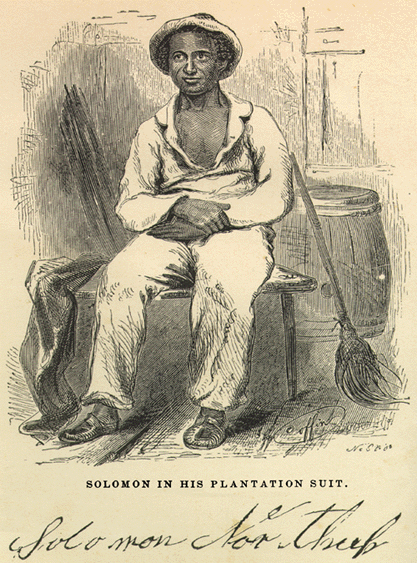
Solomon Northup copy

Born a free man in the State of New York, Solomon was happily living in Saratoga Springs, married to Anne and enjoying a loving family life as father to Elizabeth, 10, Margaret, 8, and Alonzo, 5. In March, 1841, his life was tragically altered when he was deceived by two men, Brown and Hamilton, and followed them to Washington, believing that he was to be hired to play the violin in a circus. Solomon was later drugged, kidnapped, chained and beaten. Together with other captured victims, he was smuggled to New Orleans and sold as a slave, his name changed to Platt, erasing any evidence of a previous life.

Having no free papers to prove his identity, transported and sold like a chattel to the Bayou in Louisiana, Solomon’s fate was sealed hundreds of miles away from home. His agony was heart-wrenching:

Were the events of the last few weeks realities indeed? — or was I passing only through the dismal phases of a long, protracted dream? It was no illusion. My cup of sorrow was full to overflowing … To the Almighty Father of us all — the freeman and the slave — I poured forth the supplications of a broken spirit, imploring strength from on high to bear up against the burden of my troubles, until the morning light aroused the slumberers, ushering in another day of bondage. (p. 77)

Solomon Northup’s eloquent writing immediately draws me in. It has a traditional and formal ring to the ear, but not archaic; it exudes clarity, finesse and grace. I’m struck by his stylish narrative even when he is describing depravity and injustice. After reading, I can see how the book had inspired director Steve McQueen’s beautifully rendered, artistic cinematic work on such an ugly subject matter. 

The movie follows the memoir closely, albeit leaving out a lot of details. Reading the source material after the movie can fill those in, making it so gratifying.

It was strictly forbidden of slaves to learn to read or write; pen and paper were prohibited. Any slave found to have even minimal education would be severely punished. Solomon had to feign ignorance all the years as a slave to survive. His memoir was written after he gained back his freedom in 1853.

I was most impressed that while Solomon yearned for deliverance and justice, he harboured no traces of personal vengeance against his tormenters. He had proven himself a man of integrity. Often he was sought after for his resourcefulness and his skills in playing the violin. He had entertained masters, and offered momentary relief to fellow slaves.

For two years Solomon was under the kind master William Ford, but had to be sold to the ‘slave breaker’ Edwin Epps to escape from Ford’s jealous and murderous slave driver Tibeats. The subsequent ten years with Epps became an extended living nightmare.

While the movie adaptation is an excellent production which I gave 4/4 Ripples, I find  Solomon Northup’s memoir even more engrossing. I’m particularly impressed by the fact that the book is not a self-absorbed account of sufferings, but as a careful memoirist, he records many details that are informative and even interesting, such as the natural vegetation of the Bayou environment, the cotton and sugar cane crops growing from seeding to harvesting, and the geography of the locales.

Like a perceptive ethnographer, he chronicles plantation life as a slave, the dwellings, diet, work load, daily chores, maltreatments. From his candid revealing, we are led into the subjective world of slavery, being sensitized to what it is like living in bondage and helplessness, constantly fearful of severe whipping and even death. Like a suspense writer, Solomon leads us to follow his risky attempts to seek help, and await in bated breath the day of his rescue. 

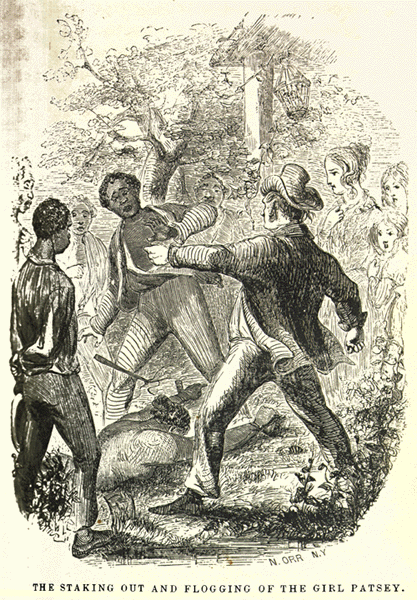
An incisive observer of human nature, Solomon sharply describes the psychological makeup of the alcoholic psychopath Epps, and the conflicting power relation binding Epps and his wife, complicated by his gratuitous fondness of the slave girl Patsey. We see in the movie Patsey suffers the brunt of her Mistress’ jealousy, and the maltreatment under her Master who tries to please his wife. The traumatic scene in the movie where Solomon is ordered by Epps to whip Patsey is described even more poignantly in the book. I’m surprised that the literary narrative has a more powerful hold on me than the visual rendition in this scene.

Flogging of Patsey copy

The memoir serves its purpose as a piece of personal narrative that’s poignant and deeply moving. The resilience and faith of Solomon Northup is crucial in his later being rescued. His longing for freedom and justice that is devoid of personal vengeance is most admirable and inspiring.

The rescue is a long and testing process, not so short as in the movie which I feel is a bit off balance. The adaptation should have given viewers a sense of the actual attempt especially in his home state of New York among those who try to find and rescue him. Thanks to the free-thinking, itinerant carpenter Bass from Canada who came to work for Epps for a short time, Solomon saw a crack opened for a chance to relay news back to the North by way of Bass.

Solomon had disappeared from the lives of his wife and three children for twelve years. Thankfully they were all well. When he reunited with them, he had the pleasure of seeing his newborn grandson, named after him by a devoted daughter. His youngest son Alonzo had the plan to make enough money to buy back his freedom if he could be located. It was indeed a moving scene as depicted in the following sketch from the book:

Family Reunion copy

After he had regained freedom, the slave trader Burch, ‘a speculator in human flesh’, was arrested and brought to trial in Washington, where he kidnapped and sold Solomon into slavery. However, Solomon was denied the right to be a witness against Burch for he was a black man. Burch was later found not guilty and discharged. Solomon wrote in his memoir:

A human tribunal has permitted him to escape, but there is another and a higher tribunal, where false testimony will not prevail, and where I am willing, so far at least as these statements are concerned, to be judged at last. (p. 319)

His faith in that ‘higher tribunal’ and an ultimate judge had carried Solomon Northup through the twelve years of slavery. His narrative not only is a voice that testifies against the injustice of man, but poignantly declares that freedom transcends physical bondage. Amidst inhumanity and despair, he had chosen to remain human, and to value integrity and faith. Solomon Northups’ ordeal is a glimmer of light in a dark page of history.

The Oscars dim by comparison.

~ ~ ~ ~ Ripples

CLICK HERE to read my movie review of 12 Years A Slave

***

Free Download:

Twelve Years A Slave, Narrative of Solomon Northup, NY, Miller, Orton & Mulligan, 1855, 336 pages, with appendix of legal documents and papers. You can download the PDF version of the original 1855 publication free here.

***

Downton Abbey Season 4 Episode 6 (PBS)

The opening reminds me of the very first scene of Season 1 Episode 1, where the Western Union telegraph machine rhythmically tapping, leading us into this whole new world called Downton Abbey, and the rest is history. That first telegram was news about the Titanic sinking. Now Lord Grantham sets off to America in response to a telegram from Cora’s mother Martha (we all remember Shirley MacLaine’s American entry into Downton) just to help her son look good in front of a Senate Committee.

Robert may well be doing this more for Cora’s bidding than Martha’s. A sweet farewell follows. Crossing the raging seas, leaving the comfort of Downton on such a short notice, Lord Grantham would have wished he could just do a video conferencing. That would be more futuristic than the science fiction of his time, considering the telephone was just introduced to the household not too long ago.

Come to think of it, going to America just to help out a brother-in-law? Or was it to take time off to shoot The Monuments Men? Or, a subtle promo of the next best thing, The Gilded Age Julian Fellowes will be writing for NBC after Downton? Just thinking…

Downton S4E6 Robert goes to America

So now the secret is out, to Mary at least, and to the suspicion of several others. They would want to find out why Thomas is going to America with Lord Grantham and not Mr. Bates. Baxter is commissioned to hand in a report on exactly that when Thomas returns.

The pig farming business is off to a blossoming start… romantically that is. Getting dirty to save the pigs looks quite contrived a scene. Blake has to do much more than getting his white shirt and tux muddy to win me over. I’m not as easy as Mary. Or, is she just trying to prove she’s not so aloof after all. So they both enjoy their ‘night of discovery’. Why, Mary Crawley can make scrambled eggs. How marvellous!

Tom also seems to have met a potential companion in a political lecture in Ripon. Will this revive an idealistic young heart he once possessed?

Violet falls ill and Isobel nurses her back to health. Even in her delirious state Violet still takes a swing at Isobel, this ‘mad woman’, have her replaced, for she ‘talks too much, like a drunken vicar.’ Whatever we can’t say out loud in our right mind can be said in our delirium. How convenient.

Alfred’s brief return rousing further animosity between Ivy and Daisy. Mrs. Hughes and Mrs. Patmore come up with the flu as a reason to keep him off, and Mr. Carson is willing to go along even to the point of paying for a hotel stay. That sounds a bit far-fetching. A little jealous bickering adds spice of life downstairs. No need to avoid that like the plague.

A storyline that has far greater consequence is Edith going to London to have an abortion. Her secret is out as she breaks down when Lady Rosamund mentions about Michael Gregson. Aunt Rosamund looks an unlikely sympathizer, reassuring her “I will support you whatever you decide, just as Cora will—and Robert.” Edith doubts her sincerity and says “That sounds like a speech from The Second Mrs. Tanqueray”, alluding to the 1893 play by Arthur Wing Pinero about ‘a woman with a past’. Rosamund shows her support by accompanying her to the clinic. At the last minute, Edith changes her mind and chooses to keep the baby. I’m glad to see that a humane storyline branching out from there.

While in London with Edith, Rose runs her errand. Yes, that means meeting up secretly with the Jazz singer Jack Ross. Rose just wants some temporal fun, while Ross looks a bit hesitant but is fast convinced by her enthusiasm.

The most gripping scene again belongs to Bates and Anna. Lord Gillingham is back (but why?) and with him comes his valet Green, a blow to Anna as she steps into the servants’ dining room and sees her attacker. She composes herself quickly, but not before the reporter Baxter notices. Mrs. Hughes doesn’t lose any time to give him a severe warning, “If you value your life, I should stop playing the joker and keep to the shadows.”

At the dining table Green is as sociable as ever, greeting everyone, talking naturally. Baxter mentions how much she admires Nellie Melba, the opera singer, obviously with an agenda. Green says he can’t stand the ‘screaming and screeching’. The Sherlock in Baxter then asks, “So what did you do?” Green takes the bait, “So I came down here for some peace and quiet.” The look Bates pins on Green after that should send chills up your spine. And there, the episode ends. Baxter has more than a report to write, that’s a lead into a juicy story, Stephen King style.

***

PREVIOUSLY ON DOWNTON ABBEY SEASON 4:

Episode 5

Episode 4

Episode 3

Episode 2

Opening Special

***

Downton Abbey Season 4 Episode 5 (PBS)

A relatively light-hearted episode, but the cheeriness depends on your point of view, quite like the Super Bowl, celebratory depends on which side you’re rooting for. But overall, a delightful and engrossing hour.

First off, a little surprise, Alfred is leaving. I thought the foursome is going to have some more entanglement. Alfred is accepted to the training course after all at the Ritz Hotel, London. That’s a significant leap from the servants’ hall in Downton, deserving celebration, but only depends on which side you’re on. Daisy is heartbroken. Eventually she’s sweet to make peace with Alfred and herself, wishing him luck as he leaves.

Violet and Isobel’s battles resume, evidence that Isobel has recovered from her mourning. She’s a social activist fighting for justice, and Violet, the established aristocracy, therefore legitimate target of her indignation. When Violet wrongly accuses and fires young Pegg for stealing her things, yes, things, Isobel rediscovers her calling. Things are what Violet cares about, so materialistic, so unjust. The ivory curio is soon found, misplaced.

Some interesting dialogues ensue…

Isobel: “Aren’t you going to say you’re sorry?”

Violet: “Certainly not.”

Isobel: “How you hate to be wrong.”

Violet: “I wouldn’t know. I’m not familiar with the sensation.”

The Sherlock in Isobel does some personal digging and recovers the valuable missing letter opener. What develops is like a parable. Isobel makes the same mistake of which she accuses Violet when she misjudges Pegg too soon and unwilling to face up to her wrongs, not knowing Violet after discovering her own mistake has already apologized to young Pegg, asked for his forgiveness, and rehired him back. Nobody monopolizes justice after all.

Napier and Blake turn out to be unwelcome guests. Not that I’m not sympathetic to farmers or food production, but these two men just prove they are the entitled ones, especially Blake, biting the hand that feeds him. Why, which guest would sit beside his host and call her “a sentimentalist who cannot face the truth.” Now where does that come from?

Rose has proven to be quite an event planner. Lord Grantham’s birthday party is a success, the secret is a big surprise, as she has intended. Jack Ross has done the unprecedented, bringing a night club jazz band into Downton, and he himself can go down history as the first black person to set foot in that aristocratic estate. Time has changed, or at least started to. Despite his shock, Mr. Carson is quick to point out that “we led the world in the fight against slavery,” but not before embarrassing himself by asking Ross: “Have you never thought of visiting Africa?”

While everyone is having some light-hearted turns, the heavy news or lack thereof falls like lead on Edith. She found out she’s pregnant, and Michael Gregson has “vanished into thin air.” At this stage, she doesn’t suspect anything except to worry about him. But this just may prove to be another dark chapter in her failed romantic narratives.

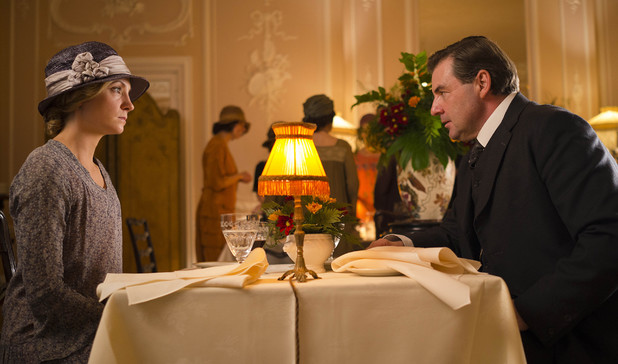
A date in the shadowBates and Anna’s seemingly reconciled relationship is another dark shadow in an otherwise bright episode. I like these contrasts as far as plot is concerned, light and shadow. The intriguing development is with Cora overhearing their conversation in the hotel dining room, and later, Baxter overhearing Cora talk with Mary about her concern. Even though she’s warned not to leak out what she has heard, Baxter has her assignment, the ‘condition’ as Thomas reminds her.

That hotel dining scene is oh so gratifying. Anna has phoned earlier to make a reservation. When actually there, the Maître d’ takes a top-to-bottom glance at their attire, decides there’s no reservation under the name of Bates. Julian Fellowes’ another social justice moment. Lady Grantham, Cora, comes to the rescue, ever so graciously. Isobel would have made a scene.

As for the Maître d’, a perfect casting would be Rowan Atkinson, aka Mr. Bean. Just a thought.

But my favourite scene is when Isobel, Mary, and Tom are in a room waiting to see the little ones being brought in by their nanny. These three are all widowed, survivors of tragedies when their loved ones were unexpectedly taken away from them. Mary is honest with her feelings: “I’m just not quite ready to be happy.” Then, Isobel starts sharing and reminisces on her engagement with her husband Reginald; Tom joins in with his love for Sybil; Mary recalls Matthew’s proposal to her while standing in the snow, not feeling a bit cold. Each recharged by the memory of love. Isobel cheerfully concludes at the end: “Well, aren’t we the lucky ones.”

Your favourite scene?

***

Previously on Downton Abbey Season 4:

Episode 4

Episode 3

Episode 2

2 Hour Opening Special

***