Copyright Infringement

Arti is going through the most depressing blogging experience at the moment.  No, it’s not the Blog Stats, or the comments, or the lack of them.  I admit they can affect one’s mood.

The most discouraging scenario for a blog writer is to see not one, or two, but 10 of her posts being copied and reprinted in their entirety on another website.  Of course when they do that, there won’t be any link back to your own blog, neither would your name appear as the writer.

I was aware of this as a “pingback” on my posts, waiting for me to approve.  A click on the trackback link I found they were no “pingbacks”.  My whole home page with 10 posts all appeared on the plaigerizer’s site.  What’s funny is even my last post, stating I was Arti at Ripple Effects, was intact in the content. 

This just confirms it’s a myth to think it’s a compliment to your writing when you see your work copied.  Do you think Splog operators would care to read every post and think it’s good before stealing?  The whole process is automated.  It just happens that maybe my posts just carry the tags they’re looking for.  By the way,  all my 10 posts are categorized under “Music” on that Splog.  You can tell how much they care about the content of even their own site! 

These are Splogs, Spamblogs.  They exist to collect advertising revenues using other people’s materials just to attract traffic.  How can one write so many posts all on a single day if not by the simple act of copying and pasting?  It has been noted that on the average, a blogger takes from 1 to 8 hours to writer a post.  Well, for slow bloggers like Arti of Ripple Effects, it takes days of mulling, reading, viewing, researching, before writing.  The last step in the whole process usually logs in the higher end of that 1-to-8-hour range.

Arti feels robbed, violated, and knocked out.  What’s the point of continuing wtih this if whatever I write is taken away and published as somebody else’s work? 

While still sustaining a concussion, Arti went through the process of writing a complaint letter, found in the very informative website Plaigarism Today, and trying to find the hosting company of the site through http://whois.net.  But of course, it’s blocked by the domain owner so I had nowhere to send my complaint letter.  It did though lead me to the site Privacy Protect, where I could at least launch a report of abuse and hopefully locate the domain owner.  As of now, I’m still waiting for a reply.

Finally, an email to WordPress Support, a most helpful source, led me to the possible hosting company, to whom I directly sent my letter of complaint.  Within the hour, I received their reply, stating that they had ‘reminded’ the owner to remove the pirated content.  I assume they are in good faith, since the language is not in English, except the few lines addressed to me. I appreciate their immediate response.

Whew!  Even writing this sequence of events is exhausting!  But now that I’m done, I feel relieved.  Another reason why we blog.  Ok, maybe it’s still worth it, to continue writing, blogging, and all that.

So yes, if you’re reading this on a website other than Ripple Effects, you know you are reading a post that has been copied without permission. Go to https://rippleeffects.wordpress.com to read this and other interesting articles in their original.

Update April 29:  Arti felt like the victim of a practical joke when she saw this very post, entitled “Copyright Infringement”, was copied on to that Splog mentioned here.   Anyway, here’s the good news:  The Splog in question has now been suspended by the hosting administration.  Thanks for all your moral and practical support.

The Poets’ Corner

poets-corner-book-cover

Just got this from the library, and it’s a gem.  The Poets’ Corner is subtitled The One-And-Only Poetry Book for the Whole Family, compiled by John Lithgow.  Yes, that’s John Lithgow of the ‘3rd Rock from the Sun’.  From Matthew Arnold to W. B. Yeats, Geoffrey Chaucer to Allen Ginsberg, it’s more like a high school curriculum than your light family reading.  However, the collection includes many favorite selections, ideal to share as literary heirloom.

Lithgow presents fifty poets whose work he had grown up with.  He has written a two-page introduction for each of them, a personal response to a piece of literary art.  In the introduction of the book, he explains how it all started.  Lithgow was invited to host a benefit for a non-profit organization.  The fund raiser was for the fostering of creative approaches to educating autistic children.  He was given a few poems to read out that night, poignant poetry that speaks to the heart of parents with autistic children.  That night, Lithgow saw the power of poems read out, the voice and the words striking a shared chord with deep resonance. Thus planted the seed for this book.

The central theme here is not autism, but the selections here speak to a general and wider audience, humanity at large.  The bonus is a CD featuring readings from Lithgow And Friends.  I believe that poetry read out loud offers a heightened enjoyment than just from silent reading.  I had heard recordings of Robert Frost and William Carlos Williams  reading their own work, leaving indelible resonance that I didn’t get from reading off the page.

Here in this CD, what we have are  professional performers, experienced and well-trained in the art of speech, dramatically performing these selections. And Lithgow’s ‘Friends’ include: Eileen Atkins, Kathy Bates, Glenn Close, Jodie Foster, Morgan Freeman, Helen Mirren, Lynn Redgrave, Susan Sarandon, Gary Sinise, and Sam Waterston… what a cast.

Here are  some of my favorites, too bad I can’t embed the sound track.  But do check it out from your local library, or even get a copy of your own.  It’s a keeper.

We Real Cool by Gwendolyn Brooks

(Read by Morgan Freeman)

The Pool Players.

Seven at the Golden Shovel.

We real cool. We

Left school. We

Lurk late. We

Strike straight. We

Sing sin. We

Thin gin. We

Jazz June. We

Die soon.

***

I Wandered Lonely As A Cloud by William Wordsworth

(Read by Helen Mirren)

I wandered lonely as a cloud

That floats on high o’er vales and hills,

When all at once I saw a crowd,

A host, of golden daffodils;

Beside the lake, beneath the trees,

Fluttering and dancing in the breeze.

*

Continuous as the stars that shine

And twinkle on the milky way,

They stretched in never-ending line

Along the margin of a bay:

Ten thousand saw I at a glance,

Tossing their heads in sprightly dance.

*

The waves beside them danced; but they

Out-did the sparkling waves in glee: A poet could not but be gay, In such a jocund company: I gazed—and gazed—but little thought

What wealth the show to me had brought:

*

For oft, when on my couch I lie

In vacant or in pensive mood,

They flash upon that inward eye

Which is the bliss of solitude;

And then my heart with pleasure fills,

And dances with the daffodils.

***

The Red Wheelbarrow

by William Carlos Williams

(Read by Jodie Foster)

so much depends

upon

a red wheel

barrow

glazed with rain

water

beside the white

chickens.

***

No Doctors Today, Thank You by Ogden Nash

(Read by John Lithgow… I LOL listening to him)

They tell me that euphoria is the feeling of feeling wonderful,

well, today I feel euphorian,

Today I have the agility of a Greek god and the appetitite of a Victorian.

Yes, today I may even go forth without my galoshes,

Today I am a swashbuckler, would anybody like me to buckle any swashes?

This is my euphorian day,

I will ring welkins and before anybody answers I will run away.

I will tame me a caribou

And bedeck it with marabou.

I will pen me my memoirs.

Ah youth, youth! What euphorian days them was!

I wasn’t much of a hand for the boudoirs,

I was generally to be found where the food was.

Does anybody want any flotsam?

I’ve gotsam.

Does anybody want any jetsam?

I can getsam.

I can play chopsticks on the Wurlitzer,

I can speak Portuguese like a Berlitzer.

I can don or doff my shoes without tying or untying the laces because

I am wearing moccasins,

And I practically know the difference between serums and antitoccasins.

Kind people, don’t think me purse-proud, don’t set me down as vainglorious,

I’m just a little euphorious.

**

Lithgow and friends have convinced me all the more that poetry is written to be heard.

Poets’ Corner:  The One-And-Only Poetry Book For The Whole Family, compiled by John Lithgow, Grand Central Publishing, 2007,  280 pages.

Stream of Easter Consciousness

stained-glass-2a2So students are sent back to school this week, just in time for Easter.  Nobody wants to have a holiday right on Easter week, especially the public school board.  That’s how you survive,  by being politically correct.  And the last two weeks’ holiday is called Spring Break of course.   Easter has almost become a banned word, like Christmas.  Who wants to be rude and offend others, we’re Canadians after all.
I know,  it’s not totally a taboo yet.  It’s a much tamer word, Easter, than Christmas, just because it doesn’t have the six-lettered word in it.  You can curse with that name, but no, God forbid you should say it in a proper context.   I can see you sneer, what’s a proper context, you ask.  You’re right of course, no word or context is more proper than others, we’re egalitarians after all.  As for Easter, as long as it’s synonymous with eggs and bunnies, pastels and flowers then it’ll never die.  Who needs resurrections?

All Fridays are good.  They even have a whole restaurant chain commemorating the day.  What’s it called… yes,  T.G.I. Friday’s.  Who says we’re not religious, we thank God for happy hours.  We’re much more open-minded now,  more civilized, equal and fair, don’t want to pick one day to be better than the others.  But definitely we won’t forget Ramadan, or the Chinese New Year.

There’s probably no God,  so stop worrying and enjoy your life, the sign on the bus says.  So we’re safe?   Whew!  No God means we can now be happy, worry free, all life, no death, …  Umm just let me figure this one out.  Give me a minute, I’m just not as smart as them.

Jesus wept.  He wept at the graveside of Lazarus, brother of his dear friends Martha and Mary.  He wept at the fragility of life.  He wept at the searing pain of separation.  He wept at the hopeless and uncomprehending expression on Mary’s face, even after he said to her I am the resurrection and the life.

Fleming Rutledge said more than ten years ago:  “I am deeply convicted, more so each year, of the profound sinfulness of the human race.  Yet because of the Cross and Resurrection of Jesus Christ — because of that and nothing else, because of that and nothing less — I am also convicted of the truth of what the Bible tells us about God’s plan of salvation.  The rainbow bridge does not lead to Valhalla, where the gods quarrel so much that they destroy themselves.  The rainbow bridge leads to the Cross and to the empty tomb on Easter Day.”

Utterly politically incorrect!  Who uses the word sin anymore?  Who’s Fleming Rutledge, anyway.  Never heard of him.  No?  It’s a she?  No wonder.

Now these words echo loud and clear too, written by T. S. Eliot in… what, 1934?  Aren’t they a bit archaic now?  Or, maybe they’re really prophetic:

Where is the Life we have lost in living?
Where is the wisdom we have lost in knowledge?

Where is the knowledge we have lost in information?

The cycles of Heaven in twenty centuries

Bring us farther from God and nearer to the Dust.

We should go on living, be happy and worry-free, the sign on the bus says.

So we go on living…

and Jesus still weeps.

stained-glass-41

*****

Original photos and text copyright by Ripple Effects, https://rippleeffects.wordpress.com, April 2009.  All Rights Reserved.

No Texting for Lent and The End of Solitude

Roman Catholic Bishops in Italy have added some contemporary relevance in the fasting tradition during Lent:  High Tech Fast.  The faithful are urged to free themselves from the bondage of technology and gadgets, and refrain from surfing, emailing, twittering, texting … in order to prepare themselves for Easter.  This could prove to be a penance much harder to practice than not eating meat, even just on Fridays, for texting could well be the newest form of addiction today.

At about the same time, I heard an interview on the CBC Radio program Spark.  Host Nora Young conducted an interview with William Deresiewicz, literary critic and essayist, who has recently written an article entitled ‘The End of Solitude’.

Deresiewicz taught at Yale from 1998 to 2008.  When he asked his students what place solitude had in their lives, he got this reply: “Why would anyone want to be alone?”

With the ubiquitous use of high tech gadgets, and the torrents of Internet social networks around us, we are caught in a web of connectivity like never before:

Not long ago, it was easy to feel lonely.  Now, it is impossible to be alone.

Not only that, the goal now seems to be to gain as much self-exposure as possible, to be visible.  It seems that the number of friends we have on Facebook, and the number of hits on our blog directly leads to our self-esteem and our quality of self.  The irony is, the pseudo and the virtual are substituting the genuine and the authentic.

What does friendship mean when you have 532 “friends”?  How does it enhance my sense of closeness when my Facebook News Feed tells me that Sally Smith (whom I haven’t seen since high school, and wasn’t all that friendly with even then) ‘is making coffee and staring off into space’?

Deresiewicz notes that solitude used to be a desirable social value.  From religious sages to the Romantics like Wordsworth, solitude is the channel one hears the still, small voice of God, or heed the beckoning of Nature.  As modernism crept in,  the literati turned inward to find validation of self, like Woolf, Joyce, Proust.

Then came urbanization and suburbanization.  The generation that used to vegetate in front of the TV has given way to the child of the Internet, the networked self.  And we no longer believe in the solitary mind.

So what does it matter when we have lost the moments to be alone?  What have we lost?

First, the propensity for introspection, that examination of the self that the Puritans, and the Romantics, and the modernists (and Socrates, for that matter) placed at the center of spiritual life — of wisdom, of conduct.

Also, the urge to be instantly connected has bred a new generation of skippers and skimmers, replacing readers.

… five minutes on the same Web page is considered an eternity

No wonder we’re told to keep our blog posts short if we want to attract readership.

With the loss of the capacity for solitude, we’ve lost the ability to cultivate depth of self  and create independent thinking.  Emerson said that “Solitude is to genius the stern friend.”  Deresiewicz goes on to say:

…no real excellence, personal or social, artistic, philosophical, scientific or moral, can arise without solitude.

The irony is, the more we are connected with the virtual world out there, the less we are connected with ourselves inwardly.  But this is what’s valued nowadays, isn’t it, to be open, sociable, gregarious.  But to maintain a sense of authentic self, we may have to sacrifice popularity, to be not so polite:

Thoreau understood that securing one’s self-possession was worth a few wounded feelings.  He may have put his neighbors off, but at least he was sure of himself.

Those who would find solitude must not be afraid to stand alone.

Maybe this is one meaningful connection we should strive for: solitude, introspection, slow blogging, quality thinking, quality reading, quality writing, quality self.

****

Click here to listen to the full interview.

Click here to read the article ‘The End of Solitude’ by William Deresiewicz.

Click here to read my review of Sherry Turkle’s Alone Together

Click here to read my post on Virginia Woolf’s A Room of One’s Own in which she explored the privilege of Solitude.


Time’s 25 Best Blogs 2009

Just when Arti is wondering how to spend the next 48 hours before Sunday’s Academy Awards, an incoming link pops up on her dashboard.  It is a blog talking about Time’s recent selection of  25 Best Blogs for 2009.   A stroke of glamour no less than the golden Oscar flashes across Arti’s muddled mind… huh, Ripple Effects got linked to what?  The researcher in Arti quickly heeds the call to check it out.   No, Ripple Effects is not on the list.  Slap, slap, wake up, this is the real world now… it’s just that one of Ripple Effects’ posts got linked by WordPress’ auto-generated linking mechanism.  In the huge blogosphere out there, being chosen as one of the top 25 blogs is just got to be harder than winning the Oscars.  What am I thinking.

For those interested in the curious case of  Time’s 25 Best Blogs of 2009, here is the list and the subject matter of the blogs:

  1. Talk Points Memo — Political
  2. The Huffington Post — Political
  3. Lifehacker — “Tips and downloads”
  4. Metafilter — Wikiweblog
  5. The Daily Dish — Atlantic Andrew Sullivan’s Political blog
  6. Freakonomics — NY Times Stephen Dubner and Levitt, Economics
  7. BoingBoing — Technology and fringe culture
  8. Got2BeGreen — Environment
  9. Zen Habits — Self-help and motivational
  10. The Conscience of a Liberal:  NY Times Paul Krugman, Nobel Laureate, Economics
  11. Crooks and Liars — Political
  12. Generación Y — Political
  13. Mashable — Social Networking
  14. Slashfood — Food
  15. The Official Google Blog — Business
  16. synthesis — opinions & ideas
  17. bleat — life in retro
  18. /Film — Films and Video Games
  19. Seth Godin’s Blog — Marketing
  20. Deadspin — Sports
  21. Dooce — Heather Armstrong on a female life
  22. The Pioneer Woman — Ree Drummond on a female pioneer life
  23. Said the Gramophone — Music
  24. Detention Slip — cheat sheet for education news
  25. Bad Astronomy — in praise of real science

So, here they are, your celebrities, the blockbusters of the blogosphere, some attracting millions of page views per month, the Hollywood Oscar scene of blogging.  But I must say I regret to see there are no blogs on the list that are dedicated to the arts or books.  Further, hats off to all those who write in obscurity, like many of my favorites.  They are the solitary bloggers who quietly express their views towards life’s issues, or share their love of a book, response to a film, or simply capture a moving moment, blogs that deserve to be read just the same as the blockbusters.

Maybe there needs to be an indie blogging recognition, like in the film industry, an Independent Spirit Award for bloggers who write and toil just for the simple pleasure of observing, expressing, sharing, and celebrating the essence of being human.  No glamour, no red carpet.

*****

P.S.  Ok, they have the red carpet too at the Spirit Awards and glamour automatically comes with that I suppose… Anyway, I’m sure you get my point.


Too Much Jane?

davies460

Andrew Davis pondering

The Welsh filmmaker Peter Greenaway once made a controversial remark criticising film versions of literary work as mere “illustrated books”.  Regarding Jane Austen’s work, he said:

Cinema is predicated on the 19th century novel.  We’re still illustrating Jane Austen novels–there are 41 films of Jane Austen novels in the world.

What a waste of time.

Click here for the Wales news article containing the above quote.

To the discomfort of Mr. Greenaway, there have been more Austen adaptations made since he spoke.  As recent as just two weeks ago, BBC has announced that a four-episode production of Emma will be launched this fall.  The award-winning writer Sandy Welch (Jane Eyre, 2006, TV; Our Mutual Friend, 1998, TV) is working on the new script, with actors pending.

Why do we need another Austen adaptation?  Do we need another “illustrated book” as Greenaway has argued?

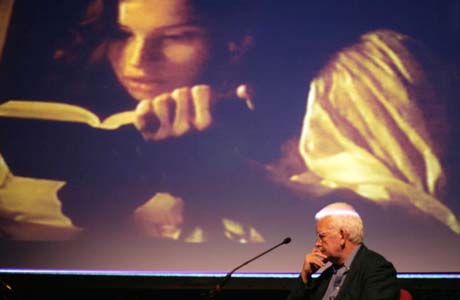
I was surprised to hear such remarks from Mr. Greenaway, himself an art house filmmaker.  He certainly doesn’t need to be reminded of the power of the visual.  I have expressed my stance against his argument in a previous post entitled ‘Vision not Illustration’.  But as more Austen adaptations appear, laying ratings and profits aside, I still believe there is an artistic merit in turning book into film.

The visual has an immense power in bringing out the essence of the literary.  An image can elicit deep and hidden thoughts, stir up emotions of past experiences, point to new insights, and unleash multiple responses in just a short lapse of time.  The cliché  “A picture speaks a thousand words” has its application in this visually driven generation.  Not that I do not treasure the classics, or the literary tradition.  Far from it.  I think a good film adaptation can, at best, enhance our enjoyment of the literary, and if it fails, can only help us appreciate the original genius even more.

If Bach, over 300 years ago, could invent Theme and Variations, why can’t we in this post-modern age, where multiple narratives are cherished, create adaptations to a recognized original?  Of course, the key is held by the filmmakers. It takes the insightful and  interpretive lens of a good writer, director, and cinematographer to craft a fresh perspective, one that can evoke a new vision and yet still remain true to the spirit of the original.

Kate Harwood of BBC explains why another adaptation of Emma is ensued:

In Emma, Austen has created an intriguing heroine, and our four-hour canvas allows us to explore this multi-faceted character in detail.  Emma was Austen’s last novel, written when she was at the height of her craft, and we are delighted that such an esteemed writer as Sandy Welch is bringing her vision to this appealing story.

How appropriate it is for Harwood to see film as a canvas for visual exploration, and the writer’s vision as a crucial element in the creative process.

I say, bring on more Austen adaptations.  Jane would be most pleased… belatedly.

*****

The above posted article has since been published in the Jane Austen Centre Online Magazine, where you can read more about Jane and her world.  Click here to go there.   

Click here to read my review of Part 1 and Part 2 of Sense and Sensibility, broadcast on PBS Masterpiece Classic Feb. 1 and 8.

Unaccustomed Earth by Jhumpa Lahiri

unaccustomed_earth

“Jhumpa Lahiri is the kind of writer who makes you want to grab the next person you see and say, ‘Read this!'”

— Amy Tan

Unaccustomed Earth is one of the five fiction selections of  New York Times Best Books for 2008.  Jhumpa Lahiri’s debut work, Interpreter of Maladies, a collection of short stories, won the 2000 Pulitzer Prize for fiction, and later received the PEN/Hemingway Award, the New Yorker Debut of the Year award,  American Academy of Arts and Letters Addison Metcalf Award, and was translated into twenty-nine languages.  Her next work was The Namesake, a novel which was turned into film by acclaimed director Mira Nair.  Unaccustomed Earth is her third book.

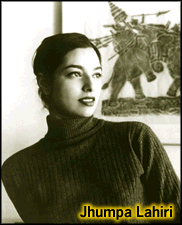
Jhumpa Lahiri was born in London, England, to Bengali immigrants.  Her family later moved to the United States and settled in Rhode Island where she grew up. Lahiri went to Barnard College and received a B.A. in English Literature.  She furthered her studies in literature and creative writing and obtained three M.A.’s, and ultimately, a Ph.D. in Renaissance Studies at Boston University.  So, she knows her subject matter well.  In Unaccustomed Earth, characters are Bengali immigrants, mostly academics, their second generation who are born in foreign soil and their non-Indian friends or spouse.  The stories deal with the entanglement of cultural traditions, incompatible values, failed hopes and expectations, and the subsequent internal strives that haunt them all.

But why would we be interested in stories like these?  Herein lies Lahiri’s insight.  While the viewpoint of these characters might be parochial, Lahiri’s stories bring out the larger universal significance.  Who among us doesn’t belong to a community, and at one time or another, question his/her conformity in that very community?   Regardless of our ethnicity, who among us isn’t born into a family with its own peculiar traditions and values?  Who among us doesn’t feel the distance separating generations in our world of rapidly shifting paradigms, be they cultural, social, or spiritual?   And who among us, as one in the mass diaspora of drifting humanity, doesn’t want to lay down roots in fertile soil?

Despite the somber themes, reading Lahiri is an enjoyable ride.  Herein lies Lahiri’s talent.  She is a sensitive storyteller, personal in her voice, subtle in her description, meticulous in her observation of nuances, and stylish in her metaphoric inventions.  Her language is deceptively simple.  The seemingly lack of suspense is actually the calm before the storm, which usually comes as just a punchline in the end of each story, leaving you with a breath of  “Wow, powerful!”  But it is for that very line that you eagerly press on as if you are reading a thriller or a page-turner.

jhumpa_lahiriThe book is divided into two main parts.  The first contains five short stories.  The second, entitled “Hema and Kaushik”, consists of three stories but can be read as a novella on the whole, for they are about two characters whose lives intertwine in an inexplicable way.  While the characters and their situations are contemporary, their quest is the age old longing for love and connection.
I have enjoyed all the stories, but the most impressionable to me is the title one.  In  “Unaccustomed Earth”,  Ruma is married to an American, Adam, with a young child Akash, and pregnant with another.   Her recently widowed father comes to stay with her in Seattle from the East Coast, just for a visit.   During his stay, Ruma’s father builds up a bond with his grandson Akash.   The two create a little garden at the back of the house, a relationship thus flourishes as the flowers and plants blossom.  Ruma struggles with the idea of whether she should welcome her father to live with her for good to fulfil her filial duty, but by so doing, she would be adding a burden to her nuclear family.  What she does not know though is that her father has his secret and internal conflict as well.  He too wants a life of freedom and love.  The story ends with a dash of humor and a little surprise, reminiscent of a Somerset Maugham story.  I will not say more, or the spoiler will lessen your enjoyment.

I have read all three of Lahiri’s work.  And this is my query:  If her first book garnered the many literary awards including the Pulitzer, I just wonder what else could she win with her newest creation, which I enjoy far more.

Unaccustomed Earth by Jhumpa Lahiri, published by Alfred A. Knopf, NY, 2008.  333 pages.

~ ~ ~ Ripples

****


81st Academy Awards Nominations (2009)

oscars

CLICK HERE to read The 2009 Oscar Results.

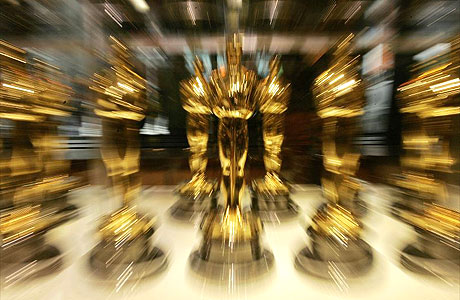
So, the news is out. For a complete list of the 2009 Oscar nominees, click here to go to the official Oscars website. For those who didn’t bother getting up at 5:30 am PT to watch the announcement live, here’s the video clip.

The clear front runner is The Curious Case of Benjamin Button, grabbing 13 nominations, just one short of the record shared by All About Eve (1950) and Titanic (1997).

Slumdog Millionaire is not far behind, a fantastic rags to riches exemplar in itself, garnering 10 nominations.

When I look at the Best Picture categories, I notice that four of the five nominees are produced from an adapted screenplay.  Here are the origin of these now famous movies, the source materials that first spark and channel the creative energy of screenwriters,  causing them to propel a much lesser known work into the orbit of box office profits:

  • The Curious Case of Benjamin Button:  Loosely based on a short story of the same name by F. Scott Fitzgerald.  The imdb site does not even mention this source material.  But for those of you who want to acknowledge the original writer’s work, click here to read the short story online.
  • Frost/Nixon:  Based on a play by Peter Morgan.  To read the NY Times review of this theatre production, click here.
  • The Reader:  Based on the novel by the German writer Bernhard Schlink.  To read the discussion of book into film at guardian.co.uk, click here.
  • Slumdog Millionaire:  Based on the novel Q & A by the Indian novelist Vikas Swarup.  To read his interview on guardian.co.uk, click here.

So I say, kudos to all the original writers out there, without getting as much notice, not in this part of the world anyway, until their work is chosen to be made over into a movie, or picked by Oprah (The Reader).  It says a lot about our consumer and celebrity driven culture, that a piece of writing gains recognition only when it is released in a movie tie-in edition, or favored by a TV icon.

Well,  the message of Wall-E is relevant here.  I’m glad to see it getting 6 Oscar nods including Best Original Screenplay.  The last time an animated feature received 6 nominations was Beauty and the Beast (1991), itself a case in point with the hype of commercialism boosting the literary form.

And then on another note, I read about the first edition of Emma that Jane Austen signed and gave to her friend Anne Sharp (thought to be the inspiration for the character of Mrs. Weston in Emma) was on sale at the Antiquarian Book Fair in Hong Kong last week, asking price HK$3.95 million (approx. US $500,000).  I wonder also how much all those movies profited from adapting her novels.  I lament Jane who died impoverished.

Photo Source: guardian.co.uk

*****


Reading the Season: A Grief Observed by C. S. Lewis

c-s-lewis2To embrace the Christmas season in a more meaningful way, I’ve been trying to stay close to the heart of the matter by reading.

A Grief Observed by C. S. Lewis is one of my selections. Now, of all the wonderful books by the Oxford scholar, why would I choose this title for the Season?

From my reading of Joan Didion’s The year of Magical Thinking, I learned that during her mourning for the loss of her husband, she had read C. S. Lewis’ A Grief Observed. That sparked my curiosity. After finishing Didion, I turned right away to explore Lewis’s book about his own experience of loss.

After 58 years of bachelorhood, Lewis found the love of his life in Helen Joy Gresham, an American author who had come all the way to England in search of a genuine and credible faith. Their love story is poignantly portrayed in the movie Shadowlands (1993). In Helen Joy Gresham (‘H’ in the book),  Lewis found his equal in wit, intellect, and a faith that had endured testing and evolved from atheism to agnosticism and ultimately reaching irrevocable belief. Lewis entered into marriage with Joy at her hospital bed as she was fighting bone cancer. She did have a period of remission afterwards, during which the two enjoyed some traveling together. Regretfully, only four years into their marriage, Joy succumbed to her illness.

shadowlands

A Grief Observed is a courageous and honest disclosure of a very private pain. But what’s so different about this personal loss is that this prominent Christian apologist, acclaimed academic and writer, was willing to lay bare his questioning mind and disquiet heart to his readers. As his step-son Douglas Gresham wrote in the Introduction, the book is “a man emotionally naked in his own Gethsemane”. By crying out in anguish and exposing his torments, he shared his personal journey of painfully seeking the meaning of death, marriage, faith, and the nature of God. Lewis was brave enough to question “Where is God?” during his most desperate moments, when his heart was torn apart by searing pain and his intellect failed him with any rational answers.

Gradually he came out of despair realizing that the loudness of his screams might have drowned out the still, small voice speaking to him.

The time when there is nothing at all in your soul except a cry for help may be just the time when God can’t give it:  you are like the drowning man who can’t be helped because he clutches and grabs…

After all, you must have a capacity to receive, or even omnipotence can’t give.

After the fog of doubt has dispersed and the dust of despair has settled, Lewis saw the dawning of a gentle glimmer. He realized that he had been mourning a faint image or memory of his beloved, but not beholding the reality of her. The fickleness of his senses offered only fading fragments of her image. However, it is in praise that he could enjoy her the best.

I have discovered, passionate grief does not link us with the dead but cuts us off from them. This become clearer and clearer.  It is just at those moments when I feel least sorrow–getting into my morning bath is usually one of them–that H. rushes upon my mind in her full reality, her otherness.

Praise is the mode of love which always has some element of joy in it. Praise in due order; of Him as the giver, of her as the gift.

Further, as with God, he knew he should grasp the reality, not just the image.  He should treasure God Himself, not just the idea of Him:

I need Christ, not something that resembles Him.  I want H., not something that is like her.

Upon this revelation, Lewis powerfully points out that the Incarnation, the Word becoming flesh, is how God reveals Himself to us in His full reality.  Our ideas of God are shattered by Christ Himself.

The Incarnation… leaves all previous ideas of the Messiah in ruins.  And most are ‘offended’ by the iconoclasm; and blessed are those who are not.

As Christmas draws near, I ponder once again the humbling of the Creator God, born a babe to grow up to experience the full spectrum of being human, showing us by His life and death the reality of God, an iconoclastic act only He can perform.

Lewis has drawn me to the heart of the matter, the crux of the Season:

And the Word became flesh and dwelt among us, and we have seen his glory, glory as of the only Son from the Father, full of grace and truth.

— John 1:14

*****

‘Reading The Season’ Posts over a Decade:

2020: Jack by Marilynne Robinson

2019: ‘A Hidden Life’ – A Film for the Season

2018: A Verse from Madeleine L’Engle’s The Irrational Season

2017: A Wrinkle in Time by Madeleine L’Engle

2016: Silence by Shusaku Endo

2015: The Book of Ruth

2014: Lila by Marilynne Robinson

2012: Surprised by Joy by C. S. Lewis

2011: Walking on Water by Madeleine L’Engle 

2010: A Widening Light by Luci Shaw

2009: The Irrational Season by Madeleine L’Engle

2008: The Bible and the New York Times by Fleming Rutledge 

2008: A Grief Observed by C. S. Lewis

I’ve Loved You So Long (2008, France) Il y a longtemps que je t’aime

Update: 

March 3:  The DVD has come out.  For those who don’t like to read subtitles, the DVD has an English Version with Kristin Scott Thomas voicing her own part.  But nothing compares to the original of course. 

Feb. 8  I’ve Loved You So Long has just won the BAFTA for Best Film Not In The English Lanugage tonight in London, England.

Dec. 11:  I’ve Loved You So Long has just been nominated for two Golden Globes, Best Foreign Film and Best Actress (Drama) for Kristin Scott Thomas.

Sisters reuniting is the storyline of several movies recently, as in Margot At The Wedding (2007) and Rachel Getting Married (2008 ).  But both Nicole Kidman and Anne Hathaway are just featherweights compared to Kristin Scott Thomas’s powerful performance here in I’ve Loved You So Long.

il-y-a-longtemps-que-je-taime

Winner of the 2008 Berlin International Film Festival, I’ve Loved You So Long is the  directorial debut of Philippe Claudel, French novelist, screenwriter, and professor of literature at The University of Nancy.  It is unfortunate that festival films like this one are rarely shown in North America, except in major selective cities.  I’ve wanted to see the film for a while, but not until my trip to Vancouver last week did I have the chance to watch it in a theatre.

In the film, the reunion of the sisters comes under the most unusual of circumstances.  Kristin Scott Thomas (The English Patient, 1996) plays Juliette, an older sister who has just been released on parole after 15 years in prison.  She rejoins society to the  embrace of her younger sister Léa (Elsa Zylberstein).  Léa was only a young teenager when her much older sister was disowned by their parents.  To them, the crime she had committed was unforgivable.   Léa was told to ostracize Juliette, as the rest of the family did.   Now years later, Léa is teaching literature at a university, and  mature enough to reconnect the tie that binds.   She receives Juliette  into her own home, a warm family with a loving husband, two adopted Vietnamese girls, and her father-in-law Papy Paul (Jean-Claude Arnaud), who has lost his ability to speak after a stroke.  But her husband Luc (Serge Hazanavicius) is apprehensive, and understandably so.

Like the viewers, Léa is kept in the dark as to the details of the act Juliette had done , a secret that is painfully borne by Juliette alone.  The slow unfolding of the facts thus sets the stage for the heart-wrenching performance by Scott Thomas.  The film is an exploration into the nature of good and evil, love and forgiveness.  In our society that excels in labeling people, the writer/director leads us to ponder the questions of what constitutes a crime, who are the victims, likewise, who are the strong, the helpers, and who are those that need help?  How can we truly know each other?  And ultimately, what is love?

ive-loved-you-so-long

I admire that the elegant Oscar nominated actress Scott Thomas was willing to take up a role that would cast her against type, and to work under a first-time director.  Devoid of  make-up, her gaunt and haunted look,  deep set eyes and languid lids, and the high cheek bones that used to speak of beauty in her other films now form the epitome of a soul tormented.  Her icy demeanor reflects a guarded self that is too wounded to risk another blow.  Though released from physical confinement, Juliette is still imprisoned by her own guilt, and has to serve a  life sentence of torments from the ambivalence of her act.  Scott Thomas has poignantly portrayed a believable character and effectively created a tragic heroine.  Juliet is out of prison, has nowhere to go, lost to herself and the world.

Yet love paves the road to redemption, and courage is the building block.  While Léa plays a major part in reaching out to Juliette, her adopted daughters and even the silent Papy Paul have all unknowingly participated  in the healing process. It is his silence and the calming effect of his books that Juliette finds affinity.  In sharing the French children’s song ‘Il y a longtemps que je t’aime’ with Léa’s adopted daughter P’tit Lys (Lise Ségur), she ventures out to reconnect in a meaningful way.

Léa also invites Juliette into her circle of friends, in particular, her colleague Michel (Laurent Grévill).  Michel has spent some time teaching in a prison.  He reaches out to Juliette with his understanding and compassion, and shares with her the enjoyment of art.  Although he does not know the full details of her circumstances, he respects her humanity and offers his friendship, even when Juliette is not ready to receive.  He patiently waits.

Engrossing and intense, the film nonetheless offers a satisfying experience.  Even though I was able to guess the nature of the dark secret underlying the suspense, such that it has lessened the effect of surprise on me at the end, I still find the film thoroughly enjoyable, in particular, the superb acting from both sisters.  For those who associate tears with melodramatic and contrived effects, the film is an apt refutation of such a view.  Tears are most welcome and cathartic as a closure here after almost 90 minutes of elliptical restraint,  for they are  the very expression of reconciliation and redemption.  The climax is one of the most poignant I’ve seen in a long while, and the subsequent ending, a triumph.

I look forward to more of Claudel’s work.  And for Kristin Scott Thomas, I think she deserves no less than an Oscar for her performance.

~ ~ ~ ½ Ripples

****

Slow Blogging and the Long Take

Recently, I’ve been mulling over the notion of slow blogging, a movement that is gradually gaining attention. I first read about it in a blog I frequent.  In her post entitled “Slow, Stefanie has drawn out the essence of what slow blogging is. It’s all about thinking through, reading and studying in depth, chewing and digesting, and finally putting something meaningful down in words. I don’t know who initiated the idea. It may have sprouted up from various bloggers, those who care about the quality of their writing, and the effects of their posts. I urge my readers to visit the Oxford University Press blog post on the subject, and the Slow Blog Manifesto.

Yes, a Slow Blog Manifesto, written by Todd Sieling dated back to September, 2006. But for some uncanny reasons, just as I was working on my draft of this very post, after I’ve linked the SBM to my draft, it has now been taken off the WWW.  Hope this is not an omen of things to come.  Fortunately, before its disappearance, I had the chance to read and mull over his words:

“Slow Blogging is a rejection of immediacy.  It is an affirmation that not all things worth reading are written quickly.”

(It’s back!  Todd Sieling has just re-posted his SBM. He has created a whole new site just for this.  Click here to go there.  You may want to read his comment at the end of this post. I’m just going to leave the following paragraph as is.)

But then, all is not lost.  Barbara Ganley’s BGBLOGGING is still standing.  Ganley had taught writing at Middlebury College in Vermont for some years until quiting her academic job in recent months and ventured into uncharted personal exploration.  She is an advocate of slow blogging, and related the idea to the term meditative blogging, way back in November 2006.  Here’s the link to that post.

After more than two years, the notion has finally reached Arti of Ripple Effects. As my blog name suggests, I thrive on hindsights and delayed resonance. I may not have immediate response to all that I come across, but for those ideas I find stimulating, I would delve into and mull over, research and read about them, sometimes for a long while, before I dare to put thoughts into words. I’m glad I have finally found a name for the kind of writing and thinking with which I feel most comfortable all along.

leaves-on-pavement-webpage2

And that is why I find a recent article in the November issue of ‘The Atlantic’ so disconcerting.  In his article entitled “Why I Blog”, Andrew Sullivan , the prominent political commentator and blogger, describes blogging as postmodern writing that thrives on its immediacy. By nature it is rash and temporal.

“It is the spontaneous expression of instant thought. As a blogger, you have to express yourself now, while your emotions roil, while your temper flares, while your humor lasts.”

What Sullivan is pronouncing is that you may have an instant platform accessible by all in the blogosphere, and with links authenticating your sources, but what you write is as ephemeral as your breath, as unreliable as your mood, and as momentary as your fleeting thoughts. Time is of the essence in the blogging world.

I can understand such a perspective may apply to political and news blogs, where bloggers’ views and comments are almost on a par with professional journalists, or where bloggers are journalists, such as Sullivan himself.

But I’d just like to remind Sullivan that there are also those of us for whom blogging is not about beating to the punch, or channeling rants and angsts, or climbing to a higher ranking and authority. What we write may seem like ramblings at times, but they are thoughts that have gone through regurgitation, pondering, and conscious self-censure. For the writing I read in some of the blogs I visit, their quality is not undermined by the self-publishing nature of blog writing.  Their message is no less important, their style no less eloquent, their impact no less powerful than many conventionally published materials.

pilings-in-astoria-slow-blogging

Around the same time, I came across the post on the long take in Brett McCracken’s blog The Search. Do click on the link there to read the whole essay when you are there.  The long take is a technique where a camera follows its subject for an extended period of time without cutting, capturing life in real time. Viewers looking for instant gratification and fast actions would often find the long take boring, incongruent to the normal pacing of a normal movie. But as blog writer and movie critic Brett McCracken reflects, the long take leads us to confront life in a real sense, in real time:

I go to movies to recapture time—that achingly pervasive burden that keeps us so unceasingly busy in our normal lives. In the movies, time is “free.” We need not worry about our own time; all that is required of us is that we cede our imagination to the screen, where time is footloose and fancy free, dancing to and fro in flashback, flashforward, slow-mo, still, etc.

voyage-du-ballon-rougeA vivid example is Hou Hsiao-Hsien’s Flight of the Red Balloon which I reviewed in my last post.  Who would want to sit in a theatre to watch a balloon slowly drifting above the urbanscape, other than those who enjoy the grace of unhurried moments, those who consciously seek for poetics in the mundane, and those who take time to ponder the meaning conveyed by the filmmaker.

Slow blogging and the long take, two powerful ways to glean the indelible essence of life.

*****

Two Guys Read Jane Austen: Again, the Gender Issue

two-guys-read-jane-austen 

Some guys would rather have jaw surgery than to read JA.  Steve Chandler could well have been one of them.  As an English major in college, now a successful writer in his sixties, Steve has miraculously managed to avoid reading JA all his life, until now.  On the other hand, his co-author Terrence N. Hill, an award-winning playwright and author, has read Pride and Prejudice three times, good man.  Prompted by their wives, Steve and Terry embarked on this new project in their “Two Guys” series, taking the risk of treading no man’s land.  However, considering their previous “Two Guys” titles, Two Guys Read Moby Dick and Two Guys Read the Obituaries, they are well-primed for this venture.

Thanks to blog reader Julie for sending me a copy of this book,  I’ve been thoroughly entertained.  Attaining to true Austenesque style, the two lifelong friends read two JA novels and wrote letters to each other about their thoughts over a six-month period. I must admit I’m surprised (sorry guys) at the incisive look and the fresh perspective they bring to the forefront.  Their sharp observations, humorous takes on many issues, their LOL commentaries on popular culture, and intelligent analysis on various topics make this a most gratifying read for both men and women, Janeites or would be’s.

Many do not want to read JA because they think she was just a 19th Century rural spinster awashed in naiveté, who had never heard of Napoleon or the war he was raging, ignorant about the slave trade from which England was benefiting, or couldn’t tell the difference between a country and a continent.  The most they might think of her is the mother of all modern day chick lit or the romance novel.  Well, these myths are all dispelled by two guys that have experienced Jane Austen first-hand, and lived to tell their discovery.

Here are some of their insights and words of wisdom as they read Pride and Prejudice and Mansfield Park.  I’m quoting directly from their letters to each other:

  • Jane’s got more adoring female fans than Brad Pitt, and my guess is they’re more intelligent too.
  • JA (through Elizabeth) is a witty, rebellious voice for intelligence and passion in the face of those stuffy British strictures.  I love this.  I love a woman (or a man, for that matter) who has no need to win anyone over.
  • Wasn’t Elizabeth Bennet heroic because she was such a totally self-responsible, proudly independent person?  Wasn’t Darcy the same?
  • I really enjoy how much you like Jane Austen, that you cry when reading her books, and that you can still be a man… A man not afraid of the feminine principle becomes even more of a man.
  • …elegantly cerebral.  But once you acclimate yourself to the flow of the language, it is addictive.  JA’s writing becomes more captivating with each new chapter because of how many layers of psychological posturing she strips away.
  • Men are often accused of putting their wives on a pedestal. Women build a pedestal and then spend their time trying to create something worthy of going on it.
  • I don’t think Austen ever gets proper credit for her role in the development of the comic novel.
  • Jane never attended school after the age of 11.  After that she was entirely self-taught…  S&S, P&P, NA, three of the greatest novels of all time–all written by 25.  Thinking of myself at that age.  If I had had time on my hands I could well imagine having written three novels… What I can’t imagine is that they would have been any good.  Ah, but then I had the disadvantage of an education.
  • The true measure of her characters is their hearts and minds.  What the movies cannot get to – or do justice to – is the intelligence.
  • What has excited Henry Crawford the most is Fanny’s inner strength.  On the surface she is delicate and demure.  But underneath she is power itself.  That’s what makes JA so great and so endearing.
  • Jane is all about principle.  Living true to your highest ideals, your highest self… she shows us there is a beauty to morality… there’s beauty in integrity!

Need I say more?

Two Guys Read Jane Austen by Steve Chandler and Terrence N. Hill, Robert D. Reed Publishers, Bandon OR.  2008, 126 pages.

*****

This article has been published in the Jane Austen Centre Online Magazine, where you can read more about Jane and the Regency Period.