The Easter Message


dominus-flevit-mt-of-olives.jpg 


When I Survey the Wondrous Cross

When I survey the wondrous cross
On which the Prince of Glory died,
My richest gain I count but loss,
And pour contempt on all my pride.

Forbid it, Lord, that I should boast,
Save in the death of Christ my God,
All the vain things that charm me most,
I sacrifice them to His blood.

See from His head, His hands, His feet,
Sorrow and love flow mingled down,
Did e’er such love and sorrow meet,
Or thorns compose so rich a crown?

His dying crimson, like a robe,
Spreads o’er His body on the tree;
Then I am dead to all the globe,
And all the globe is dead to me.

Were the whole realm of nature mine,
That were a present far too small;
Love so amazing, so divine,
Demands my soul, my life, my all.

—– Isaac Watts, 1707


   ***

Photo: Dominus Flevit Church, Mount of Olives, Jerusalem.  Taken by Arti of Ripple Effects, www.rippleeffects.wordpress.com, November 2007.  All Rights Reserved.

In Praise of Austen: Virginia Woolf’s A Room of One’s Own


 A Room of One’s Own is based on a series of lecture Woolf delivered at the two women’s colleges in Cambridge University on the topic of “Women and Fiction”.  It was published in 1929.

Woolf lamented the disparities women in a patriarchal society had to face throughout history.  The stream of consciousness flowed into torrents of incisive social observations and satirical commentaries.

She noted that women had long been deprived of equitable opportunities in education and employment. Men were rich, women were poor; men got to roam the country and travel the world, women had to be satisfied with the domestic.  Men were great writers, poets, playwrights, women had to concede to find fulfillment in “making puddings and knitting stockings”. Men had rooms to work, to rest, to create…women, the average, middle class women, seldom had a room of their own.

…to have a room of her own, let alone a quiet room or a sound-proof room, was out of the question, unless her parents were exceptionally rich or very noble, even up to the beginning of the nineteenth century.

And sadly, Woolf had to utter this statement:

Yet genius of a sort must have existed among women as it must have existed among the working classes.

Isn’t it true, Jane spent her most prolific years writing in a very public room in Chawton House.  In the midst of family activities, at a small and spartan desk, she revised Pride and Prejudice and Sense and Sensibility, wrote Mansfield Park, Emma, and Persuasion, and began Sanditon:

Jane's writing desk in Chawton

And isn’t it true that only in movies do we see the idyllic desk against a clear window, with soft light diffusing in, gently illuminating a lady dressed in elegant regency gown, writing on expansive papers and stationary, contemplating in solitude:

Room or no room, recognized or not, something happened towards the end of the eighteenth century that, according to Virginia Woolf, deserved much more mention in history than the Crusades or the Wars of the Roses:  The middle-class woman began to write.

Woolf pointed out that not only did Jane Austen lack a room of her own, having had to write her novels in the very public sitting-room, she had to hide her manuscripts or cover them with a piece of blotting-paper, as observed by her nephew James Edward Austen Leigh in his Memoir of Jane Austen.

Ironically, there lay the genius of Austen, and the few woman writers around her time such as Bronte and George Eliot.  Woolf wrote:

…and we must accept the fact that all those good novels, Villette, Emma, Wuthering Heights, Middlemarch, were written by women without more experience of life than could enter the house of a respectable clergyman; written too in the common sitting-room of that respectable house and by women so poor that they could not afford to buy more than a few quires of paper at a time upon which to write.

Little did they know, it was in such a room that they were trained in the prerequisites of novel writing:

…all the literary training that a woman had in the early nineteenth century was training in the observation of character, in the analysis of emotion.  Her sensibility had been educated for centuries by the influences of the common sitting-room.  People’s feelings were impressed on her; personal relations were always before her eyes.  Therefore, when the middle-class woman took to writing, she naturally wrote novels…

Not only that, they wrote good novels.  With reference to Jane Austen, Virginia Woolf concluded:

Here was a woman about the year 1800 writing without hate, without bitterness, without fear, without protest, without preaching.  That was how Shakespeare wrote.

High praise indeed.

The Jane Austen Centre Online Magazine

I’m excited to see my three posts on PBS’s Pride and Prejudice (1995 TV, Parts 1 to 3) have been selected for publication in the March issue of  The Jane Austen Centre Online Magazine

The posts have been combined into a single article. Magazine editor Laura Boyle has given it a new name “Pride and Prejudice Revisited”.  If you go to the Magazine’s home page, it can be found under the category of Jane Austen’s Work: Jane Austen’s Books and Characters .  You can also click here to go directly to my article.

While you’re there, browse through the many interesting and informative articles on topics relating to Jane and the Regency world, including fashion, recipes, histories, Jane’s work, media reviews, biographies, hands-on crafts and projects, and a short story mystery featuring Northanger Abbey characters entitled ‘There Must Be Murder’.

The Jane Austen Centre

I visited the Jane Austen Centre in Bath last December.  It’s located a few doors from Jane’s second residence in that Georgian City at 40 Gay Street.  The Centre houses a permanent exhibition, a gift shop, tea rooms, and sponsors walking tours and an annual Jane Austen Festival.  

For pictures of my Bath visit, here are my posts Jane Austen’s Bath and Bath in December.

In Praise of Austen: Emma Thompson’s Acceptance Speech

I’ve a video tape of Sense and Sensibility (1995) for a long time.  A few days ago I bought the DVD of the movie, and was pleasantly surprised to see the ‘Extra Features’ includes Emma Thompson’s acceptance speech at her Golden Globe win for Best Screenplay.

And for all these years I’ve missed this one!

That the Taiwanese director Ang Lee would take on such a project is evidence of the universal appeal of Austen’s work.  But it is Emma Thompson who stands out as the well-deserved winner of both an Oscar and a Golden Globe for her writing of the adapted screenplay of Sense and Sensibility (1995).

Here’s Emma Thompson’s acceptance speech at the 1996 Golden Globes Awards ceremony.  It is an ingenious and imaginary rendition of what Jane Austen would have written about that night.  A speech of true Austenian style, a must-see for all Janeites and Emma Thompson fans.  Of course, those who own the DVD must have seen it numerous times, I’m just twelve years too late:


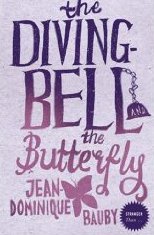
The Diving Bell and the Butterfly: The Memoir

diving-bell-and-the-butterfly-book-cover1

This is one book that should be read after watching the film.  Without visualizing what Jean-Dominique Bauby had gone through after his massive stroke, the reader simply could not empathize or appreciate enough of Bauby’s effort in ‘writing’ his memoir.

But in case you missed the theatre screening and are still waiting for the DVD to come out, you may like to read my review of the film by clicking here.

At age 43, Jean-Dominique Bauby, the editor-in-chief of France’s Elle magazine, was paralyzed after a massive stroke.  The only ability left in his whole body was the blinking of his left eye. With the help of his speech therapist, he learned to communicate with the outside world by blinking to the corresponding French alphabets held in front of him.

When the physical body fails us, what elements remain that can qualify us as a human being? Our beating heart?  Our brainwave?  Bauby’s memoir has so poignantly shown us the two essential functions that kept his soul alive:  memory and imagination.  Locked-in syndrome may have encased his physical body, the butterfly within escapes to the expanse of limitless skies.

The 140-page memoir expertly translated by Jeremy Leggatt comprises of 29 personal essays, ‘written’ one blink at a time, and published shortly before his death in 1997. What is trapped inside a totally debilitated body was a vivid memory and lively imagination, that despite being confined to a hospital bed, can set free a soul that yearns for love and intimacy, a soul that still basks in the humor and pleasures of life.

No words can speak more powerfully than Bauby’s own.  Here are some excerpts from his book.

Shortly before his stroke, he visited his 92 year-old father and helped him shave:

I complete my barber’s duties by splashing my father with his favorite aftershave lotion.  Then we say goodbye…We have not seen each other since.  I cannot quit my seaside confinement.  And he can no longer descend the magnificent staircase of his apartment building on his ninety-two-year-old legs.   We are both locked-in cases, each in his own way: myself in my carcass, my father in his fourth-floor apartment.  Now I am the one they shave every morning…

One would never know how potent memories and the imagination can be:

Once I was a master at recycling leftovers.  Now I cultivate the art of simmering memories.  If it’s a restaurant, no need to book.  If I do the cooking, it is always a success.  The bourguignon is tender, the boeuf en gelée translucent, the apricot pie possesses just the requisite tartness.  Depending on my mood I treat myself to a dozen snails, a plate of Alsatian sausage with sauerkraut, and a bottle of late-vintage golden Gewurztraminer, or else I savour a simple soft-boiled egg with fingers of toast and lightly salted butter.  What a banquet!

Or how poignant the little gestures of love and intimacy are:

While I have become something of a zombie father, Theophile and Celest are very much flesh and blood, energetic and noisy.  I will never tire of seeing them walk along side me, just walking, their confident expressions masking the unease weighing on their small shoulders.  As he walks, Theophile dabs with a Kleenex at the thread of saliva escaping my closed lips.  his movements are tentative, at once tender and fearful, as if he were dealing with an animal of unpredictable reactions.  As soon as we slow down, Celeste cradles my head in her bare arms, covers my forehead with noisy kisses and says over and over, “You’re my dad, you’re my dad,” as if in incantation.

As I finished the book, I could not help but ask myself:  Do I have enough ingredients to practice ‘the art of simmering memories’ if I ever needed to?

~ ~ ~ ½ Ripples


Austen Regrets Becoming Jane?

After watching last night’s Masterpiece Theatre’s “Miss Austen Regrets”, the fourth installment of The Complete Jane Austen, I feel that something is missing in the title:  a question mark. It should be “Miss Austen Regrets?”  Making it like a statement as it is, the movie rests on the presumption that Jane indeed has regrets before her untimely death at age 41. What would she have regretted?

Would Jane have regretted not marrying for money?  Would she have regretted not trading for a life of comfort in a loveless marriage as Mrs. Bigg-Wither?  Would she have regretted not being a vicar’s wife living with Rev. Bridges and not seeing herself strive to become the writer that she is now? Would Elizabeth Bennet have married Mr. Darcy if he had not gained her total respect and requited love, even though she could have been Mistress of beautiful Pemberley?  Fanny Knight would have regretted not getting married for marriage’s sake, as Jane had so incisively seen through her, but Jane herself?

While the movie Becoming Jane is a fantasy, where the imagination takes flight and the director can have a free hand, more or less, to bring to the screen a creative narrative of ‘what if’,  “Miss Austen Regrets”, on the other hand, is supposed to be a biopic based on facts, from Jane’s correspondences with her niece Fanny.  It is to present an interpretation of Jane’s unmarried predicament derived from what she says in these documents. I have not read these letters. For those who have, is the movie an accurate portrayal of Jane’s internal world?

Even towards the end of the movie, and her life, suffering illness and facing her mother’s scornful accusation, Jane adamantly replies she wouldn’t have sold her soul for wealth. What she has gained she succinctly answered Cassandra in one word, “Freedom”. If she has had any regrets, it would be a life too short to continue the little success she has achieved as a writer, of not earning enough money to support her mother and sister with her writing. In summing up, she feels she has walked the path that God has intended for her.

The title and premise of the film has painted the work with a dark and somber overtone, and Gillian Anderson’s introduction looks like a ghastly announcement of death toll. But the funny thing is: I totally enjoyed it last night!  I was drawn to the movie’s engrossing scenes and intelligent dialogues, its beautiful cinematography and capricious camera work, the fast-paced story and the excellent editing embellished with a powerful score.

Olivia Williams and Imogen Poots as Aunt Jane and niece Fanny make an interesting pair, great contrast in character, and aptly playing out the embedded irony: the idealistic, unmarried Aunt giving practical advice on courtship to her young niece. The blurring of sarcasm and realism also makes the script ever more lively and intriguing.  There may be a miscast in Cassandra, depicting her more like a mother than a sister two years older, but overall the cast is effective in telling the story with depth.

All in all, the movie has succeeded in portraying the complexity of characters and choices Jane has encountered in her short life. It may have come to a different conclusion as some viewers would like to see, but it has presented an aesthetically pleasing and enjoyable work.

And for me, Jane has chosen the road less travelled, and that has made all the difference…


~ ~ ~ Ripples

********

For a comprehensive review of “Miss Austen Regrets” written by Laurel Ann of Austenprose, go to PBS site “Remotely Connected”.

Ms. Place has also posted an interesting review, with lots of pics from the movie, at Jane Austen’s World.

Away From Her Movie Review

Update March 4: Away From Her won 7 Genie Awards last night in Toronto, Canada.  Among them are Best Picture, Best Director, Best Actor, Best Actress, Best Supporting Actress, and Best Adapted Screenplay.

In light of all the awards Julie Christie is garnering in this Awards Season, first winning the Best Actress Golden Globe, then getting an Oscar nod, and just now winning the Screen Actors Guild’s Best Actress Award all for her role in Away From Her, plus director Sarah Polley’s Oscar nomination for Best Adapted Screenplay, I’m re-posting here my review of the movie I wrote 8 months ago in May, 2007.  For those who missed the movie released in theatres last year, it’s timely to read the review and watch the DVD of this beautiful Canadian film, in preparation for the Oscars coming up February 24, 2008.

Away From Her

Away From Her (2006)–How can you turn a good short story onto the screen without compromising its quality? … By turning it into a screenplay written by an equally sensitive and passionate writer, and then, through her own talented, interpretive eye, re-creates it into a visual narrative. Along the way, throw in a few veteran actors who are so passionate about what the script is trying to convey that they themselves embody the message. Such ‘coincidents’ are all happening in the movie Away From Her.

Sarah Polley has made her directorial debut with a most impressive and memorable feat that I’m sure things will go even better down her career path. What she has composed on screen speaks much more poignantly than words on a page, calling forth sentiments that we didn’t even know we had. As Alzheimer’s begins to take control over Fiona, what can a loving husband do? Julie Christie and Gordon Pinsent stir up thoughts in us that we’d rather bury: how much are we willing to give up for love, or, how would we face the imminence of our loved ones’ and our own mental and physical demise.

Based on the story by Alice Munro, ‘The Bear Came Over the Mountain’, Polley brings out the theme of unconditional love not with your typical Hollywood’s hot, young, and sexy on screen, but aging actors in their 60’s and 70’s. It may not be as pleasurable to watch wrinkled faces hugging and kissing, or a man and a woman in bed, bearing age spots and all, but such scenes effectively beg the question: why feel uncomfortable?

Why does love has to be synonymous with youth, beauty, and romance? It is even more agonizing to watch how far Grant is willing to go solely for love of Fiona. Lucky for us, both writers spare us the truly painful at the end. It is through persistent, selfless giving that one ultimately receives; and however meager and fleeting that reward may seem, it is permanence in the eyes of love. And it is through the lucid vision of a youthful 27-year-old writer/director that such ageless love is vividly portrayed….Oh, the paradoxes in life.

~ ~ ~ Ripples

***

To Read or Not To Read: Canadian Version

So here it is, the most recent Canadian statistics on book reading.  According to an Ipsos Reid survey commissioned by CanWest News Service and Global Television, conducted between Dec. 11 and 13, 2007,  31 % of the 1001 respondents of the survey did not read a single book for pleasure in all of 2007, 4% behind the U.S. in an identical poll.

Now, it really hits home…I know, we’ve been through all the discussions about how accurate these polls are, and the causes, and the biases…etc. in my last two posts.  So here, I’d just like to briefly point out a few interesting findings from this one:

  • The 69% of Canadians who were reading in 2007 did so voraciously, averaging 20 books in 2007.
  • According to industry giant Indigo Books, the Canadian market is remaining steady.  The biggest selling day of the year, Dec. 22, saw an average of 570 customers per minute.
  • West Coasters were Canada’s most avid readers in 2007.  B.C. residents devoured an average 33 titles.
  • Fiction was the most popular genre among Canadians, at 56% of books read.

My response remains the same as I wrote in my post on New Year’s Eve.  Again, after visiting your blogs, I was much impressed and humbled by some of your personal reading statistics, and glad to know about still others who have indicated reading resolutions and goals for the New Year, again I say…all is not lost.

So to all, enjoy your reading, whatever genre, whatever modes they may be, and have a rewarding 2008!

To Read or Not To Read: A Personal Response


It looks like my last post has stirred up some ripples. I thank you all for your input to a very complex topic.  Your comments certainly make an interesting forum, where there’s the exchange of ideas and the sharing of opposing views.  That this is even possible is basically because we all read and write.  It’s not too late to thank our teachers for this.

Indeed, the issue of reading is a complicated one.  On the outset, and from your comments, we see aspects dealing with the skill, the form, and the content of reading.  While at the same time, underlying are the very values we hold towards this seemingly simple act: What is reading after all?  How should it be taught in our schools and transmitted (or not) in our homes?  And, what should the content be in order to classify the act as such?

As someone who has involved in literacy research, I have seen recent academic studies taken the perspective of re-defining reading and writing not as a skill but a social practice. Our values sustain the act, or transform it. As we see the ubiquitous usage of the internet and digital communication, we are witnessing the power of technology changing our social values, lifestyle, interests, and how we spend our time.

The NEA surely had the effects of our technological age in mind, thus, an update on the reading habits of Americans.  The last one they did was in 2004.  As with any survey, the NEA Study has its limitations and confined by its own perspective and contextual stance.  And, within the parameters of the present study, they did not go into details the causes, but they did present the correlations of variables.  The results can be considered as reflections of our contemporary society.  The correlations of factors and the implications of the findings are significant enough for us to ponder.  Again, you can download the 98-page report in pdf format here (3.32 MB).

I welcome the progress we have made in digital and internet technology, bringing the world closer at the twitch of our finger, feeding us with instant knowledge and information. I congratulate those who attempt to bring the world of print to their readers by more convenient modes of delivery, such as transmitting reading materials in digital mode, and others who attempt to attract young readers through the creation of new kinds of books, such as graphic novels and manga’s. 

And yet…I lament the erosion of a part of our culture and civilization, the form of reading and writing as we still know it.  I’m concerned about the gradual obliteration of the “classics”, or the dying of the literary form. I lament to see the decline of appreciation and comprehension of literature, for I believe the humanity and universality in many of these works still speak in our world today.  I believe there’s an urgent need to create even more literary works in the face of technological domination.  There may not be a golden age of reading, but there has been a heritage of writing.

I worry about our next generation replacing the art and pleasure of book reading with offerings from other media. I’m also concerned about the English language disintegrating into cyber lingos, or replaced by sensational, action-packed anime. It is a phenomenon graver than just seeing the puzzled faces of our young as they look at an analog clock or try to use a dial phone. 

The progress we have made in technology does not mean that we should downplay the loss of a heritage.  That we can artificially make ice should not trivialize the disappearance of glaciers. The ushering in of electronic music should not obliterate the works of Mozart.  The two can co-exist…isn’t that the postmodern promise? 

No doubt, reading and writing will survive, since we still need to look up information, make lists, chat on-line…and blog.  But I regret to see the erosion of literary reading and the appreciation of literature, classic or contemporary, and may it not come to pass, the termination of its creation in the future, near or distant.

As another year draws to a close,  we may need to take stock of both our progress and our loss.  I’m not a doomsayer, but surveys like the NEA’s point to what seems like an irreversible trend.  While some may not see it as a gloomy path but just a shift of social practices and lifestyle, the survey results reflect our priorities and the shifting values in this day and age. 

Or, is it really irreversible? 

Maybe all is not lost.  At the start of a new year, I’d like to remain optimistic.  Maybe it begins with…yes, a New Year’s resolution on reading… 

A Happy New Year to All!

To Read or Not To Read

To Read or Not To Read: A Question of National Consequence…That is the name of the recent study conducted by the National Endowment for the Arts on reading habits in America.  Just as I was writing about the study in the UK on re-reading in my post Reading and Re-reading, regretting no such kind of surveys being done in North America, and here it is, the NEA’s reading survey results, incidentally, released the same day I published my post. 

Well, maybe I should not be so much of lamenting the lack of reading surveys than the actual survey results.  In a nutshell, the major findings are:

  • Americans are reading less, especially the young.  For example, the percent of non-readers among 17 year-olds doubled to almost 20% in the last two decades.  Or, on the average, 15 – 24 year-olds spend 7 minutes reading on a weekday, 25 – 34 year-olds are slightly better, 9 minutes.
  • Reading comprehension is on the decline, as indicated by reading scores.
  • The decline in reading has civic, social, and economic implications.

The whole 98-page report can be downloaded in pdf format here.  It is not Stephen King material, but just the same…interesting reading with an ominous undertone.  It covers various topics including correlations between pleasure reading and academic scores, reading habits, reading and multitasking, employment, internet and digital technology, the relevance of newspaper, and yes, even blogging.

I understand that the issue is complicated and the causes are complex.  Critics are quick to point out that the form and purpose of reading have changed in this internet driven age.  People still read to look up information they need, critics argue.

Maybe the concern should be the gradual extinction of literary reading, the reading of literature for pleasure, and the whole business of reading and writing.  When the figure shows that 63% of college seniors read little or nothing for pleasure, even the pragmatists should be worried when they consider the bottom line.

Adora Svitak: “Tiny Literary Giant”

“Knights!  Clear the square of townsfolk!” the Duke cried.  Within a few moments, the square was empty except for the Duke, the Duchess, Myles, Didoni, and the large, burly knights who were guarding the Duke.  The men put the litter down, and the Duchess lay down to rest.  The Duke was telling Didoni what he wanted on his portrait.

“Make me look strong and majestic. I want no one to think that I am a weakling, like my soft older brother the King,” the Duke said imperiously.

“Knights! Clear the square of townsfolk!” the Duke cried. Within a few moments, the square was empty except for the Duke, the Duchess, Myles, Didoni, and the large, burly knights who were guarding the Duke. The men put the litter down, and the Duchess lay down to rest. The Duke was telling Didoni what he wanted on his portrait.  

“Why not paint a suit of armor?” Myles suggested before he could stop himself.

“Yes! The lad has quite the idea!” the Duke exclaimed. “Paint me in a suit of armor, with nothing amiss. Make my eyes as sharp as an eagle’s, and my nose straight and curved at the end. My lips I care for not— but make them solemn.”

Didoni nodded.

“It shall be done of course, your Grace,” Didoni said, already beginning to sketch on his canvas.

                                —- Excerpt from Adora Svitak’s Historical Fiction


 Adora Svitak Website

Just as I was saying in my last post that I’d never come across any literary prodigy, the name Adora Svitak came up on my computer screen last night.  The above excerpt is one of the sample writings from her website,  where you can also find her poems and fantasy writing.  Adora is a 10 year-old girl from Redmond, Washington.  Whether you want to label her a prodigy or not really does not change what has taken place in her life.  Here are the milestones so far:

Age 2.5: 

Could read and write simple words.

Age 3.5:

Read her first chapter book.

Age 4:

Started writing short stories.

Age 6:

Got a laptop from her Mom, writing began to take off.

Age 7:

Published 296-page Flying Fingers, a collection of her own fiction and writing tips for others (with her Mom).  Appeared on Good Morning America, interviewed by Diane Sawyer, who called her “Tiny Literary Giant”.  Met Peter Jennings and was given his book The Century For Young People, which remained her favorite.  Started Adora’s Blog.  http://www.adorasvitak.com/Blogger.html

Age 8:

Had written over 400 short stories and 100 poems, typed 60-80 words per minute, read 3 books at a time, 18 books a week.  Oh, that’s nothing, you might say, “My kid could do that.”  Just wait, Voltaire’s Candide?

Another book in the work, a collection of her poems called Dancing Fingers.

Promoted literacy to children in the UK.  Here’s The Guardian report: http://books.guardian.co.uk/news/articles/0,,1713183,00.html

Age 9:

Completing her first full-length novel Yang in Disguise,  serving as a spokesperson for Verizon Reads campaign for literacy, working on an animated computer program to help develop childhood literacy.

Montel Interview: http://www.metacafe.com/watch/439176/adora_svitak_9_year_old_author_criticize_george_bushs_iraq_pol/

Note: According to her interview on Montel, the proceeds of her book Flying Fingers will be going to the National Education Association and she would auction off some of her works to raise money for the victims of hurricane Katrina, rebuilding libraries in schools.

All in all, I feel that this gifted little girl doesn’t really care whether you label her “literary prodigy” or not.  She’s having the time of her life in her reading, writing, cooking, playing, and helping others how to read and write…  And, how many 10 year-olds can have the terms “Writer, Poet, Humanitarian” to describe themselves on their website?   http://www.adorasvitak.com/Main.html