Year End Tally and 2012 Outlook

Lots to say on this post, but I promise you I’ll keep the pace swift. First off, a wrap-up of this my fourth year of blogging. I’m always amused to see what words people use to come to Ripple Effects. So, here are some of them over this past year.

Search Engine Terms

  • modern day insane asylum
  • stranger than fiction free will or predestination
  • Vermeer skulls
  • how many hunting license were sold before and after  the movie Bambi
  • Toronto International Film Festival social impact
  • culture and imperialism in Mansfield Park
  • Shawshank Redemption sewer pipe
  • Hemingway beaten up by Canadian authors
  • what value in life if not together
  • how to get in touch with Diane Keaton

Give you a feel of what Ripple Effects is all about, right? Yes, it’s a mixed bag of ruminations on books and films, where crawling through a sewer pipe could be noted as an existential quest, and always, a lookout for the minutest ripples of current culture… while maintaining humor and sanity doing all that. And, if you know how to get in touch with Diane Keaton, do let me know.

Most Popular Post

Slowly heading towards half a million views, this turtle does not intend  to win any races, but is glad just the same to see some posts maintaining their popularity. This is the all time most popular post:

Memorable Movie Love Quotes which I compiled and posted for Valentine’s Day 2008. I sure hope that the 24,000 views in 2011 have contributed to some consolidation (and conciliation?) of relationships.

My Personal Best Picks

There are posts people may like, there are also posts that I favour more. Books into films is Arti’s ‘specialty’, and it’s always fun to link the two, albeit I know they are distinctly different art forms.  Some of my favorite posts in 2011 are:

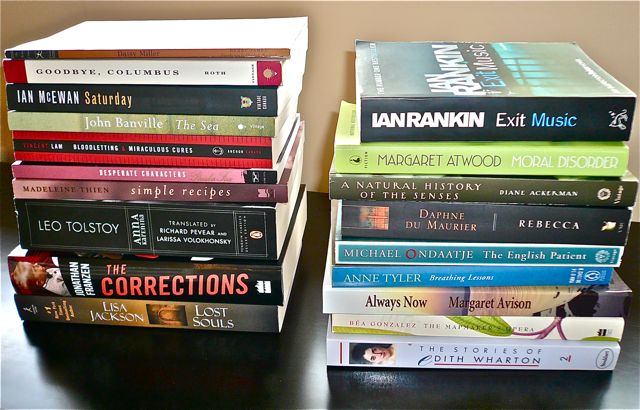
And that leads me to the coming new year. From my upcoming book to movie lists, I look forward to reading the following titles, as they are in development with their film adaptations:

Books to Read in 2012 (before the film comes out)

  • The Marriage Plot by Jeffrey Eugenides
  • The Emperor’s Children by Claire Messud
  • Runaway (short story) by Alice Munro
  • Midnight’s Children by Salman Rushdie
  • As I Lay Dying by William Faulkner

Book Challenges in 2012

I’m excited to sign up for two Book Challenges sponsored by CarrieK. at Books And Movies.

2012 Graham Greene Challenge — What better way to delve into books and movies than reading Graham Greene, who had almost all of his works adapted into feature film or TV series. I’ve selected these titles:

  • The Quiet American
  • The End of the Affair
  • Brighton Rock

.

2012 Ireland Challenge — I’m to pick four titles, including fiction and non-fiction by Irish writers with setting in Ireland. Now this is uncharted water for me. I’ve John Banville and Anne Enright in my TRB pile which I want to get to, and Deirdre Madden’s book suggested by litlove. I’m open to other recommendations.

  • Molly Fox’s Birthday by Deirdre Madden
  • The Sea by John Banville
  • The Gathering or
  • The Forgotten Waltz by Anne Enright

Most Anticipated Books to be Released in 2012

  • When I Was a Child I Read Books by Marilynne Robinson
  • Some Assembly Required: A Journal of My Son’s First Son by Anne Lamott

I’ll be reading screenplays too. Selections will likely be driven by spur of the moment, but these I’d like to get hold of:

Screenplays to Read in 2012

  • The Descendants (see how Alexander Payne adapts from novel)
  • Midnight In Paris (Woody Allen’s always fun to read)
  • Young Adult (Screenwriter Diablo Cody’s script after Juno)

Ironically, I find reading and blogging feed my procrastination. Finishing a book or a blog post is usually the best reason to delay, pulling me away from ‘real’ writing… I still have a screenplay half finished. 2012 looks like a good year to get that done.

And then of course…

The Awards Season 2012

  • Golden Globes – Jan. 15
  • SAG Awards (Screen Actors Guild) – Jan. 29
  • BAFTA Awards (British Academy) – Feb. 12
  • WGA Awards (Writers Guild) – Feb. 19
  • Independent Spirit Awards – Feb. 25
  • The 84th Academy Awards – Feb. 26

As we edge towards the end of the year, my thanks to all who have visited, and those who have stirred up ripples by leaving their thoughts. The pond is all yours.

Best Wishes to All for a Wonderful 2012!

Happy New Year!

***

What If… A Northern Nativity

The late Canadian artist William Kurelek embraced a nativity that’s beyond time and culture. In his children book A Northern Nativity, he envisioned through a little Prairie boy’s dreams the various scenarios: what if Christ was born in the land of deep snow in an Inuit community, or what if Mary and Joseph, homeless on our streets, had to take shelter in a soup kitchen, what if… Would we have noticed? Would we even care?

This is a moving video clip on the paintings in Kurelek’s children book A Northern Nativity, accompanied by Chris de Burgh’s touching piano music “When Winter Comes”.

.

And to All, A Merry Christmas!


***

Reading The Season: Walking On Water by Madeleine L’Engle

It’s that time of the year when a quiet respite is probably the most precious gift. For the past four years since I started blogging, amidst the cacophony of December festivities, I would pick something to read that anchors me to the spiritual meaning of the occasion.  I call these attempts “Reading The Season”. This year, I took down from the shelf a long-time TBR, Walking On Water: Reflection On Faith And Art by Madeleine L’Engle.

After reading it, I went straight to her Newbery Award novel A Wrinkle In Time (another long time TBR for me). Amazed at its wisdom and depth, once I finished it I went back to reread Walking On Water, appreciated all the more L’Engle’s intricate weaving of intellect and spiritual insights.

At the very beginning of the book, these words jumped right out at me:

I sit on my favourite rock, looking over the brook, to take time away from busyness, time to be. I’ve long since stopped feeling guilty about taking being time; it’s something we all need for our spiritual health, and often we don’t take enough of it.

And just a few pages after that, I found this gem:

Leonard Bernstein tells me … for him music is cosmos in chaos. That has the ring of truth in my ears and sparks my creative imagination. And it is true not only of music; all art is cosmos, cosmos found within chaos.

Bernstein might have echoed a Jungian concept of the power of memory and the subconscious self, but there’s a spiritual reality in the thought.

It all began with the calling forth of light from darkness, splendor from void, life from nothingness, the Creation. Terrence Malick’s The Tree of Life comes to mind… the cosmic light and galaxy clouds, the molten lava that spews out of the earth, the roaring breakers of the ocean deep, and my heart resounds: ‘day to day pours forth speech, night to night declares knowledge.’

But what’s most awesome is not just the forming of the cosmos, but the Creator incarnated, the infinite confined, the invincible made vulnerable in order to live the hurts, to share the pains. L’Engle writes:

To be alive is to be vulnerable. To be born is to start the journey towards death… We might paraphrase Descartes to read, ‘I hurt; therefore I am.’

The Creator demonstrated that behind the majesty, there’s the power of love, that driving force behind the willingness to stoop, to be made vulnerable, to be stripped naked, be born a babe. Utterly unfathomable. At one point in human history,  Cosmos entered and lived among Chaos.

And artists, those who write, who paint, who sing, who dance, who act… they are birth-givers. “An act of art is an incarnational activity,” L’Engle writes. Artists partake in the continuation of creation, bringing wholeness to a fragmented world, hope in the slough of despair.

As well, true artists live the vulnerability as the One who first took that cosmic plunge, taking the risk of birth because of love.

Here, take a 3:44 minute respite to enjoy some Seasonal reflections. Click on the video to listen to the music as you read Madeleine L’Engle’s poem:

The Risk of Birth 

This is no time for a child to be born,
With the earth betrayed by war & hate
And a nova lighting the sky to warn
That time runs out & the sun burns late.

That was no time for a child to be born,
In a land in the crushing grip of Rome;
Honour & truth were trampled by scorn–
Yet here did the Saviour make his home.

When is the time for love to be born?
The inn is full on the planet earth,
And by greed & pride the sky is torn–
Yet Love still takes the risk of birth.

Madeleine L’Engle

***

Walking On Water: Reflections On Faith And Art by Madeleine L’Engle, Commemorative Edition, published by Shaw, 1998, 227 pages.

CLICK HERE to Reading the Season 2012: Surprised by Joy

‘Reading The Season’ posts in previous years:

Reading The Season: C. S. Lewis

Reading The Season: Fleming Rutledge

Reading The Season: Madeleine L’Engle’s The Irrational Season

Reading The Season: Luci Shaw

All The Year’s Best

All the year’s best are coming out now: Best books, best movies, best… whatever. And I admit, I’m one who’s always on the look-out for such lists. Hundreds of books and movies in a year reduced to a list of 10, definitely makes one convenient Christmas shopping list.

Here are some of the best book lists:

Publishers Weekly Top 10 Books of 2011

NPR 10 Best Novels of 2011

New York Times 10 Best Books of 2011

Best Fiction 2011 from “The World’s Toughest Book Critics”

The Globe 100 Best Books of 2011 shopping list

Books of the Year 2011 The Telegraph

A list of indispensable books from Harvard Gazette, not your usual best-sellers

And here’s a one-stop shopping lists for The Top 10 Everything of 2011 from TIME Magazine.

**

Movies? Year’s best lists are everywhere. Of course, all lead to the ultimate finale of the Award Season: The Oscars. But for Christmas shopping suggestions, here are several lists, albeit some of the current releases may not have come out in DVD or Blu-ray yet:

American Film Institute’s Best Films 2011

Critics Awards for 2011 Best Films

Roger Ebert’s Best Films of 2011

NYT Stephen Holden Best Films 2011

NYT A. O. Scott’s & Manohla Dargis’s lists

Metacritic’s Best Films 2011

Toronto Film Critics’ Picks

Time-Out London

And more lists are coming out even as I type.

But of course, the most important to readers/movie viewers is whether they agree or not, whether what the critics say happen to be their own favorites. If not, there’s really not much relevance to all these lists, is there? No? I’d like to hear from you… Do you read movie reviews first before heading out to the theatre? Do you depend more on film critics or ‘user-reviewers’? Herein lies another subtle (or not so subtle) battle between the critics vs. the reader/movie watcher, and… alright, the blogger.

So, from one POV, here’s Arti’s year-end tally. Yes, I happen to have written down, if I remembered to do so, all the movie titles I’ve watched this year. There are about 90 that I’ve got down, not including those I previewed for a film festival.

If I’m to choose the best film of this year from all that I’ve watched, I’ll have to say The Tree Of Life by Terrence Malick. It’s a film by far the most unique, cinematically gratifying, cerebral, transcendent, and a showcase of excellent talents. I hope the young actor Hunter McCracken can get some recognition for his sensitive and intelligent performance.

Other titles I should mention for my list of best 2011 films include The Artist, Midnight In Paris, Drive, Cave of Forgotten Dreams, My Week With Marilyn, and The Descendants. I’m still waiting for the screening in our city of some titles which I highly anticipate, including A Dangerous Method, Carnage, Take Shelter, Tomboy, and Tinker, Tailor, Soldier, Spy, and We Need to Talk About Kevin.

And for older films I’ve seen this year, some I rewatched, others are my catch-up on acclaimed titles I’ve missed in the past. I’ve a few favorites (in no particular order):

Animal Kingdom, My Life As A Dog, Truly, Madly, Deeply, Autumn Sonata, Play It Again Sam, Interiors, Marvin’s Room, Shine, Badlands, Days of Heaven, Fargo, The Makioka Sisters, Radio Days, Anne Hall, Manhattan, Match Point, Pickpocket, Howards End, The Third Man.

As a slow reader, much slower than my movie-watching speed, the ratio of film to book for me this year is about 2:1. My picks for my favorite reads this year (not all published in 2011), and in no particular order:

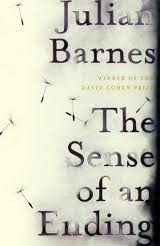
Then Again by Diane Keaton, The Sense of An Ending by Julian Barnes, Blue Nights by Joan Didion, Let The Great World Spin by Colum McCann, The Paris Wife by Paula McLain, A Moveable Feast by Ernest Hemingway, The Letters of Vincent Van Gogh, True Grit by Charles Portis, Howards End by E. M. Forster, The Cat’s Table by Michael Ondaatje, The English Patient by Michael Ondaatje, Diary of a Country Priest by Georges Bernanos.

**

What about you? What are your year’s best in books and movies?

Upcoming Books Into Movies — List 3

For an update of this post, CLICK HERE to Great Film Expectations.

What makes a book movie material? I’m not thinking of the plot-driven page turners. I mean literary fiction, albeit the term is open to debate. Anyway, what baffles me is, how do filmmakers determine whether a book is good for a movie adaptation? Just let me give a few examples.

The English Patient. Michael Ondaatje’s Booker Prize winning novel that reads like poetry and leaves me swirling in nostalgic daze. When Anthony Minghella finished reading it in one sitting late one night, he knew right away that he must make the movie. Well, he did and won 9 Oscars for his film. But for another equally poetic work that I’ve enjoyed, Fugitive Pieces by Anne Michaels, its movie adaptation just didn’t work that well for me.

I can name many others. Muriel Barbery’s philosophical novel The Elegance of the Hedgehog stirred up deep resonance in me, but its movie adaptation Le Hérisson failed to produce such impact. Booker Prize winner Kazuo Ishiguro’s novel The Remains of the Day delves into the internal worlds of the two main characters, and is turned into film effectively, thanks to the fine performance of the actors, Anthony Hopkins and Emma Thompson.  Ishiguro’s more recent work, Never Let Me Go is both cerebral and emotionally charged, it too enjoys a good film transposition.

Or, how about short stories like Alice Munro‘s “The Bear Came Over The Mountain”, about an elderly couple dealing with the wife’s Alzheimer’s. When 28 year-old Sarah Polley finished reading the short story on the plane, she decided she would adapt it into film and who she would get to play the main character. The result is Polley’s directorial debut, the Oscar nominated film Away From Her, with Julie Christie getting a nom for Best Actress and Sarah Polley for Best Adapted Screenplay.

I’ve learned to appreciate books and movies as two distinct art forms. While I used to delve into the ‘loyalty’ issue, how close the film is to its source material, now I’m more accepting to new interpretations and diverse visual representations as long as the work holds up to its artistic values. But one thing still baffles me: How does a filmmaker decide whether a book is movie material?

The following are my recent findings on some literary works that are or will be adapted into films (ie, movie rights sold). On the top of the list, generating a lot of buzz these days is Jeffrey Eugenides’s The Marriage Plot. Now, it’s on my TBR list, as I’m still no. 213  in the hold lineup at my local library. But for those of you who have read the book, what do you say? Do you think the book makes good movie material? And the most intriguing for me, as always, how do you transpose philosophical ruminations into a visual medium? How do you dramatize intellectual angst?

Here’s Ripple Effects generated Upcoming Books Into Movies — List 3.  If you’ve missed List 1 and List 2, just click on the links. Some of the works mentioned on those previous lists have already been shown on screen. Arti will continue to furnish you with updated info on future books into films.  And all ye book group members, here are your 2012 suggestions:

Upcoming Books Into Movies — List 3

The Marriage Plot by Jeffrey Eugenides (2015, Scott Rudin producer, who will also bring you Jonathan Franzen’s The Corrections in 2013. Impressive record as a producer of modern literary works into films: Revolutionary RoadDoubtNo Country for Old MenTrue Grit… and soon Extremely Loud and Incredibly Close)

The Emperor’s Children by Claire Messud (Keira Knightly, Richard Gere, Eric Bana, Emma Thompson, Rachel McAdams will be directed by Scott Cooper, who did Crazy Heart, 2009)

The Paris Wife by Paula McLain (From producer Ileen Maisel who’s bringing you a new Romeo & Juliet in 2012. I’m curious to see how they approach this adaptation, a sequel to Midnight In Paris?)

A Visit from the Goon Squad by Jennifer Egan (TV movie. The Pulitzer Prize winning novelist cited the HBO series The Sopranos as her inspiration.)

The Weekend by Bernhard Schlink (2013, Schlink has a previous work The Reader adapted into film.)

Before I Go To Sleep by S. J. Watson (Ridley Scott has got the film rights, and it’s going to be “a blend of the popular and the literary.” What’s popular may well be the subject matter these days, memory and the loss of it.)

Les Misérables by Victor Hugo (2012, A Musical in “good old-fashioned 2D”, directed by Tom Hooper of The King’s Speech. Anne Hathaway, Huge Jackman, Russell Crowe, Helena Bonham Carter, Geoffrey Rush. Sorry, no Colin Firth singing here.)

Runaway by Alice Munro (short story, screenplay by Jane Campion. Like I said earlier in this post, a short story can be turned into a deep feature film. I await this one from Campion, who won a screenwriting Oscar as well as the Palme d’Or for her 1994 film The Piano. Her more recent Bright Star on the poet John Keats reaffirms her literary style in the visual medium.)

***

Other related posts on Ripple Effects:

Can a movie adaptation ever be as good as the book?

Upcoming Books Into Films (List 1)

More Upcoming Books Into Movies (List 2)

Movies Reviewed

Photo Source: Films, Wikimedia Commons, Books, Arti’s file.

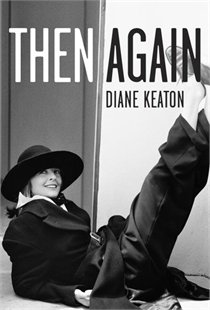
Then Again by Diane Keaton

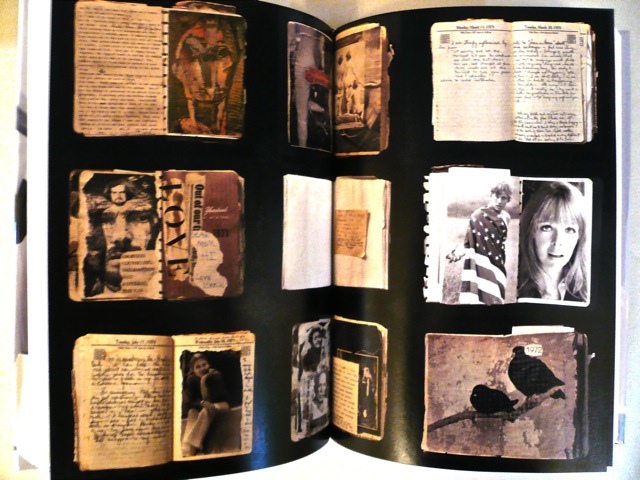
It’s interesting to read Diane Keaton’s memoir after Julian Barnes’ The Sense of an Ending. In contrast to Tony’s hazy past in Barnes’s novel, here we have memories strung together with clarity and adequate documentation. Take a look at these insert photos. I admit, they were the very reasons the second I opened the library copy that I decided I must get my own to keep.

Dorothy Keaton’s Journals

These are journals belonging to Diane’s mother Dorothy Keaton.  She first started with a series of letters she wrote from her California home to her eldest daughter Diane, who had moved to NYC at age 19. Letter writing developed into full volumes of family journals and scrapbooks. Further, she had kept detailed documentation of Diane’s career from 1969 to 1984. With the onset of Alzheimer’s, Dorothy still kept close contact with her daughter through letters and phone calls, leaving phone messages which showed the signs of a mind quickly sliding down the slope.

Stacks of memories

Diane has poignantly interwoven her own thoughts and memories with her mother Dorothy’s, a daughter’s attempt to capture life that was THEN in order to relive the moments AGAIN. Diane’s father Jack Hall died of cancer in 1990, only a few months after the diagnosis. Dorothy died of Alzheimer’s in 2008. This memoir is a joint endeavor of a daughter with her mother who has passed on, yet whose presence is strongly felt:

Now I’m alone, juggling with a memoir that’s also your memoir.

Family Scrapbook

Diane Hall grew up in California and had enjoyed a vibrant suburban family life before she moved to NYC to study at The Neighborhood Playhouse. She kept close contact with her family through letters. I admire her courage to reveal these correspondences, for through them, we see the private side of Diane Keaton, a persona with all the insecurities and non-glamorous aspects of a real life human being. After the Neighborhood Playhouse, she decided to change her name from Hall to Keaton. She got her first break in the musical Hair. This is her letter home:

Hi, Everyone,

Well, I’m in a hit, we opened the 29th… A real job, and on Broadway. Big stars have come to see it, like Warren Beatty (remember my crush on him from Splendore in the Grass) and Julie Christie, who is the most beautiful woman I’ve ever seen, and Liza Minnelli… Apparently Hair is the in thing to see. People stand in lines every day to get tickets.

Things are pretty much the same. I’m certainly the same. Will I ever change? I’m still the dumbest person alive. One apparently does not grow out of stupidity. Oh, also I’m on a diet…

And on that note, Diane goes on to reveal her past battle with bulimia in the next chapter, a piece of private history that has been kept secret until now.

From Hair, to Play It Again, Sam, and later from stage to screen. Thanks to Woody Allen, we have many fabulous movies but the most memorable probably is Annie Hall (1977), which brought Diane Keaton the Best Actress Oscar, and Woody Allen the Best Director and Best Writing Oscars. It also won Best Picture. Here’s Diane’s memory of the production:

Woody’s direction was the same. Loosen up the dialogue. Forget the marks. Move around like a real person. Don’t make too much of the words, and wear what you want to wear. Wear what you want to wear?  That was a first. So I did what Woody said: I wore what I wanted to wear…

And her choice of ‘costume’ became a classic:

And yes, there was a real life Grammy Hall. She was Jack Hall’s mother Mary Hall. She could have given Woody the idea of the movie character, for she was just as nasty. Regarding Diane winning the Oscar, this is Grammy Hall’s response when interviewed in the local paper:

People say I’m in the clouds, I ain’t in no clouds. I’ll tell you one thing about the Academy Awards. It’s something big for a small family. That Woody Allen must be awfully broadminded to think of all that crap he thinks of

As for Woody Allen, he didn’t even attend the Awards ceremony nor did he talk about it afterwards.

Diane is also candid about her ‘romantic failures’, beginning with Woody Allen, then Warren Beatty whom she co-starred in Reds, and Al Pacino as they worked together on Godfather II & III.

At age 50, Diane stepped out to make a most courageous move: she adopted a newborn baby girl, Dexter, and  five years later a baby boy, Duke. Her role as a single mother bringing up a daughter and a son is probably the most gratifying.

In between some serious skirmishes–like when he refuses to have his diaper changed, or when he starts crying because he’s been put down or Dexter has stolen his waffle, or when he bangs his head on the sidewalk… –in between these scuffles, there are moments that feel like an eternity of bliss.

The final pages of the memoir are the most moving for me. Diane Keaton as daughter who ultimately had to say farewell to both parents, writing at 63 and as mother to a 14 and 9 year-old, she could hear as if Dorothy is telling her: “Dear Diane, my firstborn, take a deep breath, be brave, and let go…”

Here’s her reply:

I’m trying, Mom, but it goes against every instinct I possess. I promise you one thing though. I promise to unleash Duke and Dexter from the stranglehold of my need before it’s too late. I promise to give them their freedom no matter how much I want them to hang on. I promise to let go of you too, the you I created for the benefit of me…

Through her memoir, moments Then are relived Again. It is also a catch and release, the challenging process of gathering and letting go.

~ ~ ~ ~ Ripples

***

The Sense of an Ending by Julian Barnes

When we are young, we invent different futures for ourselves; when we are old, we invent different pasts for others.

How reliable is our memory? How accurate are our thoughts, analysis of situations, perception of people? Yet we live by them and interpret our experiences through their lenses.

The winner of the 2011 Man Booker Prize, Julian Barnes’ The Sense of an Ending plays with these subjective faculties and crafts a scenario that’s captivating and with a touch of surprise at the end. A man in his 60’s looks back at his life, focusing on what he can remember about his relationships and their aftermath.

In the first part of the book, we see three school buddies in the upper form, the narrator Tony Webster with his classmates Alex and Colin,  happy to befriend a newcomer, Adrian Finn. Obviously superior in brain, insight, and self-composure, Adrian soon becomes the model they look up to. Apart from the pretentiousness of youth in intellectual matters, Tony has to concede that Adrian is indeed  superior material. When asked by the teacher “What is history?”, while Tony gives the relatively pat answer “History is the lies of the victors”, Adrian articulates this thought:

History is that certainty produced at the point where the imperfections of memory meet the inadequacies of documentation.

With these words at the beginning pages of the book, Barnes has quietly laid the enquiry of his story.

Post-secondary life leads them to different paths. Adrian, not surprisingly, gets into Cambridge on scholarship, while Tony goes to Bristol to read history. There, he starts to go out with Veronica Ford. One weekend, Veronica brings him home to meet her family. In Tony’s memory, that is a humiliating episode. He leaves with bewilderment: Veronica’s aloofness, her father’s joking insults, her mother’s mysterious gesture, and her brother’s silent wink.

After that, Tony introduces Veronica to his friends. Naturally, she strikes up a good rapport with Adrian right away, with a common tie of Cambridge where her brother also attends. Later, Tony and Veronica break up.  Adrian soon starts to date Veronica. As usual, Tony seems resigned to his circumstances and  moves on with his own life, and assumedly, others too with theirs… until later he hears the shocking news about Adrian. Time flows by, Tony marries a less mysterious Margaret, has a daughter Susie, and years later, his marriage ends in divorce.

Tony is now retired in his 60’s, expecting a life that’s bland and uneventful. Retired life for him is a natural drift of time, flat and oblivious. But he’s roused by an unexpected letter from a solicitor one day, naming him to receive £500, a bequest in the will of someone he has only met once forty years ago, Veronica’s mother. What’s more intriguing is together with this money, he is to be left with Adrian’s diary.

Life to Tony now is a quest for finding out what had actually happened to these people. His investigation has cast fearful doubts on his own memory and sense of personal history. In his retirement, Tony is awakened to re-interpret his past.

… the history that happens underneath our noses ought to be the clearest, and yet it’s the most deliquescent.

It will take his whole remaining life to solve the mystery of how real his perceptions are, and what has taken place in the lives of those he once knew as close friends. Such queries only lead to a more taxing question: “Does he play a role in other people’s fate?”

In just 150 pages, Barnes has opened a floodgate of inquiries into our subjective mind, carrying us through with a tantalizing story, towards an ending that, I feel, is a tad bit sensational, however reserved the tone. Nonetheless, I come out of the reading experience marvelling at the power of the economy of words in the hands of a master storyteller.

~ ~ ~ 1/2 Ripples

The Sense of An Ending by Julian Barnes, published by Random House Canada, 2011, 150 pages.

***

Book Trailers: Ads, Lure, and Paradox

Watched any good book trailers lately?  No, not movies, books. Book trailers… they’ve been around since 2003. You might be aware that more and more publishers and authors are embracing this marketing tool in recent years.

If you type in the term ‘book trailers’ on YouTube, you can find many of them cater to the mash and morph generation. Quirk Books, publisher of Pride and Prejudice and Zombies, has produced some popular trailers of their modern takes on classic works. Amazon named their  “Sense and Sensibility and Sea Monsters” book trailer as the best book trailer of 2009.

Now, I don’t want to digress and start talking about the morphing of the classics with contemporary culture, or things like getting the news from The Colbert Report, I’ll leave those to another post. But since book trailers have piqued my interest lately, let me show you their more recent release: The Meowmorphosis, a contemporary twist on Kafka’s classic. Here’s the book trailer (If you can’t view the videos on this post, click on the link to watch them on YouTube. And, do come back):

But of course, book trailers are for all. When you spread your net, you want to catch as wide a multitude as possible, don’t you? Look at this one promoting an upcoming book by the popular crime fiction writer Michael Connelly:

You probably think you’re watching a movie trailer. And that’s what I speculate, book trailers just might well be prompts for potential movie adaptations. Film option, anyone? And for Connelly, he already has two of his books turned into popular movies: ‘Blood Work’ (2002, Clint Eastwood), and ‘The Lincoln Lawyer’ (2011, Matthew McConaughey)

But really, book trailers are an attractive bunch, most of them. They appeal to the digitally savvy and visually driven. While some readers may not appreciate the visualization of the literary, leaving little room for imagination, others welcome these dramatizations and animations. Their stunning effects can be just mesmerizing. Look at this trailer with over 1 million views, Going West by New Zealand novelist Maurice Gee:

What a marvel of video production, don’t you agree? Now, here’s a more important question: Will you go and buy this book to read after watching the trailer, or, are you more likely to just add another view count to the video and a click on ‘like’?

This last trailer just about sums up the apparent paradox: It takes the visual to sell the word. I’d held Lane Smith’s appealing hardcover children’s book It’s A Book in my hands in a bookstore, marvelled at its conception. Look at this adorable trailer:

In this eWorld of ours, we need a real hardcover book to explain to children what a book is… or used to be, if you take the apocalyptic view.  We’re told a book isn’t something you scroll, tweet, or text, and no need to charge up. But the fact is, those are the very functions you do to view and share the trailer.

And it’s a book trailer, with all its visual images and special effects, uploaded and viewed online and hopefully gone viral, that helps boost book sales. Another mash? Or simply an inevitable paradox nowadays?

And, speaking of paradox, can you imagine the eBook version of It’s A Book?

***

Blue Nights by Joan Didion

I woke up at 1:30 am last night and couldn’t get back to sleep. Casually grabbed Joan Didion’s new book Blue Nights I got from the library and started reading, thinking I could read myself back to sleep. But I was kept awake the next few hours until I finished it. I simply could not put it down.

Blue nights are the span of time following the summer solstice when the twilights turn long and blue… and over the course of an hour or so, this blue deepens, becomes more intense even as if darkens and fades… Blue nights are the opposite of the dying of the brightness, but they are also its warning.

A poignant ‘sequel’ to The Year of Magical Thinking, which is about the death of Didion’s husband of 40 years, the writer/screenwriter John Gregory Dunne. That all happened in December 2003. John had a heart attack right in the living room of their home as Joan was preparing dinner in the kitchen. That was also a few days after their daughter Quintana Roo was hospitalized with septic shock and a coma.

Blue Nights is a memoir of Quintana, who died of her illness twenty months after her father’s passing. To say it’s a memoir is sanitizing it. In her sensitive and moving voice, Didion describes a searing separation. She recalls the memorable moments, and the mementos around her NYC apartment that prove so futile in evoking a life, a daughter adopted since birth.

Didion remembers the leis Quintana wore at her wedding in NYC’s St. John the Divine on July 26, 2003. Thus begins the book. The wedding reflected Quintana’s yearning for her childhood in Brentwood Park, California.  In the garden were stephanotis, lavender and mint. And it was stephanotis that she wore on her braid as she walked down the aisle.

All the deaths that Didion had encountered among friends and all the ICU visits of others seemed to foreshadow the ultimate fate of her own daughter, dead just 20 months after her wedding.

But nothing can prepare one for the death of one’s child. In fact, Didion painfully states that, time and time again in the book:

When we talk about mortality, we are talking about our children.

Deaths of friends since had only reinforced the looming weight of a blue night. In the spring of 2009, upon a short notice, one of those phone calls everyone dreads, Didion went to say farewell to Natasha Richardson in a NYC hospital, transported there from Montreal. It was only a minor fall on a bunny slope of a Quebec ski hill, but she succumbed to a brain injury soon after. Didion had known Natasha since she was a young teenager, daughter to Vanessa Redgrave and Tony Richardson, among Didion’s closest friends.

She is particularly disturbed by those who label her and her family ‘privileged’. As I read the book, I can see why she rejects such a term. Death befalls all, even the ‘privileged’, and spares no one with the subsequent pain. It is the starkest common denominator. And with both her husband and only daughter passing within months of each other… she has a reason to rage.  But the pathos lies in the muffled cries she lets out.

And to say one still has memories to cherish is the most ironic euphemism ever to console the grieving:

Memories are by definition of times past, things gone. Memories are the Westlake uniforms in the closet, the faded and cracked photographs…

Alas, Blue Nights is exactly that book, an attempt to capture memories before they slip away, and a grief made public so others can share and maybe by so doing, preserve a life.

This is not just a grief observed and incisively expressed, it is also an attempt at keeping the momentum to live. Writing down the pain and loss could well have a certain therapeutic effect as we see the slight humor sprinkled towards the last chapters in an intense and poignant recollection. And yet the end is still the loss, albeit now is shared and hopefully a suffering lightened, however minute the relief.

~ ~ ~ 1/2 Ripples

Blue Nights by Joan Didion, Alfred A. Knopf, NY, 2011, 188 pages.

***

Other related posts on Ripple Effects:

Natasha Richardson, Nell & the White Countess
Reading the Season: C. S. Lewis

Cave of Forgotten Dreams (2010)

In December 1994, a small team of cave explorers came upon a cave near the valley of the Ardèche River in southern France. They were awestruck as they went inside. Since named after the team leader Jean-Marie Chauvet, the Chauvet Cave had provided the natural canvas for prehistoric paintings dating back 32,000 years to the Upper Paleolithic period, twice as old as those previously found in Lascaux. These are the earliest paintings ever discovered.

The Chauvet Cave is located near the natural limestone bridge over the Ardèche River, the Pont d’Arc, which has been noted to be half a million years old:

.

The acclaimed documentary filmmaker Werner Herzog was granted special permission endorsed by the French Ministry of Culture to go into the Chauvet Cave to film the rock paintings in situ. The result is this mesmerizing documentary.

Following a restricted 2-foot wide pathway, and limited only to a film crew of four, with no heat-emitting lights and only hand-held camera, Herzog made a spellbinding document of epic historical significance. A team of archeologist, paleontologist, art historian and geologist formed the quiet, unobtrusive entourage into this pristine trove of treasures.

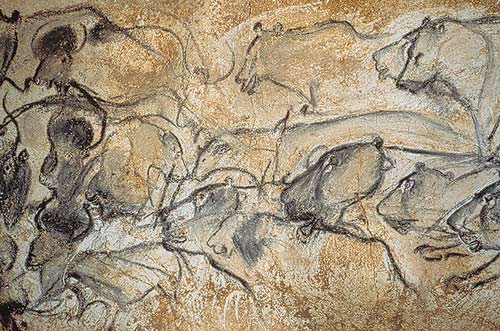
Surrounded by pink calcite columns like icicles with glittering crystals, the rock paintings depict a myriad of animals including cave bears, ibexes, deers, owls, mammoths…

Action-packed panels of bisons, horses, and rhinos locking horns:

.

Lions hunting bisons:

A panther and hyenna surprisingly in friendly mood:

.

From the film, archeologists and an art historian inform us that a single artist created most of these works. He had a crooked little finger, and his palm prints could be seen from crouching position to a height of 6 ft.  They are now the oldest human handprints:

.

.

There are animal fossils but no human remains in the cave, suggesting that it was not used for human dwelling but maybe just for painting. A prehistoric art studio? The artist had utilized the curvatures and ridges of the rocks to create fascinating renderings of animals charged with life and energy.

This is where I’d wholeheartedly endorse the 3D technology. Director Herzog, after some hesitations, decided to use a 3D camera to capture the vivid renderings. With the 3D advantage, we can see how the artist utilized the contours of the rocks to depict the animals in a most realistic way.

In the film, we also see multi-legged bisons, like those in cartoon strips or frames in animated films, suggesting movements.

Many of the animals are depicted in perspectives:

.

.

and in layered renderings like this showing lions without manes:

.

.

A few of the paintings are dated to some 5,000 years later, about 27,000 to 25,000 ago, indicating another period of artistic activities there. But since that newer date, no human traces were left. The cave had remained untouched until the recent discovery in 1994.

In the vicinity of the cave, remnants of musical instruments are found, evidence of another form of artistic pursuit. In the film, we hear one of the researcher playing the “Star-Spangled Banner” on what looks like a tiny twig with equally-spaced holes. It would be another extraordinary find if we could discover the pop tunes of the day.

Now, a note about watching this film in 3D. I admit as someone with an acute built-in motion sensor, I had to leave the theatre half way through the film when I first saw it in 3D. The roving camera plus the 3D effects had proven to be worse than being tossed at sea.

But I’m fortunate to be given a second chance. The film is now screened in another theatre without the 3D technology. I knew I must see the rest of it, so I returned for a second viewing. And this time, I stayed till the end.

A must-see documentary for all.

~ ~ ~ 1/2 Ripples

***

Sarah’s Key: Book into Movie

“When a story is told, it is not forgotten…”   — “Sarah’s Key” the movie

The Background: Vel d’Hiv Roundup

The story has to be told, because it is based on a historical event that has long been ignored. On July 16 and 17, 1942, the French police in Paris rounded up more than 13,000 Jews in Paris, among them 4,000 children, and confined them in the Velodrome d’Hiver (Winter Velodrome), an indoor bicycle racing track and stadium not far from the Eiffel Tower. There in the Velodrome the Jews were kept under French police guard for five days with no food and just one tap. They were subsequently sent to internment camps outside of Paris, where children were torn apart from their parents. Apart or together, they shared the same fate. From the internment camps, young and old alike were later transported by train to the Auschwitz extermination camp. The Velodrome, which was situated in the 15th arrondissement of Paris, has since been torn down but the event remains a dark page in France’s history.

The Vel d’Hiv roundup had been ignored for decades in the classrooms of the nation. Post-war French leaders from de Gaulle to Mitterrand had kept mum on the issue of France’s role in deporting Jews to the death camps. It was not until Jacques Chirac became president in 1995 that the French state accepted its official complicity, in particular, the Vel d’Hiv roundup. Here’s an excerpt of Chirac’s historical speech taken from a TIME magazine article:

France, homeland of the Enlightenment and of human rights, land of welcome and asylum; France, on that very day, accomplished the irreparable,” Chirac said in his speech, using the Vel d’Hiv roundup as a metaphor for all Vichy crimes. “Failing her promise, she delivered those she was to protect to their murderers.

A story based on this true event ought to be noticed. The French drama based on true accounts, “La Rafle” (“The Round Up”), was released in 2010 to a large audience in the country. And for us in North America, we have the novel Sarah’s Key (2007) and its movie adaptation (2010) to inform us of that horrific event and the imagined scenario of its impact on the lives involved.

(Spoiler Alert from here on.)

The Book

Written by Tatiana de Rosnay and published in 2007, the book has been on the New York Times bestseller list for 120 weeks. It has sold 5 million copies world wide and been released in 38 countries. de Rosnay has published works in French. This is her first English language book.

The book weaves two stories together 60 years apart. 10 year-old Sarah Starzynski’s family is one of those being rounded up on July 16, 1942. On the spur of the moment, Sarah hides and locks her 4 year-old brother Michel in a cupboard in the wall of their bedroom, thinking there he will be safe until she comes back for him. It was horrific for her and her parents to find out later that they won’t be returning at all.

Sarah and her parents are kept in Vel d’Hiv in appalling conditions, only to be deported to an internment camp where she is separated from them. Her determination never wavers though in getting back home to let her brother out of the locked cupboard. She has kept the key, guarding it with her life.

Fast forward to 2002. Julia Jarmond, a U.S. expatriate married and working as a journalist in Paris, delves into the research of the Vel d’Hiv roundup for a magazine article commemorating its 60th anniversary. She is totally absorbed by the little-known event. What’s more, she finds out that the apartment that used to belong to her French husband’s grandparents and which is now under renovation for her to move in was the very home of Sarah and her family.

At the same time, Julia struggles with a personal dilemma. At 45, mother to 11 year-old Zoé, and after two miscarriages, Julia is excited to find out she is pregnant. Her husband does not share her sentiment however, pressing her to abort. The poignant story of Sarah inspires Julia’s decision as the story unfolds.

While I whole-heartedly admire the author for her intention to honor the victims of Vel d’Hiv and her eagerness to expose the atrocities afterwards, I have reservations about the literary quality judging from the style and structure of the book. At several points, I feel the writing redundant. And for a novel written for an adult readership, it gives me the feeling of being talked down to, told what to think and how to feel.

Structurally, it presents the two stories in alternating chapters. The shifting is abrupt as the chapters are only three pages long. This lasts till the middle of the book when the story of Sarah’s key comes to an end. That occurs when Sarah makes it back to her apartment and discovers the heart-wrenching horror. The rest of the book is the continuation of modern day Julia’s story, her persistence to discover Sarah’s trail after the war and dealing with her own personal dilemma. Compared to Sarah’s story, this latter part seems trivial and anti-climatic.

The Movie

One year after it premiered at the TIFF, I finally have the chance to see this movie as it is being screened only recently in one theatre here in town.

Screenwriter director Gilles Paquet-Brenner has gleaned the essence of the novel and tightened the plot in an engrossing way. By virtue of its form, the movie has the advantage of showing rather than telling.  It can condense paragraphs of words into a cinematic moment frozen in the mind’s eye. The film is captivating, telling the story with vivid and haunting images.

We see the recreated Vel d’Hiv and its appalling condition. We see a woman plunging to her death from a high level in the Velodrome, an apparent suicide. We see the horror of children torn away from their mothers in the internment camp. We see too the desperation of Sarah finally running up to her apartment, pounding on the door of the new family living there. We see her barging into her bedroom and unlocking the cupboard. And from inside there with the camera pointing out, we see the terror on Sarah’s face as she looks in. We hear her scream.

The storytelling is carried out by the excellent performance of the two main actors, Mélusine Mayance as Sarah and Kristin Scott Thomas (“I’ve Loved You So Long”, 2008) as Julia Jarmond. The structure of the plot limits young Sarah to only the first part of the film, albeit her portrayal is memorable, her unseen presence lingers through the movie.

Kristin Scott Thomas always delivers. Her role as the persistent journalist Julia is convincing and a pleasure to watch. Her cool demeanor conveys the fact that it takes intelligence and professionalism to find the truth as a journalist, and yet, once exposed, the truth can have the affective power to inspire and turn one’s life around. Scott Thomas has aptly portrayed this change.

Nevertheless, the weakness of the film lies in the lack of character development in the ‘minor’ roles. If given more depth, they can sharpen the conflicts and enhance the story. I’m thinking of Julia’s relationships with husband Betrand (Frédéric Pierrot, “I’ve Loved You So Long”, 2008) who insists on her abortion, and with her daughter Zoé (Karina Hin).

And since I’ve been looking for ‘intrusions of grace’ lately, there’s a scene here that is of note. It is not in the book, but screenwriter/director Paquet-Brenner has aptly created a poignant cinematic moment with it.  When Sarah and another girl are trying to crawl under a barbed wire to escape from the internment camp, they are caught by a guard. But upon the urgent appeal of Sarah, he softens. Using his bare hands to hold up the wire, he pushes the girls through. The camera then closes up on his bleeding hand, pierced by the barbs, an apt allusion. How we need these ‘intrusions of grace’ to shed a glimmer of hope amidst overwhelming darkness.

“Sarah’s Key” may well be one of those examples where the movie speaks more powerfully than its source material. If you are time-pressed, go for the cinematic rendition.

***

To read more about the Vel d’Hiv roundup and related articles, click on the following links:

Behind the French Ruling on WWII Deportations of Jews“, TIME.

“Remembering the Vel d’Hiv” The Economist.

“Letters from Drancy” The Guardian.

“Vel d’Hiv Roundup” Wikipedia

Looking for “Intrusions of Grace” in Nature

This may be the easiest to find, especially with our glorious fall this year. Not intrusions, but infusion of common grace. I’m amazed because everywhere I turn, I see beauty that’s out there and so accessible to me. Like their raison d’etre is for me to behold and enjoy. From the macro scale like these scenery at Banff National Park:

.

To the medium range, nature in our city streets:

.

To the micro scale. Last long weekend, I walked the Douglas Fir Trail. Again, I’m grateful for our urban parks:

And what an apt occasion, Thanksgiving Day, for me to discover all these minute wonders on the Trail. First, the colours:

Nature in the miniscule… the varieties of berries. Black against red:

Red against green:

And these pure whites like pearls in the undergrowth:

And the vibrant lives on two fallen twigs… I was mesmerized:

If we’re intruded by grace, I’m more than willing to give in.

***

All photos taken by Arti of Ripple Effects in the fall of 2011. ALL RIGHTS RESERVED.