CBC Disbands Radio Orchestra

Update April 1:  Reader Tom has alerted me to the site for online petition to save the CBC Radio Orchestra.  http://www.savecbcorchestra.com  Please sign the petition and spread the word. 

Another shocking news:  The CBC Radio executives have just decreed that The CBC Radio Orchestra is to be dismantled as of November, 2008, on the heels of Cutting Classical Music Programs on Radio 2. 

What a swift one-two punch!

Formed in 1938, mandated “to make engaging musical radio programs, commission and perform works by Canadian composers, showcase Canadian performers and conductors, and discover and expose Canadian excellence”, the orchestra has been a Canadian cultural and musical tradition for 70 years.

 Click here for the news coverage in the Globe and Mail of March 27, 2008.

Click here for the Vancouver Sun article on Canada.com: CBC Kills Radio Orchestra

Click here for the article:  The Day The Music Died in The McGill Daily.

Does the CBC management even have the right to do that?  I thought this is a publicly-owned national radio station.  A cultural and arts institution with 70 years of history can be chopped off the Canadian landscape by a few executives like a branch off an old tree in the backyard? 

With this executive order, the CBC has finished off a piece of North American history, disbanding the last radio orchestra in the continent.

Again, I was alerted to this piece of appalling news by my teenaged son…talking about axing classical music to attract younger audiences.  CBC has gravely miscalculated the musicality of our youth and done an utter disservice to them, depriving them of knowing and appreciating a heritage dating back to hundreds of years of human civilization.

To save Classical Music from being axed off the cultural tree, Click here for the Online Petition.

BTW, the Facebook Group ‘Save Classical Music on the CBC’ now has over 8,000 members…I’m not trying to stereotype, but would these not be some of the ‘younger audiences’ CBC is trying to woo?

                                                            ******

CBC Cutting Classical Music Programs

What a shock it is for me to learn that our national radio station CBC Radio 2, is choosing to axe more classical music programs to appeal to a ‘wider audience’.  Why, aren’t we who have been enjoying the arts and music, who have cherished the long tradition of these CBC productions, who have raised our children on them, teaching and nurturing them to appreciate their content, not a part of the general public? 

Click here for Russell Smith’s article in The Globe and Mail on March 13, 2008, “No classical?  Then kill Radio 2 and get it over with.”  Just let me try to fathom the motives behind these further cuts:

1.  Diversity.  If it’s diversity they are aiming at,  they should all the more leave the classical edge in because CBC Radio 2 is the only nation-wide English radio station in Canada that offers classical music.  Which station can I tune in for such extensive and in-depth coverage of the arts and artists, classical music and musicians, live concerts, commentaries, CD reviews and even an audience requests program? What alternative do I have when the only classical music station in Canada decides to go with the flow and become just another dial for easy listening or contemporary pop?  I feel like I’m a CBC copywriter doing a promo for the station…but why would they need me to tell them this?   To CBC Radio: Respect your role in the Canadian cultural landscape.  What ‘diversity’ are you offering if there are no choices in genre? If ‘diversity’, and ‘choice’ are such powerful words nowadays, honor the real meaning of these terms and not just utter them for political correctness. 

2.  Multicultural. The term “Classical Music” has often been misconstrued as being monocultural.  Are CBC program researchers and management not aware that many so called “classical” composers, especially the more contemporary ones, are from a diverse cultural background including not only Western European, but Central and southern European, Scandinavian, Russian, North American, South American, and Asian?  And do they not know that for this last group here, Asian-Canadians, especially appreciate classical music and particularly in the teaching of their young, the next generation of music lovers?  I for one can speak out on this issue where I personally and know and have come into contact with countless parents of Asian descent who have involved their children in the learning of classical music, and have nurtured numerous talented young classical musicians here in Canada.  Jan Wong in her recent book Beijing Confidential notes that there are 30 million piano students and 10 million violin students in China today.  Two of the most popular music icons among the young are Lang Lang and Yundi Li, both world renowned classical pianists in their 20’s. Wouldn’t it be odd that one can enjoy classical music on radio in China but not be able to in Canada?

3.  Education. If it’s just for the sake of our young, we owe them a great heritage if we do not nurture them to appreciate the roots of modern music. Without going deep into music theory, isn’t it true that our contemporary music evolves from classical foundations?  Calling it ‘classical’ sounds so politically incorrect, as it wrongly conveys ‘elitism’ or simply connotations of being passé. But, would you avoid teaching our next generation Canadian history just because history is passé? 

4.  Business. If it’s for marketing reasons, why add one more ‘easy listening’, ‘pop’, ‘jazz’ or ‘contemporary’ station to the already competitive business, why fight for market share while you can distinctly offer something very different and unique, a real alternative to the radio audience in Canada.  If you wish to morph into a more hip mode to appeal to the young, look for younger DJ’s for your classical music programs. If George Stroumboulopoulos (previously of MuchMusic) can become a Canadian news icon on CBC Television, I’m sure you can find young blood equally well versed in the classical music sector.  

5.  Identity. And if it’s Canadian identity they are seeking, trying to appease the ‘general public’ (as if we are not), then CBC Radio 2 should all the more realize, as a publicly owned radio station and a national institution, the classical music they are eliminating is not just a part of Canadian identity, but human civilization…and I suppose western or eastern, old or young, we are a part of that.

Enough said here.  My teenaged son who alerted me to this piece of incredulous news has sent me a link to the on-line petition.  Click here to sign.

Other reactions to this announcement:

 http://www.cbc.ca/arts/media/story/2008/03/04/radio-two.html

http://www.friends.ca/News/Friends_News/archives/articles03200802.asp

A Facebook group has already been formed:  “Save Classical Music on the CBC”, has gathered more than 8,000 members and counting.

Emma: Miss Woodhouse Regrets

UPDATE:  To read my posts on the new BBC production of Emma (2009, TV), Episode 1 CLICK HERE.Episode 2 CLICK HERE... Episode 3 Conclusion CLICK HERE.

.

Andrew Davis created another proficient and loyal adaptation of Austen’s work, a year after his success with Pride and Prejudice(1995).  Emma (1996 TV) shown on PBS last night is effectively written for the screen, bringing out all the crucial scenes in congruent sequences. Great acting from all, except I must say, Mark Strong’s Mr. Knightly seems to be a bit too severe and lacks the forbearing and benevolent nature he possesses in the book. Maybe because of that, Kate Beckinsale is a more subdued Emma, less spriteful as Gwyneth Paltrow’s portrayal. I have enjoyed Olivia Williams as Jane Fairfax and Samantha Morton as Harriet Smith, who is more appropriately cast than Toni Collette in the 1996 movie.

“I am going to take a heroine whom no-one but myself will much like.”  –Jane Austen on Emma

Is Emma such a despicable character that Jane Austen thought no one but herself would much like?

At first, I thought so. Emma is manipulative, imposing and snobbish. In her pride, she has toyed with Harriet’s emotions, misdirected her path, and dominated her decisions. In her blindness, she has misjudged intentions and at times, behaved disdainfully. If Lady Catherine were around, her words targeted at Elizabeth Bennet would be most appropriate here: “Obstinate, headstrong girl!”. Lizzy would also decry: “Insufferable!”

But, why did Jane Austen still like her?

In her ingenious style, Austen has led us in a most gratifying way, to see our heroine regret. Emma is not a perfect human being. Far from it. She probably has more ingrained flaws than most of the other characters in the story. However, that is the way our beloved author likes to sculpt her heroines: making them earn their respect by their mending their ways. And she knows how gratified her readers must feel to see Emma enlightened and humbled. By showing a regretful and corrected Emma, Jane Austen has aligned our views with hers, helping us to appreciate our heroine as a respectable character who is not afraid to own up to her blunders.  Emma’s tears of regret have melted our hearts away.

Moreover, and most importantly I think, Austen has inconspicuously led us to see Emma from the eyes of Mr. Knightly towards the end of the story. Mr. Knightly has been Emma’s moral compass and benevolent mentor. While he can see her errors clearly, and does not hesitate to correct and admonish, he is also ready to forgive. He has chosen to love her from a distance while she is still an immature and self-deluded girl, albeit an imaginative one.

At the end, we are rewarded to see Emma gaining self-understanding:

“I seem to have been doomed to blindness.”

Hearing Knightly’s declaration of love, the undeserved euphoria is unspeakable. But of course, Mr. Knightly sees it otherwise:

“I have blamed you, and lectured you, and you have borne it as no other woman in England would have borne it.”

His kindness and love for Emma compel him to still give her credit in her most self-deprecating state. In his eyes, she is ‘faultless in spite of all her faults’.

So, from Mr. Knightly’s point of view, we’ve come to appreciate a very human Emma, humbled by experience, regretful of her ways, and in the end, ever so ready to change. After all, it’s about time that a blissful match is made for herself.

******

Update:  You can read this article as well as other interesting and informative articles on Jane Austen and the Regency Period in the Jane Austen Centre Online Magazine.

The Easter Message


dominus-flevit-mt-of-olives.jpg 


When I Survey the Wondrous Cross

When I survey the wondrous cross
On which the Prince of Glory died,
My richest gain I count but loss,
And pour contempt on all my pride.

Forbid it, Lord, that I should boast,
Save in the death of Christ my God,
All the vain things that charm me most,
I sacrifice them to His blood.

See from His head, His hands, His feet,
Sorrow and love flow mingled down,
Did e’er such love and sorrow meet,
Or thorns compose so rich a crown?

His dying crimson, like a robe,
Spreads o’er His body on the tree;
Then I am dead to all the globe,
And all the globe is dead to me.

Were the whole realm of nature mine,
That were a present far too small;
Love so amazing, so divine,
Demands my soul, my life, my all.

—– Isaac Watts, 1707


   ***

Photo: Dominus Flevit Church, Mount of Olives, Jerusalem.  Taken by Arti of Ripple Effects, www.rippleeffects.wordpress.com, November 2007.  All Rights Reserved.

Enchanted (2007, DVD)

I consider myself a rational person.  As an armchair critic, you have to, right?  Analytical, critical, not easily moved… But when it comes to humor, I just can’t resist.  I have to admit, I tried to control myself from laughing out loud many times, and not embarrass myself among all the preschool kids and their parents in that matinee show, even though it was dark there in the theatre.

Note to myself:  get the DVD when it’s out.  And so I did.

Why am I enchanted?  First of all the movie.  It’s loaded with smart dialogues, humorous parodies, seamless fusion of animation and real characters, and an old-fashioned and yet still wise message for today.  And the cast,  sure looks like they are having the time of their life making the movie. And the Oscar nominated songs by Menken and Schwartz, with the huge conglomeration of dancers, a delightful revival of the old musicals of the heydays.

Enchanted is a classic fairy tale: An evil queen, afraid of being dethroned, tries in all her power to prevent her stepson from marrying his true love by banishing her to the real world of modern day New York City, where there are no “happily ever afters”, a punishment indeed.  While there, the fairytale maiden meets her real life prince…and so on and so forth…But, what’s not typical is that it’s being handled intelligently, thanks to an excellent script, and the talented technical support it receives.

Amy Adams, Patrick Dempsey,  James Marsden, and Timothy Spall all deliver lively and very gratifying performances. Also, Susan Sarandon as the wicked Queen Narissa…I say, she’s in character.  And the then 8-year-old Rachel Covey, the cutest child star I’ve seen in movies these years. This is only her second movie, but she’s a natural, that is, she doesn’t need to act. She can just stand there and be adored.

The DVD is packed full of fun and information. We have a Carrie Underwood music video “Ever Ever After”, an additional animated story, bloopers, and director Kevin Lima commenting on the deleted scenes. I’m most fascinated by the behind the scene look at how the songs and the musical scenes are produced.  It’s fascinating to watch how choreographers have to coordinate hundreds of performers involving gymnastic troops, stilt walkers, eclectic groups of dancers and multicultural musicians in the “That’s How You Know” scene in Central Park.  I’m most impressed to find a few of them are veteran dancers who had appeared in the classic movie West Side Story (1961) and one was a chimney sweeper in Mary Poppins (1964)!  I’m thinking…Can I even get out of my bed when I’m at their age?

Great family entertainment for the Easter break coming up.  In a world of dysfunctional relationships, no wonder I am enchanted by a movie painting couples reconciled, yes right in the divorce lawyer office, and lovers united after swashbuckling adventures in the hustle and bustle of New York City. 

Just don’t remind me it’s only a fairy tale.

~ ~ ~ Ripples

In Praise of Austen: Virginia Woolf’s A Room of One’s Own


 A Room of One’s Own is based on a series of lecture Woolf delivered at the two women’s colleges in Cambridge University on the topic of “Women and Fiction”.  It was published in 1929.

Woolf lamented the disparities women in a patriarchal society had to face throughout history.  The stream of consciousness flowed into torrents of incisive social observations and satirical commentaries.

She noted that women had long been deprived of equitable opportunities in education and employment. Men were rich, women were poor; men got to roam the country and travel the world, women had to be satisfied with the domestic.  Men were great writers, poets, playwrights, women had to concede to find fulfillment in “making puddings and knitting stockings”. Men had rooms to work, to rest, to create…women, the average, middle class women, seldom had a room of their own.

…to have a room of her own, let alone a quiet room or a sound-proof room, was out of the question, unless her parents were exceptionally rich or very noble, even up to the beginning of the nineteenth century.

And sadly, Woolf had to utter this statement:

Yet genius of a sort must have existed among women as it must have existed among the working classes.

Isn’t it true, Jane spent her most prolific years writing in a very public room in Chawton House.  In the midst of family activities, at a small and spartan desk, she revised Pride and Prejudice and Sense and Sensibility, wrote Mansfield Park, Emma, and Persuasion, and began Sanditon:

Jane's writing desk in Chawton

And isn’t it true that only in movies do we see the idyllic desk against a clear window, with soft light diffusing in, gently illuminating a lady dressed in elegant regency gown, writing on expansive papers and stationary, contemplating in solitude:

Room or no room, recognized or not, something happened towards the end of the eighteenth century that, according to Virginia Woolf, deserved much more mention in history than the Crusades or the Wars of the Roses:  The middle-class woman began to write.

Woolf pointed out that not only did Jane Austen lack a room of her own, having had to write her novels in the very public sitting-room, she had to hide her manuscripts or cover them with a piece of blotting-paper, as observed by her nephew James Edward Austen Leigh in his Memoir of Jane Austen.

Ironically, there lay the genius of Austen, and the few woman writers around her time such as Bronte and George Eliot.  Woolf wrote:

…and we must accept the fact that all those good novels, Villette, Emma, Wuthering Heights, Middlemarch, were written by women without more experience of life than could enter the house of a respectable clergyman; written too in the common sitting-room of that respectable house and by women so poor that they could not afford to buy more than a few quires of paper at a time upon which to write.

Little did they know, it was in such a room that they were trained in the prerequisites of novel writing:

…all the literary training that a woman had in the early nineteenth century was training in the observation of character, in the analysis of emotion.  Her sensibility had been educated for centuries by the influences of the common sitting-room.  People’s feelings were impressed on her; personal relations were always before her eyes.  Therefore, when the middle-class woman took to writing, she naturally wrote novels…

Not only that, they wrote good novels.  With reference to Jane Austen, Virginia Woolf concluded:

Here was a woman about the year 1800 writing without hate, without bitterness, without fear, without protest, without preaching.  That was how Shakespeare wrote.

High praise indeed.

The Jane Austen Centre Online Magazine

I’m excited to see my three posts on PBS’s Pride and Prejudice (1995 TV, Parts 1 to 3) have been selected for publication in the March issue of  The Jane Austen Centre Online Magazine

The posts have been combined into a single article. Magazine editor Laura Boyle has given it a new name “Pride and Prejudice Revisited”.  If you go to the Magazine’s home page, it can be found under the category of Jane Austen’s Work: Jane Austen’s Books and Characters .  You can also click here to go directly to my article.

While you’re there, browse through the many interesting and informative articles on topics relating to Jane and the Regency world, including fashion, recipes, histories, Jane’s work, media reviews, biographies, hands-on crafts and projects, and a short story mystery featuring Northanger Abbey characters entitled ‘There Must Be Murder’.

The Jane Austen Centre

I visited the Jane Austen Centre in Bath last December.  It’s located a few doors from Jane’s second residence in that Georgian City at 40 Gay Street.  The Centre houses a permanent exhibition, a gift shop, tea rooms, and sponsors walking tours and an annual Jane Austen Festival.  

For pictures of my Bath visit, here are my posts Jane Austen’s Bath and Bath in December.

In Praise of Austen: Emma Thompson’s Acceptance Speech

I’ve a video tape of Sense and Sensibility (1995) for a long time.  A few days ago I bought the DVD of the movie, and was pleasantly surprised to see the ‘Extra Features’ includes Emma Thompson’s acceptance speech at her Golden Globe win for Best Screenplay.

And for all these years I’ve missed this one!

That the Taiwanese director Ang Lee would take on such a project is evidence of the universal appeal of Austen’s work.  But it is Emma Thompson who stands out as the well-deserved winner of both an Oscar and a Golden Globe for her writing of the adapted screenplay of Sense and Sensibility (1995).

Here’s Emma Thompson’s acceptance speech at the 1996 Golden Globes Awards ceremony.  It is an ingenious and imaginary rendition of what Jane Austen would have written about that night.  A speech of true Austenian style, a must-see for all Janeites and Emma Thompson fans.  Of course, those who own the DVD must have seen it numerous times, I’m just twelve years too late:


The Diving Bell and the Butterfly: The Memoir

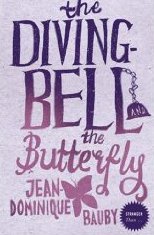
diving-bell-and-the-butterfly-book-cover1

This is one book that should be read after watching the film.  Without visualizing what Jean-Dominique Bauby had gone through after his massive stroke, the reader simply could not empathize or appreciate enough of Bauby’s effort in ‘writing’ his memoir.

But in case you missed the theatre screening and are still waiting for the DVD to come out, you may like to read my review of the film by clicking here.

At age 43, Jean-Dominique Bauby, the editor-in-chief of France’s Elle magazine, was paralyzed after a massive stroke.  The only ability left in his whole body was the blinking of his left eye. With the help of his speech therapist, he learned to communicate with the outside world by blinking to the corresponding French alphabets held in front of him.

When the physical body fails us, what elements remain that can qualify us as a human being? Our beating heart?  Our brainwave?  Bauby’s memoir has so poignantly shown us the two essential functions that kept his soul alive:  memory and imagination.  Locked-in syndrome may have encased his physical body, the butterfly within escapes to the expanse of limitless skies.

The 140-page memoir expertly translated by Jeremy Leggatt comprises of 29 personal essays, ‘written’ one blink at a time, and published shortly before his death in 1997. What is trapped inside a totally debilitated body was a vivid memory and lively imagination, that despite being confined to a hospital bed, can set free a soul that yearns for love and intimacy, a soul that still basks in the humor and pleasures of life.

No words can speak more powerfully than Bauby’s own.  Here are some excerpts from his book.

Shortly before his stroke, he visited his 92 year-old father and helped him shave:

I complete my barber’s duties by splashing my father with his favorite aftershave lotion.  Then we say goodbye…We have not seen each other since.  I cannot quit my seaside confinement.  And he can no longer descend the magnificent staircase of his apartment building on his ninety-two-year-old legs.   We are both locked-in cases, each in his own way: myself in my carcass, my father in his fourth-floor apartment.  Now I am the one they shave every morning…

One would never know how potent memories and the imagination can be:

Once I was a master at recycling leftovers.  Now I cultivate the art of simmering memories.  If it’s a restaurant, no need to book.  If I do the cooking, it is always a success.  The bourguignon is tender, the boeuf en gelée translucent, the apricot pie possesses just the requisite tartness.  Depending on my mood I treat myself to a dozen snails, a plate of Alsatian sausage with sauerkraut, and a bottle of late-vintage golden Gewurztraminer, or else I savour a simple soft-boiled egg with fingers of toast and lightly salted butter.  What a banquet!

Or how poignant the little gestures of love and intimacy are:

While I have become something of a zombie father, Theophile and Celest are very much flesh and blood, energetic and noisy.  I will never tire of seeing them walk along side me, just walking, their confident expressions masking the unease weighing on their small shoulders.  As he walks, Theophile dabs with a Kleenex at the thread of saliva escaping my closed lips.  his movements are tentative, at once tender and fearful, as if he were dealing with an animal of unpredictable reactions.  As soon as we slow down, Celeste cradles my head in her bare arms, covers my forehead with noisy kisses and says over and over, “You’re my dad, you’re my dad,” as if in incantation.

As I finished the book, I could not help but ask myself:  Do I have enough ingredients to practice ‘the art of simmering memories’ if I ever needed to?

~ ~ ~ ½ Ripples


August Rush (2007)

Autust Rush

In a fairy tale, you could throw all the right ingredients up in the air, and everything will fall in place into a gourmet feast right in front of you eyes.  Of course, the table will be set in fancy, with candlelights and all that jazz (you know, just like the “Be my guest” scene in Beauty and the Beast).  But moving-making is no fairy tales, even when you’re shooting one. 

A modern version of Dickens’ Oliver Twist, August Rush is a contemporary fairy tale set right in the realistic and metropolitan New York City: great setting.  A boy growing up in a boys’ home heading out to search for his birth parents merely by following the music in his heart: good story line.  That music has the power to unite souls and connect lost relations: magical idea. And the title ‘August Rush’: how cool is that?

Well, August Rush has all the right ingredients… but it lacks the quintessential elements: a good recipe and a good cook.  Without a good script that delivers intelligent and engaging dialogues, and quality directing to bring it to fruition, the characters remain banal, the story and scenes contrived and the intended magic is simply a concoction in saccharine.  It might still please, but not gratify.

Mind you, I wanted to see the film work.  I’d appreciated the music.  I was enthralled by the ingenious scores juxtaposing classical orchestral work with jamming guitars and raucous rock bands.  I’m also a fan of Keri Russell, have thoroughly enjoyed her performance in The Upside of Anger (2005), in particular.  But her great effort here in August Rush just can’t compensate for her lack of chemistry with Jonathan Rhys Meyers, who, I’m afraid, may be a miscast. I also feel that Freddie Highmore’s character August Rush needs a bit more depth (and less smile), and the overacting of Robin Williams may have done more harm than good…but of course, we need a villain in a fairy tale, don’t we.

Keri Russell plays a young cellist Lyla who is rising to fame in NYC.  She gets pregnant by rock band lead singer Louis (Jonathan Rhys Meyers) in a one-night stand.  The next morning Lyla’s father abruptly stops their relationship before it can even get started.  Louis goes back to England, and both give up their musical career. Months later, Lyla gets in a car accident and gives birth to a son but is told by her father that the baby didn’t survive. The boy grows up in an orphanage.  Compelled by the music he has been hearing in his heart, he runs away to NYC to look for his birth parents. He soon befriended a young busker who leads him to the Wizard, a modern day Fagin (Robin Williams).  The Wizard manages a group of young street musicians, squatters in a shabby abandoned building. Seeing the potential gains from his new found talent, the Wizard takes the prodigy under his controlling wings, until the boy breaks free and follows his inner music that ultimately leads him to the end of his search.

I’m all for wholesome, uplifting and inspiring films, and strongly believe in the power of music, but all good intentions cannot catapult August Rush to reach its lofty goals. 

~ ~ ½ Ripples

Jane Making The List of Best Movies Ever Made

With January to April being Jane Austen Season on PBS where The Complete Jane Austen is being aired on Masterpiece, it’s just refreshing to know that three Austen movies made it to the list of 1,000 Best Movies mentioned in my last post. I’m sure Janeites do not need anybody’s approval, but it’s good to have it just the same.

Again, here’s the link to New York Times’ The Best 1,000 Movies Ever Made. It should be noted that the list is based on the second edition of the book The New York Times Guide to the Best 1,000 Movies Ever Made which was published in 2004. The New York Times on-line edition still have the icon and link for readers to click even as recent as March 3, 2008, apparently they have not updated the list since the publication of the book.

The following are the three Jane Austen movie adaptations that made the list.

Persuasion (1995)Persuasion (1995) with Amanda Root as Anne Elliot and Ciaran Hinds as Captain Wentworth. Here’s a little excerpt from the NY Times:

Of course, Austen’s protagonists are never dumb, but Anne, being somewhat older, is also a good deal wiser, and the characters around her accordingly take on greater dimension and subtlety. Naturally, this being an Austen story, all ends well, but the path is somewhat less straightforward than in other films adapted from her work.

*****

Pride and Prejudice 1940

Pride and Prejudice (1940) with Greer Garson as Elizabeth Bennet and Laurence Olivier as Mr. Darcy. The New York Times had this tidbit about the classic adaptation:

Though Austen’s novel was set in 1813, the year of its publication, the film version takes place in 1835, reportedly so as to take advantage of the more attractive costume designs of that period.

*****

Sense and Sensibility (1995)

Sense and Sensibility (1995) with Emma Thompson, Kate Winslet, Hugh Grant and Alan Rickman. New York Times critic Janet Maslin summed it up:

We need no further proof that this material is ageless.

                          ************

It’s interesting to note that a modern version of Emma also gets a nod from the critics. Thus begins the review of Clueless (1995) on the NY Times:

“Jane Austen might never have imagined that her 1816 novel Emma could be turned into a fresh and satirical look at ultra-rich teenagers in a Beverly Hills high school.”

              Clueless (1995)

Jane Austen’s novels are indeed timeless.

New York Times: Best 1,000 Movies Ever Made

Here’s the link to the list of 1,000 Best Movies Ever Made according to New York Times movie critics. The list is based on the book The New York Times Guide to the Best 1,000 Movies Ever Made, second edition, published 2004.

Do you find your favorites here? If not, which movies do you think should be on the list? Which should not be? A list of 1,000 movies spanning almost a century, you might think there should be a lot of choices, right?

My view:

  • I agree maybe Bambi (1942) should be there, but no Out of Africa (1985) or Shawshank Redemption (1994)?
  • Ok, so Bull Durham (1988 ) is in, but where are Field of Dreams (1989) and Dances With Wolves (1990)?
  • I regret to see The Last Temptation of Christ (1988 ) is on the list but not The Passion of the Christ (2004).
  • So they have The Pianist (2002) but ignore Sophie’s Choice (1982) and Life is Beautiful (1997).
  • I see that Chicken Run (2000) gets to rub shoulders with Ben-Hur (1959)….ookay….and, if Working Girl (1988 ) can get a nod, then where’s my Bridget Jones’ Diary?

… and so on and so forth…

Your view?