At last year’s Oscar time, I was a little surprised that the buzzy Anatomy of a Fall wasn’t selected as the official entry by France to enter the race for Best International Feature Film. Instead, it was The Taste of Things. Now that I have the chance to watch it, I can understand why it was the choice and I totally agree with it. That it did not win seems immaterial, for its aesthetic value and the honour of being chosen to represent France make it a worthy accolade.
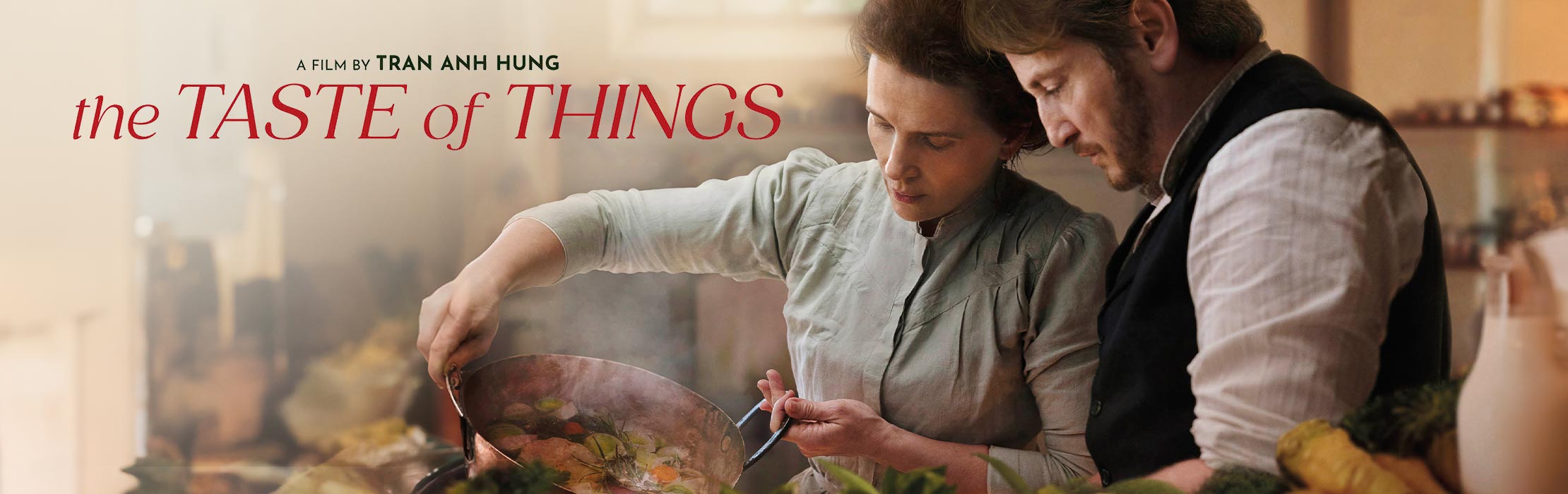
The Taste of Things is a delectable feature, a celebration of French gastronomy and its historic, culinary traditions, an exquisite and aesthetically riveting period film set in a country house. Vol-au-vent, pot-au-feu, roast rack of veal with braised vegetables… To say it’s a delicious food movie is just lowering the level of enjoyment, like eating an ice cream cone compared to being served baked alaska prepared by a gourmet. The film is not just about the taste of food, but of love, beauty, sensuality, and human connection, offering a deeply gratifying viewing experience.
Directed by the Vietnamese-French filmmaker Anh Hung Tran––whose first film The Scent of Papaya won a César Award in 1994 as well as accolades at Cannes––The Taste of Things sent Tran to Cannes again in 2023 and this time a Palme d’Or nominee and winning Best Director.
Tran reunited Juliette Binoche with her ex Benoît Magimel for the film. The two were divorced twenty years ago. Maybe a past relationship had some bearings on stirring up fond memories, for the pair exudes admirable chemistry on screen. Magimel plays the fictional gourmet Dodin Bouffant, nickname ‘Napoleon of gastronomy’, who resides in a country house during the late 19th century. His cook for twenty years has been Eugénie, superbly portrayed by Binoche, ethereal even in a rustic kitchen.
While Babette’s Feast (1988 Oscar’s Best Foreign Language Film) comes to mind readily, it’s the visual memory of Girl with a Pearl Earring (2004) that enhances my appreciation of The Taste of Things. Indeed, Dodin’s kitchen is like Vermeer’s studio, large window allowing natural light to pour in, the colour scheme of period costume and set design (Tran’s wife Nu Yên-Khê Tran), the naturalistic capturing of characters and their movement make it an exquisite, artistic production.
Inspired by Marcel Rouff’s novel La vie et la passion de Dodin-Bouffant, Gourmet (The Life and Passion of Dodin-Bouffant, Gourmet), writer director Tran wrote the screenplay of The Taste of Things as a prequel to Rouff’s novel, imagining the bond of love between Dodin and his longtime cook Eugénie. Dodin has proposed marriage to Eugénie time and again but is turned down every time. The twist comes when Eugénie falls ill and the reversal of roles emerges. Dodin begins to cook for her––love expressed through the ingenuity of new dishes meticulously prepared and the enjoyment of watching her savour his handiwork.
It’s interesting to note that there’s no music in the whole film. Massenet’s Méditation in piano version comes on only when the end credits roll. With no soundtrack, the essence is in the ambient sounds of nature, bird songs outside the country kitchen, and inside, the sounds of cooking, the crackling of the fire, and the gentle conversations among the characters as they prepare meals. In an interview, Tran mentions that: “The sound is the flavour of the picture. The picture has the beauty; the flavour of it comes from the sound.”
Another crucial ingredient is the camerawork. Cinematography (Jonathan Ricquebourg) is the key in capturing the overall aesthetics and mood of the film. The camera is like a quiet observer, moving gently, often in long takes, following the characters in the kitchen, their movement like a choreographed sequence, smooth, seamless, serene and subtle. While the food preparation may seem complicated and time-pressed, the overall mood in the kitchen is always harmonious. The would-be apprentice, fourteen-year-old Pauline (Bonnie Chagneau-Ravoire) is particularly impressive. A tidbit: The French chef Pierre Gagnaire, owner and head chef of his eponymous restaurant, is the consultant for the movie. He himself has a role in there as well.
Overall, an artistic achievement to savour. Vermeer’s kitchen or Dodin’s studio? A fitting fusion of imaginary connections.
~ ~ ~ 1/2 Ripples
***
Thanks to Words and Peace for hosting Paris in July 2024

Note: All posts on Ripple Effects written by Arti, the real person.
***
Related Posts on Ripple Effects:
Anatomy of a Fall or how to dissect a marriage
Paris in July 2022: A Culinary Sojourn
Girl with a Pearl Earring: the painting, the novel, and the movie












 Ripple Effects