Another Proust Read-Along

… as if we’re not busy enough?

Truth is, reading Proust calms me down. Maybe because I’ve to slow down, really slow down, to savor, and decipher. These two have become a fused enjoyment for me while reading Vol. 1 of In Search of Lost Time, Swann’s Way.

After finishing that, I quickly ordered the next volume Within a Budding Grove, but have since put it aside… until now, thanks to Bellezza of Dolce Bellezza, who read Vol. I with me. She’s right, of course, as she wrote on her invitation post for Vol. II:

‘No one should read Proust alone.”

So here we are, embarking on another Proust Read-Along, In Search of Lost Time Vol. II, Within A Budding Grove.

Within A Budding Grove Modern Library

Yes, this is a slow read, as always on Ripple Effects. We plan to finish and post our thoughts on November 30. I just might add in a mid-way post around end of October.

You are invited to join us for another slow and enjoyable ride.

If quantifying makes it easier to grasp, counting the days in October and November, and the 730 pages in my Modern Library Classic edition, you only need to read about 12 pages every day. A very doable plan.

Those of you who have read it all… how about a re-read now?

***

First Post for Vol. II:

Half Way Through A Budding Grove

My posts on Vol. I, Swann’s Way:

Part 1: Combray (my ‘Freshly Pressed’ post)

Wrap-up: The Swann and Gatsby Foil

***

Book Haul 2013

Here I go again, the annual Book Sale at Crossroad Market, organized by the Servants Anonymous Society. It’s a worthy cause, therefore, guilt-free looting of good condition used books, over a million of them donated by citizens like me. But I must say, I haul back more than I donate over the years, for many of them I plan to keep.

Compared to the last few years, I’m a bit more restrained this time. Here are some of my loot, all trade paperbacks for just $2 each:

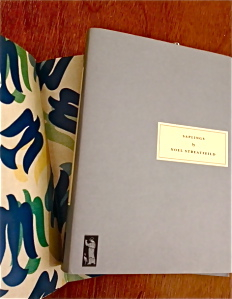
saplings-book-coverSaplings by Noel Streatfeild — I picked it up right away as soon as I saw the grey, minimalist book cover. Delighted to find inside is beautifully designed. Look at the photo I shot on the left. You can see both the dust cover and the inside of the book cover. This is my first Persephone Book, publisher of neglected women writers. I’ve not heard of the title or the author, but trust the London publisher’s choice, and glad to find it in such a mint condition at a used book sale, I quickly grabbed it.

Parade's End BBC Book Cover copyParade’s End by Ford Madox Ford — Truth be told, I’d never heard of FMF until I read Hemingway’s A Moveable Feast a couple of years ago. What a name. The only one I can think of along that line is… William Carlos Williams. Anyway, BBC’s adaptation of Parade’s End as a TV mini-series has added another name to my list of favorite actors: Benedict Cumberbatch (Again, ‘what a name.’) In these dry months in between seasons of Downton Abbey, Parade’s End makes one satisfying treat.

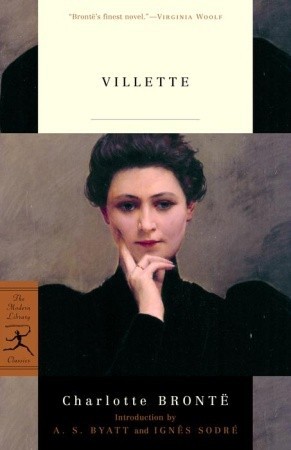
Villette by Charlotte BronteVillette by Charlotte Bronte — Here’s another reason for buying a book because of the publisher. I’m a collector of The Modern Library Classics. So finding this in the Classics section in the book sale was a pleasant surprise. A. S. Byatt offers her views in the intro. Other than Jane Eyre, I’ve not read anything else from Charlotte Bronte. Have you read this?

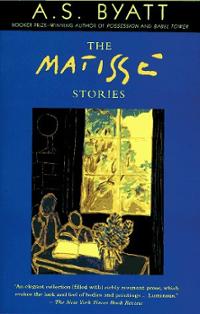
matisse-stories-a-s-byatt-paperback-cover-artThe Matisse Stories by A. S. Byatt — Three stories about three art works by Matisse. A beautiful little book. This from Goodread’s description: “These three stories celebrate the eye even as they reveal its unexpected proximity to the heart… the intimate connection between seeing and feeling…” My kind of stories.

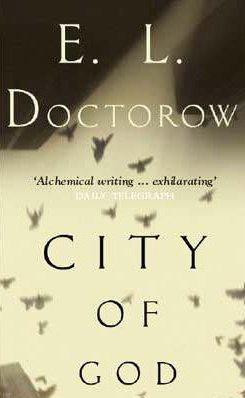
City of GodCity of God by E. L. Doctorow — Some years ago, The New York Times called the film adaptations of Doctorow’s works ‘expensive failures’. Reason: his novels are ‘too cerebral’, ‘too lyrical’, ‘too writerly’ to be transposed into cinematic images. Got it. Whenever I’ve the time and in the mood for some cerebral challenges, I know what book to pick up. After all, I’ve long wanted to read Doctorow. The subject matter of City of God just may arouse interest to help me through the thickets of Biblical proportion.

Becoming George Sand copyBecoming George Sand by Rosalind Brackenbury — George Sand I’ve heard of, Frédéric Chopin’s lover, one of those female writers who had to adopt a male pseudonym in 19th C. society. The interesting part is the modern parallel of the story of a female French professor in Edinburgh. Author Brackenbury (due to my ignorance I’ve not heard of) graduated from Cambridge University (which I’ve heard of) and now Fellow of Creative Writing at the College of William and Mary (that good name I’ve also heard of) in Williamsburg, VA. Enticing enough.

Tell It to the TreesThe Hero’s Walk and Tell It To The Trees by Anita Rau Badami — A look at the book cover of Tell It to the Trees helps me get the idea… The Indian diaspora in cold, wintry Canada, and for that I find a linkage. Not that I’m from India, but close enough. I’m sure Anita Rau Badami has a lot more to tell than adjusting to the climate. Born in India, now living in Montreal, Rau Badami has in recent years emerged as a clear voice in Canada’s literary landscape.

Movie Love Book CoverMovie Love: Complete Reviews 1988-1991 by Pauline Kael — Roger Ebert in his memoir Life Itself acknowledged Pauline Kael (1919-2001) as his mentor and major influence. While Ebert got a Pulitzer for his movie criticism, Kael got a National Book Award. She had been praised for re-inventing the form and aesthetics of the genre of film critiques. Along with a dearth of female literary voices in film criticism like Susan Sontag (1933-2004), seems like such a species had become extinct nowadays. All the more to appreciate ‘a classic’.

Wonderful TownWonderful Town: New York Stories from The New Yorker, edited by David Remnick — A Modern Library edition compiling over forty short stories published in The New Yorker before 2000, since that’s the pub. date. Reading the Table of Content is like reading the Who’s Who of 20th C. literary scene… John Cheever, Irwin Shaw, Philip Roth, Jonathan Franzen, James Thurber, John Updike, Vladimir Nabokov, Jamaica Kincaid, J. D. Salinger, Isaac Bashevis Singer, Susan Sontag, Woody Allen, Jeffrey Eugenides, Bernard Malamud, E. B. White… just to name a few. Woody Allen? You gasped. But, why are you surprised?

***

I’m a keeper of lists. If you’re interested, here are my loots from previous years:

2012

2011

2010

2009

***

Proust Read-Along: The Swann and Gatsby Foil

“He knew perfectly well as a general truth that human life is full of contrasts…” Swann’s Way, P. 510

While plowing through Part 2, ‘Swann In Love’, I happened to reread The Great Gatsby. Thanks to Baz Luhrmann’s new movie adaptation, I’m sure many more are doing the same. And oh what interesting contrasts Swann and Gatsby make.

Both are deeply in love, yearning for a woman who seems to be utterly elusive. Gatsby frantically maximizes to attract Daisy; Swann willingly minimizes to reach Odette. From a poor background, Gatsby grabs whatever means he can to build his wealth; Swann whose niche belongs to high society, has to pretend that he is nobody special, stooping to ‘a lower social sphere’ (P. 285) to be near Odette.

That distance is more than social. Swann is willing to forsake his cultured tastes of art and music, to lay aside even his own research and writing on Vermeer (Odette: I’ve never heard of him, is he alive still? P. 279). Swann is willing to lay down his interests and privileges for a woman who is uncouth in the sophistication of high society, who has superficial views and flashy tastes, and alas, even promiscuous.

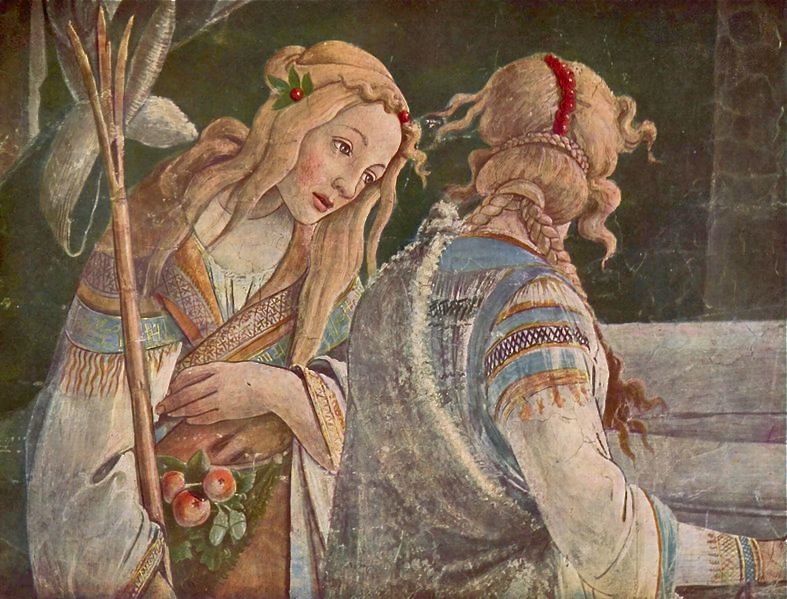
However, love transforms all deficiencies and blemishes into ethereal beauty. Here’s how Swann visualizes Odette. To him, she is like Sipporah, Jethro’s daughter, Botticelli’s fresco in the Vatican’s Sistine Chapel:

Zipporah, Jethro's Daughter by Botticelli

Following Odette to her ‘little nucleus’ at the Verdurins, Swann downplays his association with prominent people and tries not to be so outspoken with his knowledge and opinion about art and music.

When he is alone with Odette, he has taken her values and interests:

he tried at least to ensure that she should be happy in his company, tried not to counteract those vulgar ideas, that bad taste which she displayed on every possible occasion, and which in fact he loved, as he could not help loving everything that came from her, which enchanted him even. (P. 348)

Is this measurement of incompatibility in tastes inherently snobbish? Yes, Swann (or Proust) is sensitive enough to analyze this in depth. What is ‘taste’ anyway, or the intellectual beliefs with which he has been raised from the days of his youth?

… the objects we admire have no absolute value in themselves, that the whole thing is a matter of period and class, is no more than a series of fashions, the most vulgar of which are worth just as much as those which are regarded as the most refined. (P. 350)

So, all for love of Odette, Swann is willing to give up going to the Jockey Club, lunching with the Prince of Wales, or his love of Holland, or a visit to the Versailles (‘which bored her to tears’):

And so he denied himself the pleasure of visiting those places, delighted to tell himself that it was for her sake, that he wished only to feel, to enjoy things with her. (p. 350)

Those colorful shirts Gatsby has hoarded, Odette would have loved them, just like Daisy, and his mansion too… if only Swann had resided in a more prestigious address, somewhere ‘more worthy of him’ instead of his house on the Quai d’Orleans. (P. 346)

Odette’s fondness of Swann begins to wane as Forcheville enters into the picture. She becomes even harder to get. Swann is burned with jealousy, anger and bitterness. Yet he cannot forget her. His love even grows stronger for her, despite receiving an anonymous letter defaming her. Why,

People often say that, by point out to a man the faults of his mistress, you succeed only in strengthening his attachment to her… he had begun to desire the possession — as if that were ever possible — of another person. (P. 517)

Perhaps that is a mark of love: the demand for exclusivity. This is exactly what Gatsby wants Daisy to admit, that she has never loved Tom, that she has always loved him. “Oh, you want too much,” she cried to Gatsby.

But Swann is more fortunate. He knows he must gain back Odette’s full and exclusive devotion and somehow he does. I’m glad to read in Part 3 that eventually Odette does become Mme Swann. I’d be curious to know how that comes about. (Proust’s strategy to get us go on reading the next volumes?)

**

Part 3 is an enjoyable and much swifter read as the narrator remembers his childhood in Paris drown in unrequited love (so far, not sure about how this unfolds later) for Swann and Odette’s daughter Gilberte. Because of his love for Gilberte, the boy is infatuated with M and Mme Swann as well. His crush on the elusive Gilberte parallels Swann’s love for Odette in their earlier days.

The last sentence in Volume 1 of In Search of Lost Time, like that in The Great Gatsby, ends with a haunting remark on memory and the past:

The places we have known… were only a thin slice, held between the contiguous impressions that composed our life at that time; the memory of a particular image is but regret for a particular moment; and houses, roads, avenues are as fugitive, alas, as the years.

There are much more to be said, but nothing can replace the actual experience of reading Proust first hand. From March to May as I plowed through Swann’s Way, there had been up’s and down’s. Numerous times long sentences entangled, yet the very next moment could be so beautiful and lucid it dissipated all frustrations. I now look forward to Volume II.

**

Thanks for joining me in this Read-Along. Finish or not, you’re welcome to share your thoughts. Throw your two pebbles into the pond and make some ripples. If you have written a post, do let me know so I can link it here.

Bellezza of Dolce Bellezza

**

CLICK HERE to my post on Part 1 of Swann’s Way: Combray

***

Proust Read-Along: Swann’s Way Part One, Combray

Reading these first 264 pages of Proust conjures up some of my own memories…

I was sitting in a graduate class. A fellow student was doing a presentation on phenomenology. He brought into class a chocolate cake, cut it and gave each of us a piece. We were to describe this particular act of ‘Eating chocolate cake in class’.

What elicited only single words or phrases from us, Proust could have written pages. Why, from pages 60 to 64 the narrator details his experience of eating four morsels of the little cakes ‘petites madeleines’, the uplifting sensation, the taste, the action of dipping them into tea before eating, and the diminishing enjoyment after each mouthful. Above all, he relays how the very act of eating these madeleines has evoked long-buried childhood memories of Combray:

… in that moment all the flowers in our garden and in M. Swann’s park, and the waterlilies on the Vivonne and the good folk of the village and their little dwellings and the parish church and the whole of Combray and its surroundings, taking shape and solidity, sprang into being, town and gardens alike, from my cup of tea. (p. 64)

I don’t pretend to understand everything I read. Far from it. These first 264 pages of Proust’s seven volumes of In Search of Lost Time for me is a learning experience. I have to read through ambiguity, discard the expectations of clarity and congruity, accept incomprehension and press on. But an experience still, and surprisingly, an enjoyable one. An eye-opener too. Where have I read a sentence of 31 lines (p. 67-68) in such flowing prose, with such sensitivity and nuanced observations? And I must add, which I read at 1 a.m. I’m a quick study.

Sure, the unexamined life is not worth living. Proust must have plowed through his to the single second, and in depth too, as the madeleine-eating episode reveals. Insomnia sure has its benefits… arousing volumes of memories for the narrator.

Proust Book

From this first reading I’m surprised to find Proust’s subject matter comes from the mundane, from people and places in the village Combray where the narrator would go to stay for a period of time every year as a child. Even more a surprising delight is the loquacious way he describes the events, the people, the scenery, and the insights he can generate from the minutest observations.

A tiled roof is a tiled roof, okay, it looks more beautiful reflected on the river. But I was struck by how the narrator caught himself with speechless admiration, and ironically, articulating it with lucidity and humor:

The tiled roof cast upon the pond, translucent again in the sunlight, a dappled pink reflection which I had never observed before. And, seeing upon the water, and on the surface of the wall, a pallid smile responding to the smiling sky, I cried aloud in my enthusiasm, brandishing my furled umbrella: “Gosh, gosh, gosh, gosh!” But at the same time I felt that I was in duty bound not to content myself with these unilluminating words, but to endeavour to see more clearly into the sources of my rapture.  (p. 219)

Indeed, humor is another surprising find for me. In several places I’ve put down on the margin of the page, LOL!

So, I’ve quickly learned to go past those passages and sentences that have lost me, but soon as I come to something I can comprehend, and do resonate, I’d stop and reread, savoring the beauty of that moment.

My favourite passages include the heartbreaking accounts of the child’s longing for his mother’s goodnight kiss, the description of the church St. Hilaire where he goes to Sunday mass, the pages depicting the river Vivonne and the hawthorn trees in Swann’s park, the child’s discussions with Swann on reading and books, and his frustration with writer’s block as he strives to write poetry as a youngster.

But there is one passage I must mention. That is about the child’s Mamma caring to talk with their house maid and cook Françoise, asking her little questions about her feelings for her own family:

Francoise answered, laughing: ‘Madame knows  everything… [like] the X-rays that they brought here for Mme Octave, and which can see what’s in your heart’ — and she went off, overwhelmed that anyone should be caring about her, perhaps anxious that we should not see her in tears: Mamma was the first person who had given her the heart-warming feeling that her peasant existence, with its simple joys and sorrows, might be an object of interest, might be a source of grief or pleasure to someone other than herself (p. 73).

This, I think, is exactly what Proust has done.

Seeing the extraordinary in the ordinary, the village life, the kitchen and the table, the interactions and socializing, family relations, walking the country paths, the irises and the hawthorns… Reading this first part reminds me of paintings by Pieter Bruegel, or Van Gogh… and, not far from eating chocolate cake.

***

How’s your reading so far?

Janell of An Everyday Life

tuesday in silhouette

Wrap up post on Parts Two and Three: May 15.

***

Diary of a Country Priest: An Easter Meditation

Last year around this time, I wrote about the book The Diary of A Country Priest by French author Georges Bernanos, (Journal d’un curé de campagne, 1936). I’d like to repost my review this week, for every time I read it, I find the essence of Easter.

***

The Diary of a Country Priest Book Cover

A young priest comes to his first parish, the rural town of Ambricourt, filled with humble hopes. All he wants is to serve the people, to give of himself, to bring God’s love. But as soon as he sets foot in the village, he is engulfed by hatred and rejection. There are dark secrets too sinister to be exposed. The young priest is an unwelcome alien. In a town afflicted by hypocrisy, pride, anger and bitterness, he is despised, taunted and ridiculed. His own innocence is no match even for the children in his catechism class, especially the precocious Seraphitas, a girl ‘with a hardness far beyond her years.’

Ambricourt is a world afflicted by the ‘leprosy of boredom’, a microcosm of the human condition. Bernanos uses diseases to illustrate his point well. The young priest himself is being slowly consumed by terminal illness. The pain in his stomach ultimately defeats his body, cancer. His diet consists mainly of bread dipped in wine which he makes for himself, and some potato soup. Poverty of means, but also frailty of body to take in solid food. Many a times we see him in the Garden of Gethsemane, pleading for strength in anguish. But he faithfully presses on, using his diary to confide his deepest thoughts, a means to commune with his God.

On the outskirt of Ambricourt is the Château of the powerful M. le Comte. The Count needs no priest to know about his adulterous affairs, this time, with the governess Mlle Louise. His wife Mme la Comtesse is totally absorbed by her long-held bitterness and grief from the loss of her young son. And his daughter Mlle Chantal is a deeply disturbed girl eaten up by anger and jealousy. Soon, she will be sent away to England, a most convenient plan devised by her father.

It is with this deep mess of a family that the young priest finds himself entangled. The most intense scene of the whole book, the climatic moment, comes when the priest goes to the Château to meet with Mme la Comtesse. She lost her beloved son when he was only eighteen months old, a child hated by his jealous older sister Chantal.

On his last day they went out for a walk together. When they came back my boy was dead.

Mme la Comtesse is fully engulfed by hatred for her daughter, grief for her lost son, and bitterness towards God.

Hearing her speak, a tear flows down the face of the young priest. “Hell is not to love any more, madame.” The young priest responds. And with miraculous strength, he delivers the following words.

… But you know that our God came to be among us. Shake your fist at Him, spit in His face, scourge Him, and finally crucify Him: what does it matter? It’s already been done to Him.

Towards the end of some soul piercing exchanges, Mme la Comtesse kneels down, releases her pain, and receives blessings from the young priest. Afterwards, she writes to him in a letter:

… I have lived in the most horrible solitude, alone with the desperate memory of a child. And it seems to me that another child has brought me to life again…

And this young child, a priest, consumed by illness, wreaked by frailty of spirit, can only marvel at the power through weakness:

Oh miracle — thus to be able to give what we ourselves do not possess, sweet miracle of our empty hands!

Not long after this, he succumbs to his illness. A life too short, a mission seems unaccomplished. But his last words faintly uttered on his deathbed are as powerful as the God who sends him:

Does it matter? Grace is everywhere…

And in the film, these three words leave me with one of the most impressive endings of all the films that I’ve seen:

“All is grace.”

 ***

~ ~ ~ ~ Ripples

CLICK HERE to read my film review of The Diary of a Country Priest.

The Diary of a Country Priest by Georges Bernanos, translated by Pamela Morris, Perseus Books Group, Philadelphia, PA, 1965, 298 pages.

Journal d’un curé de campagne, 1936, was winner of the Grand prix du roman de l’Académie française.

Bel Ami by Guy de Maupassant

Reading Maupassant reminds me why I love Jane Austen.

To be fair, I’ve only read one of the numerous short stories and one novel of Maupassant’s, but all of Austen’s six novels. So it just may not be apt for me to generalize the former. But focusing on just this book, Bel Ami, I can say here’s a protagonist whom I can never cheer for nor find amiable, to put it mildly…

Maupassant uses a scoundrel as the main character and have us follow his ascent, unscrupulous at every turn, as his ego and desires are being fed all the way to the end, and then some more. An antihero, the poster boy of realism in his depiction of late 19th C. Parisian high society?

Jane Austen has also written a protagonist she described as “A heroine whom no one but myself would like”. But comparing to Bel Ami‘s Georges Deroy, Emma Woodhouse is angelic. How do I even start to think of a parallel… imagine Wickham of Pride and Prejudice and Willoughby of Sense and Sensibility, combine them and magnify their nasty streak ten folds, then you’ll have Georges Deroy, nicknamed Bel Ami by the women in his life, ‘good friend’, a most pathetic irony.

The time is 1890’s Paris. Georges Duroy is a former soldier living in poverty. But call it luck or call it will, Duroy ends up a prominent figure in Parisian high society. This is how he does it.

Women. At one time, there are four significant females in Deroy’s life. These are upper crust, influential beauties. To Duroy, they are but rungs up the social ladder, each a conquest.

First is Madeleine Forestiers, the wife of his benefactor, editor friend whom he runs into coincidentally, and who saves him from poverty by bringing him in to work for the newspaper La Vie française.

The second one is Clotilde de Marelle, a married woman whom Duroy has made mistress. She aptly analyzes the Mars and Venus chasm of gender differences on that elusive notion called love. To Duroy, she says:

I know perfectly well that for you love is merely a sort of appetite whereas for me it would be more a sort of… communion of souls which doesn’t exist in a male religion. You understand the letter and I understand the spirit.

The third is the big boss of the newspaper Monsieur Walter’s wife Virgine, who has such a crush on Duroy that she loses her senses when he successfully schemes and manipulates her daughter Suzanne to elope with him.

George Wickham has plenty to learn from Georges Duroy because his subsequent wedding after the elopement is not a hush hush patch up, but a glamorous celeb nuptial, fully legit and the envy of all. By now, Duroy has climbed to be editor of La Vie française and made himself a Baron, changing his name to Du Roy for a more aristocratic sound. And we know full well that the conquest doesn’t stop there.

In one earlier incident, Duroy comes out of a gun duel unscathed, albeit a bit numbed. With his life spared, he could well have used such a near-death experience as a springboard to a new beginning and a turnaround of his ways. But his lucky escape has only fuelled his hubris and reaffirmed his self-importance. After the duel, he thinks himself invincible.

Is he immoral or amoral? I feel I have to choose the latter in order to find some amusement in following this unscrupulous character. Is it realism or sarcasm? I have to mix them both in order to seek some reading enjoyment. And with the English translation by the Cambridge scholar Douglas Parmée, there are the occasional descriptions that sounds… curt. But are they the original intent as realism dictates, or the collateral effects of translation? Can’t make up my mind on that one. Just an example:

The elder sister Rose was ugly, as flat as a pancake and insignificant, the sort of girl you never look at, speak to or talk about.

There, I find myself having to choose or debone or mix and stir in order to wash down better when reading Bel Ami. Under Maupassant’s pen of realism, Duroy is relentless all the way to the end. Just goes back to my love for Austen’s works… why, I can take in big gulps, devour and be totally satisfied. There are Wickham and Willoughby, but ultimately my yearning for some sort of poetic justice can be gratified. For my reading pleasure, I’ll take Jane’s idealism anytime.

***

Bel-Ami by Guy De Maupassant, translated by Douglas Parmée, Penguin Classics, movie tie-in edition, 2012, 394 pages.

As you can see from the book cover, Bel Ami has been adapted into film. To literature purists, I suggest you look for another edition. Whenever I read about Georges Duroy, which is on every page, Robert Pattinson’s face keeps haunting me, and images of Uma Thurman as Madeleine Forestier, Kristin Scott Thomas as Virginie keep conjuring up in my mind. Now I haven’t even watched the film… oh the suggestive power of a book cover.

This concludes my Paris in July entries for 2012. Thanks to Karen of BookBath and Tamara of Thyme for Tea for hosting.

To Paris again next year!

***

Midnight’s Children: Book Three

Click on the following links to the different sections of the book:
Midnight’s Children Book One
Midnight’s Children Book Two, Part A
Midnight’s Children Book Two, Part B

CLICK HERE to read my Movie Review of Midnight’s Children

***

Finally, we’ve come to the last section, the most eventful and catastrophic in our protagonist Saleem Sinai’s life. I must admit, my enthusiasm sagged a little at the end of Book Two, through no faults of Mr. Rushdie’s. Book Three sent me to some major Googling to be informed. After reading what I found on the Internet, I was fully awake.

The tumultuous waves of history swept Saleem along like an open dinghy. The 1965 Indo-Pakistani War over Kashmir ‘wiped out’ his family in a bomb blast. Saleem was ‘wiped clean’ with no memories of his own identity. He subsequently joined an intelligence gathering unit in the Pakistani military, his super sensitive nose being the major asset. In 1971, another war awaited him as he headed from West Pakistan into East to counter the revolutionary Mukti Bahini in their fight for an independent Bangladesh.

Perhaps fate had a gentler hand than humans. Saleem, now ‘buddha’ as he was ‘purified’ of all his past, got lost in the Sundarbans jungle. For seven months, he escaped the war between the two Pakistans. When he reemerged he witnessed atrocities done by his own Pakistan army he could not believe. Ten million refugees from East Pakistan walked across the border into India. As a result, the mightier Indian army led by Sam Manekshaw intervened and soon ended the war, with Pakistan’s Tiger Niazi surrendering with his 93,000 men. Buddha shed his uniform and became a deserter in Dacca, independent Bangladesh.

Tossed amidst the raging sea of national and personal upheavals, our protagonist, though a drop in a sea of six hundred millions, felt the burden of history and came to a self-realization. Rushdie’s description is powerful:

Who what am I? My answer: I am the sum total of everything that went before me, of all I have been seen done, of everything done-to-me… I repeat for the last time: to understand me, you’ll have to swallow a world.

With the Bangladesh Independence victory parade came a band of magicians from India, among them was Parvati-the-witch, one of the Midnight’s Children. Seeing Saleem again and calling his name out loud in excitement, Parvati cured his amnesia. She smuggled him in her basket back to India. Subsequently, Saleem stayed with Parvati and the magicians in the slum of Delhi. The silver spittoon he carries all these years is a perfect metaphor of his life… once born with a silver spoon in his mouth as a changeling, Saleem now comes back to where he would have been if he had not been switched at birth, the spittoon.

Saleem met his changeling rival, Major Shiva now. A loyal supporter of PM Indira Gandhi, Shiva had risen as Saleem fell. A national hero and a womanizer, Shiva went to the magician ghetto and took Parvita away. Months later she was sent back to the slum when he learned that she was pregnant. At the end, it was Saleem who married Parvita, knowing that she would give birth to Shiva’s son.

Baby Aadam Sinai was born at midnight, June 25, 1975, on the brink of Indira Gandhi’s Emergency measure in gripping absolute power, another fateful night of the nation’s history. But Saleem knows his son who is not his son will have a different path:

Aadam was a member of a second generation of magical children who would grow up far tougher than the first, not looking at their fate in prophecy or the stars, but forging it in the implacable furnaces of their wills.

With Shiva as the biological father, baby Aadam once again flowed back to the blood line of his grandfather Ahmed Sinai, the offspring of a changeling comes full circle back to his rightful lineage.

Indira Gandhi’s son Sanjay conducted an anti-poverty operation to eradicate the slums. Parvati was killed in the clean-up. After her death, Saleem had a chance to go back to his birth city Bombay with his son. There he reunited with Mary Pereira. She was now Mrs. Braganza, manager of a pickle factory. Her changeling crime forgiven, Saleem now worked in her factory, paralleled his work as a writer preserving history:

… in words and pickles, I have immortalized my memories, although distortions are inevitable in both methods. We must live, I’m afraid, with the shadows of imperfection.

Is an author liable for what he writes in a work of fiction? The line delineating reality and fiction in Midnight’s Children is often blurry. Do Saleem’s views parallel Rushdie’s? Like Saleem telling his life story to Padma, Rushdie in Midnight’s Children could well have gone all out to unleash his sentiments towards the historical progression and political turmoil of India, the Partition, Pakistan and later Bangladesh.

In Book Three, Rushdie was particularly critical of the suspension of civil rights, censorship of the press and arrests of subversive elements during the Emergency as Indira Gandhi seized absolute power. But it was for a more personal description, a single sentence about Indira in this section of the book that brought Rushdie a defamation suit in 1984 by Mrs. Gandhi when she was PM again. In context, the sentence is Saleem’s account, but has to be removed from publication after that year. Rushdie mentions it in his introduction to the 25th Anniversary edition.*  The author still has the last word.

Midnight’s Children is an epic chronicle that carries multi-layered meaning and parallels, a feast of stylistic literary offerings. As an outsider, I feel I have only scratched the surface. But with just this outer core, I’ve been much entertained and informed. I will be back for more.

***

A note of appreciation to Mrs. B of The Literary Stew who planted the seed of this read-along, and Bellezza of Dolce Bellezza who supported the start-up. My hearty thanks to all who have shown interest, participated at one time or another exchanging thoughts and insights in your reviews and comments, as well as those who are silent readers. All your contributions have made this four-month endeavour gratifying and worthwhile.

Review posts for Midnight’s Children Finale:

Janell of An Everyday Life

Gavin of Page247

To read my reviews of previous sections of Midnight’s Children, please click the links on the sidebar.

We must do this again some other time. Book suggestions?

* Midnight’s Children by Salman Rushdie, 25th Anniversary Edition, Random House Trade Paperbacks, New York, 2006, 533 pages. (Book cover as image above)

***

Midnight’s Children is one of my most anticipated films for 2012. Here are the actors playing young (Darsheel Safary) and adult Saleem Sinai (Satya Bhabha):

Here’s @SalmanRushdie’s Tweet regarding the release dates of the film: ‘Canada, October 26th; UK, November 9th; USA, being finalized, should be around the same time.’

***

To G. K. Chesterton: Happy 134th Birthday

Well, I miss it by a day, but I don’t think he’d mind. 

To celebrate the birthday of the gifted writer G. K. Chesterton (born May 29, 1874 – June 14, 1936), I’m posting here some thoughts I wrote down after I finished reading his book The Man Who Was Thursday earlier this year.


 ‘Well, I don’t understand anything…’  — Gabriel Syme

‘I understand nothing, but I am happy…’  — Dr. Bull

Just finished this book by G. K. Chesterton.  One word had been on my mind as I was reading it:  ingenious.  Of course, there were other words too, like baffling, profound, funny, even hilarious.  Published exactly 100 years ago in 1908, The Man Who Was Thursday: A Nightmare reads like an allegory, farce, fantasy, thriller, adventure, philosophical treatise, religious exposition, and a postmodern piece of literary anime, and yes, that’s 1908.

Having said all that, I must concede and humbly admit, upon finishing this first reading, I understand very little.  The twists and turns make one doubt what actually is real, or what is disguised as real, and where the line lies between good and evil, friend and foe, government and anarchists.  I’m baffled by the symbolism and eager to seek the appropriate interpretation. 

Who is Sunday?  Is he who I think he is?  The author in his own words in the addendum says, no, he’s not.  So, what am I to think? And, even if he is, how can I explain all the events that lead up to the ending?  And…what does the ending mean?

I welcome anyone who has read, studied, or taught the book to help me out with my bewilderment.  Of course, I could research on what scholastic publications have said, but, I’d just like to entertain some casual and random thoughts.

For those who wish to explore more, here are some Chesterton links:

The American Chesterton Society: Common Sense for the World’s Uncommon Nonsense  (Plainly tells you who you’re dealing with here)

G. K. Chesterton Quotations  (Just brilliant!)

Read Chesterton Online

The Man Who Was Thursday discussion on the blog “So Many Books”

The Maytrees by Annie Dillard: Book Review

To celebrate National Poetry Month, I am reviewing Annie Dillard’s novel The Maytrees.  That’s right.  For Annie Dillard, even her novel reads like poetry.  Consider these lines:

“Behind his head, color spread up sky.  In the act of diving, Orion, rigid, shoulder-first like a man falling, began to dissolve.  Then even the zenith and western stars paled and gulls squawked.”

Toby Maytree came home to Provincetown, Cape Cod, after the Second World War and met Lou Bigelow.  They soon fell in love and married, their lives bound by nature.

“His wife, Lou Maytree, rarely spoke.  She painted a bit on canvas and linen now lost.  They acted in only two small events–three, if love counts.  Falling in love, like having a baby, rubs against the current of our lives: separation, loss, and death.  That is the joy of them.”

Toby and Lou Maytree live a bohemian life. Toby works enough as a carpenter to support his real pleasure, poetry writing; Lou paints, rendering obsolete her MIT architecture degree.

“For a long time they owned no car, no television when that came in, no insurance, no savings.  Once a week they heard world news on the radio. They supported striking coal miners’ families with cash.  They loved their son, Pete, their only child.  Between them they read about three hundred books a year.  He read for facts, she for transport.  Nothing about them was rich except their days swollen with time.”

Can life, or love, be any simpler for any married couple?   Life in Cape Cod is idyllic for the Maytrees, and for a long while, time almost stood still.  Until, a third person, their long-time mutual friend Deary, came between them. Anticipating the ambivalence of guilt and desire, Toby and Deary secretly plans a move away to Maine, leaving Lou to raise Pete alone in Provincetown. 

“We bound ourselves to the fickle, changing, and dying as if they were rock.”

Dillard follows the Maytrees’ lives together, apart, and together again years later under very peculiar circumstances.  She uses condensed and poetic language to describe the subtle beauty of love, the reality of human frailty, the numbing of separation, and the inevitability of death.  Against the backdrop of nature, and a web of characters in the Maytrees’ lives, the author explores the power of forgiveness, the sharing of human responsibility, the acceptance of the human condition, and the preparation for death.  Love can still triumph despite failings, and yet, she also queries, what exactly, is love.

For most of the novel, Dillard displays fully her expertise: meditative nature writing, her thoughts touching the realms of science, literature, anthropology, religion, and philosophy. I do not pretend that I fully comprehend all that Dillard writes.  Eudora Welty in her 1974 New York Times review of Pilgrim at Tinker Creek admitted that: “I honestly do not know what she is talking about at such times.”  Who am I to say I have understood all that Dillard has written here in The Maytrees. It may help if you are well-versed in Keats, Kafka, and Wittgenstein.  But often it is in the language.  Occassionally, her condensed language has left me cold and clueless.  However, it is also her language that appeals to me.  Amidst the ambiguity, I have appreciated the mesmerizing power of her poetic sense.

“Later he stood on the foredune’s lip and looked at the stars over the ocean.  A wider life breathed in him, and things’ rims stirred and reared back.  Only the lover sees what is real, he thought.  Only the lover sees the beloved truly, inwardly.  Far from being blind, love alone can see.  Watching the sky now, and forever after, doubled his world.  He felt he saw through Lou’s eyes as an Aztec priest, having flayed an enemy, donned the skin.  Or somewhat less so.”

At the end, death wraps up a life and a narrative. Surprisingly, Dillard describes it in a prosaic and matter-of-fact manner. And yet, the images are vivid, and the humanity shines through.  This is the genius of Annie Dillard. The Maytrees is a gem of a story; it gives and demands much. It may need some effort to plough through, but well worth the time. And like poetry, you would want to go back and savor it again.

The Maytrees by Annie Dillard. Harper Collins, 2007.  224 pages.

~ ~ ~ Ripples 


Emma: Miss Woodhouse Regrets

UPDATE:  To read my posts on the new BBC production of Emma (2009, TV), Episode 1 CLICK HERE.Episode 2 CLICK HERE... Episode 3 Conclusion CLICK HERE.

.

Andrew Davis created another proficient and loyal adaptation of Austen’s work, a year after his success with Pride and Prejudice(1995).  Emma (1996 TV) shown on PBS last night is effectively written for the screen, bringing out all the crucial scenes in congruent sequences. Great acting from all, except I must say, Mark Strong’s Mr. Knightly seems to be a bit too severe and lacks the forbearing and benevolent nature he possesses in the book. Maybe because of that, Kate Beckinsale is a more subdued Emma, less spriteful as Gwyneth Paltrow’s portrayal. I have enjoyed Olivia Williams as Jane Fairfax and Samantha Morton as Harriet Smith, who is more appropriately cast than Toni Collette in the 1996 movie.

“I am going to take a heroine whom no-one but myself will much like.”  –Jane Austen on Emma

Is Emma such a despicable character that Jane Austen thought no one but herself would much like?

At first, I thought so. Emma is manipulative, imposing and snobbish. In her pride, she has toyed with Harriet’s emotions, misdirected her path, and dominated her decisions. In her blindness, she has misjudged intentions and at times, behaved disdainfully. If Lady Catherine were around, her words targeted at Elizabeth Bennet would be most appropriate here: “Obstinate, headstrong girl!”. Lizzy would also decry: “Insufferable!”

But, why did Jane Austen still like her?

In her ingenious style, Austen has led us in a most gratifying way, to see our heroine regret. Emma is not a perfect human being. Far from it. She probably has more ingrained flaws than most of the other characters in the story. However, that is the way our beloved author likes to sculpt her heroines: making them earn their respect by their mending their ways. And she knows how gratified her readers must feel to see Emma enlightened and humbled. By showing a regretful and corrected Emma, Jane Austen has aligned our views with hers, helping us to appreciate our heroine as a respectable character who is not afraid to own up to her blunders.  Emma’s tears of regret have melted our hearts away.

Moreover, and most importantly I think, Austen has inconspicuously led us to see Emma from the eyes of Mr. Knightly towards the end of the story. Mr. Knightly has been Emma’s moral compass and benevolent mentor. While he can see her errors clearly, and does not hesitate to correct and admonish, he is also ready to forgive. He has chosen to love her from a distance while she is still an immature and self-deluded girl, albeit an imaginative one.

At the end, we are rewarded to see Emma gaining self-understanding:

“I seem to have been doomed to blindness.”

Hearing Knightly’s declaration of love, the undeserved euphoria is unspeakable. But of course, Mr. Knightly sees it otherwise:

“I have blamed you, and lectured you, and you have borne it as no other woman in England would have borne it.”

His kindness and love for Emma compel him to still give her credit in her most self-deprecating state. In his eyes, she is ‘faultless in spite of all her faults’.

So, from Mr. Knightly’s point of view, we’ve come to appreciate a very human Emma, humbled by experience, regretful of her ways, and in the end, ever so ready to change. After all, it’s about time that a blissful match is made for herself.

******

Update:  You can read this article as well as other interesting and informative articles on Jane Austen and the Regency Period in the Jane Austen Centre Online Magazine.

In Praise of Austen: Virginia Woolf’s A Room of One’s Own


 A Room of One’s Own is based on a series of lecture Woolf delivered at the two women’s colleges in Cambridge University on the topic of “Women and Fiction”.  It was published in 1929.

Woolf lamented the disparities women in a patriarchal society had to face throughout history.  The stream of consciousness flowed into torrents of incisive social observations and satirical commentaries.

She noted that women had long been deprived of equitable opportunities in education and employment. Men were rich, women were poor; men got to roam the country and travel the world, women had to be satisfied with the domestic.  Men were great writers, poets, playwrights, women had to concede to find fulfillment in “making puddings and knitting stockings”. Men had rooms to work, to rest, to create…women, the average, middle class women, seldom had a room of their own.

…to have a room of her own, let alone a quiet room or a sound-proof room, was out of the question, unless her parents were exceptionally rich or very noble, even up to the beginning of the nineteenth century.

And sadly, Woolf had to utter this statement:

Yet genius of a sort must have existed among women as it must have existed among the working classes.

Isn’t it true, Jane spent her most prolific years writing in a very public room in Chawton House.  In the midst of family activities, at a small and spartan desk, she revised Pride and Prejudice and Sense and Sensibility, wrote Mansfield Park, Emma, and Persuasion, and began Sanditon:

Jane's writing desk in Chawton

And isn’t it true that only in movies do we see the idyllic desk against a clear window, with soft light diffusing in, gently illuminating a lady dressed in elegant regency gown, writing on expansive papers and stationary, contemplating in solitude:

Room or no room, recognized or not, something happened towards the end of the eighteenth century that, according to Virginia Woolf, deserved much more mention in history than the Crusades or the Wars of the Roses:  The middle-class woman began to write.

Woolf pointed out that not only did Jane Austen lack a room of her own, having had to write her novels in the very public sitting-room, she had to hide her manuscripts or cover them with a piece of blotting-paper, as observed by her nephew James Edward Austen Leigh in his Memoir of Jane Austen.

Ironically, there lay the genius of Austen, and the few woman writers around her time such as Bronte and George Eliot.  Woolf wrote:

…and we must accept the fact that all those good novels, Villette, Emma, Wuthering Heights, Middlemarch, were written by women without more experience of life than could enter the house of a respectable clergyman; written too in the common sitting-room of that respectable house and by women so poor that they could not afford to buy more than a few quires of paper at a time upon which to write.

Little did they know, it was in such a room that they were trained in the prerequisites of novel writing:

…all the literary training that a woman had in the early nineteenth century was training in the observation of character, in the analysis of emotion.  Her sensibility had been educated for centuries by the influences of the common sitting-room.  People’s feelings were impressed on her; personal relations were always before her eyes.  Therefore, when the middle-class woman took to writing, she naturally wrote novels…

Not only that, they wrote good novels.  With reference to Jane Austen, Virginia Woolf concluded:

Here was a woman about the year 1800 writing without hate, without bitterness, without fear, without protest, without preaching.  That was how Shakespeare wrote.

High praise indeed.

The Jane Austen Centre Online Magazine

I’m excited to see my three posts on PBS’s Pride and Prejudice (1995 TV, Parts 1 to 3) have been selected for publication in the March issue of  The Jane Austen Centre Online Magazine

The posts have been combined into a single article. Magazine editor Laura Boyle has given it a new name “Pride and Prejudice Revisited”.  If you go to the Magazine’s home page, it can be found under the category of Jane Austen’s Work: Jane Austen’s Books and Characters .  You can also click here to go directly to my article.

While you’re there, browse through the many interesting and informative articles on topics relating to Jane and the Regency world, including fashion, recipes, histories, Jane’s work, media reviews, biographies, hands-on crafts and projects, and a short story mystery featuring Northanger Abbey characters entitled ‘There Must Be Murder’.

The Jane Austen Centre

I visited the Jane Austen Centre in Bath last December.  It’s located a few doors from Jane’s second residence in that Georgian City at 40 Gay Street.  The Centre houses a permanent exhibition, a gift shop, tea rooms, and sponsors walking tours and an annual Jane Austen Festival.  

For pictures of my Bath visit, here are my posts Jane Austen’s Bath and Bath in December.