The Ultimate Arrival

Spoiler Alert: This post contains a major spoiler of a current movie with a similar name.

***

If you’d known the future, would you change anything?

In the movie Arrival, what’s most moving for me is at the end, when we realize, ah-ha! Dr. Louise Banks has seen it beforehand—knowing full well that years later, her husband Ian will leave her, and her dear daughter Hannah will die of illness at a young age—she still chooses to embark on this journey of love and motherhood, a small idea to illustrate a bit of the Ultimate Arrival.

In the words of the story writer Ted Chiang:

“From the beginning I knew my destination, and I chose my route accordingly.”

arrival-1

And here’s another life…

If you’d known that you’d be born in a smelly horse stable, had to flee from a death threat on your life while still an infant, and later, you’d be misunderstood, criticized, rejected, plotted against, deserted and denied by your intimate friends, betrayed, beaten, spat upon, taunted, and finally hung on the cross with just three nails holding you up until death of asphyxiation, and that’s after living a short life of only 33 years, would you rather not be born?

Yet, He chose to arrive.

***

The Risk of Birth, Christmas, 1973

This is no time for a child to be born,
With the earth betrayed by war & hate
And a comet slashing the sky to warn
That time runs out & the sun burns late.
That was no time for a child to be born,
In a land in the crushing grip of Rome;
Honour & truth were trampled by scorn–
Yet here did the Saviour make his home.
When is the time for love to be born?
The inn is full on the planet earth,
And by a comet the sky is torn–
Yet Love still takes the risk of birth.

— Madeleine L’Engle

***

Other Related Posts:

Arrival: From Short Story to Film (a spoiler-free review)

Poetry by Madeleine L’Engle

Reading the Season: Arti’s Annual Christmas Reads 

Reading the Season: Silence by Shusaku Endo

Click for ‘Silence’ movie review and thoughts.

For this year’s Reading the Season, I’ve chosen Shusaku Endo’s masterpiece Silence. Unlike previous years, it’s not as pleasing and exulting a read at Christmas time.  Rather, it’s unsettling and disturbing. It will interfere with your festive mood. It presents an excruciating dilemma that we hope we may never need to confront, and a question that more likely for us to face: Where is God during our suffering?

silence

Why so unpleasant a read at this time? We’re all busy with our festivities. Who would want to think about such a somber question? Director Martin Scorsese thinks it’s seasonal; Dec. 23 is the day his adaptation of Silence will be released in North America. Mind you, before showing here, it will first premiere at the Vatican. What a diversion of Christmas over there.

Thanks to Scorsese, I dug out Endo’s book and reread it. This time around, it’s even more disturbing for me. However, I also see the light seeping through the cracks of a broken human scene. I sure hope Scorsese’s film — twenty-five years brewing in the director’s heart — can lead to some quiet meditation amidst the cacophony bombarding us these days.

Historical Note

First off, very crucial before reading Silence is to establish a frame of reference; this is furnished by the Historical Note at the beginning of the book. Christianity was introduced to Japan by Francis Xavier in 1549. It was very well received at that point, despite an expulsion order later in 1587 by the Shogun Hideyoshi and the subsequent crucifixion of twenty-six Japanese Christians and European missionaries. By 1600, there were an estimated 300,000 Christian converts living in Japan.

By the time the second expulsion order was issued in 1614, however, the Christian Church in Japan was driven underground. Warlord Tokugawa Ieyasu was resolute in wiping out all traces of Christianity that from 1614 to 1640, an estimated five to six thousand Christians were killed. He later found out martyrdom wasn’t as effective an eradication measure as forced apostasy, especially with leaders of the faith, so torture was widely used towards that end.

crucifixion

In 1632, the Catholic world was shocked to learn that the stalwart leader of the Jesuits mission in Japan, Father Christovao Ferreira, had disavowed his faith and become an apostate after being tortured at ‘the pit’ in Nagasaki. No news of him came after that.

Upon this setting Endo begins his story. The historical novel describes the journey of one fervent young priest from Portugal, Father Sebastian Rodrigues, who has had the privilege to be taught and mentored by Father Ferreira years before. Upon hearing Ferreira’s apostasy, and with the reluctant approval of the Jesuit Superior, Rodrigues and fellow priest Father Francisco Garrpe board a ship and sail all the way to Japan to look for their beloved teacher and to investigate the situation. They have been forewarned, the magistrate Inoue is ruthless.

While still on the ship, the priests encounter Kichijiro, a sly, cowardly, and ambiguous figure who later will wade on shore ahead to guide them to some hidden Christians. For a while, the two Fathers have to hide themselves in a hut on a mountain during the day, and minister to the needs of Japanese believers who, despite the danger, come to seek them out for spiritual matters at night.

Later Kichijiro leads them to a nearby island to meet with more hidden believers. To the welcoming relief of the villagers, the fathers secretly conduct mass and baptism despite the risks. The evasive Kichijiro hangs around like a phantom nemesis.

The people suffer greatly under the rule of magistrate Inoue, yes, that Inoue who Rodrigues was forewarned. He extracts from the poor peasants harsh revenues and infuse the utmost fear into those of the Christian faith with his deathly measures. Rodrigues observes that “The persecutions of Christians make their faces expressionless. They cannot register on their faces any sorrow —nor even joy. The long years of secrecy have made the faces of these Christians like masks. This is indeed bitter and sad.”

Never before has Rodrigues felt so deeply about the meaningfulness of his mission:

“… like water flowing into dry earth … For the first time they have met men who treated them like human beings. It was the human kindness and charity of the fathers that touched their hearts.”

But such a firm conviction begins to shatter when Rodrigues comes closer and closer to the reality of persecution. No, not just of his own, but those of the Japanese peasants, his flock. Many are faithful to the end. When discovered, they would be tied on trees in the shape of a cross at the seashore, the rising tide slowly consumed their bodies after two or three days.

The ultimate punishment is ‘the pit’. Believers are tied up and suspended upside down above a pit. Blood would flow out of their eyes, ears, nose and the slits on the neck. They would be literally drip dry into a slow death through several days.
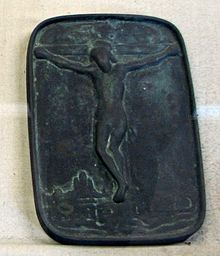
fumieA way out of such torture is to trample on the fumie. The fumie is a wooden plaque with a copper plate on which the image of Christ was artfully engraved. A person’s willingness to trample on the fumie is Inoue’s way of testing if one belongs to the outlawed Christian religion. It is also a convenient way to turn a believer into an apostate upon the threat of torture and death. One only needs to put one’s foot on the fumie, trample or even just step on it, then one can be released immediately, a most easy and convenient ‘formality’ to show one’s denunciation of faith. This was what happened to Father Ferriera.

The officials would say: “I’m not telling you to trample with sincerity and conviction. This is only a formality. Just putting your foot on the thing won’t hurt your convictions.”

To a believer, this may sound like a temptation, or self-deception. Or, is it a necessary choice to survive?

In this historically based novel, Shusaku Endo (1923 – 1996), a Japanese Catholic, paints a vivid picture of the crisis of faith in the face of extreme suffering, the doubts that often lie hidden even in the most devout. In the midst of persecutions, where is God? Why is He silent?  Endo is not depicting so much about the hubris of foreign missionaries coming with the hope and optimism to preach and convert, but just the opposite, he has exposed the lowest state a believer, let alone a priest, can possibly experience, the utter humiliation of being the one to denounce and betray his God, albeit under duress.

The duress is horrific indeed. The priest sees no glorious martyrdom but is witness to unbearable torture of these peasants. For several nights, the screams and moans of five Christian villagers accompany him in his sleepless nights. Father Rodrigues is thus being dragged into the ultimate dilemma: He only needs to place his foot on the fumie and all five of these suffering peasants will be released right away.

In a court of law, a statement or action made under duress cannot stand as evidence to lay blame, as the subject is under threat and coercion like Father Rodrigues is here. But in the court of the priest’s conscience, it is an ironclad verdict: Apostasy!

As he is struggling with this painful dilemma, trample on it and denounce his faith or five peasants will be suspended in the pit till death, Father Rodrigues seems to encounter an epiphany. Seeing the well-trodden, blacken face of the Christ image on the fumie, the priest hears a voice breaking through the silence:

“‘Trample! Trample! I more than anyone know of the pain in your foot. Trample! It was to be trampled on by men that I was born into this world. It was to share men’s pain that I carried my cross.’

The priest placed his foot on the fumie. Dawn broke. And far in the distance the cock crew.”

Indeed, the allusion to Peter’s denial of Christ three times before the cock crows points to Christ’s forgiveness, the light that sheds through the cracks of human failure. After his denial, Peter later served his Lord with transformed fervency and love. Yes, even the Rock, upon whom the Church was to be built, had once denied Christ.

When I first read Silence a few years ago I could not accept Rodrigues’s action. This time around, I’ve come to see that Endo is not discussing theology here, but depicting an imaginary scenario. In the darkest hour of a believer’s journey—likely Endo’s own as well—when a devout is entrapped in an excruciating dilemma like being suspended in the deep pit of spiritual conflicts, Endo draws our attention to the response of a compassionate Christ.

As to the seeming silence of God, Endo lets us hear these internal dialogues:

‘Lord, I resented your silence.’
‘I was not silent. I suffered beside you.’

At the humble manger some two thousand years ago, God had spoken, with a birth that pierced the darkness of that silent night.

***

Reading the Season of Christmas Past:

2015: The Book of Ruth

2014: Lila by Marilynne Robinson

2013: Poetry by Madeleine L’Engle

2012: Surprised by Joy by C. S. Lewis

2011: Walking on Water by Madeleine L’Engle

2010: A Widening Light, Luci Shaw

2009: The Irrational Season 

2008: The Bible and the New York Times by Fleming Rutledge

2008: A Grief Observed by C. S. Lewis

***

Saturday Snapshot Dec. 3: Late Autumn

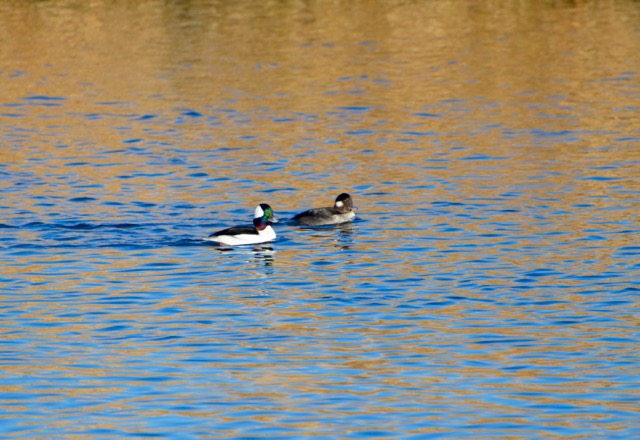
After I came back from London in mid October, the Pond already looked deserted. Suddenly in the last few days my Air (Avian) B&B was buzzing with activities again. The Pond had become the meeting place of waterfowls making their last stop before heading south.

Here are some of them on a sunny, cheery afternoon. So glad to see signs of life before the big chill. Forecast for next week’s lowest temperature: -24C (-11F).

late-autumn

riverview

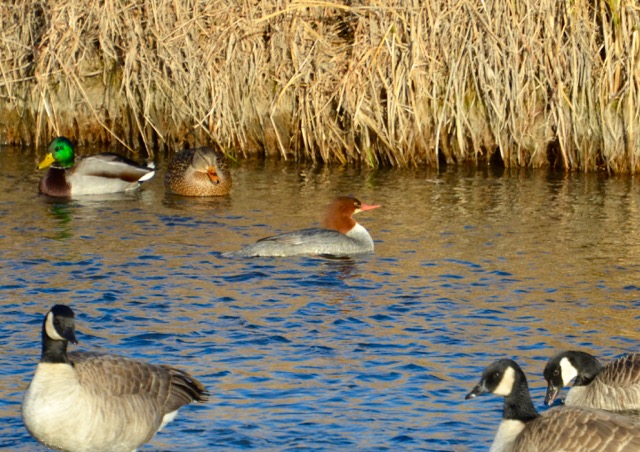
Pardon me for not showing my regulars the Mallards, but it’s the infrequent guests that I treasure more; although still ‘common’, there are just less of them than Mallards. Here are the Buffleheads. Like they’re right out of a Monet painting. No colour alteration here:

buffleheads


bufflehead-couple

My favourite has to be Mrs. Merganser. No matter what time of day, she looks like Lucille Ball just out of bed. Her uncombed, red hair stands out particularly:

lucille-ball


lucille

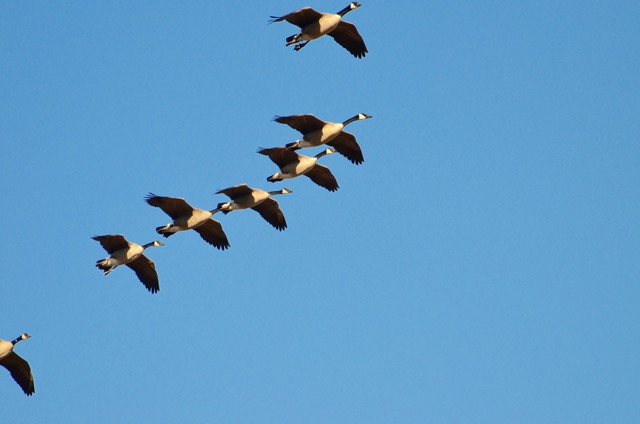
Up in the sky, more Canada Geese getting ready to land on the Pond, joining the late Autumn sendoff party:

canada-geese

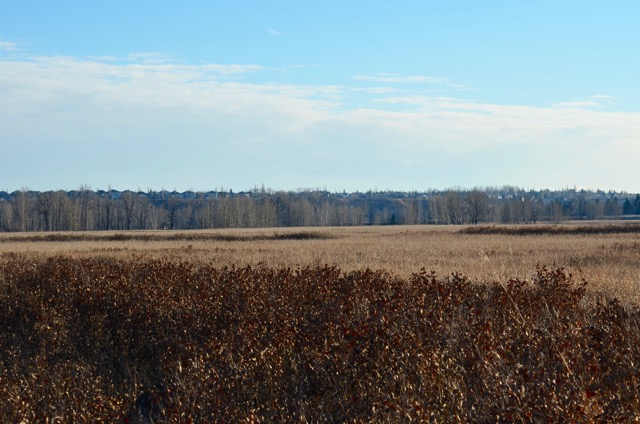
Less convivial on land, I’m afraid. Why, it’s all brown and barren. The white-tailed deer filling up in the evening sun. Yes, it looks desolate. Dry shrubs are all that’s left for food.

autumn-brown


deer

And -20’s C. next week? Good time to tackle the piles of books on my bedside table.

***

Saturday Snapshot is hosted by West Metro Mommy Reads. CLICK HERE to see what others have posted.

Arrival: From Novella to Film

The following discussion is relatively spoiler free. To talk about the novella and the film without giving out the most crucial piece of information is like writing with both hands tied at my back, and trying to hold a pen with my mouth to scribble down words. A difficult task. But it’s all worth it, as that’s the main thrust of the story: to communicate takes effort and hard work.

After watching the movie, spellbound for two hours, I left the theatre knowing  I must get hold of the story to read. I found it here. But, I most likely will seek out Ted Chiang’s other sci-fi fiction to explore more, despite not being a regular reader of the genre. His writing just grabs me with its insight and sensitivity.

Novella: “Story of Your Life”

The source material of the movie Arrival is Ted Chiang’s “Story of Your Life”, winner of the Nebula Award in 2000.  A host of aliens had touched down in numerous spots in different countries on Planet Earth; in the U.S. alone there are nine. Their intention does not appear to be conquest. With multiple tentacles that look somewhat like an octopus, they are hence called heptapods by their cautious human observers. In order to understand their purpose, the U.S. Government sends teams of physicists and  linguists to establish communication with the foreign arrivals. They do this via the aliens’ transparent, face-to-face meeting devices, again, nicknamed by humans “the looking glass”. The large, two way glass separates the two living species, but joining them is the desire to communicate peacefully using each other’s language.

An ideal case Chiang has depicted. One, that the aliens come in peace; two, that humans respond with peaceful means all for the purpose of understanding and communication. A much needed case study for us Earthlings today. While they have set up military base surrounding the alien spacecraft in the open field to stand guard, the commander Colonel Weber leaves the task of communicating with the foreign arrivals to linguist Dr. Louise Banks and physicist Dr. Gary Donnelly.

Running parallel to this major plot line we see a more intimate story of human interactions, Louise and her daughter. Chiang’s writing is emotionally subtle and sensitive as he juxtaposes different episodes to depict the bond between Louise and her daughter through the stages of her life, as infant, child, teenager and later adult. Every stage we read some realistic situations. The human mother-child relationship is not without conflicts, but all interwoven with the bond of love. That’s the whole package of motherhood, the joys, the risks, the pains.

The language the aliens use to communicate with humans looks like a system of semagrams, each semantic symbol referring to a concept. It doesn’t appear to have a phonetic association, i.e., can’t be read out audibly, but is visually transmitted. Here’s Chiang’s eloquent description through Louise’s words:

“If I wasn’t trying to decipher it, the writing looked like fanciful praying mantids drawn in a cursive style, all clinging to each other to form an Escheresque lattice, each slightly different in its stance.”

I just love this idea: “An Escheresque lattice”. Fascinating.

MOVIE: ARRIVAL

Arrival.jpg

A movie will be the best means to depict such kind of a language system. But then again, the movie Arrival is much more than illustrations of the story. In this case, Arrival is one of the most apt transference of art forms, from literary to cinematic that I’ve seen.

Arrival the film has magically lifted the story out of the page. It has transferred the imaginary onto a visual plane in an aesthetic and inspiring way. We see the alien spacecraft suspended just slightly above ground in the open field like a vertical Hindenburg, or a stylistic installation of an objet d’art balancing in midair.

Canadian director Denis Villeneuve (Sicario, 2015; Incendies, 2010) and cinematographer Bradford Young (Selma, 2014) had transported Chiang’s eloquence from page to screen affectively, emotionally enhanced. The juxtapositions of time is seamless and effective, spurring my curiosity to think. Villeneuve leads us through a passage of cerebral perplexity, prodding me to decipher, to try to understand, like linguist Dr. Louise Banks (Amy Adams) does through her experience.

Amy Adams’ nuanced performance is effective in emotional capture. That’s the key factor for the film to work. Kudos also to Jeremy Renner as physicist Dr. Ian Connelly. The leading man Renner, who usually plays the cool hero in other movies here steps aside to let Louise run the show, offering his support and tender loving care wherever needed, most moving in the climatic scene.

Of course there are alterations and elaborations for dramatic effects. In situations like this where different countries on Planet Earth need to operate in a united front to share information and knowledge, there’s bound to be conflicts and dissensions. So some countries decide on military action to assault and take down the arrivals soon after attempts at understanding fail.

Computer technology might have helped Louise to decipher each symbol and finally the whole train of alien thoughts, it is her inner passion that drives her to persist and continue with the peaceful means to communicate, against the order of Colonel Weber (Forest Whitaker) to withdraw the operation and leave the military to handle the situation.

Computer technology is crucial no doubt, but it is the human heart that has motivated Louise Banks to reach out, to achieve a Non-Zero-Sum Game: a win-win situation for both sides. The aliens’ gains does not necessarily mean human’s loss. Both sides can benefit from their exchanges.

In the grand scheme of things, however small the individual human may seem, the significant acts could be the everyday choices one makes. For Louise Banks, choosing to take up the role as a frontline translator to liaise with unknown aliens is a courageous act, but then again, so is choosing to embark on love and to take up the whole package of motherhood, with all that her choice will entail.

***

Short Story and Film:

~ ~ ~ ~ Ripples

Books to the Big Screen

Here are a few Book to Movie Adaptations that I look forward to. Some are already in theatres, others will come later this year, poised for the Awards Season. Still others have just been announced or in the early stage of development.

Arrival

arrival

Already arrived in theatres, acclaimed Canadian director Denis Villeneuve’s (Sicario, 2015) first sci-fi feature that’s gaining buzz as this year’s award hopeful. Seems like every year we have one of those, like Gravity (2013), Interstellar (2014), and The Martian (2015). Alien arrival to planet Earth isn’t a new topic, but communicating with aliens in a cerebral, linguistic framework, with a female leading role is a first. Amy Adams plays linguist Dr. Louise Banks, moved to translate. What interests me most though is that the movie is based on a short story, “Story of Your Life” by the award-winning sci-fi writer Ted Chiang. From short story to the big screen will be a future post on Ripples soon. I’ve been reading quite a few to catch up.


Nocturnal Animals

Nocturnal Animals.jpgAmy Adams is on a roll. She has been in recent years. With five Oscar noms and yet to win, will this coming Awards Season end the drought? A movie based on a novel of a novel. Right, and that real novel is Austin Wright’s Tony and Susan. Exactly, probably that’s why director Tom Ford changed it to this current title for his movie. Amy Adams plays an art gallery director troubled by her ex-husband’s novel, which she thinks is a revenge tale on her. Intriguing storyline. Jake Gyllenhaal plays her ex. Director Tom Ford won the Grand Jury Prize at Venice Film Festival this year. Not bad considering this is only his second feature in directing. His first? He led Colin Firth to the actor’s first Oscar nom in A Single Man (2009).


Silence

silenceI’ve just reread this novel by Japanese writer Shûsaku Endô (1923-1996). This time it’s even more disturbing. In 17th C. Japan, a sadistic governor was determined to eradicate Christianity by turning devout Jesuits missionaries into apostates. His methods were ruthless and unimaginable, making waterboarding look like squirting with a water gun. Endô, a Catholic, had written a thought-provoking masterpiece, bringing out the unanswerable Question: Why is God silent in the midst of insufferable torments of his own? And now, the film adaptation by none other than Martin Scorsese, also a Catholic. I’ve a feeling that I need to gird myself for some tormenting scenes. But I just can’t resist that cast: Liam Neeson, Andrew Garfield, Adam Driver. Also, screenplay adaptation by Jay Cocks, two times Oscar nominee for his writing, The Age of Innocence (1993) adapted from Edith Wharton’s novel, and original script Gangs of New York (2002).

**

And now, to some announcements of future adaptations. Looks like F. Scott Fitzgerald is on a roll too. The Great Gatsby (2013) isn’t too distant a memory and now two upcoming features with prominent actors:


Zelda

Zelda.jpgFilm is inspired by Nancy Milford’s bio of Zelda Fitzgerald, a finalist for the Pulitzer and National Book Award when it first came out in 1970. Please note it’s not Z by Therese Anne Fowler as I first thought. So I read the wrong book and now I need to find Milford’s Zelda. I want to, for I trust an acclaimed biographer to tell me the ‘true’ story. Zelda and F. Scott’s situation is such an intriguing scenario: Can a couple with the same professional pursuit still be a loving pair and not rivals? Especially in the Jazz Age, where men dominated all scenes and women were but ornate “flappers” in parties, and yes, even as muses. Jennifer Lawrence is Zelda, Ron Howard directing. Sounds like a promising production.
 

The Beautiful and the Damned

The Beautiful and the Damned.jpg

That’s the name of the novel by F. Scott Fitzgerald whose married life with Zelda isn’t too far off from the characters in the book. Whether the film is an adaptation of the book, or just use the book title as the film title to tell the real story of Scott and Zelda is yet to be seen. Either way, it is one tumultuous marriage amidst the glamour of the Jazz Age. The movie is said to be in development, not much else is announced  except that Zelda is going to be another A-lister: Scarlett Johansson. For those interested in reading the book first, you have lots of time to catch up on the lives of Scott and Zelda, as well as this book.


The Bell Jar

The Bell Jar.jpg


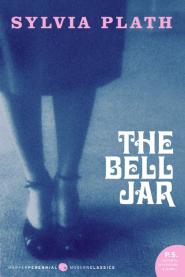
For her directorial debut, Kirsten Dunst has picked Sylvia Plath’s The Bell Jar. I’d say, a challenging book to be adapted into film, albeit dramatic. Dakota Fanning will play Esther Greenwood, the coming-of-age story that leads her all the way to the border of madness. A heavy and difficult novel to handle as a directorial debut. But I’m sure Kirsten Dunst has her reason for picking Sylvia Plath’s famous work. Could this be the ripple effects of her experience starring in Lars von Trier’s Melancholia ? Patricia Arquette (Boyhood, 2014) co-stars.


***

Related Posts on Ripple Effects:

Boyhood: The Moment Seizes Us 

The Great Gatsby 

Books to TV Adaptations

It’s a consolation that no matter how crazy the world spins, one can always retreat into books for respite. And film adaptations, when done well, can double the enjoyment. And now, there are TV mini series.

As if you need more suggestions to read this fall, here are some titles that are in various stages of development, but this time, not on the big screen but for TV. TV looks to be the next great realm to conquer, for even A-list movie stars and directors have started to cross over. It’s not surprising then that more books are being turned into TV miniseries.*

Here are a few upcoming titles:

The Luminaries by Eleanor Catton

the-luminaries

The 2013 Man Booker Prize winning novel is to be made into a six-part BBC drama series. Author Catton will be writing the adaptation herself. Six parts to put the 832 page book into perspective. Set in the New Zealand gold rush era, the Victorian mystery tale is a first for Catton in TV writing. Other than the longest book to win the Booker Prize, Catton is also the youngest winner at 28.
A thriller, suspense, with lots of characters and stories during the 19th C. New Zealand gold rush; sounds like a wealth of materials to turn into a TV miniseries.


The Miniaturist by Jessie Burton

The Miniaturist.jpg
BBC loves suspense thrillers. Here’s another one. The Miniaturist is British actress Jessie Burton’s debut novel that had sold over 1 m copies in 37 countries. Set in 17th C. Amsterdam, the story looks like a version of the movie Crimson Peak. A young bride married to a merchant trader is left in his huge mansion alone with his sister most of the time. Her wedding gift is a cabinet-sized replica of their home. A miniaturist comes in to create the items of the mansion in smaller, parallel version. Secrets begin to unveil as the miniature house takes shape. Sounds eerie.


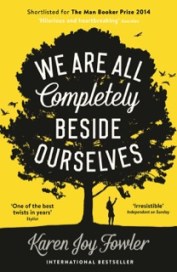
We Are All Completely Beside Ourselves by Karen Joy Fowler

we-are-all-completely-besider-ourselves-2


On this side of the Atlantic, we too have the Book into TV kind of phenom. HBO is turning Karen Joy Fowler’s Booker shortlisted, PEN/Faulkner Award winning novel into a miniseries. Now this one I’ve read, and I admit it’s quite incredulous a story. Natalie Portman is to produce and star and is ready to create a sisterly bond with a chimpanzee as they grow up together in the same home. That’s the storyline, but do they now have to train a chimp to star with her?


American Gods by Neil Gaiman

american-gods

Gaiman fans rejoice. A new TV series to come in 2017 based on his multiple award-winning fantasy American Gods, with the author writing the episodes. Gaiman is prolific in various realms and no stranger to TV productions. Many will likely remember his Coraline, turned into the Oscar nominee for Best Animated Feature Film in 2010. For TV, there are Dr. Who, Lucifer, Eternals and his short stories into miniseries. Now American Gods, old mythological super beings challenged by modern day gods in America; they exist as people believe in them. Their names: Media, Technology, Internet, …


Alias Grace by Margaret Atwood

alias-grace-book-cover.jpg

Canada will not be left behind. Our own wonder woman Sarah Polley, actress and director, is adapting the work of another prominent Canadian, Margaret Atwood. Alias Grace will be a six-hour miniseries to air on CBC-TV and Netflix. Polley’s previous adaptation of a short story by Alice Munro, retitled Away From Her, brought her an Oscar nom for Best Adapted Screenplay (2008). Alias Grace is in good hands then. Historic fiction inspired by a 19th c. double murder, the story is about a maid named Grace Marks who was convicted, had spent 30 years in prison, and finally exonerated.


Are you aware of other book to TV adaptations? Do fill me in and expand this list.

* See ‘Comments’ for clarification.

***

Reviews of Adaptations on Ripple Effects (for a complete list, click here):

Stillman’s Love & Friendship: More than Book Illustration

Brooklyn: From Book to Film

Life of Pi

Never Let Me Go

Away From Her

Can a movie adaptation ever be as good as the book?

Abbey Road & Notting Hill

FRIDAY OCT. 7

For the last day in London, we wanted to grab the chance to go see places we hadn’t been to before. Our plan for the day: first to Abbey Road, then Notting Hill.

This is probably the most famous zebra crossing in the world. And that of course is the location where The Beatles’ Abbey Road album cover was taken. Tourists would gather right at the crossing, stopping cars frequently.:

Zebra Crossing.jpg

… and actually pose crossing it, making numerous takes, cause it’s just hard to find no cars coming, then snapping the right pics at the right time in the right pose:

Pose Crossing.jpg

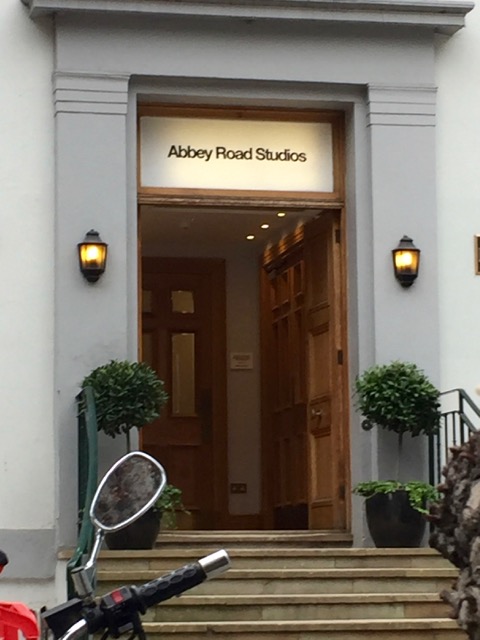
The other side of the zebra crossing is the famous Abbey Road Studios where The Beatles recorded their albums:

studios

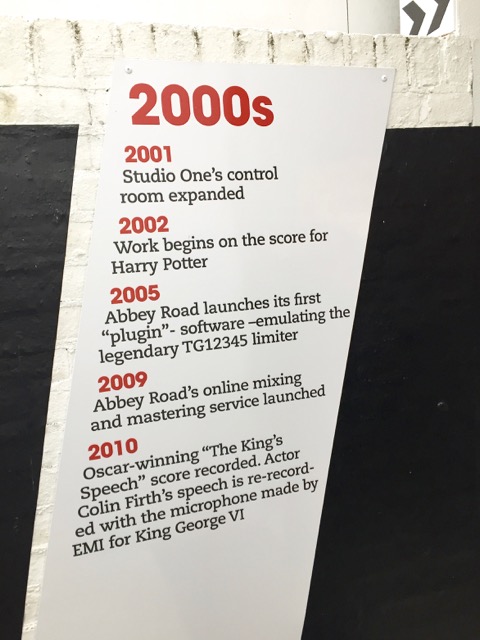
We couldn’t go into the studios, but there was a gift shop adjacent where signs were posted to chronicle the historical significance of the Abbey Road Studios. Sir Edward Elgar opened the Studios in 1931. In 1939, King George VI recorded his now famous “King’s Speech to His Peoples”.  Seventy-one years later in 2010…

Colin Firth.jpg

“Oscar-winning ‘The King’s Speech‘ score recorded. Actor Colin Firth’s speech is re-recorded with the microphone made by EMI for King George VI.”

Looks like we’d come to something truly historic.

**

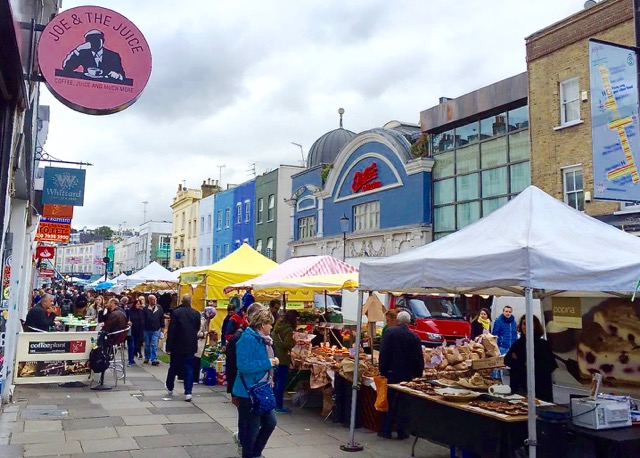
After Abbey Road, we headed to Notting Hill. I like the movie Notting Hill (1999), have seen it several times especially now it’s on Netflix, but have never been to that part of London. I’d done some Googling before I left home. Notting Hill is the actual movie location, and the famous 2-mile long Portobello Road Market there is one of the best street markets in London. And it’s open on Fridays and Saturdays only.

It was an overcast and chilly Friday morning, the clouds hung heavy, but that didn’t dampen our spirits. We took the Tube from Abbey Road Studios and got off at Notting Hill Gate Station.

In the movie, Portobello Road is where William Thacker (Hugh Grant) has his Travel Book Shop. He walks past the stalls in the Market to get to his shop.

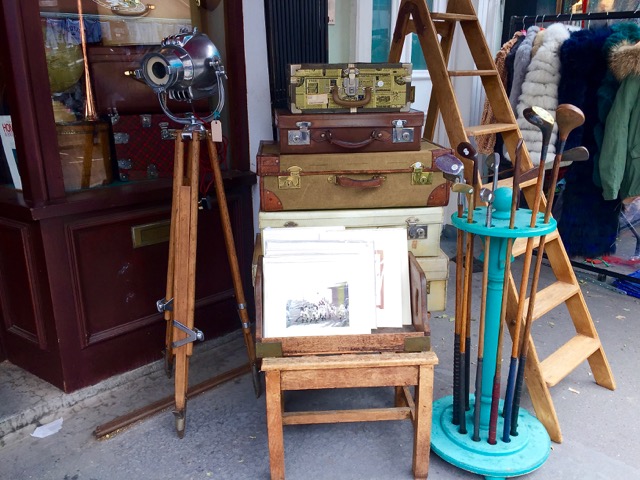
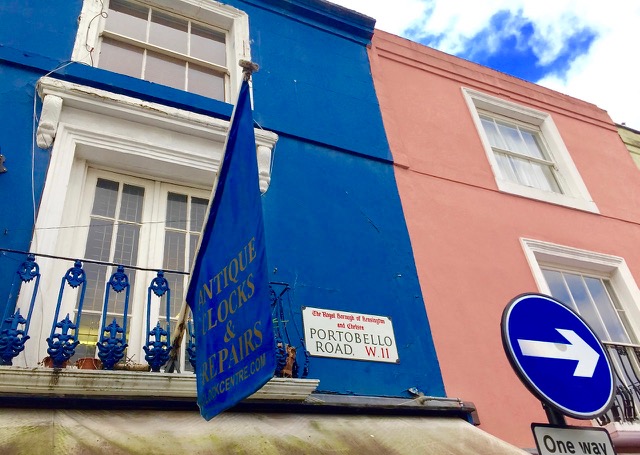
So here it is. Portobello Road, a colourful street lined with antique and curio shops, and on Fridays and Saturdays, open stalls selling all sorts of interesting items, a bazaar like a movie set.

Portobello Rd Market.jpg

Portobello Rd.jpg


street-market

Antiques2.jpg

antique1

Antiques3.jpg

Here’s William’s Travel Book Shop location, now a gift shop. In the movie, that is where William meets American film star Anna Scott (Julia Roberts) the first time. William is totally oblivious to who she is, while a shoplifter recognizes her and has the gut to come right up to ask for her autograph. That’s William’s intro to movie culture. Here’s the location:

The Travel Book Shop.jpg

Afterwards, William buys orange juice across the street and bumps into Anna again, spilling juice on her dress. Thus, leading her to his house with the blue door nearby to clean up.

The tipping point of the movie happens on both sides of that blue door. Apparently tipped off by William’s hairy roommate Spike (Rhys Ifans), a large crowd of paparazzi wait outside that blue door the morning after Anna stays over, ready to snap anything of the star. Unfortunately it’s William who opens the door in his T-shirt and boxer, and after, Anna in her sleep wear, and last but not least, Spike opens again in his brief only.

Well, here it is, that house with the blue door, 280 Westbourne Park Road:

The Blue Door.jpg

280-westbourne-rd


And of course, the first movie I saw after I’d come home was Notting Hill, again.

That’s a wrap of my five-day London experience, my Thelma and Louise escapade for 2016 with my cousin. Obviously, no… we didn’t drive off a cliff.

***

This is a Saturday Snapshot post. Saturday Snapshot is hosted by West Metro Mommy Reads. CLICK HERE to see what others have posted.

***

Here’s a recap of my Five Days in London:

London: West End Theatre

Tate Modern: Georgia O’Keeffe Exhibition 

Day Trip to Cambridge

British Library & St. Pancras Station

British Library & St. Pancras Station

THURSDAY, OCT. 6

Well you win some and you lose some. Having tasted the delicious treat that’s the Georgia O’Keeffe at Tate Modern, I came to British Library the next day to find they’ve just finished with a major Shakespeare exhibition there marking the 400th anniversary of the Bard’s death.

The British Library is another must see for me, having ‘discovered’ it the last time I was in London a few years ago. In their Gallery is their permanent collections of iconic papers and manuscripts that define the history of civilization, like the Gutenberg Bible, The Magna Carta, handwritten score of Handel’s Messiah, Middle Eastern and Asian manuscripts and sacred scripts, Leonardo da Vinci’s notebook, handwritten lyrics by the Beatles with comic drawings on the side… just to name a few of the 200 items on display, free to the public.


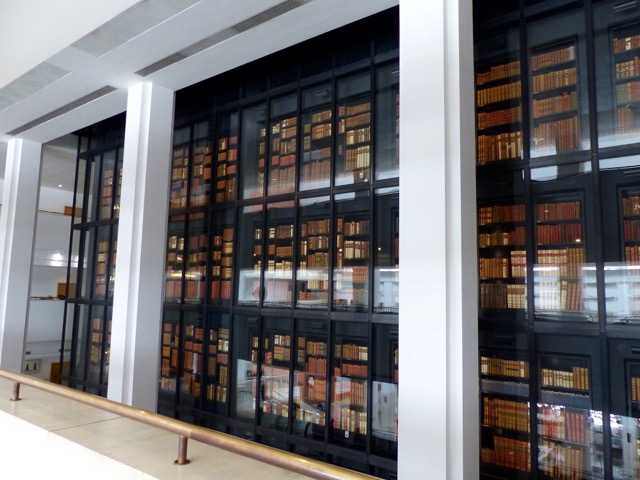
Enough of words. Here are some pics of British Library:

wall-of-books

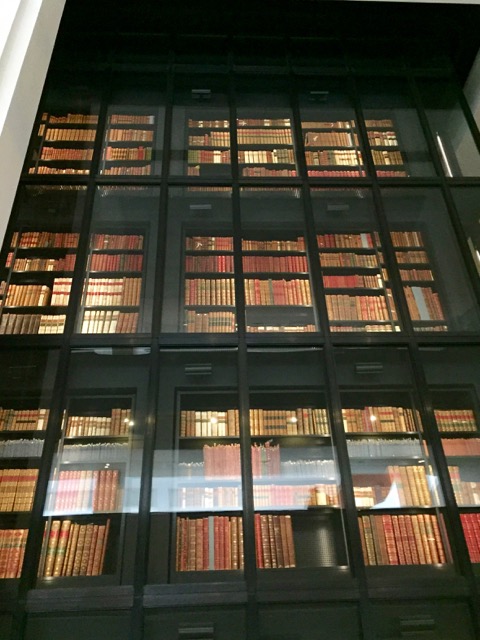
Storeys of rare books:

storeys of rare books.jpg

Looking down to the main area:

main-area

Art works are everywhere. I like this piece by British artist Patrick Hughes, entitled “Paradoxymoron”. His signature style is the changing perspective for the viewer. A ‘normal’ painting from the front:

Paradoxymoron Front View.jpg

The painting gradually shifting to 3D as the viewer moves to the side:

Shifting Perspective.jpg

Finally, from the side, a complete 3D version:

Side View.jpg

Here’s from the other side:

The other side.jpg


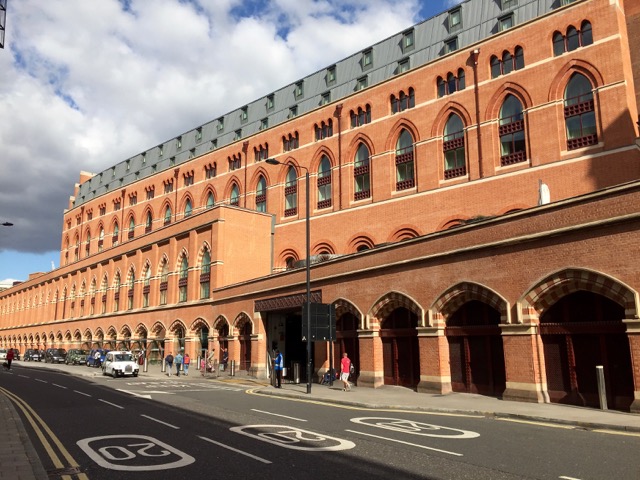
And how did we get to British Library? We took the Tube from Victoria Station to the St. Pancras Station. You’ve seen the magnificent make-over of King’s Cross Station from my last post, here’s another superb alchemy of the old and the new. St. Pancras Station is an international transportation hub for trains. The scale is massive and the architecture style, Gothic Revival.

st-pancras-station

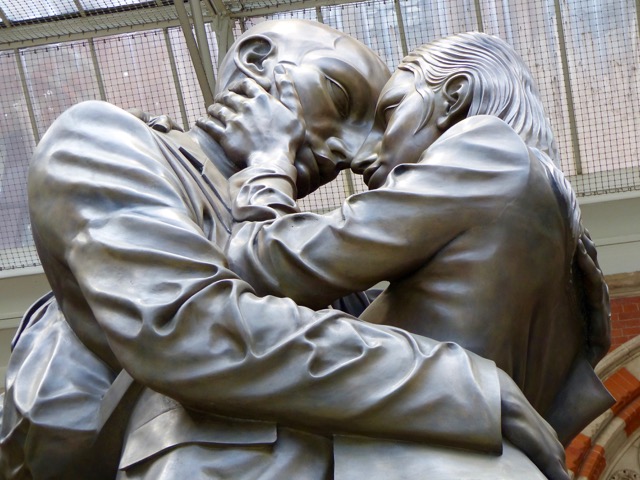
I’m most impressed by the interior, the public art and the huge bronze sculpture by Paul Day (2007). Here are some pics:

St. Pancras Station.jpg

Public Art.jpg

Bronze Sculpture.jpg

Amazed by how detailed this huge sculpture is. Look at the folds of the clothing:

Details.jpg

Here are some of the vignettes circling below the tall sculpture. Whimsical perspectives:


P1020849.jpg


perspective


Saying goodbye to soldiers going to war:

Going to War.jpg


… and the modern goodbye. I like this one the best:

P1020853.jpg

***

Day Trip to Cambridge

WEDNESDAY, OCT. 5

Trains leaving for Cambridge run frequently from King’s Cross Station in London. We bought tickets for after peak hour in the morning, more leisurely and cheaper price. We were in no hurry, and it was only an hour’s ride. But first, I was most impressed by the train station. I was there years ago for a trip to Cambridge also. But this time around, King’s Cross looks like a space station. What’s more, the old and the new co-exist comfortably :

IMG_4385.jpg

More about the train stations tomorrow. But on this day Oct. 5, 2016, I was at Cambridge again.

When we got out of the train station in the university town, high winds greeted us, sending us to look for shelter in the Hop on Hop Off Sightseeing bus. Yup, what a convenient way to reach all the points of interest, and with commentary as well.

The following are some glimpses of Cambridge, this one taken from the open top bus as we passed by the Fitzwilliam Museum:

fitzwilliam-museum

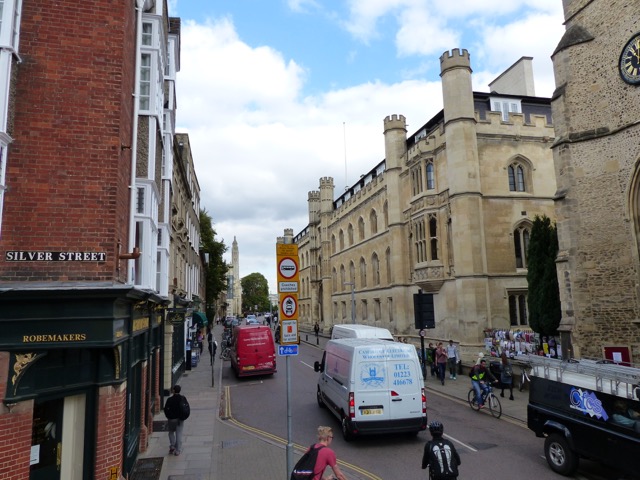
These were taken when we hopped off and took to the streets:

While all these views from the outside were free, they now charged entrance fee to go inside many of the buildings, even just walking into the courtyards and the greens. I remember years ago I could freely walk around. Also there are many more commercial establishments now, which is understandable, and in a way, good for us tourists, and I’m sure the people at the university too. There are many more selections to choose from when it’s time for lunch.

We walked along Bridge Street where there was a myriad of international cuisines, undecided for a while and eventually went into a little restaurant called Galleria.

galleria

They offered a 3-course lunch for £12.95  Not bad at all. The appetizer and main course were both delicious, but I was most happy with the dessert, a chocolate raspberry mouse, that’s the pyramid at the front in the following pic, my cousin had the apple pie. But I can tell you, mine was heavenly:

dessert

As we came out of the restaurant and crossed the street, we saw this beautiful view:

view-from-galleria

p1020794

We spent the afternoon strolling along the streets:

p1020690

tradition

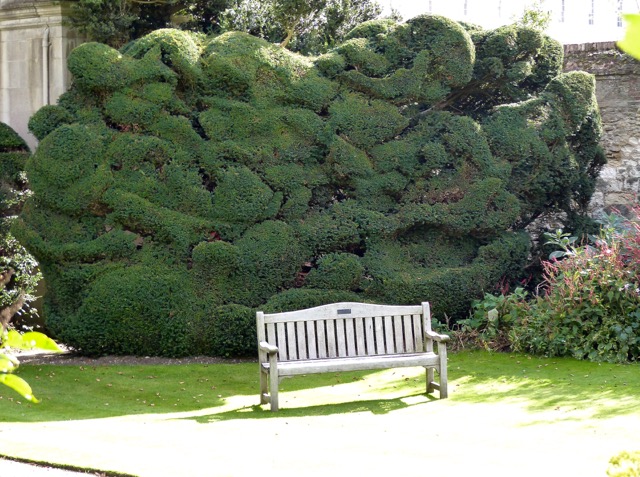
bench.jpg

and stayed a while in Waterstones, the four-floor bookshop. It’s been years since I set foot into a multi-storey bookshop with elevator. We used to have one in our city but it’s long gone out of business. Other than the books, I was attracted to these Penguin tote bags and the blackboard:

waterstones

Board.jpg

Soon it was time to head back to the train station. Hop on to the sightseeing bus once again and we were soon on the train back to London. The whole evening was still untapped.

***


Tate Modern: Georgia O’Keeffe Exhibition

TUESDAY, OCT. 4

Six years ago I first visited Tate Modern. I was wowed by its ingenuity, a derelict power plant on the south bank of the River Thames converted into a modern art gallery. I didn’t hesitate to revisit this time around.

The Tate Modern was designed by the Swedish architects Jacques Herzog and Pierre de Meuron, the 2001 winner of the Pritzker Prize, the ‘Nobel Prize’ of architecture.  Their concept of maintaining the industrial motif and juxtaposing it with the artistic is a marvellous idea.  Furthermore, they have turned the massive, hollow industrial space in the centre into a welcoming people space, the Turbine Hall. When I got there on an overcast Tuesday morning, I saw people, many are families with children and babies, lay on the massive floor space, yes, actually lying down, to view the mobile, mixed media installation from the ground.

How much more ‘grassroot’ can you get? The symbolism is ingenious as the people space breaks down the barrier of ‘high art’ and ‘public art’. In another area, several large helium-filled fish ‘balloons’ floating in mid-air, kids and adults playing with them. Interactive art, like an invisible sign saying, ‘Please do touch the art objects.’

While most of the collections were free and photography was allowed, I was excited to learn their current event was a Georgia O’Keeffe exhibition, paid admission and no photography. Interesting to note that there’s no O’Keeffe works in UK public collections, thus making this exhibition all the more rare and valuable.

Before I entered the exhibition room, I only had one image in my mind: flowers. Georgia O’Keeffe was a painter of flowers, wasn’t she? And with 100 pieces of O’Keeffe’s works on exhibit, lots of flowers. How wrong I was.

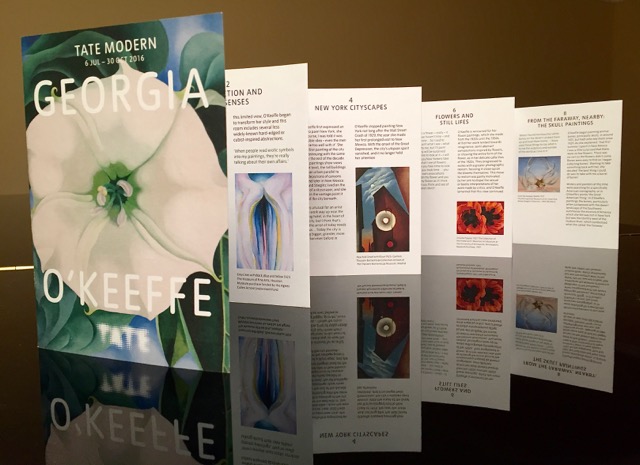
Certainly, the cover of this beautifully designed accordion pamphlet uses the iconic O’Keeffe subject of flowers, but I soon found that she was a highly versatile artist, and cerebral in style and subject matter. No photos were allowed in there so I had to take a picture of the pamphlet for you to visualize. For the rest of the post, I’m afraid I’ll have to make do with my clumsy written words to describe my experience with the magnificent visuals.


georgia-okeeffe-exhibition

Here’s a synopsis of the exhibition in a sequence of rooms following the life of O’Keeffe as an artist. And thanks to this compact, informative pamphlet, I’m still learning even after I’ve come home.

1. The Early Years – abstractions in charcoal, made while she was an art teacher in Virginia and Texas. There are colourful watercolours and vivid oil paintings inspired by the landscapes of both States. My fave has to be the Red and Orange Streak, 1919. So here I see Georgia O’Keeffe, the emerging abstract painter.

2. Moved to New York in 1918 and produced more abstraction while exploring other artistic possibilities such as chromesthesia, where musical tones elicit particular colours, “the idea that music can be translated into something for the eye”. This is also the period when she painted more sensory content, and for some, eroticism is evoked. I like this quote: “When people read erotic symbols into my paintings, they’re really talking about their own affairs.”

3. O’Keeffe, Stieglitz and their Circle. As muse, collaborator, and finally spouse of photographer Alfred Stieglitz, O’Keeffe is presented in photography in this section. I find O’Keeffe’s personal portraits particularly revealing; Stieglitz’s portraits of her all exude a special boldness and independence. Here we see her beginning fondness of clouds, depicted in A Celebration 1924, the year they married. Clouds evolving into petals later?

4. O’Keeffe the New Yorker. I never knew. Here I see her stylistic depiction of the urban cityscape of NYC. O’Keeffe and Stieglitz lived on the 30th floor of a skyscraper, a convenient vantage point to paint tall buildings. “… I think that’s just what the artist of today needs for stimulus.” After the 1929 Wall Street crash, however, she moved out of NYC. The vision of the urban promise dismantled with the market crash.

5. Upstate, New York, Maine, and Canada. Lake George, trees, clouds, apples and leaves. For a change, from metropolitan New York to Nature.

6. Finally, we begin to see her flower paintings. They are huge. The photo of the pamphlet cover above, Jimson Weed/ White Flower 1, 1932, is 48″ x 40″. BTW, I just checked online, that painting is the world’s most expensive painting by a woman. Walmart heiress Alice B. Walton bought it for $44.4 million in 2014. I should have looked at it a while longer. But from the short stop when I stood in front of it, I could see the gradual change of light and shadow on the petals, meticulously painted. Most impressive was the sheer size of it.

Why paint a tiny flower this big? Here’s O’Keeffe’s answer:

“Nobody sees a flower, it’s so small… I’ll paint it big and they will be surprised into taking time to look at it… I will make even busy New Yorkers take time to see what I see of flowers…”

7. New Mexico: Taos and Alcalde. Paintings of the vast, horizontal expanse of the land in contrast to the vertical, tall skyscrapers of NYC, earth-built dwellings, crosses, Native American and Spanish colonial features. In Taos O’Keeffe met Ansel Adams and other artists.

8. O’Keeffe found the white bones and animal skulls left on the barren Southwestern desert a worthy subject for her paintings. A sharp, harsh contrast with the soft petals of flowers, but the light and shadow gradients convey the same fondness from the artist’s eyes.

9. Red earth, pink cliff of the landscape in the Southwestern expanse. O’Keeffe discovered Ghost Ranch, a tourist attraction and later bought her first home there. During the 1930’s to the 40’s, she delved into the area with immense passion, especially the flat-top mountains or mesa.

10. White Place and Black Place, two locales she continued to stylize in her painting. From the realism of the earthy desert expanse shifted to more stylized contrast of white and black.

11. The artist continued her focus on bones, in particular, the holes in them; when she lifted them up towards the sky, the blue piercing out from these holes. The bones too are symbols of death and destruction, a parallel of WWII and the death of Stieglitz in 1946.

12. The Southwest and Native American influences on her subjects while living in New Mexico during the 1930’s and 40’s.

13. Lastly, from landscapes to skyscapes. I was confronted with another huge painting, inspired from her airplane travels during the 50’s and 60’s: Sky Above the Clouds III, 1963. Since I couldn’t take any pictures at the exhibition, I just have to do this. Here, take a look at this photo of the pamphlet, section 13 on the right. The painting is on there. Clouds like ice floes against a distant, pinkish sky.

sky-above-the-clouds


Definitely more than just flowers.


 ***

Related Posts on Ripple Effects:

 Tate Modern and Billy Elliot

Alex Colville and the Movies 

Art Gallery of Ontario

Beauty and Terror


London: West End Theatre

MONDAY, OCT. 3

I arrived London Gatwick Airport around noon. Found my way to the shuttle taking me from the North to the South Terminal to catch the Gatwick Express heading for central London. Once on the train, it was a smooth and fast ride, just 30 minutes and I was at Victoria Station. My cousin was already waiting for me there to begin our 5-day escapade. After settling into our lodging it was already mid-afternoon. What to do with just a half day in London?

We decided to take the Tube and head to Leicester Square to check out bargain tickets for the shows that evening. We had nothing planned, no agenda, and in no hurry… for a change. And that’s what I call a holiday.

Leicester Square is the place for buying cheap same day theatre tickets. We had nothing in mind. We stopped by several ticket booths and nothing really piqued our common interest. Several we’d seen; the one  I’d really wanted to see before wasn’t on anymore, and that’s Skylight with Carey Mulligan and Bill Nighy. I came to the West End two years late.

Then we turned into Shaftesbury Avenue, and we knew what to see: The Go-Between at the Apollo Theatre. My cousin wanted to see Michael Crawford—the original Phantom—without the mask, albeit thirty years older, and I wanted to see the stage musical adaptation of L. P. Hartley’s famous novel. That scene in the movie with Julie Christie and Alan Bates rolling on the haystack in the barn emerged in my mind. Wow, that was some longterm memory. That’s a 1971 movie.

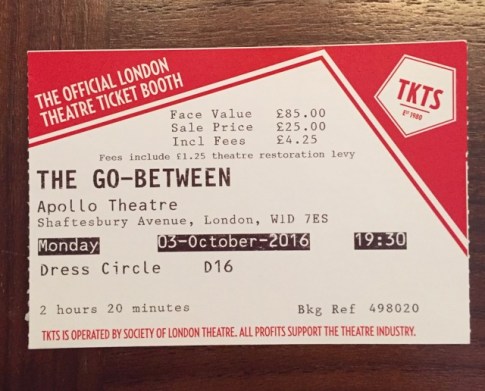
We quickly walked back to the Square to find the TKTS ticket booth. Why the TKTS? It’s the official London theatre ticket booth, operated by the Society of London Theatre with all profits going to support the theatre industry. I was delighted to be able to get two very good seats, dress circle centre, at 70% off, £25 each.

Ticket.jpg

We still had about two hours before the 7:30 pm show began, so into near-by Chinatown we went. I saw tourists taking pictures of the BBQ ducks hanging inside the windows of eateries. No, I’d never thought of photographing ducks other than with them swimming on the pond. Anyway, that’s what I had for dinner. A bowl of noodles with two kinds of BBQ meats, duck and pork, only £6.50, a very good price I think.

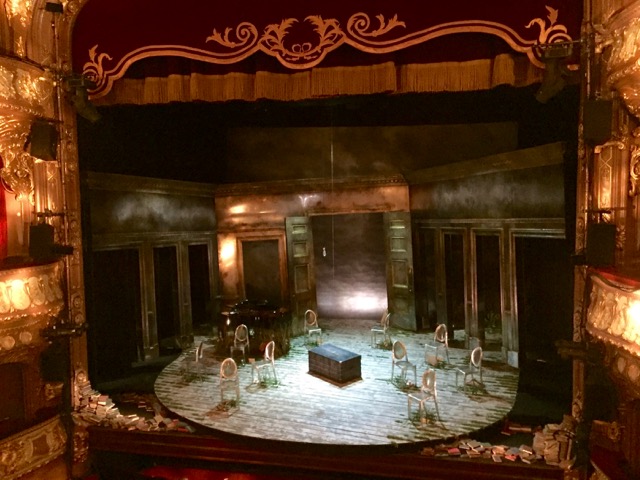
The Apollo Theatre opened in 1901, a month after the death of Queen Victoria, making it the first Edwardian theatre to open in London. It was already dark when we got to the doors so I didn’t have a good view of the architecture. But once inside, I was mesmerized by the beauty of its historic glamour.

apollo-theatre

On the stage you see a chest, the centrepiece. Instead of a red box that stores mementos and a diary as in the novel, the playwright had turned it into a large chest, which is appropriate, for we see the boys Leo and Marcus step on it as they sing. The same with the chairs, they’re for standing on.

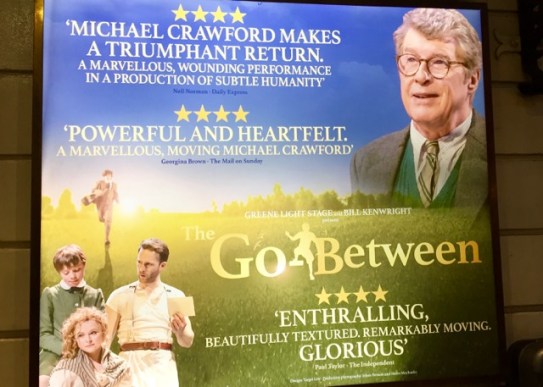
When Leo Colston (Michael Crawford) in his old age opens up the memory chest, his past as a youngster acting as a go-between for two secret lovers of different classes rises up to haunt him. The time is the turn of the twentieth century, in a setting like Downton Abbey. Come to think of it, Downton has a much more progressive outcome, chauffeur Tom can have Lady Sybil, but not farmer Ted and Lady Trimingham, Marian.

gb

The Go-Between is a musical, but not your spectacles like The Phantom of the Opera, Les Miserables, or The Lion King. It’s a chamber work, small scale, and drawing you into the story more readily rather than showing off grandeur and technicalities. Richard Taylor’s music, however, may not be as readily inviting as the popular tunes from those larger productions. With only a piano as accompaniment, the characters at times sing a cappella, and at times in dissonant chords. Michael Crawford, 74, loved it, but indicated in an interview that the music had been technically demanding.

What did I get from the show? The book’s famous intro line sure hits home:

“The past is a foreign country: they do things differently there.”

That says about my early days as a teenaged cinephile, and actually just arrived Canada from a foreign country. Going to see The Go-Between movie in the cinema was itself a coming-of-age episode for me. I remember that was a more ‘mature’ film than this musical play, or is it because I was just a tender lass. No matter, now, I should get hold of the novel. I’ve never read it.

Only a few hours in London and it already felt like a full day. Four more to go.

***

Related post on Ripple Effects:

Here’s the link to my New England Fall Foliage Road Trip, last year’s escapade.

Saturday Snapshot Oct. 15: Five Days in London

About this time last year I’d just finished a Thelma-and-Louise kind of road trip (exclude the ending, of course) to New England with my cousin to see fall foliage. The series of travel posts begins here.  This year, it’s London, England.

Here are the highlights of our short, five-day escape to London on the week of Oct. 3-7. Detailed blog posts to come.

MondayThe Go-Between at the historic Apollo Theatre (since 1901) on Shaftesbury Avenue. Leading star is Michael Crawford, the original Phantom.


Apollo Theatre.jpg

gb

Tuesday — Tate Modern, Georgia O’Keeffe Exhibit. No photos allowed for that exhibit, but I was free to take artworks from other areas in brilliant Tate Modern. Here’s one I love the best. View from its 10th floor observation level:

img_4373


Wednesday — Day trip to Cambridge:

Cambridge.jpg

Thursday — The British Library, King’s Cross and the St. Pancras Stations. Why a train and tube station could be the highlights of the day? Wait and see. Here’s St. Pancras Station:

St. Pancras Station.jpg

Friday — Which zebra crossing (those in N. America, no zebra, just pedestrian) is a point of interest for world visitors?

Abbey Road Studios.jpg

And which movie puts a community and street market on the to-see list of visiting cinephiles and antique hunters?

Portobello Rd (1).jpg


Detailed London posts coming up.

***

Saturday Snapshots is hosted by West Metro Mommy Reads. CLICK HERE to see what others have posted.