Book Sale 2014: A Very Restrained Purchase

It’s that time of the year again… no, I don’t mean nesting habit of birds. I’m referring to The Crossroads Market Annual Book Sale. A diversion from my usual avian pics for Saturday Snapshot, here’s a photo of my very restrained purchase this year.

Readers familiar with my previous annual book loot will know how I’d hauled back home dozens of like-new or even unopened books at $2 each. All for the good cause of supporting Servants Anonymous Society.

Due to the boxes of still unread inventory from previous years, I’d decided to refrain from gratifying my hoarding instinct this time. The result is this minimal bagging of just four books, which I’d spent hours hand picking. Again, $2 each, all in mint condition:

Book Sale 2014


The reasons for these selections? Three had sold film rights and two of them are already in development for a movie adaptation. The fourth  one isn’t going to be a movie, but no less dramatic.

An Object of Beauty by Steve Martin 

Other than being known as the Father of the Bride, Steven Martin is also a talented banjo player. I’ve heard his banjo playing, but as for his books, quite a few of them actually, I still haven’t had the pleasure to enjoy. So here it is, a Steve Marin novel with 22 full-colour art reproductions inside. Story is set in the demanding art world of Manhattan, about Sotheby’s up-and-coming and very ambitious Lacey Yeager who has set her mind on climbing high on the career ladder. Amy Adams had bought the film rights, aiming at producing and starring in it. Who is writing the screenplay? Ned Benson, who wrote and directed The Disappearance of Eleanor Rigby Him and Her, which had me mesmerized at TIFF last year.

The Secret Scripture by Sebastian Barry

The novel won the prestigious James Tait Black Memorial Prize in the UK and the Costa Awards in 2008, Irish Book Awards’ Novel of the Year, and short-listed for the Man Booker Prize. Roseanne McNulty has lived in a mental asylum for fifty plus years. Now at the ripe old age of one hundred, she decides to write her life story. Fascinating. So the book chapters transport the character and her readers between the present and the past. I look forward to the movie adaptation, just take a look at this perfect casting: the legendary Vanessa Redgrave as the older Roseanne McNulty and the talented Jessica Chastain as the younger. Producer is Noel Pearson, the Irish theatre and film producer who brought us the Oscar winning My Left Foot (1989, Daniel Day-Lewis). The Secret Scripture film adaptation has great potentials. Shooting is reported to be starting in June this year.

The Sisters Brothers by Patrick DeWitt

Here in Canada, this is a multiple award winner: 2011 Governor General’s Literary Award, 2011 Rogers Writers’ Trust Fiction Prize, 2011 Scotiabank Giller Prize Finalist, 2011 Man Booker Prize Finalist, and selected as Amazon #1 Best Book of 2011. Film rights have been purchased by John C. Reilly’s production company… yes, the actor John C. Reilly, to turn this Western, yes, cowboy novel in the style of Elmore Leonard and True Grit into film. Should be an interesting read and movie. I don’t know about John C. Reilly, but, would he be willing to collaborate with the Coen brothers for the project?

The Film Club by David Gilmour

This is not the David Gilmour of Pink Floyd fame. Again, despite being an award-winning Canadian author, one time TV personality and CBC film critic, university lecturer, people outside of Canada upon hearing the name would likely think of someone more famous, at least Google does. Due to his recent incendiary remarks on his preferences re. writers and literature, this Canadian Gilmour just may have raised some awareness, adding notoriety to his name.

However, for me it’s not about him but about this audacious parenting experiment he conducted. At the time, his son was a 16 year-old who had an incurable avoidance of school. Watching him loiter at the edge of the cliff of boredom and aimlessness, what is a father to do? Well, Gilmour let his son drop out of school, but on two conditions: watch three movies with him every week, and, no drugs. Not a bad offer. A father and son film club instead of school… only in Canada, eh? Which titles were in his syllabus? As a film buff, I’m totally intrigued by his unorthodox parenting method, already half way through the book. Will definitely share with you eager parents when I’m done.

***

You might want to see what others have posted for their Saturday Snapshot. CLICK HERE to Melinda of West Metro Mommy Reads.
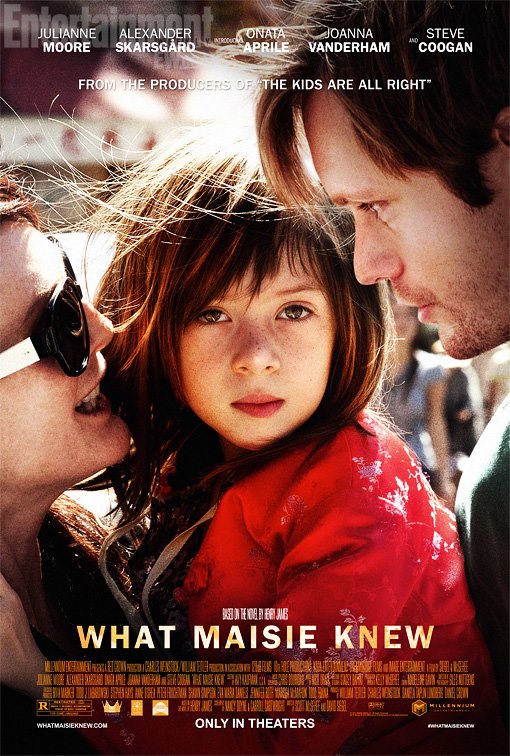
What Maisie Knew (2012): From Book to Film

With all due respect to Henry James, I’d rather be watching this contemporary adaptation of his work than slashing through the thickets of his novel. A thicket of a book, the last time I used this description was with Proust. And, if I’m to decipher long and incomprehensible sentences I’d rather be reading Proust than James. Nevertheless, James’s novel is a dense and deep psychological analysis of a dysfunctional marriage and its fallout on the child, a relevant issue today. Nobody wins in cases like that.

When published in 1897, it was probably one of the earliest fictional depictions of divorce and child-custody. Precocious Maisie knows much more than her parents could ever imagine. Like a volleyball, she is being tossed back and forth between her Mama and Papa, whichever side she lands on loses, for they both want their life to be free from child-rearing, free from ties and obligations. The notion of being ‘free’ recurs in the last chapters of the book, a key to how Maisie ends up choosing who to follow — her governess Mrs. Wix, someone who is not obsessed with being ‘free’, but who is committed to Maisie’s welfare.

What Maisie Knew


Again, may I reiterate here as in previous posts about books to movies, the two are totally different art forms. Here, one is a 300 page literary work, internal, dense and deep. The other is a 93-minute production of visual storytelling, enhanced by dialogues and musical score. To achieve this end, screenwriters Nancy Doyne and Carroll Cartwright have to pick and choose the most relevant storyline and characters, and opt out of lengthy, internal exploration of psychological entanglements, something the literary form can describe readily. The screenwriters have done a good job in their choices, keeping the story simple and relevant for viewers a hundred years after the book was published. Despite the subject matter, the movie is enjoyable and highly watchable.

Set in modern day NYC, it smoothly tells a poignant story from the child’s point of view. Six-year-old Maisie (Onata Aprile) is eyewitness and victim of her parents’ constant quarrels and later divorce, a young child caught in the thorns and thistles of adult relationships. It is unfortunate that the most sensitive and observant child is often the most vulnerable. The naturalistic capture by the camera of Maisie’s quiet observations is most heart-wrenching. Maisie learns that the adult world is a busy place, her presence, an inconvenience. Thanks to the screenwriters’ gentler treatment, the movie spares us from some cruel, hateful fights in the book. We see Maisie ultimately get a taste of what it’s like to be cared for and to have some simple, childhood joy. The ending shot is beautiful.

Unlike Maisie in the novel, there is no moral dilemma for her in the movie. No doubt, the moral element is crucial in James’s novel. Divorce and adultery must have poked deep into the heart of James’s readers in his days. But our contemporary society has, alas, evolved into a ‘morally neutral’ state of numb resistance. The screenwriters may well know too that entertainment value comes before the didactic. We see no moral choices here with Maisie in the movie. After all, a young child will readily cling to whoever that loves her in deeds rather than mere words. Kudos to the filmmakers, they know the heart of a child.

Directors Scott McGehee and David Siegel capture the story from Maisie’s viewpoint, natural and realistic, camera lens often at a lower angle. Certain shots are particularly affective, from inside a taxi, the transport of choice in Manhattan, at different times the vehicle that takes away Mama, Papa, and caring Margo. We would see from inside the taxi out to Maisie standing on the roadside, abandoned and distraught.

The wonderful cast is what makes the movie so absorbing, and at times, even heartwarming, despite its subject matter. The then seven year-old Onata Aprile is a natural. Julian Moore’s solid performance as her mother Susanna is convincing. She is a touring rock-and-roll singer who has passed her prime. Jealous and temperamental, Susanna’s love for Maisie is possessive, and often displayed in empty words. British actor Steve Coogan, known to North American viewers by his recent starring role in Philomena, plays the career-minded art dealer father Beale. Like his ex-wife, he is too busy with his own life to care for a child. They both say they love Maisie, showering bursts of affection whenever they see their child.

What saves Maisie is the awkwardly positioned step-parents, her father’s new wife and Maisie’s former babysitter Margo (Joanna Vanderham, the parallel of Ms. Overmore in the book) and her mother’s new love interest, the tall and young bartender Lincoln (Alexander Skarsgård, a Sir Claude parallel). As predicted, they soon are abandoned themselves and the two quickly form a tie that includes Maisie in their life. Diverging from James’s story, the two are genuinely loving and caring, a soothing balm to Maisie and the viewers.

Overall, a fine, contemporary adaptation of the novel. To James purists, a loose reinvention; for viewers seeking meaningful entertainment, this should be on the list of films to watch.

~ ~ ~ Ripples


 ***

Saturday Snapshot April 26: Within a Budding Grove

I just can’t resist. Having seen life bursting out in the spring forest, I’ve an urge to borrow Proust’s title here. But unlike Proust’s magnificent work, within the budding grove where I go birding, everything is stark literal, direct and visceral. No need for metaphors. Alive, chirping, calling, even confronting…

Robins stay here in the winter, but they keep quiet and hidden. Good to see energy recharged:

Robin

Or simply posturing. Here’s one Angry Bird:

Angry Bird

In contrast, the Cedar Waxwings are more elegant, embracing the sun with poise and panache:
Waxwings


Cedar Waxwing 2

And there are other beautiful creatures with wings, in much simpler form but no less elegant:

Butterfly

The woods are lovely, but the main draw is the Owl Family. Again, another sighting of Papa amidst the budding grove, silently keeping watch…

Papa keeps watch

over this trunk from a short distance, so not to draw attention to the nest I suppose:

Owlets in nest inside trunk

Can you see them?

Here they are … a closer look. Two Owlets born shortly before Easter. Mom is in there, probably taking a much needed nap. This is a different pose from the one I posted on Easter Sunday:

Owlets

What does this make you think of? For me… Mt Rushmore.

Within a budding grove, surprises abound.

***

Saturday Snapshot is hosted by Melinda of West Metro Mommy Reads. CLICK HERE to see what others have posted.

ALL PHOTOS TAKEN BY ARTI OF RIPPLE EFFECTS

DO NOT COPY OR REBLOG

***


When Easter is the Spring

Quickening

Dead trees draw life
when the days expand and the sun
fulfills its promise, oft delayed
by the clutch of ice.

Clotted, gnarled, knotted twigs
on the trees sense sap and the death
of death. They stretch, begin
to puff green on the end.

We sing new songs
of a Life laid down for rebirth
when Easter is the Spring
and the branch is Christ.

— Mark A. Noll

**

Every new birth is a miracle. I saw two yesterday:

2 Owlets

***

And To All, A Happy Easter!

***

Robert Bresson’s Au Hasard Balthazar (1966): A Timeless Parable

Surely he has borne our griefs
and carried our sorrows;
yet we esteemed him stricken,
    smitten by God, and afflicted. 

— Isaiah 53:4 ESV

Several days before He is crucified, Jesus enters Jerusalem riding on a donkey. I love this scene. If there’s any cognitive dissonance in the crowd, here’s the stark message for their bewilderment. The King for whom they are cheering is not to be a glamorous celebrity. Rather, like the donkey, He comes as a humble servant, one who carries their load, and ultimately, even lays down his life for them. His kingdom belongs to another world.

Marie and Balthazar


As with my Easter viewing from previous years, I watch a film by the French auteur Robert Bresson. Bresson’s work has a transcending and spiritual quality that is deeply moving. In Au Hasard Balthazar, he creates an unusual metaphor using a donkey as his protagonist. We follow Balthazar as a young colt, loved by his first owner Marie. We see him grow up, weaving his life among different owners. We also see Marie grow up. Despite her love for Balthazar, she cannot stop the encroachment of evil, or maybe she is simply powerless. She does not defend Balthazar when a gang of young men abuse the donkey, tormenting him, whipping, mocking.

The gang leader is Gérard, whose sadistic, mean streak speaks for human depravity. He would pour gasoline on the road to cause unsuspecting drivers to skid and crash. He and his gang would watch nonchalantly from a distance, gratified that their prank has worked. He steals and deceives. What is a donkey to him if he does not even have the slightest respect for other humans. Once, to prod Balthazar to move forward, Gérard ties a newspaper to his tail and light it on fire.

The Gang

Throughout, Balthazar lives his life quietly in a parallel course to the growing depravity of the humans he serves. He suffers their cruelty in silence, occasionally he would bray in pain, but he continues to bear his load, pull a cart, or do whatever he is prodded to do, even a circus act. Due to neglect and maltreatment, he often becomes ill.

As she grows up, Marie discards childhood innocence and seeks to gratify her sensual pleasures. Against the protest of her parents, she falls for Gérard. She could have another choice, one who offers her genuine love, Jacques, the son of the owner of the farm where Marie and her parents reside. Jacque would come by every summer from the city with his father and sister to stay on the farm. When they were still children, they had spent endearing moments together with Balthazar. Jacques has declared lifelong commitment to Marie. But Gérard is a more instant and attractive outlet for Marie. Ultimately, she is dealt the harshest blow and most degrading abuse from Gérard and his gang as they rape her. Bresson spares us the ugly scene, but in the chilling aftermath, we see the young men walk away, nonchalant, throwing her garments on the ground behind them. After that tragic incident, Marie runs away. Her father is grief stricken, and soon falls ill and dies.

Gérard is unrepentant. After all, it’s self-serving lust he seeks; his callousness is most disturbing. In the last scene, we see he uses Balthazar to do one more job for his gang. They are to smuggle goods across the mountainous border. At night, he loads up his goods on the donkey and leads him to the border. From a distance, he hears gun shots from armed customs police. Gerard and his gang flee, abandoning Balthazar on the mountain. But it’s too late for Balthazar, he has been shot.

The final scene is most moving. In the open field, Balthazar walks slowly, haggard, blood streaming from his leg. He finally lies down, still carrying the goods Gérard has put on him, the load of sin. He breathes his last and quietly dies, alone.

Like Bresson’s Diary of a Country Priest, Au Hasard Balthazar is an apt meditation for Good Friday. But not just for this one day, their timeless message is like the Easter Season itself, a moveable feast.

~ ~ ~ ~ Ripples

***

Related Posts and Links:

Diary of a Country Priest: A Book For Easter

Diary of a Country Priest: Film Adaptation

Video of Robert Bresson on Au Hasard Balthazar

Saturday Snapshot April 12: The Hustle and Bustle of Spring

After a long and silent winter, I’m pleasantly surprised by the sounds and activities of spring in the woods. Here I’m just showing you the photos, so you can’t actually hear any sound. But from the images, you can imagine the cacophony there.

The sky is busy, and the woods, actually noisy. Birds beating one another to nesting sites, usually in old tree trunks. All of them are vigilant guarding their own. Avian and human traffic collide. And it looks like the biggest in size makes the loudest calls. No, not me. Canada Geese own the woods.

They’re ubiquitous, their calls dominating the air. And of course, they have the right of way. I nearly got hit by this one:


Right of way

Another standing tall, scouting for nesting site, or maybe guarding one:

Canada Goose scouting for a nesting site


They are all vigilant when it comes to protecting their nests:

Vigilant

I know how much it means to them… Here, a couple gazing out into the late afternoon sun from their front porch:


Canada Geese nesting 1

More are still flapping their wings to better trunks, or maybe just enjoying an evening dip in the setting sun:

Canada Geese flying in woods

In the meantime, there are others making lesser but more melodious calls, like the Robins, happy that winter’s finally over:

The Robinsor the Northern Flicker, charging with renewed energy:

Northern Flicker

Some quietly sharing:

Woodpeckers & Chickadee

or enjoying the (relatively) warm(er) breeze like this Nuthatch:Nuthatch

The European Starling is not just another black bird. A closer look you’ll see the shiny plumage, and their calls are much more pleasing than those of the Geese:

ES Not just a black bird


But the major attraction in the woods is, again, the Owl Family. I’m amazed how they would come back to the same trunk for nesting, and that Papa Owl always stands on guard from a distance, his sharp eyes watching over his own.

Papa Owl watching from afar


I’m mesmerized by his calmness and cool attention. If he needs to, Papa can fight off a Canada Goose with his talons. But he knows when to use force, and when to just placidly stand guard.

This is the old tree trunk he is watching quietly from afar:

Old tree trunk

A closer look you’ll see Mama Owl nesting in there. I’m told by fellow birders that two Owlets have been seen poking their downy heads out partially. But after a long while waiting, craning my neck up, I can only see Mama:

Mama Owl nursing young babes

I’ll have a better chance of taking a family photo once the Owlets fledge.

Canada Geese begin to converge near the Owl’s nest, trying to draw our attention with their jealous squawks.

As the evening sun sinks below the horizon, I can see this Goose making its nest not far from the Owl Family. And I know too, Papa will be keeping watch throughout the night, feeding and protecting his very own.

Canada Goose silhouettes against the setting sun


Saturday Snapshot is hosted by Melinda of West Metro Mommy Reads. CLICK HERE to see what others have posted.

***

ALL PHOTOS TAKEN BY ARTI OF RIPPLE EFFECTS, APRIL 2014.
DO NOT COPY OR REBLOG


Finally, Spring!

The last few days have been the warmest, welcome sign that our waiting is finally over. Just a few degrees above zero, but enough for me to venture out to the woods and go on my first birding walk. I had to tread squeaky, slushy paths of melting snow and ice.

Here are some views. These photos were taken just last Friday April 4. Melting icicles dripping into the icy creek. Yes, this is spring for us. No flowers yet, not even green grass. But this is promise enough:

Melting Icicles


Last fall they dominated the sky, but I’d missed the Canada Geese through the long, silent winter. Surprised to find these two here enjoying the cool spot, weren’t bothered a bit by my intrusion:

Canada Geese

Up close and personal… Welcome back!

Up Close and Personal


The Chickadee never flew away. But I’m sure she’s glad with the warming up:

Chickadee


The Bohemian Waxwings stay in the winter and moves north after the cold. But the Cedar Waxwings’s arrival from the south heralds spring:


Cedar Waxwings

Silky fine spring look worthy of any fashion magazine cover:


Cedar Waxwing

More spring birding photos coming up on Saturday Snapshot.

***

All Photos taken by Arti of Ripple Effects, April, 2014.
Do Not Copy or Reblog

 ***

The Budapest Hotel: A Grand Escape

“But it doesn’t mean anything.”
“So we put in words. One word for every note, like this…”

— ‘Do-Re-Mi’ from The Sound of Music

Does music need words to make it meaningful? Do we have to find a message in a work of art before we can appreciate it?

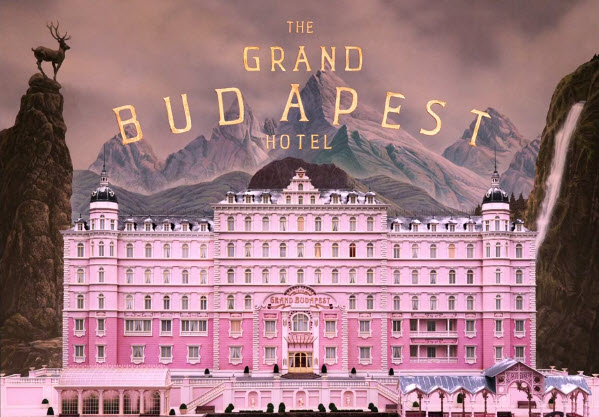
the-grand-budapest-hotel movie poster

Here we are with a cinematic piece that can’t be ‘explained’. What genre? What theme? What purpose? I’m not going to bother. As with my experience of watching previous Wes Anderson movies, somehow, I feel I need to let my rational side relax and just enjoy the ride. Rushmore probably has more of a traditional storytelling mode and thematic content. But with The Royal Tenenbaums, I have to adjust the quirky frequency to high, it’s a totally different kind of viewing experience. Fantastic Mr. Fox, I was mesmerized by the stop-motion animation and humour, great voices add to the lively adaptation of Roald Dahl’s story. Moonrise Kingdom, I wasn’t fully gratified but by then, I was used to the Wes Anderson style of ‘magical realism’.

That ‘magical realism’ strikes again in The Grand Budapest Hotel. Not my favourite colour palette, red and pink, by I was totally captivated as soon as the film began. I was being led into a fairytale world of real life people. From the cinematic framing, it aptly demonstrates the idea of symmetry. In many frames, the subject is right in the centre, almost perfect symmetry on both sides of the screen. But does it mean anything? One might ask. If we have to be rational about it, shall we just say, for the effects of a neat and tidy piece of the old world. Framing nostalgia before the world becomes too distorted, too inhumane. This is, after all, 1930’s Europe. And we can see the parallels in signs and symbols especially towards the end of the movie when uniformed men take over the Hotel.

Grand Budapest Signs & Symbols

Wes Anderson credits Stefan Zweig in creating The Grand Budapest Hotel. The Austrian writer’s name is shown at the very beginning of the end credits. In numerous interviews, Anderson pays tribute to Zweig’s whole collection of works, a writer who is noted as once ‘the world’s most translated author’. Zweig is a relatively new discovery for Anderson but so deeply has the writer inspired the filmmaker that ‘it’s basically plagiarism’, Anderson joked at the news conference when the film premiered at the Berlin Film Festival.
As someone who is much intrigued by the creative process of adapting books into films, I did read some Zweig before watching Budapest. I must be reading the wrong works though, I’d thought. From the novella Chess Story, to a few of the stories I read in the new collection recently translated into English, all tell very gloomy tales. The writings almost exude a sense of despair, as the characters are mostly running away from persecutions and ethnic cleansing, or memories thereof, even driven to madness as the chess champion Czentovic in Chess Story, albeit some descriptions embed a subtle trace of humour.

Maybe along the notion of ‘Wabi-sabi“, beauty and sadness, what Zweig has done subtly and now Anderson explicitly is to extract and fuse “humor and sadness”. Here in Budapest, writer/director Anderson has freely utilized the element of fantasy and fun to paint the passing of an old world, a realism too sad for millions in 1930’s Europe, Zweig being one of the subsequent victims. To escape the incendiaries of Nazism, Zweig and his second wife moved to England, then to the U.S., and finally to Brazil in 1940 where he ultimately committed suicide together with his wife in 1942, leaving a note of utter despair as he saw Nazism dominating Europe and his former homeland Austria.

In this fictitious Republic of Zubrowka, where The Grand Budapest Hotel is situated, Anderson offers us a great escape despite setting his story within the brewing tension of 1930’s Europe. The story begins with a closer to present day author (Tom Wilkinson) reminiscing upon an extraordinary experience which has inspired his book The Grand Budapest Hotel.

The Concierge Desk and Main Staircase

Years ago when he was still a young writer (Jude Law), in finding cures for writer’s block, he had retreated to a mountain hotel The Grand Budapest and in there met its owner, Mr. Moustafa (F. Murray Abraham). Known as Zero when he  himself was just a lobby boy in an age long passed, the owner told the writer his story of how he came to inherit this grand piece of property, albeit in a run-down shape now. Someone volunteering an extraordinary life story to an author in an exotic locale, the beginning of Budapest reminds me of Life of Pi, another great tale of magical realism.

But the movie belongs to Ralph Fiennes as the hotel Concierge and go-to person for all sorts of favours, M. Gustave. The death of long time patroness of the Hotel Madame D. (Tilda Swinton) has dragged M. Gustave and his protégé, the new lobby boy Zero, down a rabbit hole of misadventures and fortunes. Fiennes has proven that he is a versatile actor that can be as evil as Amon Goeth in Schindler’s List, or as madly romantic as Count Almasy in The English Patient, or as charming and fun here in Budapest. His comic timing is first-rate, his expressions, spot-on. My long-range forecast, an Oscar nom awaits him next year for his role in Budapest.

Gustave & Zero

The line-up of talents is long, not just in acting, where we find the usuals of Wes Anderson movies like Edward Norton, Tilda Swinton, Bill Murray, Owen Wilson, Adrien Brody, Willem Dafoe, Jeff Goldblum. Saoirse Ronan (breakout role as young Briony in Atonement) as Agatha the pastry maker is adroit and whimsical. She’s well matched to the young lobby boy Zero, aptly played by Tony Revolori.

The movie is also marked by the delightful compositions of Alexandre Desplat, whose musical scores adorn many notable movies in recent years. A collaborator with Anderson since Rushmore but here, Desplat’s scores captivated me early on with the lively East European themes and in particular, the Russian folk melodies. Some instruments that we seldom hear in other films are distinctly alluring, such as balalaikas, zithers, dulcimers, and organ, with full orchestral rendering. Another long-range forecast, Oscar for original score.

And then there’s the make-up of Tilda Swinton, the art work and production design of the whole Budapest experience (even the parody painting “Boy with an Apple” is an original art work by English painter Michael Taylor from a real life model), the flowing editing, the original screenplay and directing, the cinematography, Budapest Hotel is going to be one grand entry in the next Academy Awards.

~ ~ ~ 1/2 Ripples

 ***

Read a related post: How Zweig Inspired Anderson’s The Grand Budapest Hotel

Awards Update:

Feb. 22, 2015: Oscars for Best Costume Design, Make-up, Production Design, Original Score.

Feb. 14, 2015: Wins Best Original Screenplay from WGA.

Feb. 8, 2015: 5 BAFTA wins, Original Screenplay, Original Music, Production Design, Make-up and Hair, Costume Design.

Jan. 15, 2015: 9 Oscar noms, Best Picture, Best Director, Best Original Screenplay, Cinematography, Editing, Production Design, Make Up and Hair-Styling, Costume Design, Original Score.

Jan. 11, 2015: Golden Globe win for Best Motion Picture – Comedy or Musical

Dec. 11: 4 Golden Globe noms for Best Motion Picture – Comedy or Musical, Wes Anderson for Best Director and Best Screenplay, Ralph Fiennes for Best Actor – Comedy or Musical

Dec. 10: SAG nom for Best Cast in a Motion Picture

Dec. 7: The Grand Budapest Hotel wins Best Screenplay and Best Production Design at the L.A. Film Critics Awards

Dec. 1: The Grand Budapest Hotel just wins Best Screenplay from the New York Film Critics Circle

Related Links:

From BBC CULTURE: The Writer Behind Budapest Hotel

From NPR: The Rise and Fall of Stefan Zweig

The Music Behind the Screen

The Untold Story Behind ‘Boy With Apple’

The Railway Man by Eric Lomax: Book Review

This is an important book in that it chronicles the real-life experience of a prisoner of war in the hands of the Japanese army after the British surrendered in Singapore during WWII. The Pacific War is a part of WWII history that has often been ignored, other than the Pearl Harbour chapter. The British Empire in the Far East was dealt a deadly blow by Japanese invasions, and, British POW’s suffered not a bit less than those in Hitler’s death camps.

Japanese atrocities and war crimes have often been muffled in this our North American society. I don’t want to speculate why but yes, I do have an inkling which I will not discuss here. But as someone who had grown up in Hong Kong and came to Canada as a teenager, I can tell the difference in knowledge and perceptions when I compare the generally uninformed public of the West and those who themselves or their elders’ generation had lived through in Asia during the war.

Because of the general lack of knowledge on the Far East during WWII, Eric Lomax’s first person narrative as a POW in a Japanese labour camp and later military prison is all the more valuable. The memoir starts off with his love for the railways in childhood and how it turned into a youthful passion for engineering and radios that later led him to the Royal Signals Corp of the British army during the war in Singapore. As the colony fell to Japanese hands, Lomax’s life was torturously demented in subsequent decades until the very end.

The Railway Man Book Cover

Eric Lomax was a young 22 year-old when he was captured and moved with tens of thousands of POW’s to Kanchanaburi, Thailand, to build the notorious ‘Death Railway’ in 1943. It was a passage way for military transport from Thailand to Burma, and the route of a possible Japanese invasion of India. The conditions of forced labour were horrendous. Many POW’s died building the railway. This part of the world was the subject of the famous movie Bridge on the River Kwai, an unrealistic (even farcical now that I’ve read Lomax’s memoir) depiction of British POW’s inside Japanese military camps.

With his skills, Lomax and several others built a radio secretly to get news of the war. The radio was later discovered, together with a map Lomax had carefully drawn up of the railway line. Six of them were interrogated and savagely beaten by The Kempetai, or goon squad, as Lomax described them. Both his arms, wrist, several ribs, teeth, and his hip were broken. Two died from the beatings. While Lomax survived, more tortures and horrendous treatments followed in the days after. The experiences had left him permanently damaged psychologically for the rest of his life. Decades after the war, Lomax was still being tortured by terrifying flashbacks. The nightmares continued until he met his tormentor and forgiveness replaced hatred and vengeance.

So all in all, a significant story to tell. But while the book’s description is straight forward and clear, it leaves me ungratified as to its writing style and lack of deeper exploration, with all due respect to the author and his horrific, nightmares of ordeals. Yes, he had done a detailed job in reporting his personal journey from childhood to the war, the tortures and his suffering, other victims and their fate. As well, he recorded the aftermath of his horrific experiences as he re-entered ‘normal’ society, and sadly still, to a family that he no longer knew. His mother had died of a broken heart and his father had remarried. I was particularly engrossed with the after war effects in the last chapters.

However, the internal change of heart for the reconciliation with the Japanese interpreter had not been explored. After the bulk of the book describing his painful ordeals, the very last chapter of a happy ending looks off-balanced. It all started with the Japanese officer and interpreter, Takashi Nagase, who was present at Lomax’s torture, publishing his autobiography in his seventies. In there, he even mentioned the torture of Lomax, but due to his remorse, he felt he had been ‘forgiven’. Lomax’s second wife Patti, upon reading the English translation of the book, decided to write to Nagase regarding her husband. Patti’s letter opened up a chance for the later meeting between the tormentor and the victim.

Nagase had shown deep remorse, and dedicated his life after the war to help the Allies locate graves of POW’s, to ‘make-up’ for the wrongs the Japanese army had done. In his meeting with Lomax fifty years later, both in their seventies, near the bridge on the River Kwai, Nagase offered his visibly acute and sincere regrets for what the Japanese army had done to the British soldiers. A forgiving spirit suddenly took hold of Lomax and the two became friends. However, Lomax did not go deep into how his ingrained hatred and vengeance were alleviated, except noting that Nagase was a changed man now.

Further, the book had not answered a question I’ve always pondered. No, I understand it was never intended to delve into that issue as it is a personal memoir and not a political or philosophical treatise. But this question has been unsettling for me. What if the tormentor had no remorse, could reconciliation be possible? Other than Nagase, we know that many in Japan today still worship their dead WWII soldiers including war criminals as national heroes, unlike Germany’s denunciation of the Nazi regime. History textbooks had even been changed to tone down Japan’s aggression in the war. Even as recent as January 2014, Japanese Prime Minister Shinzo Abe visited and paid his pilgrimage at the Yasukuni Shrine in Tokyo. The controversial Shrine is a clear symbol of, in Lomax’s words, “an unashamed celebration of militarism”. In the book, we also read that Nagase had taken the unpopular and even dangerous stance of denouncing this war monument. To victims and their descendants of Japanese wartime atrocities, the chapter has not ended; in international politics, the issue remains.

It is always a triumph to see true remorse and subsequent reconciliation. Lomax’s personal story is extraordinary for both himself and Nagase. In that sense, readers are gratified with a light at the end of a long, dark chapter of one life, a bright stroke on the large canvas of WWII history.

***

The Railway Man by Eric Lomax, first published in Great Britain, 1995 by Jonathan Cape. Movie tie-in edition by Vintage Books, London, 2014, 322 pages.

** Movie Adaptation: I saw The Railway Man the movie at the Toronto International Film Festival in 2013. So far, there has not been a general, major release of the film here in North America. As much as I’d like to share my view on the film, with Colin Firth as Eric Lomax, Nicole Kidman as his wife Patti, and Jeremy Irvine as young Lomax, I intend to wait till there is a public release of the film before I post my review. Let’s hope I don’t have to wait much longer.

Related Links:

Pride and Pain of Patti Lomax

Railway Man’s Forgotten Family

What Japanese History Lessons leave out by Mariko Oi 

Homage to Flannery O’Connor: Looking for ‘Intrusions of Grace’ in Films

Today is the birthday of Flannery O’Connor. As a tribute, I’m re-posting a piece I wrote a few years ago entitled “Looking for ‘Intrusions of Grace’ in Films: Pickpocket and Drive”

**

Our age not only does not have a very sharp eye for the almost imperceptible intrusions of grace, it no longer has much feeling for the nature of the violence which precede and follow them.” — Flannery O’Connor (quoted in my post A Good Man Is Hard to Find and Other Stories)

Flannery O’Connor made this remark back in 1963. It was not only a sharp social commentary and prophetic, but to me, it also stands as one of the signs of a good film. Amidst the violence and ugliness a film may depict, the presence of grace, however small, or a mere spot of purity, could bring out a powerful contrast. Usually that is what’s needed to emit a redemptive spark, a glimpse of light pointing to the transcendent.

With this frame of grace among violence, I go back to the films I’ve watched and try to find some good examples. My task proves to be more difficult than I first thought. But after some deep searching through my mental archive, several films came to mind. I’ll just mention two for this post.

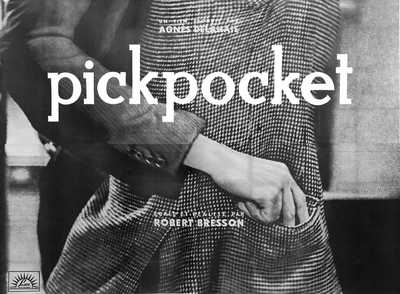
Pickpocket (1959)


pickpocket movie poster

Robert Bresson’s modern version of Dostoevsky’s Crime and Punishment. Caught in his own desensitized internal world, our protagonist Michel commits acts of theft as a desperate measure to fill the void in his existence. He goes through his days in a haunting vacuum devoid of meaning and emotions. He is unfeeling even towards his own dying mother, reminds me of Meursault in Camus’s The Stranger. Although not an axe murderer like Raskolnikov in Crime and Punishment, Michel theorizes that those with superior talents and intelligence, the supermen in society, should be free to disobey laws in certain cases. He is numbed by his own hubris, and stifled by his cold and absurd worldview. Outright violence is not visible here, but we see the battle of wits he engages with the police inspector behind his trails, and we see him struggle in an amoral and meaningless existence.

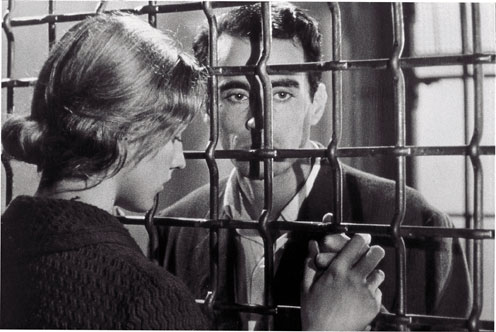
Grace comes as Jeanne, a neighbor and carer of Michel’s ailing mother. Jeanne lives on her own looking after her younger brother. Her father is a drunk and her mother has deserted them. But she continues to live and care. She accepts her circumstances calmly, and extends kindness to those unrelated to her, caring for Michel’s mother, a neighbor on another floor. She stands as a stark contrast to Michel’s aloofness. At the end of the film, Jeanne came to visit Michel in prison after he was arrested, the two separated by the cold iron bars. For the first time, Michel feels love and wants to reciprocate it. And thus the cathartic ending as he totally melts in the presence of pure love and grace, wrapping up the film with this last line:

“Oh, Jeanne, to reach you at last, what a strange path I had to take.”


Pickpocket


**

Drive (2011)

A current release that comes with high acclaims. The film was nominated for the Palme d’Or and Nicolas Winding Refn won Best Director at the Cannes Film Festival this year (2011). With slick and dashing camera work, the violence in “Drive” is visceral and graphic, a big contrast to the black and white, internal “Pickpocket”. However, I see some parallels between these two films made 50 years apart.

Ryan Gosling is “the Driver”. He does not even have a name. He is an expert stunt driver for movies and works at an autobody shop by day, drives a get-away car in the underworld of crimes by night. Like Michel in “Pickpocket”, he drifts in existence, numb and desensitized to the world around him. That is, until he meets Irene (Carey Mulligan), his neighbor.

Drive 1


Mulligan’s almost angelic presence in the film is most effective as a stark contrast to those around her. She lives alone looking after a child and works as a waitress in a diner. She appeals to the Driver by being herself, innocent, taking life as it is, responsible, caring for a child alone while his father is locked up in prison. Irene is a spot of purity in a rough environment. Her mere presence has transformed the Driver. From being aloof the Driver has become engaged emotionally, friendly and protective of both mother and son.

Drive

The plot thickens as Irene’s husband is released from prison and rejoins his family. The Driver is caught in an awkward situation. But he soon realizes that the husband’s resolve for a new start is genuine. The power of transformation is so thorough that the Driver is willing to go out on a limb to help the husband with one last heist in order to break the hold a gang has on the man, his wife and kid. While things go awry terribly and the ending is not as clean-cut as “Pickpocket”, we learn that the Driver remains a changed man from the ephemeral friendship he once had with Irene and her child.

Some might say Mulligan is a miscast, that she’s not “damaged enough”, and would prefer a ‘stronger’ character. I disagree. I feel that Mulligan has portrayed Irene’s innocent persona aptly, and yes, those ethereal dimples can just melt any heart. Hers is the perfect role for exactly the right reason. In the dark underworld of gangs, violence and crimes, she stands out as a tiny source of purity, a spark of grace. It all shows that what may look weak and vulnerable can have transformative power over the strong. A thought that may well be unpopular today.

***

Other related posts from Ripple Effects:

A Good Man Is Hard To Find and Other Stories by Flannery O’Connor

Bernini’s Corpus and Modern Movies

Notes on the Synthesis of Film, Art… Life?

***

Listening for Lent

In the old days, say, six years ago, reading for me was, simply, reading. Holding a book in my hands, read through the printed words, turned the pages manually, feeling the paper at my fingertips. But today, I have several ways to ‘experience’ a book. I can still read in the old traditional way, or download the eBook to my iPad using the app ‘OverDrive’, or, listen to an audiobook, on CD’s or MP3.

As a slow reader, I find listening to audiobooks a time-saving way, albeit I still prefer to hold a book in my hands and see prints on paper. But in this day of multi-tasking, I sometimes listen to audiobooks while driving as I can fit in my reading time. I confess, I could be distracted by the story, or the traffic. But overall, listening to audiobooks while driving is a perfect alternative for me, in lieu of time and space for ‘actual’ reading.

Recently I read an article by T. M. Luhrmann in the New York Times entitled Audiobooks and the Return of Storytelling. This insightful piece introduced me to a different reason for listening to audiobooks.

First off, Luhrmann takes down the generally accepted view that reading with our eyes as ‘more serious, more highbrow’ than listening to a story being told orally. She points to the early childhood experience when way before we could read, we were introduced to stories through listening to them. So maybe such a notion extends to our adult life making us feel that listening to stories is a childlike activity than reading the text on our own.

Many great books were actually oral legends, Luhrmann points out, “… for most of human history literature has been spoken out loud. The Iliad and the Odyssey were sung.” Noted. Can’t say listening to audiobooks is child’s play.

Luhrmann then comes to the crux of her idea. While we listen to an audiobook, we can do something else with our eyes and hands. That’s just obvious, isn’t it? Exactly what I said at the beginning of this post, the benefit of multitasking. But I was too rash to have thought I knew it so. What I read after this was nothing short of an epiphany for me.

No, not while driving, but when Luhrmann is gardening, she listens. Often, she would listen to the Bible. I love what she has to say next (emphasis mine):

Listening to a book is a different sensory experience than reading it. The inner imagining of the story becomes commingled with the outer senses — my hands on the trowel, the scent of tansy in the breeze. The creation of this sensory richness was in fact an explicit goal of the oral reading of the Bible in the medieval European cloister, so that daily tasks would be infused with Scripture, and Scripture would be remembered through ordinary tasks.

Whenever she looks at the “50 polypodium californicas and 50 festuca idahoensis in the dappled light beneath [her] oaks” she would think of “Gatsby’s extraordinary gift for hope.” Why, Luhrmann was listening to Fitzgerald’s novel while planting those the year before. Now looking at the plants would flash upon that inward eye what she had heard.

Of course, that sounds so simple and natural, a kind of classical conditioning, if you will. We fuse our senses and experience. All the more that we should listen to good books or we’ll have bad memories looking at the tasks we’d performed.

And what a wonderful idea Luhrmann had left me with: Scripture-infused daily tasks. That can’t be more apt for Lent.

***

Tanya Marie Luhrmann teaches Anthropology at Stanford.

Related Posts on Ripple Effects:

No Texting for Lent and the End of Solitude

The Dinner by Herman Koch: A Timely Read, for Lent?

Dances With Words

What Makes a Good Audiobook Narrator?

***

More Downton Ripples

Two years ago, some time after Downton Abbey Season 2 had finished airing on PBS, I wrote my first “Downton Ripples” post. I subtitled it “How I Overcome Downton Abbey Withdrawal Syndrome”. In that post, I’d listed some books and movies/TV productions that relate to the setting similar to Downton Abbey, for I was fascinated by the Great War period after watching Downton.

Some of the authors I read included Robert Graves, Hemingway, Evelyn Waugh, and watched Brideshead Revisited, A Handful of Dust, Easy Virtue and discovered Lost Empires, the TV series with a young Colin Firth together with Laurence Olivier, amazing.

This time, after Season 4, the withdrawal syndrome seems to have numbed a bit, but the ripples continue to spread. Again, Downton has prodded me to seek out the literature around the time between WW1 and WW2 Europe. While there are many present day authors writing about that era, I’d like to hear more authentic voices. I went looking for writers actually living in that period of history to hear their stories.

The following is a list of titles I’ve gone through this time, some I have finished, some still on my ‘To be’ agenda:

Parade’s End (2012, BBC/HBO co-production)

Parade's End Blu-Ray Cover

This series complements Downton Abbey perfectly. While Downton is light and heart-warming, soapy in its feel, Parade’s End is cerebral and literary, its social commentary of the time harsher and more incisive. I think the difference is, Julian Fellowes creates as a contemporary screenwriter, and knowing what modern day viewers want, he caters to their desire. Yes, he has offered us charming entertainment, and for the stars and the show, opportunities for Emmy and Golden Globe noms and wins.

Parade’s End is another story. Playwright Tom Stoppard (Emmy and BAFTA nom for this) adapts from Ford Madox Ford, a writer during WWI period, contemporary of Hemingway, Fitzgerald, the Lost Generation after The Great War, and witness to the destruction of the old world order and individual lives. Sure social barriers were dismantled, but together with such collapse came the shattering of long-held values and beliefs. Through the protagonist Christopher Tietjens, we can feel the intense struggles and poignancy of a man caught in such desolation.

I first saw Parade’s End on HBO when there was a window of free viewing. After watching one episode, I knew I must subscribe to continue with the rest of the series, and so I did. Effective advertising indeed. That was last year, and I recently just finished re-watching Parade’s End on Blu-Ray.

Parade’s End is the first time I watch Benedict Cumberbatch in a leading role (Emmy nom), an impressive performance as Christopher Tietjens, one of the last remaining honourable men struggling to stay afloat in the drowning waves of social change and ideals. Rebecca Hall (BAFTA nom) is effective as the scheming and seductive wife Sylvia. The young, almost ethereal Adelaide Clemens as suffragette Valentine Wannop is perfect. She makes me think of Carey Mulligan. And what a wonderful connection — Mulligan will be the star of the new film Suffragette, which I highly anticipate.

Parade’s End by Ford Madox Ford

Parade's End BBC Book Cover copy

This will be my major challenge in TBR books this year. Image here is the BBC Book edition I bought in a book sale a few years back. It has 906 pages, and is made up of four novels — Some Do Not, No More Parades, A Man Could Stand Up, and The Last Post. A more recent edition is the reissue of Penguin Modern Classic, with a new introduction written by Booker Prize winner Julian Barnes (The Sense of an Ending). You can read the intro here.

Parade’s End by Tom Stoppard

Parade's End Script by Tom Stoppard

I enjoy reading the scripts of productions I like. It’s a kind of deconstruction, if you will, demythisizing of sort. I’m fascinated by the skills of a screenwriter who uses words to elicit images for the director to execute, translating the literary into the visual using words. To write for the screen almost sounds like an oxymoron. I’ve read Julian Fellowe’s Downton Abbey scripts and found it most interesting. I’d like to explore Tom Stoppard’s journey of adaptation. But first, I need to tackle Ford Madox Ford’s original texts.

T. S. EliotT. S. Eliot — After Downton and Parade’s End, I’m all geared up to explore deeper into the the psyche and spirituality of the time. Why, after all, what had lost in a generation was not just the physical bodies or social structures, but the internal, the destruction of a value and belief system. I’d like to read and reread Eliot’s works, delve into a time that prompted the poet to see hollow men, and women come and go, talking of Michelangelo. What’s underneath the façade of human progress?

The Europeans by Henry JamesThe Europeans by Henry James — A voice from the dawn of the 20th Century. I have finished listening to the amusing auidiobook of The Europeans. Yes, unlike many readers’ impression of James’ works, The Europeans is a delightful read (listen). It is like a medley of E. M. Forster and Jane Austen. Humorous depiction of the different POV’s between a pair of European sister/brother coming to visit their American cousins residing in the outskirt of Boston. With some LOL moments. My next James read is The Ambassadors.

The Collected Stories of Stefan ZweigStefan Zweig — While Lady Edith’s love Michael Gregson headed to Germany and mysteriously gone missing, the then famous (real life) writer Stefan Zweig in Austria was lamenting the spread of anti-semitism in the continent. It’s interesting that Downton has led me to connect, at least in historical timeline, with an author I’ve just recently discovered, thanks to Wes Anderson’s The Grand Budapest Hotel, to which he has credited the works of Stefan Zweig. I’ve recently read Zweig’s Chess Story, and now delving into his short stories.

***