No Texting for Lent and The End of Solitude

Roman Catholic Bishops in Italy have added some contemporary relevance in the fasting tradition during Lent:  High Tech Fast.  The faithful are urged to free themselves from the bondage of technology and gadgets, and refrain from surfing, emailing, twittering, texting … in order to prepare themselves for Easter.  This could prove to be a penance much harder to practice than not eating meat, even just on Fridays, for texting could well be the newest form of addiction today.

At about the same time, I heard an interview on the CBC Radio program Spark.  Host Nora Young conducted an interview with William Deresiewicz, literary critic and essayist, who has recently written an article entitled ‘The End of Solitude’.

Deresiewicz taught at Yale from 1998 to 2008.  When he asked his students what place solitude had in their lives, he got this reply: “Why would anyone want to be alone?”

With the ubiquitous use of high tech gadgets, and the torrents of Internet social networks around us, we are caught in a web of connectivity like never before:

Not long ago, it was easy to feel lonely.  Now, it is impossible to be alone.

Not only that, the goal now seems to be to gain as much self-exposure as possible, to be visible.  It seems that the number of friends we have on Facebook, and the number of hits on our blog directly leads to our self-esteem and our quality of self.  The irony is, the pseudo and the virtual are substituting the genuine and the authentic.

What does friendship mean when you have 532 “friends”?  How does it enhance my sense of closeness when my Facebook News Feed tells me that Sally Smith (whom I haven’t seen since high school, and wasn’t all that friendly with even then) ‘is making coffee and staring off into space’?

Deresiewicz notes that solitude used to be a desirable social value.  From religious sages to the Romantics like Wordsworth, solitude is the channel one hears the still, small voice of God, or heed the beckoning of Nature.  As modernism crept in,  the literati turned inward to find validation of self, like Woolf, Joyce, Proust.

Then came urbanization and suburbanization.  The generation that used to vegetate in front of the TV has given way to the child of the Internet, the networked self.  And we no longer believe in the solitary mind.

So what does it matter when we have lost the moments to be alone?  What have we lost?

First, the propensity for introspection, that examination of the self that the Puritans, and the Romantics, and the modernists (and Socrates, for that matter) placed at the center of spiritual life — of wisdom, of conduct.

Also, the urge to be instantly connected has bred a new generation of skippers and skimmers, replacing readers.

… five minutes on the same Web page is considered an eternity

No wonder we’re told to keep our blog posts short if we want to attract readership.

With the loss of the capacity for solitude, we’ve lost the ability to cultivate depth of self  and create independent thinking.  Emerson said that “Solitude is to genius the stern friend.”  Deresiewicz goes on to say:

…no real excellence, personal or social, artistic, philosophical, scientific or moral, can arise without solitude.

The irony is, the more we are connected with the virtual world out there, the less we are connected with ourselves inwardly.  But this is what’s valued nowadays, isn’t it, to be open, sociable, gregarious.  But to maintain a sense of authentic self, we may have to sacrifice popularity, to be not so polite:

Thoreau understood that securing one’s self-possession was worth a few wounded feelings.  He may have put his neighbors off, but at least he was sure of himself.

Those who would find solitude must not be afraid to stand alone.

Maybe this is one meaningful connection we should strive for: solitude, introspection, slow blogging, quality thinking, quality reading, quality writing, quality self.

****

Click here to listen to the full interview.

Click here to read the article ‘The End of Solitude’ by William Deresiewicz.

Click here to read my review of Sherry Turkle’s Alone Together

Click here to read my post on Virginia Woolf’s A Room of One’s Own in which she explored the privilege of Solitude.
 

Time’s 25 Best Blogs 2009

Just when Arti is wondering how to spend the next 48 hours before Sunday’s Academy Awards, an incoming link pops up on her dashboard.  It is a blog talking about Time’s recent selection of  25 Best Blogs for 2009.   A stroke of glamour no less than the golden Oscar flashes across Arti’s muddled mind… huh, Ripple Effects got linked to what?  The researcher in Arti quickly heeds the call to check it out.   No, Ripple Effects is not on the list.  Slap, slap, wake up, this is the real world now… it’s just that one of Ripple Effects’ posts got linked by WordPress’ auto-generated linking mechanism.  In the huge blogosphere out there, being chosen as one of the top 25 blogs is just got to be harder than winning the Oscars.  What am I thinking.

For those interested in the curious case of  Time’s 25 Best Blogs of 2009, here is the list and the subject matter of the blogs:

  1. Talk Points Memo — Political
  2. The Huffington Post — Political
  3. Lifehacker — “Tips and downloads”
  4. Metafilter — Wikiweblog
  5. The Daily Dish — Atlantic Andrew Sullivan’s Political blog
  6. Freakonomics — NY Times Stephen Dubner and Levitt, Economics
  7. BoingBoing — Technology and fringe culture
  8. Got2BeGreen — Environment
  9. Zen Habits — Self-help and motivational
  10. The Conscience of a Liberal:  NY Times Paul Krugman, Nobel Laureate, Economics
  11. Crooks and Liars — Political
  12. Generación Y — Political
  13. Mashable — Social Networking
  14. Slashfood — Food
  15. The Official Google Blog — Business
  16. synthesis — opinions & ideas
  17. bleat — life in retro
  18. /Film — Films and Video Games
  19. Seth Godin’s Blog — Marketing
  20. Deadspin — Sports
  21. Dooce — Heather Armstrong on a female life
  22. The Pioneer Woman — Ree Drummond on a female pioneer life
  23. Said the Gramophone — Music
  24. Detention Slip — cheat sheet for education news
  25. Bad Astronomy — in praise of real science

So, here they are, your celebrities, the blockbusters of the blogosphere, some attracting millions of page views per month, the Hollywood Oscar scene of blogging.  But I must say I regret to see there are no blogs on the list that are dedicated to the arts or books.  Further, hats off to all those who write in obscurity, like many of my favorites.  They are the solitary bloggers who quietly express their views towards life’s issues, or share their love of a book, response to a film, or simply capture a moving moment, blogs that deserve to be read just the same as the blockbusters.

Maybe there needs to be an indie blogging recognition, like in the film industry, an Independent Spirit Award for bloggers who write and toil just for the simple pleasure of observing, expressing, sharing, and celebrating the essence of being human.  No glamour, no red carpet.

*****

P.S.  Ok, they have the red carpet too at the Spirit Awards and glamour automatically comes with that I suppose… Anyway, I’m sure you get my point.


Slow Blogging and the Long Take

Recently, I’ve been mulling over the notion of slow blogging, a movement that is gradually gaining attention. I first read about it in a blog I frequent.  In her post entitled “Slow, Stefanie has drawn out the essence of what slow blogging is. It’s all about thinking through, reading and studying in depth, chewing and digesting, and finally putting something meaningful down in words. I don’t know who initiated the idea. It may have sprouted up from various bloggers, those who care about the quality of their writing, and the effects of their posts. I urge my readers to visit the Oxford University Press blog post on the subject, and the Slow Blog Manifesto.

Yes, a Slow Blog Manifesto, written by Todd Sieling dated back to September, 2006. But for some uncanny reasons, just as I was working on my draft of this very post, after I’ve linked the SBM to my draft, it has now been taken off the WWW.  Hope this is not an omen of things to come.  Fortunately, before its disappearance, I had the chance to read and mull over his words:

“Slow Blogging is a rejection of immediacy.  It is an affirmation that not all things worth reading are written quickly.”

(It’s back!  Todd Sieling has just re-posted his SBM. He has created a whole new site just for this.  Click here to go there.  You may want to read his comment at the end of this post. I’m just going to leave the following paragraph as is.)

But then, all is not lost.  Barbara Ganley’s BGBLOGGING is still standing.  Ganley had taught writing at Middlebury College in Vermont for some years until quiting her academic job in recent months and ventured into uncharted personal exploration.  She is an advocate of slow blogging, and related the idea to the term meditative blogging, way back in November 2006.  Here’s the link to that post.

After more than two years, the notion has finally reached Arti of Ripple Effects. As my blog name suggests, I thrive on hindsights and delayed resonance. I may not have immediate response to all that I come across, but for those ideas I find stimulating, I would delve into and mull over, research and read about them, sometimes for a long while, before I dare to put thoughts into words. I’m glad I have finally found a name for the kind of writing and thinking with which I feel most comfortable all along.

leaves-on-pavement-webpage2

And that is why I find a recent article in the November issue of ‘The Atlantic’ so disconcerting.  In his article entitled “Why I Blog”, Andrew Sullivan , the prominent political commentator and blogger, describes blogging as postmodern writing that thrives on its immediacy. By nature it is rash and temporal.

“It is the spontaneous expression of instant thought. As a blogger, you have to express yourself now, while your emotions roil, while your temper flares, while your humor lasts.”

What Sullivan is pronouncing is that you may have an instant platform accessible by all in the blogosphere, and with links authenticating your sources, but what you write is as ephemeral as your breath, as unreliable as your mood, and as momentary as your fleeting thoughts. Time is of the essence in the blogging world.

I can understand such a perspective may apply to political and news blogs, where bloggers’ views and comments are almost on a par with professional journalists, or where bloggers are journalists, such as Sullivan himself.

But I’d just like to remind Sullivan that there are also those of us for whom blogging is not about beating to the punch, or channeling rants and angsts, or climbing to a higher ranking and authority. What we write may seem like ramblings at times, but they are thoughts that have gone through regurgitation, pondering, and conscious self-censure. For the writing I read in some of the blogs I visit, their quality is not undermined by the self-publishing nature of blog writing.  Their message is no less important, their style no less eloquent, their impact no less powerful than many conventionally published materials.

pilings-in-astoria-slow-blogging

Around the same time, I came across the post on the long take in Brett McCracken’s blog The Search. Do click on the link there to read the whole essay when you are there.  The long take is a technique where a camera follows its subject for an extended period of time without cutting, capturing life in real time. Viewers looking for instant gratification and fast actions would often find the long take boring, incongruent to the normal pacing of a normal movie. But as blog writer and movie critic Brett McCracken reflects, the long take leads us to confront life in a real sense, in real time:

I go to movies to recapture time—that achingly pervasive burden that keeps us so unceasingly busy in our normal lives. In the movies, time is “free.” We need not worry about our own time; all that is required of us is that we cede our imagination to the screen, where time is footloose and fancy free, dancing to and fro in flashback, flashforward, slow-mo, still, etc.

voyage-du-ballon-rougeA vivid example is Hou Hsiao-Hsien’s Flight of the Red Balloon which I reviewed in my last post.  Who would want to sit in a theatre to watch a balloon slowly drifting above the urbanscape, other than those who enjoy the grace of unhurried moments, those who consciously seek for poetics in the mundane, and those who take time to ponder the meaning conveyed by the filmmaker.

Slow blogging and the long take, two powerful ways to glean the indelible essence of life.

*****

Rewards and Awards of Blogging

Why do we blog? WordPress seems to have grasped the psyche of bloggers in five words: “Express yourself. Start a blog.” If being free to self-expression is the intrinsic reward of blogging, then being heard and read is the extrinsic reward. And, to top it all off, getting unexpected awards for what one already enjoyed doing is the icing on the cake.  A few months ago Arti had the first taste when she received the Excellent Blog Award.  This past week Arti has tasted more icing from fellow bloggers in the form of two awards.  In chronological order, they are:

The Premio Dardos from Ms. Place (Vic) of Jane Austen’s World. Thank you Vic for naming Arti as one of your 15 recipients of this award “that is given for recognition of cultural, ethical, literary, and personal values transmitted in the form of creative and original writing”. Thanks Vic for the honor and for the translation from Portuguese:“O conceito deste prémio passa por reconhecer valores culturais, éticos, literários e pessoais, transmitidos de forma criativa e original nos pedacinhos rabiscados por cada blogueiro que o receba.”

To meet the requirement, in turn, I am naming the following blogs to receive the same award.   To avoid duplication and to make it more meaningful, I have selected 10 instead of the 15 suggested.  Here are their excellent sites in alphabetical order:

  1. Austen Quotes is the blog of Lori Smith, writer of the book A Walk with Jane Austen, her personal experience of treading the paths of Jane’s in England.  She has inspired me with quotes from the works and letters of JA, some witty, some wise, some poignant, and all of them delightful.  Lori may have taken a hiatus due to physical ailment, but what she already has chronicled in her site is worth reading time and time again.
  2. Austenprose is a wealth of JA information and forum. Laurel Ann offers Janeites with a wealth of Regency knowledge, book discussion, interviews… a delight to visit every time.  This is one of the first blogs that got me hooked on JA…, no I wasn’t born a Janeite.  I only discovered this wonderful world a few years back.  And it’s blogs like this that feed me to my fill.
  3. Blogging for a Good Book is created by the staff of Williamsburg Regional Library.  In there you’ll find in-depth and insightful book reviews.  With several contributors, the blog offers a new post almost every day, keeping us up-to-date with newer titles. The quality writing and informative entries are enjoyable to read.
  4. Film Think is a site where films, theology, and criticism meet.  Writer M. Leary offers a wealth of resources and knowledgeable discussions and critique for those interested in the intellectual pursuit of the art of film, and its interaction with Christianity, criticism theory, other art forms, and their relevance in society today.
  5. Itinerant Idealist is Sarah’s journal  “in search of a soul awake”.  I’ve enjoyed her excellent writing.  In her casual way, Sarah embeds her prose and poems with style and spiritual insights.  Hers is one of the long time blogs I’ve been reading since the beginning of my own blog.  I’ve learned and gained much from reading her posts.
  6. Looking for Life’s Humor looks at life and brings out the joyous perspective.  As a mom with an autistic child, the writer of this blog depicts the humor and love that we often miss in many of life’s circumstances.  A heart-warming and delightful read in every post.  A truly enjoyable break in the midst of daily chores and chaos.
  7. Of Books and Bicycles As a book lover and an avid cyclist, Dorothy has successfully created a concoction of writings involving both…well maybe more about books.  Informative reviews and personal book experiences can be found here, while she has another site dedicated more to bikes and her training as a cyclist.
  8. So Many Books Stefanie chronicles “the agony and ecstasy of a reading life” with detailed research and insightful commentaries.  This is a literature lover’s blog.  Just the Blogroll is impressive enough, for there are probably hundreds of lit blogs on her list to provide almost unlimited avenues for blogging and reading pleasure.
  9. The Happy Wonderer It’s a joy every time I visit Ellen’s blog.  As a happy wonderer, Ellen wanders in the fields of photography, food, life, family, and the Bible, offering us musings, pictures, and inspiration, a celebration of life every day. This is one of the earliest blogs I found when I first started blogging, and I’ve been reading her since.  “To honor and encourage”, that is exactly so.
  10. The Task At Hand What Linda Leinen has created here in her relatively new blog is nothing short of a compilation of model writing.  Every single post is an example of style and inspiration.  At this point of her life she is a boat varnisher along the Texas Gulf Coast (how cool is that!), and she writes what she lives.  In her blog, she has woven artfully a tapestry of penetrative observations and skillful, affective writing.  I have gained and learned much from reading her every single post.

*****

The other award I received just a couple of days ago is the Arte y Pico given by Linda of The Task at Hand. Directly translated from Spanish means “Art and Peak”, at the peak of its art. Linda has included Arti’s Ripple Effects for its “creativity, design, content and contribution to the blogging community, regardless of language”.  Thank you Linda, I’m greatly humbled by such an honor.

To fulfill the requirement of the Arte y Pico, I’m naming 5 other blogs to be recipients in turn.  Noting that it’s Spanish in origin, and the phrase “regardless of language”, I attempt to highlight some of the ones I visit that have a different geographical or cultural flavour, although I admit they are all in English.

  1. Blogging in Paris As a 64 years-old cancer survivor, Claude’s attempt at blogging is in itself inspiring.  She writes from Paris, and from her many travels in Europe, affecting us with her zest for life and eye for beauty.  It’s a mixed bag in her blog, some photography, some journal writing, some personal musings.  A delight to visit.
  2. Moderato brings a European perspective to the discussions of art, books, music, films, and literature.  The writer offers in-depth and well researched commentaries on the subjects.  A very fine and intellectual lit blog.  Some great You-tube clips to augment the enjoyment.
  3. The Errant AEsthete From New York, “Essentials for the Cocktail Swilling Savant”, ok, it may sound a bit exclusive, but the art, photography and visuals presented in the blog are stunning and often thought-provoking.  And since it’s located in the ever widening blogosphere, anyone can visit and better yet, no dress code.
  4. Hidden Art A blog for the arts and crafters among us. The name says it all… art can be found and creativity unleashed in almost every homely place.  I’ve enjoyed the casual atmosphere and the stimulating ideas for mixed media and paper arts that are achievable by those who, like myself, are not art school graduates.  Accessible art speaks a universal language.
  5. Edible Landscape This is a unique blog on food written by a young guy from Hong Kong, an interesting diversion from the blogs on food and cooking we see from North America.  Wilson concocts an international flavour with his fine, quality writing on food and restaurants.  What more, where do you ever read a 20-something young man writing about cooking and cuisine art with such expertise?

Wow, that’s a mouthful!  Why do we blog?  The above are some of the obvious answers.

Reading, Writing, and the Gender Issue

With all these posts lately about Jane Austen on Ripple Effects, Arti feels there is a need for an erratum.  Before the comedy of errors gets to Austenesque proportion, and considering Arti’s minute talent in writing such that there being no aspiration to become a modern day George Eliot, a major confession is called for here:  Arti is A Lady.

At first when I started Ripple Effects, I thought that the name “Arti” is neutral enough like “Les”, “Chris”, or “Alex”.  I subscribe to the ideal that great literature and good writing is gender neutral, by this I mean their relevance and significance surpass the boundaries of gender to reach the universal, be it the work of Jane Austen or George Orwell.   And, laying aside the gender issue, good books deserve to be read.  The novels of Jane Austen come to mind.  The gender of a writer should not be an impediment if the writing speaks to all.  Arti proceeded to write all reviews and articles based on this premise, attempting to strive, albeit remotely, towards this ideal.

I hope the disclosure of Arti’s gender does not diminish readers’ enjoyment of Ripple Effects.  Definitely, Arti does not want to be accused of carrying a concealed weapon, or acting as an undercover agent when it comes to the battle of the sexes.  So here I am, coming out with both hands up in the air.

As readers can quickly observe, Ripple Effects encompasses not only Austen, or just books.  But because Arti is endowed with only 24 hours in a day,  wherein a few have to be allotted to that essential yet elusive activity called sleep, there is just not enough time to see all the many exciting worlds Arti would like to explore.  To alleviate this deficiency,  Arti visits other people’s blogs to quench the thirst.  I thank you all for transporting me to those worlds in this great blogosphere of ours.

In between visits,  Arti will continue to plow through neutral grounds to learn the art and craft of reading, writing, watching, and gleaning the worthy ones to review.

(Visual:  Le Blanc Seing by René Magritte)

First Blogaversary and Summer Wrap-up

Last year on this day, August 29, 2007, I began my blogging journey on WordPress.  One year and 104 posts later, this sputtering engine is still chugging along.  I’d like to think of my blogging experience as a road trip.  The kind of vehicle I have in mind is the VW van in the movie Little Miss Sunshine.  Almost an obsolete wreck and yet still functioning, just needs a little running push.   

It has been an eventful summer for me.  Having had to move twice and living out of a suitcase, sustaining the horrors of home renos, tending illness in the family, and caring for two elderly parents have put my life on hold…or maybe this is life.  All this time, I didn’t have easy access to the internet, no TV, or other high tech luxuries.  While my posts have been more sparse than I’d like, blogging, even though infrequent, has at least kept some kind of normalcy for me during this unsettling and chaotic period.

While I’ve missed many important events during these two months, such as Hilary’s concession speech, and the Olympics… I’ve been able to catch some summer flicks and read a few books.  As I take stock of this summer’s entertainment consumption, I’m surprised to find that my list is long despite the interruptions:

The following are straight from memory, in no particular order:

Movies seen at theatres:

  • Mamma Mia! 
  • The Dark Knight
  • Swing Vote
  • Brideshead Revisited

Live Musical:

  • Spamalot

DVD’s watched or re-watched:

  • Persuasion (1996)
  • Persuasion (2008)
  • Sketches of Frank Gehry (2005)
  • Life As A House (2001)
  • Eternal Sunshine of the Spotless Mind (2004)
  • Vantage Point (2008)
  • The Bank Job (2008)
  • Miss Pettigrew Lives for a Day (2008)
  • Plus about 25 titles previewed for a Film Festival

Books read or re-read:

  • Persuasion by Jane Austen
  • Then She Found Me by Elinor Lipman
  • The Savior by Eugene Drucker
  • The Glass Castle by Jeannette Walls
  • Up Till Now by William Shatner
  • Lady Killer by Lisa Scottoline

So this is the summer of 2008.  Will be leaving for Ontario tomorrow to take our son back to university, Arti is wrapping up another summer, and the first year of blogging. 

What’s your blogging trip been like this summer?   And your list of books and entertainment?

                                                                           *****

Excellent Blog Award

“I am not a great reader, and I have pleasure in many things.”

— Lizzy Bennet, Pride and Prejudice.

excellentblog1I’m honored to be named one of the recipients of the Excellent Blog Award given out by Vic, a.k.a. Ms. Place, of Jane Austen’s World.  Considering her criteria and a look at my fellow honorees, I feel greatly encouraged indeed.  Thank you Vic, it means a lot for a “non-Austen” blog to get a nod from Jane Austen’s World.  Actually it is blogs like yours that spur my interest in Austen and the Regency world.
Ripple Effects is not exclusively an “Austen blog”, although Jane Austen is one of my all time favorite writers, and you can certainly find many Austen posts here. But as Lizzy Bennet in Pride and Prejudice said: “I’m not a great reader and I have pleasure in many things”.  I enjoy writing about topics relating to my various interests in the arts and entertainment field.  I try to maintain a magazine-style format to encompass the diverse subjects.  Ms. Place has kindly observed: “I’ll never know what I’ll find when I visit.”

I love books, but I’m a slow reader.  So my mind is always trying to catch up with what my heart desires.  I love movies, but I seldom go to opening showings to avoid the crowd.  So what you read in Ripple Effects are often hindsights and resonances from delayed gratification.

At times, it’s a rough road, this blogging journey.  Sometimes I just drive not knowing where I’m heading. But receiving acknowledgement like this is the fuel needed for me to press on, and help me to relax enough to enjoy the scenery along the way.

At first I was planning to write a post like this on my first blogaversary August 29. But at 11 month now I feel I just can’t wait to express a heart-felt thank-you to all my fellow bloggers and the many anonymous visitors from around the world.  You’ve unknowingly added fuel to these clattering wheels.

******

Summer Indulgence (2008)

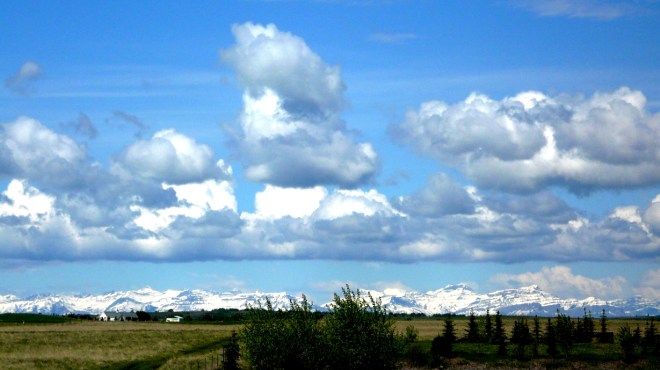
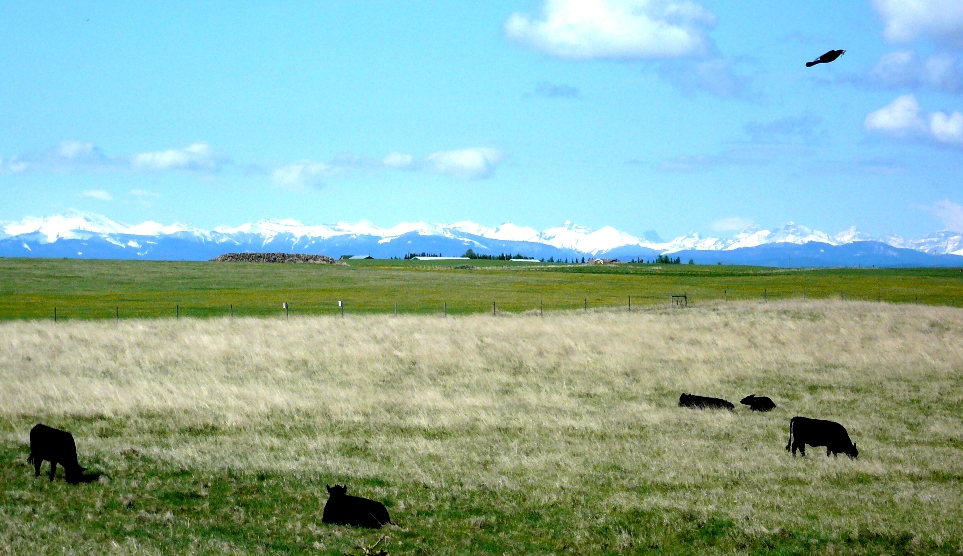
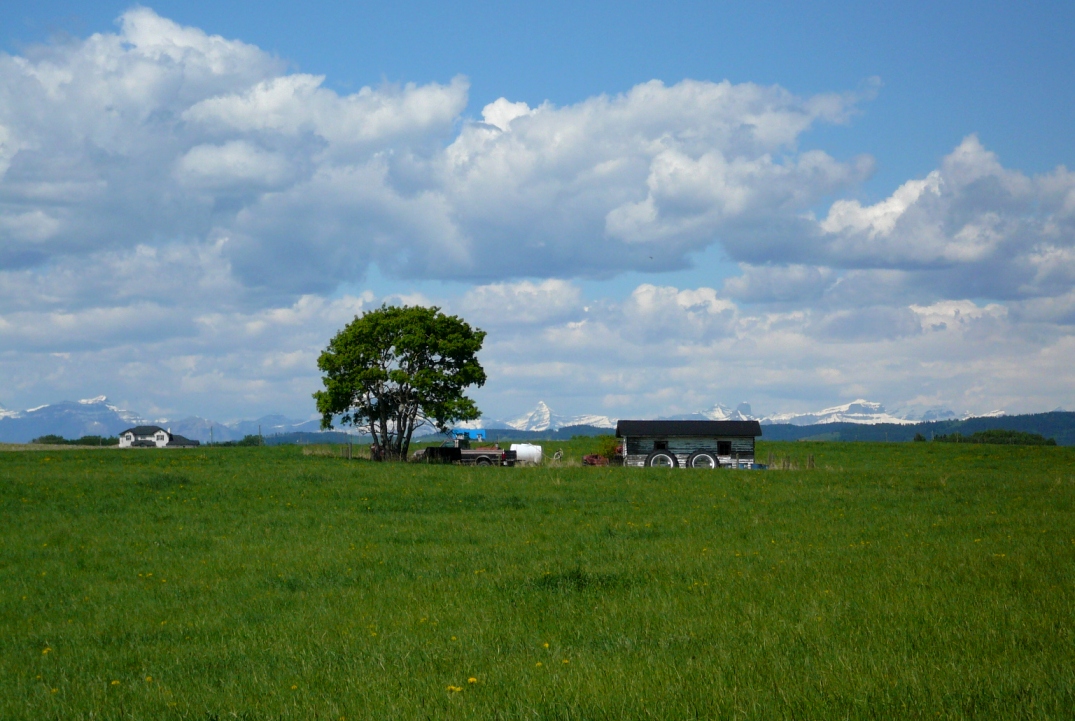
No, this is not a movie. It’s real life. I’ve to move to make way for some major renovations in our house. For a month or so, Arti the urbanite is living in the country. My summer abode is a log home amidst acres of farmland, at the foot of the Rockie Mountains in Alberta, Canada.  I have fresh air, big blue sky, quiet neighbors, and magnificent views. The following are some pictures of my summer indulgence.

The little big house on the Prairie:

Little big house on the Prairie


My view:


My quiet neighbors:


My other quiet neighbor:


My visitors:


There’s no water for me to make ripples.  I’ll have to create sketches in the wind.  I’m gratified by the views and the solitude I’m granted here in the open country.  But there are costs:  no TV, no Internet, the commuting to the City (about an hour’s drive), unwanted house guests: mice and other rodents.  As much as I yearn to embrace nature, I confess I’m no Thoreau or Dillard…I just can’t live without modern conveniences, nor can I survive without the Internet.  How can I be a recluse and stay away from the blogging community for a whole month!?

So here’s my list of survival gears:

Electronic gadgets:  A 7″ portable DVD player, a couple of cameras, my laptop, and of course, my BlackBerry.  I’ll have to drive to the nearest town to find Internet access.

DVD’s I brought with me:  Sketches of Frank Gehry, Paris, Je T’Aime, Life As A House, Fargo, The Hours, Wordplay, The Namesake…plus some titles I need to preview for a Film Festival.

Books:  My current reading list includes The Glass Castle by Jeannette Walls, Persuasion by Jane Austen, and two books by Robert K. Johnston, Reframing Theology and Film, and Reel Spirituality: theology and film in dialogue.

Also, I intend to visit the nearest town and explore some arts and crafts stores and yes, they have a public library there…I won’t feel so alienated after all. 


                                                                  ******


To Read or Not To Read: A Personal Response


It looks like my last post has stirred up some ripples. I thank you all for your input to a very complex topic.  Your comments certainly make an interesting forum, where there’s the exchange of ideas and the sharing of opposing views.  That this is even possible is basically because we all read and write.  It’s not too late to thank our teachers for this.

Indeed, the issue of reading is a complicated one.  On the outset, and from your comments, we see aspects dealing with the skill, the form, and the content of reading.  While at the same time, underlying are the very values we hold towards this seemingly simple act: What is reading after all?  How should it be taught in our schools and transmitted (or not) in our homes?  And, what should the content be in order to classify the act as such?

As someone who has involved in literacy research, I have seen recent academic studies taken the perspective of re-defining reading and writing not as a skill but a social practice. Our values sustain the act, or transform it. As we see the ubiquitous usage of the internet and digital communication, we are witnessing the power of technology changing our social values, lifestyle, interests, and how we spend our time.

The NEA surely had the effects of our technological age in mind, thus, an update on the reading habits of Americans.  The last one they did was in 2004.  As with any survey, the NEA Study has its limitations and confined by its own perspective and contextual stance.  And, within the parameters of the present study, they did not go into details the causes, but they did present the correlations of variables.  The results can be considered as reflections of our contemporary society.  The correlations of factors and the implications of the findings are significant enough for us to ponder.  Again, you can download the 98-page report in pdf format here (3.32 MB).

I welcome the progress we have made in digital and internet technology, bringing the world closer at the twitch of our finger, feeding us with instant knowledge and information. I congratulate those who attempt to bring the world of print to their readers by more convenient modes of delivery, such as transmitting reading materials in digital mode, and others who attempt to attract young readers through the creation of new kinds of books, such as graphic novels and manga’s. 

And yet…I lament the erosion of a part of our culture and civilization, the form of reading and writing as we still know it.  I’m concerned about the gradual obliteration of the “classics”, or the dying of the literary form. I lament to see the decline of appreciation and comprehension of literature, for I believe the humanity and universality in many of these works still speak in our world today.  I believe there’s an urgent need to create even more literary works in the face of technological domination.  There may not be a golden age of reading, but there has been a heritage of writing.

I worry about our next generation replacing the art and pleasure of book reading with offerings from other media. I’m also concerned about the English language disintegrating into cyber lingos, or replaced by sensational, action-packed anime. It is a phenomenon graver than just seeing the puzzled faces of our young as they look at an analog clock or try to use a dial phone. 

The progress we have made in technology does not mean that we should downplay the loss of a heritage.  That we can artificially make ice should not trivialize the disappearance of glaciers. The ushering in of electronic music should not obliterate the works of Mozart.  The two can co-exist…isn’t that the postmodern promise? 

No doubt, reading and writing will survive, since we still need to look up information, make lists, chat on-line…and blog.  But I regret to see the erosion of literary reading and the appreciation of literature, classic or contemporary, and may it not come to pass, the termination of its creation in the future, near or distant.

As another year draws to a close,  we may need to take stock of both our progress and our loss.  I’m not a doomsayer, but surveys like the NEA’s point to what seems like an irreversible trend.  While some may not see it as a gloomy path but just a shift of social practices and lifestyle, the survey results reflect our priorities and the shifting values in this day and age. 

Or, is it really irreversible? 

Maybe all is not lost.  At the start of a new year, I’d like to remain optimistic.  Maybe it begins with…yes, a New Year’s resolution on reading… 

A Happy New Year to All!

To Read or Not To Read

To Read or Not To Read: A Question of National Consequence…That is the name of the recent study conducted by the National Endowment for the Arts on reading habits in America.  Just as I was writing about the study in the UK on re-reading in my post Reading and Re-reading, regretting no such kind of surveys being done in North America, and here it is, the NEA’s reading survey results, incidentally, released the same day I published my post. 

Well, maybe I should not be so much of lamenting the lack of reading surveys than the actual survey results.  In a nutshell, the major findings are:

  • Americans are reading less, especially the young.  For example, the percent of non-readers among 17 year-olds doubled to almost 20% in the last two decades.  Or, on the average, 15 – 24 year-olds spend 7 minutes reading on a weekday, 25 – 34 year-olds are slightly better, 9 minutes.
  • Reading comprehension is on the decline, as indicated by reading scores.
  • The decline in reading has civic, social, and economic implications.

The whole 98-page report can be downloaded in pdf format here.  It is not Stephen King material, but just the same…interesting reading with an ominous undertone.  It covers various topics including correlations between pleasure reading and academic scores, reading habits, reading and multitasking, employment, internet and digital technology, the relevance of newspaper, and yes, even blogging.

I understand that the issue is complicated and the causes are complex.  Critics are quick to point out that the form and purpose of reading have changed in this internet driven age.  People still read to look up information they need, critics argue.

Maybe the concern should be the gradual extinction of literary reading, the reading of literature for pleasure, and the whole business of reading and writing.  When the figure shows that 63% of college seniors read little or nothing for pleasure, even the pragmatists should be worried when they consider the bottom line.