Sarah’s Key: Book into Movie

“When a story is told, it is not forgotten…”   — “Sarah’s Key” the movie

The Background: Vel d’Hiv Roundup

The story has to be told, because it is based on a historical event that has long been ignored. On July 16 and 17, 1942, the French police in Paris rounded up more than 13,000 Jews in Paris, among them 4,000 children, and confined them in the Velodrome d’Hiver (Winter Velodrome), an indoor bicycle racing track and stadium not far from the Eiffel Tower. There in the Velodrome the Jews were kept under French police guard for five days with no food and just one tap. They were subsequently sent to internment camps outside of Paris, where children were torn apart from their parents. Apart or together, they shared the same fate. From the internment camps, young and old alike were later transported by train to the Auschwitz extermination camp. The Velodrome, which was situated in the 15th arrondissement of Paris, has since been torn down but the event remains a dark page in France’s history.

The Vel d’Hiv roundup had been ignored for decades in the classrooms of the nation. Post-war French leaders from de Gaulle to Mitterrand had kept mum on the issue of France’s role in deporting Jews to the death camps. It was not until Jacques Chirac became president in 1995 that the French state accepted its official complicity, in particular, the Vel d’Hiv roundup. Here’s an excerpt of Chirac’s historical speech taken from a TIME magazine article:

France, homeland of the Enlightenment and of human rights, land of welcome and asylum; France, on that very day, accomplished the irreparable,” Chirac said in his speech, using the Vel d’Hiv roundup as a metaphor for all Vichy crimes. “Failing her promise, she delivered those she was to protect to their murderers.

A story based on this true event ought to be noticed. The French drama based on true accounts, “La Rafle” (“The Round Up”), was released in 2010 to a large audience in the country. And for us in North America, we have the novel Sarah’s Key (2007) and its movie adaptation (2010) to inform us of that horrific event and the imagined scenario of its impact on the lives involved.

(Spoiler Alert from here on.)

The Book

Written by Tatiana de Rosnay and published in 2007, the book has been on the New York Times bestseller list for 120 weeks. It has sold 5 million copies world wide and been released in 38 countries. de Rosnay has published works in French. This is her first English language book.

The book weaves two stories together 60 years apart. 10 year-old Sarah Starzynski’s family is one of those being rounded up on July 16, 1942. On the spur of the moment, Sarah hides and locks her 4 year-old brother Michel in a cupboard in the wall of their bedroom, thinking there he will be safe until she comes back for him. It was horrific for her and her parents to find out later that they won’t be returning at all.

Sarah and her parents are kept in Vel d’Hiv in appalling conditions, only to be deported to an internment camp where she is separated from them. Her determination never wavers though in getting back home to let her brother out of the locked cupboard. She has kept the key, guarding it with her life.

Fast forward to 2002. Julia Jarmond, a U.S. expatriate married and working as a journalist in Paris, delves into the research of the Vel d’Hiv roundup for a magazine article commemorating its 60th anniversary. She is totally absorbed by the little-known event. What’s more, she finds out that the apartment that used to belong to her French husband’s grandparents and which is now under renovation for her to move in was the very home of Sarah and her family.

At the same time, Julia struggles with a personal dilemma. At 45, mother to 11 year-old Zoé, and after two miscarriages, Julia is excited to find out she is pregnant. Her husband does not share her sentiment however, pressing her to abort. The poignant story of Sarah inspires Julia’s decision as the story unfolds.

While I whole-heartedly admire the author for her intention to honor the victims of Vel d’Hiv and her eagerness to expose the atrocities afterwards, I have reservations about the literary quality judging from the style and structure of the book. At several points, I feel the writing redundant. And for a novel written for an adult readership, it gives me the feeling of being talked down to, told what to think and how to feel.

Structurally, it presents the two stories in alternating chapters. The shifting is abrupt as the chapters are only three pages long. This lasts till the middle of the book when the story of Sarah’s key comes to an end. That occurs when Sarah makes it back to her apartment and discovers the heart-wrenching horror. The rest of the book is the continuation of modern day Julia’s story, her persistence to discover Sarah’s trail after the war and dealing with her own personal dilemma. Compared to Sarah’s story, this latter part seems trivial and anti-climatic.

The Movie

One year after it premiered at the TIFF, I finally have the chance to see this movie as it is being screened only recently in one theatre here in town.

Screenwriter director Gilles Paquet-Brenner has gleaned the essence of the novel and tightened the plot in an engrossing way. By virtue of its form, the movie has the advantage of showing rather than telling.  It can condense paragraphs of words into a cinematic moment frozen in the mind’s eye. The film is captivating, telling the story with vivid and haunting images.

We see the recreated Vel d’Hiv and its appalling condition. We see a woman plunging to her death from a high level in the Velodrome, an apparent suicide. We see the horror of children torn away from their mothers in the internment camp. We see too the desperation of Sarah finally running up to her apartment, pounding on the door of the new family living there. We see her barging into her bedroom and unlocking the cupboard. And from inside there with the camera pointing out, we see the terror on Sarah’s face as she looks in. We hear her scream.

The storytelling is carried out by the excellent performance of the two main actors, Mélusine Mayance as Sarah and Kristin Scott Thomas (“I’ve Loved You So Long”, 2008) as Julia Jarmond. The structure of the plot limits young Sarah to only the first part of the film, albeit her portrayal is memorable, her unseen presence lingers through the movie.

Kristin Scott Thomas always delivers. Her role as the persistent journalist Julia is convincing and a pleasure to watch. Her cool demeanor conveys the fact that it takes intelligence and professionalism to find the truth as a journalist, and yet, once exposed, the truth can have the affective power to inspire and turn one’s life around. Scott Thomas has aptly portrayed this change.

Nevertheless, the weakness of the film lies in the lack of character development in the ‘minor’ roles. If given more depth, they can sharpen the conflicts and enhance the story. I’m thinking of Julia’s relationships with husband Betrand (Frédéric Pierrot, “I’ve Loved You So Long”, 2008) who insists on her abortion, and with her daughter Zoé (Karina Hin).

And since I’ve been looking for ‘intrusions of grace’ lately, there’s a scene here that is of note. It is not in the book, but screenwriter/director Paquet-Brenner has aptly created a poignant cinematic moment with it.  When Sarah and another girl are trying to crawl under a barbed wire to escape from the internment camp, they are caught by a guard. But upon the urgent appeal of Sarah, he softens. Using his bare hands to hold up the wire, he pushes the girls through. The camera then closes up on his bleeding hand, pierced by the barbs, an apt allusion. How we need these ‘intrusions of grace’ to shed a glimmer of hope amidst overwhelming darkness.

“Sarah’s Key” may well be one of those examples where the movie speaks more powerfully than its source material. If you are time-pressed, go for the cinematic rendition.

***

To read more about the Vel d’Hiv roundup and related articles, click on the following links:

Behind the French Ruling on WWII Deportations of Jews“, TIME.

“Remembering the Vel d’Hiv” The Economist.

“Letters from Drancy” The Guardian.

“Vel d’Hiv Roundup” Wikipedia

A Good Man is Hard to Find and Other Stories by Flannery O’Connor

“The heart is deceitful above all things, and desperately wicked: Who can know it?”  Jeremiah 17: 9, The King James Bible

I’m delving into Flannery O’Connor like mad, looking for violence. It all started with my stumbling upon this YouTube clip of Father Robert Barron’s movie review of Coen Brothers’ acclaimed movie “Fargo.”

I was bemused to hear him compare Joel and Ethan Coen’s films to Flannery O’Connor’s stories, for in them we can find violence juxtaposed closely with humor. It has been years since I read O’Connor’s stories. After watching “Fargo” again the other night, I thought, I must read more of Flannery O’Connor, this time in a different light. I want to experience how this is true. I’m curious to find out how and why a deeply religious female author would instil violence in her stories. A Good Man is Hard to Find and Other Stories is a good source for my purpose.

Within the ten stories in this collection, I’ve encountered shocking and disturbing scenes that if being shown in cinematic light today could match what’s on screen, not only physical violence, but malicious deceits, verbal abuse, nasty and mean motives leading to disturbing actions.

Here are some of the scenes: Leading the pack is “A Good Man Is Hard To Find”, where a family of six from baby to Grandma is killed by an escaped convict The Misfit and his men. In “Good Country People”, a deceitful young man posing as a Bible salesman outsmarts a woman aiming to seduce him, overpowering her and robbing her prosthetic leg.

Or how about these scenes: A grandfather denies knowing his young grandson in the face of danger in an unfamiliar city in “The Artificial Nigger”. A stranger gaining the trust of an old woman and later marrying her deaf-mute daughter but ends up abandoning her and driving off with her mother’s car and money after the wedding in “The Life You Save May Be Your Own”. Children setting off a wild-fire and endangering a home and its occupants out of revenge, jealousy, or plain malice in “A Circle in the Fire”. Almost all the stories depict human depravity in a shocking way, albeit intermingled with humor. But often, for me, the humor does not compensate for the disturbing and grotesque. From what I’ve read in this collection, O’Connor could well have written the movie “No Country for Old Men”, except she would have sprinkled with a dash of sardonic fun.

But why? If for anything but to show the depravity and the hypocrisy among supposedly ‘good country folks’, and by extension, all humanity, O’Connor is most successful. Like the choir boys turned savages in The Lord of the Flies, what we are is largely circumstantial, the author seems to point out. O’Connor is very bold and direct in conveying this message. She does not cover up the dark side of human nature but exposes it. By so doing, she points to the need for redemptive grace.

In “A Good Man Is Hard To Find”, we see at the moment of imminent death, the grumpy Grandma looks at The Misfit in a new light, realizing that her existential predicament is not much different from the criminal’s. She says to The Misfit:

Why you’re one of my babies. You’re one of my own children! She reached out and touched him on the shoulder.

But her epiphany comes too late for herself.

The Misfit sprang back as if a snake had bitten him and shot her three times through the chest.

While we see the murder of a seemingly innocent old woman, albeit hypocritical, O’Connor delivers the verdict of our human condition ironically by the words of The Misfit:

She would of been a good woman,” The Misfit said, “if it had been somebody there to shoot her every minute of her life.

I find too, that violence in O’Connor’s stories are not gratuitous. It’s a situation, an action that comes as unexpected, and with that, O’Connor deftly tips the balance. These shocking acts usually serves to shatter the status quo of her characters, challenge their world view and convictions. O’Connor does not go about describing the grotesque in gory images, rather, in a matter-of-fact way. We only hear gun shots from afar when the other members of the family are killed. And for the Grandma, The Misfit “shot her three times through the chest.” These mere seven words send out the eerie and shocking effect of cold-blooded murder without having to dwell on the explicit.

Likewise, in “A Circle in the Fire”, it’s a few sardonic words from the disgruntled kid Powell that send chill down our spine as he lights up a match to set fire to the dry wooded area outside Mrs. Cope’s farm home:

Do you know what I would do with this place if I had the chance?… I’d build a big parking lot on it…

Powell told his two companions. Seeing this, the slow-witted daughter of Mrs. Cope’s runs home excited, shouting:

Mama, Mama, they’re going to build a parking lot here!

Yes, a likely scene and dialogue from a Coen Brothers movie.

But it is O’Connor’s own words that is most revealing in pointing out the reasons behind the violence:

In my own stories I have found that violence is strangely capable of returning my characters to reality and preparing them to accept their moment of grace.  Their heads are so hard that almost nothing else will do the work.

And violence is never an end in itself:

We hear many complaints about the prevalence of violence in modern fiction, and it is always assumed that this violence is bad thing and meant to be an end in itself.  With the serious writer, violence is never an end in itself.  It is the extreme situation that best reveals what we are essentially…

In reading (and movie watching, for that matter) we need to find and catch that glimpse of grace. With this, O’Connor had also set a standard for a good screenplay:

Our age not only does not have a very sharp eye for the almost imperceptible intrusions of grace, it no longer has much feeling for the nature of the violence which precede and follow them.

It is the “intrusion of grace” that the violent act is set up for. Without the Grandma’s final epiphany and the gesture of reaching out to The Misfit, O’Connor had said, “I would have no story.”

The writer sure knew a bit about the human heart.

***

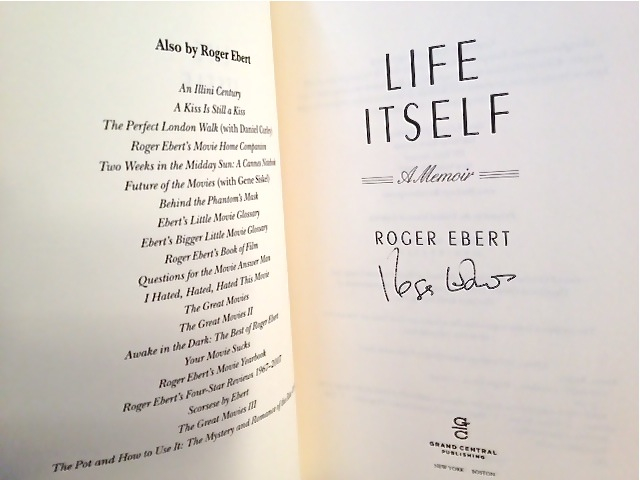
Roger Ebert in Toronto: A Close Encounter

Thanks to the Toronto International Film Festival, I have the chance to encounter the legend. It’s only natural that wherever there are films, there are film critics. But I never would have thought that I would see Roger Ebert in person and shake hands with him.

It was pure serendipity. While browsing in Indigo on Bay Street, I noticed a sign saying Roger Ebert would be in that store signing his memoir Life Itself a few days later. I’d followed his reviews since his “Siskel and Ebert” days, the two-thumbs-up duo. By the way, Ebert’s right thumb up had been trademarked. Reviewing films for the Chicago Sun-Times since 1967, Roger Ebert was the first film critic to win a Pulitzer Prize for criticism (1975), prolific all the way till his last two days.

Roger Ebert autograph Life Itself

This was not just about an autograph, or seeing a celebrity up close. It was about seeing a man who after torturous cancer treatments and surgeries for his thyroid, salivary gland and jaw, had lost a part of his face and the ability to talk and eat, and yet still maintained his humor and passions, who continued to press on to new ventures… this was about seeing life itself.

In the late afternoon on September 14, 2011, at the signing area in Indigo Books on Bay Street, people had been lining up for over an hour. I was one of them. At 7 pm, Roger came in walking slowly and with aid. He came on stage and faced the crowd. Together with his wife Chaz, they gave us a wave. Then he sat down and began signing. Photographs were allowed except for the rule of no posing. The Q & A session also began.

Chaz was his voice. She was personable and a film lover herself. She shared some of her views of the TIFF selections. As executive producer of “Ebert Presents at the Movies”, Chaz answered some questions without consulting Roger. But for most questions addressed to Roger, he would write on a small spiral notebook, handed it to Chaz to read out his answer.

Here are some of the notes I’d taken:

* Who influenced you the most?
He pointed to his wife standing behind him.

* Which decade is your favorite?
The 70’s… where you had The Godfather, Raging Bull…

* Buster Keaton or Charlie Chaplin?
Buster Keaton, albeit both are great.

* 3D?
Don’t ask. Story is number one.

* CGI (computer-generated imagery)?
Movies with CGI are soulless.

* All time best?
Citizen Kane.

* Favorite actor?
Robert Mitchum.

* Contemporary?
Al Pacino, Philip Seymour Hoffman, Tilda Swinton

* Favorite Canadian directors?
Atom Egoyan, David Cronenberg, Norman Jewison, Guy Maddin (thumb up)

* James Cameron?
Is James Cameron Canadian? Chaz asked in surprise.

* Favorite book?
A Fine Balance by Rohinton Mistry (Canadian! A voice came from the back)

* Any pressure from movie producers to write a good review?
No, he hasn’t been pressured. He was beyond reproach, Chaz answered.

* Any movies you haven’t seen?
The Sound of Music

* If there’s a movie made about you, who’d you want to play you?
Philip Seymour Hoffman. Chaz added, Oprah to play me. Diana Ross would be good too.

* Advice for potential film critics?
Do you want to get paid? Roger answered with a question.
Yes and no. The questioner covered all bases.
Start blogging. Roger replied.

* How does your life influence the way you review a film?
It generates every word.

Definitely more than just an autograph. What an encounter. What a night.

***

CLICK HERE to listen to an interview of Roger Ebert on CBC Radio during TIFF. Roger used a text-to-voice software as his speaking voice.

***

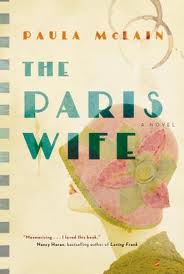
The Paris Wife by Paula McLain

Hemingway’s voice has been heard the world over. His persona and perspective reflected from his prolific writings. Now fifty years after his death, Paula McLain has gleaned through facts and whatever that’s true to create the novel The Paris Wife, revealing the point of view of Hadley Richardson, Hemingway’s first wife.

.
.

Hadley’s voice speaks from the shadow. It reflects the thoughts of one who had seen it all from the beginning. Within seven short years, she had witnessed the transformation of a disgruntled journalist into a promising, full-fledged novelist. And she was the one who, after only three months of marriage, sailed with Hemingway to Paris and began her fateful role of the ever supportive and loving companion. How we need to listen to her side of the story.

.

There are those who have read The Paris Wife and then want to read more of Hemingway’s works.  For me, after reading the book, I want to read more of Paula McLain’s.  It’s interesting that her MFA is in poetry, and that she has published two volumes of poetry collections before this novel. I wonder if it takes a poet to write prose like this, highly sensitive and nuanced, while surprisingly void of ornaments. I find the no-frills narrative style of McLain’s a bit like Hemingway’s, spare and direct, like his memoir A Moveable Feast. Consider something like this as Hadley recounted her earlier life:

And everything was very good and fine until it wasn’t.

What wasn’t fine is an understatement. It’s ironic that what happened to both Hadley and Ernest was quite similar. A domineering mother and a depressed father whose fate led to suicide by a self-inflicted gun shot wound. We know now that Hemingway himself could not escape such a fateful end himself.

But from the start, it was love at first sight for Hadley and Ernest as they met in a house party in Chicago, after Ernest returned home from the war. He was 21, she 29. A year after they met, on September 3, 1921, they were married.

Hadley’s voice captured me right away from the very beginning. I like her down-to-earth persona, her self-deprecating anecdotes as a simple American gal in Paris among the ‘lost generation’. I like it that she played Rachmaninoff and Chopin and not jazz-savvy. I like her ignorance in fashion and avoidance of the dazzling Parisian glitz and glamour:

 If the women in Paris were peacocks, I was a garden-variety hen.

It’s interesting too reading how other writers advise Ernest. They point to the bare essentials, as Hadley recalls Gertrude Stein saying:

Three sentences about the color of the sky. The sky is the sky and that’s all. Strong declarative sentences, that’s what you do best. Stick to that.”

As Stein spoke Ernest’s face fell for a moment, but then he recovered himself. She’d hit on something he’d recently begun to realize about directness, about stripping language all the way down. “… leave only what’s truly needed.” She’d said.

Or this from Ezra Pound:

Cut everything superfluous… Go in fear of abstractions. Don’t tell readers what to think. Let the action speak for itself.

Hadley was with him all the way. When she was later pregnant, Hadley felt the need to go for better birthing care in Canada to deliver her child. I was amazed to read about such a currently hot issue in their time. They sailed to Canada in September, 1923. One month later, Bumby was born.

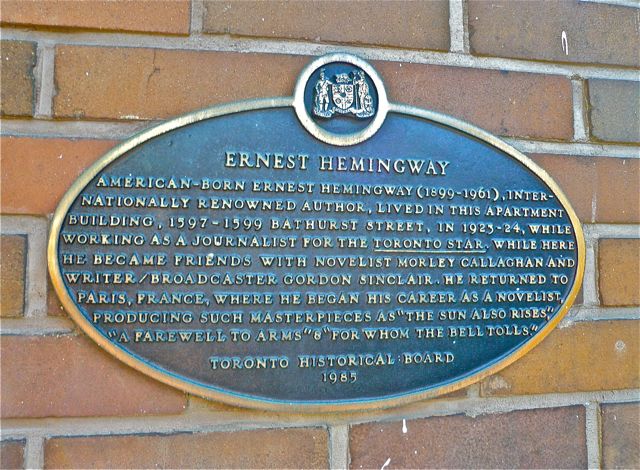
They lived on the fourth floor of an apartment on Bathurst Street. And since I’m in Toronto now as I write this review, I’m able to go over there and take these photos for my readers. Currently, the building at 1597-1599 Bathurst Street is a comfortable and elegant looking five-storey apartment aptly named The Hemingway.

A plaque is placed at the entrance to mark this historic site:

It reads:

Ernest Hemingway

American-born Ernest Hemingway (1899-1961), internationally renowned author, lived in this apartment building 1597-1599 Bathurst Street, in 1923-24, while working as a journalist for the Toronto Star, where he became friends with novelist Morley Callaghan and writer/broadcaster Gordon Sinclair. He returned to Paris, France, where he began his career as a novelist, producing such masterpiece as “The Sun Also Rises”, “A Farewell To Arms”, & “For Whom The Bell Tolls”

Toronto Historical Board
1985

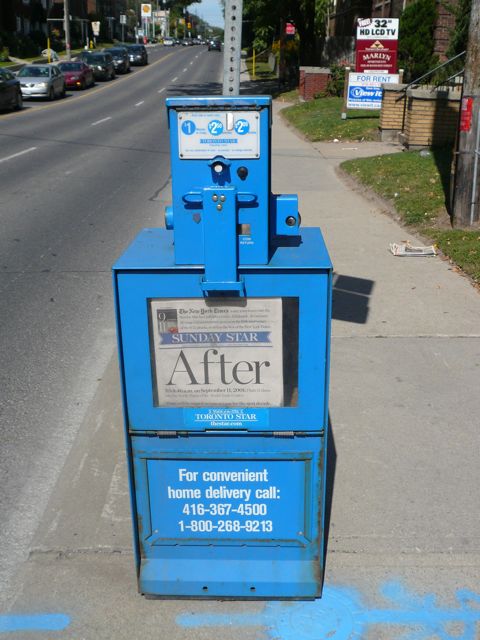
Ernest had worked for the Toronto Star before, and had developed an amicable working relationship with his boss John Bone. But this time he encountered tumultuous problems with his new boss, causing him to shorten his stay. This is what I found a block away from The Hemingway apartment:

Four months after their son Bumby was born, in January, 1924, the Hemingways sailed back to Paris. Upon seeing Gertrude, Ernest said:

I know we meant to be gone a year, but four months is a year in Canada.

I just can’t help but smile upon reading this. Interpret whatever way you will.

Once back in Paris, Ernest discarded his journalist hat and went all out to pursue his dream of a published writer, encouraged by his mentor Gertrude Stein. He began to be noticed and gain publishing success. And with success came fame, and fame, a different circle of friends, richer, more glamorous and drunk. Within their group of acquaintance, people were falling for each other’s spouses, messy and totally lost.

Hadley began to fall out of it all. One time at a tense exchange among the group, she was so fed up that she had to excuse herself and left early with Don Stewart, their writer friend. And here’s the sentence that leaves such an impression on me:

“Before we’d even gotten to the door, the gap had closed around the table and you couldn’t even tell I’d been there.”

The American journalist for Vogue magazine Pauline Pfeiffer soon became Ernest’s new preoccupation. She had not only won his heart, but Hadley’s trust and friendship. But the balance was bound to tip. Hadley’s innocence was soon shattered by betrayal from both her friend and her husband; her naivety ebbed away as she watched helplessly the painful disintegration of her marriage and small family.

I’d chosen my role as supporter for Ernest, but lately the world had tipped, and my choices had vanished. When Ernest looked around lately, he saw a different kind of life and liked what he saw. The rich had better days and freer nights. They brought the sun with them and made the tides move. Pauline was a new model of woman and why couldn’t he have her…

When I think back on Hemingway’s memoir of those Paris years, A Moveable Feast, in which he writes about his early love with Hadley, I can’t help but feel for both of them. How can we command our own feelings, passion, love? The bull fighting scenes in Pamplona which mesmerized Ernest so had become such an apt metaphor… the bulls charging madly through the narrow streets towards the ring, aroused by a mere spot of red, driven by brute instincts and raw impulses, yet all come to the same gory end in the ring.

In the book, McLain has their writer friend Don Stewart declared:

I can take the bulls and the blood. It’s this human business that turns my stomach.

You might ask: “But is this all true?” After all, this is only a novel. From his notes on A Moveable Feast, Hemingway stated that all was fiction. Conversely, in McLain’s The Paris Wife, she has this quote from Hemingway:

 There’s no one thing that’s true. It’s all true.

Looks like it’s for us readers to pick and choose.

***

~ ~ ~ 1/2 Ripples

The Paris Wife by Paula McLain, published by Bond Street Books, Random House, 2011, 314 pages.

You might like to read my review of:

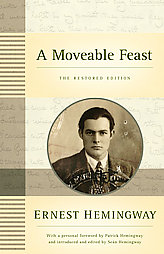
A Moveable Feast (Restored Edition) by Ernest Hemingway.

Midnight In Paris, a film by Woody Allen.

More Upcoming Books into Movies

Wondering what to read in the fall? Here are some books being adapted into movies at various stages of development. Some may come out later this year, most in 2012, and others may materialize even further. Your book group may be interested to look at the following titles. Some are bound to generate lively discussions. Consider this a sequel to my earlier list which you can find by clicking here.

***

Anna Karenina by Leo Tolstoy (Can’t resist mentioning this again. Joe Wright of ‘Atonement’ directing, Tom Stoppard screenplay, and an excellent British cast)

As I Lay Dying by William Faulkner (James Franco directing)

Austenland by Shannon Hale (Keri Russell)

The Book of Negroes by Lawrence Hill

Coriolanus by William Shakespeare (Ralph Fiennes directs and stars)

Crooked House by Agatha Christie (Gemma Arterton)

Gods Behaving Badly by Marie Phillips

Great Expectations by Charles Dickens (Helena Bonham Carter, Ralph Fiennes)

The Guernsey Literary and Potato Peel Pie Society by Mary Ann Shaffer and Annie Barrows (Kenneth Branagh directing)

The Humbling by Philip Roth

The Hypnotist by Lars Kepler

Italian Shoes by Henning Mankell (Kenneth Branagh directing Anthony Hopkins)

Ivan the Fool by Leo Tolstoy

King Lear by William Shakespeare (Al Pacino)

Let The Great World Spin by Colum McCann

The Lucky One by Nicholas Sparks

Major Pettigrew’s Last Stand by Helen Simonson

Midnight’s Children by Salman Rushdie

Mister Pip by Lloyd Jones (Hugh Laurie)

Paradise Lost by John Milton (Bradley Cooper as Lucifer)

Romeo and Juliet by WIlliam Shakespeare (Hailee Steinfeld)

What Maisie Knew by Henry James (Julianne Moore)

The Winter Queen by Boris Akunin

***

I know many book lovers are usually hesitant to see their beloved stories and fictional characters transposed on screen. But just imagine for a moment a best-case scenario, which book would you like to see adapted into a movie? And, who do you have in mind as the ideal cast?

***

CLICK HERE to read related posts:

“Can a Movie Adaptation Ever be as Good as the Book?”

“Upcoming Books Into Movies — List 3”

**

The Letters of Vincent van Gogh

While reading van Gogh’s letters is a fascinating journey into the mind of the artist, it is also poignantly heartbreaking. This is an abridged version of van Gogh’s letters, almost all written to his brother Theo from the various places he had stayed from 1872-1890, Holland, Belgium, England and France.

A few decades separate his life from Hemingway’s, but I think he too had his “moveable feast”.  To the painter, it’s not Paris, but the open country of southern France, in particular, Arles and St. Remy’s, Provence.

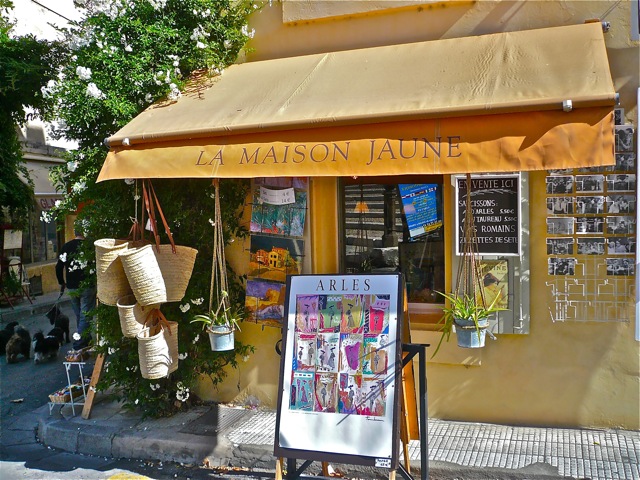
(A corner store in Arles, named after the famous ‘Yellow House’ Van Gogh once lived in)

Unlike Hemingway, van Gogh felt Paris only ‘distracts’. He wrote to his brother Theo after moving to Arles from Paris in February, 1888:

It seems to me almost impossible to be able to work in Paris, unless you have a refuge in which to recover and regain your peace of mind and self-composure. Without that, you’d be bound to get utterly numbed.

While Hemingway sought to “write one true sentence”, van Gogh yearned to reflect what was true through his paintings:

… giving a true impression of what I see. Not always literally exact, rather never exact, for one sees nature through one’s own temperament.

And colours were his tools. Van Gogh began to use a new palette that he did not see in his native Holland. Under the bright Provence sun, the artist excitedly indulged in a myriads of brilliant colours he had not experienced before…”There is that sulphur yellow everywhere the sun lights on.” He eagerly ushered in a new style.

Instead of trying to reproduce exactly what I have before my eyes, I use colour more arbitrarily so as to express myself forcibly… — To Theo from Arles, August 1888

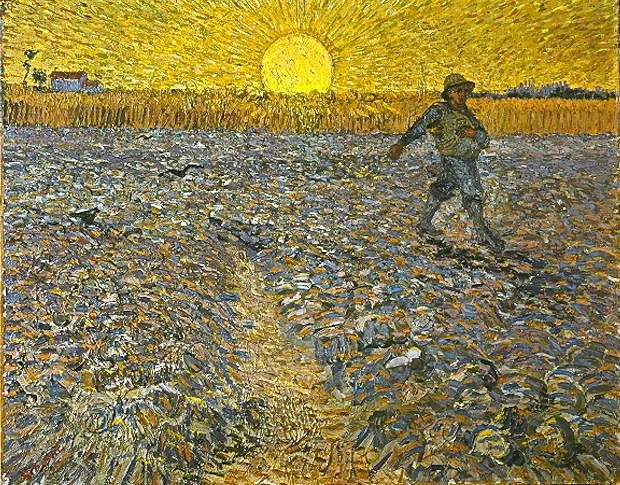
(The Sower)

I believe in the absolute necessity for a new art of colour, of design, and — of the artistic life.”

“But the painter of the future will be such a colourist as has never yet been [emphasis his].

Through the artist’s colourful lens, the view that van Gogh saw was one that I could never imagine. Here he described to his brother Theo a painting he’d finished, in a letter dated September, 1888:

 … the starry sky painted actually at night under a gas jet. The sky is greenish blue, the water royal blue, the ground mauve. The town is blue and violet, the gas is yellow and the reflections are russet gold down to greenish bronze. On the blue-green field of the sky the Great Bear sparkles green and rose, its discreet pallor contrasts with the brutal gold of the gas.

(Starry Night)

Many of the letters are descriptions like this to Theo in Paris. Reading them, I can sense the artist’s excitement and joy in capturing everything he saw in Arles:

At the moment I am working on some plum trees, yellowish white, with thousands of black branches. I am using a tremendous lot of colours and canvases…

… it will be to our advantage to make the most we can of the orchards in bloom. I am well started now, and I think I must have ten more, the same subject. You know, I am changeable in my work, and this craze for painting orchards will not last for ever. After this may be the arenas…

His letters alas are also pleas for funds, as he was “literally starving”. With the last fr.5 he had, he’d spend it on canvases. He lived in dire poverty most of his career, damaging his physical and mental health.

I can’t do without colours, and colours are expensive… I cannot get more on credit. And yet I love painting so…

Worse still, his letters are also accounts of anguish, depression, and “unbearable hallucinations.” He desperately sought cures, admitting himself into the asylum in St. Remy’s. Ironically, it was there that he experienced the most prolific period of his life.

                    (St. Paul’s Hospital at St. Remy’s)

Throughout van Gogh’s numerous letters, there are many beautiful lines, insight into love, art, books, and life. Here are a few:

  • “Since I really love there is more reality in my drawings.” — Autumn 1881
  • “I would not give a farthing for life, if there were not something infinite, something deep, something real.” — December 1881
  • “It is the painter’s duty to be entirely absorbed by nature and to use all his intelligence to express sentiment in his work so that it becomes intelligible to other people. To work for the market is in my opinion not exactly the right way…” — July 1882
  • “I assure you that some days at the hospital were very interesting, and perhaps it is from the sick that one learns how to live.”  — January 1889
  • “I took advantage of my outing to buy a  book… I have devoured two chapters of it… This is the first time for several months that I have had a book in my hand. That means a lot to me and does a good deal towards my cure.” — March 1889
  • “What I should very much like to have to read here now and then, would be a Shakespeare… What touches me, as in some novelists of our day, is that the voices of these people, which in Shakespeare’s case reach us from a distance of several centuries, do not seem unfamiliar to us. — From St. Remy’s Hospital, June 1889.

But tragically, van Gogh succumbed to his mental illness. In July, 1890 two months after moving back to Auvers, north of Paris, he went out to the open fields and shot himself. Two days later he died from his gunshot wound. He was 37.

The Letters of Vincent van Gogh to his Brother and Others. Introduction by his sister-in-law Johanna van Gogh-Bonger, abridged by Elfreda Powell, Published by Constable & Robinson Ltd., 2003, 324 pages.

***

The is my last post for the blogging event Paris in July hosted by Karen of BookBath, and Tamara of Thyme for Tea. My other post is “A Moveable Feast (Restored Edition) by Ernest Hemingway.”

To read my travel post from last August “Arles: In The Steps of Van Gogh” CLICK HERE.

Photos: Van Gogh’s paintings, from Wikimedia Commons, Public Domain. Arles and St. Remy’s by Arti of Ripple Effects, August, 2010.

To read all the 900 letters of van Gogh online, go to this excellent site of the Van Gogh Museum, Amsterdam.

A Moveable Feast (Restored Edition) by Ernest Hemingway

Reading A Moveable Feast is like walking along the sea shore. On the fine sandy beach you see many attractive shells, but you don’t have a bucket with you. You pick the finest ones and put them in your pockets, until they’re full. But every step you take further, you see more that you want to keep. This post is too limited for me to display all the shells I’ve collected, but allow me to just pour them out from my pockets, without sorting, sand and all.

I first read about the term “Moveable Feast” while sitting in an Anglican church in Vancouver, flipping through the The Book of Common Prayer. After some googling later, I got the idea. A feast in the liturgical calendar that you commemorate no matter which date it falls on year after year. In the Foreword of this restored edition, Hemingway’s son Patrick (with second wife Pauline Pfeiffer) writes:

The complexity of a moveable feast lies in the calculation of the calendar date for Easter in a given year, from which it is simple enough then to assign a calendar date to each and every moveable feast for a given year. Palm Sunday is seven days before Easter.

A memorable experience that will follow you all the years of your life. You’ll cherish it whenever and wherever you are. Hemingway’s friend A. E. Hotchner suggested this title. Author of the biography Papa Hemingway, Hotchner recalls Hemingway once said to him:

If you are lucky enough to have lived in Paris as a young man, then wherever you go for the rest of your life, it stays with you, for Paris is a moveable feast.

Like Rick says to Ilsa in “Casablanca”: “We’ll always have Paris.” Same sentiment.

A Moveable Feast is Hemingway’s memoir written from notes he had forgotten in two steamer trunks stored at the Ritz Hotel in Paris since 1928. In 1956 he repossessed the treasure trove, upon the urging of the hotel management. The book details his experience while living in Paris from 1921 to 1926, when the author was in his early 20’s. The memoir was first published posthumously in 1964. The Paris Years was a period when Hemingway, just married Hadley Richardson, young and care-free, decided to give up journalism to strive at being a novelist.

He would write in a rented room or in a café over café crème,
meet Gertrude Stein for critique of his writing, go back home for lunch with wife Hadley, or have oysters and wine in a restaurant, socialize with Fitzgerald, Ezra Pound, and other expats, borrow piles of books from Sylvia Beach’s library in her bookshop Shakespeare and Company, visit Luxembourg gardens and museum…

Two people, then, could live comfortably and well in Europe on five dollars a day and could travel.

No wonder Gil in “Midnight in Paris” dreams of such a life.

What strikes me initially is Hemingway’s frankness, sometimes blatant description of his opinion about the people he met. Like the first time he saw the artist Wyndham Lewis through Ezra Pound:

I watched Lewis carefully without seeming to look at him, as you do when you are boxing, and I do not think I had ever seen a nastier-looking man… I tried to break his face down and describe it but I could only get the eyes. Under the black hat, when I had first seen them, the eyes had been those of an unsuccessful rapist.

According to grandson Sean Hemingway who edited and wrote the introduction of this restored edition, Hemingway developed his sharp eye and ear during these Paris years. Here’s an account of Scott Fitzgerald when Hemingway first met him in the Dingo bar:

Scott was a man then who looked like a boy with a face between handsome and pretty. He had very fair wavy hair, a high forehead, excited eyes and a delicate long-lipped Irish mouth that, on a girl, would have been the mouth of a beauty. His chin was well built and he had good ears and a handsome, almost beautiful, unmarked nose.

This is only a little excerpt in a two page description of Scott’s appearance. It’s sentences like these that stand out for me. They all point to the writer at work: observing.

I kept on looking at him closely and noticed…”

“I kept on observing Scott.

And putting down in words later:

I wasn’t learning very much from looking at him now except that he had well shaped, capable-looking hands, not too small, and when he sat on one of the bar stools I saw that he had very short legs. With normal legs he would have been perhaps two inches taller.

But it was Scott’s talents despite his eccentricities and alcoholism that formed the building blocks of their friendship.

When I had finished the book [The Great Gatsby] I knew that no matter what Scott did, nor how preposterously he behaved, I must know it was like a sickness and be of any help I could to him and try to be a good friend. …   If he could write a book as fine as The Great Gatsby I was sure that he could write an even better one. I did not know Zelda yet, and so I did not know the terrible odds that were against him.

It is perhaps with such candour and devotion in writing that he constantly sought to “write one true sentence.” Woody Allen has grasped the essence in this juicy line from “Midnight in Paris”:

No subject is terrible if the story is true, if the prose is clean and honest, and if it affirms courage and grace under pressure.

The restored edition brings back sections missing in the earlier 1964 publication which was edited by fourth and last wife Mary. According to Sean Hemingway, this restored work represents the content that Hemingway himself had intended the book to have, with the chapter “Nada y Pues Nada” (Nothing And Then Nothing) written three months before his suicide.

The second last chapter “The Pilot Fish and the Rich” shows he was remorseful over the breakdown of his first marriage to Hadley towards the end of his Paris days. A mutual friend they both knew, journalist Pauline Pfeiffer, came in between them. “You love them both now… Everything is split inside of you and you love two people now instead of one.”

But A Moveable Feast belongs to Earnest and Hadley and their young son Bumby.  “… this is how Paris was in the early days when we were very poor and very happy.” As a reader, I feel a sense of loss as I come to the end, for Earnest and Hadley were so much in love the first few years in Paris:

She: ‘And we’ll never love anyone else but each other.’

He: ‘No. Never.’

Their 2-room rental walk-up with no electricity and no hot water had been a haven of warm meals and intimate talks. It was the time when he was “a young man supporting a wife and child … learning to write prose.” Their short marriage lasted only six years. In 1927 Hemingway married Pauline, four months after divorcing Hadley.

The last section at the end of the book is entitled “Fragments”. These are “false starts”, beginning paragraphs of an introduction Hemingway tried to write for this book. Interestingly, every one of these attempts starts with: “This book is fiction.” Many include this sentence: “I have left out much and changed and eliminated and I hope Hadley understands.” In another fragment he wrote: “No one can write true fact in reminiscences…”

I’m baffled. But maybe unnecessarily. From our very subjective mind, our often hazy view of what did happen and what we wish to have happened and what could have happened, we conjure up a fusion. Should there be a clear line separating them? It’s because the demarkation of fact and fantasy is fluid that we can appreciate the arts, such as the film “Midnight in Paris.” The events that happen to Gil after midnight would remain fondly with him as reality, so real that they change his decision regarding his future. Facts or fiction… or fusion?

~ ~ ~ 1/2 Ripples

***

A Moveable Feast: The Restored Edition by Ernest Hemingway, published by Scribner, NY, 2009, 240 pages. Foreword by Patrick Hemingway, introduced and edited by Sean Hemingway.

This post is to participate in the Paris In July blogging event hosted by Karen of BookBath and Tamara of Thyme for Tea. You can also find another review of A Moveable Feast here at Dolce Bellezza.

To read my review of “Midnight In Paris”, CLICK HERE.

Photos: Paris, Shakespeare and Company, Writers’ portraits and The Library in Shakespeare and Company taken by Arti of Ripple Effects, Aug. 2010. All Rights Reserved.

Click on the following links for some insightful interviews:

National Post Interview with Sean Hemingway on the restored edition

Interview with Woody Allen on making “Midnight In Paris”

True Grit: A Cool Summer Read and Movie

14 year-old Mattie Ross has just got herself a place on my short list of favorite fictional heroines, alongside Elizabeth Bennet. Come to think of it, if Jane Austen were to write a Western novel, I’m sure she’d have created a character like Mattie Ross, determined, principled, curious, fearlessly independent, her heart sincere and her morals strong.


Kudos must go to author Charles Portis, who has described with succinct and flowing prose the captivating adventure of Mattie Ross. It’s a hero’s journey, but Mattie is no reluctant heroine. No more than a child, she hires the meanest of them all, Marshal Rooster Cogburn in Fort Smith, Arkansas, and goes with him, against his strong objection, to hunt down Tom Chaney, the killer of her father.

Portis’s storytelling is alluring and comedic, capturing my attention from the opening lines. The vision of 14 year-old Mattie is clear and crisp. Reminiscing as an adult now, her voice is vivid and affective. I’m won over soon by her articulate dealing in the adult world, protecting her own interest and yet still pouring out the heart of a child. Portis’s description is lucid, at times eloquent, and at times, deadpan humorous. His characters come alive with their vernacular dialogues of the American South after the Civil War. Many of the pages are script-ready for their cinematic effects.

I admit this is my first Western novel if my memory serves me correctly. My other one in the Western genre is Elmore Leonard’s short story “3:10 to Yuma” which I read after watching the movie. Here the reason is similar. I waited in a long line of holds from the public library for this book because of the fine movie adaptation I’d seen. The Coen brothers’ soulful rendition of True Grit (2010) got me curious… I just wonder how much of the movie is their creation, and how much is the author’s own.

I’m totally surprised to learn from reading the novel that the remake of “True Grit” is mostly a faithful adaptation of Portis’s novel. Not that I’m concerned it needs be accurately transposed, for I don’t expect movies to go the fidelity route anymore. But that’s exactly my surprise, that the Coen brothers have stayed with the plot and character development, and derived their scene sequences almost to the dot, unlike the 1969 John Wayne flick, which has changed the ending totally.

Not only that, under Joel and Ethan Coen’s direction, the movie is imbued with soul and heart. The Biblical quotes and allusions in Portis’s novel are eloquently woven into the narration and music of the film, something that’s missing in the 1969 version. The leitmotif of “Leaning On the Everlasting Arm” is deadpan ironic in the ending, albeit instilling meaning throughout. Without their leaning on each other they would not have overpowered Tom Chaney (Josh Brolin) and the bandits with whom he takes cover, and definitely would not have survived at the end.

In True Grit, characters make the movie. The film is spot-on in depicting the dynamics of the man-hunt trio, Mattie Ross (Hailee Steinfeld), Federal Marshal Rooster Cogburn (Jeff Bridges), and Texas Ranger LaBoeuf (Matt Damon). Hailee Steinfeld is a natural, and owns the role of tough and precocious Mattie, deservedly receiving a Best Actress Oscar nom at this year’s Academy Awards. At 13, Steinfeld beat out 15,000 other girls in the audition to get the role.  Just one year later, she has landed at the Oscars.

Portis’s intricate portrayal of the threesome in the novel is sensitively transposed visually on screen. The common goal in capturing a killer supersedes any rivalry between the two men in front of a 14 year-old girl, who has got both of them “pretty well figured”. One day when he has a sober minute to look back to his drunken, drifting life, Rooster would likely credit this episode of his journey with Mattie to capture the coward Tom Chaney as the most rewarding. The girl has gotten and drawn out the best of him.

First published in 1968, the book has since become a modern American classic. Some have compared it with Huckleberry Finn. But it has been neglected in subsequent years until the 2010 Coen brothers’ adaptation came out. It has garnered 10 Oscar noms earlier this year, including Best Picture, Best Director and Best Adapted Screenplay. Now we see the fresh reprints by The Overlook Press, New York. Thanks to the movie, the once overlooked book is back in print and on the new and popular shelves in bookstores, even now months after the Oscars.

Ah yes… books and movies, still the best summer treats.

True Grit by Charles Portis, published by The Overlook Press, NY. 2010, with Afterword by Donna Tartt, 235 pages.

Book and Movie:

~ ~ ~ 1/2 Ripples

Book Sale 2011

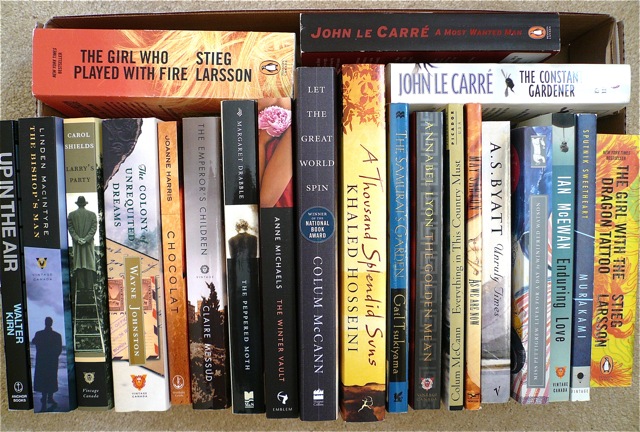
If you ask me, I really can’t tell the difference between my summer reading and that of the other seasons. But, in terms of timing, I’d say the annual Book Sale at the Crossroads Market marks the kickoff… and not the summer solstice. It’s a charity book sale in support of the Servants Anonymous Society. I’ve posted my boxes of loot in the past couple of years. Here’s Arti’s annual book haul, 2011.

Again, as a picky screener, I spent hours looking through tons of books under that giant tent and picked out only those that were in mint condition… some I suspect have not even been opened. They were all $1.50 each. That’s the price if you buy in multiples of 10. Short of 10, $2 each. Best of all, it’s for a good cause… great excuse for hoarding. Well, at least I wasn’t tugging a rolling tote or luggage like some did.

.
Here’s a list of my haul, in no particular order:

  1. Unruly Times: Wordsworth and Coleridge in Their Time by A. S. Byatt
  2. As We Are Now by May Sarton (love her Journal of a Solitude)
  3. Chocolat by Joanne Harris (film is interesting, curious about the book)
  4. Enduring Love by Ian McEwan (after Atonement, like to try more of McEwan’s works)
  5. Sputnik Sweetheart by Haruki Murakami (for JLC 5)
  6. The Samurai’s Garden by Gail Tsukiyama (another one for JLC 5)
  7. Everything Is Illuminated by Jonathan Safran Foer (great find, book is brand new)
  8. Miss Pettigrew Lives for a Day by Winifred Watson (the movie is delightful)
  9. The Winter Vault by Anne Michaels (13 years after her Fugitive Pieces, I’m curious)
  10. Up In The Air by Walter Kirn (always like to read the source material of a good movie)
  11. The Bishop’s Man by Linden MacIntyre (winner of 2009 Giller Prize)
  12. The Golden Mean by Annabel Lyon (finalist, 2009 Giller Prize)
  13. The Colony of Unrequited Dreams by Wayne Johnston (numerous Canadian literary prize winner, just can’t resist a title like that)
  14. The Emperor’s Children by Claire Messud (NYT Book Review Best Book of the Year 2006. I’ve wanted to read it since it first came out)
  15. Let The Great World Spin by Colum McCann (my own copy finally)
  16. Everything in This Country Must: A Novella and Two Stories by Colum McCann
  17. The Peppered Moth by Margaret Drabble
  18. Larry’s Party by Carol Shields
  19. A Thousand Splendid Suns by Khaled Hosseini (Following The Kite Runner, a movie version is coming out)
  20. Things Fall Apart by Chinua Achebe (still haven’t read this classic)
.
Went back another day and more multiples of 10:
  1. Heat And Dust by Ruth Prawer Jhabvala (1975 Booker Prize Winner, RPJ is the screenwriter of many Merchant Ivory productions, including “Heat And Dust” starring Julie Christie)
  2. Middlesex by Jeffrey Eugenides (Pulitzer Prize winner, 2003)
  3. The Handmaid’s Tale by Margaret Atwood (First the book, then the movie, and then the opera, yes, opera)
  4. The Hours by Michael Cunningham (Pulitzer Prize winner, 1999. After the film, I’ve wanted to read this for years. Glad I found a trade paperback edition without Streep/Moore/Kidman on the cover)
  5. The Brief Wondrous Life of Oscar Wao by Junot Diaz (Pulitzer Prize winner, 2008)
  6. Our Mutual Friend by Charles Dickens (I’m partial to The Modern Library Classics, so this is a good find)
  7. The City of Yes by Peter Oliva (Found out from the cover that the author is owner of one of the still surviving indie bookstore in our city… a novel on Japan… interesting connections!)
  8. The Pillars of the Earth by Ken Follett (Other shoppers at the Book Sale urged me to get it, or else I wouldn’t have picked it up… about 2 lbs and 973 pages. But for $1.50… alright.)
  9. The Illuminator by Brenda Rickman Vantrease
  10. The Sunday Philosophy Club by Alexander McCall Smith
  11. The Lost Art of Gratitude by Alexander McCall Smith
  12. Little Earthquakes by Jennifer Weiner (Author of In Her Shoes, looks like a breezy summer read)
  13. The Shack by Wm. Paul Young (Have been avoiding this, but my $1.50 curiosity took over)
  14. Limitations by Scott Turow (I used to be a fan of legal thrillers, so let me indulge again… it’s summer)
  15. The Girl With the Dragon Tattoo by Stieg Larsson (Finally, after the dust has settled. The Swedish movie is good, but not sure about the Hollywood version coming out)
  16. The Girl Who Played With Fire by Stieg Larsson (That’s all, couldn’t find the third one)
  17. False Impression by Jeffrey Archer (Have enjoyed some of his previous books)
  18. The Constant Gardener by John Le Carré
  19. A Most Wanted Man by John Le Carré
  20. Tinker Tailor Soldier Spy by John Le Carré (The film version is coming out this year with Colin Firth. But this little old paperback is the black sheep of the lot. I found the first 18 pages missing after I came home. But hey, I’m not complaining)

How do I alleviate the burden of so many books? Well, this is how I figure. I don’t see them as a TBR list, but new inventory of my personal library. They’re at a fraction of the cost if I were to buy them new.  Besides, how many people read all the books in a library?

***

What’s your summer reading plan?

***

(If you’re interested, here are my finds from the Book Sale of 2010 and 2009.

You may also like to explore the list of “Upcoming books into films”)

Midnight In Paris (2011)

.

.

A Woody Allen movie rated G? Yes, and maybe only in B.C. where I saw it in Vancouver yesterday. If you’re offering charming characters, lively performance from some talented actors, Woody Allen’s own clever screenplay inundated with witty dialogues, and have him direct in the backdrop of dreamlike Paris, the result is pure delight. You don’t need too much of anything extra, hence the MPAA PG-13 rating. And maybe because of that, clean and crisp, this is one of the Woody Allen movies I enjoy most for some years. And yes, this is the one with French first lady Carla Bruni in it, where Allen has to direct under the watchful eyes of the French President and his security personnel.

Gil (Owen Wilson) and Inez (Rachel McAdams) are engaged to be married. They take a trip to Paris with Inez’s parents John (Kurt Fuller) and Helen (Mimi Kennedy) for John’s business merger. While Gil and Inez first appear to be a romantic pair, we soon find them to be incompatible. Gil is an underachieved screenwriter from California, aiming to write his first novel. His dream of Paris is one of the golden age, nostalgically inhabited by the modernists, the artists and literati of the 1920’s.

However, his fiancé Inez fails to see his aspiration or potential, and the imagination that the cultural city can unleash in him. Rather, she falls for their American friend Paul (Michael Sheen), the intellectual snob whose self-importance drives him to snub Gil and even counter their museum guide (Carla Bruni) in the accuracy of her information. But Gil is more preoccupied with his midnight encounters, which ultimately transform him and change their individual paths. These experiences after midnight are just wonderful surprises for Gil, and me. Without giving too much of a spoiler, let’s just say it’s Woody Allen’s version of ‘Back to the Future’.

When I first saw the trailer, I had reservation about Owen Wilson being the leading man in a Woody Allen movie set in Paris. Would that be a miscast? Well, I’m proven wrong the moment he appears on screen. Wilson embodies the unassuming and delusional Gil, screenwriter from Pasadena, CA. He casts all of his previous film roles out of my mind and replaces with only this one of the moment, offering a performance that is impressively convincing. He leads a cast of wonderful actors, including the charming Marion Cotillard, veteran Kathy Bates, the versatile Michael Sheen, and a very dramatic Adrien Brody. And I won’t give away who is supposed to be who, I’ll leave that joy of discovery for you.

This is a movie for art and literature lovers, ideal for book bloggers and discussion groups. Allen has cleverly juxtaposed the modernists in the turn of the 20th century with their contemporary admirer Gil. We encounter all these iconic figures in the film: Ernest Hemingway, Scott and Zelda Fitzgerald, Gertrude Stein, Pablo Picasso, Cole Porter, Salvador Dali, T.S. Eliot and more… it’s so much fun to hear allusion to their works, and some of them utter lines that are their own but in the style and wit of Woody Allen’s.

What makes the movie gratifying of course is not just the visuals, people and places, but how the story leads. The twist towards the end is the pivotal revelation for Gil. While one can bask in nostalgia, one needs to embrace the present in order to fully live. As I watched the movie, I wanted to read the script and capture Allen’s ingenuity. As I left the theatre, I wanted to see it again.

~~~1/2 Ripples

To read my review of Hemingway’s A Moveable Feast CLICK HERE.

A Jane Austen Education by William Deresiewicz

I’ve been following William Deresiewicz’s articles in The American Scholar for a few years. His idea of solitude has inspired my posts “No Texting for Lent and the End of Solitude” and “Alone Again… Unnaturally.”

I’ve not seen any pictures of him, but know that he has taught English at Yale for ten years. So I’ve always thought him to be one calm, cool, and collected (older) academic. Well, I was totally surprised as I read his book A Jane Austen Education: How Six Novels Taught Me About Love, Friendship, and the Things That Really Matter. Expecting a book on literary criticism, and from the title, maybe a dash of personal anecdote, I found it to be much more than these.

It is all of the following: literary analysis, biography, memoir and even confessional. Introduced to Jane Austen by his professor in graduate school, Deresiewicz had encountered numerous ‘eureka moments’ of self-discovery from reading her six novels. He unabashedly discloses how his own life experiences, and often youthful foibles, parallel those of Austen’s characters from each book. For us who have savored Austen’s works, we already know how wise and perceptive she is. But Deresiewicz has gone much deeper by being so brave as to reveal his self-absorbed psyche of younger days, his romantic mishaps, true friends and those who appear to be, the painful conflicts between his parents, and his search for self apart from a domineering father, all in light of Austen’s colorful literary canvas.

So before the calm, cool and collected guy emerged, there was one rebel, alienated follower of the modernists. Seems like every guy who comes to Austen is being dragged along with much reluctance, “just thinking about her made me sleepy.” But his reading, studying and writing a dissertation chapter on Austen’s works totally reshaped his views, and life.

Here’s an outline of Deresiewicz’s journey of maturity, of finding true love, and most importantly, of becoming one who has the capacity to love, all due to Austen’s novels. Too good to be true, isn’t it? I admit at times I found there were too many coincidences and perfect parallels, a bit contrived. But as I read, I knew I must decide one way or the other. And I was persuaded to see it as audacious honesty. His self-deprecating and revealing account of his journey towards maturity and improvement is entertaining, bold even as he mentally draws the line between friends and ‘foes’, true and fake, albeit keeping them anonymous. I’m sure those he’d described would definitely recognize themselves in the book.

As with Austen’s opening lines in her novels, Deresiewicz’s opening line sets the stage of what’s to come:

I was twenty-six, and about as dumb, in all human things, as any twenty-six-year-old has a right to be, when I met the woman who would change my life.

That woman, of course, is Jane Austen. Here are some of the key lessons:

From Emma, he learns to put aside his academic snobbery, that there’s no one too lowly for him to know, nothing too trivial or common for him to pass by. For these are the very ingredients that make up life.

Not that I hadn’t always taken my plans and grand ambitions seriously–of course I had. What I hadn’t taken seriously were the little events, the little moments of feeling, that my life actually consisted of. I wasn’t Stephen Dedalus or Conrad’s Marlow, I was Emma. I was Jane Fairfax. I was Miss Bates. I wasn’t a rebel, I was a fool. I wasn’t floating in splendid isolation a million miles above the herd. I was part of the herd. I was a regular person, after all. Which means, I was a person.

From Pride and Prejudice, he learns to grow up.

For [Austen], growing up has nothing to do with knowledge or skills, because it has everything to do with character and conduct… Growing up means making mistakes… to learn to doubt ourselves…

By making mistakes, and recognizing her mistakes, and testing her impulses against the claims of logic, the heroine of Pride and Prejudice learned the most important lesson of all. She learned that she wasn’t the center of the universe.

From Northanger Abbey, he learns to learn, and by so doing, to teach.

The habit of learning: if Catherine could learn to love a hyacinth when she was seventeen… I could keep learning to love new things my whole life. Of course, it was my professor himself who had helped me learn to love Jane Austen in the first place, against expectations at least as stubborn as the ones that Catherine brought to Northanger Abbey. But I was starting to get it now: the wonderful thing about life, if you live it right, is that it keeps taking you by surprise.

From Mansfield Park, he learns to see it as a mirror of “the rich Manhattanites” circle he was trying to get in.

… the greed beneath the elegance, the cruelty behind the glow–and what I myself had been doing in it… If my friend was a social climber, then what the hell was I?… my attraction to that golden crowd, my ache to be accepted by them, what did it amount to if not the very same thing? Who was I becoming? Who had I already become?

… we also have an aristocracy in this country, and I was looking at it.

From Persuasion, and from his own experience, he learns to prove Nora Ephron wrong. Unlike her movie “When Harry Met Sally”, man and woman can be friends, without “the sex thing getting in the way.”

A man and a woman, even two young, available ones, could talk to each other, understand each other, sympathize with each other, be drawn to each other, even share their intimate thoughts and feelings with each other–as Anne and Benwick did–without having to be attracted to each other–as Anne and Benwick clearly weren’t. They could, in other words, be friends.

Anne and Harville shared a common footing in the conversation, debating each other with mutual respect and affection and esteem. Men and women can be equals, Austen was telling us, so men and women can be friends.

And finally, from Sense and Sensibility, he learns what it means to fall in love.

To Austen, love at first sight is a contradiction in terms… As dull as it sounded, I now saw, Elinor’s way of going about things is the right one: to see a great deal of a person, to study their sentiments, to hear their opinions. … And it is a person’s character, not their body, with which we fall in love.

Like all Austen’s novels, Deresiewicz’s book ends with a marriage, his own. But without first reading the six Austen novels, he would have been totally unprepared for such a relationship. “Love, for Austen, is not becoming forever young. It’s about becoming an adult.” The book is the best way to show his gratitude to the matchmaker.

~ ~ ~ Ripples

***

A Jane Austen Education: How Six Novels Taught Me About Love, Friendship, And The Things That Really Matter by William Deresiewicz, The Penguin Press, New York, 2011, 255 pages.

This article has been published in the Jane Austen Online Magazine. CLICK HERE to go there for more Regency and Austen reads.

CLICK HERE to William Deresiewicz’s website, and watch interviews of him with the editorial director of Penguin Classics, Elda Rotor.

Howards End by E. M. Forster

Howards End requires slow reading. That’s how I savor every page, dig out every gem and delve into every contentious issue it raises. It is a book exploring dichotomies: Rich and poor, male and female, town and country, art and business, life and death.  After reading several contemporary novels, where the everyday vernacular is part of the text, it is immensely gratifying to immerse in the literary and poetic narratives, deep and yet highly amusing story of E. M. Forster’s masterpiece.

Howards End is a cozy country home, pristine and idyllic. Its owner, Ruth Wilcox, like her property, is untainted and well set in traditions. Her husband Henry Wilcox is a stark contrast. He is the new rich, entrepreneurial, business-minded and successful in the London financial circuit. Shortly before her death, Ruth finds a new friend in Margaret Schlegel and is introduced to a different world when Ruth visits her in London. Margaret, her out-spoken sister Helen, and younger brother Tibby who is attending Oxford, represent the new wave of social progressives with a vision of an egalitarian society, and who find their fulfillment in the arts and intellectual pursuits.

Before her passing in a nursing home, Ruth wills that Howards End be left to Margaret Schlegel. This comes as a shock to the rest of the Wilcoxe family, who deliberately disregard the wish. By chance, the Schlegel sisters come across Leonard Bast, an impoverished man who due to some ill advice from Henry Wilcox, has lost his job and livelihood. Herein lies the thread that Forster so skillfully weaves through his characters and storyline, exposing conflicts of the classes, of conscience and ideals.

I’ve seen the Merchant Ivory film adaptation a few times over the years, but this is my first experience with the source material. While I read it with Emma Thompson (Margaret Schlegel), Helena Bonham Carter (Helen Schlegel), Anthony Hopkins (Henry Wilcox), Vanessa Redgrave (Ruth Wilcox), Samuel West (Leonard Bast)… constantly appearing on my mind, they are no hindrances to my enjoyment. Rather, I just have to marvel at how superb their performances had been in light of my reading Forster’s characterization.

.

.

The book transports me to a world different in time and space, but feels ever so close. One hundred years have passed since its publication in 1910, the issues are still relevant, and the characters authentic and real. Like just a few weeks ago, I was writing about the two different art forms of books and films, and how we should treat each one separately to appreciate them. Here’s Margaret addressing this very issue:

What is the good of the arts if they’re interchangeable? What is the good of the ear if it tells you the same as the eye? Helen’s one aim is to translate tunes into the language of painting, and pictures into the language of music…. Oh, it’s all rubbish, radically false. If Monet’s really Debussy, and Debussy’s really Monet, neither gentleman is worth his salt — that’s my opinion.

Thank you Margaret for your comment.

Listening to the sisters arguing about every single issue is most entertaining. Here’s Margaret again:

We have great arguments over it. She says I’m dense; I say she’s sloppy.” (makes me think of Elinor and Marianne Dashwood, Sense and Sensibility)

After all, it’s the reflexive self that’s valuable, and the perceptive Schlegel sisters are prone to analyze. Helen is quick to make Leonard Bast feel comfortable when he accepts the invitation to tea at the Schlegel’s:

Cake?” said Helen. “The big cake or the little deadlies: I’m afraid you thought my letter rather odd, but we’ll explain–we aren’t odd, really–nor affected, really. We’re over-expressive: that’s all.

Thank you Helen, for that last line.

For Leonard Bast, the impoverished clerk with richness of soul, the meeting of the sisters is just too much for him… another world that he yearns to belong but knows he will never enter. Forster’s lyrical description just might well expose his ambivalent psyche. Leaving the Schlegel home, Bast steps out onto the street:

London was beginning to illuminate herself against the night. Electric lights sizzled and jagged in the main thoroughfares, gas-lamps in the side streets glimmered a canary gold or green. The sky was a crimson battlefield of spring, but London was not afraid. Her smoke mitigated the splendour, and the clouds down Oxford Street were a delicately painted ceiling, which adorned while it did not distract. She has never known the clear-cut armies of the purer air. Leonard hurried through her tinted wonders, very much part of the picture. His was a grey life, and to brighten it he had ruled off a few corners for romance. The Miss Schlegels–or, to speak more accurately, his interview with them–were to fill such a corner…

And who would have thought the rich and callous but now widowed Henry Wilcox would ask for Margaret’s hand in marriage. Forster’s sensitive rendering again is marvellous as he describes Henry proposing to Margaret:

She had too much intuition to look at him as he struggled for possessions that money cannot buy. He desired comradeship and affection, but he feared them…

But what kind of a marriage will that be? The following conversation could well foreshadow their future together. This takes place when Margaret asks Henry about his initiated friendly talk with her brother Tibby:

What did you talk about? Me, presumably.”

“About Greece too.”

“Greece was a very good card, Henry… Well done.”

“I was telling him I have shares in a currant-farm near Calamata.”

“What a delightful thing to have shares in! Can’t we go there for our honeymoon?”

“What to do?”

“To eat the currants. And isn’t there marvellous scenery?”

“Moderately, but it’s not the kind of place one could possibly go to with a lady.”

“Why not?”

“No hotels.”

“Some ladies do without hotels. Are you aware that Helen and I have walked alone over the Apennines, with our luggage on our backs?”

“I wasn’t aware, and, if I can manage it, you will never do such a thing again.

The undercurrent of power and conflicts… intriguing storytelling.

And finally, I must stop. But not until I’ve quoted this conversation between Helen and Leonard Bast. The finality of life renders all material goods meaningless. Is this cold comfort though for the poor? Even with such a good line as this one uttered by Helen: “Death destroys a man: the idea of Death saves him.”, Forster may just well be toying with us again. Here’s Helen with her exposition on the existential and Bast’s response:

I love Death–not morbidly, but because He explains. He shows me the emptiness of Money. Death and Money are the eternal foes… Men like the Wilcoxes… building up empires… But mention Death to them and they’re offended, because Death’s really Imperial, and He cries out against them for ever.” …

Leonard looked at her wondering… Death, Life, and Materialism were fine words, but would Mr. Wilcox take him on as a clerk?

Oh, the subtle humour…

And the ultimate ironic ending makes this already enjoyable read ever more intriguing… Forster’s version of the meek inheriting the earth?

~ ~ ~ ~ Ripples


***