Diary of a Country Priest: An Easter Meditation

Last year around this time, I wrote about the book The Diary of A Country Priest by French author Georges Bernanos, (Journal d’un curé de campagne, 1936). I’d like to repost my review this week, for every time I read it, I find the essence of Easter.

***

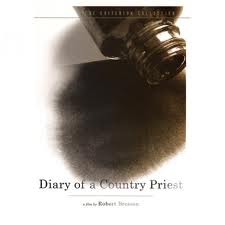
The Diary of a Country Priest Book Cover

A young priest comes to his first parish, the rural town of Ambricourt, filled with humble hopes. All he wants is to serve the people, to give of himself, to bring God’s love. But as soon as he sets foot in the village, he is engulfed by hatred and rejection. There are dark secrets too sinister to be exposed. The young priest is an unwelcome alien. In a town afflicted by hypocrisy, pride, anger and bitterness, he is despised, taunted and ridiculed. His own innocence is no match even for the children in his catechism class, especially the precocious Seraphitas, a girl ‘with a hardness far beyond her years.’

Ambricourt is a world afflicted by the ‘leprosy of boredom’, a microcosm of the human condition. Bernanos uses diseases to illustrate his point well. The young priest himself is being slowly consumed by terminal illness. The pain in his stomach ultimately defeats his body, cancer. His diet consists mainly of bread dipped in wine which he makes for himself, and some potato soup. Poverty of means, but also frailty of body to take in solid food. Many a times we see him in the Garden of Gethsemane, pleading for strength in anguish. But he faithfully presses on, using his diary to confide his deepest thoughts, a means to commune with his God.

On the outskirt of Ambricourt is the Château of the powerful M. le Comte. The Count needs no priest to know about his adulterous affairs, this time, with the governess Mlle Louise. His wife Mme la Comtesse is totally absorbed by her long-held bitterness and grief from the loss of her young son. And his daughter Mlle Chantal is a deeply disturbed girl eaten up by anger and jealousy. Soon, she will be sent away to England, a most convenient plan devised by her father.

It is with this deep mess of a family that the young priest finds himself entangled. The most intense scene of the whole book, the climatic moment, comes when the priest goes to the Château to meet with Mme la Comtesse. She lost her beloved son when he was only eighteen months old, a child hated by his jealous older sister Chantal.

On his last day they went out for a walk together. When they came back my boy was dead.

Mme la Comtesse is fully engulfed by hatred for her daughter, grief for her lost son, and bitterness towards God.

Hearing her speak, a tear flows down the face of the young priest. “Hell is not to love any more, madame.” The young priest responds. And with miraculous strength, he delivers the following words.

… But you know that our God came to be among us. Shake your fist at Him, spit in His face, scourge Him, and finally crucify Him: what does it matter? It’s already been done to Him.

Towards the end of some soul piercing exchanges, Mme la Comtesse kneels down, releases her pain, and receives blessings from the young priest. Afterwards, she writes to him in a letter:

… I have lived in the most horrible solitude, alone with the desperate memory of a child. And it seems to me that another child has brought me to life again…

And this young child, a priest, consumed by illness, wreaked by frailty of spirit, can only marvel at the power through weakness:

Oh miracle — thus to be able to give what we ourselves do not possess, sweet miracle of our empty hands!

Not long after this, he succumbs to his illness. A life too short, a mission seems unaccomplished. But his last words faintly uttered on his deathbed are as powerful as the God who sends him:

Does it matter? Grace is everywhere…

And in the film, these three words leave me with one of the most impressive endings of all the films that I’ve seen:

“All is grace.”

 ***

~ ~ ~ ~ Ripples

CLICK HERE to read my film review of The Diary of a Country Priest.

The Diary of a Country Priest by Georges Bernanos, translated by Pamela Morris, Perseus Books Group, Philadelphia, PA, 1965, 298 pages.

Journal d’un curé de campagne, 1936, was winner of the Grand prix du roman de l’Académie française.

Bonhoeffer Read-Along Part 2: Ch. 19 – 31

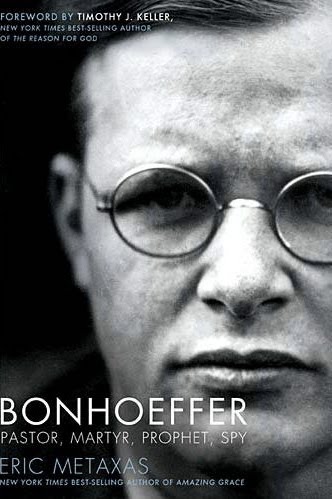
I’ve read some of Dietrich Bonhoeffer’s writing years ago, but knew close to nothing about the life of this highly admired Christian theologian, pastor and anti-Nazi martyr. Eric Metaxas’s 2010 biography of Bonhoeffer is an informative first step for me to delve into a selfless and heroic life. Within the close to 600 pages are highly readable narratives, at times humorous and even entertaining, albeit juxtaposed with pathos and sombre accounts.

Book Cover

What I’ve appreciated most is Metaxas’s inclusion of Bonhoeffer’s own voice, excerpts from his writing, letters, sermons, and words spoken as reported by witnesses. One of the most important sources is from his theology student and confidant Eberhard Bethge who had written what generally considered the definitive biography on Bonhoeffer. That’s over a thousand pages. I’m in no position to offer any critique on the accuracies of Metexas’s book, for I have not read both or any other historical documents to compare notes. Here I’m just sharing my thoughts as a reader, casting my two pebbles into the pond of resonance.

In this second part, Chapters 19 to the end, the mood changes as we see Hitler tightening the noose on his opponents, especially the Jews and their sympathizers. Bonhoeffer had to help his twin sister Sabine’s family flee the country before it was too late, as her husband Gerhard Leibholz was Jewish.

Dietrich’s own Confessing Church which had boldly stood against Hitler’s anti-semitic laws was now facing Gestapo arrests, its seminary Finkenwalde shut down, and its pastors slapped with the ordinance to swear an oath to Hitler. For his own safety, he had made arrangement to leave Germany for America. The Union Seminary in NYC had offered him a teaching post, welcoming the return of this brilliant theologian from Germany.

Bonhoeffer sailed to NYC on June 12, 1939, finding a safe haven in America, but not peace of mind. His inner turmoils were so overwhelming that he stayed there for just twenty-six days. His pastor’s heart prodded him to rush back to Germany to be with those who were suffering. My admiration for the man grew even more as I came to this part.

Mere waiting and looking on is not Christian behavior. The Christian is called to sympathy and action, not in the first place by his own sufferings, but by the sufferings of his brethren, for whose sake Christ suffered.

It was a much deteriorated country to which he returned under the grip of a mad Führer. War broke out. His brother Karl and brother-in-law Dohnanyi were in the Resistance against Hitler’s regime. Soon, Dietrich was involved too, at first offering encouragement and emotional support, but later worked for the Abwehr, the German spy agency, as a pastor, which he was, but unbeknownst to the Abwehr, as an undercover for the Resistance. What a dangerous job to take on!

In Operation 7, Bonhoeffer successfully helped seven Jews escape to Switzerland from certain death. A larger amount of foreign currency had to be transferred out of the country to suport their livelihood. Thus a track was left for his later Gestapo arrest. It’s interesting to note one of the two relatively minor reasons for his arrest is money laundering, for it’s much easier for the Gestapo to believe that than for them to think any German of sound mind would want to help Jews escape.

I can see a courageous man with integrity. Bonhoeffer could not stand aside to see the murders of innocents and the spread of evil. Yet, it’s disturbing to see his stance belonged only to a dearth of people at that time. Hitler’s murderous rampage and the Gestapo’s torturous tactics seized the country with a ferocious grip. Soon, those few dissident voices had to go underground, for their own lives were at stake. I kept asking myself what would I have done… a question I’m afraid to answer.

It was also then that Dietrich was swept by love with Maria von Wedemeyer. Their love was like silver linings behind dark, ominous clouds. Most of their time was spent apart, for Dietrich was held in prison by then, a most precarious relationship indeed. Yet from their letters, I could see love bring them hope, and hope in turn enriches their bond. It was heartbreaking to read their letters to each other, foreseeing wedding and marriage. From the dreadful Gestapo prison, Dietrich wrote Maria:

You mustn’t think I’m unhappy. Anyway, what do happiness and unhappiness mean? They depend so little on circumstances and so much more on what goes on inside us. I’m thankful every day to have you – you and all of you – and that makes me happy and cheerful.

Maybe the title of this book should add in one more description: Lover.

Bonhoeffer and Bethge
Photo taken from the book.

Dietrich had earlier written a Wedding Sermon from the Tegel military prison in Berlin for the wedding of his best friend Eberhard and his niece Renate. In there is a most inspiring thought:

It is not your love that sustains your marriage, but from now on, the marriage that sustains your love.

Later, he was transferred to the Buchenwald death camp outside Berlin, and ultimately, to Flossenbürg for his execution. It’s heart-wrenching to read about Bonhoeffer’s last days, still keeping a calm and peaceful composure, touching other prisoners and even the doctor overseeing his execution. What is death? In his own words:

… life only really beigns when it ends here on earth, that all that is here is only the prologue before the curtain goes up….  if only we can be still and hold fast to God’s Word… Death beckons to us with heavenly power, if only we realize that it is the gateway to our homeland, the tabernacle of joy, the everlasting kingdom of peace.

I had expected Metexas’s book to be informative, but I had not thought it would read like a page-turner. The last chapters are so intense and engrossing that it felt like I was reading the script to the film Valkyrie, about the foiled plan to assassinate Hitler by Colonel Stuaffenberg and a subsequent coup. Bonhoeffer was not personally involved in the operation. But it was due to the failure of the Valkyrie plan that Bonhoeffer’s hidden identity with the Resistance was later discovered. Nine months after Stuaffenberg’s execution, Bonhoeffer was hanged at the Flossenbürg prison on April 9, 1945, just two weeks before the Allies marched in, and three weeks before Hitler took his own life.

Maria and Dietrich’s parents did not know of his demise until much later. Upon hearing the memorial service on BBC radio broadcast on July 27, 1945, Dietrich’s parents were confirmed of the saddest news a parent could ever hear. I was deeply moved to read the Sermon on the Mount excerpt from Matthew 10:17-42. What jumped out from the passage were these most apt and powerful verses:

And fear not them which kill the body, but are not able to kill the soul…

Whoever therefore shall confess me before men, him will I confess also before my Father which is in heaven. But whosoever shall deny me before men, him will I also deny before my Father which is in heaven.

And with the script of Bishop Bell’s poignant sermon at the Memorial Service, Metaxas ends his biography of Bonhoeffer: Pastor, Martyr, Prophet, Spy.

I thank all those who have read along with me, some with their thoughts posted on their blogs, some silently participating. If you’ve written a post, do let me know in a comment. I’ll be sure to link it here.

Alison of Chino House: 3 Encouragements from reading Bonhoeffer

***

CLICK HERE to read my post on Part 1: Chapters 1 – 18

***

Next Read-Along: Marcel Proust’s In Search of Lost Time Vol. 1: Swann’s Way

Bonhoeffer Read-Along Part 1: Chapters 1-18

February 4 has come and gone without fanfare, without even being noticed by me, the one hosting a read-along of a bio on Bonhoeffer. That day two weeks ago would have been Dietrich Bonhoeffer’s 107th birthday (1906-1945). I’m feeling a sense of loss for missing it.bonhoefer book cover

A sense of sadness too which comes from knowing a young and brilliant life so purposeful even from the start was cut short violently. It also comes from empathy with the parents Karl and Paula, who had to experience the death of three of their four sons and two sons-in-law during war time. Back in 1918, their second son Walter died in action in WWI. And during WWII, their third son Klaus, youngest Dietrich, and two sons-in-law were executed by the Nazis for their role in the German resistance against Hitler. Sad especially that they only learned of Dietrich’s death through a radio broadcast of his memorial service from England. He was only 39.

My impression from the outset is, Dietrich Bonhoeffer’s was a life of purpose, even from an early age. It was made possible largely by a nurturing and vibrant family, and a lively brood of four boys and four girls. Father Karl Bonhoeffer, a prominent psychiatrist and university professor, instilled intellectual rigor; mother Paula imparted faith and fervor. The young lives benefitted from the cultural and musical home environs, but more importantly, the indomitable sense of social justice.

The Bonhoeffer children
The eight Bonhoeffer children with their governess at a holiday home (ca. 1910). Karl and Paula Bonhoeffer in the background. Dietrich to the right of the governess.

Dietrich knew he wanted to study theology when he was only thirteen. He graduated summa cum laude from the University of Berlin, obtaining his doctorate when he was only twenty-one. What brilliant mind and potential! And with that mind he saw through the trickery and schemes of an emerging demigod in Hitler. This is probably my favorite quotes from him. You can see his driven sense of direction:

If you board the wrong train it is no use running along the corridor in the opposite direction.

This has been my query all the time, and Eric Metaxas’s accounts have partially answered it. How could Hitler have gained such power without being challenged? It can’t be all due to fear, that came later. Hitler was democratically elected by the people as chancellor in 1933. The Führer Principle was readily embraced by most. So nationalism played a large part. Then came racism, with the establishment of new laws barring Jews, many of them in prominent positions too from the legal, academic, and medical fields, and then the engulfment of the German Church by the Third Reich. It’s utterly mind boggling. Why was it that the Bonheoffer family was only one of a dearth of lucid observers during this dark chapter in German history?

Nothing is beyond the Nazis reach. The ‘purging’ of the literary and scientific realms resulted in the casting out of thoughts and works by anyone not of the Aryan race, including Helen Keller, Jack London, H.G. Wells, Albert Einstein, Thomas Mann, and the poet Heinrich Heine, who wrote these prophetic words in 1821 in his play Almansor:

Where books are burned, they will, in the end, burn people too.

Metaxas’s book is informative and detailed, especially on Bonhoeffer’s effort to take back the German Church from the Nazis by establishing The Confessing Church with Karl Barth. Metaxas has also painted a very human portrait, a purposeful young man, bold, principled, passionate, and full of life. I move along eagerly, albeit sometimes confused by the numerous names and historical accounts. I want to find out what actually happened in the end, although not so sure how I can bear to read about Dietrich’s ultimate demise.

What are your thoughts so far? Throw your two pebbles into the pond. I’ll be glad to link your post here. Do go and visit:

Alison of Chino House

Ellen The Happy Wonderer

***

To read my wrap-up post on Chapters 19 – 31, CLICK HERE.

***

2013 Read-Along Begins: Bonhoeffer

Here we are already the third day into the new year. How fast time flies! To kick things off, here’s the first Read-Along. Allow me to just reiterate from my open invite on Dec. 12, 2012:

Bonhoeffer: Pastor, Martyr, Prophet, Spy by Eric Metaxas 

bonhoefer book cover

In the top ten of Barnes and Noble’s Best non-fiction books of 2010, and on New York Times Best-Seller list, this Dietrich Bonhoeffer biography intrigues me greatly. Author Metaxas’s title makes me want to know more about this legendary figure whose books I had read in my youth, but now think I don’t know him enough to fully appreciate his daring life, a man of faith and anti-Nazi in wartime Germany.

This slow reading plan gives you plenty of time so you can still pursue other books on your plate. I’ve roughly divided the biography in two parts, posting twice:

Chapters 1 – 18 (277 pages): to post on February 15

Chapters 19 – 31 (264 pages): to post on March 15

 **

With Arti, it’s always a slow read. You still have time now to order your book if you haven’t got it. And for others, dust it off the shelf. We’re reading the first part, Chapters 1 – 18 in Jan/Feb and posting our thoughts on these chapters on Feb. 15

Some of you may not be bloggers, you’re most welcome to join in the reading. Come to any of our posts on Feb. 15 and share your thoughts with us in the comment section. As I always say, the pond is open for all to throw in a pebble or two, make some ripples.

**

As of today, those who are joining in this read-along are:

Shoreacres of The Task At Hand (and cousin 🙂 )

Shari Green

Alison of Chino House

And those who have shown interest and still deciding, hope they will hop on soon:

nikkipolani

Jeanie of The Marmelade Gypsy

Hedda of Hedda’s Place

Ellen of The Happy Wonderer (reading already, hope she’ll join in the discussion)

If you’d like to read along with us, or join in any time later, just let me know in a comment and leave a link so I can add you on the list.

**

Before Feb. 15, you can always tweet me @Arti_Ripples or anyone of us who speaks in 140 characters.

Happy Reading!

***

COMING UP in March to May: Proust Read-Along

Reading the Season: Surprised by Joy

If Shakespeare and Hamlet could ever meet, it must be Shakespeare’s doing. Shakespeare could, in principle, make himself appear as Author within the play, and write a dialogue between Hamlet and himself. The ‘Shakespeare’ within the play would of course be at once Shakespeare and one of Shakespeare’s creatures. It would bear some analogy to Incarnation. — C. S. Lewis, Surprised by Joy (p. 227)

What an apt analogy for Christmas. surprised_by_joy_the_shape_of_my_early_life_frontcover_large_1thqlUR3XQVIcV2 Chronicle of Joy Surprised by Joy is C. S. Lewis’s (1898-1963) autobiographical account of his experience with Joy in his younger days, that elusive something of which he had a hard time grasping. Subtitled The Shape of my Early Life, it is an honest chronicle of an intellectual journey. As a young teenager going to the junior school of Wyvern, Lewis had shed the veneer of Christianity from home and declared himself an atheist. But his quest for Joy remained. It was to him an ‘inconsolable longing’ for ‘the real Desirable’. As a child, a form of Joy came to him through solitary reading, writing and drawing. In his youth, Joy channelled through Wagner’s Ring Cycle and Norse mythology, or Northernness. As he grew, he began to realize that pleasure did not equate with Joy, neither physical nor aesthetic, neither Nature nor Wagnerian music, neither books nor poetry, nor the intellectual gratification from reading, nor the excitement of Northernness.

You might as well offer a mutton chop to a man who is dying of thirst as offer sexual pleasure to the desire I am speaking of. .. Joy is not a substitue for sex; sex is very often a substitute for Joy. I sometimes wonder whether all pleasures are not substitutes for Joy. (p. 170)

Reading and Studying Surprised by Joy is Lewis’s chronicle of his encounters with books and countless authors. As a young boy he was first taught Latin by his mother, who sadly died of illness when he was only nine years old. He went through all forms of education, home, public, boarding school, and the most gratifying to him was after his father pulled him out of Wyvern and directed him to a private teacher in preparation for Oxford. While his father was uncertain about the move, Lewis secretly relished the idea and thrived in the experience. His teacher was Mr. Kirkpatrick, or ‘Bookman’. He was an atheist, a rationalist, a logician. He had acutely sharpened Lewis’s critical thinking with logic and Dialectics, and well prepared him to enter Oxford. He assigned to Lewis readings from classical literature: Homer, Demosthenes, Cicero, Lucretius, Catullus, Tacitus, Herodotus, Virgil, Euripides, Sophocles, and Aeschylus. On his own, Lewis immersed in Norse myths and the Wagner’s Ring Cycle. His reading expanded to Goethe and Voltaire. It was only later upon a friend Arthur’s influence that he began to devour literature in the English language. “I read … all the best Waverleys, all the Brontes, and all the Jane Austens.” There were of course others, Donne, Milton, Spenser, Malory, Thomas Browne, George Herbert, the Romantics, Yeats, William Morris, G. K. Chesterton, and George MacDonald.

I was by now a sufficiently experienced reader to distinguish liking from agreement. I did not need to accept what Chesterton said in order to enjoy it. (P. 190)

Yet he could not help but began to revise some of his world views. Yeats, Maeterlinck, and ultimately, George MacDonald informed him of alternative glimpses other than the material world. Unde hoc mihi I admit I had to look this Latin phrase up. And this I found: Unde hoc mihi … translated as “And whence is this to me” (KJV), or “And why is this granted to me” (ESV) A phrase that moved me so. As I was reading, two-third into his autobiography these words leapt out:

Unde hoc mihi? In the depth of my disgraces, in the then invincible ignorance of my intellect, all this was given me without asking, even without consent. (p. 181)

Lewis describes the epiphany, utterly inexplicable, the moment which came to him when all things seemed so clear, and the presence of something not mythical or magical which he had craved in his mind, but ‘Holiness’. It was then that his Atheism was transformed into Theism (In a moment of divine enlightenment not unlike Levin’s conversion at the end of Anna Karenina.) This humble exclamation unde hoc mihi is used by Lewis as he alludes to Luke 1:43 when Mary, pregnant with the Christ Child, went to see her cousin Elizabeth, who also by miraculous means in her barren state, pregnant with John, the forerunner before Christ. Upon hearing Mary’s salutation to her, Elizabeth felt the babe leap in her womb, and she exclaimed: “And why is this granted to me that the mother of my Lord should come to me?” Why, a learned scholar, specialist of the Classics, logical thinker skilled in Dialectics, claimed no credits of his own in this enlightenment. But it is only the beginning, he had not met the Person yet. Further, he realized that whatever that had given him Joy before, like Nature,

that those mountains and gardens had never been what I wanted but only symbols which professed themselves to be no more, and that every effort to treat them as the real Desirable soon honestly proved itself to be a failure. (p. 204)

As he began to teach at Oxford, Lewis was surprised to find two fellow professors he respected were, alas, Christians. One of them was J. R. R. Tolkien. But Lewis was an unlikely candidate for Christianity, with his ‘deep-seated hatred of authority, monstrous individualism, lawlessness’ and his abhorrence of a ‘transcendental Interferer’ (p. 172). Yet that unquenchable longing for Joy was ever present. Friendship with Tolkien began to break down some long held biases. He admitted that “I was by now too experienced in literary criticism to regard the Gospels as myths… To accept the Incarnation was a further step… It brings God nearer, or near in a new way.” It was another year before Lewis finally “gave in and admitted that God was God… Perhaps the most reluctant convert in all England.” Ironically, as he humbly exclaimed unde hoc mihi, ‘why is this granted to me’, he was submitting to ‘Divine humility’, the Incarnation. Hamlet finally met his Author. And what of Joy? I can’t give out too many spoilers, can I?

**

I read Surprised By Joy along with Bellezza. Do click here to read her thoughts on the book.

Surprised by Joy: The Shape of my Early Life by C. S. Lewis, Harcourt Publishing, Orlando, Florida, 1955, 238 pages. This is the edition I read with the image posted.

**

Reading the Season Posts in Previous Years:

2020: Jack by Marilynne Robinson

2019: ‘A Hidden Life’ by Terrence Malick: a film for the Season

2018: Madeleine L’Engle’s Poem The Irrational Season

2017: A Wrinkle In Time by Madeleine L’Engle

2016:  Silence by Shusaku Endo

2015: The Book of Ruth

2014: Lila by Marilynne Robinson

2013: Poetry by Madeleine L’Engle

2012: Surprised by Joy by C. S. Lewis

2011: Walking on Water by Madeleine L’Engle

2010: A Widening Light, Luci Shaw

2009: The Irrational Season by Madeleine L’Engle 

2008: The Bible and the New York Times by Fleming Rutledge

2008: A Grief Observed by C. S. Lewis

***

Diary of a Country Priest: Film Adaptation (1951)

For me, the cinema is an exploration within. — Robert Bresson (1903-1999)

Robert Bresson is one of the most influential figures in French cinema. The acclaimed New Wave director Jean-Luc Godard once noted: “Robert Bresson is French cinema, as Dostoevsky is the Russian novel and Mozart is German music.”

I know, Austrians would say Mozart was Austrian. But this just shows his influence can cross borders. Same with Bresson, who is acclaimed as one of the forefathers of the French New Wave, even though his style is not experimental. The iconic Swedish director Ingmar Bergman had specifically cited Diary of a Country Priest as influence for his Winter Light.

Before Bresson adapted Diary of a Country Priest, two previous screenplays were attempted by others but turned down by the author Georges Bernanos himself. Bresson’s film was made after Bernanos died. Bernanos had nothing to worry about with Bresson’s interpretation, for the film is an almost literal and a worthy cinematic translation. It won the Prix Louis Delluc in France (best film of the year) and several international film awards. Bresson was given the Career Golden Lion at the 1989 Venice Film Festival.

That Bresson, a professed agnostic, would choose to adapt a work by the Catholic writer Bernanos shows the moving power and the universal appeal of the book. The parish of Ambricourt is a microcosm of the human world. The seemingly placid village hides a spiritually barren landscape and a cocoon of depravity. The young priest, an unwelcome alien, is captured cinematically as small and vulnerable, an apt depiction of how he feels within:

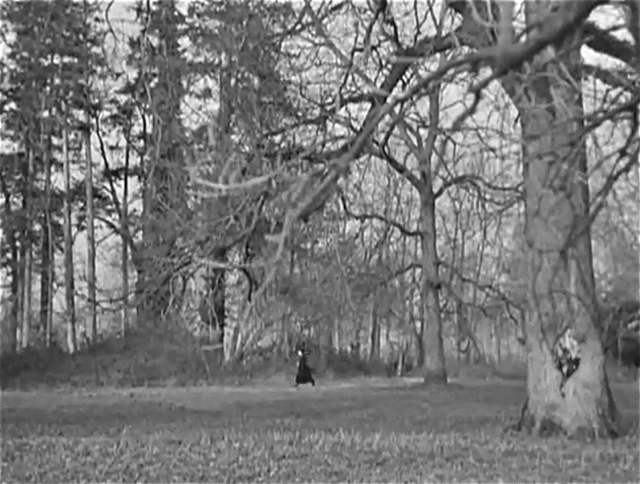
An outsider barred from a gated mansion of dark secrets, like here at the front gate of the Château.

The light comes into the world, but the darkness refuses it. On screen, we see the young priest often shut out of gates and windows. The glass pane allows him to be observed from the inside, yet he is very much on the outside isolated, the weight of the world heavy on his face.

Bresson’s style is minimal, you may find this film somewhat austere. But I’m gratified by such style, devoid of color and whatever additives we find in movies today. Instead, every frame conveys an aesthetic simplicity and thematic purpose.

To explore the drama within, Bresson chose ‘non-actors’. “As far as I can, I eliminate anything which may distract from interior drama,” Bresson was quoted saying, and distractions included ‘acting’. He selected his ‘models’ (as he called them, not ‘actors’) first for their voice. He particularly looked for inexperience. The young Curé of Ambricourt was Claude Laydu’s first film role. Others that Bresson used were often one-time actors just for the film he was making.

The Criterion Collection DVD has a most helpful commentary by film historian Peter Cowie. His insight is invaluable to the appreciation of Bresson’s adaptation. One of his remarks is the off-screen sounds we often hear in a scene. The most intense one would have to be the climatic spiritual battle between Mme la Comtesse and the young priest. Totally engulfed by grief, hatred and bitterness, and living in isolated misery all the years since her young son died, Mme la Comtesse finally releases her pain and receives blessings from the priest. And what sound do we hear off-screen the whole time they are engaged in this soul-piercing scene in the drawing room: the gardener’s raking of dead leaves.

Another source I’ve often sought out is the book written by Paul Schrader: Transcendental Style in Film: Ozu, Bresson, Dreyer. Yes, if I must choose a word to describe Bresson’s style, I would use Schrader’s term: transcendental. His minimal, aesthetically simple, ‘non-acting’ style raises the viewer to a meditative plane which is beyond the material, beyond all distractions. That’s the essence of cinema that I find so meaningful and gratifying.

And finally, despite succumbing to his illness, the young priest leaves a legacy that his superiors, the senior vicars, could not have: an embodiment of the suffering Christ and the redemptive power of grace. Despite his own frailty and ultimate death, the young country priest  triumphs through his faith, however feeble it may have seemed in his own eyes. It does not matter, for all is grace.

~ ~ ~ ~ Ripples

***
AND TO ALL, A HAPPY EASTER!
***
Other related posts on Ripple Effects:
.
.
.
.
***

Diary of A Country Priest: A Book for Easter

Every year around this time, I come back to my perennial read The Diary of A Country Priest by French author Georges Bernanos(Journal d’un curé de campagne, 1936). In this book, I find the essence of Easter.

A young preist comes to his first parish, the rural town of Ambricourt, full of humble ideals. All he wants is to serve the people, to give of himself, to bring God’s love. But as soon as he sets foot in the village, he is engulfed by hatred and rejection. There are dark secrets too sinister to be exposed. The young priest is an unwelcome alien. In a town afflicted by hypocrisy, pride, anger and bitterness, he is despised, taunted and ridiculed. His own innocence is no match even for the children in his catechism class, especially the precocious Seraphitas, a girl ‘with a hardness far beyond her years.’

Ambricourt is a world afflicted by the ‘leprosy of boredom’, a microcosm of the human condition. Bernanos uses diseases to illustrate his point well. The young priest himself is being slowly consumed by terminal illness. The pain in his stomach ultimately defeats his body, cancer. His diet consists mainly of bread dipped in wine which he makes for himself, and some potato soup. Poverty of means, but also frailty of body to take in solid food. Many a times we see him in the Garden of Gethsamane, pleading for strength in anguish. But he faithfully presses on, using his diary to confide his deepest thoughts, a means to commune with his God.

On the outskirt of Ambricourt is the Château of the powerful M. le Comte. The Count needs no priest to know about his adulterous affairs, this time, with the governess Mlle Louise. His wife Mme la Comtesse is totally absorbed by her long-held bitterness and grief from the loss of her young son. And his daughter Mlle Chantal is a deeply disturbed girl eaten up by anger and jealousy. Soon, she will be sent away to England, a most convenient plan devised by her father.

It is with this deep mess of a family that the young priest finds himself entangled. The most intense scene of the whole book, the climatic moment, comes when the priest goes to the Château to meet with Mme la Comtesse. She lost her beloved son when he was only eighteen months old, a child hated by his jealous older sister Chantal.

On his last day they went out for a walk together. When they came back my boy was dead.

Mme la Comtesse is fully engulfed by hatred for her daughter, grief for her lost son, and bitterness towards God.

Hearing her speak, a tear flows down the face of the young priest. “Hell is not to love any more, madame.” The young priest responds. And with miraculous strength, he delivers the following words.

… But you know that our God came to be among us. Shake your fist at Him, spit in His face, scourge Him, and finally crucify Him: what does it matter? It’s already been done to Him.

Towards the end of some soul piercing exchanges, Mme la Comtesse kneels down, releases her pain, and receives blessings from the young priest. Afterwards, she writes to him in a letter:

… I have lived in the most horrible solitude, alone with the desperate memory of a child. And it seems to me that another child has brought me to life again…

And this young child, a priest, consumed by illness, wreaked by frailty of spirit, can only marvel at the power through weakness:

Oh miracle — thus to be able to give what we ourselves do not possess, sweet miracle of our empty hands!

Not long after this, he succumbs to his illness. A life too short, a mission seems unaccomplished. But his last words faintly uttered on his deathbed are as powerful as the God who sends him:

Does it matter? Grace is everywhere…

And in the film, these three words leave me with one of the most impressive endings of all the films that I’ve seen:

“All is grace.”

 ***

~ ~ ~ ~ Ripples

CLICK HERE to read my film review of The Diary of a Country Priest.

The Diary of a Country Priest by Georges Bernanos, translated by Pamela Morris, Perseus Books Group, Philadelphia, PA, 1965, 298 pages.

Journal d’un curé de campagne, 1936, was winner of the Grand prix du roman de l’Académie française.

What If… A Northern Nativity

The late Canadian artist William Kurelek embraced a nativity that’s beyond time and culture. In his children book A Northern Nativity, he envisioned through a little Prairie boy’s dreams the various scenarios: what if Christ was born in the land of deep snow in an Inuit community, or what if Mary and Joseph, homeless on our streets, had to take shelter in a soup kitchen, what if… Would we have noticed? Would we even care?

This is a moving video clip on the paintings in Kurelek’s children book A Northern Nativity, accompanied by Chris de Burgh’s touching piano music “When Winter Comes”.

.

And to All, A Merry Christmas!


***

Reading The Season: Walking On Water by Madeleine L’Engle

It’s that time of the year when a quiet respite is probably the most precious gift. For the past four years since I started blogging, amidst the cacophony of December festivities, I would pick something to read that anchors me to the spiritual meaning of the occasion.  I call these attempts “Reading The Season”. This year, I took down from the shelf a long-time TBR, Walking On Water: Reflection On Faith And Art by Madeleine L’Engle.

After reading it, I went straight to her Newbery Award novel A Wrinkle In Time (another long time TBR for me). Amazed at its wisdom and depth, once I finished it I went back to reread Walking On Water, appreciated all the more L’Engle’s intricate weaving of intellect and spiritual insights.

At the very beginning of the book, these words jumped right out at me:

I sit on my favourite rock, looking over the brook, to take time away from busyness, time to be. I’ve long since stopped feeling guilty about taking being time; it’s something we all need for our spiritual health, and often we don’t take enough of it.

And just a few pages after that, I found this gem:

Leonard Bernstein tells me … for him music is cosmos in chaos. That has the ring of truth in my ears and sparks my creative imagination. And it is true not only of music; all art is cosmos, cosmos found within chaos.

Bernstein might have echoed a Jungian concept of the power of memory and the subconscious self, but there’s a spiritual reality in the thought.

It all began with the calling forth of light from darkness, splendor from void, life from nothingness, the Creation. Terrence Malick’s The Tree of Life comes to mind… the cosmic light and galaxy clouds, the molten lava that spews out of the earth, the roaring breakers of the ocean deep, and my heart resounds: ‘day to day pours forth speech, night to night declares knowledge.’

But what’s most awesome is not just the forming of the cosmos, but the Creator incarnated, the infinite confined, the invincible made vulnerable in order to live the hurts, to share the pains. L’Engle writes:

To be alive is to be vulnerable. To be born is to start the journey towards death… We might paraphrase Descartes to read, ‘I hurt; therefore I am.’

The Creator demonstrated that behind the majesty, there’s the power of love, that driving force behind the willingness to stoop, to be made vulnerable, to be stripped naked, be born a babe. Utterly unfathomable. At one point in human history,  Cosmos entered and lived among Chaos.

And artists, those who write, who paint, who sing, who dance, who act… they are birth-givers. “An act of art is an incarnational activity,” L’Engle writes. Artists partake in the continuation of creation, bringing wholeness to a fragmented world, hope in the slough of despair.

As well, true artists live the vulnerability as the One who first took that cosmic plunge, taking the risk of birth because of love.

Here, take a 3:44 minute respite to enjoy some Seasonal reflections. Click on the video to listen to the music as you read Madeleine L’Engle’s poem:

The Risk of Birth 

This is no time for a child to be born,
With the earth betrayed by war & hate
And a nova lighting the sky to warn
That time runs out & the sun burns late.

That was no time for a child to be born,
In a land in the crushing grip of Rome;
Honour & truth were trampled by scorn–
Yet here did the Saviour make his home.

When is the time for love to be born?
The inn is full on the planet earth,
And by greed & pride the sky is torn–
Yet Love still takes the risk of birth.

Madeleine L’Engle

***

Walking On Water: Reflections On Faith And Art by Madeleine L’Engle, Commemorative Edition, published by Shaw, 1998, 227 pages.

CLICK HERE to Reading the Season 2012: Surprised by Joy

‘Reading The Season’ posts in previous years:

Reading The Season: C. S. Lewis

Reading The Season: Fleming Rutledge

Reading The Season: Madeleine L’Engle’s The Irrational Season

Reading The Season: Luci Shaw

A Good Man is Hard to Find and Other Stories by Flannery O’Connor

“The heart is deceitful above all things, and desperately wicked: Who can know it?”  Jeremiah 17: 9, The King James Bible

I’m delving into Flannery O’Connor like mad, looking for violence. It all started with my stumbling upon this YouTube clip of Father Robert Barron’s movie review of Coen Brothers’ acclaimed movie “Fargo.”

I was bemused to hear him compare Joel and Ethan Coen’s films to Flannery O’Connor’s stories, for in them we can find violence juxtaposed closely with humor. It has been years since I read O’Connor’s stories. After watching “Fargo” again the other night, I thought, I must read more of Flannery O’Connor, this time in a different light. I want to experience how this is true. I’m curious to find out how and why a deeply religious female author would instil violence in her stories. A Good Man is Hard to Find and Other Stories is a good source for my purpose.

Within the ten stories in this collection, I’ve encountered shocking and disturbing scenes that if being shown in cinematic light today could match what’s on screen, not only physical violence, but malicious deceits, verbal abuse, nasty and mean motives leading to disturbing actions.

Here are some of the scenes: Leading the pack is “A Good Man Is Hard To Find”, where a family of six from baby to Grandma is killed by an escaped convict The Misfit and his men. In “Good Country People”, a deceitful young man posing as a Bible salesman outsmarts a woman aiming to seduce him, overpowering her and robbing her prosthetic leg.

Or how about these scenes: A grandfather denies knowing his young grandson in the face of danger in an unfamiliar city in “The Artificial Nigger”. A stranger gaining the trust of an old woman and later marrying her deaf-mute daughter but ends up abandoning her and driving off with her mother’s car and money after the wedding in “The Life You Save May Be Your Own”. Children setting off a wild-fire and endangering a home and its occupants out of revenge, jealousy, or plain malice in “A Circle in the Fire”. Almost all the stories depict human depravity in a shocking way, albeit intermingled with humor. But often, for me, the humor does not compensate for the disturbing and grotesque. From what I’ve read in this collection, O’Connor could well have written the movie “No Country for Old Men”, except she would have sprinkled with a dash of sardonic fun.

But why? If for anything but to show the depravity and the hypocrisy among supposedly ‘good country folks’, and by extension, all humanity, O’Connor is most successful. Like the choir boys turned savages in The Lord of the Flies, what we are is largely circumstantial, the author seems to point out. O’Connor is very bold and direct in conveying this message. She does not cover up the dark side of human nature but exposes it. By so doing, she points to the need for redemptive grace.

In “A Good Man Is Hard To Find”, we see at the moment of imminent death, the grumpy Grandma looks at The Misfit in a new light, realizing that her existential predicament is not much different from the criminal’s. She says to The Misfit:

Why you’re one of my babies. You’re one of my own children! She reached out and touched him on the shoulder.

But her epiphany comes too late for herself.

The Misfit sprang back as if a snake had bitten him and shot her three times through the chest.

While we see the murder of a seemingly innocent old woman, albeit hypocritical, O’Connor delivers the verdict of our human condition ironically by the words of The Misfit:

She would of been a good woman,” The Misfit said, “if it had been somebody there to shoot her every minute of her life.

I find too, that violence in O’Connor’s stories are not gratuitous. It’s a situation, an action that comes as unexpected, and with that, O’Connor deftly tips the balance. These shocking acts usually serves to shatter the status quo of her characters, challenge their world view and convictions. O’Connor does not go about describing the grotesque in gory images, rather, in a matter-of-fact way. We only hear gun shots from afar when the other members of the family are killed. And for the Grandma, The Misfit “shot her three times through the chest.” These mere seven words send out the eerie and shocking effect of cold-blooded murder without having to dwell on the explicit.

Likewise, in “A Circle in the Fire”, it’s a few sardonic words from the disgruntled kid Powell that send chill down our spine as he lights up a match to set fire to the dry wooded area outside Mrs. Cope’s farm home:

Do you know what I would do with this place if I had the chance?… I’d build a big parking lot on it…

Powell told his two companions. Seeing this, the slow-witted daughter of Mrs. Cope’s runs home excited, shouting:

Mama, Mama, they’re going to build a parking lot here!

Yes, a likely scene and dialogue from a Coen Brothers movie.

But it is O’Connor’s own words that is most revealing in pointing out the reasons behind the violence:

In my own stories I have found that violence is strangely capable of returning my characters to reality and preparing them to accept their moment of grace.  Their heads are so hard that almost nothing else will do the work.

And violence is never an end in itself:

We hear many complaints about the prevalence of violence in modern fiction, and it is always assumed that this violence is bad thing and meant to be an end in itself.  With the serious writer, violence is never an end in itself.  It is the extreme situation that best reveals what we are essentially…

In reading (and movie watching, for that matter) we need to find and catch that glimpse of grace. With this, O’Connor had also set a standard for a good screenplay:

Our age not only does not have a very sharp eye for the almost imperceptible intrusions of grace, it no longer has much feeling for the nature of the violence which precede and follow them.

It is the “intrusion of grace” that the violent act is set up for. Without the Grandma’s final epiphany and the gesture of reaching out to The Misfit, O’Connor had said, “I would have no story.”

The writer sure knew a bit about the human heart.

***

The Tree of Life by Terrence Malick

(It is impossible to review The Tree of Life without writing about what it is about, hence: Spoiler Alert for this post.)

“The Tree of Life” is the fifth feature film in the forty-year career of the reclusive director Terrence Malick. It received mixed reactions at the Cannes Film Festival in May this year. There were boos and applause. That it finally won the top prize at the festival, the prestigious Palme d’Or, indicates which side was gratified. But, it is a film that needs to be experienced personally before one takes side, and maybe seeing it more than once.

Watching the film is an experience in itself. It starts off with this quote from Job 38: 4 and 7:

Where were you when I laid the foundation of the earth? When the morning stars sang together
 and all the sons of God shouted for joy?

With this premise, the film pours forth mysterious yet majestic visual sequences depicting the cosmos, our molten earth, prehistoric era where dinosaurs roam, early life forms, the roaring ocean, blood streams, fetal heartbeats. The first part.

Upon such visuals we hear a voice over:

There are two ways through life — the way of nature and the way of grace. You have to choose which one you’ll follow. Grace doesn’t try to please itself. Accepts being slighted, forgotten, disliked. Accepts insults and injuries. Nature only wants to please itself. Get others to please it too. Likes to lord it over them. To have its own way…

From the macro scale of the universe we now focus on the micro, something with which we can identify, a family. We see it from the point of view of Jack O’Brien (Sean Penn). An architect now, Jack is haunted by memories of his past, in particular, the death of his younger brother at age 19. We see scenes of his parents receiving the bad news. We hear his yearning for the people he loves through his whisper in voice over: ”Brother, mother.” We are then privy to Jack’s childhood days in 1950’s Texas.

From the O’Brien family we see how grace and human nature play out. Jack’s childhood in Waco, Texas, begins in innocence. With a capable father (Brad Pitt) and an almost angelic mother (Jessica Chastain) who is loving, nurturing, grace manifest, young Jack’s (Hunter McCracken) early days are blissful. Two younger brothers later, the siblings form a close bond. But as the boys grow older, the father becomes stern and strict, callous with his sons, demanding total obedience, expecting love where the seeds of fear are sown. From this character, we see human nature manifest in its destructive, self-seeking mode.

Other incidents further shatter the once blissful young life. Jack goes to town with his mother and brothers, he sees a crippled man make his way awkwardly across the street. He also witnesses the unlawful being arrested. While at the swimming pool, he watches a boy drowned despite frantic rescue. We hear young Jack’s whisper in voice over: “Was he bad? Where were you? You let a boy die.” The problem of pain, suffering, and evil begin to churn in his mind. Direct questions to God, not unlike Job.

Watching his father’s harsh handling of his sons, young Jack slowly discovers that he himself too has the latent capacity to not just think, but to commit wrongs, “I do what I hate.” In a moving scene, after he has hurt his little brother, Jack becomes remorseful and asks for forgiveness. We see the power of love at work. We also see his innocence slowly taken over by conflicts in his heart, love and hate, good and evil… grace and nature.  The second part.

Jack’s father loses his job and the family has to leave town. The uprooting is the most painful the boys have experienced. Everything is lost, it seems, friends, the house, the neighborhood, memories, … But among the loss, we hear the graceful voice of Jack’s mother: “The only way to be happy is to love. Unless you love, your life will flash by… Do good, wonder, hope.” Yet poignantly, she experiences the most devastating blow later, the death of her own son. We hear her heartbreaking whisper in voice over: “Where were you? Did you know?” Again, reiterating the questions that were on Job’s mind.

But ultimately light takes over darkness. We are assured that all is not lost. We hear Jack’s yearning whisper, like a prayer: “Keep us, guide us, to the end of time.” In the eternal scheme of things, shown by the display of the magnificent cosmic visuals, we see all members of the O’Brien family reunite and bathed in a warm bright light. Jack once again embraces the ones he loves, his mother and his brothers. He also stands shoulder to shoulder with the one who has inflicted in him the mixed emotions of pain, anger and love, his father, now reconciled under the brilliant light.  The third part.

Yes, we have the big names. Sean Penn as adult Jack appears only sporadically. Brad Pitt nails his role as the stern and difficult father. The relatively new film actor Jessica Chastain is grace embodied. In an interview she recalls that director Terrence Malick had asked her to watch a lot of Lauren Bacall movies to prepare for her role. But the most impressive of all is Hunter McCracken playing young Jack. The casting is brilliant here. His mesmerizing portrayal of a conflicting boy incubating the later character of a tormented adult Penn is deeply moving, a reflection too of Malick’s sensitive direction. As with his other films, cinematography is superb. You’ll have plenty of time to savour the long sections of cosmic and natural wonders.

“The Tree of Life” is for the patient viewer. It is a slow movie, and rightly so. You have to take the two hours and eighteen minutes as a respite from your busy schedule, and experience the film as a quiet meditation on life, family, God, and relationship with Him. It is also a portrait of love, faith, doubts, and promise. It poses questions in whispers, and answers with majestic visuals in silence, and at times, in engulfing themes of torrential music. Smetana’s “The Moldau” still flows through my mind at 4:30 a.m.

Boos or applause, what does it matter? To quote Bresson: “All is grace.”

~ ~ ~ ~ Ripples

***


CLICK HERE to read my post on another Malick film, Days of Heaven (1978), which won an Oscar for Best Cinematography.

Urban Sanctuary

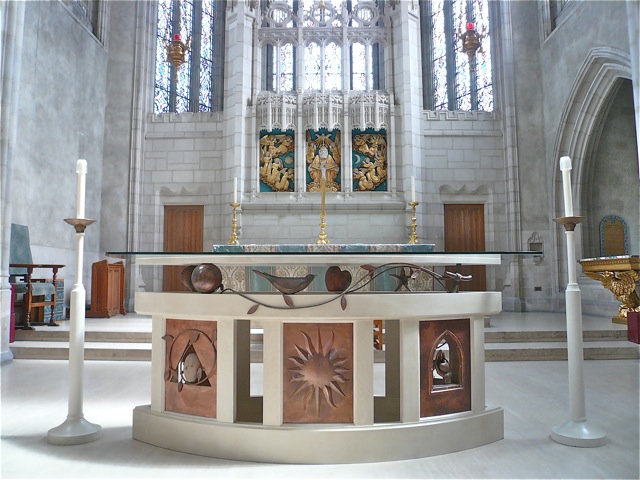
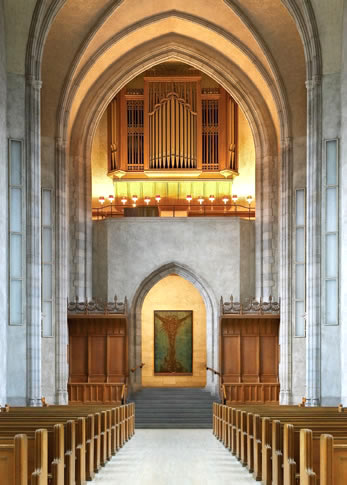
June has been a month of travelling for me. From the natural beauty of Vancouver to über busy and congested Metro Toronto, I’ve shifted gear and gone from park to overdrive in two short weeks. Quiet garden paths have been replaced by the 12-lane Highway 401, rain forest has turned into concrete jungle. And so I was pleasantly surprised by this serendipitous find right in the heart of downtown Toronto. Amidst the hustle and bustle, I found this sanctuary… literal and spiritual, the Trinity College Chapel on the campus of the University of Toronto:

Every step into the magnificent architecture instills awe and wonder, every artefact a symbol:

Looking back to the choir loft is another stunning view (this photo from Wikipedia):

The painting on the wall in the narthex, a crucifix, is entitled “Mediterranean Christ” by the artist Juan Sala Santonja:

***

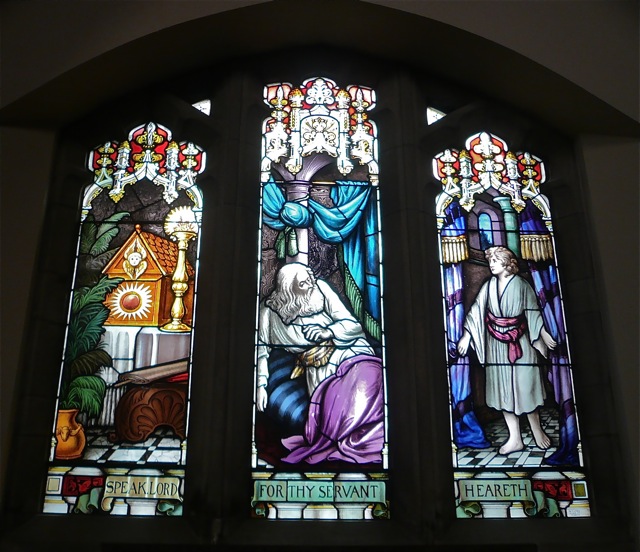
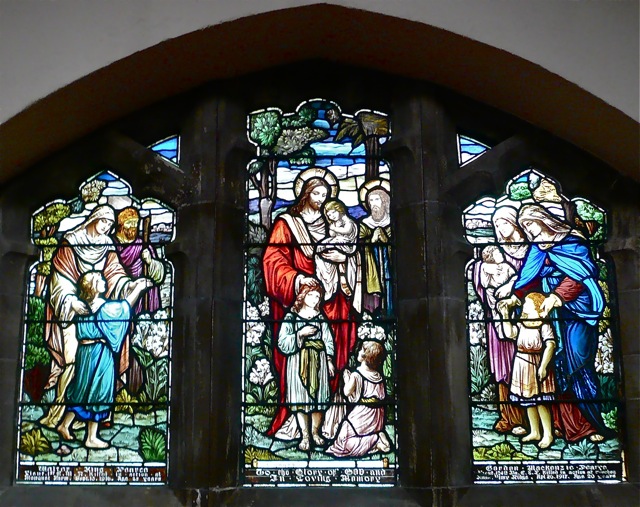
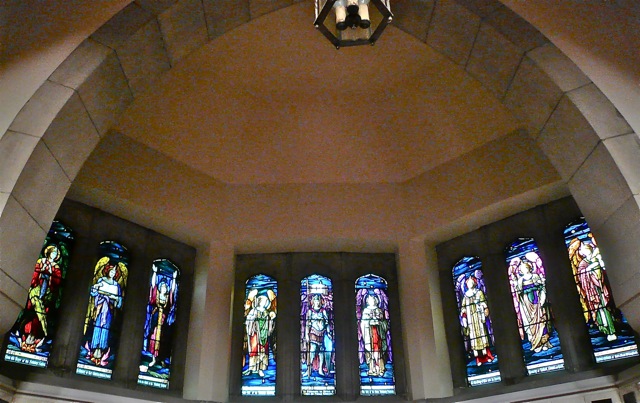
Another joy of discovery is Grace Church On the Hill, Anglican. My expectation of my short sojourn in Toronto had never been stained glass or religious art. But here I was, beholding Biblical themes in beautiful stained glass:

This contemporary wall sculpture created by Catherine Widgery of Montreal juxtaposes well among the stained glass, for its message points to a similar theme:

Entitled “By Her Own Radiant Light”, John Milton’s verse is engraved on a brass plaque beside the installation:

By her own radiant light, though sun and moon

were in the flat sea sunk.

And Wisdom’s self

oft seeks to sweet retired solitude,

Where, with her best nurse

Contemplation,

She plumes her feathers,

and lets grow her wings.

The pamphlet beside the art installation conveys the meaning: As the Moon’s illumination is the reflection of the Sun, Christian disciples are reflectors of the Greater Light. The phases of the moon suggest an eternal cycle of life, death and rebirth. Loss returns to fullness; darkness becomes light. The fragments of reflected light on water form a triangle below the full moon. Each fragment of light is a single piece of metal, cut and assembled so as to suggest the light’s effect on the surface of the water. At the heart of the circle, the light reflected on the surface is brilliant and intense, and diminishes as it spreads farther from the source.

As someone who’s always drawn to ripples, I spotted this installation right away as I entered the  sanctuary. Reading Milton’s verse and the explanation of the art work helped me gain a deeper appreciation of the visual symbolism.

No rain forests and greenery, but I was drawn to explore another landscape, one where art and imagination formed a bridge towards the unseen and spiritual, no less powerful in bringing out the wonders of creation and the Creator, the Source of Light and Wisdom.

***

CLICK HERE to watch a video clip with visual artist Catherine Widgery

PHOTOS: All photos were taken by Arti of Ripple Effects except the one noted from Wikipedia. Arti’s photos taken in June, 2011. All Rights Reserved.