The Lunchbox (2013): A Meal that Binds

The Lunchbox premiered at Cannes last year. Since then, it had appeared in many other international film festivals, nabbing nominations and wins. I missed it at TIFF last September, so am glad I’ve the chance to watch it in the theatre recently. Here’s my review published in the May 18 issue of Asian American Press, a weekly newspaper based in Minneapolis, MN. That’s right, folks, it’s globalization.

***


The Lunchbox Movie Poster

The lunchbox, dabba, is a stackable unit of four or five round metal cans fastened by straps on the side that flip up to attach to a handle on top. Every day in Mumbai, India, five thousand dabbawallahs, or lunchbox deliverymen, would fetch the dabbas from homes after housewives have filled them with hot food and deliver the tiffin to their husbands in their offices. After lunch, they would return the empty dabbas back to each home.

In Mumbai alone, there are five thousands dabbawallahs, many of them illiterate. For one hundred and twenty years, they carry dozens of dabbas on their bicycles, negotiate the mass of humanity and impossible street traffic and railways to bring office workers a hot meal from home, or from dabba preparation outlets. Harvard University had studied their inexplicable coding and delivery system. Their finding: only one in a million of these dabbas would ever get lost.
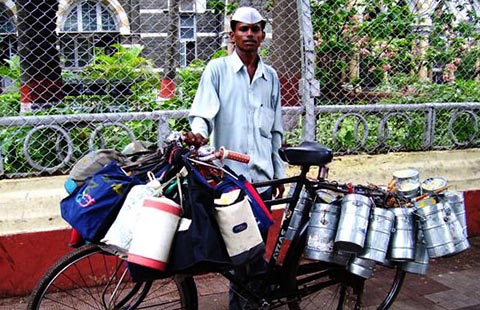
dabbawallah

If you think the title is too mundane for a movie, then just focus on that one-in-a million lost lunchbox. It is picked up from a young housewife, Ila (Nimrat Kaur), and delivered to the wrong recipient, Saajan Fernandes (Irrfan Khan, Life of Pi, 2012), a retiring office worker who has been on the job for thirty-five years. Thus begins the exchange of short notes then letters placed inside these tiffin cans, two strangers who are socially worlds apart, but joined together by a savory meal.

The veteran actor Irrfan Khan won Best Actor at the 8th Asian Film Awards in March this year for his role in The Lunchbox, adding to his several other wins for the film. His subtle and nuanced performance requires no dialogues. Indeed, both Saajan and Ila have not shared a frame together in the movie. I would not so much call this a romantic comedy as their relationship is purely platonic. The romance could well be the ideals and dreams they stir up in each other’s mind through the exchange of written notes. If there is anything comedic it comes as finding a listening ear, a slight relief from the mundane and inescapable in life.

It is interesting to watch how writer/director Ritesh Batra reveals to us the dabba as a metaphor. Like the stackable cans, the story is multi-layered. It touches on marriage, human connections, memories, and dreams. From the mass of humanity, we focus on two individuals striving to find meaning in their daily existence. Like the fastener that strap tight the cans of the dabba, Ila is caught in a loveless marriage with her husband Rajeev (Nakul Vaid), and the aging Saajan is bound by memories of his late wife.

Ila prepares lunch

The film begins with Ila’s attempt to make a delicious meal for her husband Rajeev to win back his heart through his stomach, an advice from an upstairs neighbor Ila calls Auntie (Bharati Achrekar). Ila communicates with Auntie by talking out of her kitchen window. Herein lies the subtle humor of the movie. We do not see Auntie, except just hear her voice. She is like an invisible adviser to Ila’s love life. Poignantly, Auntie herself has been taking care of her own husband, Uncle, who is bedridden and in a comatose state for fifteen years. If life is a bondage like the dabba, Auntie doesn’t show it a bit from her cheerful voice.

Ila’s delicious meals soon get through to the heart of Saajan, the mistaken recipient. Saajan lives alone, and seems to be heading straight to even more meaningless days in his retirement. The note exchanges gradually break through his isolation. Further, albeit reluctantly, he has to train his replacement at work, the young and enthusiastic Shaikh (Nawazuddin Siddiqui). Now this is one lively character that not only offers a humorous foil to the withdrawn Saajan, but like Auntie, Shaikh is optimistic about life, even though he has grown up an orphan. Soon, Shaikh has broken down the barrier with Saajan and the two establish a kind of father/son relationship.

Saajan & Shaikh

With The Lunchbox, his debut feature, Batra has won several screenplay and directing awards. He is definitely one promising filmmaker to watch. His approach here is naturalistic. Shooting on location in Mumbai, the camera captures realistic, ethnographic street scenes and the mass on public transits, telling this Mumbai story in situ. Through the handwritten notes hidden in the mundane dabba, delivered by a traditional human service, the film vividly shows us that even in our day of emails and instant messaging, the route to connect is still through the human heart.

~ ~ ~ 1/2 Ripples 

***

Related Movie Reviews on Ripple Effects:

Life of Pi (2012): The Magical 3D Experience

English Vinglish (2012)

Slumdog Millionaire (2008)

The Namesake (2006): Movie Review

***

Ruth Prawer Jhabvala: A Tribute to Rootlessness

On April 3, one day before Roger Ebert died, Ruth Prawer Jhabvala passed away from illness at the age of 85. Her death seemed to have been overshadowed in the next few days by Ebert’s. I feel here’s a life that ought to be noted as well, but maybe for a special reason.

ruth-prawer-jhabvala

Ruth Prawer Jhabvala was best known for her Oscar winning adaptations of E. M. Forster’s A Room With A View and Howards End. Her other screenplays include Kazuo Ishiguro’s The Remains of the Day, Henry James’s The Golden Bowl and The Bostonians, among a total of twenty-six.

But for Ruth (to discard formality and to focus on the person, allow me to call her Ruth), adapting screenplays was only a hobby. Her main calling was to be a writer of her own stories. She had heeded that call with fervour since childhood. Guardian’s obituary mentions Ruth once said about her writing time as “the only three hours in the day I’m really alive.”

There are thirty titles by Ruth Prawer Jhabvala on Goodreads, including novels, short story collections, and her works in anthologies. Among her accolades, most well known is the 1975 Booker Prize for her novel Heat and Dust, about the meeting of East and West in India. Her short stories had been published in The New Yorker since 1957, thirty-nine of them. Her latest appeared just one month before her death. She is the only person who had ever won both the Booker and the Oscar. Two Oscars, to be exact.

Reading her obituaries from several sources, I’m more intrigued by this matter of laying down roots, or rather, of rootlessness in the landscape of our life.

**

Ruth was born in Cologne in 1927 to a Polish father and a German mother. Her family was assimilated Jews in Nazi Germany. Her grandfather was the cantor in Cologne’s biggest synagogue. Her father Marcus was a lawyer. Assimilated or not, Ruth and her brother had to flee with her parents in the nick of time in 1939 to England. She was 12.

For the next twelve years, she grew up in London, learned a new language, adopted a new identity, and later graduated in English literature from Queen Mary College, London University. In 1948, upon finding out all members of his family were killed in the Holocaust, more than forty of them, Ruth’s father took his own life.

In 1951, when she was 24, Ruth married the architect Cyrus Jhabvala in London and followed him back to his native country India. Another uproot and transplant, this time, to a whole new continent. They settled in Delhi. For the next 25 years, Ruth immersed herself in her adopted country as a wife, mother, and writer. Colonial and post-colonial Indian life, East-West relationship and caste conflicts became her subject. Despite her effort in total immersion, she had not taken roots in India.

Finally, In 1976, a third continent, as Ruth and her husband moved to New York City. There, she found a place closest to a notion of home, paradoxically, because of “many people like herself: refugees, outsiders, interesting American discontents,” wrote the remaining Merchant-Ivory-Jhabvala collaborators, director James Ivory, in Time magazine’s tribute.

**

While still in India, Ruth had already collaborated with Merchant and Ivory on several movies. Now in New York, she lived in an apartment on the same block as they. The proximity of actual geographical location fostered a prolific period of their lives. Together, they had joined hands in more than twenty productions. Their forty years of collaboration remains the longest in movie history.

Ivory Jhabvala Merchant
Ivory, Jhabvala, Merchant

How did rootlessness affect her perspective? In Guardian’s obituary, I found this inspiring excerpt:

I stand before you as a writer without any ground of being out of which to write: really blown about from country to country, culture to culture, till I feel—till I am—nothing.” And yet, she said, this was one of her strengths. Many of her stories are about a kind of inner travel: feeling rootless, her protagonists find new ways to feel at home in the worlds they happen to inhabit.

Perhaps, in the vast landscape of literature, such rootlessness is essential for the imagination to take flight. Rootlessness allows flexibility and fluidity of navigation, the freedom to roam. Rootlessness can more readily unlock the wayfaring spirit within, and embrace change.

One result of being rootless could well be the hybrid identity. Amusingly the Merchant-Ivory-Jhabvala team itself is a good example. Producer Ishmael Merchant was a Muslim from Bombay who had settled in America; director James Ivory is the son of a French-Irish American; Ruth Prawer Jhabvala was a Polish-German-Jew from Cologne, Delhi, London, and New York City.

Perhaps as Nick Carraways, the narrator in The Great Gatsby, observes, only by being “within and without” can we see “the inexhaustible variety of life.”

***

Related posts and links:

Obituaries and tributes from The Guardian, The Telegraph, The Paris Review, Time Magazine, The New York Times.

Since 1957, The New Yorker had been publishing Ruth Prawer Jhabvala’s short stories, a total of 39, her last appeared only one month before her death. Thanks to The New Yorker, we can now read Ruth Prawer Jhabvala’s short stories online.

My book review of Howards End, my post on the Merchant Ivory production of Howards End, my review of A Room With A View (TV, 2007)

***

Photo Sources:

First photo from The Paris Review; Second photo from The Telegraph

English Vinglish (2012)

If The Best Exotic Marigold Hotel is from the outside looking in, then English Vinglish is the reverse shot, bringing us a point of view from the inside looking out.

Writer-director Gauri Shinde gleaned from her real life experiences to craft this delightful dramedy that is rooted in human miscommunication, but speaks much more. The film is one of the Gala Presentations at the Toronto International Film Festival in September.

The legendary Bollywood star Sridevi comes back to the big screen after a 15 years hiatus to play Shashi, a devoted wife and mother in a modern, middle-class family in Pune, India. She is a lively, capable woman, a good cook who runs her own catering business, her specialty the ladoos, sweet golden balls of dainty delights. But she has to struggle with one major insecurity: she knows little English. Well, you may think, what’s the big deal. But with English recognized as the lingua franca by those living in a former British colony, and a patriarchal society, Shashi as a woman with no English sorely feels disadvantaged, even within her own family.

Her daughter teases her for her pronunciation, even her preschooler. She shies away from parent-teacher interviews, for her daughter goes to an English-speaking school. No matter how devoted a wife she tries to be, she feels the gap between herself and her husband (Adil Hussain, Life of Pi, 2012; The Reluctant Fundamentalist, 2012), who is proficient in English and thus becomes her spokesman in social situations.

“She’s born to make ladoos,” her husband’s intended praise of her cooking skills only reflects the confining social reality in which she finds herself. Not knowing English makes her feel subservient, without a voice.

The tipping point comes when Shashi’s niece is getting married in New York City. She has to go on her own to help her prepare for the wedding. Her family will travel later. An Indian woman in a sari on her first international flight alone, Shashi is understandably timid and insecure. But a friendly and helpful gentleman who sits beside her eases her anxiety. That role is aptly played by the veteran actor Amitabh Bachchan (Watch for him in The Great Gatsby, 2013)

A funny and quite original scene comes when this helpful gentleman suggests they watch the same in-flight movie, and he be her interpreter. Only he wears the headphone, and translates the dialogues out loud from English to Hindi for Shashi to hear, in a voice that’s animated and true-to-life, sound effects included. Here’s the rub… the movie is an action thriller of terrorists committing violence with guns and bombs. Other passengers trying to sleep have to shush him, short of subduing him for uttering bomb and death threats.

New York City, the place where one can transform oneself in a surprising way. Shashi has her first major language mishap in a coffee shop. Turning insult into courage, she enrolls in an English language class. The camaraderie of fellow learners lowers her guard and builds up her confidence. In a few short weeks, she has not only gained some mastery of the language but supportive friendship, with one being more intimately intended.

Shashi’s vindication comes at the wedding of her niece. Her husband and children have arrived for the occasion, not knowing her secret English lessons. In front of all the guests, Shashi is asked to make a speech to the newlyweds. While her husband tries to deflect the embarrassment and excuses her for lack of English, Shashi stands up and uses her new found voice to urge the bride and groom to value equality and treat each other with respect, a heartfelt speech well intended for her husband, and a lesson that brings tears of remorse to her daughter. This is one of the most moving wedding speeches in films I’ve seen. In case you’re interested, another memorable one is Dustin Hoffman’s at his daughter’s wedding in Last Chance Harvey (2008).

The 130 minute movie could benefit from keener editing, but the charming Sridevi carries it through with style and grace. It is a joy to watch her even amidst her insecurities, for she has won my heart with her quiet determination to overcome the odds, her strength of character shines through beautifully.

The movie offers a variety of entertainment, albeit not without some contrived moments. It is a full pack of heartwarming comedy, melodrama, cultural mishaps, the ESL classroom, Bollywood style music and dance numbers, but above all, reality. The film has brought to the forefront children showing disrespect for a parent with no English. This could be an issue particularly among immigrant families. Such a portrayal could well be indicative of society at large. Shashi has demonstrated that language does not define who she is, nor should it be the condition of respect and meaningful relationships.

The fact that we in North America can thoroughly enjoy a Hindi film, no doubt by reading English subtitles, could only mean that we can cross the language barrier to understand each other and appreciate different points of view. English may be the lingua franca in certain parts of the world, but it is compassion that joins us. What better way than to be entertained as we go about learning other perspectives?

~ ~ ~ Ripples

***

Other posts you might like:

The Best Exotic Marigold Hotel

Midnight’s Children Film Adaptation

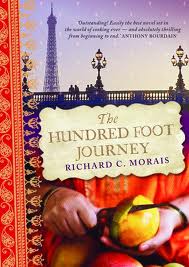
The Hundred-Foot Journey by Richard C. Morais

Life of Pi by Yann Martel

The Hundred-Foot Journey by Richard C. Morais

How do you get to Paris from Bombay? Food, Food, Food.

What better transport is there than a light vehicle that provides a fun and wild ride, taking me out of Midnight’s Children‘s Bombay to my next destination, Paris in July? Thanks to Karen of Book Bath for organizing the trip.

This delightful, breezy read is that speedy transit. It tells the story of Hassan Haji, a Muslim boy who lives above his grandfather’s restaurant in then Bombay and how he ultimately ends up as a three-star chef in Paris.

Growing up immersed in the savoury aroma of Indian food and spices,

I suspect my destiny was written from the very start, for my first sensation of life was the smell of machli ka salan, a spicy fish curry, rising through the floorboards to the cot…

Hassan is endowed with an exceptional gift of culinary talent. After the Partition and the death of his grandfather, religious and political turmoils push his family out of the country. They first land in London, later immigrate to France. The boisterous family finds a home in the resort village Lumière near the Alps and starts its own restaurant Maison Mumbai, serving Indian dishes and bringing a welcome change to the villagers.

Hassan soon is jealously noticed by the veteran, feisty two-star French Chef Madame Mallory across the street. She is the proprietor of the small country hotel, Le Saule Pleureur. Her restaurant is a haute French culinary establishment that plays Satie in contrast to the Indian music from a loudspeaker at the Haji’s. After many animated and almost cartoonish conflicts between Madame Mallory and Hassan’s Papa, Abbas Haji, both concede to the reconciliatory move of allowing Hassan to become Chef Mallory’s apprentice.

Thus, Hassan takes the one hundred-foot journey and crosses the street to stay at Le Saule Pleureur, learn all he can from the great Chef and answer ‘the irrefutable call of destiny’ to be one himself. Towards the end of his apprenticeship, Hassan is left on his own to create recipes for pigeons, gigot, and hare, all to the satisfaction of Chef Mallory. After three years under her wings, Hassan is ready to move on.

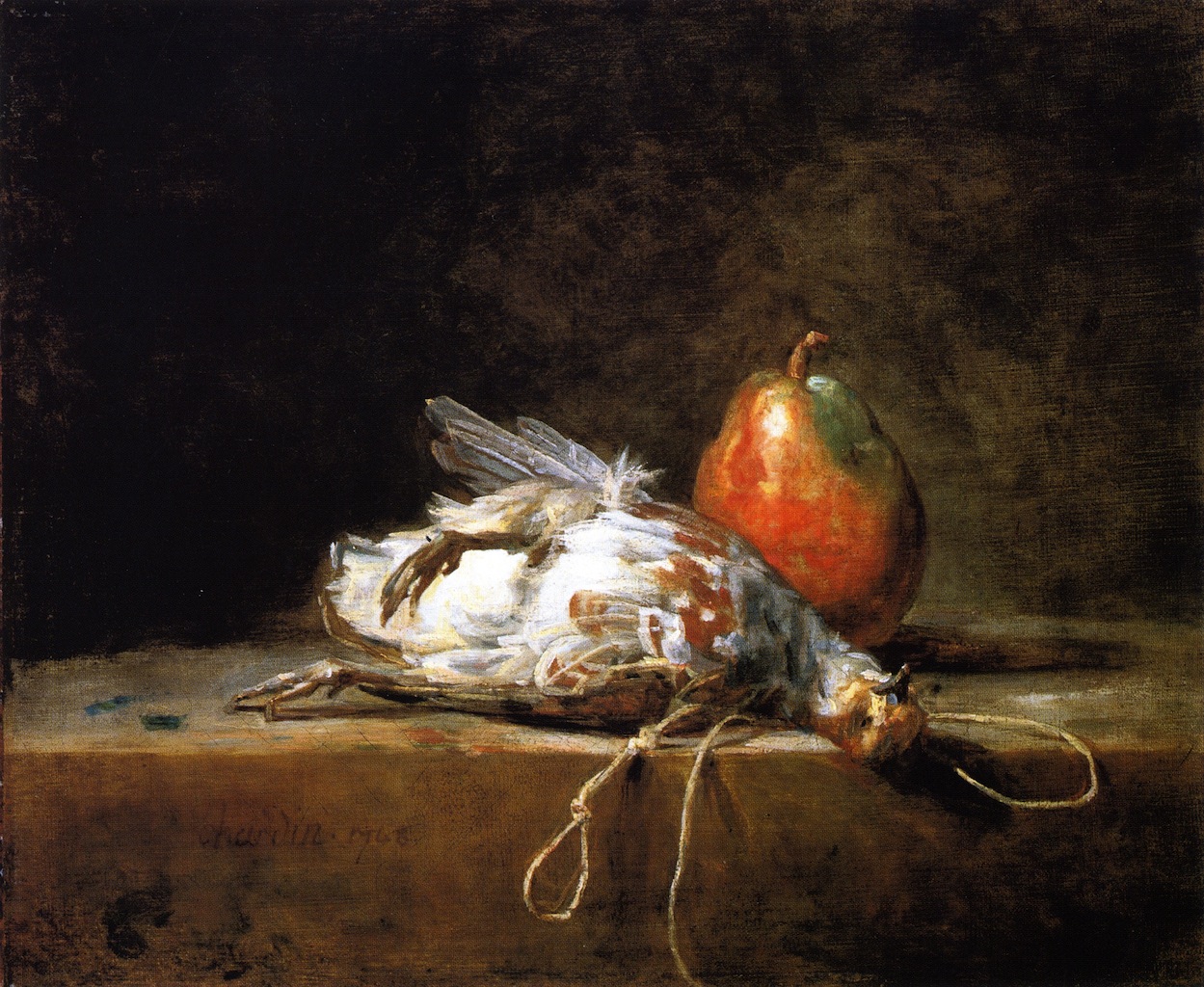
Chardin’s Grey Partridge Pear and Snare on Stone Table, one of Hassan’s favorite paintings.

Next step, Paris. Hassan starts as a sous chef with a couple of smaller restaurants. After a few years, he decides to open his own and is approached by a benefactor who offers him reduced rent in an upscale location near the Panthéon. The one-hundred foot journey has brought him fine training, now he can take flight.

Here is his trademark dish:

the Siberian ptarmigan, roasted with the tundra herbs taken from the bird’s own crop, and served with caramelized pears in an Armagnac sauce.

We as readers are privy to the actual cooking procedure beginning with the feathered live bird.

For me, more a movie buff than a foodie, the book conjures up many cinematic images… the colours and conflicts in The Best Exotic Marigold Hotel, the prejudice in Chocolat, the sumptuous offering in Babette’s Feast, and, the training sessions in the The Karate Kid. Dev Patel (Marigold Hotel, Slumdog Millionaire) will be perfect for the role as young Hassan. I couldn’t help but think, this book is good movie material.

And then I found out from the Acknowledgements after I finished, the book is an homage to the late Ismail Merchant, the film producer behind the Merchant Ivory productions (Room With A View, Howards End, The Remains of the Day) who met an untimely death in 2005. The bond between the author Richard Morais and his friend Ismail Merchant was food. This book was started with a subsequent movie in mind.

In-depth research has gone into writing the book, culinary history, recipes, game, desserts, soups, the French kitchen, the Indian kitchen, restaurant operations, even for me the uninformed and casual eater, there are plenty to savour. The book is a smorgasbord of gastronomic delights. My only criticism is that its literary treatment may taste a bit raw, simplistic, and at times, didactic. However, read it like a comedy, it can satisfy like a dessert.

~~~ Ripples

The Hundred-Foot Journey by Richard C. Morais, Scribner, NY, 2010, 245 pages.

***

The Best Exotic Marigold Hotel

Outsourcing old age, that’s the idea.

Imagine in the distant (or not so distant) future, you retire to a warm climate, enjoy a colourful land and best of all, affordable living in a retirement resort. The concept is sold to several retirees from Britain. Little do they know the advertised Best Exotic Marigold Hotel for the Elderly and Beautiful is a run-down establishment of faded glory. The place is Jaipur, India.

The Hotel owner is Sonny Kapoor (Dev Patel of Slumdog Millionaire fame) who has inherited the property from his late father. Despite his mother’s insistence to close it down and get him back to live with her in Delhi to marry the girl of her choice, Sonny is determined to make it on his own. He has already picked out his girl, and is positive about his plan to outsource retirement, among many other services India is already offering to foreign countries.

The trailer doesn’t do justice to the movie. When I first watched it, I was totally baffled … why would such a top-notch cast of veteran British actors take up what seems to be a shallow and silly farce? But after watching the movie, I think I can make a guess: they must have known what fun it would be to do this, they must have sensed the thematic relevance as well. Why I went out to see it if I didn’t like the trailer? I just couldn’t resist the combined star power and my trust in their judgment.

Where can you see these actors together on one big screen: Judi Dench, Evelyn, who has depended on her husband all the years but now recently widowed, decides to take charge of her life; Maggie Smith, Muriel, who is xenophobic and won’t eat anything she can’t pronounce, goes to India mainly to have a hip replacement she can afford; Bill Nighy and Penelope Wilton, Douglas and Jean, are an incompatible couple who sticks together out of habit and loyalty; Tom Wilkinson, Graham, a judge who follows his heart and returns to his former home to look for a long-lost friend; Celia Imrie, Madge, who at retirement is still looking for the right one, and Ronald Pickup, Norman, seems to know exactly what he wants.

The humour is natural and not forced, the dialogues are witty and refreshing. Something that is not easily found in comedies, with the expert cast of veteran actors, a sense of seriousness exudes from their performance, giving weight to the characters and making their simple storylines convincing.

Oscar nominated director John Madden (Shakespeare In Love,1998) has done a great job in concocting the on-screen chemistry of his cast. Their camaraderie as fellow travellers from the UK and as guests in the Marigold Hotel emit an appealing and quiet persuasion. I’ve enjoyed every one of their storylines. From the very start of the film, I’m drawn into each of the characters while they are still in England. I follow their journey expectantly, open and ready to accept the unfolding of events.

As with all ‘exotic’ movies, there bound to be cultural features that can easily lead to stereotyping and patronizing. That I expected. But what I didn’t was that these ‘typical’ renderings are few and mostly restrained. Further, shot right in Udaipur, India, many scenes are in situ happenings that come out naturalistic and real. The whole movie is a delightful surprise, probably the main one is, I don’t mind watching it again.

~ ~ ~ Ripples

Midnight’s Children by Salman Rushdie, Book Two (Part A)

CLICK HERE to read my Movie Review of Midnight’s Children

***

While Part One of the book is a macro view of historical background and family genealogy dating back a few generations, Part Two is what we’re all waiting for, the emergence of Midnight’s Children, in particular, our young hero Saleem Sinai. This present section of our Read-Along is the first part of Book Two, ending with the chapter ‘Alpha And Omega’.

We see Saleem Sinai growing up from a protected infant doted on by mom Amina and maid Mary to a thinking, mature, yet mildly timid and clumsy ten year-old. He shares his childhood in the family with his sister Brass Monkey, one year younger, ‘untamed, unfeminine’. Faced with the ambivalence of sibling rivalry and camaraderie, he learns in time the axiom that blood is thicker than water.

By all standards, Saleem’s first ten years (so far) have been eventful. Not long after his birth, Ghandi is assassinated. Saleem’s father Ahmed’s assets are frozen but later rescinded by the court. He spies on his mother and follows her secretly as she meets her ex-husband, now the Communist Party leader.

Saleem’s great sense of imagination is nurtured by various cultural traditions, a generous share of fairy tales, super heroes and the cinema.

Hatim Tai and Batman, Superman and Sinbad helped to get me through the nearlynine years… I became Aladdin, voyaging in a fabulous cave… I imagined Ali Baba’s forty thieves hiding in the dusted urns… I turned into the genie of the lamp… I was mild-mannered Clark Kent protecting my secret identity…

Other memorable episodes include a first taste of unrequited love from his crush on Evie Burn. As for school, colonial traditions stay. Saleem goes to a Christian mission school where he gets his multi-cultural exposure. Some learning is hard, that’s expected. But he gets more than his fair share as he tastes the ultimate in corporal punishment and humiliation as a clump of his hair is pulled out by his Peruvian geography teacher. Later in the school dance, in front of his new crush Masha Moviac, he shows her he is a man after all as he knees his insulters. Mayhem ensues that ends with a mutilated finger in the emergency room.  I can see lots of movie moments, hilarious yet endearing.

But above all, growing up in Methwold’s Estate and his part of Bombay is a close encounter with multiplicity. And to a young boy tossed in the net of a myriad of interwoven cultural strands, Saleem is preoccupied with the search for an identity. Further, with his secret, supernatural gift of tuning into other people’s mind, he eagerly looks for a purpose and meaning to his life. And here is how Rushdie so brilliantly parallels Saleem’s birth to that of a nation.

On my tenth birthday, everyone at Methwold’s Estate tried hard to be cheerful, but beneath this thin veneer everyone was possessed by the same thought: “Ten years, my God! Where have they gone? What have we done?

Saleem holds a Midnight’s Children Conference right in his mind, he himself the self-imposed leader of the 581 surviving Midnight’s Children, all born with unusual gifts. His leadership is challenged by none other than his changeling, Shiva, born at the stroke of midnight with him. While Saleem ponders on the purpose and reason for his supernatural power, his counterpart Shiva, coming from the slums, opposes him with the facts of life:

Rich kid,” Shiva yelled, “you don’t know one damn thing! What purpose, man? What thing in the whole sister-sleeping world got reason, yara? For what reason you’re rich and I’m poor? Where’s the reason in starving, man? God knows how many millions of damn fools living in this country, man, and you think there’s a purpose! Man, I’ll tell you–you got to get what you can, do what you can with it, and then you got to die. That’s reason, rich boy. Everything else is only mother-sleeping wind!

Crisp and simple. Existential pondering a luxury to many… ?

How I look forward to the rest of the book, and the movie. BTW, it has been shown to selective previewers, who were told not to write any reviews as yet. They sure know how to build up expectations and curiosity.

***

CLICK HERE to BOOK TWO: Part B
CLICK HERE to BOOK THREE CONCLUSION

Read-Along Participants’ Posts for Book Two (Part A):

Bellezza at Dolce Bellezza 

Gavin of Page247

Janell of An Everyday Life

Jerika at averydisorientedreader

ds at third-storey window

If you’ve written a post on this section, do let us know in a comment. I’ll add your link on the list.

Next section: Book Two, Part B. From ‘The Kolynos Kid’ to the end of Book Two. Share your view May 31st. You still have time to catch up if you like to start the book now.

***

Midnight’s Children by Salman Rushdie, Book One

CLICK HERE to read my Movie Review of Midnight’s Children

***

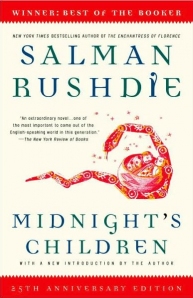
In his introduction to the 25th Anniversary Edition of Midnight’s Children, Salman Rushdie writes:

In the West people tended to read Midnight’s Children as a fantasy, while in India people thought of it as pretty realistic, almost a history book.

I admit, when I started reading Midnight’s Children, I was frustrated. I knew I just couldn’t read it purely as a fantasy. Why, these are real dates in history, important events, the World Wars, the Mahatma’s call for an independent India with non-violent means, the separation of India and Pakistan along religious lines… There must be more, I told myself. I knew I could never read it as an insider, but I could at least peek through the fences, and get a glimpse of what’s going on inside.

And so I did. I searched for background info and author interviews, both online and off. As a result, my reading pleasure is enhanced after I found out how realistic the novel is. Personal happenings actually correspond with important historical events, not unlike the movie Forrest Gump, little people tossed in the currents of history.

Rushdie in an interview noted that instead of using an Austenesque way to tell his story by focusing on the details and the minute, he chose to adopt a Dickensian approach, placing his characters on a macro, societal canvas. As a result, we have a monumental epic. Mind you, he just wanted to write a novel about childhood, he said.

The narrator, Saleem Sinai, started with his Grandfather Aadam Aziz in 1915, thirty-two years before India’s independence. The young doctor examined his patient and future wife Naseem through a perforated sheet a bit at a time, under the close supervision of her cautious father. When at last she complained of a headache, he finally could see her face, “on the day the World War ended.” It’s pure humor also, and I’ve enjoyed Rushdie’s free wheeling brush strokes.

But often the comical may just serve to bring out more poignantly a sombre reality. When I first read the ‘Mercurochrome’ chapter, it didn’t hit me at all. Later, I read about the atrocity that had actually happened on April 13th, 1919, the Amritsar massacre. British Brigadier-General Reginald E. H. Dyer ordered Marshal Law regulations, banning all assemblies. A large crowd defied his orders and started converging in the compound Jallianwala Bagh for a peaceful protest. Dyer marched fifty riflemen up and ordered them to shoot at the crowd indiscriminately, men, women children.

They have fired a total of one thousand six hundred and fifty rounds into the unarmed crowd. Of these, one thousand five hundred and sixteen have found their mark… ‘Good shooting,’ Dyer tells his men, ‘We have done a jolly good thing.’ (p. 34)

A few days ago, Aadam helped the wounded on the streets and got Mercurochrome all over his white shirt, and had to explain to wife Naseem the red stains were not blood. Now on this fateful day, Naseem assumed the red was Mercurochrome again, but was told, “it’s blood,” and she fainted.

The relevance of the perforated sheet reemerges in the next generation when Amina Sinai, Saleem’s mother, has to learn to love her husband Ahmed Sinai one fragment at a time:

 ‘Who, after all,’ she reasoned privately, ‘ever truly knows another human being completely?’

The last two chapters ‘Methwold’ and ‘Tick, Tock’ strike a chord in me. Why, I’m not totally an outsider after all. For the first fifteen years of my life, I was a colonial. I was born and grew up in the then British colony of Hong Kong. So reading Book One of Midnight’s Children, I feel certain affiliation. It reminds me of my childhood days, which were also filled with multiplicity of cultures, the fusion of languages, and fortunately, the calm co-existence of religions. There were spittoons and Mercurochrome. I was familiar with bilingual usages, aware of the divide between the subject and the ruling, the East and the West. Even now, I can spot the ‘imitation Oxford drawls’. My “Tick, Tock” moment was when I watched on TV here in Canada the last governor of Hong Kong Chris Patten standing in the rain holding the British Colony flag, saying goodbye to all that on July 1, 1997.

Rushdie’s animated style makes his India colourful and fascinating. His characters, descriptions and dialogues are like the splashes of a Pollock painting. That’s where the fantasy comes in, I suppose, on the large canvas of history.

Book One ends with intrigue. Saleem Sinai, it turns out, is a changeling. At the stroke of midnight August 15, 1947, two boys were born, but was soon mixed up by midwife Mary Pereira in a wilful act of self-assertion. This too has its deeper reference:

When we eventually discovered the crime of Mary Pereira, we all found that it made no difference! I was still their son: they remained my parents. In a kind of collective failure of imagination, we learned that we simply could not think our way out of our pasts…

I look forward to reading the childhood of these two changelings Saleem and Shiva, and their  journeys ahead.

***

Here are the other Read-Along Posts for Book One (so far):

Bellezza at Dolce Belleza
Gavin of Page247
Janell of An Everyday Life
Jerikavonalexandra of averydisorientedreader
Colleen of Books in the City 

If you’ve written a post for our Read-Along, do let us know in a comment.

***

CLICK HERE to Book Two: Part A
CLICK HERE to Book Two: Part B
CLICK HERE to Book Three Conclusion

CLICK HERE to read a March 1, 2012 interview of director Deepa Mehta on CBC news.
CLICK HERE to read about the filming of Midnight’s Children.

Midnight’s Children Read-A-Long

Midnight’s Children Read-Along has begun. Here are the post to:
Midnight’s Children Read-Along Begins
Midnight’s Children by Salman Rushdie, Book One
Midnight’s Children Book Two (Part A: up to ‘Alpha and Omega’) 
Midnight’s Children Read-Along Book Two Part B
Midnight’s Children: Book Three

On Dec. 29 of last year, I posted “Year End Tally and 2012 Outlook“, and I thought that would be it. The two challenges I’ve taken up for this year, the Graham Greene and the Ireland Reading, would be sufficient in lieu of any new year’s resolutions. Further, there will always be movie reviews and other choices in reading on the spur of the moment.

Along came the new year and another opportunity. Thanks to Mrs. B of The Literary Stew, who suggested to me a read-a-long of Salman Rushdie’s Midnight’s Children, I gladly accepted the idea. We’re excited that Bellezza of Dolce Bellezza and Colleen of Books in the City will also be joining us. I know that on Bellezza’s blog, she has a few who have shown interest. You’re invited to hop on as well.

Salman Rushdie’s Midnight’s Children won the 1981 Booker Prize. In 1993, it was awarded the Booker of the Bookers trophy, the best novel to have won the Booker Prize for Fiction in the Award’s 25-year history. I admit I haven’t read any Rushdie before, so I just thought this would be a good one to start. Do click on the link above to Booker’s website for the synopsis and bio.

Another major reason for my interest in reading it this year is that its film adaptation is currently in post-production. Acclaimed Canadian director Deepa Mehta (Water, 2005) is at the helm of the production. Rushdie is closely involved in the process with Mehta in condensing his novel into 130 pages of screenplay. Filming has already been completed in Sri Lanka. According to IMDb, it will be released this fall.

My copy is the 25th Anniversary Edition. It has 533 pages. Considering the dense writing and the historical backdrop of the novel, it sounds like a book that calls for reading camaraderie and dialogue. Also, we’ve decided to take it slow. By so doing, we can also pursue other readings or blogging activities while doing this.

So here’s our plan. The novel is divided into 3 sections, with the middle the longest, so we’ll split it in two. We’ll begin reading in March. One month for each part. Review posts are to be posted according to the following schedule:

March 31 — Book One
April 30   — Book Two (Part A ending with ‘Alpha and Omega’)
May 31    —  Book Two (Part B starting with ‘The Kolynos Kid’)
June 30   — Book Three

You’re welcome to join us in this slow read. Just indicate in the comment section and leave a link. 

**

And to everyone, Happy Reading in 2012!

***

Cave of Forgotten Dreams (2010)

In December 1994, a small team of cave explorers came upon a cave near the valley of the Ardèche River in southern France. They were awestruck as they went inside. Since named after the team leader Jean-Marie Chauvet, the Chauvet Cave had provided the natural canvas for prehistoric paintings dating back 32,000 years to the Upper Paleolithic period, twice as old as those previously found in Lascaux. These are the earliest paintings ever discovered.

The Chauvet Cave is located near the natural limestone bridge over the Ardèche River, the Pont d’Arc, which has been noted to be half a million years old:

.

The acclaimed documentary filmmaker Werner Herzog was granted special permission endorsed by the French Ministry of Culture to go into the Chauvet Cave to film the rock paintings in situ. The result is this mesmerizing documentary.

Following a restricted 2-foot wide pathway, and limited only to a film crew of four, with no heat-emitting lights and only hand-held camera, Herzog made a spellbinding document of epic historical significance. A team of archeologist, paleontologist, art historian and geologist formed the quiet, unobtrusive entourage into this pristine trove of treasures.

Surrounded by pink calcite columns like icicles with glittering crystals, the rock paintings depict a myriad of animals including cave bears, ibexes, deers, owls, mammoths…

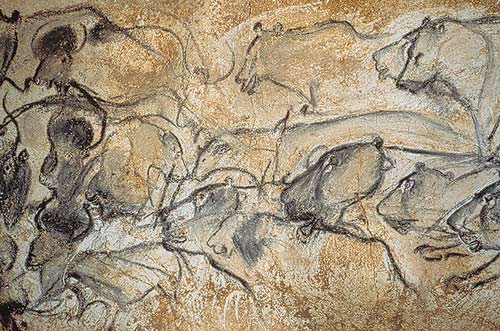
Action-packed panels of bisons, horses, and rhinos locking horns:

.

Lions hunting bisons:

A panther and hyenna surprisingly in friendly mood:

.

From the film, archeologists and an art historian inform us that a single artist created most of these works. He had a crooked little finger, and his palm prints could be seen from crouching position to a height of 6 ft.  They are now the oldest human handprints:

.

.

There are animal fossils but no human remains in the cave, suggesting that it was not used for human dwelling but maybe just for painting. A prehistoric art studio? The artist had utilized the curvatures and ridges of the rocks to create fascinating renderings of animals charged with life and energy.

This is where I’d wholeheartedly endorse the 3D technology. Director Herzog, after some hesitations, decided to use a 3D camera to capture the vivid renderings. With the 3D advantage, we can see how the artist utilized the contours of the rocks to depict the animals in a most realistic way.

In the film, we also see multi-legged bisons, like those in cartoon strips or frames in animated films, suggesting movements.

Many of the animals are depicted in perspectives:

.

.

and in layered renderings like this showing lions without manes:

.

.

A few of the paintings are dated to some 5,000 years later, about 27,000 to 25,000 ago, indicating another period of artistic activities there. But since that newer date, no human traces were left. The cave had remained untouched until the recent discovery in 1994.

In the vicinity of the cave, remnants of musical instruments are found, evidence of another form of artistic pursuit. In the film, we hear one of the researcher playing the “Star-Spangled Banner” on what looks like a tiny twig with equally-spaced holes. It would be another extraordinary find if we could discover the pop tunes of the day.

Now, a note about watching this film in 3D. I admit as someone with an acute built-in motion sensor, I had to leave the theatre half way through the film when I first saw it in 3D. The roving camera plus the 3D effects had proven to be worse than being tossed at sea.

But I’m fortunate to be given a second chance. The film is now screened in another theatre without the 3D technology. I knew I must see the rest of it, so I returned for a second viewing. And this time, I stayed till the end.

A must-see documentary for all.

~ ~ ~ 1/2 Ripples

***

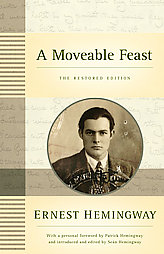
A Moveable Feast (Restored Edition) by Ernest Hemingway

Reading A Moveable Feast is like walking along the sea shore. On the fine sandy beach you see many attractive shells, but you don’t have a bucket with you. You pick the finest ones and put them in your pockets, until they’re full. But every step you take further, you see more that you want to keep. This post is too limited for me to display all the shells I’ve collected, but allow me to just pour them out from my pockets, without sorting, sand and all.

I first read about the term “Moveable Feast” while sitting in an Anglican church in Vancouver, flipping through the The Book of Common Prayer. After some googling later, I got the idea. A feast in the liturgical calendar that you commemorate no matter which date it falls on year after year. In the Foreword of this restored edition, Hemingway’s son Patrick (with second wife Pauline Pfeiffer) writes:

The complexity of a moveable feast lies in the calculation of the calendar date for Easter in a given year, from which it is simple enough then to assign a calendar date to each and every moveable feast for a given year. Palm Sunday is seven days before Easter.

A memorable experience that will follow you all the years of your life. You’ll cherish it whenever and wherever you are. Hemingway’s friend A. E. Hotchner suggested this title. Author of the biography Papa Hemingway, Hotchner recalls Hemingway once said to him:

If you are lucky enough to have lived in Paris as a young man, then wherever you go for the rest of your life, it stays with you, for Paris is a moveable feast.

Like Rick says to Ilsa in “Casablanca”: “We’ll always have Paris.” Same sentiment.

A Moveable Feast is Hemingway’s memoir written from notes he had forgotten in two steamer trunks stored at the Ritz Hotel in Paris since 1928. In 1956 he repossessed the treasure trove, upon the urging of the hotel management. The book details his experience while living in Paris from 1921 to 1926, when the author was in his early 20’s. The memoir was first published posthumously in 1964. The Paris Years was a period when Hemingway, just married Hadley Richardson, young and care-free, decided to give up journalism to strive at being a novelist.

He would write in a rented room or in a café over café crème,
meet Gertrude Stein for critique of his writing, go back home for lunch with wife Hadley, or have oysters and wine in a restaurant, socialize with Fitzgerald, Ezra Pound, and other expats, borrow piles of books from Sylvia Beach’s library in her bookshop Shakespeare and Company, visit Luxembourg gardens and museum…

Two people, then, could live comfortably and well in Europe on five dollars a day and could travel.

No wonder Gil in “Midnight in Paris” dreams of such a life.

What strikes me initially is Hemingway’s frankness, sometimes blatant description of his opinion about the people he met. Like the first time he saw the artist Wyndham Lewis through Ezra Pound:

I watched Lewis carefully without seeming to look at him, as you do when you are boxing, and I do not think I had ever seen a nastier-looking man… I tried to break his face down and describe it but I could only get the eyes. Under the black hat, when I had first seen them, the eyes had been those of an unsuccessful rapist.

According to grandson Sean Hemingway who edited and wrote the introduction of this restored edition, Hemingway developed his sharp eye and ear during these Paris years. Here’s an account of Scott Fitzgerald when Hemingway first met him in the Dingo bar:

Scott was a man then who looked like a boy with a face between handsome and pretty. He had very fair wavy hair, a high forehead, excited eyes and a delicate long-lipped Irish mouth that, on a girl, would have been the mouth of a beauty. His chin was well built and he had good ears and a handsome, almost beautiful, unmarked nose.

This is only a little excerpt in a two page description of Scott’s appearance. It’s sentences like these that stand out for me. They all point to the writer at work: observing.

I kept on looking at him closely and noticed…”

“I kept on observing Scott.

And putting down in words later:

I wasn’t learning very much from looking at him now except that he had well shaped, capable-looking hands, not too small, and when he sat on one of the bar stools I saw that he had very short legs. With normal legs he would have been perhaps two inches taller.

But it was Scott’s talents despite his eccentricities and alcoholism that formed the building blocks of their friendship.

When I had finished the book [The Great Gatsby] I knew that no matter what Scott did, nor how preposterously he behaved, I must know it was like a sickness and be of any help I could to him and try to be a good friend. …   If he could write a book as fine as The Great Gatsby I was sure that he could write an even better one. I did not know Zelda yet, and so I did not know the terrible odds that were against him.

It is perhaps with such candour and devotion in writing that he constantly sought to “write one true sentence.” Woody Allen has grasped the essence in this juicy line from “Midnight in Paris”:

No subject is terrible if the story is true, if the prose is clean and honest, and if it affirms courage and grace under pressure.

The restored edition brings back sections missing in the earlier 1964 publication which was edited by fourth and last wife Mary. According to Sean Hemingway, this restored work represents the content that Hemingway himself had intended the book to have, with the chapter “Nada y Pues Nada” (Nothing And Then Nothing) written three months before his suicide.

The second last chapter “The Pilot Fish and the Rich” shows he was remorseful over the breakdown of his first marriage to Hadley towards the end of his Paris days. A mutual friend they both knew, journalist Pauline Pfeiffer, came in between them. “You love them both now… Everything is split inside of you and you love two people now instead of one.”

But A Moveable Feast belongs to Earnest and Hadley and their young son Bumby.  “… this is how Paris was in the early days when we were very poor and very happy.” As a reader, I feel a sense of loss as I come to the end, for Earnest and Hadley were so much in love the first few years in Paris:

She: ‘And we’ll never love anyone else but each other.’

He: ‘No. Never.’

Their 2-room rental walk-up with no electricity and no hot water had been a haven of warm meals and intimate talks. It was the time when he was “a young man supporting a wife and child … learning to write prose.” Their short marriage lasted only six years. In 1927 Hemingway married Pauline, four months after divorcing Hadley.

The last section at the end of the book is entitled “Fragments”. These are “false starts”, beginning paragraphs of an introduction Hemingway tried to write for this book. Interestingly, every one of these attempts starts with: “This book is fiction.” Many include this sentence: “I have left out much and changed and eliminated and I hope Hadley understands.” In another fragment he wrote: “No one can write true fact in reminiscences…”

I’m baffled. But maybe unnecessarily. From our very subjective mind, our often hazy view of what did happen and what we wish to have happened and what could have happened, we conjure up a fusion. Should there be a clear line separating them? It’s because the demarkation of fact and fantasy is fluid that we can appreciate the arts, such as the film “Midnight in Paris.” The events that happen to Gil after midnight would remain fondly with him as reality, so real that they change his decision regarding his future. Facts or fiction… or fusion?

~ ~ ~ 1/2 Ripples

***

A Moveable Feast: The Restored Edition by Ernest Hemingway, published by Scribner, NY, 2009, 240 pages. Foreword by Patrick Hemingway, introduced and edited by Sean Hemingway.

This post is to participate in the Paris In July blogging event hosted by Karen of BookBath and Tamara of Thyme for Tea. You can also find another review of A Moveable Feast here at Dolce Bellezza.

To read my review of “Midnight In Paris”, CLICK HERE.

Photos: Paris, Shakespeare and Company, Writers’ portraits and The Library in Shakespeare and Company taken by Arti of Ripple Effects, Aug. 2010. All Rights Reserved.

Click on the following links for some insightful interviews:

National Post Interview with Sean Hemingway on the restored edition

Interview with Woody Allen on making “Midnight In Paris”

You’ll Never Catch Up

Comments from my last post “Movies to watch with Mom” had me running back to the 60’s, 50’s and even the 30’s for movie recommendations. Admittedly, I’ve been playing catch-up in recent years, watching films I’ve missed, including those from “The Golden Age of Hollywood”, the 30’s and 40’s. TCM is one of my favorite channels. So, thanks to litlove and shoreacres, I’ve been having a fun time digging out gems… IMDb is a great resource.

The oldest movie I’ve seen in its entirety is probably Charlie Chaplin’s “The Kid” (1921). I’ve watched only excerpts of D. W. Griffith‘s “The Birth of a Nation” (1915), so that doesn’t count. Dreyer’s “The Passion of Joan of Arc” is probably the next oldest (1928) I’ve seen. Then comes Ozu’s “A Story of Floating Weeds” (1934). They are all silent films.

Several of my all time favorites are in black and white: “Casablanca” (1942), Ozu’s “Tokyo Story” (1953), Robert Bresson’s “Diary of a Country Priest” (1951) and “Pickpocket” (1959), and to the 60’s, “To Kill a Mockingbird” (1962).

Yesterday, I came across this tweet from Scott Myers of Go Into The Story, a top screenwriting site in the blogosphere:

Thor” is the 46,775th movie registered with MPAA. If u watched 1 movie per day, it would take you 128 years to see them all.

That is… “see them all” up to “Thor”.

So, I don’t feel that bad for having a relatively limited ‘repertoire’. And it’s perfectly justified that I only see and write about those that interest me… That may well explain why you see mostly three out of four ripples in my reviews, since I’ve already eliminated the bulk of them. So, don’t feel bad that you haven’t caught up, it’s humanly impossible. And I’m afraid I’ll have to skip “Thor”.

The same with books.

I joined Goodreads recently. A whole new world opened up for me. I mean, the number of books people have read, or are currently reading… I feel like a tortoise in a race among road runners. Now this is not as easy as adding a friend on Facebook. Turning a ‘currently-reading’ book into ‘read’ is an achievement, not just a click on the ‘confirm’ button.

Lately, there’s a lot of discussions about the topic of being well-read. First off, finding a consensus on its definition is hard enough, let alone its measurement. According to Wikipedia, in 2009, there were 288,355 new books published in the United States (UNESCO data). Now that’s only for one year, in one country. Consider the past decades and centuries and all the classics of all human history and languages.

I like the title of a recent NPR article by Linda Holmes: “The Sad, Beautiful Fact That We’re All Going To Miss Almost Everything”. It begins with this statement:

The vast majority of the world’s books, music, films, television and art, you will never see. It’s just numbers.

We just can’t keep up with them all. In the article, Holmes calculates if you read 2 books a week continuously from age 15 until you’re 80, you’ll have read 6,500 books, which sounds pretty impressive. Let’s say you limit yourself to just read books from the last 250 years, those 6,500 books don’t even make a dent. Further, as you’re reading, catching up with all those already published works, by the time you’re 80, you’ll have missed 65 years of new publications.

Why even bother playing the catch-up game? If there’s any catch-up that’s truly meaningful, catch up with your own passion, curiosity and purpose, instead of heeding the tyranny of the populace. I’d probably enjoy my reading most if I don’t need to achieve anything by it. I’m sure the tortoise would see every single flower along the way.

Photo Source: The British Museum Reading Room from Wikimedia Commons

Alone Together by Sherry Turkle, Part 2

Part 2 of Sherry Turkle’s book Alone Together presents the networked self. Turkle has been called ‘the anthropologist of cyberspace.’ Her book reads like an ethnography of our human society today. While in Part 1 (my previous post) she has shown how we are receptive to robotics to solve our problems, Part 2 paints a picture of how we have embraced digital technology to seek the connections that we crave. The social media phenom is no longer the exclusive description of the young. Turkle cites that “the fastest-growing demographic on Facebook is adults from thirty-five to forty-four.”

I’ve found some more recent data (August, 2010) indicating that social networking use among Internet users age 50 and above has increased from 22% to 42% in one year. Now, more than ever, the popularity of social networking has permeated into all strata of our demographics.

This latter part of Turkle’s book addresses some of the consequences.

The Tethered Self

First off, we’re always on, no down time. Especially those with a smart phone, it keeps us connected no matter where we are.  Turkle has provided us with numerous examples like Robin, 26, a copywriter in a demanding advertising agency:

If I’m not in touch, I feel almost dizzy. As though something is wrong, something terrible is wrong.

Check where you put your cell phone when you go out. In your pocket? Purse? Where you put it may well indicate how tethered and dependent you are.

Robin holds her BlackBerry; at meals, she sets it on the table near her, touching it frequently.

So you think you can place it out of reach. An art critic with a book deadline took drastic measures:

I went away to a cabin. And I left my cell phone in the car. In the trunk. My idea was that maybe I would check it once a day. I kept walking out of the house to open the trunk and check the phone. I felt like an addict…

As to the form of communication, emails have already become obsolete among those 25 and younger. They use emails only for more ‘formal’ purposes, like job hunting. Texting is more instant and casual.

Needless to say, the telephone has become archaic among the young:

 ‘So many people hate the telephone,’ says Elaine, seventeen… ‘It’s all texting and messaging.’

A sixteen year-old says:

When you text, you have more time to think about what you’re writing… On the telephone, too much might show.

Turkle notes that such a phenomenon may be more wide-spread than we think. She writes:

Teenagers flee the telephone. Perhaps more surprisingly, so do adults. They claim exhaustion and lack of time; always on call, with their time highly leveraged through multitasking, they avoid voice communication outside of a small circle because it demands their full attention when they don’t want to give it.

Not only that, the real security of non-face-to-face and voiceless communication is the safety it offers. Behind the screen, one can hide… “On the telephone, too much might show.”

Of course, we must not deny the benefits of technology, especially for parents with children. A cell phone is probably the best assurance parents can have. For those with college-age children, we too can constantly keep in contact through all sorts of features on our mobile devices. But beyond the effect of tethering, what have social media and our über connected society done to our values? Turkle notes:

These days, cultural norms are rapidly shifting. We used to equate growing up with the ability to function independently. These days always-on connection leads us to reconsider the virtues of a more collaborative self. All questions about autonomy look different if, on a daily basis, we are together even when we are alone. (p. 169)

Indeed, collaboration has become the virtue of our time… whether it is a school project, or a creative endeavor, or a business plan. But for one who prize independent thinking and solitary quietude, I can’t help but ponder the downside of perfunctory collaboration. It could be a good thing if it is collective wisdom at work. Nevertheless, what if it is mass sentiment, or, as the popular notion today, a view ‘gone viral’.  Our ‘likes’ and ‘dislikes’ seem to be influenced more and more by what others are saying. Is there a place for independent thinking? Can we still preserve some privacy of mind, carve out a solitude just reserved for our own thoughts and feelings, insulated from the madding crowd? Or, is such a piece of solitude even desirable anymore?

.

.

Avatars and Identities

But it may not be all about business, or connecting with real life friends and associates that technology has made possible. Cyberspace has allowed us to adopt a different identity, building another life altogether. Avatars and online games have made it possible for one to take on multiple roles, all of them just as real. Using their mobile devices, people transport themselves to different realities simultaneously as they are living their real life in the here and now.

And it is this part of the book that is most disturbing to me.

In one of Turkle’s studies, she follows Pete, 46, bringing his children to the playground one Sunday. Turkle observes adults there divide their attention between children and their mobile devices, at which I’m no longer surprised.  But here’s the twist to Pete’s case. With one hand, Pete pushes his six year-old on the swing, and with his other hand he uses his cell phone to step into his other identity, an Avatar called ‘Rolo’ in Second Life, a virtual place that is “not a game because there’s no winning, only living”.

Pete lives as ‘Rolo’ in Second Life. He is married to ‘Jade’, another Avatar, after an “elaborate Second Life ceremony more than a year before, surrounded by their virtual best friends.” Pete has an intimate relationship with Jade, whom he describes as “intelligent, passionate, and easy to talk to”, even though he knows very well that ‘Jade’ could be anyone, of any age and gender. Here’s what Pete says about his other married life:

Second Life gives me a better relationship than I have in real life. This is where I feel most myself. Jade accepts who I am. My relationship with Jade makes it possible for me to stay in my marriage, with my family.

Borders sure have blurred in our digital age. Is this considered a kind of extramarital affair? To Pete, this virtual marriage is an essential part of his life-mix, another of our postmodern notions. Life-mix is “the mash-up of what you have on- and off-line.”

So, it’s no longer “multi-tasking” any more, but “multi-lifing”. With all the avatars we can claim online, we can have multiple identities. I can’t help but ask: But which one is real? I also wonder how many are projecting their real-life identity and true self on Facebook, blogs or Twitter? But the ultimate questions probably would be: What is ‘real life’ anyway, or the ‘true self’? Does ‘authenticity’ still matter? Is it even definable?

Part 1 of Alone Together shows people’s positive reception of robots, those simulated human machines. Part 2 is in a similar vein, depicting a society that embraces simulated lives through avatars, and simulated relationships through virtual connections. We may be more connected ever, but we are isolated. Alone, but we are alone together.

In her concluding chapter, Turkle writes:

We brag about how many we have ‘friended’ on Facebook, yet Americans say they have fewer friends than before. When asked in whom they can confide and to whom they turn in an emergency, more and more say that their only resource is their family.

The ties we form through the Internet are not, in the end, the ties that bind. But they are the ties that preoccupy.

And I must mention this case. Turkle has a former colleague, Richard, who has been left severely disabled by an automobile accident. Confined to a wheelchair in his home. He has had his share of abusive carers…

Some… hurt you because they are unskilled, and some hurt you because they mean to. I had both. One of them, she pulled me by the hair. One dragged me by my tubes. A robot would never do that,” he says. And then he adds: “But you know, in the end, that person who dragged me by my tubes had a story. I could find out about it. She had a story.”

For Richard, being with a person, even an unpleasant, sadistic person, makes him feel that he is still alive… For him, dignity requires a feeling of authenticity, a sense of being connected to the human narrative. It helps sustain him. Although he would not want his life endangered, he prefers the sadist to the robot.

Richard might have pointed to what it means to be human. I wish I could quote more, but my post is too long.

Alone Together: Why We Expect More from Technology and Less from Each Other by Sherry Turkle. Basic Books, New York, 2011, 360 pages.

~~~ 1/2 Ripples

CLICK HERE to hear Sherry Turkle talk on reclaiming conversations.

CLICK HERE to an interview with Sherry Turkle

CLICK HERE to read my post “Alone Together by Sherry Turkle, Part 1

CLICK HERE to read my post “No Texting for Lent and The End of Solitude”

Both photos on this post are taken by Arti of Ripple Effects. Top: One of the Thousand Islands, Kingston, Ontario, Sept. 2007. Bottom: Authenticity & the Networked Self, March, 2011.  ALL RIGHTS RESERVED.