Flight of the Red Balloon (2007, France, DVD)

flight-of-the-red-balloon

In celebration of its 20th anniversary, the Musée d’Orsay in Paris has commissioned four notable directors to create a series of commemorative films. One of them is Olivier Assayas with his Summer Hours (l’Heure d’été) which I have reviewed.  Another is the highly acclaimed Taiwanese auteur Hou Hsiao-hsien. Flight of the Red Balloon is a unique piece of film art gently crafted by Hou in homage to Albert Lamorisee’s Oscar winning short Le Ballon Rouge (1956). Hou has long been garnering awards in international film festivals throughout Europe and Asia since the 1980’s, albeit relatively unknown in North America. Flight of the Red Balloon is his first French language film.

The little boy in this 2007 rendition is Simon (Simon Iteanu), a child growing up in the hustle and bustle of Paris. With an absentee father somewhere in Montreal pursuing his writing, and a frantically busy mother Suzanne (Juliette Binoche), Simon is alone in an adult world. Overloaded with her work as a voice-over artist in a puppet production plus other personal matters, Suzanne hires Song (Fang Song), a film student from Beijing, to look after Simon for her.

Suzanne is the embodiment of urban frenzy. As a single mother, she has to shuttle between home and work, deal with the eviction of a bad tenant in her lower apartment, confront her non-committal husband on the phone to Montreal, and connect with her daughter in Brussel, all in a day’s work. Simon is most perplexed.  “Why are you so busy, Mama?”, he asks.

song-and-simon

Song, on the other hand, offers the tranquility that is needed to balance life in the midst of chaos. As a film student, she uses her hand-held camera to record Simon’s activities, and by her quiet demeanor and calm observing, she reflects pleasure in the mundane, everyday trivialities called life. This is reality show without sensationalism.  Hou has ingeniously conveyed his perspective of realism with artistic overtone. No doubt, there is a lack of plot, suspense, or climax, but there is character contrasts, cinematic offerings in sights and sounds, and realistic, natural performance. Juliette Binoche has once again assured me why she is one of my favorite actresses. And no, you are not watching paint dry, you are watching life unplugged.

The red balloon forms the focal point of Hou’s signature long take. The almost God-like omnipresence hovering over buildings in the Paris skyline is a joyful symbol of childhood. Its silent drifting is as elusive as the fleeting memories of happiness. Even little Simon achingly remembers the pleasant days he had shared with his much older sister, who is now living in Brussel. We are all trying to catch and hold on to fond memories and meaningful relationships. Yet as the busyness of urban living numb our senses, we ignore and shove away what we think is a hindrance to our time, just like the people rushing out of the subway station, shoving away the red balloon. Only a child would try to catch and befriend it.

Complementing the cinematic artistry is the equally mesmerizing piano music, meditative, serene and restoring, setting the mood and the preamble of the film.  Other musical numbers are equally soulful. Click here for the official IFC site where you can have a taste of the sights and sounds of the film.

felix-vallotton-le-ballon-1899I particularly enjoy the ending. As Simon goes on a school trip to the art gallery of the Musée d’Orsay, the children gather on the floor to talk about Félix Vallotton’s 1899 painting Le Ballon, he leans back, slightly removes himself from his school mates, and lays on his back. As he looks up to the glass canopy of the museum ceiling, he sees it again, the red balloon, watching over him, removed yet engaged, far away, yet ever so near.

~ ~ ~ Ripples


Glenn Gould: The Russian Journey (2002, TV)

 For two months, I had to stay away from home while my house underwent a major renovation.  After sequestered from TV watching for the whole summer, that was one of the first things I delved into as soon as I moved back last week.  A couple of days ago, in between re-runs of Olympics events, I was most gratified to watch this CBC/National Film Board documentary.  What a breath of fresh air and what an invigorating luxury I have been deprived of all summer!  Only on CBC.

The legendary Canadian pianist Glenn Gould (1932 – 1982) visited the Soviet Union in 1957, at the age of 24, the first concert pianist from North America to be extended and accepted an invitation to play behind the Iron Curtain.  Stalin died just four years ago.  The Cold War was at its climax.  Very few had heard of a Canadian pianist named Glenn Gould, what more, very few had heard Bach since the composer was banned by the totalitarian regime for the religiosity of his work. 

This 56 minutes documentary, which won the Grand Prize of the 2003 Montreal International Festival of Films on Art, is packed with valuable archival footage of the actual Gould concerts, meditative shots of the lone pianist against the grand Russian architectural backdrop, as well as some of Gould’s own reminiscence of the historic journey. Interspersed are interviews with significant personalities within the Soviet arts and music circles, sharing their life-changing Gould experiences.  Among them are prominent musicians such as the renowned pianist and conductor Vladimir Ashkenazy, and dissident cellist Mstislav Rostropovich, who sheltered the writer Solzhenitsyn and resulted in the Soviet government banning his performances.

Tatiana Selikman, a pianist and teacher at the Russian Academy of Music, recalls the day of Gould’s first concert in May, 1957.  She saw the poster and was curious about a pianist from Canada, playing The Art of the Fugue, which nobody ever played in Communist Soviet Union.  The Grand Hall of the Moscow Conservatory was sparsely seated.  Then the pale faced pianist came on stage, sat on a low chair, and unleashed a magical performance that mesmerized his small audience.  During the intermission, those in the concert hall dashed out to phone their friends, urging them to come right away.  As the concert resumed for the second half, the hall was packed to overflow.

And the rest is history…

What Gould brought to the Russian audience was not just Bach, or the intricacies of the Fugue, or the beguiling Goldberg Variations, but a new perspective.  Gould’s performance embodied the liberating effect of music, the freedom of artistic expression and the bold exhibition of individualism.  The audience was emancipated to a new found freedom that was not sanctioned under totalitarian rule.  Using the words of some of the musicians interviewed in the film, the Berlin Wall of music came down, warming the Cold War by a few degrees. For the first time, they were applauding something that was not Soviet.  And they were exhilarated.

The recent passing of the Russian dissident writer Alexander Solzhenitsyn, and the events taking place in Georgia, or even the Olympics, have whirled up sentiments in me that I thought was long gone… the pathos of hearing the muffled cries of the oppressed, be it political, social, or artistic. 

There are those who are indignant about the Canadian government subsidizing the Glenn Gould trip, arguing it was a waste of taxpayers’ money.  If a lone pianist can inspire the masses, and if music can soften the hearts of man, enhance international goodwill, and reiterate the ideals of humanity, I am all for it.  Would it not cost more to send hundreds of thousands of soldiers to the front line?

 ~ ~ ~ ½ Ripples

The documentary has been posted on YouTube in six parts.  Here is the beginning.  However, nothing compares to the big screen especially with Glenn Gould playing Bach:


                                                                              *****

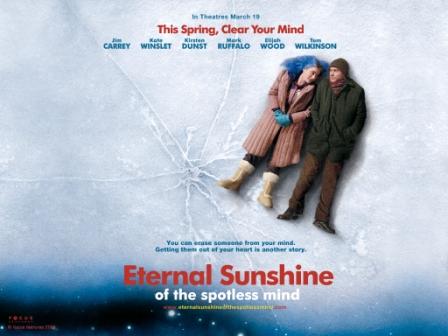
Eternal Sunshine of the Spotless Mind (2004) DVD

How happy is the blameless vestal’s lot!
The world forgetting, by the world forgot.
Eternal sunshine of the spotless mind!
Each pray’r accepted, and each wish resign’d.
          – Alexander Pope, “Eloisa to Abelard


**

Summer is the best time for me to catch up on movies I have missed in recent years.  Eternal Sunshine of the Spotless Mind is one of them.  I have long admired the title of this movie, and wondered who made it up and what it could possibly mean.  Well, I finally made the move and bought the DVD.  After watching it I gave out a sigh of contentment, “Of course!”

It is a challenge to write a review of this movie without spoiling the enjoyment of those who haven’t seen it.  But just let me say this Oscar Best Original Screenplay (2005) is one of the most ingenious in years.  Screenwriter Charlie Kaufman, of Adaptation (2002) and Being John Malkovich (1999) fame, teamed up with director Michel Gondy and screenwriter Pierre Bismuth, and created a wonderful and fresh look at a love story.

If science could allow you to erase any bad memories, which ones would you delete?  This is the premise of the film.  Two individuals, Joel Barish (Jim Carrey) and Clementine Kruczynski (Kate Winslet) met each other at a friend’s party and fell in love.  As with all relationships, they went through ups and downs, experiencing the exhilaration that love could bring, as well as the humiliation it could unleash.  Given the convenience of technological advancement, they elected to erase each other from their memories when their relationship turned sour.

What follows is nothing short of a visual treatise on the conflict between scientific advancement and what it  means to be human, but well embedded in an intelligent sci-fi comedy, evoking the minds of Nietzsche and Pope.

The fine script is augmented by the excellent acting of the cast.  I’m not a Jim Carrey fan, but I’ve particularly enjoyed his more ‘serious’ roles, like in The Truman Show (1998 ) and here in ESOTSM.  He has given a superb performance as the sullen Joel Barish.  Kate Winslet is convincing as the wild and intuitive Clementine.  Their amiable chemistry draws out some great performance from each other.

The rest of the cast is also fun to watch.  Kirsten Dunst (Marie Antoinette, 2006), Tom Wilkinson (Michael Clayton, 2007), Mark Ruffalo (Blindness, 2008 ), and Elijah Wood (The Lord of the Rings, 2001-2003), all lend exceptional support to the main characters.

Other than the acting, the movie also benefits from some excellent editing and technical expertise.  The switching back and forth in time, and the juxtaposition of memories with the present, and imagination with reality, is superbly intertwined.  On first viewing, one may find it a little confusing.  However, as the movie finishes, one would definitely want to watch the beginning again.

I was much gratified to see the story come to an ingenious end.  With love, bad memories are better than no memories.  As I was watching, a movie quote from another film came to mind:

The things that people in love do to each other they remember, and if they stay together it’s not because they forget, it’s because they forgive.

It is uplifting to be reaffirmed that being human encompasses the various subjectivity of experiences, be they sad or joyous.  And forgiveness and love may well be some of the loftiest ideals humanity could ever pursue.

The DVD comes with some excellent special features including behind-the-scenes look at the production, a conversation with Jim Carrey and director Michel Gondry, feature commentary with Michel Gondry and writer Charlie Kaufman, a music video, deleted scenes, and a neat little surprise.

~ ~ ~ Ripples


Sketches of Frank Gehry (2005) DVD


“You can look anywhere and find inspiration.”

—- Frank Gehry

The past couple of months I’ve been tied down with previewing films for an upcoming International Film Festival that I haven’t time to watch films of my own choosing.  The past weekend I decided to cease the dry spell and watched the DVD I’ve purchased for a long while but haven’t the chance to view.  My only regret: Why did I wait so long?

This is a documentary about and made by two of my favorite artists:  Architect Frank Gehry and film director Sydney Pollack (Best Director 1985, Out of Africa), whom I sadly miss upon his untimely passing on May 26.  (To read my tribute to Sydney Pollack, click here.) Pollack worked on this film, his first documentary, over weekends
for about five years.  An official selection at the 2006 Cannes Film Festival, Sketches of Frank Gehry is his last directorial work.

Pollack has taken a simple and casual approach to present his long time friend Frank Gehry to the viewer, and that’s what impresses me.  The low-key yet artistic design of the film is a modest portrait of the architect whose body of work is often associated with rule-defying, bold and striking structures around the world.

Born 1929 in Toronto, Canada, Gehry moved to the United States with his family in 1947. His career spans four decades, establishing himself with renowned projects such as the Guggenheim Museum, Bilbao, Spain (1997), the Vitra Design Museum, Germany (1989), and more recently the Walt Disney Concert Hall, L.A. (2004). The personal and unpretentious portrayal of the architect brings out the mild and human side behind these massive physical structures.

Through informal dialogues, the filmmaker effectively captured the essence of artistic pursuit: the self-doubt during the creative process, the incubation and collaboration of ideas, the uncertainty of the soundness and appeal, and the ultimate exhilaration of the successful completion and reception of the work. Interestingly, the film works like a double-edged sword.  It explores the creative process of both the subject and the filmmaker.  And it is such revelation that makes the documentary so appealing.

In the beginning was the void:

Sydney:  Is starting hard?

Frank:  You know it is… I’m always scared that I’m not gonna know what to do.  It’s a terrifying moment.  And then when I start, I’m always amazed, “Oh, that wasn’t so bad.”

The veteran director had his uncertainties as well:

Sydney:  Several people approached him with the idea of making a documentary about him.  And when he asked me if I’d do it, I thought he was crazy.  Not just that I didn’t know anything about making documentaries, I don’t know anything about architecture.

“That’s why you’re perfect,” he said.

Maybe all our training and experience that we hang on to so dearly are impediments to a fresh, new perspective.

The film gives us the insider view of the Gehry creative process.  It is a collaborative effort involving inputs from design partners mulling over paper models and computer expertise transferring concepts to 3D digital mode. Despite the elaborate and sometimes long incubation period, every piece of work begins with the architect’s own signature squiggles on a blank piece of paper.

We see Pollack using a hand-held digital camera to capture more agile and personal shots. As the title suggests, the filmmaker interviewed and chatted with various artists, architects, critic, and even Gehry’s therapist to gain different perspectives into the heart and mind of the architect.  He was able to elicit some insightful comments.

Writer and curator Mildred Friedman has this to say about Gehry:

He’s an architect who’s also an artist.  He takes so many risks.  And that’s what artists do.  Artists take risks to do something new that no one has seen before.

Gehry’s therapist Milton Wexler:

A great many people come to me hoping they can change themselves, settle their anxieties, their problems, their marriage or whatever…  When an artist comes to me, he wants to know how to change the world.

And from Pollack, when talking about the epic and mythical Guggenheim Museum, Bilbao, Spain:

He sees that the whole reason for being an artist is that moment in somebody’s eyes when you reach him.

The nay-sayer is represented by Hal Foster, Professor of Art and Archaeology, Princeton University, who criticizes Gehry of making a spectacle of his work.  We also see montage of printed words from the media, such as “ugly”, and even “perverse”.

Responding to criticisms about Gehry’s galleries and museums competing with the very exhibits they showcase, Julian Schnabel, artist and filmmaker (The Diving Bell and the Butterfly, 2007), defends Gehry’s design with this audacious sum up:

I feel very comfortable in his spaces.  He understands scale.  And if it does compete with the art, maybe that art isn’t good enough.

Such thought-provoking comments are just some ideas one can mull over long after the film.

I must also mention the original score composed by Sorman and Nystrom.  Like a soothing balm, it is pure delight looking at Gehry’s fluid designs with the equally flowing and meditative musical rendering.

The special features on the DVD include a bonus 35 minutes interview and audience Q & A with Sydney Pollack at the L. A. Premiere of the film.  The icing on the cake, this feature offers Pollack’s reminiscence of the production and more thoughts on the creative process.  A valuable DVD to keep for anyone interested in the artistic expression of the human mind.

~ ~ ~ ½ Ripples

A note on the photos:  Arti has the pleasure of visiting two of Frank Gehry’s work.  The above photos are taken by Arti in October 2007 and February, 2008. The first two are the Walt Disney Concert Hall in L.A.  The last two are different views of The Peter B. Lewis Building at Case Western Reserve University in Cleveland, Ohio.  All Rights Reserved.

The source for the squiggles image:  Maclean’s Magazine.

The Ripple Rating System

At long last, a clarification on the Ripple Rating System.

First, some FAQ.

Q:  Why do the movies you review on your blog mostly get 3 Ripples, only a few 2.5 Ripples, and very few 4 Ripples?

A:  I love films, but my time is also precious.  So I usually pick those which I think I’ll enjoy, or which I’m curious about before I go see them.  I’m a selective movie goer, as most people are.  The same is true for readers picking which books they’ll read, or music lovers which song to buy…The ratings reflect whether I’ve made the right choice, in a way.  So far, I haven’t come across many that compel me to give 4 Ripples… but there are a few…

Q: How do you know which movies you’ll enjoy?

A:  I read about them, know the background first…sometimes, I go to the source material and read the book on which a movie is based.  I particualrly like to do this because I’m interested in the process of turning Book Into Film … Other times, I go to see the movie first, and then read the book if I am particularly moved.

Of course, the Ripples reflect personal resonances.  Nevertheless, they are given after considerable critical analysis and evaluation, and hopefully do not come out as mere impulse.  They might stir up ripples among my readers too, and that’s what the comment box is for.

I like NY Times movie critic A. O. Scott’s statement in his introduction to the book The New York Times Guide to the Best 1,000 Movies Ever Made:

This collection is more likely to start arguments than to settle them, argument being one of the solemn duties of criticism and, more importantly, one of the great pleasures of movie-going.”

You are welcome to express your opinion. But please comment in a way that shows your respect for other readers and yourself.

So here it is, Arti’s Ripple Rating System explained:

~ Ripple               = Stay away, I did

~ ~ Ripples         = Manage your time better

~ ~ ½ Ripples     = Average, Okay

~ ~ ~ Ripples     = Good, worth seeing

~ ~ ~ ½ Ripples  = Superior, must-see

~ ~ ~ ~ Ripples  = Almost Perfect

Emma: Miss Woodhouse Regrets

UPDATE:  To read my posts on the new BBC production of Emma (2009, TV), Episode 1 CLICK HERE.Episode 2 CLICK HERE... Episode 3 Conclusion CLICK HERE.

.

Andrew Davis created another proficient and loyal adaptation of Austen’s work, a year after his success with Pride and Prejudice(1995).  Emma (1996 TV) shown on PBS last night is effectively written for the screen, bringing out all the crucial scenes in congruent sequences. Great acting from all, except I must say, Mark Strong’s Mr. Knightly seems to be a bit too severe and lacks the forbearing and benevolent nature he possesses in the book. Maybe because of that, Kate Beckinsale is a more subdued Emma, less spriteful as Gwyneth Paltrow’s portrayal. I have enjoyed Olivia Williams as Jane Fairfax and Samantha Morton as Harriet Smith, who is more appropriately cast than Toni Collette in the 1996 movie.

“I am going to take a heroine whom no-one but myself will much like.”  –Jane Austen on Emma

Is Emma such a despicable character that Jane Austen thought no one but herself would much like?

At first, I thought so. Emma is manipulative, imposing and snobbish. In her pride, she has toyed with Harriet’s emotions, misdirected her path, and dominated her decisions. In her blindness, she has misjudged intentions and at times, behaved disdainfully. If Lady Catherine were around, her words targeted at Elizabeth Bennet would be most appropriate here: “Obstinate, headstrong girl!”. Lizzy would also decry: “Insufferable!”

But, why did Jane Austen still like her?

In her ingenious style, Austen has led us in a most gratifying way, to see our heroine regret. Emma is not a perfect human being. Far from it. She probably has more ingrained flaws than most of the other characters in the story. However, that is the way our beloved author likes to sculpt her heroines: making them earn their respect by their mending their ways. And she knows how gratified her readers must feel to see Emma enlightened and humbled. By showing a regretful and corrected Emma, Jane Austen has aligned our views with hers, helping us to appreciate our heroine as a respectable character who is not afraid to own up to her blunders.  Emma’s tears of regret have melted our hearts away.

Moreover, and most importantly I think, Austen has inconspicuously led us to see Emma from the eyes of Mr. Knightly towards the end of the story. Mr. Knightly has been Emma’s moral compass and benevolent mentor. While he can see her errors clearly, and does not hesitate to correct and admonish, he is also ready to forgive. He has chosen to love her from a distance while she is still an immature and self-deluded girl, albeit an imaginative one.

At the end, we are rewarded to see Emma gaining self-understanding:

“I seem to have been doomed to blindness.”

Hearing Knightly’s declaration of love, the undeserved euphoria is unspeakable. But of course, Mr. Knightly sees it otherwise:

“I have blamed you, and lectured you, and you have borne it as no other woman in England would have borne it.”

His kindness and love for Emma compel him to still give her credit in her most self-deprecating state. In his eyes, she is ‘faultless in spite of all her faults’.

So, from Mr. Knightly’s point of view, we’ve come to appreciate a very human Emma, humbled by experience, regretful of her ways, and in the end, ever so ready to change. After all, it’s about time that a blissful match is made for herself.

******

Update:  You can read this article as well as other interesting and informative articles on Jane Austen and the Regency Period in the Jane Austen Centre Online Magazine.

Enchanted (2007, DVD)

I consider myself a rational person.  As an armchair critic, you have to, right?  Analytical, critical, not easily moved… But when it comes to humor, I just can’t resist.  I have to admit, I tried to control myself from laughing out loud many times, and not embarrass myself among all the preschool kids and their parents in that matinee show, even though it was dark there in the theatre.

Note to myself:  get the DVD when it’s out.  And so I did.

Why am I enchanted?  First of all the movie.  It’s loaded with smart dialogues, humorous parodies, seamless fusion of animation and real characters, and an old-fashioned and yet still wise message for today.  And the cast,  sure looks like they are having the time of their life making the movie. And the Oscar nominated songs by Menken and Schwartz, with the huge conglomeration of dancers, a delightful revival of the old musicals of the heydays.

Enchanted is a classic fairy tale: An evil queen, afraid of being dethroned, tries in all her power to prevent her stepson from marrying his true love by banishing her to the real world of modern day New York City, where there are no “happily ever afters”, a punishment indeed.  While there, the fairytale maiden meets her real life prince…and so on and so forth…But, what’s not typical is that it’s being handled intelligently, thanks to an excellent script, and the talented technical support it receives.

Amy Adams, Patrick Dempsey,  James Marsden, and Timothy Spall all deliver lively and very gratifying performances. Also, Susan Sarandon as the wicked Queen Narissa…I say, she’s in character.  And the then 8-year-old Rachel Covey, the cutest child star I’ve seen in movies these years. This is only her second movie, but she’s a natural, that is, she doesn’t need to act. She can just stand there and be adored.

The DVD is packed full of fun and information. We have a Carrie Underwood music video “Ever Ever After”, an additional animated story, bloopers, and director Kevin Lima commenting on the deleted scenes. I’m most fascinated by the behind the scene look at how the songs and the musical scenes are produced.  It’s fascinating to watch how choreographers have to coordinate hundreds of performers involving gymnastic troops, stilt walkers, eclectic groups of dancers and multicultural musicians in the “That’s How You Know” scene in Central Park.  I’m most impressed to find a few of them are veteran dancers who had appeared in the classic movie West Side Story (1961) and one was a chimney sweeper in Mary Poppins (1964)!  I’m thinking…Can I even get out of my bed when I’m at their age?

Great family entertainment for the Easter break coming up.  In a world of dysfunctional relationships, no wonder I am enchanted by a movie painting couples reconciled, yes right in the divorce lawyer office, and lovers united after swashbuckling adventures in the hustle and bustle of New York City. 

Just don’t remind me it’s only a fairy tale.

~ ~ ~ Ripples

3:10 to Yuma (2007)

How many movies have inspired you to read the original book or story right after you’ve watched it? You might think of films like The Kite Runner, Atonement, or Away From Her. But a cowboy flick?

Yes, it sure did for me. And while I’m still looking for Elmore Leonard’s book Three-Ten to Yuma and other stories to read his short story, the source material for this film, I can’t wait to write the movie review. It’s also timely because of the recent release of the DVD.

This is one film that should have received a lot more attention at the Oscars. It got two nominations, one in Original Score, the other in Sound. Well it did get a nod from the Screen Actors Guild for an Outstanding Performance by a Cast in a Motion Picture nomination. It’s also a nominee for Best Picture and Best Supporting Actor (Ben Foster) Satellite Awards.  But if it’s being touted as the best Western since Unforgiven, then why aren’t there any more commotion? Anyway, I’m here to stir some ripples.

This is a modern remake of the highly acclaimed 1957 movie with Glenn Ford. I missed that one. This new version sees Russell Crowe, Christian Bale, Ben Foster and Peter Fonda join hands to create an action movie with a heart and mind. In a way, it’s one typical western, with gunslinging outlaws, headed by the notorious Ben Wade (Russell Crowe), aided by his despicable right-hand man Charlie Prince (Ben Foster), a defenceless cattleman (Christian Bale) and his family, and a few lawmen pathetically trying to enforce some sort of law and order.

I’m captivated by the riveting sequences and twists of the plot leading to the engrossing climax at the end. Anything typical is only a backdrop for the ultimate moral dilemma it sets up for its main characters. Basically it’s a duel of will and conscience for Crowe and Bale. 15 year-old Logan Lerman is right on a par with these two veteran actors.

The movie surprises me with the intense and deep depiction of psychological battles, internal conflicts, and moral choices one has to make in the face of life and death. Its fast action scenes, effective camera works and great acting from the whole cast mask the deeper issues the story is challenging us to ponder: What makes a man? What is the most important legacy a father can leave to a son? I say mask because you think you’re just watching, but actually you’re thinking. How we need this kind of movies these days. The poignant ending is what makes the film beautiful and rewarding.

From Jane Austen to Elmore Leonard…it’s all about life.

~ ~ ~ Ripples

Pride and Prejudice (1995 TV)

Colin Firth and Jennifer EhleIs it coincidental that PBS has chosen, of all the six Jane Austen adaptations, to air Pride and Prejudice the Sunday before Valentine’s Day? I think they must have strategically placed it there, knowing that this novel is one of the most-loved books in literature, as the results in recent polls have shown. They must have known that Pride and Prejudice is ranked the third most reread books in Britain, and first in a poll on books that people in the British nation can’t live without.

Other surveys reveal similar results. In a 2003 BBC poll, Pride and Prejudice ranked second as UK’s favorite book. In 2007, it ranked first.

Only in Britain, you might say…but it seems like this is a phenomenon across countries.

In Australia, Austenmania and Janespotting are the common terms to describe this unprecedented occurrence since the mid 1990’s. The Pride and Prejudice miniseries (1995) broke TV ratings, books and sales records.

Jane Austen takes an international stance as it goes multicultural. In Bride and Prejudice (2004), the best-loved Austen novel received a dashing Bollywood makeover. Which country doesn’t have its own class system and prejudice? The movie has also put Aishwarya Rai (with Colin Firth in The Last Legion, 2007) on the world map.

Most recently, Venezuelan director Fina Torres is getting ready to film Sense and Sensibilidad, with screenplay by Mexican Luis Alfaro. Locations of filming will be in Mexico and East L.A., and to be released at the end of 2008. If Jane is around she would be much gratified and amused to see her books gaining such a multi-cultural following.

Just last Friday, the February 8th issue of the Taiwan-based (North American East Edition) Chinese Newspaper World Journal has a full-page coverage on Jane Austen and her many movie and television adaptations.

In the cyberworld, as recent as this past week, Project Gutenberg ranks Jane Austen as the third most downloaded author in the past 30 days after Mark Twain and Charles Dickens, while Pride and Prejudice is the most downloaded Austen books.

But of course, statistics are irrelevant when it comes to matter of the heart.

We who love Austen’s works and in particular, for me, Pride and Prejudice, will continue to reread the book and rewatch this TV miniseries regardless of what the polls show. Different people might find different reasons for its appeal. But I, for one, feel that Austen has created through Elizabeth Bennet and Fitzwilliam Darcy the ideal (note: not perfect) woman and the ideal man. I see in them the essential ingredients of relationships, with oneself, and with others: respect, compassion, kindness, generosity, hope, and grace, but above all, the willingness to change and be transformed for the better. I’m much grounded to expect perfection in the human world, but through Austen’s depiction I can cherish and admire the ideal.

With Valentine’s Day drawing near, and with our world unfolding as it is, cherishing the ideal could well be the key to help us build a more beautiful tomorrow.

*******

Click here to go directly to Pride and Prejudice: Part 2.

Click here to go to Part 3, The Finale of Pride and Prejudice (1995 TV).

Away From Her Movie Review

Update March 4: Away From Her won 7 Genie Awards last night in Toronto, Canada.  Among them are Best Picture, Best Director, Best Actor, Best Actress, Best Supporting Actress, and Best Adapted Screenplay.

In light of all the awards Julie Christie is garnering in this Awards Season, first winning the Best Actress Golden Globe, then getting an Oscar nod, and just now winning the Screen Actors Guild’s Best Actress Award all for her role in Away From Her, plus director Sarah Polley’s Oscar nomination for Best Adapted Screenplay, I’m re-posting here my review of the movie I wrote 8 months ago in May, 2007.  For those who missed the movie released in theatres last year, it’s timely to read the review and watch the DVD of this beautiful Canadian film, in preparation for the Oscars coming up February 24, 2008.

Away From Her

Away From Her (2006)–How can you turn a good short story onto the screen without compromising its quality? … By turning it into a screenplay written by an equally sensitive and passionate writer, and then, through her own talented, interpretive eye, re-creates it into a visual narrative. Along the way, throw in a few veteran actors who are so passionate about what the script is trying to convey that they themselves embody the message. Such ‘coincidents’ are all happening in the movie Away From Her.

Sarah Polley has made her directorial debut with a most impressive and memorable feat that I’m sure things will go even better down her career path. What she has composed on screen speaks much more poignantly than words on a page, calling forth sentiments that we didn’t even know we had. As Alzheimer’s begins to take control over Fiona, what can a loving husband do? Julie Christie and Gordon Pinsent stir up thoughts in us that we’d rather bury: how much are we willing to give up for love, or, how would we face the imminence of our loved ones’ and our own mental and physical demise.

Based on the story by Alice Munro, ‘The Bear Came Over the Mountain’, Polley brings out the theme of unconditional love not with your typical Hollywood’s hot, young, and sexy on screen, but aging actors in their 60’s and 70’s. It may not be as pleasurable to watch wrinkled faces hugging and kissing, or a man and a woman in bed, bearing age spots and all, but such scenes effectively beg the question: why feel uncomfortable?

Why does love has to be synonymous with youth, beauty, and romance? It is even more agonizing to watch how far Grant is willing to go solely for love of Fiona. Lucky for us, both writers spare us the truly painful at the end. It is through persistent, selfless giving that one ultimately receives; and however meager and fleeting that reward may seem, it is permanence in the eyes of love. And it is through the lucid vision of a youthful 27-year-old writer/director that such ageless love is vividly portrayed….Oh, the paradoxes in life.

~ ~ ~ Ripples

***

Congratulations Julie Christie!

Julie Christie

Update Jan. 28: Julie Christie has just won the Screen Actors Guild Award for Best Actress for her role in Away From Her last night in L.A.  Congratulations again!  

Update Jan. 22: Julie Christie has just been nominated for a Best Actress Oscar for her role in Away From Her, and Sarah Polley for Best Adapted Screenplay.  Sarah:  Dreams do come true! For a full list of Oscar Nominees, click here.

A glamourless Globe for Best Actress (Drama) went to Julie Christie, how fitting!  A no-nonsense recognition for some no-nonsense acting for her role as Alzheimer sufferer Fiona in Sarah Polley’s Away From Her.

Once described by Al Pacino as “the most poetic of all actresses” Julie Christie’s movies have been cinematic icons of an era: Darling (1965), Doctor Zhivago (1966), Fahrenheit 451 (1966), Far from the Madding Crowd (1967), The Go-Between (1970)…Yet, at 66, she has downplayed her achievement and shunned the attraction of fame and celebrity.

Christie has long avoided the glitz and glamour of stardom, appearing in only a selectively few films, evading the limelight that could have been hers.  In an interview with the New York Times last year at the release of Away From Her, she was asked about her name as a legend. Christie responded:  “I have no connection with that person at all…that person has gone.”

The British actress could have it all, if she had embraced such a life, but she chose to devote her time and passion to social activism and political causes.  Living almost reclusively away from the public eye for the past decades, Julie Christie just might not show up at the Golden Globe ceremony even if there were one. 

…but then, she probably would though, for her young Canadian friend Sarah Polley.  Christie wouldn’t want to miss the chance of bringing honor to Polley’s directorial debut, having met her while filming No Such Thing (2000) together.

Polley wrote the screenplay Away From Her, based on Alice Munro’s short story “The Bear Came Over the Mountain”.  As she was writing, she had in mind Julie Christie and Canadian veteran actor Gordon Pinsent playing Fiona and Grant.  At first, expectedly, Christie turned her down. But finally, Polley’s persistence over the years paid off.  At 28, Polley was inspired enough to pull together two veterans in their 60’s and 70’s to make a film about old age, love, loss, and Alzheimer.


Sarah Polley 


Sarah Polley once said about Away From Her in an interview:

“I don’t’ think that there’s any chance that I would get nominated. I mean I really hope that the actors have a shot at it …it would be such a dream come true if they were acknowledged…”

In a recent interview with The Toronto Globe and Mail, Polley felt ‘strange’ and ‘surreal’ about the recognition the $4.5 million production has received.

Of course she was delighted with Christie’s win, she also added:

“If there’s any note of reluctance on my part – of not enjoying all of this fully – is that Gordon’s performance is also stunning … and I just don’t want his work in the film to be undervalued.”

Ooh…it’s satisfying seeing the humble exalted…To both Julie Christie and Sarah Polley, Congratulations! I hope to see more nominations and awards coming your way at the Oscars.  

The Message of Christmas

Hopefully by now, the dust has settled, and frantic frenzies can now be turned into some placid ponderings…

A Charlie Brown Christmas (1965 TV) remains my all time favorite Christmas special.  Charles Schulz has wittingly shrunk all humanity into his pint-sized Peanuts gang.  Aren’t we all but tiny specks in the vast universe, and yet our strives and questions are ever so close and immediate.

And for Charlie Brown, little did he know that by throwing up his arms and ranting his disappointment and frustration, had asked the existential question for us all:  “Isn’t there anyone who knows what Christmas is all about?”

And for Linus, little did he know that by answering this question, had delivered not only the Message of Christmas, but the crux of Christianity, pointed us all, the peanuts of the universe, to the way of reconciliation and redemption.

…Out of the mouth of babes (Psalm 8:2)…

A blessed Christmas to all!