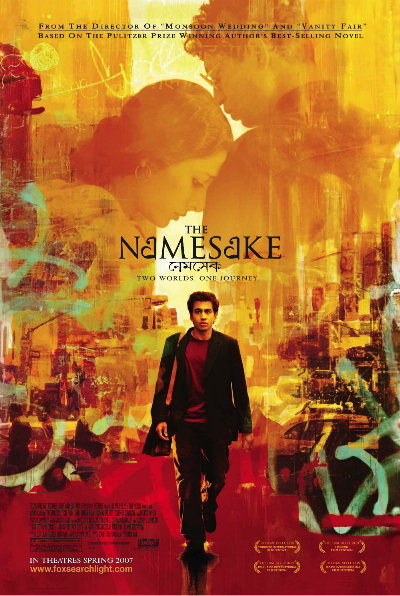
The Namesake (2006, DVD): Movie Review

This is a sequel to my last post, Book Review of The Namesake by Jhumpa Lahiri.  These back-to-back write-ups form my second instalment for the Read the Book, See the Movie Challenge over at Ready When You Are, CB.
“If it weren’t for photography, I wouldn’t be a filmmaker.  Every film I make is fuelled by photographs…. Photographs have always helped me crystallize the visual style of the film I’m about to make.”

—Mira Nair

And photography has brought to life the poignant novel The Namesake.

This is a perfect match.  The Namesake film adaptation is privileged to be crafted in the hands of the accomplished director Mira Nair, and its screenplay written by the multi-talented Sooni Taraporevala.  Both born in India the same year, grew up and educated there, later both had attended Harvard.  After earning her Masters at NYU majoring in Film Theory and Criticism, Taraporevala moved back to India and pursued a successful career in photography and other artistic endeavours. Mira Nair went on to become an acclaimed filmmaker and professor of Film at Columbia University.  Nair and Taraporevala collaborated on several films that have garnered international nominations and awards, including Cannes, Venice, BAFTA, and the Oscars.

The pair could have been characters taken right out of Jhumpa Lahiri’s stories.  They must have known from personal experience the realities of Lahiri’s stories, the feelings of being transplanted, the quest for identity.  As a result, they have effectively brought into visualization the internal worlds of Ashoke, Ashima, Gogol and Moushumi.  It is interesting to hear Nair describe herself as “a person who lives in many worlds”.  Every immigrant is at least a bicultural being.  Our postmodern world has only made it more and more viable to navigate across boundaries and sustain multiple identities.  The Indian meaning of the name Ashima could well have spoken to such a modern day phenomenon: without borders.

From this perspective, Nair is the best person then to take what could have been just another “ethnic movie” to a universal plane.  She has created a colorful rendition of a human story for us to enjoy.  You don’t have to be Bengali to appreciate the Ganguli saga.  Elements such as love, marriage, parent-child relation, expectations, self-fulfilment and its obstacles, the search for one’s place in the family and the world, these are all situations we can relate to.   It’s just now the issues have been explored from a different frame, offering us an alternative perspective.

I have appreciated the quiet development of love between Ashoke and Ashima despite their arranged marriage.  Their intimate husband and wife relationship is sensitively played by Irrfan Khan (Slumdog Millionaire, 2008) and the model and award-winning actress Tabu, an excellent choice in casting.  I particularly admire Tabu’s gentle and elegant poise.  It’s interesting to see how the two exchange deep sentiments by wordless, nuanced expressions and body language.

The treatment of the story in the hands of a visual artist understandably would be quite different from its original literary form.  Instead of the sombre tone, Nair has given the story a lively adornment, sustained by animated characters.  Nair’s Gogol is a more outgoing young man than that from the book, and I’m fine with that.  Kudos to Kal Penn’s portrayal of  Gogol/Nick Ganguli, an interesting performance fusing youthful energy and wistfulness at the same time.

Yes, that’s Kal Penn of the stoner movies Harold and Kumar fame (2004, 2008, and coming 2011) A much more serious role here in The Namesake.  A lively Gogol is only natural and fun to watch, for he is an American born young man who just wants to belong.  So we see him being impatient with his father’s restrained and non-communicable composure, we see him playing air guitar to loud music in his room, we see tender moments when he teases his younger sister Sonia, or the natural comedic look on his face, culture shocked during his family trip back to Calcutta, and we see his romance with Maxine (Jacinda Barrett, New York, I Love You, 2009), the American girl who is so oblivious to the cultural baggage he is carrying.

But Kal Penn has earned his role.  He wrote to Nair earnestly seeking for the part, telling her that The Namesake is his favorite book and often times, he would use the pseudonym Gogol Ganguli to check in hotels.  Some method acting, who’d have known he’s in character all along.

The bonus with watching a DVD is of course the special features.  The Namesake is a keeper if you’re into the creative process of filmmaking.  My favorite featurette is The Anatomy of The Namesake: A Class at Columbia University’s Graduate Film School in which Nair and other crew members engage in conversation with film students about the making of the movie.  Other wonderful featurettes include Photography as Inspiration, and Fox Movie Channel interview In Character with Kal Penn.

Overall, a faithful adaptation of Lahiri’s book, offering an entertaining, visually inspiring rendition of a story deserving to be seen.

~ ~ ~ Ripples

The Namesake by Jhumpa Lahiri: Book Review


CLICK HERE to read my movie review of The Namesake (2006).

The immigrant experience.  I know it first hand, and this I’ve found: categorizing could be futile. From afar, we may look like a collective mass, like the autumn leaves that have fallen on the ground. But if you pick them up and look more closely, every single one is uniquely different.

Jumpha Lahiri’s stories belong to the academics from India.  Her setting is usually Northeast United States.  Her characters, often first generation immigrants striving to plant a career and a life on new soil, raising their children with the promise of a brighter future.  The conflicts are not only generational by often internal. This much is true for all immigrants, academics or otherwise.  But as we zoom in on a more personal level, like the single fallen leaf, we see its unique shades of color, its tarnishes, its withered edges, and we soon find that no two leaves are exactly the same.

In The Namesake, Ashima weds Ashoke Ganguli in an arranged marriage, not even knowing his name when she first met him in the betrothal.  Shortly after the wedding they leave India for Boston where Ashoke continues his graduate studies in engineering at MIT.  The adjustments for Ashima is overwhelming as a new wife in a new country.  But she finds out a year later that her duty as a wife does not pose as much anxiety as giving birth in a land unknown. Motherhood is a much more daunting challenge.

In simple language, Lahiri paints a vivid picture of Ashima’s apprehension:

“But nothing feels normal to Ashima.  For the past eighteen months, ever since she’s arrived in Cambridge, nothing has felt normal at all.  It’s not so much the pain, which she knows, somehow, she will survive.  It’s the consequence:  motherhood in a foreign land… She’d been astonished by her body’s ability to make life, exactly as her mother and grandmother and all her great-grandmothers had done.  That it was happening so far from home, unmonitored and unobserved by those she loved, had made it more miraculous still.  But she is terrified to raise a child in a country where she is related to no one, where she knows so little, where life seems so tentative and spare.”

Ashima soon gives birth to a baby boy, and she has to learn quickly a new role and its responsibilities.  But Lahiri surprises us by turning Ashima’s experience into a metaphor:

“Though no longer pregnant, she continues, at times, to mix Rice Krispies and peanuts and onions in a bowl.  For being a foreigner, Ashima is beginning to realize, is a sort of lifelong pregnancy — a perpetual wait, a constant burden, a continuous feeling out of sorts.  It is an ongoing responsibility, a parenthesis in what had once been ordinary life, only to discover that that previous life has vanished, replaced by something more complicated and demanding.  Like pregnancy, being a foreigner, Ashima believes, is something that elicits the same curiosity from strangers, the same combination of pity and respect.”

Ashoke’s story is more dramatic.  He is now teaching engineering at a university, but he has a lifelong love for literature, for it is deeply set in his past experiences.  His paternal grandfather, a professor of European literature at Calcutter University, read to him since he was a child the books of the classics.  Ashoke grew up taking to heart his grandfather’s advice:

“Read all the Russians, and then reread them,” his grandfather had said.  “They will never fail you.”  When Ashoke’s English was good enough, he began to read the books himself.  It was while walking on some of the world’s noisiest, busiest streets, on Chowringhee and Gariahat Road, that he had read pages of The Brothers Karamazov, and Anna Karenina, and Fathers and Sons… Ashoke’s mother was always convinced that her eldest son would be hit by a bus or a tram, his nose deep into War and Peace.”

I just love Lahiri’s images, fresh and surprising with a touch of subtle humour.  And Ashoke believes this to be so, the saving power of literature in its most literal sense.  As a teenager, he had miraculously survived a horrendous train crash.  Among the wreckage, rescuers found Ashoke clinging to life, his hand clutching a torn page from a collection of short stories by Nikolai Gogol, a book he was reading as the accident occurred.

The thrust of the story in The Namesake rests on this narrative.  It is understandable then that Ashoke commemorates such a miracle by naming his son Gogol.  At first it is meant to be an intimate pet name used only by family members.  It soon turns into a legal name.  So now Gogol is a name with two distinct sentiments: privately, it evokes endearments, but in public it only generates awkwardness.  As he grows older, the name Gogol Ganguli begins to sound more and more strange, it is neither fully Indian nor Russian.  It has become an embarrassment and even a laughingstock as he steps out into the adult world of America.

Upon high school graduation, Gogol chooses to go away to Yale as opposed to the closer campus of MIT, and take up architecture instead of engineering, all against his father’s wishes. Above all, to his parents’ disappointment, he decides to legally change his name to Nikhil. Unlike them, the need to belong has taken priority over the maintenance of cultural roots for Gogol.  A name change is the best way to a new identity and a fresh start, away from home and lineage. Oblivious to him though is the very cause and meaning behind that name, Gogol, a saving miracle that has given his own father a new leash on life.

For Nikhil, life unfolds in unexpected turns.  He soon realizes that a name change does not necessarily usher in a new self.  There are deep sentiments and ties that cannot be severed by mere outward re-labelling.  Nikhil drifts in and out of relationships striving to connect.  The family of his American girlfriends only confirms the drastic cultural differences in contrast to his own.  Intimacy with them burdens him with a sense of betrayal of his own family.  And yet, he longs to establish himself in the country of his birth, a land still considered foreign soil by his parents.

The sudden death of Ashoke has shaken up everyone in the family, and brought the scattered members together again, Ashima, Gogol and his younger sister Sonia.  The crisis presents a turning point for Gogol.  He begins to rediscover his cultural roots and his duty as a son. Hidden memories resurface to nurture a belated father-son relation.

Upon Ashima’s suggestion, Gogol reunites with a childhood friend of the family, Moushumi, now a PhD candidate of French literature at NYU.  A short time later they get married to the delight of both sides of the family.  Sadly, the marriage of two individuals with a common cultural heritage does not necessarily mean a blissful union.  Lahiri sensitively explores the complex issues and the sometimes unresolved conflicts of identity, expectations, and personal fulfillment, not just for Gogol, but Moushumi, and Ashima as well.

Lahiri is a cultural transplant herself, an experience I presume that has offered her the lucid perception and authority in crafting her stories. Born in London to Bangali parents, her family moved to Rhode Island where she grew up.  After graduating from Barnard College, Lahiri went on to Boston University, where she received her masters degrees in English, comparative literature, and creative writing and later her PhD in Renaissance studies.

Lahiri received the Pulitzer Prize in 2000 and later the PEN/Hemingway award for her first book The Interpreter of Maladies, a collection of short stories.  The Namesake is Lahiri’s first novel, published in 2003 to high acclaims.  Her third work Unaccustomed Earth, also a celebrated short story collection, won the Frank O’Conner Short Story Award among other recognitions.

The Namesake by Jhumpa Lahiri, published by Mariner Books, Boston, 2004.  291 pages.

~ ~ ~ Ripples


****

CLICK HERE to read my next post The Namesake (DVD, 2006): Movie Review.

CLICK HERE for an interview with Jhumpa Lahiri talking about The Namesake and her own immigrant experience.

CLICK HERE for my review of Unaccustomed Earth.

Another Year (2010)

Update Feb. 10: Leslie Manville just won British Actress of the Year at the London Film Critics’ Circle Awards.

Update Jan. 25: Mike Leigh is nominated for an Oscar for Original Screenplay.

Update Jan. 18: Another Year is nominated for a BAFTA for Outstanding British Film of the Year, and Leslie Manville for Best Supporting Actress.

“Ah, look at all the lonely people.”

— ‘Eleanor Rigby’

Every DayAnother Year, film titles like these evoke the oblivious passage of time, and the human experiences that float down the stream of life. The kind of films we would find in art-house cinemas, not your fast-paced action or effects-generated spectacle.  Another Year would gratify one’s need for slow ruminations and offer one time to savour the dynamics among characters.  The film was on my ‘must-see’ list at the Calgary International Film Festival 2010, which ended last weekend.  It had met all my expectations and offered more.

What’s more is the excellent performance from a high calibre cast of British actors.  Their nuanced portrayals of characters convey emotions unabashedly, but in a deep, restrained and unsentimental manner.  That is what makes Another Year so satisfying.  I enjoyed it much more than director Mike Leigh’s previous title, equally acclaimed Happy-Go-Lucky (2008), in which Poppy (Sally Hawkins) the happy gal is just a bit too loud and even obnoxious for me.  While here in Another Year, Tom and Gerri are the happy couple whose relationship is one of mature, quiet and gentle bliss, compassionate towards themselves and others.

Framed in the passing of the four seasons, the film explores the realities of life: ageing, loneliness, death, love, marriage, friendship… Yet the occasional animated and humorous renderings of the characters allow a lighter way of handling the subject matters.

Gerri (Ruth Sheen) and Tom (Jim Broadbent) are a happily married couple living in London.  In the midst of the bustling city, they have their own plot of land close by their home where they work hard to grow vegetables. They bring home fresh produce to cook healthy meals and entertain guests.  Their vegetable garden is an apt metaphor for the love they cultivate in their relationship despite the busyness of everyday life. Tom is a geologist and Gerri a counsellor in a medical office. If there’s any pun intended here with their names, it would be for the very opposite effect that they are a harmonious pair whose relationship has attracted those less happy to cling on for stability and support.

Their usual dinner guest is Gerri’s office administrator Mary (Lesley Manville).  A single, middle-aged woman, emotionally fragile, alcohol dependent, and desperately seeking love and companionship. Her male version is Tom’s long time friend Ken (Peter Wight), equally miserable. A heavy smoker and drinker, Ken’s physical health mirrors his emotional state.

But why Tom and Gerri gather such damaged and dependent friends the film does not explain.  What we do see is a most gracious couple extending their lives to them. Through their interactions, we see the contrast. While we admire the almost perfect marriage, we ache for the singles, sad and lonely… as we see them in this film.  I trust the director is making a specific rendering and not a generalization on singlehood.  The contented Poppy (Sally Hawkins) in Happy-Go-Lucky (2008) is the best spokesperson for the single league.

Tom and Gerri have an adult son Carl (Martin Savage) who frequently comes home to visit his parents from a nearby town by train. When I saw the shot of a commuter train going past on screen, it flashed upon my mind the image in Ozu’s works.  That is one of the Japanese director’s signature shots, a train passing through, and his favourite subjects also being family, marriage, nuanced interactions.  I thought, if Ozu were an Englishman living today, this would be the kind of films he would make.  And lo and behold, I found this tidbit of trivia on IMDb: One of Mike Leigh’s top 10 films of all time is Tokyo Story (1953).

If one is to find fault with Another Year, it could be the very fact that Tom and Gerri’s marriage is just too perfect. But with all the ubiquitous dysfunctional families we see represented in movies nowadays, Leigh might have opened a window to let in some much needed fresh air. Tom and Gerri make an ideal contrast to what we have so sadly gotten used to seeing in films.

There are excellent performances from the veteran actors, but one stands out. Lesley Manville’s animated portrayal of the vulnerable Mary deserves an Oscar nomination. The most impressive shot comes at the end. Without giving it away, let me just say the ending shot lingering on her face and the ultimate fade to black is poignant and most effective. Of course, it’s acceptable to applaud after a festival screening. And so we did, appreciatively, a much needed channel for a cathartic response.

~ ~ ~ 1/2 Ripples

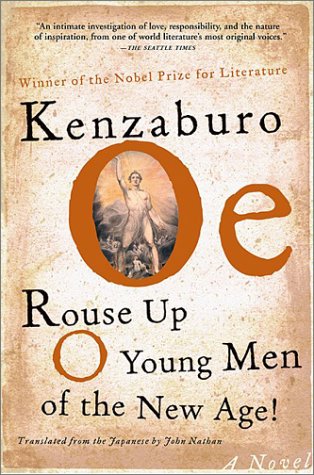
Rouse Up O Young Men of the New Age!

Thanks to Bellezza’s Japanese Literature Challenge 4, I have the chance to explore the intricate world of Kenzaburo Oe (pronounced ‘oh-ay’, 大江 健三郎 ), Japan’s second Nobel Laureate for Literature (1994), after Yasunari Kawabata (川端 康成) received the Prize in 1968.

Like his earlier work A Personal Matter*, Rouse Up O Young Men of the New Age! is an autobiographical novel dealing with the author’s experiences of raising a handicapped child.  A Personal Matter was written when Oe was young, describing an ordeal still raw from the initial shock of the birth of his brain-damaged child. Rouse Up was published in 1983, almost twenty years after A Personal Matter.

Rouse Up chronicles a more mature protagonist, the writer K, who has gone past the stage of denial and escape, to come to terms with the reality of fathering a handicapped child. Through the arduous journey, the writer has gained insights and pleasure from his relationship with his son Hikari, whom he nicknamed Eeyore in his novels.

Oe starts off the book with K’s plan to write a dictionary of terms for his now maturing son, to prepare him for his entry into the real, adult world.  This turns out to be a learning task in itself.  How do you explain to a brain-damaged person what the word ‘foot’ means?  Or ‘river’, ‘life’, or ‘death’?  He needs to deconstruct the realities of his everyday life before he can grasp the essence and meaning of his encounters.

It’s interesting to see how K get through to his son in defining ‘foot’. Eeyore understands it in relation to ‘gout’ from which his father once suffered. After the healing of the pain and swelling of the gout, it has turned into ‘a nice foot’.  So, the understanding of ‘foot’ comes in light of the pain it had experienced. K soon realizes that the definitions are more for himself as for Eeyore.

The author’s long journey of acceptance and self-discovery owes mostly to his love for the works of William Blake.  Rouse Up is a smorgasbord of selections if you are a Blake scholar. So admittedly, I have had a hard time ploughing through Oe’s use of parallels from Blake’s poetic and artistic symbolisms to reflect on his own predicament.  In certain parts, Oe’s writing is just as esoteric as Blake’s mythical depictions.  However, one thing is clear.  My enjoyment of this novel is no less, and the poignancy of a father-son relationship no weaker as I find my way through the Blake maze.  The book requires and deserves multiple reading.

Despite its complexity and denseness, the essence filters through Oe’s meticulous descriptions.  Further, John Nathan’s translation navigates effectively through Oe’s nuanced and sensitive narratives.  I’m just curious as to what the original Japanese version looks like since there are numerous references and quotes from Blake.  Are they in English or in Japanese translation?

Two lines from The Four Zoas seem to have outlined K’s personal journey:

“That Man should Labour & sorrow & learn & forget, & return
To the dark valley whence he came to begin his labours anew.”

It’s a perpetual striving, not unlike Sisyphus’s effort, and yet still leads from one path to the next, prompting a renewed acceptance and offering novel discoveries on the way.

Aside from the esoteric passages of Blake’s visions, some very simple lines shine through, and they are the ones that are most moving for me:

… healing the rift with my son, I became aware of his grief through the agency of a Blake poem, “On Another’s Sorrow,” which includes this stanza:

Can I see a falling tear,
And not feel my sorrows share,
Can a father see his child,
Weep, nor be with sorrow fill’d.

One of the “Songs of Innocence,” the poem concludes with the following verse:

O! he gives to us his joy,
That our grief he may destroy
Till our grief is fled & gone
He doth sit by us and moan.

In his attempt to know more about Eeyore, K explores the power of dreams and the imagination. Using Blake’s mythological poetry and artwork, he tries to understand Eeyore’s internal world. Both he and his wife know Eeyore does not dream, but that does not preclude he does not have imagination.

Subscribing to Blake’s conviction that: “The Imagination is not a State:  It is the Human Existence itself.”, K strives in earnest to cultivate Eeyore’s imagination. Eeyore has an almost instinctive response to bird calls, distinguishing them even before he adopts human language.  As he grows older, he is drawn towards the music of Bach and Mozart.  His imagination soon finds a channel of expression in composing, an amazing accomplishment nurtured by a highly supportive and loving family.  In real life, Oe’s son Hikari is a composer.

Adopting Blake’s vision, K sees a future for father and son together in a state of grace, from Blake’s Jerusalem:

“Jesus replied Fear not Albion unless I die thou canst not live
But if I die I shall arise again & thou with me
This is friendship & Brotherhood without it Man is Not

So Jesus spoke! The Covering Cherub coming on in darkness
Overshadowed them & Jesus and Thus do Men in Eternity
One for another to put off by forgiveness, every sin.”

From coming to terms with the tragic reality of fathering a brain-damaged child, to ultimately, almost symbiotically, sharing his life with his son, is a process not short of a personal epiphany.  At the end of the novel, Eyeore has grown to be a twenty-year-old man. While still having a limited mental capacity, Eeyore has his way of exuding his own humor, love and care for those around him.  The story is a poignant tapestry weaving real-life and the visionary, through which an imagined world of reality is beautifully conceived.

As for the source of the book title, it comes as a moving episode at the end of the book.  I should keep that for you to discover.  A heart-warming finish to a poignant chronicle.

John Nathan’s Afterword is an eloquent tribute to the father, son, and the nurturing family. It is also a helpful annotation of the novel.

Rouse Up O Young Men of the New Age! by Kenzaburo Oe, translated by John Nathan, published by Grove Press, NY, 2002.  259 pages.

***

* A touching review of A Personal Matter has been posted recently by Claire at Kiss A Cloud.  Also, Mel U’s A Reading Life has posted extensively on Oe and other Japanese writers.  Of course, there’s Bellezza at Dolce Bellezza, who has hosted Japanese Literature Challenge all these years, now in its fourth term.  I thank them all for their inspiration.

eReaders, iPad, and Home Literacy

“If a cluttered desk is a sign of a cluttered mind, of what then, is an empty desk?” — Albert Einstein

.

eReaders and the iPad could well be the best house-cleaning appliances ever invented. All the clutter on your bookshelves, magazines and newspapers strewn everywhere, and even those ubiquitous household bills can all be swept under the eCarpet. Yes, even flyers, ads, and coupons, they are now online or in apps… and maps? Just bring your iPhone.

But wait, what’s with this study done by Dr. Mariah Evans, sociologist at the University of Nevada, Reno, recently published in the journal Research in Social Stratification and MobilityAccording to its abstract, the study found that:

Children growing up in homes with many books get 3 years more schooling than children from bookless homes, independent of their parents’ education, occupation, and class.

Together with her colleagues at the University of Nevada, UCLA and Australian National University, Evans studied 70,000 children in 27 countries over a span of 20 years, one of the largest and most comprehensive studies ever conducted on what influences the level of education a child will attain. The difference between a bookless home and a home with 500 books amounts to an average of 3.2 years of further education. In China, the difference is 6.6 years.

As a sociologist, Dr. Evans is concerned with helping children of rural communities in Nevada to achieve higher education. Regardless of parents’ socio-economic and educational levels, the number of books at home is the single most significant correlate of educational attainment.

I know what’s on your mind… how many families have more than 500 books in their home. Well the idea is, the more the better:

Even a little bit goes a long way,” in terms of the number of books in a home. Having as few as 20 books in the home still has a significant impact on propelling a child to a higher level of education, and the more books you add, the greater the benefit.

You get a lot of ‘bang for your book’,” she said. “It’s quite a good return-on-investment in a time of scarce resources.

In an interview which is available on MP3, Evans explains:

When you have very highly educated parents, you still get some result of additional books in the home. But you get much more of what you might call ‘bang for your book’ for parents who have little education.

So now, back to our house-cleaning issue. How would home literacy be affected if more and more books are being swept away and stored in electronic devices and less and less on our shelves and strewn on the floor? Can the neat and tidy Kindle or iPad have the same effects as a real home library or ‘literacy mess’ for a child? Can 500 books in the eReader influence a child as much as 500 books around the home? Just some thoughts for future research.

.

.

You might ask what good do mere numbers do if you don’t use them. You can’t assume usage with presence, right? Well the question is, how can you use them if they are not around?  Evans claimed that just having them there, and watching a parent read a book is significant enough. If you’re caught reading a book, you are reading a book. But if you’re caught using an iPad, you may not be reading, you could be shopping, checking your stocks, or playing video games.

As for usage, electronic gadgets tend to promote individualized activities. The traditional ways of using books just might not be as compatible with these devices, like the cuddly moments of mother and child sharing a book at bedtime (see those teeth marks on the board books), the intimacy between book and reader, the appreciation and touch, the joy their aesthetics could bring, the picking up of a pen or pencil and marking and doodling around the pages, the practice of real life literacy activities with them, both personal and communal. And oh, the pleasure of browsing in a bookstore and the excitement of looting in a book sale.

Further, home literacy is more than just books. I was involved in an ethnographic study on language learning several years ago. I spent hours in several homes of young children, observing their literacy environment. My observations included materials that could foster language development. I noted, other than books, alphabet magnets on the fridge, newspapers, magazines, calendars, recipes, personal notes, notice boards, TV guides, shopping lists, food packaging, flyers, coupons, and ‘junk mails’, any print materials exposing a child to words and writing. One parent I observed had purposely placed newspapers in the bathroom, making the printed word more accessible to her child.  The rationale behind the study was that preschool children growing up in a home milieu rich in print materials are primed for language and literacy learning long before they even begin formal schooling.

With the arrivals of eBooks and eEverything else, printed matters are on the decline. Sure, it’s not all or nothing. Printed books will still be around.  But with eBook sales now surpassing hard copies at Amazon, the trend is obvious. eReaders and iPads are definitely ingenious and convenient devices, but how would home literacy change with these gadgets? And, how would we change as a human reader? It’s not about holding on to the archaic or being a Luddite, it’s all about our future, our very human future.

Of course, I’d appreciate a clean house. But hey, please don’t touch that pile. I know exactly where to find what under which. Thanks.

***

*And, to satisfy your curiosity, how many families Evans found to have 500 or more books in their homes? In the U.S., 18%.

“Family scholarly culture and educational success: Books and schooling in 27 nations” by M. D. R. Evans, Jonathan Kelley, Joanna Sikora, and Donald J. Trelman. Published in Research In Social Stratification and Mobility, Volume 28, Issue 2, June 2010, Pages 171 – 197. Click Here to go to the article.

Top 2 Over 90

.

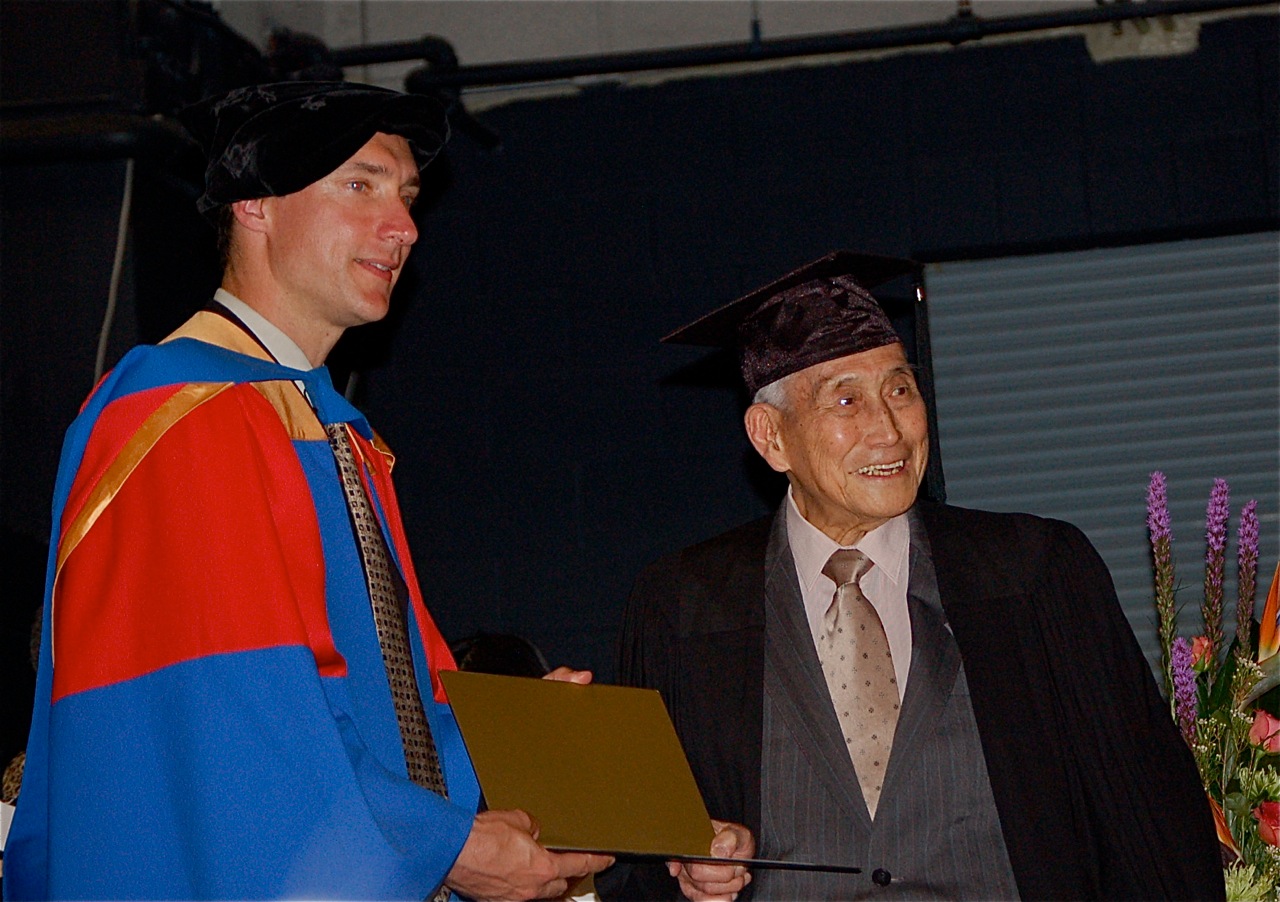
Turning 93 this October, my Dad is one of two recipients of the ‘Lifelong Learning Award’ presented to him by Dr. Scott McLean, Director of Continuing Education, University of Calgary.

In the past two years, he has taken courses from the Calgary Seniors College, co-organized by the U of C Continuing Education and the Evangelical Lutheran Church in Canada. Courses my Dad has taken include Computer, Chinese History, and Chinese Medicine.  Here’s a glimpse of yesterday’s Graduation and Award Ceremony.

No published work, no writing aspiration either.   Just a learner… for life.  Maybe that’s achievement enough.

***

Mother’s Day Picnic

Here we are, our clan of extended family, out for a Mother’s Day picnic.  The weather’s just fine, though a bit chilly.  But for a May afternoon in Cowtown, we think it’s acceptable.

.

Well you got to eat out some time.  What better day than on Mother’s Day.  Why, our human neighbors have to cook… can smell their Bar-B-Q from far.  What a chore!   Wonder if it’s their Mom who has to clean up.  As for us, even though the grass is a bit dry, at least we don’t have to deal with all that trans fat and high sodium.

.

Wait, this is just too good to pass up.

.

And an evening stroll after dinner.  Ahh… Mother knows best.

.

Hey, who’s that trying to take our pictures?  Haven’t you seen a deer family picnic before?  Oh right, not in your backyard… but, isn’t this our backyard?

*

A Note About the Photos:  Arti took them in her neck of the woods, the shared backyard with the Deer Family, on Mother’s Day, 2010.  All Rights Reserved.

***

Movies for Mom

Some good movies are on DVD now.  Great to spend the evening with mom at the comfort of home.  Here are Arti’s movie recommendations for Mother’s Day.

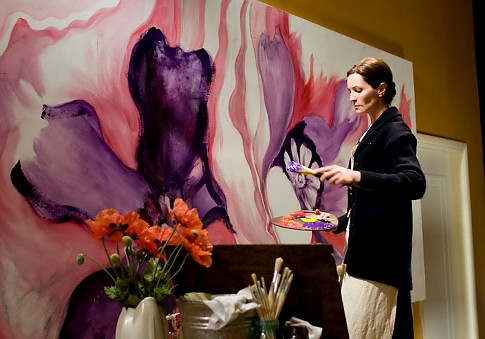
Georgia O’Keeffe (2009, TV)

.


The cinematic biopic of the great American artist stars Joan Allen as Georgia O’Keeffe, and Jeremy Irons as her husband, the photographer Alfred Stieglitz.  Both received Golden Globe acting nomination, while the movie got the nom for Best Picture made for TV.  The production is a visual delight illuminating not only the works of the artist, but her elegant poise, and her environs, especially the cinematic New Mexico landscape.  On top of the spectacular visuals, I’d enjoyed the personal narration and the quotable quotes.  My favorite: “Where I was born and where and how I have lived is unimportant. It is what I have done with where I have been that should be of interest.”  As for the tumultuous relationship between O’Keeffe and Stieglitz, is it fair to say it is a case of iron sharpening iron?

*

The Blind Side (2009)


If your mom still hasn’t seen this one, it’s a good time to watch it with her… if it’s just to give moral support to Sandra Bullock.  Like her predecessors (Kate Winslet, Reese Witherspoon, Hilary Swank, Charlize Theron, Halle Berry, Julia Roberts), winning the Oscar Best Actress just proves to be too much to handle when the consequence is marital breakdown.  And what’s this about life imitating art (ok, let’s just call it art), Bullock attempts to live her movie role with her mixed-race adoption.  One thing that she’d find I’m sure, real-life mothering will prove to be a much more demanding role than in the movies.

*

Crazy Heart (2009)


Jeff Bridges won the Best Actor Oscar as worn-out country singer Bad Blake. Spent and hopelessly alcoholic, Bad Blake is movingly revitalized by journalist Jane Craddock.  Even for one who’s not keen on country western music, I’d thoroughly enjoyed the songs performed by Bridges himself.  Song writers Ryan Bingham and T-Bone Burnett won the Best Original Song Oscar with ‘The Weary Kind’.   As a bonus, you can also hear Colin Farrell sing.  Maggie Gyllenhaal gives a convincing performance as journalist Craddock, who starts from professional interest with the country singer to deeper, personal involvement.  But ultimately, her role as mother wins out.

*

Arti’s other recommendations?  All the movies listed on the sidebar.  All of them are on DVD now.  To read my review, just click on the picture.

No matter which movie you watch with mom, do talk about it afterwards… that’s the best part of the experience.

Here’s Jeff Bridges singing the Oscar winning song The Weary Kind:

*

To all who play the real-life role of mothering: A Happy Mother’s Day!  May you all get the nod and award you deserve!

Season’s Musings

At this time of the year I always have a struggle, a fight against numbness.  The hustle and bustle of the Season leaves me striving to grasp something authentic and meaningful.  I have a hard time staying afloat the flood of packaged cheeriness, muzak in jingles or bells, ephemeral Santa’s and reindeer.   With the word “Hallelujah” almost becoming a laughable cliché, an ordinary expression for scenarios from finally finding the right gift for the family pet to paying up the Visa bill,  soon it would take a history lesson to clarify the origin of this festival called Christmas.

Intentionally or not, the Reason of the Season has been masked so not to offend, the birth of Christ replaced by themes acceptable to most cultures, like gift-giving, family reunion, ornaments, decorations, and good will towards all.  ‘Season’s Greetings’ has become the politically correct sign of the time.

On that winter night in Bethlehem, the shepherds bore no gifts. Indeed, their very presence and worship could well be the gift they offered.  Yes, the several wise men brought along gold, frankincense, and myrrh for the Christ child only, not to share among all.  For these gifts symbolized the very reason for His Advent, the infinite King debased, the lowly birth was just the beginning of a short and misconstrued life that ultimately ended in a horrific death.

The Advent, the few weeks before Christmas, is the best time for me to ponder again such a paradox.  If there is any joy or cheeriness, it comes from the initial degradation and ultimate agony of One.  It is from that vicarious suffering with humanity and the offering of substitutional death that Christmas derives its meaning for me.

A few weeks ago during a Sunday message, the name Joni Eareckson re-emerged in my mind.  I was a young teenager when I first read her tragic story.  At 17, she dove into shallow water and broke her neck, and remained a quadriplegic ever since.  I cannot imagine myself paralyzed from the neck down, having had to be lifted from bed to wheelchair for 37 years.

But what she has done sitting in that wheelchair has surpassed many able bodies. Her international ministry to people with disabilities is still thriving after 30 years.  The paintings which she has labored over inch by inch with a paintbrush between her teeth have become a testimony of perseverance, every stroke an ode to life.  Through her writing and broadcasting, Joni has become a voice and inspiration for the disabled and their families, all because she knows her suffering had been vicariously borne by the One who came just to share that pain, and redefine the meaning of life.

The hymn (Phillip Bliss, 1875) that had uplifted Joni in her most despondent hours painted not a cheery figure but a suffering Christ who came with no jingles or bells, and utterly devoid of packaging:  “Man of sorrows, what a name, for the Son of God who came…”

If you have a few minutes in this busy Christmas season, pause and take a look at this short clip.  Of all interviewers, I found Joni talking to Larry King, dated June, 2009.

Movies for Mom

If you’re reading this on a site that is not Ripple Effects, your’re reading a post that has been copied without permission. Stop reading and CLICK HERE to go to the original post written by Arti of Ripple Effects. https://rippleeffects.wordpress.com

OK, now that the little bit of housekeeping is done, we can start. Mind you, the above words are the only pink, or red, you’ll see here, because this is not your typical Mother’s Day post. I’ve checked on several Mother’s Day sites for good movie ideas. They’re all framed by pink templates. They all point you to movies as old as Gone With The Wind (1939), or as teary as Terms of Endearment (1983), or as dysfunctional as The Joy Luck Club (1993). I mean these are great, but, renting an old DVD for Mom on Mother’s Day? Hasn’t she seen enough Sleepless in Seattle (1993) on Encore Avenue?

By all means, take Mom out to the theaters to watch a movie on her special day!

And guys, you don’t have to sit there, endure and groan silently for two hours. Because here you’ll find iconoclastic, i.e., stereotype bashing, non-chick-flick-genre movies that you and Mom will enjoy watching. Who says mothers are naturally drawn to pink or chick-flicks anyway? I’m speaking from experience. Nothing can make me more proud than to have my teenage son accompany me to the movies. (Bravo to him for his boldness!) Yes, just mother and son. And nothing is more rewarding than to share an experience that we can talk about afterwards.

Here’s Arti’s list of current movie recommendations for Mother’s Day, 2009. As I said earlier, this is the stereotype bashing list, so you won’t see Shopaholic here. Thrillers, actions, sci-fi’s, dramas… who doesn’t need an adrenalin rush every now and then to keep the body functioning?

State of Play

state-of-play

An absorbing story of corruption, deceit, and investigative journalism. The movie presents an interesting scenario: the old-school investigative newspaper reporter is pitted against the fresh-out-of-college blogger, both hired by the same newspaper to draw readership, a version of PC vs. Mac on the battlefield of journalism. When the female research assistant of congressman Stephen Collins (Ben Affleck) is murdered on the day of a crucial congressional hearing, Washington Globe reporter Cal McAffrey (Russell Crowe) is drawn into the search for the truth. He has to partner up, reluctantly, with Della Frye (Rachel McAdams), a pseudo-journalist/blogger. That’s the executive order handed down by their feisty and no-nonsense boss Cameron Lynne (Helen Mirren). As the investigation peels off layers of suspense, the pair is entangled with dangerous life and death situations. Adding to the intrigue is the role of Robin Wright Penn as the Congressman’s wife, and the colorful Jason Bateman as Dominic Foy, a crucial lead to solving the case. Mom would enjoy the performance by the stellar cast and the well edited screenplay. As to who saves the day at the end? I won’t spoil it for you… you deserve the credit for entertaining Mom.

Taken

taken

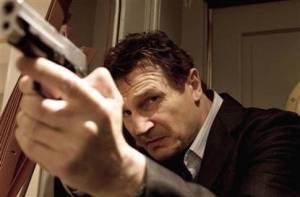
This may be in your second run theaters by now, well, so much the better. Don’t miss it on the big screen. After March 18, I look at Liam Neeson differently. Here in Taken, he embodies the superhero of parenthood. He shows us what a father will do to save his daughter, especially an ex-CIA dad against a human smuggling ring of bad guys. Bryan Mills (Neeson), a highly skilled agent who has retired early to make up for lost time with his daughter Kim (Maggie Grace), has to use all his resources when she is kidnapped while visiting Paris. The action-packed, fast-paced sequences leave you no time to be skeptical of the impossibilities. Mills’ expertly-trained speed and agility would make Jason Bourne drop his jaw (literally or figuratively). And, stand aside James Bond, you’re not in the league, it’s heart we’re talking about. Lose yourself, be swept away, it’s pure escape and fantasy. Any parent can identify with the fear of a child being taken and hurt and the feeling of helplessness that ensues. Liam Neeson just acts out the imaginary scenario, the omnipotent father coming to the rescue of his own, and he’s won my heart. (So remember, it’s great for Father’s Day too, but Dad will likely have to watch the DVD.)

Star Trek (2009)

Wolverine too hairy? Bad manicure? Bring Mom to Star Trek then, if she’ s up to pushing her way through the crowds. I’m sure she’d enjoy at least some elements of the movie. While you’re cheering for the young, new Kirk, she might be reminiscing the First Generation. This deserves a brand new post. So watch for it in the days to come.

Other recommendations have been reviewed on Ripple Effects. If they’re still on the big screen, Mother’s Day is a good time to enjoy them with Mom:

The key to making Mom happy: Spend time to talk afterwards.

****

Photo Source: Taken, msnbc.com; State of Play, usatoday.com

The Poets’ Corner

poets-corner-book-cover

Just got this from the library, and it’s a gem.  The Poets’ Corner is subtitled The One-And-Only Poetry Book for the Whole Family, compiled by John Lithgow.  Yes, that’s John Lithgow of the ‘3rd Rock from the Sun’.  From Matthew Arnold to W. B. Yeats, Geoffrey Chaucer to Allen Ginsberg, it’s more like a high school curriculum than your light family reading.  However, the collection includes many favorite selections, ideal to share as literary heirloom.

Lithgow presents fifty poets whose work he had grown up with.  He has written a two-page introduction for each of them, a personal response to a piece of literary art.  In the introduction of the book, he explains how it all started.  Lithgow was invited to host a benefit for a non-profit organization.  The fund raiser was for the fostering of creative approaches to educating autistic children.  He was given a few poems to read out that night, poignant poetry that speaks to the heart of parents with autistic children.  That night, Lithgow saw the power of poems read out, the voice and the words striking a shared chord with deep resonance. Thus planted the seed for this book.

The central theme here is not autism, but the selections here speak to a general and wider audience, humanity at large.  The bonus is a CD featuring readings from Lithgow And Friends.  I believe that poetry read out loud offers a heightened enjoyment than just from silent reading.  I had heard recordings of Robert Frost and William Carlos Williams  reading their own work, leaving indelible resonance that I didn’t get from reading off the page.

Here in this CD, what we have are  professional performers, experienced and well-trained in the art of speech, dramatically performing these selections. And Lithgow’s ‘Friends’ include: Eileen Atkins, Kathy Bates, Glenn Close, Jodie Foster, Morgan Freeman, Helen Mirren, Lynn Redgrave, Susan Sarandon, Gary Sinise, and Sam Waterston… what a cast.

Here are  some of my favorites, too bad I can’t embed the sound track.  But do check it out from your local library, or even get a copy of your own.  It’s a keeper.

We Real Cool by Gwendolyn Brooks

(Read by Morgan Freeman)

The Pool Players.

Seven at the Golden Shovel.

We real cool. We

Left school. We

Lurk late. We

Strike straight. We

Sing sin. We

Thin gin. We

Jazz June. We

Die soon.

***

I Wandered Lonely As A Cloud by William Wordsworth

(Read by Helen Mirren)

I wandered lonely as a cloud

That floats on high o’er vales and hills,

When all at once I saw a crowd,

A host, of golden daffodils;

Beside the lake, beneath the trees,

Fluttering and dancing in the breeze.

*

Continuous as the stars that shine

And twinkle on the milky way,

They stretched in never-ending line

Along the margin of a bay:

Ten thousand saw I at a glance,

Tossing their heads in sprightly dance.

*

The waves beside them danced; but they

Out-did the sparkling waves in glee: A poet could not but be gay, In such a jocund company: I gazed—and gazed—but little thought

What wealth the show to me had brought:

*

For oft, when on my couch I lie

In vacant or in pensive mood,

They flash upon that inward eye

Which is the bliss of solitude;

And then my heart with pleasure fills,

And dances with the daffodils.

***

The Red Wheelbarrow

by William Carlos Williams

(Read by Jodie Foster)

so much depends

upon

a red wheel

barrow

glazed with rain

water

beside the white

chickens.

***

No Doctors Today, Thank You by Ogden Nash

(Read by John Lithgow… I LOL listening to him)

They tell me that euphoria is the feeling of feeling wonderful,

well, today I feel euphorian,

Today I have the agility of a Greek god and the appetitite of a Victorian.

Yes, today I may even go forth without my galoshes,

Today I am a swashbuckler, would anybody like me to buckle any swashes?

This is my euphorian day,

I will ring welkins and before anybody answers I will run away.

I will tame me a caribou

And bedeck it with marabou.

I will pen me my memoirs.

Ah youth, youth! What euphorian days them was!

I wasn’t much of a hand for the boudoirs,

I was generally to be found where the food was.

Does anybody want any flotsam?

I’ve gotsam.

Does anybody want any jetsam?

I can getsam.

I can play chopsticks on the Wurlitzer,

I can speak Portuguese like a Berlitzer.

I can don or doff my shoes without tying or untying the laces because

I am wearing moccasins,

And I practically know the difference between serums and antitoccasins.

Kind people, don’t think me purse-proud, don’t set me down as vainglorious,

I’m just a little euphorious.

**

Lithgow and friends have convinced me all the more that poetry is written to be heard.

Poets’ Corner:  The One-And-Only Poetry Book For The Whole Family, compiled by John Lithgow, Grand Central Publishing, 2007,  280 pages.

The Savages (2007, DVD)

the-savages-linney-hoffman

After my last post I had to take some time to withdraw. That’s when solitude can work as a soothing balm, allowing the personal space for reflection. Whether sudden or expected, young or old, death affects us all. And some strike a deeper chord.

A couple of days ago I got hold of The Savages on DVD. I thought I was late in watching this highly acclaimed indie film, and writing a review two years after its release. But watching it, I was surprised by the coincidence; for alas, it’s about death and aging. It’s ever timely now. I wouldn’t have appreciated it as much if I’d seen it then. For now, I’ve the first-hand experience of caring for two aging parents, and with my mother being in the early stage of Alzheimer. Two years ago I would not have imagined this scenario. But as those who have cared for the old can attest, two months can make a lot of difference.

As baby boomers begin to pass the turnstile into midlife, they now have to face the hard fact about their parents, and preparing for the ultimate to befall. Herein lies the story of The Savages.

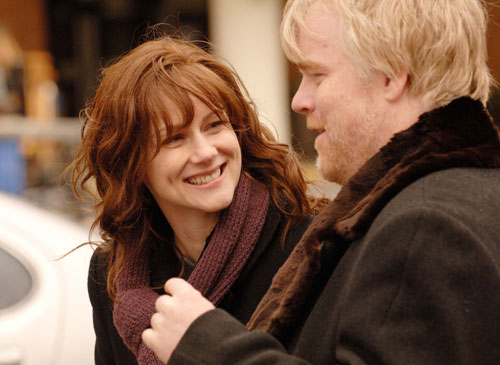
Wendy Savage (Laura Linney, Best Actress Emmy for John Adams, 2008; Love Actually, 2003) and her brother Jon (Philip Seymour Hoffman, Oscar Best Actor for Capote, 2005) live miles apart. Their childhood home had been dysfunctional. Their mother left them when they were still young, their father was neglectful and abusive.  Now as adults, they both have trouble committing to intimate relationships. Jon teaches theater at the University of Buffalo, while Wendy is a struggling playwright, working as a temp to make ends meet in NYC. Living apart from each other and their father, both strive to carve out some sort of meaningful existence with their life. Now they are brought back together by the tie of responsibility, reluctantly, in the caring for their ailing father (Philip Bosco). An old man who is afflicted with Parkinson’s related dementia, Lenny Savage is still fiery and intimidating.

Among the acclaims the film has garnered (AFI movie of the year, Golden Globes, Independent Spirit Awards…) are two Oscar nominations, one for Laura Linney for Best Actress, the other for Tamara Jenkins’s  Original Screenplay.  Both deserve the recognition hands down.  Unlike Sarah Polley’s impressive film Away From Her (2006) with Julie Christie as an Alzheimer stricken wife, The Savages looks at dementia and death from the point of view of the son and daughter, and delicately explores their conflicting emotions of having to care for an estranged father. The rebuilding of sibling relationship has also proven to be difficult, yet through the process, both find the experience to be worthwhile.

The Savages is classified as a comedy. The script is smart and funny. But it is dark and deadpan humor that marks its appeal. The reality of human failings is handled with care and sensitivity. Linney, Hoffman, and Bosco form a dynamic trio in portraying the tension of love hate emotions among family members.  Despite the past failings of their father and their present perplexities of how best to care for him, the siblings know where their duty lies. Screenwriter and director Tamara Jenkins has effectively explored the issues without sentimentality and imbued humor at the appropriate moments. As with all of life’s predicaments, a little dash of humor can offer the most direct perspective into our shared humanity.

The special features offer insights into the making of the film and into the mind of the screenwriter and director Tamara Jenkins. Of all the subject matters, she chose the caring of our aging parents. I’ve appreciated her intent: “The idea was to make you realize that you’re not alone, that you’re part of the human race, that we’re all going through this together.” She’s done a great job in doing just that.

~ ~ ~ Ripples

(photo source:  mtv.com)