Summer Reading 2009

When does ‘regular reading’ end and ‘summer reading” begin?  Well this year it’s easy.  The gigantic used book sale I went to over the weekend and the loot I brought back make it official:  Let summer reading 2009 begin.

The treasures I found were trade paperbacks in like-new condition.  And because I had twenty, they cost me just one dollar each.  Right, that’s Canadian dollar, even a better bargain.  How I found them was an ordeal.  They were painstakingly selected under smoldering heat at a farmers’ market.  For two hours, I elbowed my way in to grab hold of my targets which I had to eye from a distance over heads and shoulders.  But it’s all worth it.

Here’s a picture and a list of the titles I brought back:

Used Book Sale Loot 1

  • The Corrections by Jonathan Franzen
  • Anna Karenina by Leo Tolstoy
  • Simple Recipes by Madeleine Thien
  • Desperate Characters by Paula Fox
  • Bloodletting & Miraculous Cures by Vincent Lam (Giller Prize Winner)
  • The Sea by John Banville (Man Booker Prize Winner)
  • Saturday by Ian McEwan
  • Goodbye, Columbus by Philip Roth
  • Daisy Miller by Henry James
  • The Stories of Edith Wharton selected by Anita Brookner
  • The Mapmaker’s Opera by Béa Gonzalez
  • Always Now The Collected Poetry of Margaret Avison
  • Breathing Lessons by Anne Tyler (Pulitzer Author)
  • The English Patient by Michael Ondaatje (Booker Prize Winner)
  • Marginalia: A Cultural Reader by Mark Kingwell
  • Rebecca by Daphne Du Maurier
  • A Natural History of the Senses by Diane Ackerman
  • Lost Souls by Lisa Jackson
  • Moral Disorder by Margaret Atwood
  • Exit Music by Ian Rankin

Some of these titles I’ve long wanted to read, like Goodbye, Columbus and Rebecca.   Some are just well known titles or authors that I think I should read, like Tolstoy, Franzen and Tyler.   Some are winners of book prizes that I usually enjoy, the Booker, Giller, Pulitzer.   Some are fine Canadian authors and one of my favorite poets.   And some I’m just curious about like A Natural History of the Senses.  But one stands out.  This time, I’m literally judging a book by its cover:

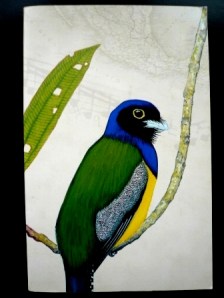
Front Cover Mapmaker's Opera

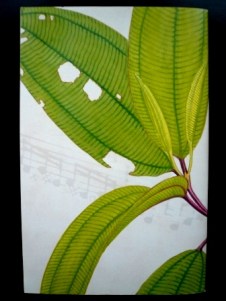
Back Cover Mapmaker's Opera

The above are the front and back cover of the book.  There’s no title, only on the spine.  It’s enjoyable just looking at it.  But the title is appealing too:  The Mapmaker’s Opera.

Together with the books I’m already reading, plus my long TBR list, I think I’m topped up till next summer.

For More Great Finds, Click Here.

***

Of Film and Faith

Now, the reason to be… in Vancouver.   As I mentioned in a previous post, I was at Regent College for two weeks in May to learn the language of film, and its interface with elements of theology.  I came home much gratified.  I’ve delayed writing about the course per se because it would mean the difficult task of capturing the Genie of ideas back and recapping the bottle.  But I know I need to do it sooner or later, for I want to record down a learning experience that’s, well, let’s just say epiphany is not too far-fetched a word.  It could well be that the little I knew initially made it more gratifying as I could gobble up more to fill the empty vessel.

My thoughts are random here, but that might be the best way to capture whatever that comes to my mind that I think is important and meaningful.  Allow me to ruminate freely.

The language of film is multi-faceted, but it more or less can be condensed into the phrase mise-en-scène: what the director puts into the scene by means of setting, camera angle, lighting, staging, wardrobe, blocking… all the cinematic elements.     Like the artist of a painting, the director conveys his point of view and aesthetics through a frame or a scene.  And for us viewers, it’s a matter of honing the skill of observing the obvious, and the not-so-obvious.  Our pleasure is to decipher and savor that which is created on screen.   It all relates to the Auteur Theory, the director as the author, the concept of caméra-stylo, the camera as pen.

The power of the cinematic pen is mighty indeed.  Take the Disney movie Bambi for example.  The screening of Bambi resulted in a huge decrease of hunting licenses sold after it was released, and subsequently the term ‘Bambi Effect’ was coined.  Or, the movie Billy Elliot, which resulted in a significant increase in ballet school enrollment.

***

Knowing the history of motion picture is essential to appreciate films, and this is the major emphasis of the course.  I’ve come to appreciate the pioneers of motion pictures whose works have become the exemplars and the artistic foundations of modern cinema: Vincente Minnelli, Preston Sturges, Charles Chaplin, Fritz Lang, John Ford, Orson Welles, Frank Capra…

Fjilm Noir Third Man Alley

Further, it’s most interesting to trace the influence of German expressionism has on Film Noir, how the idea behind Edvard Munch’s The Scream can effectively be transformed into cinematic expression, revealing the inner state of modern man.

Over the intensive two-weeks, we’d only have time to cover mostly black and white features, savoring their richness in techniques and their multi-layered meaning.  I’ve come to understand why the years 1930  to 1946 are called “The Golden Age of Cinema”.

And where does theology come in?  While knowing some Kierkegaard and Buber might help, but basically the content is very accessible.  Herein lies the ingenuity of the auteurs and their works.  The process of exploring the transcendent in the movies viewed by the populace is just fascinating.
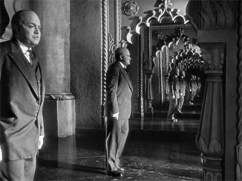
Citizen Kane

I’ve learned how Citizen Kane (1941, produced when Orson Welles was just 24!), generally considered one of the best movies of all time, like the Vanitas still life of Vermeer’s time, expresses the theme of Ecclesiastes, and asks the question, “So one has gained the whole world, then what?”

Another theological element is the archetype of the Christ figure, and I’m surprised to find it quite prevalent in many of these early motion pictures.  I admit I’ve never watched a Charlie Chaplin movie in its entirety until now.  In The Kid (1921) and City Lights (1931), the savior figure is humorously portrayed in the story, and the concept of unconditional love warmly illustrated.

City Lights

This archetype also appears  in Frank Capra’s  Meet John Doe (1941), where a main character declares the universal significance of the first John Doe two thousand years ago dying for all John Doe’s.  Visually, I’ve learned to identify the Pietà and the crucifix image in the composition of a frame in several of the features, an example being How Green Was My Valley (1941, John Ford).
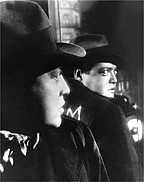
M by Fritz LangMotion pictures are an effective medium to convey the human condition.  In Fritz Lang’s thriller M (1931), the letter obviously refers to the murderer, a child killer that the whole town was after.  The not-so-obvious is the depiction of universal depravity, from the police to the masses, the message that we’re all complicit in the moral fabric of our society.  Similarly, Mel Gibson puts himself in his movie The Passion of the Christ (2004) as the Roman soldier nailing Christ on the cross.

Fast forward to the 80’s, I was introduced to the renowned Polish auteur Krzysztof Kieslowski.  It’s amazing how in Decalogue (1988), the essence of The Ten Commandments and their relevance in contemporary society are transformed into ten independent, one-hour stories and broadcast as a prime time TV series in Poland.  Decalogue is an artistically crafted and poignantly executed production that has won numerous international awards.  But would we see such kind of meaningful work as a prime time TV program here in North America?  The answer is obvious.

On the last day, I’d the chance to savor Babette’s Feast (1987), a highly acclaimed movie from Denmark (Oscar Best Foreign Language Film, 1988).  Based on a story by Isak Dinesen (Out of Africa), Babette’s Feast is a cinematic metaphor of goodness and freedom.  Its unique story and powerful visual images richly convey the theme of grace and mercy, and the liberating power of compassion.  The table prepared before us is free, sumptuous and abundant, but it takes an open heart of full acceptance and gratitude to fully enjoy it.  An inspiring film to wrap up my sojourn, creating resonance for the journey ahead.

Babette's Feast

***

Inspired by Vermeer

I’m just having so much fun discovering the immense influence of Vermeer on his posterior that I must post some more.  Here are a few interesting samples that I’ve found.

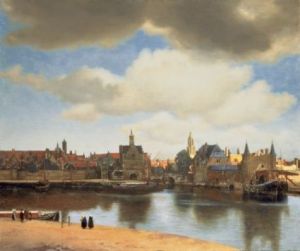
Holland has long been renowned for its natural light, and Vermeer has long been credited with his keen sensitivity in capturing that.  Here’s his View of Delft (ca. 1660),  which Marcel Proust called “the most beautiful painting in the world”:

Vermeer View of Delft

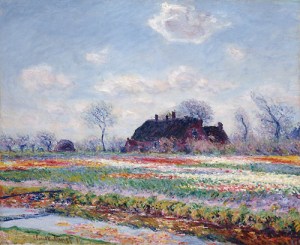
Visiting the Netherlands in 1886, Claude Monet adopted Vermeer’s point of view in observing the light of Holland in his painting of tulip fields and a farmhouse near Leiden:

Monet Tulip Fields near Leiden, Netherlands

**

Look at this famous Vermeer painting entitled Woman in Blue (ca. 1663):

Vermeer Woman in Blue

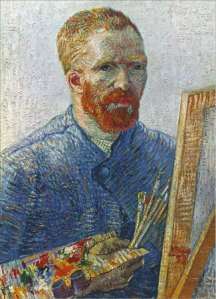
Van Gogh commented in 1888 on the exquisite artistry of Vermeer’s colors in the painting, “…blue, lemon-yellow, pearl-gray, black and white… the whole gamut of colors.”   He must have really liked Vermeer’s palette:

Van Gogh Self Portrait at Easel

**

Vermeer loved his subjects by the window.  Here’s another well known painting Girl Reading A Letter At An Open Window (1658), and below, Salvador Dali’s parody, homage, to Vermeer’s signature pose entitled Disappearing Image (1938).  Like Hitchcock, Dali liked to put himself in the picture:

Vermeer Girl Reading A Letter By The Window

Dali The Image Disappears

Tom Hunter Woman Reading A Possession Order

Now here’s a more contemporary example.  UK artist Tom Hunter, the first photographer to have a one-man show at the National Gallery of London, won the Kobal Photographic Portrait Award in 1998 with this poignant picture of a squatter, entitled Woman Reading a Possession Letter:

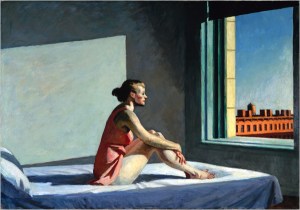
How about this from American realist painter Edward Hopper, Morning Sun (1952):

Edward Hopper Morning Sun

(For more Edward Hopper, Click Here.)

**

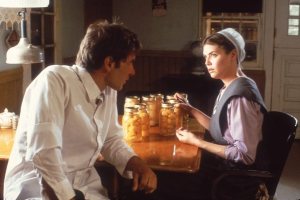
Director Peter Weir has created some ‘Vermeer scenes’ in his highly acclaimed 1985 movie ‘Witness’, with Harrison Ford and Kelly McGillis.  I can’t find pictures of the scene where the young Amish woman Rachel Lapp (McGillis) tending the wounded detective John Book (Ford) in the attic of her Amish house.  That is signature Vermeer.  But this one by the window can give you a glimpse.  Look at the contrast between the light and shadow on the two characters, the innocent and cloistered Rachel Lapp and the street-smart and gun wielding John Book:

Witness Harrison Ford and Kelly McGillis

**

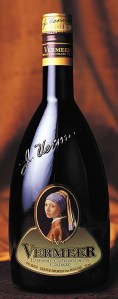
And last but not least, Vermeer’s inspiration on modern packaging and product design.  Click here to read more about it.

Vermeer inspired Dutch Chocolate Cream Liquer

****

Related Posts:

Vermeer in Vancouver: Noticing the Obvious

Girl With A Pearl Earring

Edward Hopper, William Safire: The Visual and the Word.

Arles: In the Steps of Van Gogh

The Letters of Van Gogh

***

Sources and links:  All Vermeer paintings, Click here to go to Essential VermeerClick here to Tom Hunter Website. Click here to Webmuseum for Edward Hopper. Click here to Van Gogh Gallery. Click here to Metmuseum for Monet’s Tulip Fields near Leiden.

Vermeer in Vancouver: Noticing the Obvious

For more Vermeer, Click Here to go to my post “Inspired By Vermeer”.

Vancouver Art Gallery’s premier summer kick-off is the impressive exhibition: Vermeer, Rembrandt and the Golden Age of Dutch Art. The exclusive show of masterpieces from Amsterdam’s renowned Rijksmuseum includes paintings, drawings, and decorative arts from 17th century Holland. After five hours at the Gallery, I left hungry for more Vermeer. Overall it was gratifying, but I was expecting just a few more glimpses of the great master.

Of all the 128 pieces of art work, there’s just one Vermeer painting. Placed at the end of the exhibit, apparently the highlight and climax of the show, is Vermeer’s Love Letter (1669). From his signature point of view, peeking through a partial opening of pulled-back curtain, we look into another room and see a maid just handed her mistress a letter. By the exchange of their glances, it seems they’re sharing a secret understanding. This is another one of Vermeer’s works that’s full of potential stories and rich in subtexts. Actually anyone of them is a novel to be written, not less dramatic as Girl With A Pearl Earring.

Vermeer's The Love Letter

Love Letter by Vermeer (1669-70)

~~

17th century Holland was a new Republic that had just gained independence from Spanish rule. The beginning of the exhibits sets the stage depicting a young nation with great maritime power. Domestically, it was a country marked by a vibrant economy and a rising middle class, as well as the flowering of arts and science, architecture and urban planning.

In the midst of such affluence and fresh hope, some of the artists spoke with their brushes as prophets of their time. Among paintings of naval glory and conquests, as well as glimpses of domestic life of the rich, there are also the quiet displays of still life. I must have seen them before. Why have I not noticed their significance previously?

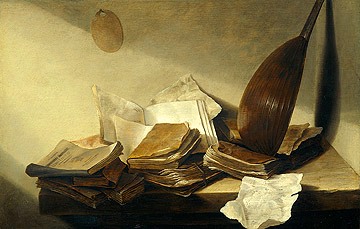
They are paintings of withered blossoms, burnt out candles, hourglasses, books and musical instruments, and most prominently, skulls, eerie arrays of them, decaying bones and teeth. Why all these objects? The audio commentary confirms that they are Vanitas still life, the term rooted in Ecclesiastes, “Vanity of vanities.” And obviously, they are symbols of the fleeting nature of life, the callous passage of time, the transience of knowledge and human achievements:

Pieter Claesz Vanitas Still Life

Pieter Claesz: Vanitas Still Life (1628)

~

Skulls on a Table

Aelbert Jansz van der Schoor: Skulls on a Table (1660)

~

On the piece of writing crumpled up is one last word, Finis, The End:

Still Life with Books Jan de Heem

Jan Davidsz de Heem, Still Life with Books (1625-29)

It’s commendable that the rich and powerful were willing to be reminded thus, considering these were once paintings adorning the walls of their affluent homes, a nagging presence they could not ignore. And they must have paid to have them painted.

~~

One of my favorites in the exhibition is Nicolaes Maes’ Old Woman in Prayer. Maes, a student of Rembrandt, had captured the simple piety of the old woman of lowly means: her earnest concentration, wrinkled face and hardened hands, the earthen wares and simple meal, and above all, her meager possessions on the ledge, an open Bible, a lamp, an hourglass and a prayer book. The warm light on her face almost makes her look divine. Maes did not forget to include a comic relief, her cat at the lower right bottom must have known what’s for dinner:

Nicolaes Maes Old Woman in Prayer

Nicolaes Maes: Old Woman in Prayer (1650-60)

~~

Sources: Skulls on a Table from Vancouver Sun. All other paintings in this post: Rijkmuseum, Amsterdam.

Vancouver Journal

Arti is blogging from Vancouver these two weeks. Here are some initial sights from yesterday’s roaming.

Rhododendrons everywhere:

Rhododendron everywhere

Rhododendron in bloom

Views from Spanish Bank:

Vancouver Skyline

Vancouver skyline from Spanish Bay

Solitary Moment

Solitude at Spanish Bay

Woodpecker hard at work and play

Woodpecker at work and play

Despite the temperamental weather, Arti will be soaking in all the views, making best use of her solitary moments to peck away … oh, who cares whether it’s for work or play. The woodpecker knows there’s no boundary separating the two.

ORIGINAL PHOTOS AND TEXT BY ARTI OF RIPPLE EFFECTS. ALL RIGHTS RESERVED. MAY, 2009.

IF YOU SEE THIS ON A SITE OTHER THAN RIPPLE EFFECTS, YOU’RE SEEING A POST THAT’S BEEN COPIED WITHOUT PERMISSION. CLICK HERE TO GO TO THE ORIGINAL SITE https://rippleeffects.wordpress.com

The Appeal and Fallout of the Susan Boyle Phenomenon

Update:  CLICK HERE to read my post on Susan Boyle’s debut Album ‘I Dreamed A Dream’.

By now, tens of millions have converged on YouTube to watch the sensational phenomenon of Susan Boyle, the middle-age woman from Scotland on Britain’s Got Talent.  Arti has waited for the dust to settle a bit before commenting, allowing her hindsight to catch up.

So, what’s the appeal of Susan Boyle?  The planned and scripted intention of the producer and judges aside, what is so attractive about the 47 year-old woman?  Is it the plain, country look, the greying frizzy hair, the unkempt and overweight physique?  In this image-driven, urbane society of ours, these features definitely aren’t valuable assets.  Or, as so many have claimed, it’s her voice that has enthralled us all.  Yes,  the lady certainly has potential and talent in this regard.   But truth be told, could Susan Boyle have garnered so much praise if she had looked differently?

The universal appeal of Susan Boyle is the mismatch of her look with her voice, a perceived dissonance based on a prejudiced, preconceived notion marking viewers’ expectations.   What talent could a middle-age, plain-looking, hamlet-dwelling woman have?  The public has a real fun case of being fooled.  Ha, the joke is on us.  We’ve been wrong all along.  Unattractive bodies can be talented personalities.  And the audience had enjoyed the twist and surprise.  Susan Boyle’s  TV appearance provides real entertainment value, albeit manipulative according to skeptics of reality shows.  Simon Cowell should be most gratified.   It’s all about the ratings, and future record sales.

susan-boyles-new-lookBut wait, don’t speak too soon.  Now the 47 year-old has a few hairs on her eyebrows plucked, her unruly lock trimmed and dyed a younger look, donned some neater attire.  Lo and behold, the mismatch has diminished.  As the excitement wanes, criticisms arise.  “She shouldn’t change too much,” the public decries.  “That’s the limit that she should go, no further,” the critics advise.  Wouldn’t it be terrible if Susan Boyles decides to join Weight Watchers.  Of course she shouldn’t, it’ll be much less entertaining.

What have we become now?  Spectators of a freak show in a circus?  What about those lyrics that have enthralled us initially?  Can a woman not be allowed to have her own way, make her own decision to change or not, choose her own lifestyle, and interpret her own dream?  Is she selling her soul just by having a facial?  I’m afraid Susan Boyle is no match for our sensationalism and thrill-seeking crowd of  reality TV viewers, or the humongous entertainment business looking to generate more profits in whatever way possible.

I worry too that the overnight rise to stardom is making Susan Boyle equally vulnerable to become an instant victim of the fallout.  A trampled rose or discarded weed, they meet the same destiny.  Of course, I wish her well and that the pursuit of her dream will not become a nightmare in the callous arena of public opinion.

The curious case of Susan Boyle also reminds me of another woman with talent living in obscurity two hundred years ago.  She was a bit younger,  living in rural England, striving to be herself in the pursuit of her dream to become a writer.  Sadly, she did not live to middle-age, nor see her name credited to her work.  To avoid fallouts and social reverberations, she had to seek anonymity.  Now we know her as Jane Austen.

The lyrics of that tune still sound poignant:  “After changes upon changes, we’re more or less the same;  after changes, we’re more or less the same…”

Photo Credit:  Andrew Milligan/PA,  Source: Times Online http://entertainment.timesonline.co.uk/tol/arts_and_entertainment/tv_and_radio/article6161198.ece

***

Original writing by Arti of Ripple Effects.  ALL RIGHTS RESERVED.  If you are reading this on a website other than Ripple Effects, you are reading a post that has been copied without permission.  Go to https://rippleeffects.wordpress.com to read this and other original and interesting articles on entertainment, books and movies.

The Proximidade: Celebrating Closeness

Arti of Ripple Effects is honored to receive The Proximidade Blogging Award from ds of  third-storey window.  A wonderful view she has over there.  Thanks again ds!

“The Proximidade Award believes in the Proximity – nearness in space, time and relationships. These blogs are exceedingly charming. These kind bloggers aim to find and be friends. They are not interested in prizes or self-aggrandizement! Our hope is that when the ribbons of these prizes are cut, even more friendships are propagated. Please give more attention to these writers! Deliver this award to eight bloggers who must choose eight more and include this clever-written text into the body of their award.”

proximade_award1

This is a while back now.  Although ds is very generous as to spare us the obligation to pass it on, I feel I should share this award by naming  some worthy recipients whose blog has closed the gap among us, in one way or another, narrowing our physical distances through common interests and other higher ideals.

It’s my pleasure to pass the Proximidade Award to the following Blogs, in alphabetical order:

Book Club Girl — for closing the gap between authors and readers by her own radio show ‘Authors on Air’.

Classy Music — for drawing us closer with news and views of classy musicians and their performance.  Take note, ye fans of Susan Boyle and Paul Potts.

FilmChat — Movie reviewer Peter Chattaway (no kidding) engages us with insightful and interesting dialogues between faith and film.

Jane Austen Today —  Great job Laurel Ann and Vic,  in connecting Janeites the world over by their excessively diverting blog.   (LA and V:  I’m still working at finding ‘classics’ blogs for the ED Award.)

Visual Dialogues — Blogging from Hong Kong, Molly Mavis closes the gap between East and West with her perceptive photography.

I trust you’ll find the above blogs informative and entertaining, well deserving the Proximidade Award.

National Poetry Month

April is National Poetry Month.  I’m glad we still celebrate poetry in this day of ephemeral twittering.  W. H. Auden once described poetry as “memorable speech”.  As millions upon millions join in on-line chats, exchanging the most trivial of their everyday life unreservedly, and even addictively all day long, how we need poetry all the more, to create lines that strive for some memorable quality worthy of keeping.

The late Canadian communication guru Marshall McLuhan was right, the medium is the message.   And such is the message of our time.  Mind you, I’m no Luddite, my iPhone is evidence.  I’ve gone through this before, so I’m not going to dwell on it here again.  It’s just that the rash and temporal nature of our medium, and mode, for that matter,  make me long for quality and permanence.

After posting an excerpt of  T.S. Eliot’s poetry in my last entry, I just didn’t have enough.  I re-read and explored more of his work and was amazed at how prophetic his vision was.  To celebrate National Poetry Month, here’s Arti’s selections of  lines from the work of T.S. Eliot, just for our post-modern, Facebook and Twitter generation.

nighthawk-by-edward-hopper

Twit twit twit

Jug jug “>jug jug jug jug jug

So rudely forc’d.

— The Waste Land (1922)


Teach us to care and not to care
Teach us to sit still.

— Ash Wednesday (1930)


There will be time, there will be time
To prepare a face to meet the faces that you meet;

….

Do I dare
Disturb the universe?
In a minute there is time
For decisions and revisions which a minute will reverse.

For I have known them all already, known them all: —
Have known the evenings, mornings, afternoons,
I have measured out my life with coffee spoons;

….

In the room the women come and go
Talking of Michelangelo.

— The Love Song of J. Alfred Prufrock (1915)


The endless cycle of idea and action,
Endless invention, endless experiment,
Brings knowledge of motion, but not of stillness;
Knowledge of speech, but not of silence;
Knowledge of words, and ignorance of The Word.

All our knowledge brings us nearer to our ignorance,
All our ignorance brings us nearer to death,
But nearness to death no nearer to God.
Where is the Life we have lost in living?
Where is the wisdom we have lost in knowledge?
Where is the knowledge we have lost in information?
The cycles of Heaven in twenty centuries
Brings us farther from God and nearer to the Dust.

— Choruses from The Rock (1934)


****

Visual: Nighthawks (1942) by Edward Hopper.  CLICK HERE FOR MORE EDWARD HOPPER.

Stream of Easter Consciousness

stained-glass-2a2So students are sent back to school this week, just in time for Easter.  Nobody wants to have a holiday right on Easter week, especially the public school board.  That’s how you survive,  by being politically correct.  And the last two weeks’ holiday is called Spring Break of course.   Easter has almost become a banned word, like Christmas.  Who wants to be rude and offend others, we’re Canadians after all.
I know,  it’s not totally a taboo yet.  It’s a much tamer word, Easter, than Christmas, just because it doesn’t have the six-lettered word in it.  You can curse with that name, but no, God forbid you should say it in a proper context.   I can see you sneer, what’s a proper context, you ask.  You’re right of course, no word or context is more proper than others, we’re egalitarians after all.  As for Easter, as long as it’s synonymous with eggs and bunnies, pastels and flowers then it’ll never die.  Who needs resurrections?

All Fridays are good.  They even have a whole restaurant chain commemorating the day.  What’s it called… yes,  T.G.I. Friday’s.  Who says we’re not religious, we thank God for happy hours.  We’re much more open-minded now,  more civilized, equal and fair, don’t want to pick one day to be better than the others.  But definitely we won’t forget Ramadan, or the Chinese New Year.

There’s probably no God,  so stop worrying and enjoy your life, the sign on the bus says.  So we’re safe?   Whew!  No God means we can now be happy, worry free, all life, no death, …  Umm just let me figure this one out.  Give me a minute, I’m just not as smart as them.

Jesus wept.  He wept at the graveside of Lazarus, brother of his dear friends Martha and Mary.  He wept at the fragility of life.  He wept at the searing pain of separation.  He wept at the hopeless and uncomprehending expression on Mary’s face, even after he said to her I am the resurrection and the life.

Fleming Rutledge said more than ten years ago:  “I am deeply convicted, more so each year, of the profound sinfulness of the human race.  Yet because of the Cross and Resurrection of Jesus Christ — because of that and nothing else, because of that and nothing less — I am also convicted of the truth of what the Bible tells us about God’s plan of salvation.  The rainbow bridge does not lead to Valhalla, where the gods quarrel so much that they destroy themselves.  The rainbow bridge leads to the Cross and to the empty tomb on Easter Day.”

Utterly politically incorrect!  Who uses the word sin anymore?  Who’s Fleming Rutledge, anyway.  Never heard of him.  No?  It’s a she?  No wonder.

Now these words echo loud and clear too, written by T. S. Eliot in… what, 1934?  Aren’t they a bit archaic now?  Or, maybe they’re really prophetic:

Where is the Life we have lost in living?
Where is the wisdom we have lost in knowledge?

Where is the knowledge we have lost in information?

The cycles of Heaven in twenty centuries

Bring us farther from God and nearer to the Dust.

We should go on living, be happy and worry-free, the sign on the bus says.

So we go on living…

and Jesus still weeps.

stained-glass-41

*****

Original photos and text copyright by Ripple Effects, https://rippleeffects.wordpress.com, April 2009.  All Rights Reserved.

The Savages (2007, DVD)

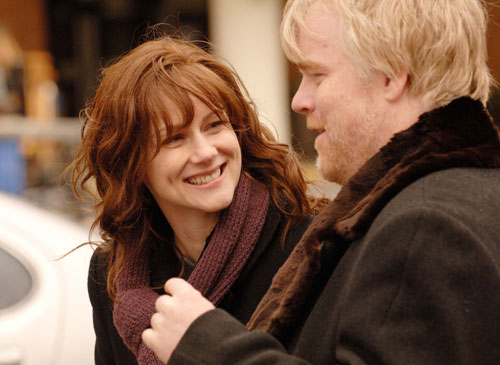
the-savages-linney-hoffman

After my last post I had to take some time to withdraw. That’s when solitude can work as a soothing balm, allowing the personal space for reflection. Whether sudden or expected, young or old, death affects us all. And some strike a deeper chord.

A couple of days ago I got hold of The Savages on DVD. I thought I was late in watching this highly acclaimed indie film, and writing a review two years after its release. But watching it, I was surprised by the coincidence; for alas, it’s about death and aging. It’s ever timely now. I wouldn’t have appreciated it as much if I’d seen it then. For now, I’ve the first-hand experience of caring for two aging parents, and with my mother being in the early stage of Alzheimer. Two years ago I would not have imagined this scenario. But as those who have cared for the old can attest, two months can make a lot of difference.

As baby boomers begin to pass the turnstile into midlife, they now have to face the hard fact about their parents, and preparing for the ultimate to befall. Herein lies the story of The Savages.

Wendy Savage (Laura Linney, Best Actress Emmy for John Adams, 2008; Love Actually, 2003) and her brother Jon (Philip Seymour Hoffman, Oscar Best Actor for Capote, 2005) live miles apart. Their childhood home had been dysfunctional. Their mother left them when they were still young, their father was neglectful and abusive.  Now as adults, they both have trouble committing to intimate relationships. Jon teaches theater at the University of Buffalo, while Wendy is a struggling playwright, working as a temp to make ends meet in NYC. Living apart from each other and their father, both strive to carve out some sort of meaningful existence with their life. Now they are brought back together by the tie of responsibility, reluctantly, in the caring for their ailing father (Philip Bosco). An old man who is afflicted with Parkinson’s related dementia, Lenny Savage is still fiery and intimidating.

Among the acclaims the film has garnered (AFI movie of the year, Golden Globes, Independent Spirit Awards…) are two Oscar nominations, one for Laura Linney for Best Actress, the other for Tamara Jenkins’s  Original Screenplay.  Both deserve the recognition hands down.  Unlike Sarah Polley’s impressive film Away From Her (2006) with Julie Christie as an Alzheimer stricken wife, The Savages looks at dementia and death from the point of view of the son and daughter, and delicately explores their conflicting emotions of having to care for an estranged father. The rebuilding of sibling relationship has also proven to be difficult, yet through the process, both find the experience to be worthwhile.

The Savages is classified as a comedy. The script is smart and funny. But it is dark and deadpan humor that marks its appeal. The reality of human failings is handled with care and sensitivity. Linney, Hoffman, and Bosco form a dynamic trio in portraying the tension of love hate emotions among family members.  Despite the past failings of their father and their present perplexities of how best to care for him, the siblings know where their duty lies. Screenwriter and director Tamara Jenkins has effectively explored the issues without sentimentality and imbued humor at the appropriate moments. As with all of life’s predicaments, a little dash of humor can offer the most direct perspective into our shared humanity.

The special features offer insights into the making of the film and into the mind of the screenwriter and director Tamara Jenkins. Of all the subject matters, she chose the caring of our aging parents. I’ve appreciated her intent: “The idea was to make you realize that you’re not alone, that you’re part of the human race, that we’re all going through this together.” She’s done a great job in doing just that.

~ ~ ~ Ripples

(photo source:  mtv.com)


No Texting for Lent and The End of Solitude

Roman Catholic Bishops in Italy have added some contemporary relevance in the fasting tradition during Lent:  High Tech Fast.  The faithful are urged to free themselves from the bondage of technology and gadgets, and refrain from surfing, emailing, twittering, texting … in order to prepare themselves for Easter.  This could prove to be a penance much harder to practice than not eating meat, even just on Fridays, for texting could well be the newest form of addiction today.

At about the same time, I heard an interview on the CBC Radio program Spark.  Host Nora Young conducted an interview with William Deresiewicz, literary critic and essayist, who has recently written an article entitled ‘The End of Solitude’.

Deresiewicz taught at Yale from 1998 to 2008.  When he asked his students what place solitude had in their lives, he got this reply: “Why would anyone want to be alone?”

With the ubiquitous use of high tech gadgets, and the torrents of Internet social networks around us, we are caught in a web of connectivity like never before:

Not long ago, it was easy to feel lonely.  Now, it is impossible to be alone.

Not only that, the goal now seems to be to gain as much self-exposure as possible, to be visible.  It seems that the number of friends we have on Facebook, and the number of hits on our blog directly leads to our self-esteem and our quality of self.  The irony is, the pseudo and the virtual are substituting the genuine and the authentic.

What does friendship mean when you have 532 “friends”?  How does it enhance my sense of closeness when my Facebook News Feed tells me that Sally Smith (whom I haven’t seen since high school, and wasn’t all that friendly with even then) ‘is making coffee and staring off into space’?

Deresiewicz notes that solitude used to be a desirable social value.  From religious sages to the Romantics like Wordsworth, solitude is the channel one hears the still, small voice of God, or heed the beckoning of Nature.  As modernism crept in,  the literati turned inward to find validation of self, like Woolf, Joyce, Proust.

Then came urbanization and suburbanization.  The generation that used to vegetate in front of the TV has given way to the child of the Internet, the networked self.  And we no longer believe in the solitary mind.

So what does it matter when we have lost the moments to be alone?  What have we lost?

First, the propensity for introspection, that examination of the self that the Puritans, and the Romantics, and the modernists (and Socrates, for that matter) placed at the center of spiritual life — of wisdom, of conduct.

Also, the urge to be instantly connected has bred a new generation of skippers and skimmers, replacing readers.

… five minutes on the same Web page is considered an eternity

No wonder we’re told to keep our blog posts short if we want to attract readership.

With the loss of the capacity for solitude, we’ve lost the ability to cultivate depth of self  and create independent thinking.  Emerson said that “Solitude is to genius the stern friend.”  Deresiewicz goes on to say:

…no real excellence, personal or social, artistic, philosophical, scientific or moral, can arise without solitude.

The irony is, the more we are connected with the virtual world out there, the less we are connected with ourselves inwardly.  But this is what’s valued nowadays, isn’t it, to be open, sociable, gregarious.  But to maintain a sense of authentic self, we may have to sacrifice popularity, to be not so polite:

Thoreau understood that securing one’s self-possession was worth a few wounded feelings.  He may have put his neighbors off, but at least he was sure of himself.

Those who would find solitude must not be afraid to stand alone.

Maybe this is one meaningful connection we should strive for: solitude, introspection, slow blogging, quality thinking, quality reading, quality writing, quality self.

****

Click here to listen to the full interview.

Click here to read the article ‘The End of Solitude’ by William Deresiewicz.

Click here to read my review of Sherry Turkle’s Alone Together

Click here to read my post on Virginia Woolf’s A Room of One’s Own in which she explored the privilege of Solitude.


Man On Wire (2008, DVD): Romancing the Towers

man-on-wire1When the idea of building the World Trade Center Twin Towers began to germinate in NYC, on the other side of the globe, a young man in France started to weave a dream.  He wanted to walk across the top of the Towers on a wire after they were built.  Six years later, with the Towers nearing completion, Philippe Petit fulfilled his dream a few days short of his 25th birthday.  On August 7, 1974, he stepped on a wire strung across the roof top of the then tallest buildings in the world.  Hailed as ‘The Artistic Crime of the Century’, Philippe Petit’s breathtaking, and illegal, high wire act is the ultimate test of the human spirit, pushing the limit of audacity and strength.

Based on Philippe Petit’s book To Reach The Clouds,  Man On Wire has won over 20 film awards only a few short months after its release, ultimately receiving the Oscar Best Documentary for 2008.  Director James Marsh chronicles the extraordinary endeavor of Philippe Petit by means of interviews, dramatic re-creation, and archival footage.  Before the WTC, Petit had walked across the two steeples of the Nortre Dame Cathedral in Paris, and the Sydney Harbour Bridge.  The WTC Towers meant the summit of his aspirations.  In a Sundance Film Festival interview, he described his act as ‘marrying the Towers’.

 Director James Marsh has chosen a very human angle to present his subject, such that we’re not just watching an extraordinary circus feat.  The documentary reveals a child growing up with unusual physical talents.  It vividly depicts the fearlessness of youth, the weaving of a fairy tale, the bond of friendship without which Philippe could not have achieved, and finally the euphoria of a dream fulfilled.  The smile on Philippe’s face while on the wire says it all.

The interviews in the film have also brought some very personal elements into this enthralling event.  We see Philippe’s childhood friend and accomplice Jean-Louis overcome with emotion, now more than 30 years later, as he recalls and is still moved by the immensity of the experience.

It’s a crime, no doubt, but it’s team work of the highest level of difficulty.  That they had to haul hundreds of pounds of wire and equipment up to the roof top, shoot the wire across, anchor it safe, all without detection was itself an incredible feat.  Once that was done, the rest was easy for Philippe, he just needed to walk on the wire suspended 1,350 feet above ground.

And that is when the artful part comes in.  Philippe had not just walked on tightrope, but performed with grace and serenity, movements conjuring up images of ballet on air.  For 45 minutes, he slow-danced across the Towers eight times, lay, knelt, and sat on the wire to the amazement of the awestruck crowd on the ground.  There was unspeakable beauty in his magnificent boldness.

Police had to threaten him with a helicopter to get him off.  He and his friends were immediately handcuffed, taken to jail, and Phillipe undergone a psychiatric examination.  He was later released and given a life-time pass to the Towers.  When asked why he did it, he answered:

“There’s no why… Life should be lived on the edge.”

Excellent special features that come with the DVD include Philippe Petit’s 1973 Sydney Harbour Bridge Crossing, exclusive interview with Philippe Petit, and an animated short film based on the children book by Mordicai Gerstein “The Man Who Walked Between the Towers”, narrated by Jake Gyllenhaal.  Further,  in this post 9/11 world, the DVD is even more significant in that it chronicles someone who had taken the arduous steps to appreciate and to relate to the Towers in a most memorable way.

And then there’s the music.  I admit it’s the music that has enthralled me from the start, yes, even with just the menu.  While Michael Nyman has written some fantastic original score for the documentary, it’s French composer Eric Satie’s pieces that so captivate me.   Satie’s Gymnopedie No. 1 is the music that augments the beauty of Philippe’s poetic walk on wire.

While most of us would rather watch life being lived on the edge from the comfort of our living room, we would be inspired nonetheless to venture out of our couch for a little more excitement, and motivated to take just a bit more risks with our life.  For us ordinary folks, maybe living life to the fullest is an aspiration challenging enough.

~ ~ ~ ½ Ripples

  “If no one ever took risks, Michaelangelo would have painted the Sistine floor.”      — Neil Simon 


Philippe Petit and James Marsh Interviews:

Click here for the  NPR’s Studio 360 Interview

Click here for the Sundance Film Festival Interview on YouTube