Diary of A Country Priest: A Book for Easter

Every year around this time, I come back to my perennial read The Diary of A Country Priest by French author Georges Bernanos(Journal d’un curé de campagne, 1936). In this book, I find the essence of Easter.

A young preist comes to his first parish, the rural town of Ambricourt, full of humble ideals. All he wants is to serve the people, to give of himself, to bring God’s love. But as soon as he sets foot in the village, he is engulfed by hatred and rejection. There are dark secrets too sinister to be exposed. The young priest is an unwelcome alien. In a town afflicted by hypocrisy, pride, anger and bitterness, he is despised, taunted and ridiculed. His own innocence is no match even for the children in his catechism class, especially the precocious Seraphitas, a girl ‘with a hardness far beyond her years.’

Ambricourt is a world afflicted by the ‘leprosy of boredom’, a microcosm of the human condition. Bernanos uses diseases to illustrate his point well. The young priest himself is being slowly consumed by terminal illness. The pain in his stomach ultimately defeats his body, cancer. His diet consists mainly of bread dipped in wine which he makes for himself, and some potato soup. Poverty of means, but also frailty of body to take in solid food. Many a times we see him in the Garden of Gethsamane, pleading for strength in anguish. But he faithfully presses on, using his diary to confide his deepest thoughts, a means to commune with his God.

On the outskirt of Ambricourt is the Château of the powerful M. le Comte. The Count needs no priest to know about his adulterous affairs, this time, with the governess Mlle Louise. His wife Mme la Comtesse is totally absorbed by her long-held bitterness and grief from the loss of her young son. And his daughter Mlle Chantal is a deeply disturbed girl eaten up by anger and jealousy. Soon, she will be sent away to England, a most convenient plan devised by her father.

It is with this deep mess of a family that the young priest finds himself entangled. The most intense scene of the whole book, the climatic moment, comes when the priest goes to the Château to meet with Mme la Comtesse. She lost her beloved son when he was only eighteen months old, a child hated by his jealous older sister Chantal.

On his last day they went out for a walk together. When they came back my boy was dead.

Mme la Comtesse is fully engulfed by hatred for her daughter, grief for her lost son, and bitterness towards God.

Hearing her speak, a tear flows down the face of the young priest. “Hell is not to love any more, madame.” The young priest responds. And with miraculous strength, he delivers the following words.

… But you know that our God came to be among us. Shake your fist at Him, spit in His face, scourge Him, and finally crucify Him: what does it matter? It’s already been done to Him.

Towards the end of some soul piercing exchanges, Mme la Comtesse kneels down, releases her pain, and receives blessings from the young priest. Afterwards, she writes to him in a letter:

… I have lived in the most horrible solitude, alone with the desperate memory of a child. And it seems to me that another child has brought me to life again…

And this young child, a priest, consumed by illness, wreaked by frailty of spirit, can only marvel at the power through weakness:

Oh miracle — thus to be able to give what we ourselves do not possess, sweet miracle of our empty hands!

Not long after this, he succumbs to his illness. A life too short, a mission seems unaccomplished. But his last words faintly uttered on his deathbed are as powerful as the God who sends him:

Does it matter? Grace is everywhere…

And in the film, these three words leave me with one of the most impressive endings of all the films that I’ve seen:

“All is grace.”

 ***

~ ~ ~ ~ Ripples

CLICK HERE to read my film review of The Diary of a Country Priest.

The Diary of a Country Priest by Georges Bernanos, translated by Pamela Morris, Perseus Books Group, Philadelphia, PA, 1965, 298 pages.

Journal d’un curé de campagne, 1936, was winner of the Grand prix du roman de l’Académie française.

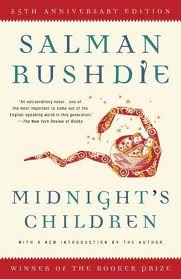
Midnight’s Children by Salman Rushdie, Book One

CLICK HERE to read my Movie Review of Midnight’s Children

***

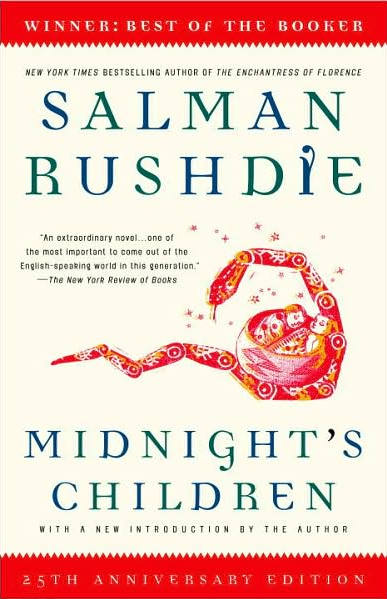
In his introduction to the 25th Anniversary Edition of Midnight’s Children, Salman Rushdie writes:

In the West people tended to read Midnight’s Children as a fantasy, while in India people thought of it as pretty realistic, almost a history book.

I admit, when I started reading Midnight’s Children, I was frustrated. I knew I just couldn’t read it purely as a fantasy. Why, these are real dates in history, important events, the World Wars, the Mahatma’s call for an independent India with non-violent means, the separation of India and Pakistan along religious lines… There must be more, I told myself. I knew I could never read it as an insider, but I could at least peek through the fences, and get a glimpse of what’s going on inside.

And so I did. I searched for background info and author interviews, both online and off. As a result, my reading pleasure is enhanced after I found out how realistic the novel is. Personal happenings actually correspond with important historical events, not unlike the movie Forrest Gump, little people tossed in the currents of history.

Rushdie in an interview noted that instead of using an Austenesque way to tell his story by focusing on the details and the minute, he chose to adopt a Dickensian approach, placing his characters on a macro, societal canvas. As a result, we have a monumental epic. Mind you, he just wanted to write a novel about childhood, he said.

The narrator, Saleem Sinai, started with his Grandfather Aadam Aziz in 1915, thirty-two years before India’s independence. The young doctor examined his patient and future wife Naseem through a perforated sheet a bit at a time, under the close supervision of her cautious father. When at last she complained of a headache, he finally could see her face, “on the day the World War ended.” It’s pure humor also, and I’ve enjoyed Rushdie’s free wheeling brush strokes.

But often the comical may just serve to bring out more poignantly a sombre reality. When I first read the ‘Mercurochrome’ chapter, it didn’t hit me at all. Later, I read about the atrocity that had actually happened on April 13th, 1919, the Amritsar massacre. British Brigadier-General Reginald E. H. Dyer ordered Marshal Law regulations, banning all assemblies. A large crowd defied his orders and started converging in the compound Jallianwala Bagh for a peaceful protest. Dyer marched fifty riflemen up and ordered them to shoot at the crowd indiscriminately, men, women children.

They have fired a total of one thousand six hundred and fifty rounds into the unarmed crowd. Of these, one thousand five hundred and sixteen have found their mark… ‘Good shooting,’ Dyer tells his men, ‘We have done a jolly good thing.’ (p. 34)

A few days ago, Aadam helped the wounded on the streets and got Mercurochrome all over his white shirt, and had to explain to wife Naseem the red stains were not blood. Now on this fateful day, Naseem assumed the red was Mercurochrome again, but was told, “it’s blood,” and she fainted.

The relevance of the perforated sheet reemerges in the next generation when Amina Sinai, Saleem’s mother, has to learn to love her husband Ahmed Sinai one fragment at a time:

 ‘Who, after all,’ she reasoned privately, ‘ever truly knows another human being completely?’

The last two chapters ‘Methwold’ and ‘Tick, Tock’ strike a chord in me. Why, I’m not totally an outsider after all. For the first fifteen years of my life, I was a colonial. I was born and grew up in the then British colony of Hong Kong. So reading Book One of Midnight’s Children, I feel certain affiliation. It reminds me of my childhood days, which were also filled with multiplicity of cultures, the fusion of languages, and fortunately, the calm co-existence of religions. There were spittoons and Mercurochrome. I was familiar with bilingual usages, aware of the divide between the subject and the ruling, the East and the West. Even now, I can spot the ‘imitation Oxford drawls’. My “Tick, Tock” moment was when I watched on TV here in Canada the last governor of Hong Kong Chris Patten standing in the rain holding the British Colony flag, saying goodbye to all that on July 1, 1997.

Rushdie’s animated style makes his India colourful and fascinating. His characters, descriptions and dialogues are like the splashes of a Pollock painting. That’s where the fantasy comes in, I suppose, on the large canvas of history.

Book One ends with intrigue. Saleem Sinai, it turns out, is a changeling. At the stroke of midnight August 15, 1947, two boys were born, but was soon mixed up by midwife Mary Pereira in a wilful act of self-assertion. This too has its deeper reference:

When we eventually discovered the crime of Mary Pereira, we all found that it made no difference! I was still their son: they remained my parents. In a kind of collective failure of imagination, we learned that we simply could not think our way out of our pasts…

I look forward to reading the childhood of these two changelings Saleem and Shiva, and their  journeys ahead.

***

Here are the other Read-Along Posts for Book One (so far):

Bellezza at Dolce Belleza
Gavin of Page247
Janell of An Everyday Life
Jerikavonalexandra of averydisorientedreader
Colleen of Books in the City 

If you’ve written a post for our Read-Along, do let us know in a comment.

***

CLICK HERE to Book Two: Part A
CLICK HERE to Book Two: Part B
CLICK HERE to Book Three Conclusion

CLICK HERE to read a March 1, 2012 interview of director Deepa Mehta on CBC news.
CLICK HERE to read about the filming of Midnight’s Children.

Great Film Expectations

For an updated list of 2012 premieres of film adaptations, CLICK HERE.

With written works from Suzanne Collins’ The Hunger Games to Shakespeare’s Coriolanus materialized on the big screen, what else can we anticipate in this year and next?

Here’s an update of some upcoming film adaptations from literary works. Great choices for book groups too.

A Most Wanted Man by John Le Carré

On the heels of the acclaimed “Tinker Tailor Soldier Spy”, this time, Philip Seymour Hoffman is the man. Directed by Anton Corbijn whose last film was the deep and thoughtful “The American, a film I found to be much better than the book.

.

Anna Karenina by Leo Tolstoy

Finally, dates are set for the premiere: Sept. 7 in the UK, Nov. 9 in the US. I look forward to this one: Tom Stoppard screenplay, Joe Wright (Atonement, Pride & Prejudice) directs, Keira Knightly as Anna, Matthew MacFadyen Oblonzky, Jude Law Alexai, Aaron Johnson Count Vronsky, and Downton Abbey‘s Michelle Dockery (Lady Mary) as Princess Myagkaya, plus many other British stars.

.

Cloud Atlas by David Mitchell 

Winner of multiple awards and shortlisted for a Booker in 2004, the apocalyptic novel is adapted by Tom Tykwer (Run Lola Run) and The Wachowski’s (Matrix’s). Tom Hanks, Halle Berry, Susan Sarandon, Ben Whishaw (Bright Star), Hugh Grant, Jim Broadbent. Here’s Susan Sarandon’s take on the production.

.

The Emperor’s Children by Claire Messud 

Some big names affiliated with this project are Richard Gere, Eric Bana, Keira Knightly, Emma Thompson, Rachel McAdams. Director Scott Cooper (Crazy Heart) on board. But I can find no more news after this announcement, which is fine, gives me more time to get to the book first. It’s been on my TBR list for a few years now.

.

Great Expectations by Charles Dickens

To coincide with the 200th birthday of Charles Dickens and the Olympics in London, Mike Newell (Enchanted April, Four Weddings and a Funeral) directs, screenplay by David Nicholl (One Day, Tess of d’Urbervilles, When Did You Last See Your Father) who may be also writing the third Bridget Jones movie. Ralph Fiennes is Magwitch, Helena Bonham Carter Miss Havisham, Jeremy Irvine, Pip.

.

The Great Gatsby by F. Scott Fitzgerald 

What will F. Scott think when he sees his masterpiece produced in 3D in the 21st Century? Woody: do give us a sequel to “Midnight In Paris” with your brilliant imagination. Australian director Bez Luhrmann is poised to bring us this new version of Gatsby in 3D, which I’m sure will stir up lots of discussions. It has already. But no matter how I dislike 3D (except Hugo), I want to see Leo DiCaprio play Jay G., Carey Mulligan, Daisy B., and Tobey Maguire, Nick C. Do Click Here to read a Guardian preview close to 3D.

.

The Guernsey Literary and Potato Peel Pie Society by Mary Ann Shaffer and Annie Barrows

Kenneth Branagh will direct Kate Winslet in this popular novel about the power of literature in desperate wartime. This is a reprise of their cooperation from 1996, when Branagh, as Hamlet, also directed Winslet as Ophelia. No dates have been set for its production or release, but something to keep in mind.

.

The Hobbit by J. R. R. Tolkien

Coming out in three parts. “The Hobbit: An Unexpected Journey” in 2012, and “The Hobbit: The Desolation of  Smaug’ in Dec. 2013, and ‘The Hobbit: There and Back Again’ in July, 2014. Peter Jackson attempts to reprise his Rings Trilogy magic. Elijah Wood, Ian McKellen, Cate Blanchett, Orlando Bloom… the whole gang. Again, we’ll get to see beautiful New Zealand as setting.

.

The Invisible Woman: The Story of Nelly Ternan and Charles Dickens by Claire Tomalin

Claire Tomalin’s account of Charles Dickens’ affair with the young writer Nelly Ternan will be brought to screen with script from Abi Morgan (Shame, The Iron Lady) to be directed by Ralph Fiennes, who will play Dickens himself. To add to the rave, Kristin Scott Thomas is also on board. Felicity Jones will be playing Nelly Ternan. Fiennes never ceases to amaze us with his versatility, after directing Shakespeare’s Coriolanus in postmodern style.

.

Les Miserables by Victor Hugo

Tom Hooper of “The King’s Speech” directs an all star cast in this musical offering. Hugh Jackman as Jean Valjean, Russell Crowe as Inspector Javert (is he going to sing too?), Helena Bonham Carter, Anne Hathaway join in the chorus. Just too bad Geoffrey Rush and Colin Firth are missing here. Release date for North America is Dec. 2012, which means it can be a contender in next Awards Season.

.

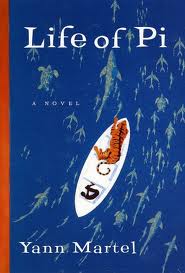
Life of Pi by Yann Martel

Director Ang Lee picked 17 year-old Suraj Sharma of Delhi, India, from 3,000 teenagers to play Pi Patel. Interesting that Tobey MacGuire will play Yann Martel, the author of the book which won the 2002 Man Booker Prize. The film to be shot in 3D has a December 2012 release date. Again, films opening in December usually have eye on the next Awards Season. Will keep our eyes peeled.

.

Midnight’s Children by Salman Rushdie

The Booker of Bookers winning work will see its author Salman Rushdie team up with acclaimed Canadian director Deepa Mehta in the film adaptation. Mehta in a recent interview hinted it will debut either at the Venice or the Toronto Film Festival this fall. You can still join us for a slow Read-Along of Midnight’s Children before the film comes out.

.

Rebecca by Daphne DuMaurier 

On the drawing board of Dreamwork and Working Title. Who can take the helm to reprise an adaptation made famous by Alfred Hitchcock, and actors to replace Sir Laurence Olivier as Mr. de Winter and Joan Fontaine as the new Mrs? Now, why does Carey Mulligan emerges in my mind… and Michael Fassbender

.

What Maisie Knew by Henry James

Looks like a good classic to read before seeing the movie. Julianne Moore and Alexander Skarsgård lead the cast. I’ve enjoyed previous Henry James adaptations of The Wings of the Dove, The Golden Bowl, and The Portrait of a Lady. Look forward to this one.

.

Books to be turned into TV series:

The Corrections by Jonathan Franzen

To be adapted into an HBO TV series with an all-star cast under the helm of Noah Baumbach (The Squid and the Whale). Stars include Ewan McGregor, Maggie Gyllenhaal, Rhys Ifans, Dianne Wiest, Chris Cooper and Greta Gerwig. But, will the author be involved in any of the writing?

.

A Visit From the Goon Squad by Jennifer Egan

Again, HBO has bought the rights to this one. The 2011 Pulitzer Prize winner is to be adapted into a half-hour TV series.

.

.

The Art of Fielding by Chad Harbach

Yet again, it’s HBO that will be developing the novel into a TV drama series, another project by the “uber producer” Scott Rudin, who also oversees “The Corrections.”

.

***

What are some of  your most anticipated films or books in the coming year(s)?

The Importance of Being Earnest by Oscar Wilde

To celebrate St. Patrick’s Day, I’d like to post my second selection for the Ireland Reading Challenge 2012, and raise a toast to Oscar Wilde for his LOL funny three-act play The Importance of Being Earnest.  

Though written in 1894, Wilde’s work is surprisingly modern. Subtitled “A Trivial Comedy for Serious People”, it is a mashup of mistaken identities, social satire, biting ironies, and one-liners worthy of our late-night talk shows.

You can finish the breezy eighty-some pages in one sitting, but don’t read it in public. You don’t want to be mistaken. To most people, only a lunatic would LOL alone without a bluetooth hanging on his ear.

Jack Worthing is in love with Gwendolen Fairfax of London, cousin of his friend Algernon Moncrieff. But obstacles abound for his courtship. As a country gentleman with many responsibilities, he has to create a wayward younger brother and town-dweller named Earnest as an excuse for him to go out to town for pleasure and to see Gwendolen. While in town, he has taken the name Earnest. Algernon, just the opposite, has to create an invalid Bunbury in the country for him to visit so he can meet and woo Jack’s ward Cecily, while pretending he is Earnest, Jack’s younger brother from London.

Locales may be a hindrance, their major obstacle is Lady Bracknell, Gwendolen’s mother and Algernon’s Aunt, a formidable and feisty gatekeeper of aristocratic matrimony.

With Downton Abbey’s dialogues still ringing in my ears (been re-watching the blu-rays perpetually since its Season 2 Finale on PBS) I can easily imagine the Dowager Countess of Grantham, Violet Crawley, uttering Lady Bracknell’s lines. Screening for Jack’s eligibility as a suitor for her daughter Gwendolen, Lady Bracknell conducts the following interview.

LADY BRACKNELL:  How old are you?

JACK:  Twenty-nine.

LADY BRACKNELL:  A very good age to be married at. I have always been of opinion that a man who desires to get married should know either everything or nothing. Which do you know?

JACK (after some hesitation):  I know nothing, Lady Bracknell.

LADY BRACKNELL:  I am pleased to hear it. I do not approve of anything that tampers with natural ignorance. Ignorance is like a delicate exotic fruit; touch it and the bloom is gone. The whole theory of modern education is radically unsound. Fortunately in England, at any rate, education produces no effect whatsoever…

LADY BRACKNELL:  Are your parents living?

JACK:  I have lost both my parents.

LADY BRACKNELL:  To lose one parent, Mr. Worthing, may be regarded as a misfortune; to lose both looks like carelessness.

JACK:  The fact is, Lady Bracknell … I don’t actually know who I am by birth. I was … well, I was found.

LADY BRACKNELL:  Found!

JACK:  The late Mr. Thomas Cardew, an old gentleman of a very charitable and kindly disposition, found me, and gave me the name of Worthing, because he happened to have a first-class ticket for Worthing in his pocket at the time. Worthing is a seaside resort.

LADY BRACKNELL:  Where did the charitable gentleman who had a first-class ticket for this seaside resort find you?

JACK (gravely):  In a hand-bag.

LADY BRACKNELL:  A hand-bag?

JACK (very seriously):  Yes, Lady Brakcnell. I was in a hand-bag—a somewhat large, black leather hand-bag, with handles to it—an ordinary hand-bag in fact.

LADY BRACKNELL:  In what locality did Mr. Thomas Cardew come across this ordinary hand-bag?

JACK:  In the cloak-room at Victoria Station. It was given to him in mistake for his own.

LADY BRACKNELL:  The cloak-room at Victoria Station?

JACK:  Yes. The Brighton line.

LADY BRACKNELL:  The line is immaterial. Mr. Worhting. I confess I feel somewhat bewildered by what you have just told me. To be born in a hand-bag, whether it had handles or not, seems to me to display a contempt for the ordinary decencies of family life…

And many more lines that would show you Wilde could have made one great Oscar host.

***

The Movie (2002, DVD)

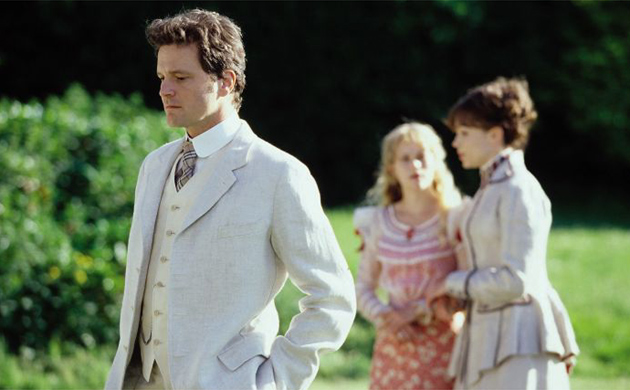
I’ve got the DVD. It never fails to delight no matter how many times I re-watch it. Lady Brecknell is portrayed by Judi Dench, as proficient as any Dench performance, albeit a bit too severe here. But just as well, she’s a monster to Jack Worthing.

Jack is played by the ever talented Colin Firth. Dispelling the Mr. Darcy myth, Firth shows he can be one freewheeling comedic actor. Having seen many of his works, I find that with the right words to say, he can always deliver in style, even if he needs to stammer to get his words out.

Before Mamma Mia! (2008), Colin Firth had sung in a movie strumming a guitar, it is here. With Rupert Everett as the piano playing Algernon, the two come together in a duet to woo their love.

Frances O’Connor, who plays Fanny Price in Mansfield Park (1999), is Gwendolen, animated but much intimidated by her icily fierce mother Lady Brecknell. Reese Witherspoon is Cecily, Jack’s 18 year-old ward. The gals can easily call each other sisters if not for the mistaken identity of their love interest, Earnest. Thinking they are romantic rivals, the ladies are at each other’s throat as much as their genteel upbringing can allow, and  quickly become allies once the misunderstanding clears up.

Both Jack and Algernon are willing to go all out to have their names changed to Earnest via christening by the minister Dr. Chasuble, a role mastered easily by veteran actor Tom Wilkinson. Dr. Chasuble is a silent admirer of Cecily’s governess Miss Prism, played by Anna Massey with much comedic sense and timing.

At the end, Jack finds out his true parentage, realizes that he is more kin than kind to Algernon, and three matrimonies ensue, a happy ending Jane Austen would have approved. The movie adaptation is an enjoyable way to go through the play, not just with sight, sound and cinematic fun, but a delightful all-star cast.

Some tidbits: The film won a Best Costume Design award from Italy, and Reese Witherspoon was a nominee of the Teen Choice Award 2002. Looking at the cast today, we see 3 Oscar winners and 1 Oscar nominee.

As usual, the DVD carries special features like The Making Of and Behind the Scene featurettes, interviews with stars and crew, and audio commentary, always a valuable companion to the main feature.

~ ~ ~ Ripples

Midnight’s Children Read-Along Begins

CLICK HERE to read my review of Midnight’s Children the Movie

Our slow and flexible read-along of Midnight’s Children by Salman Rushdie begins today. How slow? Here’s the plan. Each section about 130 pages is to be covered in a month from March to June. On the last day of each month, we post our reading response to that part:

March 31 — Book One
April 30   — Book Two (Part A ending with ‘Alpha and Omega’)
May 31    —  Book Two (Part B starting with ‘The Kolynos Kid’)
June 30   — Book Three

How flexible? I’m not even calling them ‘reviews’. Let’s just share our thoughts as we read along. You can still continue with your regular blogging activities. And if for any reasons, you can’t keep up, don’t worry. If you miss writing a post, feel free to visit others’ and join in the discussion. If you’re not a blogger, you’re welcome to stop by as well on the last day of every month from March to June to share your view.

From the open invitation posted on Jan. 8, the following readers had shown interest to join in. I’ve put your links down so we’ll know where to go for the response posts at the end of the month. If you want to join in now, you’re most welcome. Just indicate your intention in a comment below and I’ll add in your link. Conversely, if you feel you can’t commit at this point, just let me know so I can take your link off.

  1. Bellezza of Dolce Bellezza
  2. Colleen of Books in the City
  3. Deborah of Temptations of Words
  4. ds of Third-Storey Window
  5. Janell of An Everyday Life
  6. Lauren of The Very Hungry Bookworm
  7. Gavin of Page247
  8. Jerika of averydisorientedreader
Do go to Bellezza’s blog to check out other participants’ links as well. 

In between these monthly posts, if being succinct is your style, you can share your thoughts in 140 characters with tweets anytime you want. Just leave your twitter name @… in the comment. You’re most welcome to follow some clumsy attempts at laconic expressions @Arti_Ripples

A General Introduction:

Voted Best of The Booker in 2008, Salman Rushdie’s Midnight’s Children has been classified as post-colonial literature, genre historical fiction and magic realism, rich in symbols and allegories. Here’s the Synopsis from the Booker site:

“Born at the stroke of midnight on August 15, 1947, at the precise moment of India’s independence, the infant Saleem Sinai is celebrated in the press and welcomed by Prime Minister Nehru himself. But this coincidence of birth has consequences Saleem is not prepared for: telepathic powers that connect him with 1,000 other “midnight’s children” – all born in the initial hour of India’s independence – and an uncanny sense of smell that allows him to sniff out dangers others can’t perceive. Inextricably linked to his nations, Saleem’s biography is a whirlwind of disasters and triumphs that mirror the course of modern India at its most impossible and glorious.”

Helpful Background Resources Online:

History of modern India from Colonial time

History India Timeline

Setting of Midnight’s Children

Characters in Midnight’s Children 

Book Review on 1981 publication from New York Review of Books

Deepa Mehta and Salman Rushdie collaborate on film adaptation

To all reading along, Enjoy!

***

Death Comes to Pemberley by P. D. James

This is how I see it. Living to 91 is an achievement in itself, let alone write a book at that age. I admire the adventurous spirit of P. D. James, sailing out to new waters at this stage of her career. This is her first attempt at creating an Austen sequel, a Pride and Prejudice fan fiction. So, how do I reconcile the flaws in this book with her previous acclaimed mystery works?  Let’s just say… the editor did it.

Take for example the error in referring Darcy as an Oxford man, who had actually gone to Cambridge, and with Wickham too. The ubiquitous redundancy of retelling, or the irrelevant details such as taking an inventory of how many candles are lit in which room.

Or, this dialogue between Sir Selwyn’s, the magistrate, and Darcy, as Darcy goes to his home to report to him a body is found in the woodlands. Are lines like these necessary? I find them incredibly amusing. Greeting Darcy, Sir Selwyn says:

Please sit. That chair with the carved back is said to be comfortable and should hold your weight.”

Since it was the chair Darcy usually occupied he had every confidence that it would. He seated himself and told his story…

The book begins with an epilogue detailing the story of Pride and Prejudice framed by a Jamesian view. It then starts off with the Darcy household preparing for the annual Lady Anne’s Ball at Pemberley, a tradition honouring Darcy’s mother ever since he was a child. A screaming Lydia comes charging in, uninvited, manically hysterical. Somebody has shot her dear husband Wickham, she claims. A search party led by Colonel Fitzwilliam soon takes action, and a body is found lying in the dense woodlands on Pemberley grounds. Wickham, very much alive, is seen hovering over it, blood stained and drunk. The episode comes early, the rest of the book is the revealing of the facts, whodunnit and why.

This is no CSI. The body is removed once found and brought back to Pemberley. Wickham, the key witness also now the key suspect, is washed clean of the blood on him, given a sedative, and is deep asleep when the magistrate arrives to question him. The later inquest at Lambton and final trial at London’s Old Bailey sound like child’s play when compared to, what comes to mind for me, Dicken’s Bleak House trials.

Simple, straight forward, not much mystery to it. But readers get to be entertained by James’ literary rendering and imagination of all the main characters from Pride and Prejudice, six years after it has ended in Austen’s hands. Darcy and Elizabeth now are parents to two boys, Fitzwilliam, 5, and Charles, 2. Readers so fond of their courtship would be disappointed at not seeing them together much in the book. Georgiana still lives in Pemberley, has two suitors, Colonel Fitzwilliam and a young lawyer Alveston, who seems to have a much higher chance.

At the end, we see the problem that has given rise to the motive of the crime neatly resolved by … Harriet Smith, who is married to farmer Robert Martin, no kidding. You’re right, that’s the Harriet Smith who used to go to a successful girl’s school run by Mrs. Goddard in Highbury, and the farmer Robert Martin who is a good friend of Mr. and Mrs. Knightley. All characters from Emma. This part reads like a parody. But we ought to be familiar with this sort of things by now in our current culture, a total mash-up.

All in all, I say, don’t resist your curiosity. Despite its flaws, and if you don’t take Austen or James too seriously, this just could make one great escape from all the demands of rationality in your daily routines.

~ ~ 1/2 Ripples

***

For all Jane Austen / Pride and Prejudice fans, this review from The Guardian is a must-read.

The End of the Affair: Book and Movie

It’s a bit ironic to post this on Valentine’s Day. It’s a story of an extramarital affair, and it doesn’t end well. But then again, maybe this is the best time to talk about it.

This is my second instalment to meet the Graham Greene Challenge hosted by Carrie of Books and Movies. Spoiler Alert here. But since it’s a classic, I’m sure many of you have read it or seen the movie.

The End of the Affair

The book opens with a meeting between novelist Maurice Bendrix and civil servant Henry Miles on a cold, rainy night in 1946 London. Miles’ wife Sarah had ended an affair with Bendrix 18 months earlier. Bendrix has not seen them since. In this chance meeting on the street, Bendrix observes that Miles is heavy-laden, suspecting Sarah has ‘secrets’. Volunteering to hire a detective to tail the wife for the husband, Bendrix is in fact acting out of jealousy, for he too wants to find out who Sarah is seeing now. “Anyone who loves is jealous.”

Again, in just 160 pages, Greene has intricately explored the depth and complexity of the human psyche, love and hate, trust and insecurity, faith and lameness. Yes, the lameness in Bendrix’s leg can well be a metaphor for his numbness of unbelief. Isn’t there such an argument: “If God does not exist, everything is permitted?”

Love with all its smothering, blinding passion, its persistent, burning desire, its all-consuming emotions that distill into pure jealousy and hate… Graham Greene is a master of such incisive descriptions. But here’s the rub, they’re all found in an adulterous affair.

Isn’t that a pity that such intensity of love is often depicted outside of a marriage. Why, we see them all the time in literature and movies. And, don’t we tend to cheer for the romantic heroes and heroines? Guinevere and Lancelot, for example, to whom Bendrix in the book alludes when he talks to the detective Parkis, who has named his son Lance. Readily come to mind are some others: Madame Bovary, Anna Karenina, and in the epic cinematic versions like The English Patient, in a more restrained way Out of Africa, and the near success in The Bridges of Madison County…  didn’t you wish Meryl Streep would have gone with Clint Eastwood? I’m just thinking, if Ralph Fiennes were the one beckoning her, she’d probably had jumped out of her husband’s truck.

O the fantasy of romance vs. the mundane reality of a marriage. The forbidden fruit seems sweeter, for it arouses excitement, it entices with adventure. Bendrix accuses the oblivious and dull husband Henry Miles as an accomplice in Sarah’s affairs, calling him ‘an eternal pimp’:

“You pimped with your ignorance. You pimped by never learning how to make love with her, so she had to look elsewhere. You pimped by giving opportunities… You pimped by being a bore and a fool…”

There might be some truths in his rants. But then again, are these reasons enough to drive one to discard the marriage vow and seek other allurements? Alas, it seems like boredom is the major impediment to fulfilling that commitment… “If I could love a leper’s sores, couldn’t I love the boringness of Henry?” Sarah tries to reason with herself.

But of course, here, the key is the End of the affair between Bendrix and Sarah. What causes the end is none other than God Himself according to Sarah. A bomb drops near Bendrix’s home while they are both there, striking him dead. Sarah, in her horror and desperation, prays to a God she doesn’t believe to exist, but pleads for the life of her lover just the same. She makes the promise that if God gives Bendrix back his life, she would stop seeing him. As she’s still kneeling by her bed praying, Bendrix walks into the room, injured but very much alive. Thus begins the agony of keeping a promise to a God whose existence now has become an inconvenient truth.

We learn at the end, Sarah has attempted to shift her love from Bendrix to God, albeit with much searing pain. She has gone to a priest and converted to Catholicism. In the crucifix she knows that God Himself is a suffering God too. If only she can see the scale of the pain in the nail-pierced hands in a greater cosmic proportion compared to her own…

***

The marvellous cinematography, the diffused lighting of many scenes, all work to cast a romantic veil over an adulterous affair. Two Oscar noms in 2000 included one in cinematography and one for Julianne Moore as Sarah Miles. Ralph Fiennes plays Bendrix, a suitable choice. He is in his element. Since The English Patient (1996), Fiennes seems to have mastered the persona of the romantic tragic hero and obsessed lover.

While the screenwriter is understandably free to invent more scenes for the visual storytelling and change some plot points, one alteration I feel  is definitely unacceptable and that’s the character Richard Smythe. In the book, Smythe is an atheist whom Sarah visits several times to discuss views about atheism. Ironically it is Smythe’s atheistic stance that drives Sarah into believing God. She then confides in Father Crompton her wish to convert to Catholicism. But in the film, Smythe is the priest, and what more, he is implied to be another of Sarah’s lovers. I think here is where integrity to the source material should have given priority over dramatic effects.

***

And what does Colin Firth have to do with The End of the Affair? Well, for all you Colin fans, he is among some A-list stars to have signed with the UK audiobook provider Audible to record their reading of their favorite classic novel.

Audible’s founder, Donald Katz, told the Observer: “Colin Firth could read me the back of a Marmite jar and I would listen.” Well, Colin has chosen, not Marmite or Cornflakes, but for more flavour, Graham Greene’s The End of the Affair. CLICK HERE to read the announcement and see what other stars are reading for Audible’s recordings.

Now we have another portal to appreciate Colin, and, another channel to enjoy a Graham Greene book.

Update May 7, 2012: The Audiobook The End of the Affair narrated by Colin Firth is released today.

***

The Quiet American by Graham Greene: Book and Movie

This is my first selection for the Graham Greene Challenge hosted by CarrieK at Books And Movies.

I watched the film The Quiet American some years back, but not read the book. And my memory is vague. Only remember Michael Caine and Brendan Fraser, the setting in Vietnam, in the early 50’s, a complex fusion of political thriller, murder mystery, and a love triangle.

But now that I’ve read the book I’m thoroughly intrigued, thanks to this Penguin Classics Graham Greene Centennial Edition (1904 – 2004), with the intro written by American novelist Robert Stone. Stone’s novel Dog Soldiers about the Vietnam war and its effects won the 1975 National Book Award. From his introduction, I’ve come to appreciate how intricate and multi-layered the conflicts are, and, how political the novel stands.

Interesting to learn from Stone about the joke embedded in the title: the only quiet American is a dead American. In the midst of a colonial war between the French and the communists in 1950’s Saigon, American Alden Pyle’s subversive brand of democracy satisfied none other than his own idealism. A Harvard grad, armed with naiveté and book knowledge, a CIA under the guise of the American Economic Attaché, Pyle’s involvement might well represent American meddling in other country’s affairs in the name of spreading democracy.

We see all these through the eyes of the narrator, the British reporter Thomas Fowler. Much older, more experienced, and having been posted in Vietnam for some years, Fowler has grown to love the humanity therein, but is plagued by bitter cynicism. He doesn’t take sides, he just writes his story as an observer, smokes his opium pipe prepared by his young mistress Phuong, and lies in bed with her. But Fowler’s noncommittal stance comes to a breaking point at the end:

… one has to take sides. If one is to remain human.

The Quiet American is noted for its divergent from Greene’s ‘Catholic’ novels. But the existential issues are very much in the forefront. Fowler is a man of conscience, albeit aloof in his outward stance. The climax comes as he resolves a moral dilemma. Guilt is his nemesis, regarding his wife in England, regarding Phuong, and much more acutely at the end of the novel, regarding Pyle. The book ends with this line:

I wished there existed someone to whom I could say that I was sorry.

And then there’s Phuong, manipulated by her older sister, weaves herself between the two foreigners whom she sees as her ticket out of the country and into a dream future. I find her reaction to Pyle’s death most disturbing.

In a short 180 pages, Greene has brilliantly depicted the political complexities of the conflicts at the time, and addressed the internal war waged within a man’s conscience, ironically, a man whose outward creed is noninvolvement. I’m thoroughly intrigued by the story that is told with depth, eloquence and skill by a master storyteller.

~ ~ ~ 1/2 Ripples

***

The Movie: DVD

I watch the film again after finishing the book. It has altered some characters, and taken a more sympathetic view of Phuong. But the overall story and perspective remain intact. Upon this second time viewing, I find several interesting facts that I wasn’t aware of before.

Michael Caine was nominated for a Best Actor Oscar and Golden Globe in 2003 for his role as British reporter Thomas Fowler. He has portrayed the character convincingly. Brendan Fraser as the young American I feel is a miscast. If they’re making the film today, James Franco would be my choice for Alden Pyle.

Director is the award-winning Australian Phillip Noyce. (Rabbit-Proof Fence, 2002). One of the two screenwriters is Christopher Hampton who got an Oscar nom for his adapted screenplay Atonement from Ian McEwan’s novel. He is also the screenwriter for the current film A Dangerous Method. Executive producers were two personalities whom I highly respect, Anthony Minghella of The English Patient fame plus some more, and Sydney Pollack whose credits are too numerous to mention. It was a great loss that they both passed away within two months in 2008.

The DVD comes with a resource of special features. Other than all the interviews and making-of, there is a useful “Vietnam Timeline”, outlining the history of Vietnam from 1940 to 1980. Further, I appreciate the inclusion of original book reviews. One line particularly stands out. From the 1956 review of the book by John Lehman of The New Republic: 

The Quiet American is one of the most icily anti-American books I’ve ever read.

Oh…  the wealth of information one can gather from watching these special features.

~ ~ ~ Ripples

***

Molly Fox’s Birthday by Deirdre Madden

This is my first selection for the 2012 Ireland Challenge at Books and Movies. Thanks to Litlove and Rebecca for the recommendation.

Molly Fox’s Birthday was on the long list of the 2009 Orange Prize. Despite the title and the look of the book cover, it’s not chic lit. It’s not about celebrating a birthday either.

The book is set on a single day, Molly Fox’s birthday, June 21st, the summer solstice. Molly Fox is a popular and gifted theatre actor. On that day, the narrator of the book is staying at Molly’s home in Dublin while Molly has gone on a trip to New York. Nothing much happens really on Molly’s birthday, a day that she doesn’t even celebrate.

The narrator is a playwright who has enjoyed acclaims at one time but is now going through a low period in her career. On this day, she is struggling with writer’s block. While she is staying in Molly’s home trying to start a new play, she is preoccupied with memories and pondering. She reminisces on her longtime friendship with Molly, who was initially propelled to fame when she performed  in the narrator’s debut play.

Gaiety Theatre, Dublin

Through her quiet recollections, the narrator describes how their lives intertwine with two other significant characters, Molly’s brother Fergus and their mutual friend Andrew, who is from Northern Ireland. The political events that happend during the past decades had shattered his family. A successful art historian living in London now,  Andrew is still haunted by disturbing memories. And Fergus is another personality which the narrator finds intriguing to discover slowly.

Sometimes it’s just a gut feeling that you like a book. As you’re reading, there’s a gentle push that prompts you forward, reinforcing your favor as you slowly go along… even though ‘nothing much happens’. To go beyond feeling is what I need to do now. Let me try to organise my thoughts:

First it’s the voice. Often that’s the first thing that draws me into the story. Throughout the book, the narrator is unnamed. Her voice is casual, understated, and her tone is occasionally self-deprecating: “… I was in the supporting role: ever the stooge…” For some reason, I’m instantly drawn to such remarks.

But the self-deprecation only hides a genuine search for self-worth, and a deep longing for what is true in relationships and in life. I admire her sincere quest for that which is authentic in herself and others. Like a close friend relating to you her deepest thoughts, you want to listen attentively.

Author Madden’s strategy of keeping the narrator anonymous is most apt, for we are led to discover her inner world, and appreciate the substance that makes up who she is. A name only identifies the surface, the content within is what makes it worthwhile for readers to know in a character.

Intriguingly, this is exactly what the narrator tries to do. As she struggles with writer’s block, she is also sorting out the blockages of veiled personas of those whom she thinks she has come to know, to find out what they are beneath the surface.

What appeals to me is the narrator’s insightful point of view disguised as casual remarks. Like how she recalls the first time she recognized Molly in a café, sitting nearby her and reading a book:

I did not approach Molly — what could I possibly have said? I really liked you in ‘The Importance of Being Ernest’. And what could she have replied? Why thank you very much. What would that have amounted to? Less than nothing. There are forms of communication that drive people apart, that do nothing other than confirm distance. But there are also instances when no connection seems to be made and yet something profound takes place, and this was just such a moment.

Café in Dublin

On Molly’s birthday, the narrator talks to three people who come by Molly’s home, Andrew, whom the narrative has not seen for a while, Molly’s brother Fergus and a well-wisher. From interactions with them, the narrator is surprised to learn that people’s outward image may well be a front hiding a very different self or intent.

From reading the quiet ruminations, I’m delighted to discover gems along the way. Like the rest of the narratives, it seems that the author has strewn them about casually. We’re free to notice and pick up. Here are a few of them:

From the narrator’s oldest brother Tom, a Catholic priest —

Eternity is a priest’s business. But we all live in time. And what I’m doing is trying to make people aware of how the two coexist… keeping that sense of eternity while being in time; and trying to live accordingly…

How the narrator describes Molly’s acting —

There was always something unmediated and supremely natural about her acting, it was the thing itself. Becoming, not pretending.

About the self on and off stage —

Is the self really such a fluid thing, something we invent as we go along, almost as a social reflex?… so much social interchange is inherently false, and real communication can only be achieved in ways that seem strange and artificial.

And this —

Sometimes, on stage, not showing something can be more powerful than showing it.

Seems like this might well be the style Madden follows in writing her book. Subtle prompting, slow revealing… and we’re led to surprising discovery alongside the narrator.

Molly Fox’s Birthday reminds me of Somerset Maugham’s novel Theatre. But this is quieter. And after I’ve finished I wonder… what have I missed now… for there are so many layers, I haven’t explored them all. First off, what’s the significance of a birthday on the summer solstice…

~ ~ ~  Ripples

***

Post of similar subject:

THEATRE by W. Somerset Maugham: In Search of Reality

***

The Sound of the Mountain by Yasunari Kawabata

The Sound of the Mountain (山の音) is my book for Japanese Literature Challenge 5 at Dolce Bellezza, the only one this time and posting it before the Challenge ends this month. It is the first book I finished in 2012, at 1 a.m. January 1st. Truth is, I wanted to finish it by the end of last year, but couldn’t. I’ve been reading it for weeks in December. It’s a book that I had to read ever so slowly.

Yasunari Kawabata (川端 康成, 14 June 1899 – 16 April 1972) is the first of two Japanese Nobel laureates in literature, receiving the honor in 1968 (Kenzaburo Oe in 1994). So far I’ve only read two of Kawabata’s books, Snow Country and The Sound of the Mountain. But from this limited experience, I’ve found that reading Kawabata is like watching an Ozu film. The camera is set low and mostly stationary to depict quiet expressions and gestures. Viewers are engaged by the nuanced dialogues as the director explores in depth thematic materials rather than presents plot-driven sequences. Both masters deal with intimate relationships, their characterization sensitive , their imagery poetic.

Ogata Shingo is in his early sixties, beginning to show signs of old age. Ever introspective and sensitive, he can almost hear the beckoning of death as sound that comes from the mountain to the rear of his house in Kamakura. As he lies in bed at night, beside his oblivious, snoring wife Yasuko, he can distinctly hear that sound:

It was like wind, far away, but with a depth like a rumbling of the earth… The sound stopped, and he was suddenly afraid. A chill passed over him, as if he had been notified that death was approaching.

At most, Shingo feels a duty towards his wife Yasuko. His heart though is drawn to two women, one is his wife Yasuko’s older sister who passed away from an illness some time ago. Yet Shingo still cherishes memories of her. The other is his son Shuichi’s wife, his own daughter-in-law Kikuko, who lives in his house. Nurturing a crush on two women who are not his wife has troubled Shingo deeply.

But the guilt he wrestles with is only a part of the distress he faces so late in life. Shingo has to face the marital problems of both his son Shuichi’s and his daughter Fusako’s.  Shuichi, who lives with his wife Kikuko in the house of his parents, has been seeing another woman, Kinu. And Shingo’s daughter Fusako has recently returned to her parent’s home with her two young children after her husband has deserted them.  Despite their being adults now, Shingo feels responsible for the failure of his children’s marriage.

In a restrained bickering between father and son, Shingo is put on the spot:

I’ve been thinking a little,” muttered Shuichi. “About Father’s life.”
“About my life?”
“Oh, nothing very definite. But if I had to summarize my speculations, I suppose they would go something like this: has Father been a success or a failure?

…..

But whether or not a parent is a success would seem to have something to do with whether or not his children’s marriages are successful. There I haven’t done too well.

As I was reading this book, I thought of Ozu’s films. Like Ozu, Kawabata is bold to expose the breakdown of the traditional family and the threat to paternal authority in post WWII Japan. He depicts the shift from a parent-child emphasis to one between husband and wife. He is honest in revealing the common cracks of unfaithfulness which can destroy marriages. In the book, he openly describes the strain and alienation between generations and within a marriage.

Besides relationships, Shingo has to battle with something more inherent and spiritual. His son Shuichi neglects his wife Kikuko and often goes to his mistress, Kinu, who later becomes pregnant. Shingo not only takes upon himself to deal with Kinu, but is drawn into something even more difficult to confront, for in Shuichi, he sees himself:

Shingo was astonished at his son’s spiritual paralysis and decay, but it seemed to him that he was caught in the same filthy slough. Dark terror swept over him.

Shingo is a man afflicted on severals fronts, guilt, responsibility, spiritual decay. Author Kawabata instills relief for his protagonist as well as his readers by means of Nature.

Gingko Tree in Japan

Shingo is superbly in tune with the natural world, and in turn, nature is a mirror from which he sees himself clearly. The temperamental sky reflects his moods; the typhoon, his inner turmoil; stalks of bamboo broken off by the storm parallel the broken family relationships he lives with; the noise of locust wings spells restlessness; and yet the unseasonable buds on the great gingko tree splashes hope in a troubled time:

The gingko has a sort of strength that the cherry doesn’t,” he said. “I’ve been thinking the ones that live long are different from the others. It must take a great deal of strength for an old tree like that to put out leaves in the fall.

And thus comes the turning point in Shuichi and Kikuko’s marriage, though fragile, still a glimmer of hope, while Fasuko’s marriage comes to an abrupt end like an overnight storm. As for Shingo, we wish him well, like the unseasonable buds on the great gingko tree.

The Sound of the Mountain requires slow reading and quiet contemplation. Like a good film, I know I will go back to it as time goes by.

**

The Sound of the Mountain by Yasunari Kawabata, translated by Edward G. Seidensticker, published by Vintage International, NY., 1996, 276 pages.

Note: ‘gingko’ in this book is spelt differently from our common spelling nowadays ‘ginkgo’

Ginkgo Tree photo from Wikimedia Commons

***

Other related posts on Japanese Literature and Films:

Reading Snow Country in Snow Country

Rouse Up O Young Men of the New Age by Oe

Yasujiro Ozu and the Art of Aloneness 

Notes on the Synthesis of Film, Art… Life?

Year End Tally and 2012 Outlook

Lots to say on this post, but I promise you I’ll keep the pace swift. First off, a wrap-up of this my fourth year of blogging. I’m always amused to see what words people use to come to Ripple Effects. So, here are some of them over this past year.

Search Engine Terms

  • modern day insane asylum
  • stranger than fiction free will or predestination
  • Vermeer skulls
  • how many hunting license were sold before and after  the movie Bambi
  • Toronto International Film Festival social impact
  • culture and imperialism in Mansfield Park
  • Shawshank Redemption sewer pipe
  • Hemingway beaten up by Canadian authors
  • what value in life if not together
  • how to get in touch with Diane Keaton

Give you a feel of what Ripple Effects is all about, right? Yes, it’s a mixed bag of ruminations on books and films, where crawling through a sewer pipe could be noted as an existential quest, and always, a lookout for the minutest ripples of current culture… while maintaining humor and sanity doing all that. And, if you know how to get in touch with Diane Keaton, do let me know.

Most Popular Post

Slowly heading towards half a million views, this turtle does not intend  to win any races, but is glad just the same to see some posts maintaining their popularity. This is the all time most popular post:

Memorable Movie Love Quotes which I compiled and posted for Valentine’s Day 2008. I sure hope that the 24,000 views in 2011 have contributed to some consolidation (and conciliation?) of relationships.

My Personal Best Picks

There are posts people may like, there are also posts that I favour more. Books into films is Arti’s ‘specialty’, and it’s always fun to link the two, albeit I know they are distinctly different art forms.  Some of my favorite posts in 2011 are:

And that leads me to the coming new year. From my upcoming book to movie lists, I look forward to reading the following titles, as they are in development with their film adaptations:

Books to Read in 2012 (before the film comes out)

  • The Marriage Plot by Jeffrey Eugenides
  • The Emperor’s Children by Claire Messud
  • Runaway (short story) by Alice Munro
  • Midnight’s Children by Salman Rushdie
  • As I Lay Dying by William Faulkner

Book Challenges in 2012

I’m excited to sign up for two Book Challenges sponsored by CarrieK. at Books And Movies.

2012 Graham Greene Challenge — What better way to delve into books and movies than reading Graham Greene, who had almost all of his works adapted into feature film or TV series. I’ve selected these titles:

  • The Quiet American
  • The End of the Affair
  • Brighton Rock

.

2012 Ireland Challenge — I’m to pick four titles, including fiction and non-fiction by Irish writers with setting in Ireland. Now this is uncharted water for me. I’ve John Banville and Anne Enright in my TRB pile which I want to get to, and Deirdre Madden’s book suggested by litlove. I’m open to other recommendations.

  • Molly Fox’s Birthday by Deirdre Madden
  • The Sea by John Banville
  • The Gathering or
  • The Forgotten Waltz by Anne Enright

Most Anticipated Books to be Released in 2012

  • When I Was a Child I Read Books by Marilynne Robinson
  • Some Assembly Required: A Journal of My Son’s First Son by Anne Lamott

I’ll be reading screenplays too. Selections will likely be driven by spur of the moment, but these I’d like to get hold of:

Screenplays to Read in 2012

  • The Descendants (see how Alexander Payne adapts from novel)
  • Midnight In Paris (Woody Allen’s always fun to read)
  • Young Adult (Screenwriter Diablo Cody’s script after Juno)

Ironically, I find reading and blogging feed my procrastination. Finishing a book or a blog post is usually the best reason to delay, pulling me away from ‘real’ writing… I still have a screenplay half finished. 2012 looks like a good year to get that done.

And then of course…

The Awards Season 2012

  • Golden Globes – Jan. 15
  • SAG Awards (Screen Actors Guild) – Jan. 29
  • BAFTA Awards (British Academy) – Feb. 12
  • WGA Awards (Writers Guild) – Feb. 19
  • Independent Spirit Awards – Feb. 25
  • The 84th Academy Awards – Feb. 26

As we edge towards the end of the year, my thanks to all who have visited, and those who have stirred up ripples by leaving their thoughts. The pond is all yours.

Best Wishes to All for a Wonderful 2012!

Happy New Year!

***

Reading The Season: Walking On Water by Madeleine L’Engle

It’s that time of the year when a quiet respite is probably the most precious gift. For the past four years since I started blogging, amidst the cacophony of December festivities, I would pick something to read that anchors me to the spiritual meaning of the occasion.  I call these attempts “Reading The Season”. This year, I took down from the shelf a long-time TBR, Walking On Water: Reflection On Faith And Art by Madeleine L’Engle.

After reading it, I went straight to her Newbery Award novel A Wrinkle In Time (another long time TBR for me). Amazed at its wisdom and depth, once I finished it I went back to reread Walking On Water, appreciated all the more L’Engle’s intricate weaving of intellect and spiritual insights.

At the very beginning of the book, these words jumped right out at me:

I sit on my favourite rock, looking over the brook, to take time away from busyness, time to be. I’ve long since stopped feeling guilty about taking being time; it’s something we all need for our spiritual health, and often we don’t take enough of it.

And just a few pages after that, I found this gem:

Leonard Bernstein tells me … for him music is cosmos in chaos. That has the ring of truth in my ears and sparks my creative imagination. And it is true not only of music; all art is cosmos, cosmos found within chaos.

Bernstein might have echoed a Jungian concept of the power of memory and the subconscious self, but there’s a spiritual reality in the thought.

It all began with the calling forth of light from darkness, splendor from void, life from nothingness, the Creation. Terrence Malick’s The Tree of Life comes to mind… the cosmic light and galaxy clouds, the molten lava that spews out of the earth, the roaring breakers of the ocean deep, and my heart resounds: ‘day to day pours forth speech, night to night declares knowledge.’

But what’s most awesome is not just the forming of the cosmos, but the Creator incarnated, the infinite confined, the invincible made vulnerable in order to live the hurts, to share the pains. L’Engle writes:

To be alive is to be vulnerable. To be born is to start the journey towards death… We might paraphrase Descartes to read, ‘I hurt; therefore I am.’

The Creator demonstrated that behind the majesty, there’s the power of love, that driving force behind the willingness to stoop, to be made vulnerable, to be stripped naked, be born a babe. Utterly unfathomable. At one point in human history,  Cosmos entered and lived among Chaos.

And artists, those who write, who paint, who sing, who dance, who act… they are birth-givers. “An act of art is an incarnational activity,” L’Engle writes. Artists partake in the continuation of creation, bringing wholeness to a fragmented world, hope in the slough of despair.

As well, true artists live the vulnerability as the One who first took that cosmic plunge, taking the risk of birth because of love.

Here, take a 3:44 minute respite to enjoy some Seasonal reflections. Click on the video to listen to the music as you read Madeleine L’Engle’s poem:

The Risk of Birth 

This is no time for a child to be born,
With the earth betrayed by war & hate
And a nova lighting the sky to warn
That time runs out & the sun burns late.

That was no time for a child to be born,
In a land in the crushing grip of Rome;
Honour & truth were trampled by scorn–
Yet here did the Saviour make his home.

When is the time for love to be born?
The inn is full on the planet earth,
And by greed & pride the sky is torn–
Yet Love still takes the risk of birth.

Madeleine L’Engle

***

Walking On Water: Reflections On Faith And Art by Madeleine L’Engle, Commemorative Edition, published by Shaw, 1998, 227 pages.

CLICK HERE to Reading the Season 2012: Surprised by Joy

‘Reading The Season’ posts in previous years:

Reading The Season: C. S. Lewis

Reading The Season: Fleming Rutledge

Reading The Season: Madeleine L’Engle’s The Irrational Season

Reading The Season: Luci Shaw