Stillman’s Love & Friendship: More than Book Illustration

Back in 2007, the Welsh-born film director Peter Greenaway made the following stark comment:

“Cinema is predicated on the 19th-century novel. We’re still illustrating Jane Austen novels — there are 41 films of Jane Austen novels in the world — what a waste of time.”

I’m afraid since then, must be to Greenaway’s disdain, more Jane Austen movie adaptations had come out. As recent as early this year, Greenaway had reiterated his stance with an even starker comment: “all film writers should be shot.

Not that he’s anti-Austen, or holds a grudge against Tolkien or Rowling… I don’t think, but that he is pushing for a non-text-based, purely visual medium for movies.

Well, I’m glad his view remains just that, a personal opinion, and that writer/director Whit Stillman had not become a casualty of such an incendiary thought.

love-and-friendship-08.png

For thanks to Stillman, we have an intelligent, delightful and worthy adaptation of Jane Austen’s novella Lady Susan, a first for the author’s lesser known Juvenilia, apart from her famous six novels. The film is definitely not an illustrated book, but a worthy stand-alone cinematic production that Jane would approve.

As for dear Jane, I think she’d be pleased to know that her works are being cherished enough to be adapted into this modern invention called a movie two centuries later, and that in this post-modern era, we have a director by the name of Whit Stillman who’s enthused enough to turn her novella, written when she was still in her teenage years, into a movie production.

The epistolary novella “Lady Susan” was deemed unfinished and published posthumously. So this is a plus as Stillman could finished it for Jane, with an ending that’s aligned with the plot’s trajectory, and in a style that’s so well melded one would marvel at the perfect alchemy of Austenesque characters and language. Smartly borrowing the name of another of her novella “Love and Friendship”, Stillman toys with dear Jane’s uncontested approval.

While written in letters format, “Lady Susan” is highly entertaining. Austen’s talent is apparent on every page. How well she presents her characters merely through their written correspondences. Acerbic commentaries from an 18 year old? Hard to believe. But indeed, here are some lines describing Mr. Johnson (Stephen Fry), Lady Susan’s only friend Alicia’s (Chloë Sevigny) husband:

“My dear Alicia, of what a mistake were you guilty in marrying a man of his age! just old enough to be formal, ungovernable, and to have the gout; too old to be agreeable, too young to die.” (Letter 29, Lady Susan Vernon to Mrs. Johnson)

Interestingly, Stillman has toned down Lady Susan’s language and made her a more amicable heroine. The above lines were shortened and delivered by Kate Beckinsale in a casual manner. Yes, turning the letters into movie scenes are tricky, crafting mere letter writers into flesh and blood can be challenging, something I hope Greenaway can appreciate.

Stillman has taken Love & Friendship to 21st C. audience with fast paced, short scenes. The settings are elegant, the period costumes appealing, overall, a fine cinematic production. It is an apt visual presentation of Austen’s ingenuity. Writing “Lady Susan” while merely 18 or 19, she had seen through the marriage system of her country, understood human nature and foibles, depicting her characters and the main heroine, no, anti-heroine, with piercing sarcasm and generosity.

Having read the novella first could be an advantage as the viewer knows exactly who the characters are and the backstory as the film begins. With the literary source in mind, the viewer can also have a heightened appreciation of the cinematic rendering and alterations needed to make it work as a movie. The fusion of Austen / Stillman humour is most delightful, punctuated with some whimsical rendering on screen that I won’t mention here but leave for viewers to enjoy.

Kate Beckinsale portrays Lady Susan with deadpan astuteness. Deadpan or dead-on, no matter, for Beckinsale is a fine Lady Susan, newly widowed, not too young to be gullible and definitely not too old to flirt for her own gains. Don’t blame her, for she has a sixteen year-old daughter Frederica (Morfydd Clark) to mind, and so, two eligible candidates who need to wed.

If one were to find fault, blame it on the social system allowing the female population only one track to go for sustainability, i.e. to find a husband. The ultimate goal of the marriage contract is more for finance than romance. (Maybe that’s why we love Pride and Prejudice so much, for its triumph of true love.) Here in this story, it’s a social milieu where love is remote and friendship useful. Lady Susan Vernon ultimately finds her conquest, never one to boast, just a project accomplished, all bottom lines met.

Stillman has a wonderful cast to work with, and they look like they had a lot of fun making the film, the most lively being Sir James Martin (Tom Bennett). It must be a joy to be silly without restraint, yes, let it all out.

Alicia, Lady Susan’s only friend, is aptly played by Chloë Sevigny, who reunites with Kate Beckinsale from “The Last Days of Disco” (1998) where the two are the yuppie heroines under Stillman’s direction. Great to see the two friends in “Disco” have now emerged as allies yet again, this time in a comedy of manners with real Austen roots.

Stillman is a master of dialogues, and so’s Austen. In both the novella and the film, conversations make the characters. But mind you, Janeites know this, and it shows in Stillman’s film, Austen’s humour is not your roll on the floor laughing type of funny

rofl_1

but a clever kind of jokes that elicits a knowing chuckle or a smile, ones that exude insight into human nature, ones that you’d want to jot down:

images.jpg

And for those who have read the epistolary novella penned by a young female writer of the 18th century, one cannot help but marvel at her prodigious astuteness and now director Stillman’s revealing of her brilliant mind. A long time Austen ‘apologist’, Stillman’s previous work “Metropolitan” (1990) is unabashedly a “Mansfield Park” of the time. My favorite line in that movie is uttered by the Fanny Price parallel character Audrey Rouget (Carolyn Farina), when she is talking to Tom Townsend (Edward Clements) about one of her favorite Austen works, Mansfield Park. Tom has not read any Austen but feels qualified to criticize nonetheless:

Tom: But it’s a notoriously bad book. Even Lionel Trilling, one of her greatest admirer thought that.

Audrey: Well, if Lionel Trilling thought that, he’s an idiot.

(But of course, it was Tom who hasn’t read any Austen that has misread Trilling.)

That was Stillman’s debut film. Since “Metropolitan”, he had proven his mastery in the comedy of manners in our times… preppies, yuppies, and maybe someday I hope,  millennials. To say his oeuvre is a conglomeration of Woody Allen, Noah Baumbach, and Wes Anderson would be unfair, neglecting his own style of humour and social observations, although his works do leave traces of all the above.

When awards season comes, I anticipate the film to receive some nominations, specifically Adapted Screenplay, Set Design, Costumes and Hair, and perhaps directing.

Here’s my recommendation: read Jane’s novella Lady Susan first before watching the movie would probably reap the most enjoyment. Afterwards, there’s the bonus. Yes, Whit Stillman has wrapped it all up with the novel Love & Friendship: In Which Jane Austen’s Lady Susan Vernon Was Entirely Vindicated published by Little, Brown and Co. in May, 2016. Icing on the cake.

Jane Austen doesn’t need a defender, but I’m sure she wouldn’t mind getting acknowledgement for her lesser known Juvenilia, some works started when she was only twelve. “Love & Friendship” is a first attempt and a worthy homage to her ingenuity. I’m glad there are many prospects. Whit Stillman and Jane Austen make one fine match indeed.

~ ~ ~ 1/2 Ripples

***

Related posts on Ripple Effects:

Love & Friendship and Other Prospects

Too Much Jane?

Why We Read Jane Austen

Mansfield Park: Jane Austen the Contrarian


I’m nobody! Who are you?

April is still here I’m glad. Here’s a timely piece to join in the celebration of National Poetry Month.

***

I’m nobody! Who are you?
Are you nobody, too?
Then there are two of us – don’t tell!
They’d banish us, you know.

How dreary to be somebody!
How public, like a frog
To tell your name the livelong day
To an admiring bog!

Emily Dickinson (1830-86)


DSC_0739

Oh the comfort of anonymity, no need to trend, to like or be liked, to climb the social media ladder, to reach new heights with more followers. Dickinson sure enjoyed her reclusive life, felt fine with being an unknown. Most of her poems were published posthumously, including this one.

***


In Other Words: Lahiri’s Reconstruction of Self

In Other Words book cover

A couple of years ago, I was surprised to read about Jhumpa Lahiri moving to Italy to live, even just for a few years. Author of four works of fiction – Interpreter of Maladies, The Namesake, Unaccustomed Earth, and The Lowland – at the prime of her writing and teaching career, having received the O. Henry Award in 1999, the Pulitzer in 2000, and her latest The Lowland shortlisted for the Booker in 2013, Lahiri decided to uproot her family and move to Italy to totally immerse in the Italian language. That means speaking, reading and writing in Italian.

In Other Words is Lahiri’s brave and candid account as a language learner. It compiles twenty-one essays and two short stories which she wrote in Italian. She uses the metaphor of swimming out into the lake instead of safely hugging the shore to refer to her Italian language learning experience. From her descriptions of the challenges and risks, the loss of anchor, the inability to express herself and be literate, let alone literary, the disorientation, the total humbling, her Italian venture is more like jumping off a precipice to billowy waters of unfathomable depth.

My hat off to Lahiri’s honest revealing of her frustrations and strive for a new identity; yes, after all, language is a major determinant of identity, one which is, unfortunately, superseded by one’s outer appearance and racial features. So it is heart-wrenching to read that despite her love of the Italian language, her total devotion to adopt it not just to live but as a tool of her trade as a writer, she is often seen as an outsider, a foreigner, barred from acceptance. Even when she speaks to Italians fluently in their language, they would respond to her in English.

English, that’s the rub. I was surprised to read that, while the author had achieved so much in her literary career as a writer in English, she chose to discard it to totally immerse in Italian. In the chapter entitled “The Metamorphosis”, she candidly admits that her writing in Italian (which she had been learning in America for some twenty years before) is a flight:

“Why am I fleeing? What is pursuing me? Who wants to restrain me?
The most obvious answer is the English language. But I think it’s not so
much English in itself as everything the language has symbolized for me…
It has represented a culture that had to be mastered, interpreted. I was
afraid that it meant a break between me and my parents. English denotes
a heavy, burdensome aspect of my past. I’m tired of it….”

Of course, that’s also the language that she loved, and succeeded with. The conflict in identity, first as an Indian immigrant with Bangali as her mother tongue, then as a writer in English who had garnered the Pulitzer Prize – an award that she felt she did not deserve – had shrouded her with unresolved tensions. Lahiri had felt deeply the tug of war between her parental heritage and adopted land. A rejection of both had silently crept in. Italian provides a way out:

“Italian offers me a very different literary path. As a writer I can demolish
myself, I can reconstruct myself, I can join words together and work on
sentences without ever being considered an expert. I’m bound to fail when
I write in Italian, but, unlike my sense of failure in the past, this doesn’t
torment or grieve me.”

Unbelievably surprising and honest, written in Italian and translated by The New Yorker editor Ann Goldstein, the bilingual book opens up to a dual English and Italian version. The short essays chronicle the progress of not only an insightful identity search and reconstruction of selfhood, but an invaluable personal documentation of second – no, additional – language learning journey. If this book was published a couple of decades earlier, I would likely have another topic for my thesis in my graduate work on second language learning; not only that, my view of English being the lingua franca, the language holding linguistic hegemony, would have completely changed as well.

After reading In Other Words and my surprising discovery of Lahiri’s ‘tormenting sense of failure’ with the English language (for all its symbolic meaning) or even her ‘undeserving’ feeling towards her award in her writing, I am relieved of a hidden burden. I don’t feel so badly about having had to constantly check and re-check my English: prepositions, idiomatic expressions, phrasal verbs usage, subject verb agreement… All the hurdles that confront me every time I write a post or an article. If Lahiri can be so candid about her frustrations and errors when it comes to language learning, why can’t I?

~ ~ ~ ~ Ripples 

***

My thanks to Asian American Press for allowing me to post my book review here on Ripple Effects. The last paragraph is added in just for my Ripple readers.

Related Posts on Ripple Effects:

 The Namesake by Jhumpa Lahiri: Book Review

The Namesake (2006, DVD): Movie Review

Unaccustomed Earth by Jhumpa Lahiri


The Outsider Visualized

Just finished rereading Albert Camus’s The Outsider (or, The Stranger, L’Étranger). For some reasons, I find these two photos which I took late last fall well represent my thoughts. Words may come later in another post; until then, these visuals will suffice.

The Outsider 2

IMG_3400 (1)

***

Books Before Films 2016

There are several books on my shelf and in my TBR box that will be turning into films coming out in 2016. I must get to them soon. How time flies, one day’s gone already.

The Light Between Oceans by M. L. Stedman

The Light bet OceansOften it’s the cast of an upcoming movie that prods me to read a book. This one has been on the New York Times Bestseller List for years since its publication. No matter how popular it is, I’m motivated only now mainly because of the first rate cast: Alicia Vikander, Michael Fassbender, Rachel Weisz, directed by Derek Cianfrance. Instead of a place beyond the pines (his last work) we have an island off the Australian coast, with the story about a lighthouse keeper and his wife bringing up a baby they found in a boat washed up onshore.
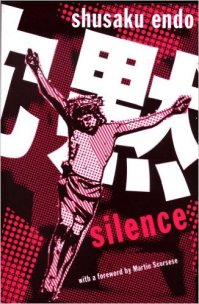
 

Silence by Shûsaku Endô

SilenceThis one is just the opposite. I want to read it regardless of whether it will be made into a film or not. But what a bonus it is to know the adaptation is a Martin Scorsese’s work with Liam Neeson, Adam Driver, Andrew Garfield, and Ciarán Hinds. I highly anticipate this film, albeit I expect the viewing experience won’t be pleasant. I’ve read it before but want to reread it before watching. The book is heart-wrenching as Endô describes the persecutions and tortures Christians and Jesuit missionaries suffered in 17th century Japan. How Scorsese, a Catholic himself, handles the subject matter – the choice between apostasy vs. martyrdom – and have these character actors interpret the internal and physical torments will be intriguing to see. Scorsese wrote the forward of this edition of the book (image here).
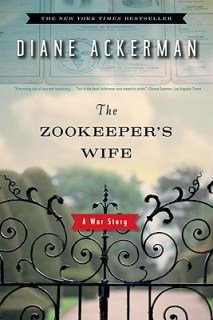
 

The Zookeeper’s Wife by Diane Ackerman

The Zookeeper's WifeThis is a worthy, true story to be made into film. Jan and Antonina Zabinski were keepers of the reputable Warsaw Zoo. During the Holocaust, Jan smuggled Jews out of the Warsaw Ghetto into their facility, saving hundreds. Antonina did the day-to-day chores of protecting them, hiding them in the cages, feeding them and keeping their spirits up. The parallel and irony of men and beasts are obvious. Acclaimed nature writer Diane Ackerman drew from Antonina’s diary to write her non-fiction work, a historical account of a heroic rescue mission. Screenplay by Angela Workerman, a scribe to note. Jessica Chastain and Daniel Brühl play the altruistic Zabinski couple.
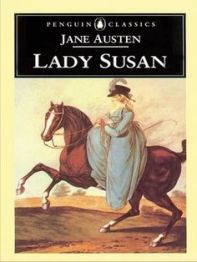
 

Lady Susan by Jane Austen

Lady Susan Book CoverThis has been in my iBooks for a long while, so long that I’d deleted it and now reloaded it again as the film adaptation is coming out. Entitled Love and Friendship, screenplay is based on Austen’s early novella Lady Susan, with Kate Beckinsale as Lady Susan Vernon. It will be interesting to see how the epistle form is translated onto screen. It will premiere at the Sundance Film Festival Jan. 23. Whether we will actually see it in our movie theatres is another matter. I hope it will be screened in the not too distant future.
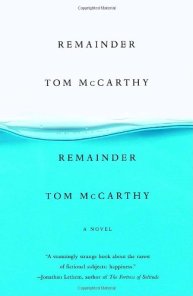
 

Remainder by Tom McCarthy

RemainderI bought this book at Harvard Book Store – the independent book store in Harvard Square since 1932 – during my New England Road Trip last fall. I’d read McCarthy’s 2015 Booker shortlisted Satin Island and knew Remainder had been adapted into film before I went on the trip. So it was a title I’d intended to get at that bookstore. Remainder is McCarthy’s debut work (2006). An unnamed Londoner is struck by a falling object and lapse into a coma. As he awakes, he has lost all memory and needs to re-enact his past to find his identity and authenticity of being. The Telegraph had called McCarthy “a Kafka for the Google Age”. Interesting to see how that translates onto screen. The film premiered at the BFI London Film Festival last October. Will screen at Berlin International Film Festival in February, 2016.


The Secret Scripture by Sebastian Barry

the_secret_scripture_bookcover The film adaptation of Booker short-listed and multiple award winning novel by Irish writer Sebastian Barry has already been completed, but has yet come up with a release date. So, I’ve plenty of time to read the book. The narrator is a 100 year-old mental hospital patient recalling her life. The old and the young are played by Vanessa Redgrave and Rooney Mara respectively. Directed by Jim Sheridan, the Oscar nominated director who introduced us to Daniel Day-Lewis in the excellent productions first in My Left Foot: The Story of Christy Brown and later In the Name of the Father.
***

Top Ripples 2015

Here are the books and movies, experiences and encounters that I’d rated 4 Ripples this year. Click on the links to read my reviews.

**

~ ~ ~ ~ Ripples 2015 Movies

The Assassin 

Brooklyn 

Clouds of Sils Maria

Ex Machina

Mustang (Review upcoming)

Spotlight

**

Worthy mentions  ~ ~ ~ 1/2 Ripples

Bridge of Spies

The End of the Tour

Jafar Panahi’s Taxi

Leviathan

The Martian

Room 

Suffragette

Testament of Youth

**

At the Cineplex, I’d also enjoyed four National Theatre Live performances on screen direct from the London stage. All of these are memorable. CLICK HERE to read my post on the first three, and HERE for Hamlet:

The Hard Problem by Tom Stoppard

The View from the Bridge by Arthur Miller

Man and Superman by Bernard Shaw

Hamlet by William Shakespeare (with Benedict Cumberbatch)

**

As in years past, the number of books I’ve read is only about half of the films I’ve seen, a stat that I’d like to improve in the future. Here are the Top Ripples in books I’ve read in 2015, not all published in this year obviously.

Nora Webster by Colm Tóibín

Brooklyn by Colm Tóibín

Satin Island by Tom McCarthy

The Age of Innocence by Edith Wharton

Beware of Pity by Stefan Zweig

The Post Office Girl by Stefan Zweig

Terrapin: Poems by Wendell Berry

Leavings by Wendell Berry

Slouching Towards Bethlehem: Essays by Joan Didion

**

Here, I must mention my 4 Ripple Experience: Fall Foliage Road Trip across four New England States two weeks in Sept/Oct., prompting me to write 10 blog posts when I came back. Starting here.

Kancamagus Hwy

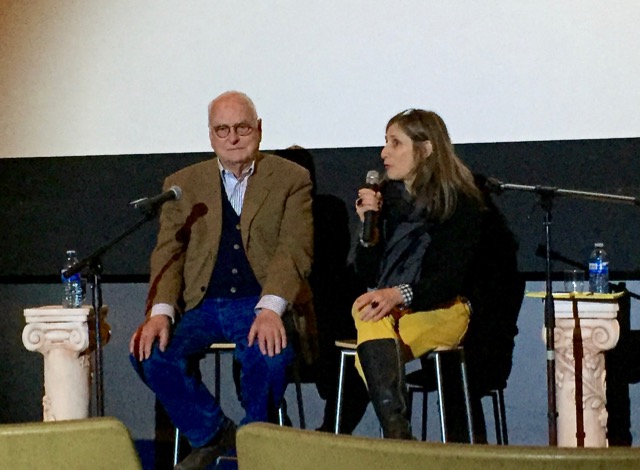
Another 4 Ripple Encounter is attending the Merchant Ivory Retrospective in December. I’d never thought I could actually see director James Ivory in person. And so I did. It was fascinating listening to the 87 year-old, legendary director who’d brought us A Room with a View (1985), Howards End (1992), The Remains of the Day (1993), and many other literary to film adaptations talk about the working dynamics of Ismael Merchant, writer Ruth Prawer Jhabvala and himself in the creative process.

Here’s a photo of the occasion, a Q & A session with film critic Katherine Monk after the screening of Heat and Dust, adaptation of the Man Booker winning novel (1983) by Ruth Prawer Jhabvala:

James Ivory1


And that’s a wrap for 2015.


***

Related posts you might like to read:

Howards End by E. M. Forster

The Merchant Ivory Dialogues 

Ruth Prawer Jhabvala: A Tribute to Rootlessness

Can a Movie Adaptation Ever be as Good as the Book

***


Brooklyn: From Book to Film

Director John Crowley’s movie adaptation of Brooklyn by Colm Tóibín has aptly answered my query (last post): what elements in the book make movie materials? Potentially, a lot. The trick is not to turn them into cliché moments on screen, for this isn’t an unusual story: a young woman leaving home and finding independence and love in a new land. While the film has its flaws, Crowley has crafted a beautiful and stylish transposition.

Author Nick Hornby has done it again following his Oscar nominated screenplay for An Education (2009) adapted from Lynn Barber’s memoir, a film that launched Carey Mulligan’s breakout role and Oscar nod, also a coming-of-age story.

Here in Brooklyn, Hornby tells his story by linking up succinct scenes that just about cover all key episodes in the book. They are short, to the point, and well-paced. The editing too is seamless, driving the film on without delay. After all, they only have about 120 minutes, and they’ve done a smooth job doing that.

Brooklyn Movie Poster

Tóibín’s seemingly simple narration of young Eilis Lacey’s journey of emigration from Ireland to America in the 1950’s is transposed onto film with sensitivity and nuance. The ‘mundaneness’ of daily living – working in a department store, dinner back at the boarding house, night class several days in the week – is transformed into vivid scenes by a lively cast of actors. To their credits, the already animated dinner table banters at Mrs. Kehoe’s (Julie Walters) rooming house as described by Tóibín have now come to life. Indeed, Julie Walters embodies Mrs. Kehoe, and Jim Broadbent as Father Flood is well cast.

Crowley, or is it Hornby, had softened Tóibín’s shrewd descriptions of some of his characters, presenting them in a sympathetic light, making them more likeable. The mood is less serious than the book but evoking empathy just the same. Although two weak spots I find. First is the glamorous and confident older sister Rose (Fiona Glascott) is not depicted as such, lessening the effect that is to come later. Secondly, Jim Farrell (Domhnall Gleeson) is absent at the beginning but appears only in the last part of the film, hence there is not much for character contrast or development.

While most of the supporting characters are well played, the film belongs to Saoirse Ronan, the young Irish actor who first drew notice from Joe Wright’s adaptation of Ian McEwan’s Atonement (2007). Her performance as 13 year-old Briony sent chills up my spine. With that role Ronan became one of the youngest Academy Awards nominees. In the most recent Wes Anderson’s The Grand Budapest Hotel (2014) she sends out very different vibes. As of now for Brooklyn, Ronan has a Golden Globe Best Actress nom. I anticipate she will go all the way to the Oscars.

Cinematographer Yves Bélanger is apt to let the camera linger on Ronan close-up many times, for she acts without speaking. Her facial expressions representing the spectrum of Eilis’s emotions and thoughts are spot on. It is a delight to watch her.

Another animated scene is dinner at Tony’s (Emory Cohen) Italian family home. Here, we see the characters jump out of the book, especially the kid brother, 8 year-old Frankie (James DiGiacomo), whose infamous line is “We don’t like Irish people.” But of course, the whole family welcomes Eilis and supports Tony, who has interpreted his literary version well: respectful, authentic and transparent, as Tóibín writes,”he was as he appeared to her; there was no other side to him.”

Domhnall Gleeson as Jim Farrell has a hard role to play for its very short appearance in the last part. He has not much material to work from but just hangs around with Nancy (Eileen O’Higgins) and George (Peter Campion) who try to set him up with Eilis. Not much to launch a lightning courtship.

Colours play a major role in the film, albeit I feel a pinch of contrivance; watching the colourful 1950’s costumes is like looking into the window of a candy shop with all kinds of macaroons. However, the colours may well set the mood and setting for the film: The overall greenish tone of the first part in Ireland, to the stark green coat Eilis wears as she leaves home on board the ocean liner to the cheery bright yellow cardigan after she has met Tony. Towards the last part, it’s back to the greenish hue of Enniscorthy, only the newly returned Irish/American gal wearing her bright colours. Too explicit a visual translation? Maybe, but I like macaroons, and I won’t hold a Ripple against the colour treatment.

Another visual imagery is at the beginning, right after Eilis has landed in America and gone past the immigration line, she opens the door to head out. We see her step out into an overwhelming brightness of white. Too heavenly? Or maybe just the right sign to boost the confidence of our seasick and insecure heroine?

How do you translate Tóibín’s quiet descriptions on screen? His signature depictions of a calm surface that hides tumultuous billows of emotions? Crowley gives us silence. Indeed, there are cinematic moments that are devoid of sound; the most memorable one is close to the ending when Eilis reveals her secret to her mother (Jane Brennan), sending shock waves and despondence on her face. Yet she restrained her emotions. Mother and daughter embrace in utter silence with tears flowing, saying possibly a last goodbye to each other in their lives and releasing a determined letting go for both.

Brooklyn is a beautiful adaptation worthy of its literary source, among one of the best films I’ve seen in 2015.

~ ~ ~ ~ Ripples 

***

Update Jan. 14, 2016:
3 Oscar Nominations – Best Picture, Best Actress, Best Adapted Screenplay

***

Related Review Posts:

Brooklyn by Colm Tóibín Book Review

Atonement: Book Into Film

The Budapest Hotel: A Grand Escape

Ex Machina (2015) 

Brooklyn by Colm Tóibín: A Second Encounter

As one who is interested in the adaptation process, I’m always eager to find out how filmmakers choose movie materials.

I first read Colm Tóibín’s Brooklyn a few years back when it was first published. I admit I found it uneventful and a bit bland at that time. On the shelf it went after my reading, and I didn’t bother to think too much about it.

Only in recent months when I knew about its upcoming movie adaptation that I was drawn back to it. My major quests this time: to give it another chance and to find out what in it that appeals to filmmakers.

Well, glad I reread it, for I’m actually giving myself a second chance. This time the ‘uneventful’ narratives become a quiet and gentle portrayal of a young woman’s journey of self-discovery, a coming-of-age story told with nuance and grace.

I read it more carefully this time, noting in particular the subtexts and inferences. I paid attention not only to the characters’ inner thoughts and feelings from Tóibín’s direct statements, but his descriptions of their actions and find that he’s a master of subtleties.

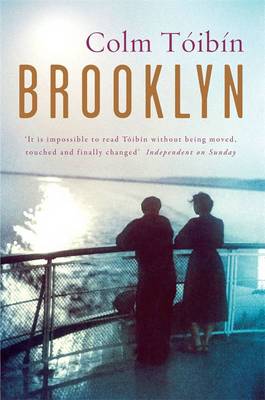
Brooklyn_Colm_Toibin

Brooklyn is about migration, this time around, I can see how relevant and timely it is with our present global situation. From the small town of Enniscorthy, Wexford County, Ireland, Eilis sails across the Atlantic on her own to reach the shore of America just for a better future.

The initial foresight is however from her older sister Rose, the financial supporter and all round sustainer of both Eilis and their widowed mother. It is no wonder that Eilis feels it’s Rose that should be the one to go to America, Rose, the good golfer, glamorous, fashionable, capable and confident.

And Eilis? Here’s a little episode while still in Enniscorthy. She goes to a dance with her best friend Nancy and watches her being invited to the dance floor by a promising young man George. Sitting on the sideline Eilis watches her every move and then we read:

“Ellis looked away in case her watching made Nancy uncomfortable, and then looked at the ground, hoping that no one would ask her to dance. It would be easier now, she thought, if George asked Nancy for the next dance when this set was over and she could slip quietly home.”

When this set is over she isn’t given such a chance, for then George brings Nancy and Eilis over to the bar for a lemonade and we are introduced to his friend Jim Farrell, who “just nodded curtly but did not shake hands… his face emotionless.” Towards the end of the book we will see Jim Farrell appear again as some sort of a nemesis who poses a moral dilemma for Eilis.

Tóibín has given us an unlikely heroine in Eilis, a reluctant emigrant. Always the recipient of Rose’s support and encouragement, Eilis is in fact pushed out of her comfort zone by her well-meaning older sister. In her personal journey we see how Eilis grow and mature, and most importantly, with her good nature intact.

In Brooklyn, Father Flood helps her settle in Mrs. Kehoe’s rooming house and secures a job as a sales clerk at Bartocci’s department store. She gets a taste of rooming house politics, and at Bartocci’s, learn work ethics and the soft skills that are so essential to survive socially. And yet, she is plagued with homesickness as soon as she receives the first letters from home.

At the mid-point of the book, Eilis meets Tony, not Irish but from an Italian immigrant family. No matter, Tony’s authentic charm and devotion break down all cultural barriers and alleviates Eilis’s homesickness.

Tony is gentle with her, courteous and considerate. How do we know? As a die-hard Brooklyn Dodgers fan, Tony never mentions baseball in front of Eilis. Instead, he listens attentively to her and having learned of her night class at Brooklyn College, waited for her after class just to walk her home.

Eilis discovers Tony’s love of baseball when he brings her home for dinner over conversations with her brothers at the dinner table. His family? That’s another charming story.

Just as she begins to settle in and fully enjoy her new life in Brooklyn, Eilis receives a tragic news that sends her back to Ireland for a short while. Now we are at the last part of the book with only fifty-one pages left. Here we have the major conflict of the novel, a moral dilemma that Eilis needs to resolve.

I much appreciate Tóibín’s storytelling. After presenting us in details a successful immigrant experience, a young woman becoming independent in a new land, finding herself, meeting a love interest, and even planning for a future with him, Tóibín drops a bombshell shattering all that has been built and invested. And all this while, he’s been so calm and quiet leading to it.

Further, Tóibín shows us how we can be a different person in different settings and environment. Once back in Ireland, the independent and confident Eilis is changed back to her old self. Under the roof of her mother, she is the dutiful and accommodating daughter once again, but this time, with the added burden of guilt.

Tóibín’s narratives are often quiet and mild, but his characterization is shrewd. We see the acerbic Mrs. Kelly who runs a tight ship in her grocery store where Eilis works on Sundays, and her American counterpart Mrs. Kehoe, Eilis’s landlady. Then there’s the curt Jim Farrell who doesn’t even cast Eilis a glance but earnestly woos her when she comes back after dipping in American waters; and finally there’s Eilis’s mother, subtly scheming and manipulative.

With the subject of migration, the ultimate quest is finding a home. As we read Eilis’s personal journey across the Atlantic from Ireland to America and back again, we see her tossed by the waves of loyalty and belonging. Like her first voyage over the turbulent sea, unsettling and gut retching, her return to Enniscorthy is an even more acute challenge. But at the end we see Eilis make her choice, and it is gratifying.

She is finally ashore.

~ ~ ~ 1/2 Ripples

***

Movie review of Brooklyn is here.


November Wrap: East Meets West at the Pond

November is an eclectic month of reading and viewing for me. I’ve watched films ranging from a Chinese wuxia legend from the Tang Dynasty, to the English suffrage movement, to the scandal in the Catholic Church in Boston… and read books from crime thrillers to Westerns to the Gilded Age to India before and after independence.

Arti is a hybrid after all, constantly navigating between cultures and languages. When it comes to books and films, dashing between genres, periods and styles only adds spice to life.

Here’s the list of my November books and films.

Films

The Assassin

The Assassin

Acclaimed Taiwanese director Hou Hsiao-Hsien’s genre-defying wuxia epic earned him Best Director at Cannes this May. Hailed as the most beautiful film at the Festival, this adaptation of a 9th century Tang Dynasty Chinese legend may not be as easily grasped in terms of its storyline as its visual appeal. The film is recently voted #1 on the reputable Sight and Sound Magazine‘s Best Films of 2015 list, that’s the result of a poll gathering the views of 168 international film critics. It is a rare gem indeed. My full review at Asian American Press.  ~ ~ ~ ~ Ripples

(BTW, Hou’s last film? The Musée d’Orsay commissioned French feature on the Museum’s 20th anniversary: Flight of the Red Balloon.)

Room

A highly watchable adaptation of Emma Donoghue’s 2010 Booker Prize shortlisted novel. Kudos to the actors Brie Larson as Ma, Jacob Tremblay as 5 yr-old Jack, and yes, to Donoghue herself for writing the screenplay. One of those titles that I’ve enjoyed watching more than the literary source. My review on Ripple Effects.  ~ ~ ~ 1/2 Ripples
Update Jan. 14, 2016: 4 Oscar Nominations including Best Picture

Suffragette

Carey Mulligan has put forth a nuanced performance as the laundry gal turned suffragette in this Sarah Gavron (Brick Lane, 2007) directed historical drama. It’s worthwhile to watch the informative depiction of the actual events woven with fictional personal stories, especially Mulligan’s riveting portrayal of Maud, how her beginning naivety is forged into committed devotion to the suffrage movement. Prolific screenwriter Abi Morgan (Irony Lady, 2011, just to name one of her works) has laid out a fact-based drama with a heart-wrenching climatic scene. The sacrifice these voiceless, working women were willing to lay down is inspiring.
~ ~ ~ 1/2 Ripples

Secret in their Eyes

The Hollywood re-make of Argentine author Eduardo Sacheri’s crime thriller is a tall order, for its previous film adaptation is the Oscar winner of 2009 Best Foreign Language Film. My post on the book, original film, and Hollywood version is here. ~ ~ ~ Ripples

Spotlight

One of the best films I’ve seen this year, detailing the sequences of how the Boston Globe’s ‘Spotlight’ team of investigative journalists uncovered the systemic cover-up of child sexual abuse among Catholic priests. The Pulitzer winning reporting is presented in the film as painstaking procedurals in matter-of-fact dramatizing. For those who may be a bit worried about the subject matter, there is no sensationalized scenes of abuse, and on the part of the reporters, no portrayal of heroism. Such may well be the praise-worthy elements of this production. The cast’s performance is convincing, in particular, Liev Schreiber as the soft-spoken but motivating, no-nonsense editor Marty Baron. Come Awards time, I trust the production, its cast and crew, and director Tom McCarthy (The Visitor, 2007) will be duly recognized.    ~ ~ ~ ~ Ripples
Update Jan. 14, 2016: 6 Oscar Nominations including Best Picture

Fireflies in the Garden

My guess is, you haven’t heard of this 2008 movie. Neither have I until I saw it on TV a few days ago. The story about a father-son’s love-hate relationship from childhood to adulthood is realistically depicted. Caught in between the straining conflicts between the always angry and harsh father and a sensitive, vulnerable son, is the mother, always loving and protecting, something like the family dynamics in Terrence Malick’s The Tree of Life. It also echoes the Oscar winning Ordinary People (1981), the small-scaled, Bergman-esque chamber film of deep entanglement of unresolved parent-child conflicts. Another film just popped into mind and that’s Colin Firth, Jim Broadbent’s When Did You Last See your Father.

Fireflies has a well-selected cast with Ryan Reynolds, Willem Dafoe and Julia Roberts. I’m surprised to see the low rating the film received among critics. Disappointed really that it wasn’t well received. What’s that to me, and why am I  concerned? There’s a half-baked screenplay in my closet that’s something along that line. I know, more rewrites.  ~ ~ ~ Ripples

**

Books (Click on links to my Goodreads reviews)

It’s all a chain reaction started with …

The Burning Room by Michael Connelly (Audiobook)

I’ve not missed a single one of Connelly’s Detective Bosch novels. This time I listened to the audiobook and was much impressed by the voice of its narrator Titus Welliver.

Appaloosa by Robert B. Parker (Audio MP3)

So I checked about Welliver’s other audio works, and found Appaloosa by Robert B. Parker. I’d seen the 2008 film adaptation with Ed Harris and Viggo Mortensen and quite enjoyed it. So I jumped right in and found it to be a very well-written book, one of the few Westerns I’ve read.

And from this Robert B. Parker, I went on to explore more about him and learned that he was the ‘Dean of American Crime Fiction’. Here are two of his works crime stories I followed up with:

Promised Land  (Audio MP3)
The Godwulf Manuscript  (Audio MP3)

The Custom of the Country by Edith Wharton
From crime fiction to the Gilded Age. I bought this book at Edith Wharton’s home at The Mount during my New England road trip, during which I learned that Julian Fellowes was much influenced by Wharton and especially this title.

The Secret in their Eyes by Eduardo Sacheri (Audio MP3)

Plato and a Platypus Walk into a Bar: Understanding Philosophy through Jokes by Thomas Cathcart and Daniel Klein (eBook) – click on link to read my one-line review of this title on Goodreads.

The Boston Girl by Anita Diamant
Makes me think of Colm Tóibín’s Brooklyn which I’m rereading to prep for the upcoming film adaptation.

Heat and Dust by Ruth Prawer Jhabvala
Shifting between the English in India before independence and later the 70’s, a clash in cultures and the human toll of unfulfilled marriages. I reread this to prepare for the James Ivory Retrospective this coming weekend right here in my City, with the legendary director (now 87) attending. Yes, really looking forward to this event.

**

Currently Reading / Listening

In the Heart of the Sea by Nathaniel Philbrick (for the upcoming film)

Brooklyn by Colm Tóibín (reread for the upcoming film)

Parade’s End by Ford Madox Ford (Audiobook)

***

Related posts you may like:

Flight of the Red Balloon (2007)

The Tree of Life (2011) by Terrence Malick

When Did you Last See your Father?

Appaloosa (2008)

Serendipity on Route 7

My drive continued south from Bennington, Vermont, via RT 7 to Williamstown, Massachusetts. There I stayed for the night. I knew Williams College was located there. But while exploring the town, I came to this building and saw the huge banner. Upon further investigation, I was excited to discover the campus of Shakespeare & Company:

The Miller BldgDSC_0337 (1)Later I found out that the actor Christopher Reeve met his future wife Dana in Williamstown where they later married. Reeve began as an apprentice at age 15 with the Wiliamstown Theater Festival right in those venues and eventually performed there for fourteen more seasons.

I had the chance to talk to a woman who was working on the grounds and learned that, lo and behold, she was born in Alberta, Canada, my home province! Imagine a chance encounter with an Alberta born American thousands of miles away.

The Berkshires region is beautiful and cultural. I made a mental note to come back to Williamstown for its annual Theater Festival.

My original plan was just to drive south on RT 7 from Williamstown to Lenox to see the Edith Wharton House at The Mount, when another serendipitous find came upon me: Tanglewood Music Center. So here I was at the famous summer home of the Boston Symphony Orchestra on my way to Edith Wharton House.

The Koussevitzky Music Shed was named after the Russian-born conductor, composer and double-bassist, long-time music director of the Boston Symphony Orchestra from 1924 to 1949:

TanglewoodI lingered at Tanglewood for quite some time, for the grounds were beautiful and offered magnificent views. Another mental note: I must come back for the Tanglewood Festival in the summer. :

viewAcross the road from Tanglewood, fall foliage began to emerge. That was October 7. I can imagine how beautiful it is now:

across from TanglewoodAnd finally, to The Mount, Edith Wharton’s home from 1902 – 1911. I knew she was a prolific novelist and short-story writer, the first woman to win the Pulitzer Prize (The Age of Innocence, 1921); later I learned too that she had been nominated for the Nobel Prize for Literature three times.

So I was a little surprised to find out from the tour guide at The Mount that she was also a house and landscape designer in her own right. Her book The Decoration of Houses is still used today by architects and designers.

Built as a writers retreat, The Mount reflects Wharton’s fondness of symmetry:

SymmetryWhat happened to the left side of the building? That makes it not symmetrical, you might ask. That’s the servants quarter which Wharton was willing to compromise her design principle.

Here’s another view why it’s called The Mount:

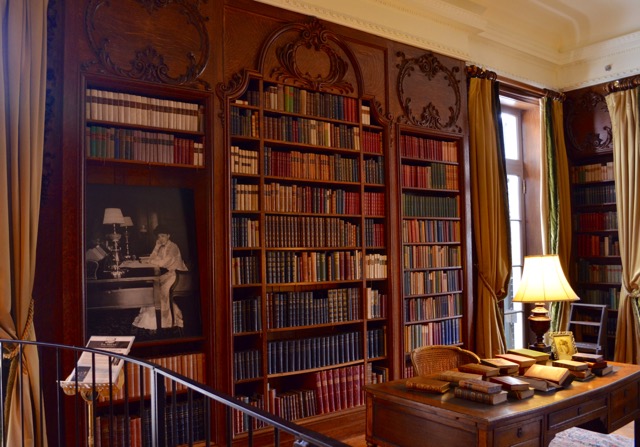
The MountI took a tour of both the inside as well as her gardens. Here’s one wall of her library:

One wallWell read in several languages since she was young, Wharton left these books behind  when she moved away to live in Paris the latter part of her life after the demise of her marriage. Her husband Edward had fallen into a state of dementia after lengthy bouts of depression and mental illness. The writer’s years at The Mount had not been as happy as its surroundings could offer her.

The Drawing Room:

The Drawing RoomDining Room, where Henry James was one of several usual guests:

Dining RoomBut where did she write? Not in the library, or at the desk in her room, but right in her bed. She had an assistant who would take her handwritten pages and type them up after her six hours of continuous writing every morning before she got out of bed. I’m sure Wharton would love to have a laptop:

Writing bed (1)And these other items I found interesting. Downton images conjured up in my mind. Typewriter, telephone, telegram:

DSC_0347
An original 1902 ice box, Daisy would love it but maybe not Mrs. Patmore. Give her some time to warm up:

Ice Box
A luggage lift. Definitely would be a fave among the footmen:

Luggage lift

And only after the tour did I find out, The Mount had given a Life Time Achievement Award to Julian Fellowes. The Downton creator had attributed Wharton as a major influence on his works, first Gosford Park (Oscar Best Original Screenplay, 2002) and then Downton Abbey. Speaking upon receiving the Award at the Harvard Club, Fellowes noted that he was particularly inspired by Wharton’s “… ability to judge without feeling the need to condemn.”

I bought the book The Custom of the Country in the gift shop and only just now did I learn that it is being adapted into a TV mini-series, with Scarlett Johansson playing the anti-heroine, Undine Spragg. This will mark Johansson’s first TV role.

As for Julian Fellowes’ new work? I eagerly await. After visiting The Mount, I can see what a natural shift it is for him to create an American version of Downton. The Gilded Age should be a smooth sequel.

From Lenox, I began the last leg of my New England Road Trip. I headed east on I90, a breezy 2.5 hrs. drive back to Wayland, the suburb outside Boston, thus completing the loop and a memorable journey. An item checked off my bucket list.

***

Follow my New England series:

A New England Fall Foliage Road Trip

Just came back from a ‘Thelma and Louise’ kinda road trip with my cousin to Northeastern United States. Kinda but not exactly, for obvious reason: I’ve come back, bearing photos and a foliage report that says it’s not too late to head out even now.

According to locals, due to the warm, extended summer days, foliage change has delayed by about a week. I started my drive in late September to the first week of October, and I’d say the foliage color change was from 10% to 40%, depending on the locale.

Here’s the itinerary of my travels:

Wayland, MA –> Portland, ME –> Rockport / Camden, ME –> N. Conway, NH –>
Stowe, VT –> Williamstown, MA –> Wayland, MA

I’ll be posting interesting sights I encountered during this trip. Here’s my first entry.

Walden Pond

I started from Wayland, MA, a suburb about 30 mins. drive west of Boston. Walden Pond is just 6.2 miles north of Wayland. In pursuit of solitude, to taste the bare essence and to ‘suck out the marrow of life’, Henry David Thoreau cleared some trees in the woodlands owned by his friend Ralph Waldo Emerson, built a 10′ x 15′ cabin and on July 4, 1845, began to live there by the Pond, an experience that lasted two years, two months and two days.

A stone-throw from the parking lot of the Walden Pond State Reservation is a replica of Thoreau’s cabin. A friendly ranger greeted me:

Thoreau's Cabin

Inside the cabin were the bare necessities, a bed, a table, a desk, three chairs: “one for solitude, two for friendship, three for society.”

Interior

As for the Pond, it was pure serenity. As for fall foliage, I could only see it in my mind’s eye:

Walden Pond

So you could imagine my surprise to see beaches and swimmers. But of course, this is now a National Park, and it’s summer still:

Swimmers at the beach

The day was September 28, the few autumn leaves reminded me that transition of the seasons was indeed happening, however slowly:

Autumn Leaves

As I walked around the lake, a sign pointed me to the actual site of Thoreau’s cabin in the woods:

Actual Site

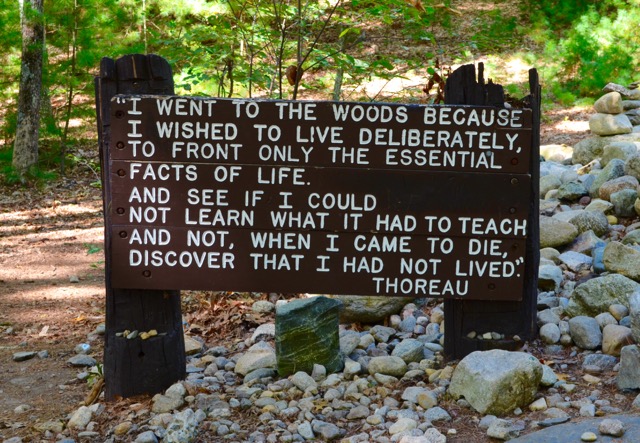
And beside it, these famous words of his:

To live deliberately

But nowhere could I find a sign posting this other quote which I also admire, on the economy of work:

“For more than five years I maintained myself thus solely by the labor of my hands, and I found that, by working about six weeks in a year, I could meet all the expenses of living.”

Don’t you just love his calculations?

***

Follow my New England series:

September Wrap

Here’s a post of lists, movies I’ve seen and books I’ve read or listened to, all in September, a list that hopefully can tide you over till my next post, which will be after a long-planned hiatus. You’re welcome to throw in your thoughts on any title on this list, or ripple out to other shores.

DSC_0319

***

MOVIES At Theatres:

Man from U.N.C.L.E.

Who are they kidding? Might as well just put in this disclaimer: Title taken at random. This is not the Man from U.N.C.L.E. with David McCallum (yeah) as Illya Kuryakin and Robert Vaughn (boo) as Napoleon Solo during my childhood days. I knew what the acronym stood for even as a grade schooler, and was mesmerized by a world wide net of spies and intrigues, despite watching a B/W TV set. This 2015 U.N.C.L.E. feature movie is just like any other lesser spy flicks, feels like haphazardly done, dated spywares that fail to send any positive nostalgic vibes, and featuring an accidental duo just happen to have the same names as those in the 60’s TV series. The third person, Alicia Vikander, makes it a bit more watchable. ~ ~ Ripples

Mistress America

A bit disappointed considering how much I’d enjoyed Frances Ha and the works of Noah Baumbach. Greta Gerwig is a mystery to me. In all her roles she looks ultra cheerful, even in difficult circumstances, but is that overacting or is that what her character is supposed to convey, optimism as fuel for life? Anyway, I wanted to give Mistress America a second chance. But as I checked the showtimes a couple of weeks later, it wasn’t there anymore.  ~ ~ 1/2 Ripples

A Walk in the Woods

A pleasant surprise! Is there life after 50, 60 … 70? Robert Redford and Nick Nolte is an odd pair to answer that from the jagged edge of a cliff. All the cliché shots of two old men hiking the Appalachian Trail are in the movie trailer; the film has more to offer. Emma Thompson is a welcome addition as the forbearing wife hoping for the best. I’ve seen several of this genre in recent years: WildTracksThe Way, to name a few, with A Walk in the Woods being the lightest but still quite relevant. Lesson learned? Forget about your age, and, giving up doesn’t make you a failure. It has been a long while since I read Bill Bryson’s book on which the film is based. Watching the adaptation brings laughs which I remember were absent while reading. An easy 2 hours of relaxation without taking one single step.  ~ ~ ~ Ripples

Learning to Drive

Just the opposite, I was not enthused about the trailer and my hesitations about the film were confirmed as I watched. Based on a non-fiction piece from Katha Pollitt’s Learning to Drive and other Life Stories, the movie turns political by changing the Filipino driving instructor into a Sikh, played by Ben Kingsley. No matter, he has that poise and dignity no matter what costume he puts on. It’s not surprising to see Patricia Clarkson’s Wendy character – a woman in her fifties learning to drive for the first time in her life – get some bonus lessons on cultural awareness on top of parallel parking.  ~ ~ 1/2 Ripples

The End of the Tour

One of the best films I’ve seen this year, and maybe for some time. Nothing looks ‘performed’, yes, even the nervous Jesse Eisenberg as writer David Lipsky is his natural self, unsure of himself and of his subject David Foster Wallace, as he follows his Infinite Jest book tour to write an article for the Rolling Stone Magazine. Based on Lipsky’s book Although Of Course You End Up Becoming Yourself: A Road Trip With David Foster Wallace, the film belongs to Jason Segel. A surprising cast and Segel has delivered with poignancy as Wallace. Framed in a sympathetic tone, the film is a moving tribute to and a revelation of an author whom some may choose to misread.
~ ~ ~ 1/2 Ripples

Pawn Sacrifice

The title says it all. A pawn is sacrificed in the heat of the cold war. Based on the true events that rocked the chess world and quickly inflamed the political landscape, American Bobby Fischer (Tobey Maguire) captured the world championship in 1972, taking the title away from Soviet Grandmaster Boris Spassky (Liev Schreiber). While the film in all its earnest intentions effectively brings out the intensity of the rivalry, the main issue I feel is the casting. Liev Schreiber is too famous a face to be Boris Spassky, even speaking in Russian doesn’t make him any more convincing; Maguire is even more famous a face to be Fischer. And may I go into this? They both need to slim down a bit to fit the profile of the cold war chess rivals, especially Schreiber. My choice for Fischer? Nicholas Hoult. Spassky? Andrew Garfield.  ~ ~ ~ Ripples

***

MOVIES on DVD’s:

The Jungle Book

It has been a long, long while since I watched it and now a refresher to prepare for the star-studded voicing in the remake. This 1967 Disney animation just shows how much has changed in animations then and now. Hand-drawn, slower paced, and nuanced facial expressions from the animal characters, albeit a bit flat when compared to the hyperactive animations we see today. The new version of The Jungle Book is coming out in 2016, utilizing ‘up to the minute technology’, and fusing a real life Mowgli with CGI generated animals and jungle environs all in 3D. As for the 1967 version, the music and the songs will stay as original as ever.

This is Where I Leave You

Another August: Osage County, which is influencing which, for these two are so alike? Or, maybe just speaks to the fact that the dysfunctional family is the norm. Under the direction of their mother, five estranged siblings have to come back home to sit shiva as their father passed. Staying under the same roof for seven days is an ordeal with the Altman family, for everyone carries baggage they’d rather bury together with the dead. Not as bad a film as critics say. Jane Fonda is a less overbearing mother as Meryle Streep is in Osage County, so not to overshadow the rest of the cast. Jason Bateman, Tina Fey, Adam Driver, Corey Stoll may not be the best of siblings, they make one good cast. Don’t you just love the title?

Greenberg

From the dysfunctional family to the dysfunctional individual. Roger Greenberg (Ben Stiller) comes back to LA from NYC to housesit for his brother as the family takes a vacation. As one who had received treatment in a mental hospital, Roger has many personal issues to deal with, and it’s a little heart-wrenching to see him struggle to relate, albeit at times he comes through more as annoying than deserving kindness; but maybe that’s the point. Greta Gerwig plays Florence, dog walker for the family. Stiller is in his usual mode, lost to himself and others; Gerwig is her usual self too, pleasant despite all. So it’s not hard to predict the outcome but the process makes one interesting take. The first time Gerwig in director Noah Baumbach’s work. Here began a beautiful and rewarding partnership.

Panic Room

Re-watch after learning this is the breakout film for Kristen Stewart, age 12. Didn’t realize she played Jodie Foster’s daughter there when I first saw the movie years back, and now seeing it again I find the two do have some resemblance, in appearance and demeanour. Locked in a panic room in a fancy NYC apartment they just moved in, mother and daughter try to stay safe as a gang of burglars break in. Although not thoroughly plausible, especially how Foster answers the door as two policeman come to check on them, which then leads to some even more implausible outcomes at the end. But, overall, a riveting, edge-of-your-seat kind of viewing. And when you think of it, of course, it’s David Fincher.

Olive Kitteridge

Binge-watched this HBO 4-hour mini-series after it won 7 Prime Time Emmys last Sunday. Writing, acting, editing, camera work, the whole production is captivating, and at times, very funny, no, not the Bill Murray section – he’s actually serious here. Frances McDormand and Richard Jenkins are deserving winners. In her acceptance speech for the Best Mini Series, McDormand emphasized that it all came from a book. Yay for books, the wellspring of inspiration. Olive Kitteridge is author Elizabeth Strout’s Pulitzer Prize winning work; writer Jane Anderson wins her Emmy for the adapted screenplay. However marvelous the visualization, it all started with words on a page.


A Touch of Sin

In preparation for Jia Zhangke’s 2015 festival film Mountains May DepartA Touch of Sin was nominated for the Palme d’Or at Cannes 2013 and won Jia a Best Screenplay award. Jia’s camera frames a perspective that’s bold and true in his home country China, a nation obsessed with modernization, economic growth, and wealth accumulation. The film reveals the human costs for such enterprises. Unfortunately, his countrymen didn’t have a chance to watch this one as it was banned. But with Mountains May Depart, officials had said they would allow it. I’m afraid it just might be much tamer and easier for the palate.

***

BOOKS

Summer by Edith Wharton

After The Age of Innocence, I continue to explore the writings of The Gilded Age, to prepare for my New England trip and yes, Julian Fellowes’ new American TV series.

The End of Your Life Book Club by Will Schwalbe

Not as chilling as the title sounds, heartwarming memoir of a son chronicling the extraordinary life of his mother, Mary Anne Schwalbe, albeit she would have likely said, “O, mine is just another life. There are many more deserving ones.” While accompanying his mother at her chemo therapy sessions in the hospital, son and mother share books and reading. The two-persons book club is therapeutic for both.

Circling The Sun by Paula McLain (Audiobook read by Katharine McEwan)

Not sure how much is true in this fact-based fiction about Beryle Markham, the award winning race horse trainer in Kenya and in 1936, the first woman to fly solo across the Atlantic from east to west. Markham flew from England to NYC, but crash landed in Nova Scotia after a 21 hour harrowing flight head-on against the prevailing winds. (I later learned that Amelia Earhart’s 1932 flight was from west to east, a much ‘easier’ feat with the tailwind, landed in Ireland after only 15 hours in flight.) McLain’s book tells many more stories, and gossips, than just this monumental event. Beryl had known the Out of Africa author Karen Blixen in the small social circle in Kenya. Why, Beryl is the other woman in Deny’s life, according to McLain. Not too sure about the book, but I was much impressed by the voice of the narrator Katharine McEwan.

Satin Island by Tom McCarthy

The only 2015 Booker Prize shortlisted book I’ve read, so far, and it’s brilliant. The book presents a most interesting story of a ‘corporate anthropologist’ collecting field data for an ethnographic study of the human society in this digital age. The ‘Great Report’ is needed to be written, same as this book: what have we become at this juncture of human history and civilization? Maybe we do need anthropologists to offer a narrative of our contemporary society, or even better, we should all be trained as anthropologists to see ourselves better.

Remainder by Tom McCarthy

I’ve enjoyed McCarthy’s style of postmodern incisions. Remainder is his debut work and soon to be made into a movie. Walking down the street our unnamed (of course) protagonist was hit by a falling object. After coming out of a coma, he needs to re-enact his past to regain memories, and to reconstruct an authentic existence. Who is he, what is he? With the huge sum of monetary compensations, he steps out to do exactly that. Still reading, a fascinating premise.

***