“Then went the jury out, whose names were Mr. Blindman, Mr. Nogood, Mr. Malice, Mr. Love-lust, Mr. Live-loose, Mr. Heady, Mr. Highmind, Mr. Enmity, Mr. Liar, Mr. Cruelty, Mr. Hate-light, Mr. Implacable, who everyone gave in his private verdict against him among themselves, and afterwards unanimously concluded to bring him in guilty before the judge. And first among themselves, Mr. Blindman, the foreman, said, I see clearly that this man is a heretic. Then said Mr. Nogood. way with such a fellow from the earth! Ay, said Mr. Malice, for I hate the very look of him. Then said Mr. Love-lust, I could never endure him. Nor I, said Mr. Live-loose; for he would be always condemning my way. Hang him, hang him, said Mr. Heady. A sorry scrub, said Mr. High-mind. My heart riseth against him, said Mr. Enmity. He is a rogue, said Mr. Liar. Hanging is too good for him, said Mr. Cruelty. Let us despatch him out of the way, said Mr. Hate-light. Then said Mr. Implacable, Might I have all the world given me, I could not be reconciled to him; let us forthwith bring him in guilty of death. And so they did; therefore he was presently condemned to be had from the place where he was, to the place from whence he came, and there to be put to the most cruel death that could be invented.”
The following is my Valentine post back in 2008 and an update after Downton. Re-posting here today for reminiscence. For several years, this post held the highest view records on my blog. I’d received 60+ comments suggesting more quotes. I regret I don’t have the plugin to copy them all here. But I’m sure we can start anew and update with fresh ones. You’re welcome to add your fave movie love quote in a comment.
****
To celebrate Valentine’s Day, I’ve compiled a list of memorable quotes from movies, all on the theme of love. All come from movies I’ve seen, some I’ve reviewed on this Blog (click on title to my review). They represent dialogues that have stirred some ripples in one small heart. And love…being a many splendid thing, embraces all kinds of human relationships, and transcends cultures and boundaries.
.
Here’s Arti’s Collection of Memorable Movie Love Quotes:
Medicine, law, business, engineering, these are noble pursuits and necessary to sustain life. But poetry, beauty, romance, love, these are what we stay alive for. — Dead Poets Society
The greatest thing you’ll ever learn, is just to love and be loved in return. — Moulin Rouge
The things that people in love do to each other they remember, and if they stay together it’s not because they forget, it’s because they forgive. — Indecent Proposal
I like you very much. Just as you are. — Bridget Jones’s Diary
.
When the planes hit the twin towers, as far as I know none of the phone calls from the people on board were messages of hate or revenge — they were all messages of love. — Love Actually
Maybe it is our imperfections which make us so perfect for one another. — Emma
And now, I’m back…and I’ve lost her all over again. I’m so sad that I don’t have Kelly. But I’m so grateful that she was with me on that island. And I know what I have to do now. I gotta keep breathing. Because tomorrow the sun will rise. Who knows what the tide could bring? —Castaway
I don’t believe in quantum physics when it comes to matter of the heart. — Bull Durham
.
.
Shoot me. There’s no greater glory than to die for love. — Love in the Time of Cholera
Natalie: Do you believe in love at first sight?
John: Yes I do. Saves a lot of time. — The Stickup
While a few are lucky enough to save time and escape the torments of love by creating a lasting flame from the first spark, some have to go through tumultuous pining, even the arduous and humbling experience of transforming oneself to gain requited love. And who, other than the following, epitomizes such kind of yearning:
My real purpose was to see you, and to judge, if I could, whether I might ever hope to make you love me. — Mr. Darcy, Pride and Prejudice
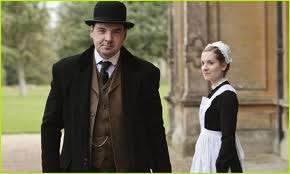
“I love you Mr. Bates. I know it’s not ladylike to say it, but I’m not a lady and I don’t pretend to be.” — Anna, S1E5
“I’m not a romantic… But even I concede that the heart does not exist solely for the purpose of pumping blood.” Violet Crawley, S2E2
“I’d rather have the right man, than the right wedding.” — Anna, S2E5
***
You all are welcome to contribute to this list. Just submit your favorite movie love quotes in the comment box below…and have a memorable Valentine’s Day!
Just came back from a ‘Thelma and Louise’ kinda road trip with my cousin to Northeastern United States. Kinda but not exactly, for obvious reason: I’ve come back, bearing photos and a foliage report that says it’s not too late to head out even now.
According to locals, due to the warm, extended summer days, foliage change has delayed by about a week. I started my drive in late September to the first week of October, and I’d say the foliage color change was from 10% to 40%, depending on the locale.
Here’s the itinerary of my travels:
Wayland, MA –> Portland, ME –> Rockport / Camden, ME –> N. Conway, NH –>
Stowe, VT –> Williamstown, MA –> Wayland, MA
I’ll be posting interesting sights I encountered during this trip. Here’s my first entry.
Walden Pond
I started from Wayland, MA, a suburb about 30 mins. drive west of Boston. Walden Pond is just 6.2 miles north of Wayland. In pursuit of solitude, to taste the bare essence and to ‘suck out the marrow of life’, Henry David Thoreau cleared some trees in the woodlands owned by his friend Ralph Waldo Emerson, built a 10′ x 15′ cabin and on July 4, 1845, began to live there by the Pond, an experience that lasted two years, two months and two days.
A stone-throw from the parking lot of the Walden Pond State Reservation is a replica of Thoreau’s cabin. A friendly ranger greeted me:
Inside the cabin were the bare necessities, a bed, a table, a desk, three chairs: “one for solitude, two for friendship, three for society.”
As for the Pond, it was pure serenity. As for fall foliage, I could only see it in my mind’s eye:
So you could imagine my surprise to see beaches and swimmers. But of course, this is now a National Park, and it’s summer still:
The day was September 28, the few autumn leaves reminded me that transition of the seasons was indeed happening, however slowly:
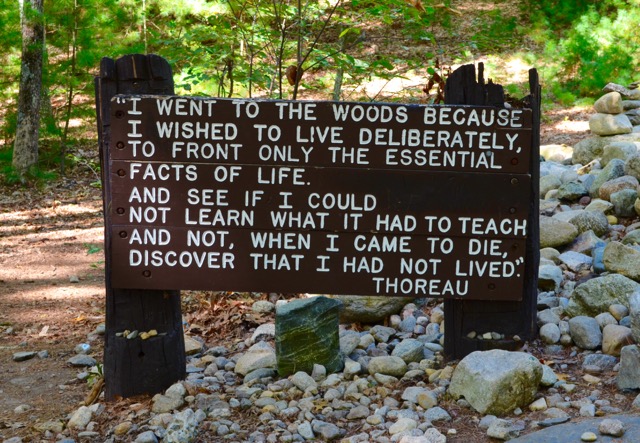
As I walked around the lake, a sign pointed me to the actual site of Thoreau’s cabin in the woods:
And beside it, these famous words of his:
But nowhere could I find a sign posting this other quote which I also admire, on the economy of work:
“For more than five years I maintained myself thus solely by the labor of my hands, and I found that, by working about six weeks in a year, I could meet all the expenses of living.”
Here’s my second instalment for the blogging event Paris in July 2014.
***
You must have heard of this book by a Swiss-born Brit writing about a French novelist called Proust. You probably have read it, and let me guess, were surprised when reading the first chapters? Well, I was. For before reading this book, my knowledge of Alain de Botton, the popular British writer and media personality, mainly came from an art critic’s thoughtful posts on her blog.
Is Botton joking? This book reads like a parody.
First we are introduced to Dr. Proust, Marcel’s father, who was a renowned physician and prolific writer. His thirty-four books had helped the French people from defences against the plague to the correct postures and exercises for the ladies. Botton being an image-driven person does not hesitate to include some of Dr. Proust’s instructional illustrations for his female readers such as how to jump off walls, or balance on one foot.
Not your definition of parody? How about this chapter on ‘How to Suffer Successfully’. Proust is well known for his physical ailments, having had to lie in bed most of the time when he wrote the longest novel ever written, In Search of Lost Time. Botton exhaustively lists down the various trials Proust had to live with throughout his life:
The Problem of a Jewish Mother
Awkward Desires
Dating Problems
A Lack of Career in the Theatre
The Incomprehension of Friends
At 31, His Own Assessment
Asthma
Diet
Digestion
Underpants
Sensitive Skin
Mice
Cold
Coughing
Noise from Neighbours
… Should I go on? And oh, he does include Death.
I know, that’s what Botton does, bring the extraordinary into the ordinary realm of common readers, and by so doing, explaining Proust to us lowly creatures. And of course, it would help if you have at least read the first two volumes of In Search of Lost Time, for many of his examples are taken from there, so you would feel a resonance, or disagree with Botton’s interpretation, when he talks about Francoise, Swann, Albertine, Combray, or Balbec.
Do I get anything out of it? Plenty. I’ve lots of highlighted passages and my own handwritten notes on the margins. When Botton gets serious between the lines, he leaves me with some useful tips:
So if speaking in clichés is problematic, it is because the world itself contains a far broader range of rainfalls, moons, sunshines, and emotions than stock expressions either capture or teach us to expect. (p.106)
For one thing, express your own feelings and ideas instead of saying ‘nice’, or describing the setting sun as ‘a ball of fire’. I love this little passage Botton quotes from Proust about the novelist’s description of his ‘lunar experience’:
Sometimes in the afternoon sky a white moon would creep up like a little cloud, furtive, stout display, suggesting an actress who does not have to ‘come on’ for a while, and so goes ‘in front’ in her ordinary clothes to watch the rest of the company for a moment, but keeps in the background, not wishing to attract attention to herself. (p.98 of Botton’s, but no mention of where this is from Proust’s)
The key of course is not so much of trying to use a new language to describe a common scene or object, but to be able to look at them from a distinctively new perspective to begin with. How can we invent new lenses to see the world? Towards this end, Botton has failed to go further. So we’re told to avoid clichés, but not how. If you sense my ambivalence, you’re right.
In order to avoid clichés himself, Botton has resorted to hyperboles. The title of the book is a ready example. The 200 page book comprises of nine short chapters, each can be a book in itself. So you can expect the oversimplification of the ideas. Further, with no citing of sources for the Proust quotes, the critical reader could be left unsatisfied; it feels like Botton has jumped to generalizations and found expressions of his own thoughts from one or two excerpts of Proust’s. Makes one feel that Proust could just be a selling point.
However, this is an entertaining read, like a self-help manual with instructional tidbits and amusing images. The book is a mixed bag of common-sense wisdom, with a ‘moral’ at the end of each chapter. Throughout, it is obvious that Botton could well find it not as easy as he tells his readers to do… to be original and not say what others have said before. Here are some of his main points:
Live life today
Read books to form your own ideas
Suffering makes you strong
Find art and beauty in the ordinary
Avoid clichés like the plague
A time to pick up a book, a time to put it down
Win friends by your praises
but pour your honest criticisms of them into a work of fiction (now that’s a novel idea).
Is there anything new under the sun?
Speaking of the sun, take this to the beach. It would make one breezy read.
Lastly, following Botton’s (actually Proust’s) advice on reading:
We should read other people’s books in order to learn what we feel, it is our own thoughts we should be developing even if it is another writer’s thoughts which help us do so. (P. 195) Reading… is only an incitement…
So I’d say the moral is: read Proust yourself. Don’t let Botton tell you what Proust can do for you.
That’s just the prodding I need to press on to In Search of Lost Time, Vol. III.
A relatively light-hearted episode, but the cheeriness depends on your point of view, quite like the Super Bowl, celebratory depends on which side you’re rooting for. But overall, a delightful and engrossing hour.
First off, a little surprise, Alfred is leaving. I thought the foursome is going to have some more entanglement. Alfred is accepted to the training course after all at the Ritz Hotel, London. That’s a significant leap from the servants’ hall in Downton, deserving celebration, but only depends on which side you’re on. Daisy is heartbroken. Eventually she’s sweet to make peace with Alfred and herself, wishing him luck as he leaves.
Violet and Isobel’s battles resume, evidence that Isobel has recovered from her mourning. She’s a social activist fighting for justice, and Violet, the established aristocracy, therefore legitimate target of her indignation. When Violet wrongly accuses and fires young Pegg for stealing her things, yes, things, Isobel rediscovers her calling. Things are what Violet cares about, so materialistic, so unjust. The ivory curio is soon found, misplaced.
Some interesting dialogues ensue…
Isobel: “Aren’t you going to say you’re sorry?”
Violet: “Certainly not.”
Isobel: “How you hate to be wrong.”
Violet: “I wouldn’t know. I’m not familiar with the sensation.”
The Sherlock in Isobel does some personal digging and recovers the valuable missing letter opener. What develops is like a parable. Isobel makes the same mistake of which she accuses Violet when she misjudges Pegg too soon and unwilling to face up to her wrongs, not knowing Violet after discovering her own mistake has already apologized to young Pegg, asked for his forgiveness, and rehired him back. Nobody monopolizes justice after all.
Napier and Blake turn out to be unwelcome guests. Not that I’m not sympathetic to farmers or food production, but these two men just prove they are the entitled ones, especially Blake, biting the hand that feeds him. Why, which guest would sit beside his host and call her “a sentimentalist who cannot face the truth.” Now where does that come from?
Rose has proven to be quite an event planner. Lord Grantham’s birthday party is a success, the secret is a big surprise, as she has intended. Jack Ross has done the unprecedented, bringing a night club jazz band into Downton, and he himself can go down history as the first black person to set foot in that aristocratic estate. Time has changed, or at least started to. Despite his shock, Mr. Carson is quick to point out that “we led the world in the fight against slavery,” but not before embarrassing himself by asking Ross: “Have you never thought of visiting Africa?”
While everyone is having some light-hearted turns, the heavy news or lack thereof falls like lead on Edith. She found out she’s pregnant, and Michael Gregson has “vanished into thin air.” At this stage, she doesn’t suspect anything except to worry about him. But this just may prove to be another dark chapter in her failed romantic narratives.
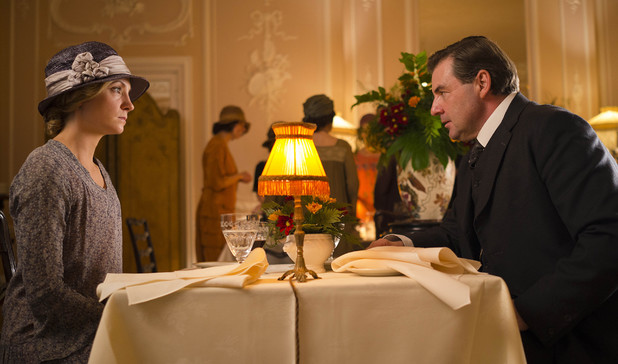
Bates and Anna’s seemingly reconciled relationship is another dark shadow in an otherwise bright episode. I like these contrasts as far as plot is concerned, light and shadow. The intriguing development is with Cora overhearing their conversation in the hotel dining room, and later, Baxter overhearing Cora talk with Mary about her concern. Even though she’s warned not to leak out what she has heard, Baxter has her assignment, the ‘condition’ as Thomas reminds her.
That hotel dining scene is oh so gratifying. Anna has phoned earlier to make a reservation. When actually there, the Maître d’ takes a top-to-bottom glance at their attire, decides there’s no reservation under the name of Bates. Julian Fellowes’ another social justice moment. Lady Grantham, Cora, comes to the rescue, ever so graciously. Isobel would have made a scene.
As for the Maître d’, a perfect casting would be Rowan Atkinson, aka Mr. Bean. Just a thought.
But my favourite scene is when Isobel, Mary, and Tom are in a room waiting to see the little ones being brought in by their nanny. These three are all widowed, survivors of tragedies when their loved ones were unexpectedly taken away from them. Mary is honest with her feelings: “I’m just not quite ready to be happy.” Then, Isobel starts sharing and reminisces on her engagement with her husband Reginald; Tom joins in with his love for Sybil; Mary recalls Matthew’s proposal to her while standing in the snow, not feeling a bit cold. Each recharged by the memory of love. Isobel cheerfully concludes at the end: “Well, aren’t we the lucky ones.”
Here’s a Downton episode that shows why it keeps gathering fans. That’s when every plot is captivating, and every other line uttered by the characters is a quotable quote, plus, two strong female characters saving the day: Violet Crawley upstairs, and Mrs. Hughes downstairs. Thanks to them, the good regain their zest for life (Mary and Isobel), and the bad are banished (Edna Braithwaite).
The most important storyline of course is Anna and Bates. And Mrs. Hughes is the only one to know about the rape. I have been successful so far to block out spoilers for future episodes but I hope Mrs. Hughes is wise and strong enough to make sure the right steps are taken in this heart wrenching case. After the most controversial tragedy befalls a faultless character, we’re all eager to see the aftermath.
Anna is thrice victimized. First raped, then silenced, and ultimately guilt-laden. I’m sure such a scenario is real even for today. “I must have made it happen. I feel dirty. I can’t let him touch me because I’m soiled.” A gap has developed so quickly like the ground has parted suddenly between a once loving couple. Now Anna and Bates are standing on opposite sides of a deep chasm. Mrs. Hughes urges her to go to the police to report, and tell Bates about the assault. She can see how hurtful it is for him to suffer from not knowing. But Anna sees the possible reality for Bates. “Better a broken heart than a broken neck.”
Several people have noticed Anna’s recent silence. Who wouldn’t? But not many would ask Bates directly except of course Lord Grantham himself. Julian Fellowes has written him some good lines. I just want to quote the whole thing here:
“There is no such thing as a marriage between two intelligent people that does not sometimes have to negotiate thin ice. I know. You must wait until things become clear. And they will. The damage cannot be irreparable when a man and a woman love each other as much as you do.”
But as always, the punchline comes after a pause:
“My goodness that was strong talk for an Englishman.”
On a slightly more pleasant note, Lady Mary’s dilemma regarding Lord Gillingham and his lightning speed of a marriage proposal. Michelle Dockery has put forth some very fine acting in this episode, especially the scene when they are walking on the green grounds of Downton, when Gillingham asks her a very short question: “Will you marry me?” The setting is romantic, the cinematography gorgeous, but this is what I’m most gratified to hear from Lady Mary:
“I can’t. I’m not free of him. Yesterday, you said I fill your brain. Well, Matthew fills mine. Still. And I don’t want to be without him, not yet.”
After all, it’s only about seven months after Matthew’s death. Further, if Tony Gillingham can discard a previously engaged relationship so readily, what kind of a lover will he be to Mary? Again, I don’t know about any future story development, but in my heart, I wish Mary would wait a while longer. But, she gives him a warm kiss though. What a conflicting heart. Did she say later that she’d done something she might regret?
Same with Edith. Have you seen anyone signing away a document without giving it even just a skim over? Julian Fellowes knows exactly where to grab our attention… when the character is least attentive. This is a document prepared by her very sincere-looking love interest, the man admittedly had had a ‘dubious, misspent youth’, and who had won back everyone’s poker losses from a crook within the same night. Oh but love conquers all fears for Edith. Lady Rosamund reminds her she’s “gambling with her future”. So Gregson leaves for Munich the next day. Interesting.
While in London, we’re introduced to the first black character in Downton Abbey, the jazz singer Jack Ross, who leaves a fine impression on Lady Rose, launching another interesting plot line.
And don’t you just love Mrs. Hughes even more, a bulwark of discernment and authority? Tom is wise enough to come downstairs to seek her advice as Edna blackmails him to marry her for a fake, just-in-case kind of pregnancy. Even Thomas (it’s Mr. Barrows now) the schemer isn’t a bit sympathetic.
And it’s Mrs. Hughes again who is so kind, and sweet, to restore a loving memory for Mr. Carson, framing up his once, young love. Can you imagine Mrs. Hughes taking time off Downton to go to town to shop for a nice picture frame? Anyway, it’s good to know these characters have heart, and are not afraid to show it. Very well done here. And no, I don’t particularly wish that Mrs. Hughes and Mr. Carson would become late romantics. They are just fine now. It’s much rarer to see genuine friendship than romantic love.
Mr. Carson gets the best quote here in Season 4 Episode 3:
“The business of life is the acquisition of memories. In the end that’s all there is.”
When I picked up Swann’s Way earlier in March, I had no idea that 2013 is the 100th Anniversary of its publication. Now in hindsight, I’m all the more excited with this serendipitous selection for a Read-Along. And what discoveries I’ve made reading Proust!
Six months later in September, I started Vol. II Within A Budding Grove, allowing myself and any fellow reader two months to finish this 730 page volume.
I reiterate, I’ve encountered thickets blocking the way through the budding grove, but I must say, the enjoyment I’ve reaped from slashing and plowing through it is greater than my frustration. All in all, coming out of it feels like finding my way through a corn maze. Out I come dazed but gratified.
I’ve posted some thoughts on Part One of Within A Budding Grovehere. This latter part is about Balbec, a seaside resort the adolescent narrator travels with his Grandmother to stay for the summer to recuperate his health. Like his memories of Combray, Proust’s description of Balbec is detailed and colourful. He relays to his reader his journey, the scenery, the Grand Hotel they stay in, its guests and their social hierarchical interactions, his new-formed friendship with the painter Elstir who introduces him to the band of girls the young narrator admires but is too shy to greet on his own, Albertine, Andrée, Rosemonde, Gisele…
The original title of this volume is In the Shadow of Young Girls in Flower (À l’ombre des jeunes filles en fleurs) which I think is spot on. But, the budding grove is an apt metaphor too for his adolescent self discoveries of love and passion. And in one hilarious scene with Albertine, Proust has shown he can be a writer for Saturday Night Live any time. Too long to quote here but well worth the read. (p. 700-701 in case you want to skip the first 699 pages.)
And young Marcel is ever in-touch with his own feelings for these girls, especially Albertine. Here is his honest analysis:
At the start of a new love as at its ending, we are not exclusively attached to the object of that love, but rather the desire to love from which it well presently arise (and, later on, the memory it leaves behind)… (p. 676)
Ahh… romancing a desire and a future memory.
What about Gilberte, Swann’s daughter, with whom the young narrator is so obsessed earlier? To his credit, young Marcel has a full grasp of his own psyche. Why? It’s all a matter of Habit, he reasons. Since Gilberte has snubbed him, he needs to forget her and let go of any form of Habit reminding him of his previous life in pursuing her. This trip to Balbec takes him away from the familiar and replaces his memories of Gilberte, and a static existence, with fresh experiences and revitalized senses. Getting out of his home in Paris and going away might just be the best medicine:
… one’s days being paralysed by a sedentary life, the best way to gain time is to change one’s place of residence. My journey to Balbec was like the first outing of a convalescent who needed only that to convince him that he was cured. (p. 301)
Even before he gets to Balbec, while on the train stopping at a station, the sensitive and observant narrator is already filled with delight as he sees a young milk-girl carrying a jar of milk walking to the train at the break of dawn:
She passed down the line of windows, offering coffee and milk to a few awakened passengers. Flushed with the glow of morning, her face was rosier than the sky. I felt on seeing her that desire to live which is reborn in us whenever we become conscious anew of beauty and of happiness. (P. 318)
My own memories of the changing hue on those Bohemian Waxwings come to mind. Proust has effectively conveyed the power of association, the linking of words on a page to the reader’s own memory and the joy it had once elicited.
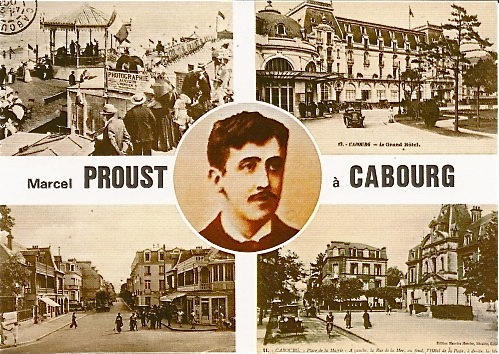
Balbec is the fictitious reconstruction of Cabourg, a seaside resort town in the Basse-Normandie region of France where Proust frequented between 1907-1914. While Proust explores voluntary and involuntary memories in his long work, he could well be weaving memories with imagination, fusing fiction with real life experiences, creating an intricate tapestry.
Lydia Davis, translator of the most recent edition of Swann’s Way (The Way by Swann’s), offers this insight: “this novel is not autobiography wearing a thin disguise of fiction but . . . fiction in the guise of autobiography.”
Right.
Whichever way you slice it, it’s still as delicious as madeleines dipped in tea.
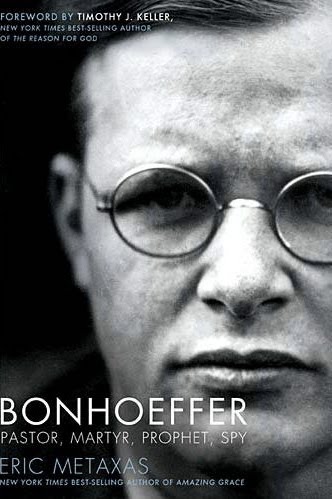
February 4 has come and gone without fanfare, without even being noticed by me, the one hosting a read-along of a bio on Bonhoeffer. That day two weeks ago would have been Dietrich Bonhoeffer’s 107th birthday (1906-1945). I’m feeling a sense of loss for missing it.
A sense of sadness too which comes from knowing a young and brilliant life so purposeful even from the start was cut short violently. It also comes from empathy with the parents Karl and Paula, who had to experience the death of three of their four sons and two sons-in-law during war time. Back in 1918, their second son Walter died in action in WWI. And during WWII, their third son Klaus, youngest Dietrich, and two sons-in-law were executed by the Nazis for their role in the German resistance against Hitler. Sad especially that they only learned of Dietrich’s death through a radio broadcast of his memorial service from England. He was only 39.
My impression from the outset is, Dietrich Bonhoeffer’s was a life of purpose, even from an early age. It was made possible largely by a nurturing and vibrant family, and a lively brood of four boys and four girls. Father Karl Bonhoeffer, a prominent psychiatrist and university professor, instilled intellectual rigor; mother Paula imparted faith and fervor. The young lives benefitted from the cultural and musical home environs, but more importantly, the indomitable sense of social justice.
The eight Bonhoeffer children with their governess at a holiday home (ca. 1910). Karl and Paula Bonhoeffer in the background. Dietrich to the right of the governess.
Dietrich knew he wanted to study theology when he was only thirteen. He graduated summa cum laude from the University of Berlin, obtaining his doctorate when he was only twenty-one. What brilliant mind and potential! And with that mind he saw through the trickery and schemes of an emerging demigod in Hitler. This is probably my favorite quotes from him. You can see his driven sense of direction:
If you board the wrong train it is no use running along the corridor in the opposite direction.
This has been my query all the time, and Eric Metaxas’s accounts have partially answered it. How could Hitler have gained such power without being challenged? It can’t be all due to fear, that came later. Hitler was democratically elected by the people as chancellor in 1933. The Führer Principle was readily embraced by most. So nationalism played a large part. Then came racism, with the establishment of new laws barring Jews, many of them in prominent positions too from the legal, academic, and medical fields, and then the engulfment of the German Church by the Third Reich. It’s utterly mind boggling. Why was it that the Bonheoffer family was only one of a dearth of lucid observers during this dark chapter in German history?
Nothing is beyond the Nazis reach. The ‘purging’ of the literary and scientific realms resulted in the casting out of thoughts and works by anyone not of the Aryan race, including Helen Keller, Jack London, H.G. Wells, Albert Einstein, Thomas Mann, and the poet Heinrich Heine, who wrote these prophetic words in 1821 in his play Almansor:
Where books are burned, they will, in the end, burn people too.
Metaxas’s book is informative and detailed, especially on Bonhoeffer’s effort to take back the German Church from the Nazis by establishing The Confessing Church with Karl Barth. Metaxas has also painted a very human portrait, a purposeful young man, bold, principled, passionate, and full of life. I move along eagerly, albeit sometimes confused by the numerous names and historical accounts. I want to find out what actually happened in the end, although not so sure how I can bear to read about Dietrich’s ultimate demise.
What are your thoughts so far? Throw your two pebbles into the pond. I’ll be glad to link your post here. Do go and visit:
Beginning this year, I started subscribing to a daily piece of meditation from The Henri Nouwen Society. Here’s the one for Saturday, January 19. As Valentine’s Day draws near, I feel this is most apt:
Creating Space to Dance Together
When we feel lonely we keep looking for a person or persons who can take our loneliness away. Our lonely hearts cry out, “Please hold me, touch me, speak to me, pay attention to me.” But soon we discover that the person we expect to take our loneliness away cannot give us what we ask for. Often that person feels oppressed by our demands and runs away, leaving us in despair. As long as we approach another person from our loneliness, no mature human relationship can develop. Clinging to one another in loneliness is suffocating and eventually becomes destructive. For love to be possible we need the courage to create space between us and to trust that this space allows us to dance together.
— Henri Nouwen
***
Photo: Bow Valley Ranch, Fish Creek Provincial Park, Alberta. Taken by Arti of Ripple Effects, November, 2012.
Upcoming Post:
Feb. 15, Bonhoeffer Read-along Part 1, Ch. 1-18 (Or any part of it)
Every year around this time, I come back to my perennial read The Diary of A Country Priest by French author Georges Bernanos, (Journal d’un curé de campagne, 1936). In this book, I find the essence of Easter.
A young preist comes to his first parish, the rural town of Ambricourt, full of humble ideals. All he wants is to serve the people, to give of himself, to bring God’s love. But as soon as he sets foot in the village, he is engulfed by hatred and rejection. There are dark secrets too sinister to be exposed. The young priest is an unwelcome alien. In a town afflicted by hypocrisy, pride, anger and bitterness, he is despised, taunted and ridiculed. His own innocence is no match even for the children in his catechism class, especially the precocious Seraphitas, a girl ‘with a hardness far beyond her years.’
Ambricourt is a world afflicted by the ‘leprosy of boredom’, a microcosm of the human condition. Bernanos uses diseases to illustrate his point well. The young priest himself is being slowly consumed by terminal illness. The pain in his stomach ultimately defeats his body, cancer. His diet consists mainly of bread dipped in wine which he makes for himself, and some potato soup. Poverty of means, but also frailty of body to take in solid food. Many a times we see him in the Garden of Gethsamane, pleading for strength in anguish. But he faithfully presses on, using his diary to confide his deepest thoughts, a means to commune with his God.
On the outskirt of Ambricourt is the Château of the powerful M. le Comte. The Count needs no priest to know about his adulterous affairs, this time, with the governess Mlle Louise. His wife Mme la Comtesse is totally absorbed by her long-held bitterness and grief from the loss of her young son. And his daughter Mlle Chantal is a deeply disturbed girl eaten up by anger and jealousy. Soon, she will be sent away to England, a most convenient plan devised by her father.
It is with this deep mess of a family that the young priest finds himself entangled. The most intense scene of the whole book, the climatic moment, comes when the priest goes to the Château to meet with Mme la Comtesse. She lost her beloved son when he was only eighteen months old, a child hated by his jealous older sister Chantal.
On his last day they went out for a walk together. When they came back my boy was dead.
Mme la Comtesse is fully engulfed by hatred for her daughter, grief for her lost son, and bitterness towards God.
Hearing her speak, a tear flows down the face of the young priest. “Hell is not to love any more, madame.” The young priest responds. And with miraculous strength, he delivers the following words.
… But you know that our God came to be among us. Shake your fist at Him, spit in His face, scourge Him, and finally crucify Him: what does it matter? It’s already been done to Him.
Towards the end of some soul piercing exchanges, Mme la Comtesse kneels down, releases her pain, and receives blessings from the young priest. Afterwards, she writes to him in a letter:
… I have lived in the most horrible solitude, alone with the desperate memory of a child. And it seems to me that another child has brought me to life again…
And this young child, a priest, consumed by illness, wreaked by frailty of spirit, can only marvel at the power through weakness:
Oh miracle — thus to be able to give what we ourselves do not possess, sweet miracle of our empty hands!
Not long after this, he succumbs to his illness. A life too short, a mission seems unaccomplished. But his last words faintly uttered on his deathbed are as powerful as the God who sends him:
Does it matter? Grace is everywhere…
And in the film, these three words leave me with one of the most impressive endings of all the films that I’ve seen:
‘You can’t do very much as an actress unless you have the proper words to say…’ — Penelope Wilton, Isobel Crawley
Four weeks have passed since Downton Abbey Season 2 Finale aired on PBS. How are you holding up? To alleviate Downton Abbey withdrawal symptoms, I’ve been in a perpetual state of re-watching all the episodes from Season 1 and 2. Downton Abbey on Blu-ray is absolutely beautiful.
Downton Abbey film location: Highclere Castle
This Golden Globe, Emmy, and BAFTA award-winning miniseries has many appeals. For me, apart from the sumptuous setting, attention to details, great acting, and inspiring cinematography, the main attraction is the writing. Julian Fellowes’ script gives us intelligent dialogues reminiscent of Oscar Wilde’s wit and satire.
I have compiled a list of quotes from both Seasons. Lucky for 78 year-old Maggie Smith, she gets the best lines as Violet Crawley, Dowager Countess of Grantham.
Here they are in chronological order so you can reprise the scene. Enjoy!
Season 1
“O, heavens, girl. You’re building a fire, not inventing it.” — Mrs. Hughes to Daisy, S1E1
“Nothing in life is sure.” — Mrs. Patmore, re. Titanic sinking, S1E1
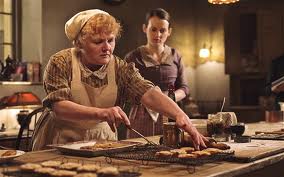
Mrs. Patmore and Daisy
“Every mountain is unclimbable until someone climbs it. So every ship is unsinkable until it sinks.” — Lord Grantham, S1E1
“We are allies, my dear, which can be a good deal more effective.” Violet Crawley, Dowager Countess of Grantham, in reply to Cora Crawley’s “Are we to be friends, then?” S1E1
Violet Crawley, Dowager Countess of Grantham
“What is a ‘weekend’?” — Violet Crawley, S1E2
“Daisy, what’s happened to you? I said you could go for a drink of water, not a trip up the Nile.” — Mrs. Patmore. S1E3
“Are you afraid someone will think you’re American if you speak openly?” — Lord Grantham to Dowager Countess, S1E3
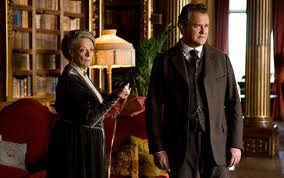
Dowager Countess and Lord Grantham
“But nobody learns anything from a governess, apart from French and how to curtsey.” Lady Sybil, S1E4
“No one ever warns you about bringing up daughters. You think it’s going to be like Little Women. Instead they’re at each other’s throats from dawn till dusk.” — Cora Crawley, Countess of Grantham, S1E5
The Crawley Sisters
“Mary can be such a child. She thinks that if you put a toy down, it’ll still be sitting there when you want to play with it again.” — Lord Grantham, S1E5
“I love you Mr. Bates. I know it’s not ladylike to say it, but I’m not a lady and I don’t pretend to be.” — Anna, S1E5
Mr. Bates and Anna
“If she won’t say yes when he might be poor, he won’t want her when he will be rich.” — Violet Crawley, Dowager Countess, S1E7
.
“First electricity, now telephones. Sometimes I feel as if I were living in an H.G. Wells novel.” — Violet Crawley, S1E7
*****
Season 2
Mary Crawley seeing Matthew off to war.
“War has a way of distinguishing between the things that matter and the things that don’t.” — Matthew Crawley, S2E1
.
Matthew Crawley in the trench
“I’m not a romantic… But even I concede that the heart does not exist solely for the purpose of pumping blood.” Violet Crawley, S2E2
“I’m a woman, Mary. I can be as contrary as I choose.” Violet Crawley, S2E4
“Are you like everyone else in thinking that because she’s a countess she has acquired universal knowledge by divine intervention?” Isobel Crawley to Dr. Clarkson re. Cora, Countess of Grantham, S2E4 (And you can substitute the word ‘countess’ with any word you need when quoting it.)
Dr. Clarkson and Isobel Crawley
“I’d rather have the right man, than the right wedding.” — Anna, S2E5
“I’m an American, I don’t share your English hatred of comfort.” Cora Crawley to Lord Grantham, S2E6
Lord Grantham and Cora Crawley
“Don’t be defeatist, dear. It’s very middle class.” Violet Crawley to Edith, S2E8
“Sir Richard, life is a game in which the player must appear ridiculous.” Violet Crawley, Last Episode, Christmas at Downton Abbey.
“I want a good man for you, a brave man. Find a cowboy in the Middle West and bring him back to shake us up a bit.” Robert Crawley to daughter Mary. Last Episode, Christmas at Downton Abbey.
“1920. Is it to be believed? I feel as old as Methuselah.” Violet Crawley, Last Episode, Christmas at Downton Abbey.
Hope lies in dreams, in imagination, and in the courage of those who dare to make dreams into reality. — Jonas Salk
American medical researcher and virologist Jonas Edward Salk (1914-1995) discovered the polio vaccine in 1955. In 1960, he founded the Salk Institute for Biological Studies, to create a collaborative environment for exploring the basic principles of life.
Some of the renowned consulting scientists at the conception of the Institute included Warren Weaver, who first coined the term “molecular biology’, and Francis Crick, co-discoverer of the DNA molecule. The Salk Institute remains one of the top research facilities in the world, generating five Nobel Laureates since its inception.
The building of the Salk Institute began in 1962 on 27 acres of pristine land donated by The City of San Diego. The site is endowed with a vantage point 350 feet above the Pacific Ocean on the coastal bluffs of La Jolla.
Jonas Salk commissioned the renowned architect Louis I. Kahn (1901-1974) to design the structures: “Create a facility worthy of a visit by Pablo Picasso.” Kahn proficiently rose to the challenge. The Salk Institute was completed in 1965. In 1992, it received the American Institute of Architects Twenty-Five Year Award.
So much for the objective facts. Here’s my experience.
I joined an architectural tour of the site. As I came to the courtyard, the entrance to the main area, I was confronted with this view. This could well be the most existential space I’d ever set foot on:
What first captivated me was the void in between the two mirrored structures. The buildings on both sides act as a frame to augment the negative space in the middle. That lookout is towards the Pacific Ocean. As I saw it then, it looked like a misty unknown, an entrance towards eternity. The last part of Terrence Malick’s film The Tree of Life came to mind.
“Architecture is the reaching out for the truth.” — Louis I. Kahn
Through the massive centre court made of travertine marble flows a stream towards the direction of the ocean, a visual metaphor for life. The water collects into a pool at the end that leads to a small waterfall, then recirculates:
Angled walls offer view from every step:
“The sun never knew how great it was until it struck the side of a building.” — Louis I. Kahn
Like parallel mirrors, concrete walls can form infinite, interesting vantage points:
Every room of the senior scientists looks out into the ocean… for creativity, inspiration, and the view of the greater scheme of things.
***
At the reception building where we met to begin the tour, I discovered the work of another artist: Dale Chihuly’s glass work The Sun, suspended from the ceiling:
Chihuly’s glasswork is a showcase of colors and vibrancy, depicting visually the exploratory spirit of the Institute. And I think, a wonderful contrast to the minimalist concrete walls around.
***
As soon as I came back home, I took out a DVD which I’d bought some years now but still haven’t yet watched. How wonderful to have that waiting for me: 2004 Oscar Nominee for Best Documentary, a film by Nathaniel Kahn My Architect: A Son’s Journey.
Son of Louis Kahn and Harriet Pattison, Nathaniel Kahn embarked on a journey to discover the father who died when he was only eleven, a father whom he wishes to have known more before a heart attack ended his life inside a washroom at a New York Subway station.
The film is not only a personal journey, but a reconciliation, a late and poignant search for a father and a son’s identity. Further, it’s a tribute to a great architect from his peers, as his son seeks out those who had known the architect professionally: Philip Johnson, I. M. Pei, Frank O. Gehry, Moshe Safdie, Robert A. M. Stern.
It is also about three women and their families who had experienced the joy and pain of being Kahn’s own, a complicated predicament in his life and after his death.
It is also a virtual gallery of the magnificent works situated all over the world. The most impressive to me, other than Salk Institute, is the one on the cover of the DVD, The National Parliament Building in Dhaka, Bangladesh.
“Design is not making beauty, beauty emerges from selection, affinity, integration, love.” — Louis I. Kahn
***
All photos of Salk Institute taken by Arti of Ripple Effects, Feb. 2, 2012. All Rights Reserved.




















 Ripple Effects