Downton Abbey the movie not just for fans

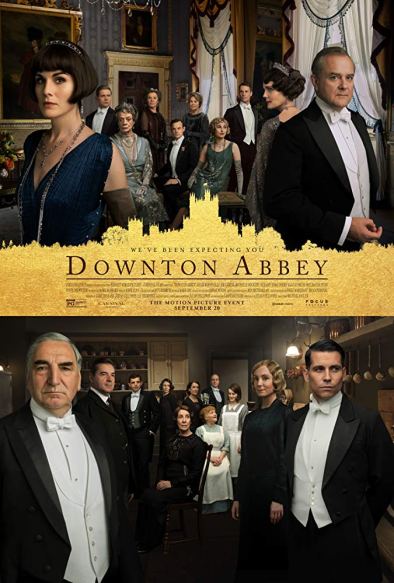
At the end of every Downton TV Season, there’s a two-hour Finale. Downton Abbey the movie feels like one of those grand finish. If there’s any TV series that can move to the big screen with just a TV script, Downton Abbey will be it. The iconic Jacobean styled mansion, superb cast, beautiful costumes and set design, not to mention creator/writer Julian Fellowes’ screenplay are its assets. Nothing close to the caliber of Gosford Park (2001) which brought Fellowes a Best Writing Oscar, but this will do. Nothing deep and poignant as some of the TV episodes, but for two hours of viewing time in the theatre, there are a lot to see and savour.
Downton.jpg

Just by listening to the rhythmic rumbling bringing out the single melody line of the theme music can send vibes of excitement. The majestic aerial shots in the setting sun (or is it rising sun?) establishing the grand manor Downton Abbey’s stature on the big screen is a thrilling experience for fans. In the theatre I was in, almost full house with fans obviously, laughing out loud at all the jokes and witty lines, embracing the film with a celebratory mood. After 6 Seasons, 3 Golden Globes and another 54 wins and 219 nominations (according to IMDb) plus three years of absence, a Downton movie is something worth celebrating.

But this isn’t just for fans. For those who come to Downton the first time, they might have missed six Seasons and 52 episodes of backstory, the movie could be an appetizer whetting their appetite for the full feast that’s offered in the PBS Masterpiece series. The estate that they must have heard in recent years called Downton Abbey, possibly wondering if it’s a cloister for monks or nuns, is now magnified on the big screen with stunning establishing shots. No medieval garbs or habits but 1920’s, Gatsby-styled fashion and hairdo. Inviting cinematography both exterior and interior familiarize them with the setting, albeit fans might find watching in a theatre is more dim with the cinematic mode, less vibrant than via their home TV which they can adjust the brightness.

Those not comfortable with the priggish social system of the past (and present to be sure, and not only limited to England) can look deeper into the series for some revelatory themes. While The Crawley’s are originally contented with their status quo and privilege, and some rejecting all forms of modernity, like Violet’s complaint about the ‘blinding’ electric lights or Mr. Carson’s fear of the telephone, the Great War (1914-1918) changes everything. Lady Sybil goes into nursing to contribute to the war effort, the whole Downton is turned into a convalescent hospital for the wounded (a historic fact of Highclere Castle), heir Matthew Crawley and footman William fight side-by-side in the trenches, and later Lady Edith venturing out on her own to start a journalism career. The most significant is probably Lady Sybil marrying Tom Branson, the driver of Downton who’s on the ‘wrong’ side of politics, Irish republican. In this movie, he reiterates his stand: “You can love people you disagree with.”

Director Michael Engler picks up from Season 6 Finale and set the time to a year later, 1927. The movie starts with a reminiscence of the very first episode in the first Season with a train pulling into the station and a telegram delivered to Lord Grantham (Hugh Bonneville). No Titanic bad news this time but earth-shattering nonetheless, King George V (Simon Jones) and Queen Mary (Geraldine James) will be coming to Downton Abbey  and stay for one night while on route to the Yorkshire area.

The household is in warp speed mode preparing for the royal visit in just two weeks. Before the arrival, the royal management team plus chef come to set up their commanding post, brushing away the Downton stalwarts downstairs. A coup is planned subsequently to offset such an invasion. Thus the movie diverge from its realist styling to a bit of a comedic/fantasy mode. That storyline lasts for the first hour. Then the subplots begin, allowing more interesting development.

Why Downton hasn’t lost its appeal through the years is highly due to the characters and how the actors slip into their skin so perfectly. Every character has his/her own back story, idiosyncrasy, viewpoint, and despite the class system that seems to segregate upstairs from downstairs, they are relatively free individuals who can and usually speak their minds. Take Daisy (Sophie McShera), for example, a kitchen maid, expresses her view against royalties, while Tom (Allen Leech), despite his stance for a republic Ireland, chooses to support his father-in-law Lord Grantham nonetheless. Just reflects the complexity of each individual character, a key asset of the TV series which a two-hour movie is impossible to delve into.

Thanks to scribe Fellowes, there are more duels of dialogues between Dowager Countess Violet Crawley (Maggie Smith) and Isobel Merton (Penelope Wilton), two darlings of opposing views. Here are some samples from the movie:

(Spoiler Alert: If you haven’t seen the movie, you might want to skip these lines so you can experience them first hand.)

______________________

When talking about the coming royal visit, Violet and Isobel have the following exchange.

Violet:  Will you have enough clichés to get you through the visit?
Isabel:  If not, I’ll come to you. (Not missing a beat.)

Or here, as the family talk about a relative who’ll be coming with the royalties:

Isobel:  You’re plotting something. I see a Machiavellian look in your eye.
Violet:  Machiavelli is frequently underrated. He had many qualities.
Isobel:  So did Caligula — not all of them charming.

_________________________

As with the finale of the last Downton Season, we see romantic pairings and the movie picks up where it left off.  Edith (Laura Carmichael) and Bertie (Harry Hadden-Paton) are happily married, so are Isobel and Lord Merton (Douglas Reith); Anna (Joanne Froggatt) and John Bates (Brendan Coyle) finally living in bliss, Tom meets a comparable mate, and that dancing scene outdoor with the two of them in silhouette is nicely shot. Downstairs Andy (Michael Fox) makes his intention known to Daisy, and Barrow (Robert James-Collier) finds a friend. While Molesley (Kevin Doyle) isn’t seen with Miss Baxter (Raquel Cassidy), he has the time of his life serving the King and Queen.

New members to the cast include Imelda Staunton (spouse of real-life Mr. Carson, Jim Carter) as the Queen’s lady-in-waiting Lady Bagshaw and Tuppence Middleton playing her maid Lucy Smith, a pleasant addition and a character with some significance. The short vignettes of Princess Mary’s (Kate Phillips) unhappy marriage to Henry Lascelles (Andrew Havill) has historic basis and it’s side stories like these that make the movie more interesting. Surprisingly, Tom Branson is the thread that weaves these characters together, and saves the day too.

An important conversation between Violet and granddaughter Lady Mary (Michelle Dockery) towards the end may have dropped a hint for the future. And what of Mary’s new hubby Henry Talbot (Matthew Goode)? He appears like a flash and cameo. I just wonder if Dan Stevens (Mary’s first love Matthew Crawley) ever regretted leaving Downton so soon.

Beautifully shot, classy costumes, and as always, top performance from a great cast, while not delving into deeper stories, the movie overall can satisfy fans’ longing and make a good introduction to pique the interest of first timers, hopefully prodding them to binge on the full-fledged episodes.


~ ~ ~ Ripples

***


I’ve a write-up for every episode beginning with Season 3 of Downton Abbey here on Ripple. The following post has the links to all of them plus some other related topics:

Quotable Quotes from Downton Abbey


‘Late Night’ Shines with Duo Emma Thompson and Mindy Kaling

“I have spread my dreams under your feet;
Tread softly because you tread on my dreams.”

                                                                                              – W. B. Yeats*

These two lines from Yeats’s poem appear at the beginning of the movie, but with hilarious effect. Director Nisha Ganatra and screenwriter actor Mindy Kaling do not waste time in setting the mood and pace of what is to come. Molly Patel (Kaling), a woman of Indian descent walking briskly on the streets of NYC meets her destiny as a full bag of garbage is thrown at her face while she recites these poetic lines to herself, mustering up courage and confidence as she heads to the interview for her dream job.

late-night-poster (1).jpg


She’s hired, but not based on her merits. Molly is now a writer for the TV talk show host, the iconic Katherine Newbury, whose late night show has been around for nearly three decades. The reason that Molly gets it? ‘Diversity hire’, for Molly has no background in writing comedy except cracking jokes over the PA in the chemical plant where she works as a quality control personnel. One writer in the team groans, “I wish I was a woman of colour so I could get any job I want with no qualifications.” With that line, we know that both Ganatra and Kaling, two ‘women of colour’, are poised to deal with a relevant workplace issue head-on.

Molly’s new work environment might just be as toxic as the chemicals in her previous employment because now she has to prove herself fit for the job, to her colleagues and her boss. The seven others in the writing team are all white male, while two other who used to be there have just been fired by Katherine, one for asking for a raise and the other talking on the phone with his girlfriend. The remaining seven know how to keep their job: colour within the lines and tread as carefully as possible so not to step on their boss’s ego.

Katherine Newbury is masterfully played by Emma Thompson. She is spot-on in portraying the sharp-tongued, hard-nosed TV anchor who is too blinded by her own light to realize her star rating has been falling like a meteoroid, and that a younger, cocky Daniel Tennant (Ike Barinholtz) is too eager to take over. The studio decision to terminate her show comes as a devastating blow to Katherine.

Scrambling to rescue her place, Katherine Newbury meets her writers for the first time. And in that writing room, the two women, Katherine the star TV anchor clashes with the novice, ex-chemical plant quality controller Molly, who points out––with good intention––Katherine’s lack of relevance in contemporary social media-driven society. Interestingly, as the two women from totally different demographic backgrounds come to interact with each other, the older one begins to feel like she’s looking at her former, younger self. And with that, Kaling brings in yet another critical societal issue: remaining relevant in the battle against ageism.

Thompson is brilliant in delivering depth and not merely a two-dimensional, Cruella type caricature of a boss as in The Devil Wears Prada, although she has plenty of opportunities to do just that. Thanks to Kaling’s subplot bringing in John Lithgow as Katherine’s Parkinson’s afflicted husband Walter, we get to know some of Katherine’s backstory. Although his character isn’t fully developed, Lithgow’s sporadic appearances act as a conduit through which we get to see a hidden facet inside the seemingly tough outer shell of Katherine’s. Kudos to Kaling in not focusing on her own story in the movie but letting Thompson shine in the limelight, and the veteran actor delivers with versatility and energy, probably rescuing  some overtly melodramatic sequences.

Who better to write the script than Mindy Kaling herself. The movie is like a biopic of her own TV career, well, not exactly in the details but definitely the trajectory. Before this her first full feature screenplay, Kaling, the daughter of immigrant parents from India, was first hired as a writer for the pilot of a new TV series called The Office (2005-2013). Exactly, that award winning series which later lasted for nine seasons. Kaling also appeared as the character Kelly Kapoor and became producer as well. After The Office, she went on to create her own series The Mindy Project with six seasons. She is Dr. Mindy Lahiri, the character inspired by Kaling’s mother who was an obstetrician/gynecologist, and the namesake, the author Jhumpa Lahiri. In the meantime, Kaling authored two books, collections of essays sharing candidly her private self and growing-up a child of immigrant parents. Kaling is an iconoclast in her own right.

Vancouver born director Nisha Ganatra is also of Indian descent. I applaud both women’s excellent efforts in bringing this Sundance (2019) acclaimed feature into mainstream entertainment via Amazon Studio with a reportedly $13 million price tag. Late Night is more glam, clever, and lively than Amazon’s The Big Sick two years back at $12 million. It’s my hope that one day, the word ‘diversity’ will not be necessary to describe contributions from ‘minorities’ or ‘non-whites’ as we all belong to the mainstream.


~ ~ ~ Ripples


*From the poem ‘He Wishes for the Cloths of Heaven’


***


Related Review:

‘The Big Sick’: A Real Life Romantic Comedy


‘Working Woman’ is yet another voice of the #MeToo Movement

Israeli director Michal Aviad’s “Working Woman” is a good reminder that even though the momentum of the #MeToo Movement might seem to have quieted down, there are still voices that need to be heard. Screened at international film festivals since last fall, the feature is now being released in selective theatres.

At the start of the movie, the roving camera follows Orna (Liron Ben-Shlush) as she walks briskly to a car her husband is waiting in. She has just come out of a job interview, exciting to be offered an opportunity to assist a real estate developer, Benny (Menashe Noy). There will be attractive financial rewards and career opportunities ahead.

As the husband parks the car on the road and we get to see the couple in their apartment in the next scene, a stationary camera captures all that is important, an establishing shot if you will. In one frame, we see the husband cooking, Orna clearing the table beside him, and not too far away but still within the frame, their children playing at a computer. We soon learn that the computer isn’t working properly, the kids want a new one, and Orna telling them not until the fridge has been paid off. Husband and wife then go on to talk about this new job she really wants to take, he not too sure about the irregular working hours.

In less than five minutes from the opening, we see Orna’s situation. A mother with young children to care for, a husband who is starting a new restaurant and a household that is cash-scrapped. Aviad’s camera work and succinct dialogues prime us with expectations.

Orna starts working as a personal assistant to real estate developer Benny on his flagship project, a skyscraper apartment by the seaside. He needs someone to organize his meetings, see the project through to completion and sell the luxury units. Being Benny’s protégé includes following him around, even waiting while he has a haircut. Orna has no experience in real estate but is a quick study; she has a knack for gaining trust from potential customers and the instinct for a fresh approach to getting things done.

A scene from WORKING WOMAN. A film by Michal Aviad. A Zeigeist Films release in association with Kino Lorber. Photo courtesy Zeigeist Films. 

Benny finds the ideal assistant in Orna. He soon promotes her to sales manager, noting her resourcefulness and creative thinking. His project by the seaside is now in good hands. But reaching that position and gaining her boss’s trust isn’t as smooth as Orna had first thought; it is becoming obvious that Benny appreciates not just her work skills but eyes her as a woman.

It first starts with commenting about her hair and telling her what to wear, then a kiss, for which he apologies. Other kinds of harassment follow, much like juvenile pranks. But a trip to Paris escalates his advances into a sexual assault. Orna’s pushback and outright ‘no’ means nothing to Benny. Aviad’s camera captures the scene matter-of-factly. The realism is disturbing to watch, not that Benny is violent but that it is obvious that the act is not consensual, his brute force the only means to subdue her in gratifying himself.

After coming back home from Paris, Orna is a different person. She is traumatized naturally, but when her suspecting mother asks what happened in Paris, she replies, “I made a mistake.”

That is a crucial statement. Such a mentality could well explain why she isn’t forthright with her husband, fearing his speculation on her part in the event, or maybe fearing his avenging Benny, making the matter worse. But we as viewers are witnesses to the scene. The ‘mistake’ definitely is not hers to shoulder.

Aviad’s storytelling is realistic and engrossing. Her handheld camera follows Orna like a shadow, the slightly roving movement accentuating the tension. Ben-Shlush’s acting is sensitive and nuanced. The screenplay spare and succinct. The 93-minute narrative feature is an effective and clear voice in stating a case of sexual harassment in the workplace, a powerful boss getting his way and taking advantage of a subordinate who needs her job for financial reason.

Fortunately, Aviad leads us towards a positive ending. We get to see Orna rise up from her challenging situation as she gains new strength to open for herself a way out.

Exclusive engagement of “Working Woman” will be screened at Landmark Lagoon Theatre in Minneapolis St. Paul beginning Friday, May 10th, 2019. Hebrew with English subtitles, 93 mins.

~ ~ ~ Ripples

***

‘Ash is Purest White’ delivers a dramatic punch

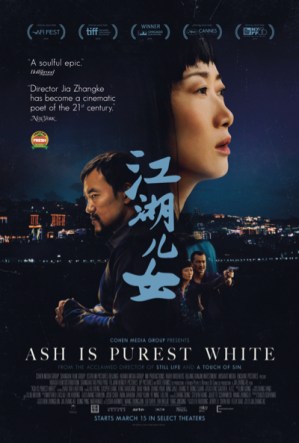
Ash is Purest White Poster (2)Premiered at Cannes Film Festival in May 2018, and since then showing in numerous international film festivals around the world, “Ash is Purest White” is now playing in selective cities in the U.S. If you live near Twin Cities, MN, it opens Friday, March 29th at Landmark’s Edina Cinema.

Ash is Purest White” is acclaimed director Jia Zhangke’s latest feature, a China and France co-production. It is like a fusion of Jia’s previous “A Touch of Sin” (2013) and “Mountains May Depart” (2015). The film is structured in three parts, packed with conflicts of loyalty and betrayal, love and loss. The fast changing physical and technological landscapes in China are the realistic backdrop of a story wrapped in the contradictions of choice and fate.

For non-Chinese language viewers, the English title could well be a mystery. What exactly is its meaning, and what kind of genre is it?  The film has an answer as the phrase is explicitly mentioned: Anything that burns at a high temperature is made pure, thus, volcanic ashes are purest white, an apt metaphor as the story unfolds. The Chinese title, however, is less philosophical.  江湖兒女  (“Jianghu er nü”) literally means “jianghu’s sons and daughters”, implying an action genre movie.

“Jianghu”, that undefinable term with no direct English translation, gives it away as it refers to the ancient wuxia (martial arts) world or the gangster realm in present day. In an early scene when the two main characters, mobster big brother Bin (Liao Fan) and his girlfriend Qiao (Zhao Tao) are out in the natural landscape with a volcano in the backdrop, Bin says he belongs in the jianghu underworld: “For people like us, it’s always kill or be killed.” Qiao quickly responds, “I’m not part of the jianghu. You’ve watched too many gangster movies.” Bin in turn takes out his gun, wraps Qiao’s hands to hold it up, shows her how to cock and fire. “See now you’re in the jianghu,” he says.

That is a pivotal scene as it foreshadows things to come. Qiao is pushed into jianghu as she later fires the gun to ward off a group of hooligans in order to save Bin. What more, to protect him, she admits to the police that the gun belongs to her. With that, she spends five years in prison. Jia has created in Qiao a reluctant heroine, capturing our attention with her loyalty and courage, two elements that are essential in jianghu.

“Ash is Purest White” is a mixed bag of crime thriller, melodrama, acerbic realism and humour; the story is an engaging vehicle taking us on Qiao’s personal journey. With this his latest film, Jia won Best Director at the Chicago International Film Festival and Zhao, his wife and muse, Best Actress. Most recently, he added one more accolade as the film garnered Best Screenplay at the 13th Asian Film Awards in Hong Kong on March 16th.

A story told in three acts, the feature is a dramatic depiction of Qiao’s change as she is swept through the currents of life, first as a young woman following Bin around as his girlfriend, a relationship that he is reluctant to confirm. Then comes the pivotal scene of fate sending her to the second act, incarcerated. Later when released, she becomes more street-smart––being cheated, she learns to cheat––all for finding Bin, to pick up where they have left off.

The last part is 18 years from the beginning, Qiao has established herself in Bin’s previous hood, but Bin is no longer the feared and respected big brother. Fate has led him onto a path towards oblivion. The final scene leaves us with a poignant realization, the currents of time may have altered physical landscapes, certain things do not change within the hidden vault of the heart.

(A full version of this review is posted on Asian American Press. Click here to read. )

~ ~ ~ Ripples


What ‘Greta’ could have been

Greta Poster

Greta has all the ingredients to be a much more elevated film. The stalker and prey duo played by veteran French actress Isabelle Huppert and the popular young star Chloë Grace Moretz make a perfect match, director Neil Jordan has top talents in his helm.

At first, looking at the cast and the director’s filmography, I was expecting a psychological thriller. Jordan had won an Oscar for writing the original screenplay of The Crying Game (1992) which he also directed. Later he brought us The End of the Affair (1999), a memorable adaptation of Graham Greene’s novel, again as writer/director. Greta is the Irish director’s most recent feature.

With the older woman stalking a young, innocent prey storyline, Greta could have developed into a deeper, character-focused movie, with more backstory, maybe even a poignant depiction of loss, loneliness, and obsession. Actually it would have been Huppert’s forte to do just that. As Greta Hideg, a widow living by herself in NYC with only her piano music as companion, the role sheds a little reminiscence of Huppert’s Cannes winning character in The Piano Teacher (2001) directed by Michael Haneke. But here she is simply a violent psychopath.

A young, new transplant to NYC, Frances (Moretz) finds the handbag that Greta has left in the subway train. With good intention and much naiveté, she locates Greta’s address and brings it all the way to her home. The rest of the story unfolds with expected development but unexpected, sudden loud sounds aim to scare and shock. Thanks to the ‘chemistry’ between the two stars and their engaging performance, the movie holds up for the first hour. A third character, the free-wheeling roommate Erica (Maika Monroe) is a balm to a distressed Frances, and I admit, to us viewers as well.

The first 60 minutes of the movie was well grounded for some deeper development of story and characterization. However, writer/director Jordan chose the path of the horror genre and its wares, lapsing the second part into unconvincing maneuvers. Huppert as a revenger in Elle is psychologically thrilling; Huppert as a psychopath goes bonkers in Greta is ludicrous. When you hear laughter in the dark theatre during a horror movie, you can almost gauge the effectiveness of the intention.

As for the prominent leitmotif, Franz Liszt’s Liebestraum (Love Dream), it just serves to stir up yearnings for something deeper and artistically satisfying, instead of, alas, leaving us with an illusive dream.

~ ~ Ripples

**


Other Isabelle Huppert’s films reviewed on Ripple Effects:

Things to Come

Claire’s Camera


***


‘Roma’ and the Power of Childhood Memories

This awards season, a black-and-white film stands out. Many have noted its cinematography and director Alfonso Cuarón’s versatility, from his multiple Oscar-winning space drifting Gravity (2013) and adaptation of P. D. James’s dystopian thriller Children of Men (2006) to the current Roma, a semi-autobiographical work. Surely I agree to all these, but it’s the personal resonance that the film evokes that makes it so memorable for me.

ROMA.jpg
Yalitza Aparicio as Cleo in Alfonso Cuarón’s Roma. Photo courtesy of TIFF.

I first saw Roma at the 2018 Toronto International Film Festival in September. The large screen effects are enfolding. Cinematography is thoughtful and the state-of-the-art Dolby Atmos sound mixing–especially the climatic ocean scene towards the end of the film–was totally engulfing, as if I was alone in the raging sea, despite sitting in a fully packed theatre.

Watching it again this time on my laptop streaming from Netflix is another experience. The intimacy and allowance for repeat viewing and listening to specific dialogues (re-reading the subtitles) are the obvious benefits. Especially with our local theatres not screening the film, the streaming service has a definite role to play in bringing the worthy feature to more viewers. Certainly if Roma plays in your local theatre, do watch it on the big screen as the production was meant to be seen.

What’s most moving is the director’s gentle rendering of his maid and nanny Cleo (first-time performance by Yalitza Aparicio) in his childhood home in Roma, an upper-middle class neighbourhood in Mexico during the years 1970-71. Cuarón juxtaposes Cleo’s personal ordeal with the political backdrop of the time, and weaving an unassuming life of a maid with episodes of an earthquake, a fire and a threatening ocean climatic scene. Other than these, the everyday work of a maid are deceptively mundane, for underlying are the emotive elements of human relationships.

Cleo is an essential member of the household, cleaning, cooking, serving, and taking care of the four children and their parents. She’s the one who puts the younger ones to bed and wakes them up in the morning. From the nuanced, naturalistic framing and some deeply affective moments, Roma is an ode to those who care for children not just out of duty but genuine love.

The reciprocal sentiments from the children, mom Sofia (Marina de Tavira) and grandma Teresa (Verónica García) make the glue that hold the family together at a critical time when the father (Fernando Grediaga) disappears, supposedly on an academic trip to Quebec but coincidentally is seen on the street with another woman. Here the role played by Cleo, a maid, is delicate and precarious. “No matter what they tell you, we women are always alone,” wife Sofia says to Cleo one night returning home by herself half drunk. Cleo shares her pain.

The film belongs to Yalitza Aparicio who plays Cleo with unadorned naturalness. Before this first time acting, she was a preschool teacher. This could well explain her instinctive fondness for the children under her care in the film. Cleo has her personal sad experience with a young man with a different agenda, and it is the family and the children that rekindle her zeal after a personal tragedy, a remarkable exchange of mutual support and kindness.

As the cinematographer himself, Cuarón’s planning of shots is meticulous and masterful. The camera captivates from the opening credits. We see the close-up frame of what looks like clay tiles of the ground, yes, they are, as water is splashed on them and sounds of sweeping and cleaning are heard. As the story unfolds we learn that it is Cleo cleaning dog wastes in the family porch. But don’t lose sight of this seemingly mundane scene. Once water is splashed on the flat, dirty tiles they reflect an open sky above with an airplane flying across from afar. That is the exact ending shot of the film. From waste-filled clay tiles on the ground to the open sky, water is the agent of reflection, a cleansing element, and towards the end, water marks a confirming love and new zest for life.

Last week, I made a long distance phone call to the maid and nanny of my family when I was growing up in Hong Kong. She is 97 years old now and living on her own, still goes to the market to buy fresh ingredients to cook for herself. I was able to chat with her and send well wishes. Childhood memories are powerful markers of identity and experiences; thanks to Roma for evoking such while one is unaware, as it works magic in creating new imagery to sustain them.


~ ~ ~ ~ Ripples


***

‘Claire’s Camera’ is a Whimsical Look at Communication

A Korean director shooting a film while attending the Cannes Film Festival, with two prominent Korean and French actors in his cast, taking just days in shooting to make what seems like a spontaneous gig had resulted in this whimsical 69-minute dramedy. Looks like something only the prolific, Cannes-honored director Hong Sangsoo can pull off. The versatile Isabelle Huppert (Things to Come, Elle) in one of her interviews said it took her only five days to do Claire’s Camera with Hong, with no script, except a daily run-through of the day’s story and lines.

3
Kim Minhee and Isabelle Huppert in Hong Sangsoo’s Claire’s Camera. Photo courtesy of Cinema Guild.

This is Huppert’s second time collaborating with Hong. The parallels in Claire’s Camera with real life are the very elements that lends to the film’s subtle humour. Claire (Huppert) is a school teacher from Paris visiting Cannes for the first time, accompanying a friend to the Film Festival. While wandering alone in this seaside resort taking pictures with her camera, Claire bumps into a triangle entanglement: a Korean director So (Jung Jinyoung), his film’s sales rep Yanghye (Chang Mihee) who has more than just a business relationship with So, and separately, her sales assistant Manhee (played by Hong’s muse Kim Minhee, On the Beach at Night Alone), whom she fires as she finds out Manhee’s one-night stand with the director.

Claire makes fast friends with Manhee after they meet on the beach. Here we see two actors from different countries using English to communicate, a language that’s not their own mother tongue. The verbal limitations may be a bother for some watching the film, but apparently not a hindrance for the two of them striking up an instant, equal friendship. They seem to know what the other is trying to say, and they care to ask each other questions, some quite personal, in order to know the other more.

Contrast that to a conversation where Manhee has with her boss Yanghye over coffee when she gets the message that she’s fired. They share the same Korean language, yet their interlocution is marked by unspoken sentiments and the boss’s minimal attempt to make it a two-way flow. Here’s a realistic depiction of a lopsided communication, one that’s not exclusive to the Korean culture. Those in authority hold the key to conversations.

In another scene, the lack of communication is what makes the naturalistic, deadpan humor work. When Claire first meets director So, the two are sitting at adjacent tables outside a café. As conversation begins, So asks Claire if he can sit with her at her table. She agrees and he stands up and moves to sit by her. But then the two have nothing more to say to each other, maybe due to language limitations. Claire then goes on to Google him on her phone to find out more about this director who’s sitting beside her. One has to take this as a comedic scene to appreciate the irony.

1
Jung Jinyoung and Isabelle Huppert in Claire’s Camera. Photo courtesy of Cinema Guild. 

The film is breezy and leisurely as the Cannes seaside, refreshing as the yellow jacket Claire is wearing; incidentally, her ‘costume’ is the actual wardrobe Huppert had brought when she was attending Cannes at that time. The setting is scenic and pleasant, whether it’s the pounding waves or the small lanes winding along cafes. No, we don’t get to see the red carpet or any of the glamour of the Cannes Film Festival, but we’re led into the side streets of storytelling.

The pitfall for those not familiar with Hong’s eccentric style could be the naturalistic, seemingly unscripted demeanours of his actors and their haphazard dialogues, and in this case especially sound laboured when characters try to interact with each other in a foreign language. And speaking of communication, the usual hard-drinking of his characters—director So here—could well be a language of expression in itself.

As for the camera Claire is always carrying, one would wish Hong could have used that a bit more, cinematically and imbued with deeper meaning. Hers is a Polaroid, so the image appears slowly on a hard copy. But we don’t get to see this effect or be led to any deeper relevance. However, in one notable dialogue towards the end when Manhee finally asks Claire a question that must have been on her mind all along, we finally hear something revealing:

Manhee: Why do you take pictures?

Claire: Because the only way to change things is to look at everything again very slowly.

Manhee: That sounds very nice.

The unfinished part seems to be, “but do we do it?”

Considering Hong Sangsoo’s signature style of repeating his film sequences in a movie like we’re watching it all over again but towards different results, Claire’s words could be more layered than they appear, and the slow appearing of an image on the Polaroid print could well be a mirroring for reflection.

Premiered at the Cannes Film Festival in May, 2017, Claire’s Camera has since been playing in film festivals all over the world. Cinema Guild will be releasing the film on Blu-Ray and DVD beginning Nov. 6, 2018. For more details click here: http://www.cinemaguild.com/theatrical/clairescamera.html

~ ~ ~ Ripples 

 ***

Related Reviews:

Let Things to Come be a Cooling Respite 

Art Imitates Life in Hong Sang-soo’s ‘On the Beach at Night Alone’

‘The Day After’ is a re-enactment Hong Sang-soo Style

WWII Comfort Women Speak Out in ‘The Apology’

In Min Jin Lee’s acclaimed novel Pachinko, there’s this episode in an early chapter. Sunja is harassed by three Japanese high school boys while heading home after shopping at the market. Hansu appears just in time to rescue her. After that, he kindly warns her:

 “Listen, you have to be careful not to travel alone or ever be out at night. If you go to the market by yourself, you must stay on the main paths. Always in public view. They are looking for girls now.”

       She didn’t understand.

       “The colonial government. To take to China for the soldiers. Don’t follow anyone. It will likely be some Korean person, a woman or a man, who’ll tell you there’s a good job in China or Japan. It may be someone you know. Be careful, …” (p. 32, Pachinko)

Korean-American author Lee is subtle here and does not dwell further on the issue. But this episode offers a realistic backdrop to her story set during the Japanese occupation of a large part of Asia. Sadly, the two sisters who work in Sunja’s mother’s boarding house are lured to work in China, with no news after that.

What was Lee referring to?

United Nations researchers report that between 1931 and 1945, the Japanese military forced an estimated 200,000 to 400,000 women and girls into institutionalized sexual slavery. They are called comfort women, a term used by the Imperial Japanese Army, euphemism for sexual slaves. Girls and young women were kidnapped, tricked, or taken away from their homes in Korea, China, Philippines, and Indonesia to comfort stations, another euphemism, for military brothels. To say they were victims of sexual assault was a description put mildly, because many of these women were literally raped on a daily basis.

THE APOLOGY 05_Director Tiffany Hsiung_Image courtesy Icarus Films
Writer-director Tiffany Hsiung

Chinese-Canadian filmmaker Tiffany Hsiung’s documentary The Apology follows three surviving comfort women. To honor them with dignity, Hsiung calls them ‘Grandmas’: Grandma Gil in Korea, Grandma Adela in the Philippines, and Grandma Cao in China.

Since 2009, the Toronto-based writer/director began documenting survivors of this silent atrocity, silent due to the long-held shame and fear of rejections of sexual violence victims. The six years of making The Apology had turned Hsiung into an advocate for WWII comfort women, seeking justice and sharing their stories in communities and universities in North America.

What had been a silent issue was first exposed by Korean survivor Kim Hak-sun, who spoke out in 1991, nearly five decades after World War II. Her brave act of putting away the shame and openly testifying to the horrible ordeals she had suffered prompted many other survivors to follow her lead. Such war-time atrocities began to draw international attention. The voices of these comfort women soon became a poignant outcry, a pioneer of social activism way before the present-day #MeToo Movement.

Grandma Gil of Korea was only 13 when she was forcibly taken away by Japanese soldiers from her home in Pyongyang to be a comfort woman in Harbin, China. She was seriously damaged physically, had gone through four operations during which she was made sterile. Today in her late 80’s, she is still separated from her family as Pyongyang now is in North Korea. She dreams of unification one day so she can see her family again.

Grandma Adela in the Philippines was 14 when she was taken away. Hsiung’s documentary shows us an actual comfort station in the Dona Baray Garrison, now desolate. Adela had not told her late husband about her past fearing rejection, but now felt she needed to let her son know. Hsiung’s camera captured the quiet understanding from her son as he learned of his mother’s painful experience during the war, a shameful secret no more. Sadly, Grandma Adela passed away after that before the production was completed.

Grandma Cao in a village in rural China had never told her adopted daughter. Again, Hsiung’s filming opened up the channel of release for her. There were three comfort women in her village. They were actually already documented by a local writer and a book had been published.

Grandma Gil in Korea is the most outspoken among these three survivors. She continues the protests that Kim Hak-sun had started. She bravely goes to Japan personally to speak to young women of a new generation, students who have not heard of such atrocities. She sits in street protests, over a thousand of such gatherings had taken place so far, yet all but fallen on deaf ears. Not only that, these woman protesters were often met with counter accusations and derogatory insults shouted at them.

A recent comment by a Japanese politician could well have represented the official view. Mayor Hashimoto had said that ‘sex slavery was necessary.’ His political party stated there was no need to apologize.

So, the protesters pressed on. Eventually 1.5 million signatures were gathered from across Asia and as far as Canada. Grandma Gil and several supporters personally delivered the boxes of petitions pressuring Japan to own up to their war crime and offer an apology. The documentary follows Grandma Gil all the way to the office of the United Nations Human Rights Council in Geneva, Switzerland, where the group delivered the boxes of signatures and met with the UN Human Rights Commission.

As of today, no apology has been given by the Japanese government.

The Apology is produced by the National Film Board of Canada. It will premiere on PBS’s POV Monday, October 22, 2018. Check your local station showtime, filmmaker info, trailer and other resources including reading list and lesson plan here:

http://www.pbs.org/pov/theapology/

POV streaming: http://www.pbs.org/pov/theapology/

***

~ ~ ~ 1/2 Ripples

‘Hotel Mumbai’ captures both terror and resilience in the tragic attack

On November 26, 2008, the City of Mumbai, India, was under siege by terrorists in a co-ordinated shooting and bombing attack that lasted four days. For long hours until security forces arrived from outside of the City, twelve sites in Mumbai were attacked and civilians were gunned down defenceless or taken hostage.

An Australian production, Hotel Mumbai had its world premiere at the 43rd Toronto International Film Festival in September, 2018. Director Anthony Maras in this his debut feature captures the horrific attack ten years ago with a pace that is intense and sweeping, leaving viewers breathless as they watch terror unfold on screen, acts after acts of senseless violence. But don’t let this drive you away.

The setting of the thriller Hotel Mumbai is the luxury heritage Hotel Taj Mahal Palace, or the Taj, where many foreign, renowned personalities had frequented. It was one of the twelve targets of the terror attacks, for obvious reason. Gunmen armed with AK-47 assault rifle and hand grenades took foreigners hostage at the five-star hotel and shot point-blank many others. In the aftermath, 31 in the hotel were killed, almost half were staff refusing to escape but stayed to defend and assist the trapped hotel guests.

Hotel_Mumbai_0HERO (1)
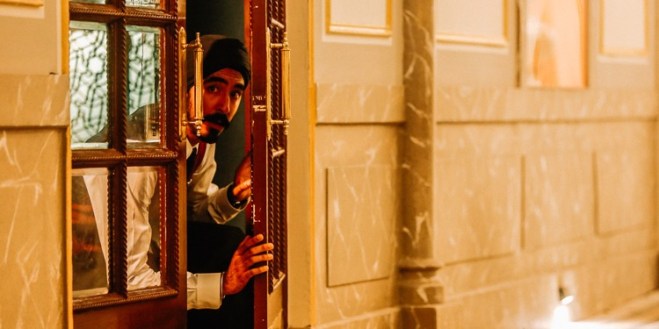
Dev Patel as Arjun in “Hotel Mumbai”. Photo courtesy of TIFF.

The storylines following several guests in the hotel are particularly gripping, like Sally (Tilda Cobham-Hervey) hiding in a closet caring for a baby who wouldn’t stop crying as the baby’s parents David (Armie Hammer) and Zahra (Nazanin Boniadi) are trapped somewhere else in the hotel, trying to get to their infant son.

Dev Patel plays staff server Arjun. The turban he wears makes one of the guests fearful. A crisis situation could tip either way, as an opportunity for understanding and the breakdown of barrier, or an incendiary fuse leading to deeper hatred and animosity. In a volatile situation as the hotel is besieged, complications could be deadly. But Arjun exudes ample dignity and generosity. That turban will later become a symbol of selfless grace.

The consoling breathers and the meaningful elements in the film then were these acts of kindness and courage. Maras captures the human foibles in the face of dangers, as well the strength of the hotel staff in protecting their guests. Their sacrificial, heroic acts render the film not merely a record of atrocity, but a gratifying chronicle of resilience and bravery.

The bullet-riddled and fire damaged five-star hotel was fully reopened after only twenty-one months. A special commemoration was held and a monument set up to honor those who died.


TIFF Hotel Mumbai Press Conference (1)
“Hotel Mumbai” Press Conference at TIFF. From left: Director Anthony Maras, actors Dev Patel, Tilda Cobham-Hervey, Nazanin Boniadi, Anupam Kher, Jason Isaacs, and Armie Hammer (back). Photo by Diana Cheng

There was a good representation of main cast members at the press conference of the film, moderated by Richard Crouse of CTV. Present were director Anthony Maras and actors Dev Patel, Armie Hammer, Nazanin Boniadi, Jason Isaacs, Tilda Cobham-Hervey, and Anupam Kher. They all commended the hotel staff for their extraordinary courage, some they had met in person who were survivors of the attack.

Upon talking with hotel staff and understanding the actual events, the actors were impressed that small acts of kindness were the essence of resistance. There were staff who had escaped but went back to save hotel guests. Some in the kitchen would put cookie sheet inside their clothes as shield to protect themselves in order to cover guests as they escape. One particular poignant observation they all felt was the breakdown of barriers as both staff and guests were all victims of the horrific act of violence. All racial and financial barriers came down in the face of crisis.

The cast also stressed the point that the perpetrators were all misguided and brainwashed young men. Nine of the ten gunmen were killed. But the mastermind, called “the Bull” in the film—who was in constant contact, directing the attackers throughout by means of their cell phones—was never caught.


***


Finally, Guernsey from Book to Screen

It was nine years ago that I posted a book review of The Guernsey Literary and the Potato Peel Pie Society, the post-WWII set, epistolary novel by Mary Ann Shaffer and Annie Barrows. It’s a book of letters between the writer Juliet Ashton and her publisher, and later the members of the Guernsey Literary and Potato Peel Pie Society, which is an impromptu excuse made up by quick-thinking Elizabeth to avoid arrest by German soldiers as she and her friends are caught walking home after curfew.

To prepare for German advances, residents on Guernsey evacuated their children and sent their young men to war. Later as the Channel Islands were under enemy occupation, the people were stripped of their freedom and had to endure hunger, casualties and disappearances of loved ones.

Here are some thoughts in my book review post:

“Despite the subject matters, readers will find the book witty and delightful. Authors Shaffer and Barrows have depicted a myriad of lively characters, charmingly joined in their humanity by their strengths and weaknesses.  Yes, we can also visualize the madness of war. But we’re relieved to see too that people can weather hardship much better when they have a common bond, here, in the reading and sharing of fine literary works.”

A few years ago I read that the NYT Bestseller would be turned into a movie and that Kate Winslet would play Juliet Ashton, and later, Rosamund Pike. And so we wait. Now we have Lily James, and I’m glad. She’s a younger Juliet, but her screen presence is always appealing, albeit the adaptation doesn’t give her much of a chance to shine as in Mamma Mia! Here We Go Again. She belongs in the singing and dancing limelight, maybe not unlike her character Lady Rose in Downton Abbey.

Lily James as Juliet Ashton (1).jpg

Matthew Goode (Henry Talbot from Downton) as Sydney, Juliet’s publisher, is a solid supportive figure. Surely what he wants is more books from her, but Sydney knows she can’t be forced to do anything she doesn’t want to. Nice play between the two, and some effective scenes as he tries to help Juliet dispel haunting war memories.

How do you turn letters into a movie? Director Mike Newell focused on storytelling and it worked. The helmer of Mona Lisa Smile (2003) and perhaps the more memorable, Four Weddings and a Funeral (1994), had chosen to depict the dramatic narratives in the letters rather than the actual reading and writing of them; the writing part can be done by another character, the typewriter.

There are fewer literary mentions in the movie, and the book club scenes are kept to a minimum but interesting. Don’t miss the one at the end when the credits roll. We hear the sound of the typewriter, remember Atonement? With just two hours for the movie, naturally a lot of the details are skimmed out. What’s left are the essentials, loss and love.

Kudos to Penelope Wilton (Isobel Crawley of Downton, of course, and many more), she leads all the way by holding the suspense, the reason for her pain. We see her expressive face conveys tensions and deep sadness. Viewers who have not read the book would find the movie a mystery slowly being revealed as Juliet investigates the Society’s history. I appreciate Wilton’s face, from which I can clearly see how the loss of loved ones can drag one down to mere existence and nothing more, if not for Kit (Florence Keen).

Joining the roles as Society members are veteran actor Tom Courtenay as Eben, Katherine Parkinson as Isola, and Kit Connor as Eli. The fine cast let us visualize the events of the book as experiences of real persons. This may well be the very reason why some hesitate to embrace movie adaptations of the literary. To the purists, the imageries and characters conjured up in their mind while reading reign supreme and they’d guard them with much possessiveness. In this case, however, I find the adaptation offers something that’s not in the book. I can see the restraints of the characters, the burden as keepers of secrets, their faces telling stories and then withholding some.

Jessica Brown Findlay (Lady Sybil from Downton) as Elizabeth is well cast, albeit not much time is spent on exploring her love story with the German soldier Christian (Nicolo Pasetti, limited appearance). The resolution to such a dilemma and its fallout will never be easy to find.

As for the love interests, or disinterest, Glen Powell aptly plays the rich American Mark Reynolds. Recognize him from Hidden Figure? He’s John Glenn there. Here, he’s the high flying socialite publisher. After Guernsey, Juliet has to be frank with him, and with much apology, returns his engagement ring. After just a short exchange, he gets up from the table, says goodbye and walks away, only to return quickly to pluck the champaign bottle from the ice bucket before he leaves for good. Just spot-on. Is that in the book?

True love belongs to Dawsey Adams (Michiel Huisman, Game of Thrones) who begins it all with his letter to a name and address written on a book he happens to stumble upon. The moment he encounters Juliet as she sets foot on Guernsey, his fate is sealed. Dawsey is good at restraints, until he can’t hold it anymore at the end. The setting may be different but who gets to pop the question remains true to the book.

A movie as well can offer the scenery which the book can’t. But then again, imagination may still be needed as the shooting location is not actually Guernsey Island but North Devon. Click on the link to check it out.

What doesn’t need imagination is also my favourite scene: Dawsey’s carving of the juicy roasted pig.


~ ~ ~ Ripples

***

Guernsey Literary and Potato Peel Pie Society is on Netflix.


Let ‘Things to Come’ be a Cooling Respite

July’s gone, but we’ll always have Paris.

There are many words I can use to describe the Paris born, veteran (here’s one of them) French actress Isabelle Huppert. Prolific, versatile, and age-defying. In 2016, two of her works came to prominence in the awards circuit, two features that show her in distinctly different roles that won her acclaims across the Atlantic. Playing a vigilant woman who schemingly fight back a rapist in her neighborhood in Elle, Huppert garnered a Best Actress Golden Globe and an Oscar nomination.

Things to Come

The other feature is Things to Come. Huppert is Nathalie Chazeaux, a philosophy professor, a published academic writer and editor, a mother of two almost grown children, a wife, a daughter, and a woman at the crossroads in her life.

On the career and academic front, Nathalie’s just been told by her publisher that her textbook would no longer be needed. On the home front, her husband of 25 years, Heinz (André Macron), has just confessed to her that he’s seeing another woman and will be leaving Nathalie to live with his younger love. Even though on good terms with their parents, her two children have grown enough to move away from home. As a daughter, Nathalie has to deal with a dementia-afflicted mother (Edith Scob) who calls her cell phone even while she’s teaching, delusional and threatening suicide. What is Nathalie to do?

Here, I must mention another crucial figure in the production, and that’s director Mia Hansen-Løve, who won Best Director with this feature at the Berlin International Film Festival in 2016. At eighteen, Hansen-Løve was cast by French director Olivier Assayas and later starred in another of his works. Partnered with him for a while, she’d chosen her own path, studying philosophy, writing for the prestigious French film magazine Cahiers Du Cinema, and later, directing.

Daughter of two philosophy professors, Hansen-Løve’s preoccupation with intellectual discourse is apparent in Things to ComeIn an interview, she’d said, “… for me, cinema is nothing but another way to practice philosophy… cinema is a search for wisdom, a search for good and for beauty, like philosophy could have been a search for my parents.” The intellectual exploration of what’s good and Utopian predominates in Things to Come. The film is worth a second, or third viewing just to capture the dialogues.

While she may be tossed like a floating weed in the torrents of life, Nathalie enjoys the fruit of her labor in her former star pupil Fabien (Roman Kolinka), now a writer and activist. However, as she’d influenced Fabien in his pursuit of philosophy and writing, he’d also chosen his own path by living with a few anarchists in a remote cabin in the French countryside. His outlook diverges from hers and which she can’t agree, ironically, that’s the reward of her teaching: training one to think for oneself and to choose one’s own path independently.

Upon his invitation, Nathalie had spent a few days there, an idyllic ,rural setting for her to recuperate from a life unhinged. She’s got her mother’s cat with her, Pandora, a cat that’s not used to the wild but takes off the instant Nathalie takes her out of the cabin. Lost for hours but Pandora finally finds her way back to the country abode in the middle of the night. ‘Instinct’, Fabien says. And that just might be what Nathalie needs to hang on to at this moment of her life.

Surely, Things to Come is a ‘thinking’ film, but viewers will also enjoy the nuanced performance of the cast, and what the camera reveals in the form of natural beauty and serenity for one to search things out. What more, Hansen-Løve lets us see both the larger scale of a flaw-ridden society and the trivial foibles in the interactions between Nathalie and Heinz.

Female viewers would likely find affiliation with Huppert’s role of an urban, professional woman who has to juggle many hats to fulfill her duties. Nathalie’s search for direction at the crossroads may not necessarily lead to obvious answers, but she manages to find comfort and joy in the birth of her grandchild, an endearing scene to end the film.

More importantly, Nathalie seems to have carved out a quiet solitude. an independence to mull on the unfathomable in life. Still searching, but in the meantime, she seems to have found a respite, a new solace to face what things may come.


~ ~ ~ ~ Ripples 


***

‘The Rider’ is Poetry on Screen

“The Rider” opens this weekend in selective cities. If it’s screening in your area, don’t miss it.

The Rider

What is a cowboy to do if he cannot live the cowboy life again? Too remote? Substitute ‘cowboy’ with any other activities you love to do, or a role that defines you. Take that away, and what do you have left?

The film focuses on the struggles of a rodeo star and expert horse trainer Brady Blackburn as he rebuilds his life and identity after a severe head injury. Upon the prognosis of his doctor, Brady should never go back to riding and rodeo again, for another injury would be fatal.

“The Rider” is an American feature, unique in its subject matter while its director is an unlikely candidate to share the insight. Chloé Zhao was born in Beijing, had studied in London, then Massachusetts and New York. “The Rider” is her second feature. In her short directorial career, she has gone to Cannes twice, nominated in 2015 for the Caméra d’Or (“Golden Camera”), Cannes’ award for the best first feature film, and winning The CICAE Art Cinema Award in 2017 with “The Rider”. That is, among other international accolades. Zhao is an exemplar of a global citizen in filmmaking.

Chloé Zhao

The actors for “The Rider” exude authenticity, for they are actual cowboys and their family, all playing themselves. Brady Jandreau takes the role of Brady Blackburn, reflecting his real-life persona, a cowboy who is much admired and respected in the rodeo community. His father Tim and sister Lily form the Blackburn family in the film. Zhao’s directorial skills shine forth as she leads the non-actors in front of the camera, capturing them in their natural speech and actions, in particular, offering viewers realistically the dexterity involved in the wrangling work. But the film goes much deeper than the actions.

Recovering from the near-fatal injury pits Brady into a precarious existence and conflicting relationship with his father Wayne (Tim Jandreau). As a tough cowboy himself, Wayne had all along brought Brady up to be resilient and competitive, but now father had to dissuade son from the risky pursuit of bronco riding and rodeo activities. Nursing a wounded body and a tormented mind, Brady has to deal with the painful task of redefining himself. Temporarily working in a supermarket and wearing a store uniform makes Brady a displaced person, a persona out of meaningful context, both to himself and to those who recognize him as they come into the store.

While there are tense undercurrents with his dad, Brady cherishes the intimate bond with his sister Lily (Lily Jandreau), who expresses herself from her own peculiar, internal world. Kudos to Zhao for casting the real-life brother and sister in the film, they need not be experienced actors to conjure up some genuine, moving scenes.

Much of the film’s effectiveness goes to the inspiring cinematography, exposing quietly Brady’s tormented soul. The opening sequence sets the stage right away with riveting close-ups of a horse and its breathing. As the camera turns from beast to man, we see the extent of the injury Brady sustains as he gets out of bed and follows the routine needed to care for his own body, striving to return to a past life and regain some sense of normalcy.

In other sections of the film, the camera pans the vast landscape of the South Dakotan plains with a tiny figure that is Brady walking or riding through. “The Rider” is visual poetry on a subject that is seldom explored, and cinematographer Joshua James Richards is most effective in transposing Brady’s internal quest lyrically on screen: “A horse’s purpose is to run in the prairies; a cowboy’s is to ride.”

Brady’s good friend Lane Scott (Lane Scott) is a painful reminder of the risks a cowboy takes. Paralyzed and brain damaged after a fall in a rodeo event, Scott now communicates barely by spelling out words one letter at a time signing with his fingers. Poignantly, Zhao depicts Brady’s every visit with Lane in the hospital as an encounter of love and hope without sentimentality.

Zhao is nuanced and eloquent in creating impressionistic scenes. And when horse and man are juxtaposed in such intimacy, the parallel is striking. As Brady puts it, when a horse is badly hurt it has to be put down, that is the humane thing to do; when a cowboy is badly hurt, he has to continue to live, for that is what humans are supposed to do. As we come to the turning point of the film towards the end, the presence of family love and support appear to be the key to moving on.

A rare gem of a film. Watch it with a quiet heart.

~ ~ ~ ~ Ripples


***