Roger Ebert in Toronto: A Close Encounter

Thanks to the Toronto International Film Festival, I have the chance to encounter the legend. It’s only natural that wherever there are films, there are film critics. But I never would have thought that I would see Roger Ebert in person and shake hands with him.

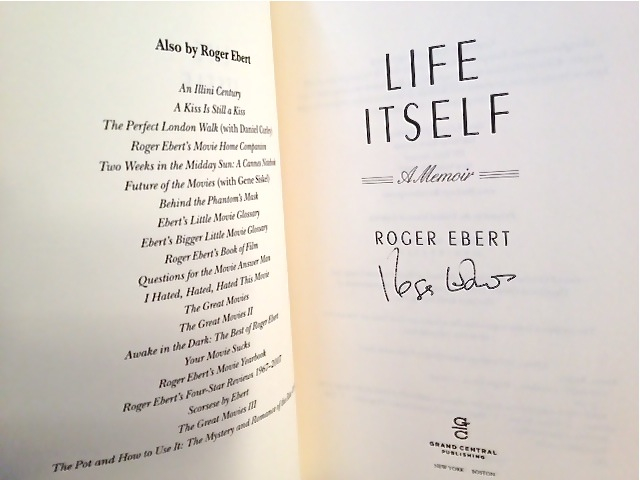
It was pure serendipity. While browsing in Indigo on Bay Street, I noticed a sign saying Roger Ebert would be in that store signing his memoir Life Itself a few days later. I’d followed his reviews since his “Siskel and Ebert” days, the two-thumbs-up duo. By the way, Ebert’s right thumb up had been trademarked. Reviewing films for the Chicago Sun-Times since 1967, Roger Ebert was the first film critic to win a Pulitzer Prize for criticism (1975), prolific all the way till his last two days.

Roger Ebert autograph Life Itself

This was not just about an autograph, or seeing a celebrity up close. It was about seeing a man who after torturous cancer treatments and surgeries for his thyroid, salivary gland and jaw, had lost a part of his face and the ability to talk and eat, and yet still maintained his humor and passions, who continued to press on to new ventures… this was about seeing life itself.

In the late afternoon on September 14, 2011, at the signing area in Indigo Books on Bay Street, people had been lining up for over an hour. I was one of them. At 7 pm, Roger came in walking slowly and with aid. He came on stage and faced the crowd. Together with his wife Chaz, they gave us a wave. Then he sat down and began signing. Photographs were allowed except for the rule of no posing. The Q & A session also began.

Chaz was his voice. She was personable and a film lover herself. She shared some of her views of the TIFF selections. As executive producer of “Ebert Presents at the Movies”, Chaz answered some questions without consulting Roger. But for most questions addressed to Roger, he would write on a small spiral notebook, handed it to Chaz to read out his answer.

Here are some of the notes I’d taken:

* Who influenced you the most?
He pointed to his wife standing behind him.

* Which decade is your favorite?
The 70’s… where you had The Godfather, Raging Bull…

* Buster Keaton or Charlie Chaplin?
Buster Keaton, albeit both are great.

* 3D?
Don’t ask. Story is number one.

* CGI (computer-generated imagery)?
Movies with CGI are soulless.

* All time best?
Citizen Kane.

* Favorite actor?
Robert Mitchum.

* Contemporary?
Al Pacino, Philip Seymour Hoffman, Tilda Swinton

* Favorite Canadian directors?
Atom Egoyan, David Cronenberg, Norman Jewison, Guy Maddin (thumb up)

* James Cameron?
Is James Cameron Canadian? Chaz asked in surprise.

* Favorite book?
A Fine Balance by Rohinton Mistry (Canadian! A voice came from the back)

* Any pressure from movie producers to write a good review?
No, he hasn’t been pressured. He was beyond reproach, Chaz answered.

* Any movies you haven’t seen?
The Sound of Music

* If there’s a movie made about you, who’d you want to play you?
Philip Seymour Hoffman. Chaz added, Oprah to play me. Diana Ross would be good too.

* Advice for potential film critics?
Do you want to get paid? Roger answered with a question.
Yes and no. The questioner covered all bases.
Start blogging. Roger replied.

* How does your life influence the way you review a film?
It generates every word.

Definitely more than just an autograph. What an encounter. What a night.

***

CLICK HERE to listen to an interview of Roger Ebert on CBC Radio during TIFF. Roger used a text-to-voice software as his speaking voice.

***

The Tree of Life by Terrence Malick

(It is impossible to review The Tree of Life without writing about what it is about, hence: Spoiler Alert for this post.)

“The Tree of Life” is the fifth feature film in the forty-year career of the reclusive director Terrence Malick. It received mixed reactions at the Cannes Film Festival in May this year. There were boos and applause. That it finally won the top prize at the festival, the prestigious Palme d’Or, indicates which side was gratified. But, it is a film that needs to be experienced personally before one takes side, and maybe seeing it more than once.

Watching the film is an experience in itself. It starts off with this quote from Job 38: 4 and 7:

Where were you when I laid the foundation of the earth? When the morning stars sang together
 and all the sons of God shouted for joy?

With this premise, the film pours forth mysterious yet majestic visual sequences depicting the cosmos, our molten earth, prehistoric era where dinosaurs roam, early life forms, the roaring ocean, blood streams, fetal heartbeats. The first part.

Upon such visuals we hear a voice over:

There are two ways through life — the way of nature and the way of grace. You have to choose which one you’ll follow. Grace doesn’t try to please itself. Accepts being slighted, forgotten, disliked. Accepts insults and injuries. Nature only wants to please itself. Get others to please it too. Likes to lord it over them. To have its own way…

From the macro scale of the universe we now focus on the micro, something with which we can identify, a family. We see it from the point of view of Jack O’Brien (Sean Penn). An architect now, Jack is haunted by memories of his past, in particular, the death of his younger brother at age 19. We see scenes of his parents receiving the bad news. We hear his yearning for the people he loves through his whisper in voice over: ”Brother, mother.” We are then privy to Jack’s childhood days in 1950’s Texas.

From the O’Brien family we see how grace and human nature play out. Jack’s childhood in Waco, Texas, begins in innocence. With a capable father (Brad Pitt) and an almost angelic mother (Jessica Chastain) who is loving, nurturing, grace manifest, young Jack’s (Hunter McCracken) early days are blissful. Two younger brothers later, the siblings form a close bond. But as the boys grow older, the father becomes stern and strict, callous with his sons, demanding total obedience, expecting love where the seeds of fear are sown. From this character, we see human nature manifest in its destructive, self-seeking mode.

Other incidents further shatter the once blissful young life. Jack goes to town with his mother and brothers, he sees a crippled man make his way awkwardly across the street. He also witnesses the unlawful being arrested. While at the swimming pool, he watches a boy drowned despite frantic rescue. We hear young Jack’s whisper in voice over: “Was he bad? Where were you? You let a boy die.” The problem of pain, suffering, and evil begin to churn in his mind. Direct questions to God, not unlike Job.

Watching his father’s harsh handling of his sons, young Jack slowly discovers that he himself too has the latent capacity to not just think, but to commit wrongs, “I do what I hate.” In a moving scene, after he has hurt his little brother, Jack becomes remorseful and asks for forgiveness. We see the power of love at work. We also see his innocence slowly taken over by conflicts in his heart, love and hate, good and evil… grace and nature.  The second part.

Jack’s father loses his job and the family has to leave town. The uprooting is the most painful the boys have experienced. Everything is lost, it seems, friends, the house, the neighborhood, memories, … But among the loss, we hear the graceful voice of Jack’s mother: “The only way to be happy is to love. Unless you love, your life will flash by… Do good, wonder, hope.” Yet poignantly, she experiences the most devastating blow later, the death of her own son. We hear her heartbreaking whisper in voice over: “Where were you? Did you know?” Again, reiterating the questions that were on Job’s mind.

But ultimately light takes over darkness. We are assured that all is not lost. We hear Jack’s yearning whisper, like a prayer: “Keep us, guide us, to the end of time.” In the eternal scheme of things, shown by the display of the magnificent cosmic visuals, we see all members of the O’Brien family reunite and bathed in a warm bright light. Jack once again embraces the ones he loves, his mother and his brothers. He also stands shoulder to shoulder with the one who has inflicted in him the mixed emotions of pain, anger and love, his father, now reconciled under the brilliant light.  The third part.

Yes, we have the big names. Sean Penn as adult Jack appears only sporadically. Brad Pitt nails his role as the stern and difficult father. The relatively new film actor Jessica Chastain is grace embodied. In an interview she recalls that director Terrence Malick had asked her to watch a lot of Lauren Bacall movies to prepare for her role. But the most impressive of all is Hunter McCracken playing young Jack. The casting is brilliant here. His mesmerizing portrayal of a conflicting boy incubating the later character of a tormented adult Penn is deeply moving, a reflection too of Malick’s sensitive direction. As with his other films, cinematography is superb. You’ll have plenty of time to savour the long sections of cosmic and natural wonders.

“The Tree of Life” is for the patient viewer. It is a slow movie, and rightly so. You have to take the two hours and eighteen minutes as a respite from your busy schedule, and experience the film as a quiet meditation on life, family, God, and relationship with Him. It is also a portrait of love, faith, doubts, and promise. It poses questions in whispers, and answers with majestic visuals in silence, and at times, in engulfing themes of torrential music. Smetana’s “The Moldau” still flows through my mind at 4:30 a.m.

Boos or applause, what does it matter? To quote Bresson: “All is grace.”

~ ~ ~ ~ Ripples

***


CLICK HERE to read my post on another Malick film, Days of Heaven (1978), which won an Oscar for Best Cinematography.

The Letters of Vincent van Gogh

While reading van Gogh’s letters is a fascinating journey into the mind of the artist, it is also poignantly heartbreaking. This is an abridged version of van Gogh’s letters, almost all written to his brother Theo from the various places he had stayed from 1872-1890, Holland, Belgium, England and France.

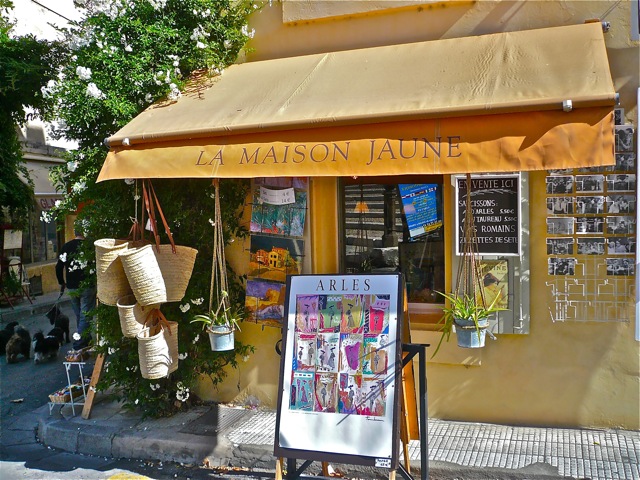
A few decades separate his life from Hemingway’s, but I think he too had his “moveable feast”.  To the painter, it’s not Paris, but the open country of southern France, in particular, Arles and St. Remy’s, Provence.

(A corner store in Arles, named after the famous ‘Yellow House’ Van Gogh once lived in)

Unlike Hemingway, van Gogh felt Paris only ‘distracts’. He wrote to his brother Theo after moving to Arles from Paris in February, 1888:

It seems to me almost impossible to be able to work in Paris, unless you have a refuge in which to recover and regain your peace of mind and self-composure. Without that, you’d be bound to get utterly numbed.

While Hemingway sought to “write one true sentence”, van Gogh yearned to reflect what was true through his paintings:

… giving a true impression of what I see. Not always literally exact, rather never exact, for one sees nature through one’s own temperament.

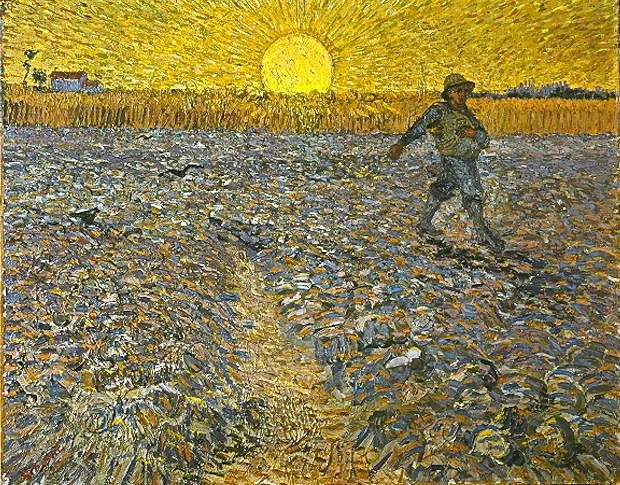
And colours were his tools. Van Gogh began to use a new palette that he did not see in his native Holland. Under the bright Provence sun, the artist excitedly indulged in a myriads of brilliant colours he had not experienced before…”There is that sulphur yellow everywhere the sun lights on.” He eagerly ushered in a new style.

Instead of trying to reproduce exactly what I have before my eyes, I use colour more arbitrarily so as to express myself forcibly… — To Theo from Arles, August 1888

(The Sower)

I believe in the absolute necessity for a new art of colour, of design, and — of the artistic life.”

“But the painter of the future will be such a colourist as has never yet been [emphasis his].

Through the artist’s colourful lens, the view that van Gogh saw was one that I could never imagine. Here he described to his brother Theo a painting he’d finished, in a letter dated September, 1888:

 … the starry sky painted actually at night under a gas jet. The sky is greenish blue, the water royal blue, the ground mauve. The town is blue and violet, the gas is yellow and the reflections are russet gold down to greenish bronze. On the blue-green field of the sky the Great Bear sparkles green and rose, its discreet pallor contrasts with the brutal gold of the gas.

(Starry Night)

Many of the letters are descriptions like this to Theo in Paris. Reading them, I can sense the artist’s excitement and joy in capturing everything he saw in Arles:

At the moment I am working on some plum trees, yellowish white, with thousands of black branches. I am using a tremendous lot of colours and canvases…

… it will be to our advantage to make the most we can of the orchards in bloom. I am well started now, and I think I must have ten more, the same subject. You know, I am changeable in my work, and this craze for painting orchards will not last for ever. After this may be the arenas…

His letters alas are also pleas for funds, as he was “literally starving”. With the last fr.5 he had, he’d spend it on canvases. He lived in dire poverty most of his career, damaging his physical and mental health.

I can’t do without colours, and colours are expensive… I cannot get more on credit. And yet I love painting so…

Worse still, his letters are also accounts of anguish, depression, and “unbearable hallucinations.” He desperately sought cures, admitting himself into the asylum in St. Remy’s. Ironically, it was there that he experienced the most prolific period of his life.

                    (St. Paul’s Hospital at St. Remy’s)

Throughout van Gogh’s numerous letters, there are many beautiful lines, insight into love, art, books, and life. Here are a few:

  • “Since I really love there is more reality in my drawings.” — Autumn 1881
  • “I would not give a farthing for life, if there were not something infinite, something deep, something real.” — December 1881
  • “It is the painter’s duty to be entirely absorbed by nature and to use all his intelligence to express sentiment in his work so that it becomes intelligible to other people. To work for the market is in my opinion not exactly the right way…” — July 1882
  • “I assure you that some days at the hospital were very interesting, and perhaps it is from the sick that one learns how to live.”  — January 1889
  • “I took advantage of my outing to buy a  book… I have devoured two chapters of it… This is the first time for several months that I have had a book in my hand. That means a lot to me and does a good deal towards my cure.” — March 1889
  • “What I should very much like to have to read here now and then, would be a Shakespeare… What touches me, as in some novelists of our day, is that the voices of these people, which in Shakespeare’s case reach us from a distance of several centuries, do not seem unfamiliar to us. — From St. Remy’s Hospital, June 1889.

But tragically, van Gogh succumbed to his mental illness. In July, 1890 two months after moving back to Auvers, north of Paris, he went out to the open fields and shot himself. Two days later he died from his gunshot wound. He was 37.

The Letters of Vincent van Gogh to his Brother and Others. Introduction by his sister-in-law Johanna van Gogh-Bonger, abridged by Elfreda Powell, Published by Constable & Robinson Ltd., 2003, 324 pages.

***

The is my last post for the blogging event Paris in July hosted by Karen of BookBath, and Tamara of Thyme for Tea. My other post is “A Moveable Feast (Restored Edition) by Ernest Hemingway.”

To read my travel post from last August “Arles: In The Steps of Van Gogh” CLICK HERE.

Photos: Van Gogh’s paintings, from Wikimedia Commons, Public Domain. Arles and St. Remy’s by Arti of Ripple Effects, August, 2010.

To read all the 900 letters of van Gogh online, go to this excellent site of the Van Gogh Museum, Amsterdam.

Urban Sanctuary

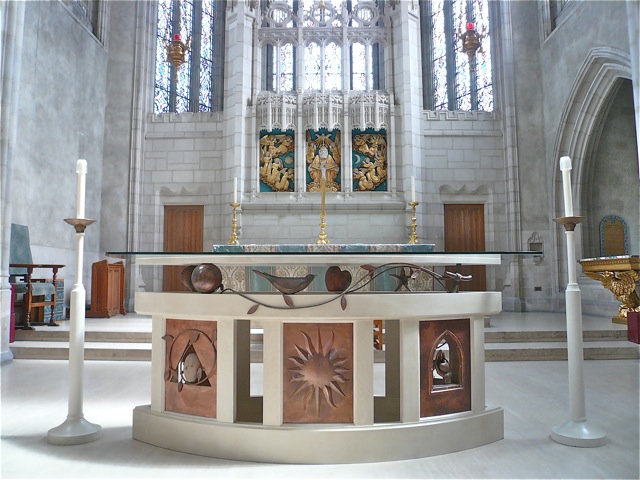
June has been a month of travelling for me. From the natural beauty of Vancouver to über busy and congested Metro Toronto, I’ve shifted gear and gone from park to overdrive in two short weeks. Quiet garden paths have been replaced by the 12-lane Highway 401, rain forest has turned into concrete jungle. And so I was pleasantly surprised by this serendipitous find right in the heart of downtown Toronto. Amidst the hustle and bustle, I found this sanctuary… literal and spiritual, the Trinity College Chapel on the campus of the University of Toronto:

Every step into the magnificent architecture instills awe and wonder, every artefact a symbol:

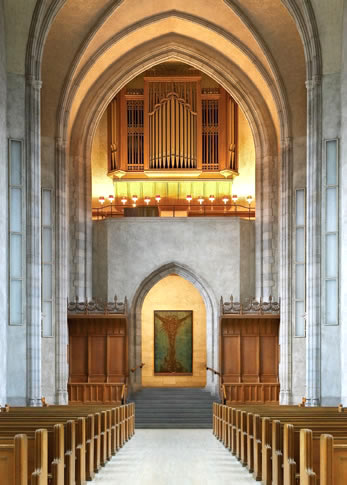
Looking back to the choir loft is another stunning view (this photo from Wikipedia):

The painting on the wall in the narthex, a crucifix, is entitled “Mediterranean Christ” by the artist Juan Sala Santonja:

***

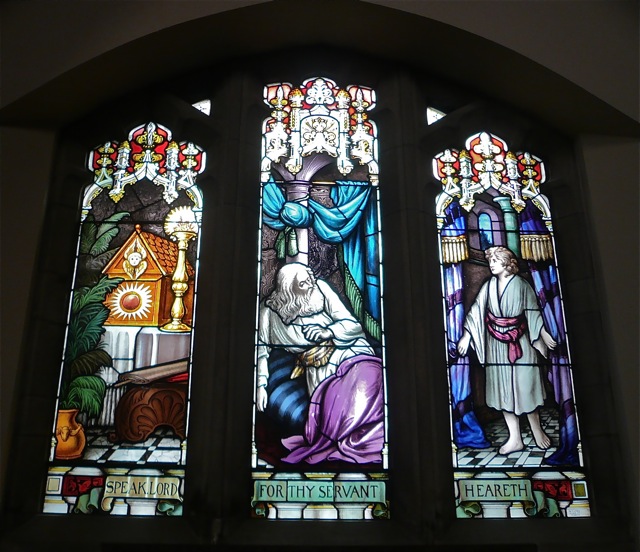
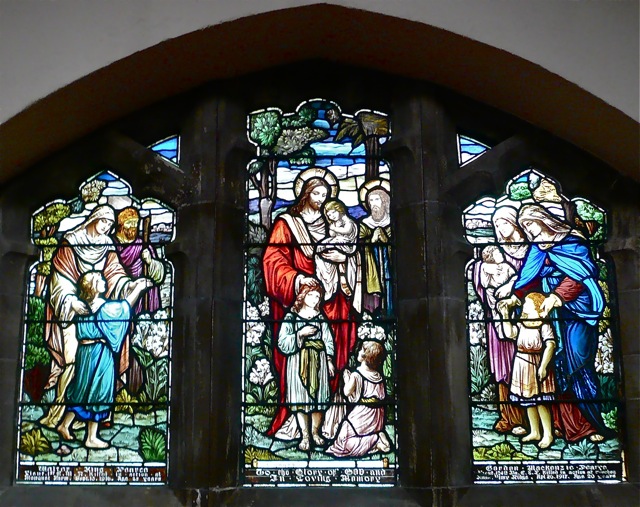
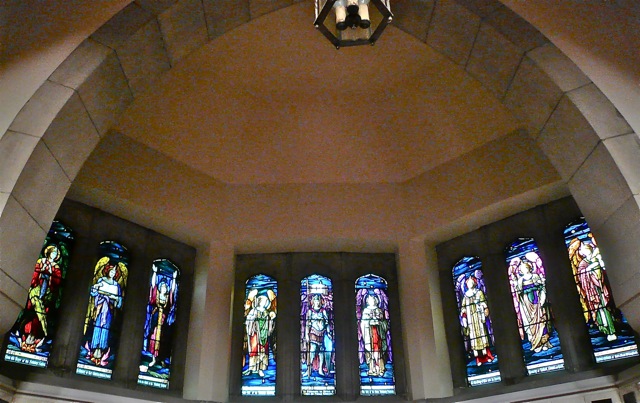
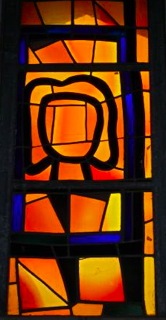
Another joy of discovery is Grace Church On the Hill, Anglican. My expectation of my short sojourn in Toronto had never been stained glass or religious art. But here I was, beholding Biblical themes in beautiful stained glass:

This contemporary wall sculpture created by Catherine Widgery of Montreal juxtaposes well among the stained glass, for its message points to a similar theme:

Entitled “By Her Own Radiant Light”, John Milton’s verse is engraved on a brass plaque beside the installation:

By her own radiant light, though sun and moon

were in the flat sea sunk.

And Wisdom’s self

oft seeks to sweet retired solitude,

Where, with her best nurse

Contemplation,

She plumes her feathers,

and lets grow her wings.

The pamphlet beside the art installation conveys the meaning: As the Moon’s illumination is the reflection of the Sun, Christian disciples are reflectors of the Greater Light. The phases of the moon suggest an eternal cycle of life, death and rebirth. Loss returns to fullness; darkness becomes light. The fragments of reflected light on water form a triangle below the full moon. Each fragment of light is a single piece of metal, cut and assembled so as to suggest the light’s effect on the surface of the water. At the heart of the circle, the light reflected on the surface is brilliant and intense, and diminishes as it spreads farther from the source.

As someone who’s always drawn to ripples, I spotted this installation right away as I entered the  sanctuary. Reading Milton’s verse and the explanation of the art work helped me gain a deeper appreciation of the visual symbolism.

No rain forests and greenery, but I was drawn to explore another landscape, one where art and imagination formed a bridge towards the unseen and spiritual, no less powerful in bringing out the wonders of creation and the Creator, the Source of Light and Wisdom.

***

CLICK HERE to watch a video clip with visual artist Catherine Widgery

PHOTOS: All photos were taken by Arti of Ripple Effects except the one noted from Wikipedia. Arti’s photos taken in June, 2011. All Rights Reserved.

Of Words and Spring

April is the month of empty dreams
Half the days gone
waiting for words and spring
still frozen ground
and on the screen
a frigid page as white as snow.

Brown could be the color of hope
After the white
for all I know
green is too much to wish for
I’m contented to see a patch
of dry and withered brown.

The sun is a perpetual sign
that there’s still hope
But it’s no herald of the seasons
for its presence comforts all year long
warming my blank and barren state
as I await for words and spring.

But Easter is an apt reminder
that The Word had come
spoken clear to half-frozen ears
His body hung on a lifeless tree
Blood and water flowed
onto parched and dusty earth

So what if no words come to me
That dreaded writer’s block
reigning the winter of sterility
numbing senses,
snatching thoughts,
seizing any sign of spring.

It’s not about a post or a blog,
Or even buds and melting snow.
The Word had come
lived and loved among us,
broken, bled, died and rose,
melting frozen hearts to greet
a new Spring and eternal growth.

Poem and Photos by Arti of Ripple Effects, April 2011. All Rights Reserved.


Alone Together by Sherry Turkle, Part 2

Part 2 of Sherry Turkle’s book Alone Together presents the networked self. Turkle has been called ‘the anthropologist of cyberspace.’ Her book reads like an ethnography of our human society today. While in Part 1 (my previous post) she has shown how we are receptive to robotics to solve our problems, Part 2 paints a picture of how we have embraced digital technology to seek the connections that we crave. The social media phenom is no longer the exclusive description of the young. Turkle cites that “the fastest-growing demographic on Facebook is adults from thirty-five to forty-four.”

I’ve found some more recent data (August, 2010) indicating that social networking use among Internet users age 50 and above has increased from 22% to 42% in one year. Now, more than ever, the popularity of social networking has permeated into all strata of our demographics.

This latter part of Turkle’s book addresses some of the consequences.

The Tethered Self

First off, we’re always on, no down time. Especially those with a smart phone, it keeps us connected no matter where we are.  Turkle has provided us with numerous examples like Robin, 26, a copywriter in a demanding advertising agency:

If I’m not in touch, I feel almost dizzy. As though something is wrong, something terrible is wrong.

Check where you put your cell phone when you go out. In your pocket? Purse? Where you put it may well indicate how tethered and dependent you are.

Robin holds her BlackBerry; at meals, she sets it on the table near her, touching it frequently.

So you think you can place it out of reach. An art critic with a book deadline took drastic measures:

I went away to a cabin. And I left my cell phone in the car. In the trunk. My idea was that maybe I would check it once a day. I kept walking out of the house to open the trunk and check the phone. I felt like an addict…

As to the form of communication, emails have already become obsolete among those 25 and younger. They use emails only for more ‘formal’ purposes, like job hunting. Texting is more instant and casual.

Needless to say, the telephone has become archaic among the young:

 ‘So many people hate the telephone,’ says Elaine, seventeen… ‘It’s all texting and messaging.’

A sixteen year-old says:

When you text, you have more time to think about what you’re writing… On the telephone, too much might show.

Turkle notes that such a phenomenon may be more wide-spread than we think. She writes:

Teenagers flee the telephone. Perhaps more surprisingly, so do adults. They claim exhaustion and lack of time; always on call, with their time highly leveraged through multitasking, they avoid voice communication outside of a small circle because it demands their full attention when they don’t want to give it.

Not only that, the real security of non-face-to-face and voiceless communication is the safety it offers. Behind the screen, one can hide… “On the telephone, too much might show.”

Of course, we must not deny the benefits of technology, especially for parents with children. A cell phone is probably the best assurance parents can have. For those with college-age children, we too can constantly keep in contact through all sorts of features on our mobile devices. But beyond the effect of tethering, what have social media and our über connected society done to our values? Turkle notes:

These days, cultural norms are rapidly shifting. We used to equate growing up with the ability to function independently. These days always-on connection leads us to reconsider the virtues of a more collaborative self. All questions about autonomy look different if, on a daily basis, we are together even when we are alone. (p. 169)

Indeed, collaboration has become the virtue of our time… whether it is a school project, or a creative endeavor, or a business plan. But for one who prize independent thinking and solitary quietude, I can’t help but ponder the downside of perfunctory collaboration. It could be a good thing if it is collective wisdom at work. Nevertheless, what if it is mass sentiment, or, as the popular notion today, a view ‘gone viral’.  Our ‘likes’ and ‘dislikes’ seem to be influenced more and more by what others are saying. Is there a place for independent thinking? Can we still preserve some privacy of mind, carve out a solitude just reserved for our own thoughts and feelings, insulated from the madding crowd? Or, is such a piece of solitude even desirable anymore?

.

.

Avatars and Identities

But it may not be all about business, or connecting with real life friends and associates that technology has made possible. Cyberspace has allowed us to adopt a different identity, building another life altogether. Avatars and online games have made it possible for one to take on multiple roles, all of them just as real. Using their mobile devices, people transport themselves to different realities simultaneously as they are living their real life in the here and now.

And it is this part of the book that is most disturbing to me.

In one of Turkle’s studies, she follows Pete, 46, bringing his children to the playground one Sunday. Turkle observes adults there divide their attention between children and their mobile devices, at which I’m no longer surprised.  But here’s the twist to Pete’s case. With one hand, Pete pushes his six year-old on the swing, and with his other hand he uses his cell phone to step into his other identity, an Avatar called ‘Rolo’ in Second Life, a virtual place that is “not a game because there’s no winning, only living”.

Pete lives as ‘Rolo’ in Second Life. He is married to ‘Jade’, another Avatar, after an “elaborate Second Life ceremony more than a year before, surrounded by their virtual best friends.” Pete has an intimate relationship with Jade, whom he describes as “intelligent, passionate, and easy to talk to”, even though he knows very well that ‘Jade’ could be anyone, of any age and gender. Here’s what Pete says about his other married life:

Second Life gives me a better relationship than I have in real life. This is where I feel most myself. Jade accepts who I am. My relationship with Jade makes it possible for me to stay in my marriage, with my family.

Borders sure have blurred in our digital age. Is this considered a kind of extramarital affair? To Pete, this virtual marriage is an essential part of his life-mix, another of our postmodern notions. Life-mix is “the mash-up of what you have on- and off-line.”

So, it’s no longer “multi-tasking” any more, but “multi-lifing”. With all the avatars we can claim online, we can have multiple identities. I can’t help but ask: But which one is real? I also wonder how many are projecting their real-life identity and true self on Facebook, blogs or Twitter? But the ultimate questions probably would be: What is ‘real life’ anyway, or the ‘true self’? Does ‘authenticity’ still matter? Is it even definable?

Part 1 of Alone Together shows people’s positive reception of robots, those simulated human machines. Part 2 is in a similar vein, depicting a society that embraces simulated lives through avatars, and simulated relationships through virtual connections. We may be more connected ever, but we are isolated. Alone, but we are alone together.

In her concluding chapter, Turkle writes:

We brag about how many we have ‘friended’ on Facebook, yet Americans say they have fewer friends than before. When asked in whom they can confide and to whom they turn in an emergency, more and more say that their only resource is their family.

The ties we form through the Internet are not, in the end, the ties that bind. But they are the ties that preoccupy.

And I must mention this case. Turkle has a former colleague, Richard, who has been left severely disabled by an automobile accident. Confined to a wheelchair in his home. He has had his share of abusive carers…

Some… hurt you because they are unskilled, and some hurt you because they mean to. I had both. One of them, she pulled me by the hair. One dragged me by my tubes. A robot would never do that,” he says. And then he adds: “But you know, in the end, that person who dragged me by my tubes had a story. I could find out about it. She had a story.”

For Richard, being with a person, even an unpleasant, sadistic person, makes him feel that he is still alive… For him, dignity requires a feeling of authenticity, a sense of being connected to the human narrative. It helps sustain him. Although he would not want his life endangered, he prefers the sadist to the robot.

Richard might have pointed to what it means to be human. I wish I could quote more, but my post is too long.

Alone Together: Why We Expect More from Technology and Less from Each Other by Sherry Turkle. Basic Books, New York, 2011, 360 pages.

~~~ 1/2 Ripples

CLICK HERE to hear Sherry Turkle talk on reclaiming conversations.

CLICK HERE to an interview with Sherry Turkle

CLICK HERE to read my post “Alone Together by Sherry Turkle, Part 1

CLICK HERE to read my post “No Texting for Lent and The End of Solitude”

Both photos on this post are taken by Arti of Ripple Effects. Top: One of the Thousand Islands, Kingston, Ontario, Sept. 2007. Bottom: Authenticity & the Networked Self, March, 2011.  ALL RIGHTS RESERVED.
Alone Together by Sherry Turkle, Part 1

Sherry Turkle is the Abby Rockefeller Mauzé Professor of the Social Studies of Science and Technology at MIT, the founder and director of the MIT Initiative on Technology and Self, and a licensed clinical psychologist.

For thirty years, Turkle has been studying the social-psychological aspect of how technology has been changing us humans. The word ‘humans’ has to be emphasized because the first half of her book details her research on The Robotic Movement. Her findings show that we are more and more dependent on technological advancements, in particular, robotics, to solve some of our human problems such as loneliness, friendship, caring for each other, and ultimately, to love and be loved.

Part one of Turkle’s book chronicles how over the decades, the robotic technology has given us simulated pets from Tamagotchi to Furby, simulated real-life humans like My Real Baby, to sociable robots developed as companion and later carers of the elderly, to the latest stage of robots capable to commune with human, and where human and machine almost existing and interacting on an equal level.

I find myself grasping for the fine line of distinction: what is human? If a machine is programmed to emote and think, is it still a machine? If a machine is created to have a human face, is it more human and less machine? For those who think machines in the form of robots will never replace humans need to read some of Turkle’s research findings. Hopefully we have not passed the point of no return.

From her book, I’m surprised to find how readily people are willing to accept a robot as a friend, a confidant, a companion, a carer, and even an equal. The researchers observe people’s behavior and interactions with the various kinds of robots in real life situations and through interviews. Here are some of the responses, from children to adults:

I want a robot to be my friend… I want to tell my secrets.” (Fred, 8 )

“I could never get tired of Cog (robot)… It’s not like a toy because you can’t teach a toy; it’s like something that’s part of you, you know something you love, kind of like another person, like a baby. I want to be its friend, and the best part of being his friend would be to help it learn… In some ways Cog would be better than a person-friend because a robot would never try to hurt your feelings.” (Neela, 11)

“Kismet, I think we’ve got something going on here. You and me… you’re amazing.” (Rich, 26, talking to the sociable robot Kismet, after showing Kismet the watch his girlfriend gave him and seemingly received some response back from Kismet.)

“I like that you have brought the robot (Paro, a ‘carer’). She (speaker’s mother in a nursing home) puts it in her lap. She talks to it. It is much cleaner, less depressing. It makes it easier to walk out that door. (Tim, 53)

Turkle notes that the reason people are so receptive to robots is because they offer painless solutions to their human need for attention and connection, to be noticed and sought after. They can all be programmed to do these.  And for the elderly, a robotic carer can be clean, accurate, and avoid mistreatment and abuse.

Robotic carers have been placed in nursing homes with very positive results. And the simulated robot My Real Babies are most desirable among many elderlies. In one case Turkle has left a My Real Baby with Edna, 82, who lives in her own home. I almost shudder to read the following observation by Turkle’s research team, when Edna’s granddaughter Gail brings along her 2 year-old daughter Amy to visit:

Edna takes My Real Baby in her arms. When it starts to cry, Edna finds its bottle, smiles, and says she will feed it. Amy tries to get her great grandmother’s attention but is ignored…

Edna’s attention remains on My Real Baby. The atmosphere is quiet, even surreal: a great grandmother entranced by a robot baby, a neglected two-year-old, a shocked mother, and researchers nervously coughing in discomfort. (p. 117)

That we can with technology doesn’t automatically lead to that we should. But the issue is complex though. Does it matter that we are engaged with the inanimate and allow it to help us?  Should there be a line drawn as to what kinds of tasks we leave to machines, and what we should keep as humans? What is ‘humanness’ after all?

A class of grade five children once posed the question: “Don’t we have people for these jobs?” It is wise enough for these young minds. But, it gets complicated if the issue is: “What if a robot can do a better job?” Then what does that leave us?

It has been a long while since I last posted. For one thing I have been preoccupied with the caring for two elderly parents. Meanwhile, reading through Sherry Turkle’s book requires much more time for thinking and mulling over, definitely not for speed reading. Now that I’ve finished, I need to crystallize my thoughts to write sensibly before I post, as the book deserves. The slow blogger in action… and thanks for waiting. So here is the first part. The second part is even more relevant and timely for us, our networked self. CLICK HERE to go there.

***

CLICK HERE to Sherry Turkle’s Alone Together, Part 2.

While we wait…

While we wait, the world spins. Tweets flood my screen by the second, as the revolutionary flame spreads, earthquake strikes, bookstore chain bankrupts, oil prices rise, Joan Didion fell and broke her collarbone, John Keats died today 190 years ago, iPad 2 comes out March 2, Oscars countdown begins. My head hurts.

The more I’m connected, the more the distress. But I still avoid falling into the escapist trap claiming ‘ignorance is bliss’. I think of it as the price to pay as a citizen of the world. Will I feel better not knowing about those dying on the streets revolting against a dictator, or that hundreds are buried in the rubbles of their homes, even when they are thousands of miles from me? Is it better not knowing? The answer is obvious.

With a series of uprising that started with a Tunisian fruit vendor setting fire to himself in protest, it’s all about a voice being heard. Thousands of miles away in the 5th most liveable city of the world, I sit comfortably on my couch checking tweets and blogging away. It almost feels surreal.

But as I listened to an interview about how people braved death to go out on the streets, I began to see the significance of this receiving end. If it’s about a voice being heard, we who are on the other side of the world are doing just that… we’re hearing that voice, and witnessing the domino effects. Sure, there are more practical ways to participate in the cause of democracy, or to help the victims of earthquakes, or to support surviving booksellers… but we who are merely checking our tweets, reading articles, and watching news clips are hearing those voices. Our awareness is a form of participation, the least we can do. A beginning.

Despite joining Twitter recently, I’m still an advocate of slow blogging. Opposites juxtapose in this postmodern world. While I’m checking out news feeds and relevant articles as quickly as time allows, I am slowly digesting and mulling over their content, and listening carefully to the multiple voices speaking out.

The world spins at a speed I can’t control. But it’s in stillness that I can make some sense of it. The voices deserve my quiet attention.

Reading Snow Country in Snow Country

The first ‘Snow Country’ in the title refers to the 1968 Japanese Nobel Laureate Yasunari Kawabata’s (川端 康成 1899-1972) seminal novel Snow Country (雪鄉); the second refers to Arti’s neck of the woods here north of the 49th parallel in mid December.

Written in the 1930’s through to the 1940’s, Snow Country was later translated into English and published in 1956.  It is probably Kawabata’s most well-known work.  Translator Edward G. Seidensticker had been credited for leading Kawabata’s work to the ultimate accolade, the Nobel Prize of Literature in 1968, a first for a Japanese writer.

The haiku-like simplicity so pervasive in the book is most apt for the Season. Firstly, its meditative descriptions and imagery offer a respite in the midst of our frantic pace.  And secondly, it points to certain relevance during this Christmas time, which I find surprising.

Translator Seidensticker writes in the introduction that the haiku is a juxtaposition of incongruous terms, such as motion and stillness. Within such contradictions sparks “a sudden awareness of beauty.”  Relax in the following poetic imageries:

They came out of the cedar grove, where the quiet seemed to fall in chilly drops.

or this:

[Her voice] seemed to come back like an echo of distilled love.

or this:

The field of white flowers on red stems was quietness itself.

Or savor the interplay of light and shadow, which evokes the poignancy of decayed beauty. This could well be the summing up of the human condition in Kawabata’s novel.

The sky was clouding over.  Mountains still in the sunlight stood out against shadowed mountains.  The play of light and shade changed from moment to moment, sketching a chilly landscape.  Presently the ski grounds too were in shadow.  Below the window Shimamura could see little needles of frost like ising-glass among the withered chrysanthemums, though water was still dripping from the snow on the roof.

The protagonist Shimamura, ‘who lived a life of idleness’ from inherited wealth, would leave his wife and children in Tokyo and go alone to the snow country every year, the mountain region of central Japan, to meet Komako, a young geisha at a hot spring village.  The love affair between the two is starkly off-balanced.  Despite her work in the pleasure quarters, entertaining parties of men, Komako is deeply devoted to Shimamura. Like her meager dwelling in the shabbiness of all, her room is spotlessly clean: “I want to be as clean and neat as the place will let me…”

Sadly, Komako realizes it is but a doomed unrequited love that she has invested in.  Shimamura too is aware of his own coldness.  Even though he is drawn back to Komako by making these trips to the snow country, he feels no obligation at all:

All of Komako came to him, but it seemed that nothing went out from him to her.

Of course, it could well be guilt and a sense of moral ground, albeit his loyalty to his wife and children rarely comes to mind.

Shimamura does not understand the purity Komako seeks in her love for him, and her desire not to be treated as a geisha.  And that is why his nonchalant statement hits Komako so hard. In the climatic scene of the story, he utters, though not without affection: “You are a good woman.”

Instead of taking his words as an endearment, Komako is deeply hurt. Despite having to work as a geisha due to her circumstance, thus selling herself as an outcast, she longs to be removed from her predicament and be transported to a new life. Shimamura’s repeated words “You are a good woman” fall upon her like the gavel of final judgement laden with biting sarcasm.

Kawabata’s characters cry out for redemption, to be delivered from their precarious state. Komako is seeking saving grace in Shimamura, and desperately hoping for a way out of the “indefinable air of loneliness” shrouding her.  But her search is in vain for the man is incapable of love:

He was conscious of an emptiness that made him see Komako’s life as beautiful but wasted, even though he himself was the object of her love; and yet the woman’s existence, her straining to live, came touching him like naked skin.  He pitied her, and he pitied himself.

Shimamura knows deep down that he needs cleansing as much as or even more than Komako.

The snow country of Japan is also the land of the Chijimi.  It is an old folk art of weaving where a certain kind of long grass is cut and treated, finally transformed into pure white thread.  The whole process of spinning, weaving, washing and bleaching is done in the snow.  As the saying goes, “There is Chijimi linen because there is snow.”  After the linen is made into kimonos, people still send them back to the mountain regions to have the maidens who made them rebleach them each year.  And this is where the universal appeal of snow as a metaphor for purity and cleansing so powerfully depicted by Kawabata, as Shimamura ponders:

The thought of the white linen, spread out on the deep snow, the cloth and the snow glowing scarlet in the rising sun, was enough to make him feel that the dirt of the summer had been washed away, even that he himself had been bleached clean.

When I came to this description towards the end of the book, a starkly similar image conjured up in my mind:

Though your sins are like scarlet, they shall be as white as snow; though they are red as crimson, they shall be like wool.”              —- Isaiah 1:18

And like the doomed ending of their love affair, death comes as a certainty to all, insects or humans alike.  Shimamura has observed how a moth “fell like a leaf from a tree… dragonflies bobbing about in countless swarms, like dandelion floss in the wind.”  The poetic descriptions do not make death any more appealing.  Kawabata uses insects as a metaphor for the frailty of life and the chilling finality awaiting:

Each day, as the autumn grew colder, insects died on the floor of his room.  Stiff-winged insects fell on their backs and were unable to get to their feet again.  A bee walked a little and collapsed, walked a little and collapsed.  It was a quiet death that came with the change of seasons.  Looking closely, however, Shimamura could see that the legs and feelers were trembling in the struggle to live.

It is pure serendipity that I picked up this book to read at this time of the year.  The Christmas story too has also cast a vivid interplay between darkness and light.  I was reminded of this reference:

The people walking in darkness have seen a great light; on those living in the land of the shadow of death a light has dawned.”            — Isaiah 9:2

There is reason to rejoice, for the Able Deliverer had come… He too had lived a life of paradoxes and contradictions: born to die, life through death, strength through weakness.  And beneath the surface of jollity of the Season and the superficial exchanges of good will, there lies deep and quiet, the source of joy and inner fulfillment, and Life’s ultimate triumph over death.

I heard a small voice echo as I treaded on the snowy path alone in my snow country.

It said: “For this reason I came.”

***

Snow Country by Yasunari Kawabata, translated by Edward G. Seidensticker. Published by Vintage International, 1996. 175 pages.

This concludes my final entry to meet Dolce Bellezza’s Japanese Literature Challenge 4 before the end of 2010.

My other JLC posts:

Never Let Me Go by Kazuo Ishiguro

Rouse Up O Young Men of the New Age! by Kenzaburo Oe

Reading the Season: Luci Shaw

Every year around this time, I try to stay afloat in the sea of chaos and consumerism.  My method of survival has been to seek a quiet haven where I can dwell upon the meaning of the Season.  I entitled my annual December post on this theme ‘Reading the Season’.

This year, watching the daring flash mob singing of Hallelujah Chorus in a shopping mall food court has jump started my quest for a spiritual respite.  In a time where the legitimate word is Jollity over Jesus, where Christ has been declared politically incorrect at Christmas, and where God is denounced together with Bigfoot and the tooth fairy in ads on buses, I want to mull on some subversive counter-reflections.

This time, I’ve steered my search towards poetry and found this collection edited by Luci Shaw.  It is the 1984 Regent College Publication of  A Widening Light: Poems of the Incarnation. (Click on link to read excerpts from Google Books.)


Luci Shaw has partnered with Madeleine L’Engle on her literary journey, including being her publisher, co-author, fellow poet and close writer-friend.  For years, I have enjoyed Luci Shaw’s poetry and her other works, and one time, had sat in her workshop learning the art and craft of journal writing.

A Widening Light is a collection of poetry by some of twentieth century prominent Christian writers and scholars, including C. S. Lewis, Eugene Peterson, Mark Noll, as well as lesser known but just as inspiring contributors.  My favourite in the collection are those from Madeleine L’Engle and Luci Shaw.

As a meager attempt to stoke the flame of faith and keep the Reason in the Season,  I’d like to share some excerpts from this collection here.

Made flesh
After the bright beam of hot annunciation
Fused heaven with dark earth
His searing sharply-focused light
Went out for a while
Eclipsed in amniotic gloom:
His cool immensity of splendor
His universal grace
Small-folded in a warm dim
Female space—
The Word stern-sentenced to be nine months dumb—
Infinity walled in a womb
Until the next enormity—the Mighty,
After submission to a woman’s pains
Helpless on a barn-bare floor
First-tasting bitter earth.

Now, I in him surrender
To the crush and cry of birth.
Because eternity
Was closeted in time
He is my open door
To forever.
From his imprisonment my freedoms grow,
Find wings.
Part of his body, I transcend this flesh.
From his sweet silence my mouth sings.
Out of his dark I glow.
My life, as his,
Slips through death’s mesh,
Time’s bars,
Joins hands with heaven,
Speaks with stars.

Luci Shaw


Some Christmas stars
Blazes the star behind the hill.
Snow stars glint from the wooden sill.
A spider spins her silver still

within Your darkened stable shed:
in asterisks her webs are spread
to ornament your manger bed.

Where does a spider find the skill
to sew a star?  Invisible,
obedient, she works Your will

with her swift silences of thread.
I weave star-poems in my head;
the spider, wordless, spins instead.

Luci Shaw


After annunciation

This is the irrational season
When love blooms bright and wild.
Had Mary been filled with reason
There’d been no room for the child.

Madeleine L’Engle

.

.

The risk of birth

This is no time for a child to be born.
With the earth betrayed by war and hate
And a nova lighting the sky to warn
That time runs out and the sun burns late.

That was no time for a child to be born.
In a land in the crushing grip of Rome;
Honour and truth were trampled by scorn—
Yet here did the Saviour make his home.

When is the time for love to be born?
The inn is full on the planet earth,
And by greed and pride the sky is torn—
Yet Love still takes the risk of birth.

Madeleine L’Engle


‘Reading The Season’ Posts over a Decade:

2020: Jack by Marilynne Robinson

2019: ‘A Hidden Life’ – A Film for the Season

2018: A Verse from Madeleine L’Engle’s The Irrational Season

2017: A Wrinkle in Time by Madeleine L’Engle

2016: Silence by Shusaku Endo

2015: The Book of Ruth

2014: Lila by Marilynne Robinson

2012: Surprised by Joy by C. S. Lewis

2011: Walking on Water by Madeleine L’Engle 

2010: A Widening Light by Luci Shaw

2009: The Irrational Season by Madeleine L’Engle

2008: The Bible and the New York Times by Fleming Rutledge 

2008: A Grief Observed by C. S. Lewis

***

Photos:  All photos in this post except “Water drops on spider web” are taken by Arti of Ripple Effects, All Rights Reserved.

‘Water drops on spider web’ is in the public domain, please refer to Wikimedia Commons for further  details.  CLICK HERE to go there.

Winter in November

Just a mere two weeks ago, I was taking an Autumn walk, where I enjoyed a feast of sight and sound.

But now, besieged by a snow storm two days ago, we have been made captives by the fierce side of nature.  We skid through icy roads and make it home only to perform our due diligence, the removal of mountains of snow on our driveway and sidewalk.

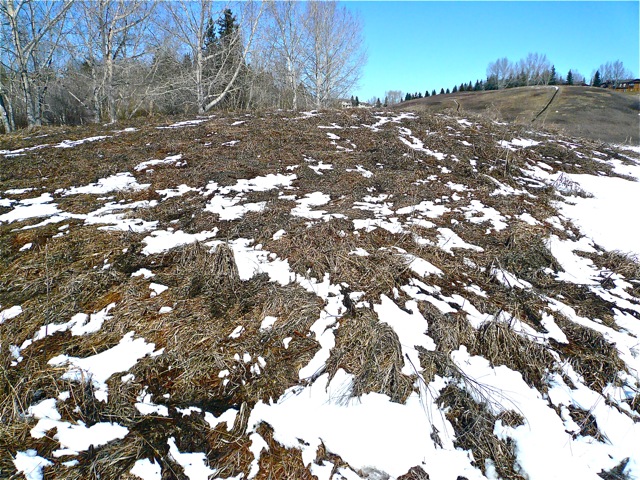
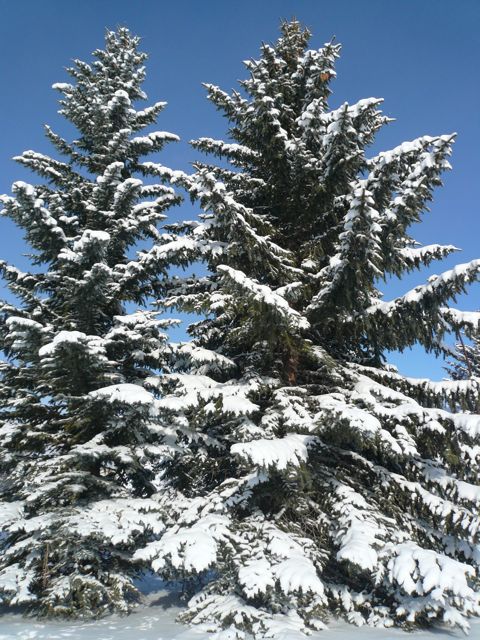
After two days, I am determined to break out of this physical and psychological confinement.  If we are to have winter in November, so be it.  Might as well embrace nature in all her facets.  Donning a toque, gloves, winter jacket and snow boots, I ventured out earlier today.  Here are some of the sights:

As I treaded through knee-deep snow, I came upon the place where I spotted my deer friend munching on his foliage just two short weeks earlier.  And even just a few days ago, I saw his clan scavenging the dry grass.  Where could they be hiding in this minus 15 C temperature?  What would they have for supper? Where and how do they sleep at night with the fierce wind blowing at even colder minus 20’s?

Just then the sun broke out through the overcast sky,  I seemed to hear my deer friend saying: Don’t worry about us.  We’ve gone through numerous winters, and still able to raise a clan.  As long as the sun comes out everyday…

Even the evergreens seemed to be waving at me, you mind your own slippery drive and cabin fever, we’ll be fine.


Yes, as long as the sun comes out everyday, we’ll soon see spring.

***

Never Let Me Go: Book and Movie

(Update Oct. 5, 2017: Kazuo Ishiguro has just won the Nobel Prize for Literature)

I must first declare this Spoiler Alert: It is impossible to write about the book and the movie clearly without stating the crux of the story. It is this key ingredient in the plot that instills meaning to the novel and now the film. While Never Let Me Go is a story of slow revealing, author Kazuo Ishiguro, in a Time magazine interview, admits that:

” … in a funny sort of way, I almost wanted the mystery aspect to be taken away so that people could conentrate on other aspects of the book.”

So there, even the author himself condones spoilers, for he knows there are much more to be pondered upon once the veil is removed.

Never Let Me Go (2005): The Book

Born in Nagasaki, Japan, in 1954, Kazuo Ishiguro‘s family moved to England when he was six. He is one of the most acclaimed English language writers today, listed by The Times as one of the 50 greatest British writers since 1945. Never Let Me Go is Ishiguro’s fourth nomination short-listed for the Booker Prize, which he won in 1989 with The Remains of the Day.

Based on a scientific premise, Never Let Me Go is a beautiful love story told with aching poignancy. Children of the exclusive boarding school Hailsham are told they are special from a very young age. They are to keep their bodies healthy and strong for that’s the purpose of their lives. They are told and yet not told, for theirs is a vague notion of who they really are or what is in store for them in the future. Knowing no other worlds, the children grow up in the sheltered, fenced-in compound of Hailsham, accepting their predetermined fate with docility.

Scientific advancement has made it possible. The children of Hailsham are clones, copied from an original, raised to have their organs harvested once they reach the prime stage of adulthood. While sports keep their bodies strong, they are particularly encouraged to pursue art and poetry. A mysterious figure they called Madame comes by regularly to collect their art work to keep in her Gallery.

The story focuses on three students, Kathy, Ruth, and Tommy. Their friendship on the outset matches the idyllic backdrop of the school in the 1960’s English countryside. Kathy is kind, caring and gentle, always watching out for Tommy, who is inept and temperamental. Seeing the bond forming between the two, Ruth slyly moves in and silently snatches Tommy to her side.

After reaching their eighteenth year, the three are transferred to the Cottages to live. There are just two roads ahead of them, donation of their organs and after 3 or 4 times, meets completion, death. Or they could apply to become carers of donors, but only temporarily until they too must fulfill their purpose. Living with other grown-ups who fall into the same destiny, the undercurrents of their love triangle begin to expose. For the first time in their lives, they hear about ‘deferrals’. If genuine love is evident between a couple, they could apply to have their donations deferred for a few years. When you are in love, just another day is precious enough. But what is love, and how do you prove it? There might also be another way out, and art could be the key. Ishiguro has masterfully handled layers of thematic complexity in a shroud of suspense.

While the story is based on an imaginary scientific scenario, the book is not a debate on the medical ethics of cloning. The events that take place which ultimately lead to their determined end explore, ironically, what it means to be human. Using the intricate relationships of the threesome, Ishiguro goes deep into issues of love and loss, dreams and reality, wrongs and their amends, and the ultimate search for the source of being, the very purpose of existence.

Using a first person narrative from Kathy, now a carer at 31 looking back at her past experiences, Ishiguro presents his story with detailed internal depictions and nuanced dialogues. Kathy’s voice is innocent and gracious, and all the more moving when it comes to the end when the story is fully unfurled. The three friends have since parted after the Cottages, but now after years have gone by, they meet again as carer and donors. On the canvas of imminent destiny, against the overwhelming tone of grey, we see three brisk strokes of colours, three lives, however temporal, serving their purpose, and above all, having tasted what it means to be human.

~ ~ ~ 1/2 Ripples

Never Let Me Go (2010): The Movie

Update Dec. 6: Carey Mulligan won Best Actress for Never Let Me Go at the British Independent Film Awards last night. This is her second BIFA win after An Education.


Directed by Mark Romanek (One Hour Photo, 2002), screenplay by Alex Garland (28 Days Later, 2002), the film was screened at the 2010 Toronto International Film Festival in September, and chosen to open the 54th London Film Festival on October 13th.

The mood is nostalgic, shot in greyish greens and blues, effectively capturing the general atmosphere of the book. When the future looks dim, the best one can do is to look back and savour what has been. Screenwriter Alex Garland has done an admirable job in being loyal to the source material, visualizing the key events and pertinent scenes, bringing to life the haunting memories of Kathy’s, whose narratives are taken straight out of the book.

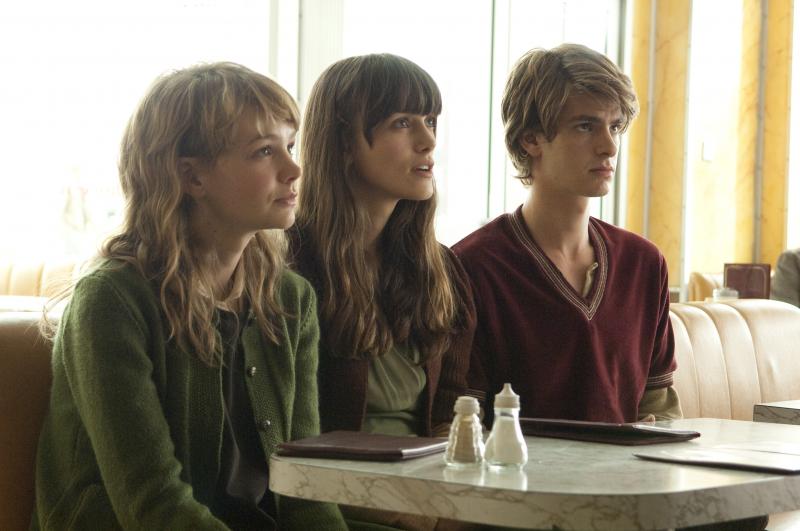
Corresponding to the novel, the film is structured in three parts. It follows Kathy (Carey Mulligan, An Education, 2009), Ruth (Keira Knightly, Pride & Prejudice, 2005) and Tommy (Andrew Garfield, The Social Network, 2010) through Hailsham in the 1960’s, young adulthood at the Cottages in the 1970’s, and lastly in the 1990’s where we see the final destination of their lives in completion. While the beginning part is the weakest, lacking the depth and details of the book, such a shortfall is compensated by the excellent performances of the three child actors as the young counterparts, Izzy Meikle-Small (Kathy), Charlie Rowe (Tommy) and Ella Purnell (Ruth). The congruence of young Kathy with her adult role played by Mulligan is particularly impressive.

As the story moves along, almost to midpoint, the unfurling of facts and feelings becomes more pronounced, calling forth some intricate and nuanced performance from Mulligan, Garfield, and Knightly. The three actors are the pillars of the production. While the original music by Rachel Portman (Academy Award Best Music, Emma, 1996) is affective and heart-wrenching, and the cinematography by Adam Kimmel (Capote, 2005) captivating, it is the performance of the threesome that makes the film so real and stirring.

Mulligan’s portrayal of Kathy and Garfield’s Tommy are particularly riveting. The hidden love Kathy has been holding for years is given a channel for expression only briefly at the end. All through Mulligan has carried her role with admirable restraint. Garfield’s portrayal of Tommy is achingly real, especially when he ultimately realizes the finality of his fate, the cry in the dark is haunting and powerful. And kudos to Knightly for accepting a role that puts her in a less than glamorous light. Her change at the end too is moving, giving depth to the exploration of what makes one human… other than love, there is also the courage to admit wrong, seek forgiveness, and the attempt to make amends.

Is it melodramatic or is it evoking deep emotions? Within context here, emotional sentiments or even a few tears at the end of the film might well be a healthy response, nothing to shy away from. Should the scenario arise some day in the future when we need to prove that we are human, and that we have a soul, what better ways to demonstrate but by our capacity to emote love, empathy, compassion, pathos, and the fear of facing such a scenario. May this all remain as science fiction for our enlightenment only.

~ ~ ~ 1/2 Ripples

***

To read other Book Into Film posts, CLICK HERE.