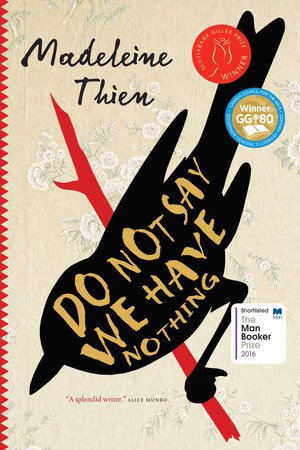
Do Not Say We Have Nothing Book Review

April 3rd UPDATE: Do Not Say We Have Nothing shortlisted for the Baileys Prize.

***

First the Booker, then the Giller and the GG, and now longlisted for Baileys Women’s Prize for Fiction, this voice must be heard. I thank Asian American Press for allowing me to post my review here in full, and Penguin Random House Canada for my reviewer’s copy.

***

Just a few months after it was published in May, 2016, Madeleine Thien’s Do Not Say We Have Nothing was shortlisted for a Booker Prize and had won the top two Canadian literary awards, the prestigious Scotiabank Giller Prize and the Governor General’s Award for fiction. That is extraordinary achievements for the Vancouver born, Montreal based writer.

Thien creates her third novel on a large canvas, spanning from the decades leading to Mao’s Cultural Revolution in 1960’s China and onward to the Tiananmen Square protests and government crackdown in 1989. Even though her novel does not stem directly from a personal experience like others’ such as Dai Sijie’s semi-autobiographical Balzac and the Little Chinese Seamstress, or the eye-witness account of journalist Jan Wong’s Red China Blues, Thien’s outsider’s stance is far compensated by her extensive and detailed research, not just 20th Century history of China but down to the streets and local teahouses. Further, the absence of a first-person experience is replaced by an exuberance of imaginary characters and storytelling, all intricately woven with actual accounts of historical figures and events.

While not being an eye-witness, Thien’s cultural lineage could have brought her into a kind of insider’s realm. Born to Malaysian-Chinese immigrant parents in Canada, Thien’s previous writing had depicted the unique perspective framed by her upbringing. The stories in her collection Simple Recipes (2001) have revealed poignantly the cultural and generational conflicts that could exist in a North American Asian family. Further, Thien’s previous novel Dogs at the Perimeter (2011) had prepared her well to venture into the abyss of human atrocity, with the backdrop of Khmer Rouge’s infamous killing fields in Cambodia. Do Not Say We Have Nothing presents a larger landscape and a more ambitious undertaking than her previous works.
Madeleine Thien

This is how the book opens, simple yet powerful:

“In a single year, my father left us twice. The first time, to end his marriage, and the second, when he took his own life.”

Here we hear a voice, seemingly nonchalant, but still lucid and sad. This is the voice of the protagonist, Marie. She was ten years-old and living with her mother in Vancouver when she learned of her father’s suicide in Hong Kong. The year was 1989. Not long after this news, Marie’s mother took in nineteen-year-old Ai-ming from China, alien and undocumented, escaped out of the country during the Tiananmen crackdown.

Ai-ming’s short refuge in Marie’s home bonded the two like sisters. As well, she opened the eyes of young Marie to life inside a totalitarian regime. The radio played only eighteen pieces of approved music. Her father, Sparrow, would listen to illegal music secretly and hum the melody of his own composition when he thought no one was around. Ai-ming’s interactions with Marie have prodded her—now twenty years later and a professor of mathematics at Simon Fraser University—to search for the truth about her father Kai and his mentor, Ai-ming’s father Sparrow, as well the tragic personal and national history that had consumed their lives.

With Ai-ming’s help, Marie and her mother began to decipher a secret hand-copied manuscript Kai had kept, “The Book of Records”, passed on to him from Sparrow, an allegorical account of their life in China, outward journey and clandestine dreams, “things we never say aloud”. As a young child, Marie was overwhelmed. Now as an adult, she is driven all the more to pursue the truth of her own family history.

It is not easy to follow Thien’s story in the first few chapters as there are many characters introduced with their own backstory. Time frame switches back and forth, spanning two continents. As I entered Chapter 4, I had to draw up a character chart, as I was looking into a kaleidoscope of three generations and other colourful figures against tumultuous events. If the book had included such a chart at the beginning, it would be most helpful for readers.

We follow Marie’s discovery as she comes to learn that her father Kai used to be a gifted piano student at the Shanghai Conservatory of Music, and Sparrow, a prominent composer, was his teacher there. Together with Sparrow’s young cousin Zhuli, a prodigious violin student, the three forged an unspeakable bond. They cherished each other’s dreams with youthful fervors, which all were altered if not extinguished when Mao ignited his Cultural Revolution.

When she was small, Zhuli discovered by accident her parents’ secret storage where they hid their treasures of western classical music records and books. This led to her parents, Swirl and Wren the Dreamer, to be charged as counter-revolutionary. They were publically criticised and humiliated, then sent to separate labour camps in the remote northwest of China in the name of ‘re-education’. Zhuli was taken secretly to her aunt, Big Mother’s Knife, Sparrow’s mother, and there she grew up. The woman who brought her there had met her aunt only once while on the train. As she ate a lot of the White Rabbit brand candies, we know her by that name. The White Rabbit told Zhuli about her parents’ situation matter-of-factly:

“They’ve been sent for re-education, that’s all… Since you’ve never been educated at all, it seemed pointless to send you along with them.”

This is just one incident where Thien deftly dispenses humour amidst somber events. This is what makes the book enjoyable to read. The subtle humour often is the wrapping of the resilience of human spirit hidden among tragic happenings.

Thien’s story is embedded in historical facts. The prestigious Shanghai Conservatory of Music was shut down in 1966 during the Cultural Revolution, its five hundred pianos destroyed, denouncement and physical battering of the professors and students had resulted in deaths and suicides. Bearing the brunt of the persecution was the unyielding Conservatory President He Luting, beaten but not bent.

Due to their political affiliation, Sparrow’s parents Big Mother Knife and Ba Lute are spared, but what remains in Sparrow is a compromising existence, being sent to work as a factory work for twenty years after the shutdown of the Conservatory. Kai the pragmatist chooses to follow the mainstream and becomes a Red Guard. Young Zhuli sets foot on a tragic path.

With such a setting, it is only natural that Thien would use classical music as the leitmotif of her composition. Shostakovich, Beethoven and Bach are like witnesses to the unfolding of human atrocity, their melodies the fuel that sustains whatever internal fervour that remains. Shostakovich, himself a composer treading a precarious line between authenticity and self-preservation under Stalin’s rule, is an apt metaphor of the situation the trio have to face. The different choices made by Sparrow, Kai and Zhuli well represent the paths that are opened to an artist facing political persecutions.

On another note, and true to her Canadian root, Thein lets pianist Glenn Gould and his two recordings of Bach’s Goldberg Variations be a recurring motif in her story. Bach’s ethereal and invigorating theme and variations belong to Sparrow, the sustenance for his inner life despite deadening circumstances outside.

As the canvas is huge, Thien’s subject matters are numerous. The details and complexity may be a hindrance to readers’ enjoyment. Yet Thien’s voice is close and personal. Do Not Say We Have Nothing, the title taken from the workers anthem the ‘Internationale’, deserves our listening ears. As an instructor of the then newly established MFA Program in Creative Writing at City University of Hong Kong from 2010, Thien experienced first-hand the abrupt cancellation of the program in 2015 “as a result of internal and external politics” as stated in her Acknowledgement at the back of the book. In her article in The Guardian (May 18, 2015), she notes that students from the Program had published essays in support of the Occupy Central student-led democracy movement, the ‘Umbrella Revolution’, that brought Hong Kong to a standstill. That personal experience could well have informed and given her the potent, insider’s voice in her novel writing.

***

~ ~ ~ ~ Ripples


The Ultimate Arrival

Spoiler Alert: This post contains a major spoiler of a current movie with a similar name.

***

If you’d known the future, would you change anything?

In the movie Arrival, what’s most moving for me is at the end, when we realize, ah-ha! Dr. Louise Banks has seen it beforehand—knowing full well that years later, her husband Ian will leave her, and her dear daughter Hannah will die of illness at a young age—she still chooses to embark on this journey of love and motherhood, a small idea to illustrate a bit of the Ultimate Arrival.

In the words of the story writer Ted Chiang:

“From the beginning I knew my destination, and I chose my route accordingly.”

arrival-1

And here’s another life…

If you’d known that you’d be born in a smelly horse stable, had to flee from a death threat on your life while still an infant, and later, you’d be misunderstood, criticized, rejected, plotted against, deserted and denied by your intimate friends, betrayed, beaten, spat upon, taunted, and finally hung on the cross with just three nails holding you up until death of asphyxiation, and that’s after living a short life of only 33 years, would you rather not be born?

Yet, He chose to arrive.

***

The Risk of Birth, Christmas, 1973

This is no time for a child to be born,
With the earth betrayed by war & hate
And a comet slashing the sky to warn
That time runs out & the sun burns late.
That was no time for a child to be born,
In a land in the crushing grip of Rome;
Honour & truth were trampled by scorn–
Yet here did the Saviour make his home.
When is the time for love to be born?
The inn is full on the planet earth,
And by a comet the sky is torn–
Yet Love still takes the risk of birth.

— Madeleine L’Engle

***

Other Related Posts:

Arrival: From Short Story to Film (a spoiler-free review)

Poetry by Madeleine L’Engle

Reading the Season: Arti’s Annual Christmas Reads 

Paterson: Of Pug and Poetry

Some movies are like the roaring ocean, waves mounting upon waves rousing up excitement, eliciting continuous, sensational reactions. Some are like a bubbling brook, smaller but still boisterous, teeming with life and sounds. The film Paterson is a quiet stream, water gently flows along, seemingly uneventful, and yet, you can sit there by its side and just watch its quiet swirling.

Paterson has been screened at many film festivals this year. I missed it at TIFF, glad I could catch it when I came home to CIFF. For a film about poetry and a loving couple (not dysfunctional, for a change) with a British bulldog named Marvin, a character in his own right, and helmed by a Palm d’Or winning director, it’s got to be a unique experience.

Director Jim Jarmusch has been garnering accolades at the Cannes Film Festival since 1984, with his early feature Stranger Than Paradise. His most commercially known work probably is Broken Flowers (Cannes Grand Prize of the Jury, 2005) with Bill Murray and Julie Delpy. This year, Paterson has once again brought the director to Cannes as a nominee for the prestigious Palme d’Or. 

Jarmusch ought to be applauded for making a film on poetry, for who in this day of mega explosive, blockbuster productions would think of turning Williams Carlos Williams’ poetic notion into a movie. Yes, WCW himself was a resident of Paterson, New Jersey, and his 5-volume epic poem Paterson must have been the source inspiration for Jarmusch.

paterson

The movie Paterson is about an admirer of WCW and an aspiring poet whose occupation may be furthest from the creative process. But that’s exactly the point. Where do we get inspirations and ideas? What kickstarts our creative process? Do we need to climb to the top of the mountain, soak up a magnificent sunrise to unleash our creativity? Apparently not.

We see in the film that the most mundane of everyday objects, like, a box of matches, can spark off a new poem. Jarmusch has his own style of cinematic poetry making: the deadpan, casual expressions of his main character, thus, embedding humour in the serious. Adam Driver (While We Were Young, 2014) is probably the best person to star in this film, not only in name, but in his demeanour. He is Paterson, a bus driver with a daily route of driving bus route no.23 around the small town of Paterson, New Jersey.

We follow Paterson for a week. He gets up at the same time, around 6:20 am, plus or minus 5 minutes, eats his breakfast cereal, carries his lunch box and goes to work. He drives his no. 23 route around town, overhearing passengers’ small talks, brewing in his mind thoughts and ideas, writing down lines in a note book when he has a chance, has his lunch sitting on a bench overlooking the Great Falls of the Passaic River, then back to work. After work he goes home, has dinner with his loving wife Laura (Golshifteh Farahani), walks the pug Marvin, ties him outside the bar, goes in and have his beer, chats with bartender Doc (Barry Shabaka Henley), meets the regulars Everett (William Jackson Harper) and Marie (Chasten Harmon) and listens to their stories, then walks Marvin back home and sleep.

As viewers we see this seven times over. Reminds me of Groundhog Day (1993). But Jarmusch is clever in sprinkling subtle humour and surprises, quite like life. Paterson is a contented soul, driving a bus may be as fulfilling as writing poetry. Wife Laura is more experimental, and takes charge of her creative expressions more explicitly, like learning the guitar to reach her dream of being a country singer, like interior decorating her home according to her obsession with black and white, or baking cupcakes in her own signature style as a step to opening her own cupcake store. Whatever, the two are a loving, contented couple. Creativity manifests in various ways.

Marvin.jpg

And then there’s Marvin, who may be the best pug in pictures. He has a role to play too in this mundane plot. His story line is, again, life as well.

That’s about all I’ll reveal about the movie without giving out the spoiler, yes, even for this seemingly uneventful film. But as I write, I’m thinking of another matter. This film is probably screened only at very limited cities, at arthouse, independent cinemas. So, why am I writing about a film that not many of you will actually be able to see? What exactly is the relevance of writing something that few may relate to? Or… is the review a piece of writing that readers can respond to despite not experiencing the film itself?

If you have some thoughts on this, I’d appreciate your input. Throw your two pebbles into the Pond and create some ripples so I’d have an idea.

Having poured out this puzzling thought that has been troubling me for some time, I’m reminded of Paterson’s poetry writing in the basement of his home, his notebook filled with his private thoughts and lines, which nobody has ever or will ever read. What’s his purpose then?

~ ~ ~ 1/2 Ripples

***

Other Related Reviews on Ripple Effects:

Silence the Movie Arrives in the Most Unwelcome Time

While We Were Young: Wearing the Hat of Authenticity 

A Quiet Passion (2016) at TIFF16

Risen for Hope

The photo was taken just yesterday. Due to illness in the family, I’ve been staying mostly indoor as a caregiver. Yesterday was the first time I went out to greet spring and the birds. A Downy Woodpecker darted right into frame.

DSC_0614 (1)

While we’re enjoying an early spring this year, there had been times when it felt like spring would never come. A few years ago, I wrote this poem at Easter, when winter lingered and spring seemed so far away… and it was already April.

**

April is the month of empty dreams
Half the days gone
waiting for words and spring
still frozen ground
and on the screen
a frigid page as white as snow.

Brown could be the color of hope
After the white
for all I know
green is too much to wish for
I’m contented to see a patch
of dry and withered brown.

The sun is a perpetual sign
that there’s still hope
But it’s no herald of the seasons
for its presence comforts all year long
warming my blank and barren state
as I await for words and spring.

But Easter is an apt reminder
that The Word had come
spoken clear to half-frozen ears
His body hung on a lifeless tree
Blood and water flowed
onto parched and dusty earth

So what if no words come to me
That dreaded writer’s block
reigning the winter of sterility
numbing senses,
snatching thoughts,
seizing any sign of spring.

It’s not about a post or a blog,
Or even buds and melting snow.
The Word had come
lived and loved among us,
broken, bled, died and rose,
melting frozen hearts to greet
a new dawn and eternal Spring.

– by Arti, April 2011

  ***

We look not towards the climate, but the Christ.

Happy Easter to all!


In Other Words: Lahiri’s Reconstruction of Self

In Other Words book cover

A couple of years ago, I was surprised to read about Jhumpa Lahiri moving to Italy to live, even just for a few years. Author of four works of fiction – Interpreter of Maladies, The Namesake, Unaccustomed Earth, and The Lowland – at the prime of her writing and teaching career, having received the O. Henry Award in 1999, the Pulitzer in 2000, and her latest The Lowland shortlisted for the Booker in 2013, Lahiri decided to uproot her family and move to Italy to totally immerse in the Italian language. That means speaking, reading and writing in Italian.

In Other Words is Lahiri’s brave and candid account as a language learner. It compiles twenty-one essays and two short stories which she wrote in Italian. She uses the metaphor of swimming out into the lake instead of safely hugging the shore to refer to her Italian language learning experience. From her descriptions of the challenges and risks, the loss of anchor, the inability to express herself and be literate, let alone literary, the disorientation, the total humbling, her Italian venture is more like jumping off a precipice to billowy waters of unfathomable depth.

My hat off to Lahiri’s honest revealing of her frustrations and strive for a new identity; yes, after all, language is a major determinant of identity, one which is, unfortunately, superseded by one’s outer appearance and racial features. So it is heart-wrenching to read that despite her love of the Italian language, her total devotion to adopt it not just to live but as a tool of her trade as a writer, she is often seen as an outsider, a foreigner, barred from acceptance. Even when she speaks to Italians fluently in their language, they would respond to her in English.

English, that’s the rub. I was surprised to read that, while the author had achieved so much in her literary career as a writer in English, she chose to discard it to totally immerse in Italian. In the chapter entitled “The Metamorphosis”, she candidly admits that her writing in Italian (which she had been learning in America for some twenty years before) is a flight:

“Why am I fleeing? What is pursuing me? Who wants to restrain me?
The most obvious answer is the English language. But I think it’s not so
much English in itself as everything the language has symbolized for me…
It has represented a culture that had to be mastered, interpreted. I was
afraid that it meant a break between me and my parents. English denotes
a heavy, burdensome aspect of my past. I’m tired of it….”

Of course, that’s also the language that she loved, and succeeded with. The conflict in identity, first as an Indian immigrant with Bangali as her mother tongue, then as a writer in English who had garnered the Pulitzer Prize – an award that she felt she did not deserve – had shrouded her with unresolved tensions. Lahiri had felt deeply the tug of war between her parental heritage and adopted land. A rejection of both had silently crept in. Italian provides a way out:

“Italian offers me a very different literary path. As a writer I can demolish
myself, I can reconstruct myself, I can join words together and work on
sentences without ever being considered an expert. I’m bound to fail when
I write in Italian, but, unlike my sense of failure in the past, this doesn’t
torment or grieve me.”

Unbelievably surprising and honest, written in Italian and translated by The New Yorker editor Ann Goldstein, the bilingual book opens up to a dual English and Italian version. The short essays chronicle the progress of not only an insightful identity search and reconstruction of selfhood, but an invaluable personal documentation of second – no, additional – language learning journey. If this book was published a couple of decades earlier, I would likely have another topic for my thesis in my graduate work on second language learning; not only that, my view of English being the lingua franca, the language holding linguistic hegemony, would have completely changed as well.

After reading In Other Words and my surprising discovery of Lahiri’s ‘tormenting sense of failure’ with the English language (for all its symbolic meaning) or even her ‘undeserving’ feeling towards her award in her writing, I am relieved of a hidden burden. I don’t feel so badly about having had to constantly check and re-check my English: prepositions, idiomatic expressions, phrasal verbs usage, subject verb agreement… All the hurdles that confront me every time I write a post or an article. If Lahiri can be so candid about her frustrations and errors when it comes to language learning, why can’t I?

~ ~ ~ ~ Ripples 

***

My thanks to Asian American Press for allowing me to post my book review here on Ripple Effects. The last paragraph is added in just for my Ripple readers.

Related Posts on Ripple Effects:

 The Namesake by Jhumpa Lahiri: Book Review

The Namesake (2006, DVD): Movie Review

Unaccustomed Earth by Jhumpa Lahiri


Reading the Season: The Book of Ruth

For the past seven years, I’ve a special post at Christmas which I’d named Reading the Season, just to help me dwell on the Reason behind all the festivities. Some past authors I’d read include Marilynne Robinson, C. S. Lewis, Madeleine L’Engle, Luci Shaw. This year I’m going back to the source material, The Bible, for my Christmas read. And no, my selection isn’t from Luke 2, which Linus so eloquently delivers every year in the delightful A Charlie Brown Christmas.

I reread the little love story in The Book of Ruth, one of the earliest parallels pointing to the Christmas story. This time I found it particularly relevant. So here it goes…

moonrise


A long time ago in a land far, far away a man named Elimelech and his wife Naomi, together with their two sons Mahlon and Chilion, had to pack up and leave their hometown of Bethlehem in Judah to escape from a famine in the land. As migrants, they travelled to a foreign country called Moab.

Alas, Elimelech died soon after and left behind Naomi and their two sons. Years passed, the sons married two Moabite gals, Orpah and Ruth. Could it be the food there, for not long after Naomi’s two sons also died. Bitter and despondent, Naomi sent her two daughters-in-law back to their own family and began her lone journey to return to Bethlehem.

But Ruth was adamant to follow Naomi back to where she came from with this moving vow:

Don’t urge me to leave you or to turn back from you. Where you go I will go, and where you stay I will stay. Your people will be my people and your God my God.

Touched by her loyalty, Naomi let Ruth travel with her back to Bethlehem. She was like a migrant all over again. To the people there Naomi, if anyone still recognized her, was now widowed, sonless, bitter and destitute. The two women didn’t even have a refugee camp to take shelter.

To survive, Ruth went out to the fields to glean the grains left by the harvesters. It happened that they were in the fields of a kind landowner Boaz, who after noticing Ruth and hearing of her love for her mother-in-law, told his workers to leave more grains in the fields for her to glean. Yes, it just happened that she’d come to the right field.

When Naomi learned of Boaz, she saw a glimpse of hope. Definitely this was more than the food bank; this generous landowner actually was a relative belonging to her late husband’s clan. Out of desperation, she sent Ruth on a risky mission: to go to Boaz at night and approach him tactfully, letting him know of their ties in kinship.

Lo and behold, Boaz, an honourable and compassionate man, was harbouring a deep and ardent love for Ruth. That night, though surprised to see Ruth, he received her readily and with respect, restraining and keeping his torrid passion well under wraps, umm like… Mr. Darcy.

According to the law of the land, the closest relative had the first right to redeem the lands that Naomi’s late husband Elimelech had sold and to marry Ruth to carry on the family line. But lo, Boaz wasn’t that person; instead, he did the honourable thing, extending the first right of redemption to the closest relative, yes, like umm… Mr. Collins.

And it happened that Mr. Collins was willing to buy back the land but wait a minute, he couldn’t take Ruth as a wife. There could be reverberations, for Ruth was a foreigner, a Moabite. Further, the land was for her to continue with Naomi’s family ownership, and would not be under his name. “I pass,” he said in the sight of ten elder witnesses. Phew!

So only then did Boaz declare not only his willingness to redeem the land once owned by Elimelech, but also his desire to take Ruth as his wife to save her from destitute, poverty, and childlessness. How marvellous it was that Boaz, a legit kinsman redeemer according to the laws, was also truly, madly, and deeply in love with his redeemed.

And we are definitely indebted to the two lovers for producing the line of descendants, for Ruth later became the great grandmother of David, from whose ancestral line generations later came Jesus.

With this beautiful ending I come back to Christmas 2015, and ponder on the lowly birth of Christ at the manger, to become our Kinsman for the ultimate purpose as Redeemer.

“And the Word was made flesh, and dwelt among us… full of grace and truth.”  – John 1:14

DSC_0034

**

The Risk of Birth

This is no time for a child to be born,
With the earth betrayed by war & hate
And a comet slashing the sky to warn
That time runs out & the sun burns late.
That was no time for a child to be born,
In a land in the crushing grip of Rome;
Honour & truth were trampled by scorn–
Yet here did the Saviour make his home.
When is the time for love to be born?
The inn is full on the planet earth,
And by a comet the sky is torn–
Yet Love still takes the risk of birth.

                              – Madeleine L’Engle

***

Previous ‘Reading The Season’ Posts:

2014: Lila by Marilynne Robinson

2013: Poetry by Madeleine L’Engle

2012: Surprised by Joy by C. S. Lewis

2011: Walking on Water by Madeleine L’Engle

2010: A Widening Light, Luci Shaw

2009: The Irrational Season 

2008: The Bible and the New York Times by Fleming Rutledge

2008: A Grief Observed by C. S. Lewis

Write Where You Are

During my New England road trip, I’ve visited several literary places. Now these are my own way of storing my memories. Whatever site I’ve been that relates to a literary figure, I categorize it as such. And it’s interesting to note the different sources of inspiration.

Thoreau went for the minimal, the Spartan way of existence. So he built a log cabin in the woods and kept only the simplest furniture. Why he only stayed for two years two months and two days may be self-explanatory. But no matter, we’re glad he had tasted the bare minimum for us so we can read all about it in his book.

Interior

By comparison, his friend Ralph Waldo Emerson, who owned those woods where Thoreau had his experiment, lived in relative luxury and comfort. Here’s his residence, not a mansion but still a handsome house.

DSC_0561

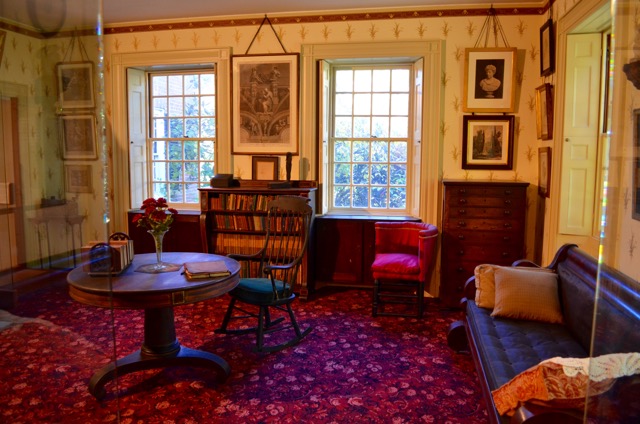
And inside the Concord Museum I saw his study with a flashy fuchsia decor which Thoreau might not have raved about. Just might not, but one never knows. They were friends.

Emerson's Study

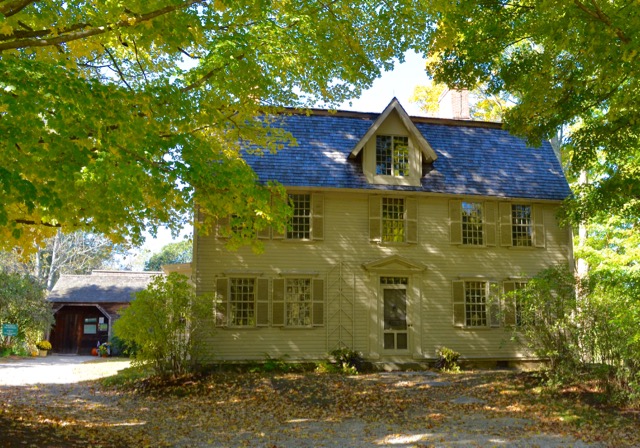
Ralph Waldo’s grandfather The Rev. William Emerson’s house, The Old Manse (Scottish term for ‘Minister’s House’), wasn’t shabby either. Quietly situated by the river, a historic residence where literary figures gathered and where Ralph Waldo had lived for a while and wrote Nature, which sparked the Transcendental Movement (1834-35).

Manse 2

Nathaniel Hawthorne had lived in the same house too for a few years (1842-45), writing a book called Mosses from an Old Manse. He enjoyed the garden immensely; it was planted by Thoreau in 1842 to celebrate Hawthorne’s marriage to Sophia Peabody. Hawthorne could have found inspiration right there among the beets.

The Beets

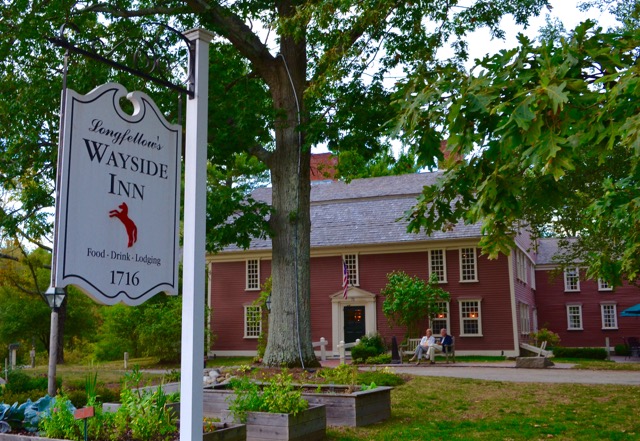
Longfellow, on the other hand, was intrigued by an old tavern and boarding house he had stayed one time in 1862. A homestead made into a lodge for itinerant farmers and transient guests had put stories in the mind of the creative, hence the publication of the Poet’s Tales of a Wayside Inn. For its namesake, the premises had since been named Longfellow’s Wayside Inn.

DSC_0193

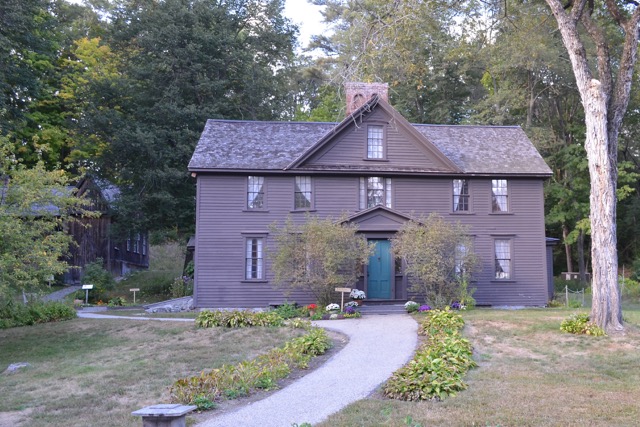
Louisa May Alcott’s Orchard House looks like a warm haven for story brewing too, even though the family could have used more material goods than their philosophically-minded father had provided:

The Orchard House

Back to Nature, the aspiring young poet Edna St. Vincent Millay climbed to the top of Mt. Battie in Camden and beheld the magnificent bird’s eye view of Penobscot Bay. Sky and water pressed close into the impressionable mind of young Edna, triggering a catalyst reaction of permanent change.

View from the top 3

For another, it’s the connection with the land, the toiling of the soil, the gathering of its fruits that inspired. He might have many roads to choose, but aren’t we glad Robert Frost had chosen orchard tending in Vermont and not the ones he did not; we get plenty of thoughts.

Frost's Apple

And for those born into affluence and wed into more, life was a choice of how to use the resources one gets. I’m glad that Edith Wharton had spent her fortune on something that can be left behind for me to set foot on, yes, The Mount.

EW's Garden

I learned too that her legacy had been more than literary pleasures and architectural delights, but something more altruistic after she moved to Paris.

As WWI broke out, Wharton could have gone back to America for safe haven. But she stayed in France, and poured herself in the war efforts, which was inspiration in itself. Here I quote from The Mount’s webpage:

“She set up workrooms for unemployed seamstresses, convalescent homes for tuberculosis sufferers, hostels for refugees, and schools for children fleeing war-torn Belgium. In the first seven months of her efforts, nearly 900 refugees were cared for, “including the nuns and about 200 infirm old men and women, who are ‘children’ too … and could not be left alone in the ruins.” (Edith Wharton, New York Times, 1915)”

and the story didn’t end there… Click on the above link to read more.

Where does one find inspiration, motivation? The answer can vary as much as asking what I should eat today. But one thing I’d experienced on this trip was that life can be lived in myriads of ways, and with it comes inspiration; it could be as simple as a leaf on the ground, or as huge as a war. But I’ll choose the leaf, thank you.

The Leaf

Wherever I am, that’s a good start.

***

My New England Road Trip Series:

Serendipity on Route 7

My drive continued south from Bennington, Vermont, via RT 7 to Williamstown, Massachusetts. There I stayed for the night. I knew Williams College was located there. But while exploring the town, I came to this building and saw the huge banner. Upon further investigation, I was excited to discover the campus of Shakespeare & Company:

The Miller BldgDSC_0337 (1)Later I found out that the actor Christopher Reeve met his future wife Dana in Williamstown where they later married. Reeve began as an apprentice at age 15 with the Wiliamstown Theater Festival right in those venues and eventually performed there for fourteen more seasons.

I had the chance to talk to a woman who was working on the grounds and learned that, lo and behold, she was born in Alberta, Canada, my home province! Imagine a chance encounter with an Alberta born American thousands of miles away.

The Berkshires region is beautiful and cultural. I made a mental note to come back to Williamstown for its annual Theater Festival.

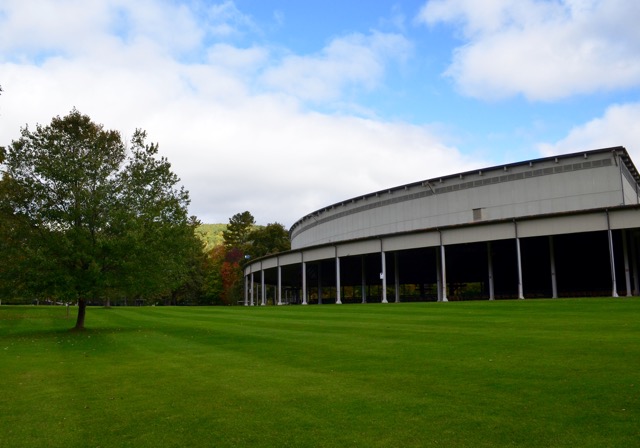
My original plan was just to drive south on RT 7 from Williamstown to Lenox to see the Edith Wharton House at The Mount, when another serendipitous find came upon me: Tanglewood Music Center. So here I was at the famous summer home of the Boston Symphony Orchestra on my way to Edith Wharton House.

The Koussevitzky Music Shed was named after the Russian-born conductor, composer and double-bassist, long-time music director of the Boston Symphony Orchestra from 1924 to 1949:

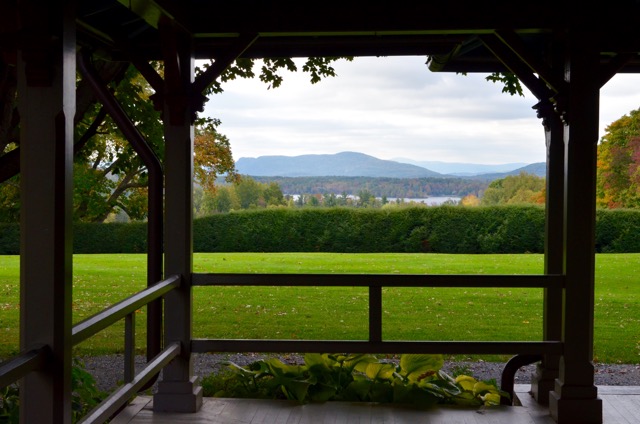
TanglewoodI lingered at Tanglewood for quite some time, for the grounds were beautiful and offered magnificent views. Another mental note: I must come back for the Tanglewood Festival in the summer. :

viewAcross the road from Tanglewood, fall foliage began to emerge. That was October 7. I can imagine how beautiful it is now:

across from TanglewoodAnd finally, to The Mount, Edith Wharton’s home from 1902 – 1911. I knew she was a prolific novelist and short-story writer, the first woman to win the Pulitzer Prize (The Age of Innocence, 1921); later I learned too that she had been nominated for the Nobel Prize for Literature three times.

So I was a little surprised to find out from the tour guide at The Mount that she was also a house and landscape designer in her own right. Her book The Decoration of Houses is still used today by architects and designers.

Built as a writers retreat, The Mount reflects Wharton’s fondness of symmetry:

SymmetryWhat happened to the left side of the building? That makes it not symmetrical, you might ask. That’s the servants quarter which Wharton was willing to compromise her design principle.

Here’s another view why it’s called The Mount:

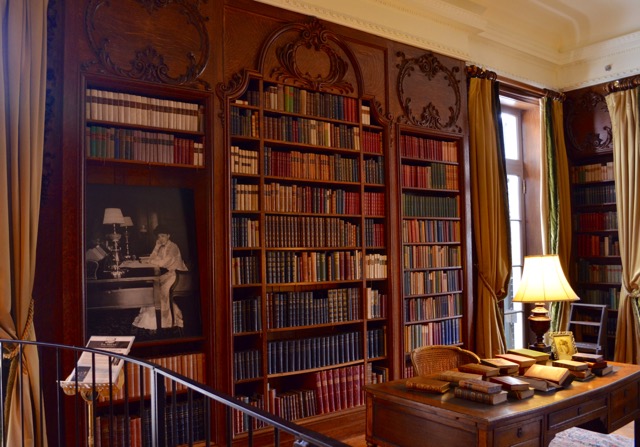
The MountI took a tour of both the inside as well as her gardens. Here’s one wall of her library:

One wallWell read in several languages since she was young, Wharton left these books behind  when she moved away to live in Paris the latter part of her life after the demise of her marriage. Her husband Edward had fallen into a state of dementia after lengthy bouts of depression and mental illness. The writer’s years at The Mount had not been as happy as its surroundings could offer her.

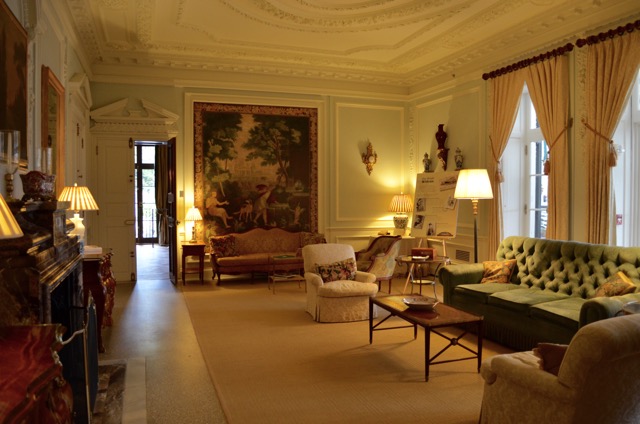
The Drawing Room:

The Drawing RoomDining Room, where Henry James was one of several usual guests:

Dining RoomBut where did she write? Not in the library, or at the desk in her room, but right in her bed. She had an assistant who would take her handwritten pages and type them up after her six hours of continuous writing every morning before she got out of bed. I’m sure Wharton would love to have a laptop:

Writing bed (1)And these other items I found interesting. Downton images conjured up in my mind. Typewriter, telephone, telegram:

DSC_0347
An original 1902 ice box, Daisy would love it but maybe not Mrs. Patmore. Give her some time to warm up:

Ice Box
A luggage lift. Definitely would be a fave among the footmen:

Luggage lift

And only after the tour did I find out, The Mount had given a Life Time Achievement Award to Julian Fellowes. The Downton creator had attributed Wharton as a major influence on his works, first Gosford Park (Oscar Best Original Screenplay, 2002) and then Downton Abbey. Speaking upon receiving the Award at the Harvard Club, Fellowes noted that he was particularly inspired by Wharton’s “… ability to judge without feeling the need to condemn.”

I bought the book The Custom of the Country in the gift shop and only just now did I learn that it is being adapted into a TV mini-series, with Scarlett Johansson playing the anti-heroine, Undine Spragg. This will mark Johansson’s first TV role.

As for Julian Fellowes’ new work? I eagerly await. After visiting The Mount, I can see what a natural shift it is for him to create an American version of Downton. The Gilded Age should be a smooth sequel.

From Lenox, I began the last leg of my New England Road Trip. I headed east on I90, a breezy 2.5 hrs. drive back to Wayland, the suburb outside Boston, thus completing the loop and a memorable journey. An item checked off my bucket list.

***

Follow my New England series:

Orange is the Primary Colour

Driving from coastal Maine westward to New Hampshire, the foliage colours began to change a bit more. Even though I was totally enjoying myself along the coast, I did look forward to seeing some fall foliage as I moved inland.

I drove from Rockport to Maine’s capital Augusta, then continued on some small country roads towards Bethel and Gilead before crossing the State line to Gorham, New Hampshire. It was a pleasure driving through these more remote parts of the country, for the routes offer some gratifying scenery:

Driving thru MaineCountry road in MaineBut it was the colour orange on the ground that caught my eyes. From afar, they were tiny orange dots in the field:

Tiny orange dots on the groundA bit closer I knew, of course, that was a pumpkin patch. And it was orange that would be the predominant colour everywhere, in towns and in the country.

On flatbeds and wagons:

DSC_0501

DSC_0509

wagonfull

Or laid out neatly in arrays on grass:

DSC_0870

arrays

In various shapes and forms:

DSC_0508At door fronts, entrances, in hanging baskets and shop windows:

EntrancesHanging Basket

DSC_0544 (1)

DSC_0420

DSC_0549

DSC_0555

DSC_0620

Or in the form of pumpkin people:

DSC_0552DSC_0784Or as pumpkin elves like these two sitting outside Elf Academy:

DSC_0617

No wonder there’s a shortage of pumpkins in the U.S. as the demand is so high. With recent crops diminished by record rain, there arose a pumpkin shortage. Help is on the way though. Here’s a recent headline on CBC News Business section:

“Canadian pumpkin patches poised to fix U.S. lack-o’-lanterns problem.”

What are neighbors for?

***

This is my Saturday Snapshot October 17 entry. Saturday Snapshot is hosted by West Metro Mommy Reads. CLICK HERE to see what others have posted.

Follow my New England series:

Camden, ME: A Gem of a Town

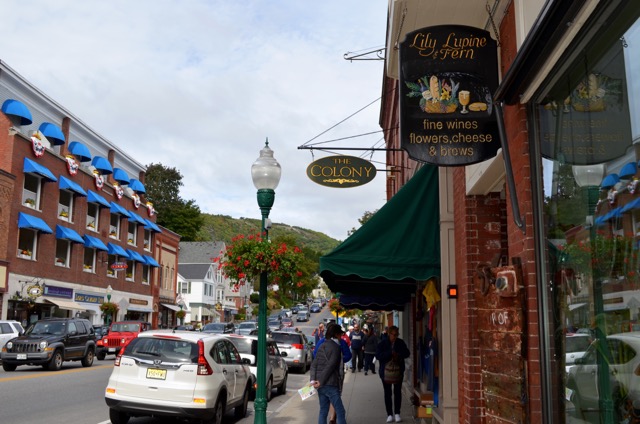
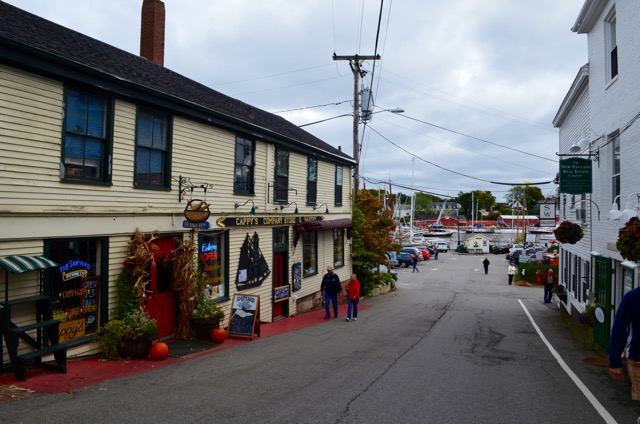
The scenic drive from Rockport (last post) led me to the town of Camden where I was welcomed with free parking everywhere. A walk down the streets could make you feel you’re stepping right into a movie set.

Camden's Main Street

Camden's Street

DSC_0360

Camden Harbor

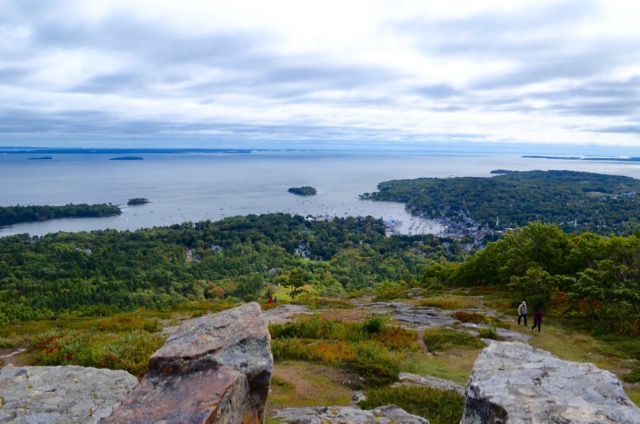
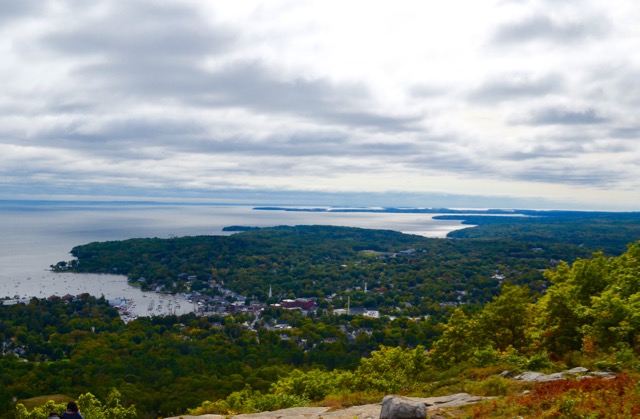
But the stunning view came later when I drove up to the summit of Mt. Battie in the Camden Hills State Park. There at the highest point of the town, a panorama of Penobscot Bay and its surrounding countryside was fully displayed:

The Summit

View from the top 3

VFTT6

View from the top 4That was the same breathtaking view a young aspiring poet Edna St. Vincent Millay (1892 – 1950) beheld, inspiring her to write the famous poem “Renascence”. Her epiphany at the top of Mt. Battie set off a poetic expedition which eventually led the Poet to the literary summit of a Pulitzer in 1923. There on the mountain top was this plaque honoring ‘America’s finest lyric poet.’

Edna St. Vincent Millay Plaque“And reaching up my hand to try,
I screamed to feel it touch the sky.
I screamed, and—lo!—Infinity
Came down and settled over me…”

– lines from “Renascence”

Every time I feasted my eyes and mind, my stomach would in turn crave for my attention. So after a lingering at this inspiring site, I went down the slope back to town and found my way to the popular Cappy’s Chowder House. There I had the best chowder of my life: A Lobster/Oyster/Mussel/Seafood Chowder, yes, all of them in a Cappy’s cup for $9.99

Best ChowderAll substanceA good finish to a rewarding day.

***

Follow my New England series:

Scenic Drive from Rockport to Camden, ME

Rockport and Camden used to be one town at the mid-coast of Maine. Now separated as two but are still joined closely with easy access. The Maine Route 1 could lead me from Rockport in the south up to Camden in just 6 minutes, but I chose to drive into Camden using the side streets, the scenic route, more slowly, stopping for photos along the way.

The day broke grey but I was grateful that despite the overcast sky, there was no rain. Actually, after that wet pounding on I95 to Portland the day before, all the rest of the driving in my road trip was breezy and enjoyable.

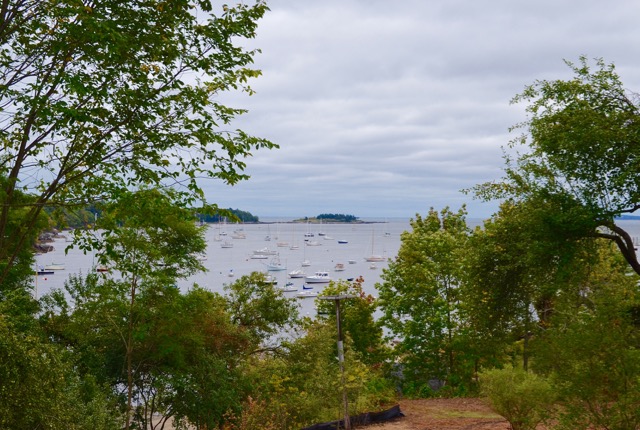
The scenic route from Rockport to Camden was particularly memorable. Here’s a view out to Rockport Harbor along the drive:

Rockport Harbor 2

And what I saw as I looked down to the ground was an unusual sight, for me anyway:

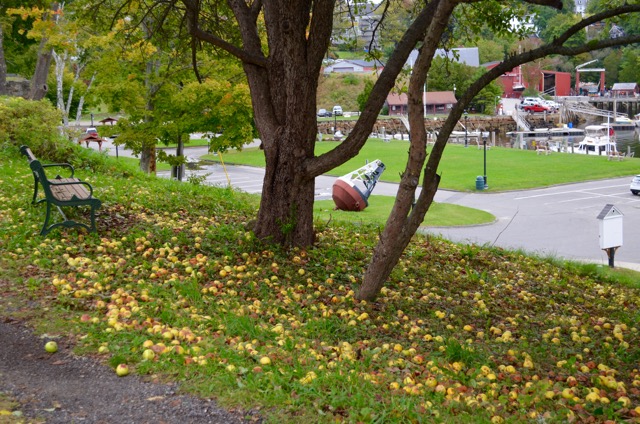
Fallen ApplesApples everywhere:

Apples among rocks Coming from the foothills of the Rocky Mountains in Western Canada, I’d never seen so many apples fallen from trees, covering the lawn. I mean, they were not tiny Crabapples which are common back home, but big ones that I usually associate with orchards, but not at a harbor or marina.

Apples everywhereWhat I did connect though was the huge number of apple pies they could make…

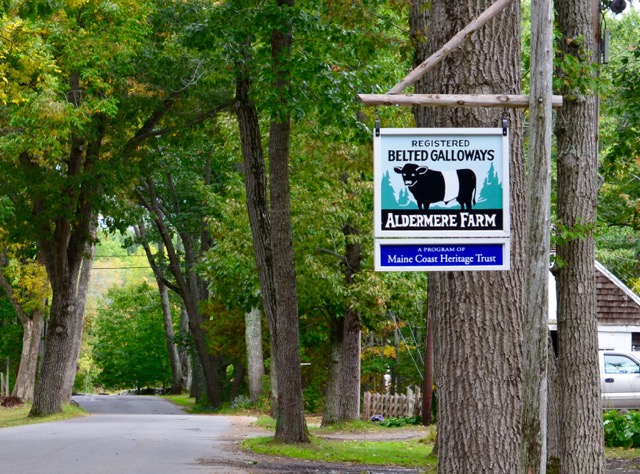
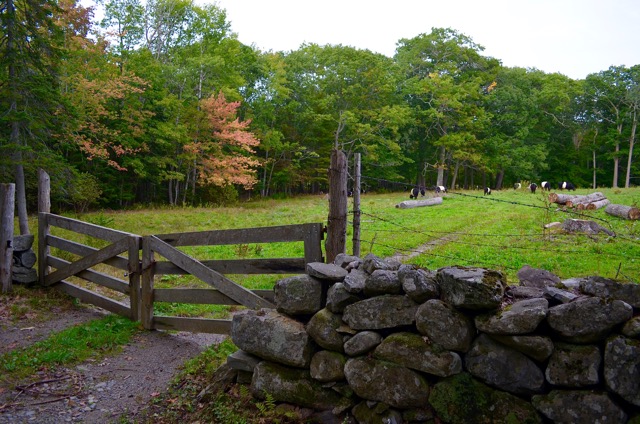
From Route 1 heading north I turned off Pascal Avenue, then followed the scenic loop beginning with Central, then Russel, Limerock and Union. Once on Russel Avenue, I came to the Aldermere Farm, a landmark of mid-coast Maine. The farm is the world’s premier breeders of Belted Galloway cattle, or ‘Belties’, a breed originated from Southwest Scotland.

Aldermere FarmThese white-belted cattle sure made one whimsical picture as they lazed on lush green pastures… think Oreo cookies in a large dish of wasabi:

2. White-belted cowsSeeing I had a camera, this ‘beltie’ showed off how to scratch an itch with no hands:

How to scratch an itchScratch againThe foliage was still overwhelmingly green, making the few sporadic splashes of orangey-red even more inviting, confirming to me, yes, I was a week or two early. No matter, this kind of a setting was pure joy, even just for a look. And yes, the grass is always greener on the other side…

Greener Grass

***

Follow my New England series:

Historic Concord, Massachusetts

“The question is not what you look at, but what you see.”
– Henry D. Thoreau

Just a few miles north of Walden Pond is Thoreau’s birthplace, Concord, MA, a beautiful town bursting with history. The Minute Man National Historical Park, North Bridge, Paul Revere Capture Site… major historical events took place right here. I’d learned to appreciate their significance especially in a modern day context.

But what caught my attention as I drove into town was this church building, meeting place of the First Parish in Concord:

First Parish

History of First Parish

While the present structure was built in 1900, the Church – the gathering of a  community of faith – stood as a monument of the social history of America dating back a few hundred years to the 1670’s. To me as an outsider, this is meaningful. It’s the first of many such Christmas card icon that I would see during my road trip, in every town I passed by.

The Concord Museum displays history in a nut-shell. In there I found the actual furniture from inside Thoreau’s cabin in Walden Pond:

Thoreau's furniture and those in Emerson’s home:

Emerson's StudyLesson learned? No, one doesn’t have to go to the woods to live a Spartan life to be inspired. But, the experience sure could help develop work skills in case the writing vocation didn’t pan out.

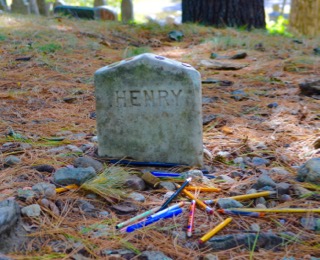
I skipped Emerson’s House across from Concord Museum, instead, followed the sign of ‘Authors Ridge’ in the Sleepy Hollow Cemetery to the graves of Thoreau, Hawthorne, Alcott, and Emerson. Much amused to see pens and pencils left at the authors’ graves:

Pen tribute

Thoreau's GraveAs I was pondering the philosophical meaning of this sighting, a greater urge suddenly took hold of me, one Thoreau could empathize, the necessity of life sustenance: food. I said goodbye to the great authors and drove back down to the main streets of Concord in search of the essential.

It’s the name that first attracted me: La Provence. The little French restaurant/café and patisserie on, where else? Thoreau Street. I ordered at the deli counter their popular Jambon de Paris sandwhich and a cream of mushroom soup. To my delight, as I stepped into the dining room with my lunch I felt like I’d entered a van Gogh painting. (Click here to see what I mean.)

While the sandwich was just average, the mushroom soup was superb. I wouldn’t mind a second helping but reminded myself another essential I must make room for, a dessert from the patisserie.

I was over at the glass case in the pastry section in no time. As a chocolate lover, my choice was easy… just look for the brown color items. I pointed to my selection and upon asking its name, was given two different replies by two different staff. So here I’m combining them: “Milk and Honey Chocolate Dome”, and it’s heavenly.

A crisp milk chocolate dome shrouding smooth melt-in-your-mouth chocolate mouse on a thin layer of cake at the bottom, this little dome sealed the best a dessert can offer any chocolate lover. The white chocolate bee on top was the added fun.

Le Provence choc domeFall foliage will have to wait.

***

Follow my New England series: