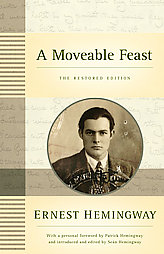
A Moveable Feast (Restored Edition) by Ernest Hemingway

Reading A Moveable Feast is like walking along the sea shore. On the fine sandy beach you see many attractive shells, but you don’t have a bucket with you. You pick the finest ones and put them in your pockets, until they’re full. But every step you take further, you see more that you want to keep. This post is too limited for me to display all the shells I’ve collected, but allow me to just pour them out from my pockets, without sorting, sand and all.
I first read about the term “Moveable Feast” while sitting in an Anglican church in Vancouver, flipping through the The Book of Common Prayer. After some googling later, I got the idea. A feast in the liturgical calendar that you commemorate no matter which date it falls on year after year. In the Foreword of this restored edition, Hemingway’s son Patrick (with second wife Pauline Pfeiffer) writes:

The complexity of a moveable feast lies in the calculation of the calendar date for Easter in a given year, from which it is simple enough then to assign a calendar date to each and every moveable feast for a given year. Palm Sunday is seven days before Easter.

A memorable experience that will follow you all the years of your life. You’ll cherish it whenever and wherever you are. Hemingway’s friend A. E. Hotchner suggested this title. Author of the biography Papa Hemingway, Hotchner recalls Hemingway once said to him:

If you are lucky enough to have lived in Paris as a young man, then wherever you go for the rest of your life, it stays with you, for Paris is a moveable feast.

Like Rick says to Ilsa in “Casablanca”: “We’ll always have Paris.” Same sentiment.

A Moveable Feast is Hemingway’s memoir written from notes he had forgotten in two steamer trunks stored at the Ritz Hotel in Paris since 1928. In 1956 he repossessed the treasure trove, upon the urging of the hotel management. The book details his experience while living in Paris from 1921 to 1926, when the author was in his early 20’s. The memoir was first published posthumously in 1964. The Paris Years was a period when Hemingway, just married Hadley Richardson, young and care-free, decided to give up journalism to strive at being a novelist.

He would write in a rented room or in a café over café crème,
meet Gertrude Stein for critique of his writing, go back home for lunch with wife Hadley, or have oysters and wine in a restaurant, socialize with Fitzgerald, Ezra Pound, and other expats, borrow piles of books from Sylvia Beach’s library in her bookshop Shakespeare and Company, visit Luxembourg gardens and museum…

Two people, then, could live comfortably and well in Europe on five dollars a day and could travel.

No wonder Gil in “Midnight in Paris” dreams of such a life.

What strikes me initially is Hemingway’s frankness, sometimes blatant description of his opinion about the people he met. Like the first time he saw the artist Wyndham Lewis through Ezra Pound:

I watched Lewis carefully without seeming to look at him, as you do when you are boxing, and I do not think I had ever seen a nastier-looking man… I tried to break his face down and describe it but I could only get the eyes. Under the black hat, when I had first seen them, the eyes had been those of an unsuccessful rapist.

According to grandson Sean Hemingway who edited and wrote the introduction of this restored edition, Hemingway developed his sharp eye and ear during these Paris years. Here’s an account of Scott Fitzgerald when Hemingway first met him in the Dingo bar:

Scott was a man then who looked like a boy with a face between handsome and pretty. He had very fair wavy hair, a high forehead, excited eyes and a delicate long-lipped Irish mouth that, on a girl, would have been the mouth of a beauty. His chin was well built and he had good ears and a handsome, almost beautiful, unmarked nose.

This is only a little excerpt in a two page description of Scott’s appearance. It’s sentences like these that stand out for me. They all point to the writer at work: observing.

I kept on looking at him closely and noticed…”

“I kept on observing Scott.

And putting down in words later:

I wasn’t learning very much from looking at him now except that he had well shaped, capable-looking hands, not too small, and when he sat on one of the bar stools I saw that he had very short legs. With normal legs he would have been perhaps two inches taller.

But it was Scott’s talents despite his eccentricities and alcoholism that formed the building blocks of their friendship.

When I had finished the book [The Great Gatsby] I knew that no matter what Scott did, nor how preposterously he behaved, I must know it was like a sickness and be of any help I could to him and try to be a good friend. …   If he could write a book as fine as The Great Gatsby I was sure that he could write an even better one. I did not know Zelda yet, and so I did not know the terrible odds that were against him.

It is perhaps with such candour and devotion in writing that he constantly sought to “write one true sentence.” Woody Allen has grasped the essence in this juicy line from “Midnight in Paris”:

No subject is terrible if the story is true, if the prose is clean and honest, and if it affirms courage and grace under pressure.

The restored edition brings back sections missing in the earlier 1964 publication which was edited by fourth and last wife Mary. According to Sean Hemingway, this restored work represents the content that Hemingway himself had intended the book to have, with the chapter “Nada y Pues Nada” (Nothing And Then Nothing) written three months before his suicide.

The second last chapter “The Pilot Fish and the Rich” shows he was remorseful over the breakdown of his first marriage to Hadley towards the end of his Paris days. A mutual friend they both knew, journalist Pauline Pfeiffer, came in between them. “You love them both now… Everything is split inside of you and you love two people now instead of one.”

But A Moveable Feast belongs to Earnest and Hadley and their young son Bumby.  “… this is how Paris was in the early days when we were very poor and very happy.” As a reader, I feel a sense of loss as I come to the end, for Earnest and Hadley were so much in love the first few years in Paris:

She: ‘And we’ll never love anyone else but each other.’

He: ‘No. Never.’

Their 2-room rental walk-up with no electricity and no hot water had been a haven of warm meals and intimate talks. It was the time when he was “a young man supporting a wife and child … learning to write prose.” Their short marriage lasted only six years. In 1927 Hemingway married Pauline, four months after divorcing Hadley.

The last section at the end of the book is entitled “Fragments”. These are “false starts”, beginning paragraphs of an introduction Hemingway tried to write for this book. Interestingly, every one of these attempts starts with: “This book is fiction.” Many include this sentence: “I have left out much and changed and eliminated and I hope Hadley understands.” In another fragment he wrote: “No one can write true fact in reminiscences…”

I’m baffled. But maybe unnecessarily. From our very subjective mind, our often hazy view of what did happen and what we wish to have happened and what could have happened, we conjure up a fusion. Should there be a clear line separating them? It’s because the demarkation of fact and fantasy is fluid that we can appreciate the arts, such as the film “Midnight in Paris.” The events that happen to Gil after midnight would remain fondly with him as reality, so real that they change his decision regarding his future. Facts or fiction… or fusion?

~ ~ ~ 1/2 Ripples

***

A Moveable Feast: The Restored Edition by Ernest Hemingway, published by Scribner, NY, 2009, 240 pages. Foreword by Patrick Hemingway, introduced and edited by Sean Hemingway.

This post is to participate in the Paris In July blogging event hosted by Karen of BookBath and Tamara of Thyme for Tea. You can also find another review of A Moveable Feast here at Dolce Bellezza.

To read my review of “Midnight In Paris”, CLICK HERE.

Photos: Paris, Shakespeare and Company, Writers’ portraits and The Library in Shakespeare and Company taken by Arti of Ripple Effects, Aug. 2010. All Rights Reserved.

Click on the following links for some insightful interviews:

National Post Interview with Sean Hemingway on the restored edition

Interview with Woody Allen on making “Midnight In Paris”

The Tranquil Side of Vancouver

I’m not a hockey fan. I go to Vancouver mainly for the tranquility of forests, gardens and greenery. There are places where one can be utterly alone, in quiet solitude. Especially now after the ugly Stanley Cup riot, I must show you this side of Vancouver, the quiet gardens and forests that offer one a haven far from the madding crowd.

The flora on the UBC campus… the budding irises, hanging wisteria, exploding rhododendrons, and the unknown flowers and foliage (I’d appreciate your identifying them for me below the rhododendron)… and the sequestered Nitobe Japanese Garden:


The Nitobe Japanese Garden:

.

***

Art of gardening

nature reshaped, redesigned

 prune the riotous heart

***

All photos and writing by Arti of Ripple Effects, June, 2011. ALL RIGHTS RESERVED.

Which Jane Austen Heroine Was Jane Most Like?

A while ago due to a glitch on my blog, I lost all the visual images on my side bar, including a poll. Accidentally I found it again today and glad to see the results are still there.

So here it is, for all you Janeites, book and literature lovers out there. If you haven’t voted, you can do that now. If you have voted before, and just might have changed your opinion, vote again. I’m sure Jane wouldn’t mind.

Life imitates art… art imitates life? Which of Jane Austen’s heroines do you think the author most resembled in terms of character?

.

You’re welcome to share with us why you vote that way.

Other related posts on Ripple Effects:

Jane Austen: Sense Or Sensibility?

What Was Jane Austen Really Like? Reading Tomalin and Shields

Art Imitates Life, Life Imitates Art, or

Of Words and Spring

April is the month of empty dreams
Half the days gone
waiting for words and spring
still frozen ground
and on the screen
a frigid page as white as snow.

Brown could be the color of hope
After the white
for all I know
green is too much to wish for
I’m contented to see a patch
of dry and withered brown.

The sun is a perpetual sign
that there’s still hope
But it’s no herald of the seasons
for its presence comforts all year long
warming my blank and barren state
as I await for words and spring.

But Easter is an apt reminder
that The Word had come
spoken clear to half-frozen ears
His body hung on a lifeless tree
Blood and water flowed
onto parched and dusty earth

So what if no words come to me
That dreaded writer’s block
reigning the winter of sterility
numbing senses,
snatching thoughts,
seizing any sign of spring.

It’s not about a post or a blog,
Or even buds and melting snow.
The Word had come
lived and loved among us,
broken, bled, died and rose,
melting frozen hearts to greet
a new Spring and eternal growth.

Poem and Photos by Arti of Ripple Effects, April 2011. All Rights Reserved.


Forget About Tiger Mothering, Try Inspirational Parenting

One of the most memorable lines in last week’s Academy Awards is Tom Hooper’s: “The moral of the story is: Listen to your mother.”

What more satisfaction can a mom get than to hear her son utter these words in front of a billion viewers worldwide.

Here’s the excerpt of his speech leading to this final conclusion:

“My mum was invited to a fringe theater play-reading of an unproduced, unrehearsed play called The King’s Speech in 2007She came home, rang me up and said, ‘Tom, I think I found your next film.’

I followed The New York Times reporter/blogger Melena Ryzik’s The Carpetbagger on Twitter through the Awards Season. Of all the Oscar interview write-ups I’ve read, and there are numerous, Ryzik’s “A Chat With The Mother Who Knows Best” has left the most lasting impression on me. And it was in that article that I found these two words, “inspirational parenting”. They were nothing short of an epiphany for me, striking a chord instantly.

Photo Credit: Matt Sayles/Associated Press

Ryzik talked to “The King’s Speech” director Tom Hooper’s mother after her son’s Oscar win, calling her “an exemplar of inspirational parenting”. Meredith Hooper is an academic and author of over 60 fiction and non-fiction works for children. Here are some excerpts from Ryzik’s article:

Did she realize she’d caused worldwide guilt among children for not listening to their mothers?

“I did not!” Ms. Hooper protested. “I didn’t say it. My advice is exactly the opposite — that we should all listen to our children.”

Now isn’t that the kind of talk that can make Amy Chua cringe? The kind of parenting style that prompted her to write about her own school of tough love parenting in her memoir Battle Hymn of the Tiger Mother, now 7 weeks so far on the NYT Bestsellers List. It’s all that debate about teacher-fronted or child-centred learning all over again.

I’ve left comments on others’ blogs about my view of this current hot topic of the “Tiger Mom”, but have not posted about it here on Ripple Effects. The main reason is that I have not read the book, so I should not say too much when I haven’t heard all that Amy Chua has to say, albeit I can understand her perspective since I share similar ethnic and cultural roots.

Nevertheless, I’d rather write about ‘inspirational parenting’. It just sounds… more uplifting. Just savor the two words… aren’t they sublime? I think I just might adopt the first word as a personal axiom, ‘inspirational’ anything… in speaking, thinking, writing, being… mmm, something to aspire to.

Ok, back to “The King’s Speech”. After seeing the play, Meredith Hooper saw a great potential for a film in this story so full of human interest, irony and humor. As an Australian herself, she was bemused by Logue’s task to teach an English royal to speak:

Logue came as an Australian, and taught the king to speak. How incredible! Because we colonials — it’s assumed that the English would teach us how to speak. So I loved this reversal of roles, that this Australian would arrive in England with his democratic attitude, and no assumptions about class and society and status, all of which I’ve experienced.

Now this just might work for parenting as well. A practice of role reversal could bring about more empathy for both parents and children. Only when we listen and try to understand can we begin to deepen a relationship. I know, only as a therapy session, for kids would be more than willing to take back their role after momentary reversal. Who would want a more arduous job than they need to?

A story, a film, real life, it all boils down to…

So here it was, this simple need to communicate, in a play or in a film. Brilliant! Because it’s all about communicating, every piece of dramatic writing is all about communicating, and this was about someone who couldn’t.”

It’s interesting that Tom did not take up his mother’s enthusiasm right away. Convinced of the latent power in the story, Meredith explained to her son how the elements of effective storytelling fall naturally in place. They shared ideas. It was five months later that the initial notion began to take shape as a film project.

I must add too that the inspirational parenting ends where the creative spark ignites. A wise mother knows when to stop and allow the seed to grow into a life of its own. That’s what Meredith Hooper did… and the rest is Oscar history.

***

Click Here to read Melena Ryzik’s NYT article “A Chat With The Mother Who Knows Best”.

Related Posts on Ripple Effects:

Oscar Winners 2011

The King’s Speech (2010): Movie Review

The King’s Speech: Fact And Fiction

The King’s Speech: Fact and Fiction

The line “Based On a True Story” at the bottom of the movie poster apparently is not enough as a disclaimer. Some point out the twisted historicity in the movie “The King’s Speech”. In particular, it has altered the fact that Churchill had adamantly supported the reign of Edward VIII even after he had stated his intention to marry Wallis Simpson, and evaded the early appeasement of Hitler by the British monarchy.

My view is this: The King’s Speech is not a documentary, nor even a biopic. It is a film based on a true struggle in the life of King George VI before he became King to shortly afterwards.  It spans from the closing of the Wembley Empire Exhibition in 1925 to the beginning of WWII in 1939. The focus is on a personal angle. It has taken some steps to dramatize the sequences which I must say are effective. While I agree the Churchill character in the movie could well be inconsistent with historical facts, I don’t see the production is making a political statement at all nor its intention to rewrite history. The climatic Speech at the end is a historical fact. By every measure, it is an exploration of one man’s internal conflicts and struggles, and how a trusting friendship between therapist and patient, and the support of a loving wife had helped him overcome insurmountable odds. Towards these ends, I think screenwriter David Seidler has done a marvellous job.

Further, as an ‘ex-colonial’, I don’t see the film as unfurling the Empire flag to flaunt past glory. If that was the intention, the Queen Mother would not have guarded her husband’s impediment as a painful secret all her life.

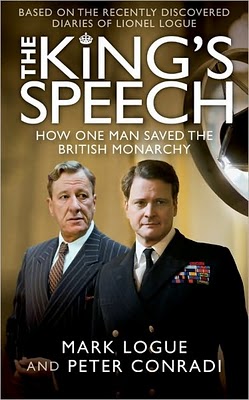
After watching the film, I came across the book. Yes, there’s a book called The King’s Speech: How One Man Saved The British Monarchy, written by Mark Logue and Peter Conradi. Mark Logue is the son of Lionel’s youngest child, Anthony. He is custodian of the Logue Archive. Conradi is an author and journalist.

The book is based on a treasure trove of family papers and diaries, letters between the King and Logue, and Lionel’s own notes on the therapy sessions, as well as photos, an invaluable source of background information for the film and a bridge of events therein. Mark Logue acted as the Logue Family Consultant for the production.

Overall, the film follows closely the facts found in Logue’s book when depicting the relationship of Logue and Bertie. Here are some facts:

It was to prepare for his Australian tour in 1927 that Bertie first went to Logue for help. The high point of the six-month world tour would be to open the new Commonwealth Parliament House in Canberra. Bertie diligently went to every appointment and practiced everyday the exercises assigned by Logue. Just between October 1926 to December 1927, the two had had eighty-two sessions.  Many more would follow in the years ahead.

Here are some quotes from several who had contact with the pre-therapy Bertie. As a navel cadet, Bertie, or Johnson to secure secrecy as mentioned in the film, was ‘plagued by shyness’. Here’s an account:

One, Lieutenant F. J. Lambert, described the Prince as a ‘small’ red-faced youth with a stutter’, and adding ‘when he reported his boat to me he gave a sort of stutter and an explosion. I had no idea who he was and very nearly cursed him for spluttering at me.’ Another, Sub Lieutenant Hamilton, wrote of his charge: ‘Johnson is very well full of young life and gladness, but I can’t get a word out of him.’ (p. 55)

And the Duchess of York had her share of distress. Helena Bonham Carter had portrayed vividly scenes such as this:

According to one contemporary account, whenever he rose from the table to respond to a toast, she would grip the edge of the table until her knuckles were white for fear he would stutter and be unable to get a word out.  This also further contributed to his nervousness which, in turn, led to outbursts of temper that only his wife was able to still. (p. 60)

And the disastrous Wembley speech at the beginning of the movie is a painful fact, an event witnessed by Logue and his son Laurie, who were among the spectators coincidentally. The closing ceremony of the Empire Exhibition in May 1925 was a live broadcast around the world. Before the event, Bertie wrote to the King his father apologetically:

I do hope I shall do it well. But I shall be very frightened as you have never heard me speak & the loudspeakers are apt to put one off as well. So I hope you will understand that I am bound to be more nervous than I usually am (p. 61)

The humiliation after that we can all see from Colin Firth’s realistic enactment. Here’s how the father put it, more generously than his usual harsher dealing with his son, nonetheless still biting:

Bertie got through his speech all right, but there were some long pauses. (p. 61)

Further, Bertie’s ill health and an operation on his ulcer had contributed to his physical and psychological torments for years to come. Logue knew it was a complex case and not merely simple speech impediment.

Bertie had problems pronouncing words beginning with ‘k’, ‘g’ or with repeated consonants. Logue’s system was to go through every one of the King’s speeches and if possible, replacing those with some other words.  He would then:

mark up the text with suggested breathing points, and the King would start practising, again and again, until he got it right — often becoming extremely frustrated in the process.

By the time of his Coronation in May 1937, King George VI had greatly improved. All the war time speeches were evidence of the benefits of Logue’s therapy. I mention this just to quench the query of some who might think that the film had grossly exaggerated the speech impediment.

Actually, the King had delivered many speeches, and for everyone of them except those overseas, Logue was beside him, giving valuable support and pointers. To the credit of screenwriter Seidler, only three occasions are highlighted: The Wembley Empire Exhibition, the coronation preparation and the call to war, from which the film title aptly derived. Here I can see the choice of a writer skillful at his craft. As always, there is much more information out there that the sheer volume could clog, drag or smother. Seidler has wisely sifted and chosen the pivotal moments and built his script around them. As a result, we have fluency and the economy of words, or word pictures in this case.

Here’s a must-see BBC news clipof an interview with David Seidler, in which we can get a glimpse of an actual recording of KGVI pausing during his speech.

Lionel George Logue was born on February 26, 1880, in Adelaide, South Australia. His grandfather came to settle in Adelaide from Dublin, Ireland, in 1850, and opened up Logue’s Brewery. Since childhood, Lionel had been a prize-winner in elocution and excelled in ‘recitals’, the recitations of literary passages, a “popular form of entertainment in an era before television, radio or the cinema.”

Lionel, his wife Mertyle and their three boys Laurie, Valentine, and Anthony moved to England in February, 1924 after forty-one days at sea. First settled in modest lodgings, Lionel soon leased a place to begin his speech therapy consultation in 146 Harley Street, an address synonymous with medicine. However, it was still a major social and class barrier to overcome for the Duke of York to personally go over there for his treatment sessions:

Gernerally speaking, the lower the number and further south towads Cavendish Square, the more prestigious the address. Logue’s building was right up towards its northern end… (p.39)

Lionel’s wife, Mertyl Gruenert, had an ‘imposing’ physique and was several inches taller than Lionel. She was German. As the children grew up in England, they had all involved in the war effort, Laurie and Tony having served in the British army over in Africa. Now to those who challenge that German music is used in the climatic call to war speech and its subsequent scene, they could just as well say the Logue children fought against their mother’s countrymen. Nationalities diminish when the overall picture is one of atrocity and aggression.

And lastly, a fact that can be turned into fiction: Logue’s method remains a mystery.  He had left no notes as to what exactly went on during his therapy sessions with Bertie. Such missing data have proven to be advantageous to Seidler, who has taken the liberty to create some lively montage in the film. Thanks to the lack of fact, we are entertained.

And, here’s one of the possible secrets: Logue’s tongue twisters. The next time you prepare for a public speaking engagement, warm up with this one:

“She sifted seven thick-stalked thistles through a strong thick sieve.”

***

The King’s Speech: How One Man Saved The British Monarchy by Mark Logue and Peter Conradi, published by Penguin Canada, 2010, 242 pages.

To read my review of the movie The King’s Speech, CLICK HERE.

To read my post Oscar Winners 2011 CLICK HERE.

CLICK HERE to view CBS 60 Minutes Overtime’s The Hidden Letters Behind “The King’s Speech”: Interview with Mark Logue and Colin Firth on the Logue Archive: the actual King’s Speech on Buckingham Palace letterhead, with Logue’s markings, handwritten letters between the King and Logue, and other personal papers and photos.

CLICK HERE to view CBS 60 Minutes’ The Story Behind “The King’s Speech”: Interview with Colin Firth, including his hometown in Hampshire, his career, his portrayal of KGVI, Geoffrey Rush, and the possible Oscar.

Somewhere (2010)… or Nowhere

I collected a few thoughts on screenwriting, or fiction writing in general, from watching Sofia Coppola’s “Somewhere” (2010).

The film was winner of the Golden Lion at Venice Film Festival last year in the ‘Emerging Film’ category.  As daughter of Francis Ford Coppola, Sofia Coppola must have breathed films from birth.  She is also an Oscar winner for Best Original Screenplay with “Lost In Translation” (2003), which also brought her an Oscar nom in the Best Director and Best Picture categories.

While I had enjoyed her “Lost In Translation”, a sensitive, existential rendering framed in the context of cultural cacophonies, I sat through “Somewhere” feeling detached and unmoved. But I did make some mental notes on how to write better… especially when I compared it with another film depicting a similar theme, Mike Leigh’s “Another Year“.

I’ve appreciated the overriding intent of “Somewhere”, the portrayal of a pointless life in the midst of Hollywood stardom. Behind the façade of glamour is a sad man, failed in his marriage, aimless, smothered with ennui. The setting of the film is significant too. From the movie poster we see the iconic Hollywood hotel Chateau Marmont, a historic landmark that’s synonymous with fame and celebrity. That is where our protagonist, actor Johnny Marco lives, at the moment.


So here are some mental notes I made on writing while watching “Somewhere”:

1.  We all know it: Show, not tell. But too much showing can be force feeding.

Case in point: The film starts off with the sound of a car engine revving, then we see a black Ferrari come on screen from the left, circling round and go off screen.  We wait for it to come back, then go round and offscreen again. This goes on for, I forgot to count, maybe four times. Then it stops, and a man gets out.  We later find out he is the main character, Johnny Marco (Stephen Dorff).  Got it… his life is going in circles, heading nowhere.

But just to confirm that we are on the right track, we’re shown some more.  We see Johnny Marco so drunk he falls down the stairs and breaks his arm.  We see him lying in bed watching exotic dancers performing in front of him, only to fall asleep before they finish their routine. We are shown again another time, another pair of exotic dancers in his room, this time he gives a bored little clap. We see him womanizing, partying, driving his Ferrari aimlessly on the road. We see him being ushered to promo sessions and photo shoots, in unfeeling mode, and answer questions from the press.  And as if not enough pounding, we hear a reporter asking the explicit question, which by now has become so contrived: ‘Who is Johnny Marco?’

This is not just the first 30 minutes to set up the mood and character, this is throughout the film.  So I noted: once you’ve got your point across, move on.

2.  Stir up empathy, not inflict vicarious suffering.  You don’t have to drag your audience to the level of boredom to depict boredom. Like, we don’t have to be turned into stutterers before we can appreciate the struggles of a stammering king.  There is a scene where Johnny has to sit down and have his face plastered with goo to make a mold of an old man. We see him plastered bit by bit until his head is covered with goo.  The static camera then stays on this plastered head, as we wait with him for the goo to dry.  Lucky we are spared after a minute and a half.  I appreciate the long take if it conveys meaning in an aesthetically pleasing way, but here it is almost didactic in its expression of tedium and ennui.

3. Bring up a contrast. Yes, in this case, Johnny Marco’s 11-year-old daughter Cleo (Elle Fanning) is a perfect foil.  Staying with her father for a short while before going to summer camp, Cleo’s life is nothing short of wholesome. She is angelic in her innocence and beauty; in contrast to her Dad, she is happy and purposeful. She figure skates, plays tennis, swims, cooks, does Sudoku, plays Guitar Hero and Wii with youthful vitality.  Johnny is mesmerized. Despite a failed marriage, Cleo is the best thing that happens in his life… and in the film as well.

4. Put the character in the context of a story, even though it is just a character study or that it is static. For the viewers to appreciate the character on a deeper level, they must see the person in various predicaments, which are missing here.  Without a story as vehicle, we only see a two dimensional character.  I thought of Mary (Lesley Manville) in “Another Year”.  Very similar to Johnny here, Mary is a sad and utterly despondent character.  Also, like Johnny, she is going nowhere even at the end, where she is spiralling further down the hole of loneliness.  Not unlike Johnny here.  Yet I found “Another Year” appealing because the other significant characters continue to show us their life story. The foil there is Tom (Jim Broadbent) and Gerri (Ruth Sheen). Through the four seasons, we see how they treat each other and deal with life, and relationships are being depicted. It is still a character study with no major dramatic climax, yet the film can hold my interest because I am watching Mary through the frame of Tom and Gerri’s story.

5.  Throw in a dash of humor, even though especially when your character is in utter sadness.  Unlike “Lost In Translation”, “Somewhere” is almost devoid of humor. A laugh or two is probably the fastest way to dissolve the audience’s aloofness. Back to “Another Year”, Mary is not a lovable character. She is delusional, dependent, aimless and weak.  As audience, we are impatient with her unhappiness, because we feel she is solely responsible for her plight. But humor disarms our critical stance and gently prods us to sympathize her.  Her character does not change and become loveable at the end, but we learn to be more gracious and give her some allowance.  We find that it is not so static after all, for we the audience, unknowingly, have been changed.

~ ~ 1/2 Ripples

***

CLICK HERE to read my review of Another Year.

CLICK HERE to read my review of The King’s Speech.


Big Movies, small films

‘Big’ and ‘small’ are relative terms.

According to Box Office Mojo, the production budgets for this year’s Oscar Best Picture nominees are as follows (in million of dollars):

Toy Story 3:  200

Inception:  160

The Social Network:  40

True Grit:  38

The Fighter:  25

127 Hours:  18

The King’s Speech:  15

The Black Swan:   13

The Kids Are All Right:  4

Winter’s Bone:  2

Strange that we call some motion pictures ‘movies’, and others ‘films’.  Other than the generic meaning which is used interchangeably, they sometimes denote certain inherent differences. The money that goes into making them just might be a factor: The higher the cost, the more likely it’s a movie… the lower, a film.  A movie is likely a Hollywood studio production, with better-known stars, big budget marketing, and aims at popularity among a wider spectrum of viewers.  A film is more or less associated with indie, art-house, and caters to a much smaller range of audience.

Such was the dichotomy between last year’s Oscars’ David and Goliath scenario: Avatar and The Hurt Locker.  And I was glad to see the little guy win.

But this year is a bit different.  Many of the Best Picture nominees are small budget productions.  They draw big buzz because of the pictures themselves, the quality of their productions, their subject matter, and the characters that drive the story.  They all depict little persons achieving big, however reluctantly.

Here’s a small glimpse of what’s big in some of these stories:

127 Hours:  The real life, harrowing ordeal of Aron Ralston, who is caught in a small crack of a big boulder and how he used a penknife to cut his arm off to free himself.  James Franco nominated for Best Actor.

True Grit:  A small, 14 year-old girl by sheer guts and determination, ventures out in the big, wild West to seek justice for her father’s death. Newcomer Hailee Steinfeld nominated for Best Supporting Actress.

Winter’s Bone: A teenaged Ozark Mountain girl trying to keep her family intact in utter poverty, and save the shack they call home by finding her father who has fled bail for drug dealing, an act that threatens the big crystal meth economy of the area. 20 year-old Jennifer Lawrence nominated for Best Actress.

The Fighter:  A down and out boxer with a small name like Micky Ward from a dysfunctional home in a drug-infested neighbourhood bounces back to win the WBU champion.

The Social Network:  A college student called Mark Zuckerberg in his little dorm room launching a big business by changing the way people in the whole wide world connect and socialize. Jesse Eisenberg nominated for Best Actor.

The King’s Speech:  A big role of a king being filled by a small, shy man hampered by a debilitating stammer big as cancer.  It could be all psychological, sure, that’s why it’s insurmountable… and overcoming it takes big courage.  Colin Firth nominated for Best Actor.

A small person overcoming big obstacles one small step at a time always makes a good story. It is so with the little character, true also with the little film.

Austen Inspired Acceptance Speech

2011 is the 200th anniversary of the publication of Jane Austen’s Sense And Sensibility, her first published novel.  And since we are in the midst of Awards Season, inundated (or soon to be) with speeches, I’d like to join these two occasions and celebrate both Austen and fine speeches.

The 1995 film adaptation of Sense and Sensibility had received numerous awards, most notably accolades for Emma Thompson’s screenplay, which had garnered the Golden Globe, BAFTA, and ultimately, the Oscar. I have posted this before a few years ago, but think it is high time we read or reread Austen’s wonderful novel and be entertained again by the very talented Emma Thompson.

Also, I’m sure you would love to read a transcript of it, one of the most unique awards acceptance speeches of some time. Since the event occurred some fifteen years ago, I have taken the liberty to annotate (in parentheses) and format it in a way to enhance your reading pleasure.

Here it is, Emma Thompson’s Acceptance Speech at the 53rd Golden Globe, 1996, for Best Adapted Screenplay, Sense And Sensibility:

“I can’t thank you enough, Hollywood Foreign Press, for honouring me in this capacity.  I don’t wish to burden you with my debts, which are heavy and numerous, but I think that everybody involved in the making of this film knows that we owe all our pride and all our joy to the genius of Jane Austen.  And, it occurred to me to wonder how she would react to an evening like this.  This is what I came up with:

Four A.M.   Having just returned from an evening at the Golden Spheres, which despite the inconveniences of heat, noise and overcrowding, was not without its pleasures.  Thankfully, there were no dogs and no children.  The gowns were middling.  There was a good deal of shouting and behaviour verging on the profligate, however, people were very free with their compliments and I made several new acquaintances.

  • Miss Lindsay Doran (producer), of Mirage, wherever that might be, who is largely responsible for my presence here, an enchanting companion about whom too much good cannot be said.
  • Mr. Ang Lee (director), of foreign extraction, who most unexpectedly appeared to understand me better than I understand myself.
  • Mr. James Schamus (co-produceer), a copiously erudite gentleman, and
  • Miss Kate Winslet (role of Marianne Dashwood) , beautiful in both countenance and spirit.
  • Mr. Pat Doyle, a composer and a Scot, who displayed the kind of wild behaviour one has learnt to expect from that race.
  • Mr. Mark Canton, an energetic person with a ready smile who, as I understand it, owes me a vast deal of money.
  • Miss Lisa Henson — a lovely girl, and
  • Mr. Gareth Wigan — a lovely boy.

I attempted to converse with Mr. Sydney Pollack (executive producer), but his charms and wisdom are so generally pleasing that it proved impossible to get within ten feet of him.  The room was full of interesting activity until eleven P.M. when it emptied rather suddenly.  The lateness of the hour is due therefore not to the dance, but to the waiting, in a long line for a horseless carriage of unconscionable size. The modern world has clearly done nothing for transport.

P.S. Managed to avoid the hoyden Emily Tomkins who has purloined my creation and added things of her own.  Nefarious creature.

With gratitude and apologies to Miss Austen, thank you.”

***

Transcript of Emma Thompson’s speech taken from the book The Sense And Sensibility Screenplay & Diaries by Emma Thompson, published by Newmarket, 2007.

Note here on the back of the cover page these words:

ACKNOWLEDGEMENTS

“I should like to acknowledge the profoundest debt for my having developed any sense of humour to Jane Austen, Monty Python and The Magic Roundabout


Reading the Season: Luci Shaw

Every year around this time, I try to stay afloat in the sea of chaos and consumerism.  My method of survival has been to seek a quiet haven where I can dwell upon the meaning of the Season.  I entitled my annual December post on this theme ‘Reading the Season’.

This year, watching the daring flash mob singing of Hallelujah Chorus in a shopping mall food court has jump started my quest for a spiritual respite.  In a time where the legitimate word is Jollity over Jesus, where Christ has been declared politically incorrect at Christmas, and where God is denounced together with Bigfoot and the tooth fairy in ads on buses, I want to mull on some subversive counter-reflections.

This time, I’ve steered my search towards poetry and found this collection edited by Luci Shaw.  It is the 1984 Regent College Publication of  A Widening Light: Poems of the Incarnation. (Click on link to read excerpts from Google Books.)


Luci Shaw has partnered with Madeleine L’Engle on her literary journey, including being her publisher, co-author, fellow poet and close writer-friend.  For years, I have enjoyed Luci Shaw’s poetry and her other works, and one time, had sat in her workshop learning the art and craft of journal writing.

A Widening Light is a collection of poetry by some of twentieth century prominent Christian writers and scholars, including C. S. Lewis, Eugene Peterson, Mark Noll, as well as lesser known but just as inspiring contributors.  My favourite in the collection are those from Madeleine L’Engle and Luci Shaw.

As a meager attempt to stoke the flame of faith and keep the Reason in the Season,  I’d like to share some excerpts from this collection here.

Made flesh
After the bright beam of hot annunciation
Fused heaven with dark earth
His searing sharply-focused light
Went out for a while
Eclipsed in amniotic gloom:
His cool immensity of splendor
His universal grace
Small-folded in a warm dim
Female space—
The Word stern-sentenced to be nine months dumb—
Infinity walled in a womb
Until the next enormity—the Mighty,
After submission to a woman’s pains
Helpless on a barn-bare floor
First-tasting bitter earth.

Now, I in him surrender
To the crush and cry of birth.
Because eternity
Was closeted in time
He is my open door
To forever.
From his imprisonment my freedoms grow,
Find wings.
Part of his body, I transcend this flesh.
From his sweet silence my mouth sings.
Out of his dark I glow.
My life, as his,
Slips through death’s mesh,
Time’s bars,
Joins hands with heaven,
Speaks with stars.

Luci Shaw


Some Christmas stars
Blazes the star behind the hill.
Snow stars glint from the wooden sill.
A spider spins her silver still

within Your darkened stable shed:
in asterisks her webs are spread
to ornament your manger bed.

Where does a spider find the skill
to sew a star?  Invisible,
obedient, she works Your will

with her swift silences of thread.
I weave star-poems in my head;
the spider, wordless, spins instead.

Luci Shaw


After annunciation

This is the irrational season
When love blooms bright and wild.
Had Mary been filled with reason
There’d been no room for the child.

Madeleine L’Engle

.

.

The risk of birth

This is no time for a child to be born.
With the earth betrayed by war and hate
And a nova lighting the sky to warn
That time runs out and the sun burns late.

That was no time for a child to be born.
In a land in the crushing grip of Rome;
Honour and truth were trampled by scorn—
Yet here did the Saviour make his home.

When is the time for love to be born?
The inn is full on the planet earth,
And by greed and pride the sky is torn—
Yet Love still takes the risk of birth.

Madeleine L’Engle


‘Reading The Season’ Posts over a Decade:

2020: Jack by Marilynne Robinson

2019: ‘A Hidden Life’ – A Film for the Season

2018: A Verse from Madeleine L’Engle’s The Irrational Season

2017: A Wrinkle in Time by Madeleine L’Engle

2016: Silence by Shusaku Endo

2015: The Book of Ruth

2014: Lila by Marilynne Robinson

2012: Surprised by Joy by C. S. Lewis

2011: Walking on Water by Madeleine L’Engle 

2010: A Widening Light by Luci Shaw

2009: The Irrational Season by Madeleine L’Engle

2008: The Bible and the New York Times by Fleming Rutledge 

2008: A Grief Observed by C. S. Lewis

***

Photos:  All photos in this post except “Water drops on spider web” are taken by Arti of Ripple Effects, All Rights Reserved.

‘Water drops on spider web’ is in the public domain, please refer to Wikimedia Commons for further  details.  CLICK HERE to go there.

A Late Autumn Walk

What’s more pleasurable

than a late Autumn walk in the wild

Chopin as companion, ballade cinematic

Tonal colors streamed through earbuds

Sight and sound in perfect harmony


.

Stripped of adorning leaves,

the birches displayed their true essence.

Backbones strong against the wind,

Branches lifted to reach the remaining sun

Stoic elegance intertwined Romanze Larghetto


.

.

And then we met,

A surprise encounter, a momentary start,

Among the low bushes a deer, antlers majestic,

Eyes darted up from his quiet meal,

Weighing my next move.


I walked past without stopping.

It’s not polite to stare,

especially when someone’s eating.

His gaze held me a moment, then let me pass.

I sensed a mutual respect, nature shared.


And so we parted, unperturbed,

after just a split second of cautious exchange,

leaving each other feeding freely,

foliage in his mouth,

and Chopin in my ears.


***


This is what I was listening to… Chopin Piano Concerto No. 1, Second Movement, Romanze Larghetto.

Art and Cliché

My musing on high art and popular culture earlier in my trip came to a new twist as I visited the Louvre. I just couldn’t help but wonder: Can art be too popular? When does art turn from a form of aesthetics into a subject of parody? Will mass popularity reduce an objet d’art into a cultural cliché?

Here’s what prompted my query:

.

Even more fascinating is this view twenty feet away:

.

And in comparison, here’s another gallery in the Louvre displaying lesser known works:

.

.

When does art become a cliché?  In our case, the Mona Lisa…

When you see her in comics, or paint-by-number sets in dollar stores, or morph into Alfred E. Neuman on Mad Magazine’s cover, or into Monica Lewinsky on the New Yorker, or find her on The Far Side Gallery, or in The Simpsons, or a Pantene commercial showing off her revitalized curly hair, or when you find 450 parodies of her image on a single website. According to an image tracking source, the Mona Lisa is the most used and abused image in advertising.

I know, other artists had created altered versions of Mona Lisa from early on. Eugene Bataille (Sapeck) painted her smoking a pipe, Marcel Duchamp added a moustache and goatee, Salvadore Dali fused himself into her image.

Poor girl, she didn’t even know what hit her, or how her one time, private sitting for da Vinci had generated so many imaginative renditions centuries down the road, as people are still using, or abusing, her image for private gains. She should have bargained for residual payments.

Are we more comfortable now that the barrier of ‘high art’ has been broken?  Are we enjoying the legacy and freedom the Dada Movement and the Surrealists had claimed for us?  I must declare outright, I’m not particularly a fan of the Mona Lisa, but I’m just a bit annoyed seeing other similar misuse, like Michelangelo’s David in boxers, or Venus de Milo wearing sunglasses.

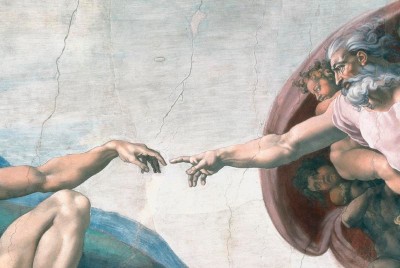
Other vulnerable examples are not hard to find. Think of this magnificent piece of painting in the Sistine Chapel… another easy target for cliché and parody:

Or this self portrait of a tormented soul:

.

Or take these beginning haunting notes from a brilliant symphony, they have become an expression of suspense not much deeper than the tune in Final Jeopardy:

.

The opening chorus of this masterpiece has now been reduced to a punctuation mark in our vernacular, an exclamation used for scenarios from finding your lost keys to losing 10 pounds:

Isn’t the advertising industry supposed to be the flagship of creativity?  And, when it comes to the creative process, aren’t we supposed to flee from clichés and produce fresh expressions? Isn’t originality a goal to strive for anymore? Or, has parody become the new genre and proof of ingenuity in our time?

And I’m just too tired to go into all the zombie and vampire versions of Jane Austen’s novels…