Saturday Snapshot August 4

Found this while taking my evening walk a few days ago. A white spider on what looks like a miniature sunflower. Can anyone identify both? I’ve never seen a spider like that before, or such a flower in the wild.

Soon it begins its acrobatic routine:

a natural for the Cirque du Soleil:

These last two shots are taken pointing to the light, hence the hazy result. But if you look closely you can see this little spider having fun.

***

Saturday Snapshot is hosted by Alyce of At Home With Books.

Bel Ami by Guy de Maupassant

Reading Maupassant reminds me why I love Jane Austen.

To be fair, I’ve only read one of the numerous short stories and one novel of Maupassant’s, but all of Austen’s six novels. So it just may not be apt for me to generalize the former. But focusing on just this book, Bel Ami, I can say here’s a protagonist whom I can never cheer for nor find amiable, to put it mildly…

Maupassant uses a scoundrel as the main character and have us follow his ascent, unscrupulous at every turn, as his ego and desires are being fed all the way to the end, and then some more. An antihero, the poster boy of realism in his depiction of late 19th C. Parisian high society?

Jane Austen has also written a protagonist she described as “A heroine whom no one but myself would like”. But comparing to Bel Ami‘s Georges Deroy, Emma Woodhouse is angelic. How do I even start to think of a parallel… imagine Wickham of Pride and Prejudice and Willoughby of Sense and Sensibility, combine them and magnify their nasty streak ten folds, then you’ll have Georges Deroy, nicknamed Bel Ami by the women in his life, ‘good friend’, a most pathetic irony.

The time is 1890’s Paris. Georges Duroy is a former soldier living in poverty. But call it luck or call it will, Duroy ends up a prominent figure in Parisian high society. This is how he does it.

Women. At one time, there are four significant females in Deroy’s life. These are upper crust, influential beauties. To Duroy, they are but rungs up the social ladder, each a conquest.

First is Madeleine Forestiers, the wife of his benefactor, editor friend whom he runs into coincidentally, and who saves him from poverty by bringing him in to work for the newspaper La Vie française.

The second one is Clotilde de Marelle, a married woman whom Duroy has made mistress. She aptly analyzes the Mars and Venus chasm of gender differences on that elusive notion called love. To Duroy, she says:

I know perfectly well that for you love is merely a sort of appetite whereas for me it would be more a sort of… communion of souls which doesn’t exist in a male religion. You understand the letter and I understand the spirit.

The third is the big boss of the newspaper Monsieur Walter’s wife Virgine, who has such a crush on Duroy that she loses her senses when he successfully schemes and manipulates her daughter Suzanne to elope with him.

George Wickham has plenty to learn from Georges Duroy because his subsequent wedding after the elopement is not a hush hush patch up, but a glamorous celeb nuptial, fully legit and the envy of all. By now, Duroy has climbed to be editor of La Vie française and made himself a Baron, changing his name to Du Roy for a more aristocratic sound. And we know full well that the conquest doesn’t stop there.

In one earlier incident, Duroy comes out of a gun duel unscathed, albeit a bit numbed. With his life spared, he could well have used such a near-death experience as a springboard to a new beginning and a turnaround of his ways. But his lucky escape has only fuelled his hubris and reaffirmed his self-importance. After the duel, he thinks himself invincible.

Is he immoral or amoral? I feel I have to choose the latter in order to find some amusement in following this unscrupulous character. Is it realism or sarcasm? I have to mix them both in order to seek some reading enjoyment. And with the English translation by the Cambridge scholar Douglas Parmée, there are the occasional descriptions that sounds… curt. But are they the original intent as realism dictates, or the collateral effects of translation? Can’t make up my mind on that one. Just an example:

The elder sister Rose was ugly, as flat as a pancake and insignificant, the sort of girl you never look at, speak to or talk about.

There, I find myself having to choose or debone or mix and stir in order to wash down better when reading Bel Ami. Under Maupassant’s pen of realism, Duroy is relentless all the way to the end. Just goes back to my love for Austen’s works… why, I can take in big gulps, devour and be totally satisfied. There are Wickham and Willoughby, but ultimately my yearning for some sort of poetic justice can be gratified. For my reading pleasure, I’ll take Jane’s idealism anytime.

***

Bel-Ami by Guy De Maupassant, translated by Douglas Parmée, Penguin Classics, movie tie-in edition, 2012, 394 pages.

As you can see from the book cover, Bel Ami has been adapted into film. To literature purists, I suggest you look for another edition. Whenever I read about Georges Duroy, which is on every page, Robert Pattinson’s face keeps haunting me, and images of Uma Thurman as Madeleine Forestier, Kristin Scott Thomas as Virginie keep conjuring up in my mind. Now I haven’t even watched the film… oh the suggestive power of a book cover.

This concludes my Paris in July entries for 2012. Thanks to Karen of BookBath and Tamara of Thyme for Tea for hosting.

To Paris again next year!

***

Saturday Snapshots July 28: Paris Montage

The Brasserie Balzar
Near the Sorbonne, Sarte and Camus’s frequent hangout where they dined and debated. Insert shot of Menu: Breakfast for 6 Euros includes a croissant, tartine, confiture, hot drink, orange juice.

A View of the Tower
Size is relative. 

The Paris Apple Store
Probably the most elegant of all the Apple branches.

The Paris Collage
As you can see, I got a bit carried away playing with the features in the photo editing site Picmonkey.

Again, Saturday Snapshot is hosted by Alyce of At Home with Books, Paris in July at Bookbath and Thyme for Tea.

Thanks to Zara Alexis for pointing me to PicMonkey.com for making these collages and watermarks.

***

Saturday Snapshots July 21

Once again, Saturday Snapshots framed by a Paris in July backdrop…

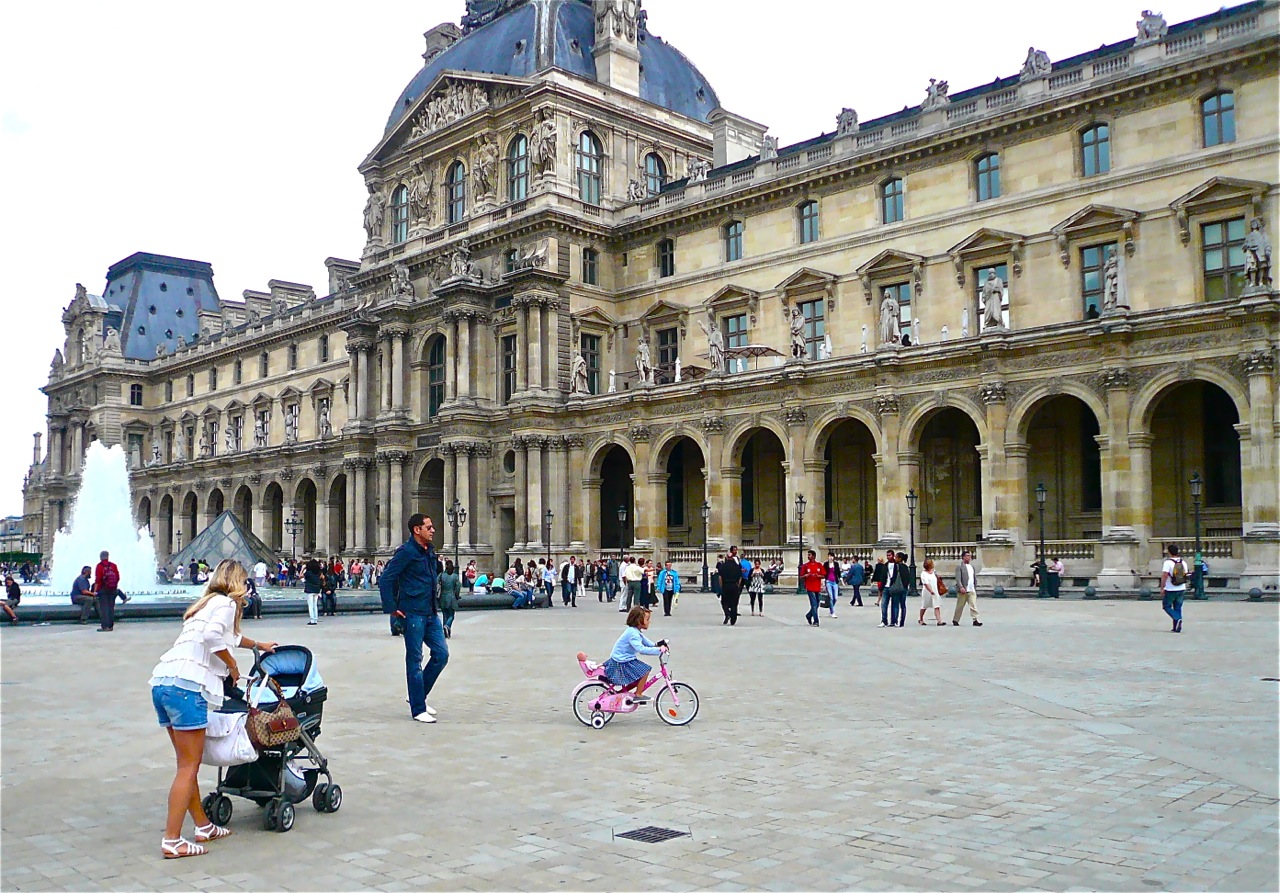
I was pleasantly surprised to find the open space outside the Louvre being used not only for tourist line-ups but as a spot for a family outing.

Dad can keep an eye on Sis biking, while Mom gets baby ready for a video shoot.

And Li’l Bro rides into the sunset.

***

Saturday Snapshot hosted by Alyce of At Home With Books, Paris In July at BookBath and Thyme for Tea.

***

Arles: In Search of Van Gogh

Watching the movie Séraphine (my last post) made me think of another artist tormented by mental illness. Vincent Van Gogh (1853-1890) was born in the Netherlands. His artistic imagination was ignited when he moved to Paris in 1886 and saw the works of the impressionists. But the prolific period of his life began only after he went south to Arles.

I visited Provence in August, 2010, went on a walking tour of Arles following the footsteps of Van Gogh. For Paris in July hosted by Karen of Bookbath and Tamara of Thyme for Tea, I’m reposting an excerpt of my travelogue here. Some of you may remember my series of travel posts, but many of you have come to Ripple Effects only recently. Please join me as I revisit Arles and its nearby St-Rémy-de-Provence.

***

Van Gogh moved to Arles from Paris in 1888, seeking the tranquility that was so elusive to him in the big city. In his letter to his brother Theo upon arrival to Arles, he wrote:

It seems to me almost impossible to be able to work in Paris, unless you have a refuge in which to recover and regain your peace of mind and self-composure. Without that, you’d be bound to get utterly numbed.”  — Tuesday, Feb. 21, 1888.

The fresher and more colourful palette is apparent during this most prolific period of the artist’s life. Bright yellows, blues, shorter and swirling brush strokes established his signature style.

As for me, I was a bit disappointed to see the sunflowers have already withered in late August. Fields of yellow were now massive brown. They would be harvested at a later time for their oil, a good reminder that, for tourists, it’s the view and the photos, but for those living here, it’s their livelihood. The lavenders on the Luberon mountains too had long passed the season. Note to myself: Early to Mid July is best if I ever come this way again.

But all was not lost. I was gratified to follow some of Van Gogh’s footsteps as I explored the clearly posted Van Gogh sites in the town, the scenes and locales where the artist so vividly captured in his paintings.

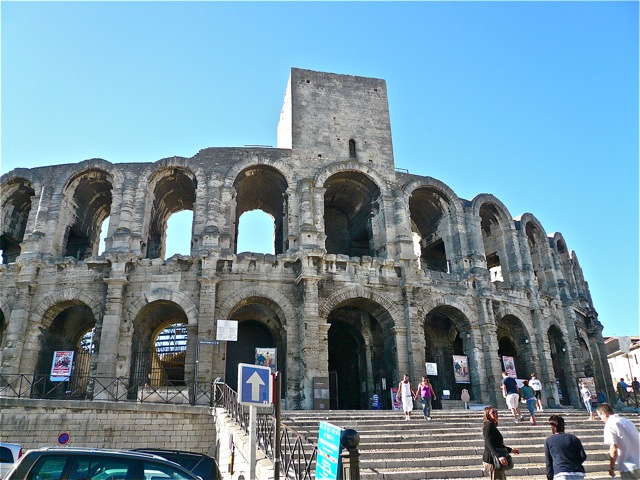
Arles is a Roman town. What more prominent landmark to reflect its past glory than the Roman Arena in the town centre. Why all the arches? The free flow of pedestrian traffic. The full seating capacity, 20,000 people, could exit the Arena in 7 minutes.

Used by gladiators in ancient time, the Arena is still the venue for bullfights:

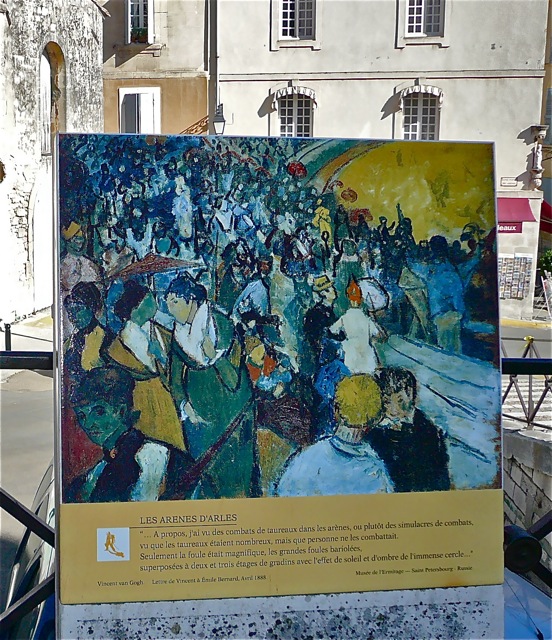
But Van Gogh’s interest was not so much in the violent action of bullfighting than the people, as his painting Spectators In The Arena At Arles (December, 1888) clearly shows:

The Café Terrace on the Place du Forum was his hang-out, renamed Café Van Gogh now. The yellow café upon the backdrop of the blue, starry night had deeply inspired the artist:

Café Terrace At Night (September, 1888):

Van Gogh had wanted to make Arles a hub for fellow artists. Upon his urging, Gauguin came to join him in October, 1888. The two painters frequented the Café Terrace many a night but only for two short months. What happened on December 23rd was reported by the local paper the next day:

At 11:30 pm., Vincent Vaugogh [sic], painter from Holland, appeared at the brothel at no. 1, asked for Rachel, and gave her his cut-off earlobe, saying, ‘Treasure this precious object.’  Then he vanished.

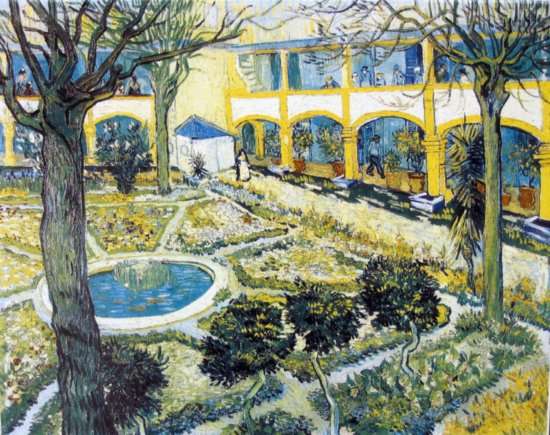
After this incident, Van Gogh was admitted to a local hospital, now the Espace Van Gogh in Arles, a cultural centre:

And here is Van Gogh’s rendering when he was staying there:

In January, 1889, Van Gogh returned home to his ‘Yellow House’ (which has now been torn down and reconstructed), but for the next few months, suffered onslaughts of hallucinations and delusions. His view of his own condition nevertheless was lucid and even progressive for his time. His letter to Theo is poignant, as he openly faced his predicament and earnestly sought a solution:

And for the time being I wish to remain confined, as much for my own tranquillity as for that of others.

What consoles me a little is that I’m beginning to consider madness as an illness like any other and accept the thing as it is, while during the actual crises it seemed to me that everything I was imagining was reality.”

— Sunday, April 21, 1889.

On May 8, 1889, he checked himself into the Saint Paul de Mausole, the mental hospital at St-Rémy-de-Provence. Under the care of his doctor Théophile Peyron, the artist’s condition improved and he thrived in the idyllic environment there. Art therapy had brought healing and prolific output. Van Gogh stayed there for a year and created more than 150 paintings.

Dr. Théophile Peyron out at the front garden of Saint Paul de Mausole hospital:

The olive grove outside:

Olive Grove (June, 1889):

To his brother Theo, he wrote on Sunday, May 11, 1890:

At the moment the improvement is continuing, the whole horrible crisis has disappeared like a thunderstorm, and I’m working here with calm, unremitting ardour to give a last stroke of the brush. I’m working on a canvas of roses on bright green background and two canvases of large bouquets of violet Irises…

My Van Gogh trip ended at St. Rémy, and so be it. I’ve seen the sites wherein the artist was at his most prolific. I’ve seen the town and surroundings where he found inspiration.  I’ve seen his final solace where he attained some stability and painted with passion. I’d like to keep these as memories of my travel to Provence. I could hardly bear to think of his last days, discharged from St. Rémy just a few days after the above letter, headed north to Auvers-sur-Oise on the outskirt of Paris, and in just two short months, succumbed to the recurrence of his illness. He shot himself in the chest with a revolver on July 27, 1890, and died of his wound two days later.

Back to the thoughts I wrote about: How do we keep art from turning into a cliché? I think it takes a certain awareness of the artist as a person, plus a measure of empathy and respect for the struggle to live and create… and realizing that the beautiful works are often triumphs in spite of life’s overwhelming adversities, rather than the natural products of bliss and fortune.

To wrap up my travel posts, and taking the risk of turning it into a cliché albeit my motive is pure, here’s the YouTube clip again, Don McLean’s tribute to Vincent:

***

My five-part travelogue on England and France:

  1. Tate Modern & Billy Elliot
  2. Bath’s Persuasion
  3. Paris: The Latin Quarter
  4. Art and Cliché
  5. Arles In the Steps of Van Gogh

Séraphine and the Wrought-Iron Chair

By day, she scrubs floors, cleans houses, washes dirty linens in the river. By night, she paints. She is Séraphine, a cleaning woman in her fifties. Later, she is better known as Séraphine de Senlis. 

Séraphine (2008), a film based on the life of the early 20th Century French painter Séraphine Louis (1864-1942), won 7 César Awards in France including Best Film of 2009 and Best Actress for Yolande Moreau as Séraphine. True to its subject matter, director Martin Provost has crafted an aesthetically pleasing work of art. The pace is slow for the viewer to savour every bit. Moreau’s charming portrayal of Séraphine is captivating. She wins my heart from the first scene.

It is gratifying to be noticed, to be confirmed of one’s worth. To the dismissive eye, an ageing cleaning woman is nothing to deserve another glance. Makes me think of the concierge Renée in The Elegance of the Hedgehog. In one of the apartment units which Séraphine cleans, a new tenant just moves in. He is Wilhelm Uhde, a noted art critic and collector of Picasso. He is also the one who has discovered Henri Rousseau of the naive art style, a term referring to untrained talents, a term to which Uhde doesn’t subscribe.

And right there in his rental unit Uhde notices another hidden gem of this style, his own housecleaner Séraphine. Uhdle is deeply moved by her work and soon becomes her patron. He stops her from mopping his floor, leads her out into the garden, seats her down in a wrought-iron chair and tells her she has talent. It is a wrought-iron chair that I notice since that scene, and it recurs later in the film, a metaphor for aesthetics, style and elegance, antidote to the crude reality of Séraphine’s life.

Séraphine loves nature, and nature rewards her with inspiration.

Her subjects are mainly flowers and fruits, their design exquisite, natural, colourful and lively. 

Deep religious fervour soon drives Séraphine to relentless, maddening obsession to paint. She claims to follow voices from her guardian angel. She would sing hymns at the top of her voice while painting through the night, waking up in the morning on the floor with her work-in-progress. She gradually becomes delusional and out of touch with reality.

Why is it that giftedness and mental illness often find affinity for each other? Van Gogh comes to mind. And only recently did I read this Guardian article drawing uncanny similarities between Séraphine and Susan Boyle.

As WWI draws near, the impending conflicts push Uhde out of France and back to Germany. They reunite after the War. Sadly, the painter’s growing achievement brings about more severe delusions. Later the economic depression ends contact between patron and artist for a while.

When Uhde finds Séraphine some years later, she is locked up in an insane asylum. This latter part of the movie is a bit uncomfortable to watch. Uhde is unable to communicate with her as she is restrained in a straight jacket, tied to the bed weeping in anguish.

Months pass and in 1935 Uhde visits her again. He needs to tell Séraphine her paintings are selling. Her condition has stabilized by now but upon doctor’s advice, Uhde should just leave her be. There in the asylum at Asile de Clermont Uhde quietly pays for her a private room with a view out towards a lush green meadow and full, leafy trees.

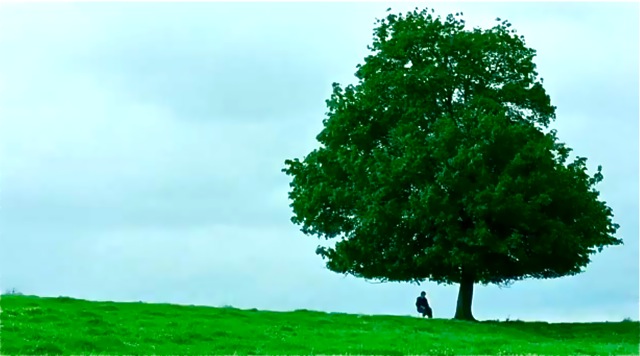
The ending that follows is one of the best I’ve seen in films. We see Séraphine being led into the room. She sits on her bed, dazed, unfeeling. Then she turns her head and notices the door leading outside to the trees and green meadow. The next three silent minutes bring us to a poignant closing:

Séraphine slowly gets up and opens the door. She sees a wrought-iron chair on the porch. The frame on screen here is roughly split in two. On the left side is her room with a sterile, wooden chair of the asylum. On the right we see the porch outside with the wrought-iron chair, not unlike the one she had sat on while being declared a talent by Uhde years before. She tentatively steps out of her room, touches and examines the chair, then picks it up and slowly carries it with her up a green hill to a full, beautiful tree. From afar, we see her look at the tree, put the chair under its shade, sit down and tilt her head back, fully relaxed.

In the silence with just the wind blowing, it seems we can hear her gratified sigh of relief, being back in nature, coming home.

~ ~ ~ 1/2 Ripples

CLICK HERE to watch Séraphine’s official trailer on Youtube. You’ll be able to see the ending scene. But of course, nothing compares to watching the film in its entirety.

A NOTE ABOUT MOVIE PHOTOS: These images are used according to the Fair Use guidelines for criticism, comment and educational purposes. CLICK HERE for more information. CLICK HERE to read the Report of the Ad Hoc Committee of the Society For Cinema Studies, “Fair Usage Publication of Film Stills” by Kristin Thompson.

***

This movie review is my third post for Paris in July hosted by Karen of BookBath and Tamara of Thyme for Tea. To read my previous posts you can click HERE and HERE.

***

Saturday Snapshot & Paris in July

Here are my photos for two blogging events: Saturday Snapshot hosted by At Home With Books and Paris in July over at BookBath.

In August, 2010, I was in Paris, stayed at a small hotel on a side street in the Latin Quarter, across from the Sorbonne. And just recently I was reading the book The Hundred-Foot Journey (my last post). In the book, the protagonist Hassan was offered a place to start his own restaurant, at 11 Rue Valette, near the Panthéon. When I came to that part of the book, I quickly went Googling and found, ta-da! Hassan’s restaurant was within walking distance of the hotel I stayed in.

This is what happens, you fuse together reality and fiction… that’s the joy of reading. And I could even imagine stopping by the restaurant to have a taste of Hassan’s haute French cuisine.

No, I didn’t get to Hassan’s Le Chien Méchant, but found this little cinema not far from our hotel on another narrow side street, Cinema du Panthéon, and it was showing the acclaimed film Des Hommes Et Des Dieux.

I had an urge to go in and watch it, but on second thought, I was in Paris, a French film showing in Paris would probably not have English subtitles.

I did get to see the film Of Gods and Men (2010) when I came back home, French with English subtitles.

***

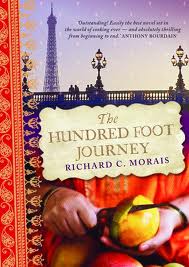
The Hundred-Foot Journey by Richard C. Morais

How do you get to Paris from Bombay? Food, Food, Food.

What better transport is there than a light vehicle that provides a fun and wild ride, taking me out of Midnight’s Children‘s Bombay to my next destination, Paris in July? Thanks to Karen of Book Bath for organizing the trip.

This delightful, breezy read is that speedy transit. It tells the story of Hassan Haji, a Muslim boy who lives above his grandfather’s restaurant in then Bombay and how he ultimately ends up as a three-star chef in Paris.

Growing up immersed in the savoury aroma of Indian food and spices,

I suspect my destiny was written from the very start, for my first sensation of life was the smell of machli ka salan, a spicy fish curry, rising through the floorboards to the cot…

Hassan is endowed with an exceptional gift of culinary talent. After the Partition and the death of his grandfather, religious and political turmoils push his family out of the country. They first land in London, later immigrate to France. The boisterous family finds a home in the resort village Lumière near the Alps and starts its own restaurant Maison Mumbai, serving Indian dishes and bringing a welcome change to the villagers.

Hassan soon is jealously noticed by the veteran, feisty two-star French Chef Madame Mallory across the street. She is the proprietor of the small country hotel, Le Saule Pleureur. Her restaurant is a haute French culinary establishment that plays Satie in contrast to the Indian music from a loudspeaker at the Haji’s. After many animated and almost cartoonish conflicts between Madame Mallory and Hassan’s Papa, Abbas Haji, both concede to the reconciliatory move of allowing Hassan to become Chef Mallory’s apprentice.

Thus, Hassan takes the one hundred-foot journey and crosses the street to stay at Le Saule Pleureur, learn all he can from the great Chef and answer ‘the irrefutable call of destiny’ to be one himself. Towards the end of his apprenticeship, Hassan is left on his own to create recipes for pigeons, gigot, and hare, all to the satisfaction of Chef Mallory. After three years under her wings, Hassan is ready to move on.

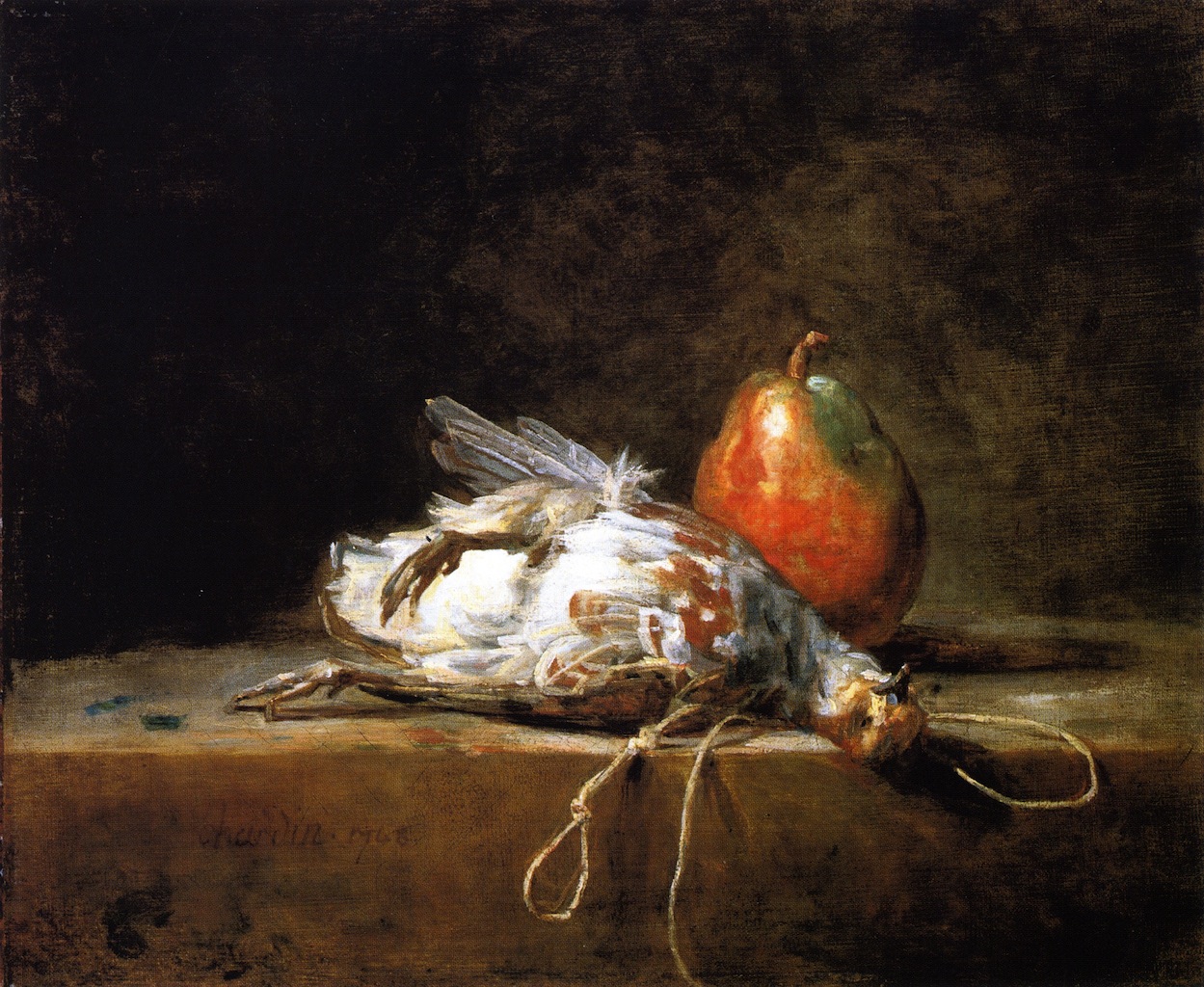
Chardin’s Grey Partridge Pear and Snare on Stone Table, one of Hassan’s favorite paintings.

Next step, Paris. Hassan starts as a sous chef with a couple of smaller restaurants. After a few years, he decides to open his own and is approached by a benefactor who offers him reduced rent in an upscale location near the Panthéon. The one-hundred foot journey has brought him fine training, now he can take flight.

Here is his trademark dish:

the Siberian ptarmigan, roasted with the tundra herbs taken from the bird’s own crop, and served with caramelized pears in an Armagnac sauce.

We as readers are privy to the actual cooking procedure beginning with the feathered live bird.

For me, more a movie buff than a foodie, the book conjures up many cinematic images… the colours and conflicts in The Best Exotic Marigold Hotel, the prejudice in Chocolat, the sumptuous offering in Babette’s Feast, and, the training sessions in the The Karate Kid. Dev Patel (Marigold Hotel, Slumdog Millionaire) will be perfect for the role as young Hassan. I couldn’t help but think, this book is good movie material.

And then I found out from the Acknowledgements after I finished, the book is an homage to the late Ismail Merchant, the film producer behind the Merchant Ivory productions (Room With A View, Howards End, The Remains of the Day) who met an untimely death in 2005. The bond between the author Richard Morais and his friend Ismail Merchant was food. This book was started with a subsequent movie in mind.

In-depth research has gone into writing the book, culinary history, recipes, game, desserts, soups, the French kitchen, the Indian kitchen, restaurant operations, even for me the uninformed and casual eater, there are plenty to savour. The book is a smorgasbord of gastronomic delights. My only criticism is that its literary treatment may taste a bit raw, simplistic, and at times, didactic. However, read it like a comedy, it can satisfy like a dessert.

~~~ Ripples

The Hundred-Foot Journey by Richard C. Morais, Scribner, NY, 2010, 245 pages.

***

Midnight’s Children: Book Three

Click on the following links to the different sections of the book:
Midnight’s Children Book One
Midnight’s Children Book Two, Part A
Midnight’s Children Book Two, Part B

CLICK HERE to read my Movie Review of Midnight’s Children

***

Finally, we’ve come to the last section, the most eventful and catastrophic in our protagonist Saleem Sinai’s life. I must admit, my enthusiasm sagged a little at the end of Book Two, through no faults of Mr. Rushdie’s. Book Three sent me to some major Googling to be informed. After reading what I found on the Internet, I was fully awake.

The tumultuous waves of history swept Saleem along like an open dinghy. The 1965 Indo-Pakistani War over Kashmir ‘wiped out’ his family in a bomb blast. Saleem was ‘wiped clean’ with no memories of his own identity. He subsequently joined an intelligence gathering unit in the Pakistani military, his super sensitive nose being the major asset. In 1971, another war awaited him as he headed from West Pakistan into East to counter the revolutionary Mukti Bahini in their fight for an independent Bangladesh.

Perhaps fate had a gentler hand than humans. Saleem, now ‘buddha’ as he was ‘purified’ of all his past, got lost in the Sundarbans jungle. For seven months, he escaped the war between the two Pakistans. When he reemerged he witnessed atrocities done by his own Pakistan army he could not believe. Ten million refugees from East Pakistan walked across the border into India. As a result, the mightier Indian army led by Sam Manekshaw intervened and soon ended the war, with Pakistan’s Tiger Niazi surrendering with his 93,000 men. Buddha shed his uniform and became a deserter in Dacca, independent Bangladesh.

Tossed amidst the raging sea of national and personal upheavals, our protagonist, though a drop in a sea of six hundred millions, felt the burden of history and came to a self-realization. Rushdie’s description is powerful:

Who what am I? My answer: I am the sum total of everything that went before me, of all I have been seen done, of everything done-to-me… I repeat for the last time: to understand me, you’ll have to swallow a world.

With the Bangladesh Independence victory parade came a band of magicians from India, among them was Parvati-the-witch, one of the Midnight’s Children. Seeing Saleem again and calling his name out loud in excitement, Parvati cured his amnesia. She smuggled him in her basket back to India. Subsequently, Saleem stayed with Parvati and the magicians in the slum of Delhi. The silver spittoon he carries all these years is a perfect metaphor of his life… once born with a silver spoon in his mouth as a changeling, Saleem now comes back to where he would have been if he had not been switched at birth, the spittoon.

Saleem met his changeling rival, Major Shiva now. A loyal supporter of PM Indira Gandhi, Shiva had risen as Saleem fell. A national hero and a womanizer, Shiva went to the magician ghetto and took Parvita away. Months later she was sent back to the slum when he learned that she was pregnant. At the end, it was Saleem who married Parvita, knowing that she would give birth to Shiva’s son.

Baby Aadam Sinai was born at midnight, June 25, 1975, on the brink of Indira Gandhi’s Emergency measure in gripping absolute power, another fateful night of the nation’s history. But Saleem knows his son who is not his son will have a different path:

Aadam was a member of a second generation of magical children who would grow up far tougher than the first, not looking at their fate in prophecy or the stars, but forging it in the implacable furnaces of their wills.

With Shiva as the biological father, baby Aadam once again flowed back to the blood line of his grandfather Ahmed Sinai, the offspring of a changeling comes full circle back to his rightful lineage.

Indira Gandhi’s son Sanjay conducted an anti-poverty operation to eradicate the slums. Parvati was killed in the clean-up. After her death, Saleem had a chance to go back to his birth city Bombay with his son. There he reunited with Mary Pereira. She was now Mrs. Braganza, manager of a pickle factory. Her changeling crime forgiven, Saleem now worked in her factory, paralleled his work as a writer preserving history:

… in words and pickles, I have immortalized my memories, although distortions are inevitable in both methods. We must live, I’m afraid, with the shadows of imperfection.

Is an author liable for what he writes in a work of fiction? The line delineating reality and fiction in Midnight’s Children is often blurry. Do Saleem’s views parallel Rushdie’s? Like Saleem telling his life story to Padma, Rushdie in Midnight’s Children could well have gone all out to unleash his sentiments towards the historical progression and political turmoil of India, the Partition, Pakistan and later Bangladesh.

In Book Three, Rushdie was particularly critical of the suspension of civil rights, censorship of the press and arrests of subversive elements during the Emergency as Indira Gandhi seized absolute power. But it was for a more personal description, a single sentence about Indira in this section of the book that brought Rushdie a defamation suit in 1984 by Mrs. Gandhi when she was PM again. In context, the sentence is Saleem’s account, but has to be removed from publication after that year. Rushdie mentions it in his introduction to the 25th Anniversary edition.*  The author still has the last word.

Midnight’s Children is an epic chronicle that carries multi-layered meaning and parallels, a feast of stylistic literary offerings. As an outsider, I feel I have only scratched the surface. But with just this outer core, I’ve been much entertained and informed. I will be back for more.

***

A note of appreciation to Mrs. B of The Literary Stew who planted the seed of this read-along, and Bellezza of Dolce Bellezza who supported the start-up. My hearty thanks to all who have shown interest, participated at one time or another exchanging thoughts and insights in your reviews and comments, as well as those who are silent readers. All your contributions have made this four-month endeavour gratifying and worthwhile.

Review posts for Midnight’s Children Finale:

Janell of An Everyday Life

Gavin of Page247

To read my reviews of previous sections of Midnight’s Children, please click the links on the sidebar.

We must do this again some other time. Book suggestions?

* Midnight’s Children by Salman Rushdie, 25th Anniversary Edition, Random House Trade Paperbacks, New York, 2006, 533 pages. (Book cover as image above)

***

Midnight’s Children is one of my most anticipated films for 2012. Here are the actors playing young (Darsheel Safary) and adult Saleem Sinai (Satya Bhabha):

Here’s @SalmanRushdie’s Tweet regarding the release dates of the film: ‘Canada, October 26th; UK, November 9th; USA, being finalized, should be around the same time.’

***

What Makes a Good Audiobook Narrator?

That’s the question for discussion today on Audiobook Week 2012 hosted by Devourer of Books.

I’ve just started listening to audiobooks regularly this year and already found a few excellent narrators:

Jeremy Irons reading Brideshead Revisited by Evelyn Waugh — I’ve already mentioned how captivating his voice is on my review. Basically, it’s the aptness of the tone in fitting the mood and atmosphere of the book. Clarity is crucial as well. Often when just listening, I would easily get confused as to who’s talking. But Irons is most efficient in keeping his characters distinct. Finally, the dramatization of them is spot on. I can see them in my mind’s eyes. They are convincingly interpreted and portrayed, consistent with the characterization of the book.

Peter Francis James reading On Beauty by Zadie Smith — This is a challenging book to narrate because of its myriad of accents and racial mix. James has done an amazing job in voicing the characters in their cultural, gender, and age-related quirks and expressions. Here we have a fusion of British, British/American, African American, rapper American, and British/Trinidadian. All these just to depict two mixed-race families. Here, the criterion for excellent narration is efficiently met: Amidst the cacophony of voices, James has distinguished the characters with apt individualism, helping me to appreciate each character on its own.

Tim Jerome reading Gilead by Marilynne Robinson — This 2005 Pulitzer Prize winning novel has only one character speaking throughout and that’s the ageing Reverend in Gilead, Iowa, John Ames. Suffering from illness but still lucid and wise, he leaves his memories to his very young son as a family legacy while he still has time. Tim Jerome’s voice exudes gentleness, compassion, forgiveness and wisdom, just like the character John Ames. Listening to the audio makes me feel like he’s casually and warmly chatting with me over coffee after a good meal. I don’t think I’ve heard another more gentle and loving voice, which is so appropriate with the characterization.

***

You can see I’ve mentioned the audiobook that I listened to with these narrators, as I haven’t heard their other works. So this leaves another question: Are they just as excellent in those other readings? That I’ll gladly explore.

***

Audiobook Review: Brideshead Revisited Read by Jeremy Irons

Don’t be misled by the cover design. This audiobook is not related to the 2008 movie adaptation. Rather, it’s an unabridged recording of Evelyn Waugh’s novel, engagingly read by Jeremy Irons, who plays the narrator Charles Ryder in the 1981 award-winning British TV series.

Jeremy Irons exemplifies what an ideal audio performance should be like. We look for the visuals in a movie; we are drawn to the voice in an audiobook.

For one who has had his share of youthful desires, tasted love and loss, and known the ambivalent effect family and religion can bring, now twenty years after, Charles Ryder is resigned to a numb and dreamless existence. Irons delivers such a tone perfectly… his deep, quiet and sombre voice an apt reflection of Ryder’s sentiments.

His voice dramatizes the various characters with clarity. As a listener, I can easily tell who’s talking, as simple as that. From the senior Lord Marchmain to 12 year-old Cordelia, from the stuttering Anthony Blanche to the constantly drunk Sebastian Flyte, Irons’ portrayal is natural and apt. Characterization is consistent in their manner of speech, quirks and eccentricities. Further, he has also effectively conveyed the subtext, the undercurrents in the dialogues, for example, the sardonic remarks Edward Ryder often hurls at his son.

On top of all these, Irons has presented Waugh’s beautiful language and descriptions with poetic eloquence. His articulation stops me time and again to rewind so I can listen and savor the language once more.

Here is the excerpt that seized me from the start and sent me to find the passage in the book to recap every word. This is in the Prologue when Charles unknowingly arrives Brideshead in his army duty twenty years later and asks his subordinate where they are. This is the moment when he is told the name of the place:

He told me and, on the instant, it was as though someone had switched off the wireless, and a voice that had been bawling in my ears, incessantly, fatuously, for days beyond number, had been suddenly cut short; an immense silence followed, empty at first, but gradually, as my outraged sense regained authority, full of a multitude of sweet and natural and long forgotten sounds: for he had spoken a name that was so familiar to me, a conjuror’s name of such ancient power, that, at its mere sound, the phantoms of those haunted late years began to take flight.

I know it’s a bit long, but I must include it here, for this is the passage that has drawn me to the written word, all because of the voice reading it. Can this be the measure of a good audiobook?

***

Brideshead Revisited by Evelyn Waugh read by Jeremy Irons, BBC Audiobooks America, 10 CD’s, 11 hrs 21 min, Unabridged. July 22, 2008.

~ ~ ~ ~ Ripples

***

Thanks to Devourer of Books for hosting Audioweek 2012.

Other related posts on Ripple Effects:

The Downton Ripples

Dances With Words

***

Listen Up: Audiobook Week 2012

June is Audiobook month, and today begins Audiobook Week 2012 (June 25-29), thanks to Devourer of Books for hosting. This is my first time participating.

Audiobooks are not new to me, albeit I’ve not been a regular listener. But 2012 is the year I rediscover the pleasure and benefits of them, and become a ‘chain user’. Mainly, it’s a time-saver for me. I listen to CD recordings of books while driving. That’s a great way to finish a book. Yes, after much pondering, I say ‘finish’ instead of ‘read’. The difference I’ve written in a previous post Dances With Words.

Yes, books on CD’s still, because there’s a large collection at our local public library. Audible.com, well, here’s a little story.

Have you ever been given a gift and then see it taken away as you open it? This is exactly my experience on this year’s Mother’s Day. My son gave me Colin Firth’s reading of Graham Greene’s The End of the Affair through Audible.com. Sweet… both the giver and the gift. We unwrapped the gift together, trying to download the recording, but was told its copyrights did not apply to Canada. So, we can’t listen to it above the 49th parallel. So much for free trade and open borders.

Anyway, I’m resigned to continue listening the old fashioned way… CD’s, while patiently waiting for Colin Firth’s reading to be transferred onto them.

The following are the audiobooks I’ve finished so far this year:

Reviews coming up. Happy listening everyone!

***