Life of Pi (2012): The Magical 3D Experience

Movies this fall is a bumper crop of film adaptations from literary sources. Two belong to the same genre of magic realism. While Midnight’s Children is more akin to realism, Life of Pi is pure magic.

Ang Lee has done it, filming what is considered the ‘unfilmable’. Canadian author Yann Martel’s Booker Prize winning novel Life of Pi is an existential fantasy, a story that challenges the limitations of human reasoning and opens the door to the imaginary and the quest for the Transcendent. What Martel has succeeded in literary form, Lee has realized in this visually stunning cinematic offering. While I know book and film are two very different art forms, I am glad that screenwriter David Magee has stayed true to the spirit of the novel, which I think is crucial in this case. Cinematographer Claudio Miranda’s creative camera work is also essential in turning Martel’s imaginary world into mesmerizing visuals on screen.

The difficulties are not just transposing the philosophical ruminations from book to screen, but to keep the audience’s attention and interest for two hours when the bulk of the story is about a 16 year-old boy adrift at sea for 227 days in a lifeboat with a Bengal tiger. Kudos to Lee for taking up this daunting task, a project of which several other directors had bowed out, including Jean-Pierre Jeunet (Amélie), M. Night Shyamalan (The Sixth Sense), and Alfonso Cuaron (Harry Potter and the Prisoner of Azkaban).

The production has taken Lee years to complete. He had to build the world’s largest self-generating water tank of its kind in Taiwan to shoot his film, utilize 3D technology and CGI to overcome many obstacles, do extensive research, and above all, find an actor who is capable to be Pi.
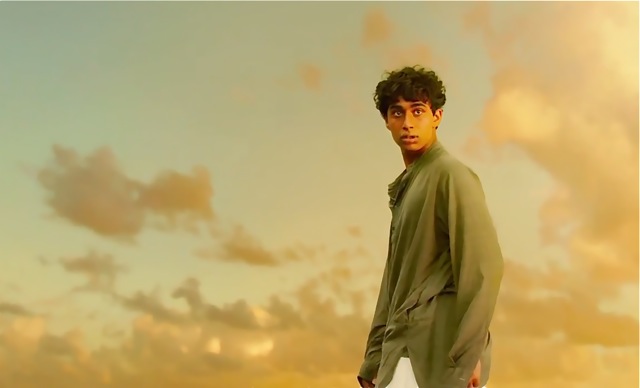
Ultimately Lee found 17 year-old Suraj Sharma in Delhi, India, from 3,000 candidates. Fate has it that Sharma was just accompanying his younger brother to the audition. The next set of challenges for Lee soon follows: directing Sharma who has never acted before, and, coaching him to imagine there is a fierce tiger present at the scenes, for Richard Parker is a virtual reality.

As I watched the film, I could see Lee’s own tenacity reflected in the character of Pi. In fact, the whole process of the production parallels the thematic significance of the story: the essence of reality, the nature of storytelling, the role of the imagination and faith in survival and in life.

**

The film begins with Pi as a boy (Gautam Belur at 5, Ayush Tandom at 12) growing up in Pondicherry, India. His father (Adil Hussain, English Vinglish) owns the Pondicherry Zoo. The most impressionable lesson he learns from his father is, the tiger is not his friend.

Pi has a loving mother (Tabu, The Namesake), and an older brother Ravi (Ayan Khan 7, Mohd Abbas Khaleeli 14, Vibish Sivakumar 19), a typical older sibling who teases and dares. This first act of family life is a delight, and the 3D effect in the opening sequence is wonderful to watch. The original score composed by Mychael Danna matches well with the exotic context.

We soon realize the story we are watching actually is the adult Pi (Irrfan Khan, Slumdog Millionaire) telling what had happened to him as a boy to a Canadian writer (Rafe Spall, A Room With A View), a story, Pi claims, that will make him believe in God.

Pi is short for Piscine. After the boy is constantly teased by his schoolmates with the pun of the name, he begins to introduce himself as Pi. He just might not have known how prophetic his name is. Precocious and earnest by nature, Pi embraces Hinduism, Christianity and Islam in his search for the divine. The value of Pi, the mathematical symbol, is 3.14, a number that goes on to infinity, which aptly reflects the boy’s heart for the Eternal.

**

When he is 16 (Suraj Sharma), Pi’s family emigrates to Canada. They set sail on the Japanese cargo ship Tsimtsum, bringing on board the zoo animals. One stormy night, tragedy strikes. A shipwreck sends Tsimtsum to the bottom of the Pacific Ocean. Pi alone is saved as some sailors throw him overboard onto a lifeboat. Thus begins the magical journey of life in an open boat. Pi soon finds out he is not alone, for there in the boat is a hyena, a zebra, an orangutan called Orange Juice, and Richard Parker, a Bengal tiger. Soon there remain only two survivors, a 16 year-old Indian boy and a hungry tiger.
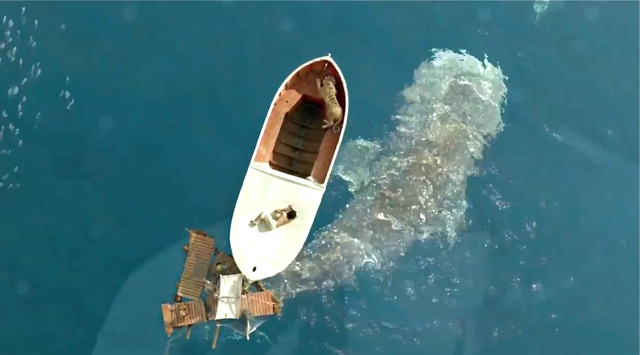
Lee demonstrates his technical and directorial prowess in this major second act of the film. He has aptly chosen to use the 3D camera. I’m not a fan of 3D, nor animal movies, but Lee’s usage of it makes what could have been an uneventful drifting at sea into an extraordinary movie experience.

What I read in the book jump out alive in magnificent visuals: the squall of flying fish, the gigantic whale shooting up from the ocean deep, the cosmic showcase of thunder and lightning, and the island overrun by meerkats. Magical realism in 3D, pure cinematic fantasy.

Lee’s style is minimalist: a life boat, a makeshift raft, a boy, a tiger, the open sea. Its simplicity exudes immense beauty; its stillness evokes quiet ruminations. This is not just a castaway, survival story. It depicts a close encounter of a soul experiencing nature and its maker. It also portrays an unlikely companionship between a boy and a tiger. Despite the loss of his family and the perils thrown at him, Pi clings to life with bare faith and the companionship he finds in Richard Parker.

The last part comes as a twist. Two employees of the ship’s insurance company interview the sole survivor of the shipwreck after Pi is rescued. Upon hearing Pi tell his ordeal, their rationale overrides any acceptance of the improbable. Here we see the thematic elements of fantasy versus reality, faith versus plausibility cleverly laid out. Like Martel’s novel, it poses a question that is open-ended, more for the viewer to resolve than for Pi to prove. A most thought-provoking end to a magical journey.

~ ~ ~ ~ Ripples

This review has been published in the Asian American Press print version, Nov. 30, 2012 issue. Online edition here. (Hint: There you’ll find Arti morphing from virtual reality into real life… take whatever is real for you.)

**

CLICK HERE to read my Book Review of Life of Pi by Yann Martel.

**

Photos posted here are stills from movie trailer.

A NOTE ABOUT MOVIE PHOTOS: These images are used according to the Fair Use guidelines for criticism, comment and educational purposes. CLICK HERE for more information. CLICK HERE to read the Report of the Ad Hoc Committee of the Society For Cinema Studies, “Fair Usage Publication of Film Stills” by Kristin Thompson.

***
Anna Karenina (2012)

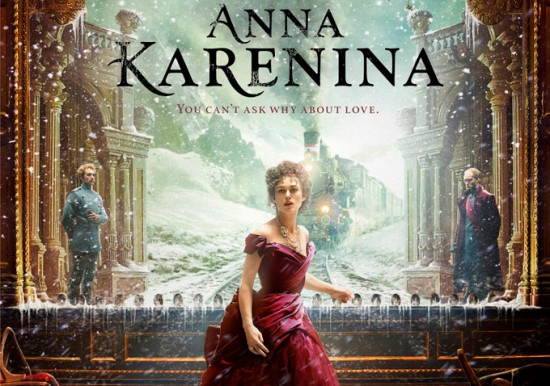
It is a good sequence, Anna Karenina read-along then the movie after. Screenwriter Tom Stoppard wrote as if his viewers already knew the story well, or have seen other film versions, for here, we are watching a highly stylized adaptation of Tolstoy’s epic novel, and it seems that it is a case of style over story.

Anna Karenina Poster

Joe Wright’s (Atonement, Pride and Prejudice) version is a bold and therefore risky direction. Instead of a realistic rendering of Tolstoy’s epic, Wright offers us a new portal into the story of Anna Karenina. All the world’s a stage, and if anything, the highly reverberated gossip of Petersburg, the adulterous affair of Anna, wife of the respected government official Alexei Karenin with Count Vronsky is aptly rendered a spectacle. Wright’s innovative concept is an interesting take, weaving his characters between the front and the backstage and into the ‘real’ set.

The idea is brilliant, the permeability of actors in and out of limelight, mingling between their own realities, and the idea that all the world’s a stage, one is both an actor and a spectator.

However, the major premise of the cinema is make-believe. It is the ‘realness’, the believability of the characters and their predicaments that arouse our empathy. That happens when we emotionally immerse into the film. As a result, we care for the characters, even though we may not identify with them.

But here while watching this film, I experience a kind of cognitive dissonance. With its setting in the theatre, at the front and backstage, it is like a kind of deconstruction if you will, for we see that these are merely actors acting, and not ‘real’. So as a viewer, I’m just like a fly on the wall, observing how a theatrical production is done. As a result, I find myself detached and aloof.

A consequence of the highly stylized gestures and movements is that they lead to overacting. And with that, believability is compromised. Now, by genre this is not a musical, so, when seeing characters walk like they’re dancing or their actions performed in unison, like the public servants rubber-stamping paper works, the effect is comical. Well, it might be the intended effect, but one that sticks out in a contrived way. The harvesting scene with the workers swinging their scythe at the same time (do they actually do that in real life, for morale?) is another example, makes me think of how natural the harvesting scenes are in Terrence Malick’s Days of Heaven.

For some reasons, far from Anna Karenina, I have Stanley Kubrick’s A Clockwork Orange in my mind as an example of a successful stylized and yet captivating film.

Nevertheless, there are many admirable elements in the film. First the sumptuous set design and costumes. The continuous camera work from scene to scene is interesting to watch. But after a while, I feel like I need a breather. Thanks to the external shots, albeit few and far between, I can get a gulp of fresh air.

And I must mention a couple of impressive scenes. First is at the beginning, the opening ball where Kitty sees Anna dancing with Vronsky. That scene is well done in its dramatic effects. I can see the actors’ inner turmoils exposed believably, and for a rare moment, Anna’s conscience at work.

Another one is the horse race. It is interesting to see a horse race in a theatrical setting, like an indoor corral. Putting the horse race in a theatre does not seem to work for me at first, but Wright has handled it effectively… Vronsky’s falling, Anna’s outburst, the shooting of the back-broken horse is one of the few captivating moments in the film.

Aaron Taylor-Johnson

As for the casting, I’m afraid it looks like there is a bit of a miscast for one. Aaron Taylor-Johnson is believable as a young John Lennon in Nowhere Boy, but here in his blond curls and starched white uniform, he looks more like a truant school boy than the military rising star Vronsky.

Keira Knightly’s poise and costume give an apt portrayal of Anna. But sometimes her facial expressions make her look like a rebellious teenager, fighting house rules and ennui.

The one role I enjoy most is Matthew MacFadyen’s Oblonsky. My opinion might differ with many. I think he is a much more convincing Oblonsky here than Mr. Darcy in Pride and Prejudice (2005), another Wright’s production. Jude Law’s character is also well-portrayed as Anna’s restrained husband Karenin the government bureaucrat.

Good to see two of Downton Abbey’s actors in the film, Michelle Dockery (Mary Crawley) as Princess Myagkaya and for a brief minute Thomas Howes (Footman William) as Yashvin.

While the love affair between Anna and Vronsky leaves me quite detached, I do see love in others. I see it in Levin’s (Domhnall Gleeson) quiet yearning for Kitty (Alicia Vikander). I see it too in Kitty’s selfless caring for Levin’s ailing brother Nikolai (David Wilmot), and at the end I see it in Anna’s son Serhoza’s (Oskar McNamara) endearing concern for his toddler half-sister, and I see it in his father Karenin’s slight contented smile looking at his son care for Anna’s child with Vronsky.

And with that scene the film ends. All in all, the production is a brave new look at an old story. It can well lead to more readers trying to discover all the left-out conversations and story lines. And so be it, a worthy attempt to turn viewers back to the book.

~ ~ ~ Ripples

***

CLICK HERE to read my posts of Anna Karenina read-along.

Lincoln (2012): Some Alternative Views

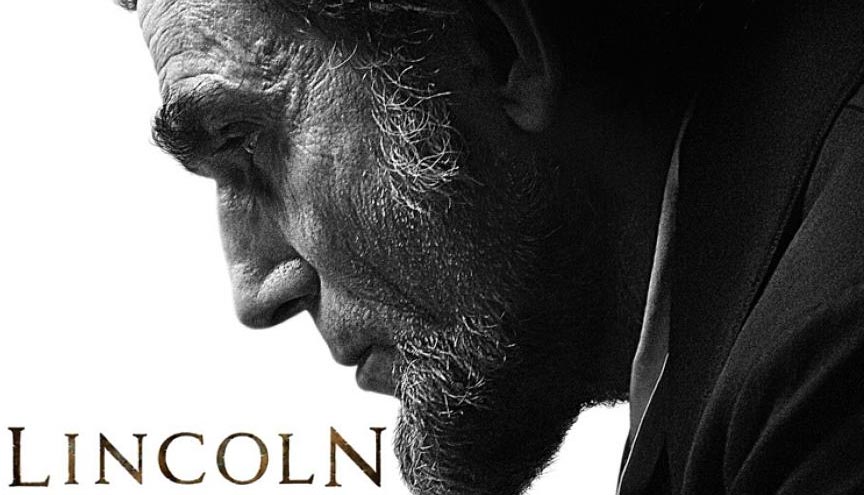
What more can I say that has not been said about this movie? I don’t want to repeat that it’s a strong contender for the Oscar race, or that Daniel Day-Lewis will likely taste his third Best Actor win as Lincoln, or that Tommy Lee Jones should get a nom in Best Supporting Actor for his role as Thaddeus Stevens, or Tony Kushner’s fine dialogues and captivating screenplay…

Here are some other thoughts that came to me as I watched the film, and later brewed in my mind.

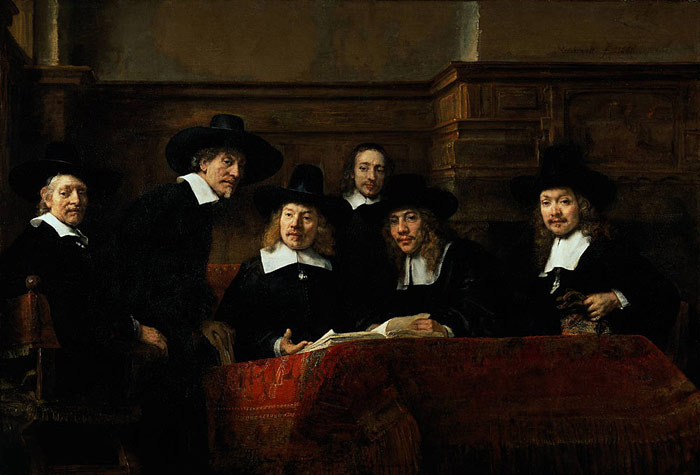
The Rembrandt impression. Watching the film is like seeing Rembrandt’s paintings come to life… especially all the indoor scenes with men gathering, in black, blue, and brown overtone throughout. Yes, the diffusing light from the windows may suggest Vermeer, but the predominantly men in most scenes dressed in black remind me more of Rembrandt. Like this one:

I can’t say much about the Dutch Masters in the above painting, they look pretty tame. But in the film Lincoln, the scenes wherein men congregate to discuss national affairs show the fierce power brokering and politicking of the time. We all know it was men who conferenced, talked about serious issues, made and won decisions, with whatever means avail to them, insults, intimidations, bickering, and persistent lobbying just to name a few.

And the women… The limited screen time Sally Field as Mary Todd Lincoln gets in the film could well indicate their position. Heaven forbid they get suffrage, and a voice. Truly, what can a wife do behind, in Mary’s own words, the most loved and powerful man in the country? How far we’ve come… but, does suffrage guarantee voices being heard? Just wondering.

As Mary Todd Lincoln, Field could well get an Oscar nom for her supporting role. She has done a fine job portraying the private grief behind the public face. Her son Willie died of high fever the night they had to entertain guests in a reception three years ago. A poignant scene occurs when the Lincolns as husband and wife quarrel over their past loss and now the possibility of losing another as their eldest son Robert (Joseph Gordon-Levitt) determines to enlist in the army, against his parents’ wish, or, is it only his mother’s?

From the photos above, we can tell how the casting, make-up and costume bring out the historic Mary Todd Lincoln. I remember Sally Field on Jay Leno said that she had to gain 25 pounds in 6 months to play the role, and later had to shed them all.

As an outsider, i.e., a non-American, I can’t say much about the accuracy of the content. I’m most interested to know which are Lincoln’s own words and in what context, and which are the scriptwriter’s. Even the British actor Daniel Day-Lewis himself had reportedly turned down the role at first as he felt he knew too little about the 16th U.S. President to portray him. As an outsider, I find it intriguing how an immensely influential historical figure is interpreted and portrayed. And apparently, there’s more than one angle.

Some time ago I watched PBS’s Looking For Lincoln, a documentary presented and written by Harvard professor Henry Louis Gates, Jr. It brings out a very different Lincoln, a complex, morally conflicting figure who had not initially tied the notions of freedom for the slaves with equality of the races. Gates went through extensive archival documents, Lincoln’s own notebooks, writings and debates, and interviews with scholars and academics to discover a Lincoln who had to lay aside prejudicial views and take on gradual personal changes as the Civil War bled on.

Interestingly, Gates interviews Doris Kearns Goodwin, the Pulitzer Prize winning biographer whose book Team of Rivals was what Spielberg based his film in parts on. It has been noted that even before she wrote it Spielberg was willing to secure the film rights. In Gates’ documentary, Goodwin admits that there is a need to demythologize the man Lincoln. While generations revere his greatness, he is very much human with strengths and weaknesses.

Spielberg’s interpretation is the popular frame and presents a singularly, saintly and benevolent emancipator instead of a complex and pragmatic politician, a 19th century white man who was very much a product of his times.

No matter, whatever angle Spielberg has chosen to interpret and present Lincoln, he has done it convincingly. Credits are due to Daniel Day-Lewis’s superb performance. He has salvaged any shortfalls with great charisma.

However, I do feel there are two weak sections in the film… the opening and later at the end. Seems like Spielberg is trying a tad bit too hard right at the start, for the opening scene sounds contrived as four young Union soldiers, two from each race, stand in awe in front of Lincoln in an army camp and recite back to him the Gettysburg Address.

The other is the assassination. With the whole movie resting on careful detailing of the passage of the 13th Amendment, I was surprised to find Spielberg’s treatment of Lincoln’s assassination in such a hasty manner, albeit the young son Tad’s reaction is moving. This is a scene that deserves much greater intensity and depth, not only for dramatic effects but for the balance of the whole story and expectation from the audience. Now this is the director who gave us the chilling sequences of Jaws, building the suspense of impending danger through the thumping of music and the ironic oblivion of the crowds.

Nevertheless, the second Inaugural Address ends the film on a poignant note. With malice toward none, with charity for all… Spielberg leaves us with Day-Lewis’s charismatic persona of Lincoln exhorting the crowd. With that, he has crafted another epic which will long be remembered, but in the short term, a sure contender come Oscars 2013.

~ ~ ~ ~ Ripples

***

CLICK HERE to watch PBS’s ‘Looking For Lincoln’. It is presented in titled segments. You can click on any of them to watch. But I highly recommend that you go through the whole documentary, just for some alternative views.

PHOTO SOURCES: Mary Todd Lincoln and Sally Field from Vanity Fair. Others are stills from movie trailer. 

Skyfall (2012)

And now for something totally different…

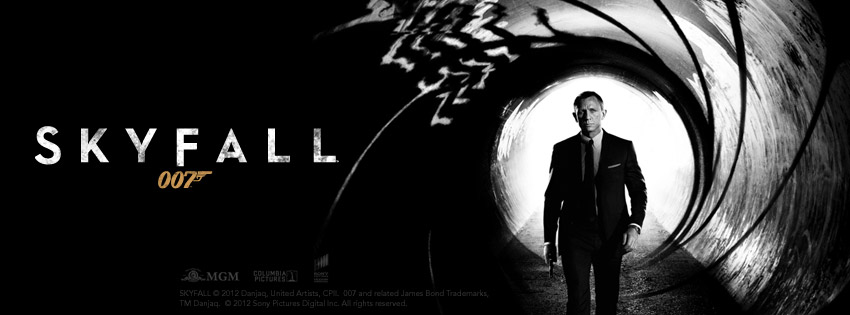
After 50 years, this 23rd instalment of the James Bond film franchise has just raised the bar and anchored its place in the 21st century spy action genre. Ian Fleming has long passed, but his iconic character lives on, portrayed and later resurrected by different suave British actors beginning with, and still my man, Sean Connery, to now Daniel Craig.

Resurrection is the word. You’ll hear it, and see its effect, for with Skyfall, looks like the franchise has just been resuscitated to a brand new life, just like the hero in the film. Kudos to Sam Mendes, the Oscar winning director who helmed such human drama as American Beauty and Revolutionary Road, working with cinematographer Roger Deakins, whose talent has enhanced some of my favorite films like Shawshank Redemption, Fargo, A Serious Man, True Grit

So what we have is a slick and stylish action thriller but not just in form. Sure, Daniel Craig in his Tom Ford suit, always standing straight and legs apart is all about style, isn’t it? Well, yes and no. Here, we see some internal tapping into the Bond character, just enough to tie over to the next action sequence. And we see too Bond shedding a few tears, for a good reason.

The villain is Javier Bardem. The cold-blooded psychotic killer in No Country for Old Men is just as ruthless and haunting here, but with a change in hair-do. He is Raoul Silva, a vengeful ex-MI6 agent who has gotten hold of a list of all the identities of MI6 agents embedded in terrorist organizations. His pleasure is to kill them down the list. Bardem’s image of Silva reminds me of Hannibal Lecter in The Silence of the Lambs, especially the scene with that transparent cylindrical cage… just gives away what would be coming next.

And our beloved Judie Dench, who’s so versatile that one minute you see her in The Best Exotic Marigold Hotel and the next transported into MI6 headquarters as M. Of course, she’s long been M before Marigold. In Skyfall, Dench deservedly gets more significant screen time than in previous Bond movies. In a later part of the film, M is called to a public hearing to justify her actions and even the existence of MI6. She has some powerful lines which make the scene so gratifying. Her voice-over juxtaposes with the urgent sequence in which we see the villain Silva leaving a trail of violence heading over to get her. Here are the poignant lines she delivers, from Tennyson’s poem ‘Ulysses’:

Though much is taken, much abides; and though
We are not now that strength which in old days
Moved earth and heaven; that which we are, we are;
One equal temper of heroic hearts,
Made weak by time and fate, but strong in will
To strive, to seek, to find, and not to yield.

Can you sense a bit how this is quite a different Bond film?

A fine cast is always the major asset. Another veteran is Albert Finney, who appears almost incognito (to me that is) but a good match with Dench.

With the new life comes two new faces. Both are excellent choices. One is Ralph Fiennes, and he definitely suits the part. Another is Ben Whishaw. Can’t imagine his transformation from John Keats in Bright Star to the digitally savvy young Q. Playing alongside Craig, Whishaw makes an interesting contrast, the gun-wielding old-timer in the field and the young computer geek in the office, taking control of situations with his fingertips.

Further, there are the exotic locations, Istanbul and other places in Turkey, Shanghai, Macau and… Scotland, which not for its exoticism but atmosphere. Cinematographer Deakins has crafted some very stylish scenes that distinguish Skyfall from just any other action flick… aesthetically appealing, moody and atmospheric, a mixed bag of nostalgic noir and contemporary, and in the last part, even a dash of gothic. If not for that iconic Aston Martin DB5 from Goldfinger parked outside the old stone mansion by the moor, you’d think it’s right out of Wuthering Heights.

Adele also joins the league. She co-wrote the Skyfall theme song and sings it in a way that echoes previous Bond numbers, most obviously, ‘Diamonds Are Forever’.

Skyfall has propelled the Bond film to a new era and up a notch. I’ve appreciated the internal character exploration but of course, there are still the spectacular explosions and car chases, the over-the-top mayhem and implausible escapes. We need those to ensure the audience that our hero is alive and well, after given a new lease on life. He’s still the same old Bond, James Bond.

~ ~ ~ Ripples

***

To Rome With Love (2012)

If you’ve been writing and making one movie every year, you’re faced with a greater challenge after each production. It’s an annual increment of difficulty. You need to create something original and not recycle old jokes, not a clone from your previous works but still imbued with your own style and signature.

A movie a year, that’s what Woody Allen has been doing for over four decades. Hats off to him for his creative energy and motivation. I’m more than willing and ready to overlook the ones that are not so great in his repertoire. For me, his misses are still better than some others’ hits.

And for those who still linger in the Annie Hall/Manhattan trance, I’d say, move on. His recent works may not be as unique and stylish as those in his earlier days, they are still entertaining and funny in their Woody Allen way.

Last year’s Midnight In Paris is an Oscar worthy hit. First you think, then you laugh. This year, Allen brings us To Rome With Love. You can just laugh. It is not as cerebral as Midnight. You don’t get to meet Hemingway or Dali, instead, you see the vignettes of ordinary folks who happen to be living in or visiting Rome.

An interesting film structure here, and in the hands of an auteur, it looks alright to tell four totally unrelated stories at the same time. The plots are interwoven well, albeit the ending, or endings, seem a bit abrupt.

Here they are, simple stories in the hands of a veteran writer/director…

A prominent American architect (Alec Baldwin) revisits Rome where he  studied architecture in his youth. He encounters a young architecture student (Jesse Eisenberg) and is most ready to offer the young man his advice, not on his profession but relationships, as he sees the young man succumb to the lure of his wife’s (Greta Gerwig) best friend (Ellen Page) staying shortly in their home while recuperating from a failed relationship.

It seems in every Woody Allen film, there’s a pseudo-intellectual. This role falls surprisingly on Ellen Page, giving us a fresh view of the young Canadian actress, a departure from Juno, Whip It, and Inception. Jesse Eisenberg is dreamy and sweet, unlike his Mark Zuckerberg in The Social Network. And Alec Baldwin is… Alec Baldwin.

Six years after Scoop, Woody Allen comes back on screen in his own movie as a reluctantly retired opera director. He travels with his wife (Judy Davis) to Rome to meet his daughter’s fiancé and his family. While in their home, he can’t resist the talent he finds as he hears the father sing in the shower. The real-life, acclaimed tenor Fabio Armiliato has many chances to sing in this movie, but in a very different setting. Some hilarious scenes, albeit they look like they are made in the expense of culturally stigmatizing. But I admire that Armiliato is willing to go along with the wacky Woody scenarios.

A third story line is a mistaken identity subplot with a newly-wed couple moving to Rome from a small town. As the wife (Alessandra Mastronardi) steps out of the hotel room to get her hair done, a prostitute (Penelope Cruz) drops in, to the horror of the husband (Alessandro Tiberian). His relatives are just outside the door soon after so the two have to improvise.

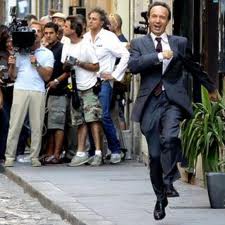
The fourth story is very funny and could well be Allen’s commentary on the making of celebrity by paparazzi. An ordinary citizen, well-played by the animated Roberto Benigni (Won Oscar for his role in Life is Beautiful), is turned into a celebrity for no apparent reason. He is chased everywhere by the paparazzi, interviewed on TV, asked the most trivial questions like what he has for breakfast, shaver or razor, boxer or brief… Uncanny parallels of what social media make of us, everyone can be readily exposed, everyone can be a celebrity if only one has enough followers. The simple lesson here is, they can drop you as quickly as they pick you up. Unfollow by just a click.

A breezy summer treat. The scenes may seem episodic but they are smoothly woven. Again here, the actors are the major assets, especially when you need to improvise as some scenes look like. Every character likable, and the overall effect enjoyable. Not epic but still an entertaining piece of Allen humor. After all, you don’t churn out an epic every year.

~ ~ ~ Ripples

***

A NOTE ABOUT MOVIE PHOTOS: These images are used according to the Fair Use guidelines for criticism, comment and educational purposes. CLICK HERE for more information. CLICK HERE to read the Report of the Ad Hoc Committee of the Society For Cinema Studies, “Fair Usage Publication of Film Stills” by Kristin Thompson.

***

Oscar Nominations 2012

Feb. 26th is Oscar night. I’m reposting here my take on the Best Picture nominees, and some more… a post I wrote on Jan. 24th, shortly after they were announced at 5:30 am PST.

***

With the announcement of the 84th Academy Awards Nominees this morning, I’ve prepared here a guide to the nominated films for Best Picture plus some more. I’ve seen them all except one, which I admit is somewhat unexpected, that’s Extremely Loud and Incredibly Close. For some of the others, do click on the link in the title to read my full review.

Here are the 9 nominees for Best Motion Picture:

The Artist —  Riding high the waves in this Awards Season, and most likely to grab the top Oscar. Kudos to the filmmakers for taking a bold and contrary step to pay homage to the silent era of Hollywood. Audacious in its attempt at a black and white silent film in 2011, where CGI and 3D’s are the cinematic effects, a long way from the great advancement of sound. Sure it’s light and frothy, which makes me admire all the more the boldness and foresight of the financial backers. Actions do speak louder than words. 10 noms in all.

The Descendants —  Well acted, probably George Clooney’s best performance I’ve seen, a close Oscar contender with Jean Dujardin of The Artist for Best Actor. The idyllic setting in Hawaii shrouds conflicts among family members: between husband and wife, parents and children, and in the extended level, relatives when it comes to monetary gains and interests. A fine film from Oscar winning director Alexander Payne of Sideways fame. While there are interesting twists and turns, the ending is predictable. A close contender with The Artist for Best Picture.

The Tree of Life — I’m excited to see Terrence Malick’s existential epic included in the list.  The film generally draws two opposing reactions, like its premiere in Cannes, boos and applause. Ironically, those might well be the two ways the film portrays, two possible views towards life. Other noms: Terrence Malick for Best Director, and deservedly, Emmanuel Lubezki for Best Cinematography.

Midnight In Paris — It has been a long time since Woody Allen won a Best Picture Oscar (Annie Hall, 1977), glad it’s time again for a nod, even though its chance of winning is slim. As in a few other nominated movies on this list, nostalgia is key. An imaginary trip back to Paris during the literary and artistic golden age of Gertrude Stein, Hemingway and Picasso, an aspiring writer from California learns the notion of golden is only relative. What’s precious may well be the time at hand. Woody Allen also receives noms for Directing and Original Screenplay.

Hugo — Leading the Oscar nom counts with 11. Another homage to the cinema, or, the creation of the cinema dating back to the Lumière Brothers, but specifically to Georges Méliès, the French innovator of cinematic special effects. Interesting to see Martin Scorsese uses the modern technique of 3D to honor the pioneer Méliès. A visually stunning adaptation of Brian Selznick’s The Invention of Hugo Cabret. Scorsese has proven to me that 3D doesn’t have to be synonymous with soulless gimmick. Heart-warming, beautiful film for everyone.

The Help — As Roger Ebert was labelled “a lackey for imperialism” after writing that he likes ‘Downton Abbey’, I must put in this Disclaimer: I have high respect for the courageous fighters in the civil rights movement, both on a societal level like Martin Luther King Jr. and those making personal steps like Rosa Parks. How I feel about this movie is strictly to do with the movie itself. Ok, here it is: I find it riddled with simplistic and contrived sentiments. The pool of major acting talents are morphed into caricatures. As I was watching, I felt they were all acting, not being. Can’t blame them, they were following a script and a director. Viola Davis nom for Best Actress, Jessica Chastain and Octavia Spencer for Best Supporting Actress. And the Oscar likely goes to Spencer.

The War Horse — Again, a Disclaimer here: I’m not against animals in movies… often, it’s the humans that leave much to be desired. Personally, I’m surprised that this is from Spielberg. Lacklustre storytelling, cliché moments and superficial characterization. The most natural and beautiful actor could well be Joey, the horse. The film is an adaptation of the children’s book of the same name written from the POV of the horse. Now, that sounds fresh and unique.

Moneyball — Can strike the heart of even non-baseball fans. A well paced and edited, engaging movie. The real story of Oakland A’s general manager Billy Beane. It’s always satisfying when the underdog wins, David overcoming Goliath, especially when money is involved. Brad Pitt getting Best Actor nom, and Jonah Hill Best Supporting. Other categories include Editing and Adapted Screenplay.

Extremely Loud and Incredibly Close — The is the only one among the nine I have yet to see, for truly I did not expect it to be nominated for Best Picture. I’ve read Jonathan Safran Foer’s novel, the source material, with mixed feelings. And for it to be adapted into a film, much has to be done to interpret, alter, and display.  So, I reserve judgement on the film until I’ve seen it.

Other Nominees:

Meryl Streep for Best Actress in The Iron Lady — If you want historical accuracy, go see a documentary. But even there it depends on the POV of the filmmaker.  Director Phyllida Lloyd (Mamma Mia!) has conjured up an internal world of the only woman Prime Minister of Britain, Margaret Thatcher. Unless she comes to rebut the director’s view, who are we to argue against it? Let’s just go beyond the debates and appreciate the marvellous performance by Meryl Streep. This might well be her chance for a second Best Actress Oscar since Sophie’s Choice in 1983. Jim Broadbent always complements superbly.

Michelle Williams for Best Actress in My Week With Marilyn — Michelle Williams proves her amazing versatility here. I mean, after seeing Wendy and Lucy, Blue Valentine, can you imagine a more diverse role as Marilyn Monroe? She delivers convincingly. Kenneth Branagh gets the nom for Best Supporting Actor as Sir Laurence Olivier. And who’s that obscure chap that gets to spend a week with Marilyn? Why, he’s Eddie Redmayne, Angel Claire in Tess of the D’Urbervilles.

Gary Oldman for Best Actor in Tinker Tailor Soldier Spy — Film scholar David Bordwell suggests that we see it as ‘a moving mosaic’. This film is made up of fragments of John Le Carré’s complex and massive work. So it’s better that you’ve read it first before watching. But if you’re like me, abandoning the book without finishing, you can still appreciate the overall atmosphere and the fine acting. Intricately weaving characters and time frames, the film’s intriguing ending has prompted me to go back to the book after watching it. CLICK HERE to read Bordwell‘s insightful review to help you through the Labyrinth.

***

CLICK HERE for a full list of Nominees.

Oscar Nominations 2012

With the announcement of the 84th Academy Awards Nominees this morning, I’ve prepared here a guide to the 9 nominated films for Best Picture plus a few more. I’ve seen them all except one, which I admit is somewhat unexpected, that’s Extremely Loud and Incredibly Close. For some of the others, do click on the link in the title to read my full review.

Here are the 9 nominees for Best Motion Picture:

The Artist —  Riding high the waves in this Awards Season, and most likely to grab the top Oscar. Kudos to the filmmakers for taking a bold and contrary step to pay homage to the silent era of Hollywood. Audacious in its attempt at a black and white silent film in 2011, where CGI and 3D’s are the cinematic effects, a long way from the great advancement of sound. Sure it’s light and frothy, which makes me admire all the more the boldness and foresight of the financial backers. Actions do speak louder than words. 10 noms in all.

The Descendants —  Well acted, probably George Clooney’s best performance I’ve seen, a close Oscar contender with Jean Dujardin of The Artist for Best Actor. The idyllic setting in Hawaii shrouds conflicts among family members: between husband and wife, parents and children, and in the extended level, relatives when it comes to monetary gains and interests. A fine film from Oscar winning director Alexander Payne of Sideways fame. While there are interesting twists and turns, the ending is predictable. A close contender with The Artist for Best Picture.

The Tree of Life — I’m excited to see Terrence Malick’s existential epic included in the list.  The film generally draws two opposing reactions, like its premiere in Cannes, boos and applause. Ironically, those might well be the two ways the film portrays, two possible views towards life. Other noms: Terrence Malick for Best Director, and deservedly, Emmanuel Lubezki for Best Cinematography.

Midnight In Paris — It has been a long time since Woody Allen won a Best Picture Oscar (Annie Hall, 1977), glad it’s time again for a nod, even though its chance of winning is slim. As in a few other nominated movies on this list, nostalgia is key. An imaginary trip back to Paris during the literary and artistic golden age of Gertrude Stein, Hemingway and Picasso, an aspiring writer from California learns the notion of golden is only relative. What’s precious may well be the time at hand. Woody Allen also receives noms for Directing and Original Screenplay.

Hugo — Leading the Oscar nom counts with 11. Another homage to the cinema, or, the creation of the cinema dating back to the Lumière Brothers, but specifically to Georges Méliès, the French innovator of cinematic special effects. Interesting to see Martin Scorsese uses the modern technique of 3D to honor the pioneer Méliès. A visually stunning adaptation of Brian Selznick’s The Invention of Hugo Cabret. Scorsese has proven to me that 3D doesn’t have to be synonymous with soulless gimmick. Heart-warming, beautiful film for everyone.

The Help — As Roger Ebert was labelled “a lackey for imperialism” after writing that he likes ‘Downton Abbey’, I must put in this Disclaimer: I have high respect for the courageous fighters in the civil rights movement, both on a societal level like Martin Luther King Jr. and those making personal steps like Rosa Parks. How I feel about this movie is strictly to do with the movie itself. Ok, here it is: I find it riddled with simplistic and contrived sentiments. The pool of major acting talents are morphed into caricatures. As I was watching, I felt they were all acting, not being. Can’t blame them, they were following a script and a director. Viola Davis nom for Best Actress, Jessica Chastain and Octavia Spencer for Best Supporting Actress. And the Oscar likely goes to Spencer.

The War Horse — Again, a Disclaimer here: I’m not against animals in movies… often, it’s the humans that leave much to be desired. Personally, I’m surprised that this is from Spielberg. Lacklustre storytelling, cliché moments and superficial characterization. The most natural and beautiful actor could well be Joey, the horse. The film is an adaptation of the children’s book of the same name written from the POV of the horse. Now, that sounds fresh and unique.

Moneyball — Can strike the heart of even non-baseball fans. A well paced and edited, engaging movie. The real story of Oakland A’s general manager Billy Beane. It’s always satisfying when the underdog wins, David overcoming Goliath, especially when money is involved. Brad Pitt getting Best Actor nom, and Jonah Hill Best Supporting. Other categories include Editing and Adapted Screenplay.

Extremely Loud and Incredibly Close — The is the only one among the nine I have yet to see, for truly I did not expect it to be nominated for Best Picture. I’ve read Jonathan Safran Foer’s novel, the source material, with mixed feelings. And for it to be adapted into a film, much has to be done to interpret, alter, and display.  So, I reserve judgement on the film until I’ve seen it.

Other Nominees:

Meryl Streep for Best Actress in The Iron Lady — If you want historical accuracy, go see a documentary. But even there it depends on the POV of the filmmaker.  Director Phyllida Lloyd (Mamma Mia!) has conjured up an internal world of the only woman Prime Minister of Britain, Margaret Thatcher. Unless she comes to rebut the director’s view, who are we to argue against it? Let’s just go beyond the debates and appreciate the marvellous performance by Meryl Streep. This might well be her chance for a second Best Actress Oscar since Sophie’s Choice in 1983. Jim Broadbent always complements superbly.

Michelle Williams for Best Actress in My Week With Marilyn — Michelle Williams proves her amazing versatility here. I mean, after seeing Wendy and Lucy, Blue Valentine, can you imagine a more diverse role as Marilyn Monroe? She delivers convincingly. Kenneth Branagh gets the nom for Best Supporting Actor as Sir Laurence Olivier. And who’s that obscure chap that gets to spend a week with Marilyn? Why, he’s Eddie Redmayne, Angel Claire in Tess of the D’Urbervilles.

Gary Oldman for Best Actor in Tinker Tailor Soldier Spy — Film scholar David Bordwell suggests that we see it as ‘a moving mosaic’. This film is made up of fragments of John Le Carré’s complex and massive work. So it’s better that you’ve read it first before watching. But if you’re like me, abandoning the book without finishing, you can still appreciate the overall atmosphere and the fine acting. Intricately weaving characters and time frames, the film’s intriguing ending has prompted me to go back to the book after watching it. CLICK HERE to read Bordwell‘s insightful review to help you through the Labyrinth.

***

CLICK HERE for a full list of Nominees.

Midnight In Paris (2011)

.

.

A Woody Allen movie rated G? Yes, and maybe only in B.C. where I saw it in Vancouver yesterday. If you’re offering charming characters, lively performance from some talented actors, Woody Allen’s own clever screenplay inundated with witty dialogues, and have him direct in the backdrop of dreamlike Paris, the result is pure delight. You don’t need too much of anything extra, hence the MPAA PG-13 rating. And maybe because of that, clean and crisp, this is one of the Woody Allen movies I enjoy most for some years. And yes, this is the one with French first lady Carla Bruni in it, where Allen has to direct under the watchful eyes of the French President and his security personnel.

Gil (Owen Wilson) and Inez (Rachel McAdams) are engaged to be married. They take a trip to Paris with Inez’s parents John (Kurt Fuller) and Helen (Mimi Kennedy) for John’s business merger. While Gil and Inez first appear to be a romantic pair, we soon find them to be incompatible. Gil is an underachieved screenwriter from California, aiming to write his first novel. His dream of Paris is one of the golden age, nostalgically inhabited by the modernists, the artists and literati of the 1920’s.

However, his fiancé Inez fails to see his aspiration or potential, and the imagination that the cultural city can unleash in him. Rather, she falls for their American friend Paul (Michael Sheen), the intellectual snob whose self-importance drives him to snub Gil and even counter their museum guide (Carla Bruni) in the accuracy of her information. But Gil is more preoccupied with his midnight encounters, which ultimately transform him and change their individual paths. These experiences after midnight are just wonderful surprises for Gil, and me. Without giving too much of a spoiler, let’s just say it’s Woody Allen’s version of ‘Back to the Future’.

When I first saw the trailer, I had reservation about Owen Wilson being the leading man in a Woody Allen movie set in Paris. Would that be a miscast? Well, I’m proven wrong the moment he appears on screen. Wilson embodies the unassuming and delusional Gil, screenwriter from Pasadena, CA. He casts all of his previous film roles out of my mind and replaces with only this one of the moment, offering a performance that is impressively convincing. He leads a cast of wonderful actors, including the charming Marion Cotillard, veteran Kathy Bates, the versatile Michael Sheen, and a very dramatic Adrien Brody. And I won’t give away who is supposed to be who, I’ll leave that joy of discovery for you.

This is a movie for art and literature lovers, ideal for book bloggers and discussion groups. Allen has cleverly juxtaposed the modernists in the turn of the 20th century with their contemporary admirer Gil. We encounter all these iconic figures in the film: Ernest Hemingway, Scott and Zelda Fitzgerald, Gertrude Stein, Pablo Picasso, Cole Porter, Salvador Dali, T.S. Eliot and more… it’s so much fun to hear allusion to their works, and some of them utter lines that are their own but in the style and wit of Woody Allen’s.

What makes the movie gratifying of course is not just the visuals, people and places, but how the story leads. The twist towards the end is the pivotal revelation for Gil. While one can bask in nostalgia, one needs to embrace the present in order to fully live. As I watched the movie, I wanted to read the script and capture Allen’s ingenuity. As I left the theatre, I wanted to see it again.

~~~1/2 Ripples

To read my review of Hemingway’s A Moveable Feast CLICK HERE.

Jane Eyre (2011): Another Movie Adaptation

The perils of making a movie of a well-known literary classic that already has over 20 adaptations are: If you are faithful to your source, there bound to be scenes that look like you have just taken out from previous versions; if you are not, you risk accusations from the purists. On top of that, you will have to condense a relatively long story into two hours of screen time. So, why would anyone want to do such an arduous task? Hopefully there is an answer waiting when we come to the end of this post.

What would you do differently to appeal to 21st century viewers? A splash of defiance and independence from Jane could work. But still, even the smart and cerebral lines uttered by her we have all heard before, for they are written by Brontë. So what merits can a new adaptation claim?

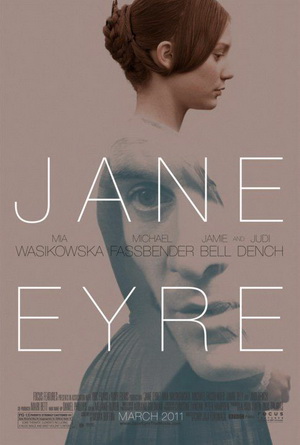
Another way to retell an old tale to today’s audience is offering a fresh perspective. Here, director Cary Fukunaga (Sin Nombre, 2009) has effectively crafted a non-linear structure of storytelling. Even for those who have not refreshed their classics memory lately, the movie’s smooth time changes should not pose a problem, for they are quite well done. It begins with Jane running away from Thornfield, desolate on the moors, but fortunate enough to be rescued and cared for by the pious but stern St. John Rivers (Jamie Bell of Billy Elliot fame, 2000) and his sisters. Upon questioning, Jane’s abused childhood and her time at Thornfield are revealed through flashbacks. It picks up from the opening scene again about three-quarters of the way, and pushes towards the anticipated ending.

Mia Wasikowska (Alice In Wonderland, 2010) faces a huge challenge to portray a Jane that’s convincing, and has to be compared to so many who had attempted in the past. Now Mia is the young Australian actor who has turned down the coveted role of Lisbeth Salander in “The Girl With the Dragon Tattoo” trilogy’s English version, and opted for the role of Jane Eyre. In an interview, she reveals that it all started when she was reading Charlotte Bronte’s 1847 novel about two years ago. By Chapter 5, she talked to her agent on the phone and asked whether by any chance there was an adaptation in the works. She knew she had to be Jane. Not long after that she received the screenplay by Moira Buffini. Thus began this newest cinematic rendition of Jane Eyre.

As a 19 year-old at the time of production, Mia was the right age for the role. That’s when Jane leaves Lowood School and heads out into the world to seek her own destiny. Brontë offers us a heroine who has a firm grip of self-respect and moral direction despite an abused upbringing. This is the Jane that has captured the hearts of so many throughout the years and who still appeals to us modern readers.

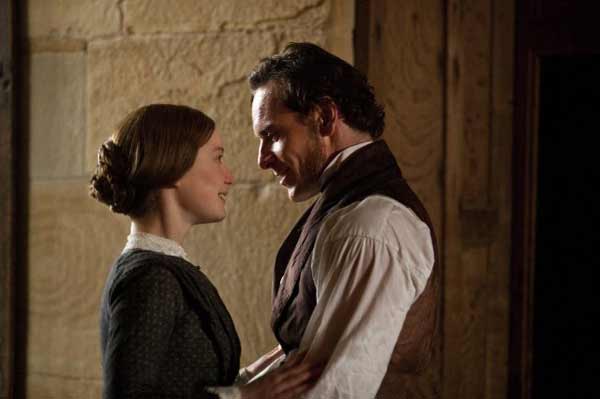
So our protagonist meets her fate as she lands a job at Thornfield as a governess to Adele, the ward of the enigmatic Edward Rochester, played by Michael Fassbender (Fish Tank, 2009). Fassbender just may have replaced Ciarán Hinds as my favorite Rochester. At 34, he might not be old enough to be faithful to the novel, but his performance is captivating and convincing. The two make a visually compatible pair. However, I have one major issue: the romance seems too restrained that it almost fails to ignite, especially on the part of Jane. With a movie like this, of course we go not so much for the Gothic, but for the passion. I wanted eagerly to be enthralled. But what I saw was a passionate Rochester wooing a repressed Jane. It’s ironic that almost throughout the film I remained emotionally disengaged, albeit thoroughly enjoying the performance of both characters.

Ultimately it comes, the scene that captures my heart. After the disclosure of the dark secret and the wedding called off, Jane desperately tries to fight off her deep yearning and love for Rochester by refusing his advance and embrace. She literally has to run away from Thornfield to uphold her moral choice and escape from her heart. And finally, for those who long for a cathartic reunion of the lovers, the ending again teases us by offering a closure that’s a bit too short and swift.

Still another and probably most effective way to appeal to modern viewers is the visuals. Kudos to both the director Fukunaga and cinematographer Adriano Goldman. They have answered the frequently asked question of “Why make another movie adaptation of a literary work?” We love to roam in our own privately constructed imaginary world when we read. A movie is the visualization of that world. It is an artistic display of a filmmaker’s interpretation and private imagination. It may not match our own, but surely can still be an enjoyment if it is presented with cinematic beauty.

We see Jane running away from Thornfield, our destitute heroine determined to make the moral choice despite the yearning of her heart. The fragile figure pitted against the harsh and barren moors, or the overhead shot of Jane standing at the crossroads … all effective visuals to present the literary, and by so doing, augment our appreciation of it. Here, you can see your own imagination realized, or see what others have conjured up in their minds. The few scenes where we have the shaky camera must be mentioned also. Generally I’m not a fan of hand-held camera work, but here in the film, such jerky moments are effective in depicting Jane’s troubled soul and inner turmoil. The camera lens following her has become the portal into her agitated and unsettling state of mind. Just another way the literary can be effectively translated into the visual.

Yet another movie adaptation of Jane Eyre? Why not… and I’m sure, there are more to come. I appreciate a filmmaker’s attempt to display the visual artistry that can be extracted from the literary. Words and visuals, they can go hand in hand in this image-driven age. And hopefully through popular screening and the viral medium, we can give recognition to the source materials that have entranced us for so long, giving credits to both the author and the writing.

~ ~ ~ Ripples

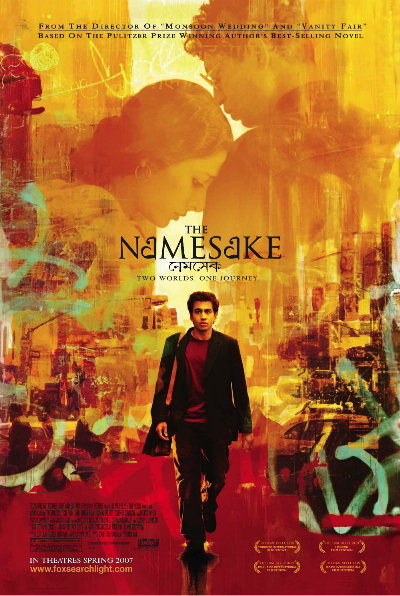
The Namesake (2006, DVD): Movie Review

This is a sequel to my last post, Book Review of The Namesake by Jhumpa Lahiri.  These back-to-back write-ups form my second instalment for the Read the Book, See the Movie Challenge over at Ready When You Are, CB.

“If it weren’t for photography, I wouldn’t be a filmmaker.  Every film I make is fuelled by photographs…. Photographs have always helped me crystallize the visual style of the film I’m about to make.”

—Mira Nair

And photography has brought to life the poignant novel The Namesake.

This is a perfect match.  The Namesake film adaptation is privileged to be crafted in the hands of the accomplished director Mira Nair, and its screenplay written by the multi-talented Sooni Taraporevala.  Both born in India the same year, grew up and educated there, later both had attended Harvard.  After earning her Masters at NYU majoring in Film Theory and Criticism, Taraporevala moved back to India and pursued a successful career in photography and other artistic endeavours. Mira Nair went on to become an acclaimed filmmaker and professor of Film at Columbia University.  Nair and Taraporevala collaborated on several films that have garnered international nominations and awards, including Cannes, Venice, BAFTA, and the Oscars.

The pair could have been characters taken right out of Jhumpa Lahiri’s stories.  They must have known from personal experience the realities of Lahiri’s stories, the feelings of being transplanted, the quest for identity.  As a result, they have effectively brought into visualization the internal worlds of Ashoke, Ashima, Gogol and Moushumi.  It is interesting to hear Nair describe herself as “a person who lives in many worlds”.  Every immigrant is at least a bicultural being.  Our postmodern world has only made it more and more viable to navigate across boundaries and sustain multiple identities.  The Indian meaning of the name Ashima could well have spoken to such a modern day phenomenon: without borders.

From this perspective, Nair is the best person then to take what could have been just another “ethnic movie” to a universal plane.  She has created a colorful rendition of a human story for us to enjoy.  You don’t have to be Bengali to appreciate the Ganguli saga.  Elements such as love, marriage, parent-child relation, expectations, self-fulfilment and its obstacles, the search for one’s place in the family and the world, these are all situations we can relate to.   It’s just now the issues have been explored from a different frame, offering us an alternative perspective.

I have appreciated the quiet development of love between Ashoke and Ashima despite their arranged marriage.  Their intimate husband and wife relationship is sensitively played by Irrfan Khan (Slumdog Millionaire, 2008) and the model and award-winning actress Tabu, an excellent choice in casting.  I particularly admire Tabu’s gentle and elegant poise.  It’s interesting to see how the two exchange deep sentiments by wordless, nuanced expressions and body language.

The treatment of the story in the hands of a visual artist understandably would be quite different from its original literary form.  Instead of the sombre tone, Nair has given the story a lively adornment, sustained by animated characters.  Nair’s Gogol is a more outgoing young man than that from the book, and I’m fine with that.  Kudos to Kal Penn’s portrayal of  Gogol/Nick Ganguli, an interesting performance fusing youthful energy and wistfulness at the same time.

Yes, that’s Kal Penn of the stoner movies Harold and Kumar fame (2004, 2008, and coming 2011) A much more serious role here in The Namesake.  A lively Gogol is only natural and fun to watch, for he is an American born young man who just wants to belong.  So we see him being impatient with his father’s restrained and non-communicable composure, we see him playing air guitar to loud music in his room, we see tender moments when he teases his younger sister Sonia, or the natural comedic look on his face, culture shocked during his family trip back to Calcutta, and we see his romance with Maxine (Jacinda Barrett, New York, I Love You, 2009), the American girl who is so oblivious to the cultural baggage he is carrying.

But Kal Penn has earned his role.  He wrote to Nair earnestly seeking for the part, telling her that The Namesake is his favorite book and often times, he would use the pseudonym Gogol Ganguli to check in hotels.  Some method acting, who’d have known he’s in character all along.

The bonus with watching a DVD is of course the special features.  The Namesake is a keeper if you’re into the creative process of filmmaking.  My favorite featurette is The Anatomy of The Namesake: A Class at Columbia University’s Graduate Film School in which Nair and other crew members engage in conversation with film students about the making of the movie.  Other wonderful featurettes include Photography as Inspiration, and Fox Movie Channel interview In Character with Kal Penn.

Overall, a faithful adaptation of Lahiri’s book, offering an entertaining, visually inspiring rendition of a story deserving to be seen.

~ ~ ~ Ripples

Another Year (2010)

Update Feb. 10: Leslie Manville just won British Actress of the Year at the London Film Critics’ Circle Awards.

Update Jan. 25: Mike Leigh is nominated for an Oscar for Original Screenplay.

Update Jan. 18: Another Year is nominated for a BAFTA for Outstanding British Film of the Year, and Leslie Manville for Best Supporting Actress.

“Ah, look at all the lonely people.”

— ‘Eleanor Rigby’

Every DayAnother Year, film titles like these evoke the oblivious passage of time, and the human experiences that float down the stream of life. The kind of films we would find in art-house cinemas, not your fast-paced action or effects-generated spectacle.  Another Year would gratify one’s need for slow ruminations and offer one time to savour the dynamics among characters.  The film was on my ‘must-see’ list at the Calgary International Film Festival 2010, which ended last weekend.  It had met all my expectations and offered more.

What’s more is the excellent performance from a high calibre cast of British actors.  Their nuanced portrayals of characters convey emotions unabashedly, but in a deep, restrained and unsentimental manner.  That is what makes Another Year so satisfying.  I enjoyed it much more than director Mike Leigh’s previous title, equally acclaimed Happy-Go-Lucky (2008), in which Poppy (Sally Hawkins) the happy gal is just a bit too loud and even obnoxious for me.  While here in Another Year, Tom and Gerri are the happy couple whose relationship is one of mature, quiet and gentle bliss, compassionate towards themselves and others.

Framed in the passing of the four seasons, the film explores the realities of life: ageing, loneliness, death, love, marriage, friendship… Yet the occasional animated and humorous renderings of the characters allow a lighter way of handling the subject matters.

Gerri (Ruth Sheen) and Tom (Jim Broadbent) are a happily married couple living in London.  In the midst of the bustling city, they have their own plot of land close by their home where they work hard to grow vegetables. They bring home fresh produce to cook healthy meals and entertain guests.  Their vegetable garden is an apt metaphor for the love they cultivate in their relationship despite the busyness of everyday life. Tom is a geologist and Gerri a counsellor in a medical office. If there’s any pun intended here with their names, it would be for the very opposite effect that they are a harmonious pair whose relationship has attracted those less happy to cling on for stability and support.

Their usual dinner guest is Gerri’s office administrator Mary (Lesley Manville).  A single, middle-aged woman, emotionally fragile, alcohol dependent, and desperately seeking love and companionship. Her male version is Tom’s long time friend Ken (Peter Wight), equally miserable. A heavy smoker and drinker, Ken’s physical health mirrors his emotional state.

But why Tom and Gerri gather such damaged and dependent friends the film does not explain.  What we do see is a most gracious couple extending their lives to them. Through their interactions, we see the contrast. While we admire the almost perfect marriage, we ache for the singles, sad and lonely… as we see them in this film.  I trust the director is making a specific rendering and not a generalization on singlehood.  The contented Poppy (Sally Hawkins) in Happy-Go-Lucky (2008) is the best spokesperson for the single league.

Tom and Gerri have an adult son Carl (Martin Savage) who frequently comes home to visit his parents from a nearby town by train. When I saw the shot of a commuter train going past on screen, it flashed upon my mind the image in Ozu’s works.  That is one of the Japanese director’s signature shots, a train passing through, and his favourite subjects also being family, marriage, nuanced interactions.  I thought, if Ozu were an Englishman living today, this would be the kind of films he would make.  And lo and behold, I found this tidbit of trivia on IMDb: One of Mike Leigh’s top 10 films of all time is Tokyo Story (1953).

If one is to find fault with Another Year, it could be the very fact that Tom and Gerri’s marriage is just too perfect. But with all the ubiquitous dysfunctional families we see represented in movies nowadays, Leigh might have opened a window to let in some much needed fresh air. Tom and Gerri make an ideal contrast to what we have so sadly gotten used to seeing in films.

There are excellent performances from the veteran actors, but one stands out. Lesley Manville’s animated portrayal of the vulnerable Mary deserves an Oscar nomination. The most impressive shot comes at the end. Without giving it away, let me just say the ending shot lingering on her face and the ultimate fade to black is poignant and most effective. Of course, it’s acceptable to applaud after a festival screening. And so we did, appreciatively, a much needed channel for a cathartic response.

~ ~ ~ 1/2 Ripples

Every Day (2010)

In the movie Shadowlands, there’s a line that goes like this: “We read to know we are not alone.”  I think it applies to watching movies as well.

I’m glad somebody thinks the every day family life worthy of movie material.  Nothing spectacular or heroic, nonetheless difficult and to some, a struggle.  This is especially true when it comes to the so called sandwich generation, adult children who needs to care for their elderly parents as well as their own children.  Caught in the middle, parents to both.  In the midst of daily challenges, there remains the key relationship, the meat in the sandwich if you will, that which is between husband and wife, and always, the bare essence of a person and his/her integrity.  Herein lies the ingredients of the story.

Screened at the Calgary International Film Festival last night, the indie dramedy stars Liev Schreiber and Helen Hunt as a NYC couple, Ned and Jeannie.  Their marriage faces a testing turn as Jeannie, driven by guilt and responsibility, brought her recently widowed father home to stay.  Ernie (Brian Dennehy) is not just any grumpy old man.  He is wheelchair confined, in ill health, and utterly bitter about everything and with everyone.  Jeannie is stressed out as she keeps pace just to live every single day.

Ned too has his share of problems at work.  As a scriptwriter for a seedy TV series, he has to meet the perverted demands of his boss Garrett (Eddie Izzard) to churn out scripts that are beneath his style.  To solve the problem he is assigned to work with a flirtatious colleague Robin (Carla Gugino) to rewrite something more daring and less boring.  Ned is tempted to do exactly that not only in his script.

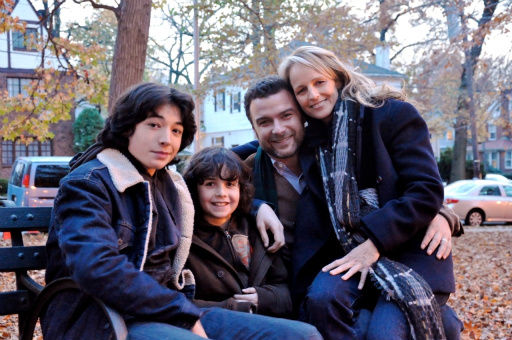
And for their sons, they may look alright, but both yearn for direction and care just the same.  15 year-old Jonah (Ezra Miller) has just come out and is heading towards some risky friendship.  The younger one Ethan (Skyler Fortgang), though talented, has to deal with a defeating self-image. Amidst their own problems, Ned and Jeannie try to be good parents, loving yet setting limits, albeit finding a happy medium is hard to do.

Though not meant to be a serious film, it does touch on two thought-provoking questions implied by two unlikely characters.  From Robin the seducer:  Is a marriage finished when the ‘fun’ is over? Similarly from Ernie the bitter old man:  Should a life be ended when there is no happiness?

With subject matters as such, sitting through Every Day could be a gloomy ordeal.  But as a fusion of comedy and drama, it has come through to me as an enjoyable film. Written and directed by Richard Levine of the TV series “Nip/Tuck” fame, Every Day could seem episodic.  But the fast scene changes keeps the momentum going and the subplots clear.  Liev Schreiber is convincing as the family man in mid-life crisis.  Brian Dennehy is a veteran and spot on in his performance.  The boys are alright.  I have enjoyed Helen Hunt the most.  Her precarious roles of mother, wife, and daughter have resonated with me.  It has been three years since her directorial debut Then She Found Me.  I look forward to more of her works in the coming year.

Every Day premiered at the Tribeca Film Festival in NYC this April.  During the Q & A after the screening, Schreiber mentioned that the film is “a simple story and simple stories are often overlooked.”  Somebody has to make simple films like this, and somebody has to watch them.  I was one of the lucky ones last night at the CIFF.

~ ~ ~ Ripples

Photo Source: myveronanj.com