Paris in July 2025 – Delightful reads by Antoine Laurain

For Paris in July this year, I want to read an actual Parisian author writing Parisian stories. I did some digging and found Antoine Laurain. I’m late to the party, for Laurain has written more than a dozen books, which have been translated into twenty languages, an award-winning novelist whose talents are multi-faceted: author, journalist, screenwriter, film director, antique collector and dealer.

I’ve read or listened to four of Laurain’s novels in the past weeks: The Red Notebook (2014), The President’s Hat (2012), The Readers’ Room (2020), and The French Windows (2024). I still have many more to savour. These ones I’ve read are all like novellas, less than 200 pages, each unique in its storyline, very entertaining, easily accessible but not shallow. Laurain’s writing is a fusion of the literary and the popular, weaving suspense and romance, or adding a dash of magical realism as in The President’s Hat. Among these four, The Red Notebook is my favourite.
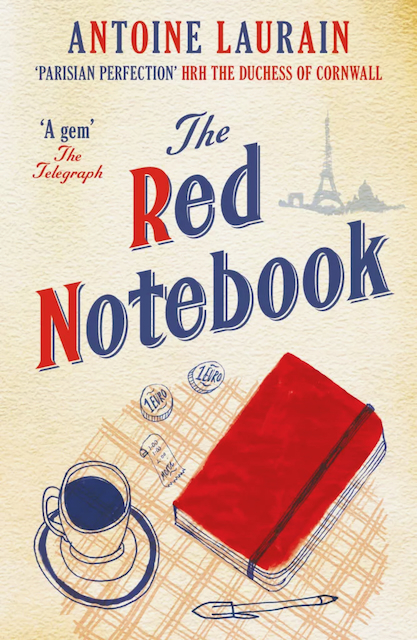
The Red Notebook by Antoine Laurain, Gallic Books (English edition), 2015,
159 pages.

Ahh… The contentment of being sought and found… and to be known.

Laurent, a bookstore owner, finds a woman’s leather handbag in good condition on top of a garbage bin on the street one morning, obviously stolen and discarded there. He takes it to the police station, but is told to wait. Doesn’t have time to spare, Laurent decides to leave it till the next day to hand it in. The mauve handbag is just too much of a lure for Laurent to keep his curiosity in check. That night at home, he opens it gingerly and explores the personal effects inside, hoping to find a name and address so he can return it to its owner.

Among the perfume, hair clip, keys, and numerous other items, there’s a red Moleskin notebook. Just too tempting, how can he not open it? The elegant and fluid handwriting records the owner’s self-reflections, her likes, her fears, her dream.

He had opened a door into the soul of the woman with the mauve bag and even though he felt what he was doing was inappropriate, he couldn’t stop himself from reading on.

It could sound creepy, but Laurain lets his readers empathize with this curious middle-age bookseller, for he is now a detective of the soul. And Laurain knows how to tell his story with humour. As he searches the bag, his girlfriend shows up, complicating matters. Later, adding zest to his quest, his daughter joins in his detective work readily and offers invaluable assistance.

Augmenting Laurent’s eagerness to find the owner of the bag himself instead of letting it go to the police is another object in the handbag, the book Accident Nocturne signed and with a line of dedication handwritten by the French author and Nobel laureate Patrick Modiano. The bookseller is overcome by a surge of passion, for Modiano is his favourite writer. Herein lies the clue to someone who shares the same mind as his. From the line of inscription, Laurent knows the first name of the owner of the bag, Laure.

While ordinary love stories might focus on a person looking for the right one to love, here in The Red Notebook, it describes the complementary side of the search as well, by revealing the one aspect which might be the most gratifying of true love: being sought and found… and to be known.

I like the idea of a man going to so much trouble to find me (no one has ever gone to so much trouble for me before)

While Laure has had men in her life before, but there has never been one who had really stepped inside her mind. Yet here is one stranger who has known and admired her inner being, and is passionate enough to go the distance to find her, and yet…

The ‘and yet…’ is purposely unwritten as I don’t want to give any spoilers. I highly recommend The Red Notebook as a light and entertaining read, one that touches that soft spot of the human heart, to be sought and found… and deeply known.

I await a filmmaker to take this up, write an English screen adaptation and set in New York City, find a perfect cast, and I’m sure it will make one marvellous rom com, or a little more serious but equally heartwarming rom dramedy.

Ah… Celine Song, would you be interested?

***

Paris in July 2025 is hosted by Words and Peace and France Book Tours
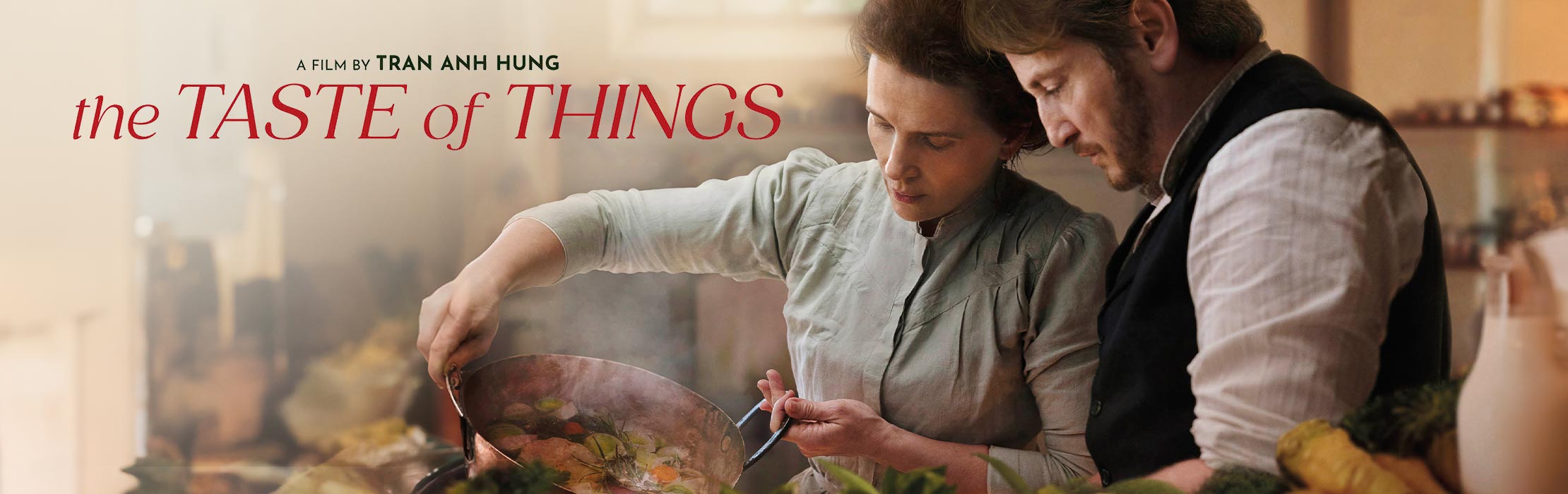
‘The Taste of Things’: the Country Kitchen as Vermeer’s Studio

At last year’s Oscar time, I was a little surprised that the buzzy Anatomy of a Fall wasn’t selected as the official entry by France to enter the race for Best International Feature Film. Instead, it was The Taste of Things. Now that I have the chance to watch it, I can understand why it was the choice and I totally agree with it. That it did not win seems immaterial, for its aesthetic value and the honour of being chosen to represent France make it a worthy accolade.

The Taste of Things is a delectable feature, a celebration of French gastronomy and its historic, culinary traditions, an exquisite and aesthetically riveting period film set in a country house. Vol-au-vent, pot-au-feu, roast rack of veal with braised vegetables… To say it’s a delicious food movie is just lowering the level of enjoyment, like eating an ice cream cone compared to being served baked alaska prepared by a gourmet. The film is not just about the taste of food, but of love, beauty, sensuality, and human connection, offering a deeply gratifying viewing experience.

Directed by the Vietnamese-French filmmaker Anh Hung Tran––whose first film The Scent of Papaya won a César Award in 1994 as well as accolades at Cannes––The Taste of Things sent Tran to Cannes again in 2023 and this time a Palme d’Or nominee and winning Best Director.

Tran reunited Juliette Binoche with her ex Benoît Magimel for the film. The two were divorced twenty years ago. Maybe a past relationship had some bearings on stirring up fond memories, for the pair exudes admirable chemistry on screen. Magimel plays the fictional gourmet Dodin Bouffant, nickname ‘Napoleon of gastronomy’, who resides in a country house during the late 19th century. His cook for twenty years has been Eugénie, superbly portrayed by Binoche, ethereal even in a rustic kitchen.

While Babette’s Feast (1988 Oscar’s Best Foreign Language Film) comes to mind readily, it’s the visual memory of Girl with a Pearl Earring (2004) that enhances my appreciation of The Taste of Things. Indeed, Dodin’s kitchen is like Vermeer’s studio, large window allowing natural light to pour in, the colour scheme of period costume and set design (Tran’s wife Nu Yên-Khê Tran), the naturalistic capturing of characters and their movement make it an exquisite, artistic production.

Inspired by Marcel Rouff’s novel La vie et la passion de Dodin-Bouffant, Gourmet (The Life and Passion of Dodin-Bouffant, Gourmet), writer director Tran wrote the screenplay of The Taste of Things as a prequel to Rouff’s novel, imagining the bond of love between Dodin and his longtime cook Eugénie. Dodin has proposed marriage to Eugénie time and again but is turned down every time. The twist comes when Eugénie falls ill and the reversal of roles emerges. Dodin begins to cook for her––love expressed through the ingenuity of new dishes meticulously prepared and the enjoyment of watching her savour his handiwork.

It’s interesting to note that there’s no music in the whole film. Massenet’s Méditation in piano version comes on only when the end credits roll. With no soundtrack, the essence is in the ambient sounds of nature, bird songs outside the country kitchen, and inside, the sounds of cooking, the crackling of the fire, and the gentle conversations among the characters as they prepare meals. In an interview, Tran mentions that: “The sound is the flavour of the picture. The picture has the beauty; the flavour of it comes from the sound.” 

Another crucial ingredient is the camerawork. Cinematography (Jonathan Ricquebourg) is the key in capturing the overall aesthetics and mood of the film. The camera is like a quiet observer, moving gently, often in long takes, following the characters in the kitchen, their movement like a choreographed sequence, smooth, seamless, serene and subtle. While the food preparation may seem complicated and time-pressed, the overall mood in the kitchen is always harmonious. The would-be apprentice, fourteen-year-old Pauline (Bonnie Chagneau-Ravoire) is particularly impressive. A tidbit: The French chef Pierre Gagnaire, owner and head chef of his eponymous restaurant, is the consultant for the movie. He himself has a role in there as well.

Overall, an artistic achievement to savour. Vermeer’s kitchen or Dodin’s studio? A fitting fusion of imaginary connections.

~ ~ ~ 1/2 Ripples

***

Thanks to Words and Peace for hosting Paris in July 2024

Note: All posts on Ripple Effects written by Arti, the real person.

***

Related Posts on Ripple Effects:

Anatomy of a Fall or how to dissect a marriage

Paris in July 2022: A Culinary Sojourn

Girl with a Pearl Earring: the painting, the novel, and the movie

Paris in July: A Culinary Sojourn

In 2008, Ann Mah, food writer and Francophile wife of an American diplomat, had her deepest desire realized when her husband Calvin was appointed a post in Paris. Having moved to three different cities in the previous five years: New York, Beijing, Washington, D.C., a three-year sojourn in Paris was beyond her wildest dream.

Then came the rub. Soon after they arrived in the City of Light, Calvin was called away to another diplomatic mission: in Baghdad, Iraq, by himself for one year. Just months arriving in Paris, Ann had a taste of fate in the most ironic form: to live in her dream City, alone. She knew that would probably be the hardest year of her life.

To fight off the loneliness and isolation she was experiencing, Mah began to look to another diplomat’s wife in Paris sixty years earlier for inspiration and channel her pioneering gusto: Julia Child.

The title is a giveaway. Mastering the Art of French Eating––instead of ‘Cooking’ as Child’s book––is a humble homage to the food journalist’s heroine. While she didn’t follow Child to the prestigious culinary school Le Cordon Bleu in Paris, in her year of living in France all by herself, Mah charted her own culinary journey to various regions in the country to taste and research on the cuisine of the land. The subtitle is also enticingly delicious: Lessons in food and love from a year in Paris.

In ten chapters, Mah presents the ten places she had visited, from Paris bistros to farmhouse kitchen, haute cuisine to communal cooking, she records her experience in the specific locales and their signature dish along with historical perspective. And at the end of each chapter, the recipe:

Paris / Steak Frites
Troyes / Andouillette
Brittany / Crêpes
Lyon / Salade Lyonnaise
Provence / Soupe au Pistou
Toulouse, Castelnaudary, Carcassonne / Cassoulet
Savoie & Haute-Savoie / Fondue
Burgundy / Boeuf Bourguignon
Aveyron / Aligot

From her last name, you might also be curious about her own background. Yes, within this little food memoir are sprinkled with stories of Mah growing up Chinese American in California. While her love of France brewed very early in her life following her family tour there as a child, she wasn’t given the chance to learn the language that she loved, French, but had to go to Chinese school on Saturdays as stipulated by some sort of a ‘tiger mom’. Within these chapters, then, embeds the quest for identity and personhood. Here’s a quote that more or less sums it up:


“Diplomacy has been called the world’s second-oldest profession, and ever since the sixteenth century––and maybe even before––other wives of diplomats have endured similar existential crises, fading into obscurity while their husbands’ achievements were recorded in history. Perhaps, then, that is why I turned to Julia [Child] for inspiration… not just because she loved food, and had also lived in China, and was also a trailing spouse, just like me––but because I was looking for proof that professional success and marriage to a diplomat were not mutually exclusive.” –– P. 218

A delightful read for Paris in July and actually, anytime.

Thyme for Tea and Readerbuzz are the hosts of this annual blogging event.

***

I listened to the audiobook first then read the hardcopy: Mastering the Art of French Eating: Lessons in Food and Love by Ann Mah, Viking Penguin Books, 2013. 273 pages. The audiobook is narrated by the actress Mozhan Marnò (The Blacklist, House of Cards), ideal for learning the pronunciation of the French words. Hardcopy is good for getting the recipes, and makes the narratives and anecdotes more memorable.

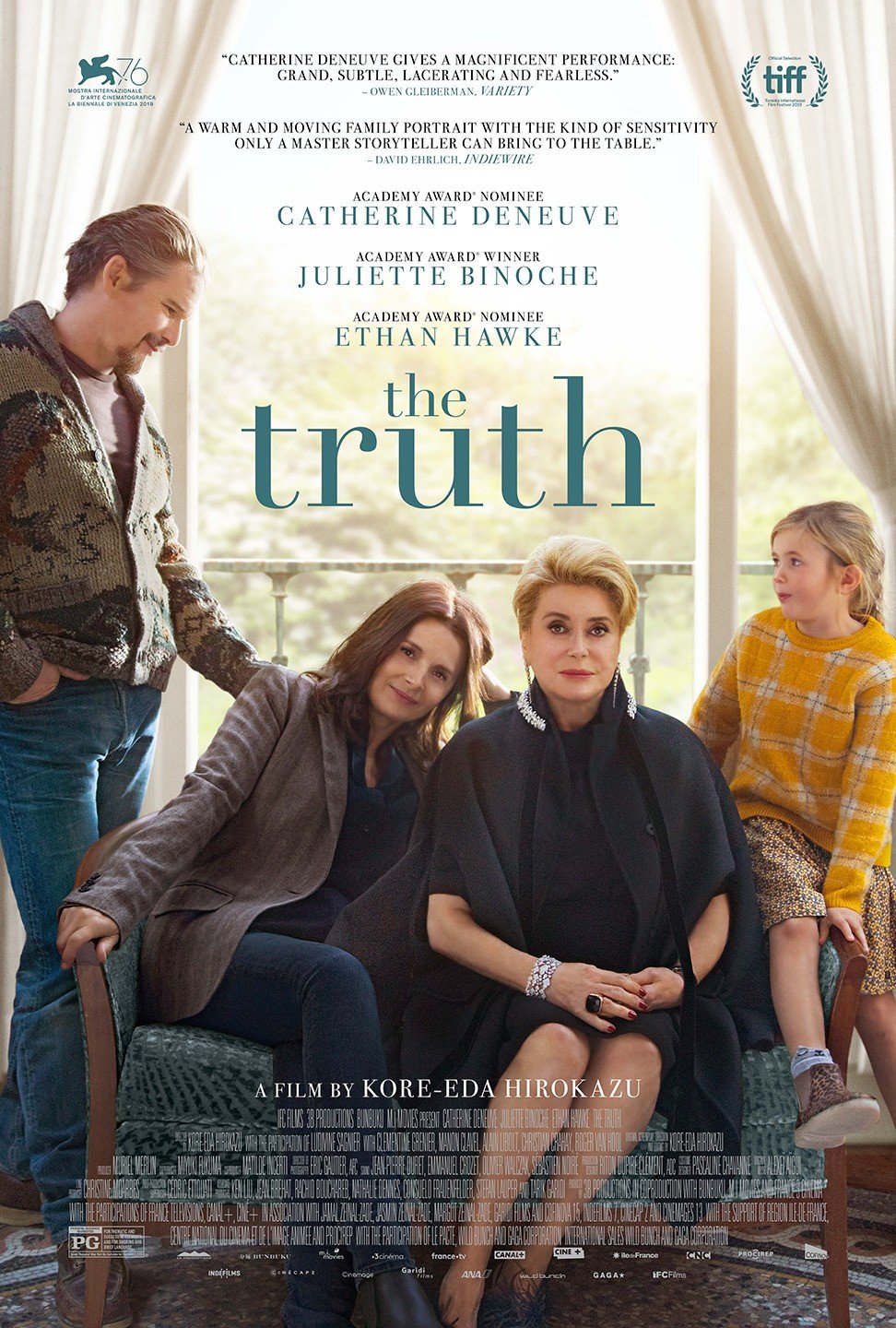
‘The Truth’ Movie Review

When you have a cast consisting of French actresses Catherine Deneuve and Juliette Binoche together with American actor Ethan Hawke, that’s attraction enough. Further, a film written and helmed by the Cannes winning Japanese director Hirokazu Koreeda (Shoplifters, 2018) adds an intriguing element, as this is his first non-Japanese film shot outside of his home country.

Deneuve plays an aging French film actress, Fabienne Dangeville, who has just written a memoir. Already 50,000 sold––and boasting to her daughter twice that number––the success in book sales, however, cannot rescue her from the dimming of her career as a film star.

Reminiscent of French director Olivier Assayas’ Clouds of Sils Maria (2014) where Binoche herself plays a French actress sinking into oblivion as prime acting roles go to the younger and much more popular personalities. But The Truth is lighter in mood and sprinkled with comedic effects and subtle humour.

Fabienne’s daughter Lumir (Juliette Binoche), a screenwriter living in New York, comes all the way to Paris on the occasion of her mother’s book publishing, her husband Hank (Ethan Hawke), an actor, and daughter Charlotte (Clémentine Grenier) in tow. To Lumir, it’s a homecoming after a long while. Cracks between her and her overbearing mother surface as soon as she enters the house.

First off, she’s upset that Fabienne didn’t let her read the manuscript before publication as she had promised. Now reading it for the first time that night, anger replaces disappointment. She confronts her mother the next morning:

 “Who are you kidding? I can’t find any truth in here.”

Fabienne, of course, doesn’t care what her daughter thinks. It’s her memoir, her take. In the book, she presents herself as a loving mother, like finding joy in picking her daughter up from school. Lumir says it’s untrue, for her mother had never picked her up from school, always her dad Pierre (Roger Van Hool) or the family’s faithful servant Luc (Alain Libolt). Her memory of Fabienne is an absent mother who basks in the limelight of her own stardom. In reply, Fabienne says:

“I’m an actress. I won’t tell the naked truth. It’s far from interesting.”

As for Hank, effectively played by Hawke, his duty seems to be there only to support his wife. Not knowing French, Hank is a complete outsider. And in the eyes of his celebrity mother-in-law, he can hardly be called an actor. Daughter Charlotte has a few delightful scenes on the subject of truth and fantasy.

The next day, they all follow Fabienne to the studio for the rehearsal of a film she’s in, but playing a minor role with the major star being a younger, reputed actress Manon Lenoir (Manon Clavel). Now the conflict shifts from mother daughter to that of the fading star and rising talent.

The studio setting is another layer Koreeda has created to bring out cinematic ‘truth’. The green screen itself by its very function works as a fake background, ‘deceiving’ in its purpose. Further, special touch up can alter even the eye colour of the actor. And most hilarious of all, but all wrapped in a serious tone, what we see is an intense scene between two characters alone on screen is actually hovered over in a short distance by a horde of people who are not in costume doing their real-life job. Sarcasm and humour are the subtle effects from scenes like that. Koreeda’s insight is astute in revealing what filmmaking is: fiction pretending to be real.

The middle part of The Truth about the studio shooting is a little weighed down as a play-within-a-play based on a short story by the acclaimed science fiction writer Ken Liu. This section of the movie is complex and multi-layered. While intriguing, it requires more than one viewing for clarity. This too, could well be Koreeda’s intension as he directs a French film, inserting a story within a story, which is a French artistic device, the mise en abyme. Like standing between two mirrors, one can see multiple images.

Overall, The Truth is a light-hearted feature, leisurely paced with embedded humour. Koreeda’s intention might be more cerebral than comical. The cast in itself is appealing enough, presenting a piece of cinema verité showing that truth is elusive even among the closest of family or the most sincere of artistic expressions.

~ ~ ~ Ripples

The Truth is now on Netflix.

_______________________

In participation of Paris in July hosted by Tamara at Thyme for Tea

Related Ripple Reviews:

Clouds of Sils Maria directed by Olivier Assayas

Our Little Sister directed by Hirokazu Koreeda

‘Cleo from 5 to 7’: A Film for Paris in July

Summertime… and the viewing is nostalgic. On a lazy, hazy summer afternoon, what better way to spend your time than to catch up on classic films that you’d missed through the years, or, rewatch them. Sure, a glass of pink lemonade and some chocolate-dipped madeleines would add to the enjoyment.

Here’s a wonderful film by the venerable Belgium born French director Agnès Varda, who turned 90 on May 30 this year. Just exactly what she was doing a few weeks before her 90th birthday?

On May 12, Varda joined Cate Blanchett in leading 82 female industry figures to walk up the stairs on the red carpet at the Cannes Film Festival, a silent protest symbolizing the challenges women face in climbing the industry ladder. Blanchett gave a speech in English, Varda in French.

Cleo from 5 to 7 (Cléo de 5 à 7) is a 1962 film by Varda, a Cannes Palme d’Or nominee the next year. The story takes place on one single day in the life of a popular recording singer Cleo (as in Cleopatra) who loves everything beautiful looking. But early in the day she receives all sorts of bad omens about her health. Her zest for life fizzles through the day as she would be calling her doctor to find out the result of the medical test she’d taken a couple days ago.

Cleo from 5 to 7.jpg

We follow Cleo on the longest day in 1962, yes, that’s the first day of summer, which could have brought her vitality and joy. How does the fear of illness and mortality affect the beauty-seeking and fun-loving Cleo? It totally changes her outlook. Instead of being cooped up in her apartment with musicians rehearsing her songs, she steps out into the streets of Paris to escape the gloomy sense of despair.

Don’t worry, this is not Sarte or Camus. Cleo is just a gal seeking to be loved, and for the first time in her life, fearing for her own mortality. Varda takes us along the streets of 1962 Paris, and offers us naturalistic scenes of cafes and roadside buskers, and leads us into an art studio as Cleo looks for her friend who works as a model for sculptors.

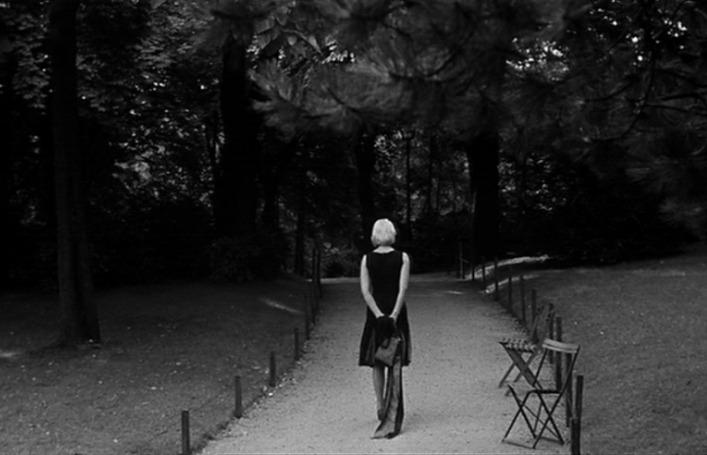
Finally, she’s alone in a park, the serene, meditative milieu is the ideal setting for her to meet Antoine. The encounter is the magic she needs. The rest you ought to see it for yourself. Varda’s pace is leisurely, her viewpoint insightful, and the ending is satisfying. Maybe by now, Cleo learns the difference between beautiful-looking and beauty.

The original music is soothing and cooling for a summer day, composed by Michel Legrand (who is the piano player in the movie). Legrand is a three times Oscar winning French film composer. Which three times? Yentl (1983), Summer of ’42 (1971), The Thomas Crown Affair (1968).

As I said, summer is the best time for nostalgic viewing.


~ ~ ~ ~ Ripples

***

Paris in July is hosted by Tamara of Thyme for Tea, an annual summer blogging event.

Paris in July 18

***


Two Fine French Films

For this week in the blogging events Paris in July 2014 and Dreaming of France, I’m sharing with you two fine, French Films. They are not new movies, but probably you had missed them when they first screened a few years ago, or they might not have screened in your area. I came across them only recently. Interestingly, they make a fine pair for they both touch on very similar themes.

My Afternoons with Margueritte (“La tête en friche”, 2010)

This comedy based on the book by French author Marie-Sabine Roger stars the famous French actor Gérard Depardieu as an uncouth, middle-aged construction worker, Germain Chazes. His lack of literacy skill is benign when compared to the low self-image he suffers as a result of the constant taunting from his teachers and classmates when he was young, and the life-long scolding from a harsh and overbearing mother (Claire Maurier). To his misfortune, Germain still has to live near her and take care of her, a woman now has senility to add to her abusive outbursts.

Germain’s life comes to a turning point when he meets Margueritte (Gisèle Casadesus, who just turned 100 in June this year!) one afternoon on a park bench. Margueritte is an elderly lady living in a retirement home, and spends her afternoons in the park. She soon engages Germain to open up. Thus begins an unlikely friendship between the two.

My Afternoons with Margueritte

More importantly, Margueritte leads Germain to a whole new world of books and literature. She reads to him The Plague by Albert Camus, going through it in ten afternoons. He listens and is totally entranced by the language and the imagery.

When she reads to him Promise At Dawn, the memoir by Romain Gary, he is absorbed by the author’s description of his late mother’s love for him, and especially moved by the imagery of Gary “howling at her grave like an abandoned dog.” He begins to see his own predicament with the lens from the books Margueritte reads to him.

Who says literature belongs to the academics, or those in the ivory tower of the intellectual and sophisticated. Why is it so incongruent to hear a construction worker quoting Camus, or his seeing the world in literary imageries, or being tender and caring for a change. Germain’s friends tease him, they want the old Germain back. But Germain knows too well that he has crossed the point of no return, and that his transformation is empowering.

Soon, with the help of his girl friend Annette (Sophie Guillemin), Germain learns to read on his own. Further, he has learned to give back to Margueritte in an endearing way. As far as the story trajectory goes, Germain could well write a book entitled How Camus Can Change Your Life (that’s mine, not in the film).

Charming performances and great screen chemistry between Depardieu and Casadesus. A heart-warming story with sprinkles of humour for added appeal. A delightful and worthwhile film to watch.

~ ~ ~ Ripples


Queen to Play (“Joueuse”, 2009)

Along the same thematic line is this quiet and stylish production set in the beautiful French island Corsica just off the mainland. From Depardieu’s construction worker we now have a middle-aged chambermaid, Hélène (Sandrine Bonnaire), who works in a seaside hotel. Hélène goes through an inner transformation even more dramatic than Germain’s. It is interesting to watch the game where the Queen is the most powerful piece is freed from its male dominance for a change.

Originally titled “Joueuse” (The Player), the film is based on the novel by French author Bertina Henrichs. Director Caroline Bottaro has  displayed an inviting game board for us viewers to interact with, for watching the film makes us witnesses to a game change.

Sandrine Bonnaire’s portrayal of Hélène is sensitive and nuanced. The turning point of her life comes one day while cleaning a room. Through the translucent curtain swayed by the soft wind, she sees the hotel guests, a couple (Jennifer Beals, Dominic Gould), playing chess out in the balcony. She is fully mesmerized. The game board, the pieces they touch, their mutual affection bonded by the game not only send out vibes of sensuality but of intellectual stimulation. (She beats him, BTW) From then on, Hélène is obsessed with chess.

She gives her husband Ange (Francis Renaud) an electronic chess set for his birthday. While he is unappreciative of the gift, many a nights Hélène would slip out of bed quietly and learn to play on her own. She now sees every piece of crumb, every salt and pepper set on the table a movable chess piece, any checkered surface a chessboard on which she can prance to her imagery delight.

Queen to play

Other than her hotel job, Hélène does cleaning for a mysterious widower, Dr. Kröger, played by Kevin Kline, his first French-speaking role. Hélène finds a chess set on his bookshelf and asks him to teach her the game. Skeptical and annoyed at first, Dr. Kröger agrees when she offers to clean his place for free in exchange for chess lessons. He soon discovers that Hélène is not only serious but gifted. After a few lessons, she begins to win repeatedly.

But Hélène keeps her pursuit secret, afraid of reverberations, and misunderstanding from her husband. Why does she need to be so sneaky? Can’t a woman desire matters of the mind? Can’t a chambermaid be absorbed by the game of chess, set foot on a male-dominated, intellectual territory? Would Hollywood make a movie like this?

Hélène’s teenaged daughter is her supporter at home when her husband finds out. He too later yields to her passion as Hélène enters her first tournament upon Dr. Kröger’s recommendation.

Oh I love these French films, for they unabashedly praise the arts, literature, and intellectual pursuits; their protagonists quietly shattering social norms and barriers to personal fulfillment. Queen to Play reminds me of Muriel Barbery’s novel The Elegance of the Hedgehog.

Do you need to know how to play chess to enjoy the film? No. Actually, the camera seldom focuses on the chessboard. Instead, we see the faces of the chess players, that is where we read all the emotions.

Intriguing as chess moves, beautiful as the crafted pieces, the film is a joy to watch, a satisfying winner.

~ ~ ~ 1/2 Ripples

Paris In July 2014Dreaming of France Meme Eiffel***

Related Posts on Ripple Effects:

The Elegance of the Hedgehog Book Review

Séraphine and the Wrought-Iron Chair: Review of the film Séraphine

Haute Cuisine Movie Review

Haute Cuisine Movie Review

My first entry for the Paris In July 2014 blogging event is a review of the 2012 French film Haute Cuisine (original name Les Saveurs du Palais, which can be translated as ‘The Taste of the Palace’ or ‘The Taste of the Palate’)


***

Haute Cuisine Movie Poster


The film begins with scenes on the remote Crozet Island in Antarctica, at the Alfred Faure Scientific Base. The cook, Hortense Laborie (Catherine Frot), is preparing dinner for the dozens of workers there. It’s a special occasion, her own farewell dinner. This is the menu she has prepared:

  • Thai clear soup with fresh foie gras
  • Sweet and sour duck with Sarlat potatoes
  • Saint-Honoré cake

Not your ordinary cafeteria food for workers in Antarctica, but then, Hortense Laborie is no ordinary cook. If her one year gig working on the Crozet island sounds extraordinary, it is yet not as remarkable when compared to her previous job. Hortense was the personal chef of the French president (Jean d’Ormesson) for two years before she quit and sought a change in venue for her talents. Her kitchen used to be in the Élysée Palace in Paris, the official residence of the French President.

Haute Cuisine is a movie based on the real-life story of Danièle Delpeuch, a Périgord farmer and renowned country cook appointed by the Palace Élysée to be the personal chef for French President François Mitterrand in 1988. She was responsible for preparing home-made, simple cooking for the President’s own private meals and his personal guests.

In the movie, as soon as she stepped into the Palace’s Main Kitchen Hortense knows what she is up against: a macho army of 24 all-male chefs who guard their territory like a castle. They serve 70,000 meals in a year, using some of the copper pots and pans dating back to Louis-Phillippe’s days. Hortense does not work right in that kitchen, but that is her source of supplies and ingredients (initially), and the battlefield for territory and sphere of culinary power and influence. The battle begins as soon as she steps on this holy ground.

The Battleground 1

Hortense works in a small, homely kitchen joined by a tunnel with the Main Kitchen. Her helper is a young pastry chef Nicholas Bauvois (Arthur Dupont). The two form an unlikely alliance and share an endearing camaraderie. Frot’s portrayal of Hortense is most amiable. She is not a harsh boss over Nicholas, but she can stand her ground and be assertive in front of the Main Kitchen chefs, and even with the President’s staff. Hortense is an iron fist inside an elegant, velvet glove.

So from the kitchen in Antarctica to Paris, the film goes back and forth to tell the story of Hortense, how she gets the Palace job and why she quits two years later. The shifting between the two time frames are smooth and seamless. With the two drastically different settings juxtaposed against each other, viewers can savour the irony: That the exquisite culinary skills and fine art of Hortense’ cooking are more appreciated by the Crozet Island workers than the Palace Élysée.

A delightful movie not just for foodies, Haute Cuisine is like a layer cake, blending multiple tastes together by tackling various issues of contention… the battle between the sexes in the work place (the kitchen is probably the most volatile), efficiency in meal preparation vs. passion for cooking, and, the dilemma of all food lovers: gratification or health (no sauces, fats, or cheeses? How can that be in French cuisine?)

A well crafted film that moves as efficiently as an experienced server, removing your empty plate as soon as the food is consumed, quietly slips in the next item for you to enjoy without a break. Yes, it’s relatively fast-paced, lean and fat-free with no wastage; to top it all off, the delightful, well-timed and orchestrated music composed by the prolific Gabriel Yared is like the light cream on the Saint-Honoré cake.

The President deeply appreciates Hortense’s home-grown culinary offerings. Her ingredients are locally grown right from the Palace garden,or nearby markets, or from her own farm, yes, truffles too. The tastes remind him of home when he was growing up as a boy. He has found a foodie soul-mate in Hortense. Here’s her first meal for him and his five guests (with two hours’ notice as to the number of guests):

Stuffed Cabbage

  • Brouillade with ceps and chervil
  • Stuffed cabbage with Scottish Salmon and Loire carrots (“I like things to come from somewhere”)
  • Saint-Honoré (her Granny’s recipe)

But I personally like this one the best:

Beef fillet pastry wrapped


  • Cream of asparagus soup with chervil
  • Fillet of beef (pastry wrapped) with Chanterelle Fricassee
  • Cream tart with fruit of the forest and pistachio nougatines

A virtual meal, so delicious and satisfying… and best of all, fat-free.

~ ~ ~ Ripples 


***


Paris In July 2014

This is my first post for the blogging event Paris in July, 2014.

This year the hosting team has expanded to four. From the original creators Karen and Tamara, we now have Adria and Bellezza. Thanks to their time and dedication, we can travel to France on a virtual flight, no need for tickets, no baggages to drag along.

Also discovered another similar blogging event and that’s a Monday Meme Dreaming of France from Paulita’s An Accidental Blog. The more the merrier I’d say.

Dreaming of France Meme Eiffel

 ***

Click Here to the New York Times’s profile of Danièle Delpeuch, the real-life personality on whom the movie is based.

Other Food Related Posts on Ripple Effects, coincidentally, all Paris-related:

Gourmet Rhapsody by Muriel Barbery

The Hundred-Foot Journey by Richard C. Morais (movie adaptation coming out in August, 2014)

***

Bel Ami by Guy de Maupassant

Reading Maupassant reminds me why I love Jane Austen.

To be fair, I’ve only read one of the numerous short stories and one novel of Maupassant’s, but all of Austen’s six novels. So it just may not be apt for me to generalize the former. But focusing on just this book, Bel Ami, I can say here’s a protagonist whom I can never cheer for nor find amiable, to put it mildly…

Maupassant uses a scoundrel as the main character and have us follow his ascent, unscrupulous at every turn, as his ego and desires are being fed all the way to the end, and then some more. An antihero, the poster boy of realism in his depiction of late 19th C. Parisian high society?

Jane Austen has also written a protagonist she described as “A heroine whom no one but myself would like”. But comparing to Bel Ami‘s Georges Deroy, Emma Woodhouse is angelic. How do I even start to think of a parallel… imagine Wickham of Pride and Prejudice and Willoughby of Sense and Sensibility, combine them and magnify their nasty streak ten folds, then you’ll have Georges Deroy, nicknamed Bel Ami by the women in his life, ‘good friend’, a most pathetic irony.

The time is 1890’s Paris. Georges Duroy is a former soldier living in poverty. But call it luck or call it will, Duroy ends up a prominent figure in Parisian high society. This is how he does it.

Women. At one time, there are four significant females in Deroy’s life. These are upper crust, influential beauties. To Duroy, they are but rungs up the social ladder, each a conquest.

First is Madeleine Forestiers, the wife of his benefactor, editor friend whom he runs into coincidentally, and who saves him from poverty by bringing him in to work for the newspaper La Vie française.

The second one is Clotilde de Marelle, a married woman whom Duroy has made mistress. She aptly analyzes the Mars and Venus chasm of gender differences on that elusive notion called love. To Duroy, she says:

I know perfectly well that for you love is merely a sort of appetite whereas for me it would be more a sort of… communion of souls which doesn’t exist in a male religion. You understand the letter and I understand the spirit.

The third is the big boss of the newspaper Monsieur Walter’s wife Virgine, who has such a crush on Duroy that she loses her senses when he successfully schemes and manipulates her daughter Suzanne to elope with him.

George Wickham has plenty to learn from Georges Duroy because his subsequent wedding after the elopement is not a hush hush patch up, but a glamorous celeb nuptial, fully legit and the envy of all. By now, Duroy has climbed to be editor of La Vie française and made himself a Baron, changing his name to Du Roy for a more aristocratic sound. And we know full well that the conquest doesn’t stop there.

In one earlier incident, Duroy comes out of a gun duel unscathed, albeit a bit numbed. With his life spared, he could well have used such a near-death experience as a springboard to a new beginning and a turnaround of his ways. But his lucky escape has only fuelled his hubris and reaffirmed his self-importance. After the duel, he thinks himself invincible.

Is he immoral or amoral? I feel I have to choose the latter in order to find some amusement in following this unscrupulous character. Is it realism or sarcasm? I have to mix them both in order to seek some reading enjoyment. And with the English translation by the Cambridge scholar Douglas Parmée, there are the occasional descriptions that sounds… curt. But are they the original intent as realism dictates, or the collateral effects of translation? Can’t make up my mind on that one. Just an example:

The elder sister Rose was ugly, as flat as a pancake and insignificant, the sort of girl you never look at, speak to or talk about.

There, I find myself having to choose or debone or mix and stir in order to wash down better when reading Bel Ami. Under Maupassant’s pen of realism, Duroy is relentless all the way to the end. Just goes back to my love for Austen’s works… why, I can take in big gulps, devour and be totally satisfied. There are Wickham and Willoughby, but ultimately my yearning for some sort of poetic justice can be gratified. For my reading pleasure, I’ll take Jane’s idealism anytime.

***

Bel-Ami by Guy De Maupassant, translated by Douglas Parmée, Penguin Classics, movie tie-in edition, 2012, 394 pages.

As you can see from the book cover, Bel Ami has been adapted into film. To literature purists, I suggest you look for another edition. Whenever I read about Georges Duroy, which is on every page, Robert Pattinson’s face keeps haunting me, and images of Uma Thurman as Madeleine Forestier, Kristin Scott Thomas as Virginie keep conjuring up in my mind. Now I haven’t even watched the film… oh the suggestive power of a book cover.

This concludes my Paris in July entries for 2012. Thanks to Karen of BookBath and Tamara of Thyme for Tea for hosting.

To Paris again next year!

***

Saturday Snapshots July 28: Paris Montage

The Brasserie Balzar
Near the Sorbonne, Sarte and Camus’s frequent hangout where they dined and debated. Insert shot of Menu: Breakfast for 6 Euros includes a croissant, tartine, confiture, hot drink, orange juice.

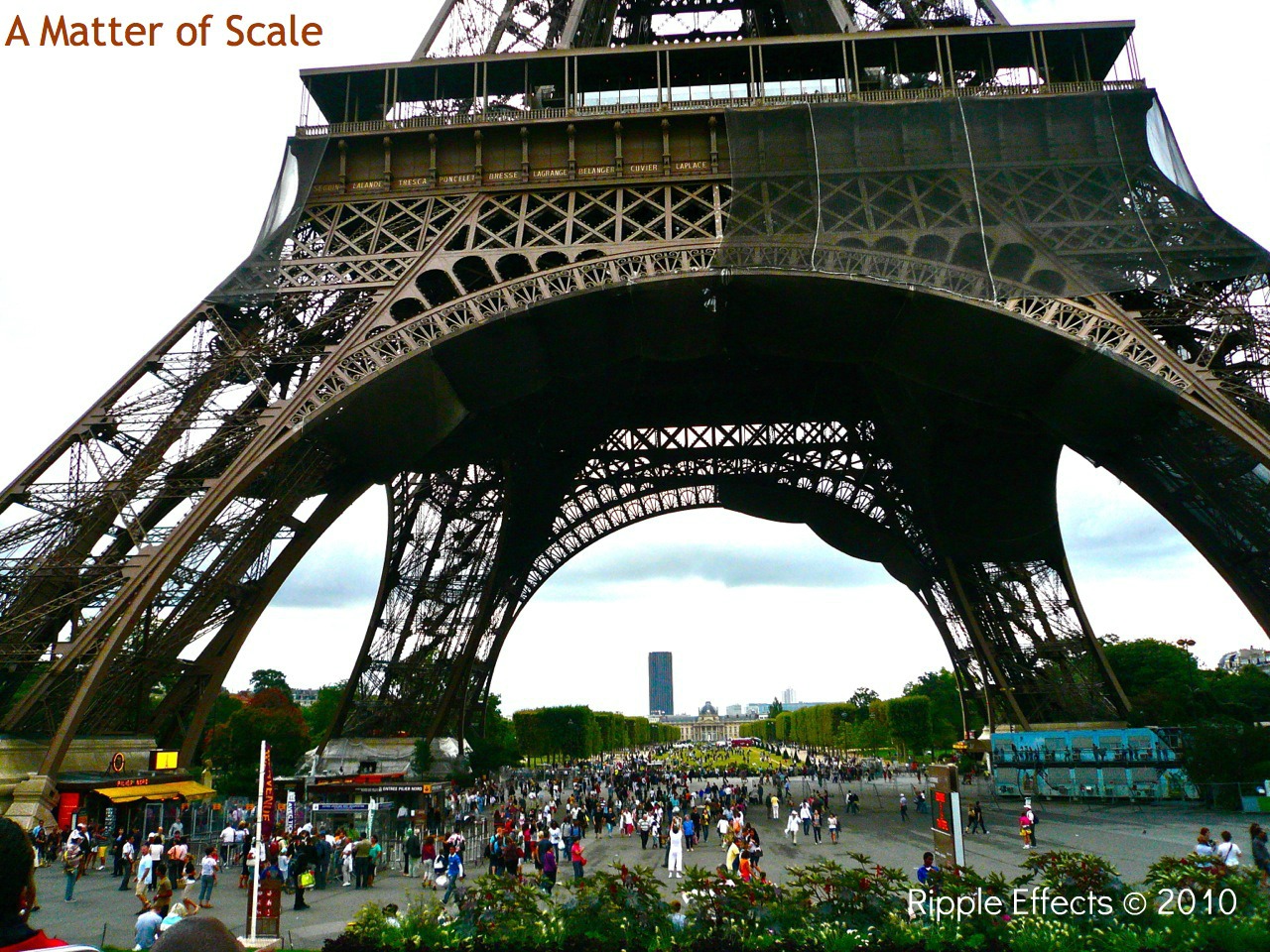
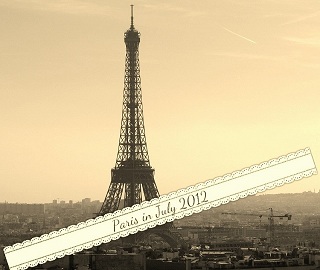
A View of the Tower
Size is relative. 

The Paris Apple Store
Probably the most elegant of all the Apple branches.

The Paris Collage
As you can see, I got a bit carried away playing with the features in the photo editing site Picmonkey.

Again, Saturday Snapshot is hosted by Alyce of At Home with Books, Paris in July at Bookbath and Thyme for Tea.

Thanks to Zara Alexis for pointing me to PicMonkey.com for making these collages and watermarks.

***

Saturday Snapshots July 21

Once again, Saturday Snapshots framed by a Paris in July backdrop…

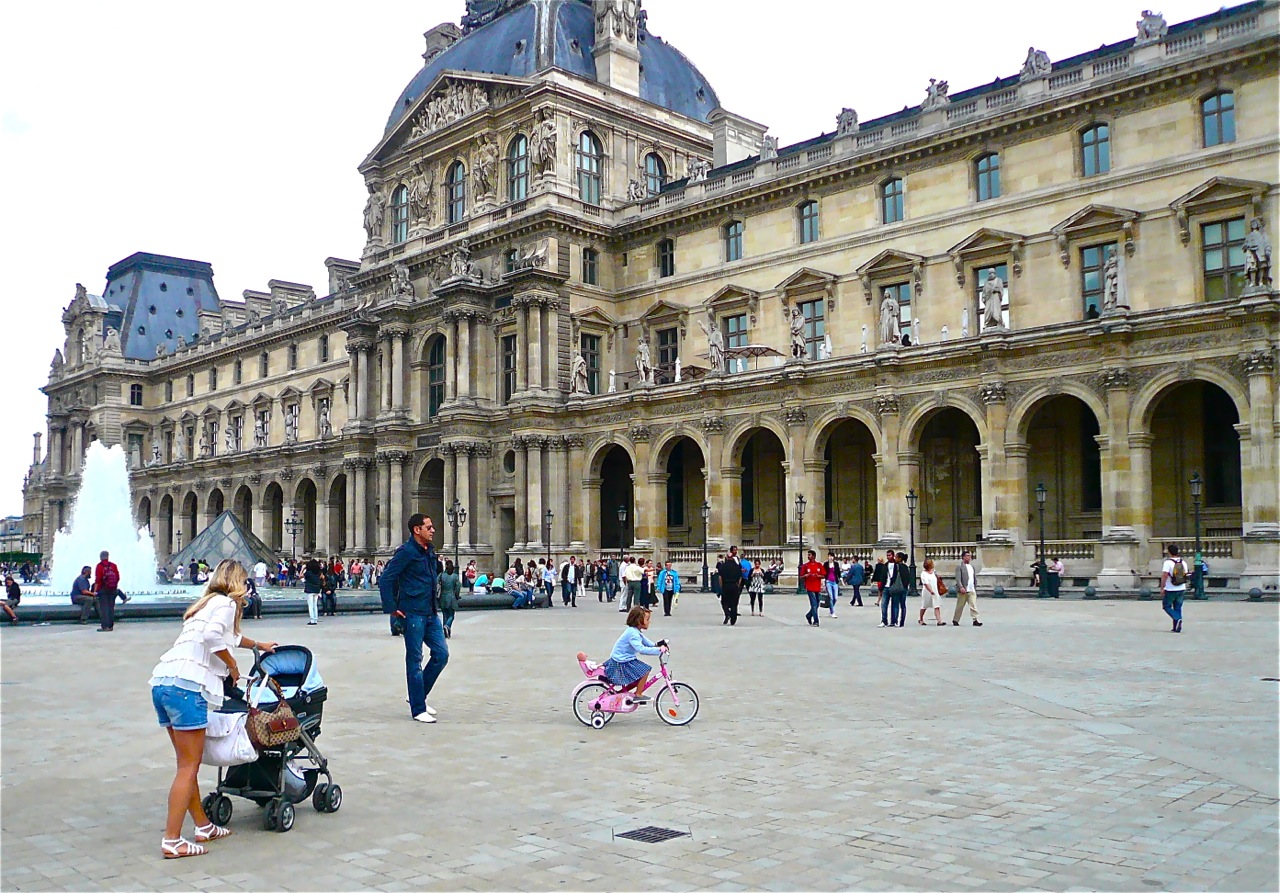
I was pleasantly surprised to find the open space outside the Louvre being used not only for tourist line-ups but as a spot for a family outing.

Dad can keep an eye on Sis biking, while Mom gets baby ready for a video shoot.

And Li’l Bro rides into the sunset.

***

Saturday Snapshot hosted by Alyce of At Home With Books, Paris In July at BookBath and Thyme for Tea.

***

Arles: In Search of Van Gogh

Watching the movie Séraphine (my last post) made me think of another artist tormented by mental illness. Vincent Van Gogh (1853-1890) was born in the Netherlands. His artistic imagination was ignited when he moved to Paris in 1886 and saw the works of the impressionists. But the prolific period of his life began only after he went south to Arles.

I visited Provence in August, 2010, went on a walking tour of Arles following the footsteps of Van Gogh. For Paris in July hosted by Karen of Bookbath and Tamara of Thyme for Tea, I’m reposting an excerpt of my travelogue here. Some of you may remember my series of travel posts, but many of you have come to Ripple Effects only recently. Please join me as I revisit Arles and its nearby St-Rémy-de-Provence.

***

Van Gogh moved to Arles from Paris in 1888, seeking the tranquility that was so elusive to him in the big city. In his letter to his brother Theo upon arrival to Arles, he wrote:

It seems to me almost impossible to be able to work in Paris, unless you have a refuge in which to recover and regain your peace of mind and self-composure. Without that, you’d be bound to get utterly numbed.”  — Tuesday, Feb. 21, 1888.

The fresher and more colourful palette is apparent during this most prolific period of the artist’s life. Bright yellows, blues, shorter and swirling brush strokes established his signature style.

As for me, I was a bit disappointed to see the sunflowers have already withered in late August. Fields of yellow were now massive brown. They would be harvested at a later time for their oil, a good reminder that, for tourists, it’s the view and the photos, but for those living here, it’s their livelihood. The lavenders on the Luberon mountains too had long passed the season. Note to myself: Early to Mid July is best if I ever come this way again.

But all was not lost. I was gratified to follow some of Van Gogh’s footsteps as I explored the clearly posted Van Gogh sites in the town, the scenes and locales where the artist so vividly captured in his paintings.

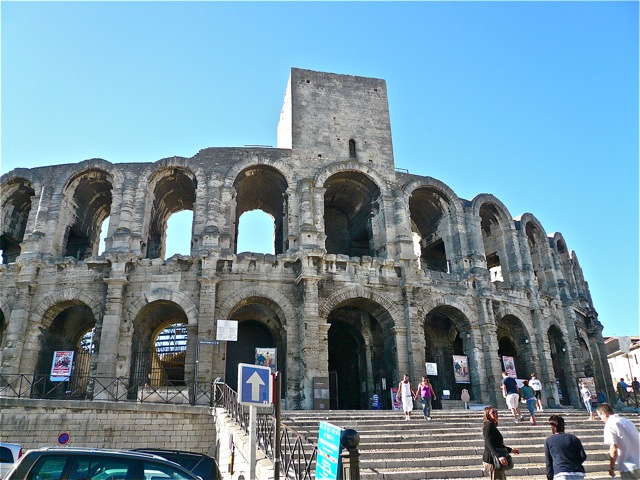
Arles is a Roman town. What more prominent landmark to reflect its past glory than the Roman Arena in the town centre. Why all the arches? The free flow of pedestrian traffic. The full seating capacity, 20,000 people, could exit the Arena in 7 minutes.

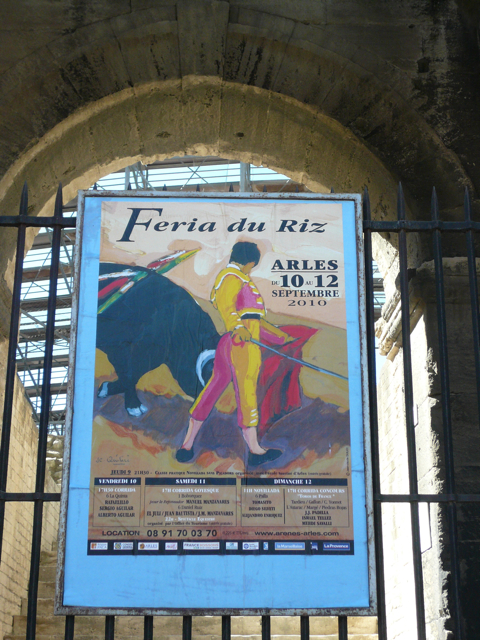
Used by gladiators in ancient time, the Arena is still the venue for bullfights:

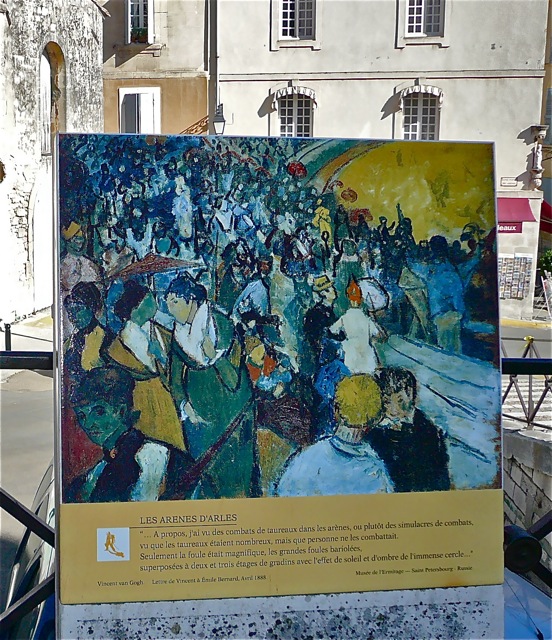
But Van Gogh’s interest was not so much in the violent action of bullfighting than the people, as his painting Spectators In The Arena At Arles (December, 1888) clearly shows:

The Café Terrace on the Place du Forum was his hang-out, renamed Café Van Gogh now. The yellow café upon the backdrop of the blue, starry night had deeply inspired the artist:

Café Terrace At Night (September, 1888):

Van Gogh had wanted to make Arles a hub for fellow artists. Upon his urging, Gauguin came to join him in October, 1888. The two painters frequented the Café Terrace many a night but only for two short months. What happened on December 23rd was reported by the local paper the next day:

At 11:30 pm., Vincent Vaugogh [sic], painter from Holland, appeared at the brothel at no. 1, asked for Rachel, and gave her his cut-off earlobe, saying, ‘Treasure this precious object.’  Then he vanished.

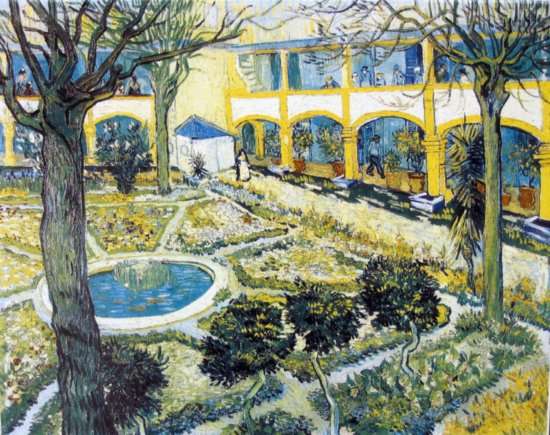
After this incident, Van Gogh was admitted to a local hospital, now the Espace Van Gogh in Arles, a cultural centre:

And here is Van Gogh’s rendering when he was staying there:

In January, 1889, Van Gogh returned home to his ‘Yellow House’ (which has now been torn down and reconstructed), but for the next few months, suffered onslaughts of hallucinations and delusions. His view of his own condition nevertheless was lucid and even progressive for his time. His letter to Theo is poignant, as he openly faced his predicament and earnestly sought a solution:

And for the time being I wish to remain confined, as much for my own tranquillity as for that of others.

What consoles me a little is that I’m beginning to consider madness as an illness like any other and accept the thing as it is, while during the actual crises it seemed to me that everything I was imagining was reality.”

— Sunday, April 21, 1889.

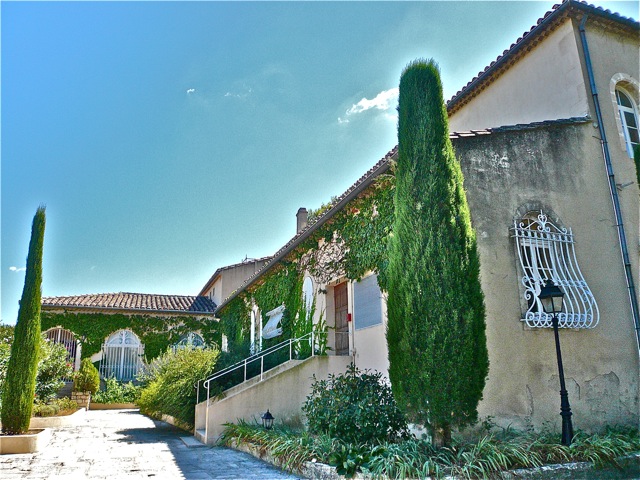
On May 8, 1889, he checked himself into the Saint Paul de Mausole, the mental hospital at St-Rémy-de-Provence. Under the care of his doctor Théophile Peyron, the artist’s condition improved and he thrived in the idyllic environment there. Art therapy had brought healing and prolific output. Van Gogh stayed there for a year and created more than 150 paintings.

Dr. Théophile Peyron out at the front garden of Saint Paul de Mausole hospital:

The olive grove outside:

Olive Grove (June, 1889):

To his brother Theo, he wrote on Sunday, May 11, 1890:

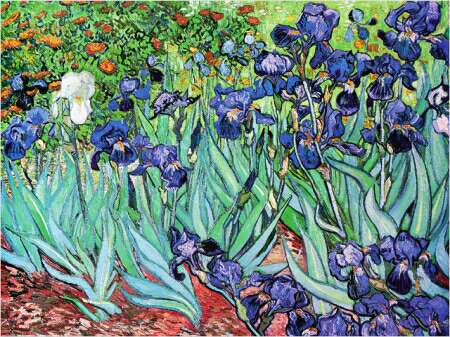
At the moment the improvement is continuing, the whole horrible crisis has disappeared like a thunderstorm, and I’m working here with calm, unremitting ardour to give a last stroke of the brush. I’m working on a canvas of roses on bright green background and two canvases of large bouquets of violet Irises…

My Van Gogh trip ended at St. Rémy, and so be it. I’ve seen the sites wherein the artist was at his most prolific. I’ve seen the town and surroundings where he found inspiration.  I’ve seen his final solace where he attained some stability and painted with passion. I’d like to keep these as memories of my travel to Provence. I could hardly bear to think of his last days, discharged from St. Rémy just a few days after the above letter, headed north to Auvers-sur-Oise on the outskirt of Paris, and in just two short months, succumbed to the recurrence of his illness. He shot himself in the chest with a revolver on July 27, 1890, and died of his wound two days later.

Back to the thoughts I wrote about: How do we keep art from turning into a cliché? I think it takes a certain awareness of the artist as a person, plus a measure of empathy and respect for the struggle to live and create… and realizing that the beautiful works are often triumphs in spite of life’s overwhelming adversities, rather than the natural products of bliss and fortune.

To wrap up my travel posts, and taking the risk of turning it into a cliché albeit my motive is pure, here’s the YouTube clip again, Don McLean’s tribute to Vincent:

***

My five-part travelogue on England and France:

  1. Tate Modern & Billy Elliot
  2. Bath’s Persuasion
  3. Paris: The Latin Quarter
  4. Art and Cliché
  5. Arles In the Steps of Van Gogh

Séraphine and the Wrought-Iron Chair

By day, she scrubs floors, cleans houses, washes dirty linens in the river. By night, she paints. She is Séraphine, a cleaning woman in her fifties. Later, she is better known as Séraphine de Senlis. 

Séraphine (2008), a film based on the life of the early 20th Century French painter Séraphine Louis (1864-1942), won 7 César Awards in France including Best Film of 2009 and Best Actress for Yolande Moreau as Séraphine. True to its subject matter, director Martin Provost has crafted an aesthetically pleasing work of art. The pace is slow for the viewer to savour every bit. Moreau’s charming portrayal of Séraphine is captivating. She wins my heart from the first scene.

It is gratifying to be noticed, to be confirmed of one’s worth. To the dismissive eye, an ageing cleaning woman is nothing to deserve another glance. Makes me think of the concierge Renée in The Elegance of the Hedgehog. In one of the apartment units which Séraphine cleans, a new tenant just moves in. He is Wilhelm Uhde, a noted art critic and collector of Picasso. He is also the one who has discovered Henri Rousseau of the naive art style, a term referring to untrained talents, a term to which Uhde doesn’t subscribe.

And right there in his rental unit Uhde notices another hidden gem of this style, his own housecleaner Séraphine. Uhdle is deeply moved by her work and soon becomes her patron. He stops her from mopping his floor, leads her out into the garden, seats her down in a wrought-iron chair and tells her she has talent. It is a wrought-iron chair that I notice since that scene, and it recurs later in the film, a metaphor for aesthetics, style and elegance, antidote to the crude reality of Séraphine’s life.

Séraphine loves nature, and nature rewards her with inspiration.

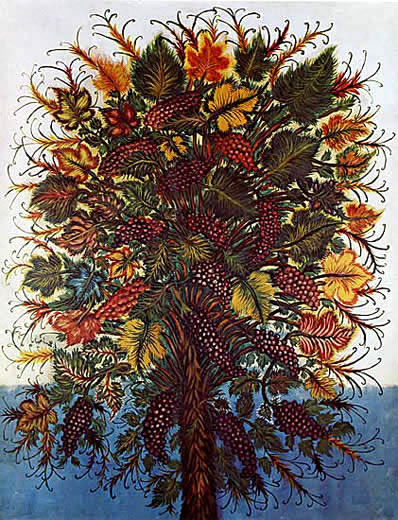
Her subjects are mainly flowers and fruits, their design exquisite, natural, colourful and lively. 

Deep religious fervour soon drives Séraphine to relentless, maddening obsession to paint. She claims to follow voices from her guardian angel. She would sing hymns at the top of her voice while painting through the night, waking up in the morning on the floor with her work-in-progress. She gradually becomes delusional and out of touch with reality.

Why is it that giftedness and mental illness often find affinity for each other? Van Gogh comes to mind. And only recently did I read this Guardian article drawing uncanny similarities between Séraphine and Susan Boyle.

As WWI draws near, the impending conflicts push Uhde out of France and back to Germany. They reunite after the War. Sadly, the painter’s growing achievement brings about more severe delusions. Later the economic depression ends contact between patron and artist for a while.

When Uhde finds Séraphine some years later, she is locked up in an insane asylum. This latter part of the movie is a bit uncomfortable to watch. Uhde is unable to communicate with her as she is restrained in a straight jacket, tied to the bed weeping in anguish.

Months pass and in 1935 Uhde visits her again. He needs to tell Séraphine her paintings are selling. Her condition has stabilized by now but upon doctor’s advice, Uhde should just leave her be. There in the asylum at Asile de Clermont Uhde quietly pays for her a private room with a view out towards a lush green meadow and full, leafy trees.

The ending that follows is one of the best I’ve seen in films. We see Séraphine being led into the room. She sits on her bed, dazed, unfeeling. Then she turns her head and notices the door leading outside to the trees and green meadow. The next three silent minutes bring us to a poignant closing:

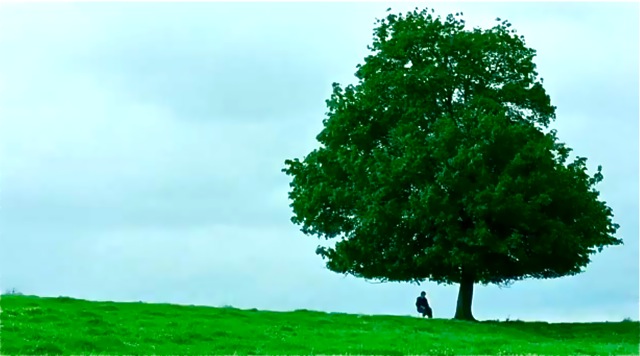
Séraphine slowly gets up and opens the door. She sees a wrought-iron chair on the porch. The frame on screen here is roughly split in two. On the left side is her room with a sterile, wooden chair of the asylum. On the right we see the porch outside with the wrought-iron chair, not unlike the one she had sat on while being declared a talent by Uhde years before. She tentatively steps out of her room, touches and examines the chair, then picks it up and slowly carries it with her up a green hill to a full, beautiful tree. From afar, we see her look at the tree, put the chair under its shade, sit down and tilt her head back, fully relaxed.

In the silence with just the wind blowing, it seems we can hear her gratified sigh of relief, being back in nature, coming home.

~ ~ ~ 1/2 Ripples

CLICK HERE to watch Séraphine’s official trailer on Youtube. You’ll be able to see the ending scene. But of course, nothing compares to watching the film in its entirety.

A NOTE ABOUT MOVIE PHOTOS: These images are used according to the Fair Use guidelines for criticism, comment and educational purposes. CLICK HERE for more information. CLICK HERE to read the Report of the Ad Hoc Committee of the Society For Cinema Studies, “Fair Usage Publication of Film Stills” by Kristin Thompson.

***

This movie review is my third post for Paris in July hosted by Karen of BookBath and Tamara of Thyme for Tea. To read my previous posts you can click HERE and HERE.

***