Recent Movies and Series Directed by Women

Yesterday while driving I heard the stirring theme music of the movie The Piano (1993) played on CBC Radio 2. Memories flooded my mind. I recalled watching it in the movie theatre way back then. A deaf-mute unable to speak but can overwhelm others as she plays the piano to express herself.

I thought of Jane Campion, writer/director of the film, marvelled at her skills in conveying thoughts and emotions via the visual medium, and thought of other women directors who’d helmed many of my favourite films. I’ve had two previous posts on Women Directors here and here. Now taking stock mentally of the recent movies and series I’ve watched on Netflix, Amazon Prime, and Kanopy while home-staying, I notice several of them are created and/or directed by women.
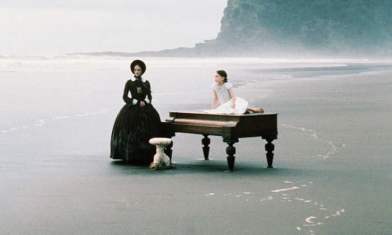
The Piano

Consider the following list with my capsule reviews an update of my previous Women Directors posts.

A Beautiful Day in the Neighborhood (Amazon Prime) – Directed by Marielle Heller 

Director Heller and the screenwriters transport Mr. Roger’s child-friendly, essential human wisdom to realistic, adult situations. The film isn’t so much about Mr. Rogers but the real-life story of journalist Tom Junod’s life-changing encounters with Fred Rogers for a magazine assignment. Tom Hanks is ideal as Mr. Rogers, and Matthew Rhys is effective in playing journalist Lloyd Vogel.

Who’s Matthew Rhys, you might ask? I highly recommend you watch “The Americans” series. Or, if you’re an Austen spinoffs fan, he’s Mr. Darcy in the mini-series “Death Comes to Pemberley”, adaptation of the novel by P. D. James. And, if you were around to watch the original Raymond Burr detective series on TV, the Wales-born actor is the new Perry Mason in our time.

Little Fires Everywhere (Amazon Prime) – Created and screenplay by Liz Tigelaar, Directors Lynn Shelton and Nzingha Stewart. 

The 8-Episode mini-series is the screen adaptation of Asian American novelist Celeste Ng’s second novel. My full book review can be found here. The thematic elements of race, motherhood, family secrets, clashes of generations and values are visualized and made more acute as Kerry Washington is cast as an African-American artist playing against Reese Witherspoon as Mrs. Richardson, the gatekeeper of the white upper-middle-class community of Shaker Heights, OH. The artist Mia Warren in Ng’s novel isn’t black, but turning her into one makes the conflict of the story more timely and pressing.

Four episodes are directed by Lynn Shelton who sadly died in May, 2020. Another female director Nzingha Stewart helmed two.

Never have I Ever (Netflix) – Created by Lang Fisher and Mindy Kaling. Directors Linda Mendoza and Anu Valia 

Here’s a recent trend that’s encouraging. Movies and series are created to feature minority cultures in America. The talented Mindy Kaling, who wrote the screenplay and co-starred with Emma Thompson in Late Night (2019) plus many other credits, created this comedy series about high school girl Devi’s experience growing up Indian-American, something Kaling knows full well. Many LOL situations and dialogues throughout the ten episodes. Kaling scouted Maitreyi Ramakrishnan in Mississauga, ON, Canada, to play Devi. A fresh look into the multi-cultural humanity that our North American population comprises. In recent years we talk a lot about representation. This is a humorous and realistic look into a vibrant sector.

The Half of It (Netflix) – Directed by Alice Wu

Here’s another lens to look into our younger generation growing up bi-cultural. The full length feature directed by Chinese-American Alice Wu is this year’s Tribeca Film Festival’s Best Narrative Feature winner. A shy academic ace, Ellie Chu, earns her pocket money from writing essays for her fellow classmates. When one day, she’s recruited by the school jock Paul Munsky to be a ghost writer of poetic love letters to a girl he tries to date, Ellie begins to feel a moral dilemma. The characterization and storyline make this feature a contemporary twist on Shakespeare’s Twelfth Night. Humor is situational with some poignant scenes, making the film all the more enjoyable.

Unorthodox (Netflix) – Created by Anna Winger, Directed by Maria Schrader

Inspired by the memoir of Deborah Feldman, who broke away from her strict Hasidic Jewish community in Brooklyn, NY, and escaped to Berlin where she changed into a new persona and started a different life. I haven’t read the memoir but I know the four-part mini-series take the liberty to re-imagine how she goes about changing her life while in Berlin. The series is captivating as viewers are introduced to the Hasidic, male-dominated and authoritarian community. Again, there are many cultural sectors in our society and through films we get to know a little bit more of how others live and the struggles they go through.

Ophelia (Netflix) – Directed by Claire McCarthy

Adaptation of the book by Lisa Klein, screenplay by Semi Chellas, Ophelia is a re-imagined story of what happened in the royal castle of Elsinore and in particular, Hamlet’s sweetheart. Lots of liberty in tweaking and twisting but still interesting to watch, albeit a lightweight Hamlet compared to the original. Notable cast includes Naomi Watts as Gertrude, Clive Owen as Claudius. Hamlet is played by George MacKay before his titular role in the WWII movie 1917, and Ophelia is Star War‘s Rey Daisy Ridley.

Hamlet (Kanopy) – Film Direction by Margaret Williams, London Stage Direction by Sarah Frankcom

A filmed recording of the play performed in Royal Exchange, Manchester. This Hamlet is a fresh take with Maxine Peake as the emotionally devastated and revengeful Prince of Denmark. Only after watching that I Google search to find the first female to play Hamlet dates back to 1796 in London Drury Lane, then 1820 in New York. Several others had followed since. But this is my first time watching. Maxine Peake’s performance almost instantly cast away all my preset feelings. She’s high-octane energy; her voice, physical stage presence totally captivate, convincing yet delicate. She’s herself and not an impersonator. Modern costume makes it more natural and, love her haircut. Peake makes me look at her not as a female taking up a male role, but a superb actor playing the ‘Everest of roles’.

Discovery and Revisit at Home

One day in the future when I have to account for how I spent my time in the months of March to May, 2020, I will come up short for a better answer than cook, eat, read, watch, sleep and then repeat day after day, lockdown except for weekly essential groceries. I admit though, I take to such reclusive, stay-home life quite naturally, albeit I did miss the Pond.

You wouldn’t want to know what I cooked and ate during those months, but I can tell you the discovery and revisit I’d made at home.

The Great Courses on KANOPY

Kanopy is wonderful if you’re not into trendy pop culture movies and TV shows. The streaming service offers classic titles and worthy contemporary films, international in scope, and is free with your local library card or an academic library account. They also carry The Great Courses, numerous subjects to choose from covering a huge variety of interests.

I took two courses, both exemplify the word ‘edutainment’, academically sound and informative. One is “Reading and Understanding Shakespeare” taught by Marc Connor (professor at Washington and Lee U), the other is “Screenwriting: Mastering the Art of Story” taught by Angus Fletcher (Ohio State U). Both comprise of 24 videos. In the Shakespeare course, I learned over 40 tools to decipher the Bard’s plays, and from the Screenwriting course, how to build a story world.

There are many pleasant discoveries but there’s one I find most gratifying. Come to think of it, I shouldn’t have been surprised at all: Both lecturers have cited Jane Austen’s Pride and Prejudice, noting how Austen had used Shakespearean elements in her storytelling, and in turn, how her work had influenced modern day screenwriting.

Pride and Prejudice

To illustrate the tone of the Ironic Narrator, an ancient literary device dating back to the Greek and Roman satires, an example professor Fletcher uses is the opening sentence of Pride and Prejudice:

It is a truth universally acknowledged, that a single man in possession of a good fortune, must be in want of a wife.

The larger things of the cosmos, ‘universal truth’, is juxtaposed with that which is much smaller and singular, albeit such triviality may well have made up the cosmos of those who are parochial. Examples of such an ironic tone can be found in The Big Short, The Princess Bride, Fargo, and CSI. ‘All of them employ the same basic what and how of Pride and Prejudice, with their own little twists and tweaks.’

Maybe you’ve noticed I used the words ‘most gratifying’ with the pleasant surprise when I hear Austen being mentioned. Yes, Jane would turn in her grave to read what I’m going to write: it feels good to find someone, particularly a male with credentials, to confirm the value of her writing such that her work isn’t being seen as ‘just women’s novels’ or ‘chick lit’. Ugh… saying this is so unnecessary, for Austen doesn’t need to prove her worth among the ignorant. However, in this day and age, it takes movements and hashtags to confirm things that should have been valued. Misconceptions ought to be corrected.

Pride and Prejudice Revisited
(Audiobook cover image above)

So, after these two courses, I was all set to revisit my favourite Jane Austen novel, Pride and Prejudice. This time, I downloaded the Blackstone audiobook (2011) narrated by Carolyn Seymour, and listened to it twice back to back; this time, I enjoyed it more. Here’s my ripple stirred by the Bard himself:

Ah ha! Fair is foul and foul is fair
Darcy and Wickham as foils repel
Appearance and sweet words can ensnare
At last! Lizzy learns her lesson well.

Further, the famous ‘block to young love’ conceit, not blocked by an older character as in the Bard’s plays –– surely Lady Catherine de Bourgh is old but she’s no match for Lizzy –– but by the lovers’ own internal flaw, be it pride, or prejudice, or both. How satisfying to see the protagonists mature in their self-knowledge as the story develops, first Darcy then later Elizabeth, gaining clarity of their own true self. Not to mention how gratifying to see that figure of grace, Darcy, as he saves the reputation of the Bennet family with his own silent, altruistic plan all for the one he loves.

Well, what’s a staycation for if not to savour one’s favourite reads over again, doing nothing all day but just dwell in the story world without feeling guilty about time spent. I’m thinking it’s a little like being stranded on a deserted island, like Tom Hanks in Cast Away, and feeling lucky you’ve got Wilson as a companion, even when there’s no one to actually play volleyball with you.


***


Related Posts on Ripple Effects

I’ve written many posts on Jane Austen during the early years of blogging. Just put her name in Search you’ll find them. Here are some of my personal favourites:

Art Imitates Life, or Life Imitates Art, or…

Why We Read Jane Austen

In Praise of Austen: Virginia Woolf’s A Room of One’s Own

Bath’s Persuasion

Here’s a link to my articles published in the Jane Austen Centre Online Magazine

‘Benjamin Button’: A Curious Look at the Movie Adaptation

The idea of a baby born as an old man and then grows younger––a reverse trajectory of the human experience––is the premise in F. Scott Fitzgerald’s short story published in 1922, reviewed in my previous post. Prompted by a remark made by Mark Twain, Fitzgerald unleashed his imagination and wrote the story.

The tale was adapted into a 2008 movie directed by David Fincher who brought it all the way to the Oscars with 13 nominations the next year. I watch it for the first time in 2020 and am surprised to find its relevance: the fear of strangeness in our age of xenophobia.

As for the 13 Oscar nominations, the movie won only three: Art Direction, Makeup, and Visual Effects. These are difficult feats and deserving wins. Unlike the Academy’s (and some critics’) aloofness in embracing the film’s other achievements, I much appreciate the adapted screenplay and Fincher’s 166 minute visual rendition.

Here’s an exemplar of how a film adaptation diverges from the original literary source and yet still keeps its main concept, but instead of faithfully following the thin, short story, carries it to a different direction, creating an expanded and more gratifying version.

Benjamin Button

Screenwriters for the adaptation are Eric Roth and Robin Swicord. Roth is known for his Oscar winning adapted screenplay for Forrest Gump (1994), and Robin Swicord for her 1994 version of Little Women. They had chosen to turn Fitzgerald’s farcical, acerbic fantasy into a serious film in the vein of magical realism. The magic lies in the imaginary, reverse growth trajectory; the realism is love.

This is not just about love between two star-crossed lovers, Benjamin (Brad Pitt) and Daisy (Cate Blanchett), but about a woman with a huge heart, Queenie (Taraji P. Henson), who embraces a Gollum-like baby abandoned at her doorstep. Instead of a non-mentioned mother in Fitzgerald’s story, Queenie raises Benjamin with devoted affection. There’s love and acceptance as well from those in the old folks lodging house where Queenie works. Further, the movie adds one more layer, and that’s Daisy at her deathbed, sharing the story of her lost love with her daughter Caroline (affectively played by Julia Ormond), leaving her with a legacy of love.

The film makes amends to the sardonic tone of the short story by creating a moving love story. For a short period in their lives, both Benjamin and Daisy are of approximate age, but such joy doesn’t last as one grows older and the other younger. Yet unlike the short story, their love endures, for as long as one can hold on to it despite separation. And we find out that one can, all the way to her deathbed; the other is just too young to remember. What’s left is the transience of time and inevitable fate.

The setting is early 20th century on the cusp of WWI in New Orleans where Benjamin is born, and not 1860 Baltimore. As he grows younger, Benjamin goes through WWII instead of the Spanish-American War in the short story. The movie starts off with a modern time with Daisy’s final hours revealing to her daughter who her real father is. That’s 2005 New Orleans, during a hurricane when the hospital is preparing to evacuate. A disastrous storm as a backdrop in the telling of a billowy story. A name to denote the significance: Katrina. 

The movie is a divergence for Fincher too considering he’s a master of crime thrillers –– Zodiac came out just a year before in 2007, and more recently Gone Girl in 2014, Benjamin Button is Fincher’s only ‘romantic’ drama (The Social Network, 2010, is drama but definitely not ‘romantic’). Crafted in signature Fincher styling with low-light, sepia colour to enhance the period effects, the aesthetics in set design and cinematography bring out the notion of ‘every frame a painting’. 

Brad Pitt’s understated performance characterizes Benjamin aptly. Instead of remaining ‘the other’, Benjamin strives to connect, albeit in a gentle and quiet way. His love at first sight with then 7 years-old Daisy is a poignant encounter. Elle Fanning is a perfect cast. A child who holds no prejudice, she’s fascinated by the ‘strangeness’ in Benjamin. The Heart is a Lonely Hunter comes to mind.

Other curious finds: music by Alexandre Desplat, Tilda Swinton in some memorable sequences, Queenie’s husband Tizzy played by now two-time Oscar winner Mahershala Ali (Green Book, 2018 and Moonlight, 2016).

You probably have watched it before when the film first came out. How the world has changed in just twelve years. Watching it again now would probably bring you a different feel, and more relevance.


~ ~ ~ Ripples


***


Unfilmed Novels

That’s a Jeopardy! category a few days ago in the Double Jeopardy round. Here are the five questions, or answers, rather. Five novels that have not been adapted to screen. For purists, their stance would be Leave Them Unfilmed. But just for interests sake, let’s see which novels Jeopardy! has included:

Catcher in the Rye (1951) by J. D. Salinger

Rumor has it that Salinger didn’t like movies. “If there’s one thing I hate, it’s the movies.” But no, Salinger didn’t say that, it’s Holden Caulfield who said that. In a letter Salinger had written, he denied that stance.

The Amazing Adventures of Kavalier & Clay (2000) by Michael Chabon

Chabon’s novel Wonder Boys was turned into a movie, but his Pulitzer winning The Amazing Adventures has not.

Foucault’s Pendulum (1988) by Umberto Eco

It’s been reported that the Italian philosopher/writer Umberto Eco wasn’t pleased with the movie adaptation of his earlier novel The Name of the Rose, so he said no more even though Stanley Kubrick had shown interest to work on Foucault’s Pendulum.

Blood Meridian (1985) by Cormac McCarthy

Many have attempted but to no avail, including Tommy Lee Jones, James Franco, Ridley Scott, and even Michael Haneke. It’s been noted that BM is more violent than No Country for Old Men. Do we need another one now, in our state of global chaos?

A Confederacy of Dunces (1980) by John Kennedy Toole

Although Hollywood had shown interest, even actors had been attached, the Pulitzer Prize winning novel remains unfilmed. Those of you who have read it, can you suggest some reasons why this is so.

***

A Note to Jeopardy Question Writers: Can’t you think of at least one novel from a woman author, just for the balance of your questions, let alone representation?

To my Ripple Readers: Can you suggest some good titles that have yet been turned into film? Old classic or current? Any books that you’d like to see transported to the big screen, in the helm of a worthy director with a talented cast and crew to bring out a deserving production?

Here are a few I can think of, some may have TV versions, but a full length, cinematic feature on the big screen is yet to be done:

Middlemarch by George Eliot (An old attempt years ago, but nothing realized. Now, let’s have Greta Gerwig write and direct. After Little Women, she just might have a fresh take on this classic.)

Beware of Pity by Stefan Zweig

The Moviegoer by Walker Percy

Lila / Gilead by Marilynne Robinson

Short stories by Jhumpa Lahiri


***

Your two pebbles?


Concord revisited with ‘Little Women’

Five years ago, I took a New England road trip with my cousin. It was a major endeavour for me coming from Western Canada, over 2,500 miles away. The photos here were taken during the road trip that fall. We began our drive across three States starting from Wayland, MA. Nearby Concord was our first point of interest. This is where Louisa May Alcott grew up and later transposed her real life family onto the page to write Little Women.

Thanks to writer/director Greta Gerwig’s adaptation, fond memories flash back as I watch the New England scenery captured so beautifully on screen. One of the memorable scenes is the panoramic autumn hillside in which Laurie made his failed attempt proposing to Jo. Another one was the Christmas morning breakfast give-away as Marmee led the girls to exercise love-in-action.

CONCORD, MA

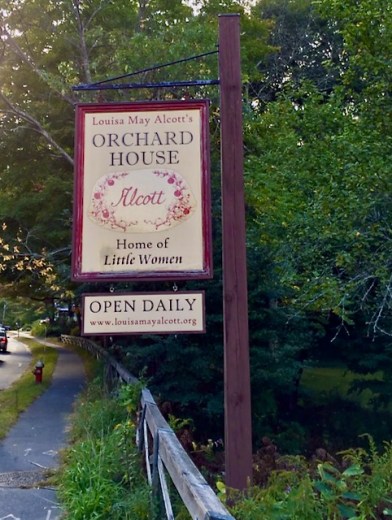
A major attraction in Concord is Orchard House where Louisa May Alcott wrote Little Women. The Alcott family owned Orchard House from 1857 to 1884, within which period all four Alcott girls Anna, Louisa, Lizzie and May had their most influential growing up years. The house is now a museum:

Sign

The rooms and furniture, Louisa’s (Jo) writing desk, the costume and props the girls made for their plays, Anna’s (Meg) wedding gown, and all of May’s (Amy) original paintings on the walls of her room are preserved inside the Orchard House Museum:

The Orchard House Museum

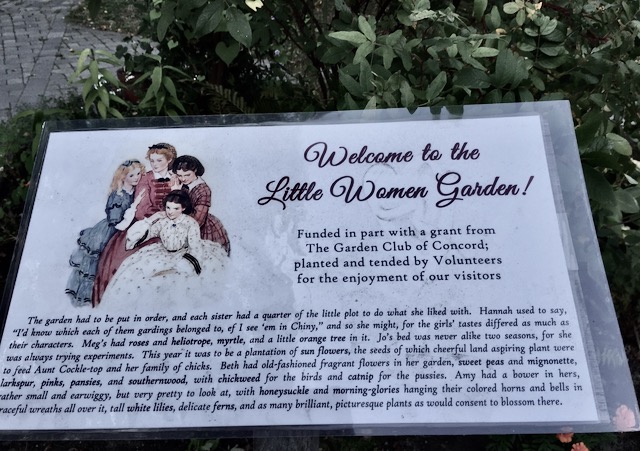
Louisa transposed her family onto the page, creating parallel characters in the March household. In the Little Women Garden, the March sisters had their own flower bed, each planted their section according to their taste or maybe, character. Here’s from the quote on the sign indicating their choices:

Meg – roses and heliotrope, myrtle, and a little orange tree
Jo – never alike two seasons, for she was always trying experiments
Beth – old-fashioned fragrant flowers, sweet peas and mignonette, larkspur, pinks, pansies, southernwood, with chickweed for birds and catnip for the pussies.
Amy – honeysuckle and morning-glories hanging their colored horns and bells in graceful wreaths all over it, tall white lilies, delicate ferns, and as many brilliant, picturesque plants.

The Garden

***

Here’s the issue many have questioned: Did Greta Gerwig alter the Little Women characters to appeal to modern day viewers, or, is she merely revealing Louisa May Alcott’s true image?

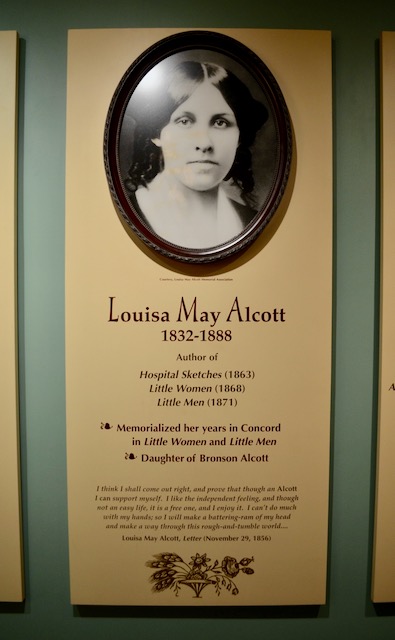
From Orchard House we went to visit the Concord Museum. Among plaques presenting some of Concord’s famous residents is this one of Louisa May Alcott. The quote on there comes from a letter Louisa wrote dated November 29, 1856:

I think I shall come out right, and prove that though an Alcott I can support myself. I like the independent feeling, and though not an easy life, it is a free one, and I enjoy it. I can’t do much with my hands; so I will make a battering-ram of my head and make a way through this rough-and-tumble world…


LMA

The Alcott parents, Bronson and Abigail were abolitionists and environmentalists. Bronson was the first teacher in Boston to admit a black student to his class despite protests from white parents who threatened either the black student go or they go. Bronson’s school was left with very few students consequently as he insisted his stance.

But his educational ideals must have been embraced by students as Bronson introduced the idea of raising their hands to speak in class, and he was the one who invented recess in school. There you go for a Jeopardy question.

Louisa’s mother Abigail was one of the first social workers in Boston, and was active in Women’s rights. She’d said, “I will go to the polls before I die if my daughters had to carry me there.”

The Alcott’s close friends and neighbours included prominent intellectuals and writers of the day: Emerson, Thoreau, Hawthorne. They made frequent, mutual visits, and had personal influence on Louisa’s formation and writing.

Down the road from the Alcott’s was Emerson’s home. Emerson had helped the financially strapped Bronson with acquiring Orchard House:

Emerson's Home

And living minimally by choice as an experiment, here’s Thoreau’s cabin (replica) at nearby Walden Pond:

thoreaus-cabin


Thoreau's Lake Side Cabin

Growing up under such stimulating milieu where thinkers and writers are free to explore new ideas and generate new philosophy, it was only natural that Louisa grew up grasping the values and the spirit of her parents and their friends, becoming a non-conformist herself.

Louisa had admitted she’s Jo in Little Women and added: “I didn’t make her half-bad enough.” If she’d been here today and directed the movie, I’ve a feeling she’d make Jo twice as radical and assertive. Gerwig is admirably restrained and for this, kudos to her.


***


Related Posts on Ripple Effects:

Little Women (2019) movie review

Can a movie adaptation ever be as good as the book?

A New England Fall Foliage Road Trip


Book to Movie Adaptations 2020

A list of upcoming book to screen titles for the new year, eclectic choices for different tastes, varied classics and contemporary notables. Looks like classic literary works of all sorts are enjoying a comeback on the big and small screens.

Classic Suspense:

Classic Mystery.jpgDeath on the Nile by Agatha Christie

Kenneth Branagh returns after his first Hercule Poirot take in Murder on the Orient Express (2017) which he directs. Once again, the prolific screenwriter/adaptor Michael Green pitches in. Interesting cast with Gal Gadot, Armie Hammer, Annette Bening.
.

RebeccaRebecca by Daphne du Maurier

Lily James is ubiquitous ever since she comes out of Downton as Lady Rose. Now she’s the young and naive Mrs. De Winter in a psychological warfare with her nemesis, housekeeper Mrs. Danver played by Kristen Scott Thomas. Can the master of Manderley save her? But of course, he must save himself first. That’s Armie Hammer, equally ubiquitous.
.

Classic Adventure:

The Call of the Wild.jpgThe Call of the Wild by Jack London

Harrison Ford heeds the call with action star Karen Gillan, Dan Stevens, and the Calgary-born, The Expanse star Cara Gee. Partially filmed in Yukon and some in Vancouver, B.C., Canada. Never heard of the Yukon Territories? This should be a good intro. I’m all for old classics, be they books or actors.
.

DOCTOR D (1).jpegVoyages of Doctor Dolittle by Hugh Lofting
Movie title Dolittle, an adventure spectacle with Robert Downey Jr. as the eponymous Doctor. See if you can identify the voices of these animals: Rami Malek, Emma Thompson, Ralph Fiennes, Marion Cotillard, Octavia Spencer… just to name a few of the stars in this production. Coming out January 17.

.

Classic Sci-Fi’s:

The Invisible ManThe Invisible Man by H. G. Wells

Classic sci-fi gets a resurrected boost. Wells’ novella and cautionary tale was first published in 1897. Now 123 years later in the 21st century, it’s adapted into a movie for the big screen. The Handmaid’s Tale Elizabeth Moss stars.
.

Brave New WorldBrave New World by Aldous Huxley

Huxley’s dystopian, imagined future written in 1931 is adapted into a TV series almost 90 years later. Again, a mark of what makes a book a classic, especially a sci-fi work. Downton early-exit Lady Sybil Jessica Brown Findlay’s in.
.

DuneDune by Frank Herbert

Another sci-fi classic, but closer to our time. A project by the acclaimed French Canadian director Dennis Villeneuve who has done some remarkable works like the Oscar nominated Arrival (2016), Blade Runner 2049 (2017) and Sicario (2015). Adapted into screen by Oscar winning writer Eric Roth (Forest Gump, 1994; A Star is Born, 2018). Timothée Chalamet, Rebecca Ferguson, and Oscar Isaac star.

Classic YA’s: 

Artemis_Fowl_first_edition_coverArtemis Fowl by Eoin Colfer

The first of Colfer’s popular series is a Disney production with Kenneth Branagh directing. A trending genre, the YA fantasy series has great potentials to be successful. A strong cast including Hong Chau, Judi Dench, Josh Gad.


The Secret Garden.jpgThe Secret Garden by Frances Hodgson Burnett
Like Little Women, this classic young reader novel has had several screen adaptations. I have no qualms about this; it only helps to spark renewed interest in the book. This new adaptation will have Colin Firth who was in the 1993 version to play Lord Archibald Craven and Julie Walters as Mrs. Medlock.
.

Contemporary Notables:

I Know this much is True.jpgI Know this much is True by Wally Lamb

Lamb’s novel about a twin brother’s advocacy and care for his paranoid schizophrenic sibling is adapted into a 6 episode TV miniseries. Mark Ruffalo will play both brothers, Dominick and Thomas Birdsey. Director Derek Cianfrance has a few fine works, the Cannes nominee Blue Valentine (2010), The Place Beyond the Pines (2012), and The Light Between Oceans (2016).

Little Fires.jpgLittle Fires Everywhere by Celeste Ng

Goodreads Choice of the Year Best Fiction (2017) and Novel of the Year on other sites, Chinese American writer Celeste Ng’s novel on class/race differences and aspirational conflicts in the idyllic community of Shaker Heights, Ohio, is adapted into a TV miniseries. Reese Witherspoon and Kerry Washington star.

Nine Perfect StrangersNine Perfect Strangers by Liane Moriarty

Moriarty’s website states her books had sold over 14 million copies worldwide. On the heels of her successful Big Little Lies turned into the small screen, Nine Perfect Strangers has already secured Nicole Kidman and Melissa McCarthy on board for the miniseries on Hulu. Her other books will follow.
.

the woman in the window.jpgThe Woman in the Window by A. J. Finn

A shaky narrator seeing a crime happening or being caught in one, Gone Girl was the first to kick off the trend. The Woman in the Window alludes to the Hitchcock classic Rear Window. Directed by Joe Wright (Darkest Hour, 2017; Anna Karenina, 2012), screenplay by Pulitzer winner Tracy Letts (August: Osage County, 2013), and an A-list cast with Amy Adams, Gary Oldman, Jennifer Jason Leigh, Julianne Moore.


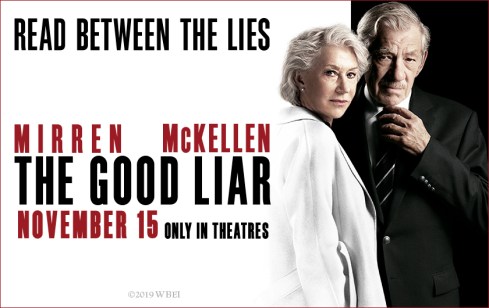
The Good Liar Movie Review

From an online dating site, two people meet. They are two seniors, con artist Roy (Ian McKellen) and his seemingly easy prey Betty (Helen Mirren), a wealthy widow. That’s all I knew about the movie before I went into the theatre. When I came out, I was surprised by its intensity and scope. Not something I’d expected. Definitely not a romantic dramedy but a suspense thriller that drops hints along the way and slowly peels off its layers of disguise. 

The Good Liar

That’s all I’m going to say about the plot because any more details I give out would diminish your enjoyment. However, I’m sure there are those who, like me, had never expected the personal history behind these two characters. Some might have been caught so off guard that they’d find the story preposterous. To them I say, it’s no more preposterous than Gone Girl, or The Debt, or Inglorious Basterds, which Roy and Betty watch in the movie. The interplay between Mirren and McKellen more than compensates for the lack of plausibility in the revealing of truth in the latter part. Further, it’s these elements of surprise that make the movie entertaining. Take it as pure escapism.

The Good Liar is based on the debut novel by British author Nicholas Searle, a pseudonym. The author worked as a UK intelligence officer before becoming a full-time writer. After watching the movie now I’m piqued to read the book, not to explore deep subject but just for its structure, to see how Searle tells his story interweaving the present and the past. This is one good case for not reading the book before watching the movie.

Mirren and McKellen, two British acting icons for the stage and screen, deliver a captivating performance playing off each other and enjoying themselves too, by the look. Director Bill Condon deftly leads us on to some revealing that makes one think twice about the meaning of the title. Condon directed Dreamgirls (2006) to two Oscar wins and received a Best Writing Oscar for adapting Gods and Monsters (1998) and a nom for his screenplay for Chicago (2002).

Other cast members include Jim Carter and Russell Tovey, both lending good support. I admit I have to try hard to cast away images of Mr. Carson of Downton Abbey when I watch Carter in The Good Liar, no matter how modern his hairdo.

Cinematographer Tobias A. Schliessler (A Wrinkle in Time 2018; Beauty and the Beast, 2017) offers some interesting vantage points, in particular the aerial shots in several scenes. The beginning of the movie grabs our attention right away with the credits being typed out on screen and a high angle shot of the two main characters connecting online on a dating site, then pulling in closer. The extreme close-ups of their eyes prepare us for intrigues. The story moves right in wasting no time. Overall, just watching the duo play off each other is entertaining enough.


~ ~ ~ Ripples


Movies based on books in November and December 2019

Here are several films coming out this fall/winter that are based on books. Usually features given a release date during this time come with some buzz as the awards season has kicked off. Surely there are also those that are from original screenplays, a few are highly anticipated titles as well. Another post for them.

Here’s a list of upcoming book to screen features. Some are in theatres already.


The Good Liar

The Good Liar.jpg

This is an interesting premise: From an online dating site, two people meet, each having an agenda of his/her own. They are octogenarian con artist Roy and his seemingly easy, slightly younger prey Betty, a wealthy widow. Played by two veterans of the stage and screen, Ian McKellen and Helen Mirren, just to watch their performance would be pleasure enough, not to mention how the plot thickens. Bill Condon directs. Based on the debut novel by Nicholas Searle; the name BTW, is a pseudonym. The author is a former UK intelligence officer before turning full-time writer. Now that’s intriguing.


The Irishman 

The Irishman.jpg

A highly anticipated Scorsese movie and it’s based on a book; many of the director’s works are.  This one is adapted from Charles Brandt’s true crime novel about the ‘Irishman’ Frank Sheeran, the hitman who murdered Teamsters boss Jimmy Hoffa. Screenplay is by Steven Zaillian, the Oscar winning writer who adapted Schindler’s List for the big screen. A Scorsese cast with Robert De Niro as Sheeran, Al Pacino, Joe Pesci, Anna Paquin. Limited release in theatres, then on Netflix, which makes it another potential clash with studio gatekeeper Spielberg.


Jojo Rabbit

Jojo Rabbit Movie Still


Winner of the Grolsch People’s Choice Award at TIFF 2019. The award has always been cited as an indicator of Oscar Best Picture, like last year’s The Green Book. But just like last year, the feature is embraced by viewers but received mixed reviews by critics. Billed as an ‘Anti-Hate Satire’, the farcical rendition is helmed by New Zealand director Taika Waititi who also stars as Adolf Hitler, a caricature and imaginary friend of 10 yr. old Jojo going through tough times towards the end of WWII. Scarlett Johansson and Sam Rockwell co-star. The movie is loosely based on the book Caging Skies by New Zealand-Belgian novelist Christine Leunens. How much has Waititi taken out from the book and how much is his own imagination? A good case study of the boundary and definition of movie adaptations.


Motherless Brooklyn

Motherless Brooklyn.jpg

Edward Norton has wanted to make the movie ever since he read Jonathan Lethem’s detective novel, a 1999 National Book Critics Circle Award winner. So, it’s taken him 20 years to do it, himself being the screenwriter, director, actor, and producer. Norton plays Lionel Essrog, a detective with Tourette’s syndrome, a disorder which afflicts him with involuntary tics. While keeping the location in NYC, Norton has changed the time to the 50’s from 1999, thereby introducing some nostalgic designs and costumes, and noir for taste. Cast includes Gugu Mbatha-Raw, Willem Defoe, Bruce Willis, and Alec Baldwin.


Little Women

Saoirse-Ronan-Jo-Character-Poster-0fb3.jpg

It has been 25 years since the last full feature adaptation of Louisa May Alcott’s classic Little Women. This updated remake is in the hands of Greta Gerwig, whose Lady Bird (2017) brought her two Oscar noms, for Best Director and Original Screenplay. But what left an indelible memory for me is her role as Frances in Noah Baumbach’s Frances Ha (2012). Now thinking back to her character Frances, a young dancer striving on her own in NYC, it shares the spirit of Jo March in Little Women: independent, fresh, and authentic. Great cast with Saoirse Ronan, Emma Watson, Florence Pugh, Timothée Chalamet, Laura Dern, Meryl Streep. A film I most look forward to this holidays season.


Cats

Cats.jpeg

For all ye ailurophiles and musical lovers. Based on T. S. Eliot’s collection of poems Old Possum’s Book of Practical Cats, Andrew Lloyd Webber’s Cats is hailed as one of the biggest hits in theatrical history on their website. Director Tom Hooper has another musical-turned-movie under his belt: Les Misérables (2012) which won 3 Oscars. Attractive cast in Cats the movie: Idris Elba, Jennifer Hudson, Judi Dench, Rebel Wilson, Ian McKellen, James Corden, Taylor Swift.

***


The Personal History of David Copperfield: From Book to Film

In a previous post I reviewed The Goldfinch, one of two literary adaptations on my list to watch while I was at the Toronto International Film Festival (TIFF) in September. The Personal History of David Copperfield is the other one, which also had its world premiere at TIFF; it represents a totally different approach to bringing a literary work to the big screen.

If The Goldfinch is an example of a traditional way of adaptation, striving at loyalty to the literary source while overlooking cinematic elements, David Copperfield is a brave venture out wielding post-modern strokes, not that it is changed into a contemporary setting, but that it is adapted with a modern-day zeitgeist. Here’s director Armando Iannucci’s rationale during a TIFF interview: Just as Dickens wrote David Copperfield reflecting life and society of his time, as a filmmaker today, he directs the adaptation through a frame of our time. 

David Copperfield
Dev Patel as David Copperfield. Image Credit: Courtesy of TIFF19

What stands out in such post-modern filmmaking is the ‘colour-blind casting’ of the production. David Copperfield is played by Dev Patel, a young British actor of Indian descent. Known for his breakout role in Slumdog Millionaire (2008), Patel has established a popular screen presence with a charisma that whisked him through many subsequent successful features such as the two Best Exotic Marigold Hotel (2011, 2015) and Lion (2016). Other non-white actors taking up main roles include Benedict Wong (Avengers: Endgame, 2019) as Mr. Wickfield, Rosalind Eleazar (Howards End, 2017) as Agnes and Nikki Amuka-Bird (The Children Act, 2017) as Mrs. Steerforth. It is a bold statement Iannucci is making: skin colour is not an issue. These talents are first and foremost, actors.

Iannucci indicated that he’d always have Patel in mind ever since he watched Lion (2016), a true story about an Indian boy separated from his older brother in a Calcutta train station and later sent away for adoption in Australia. Twenty-five years later, after a long search, he finally located and reunited with his mother in an Indian village. Watching Patel in Lion, Iannucci thought, that’s David Copperfield for him. Indeed, Dickens’s character David Copperfield could well be a metaphor for those who had suffered much in childhood and yet against all odds, have survived and grown up to be resilient and compassionate human beings.

The adaptation exudes energy and humour. Iannucci has chosen his cinematic palette with bright colours and sprinkled with comedic sparks. Surely, Dickens’s Copperfield has a sad upbringing, orphaned after his beloved mother dies young, and mistreated by his stepfather Mr. Murdstone and his sister Jane Murdstone, later having had to fend for himself as a child labourer at the ripe age of 12. Yet Dickens’s humour never fades. His light-hearted depiction of Aunt Betsey Trotwood or Mr. Micawber offer some hilarious characterization. Later, David’s brave and arduous escape to seek the shelter of Aunt Betsey turns his life around. The autobiographical fiction could well represent Dickens’s view that, in the midst of misfortunes and human pathos, there still lies a deeper essence, and that’s the joy of life. Iannucci deftly capitalizes this inherent quality in the the author’s writing and adorns his film with humour and jollity.

Here’s a note on Wikipedia on Armando Iannucci that I find interesting: “Born in Glasgow to Italian parents, Iannucci studied at the University of Glasgow followed by the University of Oxford, leaving graduate work on a D.Phil about John Milton to pursue a career in comedy.” I’m sure the story about his academic pursuit and career change entail more than just this one line can say, but that’s enough to give us the background of who’s bringing David Copperfield to the screen now. Iannucci is the creator and writer of the award-winning TV series Veep (2012-2019), the Oscar nominated political satire In the Loop (2009), and the dark comedy The Death of Stalin (2017), for which he won Best Director and Best Writer at BAFTA.

To those wary about the lack of seriousness, the superb cast is poised to deflect such criticisms. Tilda Swinton (Oscar winner Michael Clayton, 2007) as Betsey Trotwood and Hugh Laurie (Golden Globe Best Actor The Night Manager, House) as Mr. Dick are the anchors that complement Patel’s spirited performance. They are pivotal in transferring Dickens’s moral insights onto screen. Aunt Betsey’s kindness towards Mr. Dick, who in today’s term would be one stricken with mental illness, is a lesson in example, influencing David’s mutual friendship with him. The same with David’s support and acceptance of Mr. Micawber (Peter Capaldi) and his family while they are in dire financial distress. If we need a villain, Ben Whishaw’s Uriah Heep is there to show vividly the face of hypocrisy and the consequence of jealousy and deceit.

Such a light handling of the classic novel has its weakness naturally. While the moral lesson of good over evil still stands, David’s growing insights about love, life, and faith which Dickens writes about so eloquently have not been transferred onto screen as successfully. It is unfortunate that the movie does not elaborate on the effects of David’s misplaced adulations of Steerforth (Aneurin Barnard, The Goldfinch, 2019) nor does it focus on his awakening to the fervency Agnes has for him. David’s blindspot and Agnes’s hidden love for him would have made a poignant storyline. Nevertheless, the two eventually do come together, but just as a coda, with Dora (Morfydd Clark, Love & Friendship, 2016) getting the inkling of a mismatch between herself and the emerging writer to gracefully step aside, sparing David the deathbed scene from the book.

Overall, the adaptation is a joy to watch, and one of those films that I’d like to rewatch. It has just been screened at London Film Festival in early October, release dates in North America unknown. The casting might pose an issue for some, but it just may be another object lesson for today.


~ ~ ~ Ripples


***

Related Reviews on Ripple Effects:

The Goldfinch

Lion

Love & Friendship


Toronto International Film Festival 2019

In the coming weeks, I’ll be in Toronto covering the 44th TIFF taking place Sept. 5 – 15. TIFF is my annual destination away from the Pond, my chance to immerse in the celebration of film arts, world premieres of new works, festivities on King Street, and be swept up by the excitement of crowds catching a glimpse of the talents and filmmakers converging there.

For those inclined towards numbers, here are some figures: TIFF19 will screen 333 titles in total, including 245 features, 86 shorts, and 6 series, selected from 6,866 international and 1,059 Canadian submissions. There will be 133 World and 71 North American Premieres. 84 countries are represented with 36% of titles directed, co-directed, or created by women.

It’s a major task to organize one’s own viewing schedule. Films that I want to watch have time conflicts. After several days of juggling and regretful eliminating, I’ve finalized my list, more or less.

The following are some of the feature films on my To-Watch List (All images courtesy of TIFF):

A Girl MissingA Girl Missing directed by Koji Fukada (Japan) North American Premiere. Fukada’s previous film, Cannes’ Un Certain Regard Jury Prize winner Harmonium (2016) grabbed me as a concoction of Hitchcockian suspense and poignant family drama. Excited to see his newest work at TIFF.

A Hidden Life (1)A Hidden Life directed by Terrence Malick (USA, Germany) Canadian Premiere. Based on the true story of Austrian farmer and conscientious objector Franz Jägerstätter, who refused to join the German army in WWII. I expect this newest Malick film to be another soul-stirring work.

The AuditionThe Audition directed by Ina Weisse (Germany, France) World Premiere. Women play major roles in this production as director, screenwriter and cinematographer. But the main attraction for me is actor Nina Hoss, whose riveting performance won her high acclaims in the German films Phoenix (2014) and Barbara (2012).

Coming Home AgainComing Home Again dir. by Wayne Wang (USA/Korea) World Premiere. Wang brought Amy Tan’s The Joy Luck Club to mainstream cinema in 1993, telling generational stories of Chinese-Americans. His newest is based on a personal essay by acclaimed writer Chang-rae Lee about a son coming home to his ailing mother. 

David CopperfieldThe Personal History of David Copperfield dir. by Armando Iannucci (UK) World Premiere. As a book-to-movie enthusiast, I won’t miss this one. What more, the cast looks impressive, and postmodern. Dev Patel of Slumdog Millionaire (2008) fame will play Davy, Tilda Swinton as Betsey, Hugh Laurie as Mr. Dick, and Ben Whishaw the villain Uriah Heep. Turning a 800+ page classic into a two-hour movie is as daunting as Davy’s life journey. But I reserve my judgement.
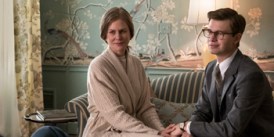
THE GOLDFINCHThe Goldfinch dir. by John Crowley (USA) World Premiere. The adaptation of Donna Tartt’s Pulitzer Prize-winning novel is helmed by the same director as Brooklyn (2015), with adapted screenplay by Wolf Hall and Tinker Tailor Soldier Spy scribe Peter Straughan. Looks like a top-notch collaboration.

Hope GapHope Gap directed by William Nicholson (UK) World Premiere. This is Nicholson’s second directorial feature which he also wrote. His other screenplays include Les Misérables (2012) and Gladiator (2000) among many others. But what draw my attention are the duo who play a couple at the brink of a marriage breakdown, Bill Nighy

and Annette Bening.

Parasite (1)Parasite directed by Bong Joon-ho (S. Korea) Canadian Premiere. This year’s Palme d’Or winner at Cannes. From the description, it echoes Kore-eda’s Shoplifters, last year’s Cannes winner. But Bong’s audacious and creative styling could make this a fresh approach to the subject of social inequality. Lee Chang-dong’s Burning (2018) also comes to mind.

Varda by Agnes (1)Varda by Agnès directed by Agnès Varda (France) Canadian Premiere. After watching the late French New Wave auteur Agnès Varda’s documentary Faces Places (2017), I’d been looking for this, her last work. Excited to know there will be a special event at TIFF 19 with the screening of Varda by Agnès plus a bonus post-film discussion by a panel of filmmakers.
***

For the full lineup, schedule, and tickets go to tiff.net

My reviews of the above plus other TIFF titles will be published on the websites Asian American Press, Vague Visages, and here at Ripple Effects.


Where’d You Go, Bernadette: From Book to Screen

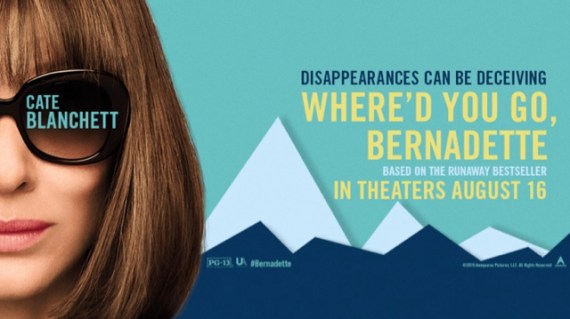
When I first learned that Maria Semple’s quirky and clever 2012 novel would be turned into a movie, I had that umm… feeling. When I found out Richard Linklater would be directing it, it turned into a whaaat? Sure it’s not a Wes Anderson project?

On the surface a mother-daughter relational story, Semple’s book is deceivingly simple. Underneath the humour is her take on contemporary American society, the tyranny of technology, vulnerability of the non-conforming, sarcasm on the upwardly aspiring middle class, the rat race and its effect on parenting, the outsourcing economy, and even taking a jab on America’s quiet and polite neighbour to the north. As a target, I must give you the following excerpt from the book as evidence of Semple’s spikiness (or is it spunkiness):

You probably think, U.S./Canada, they’re interchangeable because they’re both filled with English-speaking, morbidly obese white people. Well, Manjula (virtual personal assistant from India), you couldn’t be more mistaken.

Americans are pushy, obnoxious, neurotic, crass… Canadians are none of that. The way you might fear a cow sitting down in the middle of the street during rush hour, that’s how I fear Canadians. To Canadians, everyone is equal. Joni Mitchell is interchangeable with a secretary at open-mic night. Frank Gehry is no greater than a hack pumping out McMansions on AutoCAD. John Candy is no funnier than Uncle Lou when he gets a couple of beers in him. No wonder the only Canadians anyone’s ever heard of are the ones who have gotten the hell out. Anyone with talent who stayed would be flattened under an avalanche of equality. The thing Canadians don’t understand is that some people are extraordinary and should be treated as such.

But that’s not in the movie. Why, the movie is a total stripped-down version without the incendiary, sarcastic swipes, or the laugh-out-loud funny, and ah… thanks, Maria Semple, for the words, “it’s flattened under an avalanche of” smoothened edges in characterization and plot.

By the way, if one reads deeper into the Canadian jab quoted above, it wouldn’t be hard to see the layered meaning. Aha, the joke is on which side of the 49th?

Bernadette (1).jpg


Bernadette Fox (Cate Blanchett) has had her glorious days as an acclaimed architect, pioneer of the green building movement, a MacArthur grant recipient at 32, and a young woman succeeding in a male-dominated profession. Due to an unfortunate incident, her award-winning project was demolished without her knowledge, destroyed by a vengeful neighbour who bought it under an agent’s name. Devastated, Bernadette crashed out of her career, moved to Seattle with her Microsoft, TED Talking husband Elgie (Billy Crudup, a miscast). They bought a huge, dilapidated mansion. For twenty years she had ignored the maintenance of her home and self. The traumatic health issue of her daughter Bee’s (Emma Nelson) early years drives her further into the hole living as a reclusive agoraphobic.

Bernadette and Bee are the best of friends though. Mother/daughter relationship is well portrayed in the movie, a particular gripping scene is their singing the song ‘Time after time’ together in the car ending with a Bernadette meltdown. “You don’t know how hard it is for me.” Bee doesn’t know, viewers need to guess, but readers do, for they are supplied with ample back story. The movie, however, has trouble connecting the past with the present, or presenting sufficient motivation for the actions and behaviour of the characters.

As loving parents, Bernadette and Elgie have to fulfill a promise to Bee, that is she can have anything she asks for if she gets straight A’s; now they’re stuck with making a family trip to Antarctica. For two-third of the movie we see mostly interior shots of home and work building up a case to Bernadette’s disappearance. The momentum picks up only in the last third, the Antarctica episode.

The storytelling in the book is a lively collection of emails, notes, letters, hospital billing, and police report plus personal narrative to present the different voices from various characters. On screen, the Rashomon-like shifting of perspectives are converted into mainly two characters sitting and talking to each other. Surely Linklater is an expert in dialogues with his Before trilogy, where the camera follows two characters Jesse (Ethan Hawke) and Céline (Julie Delpy) talking throughout the movie and yet still captivating viewers as we watch them wander the streets and listening to them chat. But here, that magic is missing. Where’d you go, Linklater?

For the casting of Bernadette, Cate Blanchett is a good choice, her Academy Award winning role in Blue Jasmine comes to mind. Unfortunately, here she is not in her Jasmine form. The major issue is a weak script, hence the directing of it. The screenplay follows the book faithfully but in a minimal, abridged version. It begs the question: does a movie adaptation need to follow the source material to the dot? Here in this very different medium, dialogues are picked right out of the novel while the camera has not been fully utilized, nor any imaginative ingredients been added to the visual adaptation of this quirky and zesty book. Well, yes, it might have been faithful to the letter, but not the spirit.

The title question obviously doesn’t just mean the physical whereabouts of Bernadette but where her talent, creativity, and vitality for life have gone. There’s a scene with Bernadette meeting her previous mentor Paul Jellinek (Laurence Fishburne) who says it explicitly: “People like you must create. If you don’t, you become a menace to society.” Such is a thematic element that needs to be calved out more clearly, a talent caged in by her own disillusionment and her ultimate breakthrough. Don’t blame motherhood, and Bernadette doesn’t, for she sees a beautiful offspring flourishing in Bee. But is parenting a zero-sum game? The context and question should be handled with more depth and inner exploration. With not much contextual support, the case of a self-imposed, locked-up genius is left to the actor Blanchett to portray, and at times it seems forced.

Missing story elements cause lapses in the storytelling. Why does Audrey (Kristen Wiig), Bernadette’s neighbour and archenemy, suddenly becomes friend with her at the most critical moment? Or, during the mudslide, the camera hasn’t shown (without obstruction) what’s written on the sign, which has triggered much of the resentment between Audrey and Bernadette. Readers know, but not viewers if they have not read the source material.

At the end of the book there’s an “About the Author” page. Before writing fiction, Semple had written for the television shows Arrested Development, Mad About You, and Ellen. If one hadn’t known this tidbit already, a natural response would have been “no wonder!” It just points plainly to the ideal person who should have written the screenplay.


~ ~ Ripples

***


Related Reviews on Ripple:

Blue Jasmine: Homage and Reimagining

Boyhood: The Moment Seizes Us 

Before Midnight: Reality Check

The Budapest Hotel: A Grand Escape


Upcoming Book-to-Movie Adaptations: Good Summer Reading

Previously on Ripple, I’d posted lists of books-to-movies coming out soon here and here. If you’ve gone to the theatre lately, you’ve probably seen trailers for some of them: The GoldfinchWhere’d you go Bernadette? or Cats (like a horror movie for someone who has ailurophobia.)

Here are some updates. The following is a list of movie adaptations in development for the big screen or TV series. They are in various stages of production, just announced or in pre-production, release dates unknown or tentative. If you’re the well-prepped movie goer, here’s your list of summer reading:

Where the Crawdads sing.jpegWhere the Crawdads Sing by Delia Owens

Now 46 weeks on the NYT Bestsellers List and has sold more than 1.5 million copies, Owens’s debut novel about a young girl who has raised herself and survived alone in a coastal North Carolina marsh is a mix of nature writing, murder mystery, and coming-of-age story. Reese Witherspoon will be producing it with Fox 2000. Owens is a wildlife scientist and nature writer who had spent years in Africa.


Little Fires Everywhere (1)

Little Fires Everywhere by Celeste Ng

Another project by Witherspoon’s Hello Sunshine production company. Ng’s novel about families in a Cleveland suburb dealing with diversity, teenager angsts, and generational conflicts had been named Best Book of the Year (2017) by NPR, Amazon, Goodreads, The Guardian… just to name a few. It will be adapted into a TV series with the Hulu platform. 


Ask Again, YesAsk Again, Yes by Mary Beth Keane

The producers of American Beauty (1999) which won 5 Oscars in 2000 have bought the movie and TV rights of the book. Another novel about suburban families is being described in Goodreads as “profoundly moving.” Author Keane was a 2015 Guggenheim Fellow in Fiction; her previous works had been a finalist for the PEN/Hemingway Award and garnered Best Book of the year acclaims.


The Silent PatientThe Silent Patient by Alex Michaelides

Screenwriter Michaelides’s debut novel is described by Entertainment Weekly as “a mix of Hitchcockian suspense, Agatha Christie plotting, and Greek tragedy.” A psychotherapist has to unlock the mystery of his patient who’d killed her husband six years earlier and then remained silent since. (Read an excerpt using the link) Meanwhile, Michaelides will write the screenplay, naturally. Brad Pitt’s Plan B and Annapurna Pictures producing.


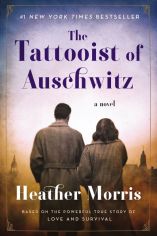
Tattoist of Auschwitz.jpgThe Tattooist of Auschwitz by Heather Morris

Hailed as the true story of Slovakian Jew, Lali Sokolov, who fell in love with a girl he was tattooing at the Auschwitz concentration camp during WWII, a powerful story of love and survival. British producer Synchronicity Films had secured the rights and a drama series is in development. Here’s the rub: the Auschwitz Memorial Research Centre had disputed the authenticity of the book according to The Guardian. A case of negative publicity is still good publicity?
The Underground Railroad

The Underground Railroad by Colson Whitehead

Colson Whitehead’s Pulitzer Prize for Fiction winner (2017) is adapted by director Barry Jenkins. Jenkins’s name had catapulted to stardom since his Oscar win for Moonlight (2016) and the subsequent If Beale Street Could Talk (2018). The story of the harrowing escape of two Southern slaves Cora and Caesar using the Underground Railroad is adapted into 11 episodes for Amazon Studio.


Washington Black (2)

Washington Black by Esi Edugyan

The book is Edugyan’s second consecutive win of Canada’s Scotiabank Giller’s Prize, also shortlisted for the 2018 Booker Prize. The journey of 11-year-old slave boy “Wash” born on a Barbados plantation is a fantastical story of adventure when he became the personal servant of Englishman Christopher Wilde, inventor, naturalist, explorer, and abolitionist. 20th Century Fox TV, after “an intense bidding war” , had secured the rights to the small screen.


***