‘Edith’s Diary’: Madness, Escape, or Creativity?

“I’ve had lots of troubles, so I write jolly tales.”    ––– Louisa May Alcott
.

Edith's DiaryMy point of contact with Patricia Highsmith’s work is mainly in the movies: Strangers on a Train, The Talented Mr. Ripley, Two Faces of January, and Carol based on her novel The Price of Salt which I’d read. Edith’s Diary, first published in 1977, is a very different work from all the above.

As the book begins, Edith Howland, 35, her husband Brett, and their ten year-old son Cliffie have just moved into small town Brunswick Corner, Pennsylvania, from New York City. The year is 1955. The reason for the move is for Cliffie to grow up in a country environment with more space to roam. Edith’s diary is a precious possession wherein she records her experiences.

Edith is quick to immerse in the community and makes a few friends. With Gert, she successfully revitalizes the local paper Bugle, and she continues with her freelance writing. It’s Cliffie that’s her main concern. Cliffie isn’t a normal boy. He keeps to himself, is indifferent to his parents, unkind to their cat Mildew, makes no friends and doesn’t do well in school. That’s enough for alarm, but Edith’s attitude is concern mixed with appeasement. 

Not long after they’ve moved into their house, Brett’s elderly uncle George comes to live with them, a decision not from mutual consent between the couple. Edith has to take care of George, cook and bring his meals to his bedside, keep the house in good order, write for Bugle and pitch to magazines, all while keeping an amicable social front.

Ten years gone by, life hasn’t aligned much with Edith’s wishes. Far from it. Cliffie can’t make it into any college, no full-time job and turns to alcohol and drugs to pass his days. Old George still hangs in there needing more of Edith’s time and attention. Most devastating to her psyche is Brett, who has left her and moved back to NYC to a new life of his own by marrying his young secretary. Highsmith is meticulous in detailing the psychological world of Edith’s, her frail personality, appeasing her son and yielding to her husband.

But as life’s burdens become heavier and things get gloomier, Edith’s entries in her diary shift to a more and more uplifting tone. She creates a different life for her son in her diary entries, imagining Cliffie successfully graduates from Princeton and begins a good career, marries a sweet girl who later bears her a grandchild.

Edith’s diary is an imaginary narrative that’s totally different from her real life. Towards the end, madness takes over and Highsmith’s ending is both shocking and dismissing. No spoiler here. However, reading the book makes me think of a quote from Little Women‘s author Louisa May Alcott:

I’ve had lots of troubles, so I write jolly tales.    ––– Louisa May Alcott

What’s the difference between Alcott writing jolly tales and Edith’s detailing an alternative life in her diary? If Edith isn’t writing into a diary, which is supposed to be ‘non-fiction’, isn’t she just creating a work of fiction? Where’s the line between escape and creativity?

Highsmith drops obvious clues for us describing Edith’s sinking deep into the slough of madness as she actually prepares for her imaginary Cliffie’s visit to her home for dinner with wife and son in tow. So, it looks like Highsmith is showing us the demarkation, when the two lives, the imaginary and the real, merge into one, therein lies madness.

But, is Edith’s diary an evidence of madness, or an imaginary work of fiction? Hmm… that would be my question to Highsmith if I were a journalist interviewing her. Now, just let me dwell on that thought some more…

***

Edith’s Diary by Patricia Highsmith, Grove Press, New York, 2018. 393 pages.

Note: Patricia Highsmith’s own diaries will be published in the coming year. Now that would be an interesting read.
 

Time to attack those TBR piles

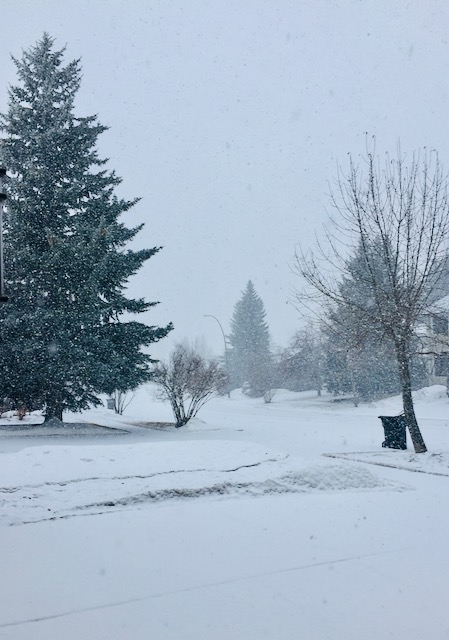
They’re everywhere, on the shelves and in boxes on the floor. Now’s a good time. If you’ve seen my Twitter photo, it’s perfectly alright to stay inside and read when outside looks like this. Look closely, yes, it’s snowing cats and dogs:


Outside

.

Here are some of them, in no particular order. Where do I begin?

***

The Ambassadors by Henry James

The Heart of the Matter by Graham Greene

Brighton Rock by Graham Greene

Amsterdam by Ian McEwan

Saturday by Ian McEwan

Saplings by Noel Streatfeild

The Enchantress of Florence by Salman Rushdie

A Fine Balance by Rohinton Mistry

The Headmaster’s Wager by Vincent Lam

The History of Love by Nicole Krauss

The Nest by Cynthia D’Aprix Sweeney

East of Eden by John Steinbeck

The Magic of Saida by M. G. Vassanji

Tell it to the Trees by Anita Rau Badami

The High Mountain of Portugal by Yann Martel

Self  by Yann Martel

Confessions by St. Augustine

A Secular Age by Charles Taylor

The Matisse Stories by A. S. Byatt

Our Mutual Friend by Charles Dickens

Death in Venice and Other Stories by Thomas Mann

Villette by Charlotte Brontë

The Tenant of Wildfell Hall by Anne Brontë

Lit by Mary Karr

The Plague by Albert Camus (O, not now)

O Pinoeers! by Willa Cather

Reborn by Susan Sontag

Cool Water by Diane Warren

The Marriage Plot by Jeffrey Eugenides

Moby Dick by Herman Melville

The Sunday Philosophy Club by Alexander McCall Smith

The Ministry of Utmost Happiness by Arundhati Roy

Jacob’s Room by Virginia Woolf

The last three volumes of Proust’s In Search of Lost Time

.
***
.

I’ll stop here.

Your 2 pebbles? What are some of your TBR titles?


Staying Home Binge Reading

Extraordinary times call for extraordinary measures, and I’m glad to do my social duty to stay home and binge read.

Since the beginning of the year, I’ve been reading mysteries from various countries. From the UK, Julian Symons’s The Colour of Murder, Agatha Christie’s Death on the Nile, Jacqueline Winspear’s Maisie Dobbs, and Alex Michaelides’s The Silent Patient, to the US, John Grisham’s Camino Island, and my first Mary Higgins Clark All by Myself, Alone, which reads like an American version of Death on the Nile. And now getting through Patricia Highsmith’s Edith’s Diary, which is a sort of psycho-mystery.

But thanks to Japanese Literature Challenge 13 over at Bellezza’s, I’m introduced to Japanese mysteries. I started with Akutagawa Ryūnosuke’s (芥川 龍之介) classic short stories “Rashomon” and “In A Grove”, posted here. After that, I’ve been intrigued by the novels written by the prolific Keigo Higashino (東野圭吾). Beginning with Malice, I’ve since binge read five of his mysteries.

There are ten books in the Detective Kaga series but only two have been translated into English: Malice and Newcomer, which I’ve reviewed in a previous post.

From the Detective Galileo series, there are 8 books from which three have been translated, The Devotion of Suspect X, Salvation of a Saint, and A Midsummer’s Equation. I devoured these in the past few weeks. Not everyone of them is a 4-Ripple rating, but this one definitely deserves it.

The Devotion of Suspect X


The Devotion of Suspect X book cover


(Winner of the 2005 Naoki Prize for Best Novel in Japan, and also winner of both the Edogawa Rampo Prize and the Mystery Writers of Japan Prize for Best Mystery. The English translation was nominated for an Edgar Award in 2012.)

From the start, the reader is eyewitness to a murder. We know who committed the crime, the murder weapon, the motive, and the actual scene. It happens in the home of single mother Yasuko and daughter Misato. The victim is Yasuko’s ex-husband, a menace in her life. A neighbour, Ishigami, is in his adjacent apartment unit at the time. What follows is a cat-and-mouse chase––in Higashino’s leisurely pace––of the police and the suspect and possible accomplice.

Detective Galileo is the nickname the Tokyo Police Department had given Manabu Yukawa, Assistant Professor of Physics at Imperial University. Yukawa is a college friend of Detective Kusanagi and someone whom Kusanagi seeks when he needs to bounce off ideas or just shoot the breeze, an actual phrase from the English translation, curious to know the original Japanese idiom.

Higashino’s novels are like bookish tourism. His story, characters and settings make movie images in my mind of what everyday Japanese life is like. Here in this case, the murder weapon is the electrical cord from a kotatsu. What’s a kotatsu? I wondered, so was happy to divert to some Googling on that. Do go and find out if you’re interested. Lively pictures I did find and a new discovery of a common item in a Japanese home.

Back to the book. The physics professor Yukawa is logical. He analyses and deducts with a clear mind. Funny that the real detective, his friend Kusanagi is often driven by presumptions and impulses. The two make an odd couple in this series. However, it’s in the suspect Ishigami, a high school math teacher, that Yukawa finds his match. From the case, Yukawa reunites with his university classmate Ishigami whom he has not seen since graduation. Yukawa remembers him as a rare genius, someone whom he respects with heartfelt affinity.

When an amateur attempts to conceal something, the more complex he makes his camouflage, the deeper the grave he digs for himself.  But not so a genius.  The genius does something far simpler, yet something no normal person would even dream of, the last thing a normal person would think of doing.  And from this simplicity, immense complexity is created.

It’s Yukawa, the physics professor who finally figures out the mind of the genius, a conjecture he’d wish wasn’t true, for pathos can overwhelm a rational mind. And that’s a parallel to depict Ishigami. For him, something rare had sprouted within: when love and devotion are factored into an equation, it could lead to the most extraordinary scenario.

With an intriguing plot and unexpected development in the final revealing, Higashino captures the emotions and humanity of his characters in a way that’s nothing short of profound. The story idea Higashino has created here is most unique and original, just reflects the ingenuity of the mind of the writer.


~ ~ ~ ~ Ripples


JLC13


The Devotion of Suspect X by Keigo Higashino, Translated by Alexander O. Smith with Elye J. Alexander. Minotaur Books, New York, 2011. 298 pages


***


‘Newcomer’ by Keigo Higashino

Thanks to Bellezza’s Japanese Literature Challenge, now in its 13th year, I’m introduced to the popular Japanese mystery writer and multiple book award winner Keigo Higashino (東野圭吾), and get to meet the amiable character he created, Detective Kyoichiro Kaga.

Higashino has written two main series of mysteries, one with Detective Kaga, the other Detective Galileo. There are also stand-alone novels. Almost twenty of his books have been turned into movies and TV series in Japan.

I’ve read Malice, and now Newcomer, and become a fan of both Higashino and Detective Kaga. Malice deals with the murder of an author and a possible suspect who’s also a writer; I was drawn to the story right away. However, I find Newcomer even more interesting. Higashino is the accidental tour guide leading his readers to the main roads and side streets of Japanese society.

Newcomer

First off, how do I describe Detective Kaga? Who can I compare him with? As clever as Hercule Poirot, but too sloppily dressed, so, no. As relentless as Harry Bosch, but much gentler and friendlier, so, no. Right, he’s more like Columbo, a young Japanese Columbo, casual in manners, friendly to all, but a gadfly to some. And I did catch him saying, “just one more thing…”

Above all, his very humane way of doing his job is admirable. Here’s a detective with heart. Kaga isn’t only concerned with finding the culprit, but in his own words: “my job as a detective should go beyond that. People who’ve been traumatized by a crime are victims, too. Finding ways to comfort them is also part of my job.” For walking that extra mile, he has made friends but also made himself a nuisance to some, especially those who have reasons to evade him.

The Newcomer in this book refers to Kaga himself, who has just been transferred to the Nihonbashi precinct in Tokyo, a demotion from the Tokyo Metropolitan Police Department’s Homicide Division, something to do with his ‘inappropriate emotional involvement’, an issue that only highlights who Kaga is like. Higashino has dropped a hint for me to find out more from his other books of the Kaga series about what that ’emotional involvement’ is all about. Unfortunately, only Malice and Newcomer have been translated into English in this ten-book series.

Here in Newcomer, a woman newly divorced has been murdered. Kaga not only needs to find the perpetrator of the crime but has to familiarize himself with his new precinct of work, the social geography of the community. We see him following clues to a rice cracker shop, a restaurant, a clock shop and its owner’s dog walking routine, a pastry shop, a theatre company, and a traditional Japanese handcrafts shop. All interesting places to which Higashino leads us to observe the livelihood and human interactions within.

One issue I have with this book, however, is that Higashino introduces a new character close to the end and reveals the denouement with totally new information. Having said that, I’m fascinated by how he weaves together the strands and casually revealing the human tapestry of his society.

I use both the hardcopy and the audiobook, whenever is more convenient. They complement each other perfectly.


JLC13


__________________


Newcomer by Keigo Higashino, translated by Giles Murray. Minotaur Books, New York. Translation copyright, 2018, 342 pages. Audiobook by MacMillan Audio, narrated by P. J. Ochlan, 2018.

__________________


Other Japanese Literature Challenge posts:

Rashomon and Other Stories by Ryūnosuke Akutagawa

The Sound of the Mountain by Yasunari Kawabata

Reading Snow Country in Snow Country

Rashomon and other Stories by Ryunosuke Akutagawa

In participation of Japanese Literature Challenge 13 hosted by Bellezza.

Rashomon and Other Stories

Ryūnosuke Akutagawa (芥川龍之介 1892 – 1927) was an acclaimed early 20th Century Japanese author of the modernist style. Prolific in his short life, Akutagawa had written more than a hundred short stories upon his death by suicide at age 35. He is cited as “The Father of Japanese Short Stories”. The prestigious Akutagawa Prize established in 1935 was named after him to reward the best work of fiction by a new author. Japanese Nobel Laureate Kenzaburō Ōe and crime fiction writer Seichō Matsumoto are among the past winners.

Even though written in the early decades of the 20th century, the six stories compiled in this collection are surprisingly modern in their relevance. Further, despite the author’s gloomy outlook, a few of these stories are sprinkled with a touch of lively humour. The collection shows Akutagawa as an incisive depicter of the human condition and an astute observer of the human psyche.

***

Here are the stories:

In A Grove –– This story and the next are adapted into the renown film Rashomon (羅生門 1950) directed by the legendary Akira Kurosawa (黑澤明 1910 – 1998). The body of a murdered samurai is found in the forest by a woodcutter. His wife has been raped. What has truly happened, however, can’t be determined as the witnesses all tell very different stories. They are the woodcutter, a beggar, a priest, the wife, and the dead husband speaking through a spirit. Akutagawa presents the multiplicity of subjective point-of-views retrieved from memory. Can objective truth ever be found?

Rashomon –– “The Rashōmon” is the largest gate in Kyoto, the ancient capital of Japan. It was constructed in the year 789. When this story takes place, the gate is dilapidated and has become the hideout for thieves and robbers, what more, corpses are left there unclaimed. A servant who has just been let go is standing under the gate waiting for a break in the pouring rain. With no employment now, he struggles with the moral dilemma of becoming a thief or face the consequence of poverty, starving to death. What Akutagawa depicts after this is a dark reality of survival. Kudos to Kurosawa, he turns a chilling story into a film with a hopeful ending.

Yam Gruel –– Reads like a cautionary tale about the satiation of desire, but with whimsical touches and acerbic humour. Goi, a plain-looking samurai suffering from low self-esteem is the laughing stock of everyone, but he learns to live with the ridicules he faces everyday. Goi has one longing, the delicious yam gruel which his boss treats the samurais once a year. What follows is like a dream come true. He’s led to a long distance away on horseback by his boss to a place where he can have limitless yam gruel. But the result isn’t as he has expected. Why, when you have unlimited supply of what you desire, they will soon upset your appetite. Be careful what you wish for.

The Martyr ––  Christianity had a substantial influence in Japan during the 16th Century. With The Martyr, Akutagawa spins a tale about a boy named Lorenzo who is adopted by the Jesuits. Time passes and as he emerges into manhood, Lorenzo is wrongly accused of getting a village girl pregnant, resulting in his exile away from society. Later in a moment of crisis, Lorenzo’s real character prompts him to act by offering the ultimate sacrifice.

Kesa and Morito –– An early version of the popular genre we have now, psychological murder mystery as told by different narrators, again, multiplicity of POVs. The substance and motive for the crime is similar to “In A Grove”, adultery, love, hate, and lust, two internal monologues revealing Akutagawa’s grasp of the darkness lodged in the human soul.

The Dragon –– An ingenious take on fake news. Here’s the post the priest Hanazō makes up to play a trick on his colleagues, sticking a message board by the pond, it can well be a tweet today: “On March third a dragon shall ascend from this pond.” Retweets follow. Words soon spread, first local people then out to the whole province and finally to other provinces. So on March third, a humongous crowd gathers by the pond waiting to see the dragon king rise up. Here’s what Hanazō learns afterwards: if you have enough likes and followers, what’s fake will become true. Even when you confess you made it all up to begin with, nobody will believe you.

***

Rashomon and Other Stories by Ryūnosuke Akutagawa, Translated by Takashi Kojima. Tuttle Publishing, Singapore, 1952.


JLC13


________________


My previous Japanese Literature Challenge posts:

The Sound of the Mountain by Yasunari Kawabata

Reading Snow Country in Snow Country

Rouse Up O Young Men of the New Age! by Kenzaburo Oe


Unfilmed Novels

That’s a Jeopardy! category a few days ago in the Double Jeopardy round. Here are the five questions, or answers, rather. Five novels that have not been adapted to screen. For purists, their stance would be Leave Them Unfilmed. But just for interests sake, let’s see which novels Jeopardy! has included:

Catcher in the Rye (1951) by J. D. Salinger

Rumor has it that Salinger didn’t like movies. “If there’s one thing I hate, it’s the movies.” But no, Salinger didn’t say that, it’s Holden Caulfield who said that. In a letter Salinger had written, he denied that stance.

The Amazing Adventures of Kavalier & Clay (2000) by Michael Chabon

Chabon’s novel Wonder Boys was turned into a movie, but his Pulitzer winning The Amazing Adventures has not.

Foucault’s Pendulum (1988) by Umberto Eco

It’s been reported that the Italian philosopher/writer Umberto Eco wasn’t pleased with the movie adaptation of his earlier novel The Name of the Rose, so he said no more even though Stanley Kubrick had shown interest to work on Foucault’s Pendulum.

Blood Meridian (1985) by Cormac McCarthy

Many have attempted but to no avail, including Tommy Lee Jones, James Franco, Ridley Scott, and even Michael Haneke. It’s been noted that BM is more violent than No Country for Old Men. Do we need another one now, in our state of global chaos?

A Confederacy of Dunces (1980) by John Kennedy Toole

Although Hollywood had shown interest, even actors had been attached, the Pulitzer Prize winning novel remains unfilmed. Those of you who have read it, can you suggest some reasons why this is so.

***

A Note to Jeopardy Question Writers: Can’t you think of at least one novel from a woman author, just for the balance of your questions, let alone representation?

To my Ripple Readers: Can you suggest some good titles that have yet been turned into film? Old classic or current? Any books that you’d like to see transported to the big screen, in the helm of a worthy director with a talented cast and crew to bring out a deserving production?

Here are a few I can think of, some may have TV versions, but a full length, cinematic feature on the big screen is yet to be done:

Middlemarch by George Eliot (An old attempt years ago, but nothing realized. Now, let’s have Greta Gerwig write and direct. After Little Women, she just might have a fresh take on this classic.)

Beware of Pity by Stefan Zweig

The Moviegoer by Walker Percy

Lila / Gilead by Marilynne Robinson

Short stories by Jhumpa Lahiri


***

Your two pebbles?


Concord revisited with ‘Little Women’

Five years ago, I took a New England road trip with my cousin. It was a major endeavour for me coming from Western Canada, over 2,500 miles away. The photos here were taken during the road trip that fall. We began our drive across three States starting from Wayland, MA. Nearby Concord was our first point of interest. This is where Louisa May Alcott grew up and later transposed her real life family onto the page to write Little Women.

Thanks to writer/director Greta Gerwig’s adaptation, fond memories flash back as I watch the New England scenery captured so beautifully on screen. One of the memorable scenes is the panoramic autumn hillside in which Laurie made his failed attempt proposing to Jo. Another one was the Christmas morning breakfast give-away as Marmee led the girls to exercise love-in-action.

CONCORD, MA

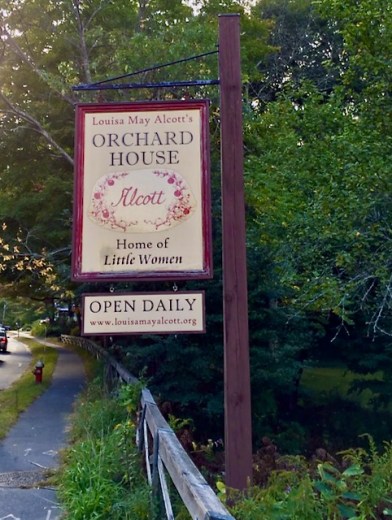
A major attraction in Concord is Orchard House where Louisa May Alcott wrote Little Women. The Alcott family owned Orchard House from 1857 to 1884, within which period all four Alcott girls Anna, Louisa, Lizzie and May had their most influential growing up years. The house is now a museum:

Sign

The rooms and furniture, Louisa’s (Jo) writing desk, the costume and props the girls made for their plays, Anna’s (Meg) wedding gown, and all of May’s (Amy) original paintings on the walls of her room are preserved inside the Orchard House Museum:

The Orchard House Museum

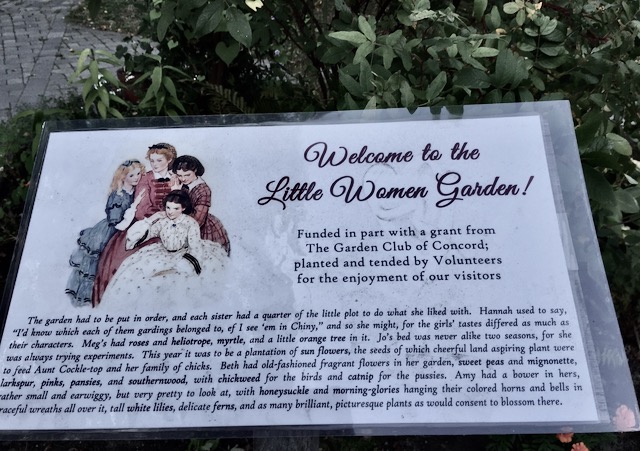
Louisa transposed her family onto the page, creating parallel characters in the March household. In the Little Women Garden, the March sisters had their own flower bed, each planted their section according to their taste or maybe, character. Here’s from the quote on the sign indicating their choices:

Meg – roses and heliotrope, myrtle, and a little orange tree
Jo – never alike two seasons, for she was always trying experiments
Beth – old-fashioned fragrant flowers, sweet peas and mignonette, larkspur, pinks, pansies, southernwood, with chickweed for birds and catnip for the pussies.
Amy – honeysuckle and morning-glories hanging their colored horns and bells in graceful wreaths all over it, tall white lilies, delicate ferns, and as many brilliant, picturesque plants.

The Garden

***

Here’s the issue many have questioned: Did Greta Gerwig alter the Little Women characters to appeal to modern day viewers, or, is she merely revealing Louisa May Alcott’s true image?

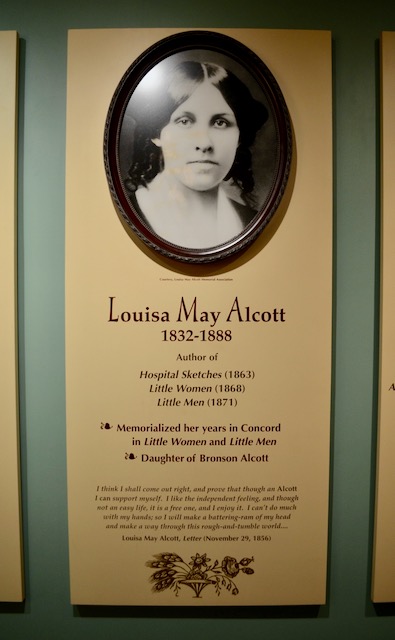
From Orchard House we went to visit the Concord Museum. Among plaques presenting some of Concord’s famous residents is this one of Louisa May Alcott. The quote on there comes from a letter Louisa wrote dated November 29, 1856:

I think I shall come out right, and prove that though an Alcott I can support myself. I like the independent feeling, and though not an easy life, it is a free one, and I enjoy it. I can’t do much with my hands; so I will make a battering-ram of my head and make a way through this rough-and-tumble world…


LMA

The Alcott parents, Bronson and Abigail were abolitionists and environmentalists. Bronson was the first teacher in Boston to admit a black student to his class despite protests from white parents who threatened either the black student go or they go. Bronson’s school was left with very few students consequently as he insisted his stance.

But his educational ideals must have been embraced by students as Bronson introduced the idea of raising their hands to speak in class, and he was the one who invented recess in school. There you go for a Jeopardy question.

Louisa’s mother Abigail was one of the first social workers in Boston, and was active in Women’s rights. She’d said, “I will go to the polls before I die if my daughters had to carry me there.”

The Alcott’s close friends and neighbours included prominent intellectuals and writers of the day: Emerson, Thoreau, Hawthorne. They made frequent, mutual visits, and had personal influence on Louisa’s formation and writing.

Down the road from the Alcott’s was Emerson’s home. Emerson had helped the financially strapped Bronson with acquiring Orchard House:

Emerson's Home

And living minimally by choice as an experiment, here’s Thoreau’s cabin (replica) at nearby Walden Pond:

thoreaus-cabin


Thoreau's Lake Side Cabin

Growing up under such stimulating milieu where thinkers and writers are free to explore new ideas and generate new philosophy, it was only natural that Louisa grew up grasping the values and the spirit of her parents and their friends, becoming a non-conformist herself.

Louisa had admitted she’s Jo in Little Women and added: “I didn’t make her half-bad enough.” If she’d been here today and directed the movie, I’ve a feeling she’d make Jo twice as radical and assertive. Gerwig is admirably restrained and for this, kudos to her.


***


Related Posts on Ripple Effects:

Little Women (2019) movie review

Can a movie adaptation ever be as good as the book?

A New England Fall Foliage Road Trip


Book to Movie Adaptations 2020

A list of upcoming book to screen titles for the new year, eclectic choices for different tastes, varied classics and contemporary notables. Looks like classic literary works of all sorts are enjoying a comeback on the big and small screens.

Classic Suspense:

Classic Mystery.jpgDeath on the Nile by Agatha Christie

Kenneth Branagh returns after his first Hercule Poirot take in Murder on the Orient Express (2017) which he directs. Once again, the prolific screenwriter/adaptor Michael Green pitches in. Interesting cast with Gal Gadot, Armie Hammer, Annette Bening.
.

RebeccaRebecca by Daphne du Maurier

Lily James is ubiquitous ever since she comes out of Downton as Lady Rose. Now she’s the young and naive Mrs. De Winter in a psychological warfare with her nemesis, housekeeper Mrs. Danver played by Kristen Scott Thomas. Can the master of Manderley save her? But of course, he must save himself first. That’s Armie Hammer, equally ubiquitous.
.

Classic Adventure:

The Call of the Wild.jpgThe Call of the Wild by Jack London

Harrison Ford heeds the call with action star Karen Gillan, Dan Stevens, and the Calgary-born, The Expanse star Cara Gee. Partially filmed in Yukon and some in Vancouver, B.C., Canada. Never heard of the Yukon Territories? This should be a good intro. I’m all for old classics, be they books or actors.
.

DOCTOR D (1).jpegVoyages of Doctor Dolittle by Hugh Lofting
Movie title Dolittle, an adventure spectacle with Robert Downey Jr. as the eponymous Doctor. See if you can identify the voices of these animals: Rami Malek, Emma Thompson, Ralph Fiennes, Marion Cotillard, Octavia Spencer… just to name a few of the stars in this production. Coming out January 17.

.

Classic Sci-Fi’s:

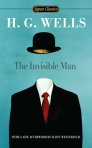
The Invisible ManThe Invisible Man by H. G. Wells

Classic sci-fi gets a resurrected boost. Wells’ novella and cautionary tale was first published in 1897. Now 123 years later in the 21st century, it’s adapted into a movie for the big screen. The Handmaid’s Tale Elizabeth Moss stars.
.

Brave New WorldBrave New World by Aldous Huxley

Huxley’s dystopian, imagined future written in 1931 is adapted into a TV series almost 90 years later. Again, a mark of what makes a book a classic, especially a sci-fi work. Downton early-exit Lady Sybil Jessica Brown Findlay’s in.
.

DuneDune by Frank Herbert

Another sci-fi classic, but closer to our time. A project by the acclaimed French Canadian director Dennis Villeneuve who has done some remarkable works like the Oscar nominated Arrival (2016), Blade Runner 2049 (2017) and Sicario (2015). Adapted into screen by Oscar winning writer Eric Roth (Forest Gump, 1994; A Star is Born, 2018). Timothée Chalamet, Rebecca Ferguson, and Oscar Isaac star.

Classic YA’s: 

Artemis_Fowl_first_edition_coverArtemis Fowl by Eoin Colfer

The first of Colfer’s popular series is a Disney production with Kenneth Branagh directing. A trending genre, the YA fantasy series has great potentials to be successful. A strong cast including Hong Chau, Judi Dench, Josh Gad.


The Secret Garden.jpgThe Secret Garden by Frances Hodgson Burnett
Like Little Women, this classic young reader novel has had several screen adaptations. I have no qualms about this; it only helps to spark renewed interest in the book. This new adaptation will have Colin Firth who was in the 1993 version to play Lord Archibald Craven and Julie Walters as Mrs. Medlock.
.

Contemporary Notables:

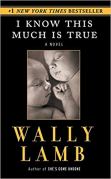
I Know this much is True.jpgI Know this much is True by Wally Lamb

Lamb’s novel about a twin brother’s advocacy and care for his paranoid schizophrenic sibling is adapted into a 6 episode TV miniseries. Mark Ruffalo will play both brothers, Dominick and Thomas Birdsey. Director Derek Cianfrance has a few fine works, the Cannes nominee Blue Valentine (2010), The Place Beyond the Pines (2012), and The Light Between Oceans (2016).

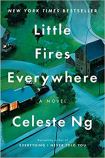
Little Fires.jpgLittle Fires Everywhere by Celeste Ng

Goodreads Choice of the Year Best Fiction (2017) and Novel of the Year on other sites, Chinese American writer Celeste Ng’s novel on class/race differences and aspirational conflicts in the idyllic community of Shaker Heights, Ohio, is adapted into a TV miniseries. Reese Witherspoon and Kerry Washington star.

Nine Perfect StrangersNine Perfect Strangers by Liane Moriarty

Moriarty’s website states her books had sold over 14 million copies worldwide. On the heels of her successful Big Little Lies turned into the small screen, Nine Perfect Strangers has already secured Nicole Kidman and Melissa McCarthy on board for the miniseries on Hulu. Her other books will follow.
.

the woman in the window.jpgThe Woman in the Window by A. J. Finn

A shaky narrator seeing a crime happening or being caught in one, Gone Girl was the first to kick off the trend. The Woman in the Window alludes to the Hitchcock classic Rear Window. Directed by Joe Wright (Darkest Hour, 2017; Anna Karenina, 2012), screenplay by Pulitzer winner Tracy Letts (August: Osage County, 2013), and an A-list cast with Amy Adams, Gary Oldman, Jennifer Jason Leigh, Julianne Moore.


Literary Adaptations at TIFF19: The Goldfinch

Two book-to-film adaptations were on my watch list while I was at the Toronto International Film Festival (TIFF) this September: Donna Tartt’s Pulitzer Prize winning The Goldfinch and the Dickens classic The Personal History of David Copperfield, both had their world premiere at TIFF. The two make such interesting contrasts that it would be good to discuss them together in one post, but that would be a long one. As I covet your attention, I’ll split them into two reviews. 

I listened to the audiobook of The Goldfinch in 2014, a year after the novel was published. My impression was: this one’s written for the screen. There are Dickensian characters and storylines transposed into present day. 13-year-old Theo is visiting a NYC art museum with his mother when she is killed in a bombing. In the aftermath, stunned and traumatized, he follows a mysterious track to an antique shop where the owner Hobie takes him in. There he meets Pippa, a girl he finds affiliation as she’s looking at the same painting with him in the museum when the bomb goes off. Later Pippa moves away and Theo goes to live with a wealthy Park Avenue family, the Barbours, only to have his stable life interrupted by the sudden reappearance of his long-gone, alcoholic father claiming full guardianship and taking him to live in Nevada, where he becomes friends with Boris, another boy lost in the sandy void.

Later, fleeing from his abusive father, Theo returns to the antique shop in NYC. Under the mentorship of Hobie he learns the skills of the trade. Years later, by chance and fate, Boris shows up again in his life, pulling him into the underworld of art dealings that eventually leads to a violent end, but that’s where the closure begins. “The Goldfinch” is the painting Theo takes with him after the museum bombing and hides it for himself, for it is a physical reminder of his last memory with his mother. They were looking at it when disaster struck; it was his mother’s favorite painting.

The Goldfinch.jpg
Nicole Kidman and Ansel Elgort in The Goldfinch. Image Credit: Courtesy of TIFF

That’s the main book story in a nutshell, and it appears that screenwriter Peter Straughan is keen to remain as faithful to the source material as possible. When the task at hand is loyalty to the original 784 page novel, the 149 minute screen time can feel like a laborious effort to create a replica, thus losing its flavour as an art form of a different medium, breathing, living cinema. The characters and major plot points are there, but what’s missing are the emotional depth and sparks of life.

Tartt’s novel has its Dickensian characters, and I can’t help but see parallels between The Goldfinch and The Personal History of David Copperfield. Theo and Davy, Boris and Steerforth, Theo’s father Larry and Davy’s stepfather Mr. Murdstone, Pippa and Agnes. The two features, however, represent two ends of possible choices for film adaptations.

Director John Crowley, who helmed Brooklyn (2015), a beautiful adaptation of Colm Tóibín’s novel, has a good cast to work with for The Goldfinch. Oakes Fegley (Wonderstruck, 2017) gives us a mature performance as young Theo. Nicole Kidman plays Mrs. Barbour decades apart, two roles that don’t give her much to say. Luke Wilson as Theo’s volatile father Larry and Sarah Paulson as his girlfriend Xandra are the livelier contrasts to other characters. Maybe Crowley focuses too much on the theme of grief that the overtone is sombre throughout. Ansel Elgort as adult Theo may not be a miscast but is boxed in by the only emotion he can express, gloominess. I can’t remember he has flashed a hearty smile once. That goes for other characters as well. The Goldfinch is a story of grief and Crowley has painted the mood in stark realism.

Thanks to the venerable cinematographer Roger Deakins (2018 Oscar winner Blade Runner 2049), we get to see some sunlight and energy in the Nevada desert days of  friendship between young Theo and Boris (Finn Wolfhard, TV Stranger Things). For most of the film, however, the color is a greyish cyan of dolefulness. While the museum bombing scene is dramatic, watching it over and over again––as Theo is drawn into guilt-ridden memory––could diminish the effect. But then, this would be an editing issue. And like Theo, don’t we all want to see the face of his mother, whose death is the cause of the grief, but that only comes for a short moment towards the end.

In an early scene, antique shop owner Hobie (Jeffrey Wright) shows young Theo how to tell a piece of furniture by touch to feel its authenticity. Too smooth has to be fake. Furniture that has weathered years of usage would be rougher and uneven. The character of adult Theo could have been a wiser man, more seasoned and worldly, but he remains static and stiff. The poignancy of fate with its power over one’s life comes late in the film and exerts little effect on the emotional connection with viewers. Unfortunately, Hobie’s antique lesson for young Theo is a metaphor for the adaptation. Other than a visual representation of the major plot of the novel, the film is a reproduction that lacks authenticity and liveliness.


~ ~ 1/2 Ripples


***

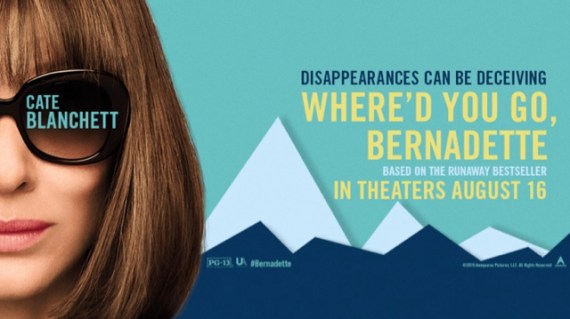
Where’d You Go, Bernadette: From Book to Screen

When I first learned that Maria Semple’s quirky and clever 2012 novel would be turned into a movie, I had that umm… feeling. When I found out Richard Linklater would be directing it, it turned into a whaaat? Sure it’s not a Wes Anderson project?

On the surface a mother-daughter relational story, Semple’s book is deceivingly simple. Underneath the humour is her take on contemporary American society, the tyranny of technology, vulnerability of the non-conforming, sarcasm on the upwardly aspiring middle class, the rat race and its effect on parenting, the outsourcing economy, and even taking a jab on America’s quiet and polite neighbour to the north. As a target, I must give you the following excerpt from the book as evidence of Semple’s spikiness (or is it spunkiness):

You probably think, U.S./Canada, they’re interchangeable because they’re both filled with English-speaking, morbidly obese white people. Well, Manjula (virtual personal assistant from India), you couldn’t be more mistaken.

Americans are pushy, obnoxious, neurotic, crass… Canadians are none of that. The way you might fear a cow sitting down in the middle of the street during rush hour, that’s how I fear Canadians. To Canadians, everyone is equal. Joni Mitchell is interchangeable with a secretary at open-mic night. Frank Gehry is no greater than a hack pumping out McMansions on AutoCAD. John Candy is no funnier than Uncle Lou when he gets a couple of beers in him. No wonder the only Canadians anyone’s ever heard of are the ones who have gotten the hell out. Anyone with talent who stayed would be flattened under an avalanche of equality. The thing Canadians don’t understand is that some people are extraordinary and should be treated as such.

But that’s not in the movie. Why, the movie is a total stripped-down version without the incendiary, sarcastic swipes, or the laugh-out-loud funny, and ah… thanks, Maria Semple, for the words, “it’s flattened under an avalanche of” smoothened edges in characterization and plot.

By the way, if one reads deeper into the Canadian jab quoted above, it wouldn’t be hard to see the layered meaning. Aha, the joke is on which side of the 49th?

Bernadette (1).jpg


Bernadette Fox (Cate Blanchett) has had her glorious days as an acclaimed architect, pioneer of the green building movement, a MacArthur grant recipient at 32, and a young woman succeeding in a male-dominated profession. Due to an unfortunate incident, her award-winning project was demolished without her knowledge, destroyed by a vengeful neighbour who bought it under an agent’s name. Devastated, Bernadette crashed out of her career, moved to Seattle with her Microsoft, TED Talking husband Elgie (Billy Crudup, a miscast). They bought a huge, dilapidated mansion. For twenty years she had ignored the maintenance of her home and self. The traumatic health issue of her daughter Bee’s (Emma Nelson) early years drives her further into the hole living as a reclusive agoraphobic.

Bernadette and Bee are the best of friends though. Mother/daughter relationship is well portrayed in the movie, a particular gripping scene is their singing the song ‘Time after time’ together in the car ending with a Bernadette meltdown. “You don’t know how hard it is for me.” Bee doesn’t know, viewers need to guess, but readers do, for they are supplied with ample back story. The movie, however, has trouble connecting the past with the present, or presenting sufficient motivation for the actions and behaviour of the characters.

As loving parents, Bernadette and Elgie have to fulfill a promise to Bee, that is she can have anything she asks for if she gets straight A’s; now they’re stuck with making a family trip to Antarctica. For two-third of the movie we see mostly interior shots of home and work building up a case to Bernadette’s disappearance. The momentum picks up only in the last third, the Antarctica episode.

The storytelling in the book is a lively collection of emails, notes, letters, hospital billing, and police report plus personal narrative to present the different voices from various characters. On screen, the Rashomon-like shifting of perspectives are converted into mainly two characters sitting and talking to each other. Surely Linklater is an expert in dialogues with his Before trilogy, where the camera follows two characters Jesse (Ethan Hawke) and Céline (Julie Delpy) talking throughout the movie and yet still captivating viewers as we watch them wander the streets and listening to them chat. But here, that magic is missing. Where’d you go, Linklater?

For the casting of Bernadette, Cate Blanchett is a good choice, her Academy Award winning role in Blue Jasmine comes to mind. Unfortunately, here she is not in her Jasmine form. The major issue is a weak script, hence the directing of it. The screenplay follows the book faithfully but in a minimal, abridged version. It begs the question: does a movie adaptation need to follow the source material to the dot? Here in this very different medium, dialogues are picked right out of the novel while the camera has not been fully utilized, nor any imaginative ingredients been added to the visual adaptation of this quirky and zesty book. Well, yes, it might have been faithful to the letter, but not the spirit.

The title question obviously doesn’t just mean the physical whereabouts of Bernadette but where her talent, creativity, and vitality for life have gone. There’s a scene with Bernadette meeting her previous mentor Paul Jellinek (Laurence Fishburne) who says it explicitly: “People like you must create. If you don’t, you become a menace to society.” Such is a thematic element that needs to be calved out more clearly, a talent caged in by her own disillusionment and her ultimate breakthrough. Don’t blame motherhood, and Bernadette doesn’t, for she sees a beautiful offspring flourishing in Bee. But is parenting a zero-sum game? The context and question should be handled with more depth and inner exploration. With not much contextual support, the case of a self-imposed, locked-up genius is left to the actor Blanchett to portray, and at times it seems forced.

Missing story elements cause lapses in the storytelling. Why does Audrey (Kristen Wiig), Bernadette’s neighbour and archenemy, suddenly becomes friend with her at the most critical moment? Or, during the mudslide, the camera hasn’t shown (without obstruction) what’s written on the sign, which has triggered much of the resentment between Audrey and Bernadette. Readers know, but not viewers if they have not read the source material.

At the end of the book there’s an “About the Author” page. Before writing fiction, Semple had written for the television shows Arrested Development, Mad About You, and Ellen. If one hadn’t known this tidbit already, a natural response would have been “no wonder!” It just points plainly to the ideal person who should have written the screenplay.


~ ~ Ripples

***


Related Reviews on Ripple:

Blue Jasmine: Homage and Reimagining

Boyhood: The Moment Seizes Us 

Before Midnight: Reality Check

The Budapest Hotel: A Grand Escape


Books into Movies: 2019 and Beyond

Feeling the post-Oscar blues? How about turning to books, before they in turn are morphed into a movie? The following are some upcoming books being adapted into movies in various stages of development. Some are coming out soon, some just announced.

The Aftermath by Rhidian Brook

The movie adaptation starring Keira Knightley, Alexander Skarsgärd and Jason Clarke is coming out March 19, directed by Testament of Youth (2014) helmer James Kent. In recent years, WWII historical fiction has enjoyed a sensational growth in popularity, The Aftermath is another one of this highly sought after genre. The transfer to movies, while not always as effective, lacks no enthused followers. The Aftermath is set in 1946 Hamburg, a British family and a German widower and his daughter had to live under the same roof during a de-Nazification operation.

Cats: The Musical 

Based on T. S. Eliot’s collection of poems Old Possum’s Book of Practical Cats, Andrew Lloyd Webber’s musical Cats is hailed as one of the biggest hits in theatrical history on their website. Director Tom Hooper has another musical-turned-movie under his belt: Les Misérables (2012) which won 3 Oscars. Attractive cast in Cats the movie: Rebel Wilson, Idris Elba, Jennifer Hudson, Judi Dench, Ian McKellen, James Corden, Taylor Swift.

Death on the Nile & Witness for the Prosecution by Agatha Christie

Kenneth Branagh will direct Wonder Woman Gal Gadot and Armie Hammer in Death on the Nile. Branagh will reprise his role of Hercule Poirot, after starring in and directing Murder on the Orient Express in 2017. Now over forty years after her death, Christie’s influence has not waned. A movie adaptation of Witness for the Prosecution has also been announced with Ben Affleck directing.

The Goldfinch by Donna Tartt

John Crowley is no stranger to literary adaptations; his previous feature, Colm Tóibín’s Brooklyn, was nominated for 3 Oscars. This time, Donna Tartt’s Pulitzer Prize winning The Goldfinch reads like it’s written readily for the camera, considering the eclectic characters and the explosive storylines. Sarah Paulson and Nicole Kidman star. Screenplay adapted by Peter Straughan, who was nominated for a Best Adapted Screenplay Oscar for co-writing the 2012 script for John Le Carré’s Tinker Tailor Soldier Spy (2012).

In the Garden of Beasts by Erik Larson

Larson’s 2011 non-fiction is a captivating look into the power and social structure of Berlin during the emergent years of Hitler’s rule. Focus is on the the true story of William Dodd, a mild-mannered Chicago professor who becomes America’s first ambassador to Hitler’s Germany. And this is relatively hot-off-the-press: English film director Joe Wright will helm the production (See also the last entry of this post). Tom Hanks was originally linked with the role of Dodd (and a good choice I think); whether he will carry it through or just remain as producer is to be seen. This is one movie I’ll definitely watch out for. Before then, the book is a great read to prep for it.

Little Women by Louisa May Alcott

Geared for a Christmas release, this new version of Alcott’s classic is written and directed by Greta Gerwig. Gerwig is acclaimed for her take on the contemporary young woman, her psyche and struggles in films like Frances Ha (2012) and Lady Bird (2017). How will she approach Alcott’s novel of a bygone era? And if you still have Susan Sarandon, Winona Ryder, Kursten Dunst and Christian Bale from the 1994 cast stamped in your mind, now try to imagine Florence Pugh, Saoirse Ronan, Timothée Chalamet, Emma Watson, Meryl Streep and Laura Dern taking their places. Actually, not a bad replacement.

The Personal History of David Copperfield by Charles Dickens

First off, I must say this is one of my all time favourite novels, but I’m no purist. While I welcome new representations and interpretation, I still hope the upcoming movie will be Dickens-approved. A most interesting (postmodern) cast: we have Dev Patel as Davie, Tilda Swinton as Betsey Trotwood, Hugh Laurie as Mr. Dick, Ben Whishaw as the ultimate villain Uriah Heep, Benedict Wong as Mr. Wickfield. Directed by Armando Iannucci (The Death of Stalin, 2017).

Rebecca by Daphne Du Maurier 

In this remake of Rebecca, Armie Hammer will play Maxim de Winter. And who will be Mrs.? None other than Lily James, ubiquitous after Downton Abbey (Lady Rose). Do you think she will make one successful Mrs. de Winter? What I’m most interested in, however, is the production design, headed by 6-time Oscar nominee Sarah Greenwood, whose filmography includes Darkest Hour (2017), Anna Karenina (2012), and Atonement (2007) among many other titles. I think Manderley is in good hands. But will the whole production beat the classic Alfred Hitchcock noir with Laurence Olivier and Joan Fontaine? And who can be more chilling than Judith Anderson as Mrs. Danvers?

The Woman in the Window by A. J. Finn

Another wildly popular genre in recent years along the line of Gone Girl and Woman on the Train etc. is the modern day thriller-cum-unreliable-narrator (and alas, they’re mostly women!) mystery novels. Finn’s (Now what’s with the writer whose real name is Daniel Mallory using a pseudonym close to Flynn, the Gone Girl author?) NYT bestseller is turned into a movie with a top-notch cast. (Aside: do writers nowadays write in preparation for a movie?) Directed by the much sought-after Joe Wright, who’d helmed Darkest Hour (2017), Anna Karenina (2012), Atonement (2007), and Pride and Prejudice (2005). Wright has a dream cast in his hands: Amy Adams, Gary Oldman, Juliane Moore. The movie adaptation is written by Pulitzer winner, playwright/screenwriter Tracy Letts, who gave us August: Osage County.

________________

Which one(s) of the above do you anticipate most? Others not on this list?


***

Ripple Effects Turns a New Page in 2019

Ripple Effects has reached a new milestone. After almost twelve years in the blogosphere, Arti has finally fought off procrastination and taken up an upgraded version. From now on, there will be no ads even if you’re not a WordPress blogger visiting (let me know if you still see them). What more, there’s a new URL address to the Pond, aptly:

rippleeffects.reviews


But if you type in the old, longer one it will redirect you to the right place here at the Pond as well.

While birding is still my passion, I’ll be posting mostly film and book reviews on Ripple Effects. My avian friends will probably fly by during intermission.

Your two pebbles are welcome as before. Throw them in, stir up some ripples. As always, I hope you’ll find here a respite for quiet thoughts and prompting to some interesting viewing and reading. I await your visits.

***

Have you ever seen so many people lining up to go into a public library? It happened right here in my city, Calgary, Alberta, on November 1, 2018, when our New Central Library opened. 50,000 visitors in the first four days. Yes, there will be talks of books and movies here on Ripple Effects.

New Central Public Library, Calgary.jpg

The Calgary Central Library was one of Architectural Digest’s 12 most anticipated buildings opening in 2018. Check it out here.

***