Alone Together by Sherry Turkle, Part 1

Sherry Turkle is the Abby Rockefeller Mauzé Professor of the Social Studies of Science and Technology at MIT, the founder and director of the MIT Initiative on Technology and Self, and a licensed clinical psychologist.

For thirty years, Turkle has been studying the social-psychological aspect of how technology has been changing us humans. The word ‘humans’ has to be emphasized because the first half of her book details her research on The Robotic Movement. Her findings show that we are more and more dependent on technological advancements, in particular, robotics, to solve some of our human problems such as loneliness, friendship, caring for each other, and ultimately, to love and be loved.

Part one of Turkle’s book chronicles how over the decades, the robotic technology has given us simulated pets from Tamagotchi to Furby, simulated real-life humans like My Real Baby, to sociable robots developed as companion and later carers of the elderly, to the latest stage of robots capable to commune with human, and where human and machine almost existing and interacting on an equal level.

I find myself grasping for the fine line of distinction: what is human? If a machine is programmed to emote and think, is it still a machine? If a machine is created to have a human face, is it more human and less machine? For those who think machines in the form of robots will never replace humans need to read some of Turkle’s research findings. Hopefully we have not passed the point of no return.

From her book, I’m surprised to find how readily people are willing to accept a robot as a friend, a confidant, a companion, a carer, and even an equal. The researchers observe people’s behavior and interactions with the various kinds of robots in real life situations and through interviews. Here are some of the responses, from children to adults:

I want a robot to be my friend… I want to tell my secrets.” (Fred, 8 )

“I could never get tired of Cog (robot)… It’s not like a toy because you can’t teach a toy; it’s like something that’s part of you, you know something you love, kind of like another person, like a baby. I want to be its friend, and the best part of being his friend would be to help it learn… In some ways Cog would be better than a person-friend because a robot would never try to hurt your feelings.” (Neela, 11)

“Kismet, I think we’ve got something going on here. You and me… you’re amazing.” (Rich, 26, talking to the sociable robot Kismet, after showing Kismet the watch his girlfriend gave him and seemingly received some response back from Kismet.)

“I like that you have brought the robot (Paro, a ‘carer’). She (speaker’s mother in a nursing home) puts it in her lap. She talks to it. It is much cleaner, less depressing. It makes it easier to walk out that door. (Tim, 53)

Turkle notes that the reason people are so receptive to robots is because they offer painless solutions to their human need for attention and connection, to be noticed and sought after. They can all be programmed to do these.  And for the elderly, a robotic carer can be clean, accurate, and avoid mistreatment and abuse.

Robotic carers have been placed in nursing homes with very positive results. And the simulated robot My Real Babies are most desirable among many elderlies. In one case Turkle has left a My Real Baby with Edna, 82, who lives in her own home. I almost shudder to read the following observation by Turkle’s research team, when Edna’s granddaughter Gail brings along her 2 year-old daughter Amy to visit:

Edna takes My Real Baby in her arms. When it starts to cry, Edna finds its bottle, smiles, and says she will feed it. Amy tries to get her great grandmother’s attention but is ignored…

Edna’s attention remains on My Real Baby. The atmosphere is quiet, even surreal: a great grandmother entranced by a robot baby, a neglected two-year-old, a shocked mother, and researchers nervously coughing in discomfort. (p. 117)

That we can with technology doesn’t automatically lead to that we should. But the issue is complex though. Does it matter that we are engaged with the inanimate and allow it to help us?  Should there be a line drawn as to what kinds of tasks we leave to machines, and what we should keep as humans? What is ‘humanness’ after all?

A class of grade five children once posed the question: “Don’t we have people for these jobs?” It is wise enough for these young minds. But, it gets complicated if the issue is: “What if a robot can do a better job?” Then what does that leave us?

It has been a long while since I last posted. For one thing I have been preoccupied with the caring for two elderly parents. Meanwhile, reading through Sherry Turkle’s book requires much more time for thinking and mulling over, definitely not for speed reading. Now that I’ve finished, I need to crystallize my thoughts to write sensibly before I post, as the book deserves. The slow blogger in action… and thanks for waiting. So here is the first part. The second part is even more relevant and timely for us, our networked self. CLICK HERE to go there.

***

CLICK HERE to Sherry Turkle’s Alone Together, Part 2.

Gifts to Myself

December 26 is Boxing Day in Canada.  Like Black Friday in the US, that’s the time to pick up bargains, and pay half the price you did just two days before.  And like Black Friday, it’s the time for legitimate self indulgence for the common good, our economy.

In recent years I’ve avoided shopping on Boxing Day. I know some people getting up at 5 am to line up for a store opening at 6.  My own experience of the Boxing Day craze had been standing 3 or 4 people deep, stretched out my arm to the sale table and grabbed whatever I could out of it, hopefully something I needed.

Out of curiosity, I gave it a try again this time around… and sure glad I ventured out.  I didn’t have to fight the crowds, and waited just a bit longer in line-ups . But well worth it.  Here are some of the gifts I got for myself at half price: wall calendars which I won’t be hanging up.

I know, prices here are not as low as in the US… we’re always paying a few dollars more in printed products. But just about $10 each, these beautiful art calendars are good buys for me. Best of all, I found all my favorite artists.  Those familiar with Ripple Effects would know.  I’ve posted on Vermeer (Dutch, 1632-75) here, Edward Hopper (US, 1882-1967) here, and images of René Magritte (Belgian, 1898-1967) here and here.  So I was really excited to be able to find big prints of their works.

VERMEER 2011


The 12 paintings are some of Vermeer’s well known works.  The cover of course is the most famous, The Girl With The Pearl Earring (1665).  If you’re interested, you might like to read my reviews of the book based on this painting and the film adaptation here.

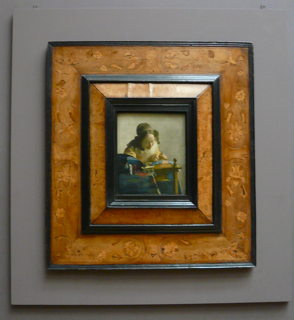
I have seen two of the paintings in the calendar, The Lacemaker (1669) and The Geographer (1668-69), both at The Louvre.  Interesting that the calendar prints are about the same size as the originals, or maybe even a tad bigger, for The Lacemaker.  Here are my photos of them hanging on the wall in the Louvre:


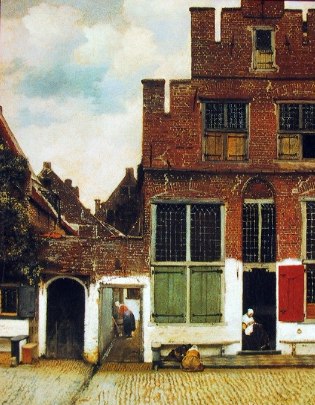
But the July print stands out, the only one that has an exterior view.  It’s my favorite of all the twelve months.  The Little Street (1658):


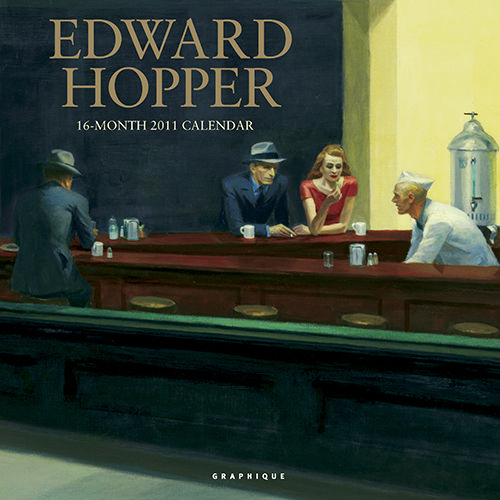
Edward Hopper 16-Month 2011 Calendar


I have 16 prints of some of my favorite Hopper paintings.  A few of them I’ve posted before, asking readers’ opinion on them. Here are a couple more that I’d like to elicit your views:

People In The Sun (1960)


Chop Suey (1929)


Magritte 2011


The cover is the Belgian artist’s work in 1953, Golconda.  Just wondering… is this the origin of the term “rain man”?  Or, are the men going up like balloons?

René Magritte was born just 16 years after Hopper, and died the same year, 1967.  So contemporaries they had been for some years, but a world of difference in terms of style.  I like the realism and existential elements hidden in Hopper’s works, but I also enjoy Magritte’s surrealist and whimsical images, openly challenging our sense of reality:

The Treachery of Images (1929)

Ceci n’est pas une pipe:  This is not a pipe.  Your take on this?


The Interpretation of Dreams (1935)


In the past years, I’ve saved up a lot of visuals just like these calendars, as teaching materials for adult ESL.  But this one definitely cannot be used for vocabulary building.  Just hang on… that may well be what Magritte is saying: ‘In a dream world, a horse can be a door, a jug a bird…’  And for that matter, how do you know you’re not dreaming right now?  Mmm… just wondering, has the movie Inception included Magritte in the credits?


***


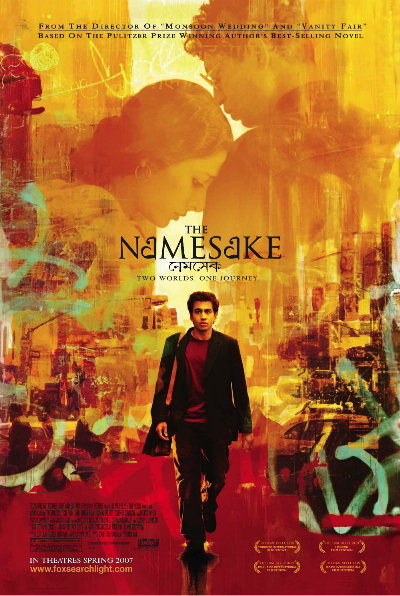
The Namesake (2006, DVD): Movie Review

This is a sequel to my last post, Book Review of The Namesake by Jhumpa Lahiri.  These back-to-back write-ups form my second instalment for the Read the Book, See the Movie Challenge over at Ready When You Are, CB.

“If it weren’t for photography, I wouldn’t be a filmmaker.  Every film I make is fuelled by photographs…. Photographs have always helped me crystallize the visual style of the film I’m about to make.”

—Mira Nair

And photography has brought to life the poignant novel The Namesake.

This is a perfect match.  The Namesake film adaptation is privileged to be crafted in the hands of the accomplished director Mira Nair, and its screenplay written by the multi-talented Sooni Taraporevala.  Both born in India the same year, grew up and educated there, later both had attended Harvard.  After earning her Masters at NYU majoring in Film Theory and Criticism, Taraporevala moved back to India and pursued a successful career in photography and other artistic endeavours. Mira Nair went on to become an acclaimed filmmaker and professor of Film at Columbia University.  Nair and Taraporevala collaborated on several films that have garnered international nominations and awards, including Cannes, Venice, BAFTA, and the Oscars.

The pair could have been characters taken right out of Jhumpa Lahiri’s stories.  They must have known from personal experience the realities of Lahiri’s stories, the feelings of being transplanted, the quest for identity.  As a result, they have effectively brought into visualization the internal worlds of Ashoke, Ashima, Gogol and Moushumi.  It is interesting to hear Nair describe herself as “a person who lives in many worlds”.  Every immigrant is at least a bicultural being.  Our postmodern world has only made it more and more viable to navigate across boundaries and sustain multiple identities.  The Indian meaning of the name Ashima could well have spoken to such a modern day phenomenon: without borders.

From this perspective, Nair is the best person then to take what could have been just another “ethnic movie” to a universal plane.  She has created a colorful rendition of a human story for us to enjoy.  You don’t have to be Bengali to appreciate the Ganguli saga.  Elements such as love, marriage, parent-child relation, expectations, self-fulfilment and its obstacles, the search for one’s place in the family and the world, these are all situations we can relate to.   It’s just now the issues have been explored from a different frame, offering us an alternative perspective.

I have appreciated the quiet development of love between Ashoke and Ashima despite their arranged marriage.  Their intimate husband and wife relationship is sensitively played by Irrfan Khan (Slumdog Millionaire, 2008) and the model and award-winning actress Tabu, an excellent choice in casting.  I particularly admire Tabu’s gentle and elegant poise.  It’s interesting to see how the two exchange deep sentiments by wordless, nuanced expressions and body language.

The treatment of the story in the hands of a visual artist understandably would be quite different from its original literary form.  Instead of the sombre tone, Nair has given the story a lively adornment, sustained by animated characters.  Nair’s Gogol is a more outgoing young man than that from the book, and I’m fine with that.  Kudos to Kal Penn’s portrayal of  Gogol/Nick Ganguli, an interesting performance fusing youthful energy and wistfulness at the same time.

Yes, that’s Kal Penn of the stoner movies Harold and Kumar fame (2004, 2008, and coming 2011) A much more serious role here in The Namesake.  A lively Gogol is only natural and fun to watch, for he is an American born young man who just wants to belong.  So we see him being impatient with his father’s restrained and non-communicable composure, we see him playing air guitar to loud music in his room, we see tender moments when he teases his younger sister Sonia, or the natural comedic look on his face, culture shocked during his family trip back to Calcutta, and we see his romance with Maxine (Jacinda Barrett, New York, I Love You, 2009), the American girl who is so oblivious to the cultural baggage he is carrying.

But Kal Penn has earned his role.  He wrote to Nair earnestly seeking for the part, telling her that The Namesake is his favorite book and often times, he would use the pseudonym Gogol Ganguli to check in hotels.  Some method acting, who’d have known he’s in character all along.

The bonus with watching a DVD is of course the special features.  The Namesake is a keeper if you’re into the creative process of filmmaking.  My favorite featurette is The Anatomy of The Namesake: A Class at Columbia University’s Graduate Film School in which Nair and other crew members engage in conversation with film students about the making of the movie.  Other wonderful featurettes include Photography as Inspiration, and Fox Movie Channel interview In Character with Kal Penn.

Overall, a faithful adaptation of Lahiri’s book, offering an entertaining, visually inspiring rendition of a story deserving to be seen.

~ ~ ~ Ripples

Arles: In The Steps of Van Gogh

Solution to Arti’s Cryptic Challenge #4: Arles

While Paris has her cultured beauty and sophistication, I’d appreciated the change of scenery and warmer weather as I headed south to Provence.  Three hours via the TGV took us to the historic City of Avignon, site of the Papal Palace before the Vatican. We stayed in Avignon for three days, taking daily excursions out to nearby towns.  Arles was a must-see on my list.

Van Gogh moved to Arles from Paris in 1888, seeking the tranquility that was so elusive to him in the big city.  In his letter to his brother Theo upon arrival to Arles, he wrote:

It seems to me almost impossible to be able to work in Paris, unless you have a refuge in which to recover and regain your peace of mind and self-composure. Without that, you’d be bound to get utterly numbed.”    — Tuesday, Feb. 21, 1888.

The fresher and more colourful palette is apparent during this most prolific period of the artist’s life.  Bright yellows, blues, shorter and swirling brush strokes established his signature style.  As for me, I was a bit disappointed to see the sunflowers have already withered in late August.  Fields of yellow were now massive brown.  They would be harvested at a later time for their oil, a good reminder that, for tourists, it’s the view, but for those living here, it’s their livelihood.  The lavenders on the Luberon mountains too had long passed the season.  Note to myself:  Early to Mid July is best if I ever come this way again.

But all was not lost.  I was gratified to follow some of Van Gogh’s footsteps as I explored the clearly posted Van Gogh sites in the town, the scenes and locales where the artist so vividly captured in his paintings.

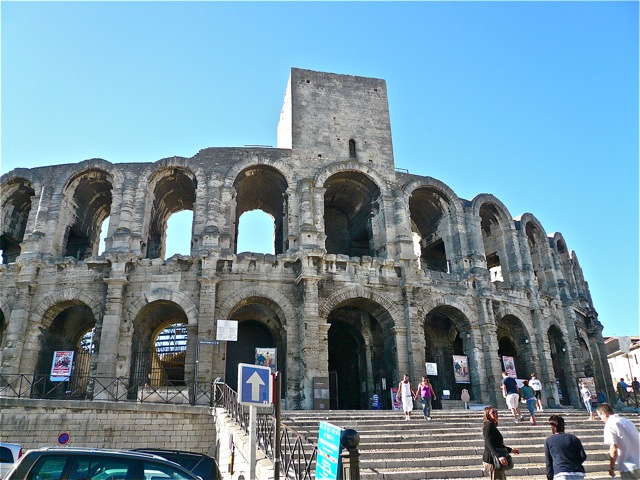
Arles is a Roman town.  What more prominent to reflect its past glory than the Roman Arena in the town centre.  Why all the arches?  The free flow of pedestrian traffic.  The full seating capacity, 20,000 people, could exit the Arena in 7 minutes.

.

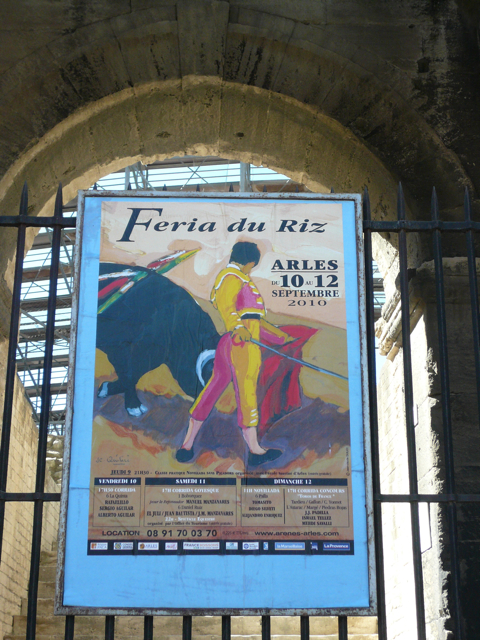
Used by gladiators in ancient time, the Arena is still the venue for bullfights:

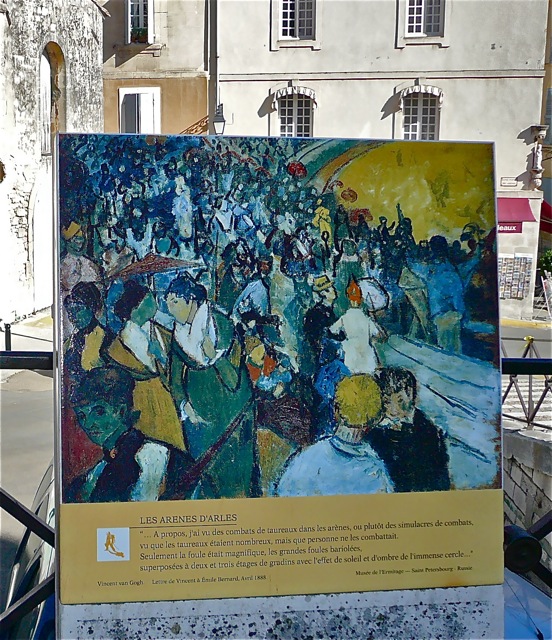
But Van Gogh’s interest was not so much on the violent action of bullfighting than on the people, as his painting Spectators In The Arena At Arles (December, 1888) clearly shows:

The Café Terrace on the Place du Forum was his hang-out, renamed Café Van Gogh now.  The yellow building upon the backdrop of the blue, starry night had deeply inspired the artist:

Café Terrace At Night (September, 1888):

Van Gogh had wanted to make Arles a hub for fellow artists.  Upon his urging, Gauguin came to join him in October, 1888.  The two painters frequented the Café Terrace many a night but only for two short months.  What happened on December 23rd was reported by the local paper the next day:

At 11:30 pm., Vincent Vaugogh [sic], painter from Holland, appeared at the brothel at no. 1, asked for Rachel, and gave her his cut-off earlobe, saying, ‘Treasure this precious object.’  Then he vanished.[1]

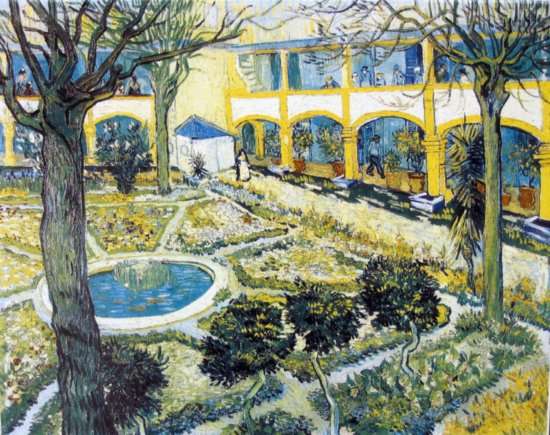
After this incident, Van Gogh was admitted to a local hospital, now the Espace Van Gogh in Arles, a cultural centre:

In January, 1889, Van Gogh returned home to the Yellow House, but for the next few months, suffered onslaughts of hallucinations and delusions. His view of his own condition nevertheless was lucid and even progressive for his time.  His letter to Theo is poignant, as he openly faced his predicament and earnestly sought a solution:

And for the time being I wish to remain confined, as much for my own tranquillity as for that of others.

What consoles me a little is that I’m beginning to consider madness as an illness like any other and accept the thing as it is, while during the actual crises it seemed to me that everything I was imagining was reality.”

— Sunday, April 21, 1889.

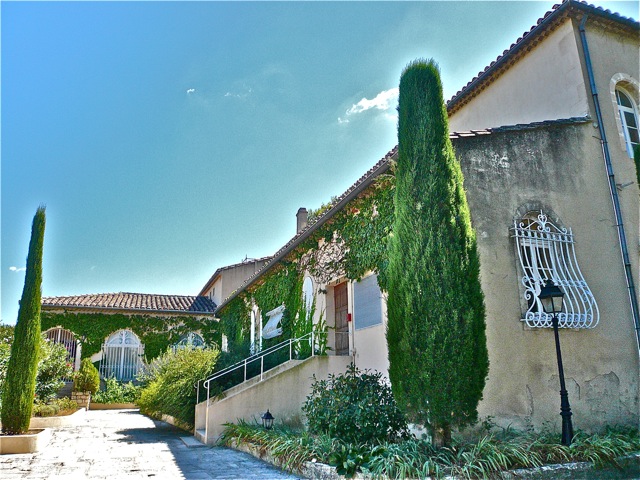
On May 8, 1889, he checked himself into the Saint Paul de Mausole, the mental hospital at St-Rémy-de-Provence.  Under the care of his doctor Théophile Peyron, the artist’s condition improved and he thrived in the idyllic environment there.  Art therapy had brought healing and prolific output.  Van Gogh stayed there for a year and created more than 150 paintings.

Dr. Théophile Peyron out at the front garden:

.

The olive grove outside St. Paul hospital:

.

To his brother Theo, he wrote on Sunday, May 11, 1890:

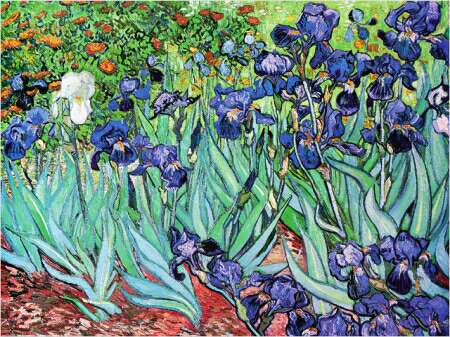
At the moment the improvement is continuing, the whole horrible crisis has disappeared like a thunderstorm, and I’m working here with calm, unremitting ardour to give a last stroke of the brush.  I’m working on a canvas of roses on bright green background and two canvases of large bouquets of violet Irises…

My Van Gogh trip ended at St. Rémy, and so be it.  I’ve seen the sites wherein the artist was at his most prolific.  I’ve seen the town and surroundings where he found inspiration.  I’ve seen his final solace where he attained some stability and painted with passion.  I’d like to keep these as memories of my travel to Provence.  I could hardly bear to think of his last days, discharged from St. Rémy just a few days after the above letter, headed north to Auvers-sur-Oise on the outskirt of Paris, and in just two short months, succumbed to the recurrence of his illness. He shot himself in the chest with a revolver on July 27, 1890, and died of his wound two days later.

Back to the thoughts I wrote about in my last post: How do we keep art from turning into a cliché?  I think it takes a certain awareness of the artist as a person, plus a measure of empathy and respect for the struggle to live and create… and realizing that the beautiful works are often triumphs in spite of life’s overwhelming adversities, rather than the natural products of bliss and fortune.

To wrap up my travel posts, and taking the risk of turning it into a cliché albeit my motive is pure, here’s the YouTube clip again, Don McLean’s tribute to Vincent:

Some Van Gogh links:

An excellent and comprehensive site for Van Gogh’s letters, 900 of them, poignant account of his life.

The Van Gogh Museum, Amsterdam

Van Gogh Gallery online

Wikipedia: Vincent Van Gogh

***

[1]  Rick Steves’ Provence and French Riviera 2010, published by Avalon Travel, p. 69.

Art and Cliché

My musing on high art and popular culture earlier in my trip came to a new twist as I visited the Louvre. I just couldn’t help but wonder: Can art be too popular? When does art turn from a form of aesthetics into a subject of parody? Will mass popularity reduce an objet d’art into a cultural cliché?

Here’s what prompted my query:

.

Even more fascinating is this view twenty feet away:

.

And in comparison, here’s another gallery in the Louvre displaying lesser known works:

.

.

When does art become a cliché?  In our case, the Mona Lisa…

When you see her in comics, or paint-by-number sets in dollar stores, or morph into Alfred E. Neuman on Mad Magazine’s cover, or into Monica Lewinsky on the New Yorker, or find her on The Far Side Gallery, or in The Simpsons, or a Pantene commercial showing off her revitalized curly hair, or when you find 450 parodies of her image on a single website. According to an image tracking source, the Mona Lisa is the most used and abused image in advertising.

I know, other artists had created altered versions of Mona Lisa from early on. Eugene Bataille (Sapeck) painted her smoking a pipe, Marcel Duchamp added a moustache and goatee, Salvadore Dali fused himself into her image.

Poor girl, she didn’t even know what hit her, or how her one time, private sitting for da Vinci had generated so many imaginative renditions centuries down the road, as people are still using, or abusing, her image for private gains. She should have bargained for residual payments.

Are we more comfortable now that the barrier of ‘high art’ has been broken?  Are we enjoying the legacy and freedom the Dada Movement and the Surrealists had claimed for us?  I must declare outright, I’m not particularly a fan of the Mona Lisa, but I’m just a bit annoyed seeing other similar misuse, like Michelangelo’s David in boxers, or Venus de Milo wearing sunglasses.

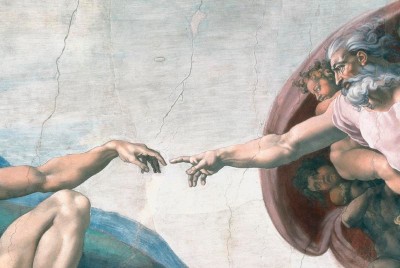
Other vulnerable examples are not hard to find. Think of this magnificent piece of painting in the Sistine Chapel… another easy target for cliché and parody:

Or this self portrait of a tormented soul:

.

Or take these beginning haunting notes from a brilliant symphony, they have become an expression of suspense not much deeper than the tune in Final Jeopardy:

.

The opening chorus of this masterpiece has now been reduced to a punctuation mark in our vernacular, an exclamation used for scenarios from finding your lost keys to losing 10 pounds:

Isn’t the advertising industry supposed to be the flagship of creativity?  And, when it comes to the creative process, aren’t we supposed to flee from clichés and produce fresh expressions? Isn’t originality a goal to strive for anymore? Or, has parody become the new genre and proof of ingenuity in our time?

And I’m just too tired to go into all the zombie and vampire versions of Jane Austen’s novels…

Tate Modern and Billy Elliot

Solution to Arti’s Cryptic Challenge #1:  London… don’t mind the gap.

When time is short, you must select and forego.  The Tate Modern has long been on my ‘must-see’ list yet unfulfilled.  So for the short stay I had in London, I chose this one above all else.  Five years ago, my then 15 year-0ld son went to visit and wrote in his email back to me: ‘Tate Modern is brilliant.’  This time I got to see it first hand.

If a museum of modern art can wow a teenager, there must be something in there that links the gap.  And was I disappointed?  Yes and no.  No because it was brilliant indeed, both the conceptual design, architecture and the exhibits.  And yes, because I was so preoccupied with the directions getting there from our hotel that I forgot my camera.  No excuse for that, I know.  And what makes it worse, the museum allows photography even of its exhibits.  In my utter disappointment, my now 20 year-old said to me calmly, ‘you just have to make do.’  That I did with my iPhone.

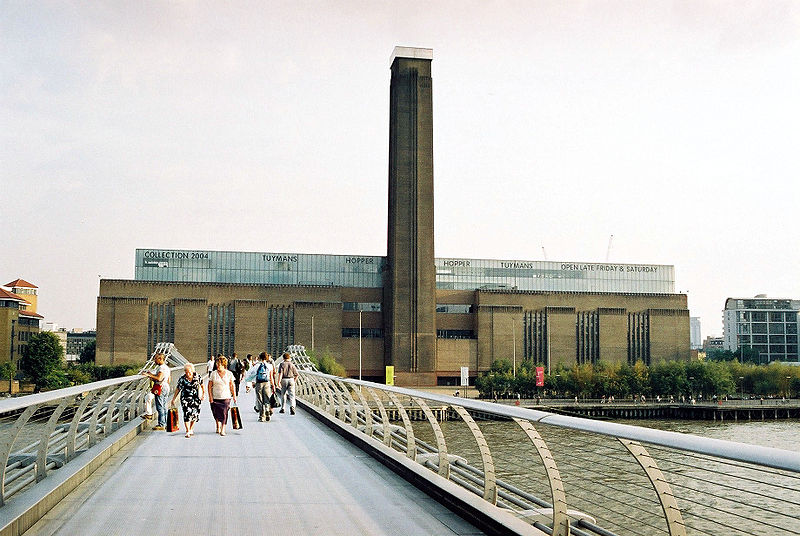
The Tate Modern was converted into a modern art museum from an obsolete power plant on the south bank of the River Thames.  The idea itself is brilliant. What better use of a derelict power station along the beautiful Thames?  Used to be a gloomy stretch of land by the river bank, now the whole area, the Southbank, is revitalized and is home to many London attractions, including the Shakespeare Globe Theatre, the Millennium Bridge, The London Eye, theatres and green, open space.

And thanks to Wikipedia Commons, I found the following photos.  The Tate Modern viewed from the Millennium Bridge.

The Tate Modern was designed by the Swedish architects Jacques Herzog and Pierre de Meuron, the 2001 winner of the Pritzker Prize, the ‘Nobel Prize’ of architecture.  Their concept of maintaining the industrial motif and juxtaposing it with the artistic is ingenious.  Furthermore, they have turned the massive industrial space into a people space.  The main entryway is named The Turbine Hall, allowing people to fill the massive vacuum that was once associated with a power plant. The huge area also makes display of larger pieces of exhibits possible.  Now they are doing it again, yet another redesigning, an even more amazing remodelling and addition, all for the 2012 Olympics Summer Games in London.

Two streams of thoughts constantly ran through my mind during this trip.  One was the dichotomy of ‘High Art’ and ‘Public Art’, ‘high culture’ and ‘popular culture’.  Does such a rift still exist?  All the galleries and museums I visited were all flooded with people.  It was hard to take a picture without any heads caught in the frame.  So every photo I took was immediate.  I had to wait for people to move away and snap the moment quickly.  In the Turbine Hall at the Tate Modern, I saw families with young children, many pushing baby carriages, kids doing cartwheels on the huge floor space.

Is it still ‘high art’ if the exhibits are free to the public, a destination for family outing?  As a rock concert ticket can cost hundreds of dollars… now does that re-define the ‘high’ in culture?  Is it still ‘high art’ if people can get in free, as with the Tate Modern collection, enjoy what they see, gasp at the possibilities, or be bewildered by a notion conveyed through an artwork?  Do we need to ‘understand’ art in order to enjoy it?  Maybe we should just allow the object of art to speak for itself, and thereby, linking the gaps between us.

Here are a few exhibits I took with my iPhone.  Please do click on the link of each piece to see the good photos at the Tate Modern website and an explanation.  I was gratified to see works from some of my favourite artists in their original.

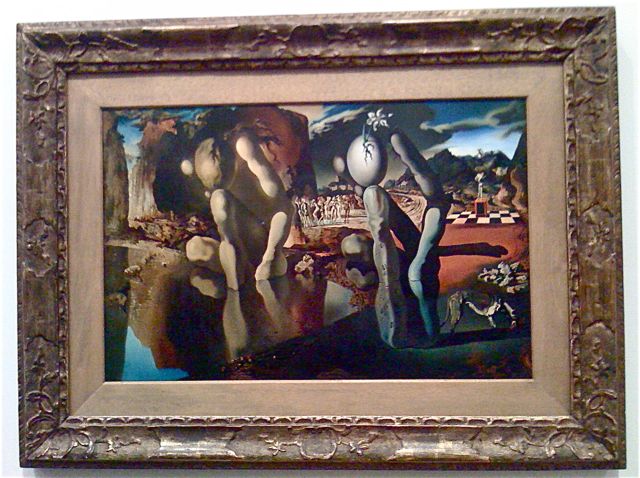
Metamorphosis of Narcissus by Salvadore Dali, the work that changed Freud’s original negative view of Surrealist art.  In the painting, you’re supposed to see Narcissus on a pedestal in the background, then kneeling by the fatal pond, and lastly transformed into a flower… and what a self-absorbed egghead he was:

.

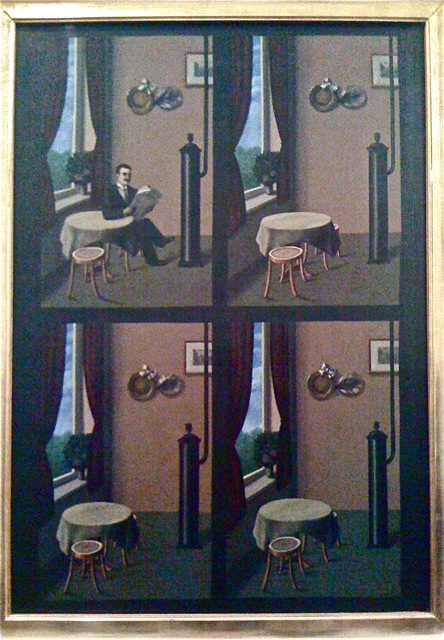
Man with a Newspaper (1928) by René Magritte (1898-1967), under the section ‘Poetry and Dream’.  These are supposedly four different perspectives … mmm … , but hey, this is Magritte speaking.  His dead pan surrealist style is regarded as a subtle form of social critique.

.

And here are a few other interesting works. Polish artist Magdalena Abakanowicz’s ‘Anti-form’ sculpture which she created during the 1960’s Soviet-occupation of Warsaw, another example of the freeing effect of art and the social statement they subtly convey:


Untitled sculpture with wood and wool by Jannis Kounellis, homage to Jackson Pollock’s drip painting:

.

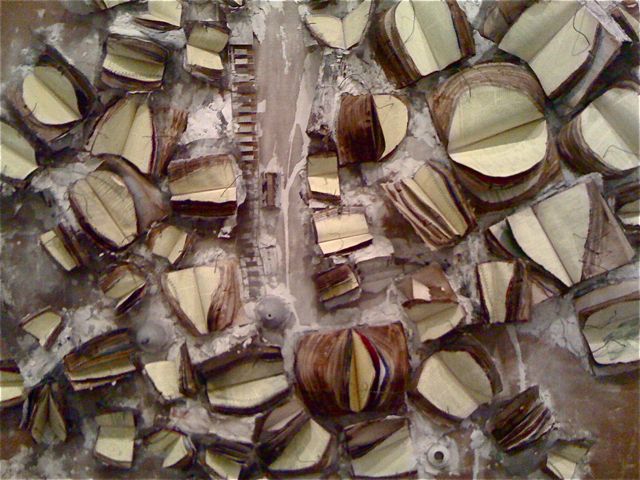
I like this work of open books, but don’t remember the artist or the name of it.  With the fast emergence of eBooks, this work could soon become an antique artifact:

***

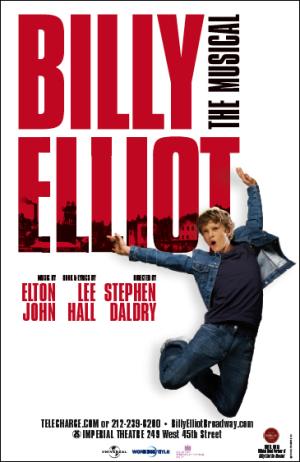
The second event I chose was to see ‘Billy Elliot The Musical’.  I liked the movie a lot, appreciating the depth of conflicts which touch on the same dichotomy: ‘High Culture’ and ‘Mass Culture’, and the seeming incompatibility of art and life.  A miner’s son in a blue collar neighbourhood is attracted to the beauty of the ballet, and the freeing energy of dance.

The conflict persists starkly as the political backdrop of the miners’ strike turns ugly in the 1984-85 years. While their livelihood is at stake, and as the miners determine to pose the fiercest strike action against the Thatcher government, where does ballet come in?  It sounds trivial and even surreal to think of ballet compared to the major battles raging in the country. But this is also a conflict between the individual and the masses, the individual and, yes, even the family.

Billy’s new-found love and immense talent ultimately melt the heart of his macho father and older brother, and soon those in the mining community.  He is given the chance to audition for the National Ballet School, with the local miners raising funds to support his cause.


The movie allows more in-depth exploration of internal conflicts while as a musical, the focus has shifted to the dance performance, the music, and for crowd appeal, some Monty Python style romp com, mellow-dramatic scenes, and many exaggerated, stereotypical expressions and language choices. I’m afraid it looks like a contrived way to bring the ‘high’ down to the ‘common’ level.  Elton John’s music while lively, seems lacking in variety and depth compared to his other works and those in the Andrew Lloyld Webber tradition.

Performed on the London stage since 2005 and still going strong, ‘Billy Elliot the Musical’ is directed by Stephen Daldry, lyrics and book by Lee Hall.  It has won both the Lawrence Olivier Awards in England and the Tony Awards in the US.  It went on Broadway in 2008, and on the main stages in several other countries.  The night I went the role Billy Elliot was performed by 12 year-0ld Rhys Yeomans, and he was marvellous, both as actor and dancer.  He practically carried the whole show on his young shoulders, singing, acting, and dancing in superb style, energy, and versatility.  The role of Michael, Billy’s friend, was done animatedly by another 12-year-old, Reece Barrett. The boys’ performance were the main attractions for me.

In the middle of the show however, the performance was interrupted by a technical difficulty.  It was no minor glitch.  We had to wait in our seat for around 15 minutes before performance resumed.  Now that had discounted some of my enjoyment.  And when the show started again, a scene was skipped.  But overall, it was quite an experience at the Victoria Theatre in London.  A good choice I still think considering the limited time I had in London.

Bernini’s Corpus and Modern Movies

The Art Gallery of Ontario holds more than 79,000 items in its collection, from 100 A.D. to the present. I’d just seen a tiny fraction of them during the six hours I was there. But if I’m to say which one has stirred the most ripples, it would be the bronze sculpture by Bernini, Corpus (The Crucified Christ), ca. 1655.

Successor of Michelangelo, the Italian Baroque architect and artist Gian Lorenzo Bernini had produced many famous Papal works. I’m impressed by how contemporary this 17th C. sculpture looks with its silvery-bronze color and its minimalist styling. Further, I’m amazed that it has been in private hands all the years… Like you might hear at a party, “Oh, I just happen to own a Bernini.” Having been ‘lost’ and then ‘found’, the sculpture was last in the possession of the Frum family who donated it to the AGO in 2007, estimated value at that time was $50 million.

Murray Frum, real estate developer and philanthropist, had earlier donated an entire African art collection to the AGO. To the general public, probably the most well-known member of his family is his late wife who died of cancer in 1992, the prominent CBC news journalist Barbara Frum.

Unlike the other art works of the crucifix that I’ve seen, the Bernini Corpus has no cross. Its 5 foot 6 inches life-size body hung in midair, supported only at the base.  There it is, right in the middle of the darkened gallery room displayed at eye-level, the suffering Christ suspended in silence. You can get near to the outstretched arms, you can see the loincloth blown to the side, and every minute detail on the body.

Without the backing of the cross, the image gives a weightier impression. You can go right up to the work, except of course you can’t touch it or take a picture, even though both were what I actually wanted to do… But at least, I could look and wonder in nearness.

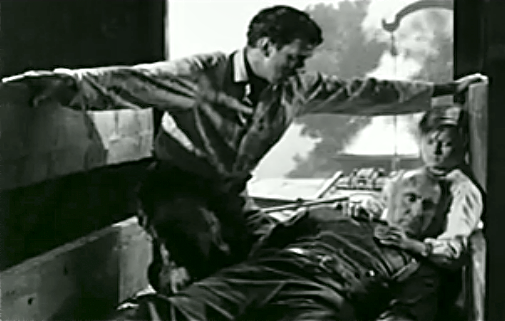
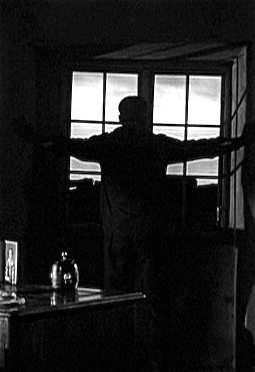
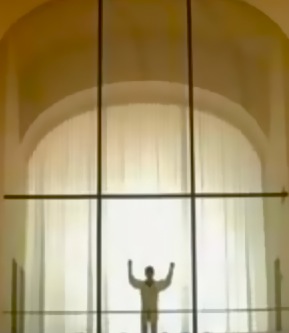
The cruciform pose of Christ being hung on an invisible cross turns the literal event into a symbolic timelessness. The mere posture of two outstretched arms has long been associated with the essence of the cross: suffering, sacrifice, redemptive salvation. Such a visual icon has been used in many movies effectively. Whether you agree with the director’s message or parallel is another matter. Nonetheless, the archetypal cruciform pose is a powerful image when aptly embedded in a visual context.

Here are a few movies that I can think of where the cruciform pose vividly depicts a memorable moment. (Warning: The following section carries Spoilers.)

How Green Was My Valley (1941): John Ford’s visually contemplative work. When the shaft comes up from the underground mine carrying survivors of the explosion, you can see the rescuer Mr. Gruffydd in the cruciform pose. What’s more, you can even see the Pieta image:

Through a Glass Darkly (1961): Ingmar Bergman’s classic. The estranged father David stretching his arms out in front of the window, sobbing and seeking redemption through family relationship: Cool Hand Luke (1967): After eating 50 eggs, it’s enough suffering for Luke (Paul Newman), a determined radical fighting a callous system in a hopeless prison. His graceful form is a clear contrast to the stark surroundings: The Graduate (1967): Ben (Dustin Hoffman) cries from above: “Elaine! Elaine! Elaine! …” Which yearning heart would not respond to such a passionate cry and be delivered in the nick of time out of a loveless union: Dances With Wolves (1990): Only when you’re not afraid to die, then can you live.  Lieutenant Dunbar (Kevin Costner) embraces death only to be ushered into a new life and adventure:

Shawshank Redemption (1994): Andy Dufresne (Tim Robbins) literally digs out a new path to salvation. This is the iconic scene of freedom and cleansing after climbing out from the sewage line: Superman Returns (2006): Superman (Brandon Routh) returning from Krypton to save the world. His famous line to Lois: “You wrote that the world doesn’t need a savior, but everyday I hear someone crying for one.” Gran Torino (2008): Walt Kowalski (Clint Eastwood) laying down his life to save his young friends from a neighborhood gang, in search of self-redemption: … I’m sure you can think of more.

***

Related Posts you might enjoy:

Alex Colville and the Movies

The Art Gallery of Ontario

***

Exit Through the Gift Shop (2010)

Update: “Exit Through The Gift Shop” is nominated for an Oscar for Best Documentary Feature. Academy Awards ceremony Feb. 27, 2011.

If you haven’t seen a Banksy signature piece in any urban centres, now you can watch a Banksy film, Exit Through The Gift Shop, ‘directed’ by the elusive street artist himself, and legitimately shown in theatres near you. And a big spoiler: no, you don’t get to see his face… only a dark silhouette inside a hoodie, voice distorted… or, maybe that’s not even Banksy himself.

The infamous and secretive graffiti artist has been claimed by some as the instigator of the ‘street art movement’.  Believed to be based in Bristol, England, Banksy has made his presence known by spray painting his articulately constructed stencilled work on walls in the most unlikely places of the world.  The following one is found on the high, separating wall in the West Bank:

The May 10 issue of TIME magazine has included Banksy in the poll of 100 Most Influential People In The World.  His silent graffiti are clear political and social statements, thought-provoking messages imbued with whimsical and imaginary images.  His works have been auctioned off at Sotheby’s, including the murdered telephone booth on a London street.  Sign of the time: the triumph of the cell phone.

At the time of the film’s premiere screening earlier this year at the Sundance Film Festival in Park City, Utah, Banksy made his presence known by contributing to the city scene with his notorious images.  Here’s one of them:

.

The documentary Exit Through The Gift Shop, ironically, is more about the filmmaker wannabe Thierry Guetta “Terry” who started off filming street artists from Paris, London, and back to his home city L.A.  His life came to a drastic turn as he, by chance, was introduced to the underground Banksy, and started tagging along, capturing Banksy’s creative process in his camcorder.

What turned him around was Banksy’s advice that he wouldn’t be a good filmmaker.  That was motivation enough for Terry, who re-directed his energy towards his new ambition: to be a street artist himself.  So the film is exactly that, the first part is the exhilarating depiction of the colorful underground world of street artists from Europe to LA, hunt down and tagged along by Terry the videotaping enthusiast.  But the film dims into a lesser light when the latter half shifts to focus on Terry himself, who, without much self-discernment, churned out obviously second-rate works which prompted Banksy to declare never to help anyone produce a doc about street art again.  We learn that as the end credits roll.

Unlike the anonymous and elusive Banksy, Terry is a self-promoting opportunist, calling himself Mr. Brainwash, his productions MBW. He hired staff to help him produce works of pop fusions, tacky, Kinko re-mixes of Warhol reproductions, while at the same time, reaping millions of dollars from their sales.

And with that Banksy cleverly throws out to us the obvious questions: What is art, or maybe, When is art, art?  And, Who can be an artist?

As I watched the first part about these highly skilled and agile urban legends, reminiscence of none other than Phillippe Petit of Man On Wire, I was entertained and amazed at the artistic skills and versatility involved. But of course, these are less dangerous, more down-to-earth feats, nevertheless the spirit of Phillippe Petit lingers.  As fellow artist Shepard Fairey writes in TIME magazine about Banksy:

He doesn’t ignore boundaries; he crosses them to prove their irrelevance.

So naturally, the film leads us to that menacing debate: Street art or vandalism?  Here’s Banksy’s own take on this issue, quoted in LA Weekly:

“I’m not so interested in convincing people in the art world that what I do is ‘art,’ ” Banksy says. “I’m more bothered about convincing people in the graffiti community that what I do is really vandalism.”

… mmm interesting thought… but then again, as elusive as his persona.

Exit Through The Gift Shop tags along this subheading: “The World’s First Street Art Disaster Movie”.  The disaster apparently refers to the public’s indiscriminate taste for Terry’s MBW works.  However, it probes further into a deeper layer, the distinction between ‘good’ art and ‘bad’ ones. I like Shepard Fairey’s take on the Mr. Brainwash phenomenon:

“Don’t be annoyed by him. Make him irrelevant, make something better.”

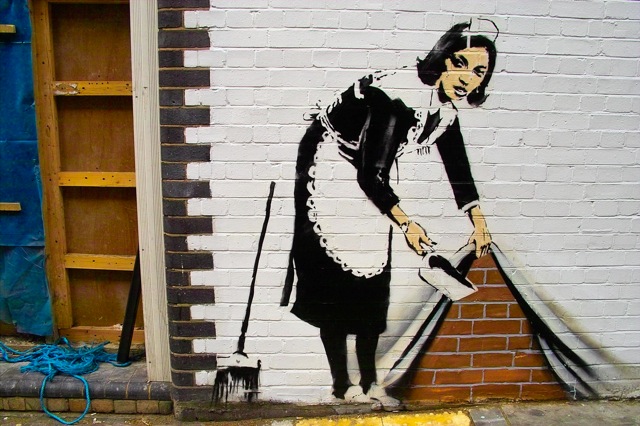
If we can all agree on what is ‘better’.  Take for example, among Banksy’s works, I like this one the best… No, it doesn’t reflect Arti’s own personal habit.  It appeared on a Camden street, and later met the fate of being cleaned up by order of the Camden City Council:


‘Directed’ by Banksy himself, the doc is narrated by Rhys Ifans, an award-winning British actor (Notting Hill‘s Spike).  It’s entertaining, informative, and thought-provoking.  This is the closest to an original Banksy.

~~~ Ripples

***

With the film’s premiere showing in Toronto, guess Banksy has also made his debut on the walls there:

CLICK HERE TO SEE BANKSY IN TORONTO.

Thanks to a reader from England, I was given the link to this, a must-see:

CLICK HERE TO SEE BANKSY V. THE BRISTOL MUSEUM

***

Photo Sources:

Banksy on West Bank Wall: http://news.bbc.co.uk/2/hi/entertainment/4748063.stm

Banksy at Sundance, Park City, Utah: http://festival.sundance.org/2010/blog/entry/banksys_missive/

Murdered Telephone Booth: http://www.laweekly.com/2010-04-08/art-books/banksy-revealed/2

Maid Sweeps Under: Wikipedia Commons

***


Floating Weeds (1959)

‘Floating weeds, drifting down the leisurely river of our lives.’

.

.

April is national poetry month… and I’ve been thinking poetry these days.  So that’s why the very title of this DVD on the shelf of the indie video store attracted me right away.  I took it down soon as I saw it was directed by Ozu.  Ozu’s films are visual poetry, the title ‘Floating Weeds’ is an apt prelude.

Floating Weeds (浮草, Ukigusa, 1959) is a remake of Ozu’s 1934 silent film ‘A Story of Floating Weeds’.  The title comes from a favored Japanese metaphor as the above quote depicts.  In this newer version the director has added colors and sound, and given his story a blossoming rebirth. The colors are vibrant yet the cinematography is contemplative.  Unlike some art house films, and despite its title, ‘Floating Weeds’ is enlivened by humor, human interests, and augmented by actions.  Despite the pensive mood the title evokes, I found it to be more story-driven than many of his other works.  However, it is characters that ultimately carry the story, and Ozu’s brilliant direction that makes viewers care about them.

The story begins with a train dropping off a troupe of travelling players to perform in a small town.  The master of the company Komajuro takes the chance to visit his former lover and see his son Kiyoshi, now grown up to be a fine young man, aspiring to attend college in the big city.  But Komajuro has kept his real identity as Kiyoshi’s father from his son because he does not wish his low social status as a travelling actor, and the vulgar circle he associates with to tarnish Kiyoshi’s future.  The plot thickens as Komajuro’s current mistress Sumiko finds out about his secrets. Burnt with anger and jealousy, she plots a scheme to destroy Kiyoshi by bribing the young actress Kayo to seduce him.  The young man soon falls for the actress, but the scheme turns into a full-blown mutual love relation.  Sadly, a marriage with Kayo would mean the quashing of his aspiration for higher education, and possible social reverberations and disgrace.

At the mean time, the drama troupe hits a low with disappointing attendance. The company has to disband.  Komajuro facing failure on different fronts, has to make choices not only for himself, but the future of his son.  In the final shot, the train that once took the travelling players to town now carries them off as disbanded individuals facing uncertain future. Like floating weeds, they drift on in the stream of life. And for Komajuro, he leaves town with the slim hope that his son would fare better than he in the oblivious currents of time.

I’ve enjoyed the subtle style of Ozu.   Here is one of my favorite scenes in the film, and the dialogues are as contemporary as you can find in a 2010 movie.  Whether one sees it as insight or foresight (considering it was remade in 1959), both are gems one discovers while watching the story unfold as casually as a quiet flowing stream.

The scene is about Komajuro talking to his son Kiyoshi as he arrives to his former lover’s home. All the years, Kiyoshi has only known Komajuro as an uncle.  Although Komajuro is ecstatic to see his son all grown up with a bright future, he is also wary that his travelling drama troupe does not measure up to what he would wish for his son.  Here in this scene, father and son’s conversation seems to touch on another issue: art and popularity.  Through this most casual dialogue exchange, Ozu might have conveyed his own ambivalence on the subject more sharply than any wordy treatise.

Kiyoshi: I’ll go see your show.  What do you play?

Komajuro: Forget it.  It’s not meant for you.

Kiyoshi:  Who is it for?

Komajuro:  An audience.

Kiyoshi:  I’m an audience.

Komajuro:  I know.  It’s nothing high-class.  Forget about it.

Kiyoshi:  Why show such plays?  Show something better.

Komajuro:  But I can’t.

Kiyoshi:  Why?

Komajuro:  Audiences today won’t understand good plays.  So you can’t come to see it.

**

In his commentary on the 1934 silent movie, writer and film critic Donald Richie notes that Ozu’s films are full of ellipses. There are story sequences he left out for the audience to bridge.  As well, he handled the story with restraints.  Such a subtle way of presenting the material is a very modern style of storytelling.  That might explain why I would care for characters in a Japanese movie made half a century back, where I have to read subtitles, and watch in black and white, or even silent.  Herein lies the ingenuity and artistry of Ozu, that an audience so far removed in time, space, and culture, would find universality and common ground to be totally absorbed.

The Criterion Collection 2-DVD set includes both the 1934 silent movie and the 1959 color remake. The first features commentary by Donald Richie, the later version by Roger Ebert. According to IMDB, ‘Floating Weeds’ (1959) is on Ebert’s list of 10 best movies of all times.

~~~~ Ripples

CLICK HERE to my review of Ozu’s classic Tokyo Story.

***
Yasujiro Ozu and The Art of Aloneness

Growing up in Hong Kong during the 60’s, I had my share of Japanese literature and films, as well, the early version of anime.  Books were in Chinese translations, films with Chinese subtitles, and anime needed no language.  As a youngster I had my fix of Samurai action flicks by the legendary Akira Kurosawa, or the early sagas of The Blind Swordsman deftly performed by Shintarô Katsu.  The fast, magical sword-fighting movements displayed in elegantly choreographed sequences defined what ‘cool’ was in the eyes of a very young film lover, decades before Jason Bourne emerged.

But I admit, I had never heard of Yasujiro Ozu (小津 安二郎, 1903-1963) before reading the book The Elegance of The Hedgehog, and since, have become a mesmerized Ozu fan.

In Muriel Barbery’s marvellous work of fiction The Elegance of The Hedgehog, I was fascinated by the following excerpt that led me to explore the world of Ozu. Barbery mentioned some dialogues in the Ozu film ‘The Munekata Sisters’ (1950). Here, after quoting elder sister Setsuko, Barbery wraps up the chapter from the point of view of the concierge Renée, narrator of the book:

SETSUKO
True novelty is that which does not grow old, despite the passage of time.

The camellia against the moss of the temple, the violet hues of the Kyoto mountains, a blue porcelain cup — this sudden flowering of pure beauty at the heart of ephemeral passion: is this not something we all aspire to?  And something that, in our Western civilization, we do not know how to attain?

The contemplation of eternity within the very movement of life.

I could not find any copy of ‘The Munekata Sisters’, but I did manage to find a few other Ozu films on DVD in The Criterion Collection at an independent video store. One particularly stands out, both the film and the special features.  And that’s Tokyo Story (1953), the best known and most acclaimed Ozu work.

.

TOKYO STORY (with spoiler)

.

.

Instead of the macho samurai films of his time, Ozu chose to explore the quiet subject of family relationships, parents and children, brothers and sisters, husbands and wives, and from them come the topics of marriage, loyalty, aging, death, filial duties, parental expectations, and generational conflicts.  Through his perceptive camera work, Ozu sensitively revealed the undercurrents beneath the seemingly calm surface of daily family interactions.

‘Tokyo Story’ is about an aging couple Shukichi (the Ozu actor Chishu Ryu) and Tomi (Chieko Higashiyama) from small town Onomichi going on a trip to visit their adult children in bustling Tokyo.  At that time, postwar Japan was cranking up her economic engine, and urbanization was taking off.  Shukichi and Tomi’s children were all busily engaged in their work and family, with no time or patience to entertain their visiting parents, albeit struggling with a thin sense of obligation. They passed the two old folks from home to home, and finally sent them off to a spa resort on their own, a supposedly well-meant package substituting for their absentee hospitality.

With his subtle cinematic language, Ozu explored the issues facing the family in urban, postwar Japan. I’m surprised that in a time when the rebuilding of national pride was as much an essential as that of the economy,  Ozu was brave enough to depict the collapse of the family, revealing the conflicts and tensions behind the amicable social façade.  It’s interesting how contemporary and universal they are.  Have we not heard of those ubiquitous ‘mother-in-law jokes’ in our modern Western society?  Or, in real life, do we not struggle between taking care of our own family and career, and finding the time and energy to look after our aging parents?

.

But the contemplative cinematic offerings of Ozu draw us into deeper thoughts. ‘Tokyo Story’ quietly depicts the truth of these issues: No matter how many siblings there are in a family, each person is responsible for his or her own decision and action.  Even in a mass society like Japan, one can still make individual choices. Despite the currents, one can stand alone against the tides, and act according to one’s heart and conviction. While the brothers and sister are evading the task of hospitality, the young widowed daughter-in-law Noriko (the Ozu actress Setsuko Hara) chooses to care for her deceased husband’s parents out of genuine love.  She stands alone in her kindness and grace, a selfless heroine in a family hinged upon superficial ties.

Illness and death too have to be borne alone.  Despite their being together all the years of their marriage, Shukichi and Tomi each has to face the imminent all alone.  After Tomi falls ill upon arriving home from Tokyo, the strong bond of togetherness in marriage quickly dissolves into helpless resignation of parting and letting go.  Shukichi soon realizes he has to face life all alone.  The poignant scene though is that despite his loss, he looks out for his daughter-in-law Noriko, appreciating her loyalty, and relieving her of further obligations.  Despite having no blood ties, the two of them have touched each other in a way that’s beyond flesh and blood. Noriko selflessly gives while Shukichi accepts and appreciates in the midst of aloneness. The tables are turned, while they are left to face life alone, they are yet bound together in an unspoken bond, one that’s far stronger than filial ties.

The Criterion Collection carries several sets of Ozu titles.  ‘Tokyo Story’ is one in a trilogy of Noriko’s stories.  Disc Two features ‘I Lived, But…’,  a two-hour documentary on the life of Ozu, and ‘Talking with Ozu’: a 40-minute tribute to the great director featuring reflections from international auteurs Stanley Kwan, Aki Kaurismaki, Claire Denis, Lindsay Anderson, Paul Schrader, Wim Wenders, and Hou Hsiao-hsien.  It also features audio commentary by Ozu film scholar David Desser.

~~~~ Ripples

CLICK HERE to my review of another Ozu classic: Floating Weeds (1959)

Alone Again… Unnaturally

A year ago around this time, I wrote the post ‘No Texting for Lent and The End of Solitude’. It was in response to the news about some Roman Catholic bishops urging the faithful to restrain from texting as a penance during Lent.  And around the same time, I came across the article by William Deresiewicz ‘The End of Solitude’, pointing out the difficulty of remaining alone in our over-connected society.

Now a year after Deresiewicz published his essay, the number of tweets had grown by 1,400%.  Now there are 50 million tweets per day, an average of 600 tweets per second.  So, if you’re calling for ‘No texting’ at Lent, you might as well tell people not to use the phone, the computer, the iPhone, all the smart gadgets, in other words, get off the human race for the time being.

Hey, that may not be such a bad idea.  The current issue of The American Scholar has another article by Deresiewicz, yes, on solitude again.  I’m glad to read articles on ‘Solitude’, why?  There just aren’t too many written on this topic.  And thanks to Deresiewicz, seems like his is the only voice crying in the digital wilderness.  The article is a lecture he delivered to the plebe class at the United States Military Academy at West Point in October of last year, entitled ‘Solitude And Leadership’.

If you want others to follow, learn to be alone with your thoughts.

This quote at the beginning of the article just about sums it all up.

Speaking to this class of freshman, all eager and gung-ho to fall in line with the rank and file of this prestigious Military Academy, Deresiewicz has the audacity (ok, guts) to tell his audience to shun conformity, break away from regimentation, to ask questions, to seek their own reality, to form their own opinion, and to exercise moral courage.  And his main crux: it is only through solitude can they do this.

Facebook and Twitter, and yes, even The New York Times, only expose you to other people’s thinking. Whenever you check your tweets, or get on to your social network, or read the newspaper for that matter, you are only hearing other people’s voices:

That’s what Emerson meant when he said that “he who should inspire and lead his race must be defended from travelling with the souls of other men, from living, breathing, reading, and writing in the daily, time-worn yoke of their opinions.” Notice that he uses the word lead. Leadership means finding a new direction, not simply putting yourself at the front of the herd that’s heading toward the cliff.

He urged them to read books instead.  Well aren’t books other people’s opinion too?  True, sometimes you need to put them down too to visualize you own reality and formulate your own stance.  But, books, especially the time-tested ones, have weathered social scrutinies and oppositions, and yet still stand today offering us wisdom of perspectives in finding our own path.

Further, the major difference between a well-written book and a tweet, or a Comedy Central episode, or even a newspaper article, is basically, time.

The best writers write much more slowly than everyone else, and the better they are, the slower they write. James Joyce wrote Ulysses, the greatest novel of the 20th century, at the rate of about a hundred words a day… for seven years. T. S. Eliot, one of the greatest poets our country has ever produced, wrote about 150 pages of poetry over the course of his entire 25-year career. That’s half a page a month. So it is with any other form of thought. You do your best thinking by slowing down and concentrating.

Of course, this may sound reductionist.  But, I like the idea of slowing down in this rapidly shifting world. Deresiewics urged the freshmen of West Point to practice concentrating and focusing on one thing rather than multi-tasking. He charged them to take the time to slowly read, think, and write, in solitude, an axiom that’s so rad that his audience probably had never heard before.

In this über connected world we’re in, it’s unnatural to be alone.  A solitary moment has to be strived for with extra effort, and much self-discipline.  That means unplugging the phone, turning off the computer and anything smart, yes, including friends, real or virtual.   For Lent or not for Lent, it could well be the only way to find out who we are and where we are heading.  Even if we’re not aspiring to lead, at least we know whom we should follow.  And, you’ll never know, others may be attracted to our slowness and surety that they just might step right behind us.  So it’s best not to steer them too close to the cliff.

What Is Stephen Harper Reading?

.
Now that the Winter Olympics have come to a close, maybe more of the world would have heard of Stephen Harper.  No, no, he isn’t a medal winner.  Just a hockey fan, and, he happens to be Canada’s Prime Minister.
.

And it’s good time to read this book.  It all started one March day in 2007.  Fifty Canadian artists of all sorts were invited to a Parliamentary session to celebrate the fiftieth anniversary of the Canada Council for the Arts, each of them representing a particular year.

There they were sitting in the Visitors’ Gallery of the House of Commons, waiting for their item to come up on the long agenda of the day.  At 3:00 pm, the business came to the celebration.  All fifty of them were asked to stand up. The Minister for Canadian Heritage, Bev Oda at the time, rose up, acknowledged their presence, and gave a five-minute speech.  Applause.  Then on to the next business item.  Stephen Harper did not even look up at them standing in the Gallery.

The fifty guest artists were incredulous.  Among them was Yann Martel, who received a Canada Council grant in 1991 allowing him to write his first novel.  His literary career reached an admirable high in 2002 when he was awarded The Man Booker Prize for his book Life of Pi.  (CLICK HERE to read one appreciative reader’s response to the book, a personal note from Barack Obama.)

After this incident, driven by frustration, Martel decided to launch a most interesting project.  He started sending Stephen Harper a book every two weeks, with his personal letter introducing  the work, and of course, whenever appropriate, fill him in as to why that’s a good read for a Prime Minister.   With such an intention, one can predict the tone of these letters.  They are mostly sincere, mind you, albeit embedded with the occasional sarcasm, irony, and yes, some condescending subtext.

But overall, these letters to the Prime Minister sent with the books are genuine appeal to the Leader of the country to place more emphasis on the arts. They offer a place of stillness in the busy agenda of a politician.  Martel’s is a gentle voice to remind the prime policy maker the role of the arts, in particular, literature and its appreciation, in the making of a nation, the importance of beauty and the imagination in the building of a vision and in shaping the humanity of her people.

So, it’s not so much as to what Stephen Harper is reading, but what’s on his TBR list.  It remains unknown whether the PM has actually read any of these gifts, although letters of appreciation had been sent to Martel from his office. It’s fun too to read the choices of the titles… and their reasons.  But above all, I’ve enjoyed reading Martel’s insights into how the literary speaks in the context of contemporary political and social landscape.  Here are some examples.  I’ve included a quote or two from Martel’s letter sent with each title:

Animal Farm by George Orwell

Animal Farm is about collective folly.  It is a political book, which won’t be lost on someone in your line of business.  It deals with one of the few matters on which we can all agree:  the evil of tyranny.

Animal Farm is a perfect exemplar of one of the things that literature can be: portable history.  … in a scant 120 pages, … the reader is made wise to the ways of the politically wicked.  That too is what literature can be: an inoculation.”

The Island Means Minago by Milton Acorn (People’s Poet of Canada)

“But any revolution that uses poetry as one of its weapons has at least one correct thing going for it: the knowledge that artistic expression is central to who and how a people are.”

“… the past is one thing, but what we make of it, the conclusions we draw, is another.  History can be many things, depending on how we read it, just as the future can be many things, depending on how we live it… And it is by dreaming first that we get to new realities.  Hence the need for poets.”

The Educated Imagination by Northrop Frye

“Literature speaks the language of the imagination.”

“… the better, the more fertile our imagination, the better we can be at being both reasonable and emotional. As broad and deep as our dreams are, so can our realities become.  And there’s no better way to train that vital part of us than through literature.”

A Modest Proposal by Jonathan Swift

“So, more cuts in arts funding… What does $45 million buy that has more worth than a people’s cultural expression, than a people’s sense of who they are?”

Mister Pip by Lloyd Jones

“Lloyd Jones’s novel is about how literature can create a new world.  It is about how the world can be read like a novel, and a novel like the world.”

The Kreutzer Sonata by Leo Tolstoy

“Why a book on music?  Because serious music, at least as represented by new and classical music, is fast disappearing from our Canadian lives… the latest proof of this: the CBC Radio Orchestra is to be disbanded… How much culture can we do without before we become lifeless, corporate drones?  I believe that both in good and bad times we need beautiful music.”

The Uncommon Reader by Alan Bennett

“The irony in the story is as light as whipped cream, the humour as appealing as candy, the characterization as crisp as potato chips, but at the heart of it there’s something highly nutritious to be digested:  the effect that books can have on a life.”

“Whenever an independent bookstore disappears, shareholders somewhere may be richer, but a neighbourhood is for sure poorer.”

Gilead by Marilynne Robinson

“Speaking of President Obama, it’s because of him that I’m sending you the novel Gilead, by the American writer Marilynne Robinson.  It’s one of his favourite novels.”

“I would sincerely recommend that you read Gilead before you meet President Obama on February 19.  For two people who are meeting for the first time, there’s nothing like talking about a book that both have read to create common ground and a sense of intimacy, of knowing the other in a small but important way.  After all, to like the same book implies a similar emotional response to it, a shared recognition of the world reflected in it. This is assuming , of course, that you like the book.”

Julius Caesar by William Shakespeare

“Since Julius Caesar is about power and politics, we might as well talk about power and politics.  Let me discuss concerns I have with two decisions your government recently announced.

My first concern is about the Social Sciences and Humanities Research Council.  New money allocated to the Council is apparently to be spent exclusively on “business-related degrees”…. we’re losing sight of the purpose of a university if we think it’s the place to churn out MBAs.  A university is the repository and crucible of a society, the place where it studies itself.  It is the brain of a society.  It is not the wallet… A university builds minds and souls.  A business employs.”

Louis Riel by Chester Brown and The Sailor Who Fell From Grace With The Sea by Yukio Mishima

“But I’ve always liked that about books, how they can be so different from each other and yet rest together without strife on a bookshelf.  The hope of literature, the hope of stillness, is that the peace with which the most varied books can lie side by side will transform their readers, so that they too will be able to live side by side with people very different from themselves.”

**

Yann Martel is still sending books to Stephen Harper every two-weeks.  Other authors he has sent include Jane Austen, Flannery O’Connor, Ayn Rand, Gabriel Garcia Marquez, Douglas Coupland, Philip Roth, Alexander Solzhenitsyn, Franz Kafka, Virginia Woolf, Samuel Beckett, Michael Ignatieff, Paul McCartney, Dylan Thomas, Laura and Jenna Bush… quite an eclectic selection. Excellent demonstration of how we can be so drastically different in our perspectives and background, and yet can still stand shoulder to shoulder in this vast land of the free.

To read the full list of all the books he has sent, and yes, including this one, CLICK HERE to go to the official site:  What Is Stephen Harper Reading dot ca

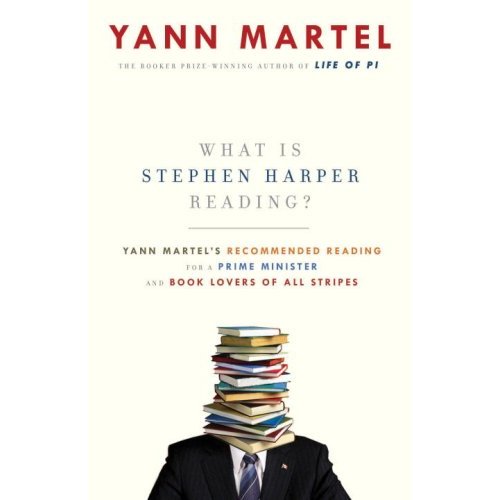
What Is Stephen Harper Reading? by Yann Martel, published by Vintage Canada, 2009, 233 pages.

****
Regarding the role of universities and the humanities as dying disciplines, CLICK HERE to read my post: THE HUMANITIES AS AN ENDANGERED SPECIES.