Reading the Season: A Wrinkle in Time by Madeleine L’Engle

For the tenth year, I’m sharing a Christmas read here at the Pond. For the first time, it’s a book written for young readers but is ever so relevant for us grown-ups. Herein lies the ingenuity of writer Madeleine L’Engle. Time to dig out that copy that you might have read when you were a youngster. If you haven’t read it, now’s a good time.
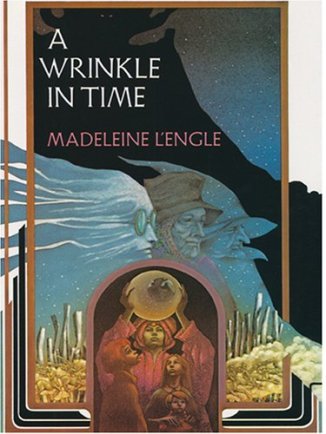
 

A Wrinkle in Time


Newbery Medal winner A Wrinkle in Time is the first book in the Time Quintet series of fantasy YA fiction about the Murray family, scientist parents and four children Meg, twins Dennys and Sandy, five year-old genius Charles Wallace, and that special friend of Meg’s, Calvin O’Keefe. The deceptively simple odyssey in time and space is packed with wonder and wisdom.

The book not only exudes insights but shows L’Engle’s remarkable foresights. Take this for an example, dematerializing and materializing  for easy transport. Published in 1962, the book came out four years before Scotty beamed Kirk up using the same method in the first season of Star Trek.

Or this fancy idea, ‘tesseracting’, that is, travelling through space and time via a wrinkle in time. The shortest distance between two points is not a straight line, but through a wrinkle when two points are folded. That’s fifty years before Christopher Nolan sends Matthew McConaughey interstellar travelling.

All concepts held in a simple plot. Meg, Charles Wallace, together with friend Calvin, go on an interstellar quest to look for Meg and Charles’ physicist father who had gone missing for almost a year while doing some classified scientific work for the government. This little, unequipped search party is initiated and aided by three celestial beings: Mrs. Whatsit, who’s much wiser than she appears, Mrs. Which, who doesn’t bother materializing but remains as a shimmering beam, and Mrs. Who, who speaks in quotes.

The more a man knows, the less he talks.

Their odyssey brings them finally to the planet Camazotz, where they find Mr. Murray confined by the evil Dark Thing, or IT (Surprise! 24 years before Stephen King’s book and now movie) The smart alecky Charles Wallace is easy prey and quickly influenced by IT. (And for Luddites, what better parallel to address our technology now, the evil IT) Ultimately, it’s Meg, our reluctant and timid heroine, who has to be the one to go fight IT to rescue her little brother.

The foolishness of God is wiser than men; and the weakness of God is stronger than men… God hath chosen the foolish things of the world to confound the wise; and God hath chosen the weak things of the world to confound the things which are mighty.

Meg knows Charles Wallace is not himself but trapped and deceived, and must be snatched from the evil force IT. She has just one weapon as her ammunition, given to her by Mrs. Whatsit, that one thing IT doesn’t have: LOVE. With her single act of bravery, she brings the family together again.

When I was a child, I read like a child, I thought like a child. When I became an adult, I can read like a child and like an adult too. That’s the joy of reading A Wrinkle in Time. One can find pleasure in the adventure and feel the vulnerability of the children, as well delve deeper into its symbolism and parallels, and ponder its layers of meaning.

L’Engle writes to the child and the adult in us. She can convey scientific and spiritual concepts at the same time and in a way that both young and old (and those in between) can enjoy. There’s no conflict between the cerebral and the spiritual; they co-exist comfortably in L’Engle’s work. Not only that, they fuse together and from that alchemy rises a whole new, inexplicable entity: Faith.

That first Christmas day when a baby was born in a lowly manger, the war against IT had started to win. Although the last, painful battle on the hill of Calvary had not been waged, the outcome was cast, just because LOVE came.

And the light shineth in darkness; and the darkness comprehended it not.


The Movie

‘Tis the Season to read or reread A Wrinkle In Time before the movie adaptation comes out in 2018. Helmed by Selma (2014) director Ava DuVernay, screenplay by Frozen (2013) scriptwriter Jennifer Lee, with some stellar beings including Rees Witherspoon, Oprah Winfrey, Mindy Kaling, Chris Pine et al.

***

Past Reading the Season Selections:

2016:  Silence by Shusaku Endo

2015: The Book of Ruth

2014: Lila by Marilynne Robinson

2013: Poetry by Madeleine L’Engle

2012: Surprised by Joy by C. S. Lewis

2011: Walking on Water by Madeleine L’Engle

2010: A Widening Light, Luci Shaw

2009: The Irrational Season 

2008: The Bible and the New York Times by Fleming Rutledge

2008: A Grief Observed by C. S. Lewis

Lion: From Personal Memoir to the Big Screen

The memoir A Long Way Home by Saroo Brierley, first published in 2014, has officially changed its name to Lion. This may well be a metaphor for its author. Only a change in the name, but everything inside remains intact. From a child lost on the streets in Calcutta, India, to a man grown up in Hobart, Tasmania, Saroo remains who he is. He writes in his memoir: “I now have two families, not two identities. I am Saroo Brierley.”

lion-movie-tie-in-edition

Lion (previously titled A Long Way Home) the memoir by Saroo Brierley

5 year-old Saroo was lost in a Calcutta (now Kolkata) train station, almost a thousand miles away from his home in a small village, Ganesh Talai. With no language (a different dialect), not clear of the name of the place he calls home (mispronounced by him as “Ginestlay”) or even his own last name, Saroo is utterly alone and helpless. Living dangerously on the streets of Calcutta for some weeks, he was picked up and sent to a youth detention centre, which was only a tiny bit safer from the streets. Subsequently Saroo was sent to an orphanage, Nava Jeevan (“new life”), run by the benevolent Mrs. Sood. There she arranged for his adoption by a loving Australian couple, John and Sue Brierley.

That could have been the happy ending of a tumultuous experience for Saroo, as he grew up in calm and beautiful Hobart, Tasmania, well adjusted and dearly loved by his adoptive parents. But for twenty-five years, Saroo has not forgotten his first home. As he grew, he was all the more tormented by the memory of his birth mother, and the brothers and sisters who had shared the first five years of his life. An important message he has always wanted to convey to them is that he’s ok, and that they need not worry about him. For years he has been haunted by the thoughts that his mother and older brother Guddu must have been devastated with losing him without a trace, as it was Guddu who had left him alone on a bench at the train station near his home, telling him to stay put as Saroo was too sleepy to tag along on that fateful night.

With the help of Google Earth twenty years later, and vague memories of the physical features of his home surrounding, Saroo finally located his village and flew back to India to search for his mother. They reunited a few doors down from his old home, as his mother had persisted all these years to not move away but stay there to wait for him, hoping against hope that her son would come back to her. The photo inserts in the book add even more poignancy as we see the Brierleys meet Saroo’s birth mother Kamla in India.

Utterly moving, authentic, genuine and real. While Slumdog Millionaire may be entertaining and eye-opening for those of us who are not familiar with Indian’s millions of children living on the streets, Lion is a true portrayal of one lost child, determined to find his way back home twenty-five years later across the oceans.

**

Lion the Movie

Is the movie any good? For those who think it’s always the book that’s better, here’s my answer: Yes, very good. Premiered at TIFF16 last September, Lion has since garnered awards and nominations, including young Sunny Pawar, his debut performance as an actor. Kudos to all those involved in transporting this story from a personal memoir onto the big screen for international viewers. If not for the movie, even though it has been reported in India and Australia, I for one in North America would not have known about this real life miracle.

So, hats off to Australian director Garth Davis, screenwriter, the acclaimed Australian  poet/writer Luke Davies, and the cast, Sunny Pawar as young Saroo, Dev Patel (Slumdog Millionaire, 2008) as the adult, Nicole Kidman and David Wenham the adoptive parents, Rooney Mara the girlfriend, and the cast of Saroo’s Indian family. They have delivered an authentic and moving real-life story.

Basically structured into three parts, the first focuses on five year-old Saroo, living in poverty but is loved by his mother and siblings. One night he pleads with his older brother Guddu to go with him to his night work, salvaging garbage left on trains. After reaching the closest station from his home village, Saroo is too tired, so he stays behind sleeping on a bench to wait for Guddu. He wakes up in the middle of the night to find himself all alone. He gets on one of the parked train to look for Guddu but falls asleep again in there. He wakes to his horror as he finds he is being transported in the speeding train further and further away from his home.

Cinematographer Greig Fraser (Zero Dark Thirty, 2012; Bright Star, 2009) uses his camera effectively showing some haunting images, a horrified 5 year-old, alone on a train speeding to the unknown. Throughout the film as well, he tells the story poignantly with his camera. Scores composed by Volker Bertelmann and Dustin O’Halloran add power in eliciting emotions, taking us closely with Saroo on his incredulous life journey.

Second part we see Saroo grown up in Australia, having a good relationship with his adopting parents but troubled nonetheless by his past. The frustration of having only vague memories of the physical features of the train station near his home makes it an impossible task to search for an unknown town in the vast land of India. Thanks to Google Earth and his unyielding perseverance, the adult Saroo was rewarded with a dream come true.

While the physical locales might be distant and vague, memories of his childhood experiences are lucid and close. In the second part, the director and screenwriter have deftly inserted Saroo’s memories of his childhood days in India, enriching the screen story of his intimate relationships with his family. These inclusions add to the texture and are placed aptly to enhance the continuity of the child and the man. Very effective.

I welcome the quiet and slower pace in Part Two, and appreciate Patel’s portrayal of inner turmoils. Kidman has done an amiable job as the adoptive mother trying to hold the family together, with two Indian boys, now grown men, both deeply troubled by their past in different ways. If Part One is about the outward dangers of a lost child, Part Two illustrates the internal turmoils one still wages into adulthood.

Part three is that triumphant and exhilarating reunion. How we want to see a happy ending by then. Although we know that is forthcoming, it is still exciting and gratifying to embrace the uplifting end. Lion is a story well told cinematically, and worth every minute of a viewer’s attention. Do wait till the very end before you leave the theatre, the photos at the closing credits make a beautiful wrap. And why the title Lion? That’s for you to find out.

~ ~ ~ ~ Ripples 

for both Book and Movie

***

Related Reviews on Ripple Effects:

Slumdog Millionaire

The Best Exotic Marigold Hotel

The Second Best Exotic Marigold Hotel

The Lunchbox

TIFF16 Review: After The Storm

“After the Storm” was screened at TIFF in September. Next week, it will be at BFI London FF and after that, the Chicago IFF. My review was first published on Asian American Press. I thank the editor for allowing me to post my review here on Ripple Effects.

***

Japanese auteur Koreeda Hirokazu graced the Toronto International Film Festival once again this year with his new feature, “After the Storm”. Since 1995, with his multiple award-winning feature “Maborosi”, Koreeda has been a staple at TIFF, which has screened every one of his feature films. His recent works are still fresh in many viewers’ minds, “Still Walking” (2008), “Like Father, Like Son” (2013), and “Our Little Sister” (2015).

With all the avant garde and experimental, new waves of filmmaking bursting out at film festivals every year, Koreeda’s traditional style of storytelling offers a fine balance and an affirming voice. His films focus on the contemporary Japanese family, bringing out themes arising from the individual and extending to the universal. Humanity is what Koreeda is interested in, and his treatment of human foibles and failures is kind and forgiving. “After the Storm” is no exception.

Ryota (Abe Hiroshi) used to be an award-winning author. But for years he has not produced any more works. Divorced from his wife Kyoko (Maki Yoko) and sorely missing his 9 year-old son Shingo (Yoshizawa Taiyo), Ryota is at the bottom of his life. Months behind in his child support payments, he is laden with debt, entrapped by a gambling habit that’s hard to kick. It runs in the family it seems, for his late father had also been a gambler. With his work at a detective agency, Ryota would try all means to squeeze extra cash out of his clients, including deception and even extortion.

Koreeda’s dealing of Ryota is gentle and sympathetic. While he may look unkempt, the six-foot-two actor Abe Hiroshi has his charm and charisma. We see the nasty side of Ryota as he slips into his mother’s cramped unit in a housing project, looking for anything of value he could lay his hands on for pawning. A moment later, Koreeda lets us have a glimpse too of the other side of Ryota, that of a son to an ageing mother Yoshiko (Kiki Kilin). The mother-son portrait is witty and tactful, punctuated with heartwarming humour. It is a reunion of the two actors, also as mother and son, from Koreeda’s 2008 feature film “Still Walking”.

Mother knows best, even when your son doesn’t live with you any more. Deep in her heart, Yoshiko wishes to see her son reunite with her daughter-in-law Kyoko whom she is very fond of. She also treasures the affectionate bonding with grandson Shingo. If only they could get back together as a family, that would be a big relief and comfort, growing old can then be much bearable.

One evening, a passing storm keeps them together in Yoshiko’s home for the night. The impromptu reunion, though awkward, is probably gratifying for every one of them. Koreeda is, alas, a realist. Life is full of disappointments. However close they have come to bonding once again, the moment is short-lived. But the reminiscence and dynamics of the small family’s once intimate relationship regurgitates enough to spark off a renewal for Ryota. While they may continue on with their own separate ways, a new perspective has subtly wiggled in. Perhaps, there’s hope after all. The young, green grass covered with raindrops the morning after the storm is a refreshing metaphor.

koreeda

The film was shot in the housing project where Koreeda had spent his youthful years. That was where his mother lived after his father had passed away. In the Q & A session, Koreeda admitted that certain incidents in the film did happen in the director’s own family. When writing the script though, once he has created his characters, Koreeda would let them run free and so they would develop themselves. Their stories just came out naturally.

Answering questions in Japanese with a translator beside him, Koreeda humbly thanked his Toronto audience, whom he had in mind when he made his films, as TIFF had screened every one of his features. He noted that as we grew older, we had to deal with disappointments, for life often didn’t turn out to be what we’d like to see. “After the Storm” shows us that Koreeda has dealt with his characters’ life disappointments with a forbearing spirit. As for viewers of his films, Koreeda does not disappoint.

~ ~ ~ 1/2 Ripples

***

Other reviews of Koreeda films on Ripple Effects:

Our Little Sister: A Respite from Summer Superhero Movies

Like Father, Like Son: Parent and Child Reunion 

‘Our Little Sister’: A Respite from Summer Superhero Movies

The following is my review of the film “Our Little Sister” by the acclaimed Japanese director Hirokazu Kore-eda, published in Asian American Press. I thank aapress.com for allowing me to post it here on my blog.

For those who might think a Japanese film would never make it to your local cinema, check this list of U.S. screenings:

http://sonyclassics.com/ourlittlesister/dates.html

***

our-little-sister

Premiering last year at Cannes, and later screened at other international film festivals the world over, Hirokazu Kore-eda’s “Our Little Sister” finally trickles into the local theatres of North American cities, which is timely. In a world rocked by tumultuous strife and unrests, this latest from Kore-eda makes a quiet solace, offering a taste of the ideal in human relationships and harmony despite brokenness.

“Our Little Sister” is Kore-eda’s most recent work after his 2013 Cannes Jury Prize winning “Like Father Like Son”. Following his usual subject of relationships in various family situations, “Our Little Sister” sees Kore-eda at the helm as director, writer, and editor of this production based on the popular Japanese graphic novel “Umimachi Diary” by Yoshida Akimi.

The three Koda sisters have not seen their estranged father for fifteen years. Sachi (Haruka Ayase), Yoshino (Masami Nagasawa) and Chika (Kaho) are now adults, living in the family’s traditional home his father had long deserted in the seaside town of Kamakura. His recent death sends the sisters to his funeral, awkwardly, meeting the woman who had stolen their father’s heart. But it is an inciting incident that changes all their lives. They meet their half sister, 15 year-old Suzu (Suzu Hirose). Herein lies the turning point for the four sisters. Moved by her little step-sister’s mature and quiet demeanor, or maybe stirred by her own older-sister instinct, Sachi invites Suzu to come away and live with them in Kamakura. Suzu gladly agrees.

The new Koda household now is a haven of happy sisterhood. Living under one roof, we see minimal conflicts and constant congeniality. Viewers from a different culture may find the saccharine relationships unrealistic. Are there not any conflicts at all? Of course there are. Kore-eda deftly leads us to some slow revealing. After three quarters of the 120-minute film, we begin to see inner turmoil rise to the surface.

Suzu had to take care of her father in his illness and seeing him to his last breath due to the incompetence of her mother; here is a young teenager bearing the burden of an adult. Now living with three older sisters, Suzu can finally enjoy the childhood she has missed. She quickly captures the attention of other students in her new school with her soccer skills, congeniality and maturity.

In the Koda household, Suzu is the angel of harmony, stirring up love and life. Kore-eda may have spent too much time on the leisurely-paced, day-to-day living such that viewers might feel the lack of conflicts to move the story along. I credit the style to Kore-eda’s realism and a candid camera focusing on the subtleties of nuanced interplay among the characters. Like his previous films “I Wish” (2011), the yearning for family connections of a young boy is shown by his actions and not so much by words, or in “Like Father Like Son” (2013), wherein conflicts are portrayed by contrasts and parallels. Here, while still nursing a deep resentment towards her father for deserting them years ago, Sachi struggles with the moral parallel now as she carries on a relationship with a married doctor at the hospital where she works.

Moral dilemmas, what to choose, how to live, and the search for identity are the issues Kore-eda’s characters have to deal with, but in a way that is quiet and gentle. He introduces us to other endearing characters in the town, adding numerous episodes to build up a human mosaic of harmony in the presence of brokenness and even death.

The scenic seaside town of Kamakura provides a beautiful backdrop for cinematographer Mikiya Takimoto (“Like Father, Like Son”) to shoot the film, reflective of the idyllic life that can be had, even in an imperfect world. The arching branches of the cherry blossoms, landscapes and seascapes mark the healing power of nature. But also like the petals of the cherry blossoms, which third sister Chika likes to pick up and gather in her palm, life is ephemeral.

Reminiscent of Ozu’s films, the passing train is a visual metaphor for the passage of time, changes, and the transience of life. To enrich the visuals, Yoko Kanno’s original score sweeps us through with warmth and tenderness, as a supporting voice telling the story. “Our Little Sister” is a heartwarming film for the unhurried heart to savor.


~ ~ ~ Ripples

***

Related Posts on Ripple Effects:

‘Like Father Like Son’: A Parent and Child Reunion

Yasujiro Ozu and the Art of Aloneness

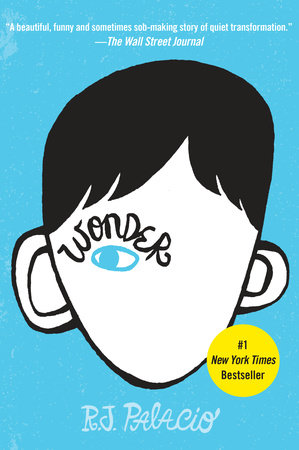
Wonder by R. J. Palacio: Required Reading for All

Wonder Book Cover

I woke up this morning thinking about Auggie. I missed him.

His extraordinary face with the unevenly positioned eyes, one half-shut all the time, the cleft lip and misshapen ears, abnormal features (I’ve learned not to use the word ‘deformed’ now) indelibly imprinted would elicit fear from those who see him the first time, especially unexpectedly. The shock may send out an uncontrolled gasp or even a scream. And if one is  maliciously driven, tiny-framed Auggie is a ready and easy target for bullying, especially in the setting he’s in now, middle school, the breeding ground for raw emotions and unchecked cruelty in both words and deeds. The ten year old has had twenty-seven surgeries big and small so far in his life. Homeschooled until now, Auggie is stepping out into 5th grade with unimaginable trepidation, mustering a courage no less than that required for all the surgeries he’d faced in his life.

Auggie, or, August Pullman, is a fictional character from R. J. Palacio’s book for 9-12 year olds, but he’s as real as my neighbor’s son, or even, my own. That’s the power of Palacio’s nuanced and realistic writing. This is a book for all ages, a required reading for every human being if I have my way, for Palacio has painted a perfect world.

In a perfect world, there are still babies born with facial abnormality. But that little life is still wrapped with warmth and cuddled with love and acceptance.

In a perfect world, that child will grow up not thinking himself ‘different’ or deficient, but as normal as any other kid his age. He can still enjoy reading his comics, be read to and tugged in at bedtime, master video games, watch Star War movies, play with his light saber, hug his doggie, and all those he loves: mom, dad and older sis. The child knows no deficiency.

In a perfect world, even after that child steps out of his well protected, comfort zone and ventures precariously into the reality of middle school, he can still find friends, however few at the beginning.

In a perfect world, there are still bullies and jerks. The child will still have to face incredulous challenges and learn to ignore horrible remarks more distorted than his facial features. In a perfect world, even in this seemingly cruel microcosm of the human society, this child can still find love, support, acceptance, and life-sustaining kindness.

In a perfect world, that child is considered a gift and a blessing, a challenge for us to be better human beings.

In a perfect world, good will overcome evil.

Seldom does a children’s book has such power over me. Actually, seldom do I read a children’s book, haven’t for a long, long while. But glad I’ve discovered Wonder. Auggie will live in my mind for a while even now that I’ve finished the book. I wish author R. J. Palacio’s Choose Kind anti-bullying movement will continue to flourish.

A book like this deserves a good movie adaptation. A recent announcement has given me hope that a worthy one might be on the drawing board. Well, just with the two being cast so far. Jacob Tremblay, the wonder boy who plays Jack in the acclaimed movie adaptation of Emma Donoghue’s Room is to play Auggie. His mom? Julia Roberts. As a mother of 10 and 8 year-olds, Roberts would have some insights to instill into her role.


***

McFarland, USA (2015): A Worthy Winner

The reason I waited till now to see McFarland, USA is plainly because I thought it would be just another cliché movie on teacher inspiring students, and specifically here, a white teacher coming into a hispanic community, changing their youngsters to what they’re not, the white knight of condescension.

I’m glad that’s all a misconstrued perception. True, there’s a white teacher coming into the poorest town in the USA, McFarland, CA, where most of its population is hispanic, Mexican immigrants labouring in the open fields from morn till dusk picking produce. The hope of the parents’ – if there is any – is for their sons to continue picking produce so they can earn a living for themselves.

What’s best about this movie is that it’s a true story. The script is well-written and the production helmed by a competent director Niki Caro (North Country, 2005; Whale Rider, 2002). While its elements seem like the ingredients of a formulaic teacher changing students feel-good movie, it is surprisingly moving and exceeds my expectation.

Sure, the coach can’t be more white… a Mr. Jim White (Kevin Costner) from Idaho. You can’t find a whiter name. The school is McFarland High School, with low morales and expectations, students from blue-collar Mexican immigrant families. We see Mr. White come to McFarland after some unsuccessful employment at another school. Bringing his wife Cheryl (Maria Bello) and two daughters Julie (Morgan Saylor) and Jamie (Elsie Fisher) with him, White soon finds they are a misfit and maybe even unsafe in the town. Yet, he has no choice; this is his only job offer.

McFarland 1

Hired as a biology and gym teacher, White one day discovers some of his boys are fast long-distance runners. There are the Diaz boys, David (Rafael Martinez), Damacio (Michael Auguero), and Danny (Ramiro Rodriguez, well, maybe not all of them fast) who are waken up by their mother every morning before dawn to go work in the fields before they head to school. Their only way to get to school on time from the field is by running fast. And then there’s Carlos Valles (Carlos Pratts), whose athletic talent is marred by family and personal conflicts.

White sees the potentials in these boys. With no experience whatsoever, he asks for permission to set up a seven-member cross country running team and train the boys for competition. Being the newest team, they have to compete against well-trained and formidable upper-middle-class schools from areas such as Palo Alto. Physical endurance comes much easier than when the McFarland boys have to deal with low self-image and discouragement.

Kevin Costner is the key to the success of the movie. I can’t think of any other actor who is more suitable for the role. Costner is a natural, even without the chance of him pitching a baseball, even having him ride a girl’s Barbie bike (White’s daughter’s apparently) to keep up with the boys in their practice, as he’s just a bit over-the-hill to run with them. A charmer and very convincing here, Costner shows genuine concern for the welfare of his students, even going to the fields to pick produce with them to make up for the time when he takes them out for practice. He soon wins the hearts of the parents and their community.

The movie captures my attention from the very start, any resistance is soon melted by Costner’s performance, and the natural appearance of the students and their families. Most of them are first time actors, and some are residents of McFarland. One soon finds that it’s not a white knight rescuing the underprivileged, but life-changing for them all. The movie sheds no traces of racism or condescension, but paints a realistic picture of family, community and the humanity that binds.

If you want to avoid spoilers here we have the historical facts in the following:

The triumph comes in the final act of the movie when the McFarland Cross Country Team The Cougars won the California States championship in 1987, and subsequently, a total of nine wins over the next fourteen years. And to his credit, White turned down an offer from a Palo Alto high school to stay where he was, at McFarland.

What is most moving is the final text shown on screen telling how the boys had turned out in real life. All of them have no family member who had gone past a grade 9 education, but all seven of them in the cross country team graduated from college. Some of them had gone back to teach at McFarland High School, one became a police detective, one a writer for the L.A. Times. We see their faces as adults, the fruits of everyone’s labour at McFarland.

The triumph of the movie is in its authenticity and uplifting ending. Uplifting because it’s a true story. Of course, the filmmakers have to tweak and add in dramatic elements to turn it into a watchable movie, but the basic facts remain intact. I can’t remember being so moved by a Disney movie. Kudos to the McFarland community for the inspiration.

~ ~ ~ Ripples

***

CLICK HERE to watch a featured video of the movie.

Here’s a “History vs. Hollywood” comparison.

Paddington: The Marmalade to Spread on Your Day

What can a little bear from ‘Darkest Peru’ do to ease one’s tension, uplift a depressed mood, or simply elicit laughs out loud? Plenty. Paddington can do plenty of good for all of the above. I’d chosen the right film to come out of a stressful month.

Clever, fast-paced, passionate, and very funny, Paddington the movie is 95 minutes of pure delight. Although Michael Bond’s stories first came out in 1958, director and screenwriter Paul King has brought out some relevant, contemporary issues in his adaptation such as migrating to a new land, finding a home, striving to belong, accepting diversity, and basically the universal search for ways we can all live together despite differences.

Paddington

The movie begins with a black-and-white old news reel. I like that already. An English explorer, Montgomery Clyde (Time Downie), heads over to ‘Darkest Peru’ and discovers a talking bear family. As he leaves, he urges them to visit London. After an earthquake that killed his Uncle Pastuzo (Michael Gambon, voice), the little bear (charmingly voiced by Ben Whishaw) is sent out by Aunt Lucy (voice of Imelda Staunton) to head for a new life in this believed-to-be-friendly London. To send him off, Aunt Lucy hangs a little sign with a string around his neck that says: “Please look after this bear. Thank you.”

And so the little stowaway with a suitcase full of marmalade hides on board a cargo ship and is transported to a foreign land where the Brown family finds him at Paddington Station. Thus his new name.

Despite the chaos that ensues in the Brown household, and the initial reluctance of Mr. Brown (Hugh Bonneville, who is like a Papa bear himself), and daughter Judy (Madeleine Harris, “So embarrassing!”), Paddington’s inept charm readily wins the heart of the enthusiastic Mrs. Brown (the always enthusiastic Sally Hawkins) and very friendly young son Jonathan (Samuel Joslin). Later, Paddington finally gains even the public’s favour with his serendipitous heroism on the streets of London.

Here is no place to argue against stock characters. Of course we need a villain; we have the parallel of Cruella De Vil of 101 Dalmatians in the form of Millicent, played by Nicole Kidman. I’m sure she enjoys doing that too. Driving a van that says Taxi when the sliding door is opened, she soon reveals herself a taxidermist when the door is closed. Good to see stars letting loose in non-typecast roles. Julie Walters and Jim Broadbent also present for you to discover. And if you know what the Paddington Bear author Michael Bond looks like, you can find him in cameo too.

Very well integrated are the effects of real-life, human actors interfacing with the animated bear and other cartoonish scenarios. Do we need to know how the technical genius behind the screen worked, how they used around 600 shots with bears, which required 350 people across two countries working on the visual effects for three years… to enjoy the film? Definitely not, maybe best we don’t go into the complexities of CGI’s, simulations, and yes, how to deal with fur. The final results are all what the technical team had striven for, delivering what they would like us to see. I can fully appreciate the effects. Kudos to them all.

It is definitely a snub Paddington doesn’t get an Oscar nomination, in any category. While in the land of its origin (England, not Peru), Paddington is nominated for two 2015 BAFTA Awards (The ‘British Oscars’): Best Adapted Screenplay and Best British Film. So I do hope the box office here can redeem the slight on this side of the Atlantic. Go see how the little bear and his new-found family can dispel your winter blues. Noms or no noms, this is a winner in my book.

As for that sign Aunt Lucy hangs around Paddington’s neck, we may need to heed it even more in this conflict-ridden world of ours:

“Please look after this bear. Thank you.”

~ ~ ~ 1/2 Ripples

***

Click on the link to the fascinating article in The Telegraph, Paddington: The technology behind the small bear from Darkest Peru.


Like Father, Like Son (2013): Parent and Child Reunion

I had wanted to see this Japanese film since it came out last year. Missed it at TIFF13 last September, its North American premiere after winning the Cannes Film Festival’s Jury Prize in May. Glad it has finally arrived on Netflix, reaching a much wider audience than just festival goers, deservedly.

Like Father Like Son

Director Hirokazu Kore-eda wrote the screenplay based on a disturbing premise: what if after six years of raising your son, the hospital where he was born contacted you and told you that your child was switched at birth, and of course, they sent their apology.

The hospital officials do not take this lightly. DNA tests are done to confirm. They have a lawyer with them, arrange to have you meet the other parents, mediate and ease the proposed switch back, which they recommend with a six-month preparation period, preferably before the boys start grade one in school. They even find out who the nurse is that made the error; due to her own frustrations at the time she knowingly made the switch. Of course, she is deeply sorry for what she had done and duly prosecuted. Monetary compensations are arranged.

But all the above have absolutely nothing to do with easing the shock and alleviating the trauma afflicted upon the families. Formality and legality do not soothe the pain; apologies and money cannot compensate for the abrupt termination of relationships.

Director Kore-eda has treated the subject matter with much tenderness and charm. The cinematography is stylish, the children and adults are all captured in a realistic manner with splashes of endearing humour.

The two families come from very different social strata, and the two boys have been raised in opposite parenting styles. Interestingly, only one of the families seems to take this news much harder. Ryota Nonomiya (Masaharu Fukuyama) is a successful professional who spends most of his time in the glass towers of Tokyo busy at work. His son Keita (Keita Nonomiya), an only child, is raised in a protective environment. Mother Midori (Machiko Ono) is loving but also ambivalent about a husband who puts his career over his family.

The other family is a shop owner in a rural part of the country, their son Ryusei (Shôgen Hwang) is the eldest of three children. Father Yudai Saiki (Rirî Furankî) is every child’s dream. He spends his days playing with his children, fixes their toys, and exerts no rules, albeit Mom Yukari (Yoko Maki) might wish he could have spent more time working.

What makes a father? What makes a son? Fatherhood and bloodline tend to supersede all other factors in a patriarchal society like Japan. But the film reflects the point of view that not all families necessarily embrace such a value. Further, apparently there are different parenting styles even in a homogeneous Japanese society.

If there is ever a Japanese version of the movie Boyhood as we have seen here from Richard Linklater, Hirokazu Kore-eda would be the ideal person to direct it. Like Father Like Son follows his previous work I Wish (2011) in its sensitive and incisive depiction of a boy’s heart and yearning. He can tear apart the facade of societal formality–but in a most tender way–and lay bare the hopes and needs, the essence of parents child relationships.

I must give credits to Johann Sebastian Bach, and the late Canadian pianist Glenn Gould. The beginning of Bach’s Goldberg Variations has been used in numerous films, but every time the soulful slow moving piano melody comes out, I am moved, no matter how many times I’ve heard it, and in so many different genres of films. Just from memory, I can think of The English Patient (1996), Hannibal (2001), Shame (2011). It is so effective in augmenting cinematic moments without becoming clichéd.

Here, the Aria is well placed as director Kore-eda uses it as a motif to spur us into deeper thoughts. What makes a father, a son? What is more important, blood or relationships? What is the role of a wife and mother in a patriarchal society? What is the purpose of giving birth and bringing up a child? What is fulfilling and meaningful to us as human beings? Indeed, a motif that can strike a universal chord of resonance that transcends cultures.

~ ~ ~ 1/2 Ripples

Saturday Snapshot May 10: The Owl Family… Moonrise Haven

Here they are, all come out to enjoy the evening sun. In just a few weeks, the Owlets have grown so much they are about the size of their parents. How I tell them apart is by their still fluffy down. Here’s Owlie 1:


Owlet 1


He likes to try out his new wings:

Trying out new wings


Oops, caught in the branches. Flapping and struggling to get untangled:

Caught in the branches


And Mama’s reaction to all the fluttering? Totally unruffled. She’s too busy posing for me:

Mom stays put


Here’s the more quiet Owlie 2:

Owlet 2


And where’s Papa? As always, watching from a distance on another tree, calm and cool. Here he is, hooting away. That’s the first time I actually hear an Owl hoot, rhythmic calls, music for Mama and kids, and me:

Papa


Papa Hooting

Who teaches their young to fly and land safely? Don’t look at Mama or Papa, they don’t lift a finger:

Learning to fly and land


Who teaches them to play nice, and hug each other? That too, is instinct.

Who taught them to hug and play nice


Ok, for Mothers Day, let’s have a photo. I’ll entitle this one “Moonrise Haven”, with thanks to Wes Anderson:

Moonrise Haven

Ah… Natural parenting, so simple, almost effortless.

***

Saturday Snapshot is hosted by Melinda of West Metro Mommy Reads. CLICK HERE to see what others have posted.

ALL PHOTOS TAKEN BY ARTI OF RIPPLE EFFECTS, 2014. 

DO NOT COPY OR REBLOG

***

Previous Posts on the Owl Family (In Chronological Order):

The Great Horned Owl (March 2013)

Sign of Spring: Nesting (April 2013)

Spring Babies and Parenting Styles (May 2013)

The Hustle and Bustle of Spring (April 2014)

Within the Budding Grove (April 2014)

***

Saturday Snapshot April 12: The Hustle and Bustle of Spring

After a long and silent winter, I’m pleasantly surprised by the sounds and activities of spring in the woods. Here I’m just showing you the photos, so you can’t actually hear any sound. But from the images, you can imagine the cacophony there.

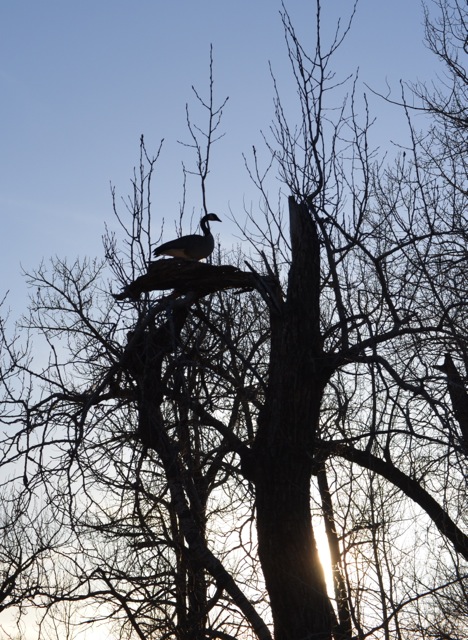
The sky is busy, and the woods, actually noisy. Birds beating one another to nesting sites, usually in old tree trunks. All of them are vigilant guarding their own. Avian and human traffic collide. And it looks like the biggest in size makes the loudest calls. No, not me. Canada Geese own the woods.

They’re ubiquitous, their calls dominating the air. And of course, they have the right of way. I nearly got hit by this one:


Right of way

Another standing tall, scouting for nesting site, or maybe guarding one:

Canada Goose scouting for a nesting site


They are all vigilant when it comes to protecting their nests:

Vigilant

I know how much it means to them… Here, a couple gazing out into the late afternoon sun from their front porch:


Canada Geese nesting 1

More are still flapping their wings to better trunks, or maybe just enjoying an evening dip in the setting sun:

Canada Geese flying in woods

In the meantime, there are others making lesser but more melodious calls, like the Robins, happy that winter’s finally over:

The Robinsor the Northern Flicker, charging with renewed energy:

Northern Flicker

Some quietly sharing:

Woodpeckers & Chickadee

or enjoying the (relatively) warm(er) breeze like this Nuthatch:Nuthatch

The European Starling is not just another black bird. A closer look you’ll see the shiny plumage, and their calls are much more pleasing than those of the Geese:

ES Not just a black bird


But the major attraction in the woods is, again, the Owl Family. I’m amazed how they would come back to the same trunk for nesting, and that Papa Owl always stands on guard from a distance, his sharp eyes watching over his own.

Papa Owl watching from afar


I’m mesmerized by his calmness and cool attention. If he needs to, Papa can fight off a Canada Goose with his talons. But he knows when to use force, and when to just placidly stand guard.

This is the old tree trunk he is watching quietly from afar:

Old tree trunk

A closer look you’ll see Mama Owl nesting in there. I’m told by fellow birders that two Owlets have been seen poking their downy heads out partially. But after a long while waiting, craning my neck up, I can only see Mama:

Mama Owl nursing young babes

I’ll have a better chance of taking a family photo once the Owlets fledge.

Canada Geese begin to converge near the Owl’s nest, trying to draw our attention with their jealous squawks.

As the evening sun sinks below the horizon, I can see this Goose making its nest not far from the Owl Family. And I know too, Papa will be keeping watch throughout the night, feeding and protecting his very own.

Canada Goose silhouettes against the setting sun


Saturday Snapshot is hosted by Melinda of West Metro Mommy Reads. CLICK HERE to see what others have posted.

***

ALL PHOTOS TAKEN BY ARTI OF RIPPLE EFFECTS, APRIL 2014.
DO NOT COPY OR REBLOG


The Dinner by Herman Koch: A Timely Read, for Lent?

Why is this book compared to Gone Girl? It’s nothing like it. The Dinner belongs to a totally different calibre. If I have to compare it to something, then I’d say, reading it conjures up Dostoevsky’s Crime and Punishment. Are there really some in our society who think themselves so superior that they ought to be above the law? The law, after all, is a human construct. Can we not bend it to serve our own interest, when the interest is out of love for our son, or wife, or husband?

The Dinner

The Dinner is Dutch writer Herman Koch’s sixth novel. It has sold over a million copies and translated into twenty-one languages. The book deals with subjects that are soul-searching: The dichotomy between nature and nurture; how much of our being and psyche is hereditary? What portions of our actions are a result of our own waywardness as lost souls? As I was reading, the movie “We Need to Talk About Kevin” (2011) came to mind. However, what is not present at least in the Kevin movie is the accessory after the fact component.

The Dinner starts off with quite an original concept. The author parallels the story development with a gourmet dinner two couples are having in an upscale restaurant. The Apéritif and the Appetizer are the foretaste of what we will get for the Main Course. What appears to be petty, disgruntled complaints and personal biases of the narrator’s in the early chapters turn out to be only a light appetizer, for the main course is when a horrific crime is revealed. The ‘horror’, though, isn’t limited to the crime per se, for it is chilling to read how everyone involved deals with the aftermath.

The main course is a gripping thriller based on a real-life crime. After reading the novel, I googled and did find the report on it. Koch tells the story effectively with his straight-forward descriptions written with journalistic detachment, and incisive observation as the notes of a perceptive psychoanalyst. Further, he informs us with the detailed thought process of his narrator. Here is a disturbing look at someone who is capable to love his wife and son deeply but hates everyone else that crosses his path. This is more than a thriller though, for the moral dilemma or rather, its characters’ lack of sensitivity to it, is what makes the book provocative.

I don’t think we are expected to ‘like’ or even ‘identify’ with any of the characters. The book is effective in that we are left as observers. And with that, hopefully, we just might think a little deeper into issues concerning our humanity, and in the next generation of humans we bring up. How much are our children a result of our parenting and examples, how much are they a result of their own choosing and decisions? Can nature or nurture excuse us from our errors? If Freud were around today, The Dinner just might be on his reading list. But, would he be able to offer a remedy to save us from ourselves?

The ending shares a similar thought with the Woody Allen movie Crimes and Misdemeanours (1989). Now, as soon as I said this, some of you familiar with the movie might think I’ve dropped a spoiler in here. So, that’s the farthest I’ll go in describing the plot and details of The Dinner. The aftertaste may be haunting, but it is something that we should face as a human society.

Today is the beginning of Lent. I always feel such is an opportune time not so much about refraining from pleasure like abstaining from going to fancy restaurants for gourmet dinners, but in dwelling on the meaning of Easter. The Dinner may just have, inadvertently, reinforced the notion that we as individuals in a human society do need some form of saving grace after all.

~ ~ ~ ~ Ripples

The Dinner by Herman Koch, translated by Sam Garrett, published by Hogarth, 2012, 320 pages.

Nebraska (2013): Color is Superfluous

When a director decides to shoot his film in black-and-white, he must have certain confidence in the story, characters and aesthetics that he feels color may just be a distraction or even superfluous. Alexander Payne’s Nebraska is exactly that.

I have thoroughly enjoyed this slow-paced, thoughtful, aesthetically gratifying, and deadpan funny movie. To take a break from the cacophony of festivities, the hustle and bustle of Christmas shopping, dinner planning and party hopping, Nebraska is a surprisingly fitting film to watch.

By no means is this a ‘holiday movie’, but if the season is about family, giving, and love, this is an apt offering on the big screen. There are strong thematic undercurrents that carry the quiet story from beginning to end. And I was gratified to see, once again, that visuals speak louder than words when it comes to the cinematic medium.

Nebraska - Woody & David

Woody Grant (Bruce Dern) is an old man of few words. Maybe the onset of dementia has driven him even more delusional and isolated, and alcohol doesn’t help either. Dern’s performance is spot on and totally engaging. From a marketing promo in the mail, Woody is convinced that he has won a magazine sweepstakes of one million dollars. He needs to get to Lincoln, Nebraska, to claim his prize. We see him at the beginning of the movie heading to Nebraska from Billings, Montana, on foot. He is too old to drive but not to walk.

Woody’s brash and critical wife Kate (June Squibb) calls their estranged sons David (Will Forte) and Ross (Bob Odenkirk) for help but all fail to dissuade him. Soften by the old man’s total absorption, and too kind to douse his dream, David takes a few days off work to drive his father to Nebraska. Thus begins an unlikely bonding road trip for father and son.

To quench his delusion, Kate and Ross will converge in Hawthorn, Nebraska, a town where Woody was born and spent most of his energetic years. There in Hawthorn, a fictitious town for the movie, they will meet up with Woody’s older brother Ray’s family for an impromptu reunion, hopefully to get Woody’s mind off Lincoln and the prize, and then they will return home to Montana after.

Hawthorn is the home of a younger Woody, a past that he rarely mentions, a place where his son David will come to discover a father he had never known. At Ray’s home, David meets his not-so-friendly cousins Randy (Kevin Kunkel) and Cole (Devin Ratray, remember the bad burglar from the first two Home Alone movies?) While the town folks are all congratulatory on his million-dollar win, Woody’s old auto business partner Ed Pegram (Stacy Keach) suddenly reminds him of outstanding debts.

A character whom I find the most endearing is Woody’s girl friend of his youthful past, the long time editor of the town’s newspaper Peg Nagy (Angela McEwan). She wants to run an interview with Woody about his alleged win. David meets up with her at the newspaper to clear up the misunderstanding. There we see a gentle and kind old lady who seems to have much admiration for his father, knowing him in the past as a sturdy, young man. Though now a widow, Peg is a happy and fulfilled grandmother. This is probably the most poignant scene of the movie. Through David’s learning of his Dad as a promising young man and this quiet, pleasant lady Peg, the haunting thought seeps into our mind: ‘What if things turned out differently?’ The black-and-white medium could well be the message itself. We are reminded of a past which we cannot relive. At the same time, we are provoked to think of the alternative scenarios of what could have been.

Director Payne had won two Oscars both for Best Adapted Screenplay for his previous acclaimed movies Sideways (2004) and The Descendants (2011). Nebraska is a totally different work, and one which I like the most among the three. A common thread that runs through all of them is the prominence of specific locales, the California wine country in Sideways, Hawaiian islands in The Descendants, and here the scenery flanking the long stretch of highways from Montana to Nebraska. In stirring and soulful black-and-white, the passing wide landscape of rolling hills and boundless prairies convey the existential passage of time, lost youth, and whatever memories that one accumulates or tries to forget, all immaterial as old age takes over, a soulful touch from the director of the new retiree played by Jack Nicholson in About Schmidt (2002).

But this is a comedy, and there are lots that I have responded with spontaneous chuckles and laughs. The humor is totally enjoyable, and so is the overall atmosphere. We see a change in the mood as the son begins to appreciate more about his father. The ending is affective and gratifying. A check on IMDb leads me to the tidbit that director Payne was born in Omaha, Nebraska. Ah… the river runs deep.

If I have a say, Nebraska would appear in the upcoming Oscar nominations for Best Picture, Best Director, Best Actor (Bruce Dern), Best Cinematography (Phedon Papamichael), and Best Screenplay (Bob Nelson). However, considering the black and white styling, and the quiet, low-tech and slow-paced storytelling, it just may not attract those who are spectacle-driven. But that would be their loss.

~ ~ ~ ~ Ripples

***

Other Awards Season Reviews on Ripple Effects:

12 Years A Slave: Beauty and Sadness

All Is Lost

Lee Daniel’s The Butler: The Trouble with Famous Faces

The Book Thief: From Book To Film

***