The Great Gatsby: A New Version

UPDATE: To read my review of The Great Gatsby (2013), CLICK HERE.

**

Well… not yet.  But seldom has a movie generated so much buzz even before it is made. The debates take on several fronts.

First off, there’s this argument of whether we need another Gatsby adaptation. There have been three full feature film versions of the classic novel by F. Scott Fitzgerald, as early as 1926, then in 1949. The most familiar for us modern day viewers is the 1974, Francis Ford Coppola screenplay, Robert Redford and Mia Farrow version. So more than thirty years now.  It would be interesting to see what a 21st century interpretation is like.

Then there’s the cast.  It’s been reported that Leonardo DiCaprio is the new Jay Gatsby, Tobey Maguire the narrator Nick Carraway, and stirring the frenzy, director Baz Luhrmann’s announcement of Carey Mulligan as Daisy Buchanan.

I’m totally delighted with the cast selection.  While he may not be very convincing as an aging Howard Hughes (The Aviator, 2004), DiCaprio could make a very natural Jay Gatsby. Tobey Maguire’s quiet, observant demeanor, like his role in Cider House Rules (1999), would be a suitable Nick Carraway, although he might not have the poise as Sam Waterston back in 1974.

I’m all for Carey Mulligan, but still I feel she would have to fight against type to play Daisy Buchanan. Far from the innocent school girl in An Education, or the caring and sensitive Kathy in Never Let Me Go, it could be a challenge to portray a frivolous and capricious Daisy.  But if she could beat out names such as Natalie Portman, Abbie Cornish, Michelle Williams, Blake Lively, Scarlett Johansson, Amanda Seyfried, Rebecca Hall and Kiera Knightly in her audition to get the part, I trust she has what it takes to deliver. I’m excited to see her given a chance to extend further her acting talents.

That leaves us with the debate of whether the new interpreter could do Fitzgerald’s novel justice.  Director Baz Luhrmann’s previous works seem to embody a Gatsby house party: Moulin Rouge (2001), Strictly Ballroom (1992), Australia (2008), and his very postmodern take of Romeo + Juliet (1996), which, I admit, is one of the few movies that I had to quit watching after the first 15 minutes.

The online arguments against Luhrmann’s directing surround his over-the-top and superficial renditions of his previous movies.  His ability to translate the layered and nuanced descriptions of this literary classic into film is challenged outright.

That leads us to a more fundamental issue.  In my review of the film The Hedgehog (2009), one reader has left this thought-provoking question in the comment:

Is it possible that, no matter how well or poorly the job is done, there are some books that simply don’t make the transition from print to film with their essence intact?

As the postmodernists would have it, books and films are two different textual entities.  Fidelity is no longer something to strive for, but the appreciation of intertexuality.  Both ought to be taken in its own right, can’t be literally tranlated, can’t be compared.  And if Barthes has the final say, you just have to take it as is with whatever Luhrmann brings us since that’s his interpretation.  The author is dead… here literally and metaphorically.

***

No matter what, I won’t judge before it’s even being made. Nonetheless, I do have a few words to appeal to Mr. Luhrmann:

Please don’t waste a talented cast, and a brilliant literary work. Offer us quality and depth of interpretations and not just the frothy splendour of the Jazz Age.  Consider lines like these and create the complexity and ambivalence in your characters:

I wanted to get out and walk eastward toward the park through the soft twilight, but each time I tried to go I became entangled in some wild, strident argument which pulled me back, as if with ropes, into my chair.  Yet high over the city our line of yellow windows must have contributed their share of human secrecy to the casual watcher in the darkening streets, and I was him too, looking up and wondering.  I was within and without, simultaneously enchanted and repelled by the inexhaustible variety of life.

While there’s no doubt you are capable of capturing the “gleaming, dazzling parties,” reveal also the undercurrents of anxiety, sadness, and ennui.  And in the midst of the seeming conviviality, give us the nuanced actions of inner quest, the search for real relationship in a mansion of party crashers, and the lingering hope of love:

A wafer of a moon was shining over Gatsby’s house, making the night fine as before, and surviving the laughter and the sound of his still glowing garden.  A sudden emptiness seemed to flow now from the windows and the great doors, endowing with complete isolation the figure of the host, who stood on the porch, his hand up in a formal gesture of farewell.

And above all, do justice to Jay Gatsby, honor his deep devotion for his love and not mock his attempt.  For behind the façade of materials and wealth, he is the one with the heart.  Show us how “the vague contour of Jay Gatsby had filled out to the substantiality of a man.”

Remember, it is the heart that gratifies your viewers, not the glitz and glamour.

And please, not a musical.

***

The Hedgehog: Movie Review (Le Hérisson, 2009, DVD)

To read my book review of The Elegance of the Hedgehog, CLICK HERE.

I’m sure it must be a major challenge to turn Muriel Barbery’s The Elegance of the Hedgehog into a movie.  I admire director/screenwriter Mona Achache’s courage.  She has taken up a tall order to make her full feature directorial debut.  How do you deal with all the ubiquitous internal dialogues, philosophical ruminations, literary allusions, and turn the story that takes place inside a Paris apartment into a full length film, holding viewers’ attention for 100 minutes?  Overall, Achache has done well on a formidable task… including building the set, the whole luxury apartment façade from scratch, from the workable old-style elevator to the cast iron gate in the front entrance.

But, maybe that’s the easy part.

.

.

In the film, we look at things from 11 years-old Paloma’s point of view, for she is constantly video-taping the people and the happenings both in her own suite and those in her apartment building.  She intends to produce some sort of a visual philosophical treatise, her legacy, as she plans to take her own life on her 12th birthday.  This is a clever alteration, shooting video instead of writing a journal, for the visual effects.   We see a very intelligent girl (Garance le Guillermic), having concluded that life is utterly absurd, decides not to spend her life in a fishbowl as everyone else. With her artistic talents, Paloma has used her drawings as a kind of personal record-keeping; from her point of view, some delightful animations are added to enhance the appeal of the film. Paloma is an interesting and amiable character that ironically brightens up the film with some humorous deadpan takes.

The movie is an abridged and simplified version of the book, that is expected.  But while it has some stylish manoeuvring in presenting the story, I’m disappointed that the crux of the premise has not been focused upon. My major concern then, must turn to the other character.  The main speaker of the book is Madame Michel, Renée, the 54 year-old autodidact, the concierge of the luxury apartment.  Yes, we see her outward appearance following exactly what the book has described:

I am a widow, I am short, ugly, and plump… I live alone with my cat, a big, lazy tom… neither he nor I make any effort to take part in the social doings of our respective species.  Because I am rarely friendly–though always polite–I am not liked, but am tolerated nonetheless…

Well, maybe not the ‘ugly’ part.  But yes, we see the Hedgehog alright, but what about its elegance?

Josiane Balasko has put on a meticulous performance as Madame Michel, a bit too much even, for her grumpy persona has hidden all humor the character could have diffused, as the book has rendered.  But other than the faithful characterization on the surface, it is more important that the inner world, the clandestine and ignored persona of Renée be depicted.  What makes the book so appealing is Renée’s inner quest, not only for intellectual ideals (yes we see her reading and her secret library in the film), but her appreciation of art as a form of transcendence, her search for beauty in the mundane, her ability to seize the moment of permanence in the temporal, as Barbery has written: “pure beauty at the heart of ephemeral passion”.  It is such wisdom that Paloma finally realizes, and which changes her mind about suicide.  This crucial theme is not shown in the movie, and I count that as a major deficit, despite the conscientious effort in following the outward details of the book.

Director Achache, who has also written the screenplay, chooses to replace these gratifying thoughts with the cliché statement of  “It’s what you’re doing the moment you die that’s important.”  Well, ok… maybe she’d like to write a book with that premise, but I’m afraid it might not be the essence of the source material here.

Yes, we still have the new tenant Kakuro Ozu (Togo Igawa), who has wisely looked past the ordinary façade of a socially lower-ranked concierge, and chooses to embark on a romantic journey with his new-found friend.  And yes, we have the chance to see his newly renovated Japanese suite, even his Mozart-playing toilet, as well as an excerpt from the Japanese director Ozu‘s The Munekata Sisters. Achache has followed the particulars faithfully. I wish she had had explored the essence, transporting her viewers from the mundane to a transcendent plane, albeit just momentarily.

I must add though, the music has come through most effectively.  Thanks to Gabriel Yared, whatever that is missing has been displayed musically by the meditative tunes and the longing voice of the cello.  The Oscar winning composer has created such memorable scores for The English Patient (1996), which won him an Oscar, and nominations for Cold Mountain (2003), and The Talented Mr. Rippley (1999).  Here in The Hedgehog, his musical rendering is beauty itself.

The DVD is in French with English subtitles.  Special features include the making of and deleted scenes. Unfortunately, they are all in French with no subtitles.  While watching the luxury apartment building being set up from scratch is interesting,  without subtitles, the comments from the director and actors in the making of featurette cannot be appreciated as they should be.

~ ~ 1/2 Ripples

Revolutionary Road: Book and Movie

There’s a story that goes like this.  The Times once asked its readers to send in their answer to this question: “What is wrong with the world?”  The writer, scholar, and theologian G. K. Chesterton sent them this reply:

Dear Editors,

I am.

Sincerely,

G. K. Chesterton

**

Here’s a lighter version from Groucho Marx:

“I don’t want to belong to any club that would accept me as a member.”


**


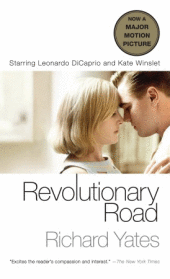
Revolutionary Road by Richard Yates (1961)

If only the Wheelers had had a conversation with Groucho Marx, maybe invited him to tea in their little white suburban house on Revolutionary Road, probably they could have avoided a tragedy.

In her mind, April Wheeler has dreamed of a club like this:

“I still had this idea that there was a whole world of marvelous golden people somewhere… people who knew everything instinctively, who made their lives work out the way they wanted without even trying, who never had to make the best of a bad job becasue it never occurred to them to do anything less than perfectly the first time.  Sort of heroic super-people, all of them beautiful and witty and calm and kind, and I always imagined that when I did find them I’d suddenly know that I belonged among them, that I was one of them, that I’d been meant to be one of them all along…”

The problem with the self.  What had taken G. K. Chesterton two words to identify, Richard Yates has shown with 463 pages (my pocket paperback).  No, I’m not complaining.  What has driven me to go on and finish the book, despite the ominous cloud hanging over its pages, is Yate’s marvellous prose leading me every step of the way, through every fight of the Wheelers’, every sardonic description of Frank’s New York office, their suburban social circle, and their self-delusion.  And even amidst the dark and grey overtone, the undercurrents of humor could sometimes make me laugh out loud (Having read the book, I’ll have to ask myself: am I being a snob for not using the acronym?)

Humor and irony are only ways of delivery, the message is still poignant.  I’ve enjoyed every visit John Givings goes to the Wheelers’ home during his half-day out of the insane asylum.  John’s mother Helen, the realtor who sells the Wheelers their house, only means good, bringing her son to meet some normal people to help improve his condition.  Yates is superb there in these scenes. As expected, the fool often comes out as the wise, the insane pointing out the truth. But you still want to go over the lines.

Knowing that Frank doesn’t like his job, John responds:

“Whaddya do it for then?   Okay; I know; it’s none of my business.  This is what old Helen calls Being Tactless, Dear. That’s my trouble, you see; always has been.  Forget I said it. You want to play house, you got to have a job.  You want to play very nice house, very sweet house, then you got to have a job you don’t like. Great… Anybody comes along and says ‘Whaddya do it for?’ you can be pretty sure he’s on a four-hour pass from the State funny-farm; all agreed.  Are we all agreed there, Helen?”

“Oh look, there is a rainbow,” Mrs. Givings said…

But of course the problem is complex.  While we are all free agents of our own actions, we are also products of our circumstances and our past. The setting of the 50’s is a time of suburbanization, post-war peace and affluence. But the story could take place anywhere, anytime. When offered a promotion at work, Frank chooses to stay rather than opting for a loftier dream.  Substitute now for the 50’s, who would notice?

Frank and April Wheelers and their two children are the perfect example of the young and wholesome family enjoying the good life, in appearance that is.  What’s troubling them is legitimate, of course. What’s the point of being a nut screw in the machine of Big Business and a willing hostage of conformity and suburban ennui?  April might be fulfilling a self-serving and snobbish desire to move the whole family to Paris, but she could be right that Frank needs to be given the chance to ‘find himself’.  What she fails to see though is that she’s the one who could benefit from such self-reflection even more.

John Givings has more pointed words for the Wheelers in his next visit, which ultimately leads to the collapse of everything.  Yates’ writing has taken me captive.  The last hundred pages of the book have me glued to the seat.  It was already dark outside, I was sitting on a couch reading, alone in the house.  The feeling I had while going through those last chapters was no different from my experience of watching The Silence of the Lambs some years earlier, also sitting alone one night in the same spot… although there’s no similarity between the content of the two.  Haunting, eerie, disturbing…. now this is with me having watched the movie before reading the book.

Revolutionary Road is my first Yates book.  While I’ve admired his writing, I’m not so sure I’ll seek out his other works…  You see, I’ve always thought The Silence of the Lambs is a first-rate movie, but I would not want to see it again and again.

Revolutionary Road by Richard Yates, First Vintage Contemporaries Mass Market Edition, January 2009, 463 pages.

***

Revolutionary Road: The Movie (2008, DVD)

Leonardo DiCaprio and Kate Winslet reunited since Titanic (1997) to play the Wheelers in Revolutionary Road.  On the outset, they are perfect for the roles: Frank the charmer, April the golden girl.  And to top it off, the movie is directed by Sam Mendes, who has brought us the Oscar Best Picture for 1999, American Beauty, another brilliant suburban commentary.

Supporting roles are well performed by Kathy Bates as the talkative realtor Mrs. Helen Givings.  And Michael Shannon deservedly got an Oscar nom for his portrayal of Mrs. Givings’ son John, the lucid lunatic on a day-pass out from the insane asylum.

But somehow I feel there’s a significant discrepancy in the characterization that has shifted the dynamics between Frank and April.  As a result, the movie offers an altered view.  April here is a victim of circumstance.  She is portrayed as the courageous one who sticks to her goal, even heroic as Mendes says in the Special Features.  No suggestion of smugness or self-delusion, but rather, she is clear as crystal about her situation. Winslet has such cinematic appeal that her April is a much more amiable character than the controlling and self-serving dreamer and schemer I see in the novel.  And here, Frank is the conforming realist, the bully that needs anger management, the one who lacks the guts to embrace change.

While the storyline and scenes are faithful to the source material, the altered characterization of April Wheeler has subtly changed the premise of the novel.  What we have here is simply a love relation gone wrong.  A tragic drama of incompatible expectations, the conflicts between the progressive, idealistic and unfulfilled suburban wife, and the temperamental, gutless husband who has given in too easily to ordinary life.  The complexities which Yates has so marvellously detailed are absent here:  Was there any love to begin with?  Are dreamers necessarily superior than realists?  And, on what do we base our choices and actions?

What initially sparks off the romance between Frank and April and which sustains their façade can be summed up in this sentence from the book, and which, of course, is absent in the film in any nuanced form:

“Sometimes there was a glint of humor in these embraces of the eye:  I’m showing off, they seem to say, but so are you, and I love you.”

All the more reason to read the source material after watching a movie.

DVD Special Features include commentary by director Sam Mendes and screenwriter Justin Haythe, and Lives of Quiet Desperation: The Making of Revolutionary Road.

****


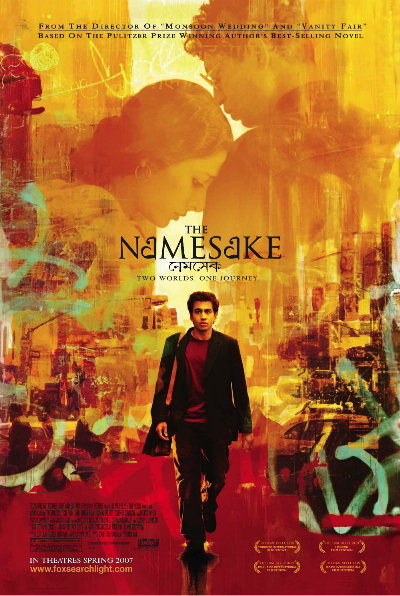
The Namesake (2006, DVD): Movie Review

This is a sequel to my last post, Book Review of The Namesake by Jhumpa Lahiri.  These back-to-back write-ups form my second instalment for the Read the Book, See the Movie Challenge over at Ready When You Are, CB.

“If it weren’t for photography, I wouldn’t be a filmmaker.  Every film I make is fuelled by photographs…. Photographs have always helped me crystallize the visual style of the film I’m about to make.”

—Mira Nair

And photography has brought to life the poignant novel The Namesake.

This is a perfect match.  The Namesake film adaptation is privileged to be crafted in the hands of the accomplished director Mira Nair, and its screenplay written by the multi-talented Sooni Taraporevala.  Both born in India the same year, grew up and educated there, later both had attended Harvard.  After earning her Masters at NYU majoring in Film Theory and Criticism, Taraporevala moved back to India and pursued a successful career in photography and other artistic endeavours. Mira Nair went on to become an acclaimed filmmaker and professor of Film at Columbia University.  Nair and Taraporevala collaborated on several films that have garnered international nominations and awards, including Cannes, Venice, BAFTA, and the Oscars.

The pair could have been characters taken right out of Jhumpa Lahiri’s stories.  They must have known from personal experience the realities of Lahiri’s stories, the feelings of being transplanted, the quest for identity.  As a result, they have effectively brought into visualization the internal worlds of Ashoke, Ashima, Gogol and Moushumi.  It is interesting to hear Nair describe herself as “a person who lives in many worlds”.  Every immigrant is at least a bicultural being.  Our postmodern world has only made it more and more viable to navigate across boundaries and sustain multiple identities.  The Indian meaning of the name Ashima could well have spoken to such a modern day phenomenon: without borders.

From this perspective, Nair is the best person then to take what could have been just another “ethnic movie” to a universal plane.  She has created a colorful rendition of a human story for us to enjoy.  You don’t have to be Bengali to appreciate the Ganguli saga.  Elements such as love, marriage, parent-child relation, expectations, self-fulfilment and its obstacles, the search for one’s place in the family and the world, these are all situations we can relate to.   It’s just now the issues have been explored from a different frame, offering us an alternative perspective.

I have appreciated the quiet development of love between Ashoke and Ashima despite their arranged marriage.  Their intimate husband and wife relationship is sensitively played by Irrfan Khan (Slumdog Millionaire, 2008) and the model and award-winning actress Tabu, an excellent choice in casting.  I particularly admire Tabu’s gentle and elegant poise.  It’s interesting to see how the two exchange deep sentiments by wordless, nuanced expressions and body language.

The treatment of the story in the hands of a visual artist understandably would be quite different from its original literary form.  Instead of the sombre tone, Nair has given the story a lively adornment, sustained by animated characters.  Nair’s Gogol is a more outgoing young man than that from the book, and I’m fine with that.  Kudos to Kal Penn’s portrayal of  Gogol/Nick Ganguli, an interesting performance fusing youthful energy and wistfulness at the same time.

Yes, that’s Kal Penn of the stoner movies Harold and Kumar fame (2004, 2008, and coming 2011) A much more serious role here in The Namesake.  A lively Gogol is only natural and fun to watch, for he is an American born young man who just wants to belong.  So we see him being impatient with his father’s restrained and non-communicable composure, we see him playing air guitar to loud music in his room, we see tender moments when he teases his younger sister Sonia, or the natural comedic look on his face, culture shocked during his family trip back to Calcutta, and we see his romance with Maxine (Jacinda Barrett, New York, I Love You, 2009), the American girl who is so oblivious to the cultural baggage he is carrying.

But Kal Penn has earned his role.  He wrote to Nair earnestly seeking for the part, telling her that The Namesake is his favorite book and often times, he would use the pseudonym Gogol Ganguli to check in hotels.  Some method acting, who’d have known he’s in character all along.

The bonus with watching a DVD is of course the special features.  The Namesake is a keeper if you’re into the creative process of filmmaking.  My favorite featurette is The Anatomy of The Namesake: A Class at Columbia University’s Graduate Film School in which Nair and other crew members engage in conversation with film students about the making of the movie.  Other wonderful featurettes include Photography as Inspiration, and Fox Movie Channel interview In Character with Kal Penn.

Overall, a faithful adaptation of Lahiri’s book, offering an entertaining, visually inspiring rendition of a story deserving to be seen.

~ ~ ~ Ripples

The Namesake by Jhumpa Lahiri: Book Review


CLICK HERE to read my movie review of The Namesake (2006).

The immigrant experience.  I know it first hand, and this I’ve found: categorizing could be futile. From afar, we may look like a collective mass, like the autumn leaves that have fallen on the ground. But if you pick them up and look more closely, every single one is uniquely different.

Jumpha Lahiri’s stories belong to the academics from India.  Her setting is usually Northeast United States.  Her characters, often first generation immigrants striving to plant a career and a life on new soil, raising their children with the promise of a brighter future.  The conflicts are not only generational by often internal. This much is true for all immigrants, academics or otherwise.  But as we zoom in on a more personal level, like the single fallen leaf, we see its unique shades of color, its tarnishes, its withered edges, and we soon find that no two leaves are exactly the same.

In The Namesake, Ashima weds Ashoke Ganguli in an arranged marriage, not even knowing his name when she first met him in the betrothal.  Shortly after the wedding they leave India for Boston where Ashoke continues his graduate studies in engineering at MIT.  The adjustments for Ashima is overwhelming as a new wife in a new country.  But she finds out a year later that her duty as a wife does not pose as much anxiety as giving birth in a land unknown. Motherhood is a much more daunting challenge.

In simple language, Lahiri paints a vivid picture of Ashima’s apprehension:

“But nothing feels normal to Ashima.  For the past eighteen months, ever since she’s arrived in Cambridge, nothing has felt normal at all.  It’s not so much the pain, which she knows, somehow, she will survive.  It’s the consequence:  motherhood in a foreign land… She’d been astonished by her body’s ability to make life, exactly as her mother and grandmother and all her great-grandmothers had done.  That it was happening so far from home, unmonitored and unobserved by those she loved, had made it more miraculous still.  But she is terrified to raise a child in a country where she is related to no one, where she knows so little, where life seems so tentative and spare.”

Ashima soon gives birth to a baby boy, and she has to learn quickly a new role and its responsibilities.  But Lahiri surprises us by turning Ashima’s experience into a metaphor:

“Though no longer pregnant, she continues, at times, to mix Rice Krispies and peanuts and onions in a bowl.  For being a foreigner, Ashima is beginning to realize, is a sort of lifelong pregnancy — a perpetual wait, a constant burden, a continuous feeling out of sorts.  It is an ongoing responsibility, a parenthesis in what had once been ordinary life, only to discover that that previous life has vanished, replaced by something more complicated and demanding.  Like pregnancy, being a foreigner, Ashima believes, is something that elicits the same curiosity from strangers, the same combination of pity and respect.”

Ashoke’s story is more dramatic.  He is now teaching engineering at a university, but he has a lifelong love for literature, for it is deeply set in his past experiences.  His paternal grandfather, a professor of European literature at Calcutter University, read to him since he was a child the books of the classics.  Ashoke grew up taking to heart his grandfather’s advice:

“Read all the Russians, and then reread them,” his grandfather had said.  “They will never fail you.”  When Ashoke’s English was good enough, he began to read the books himself.  It was while walking on some of the world’s noisiest, busiest streets, on Chowringhee and Gariahat Road, that he had read pages of The Brothers Karamazov, and Anna Karenina, and Fathers and Sons… Ashoke’s mother was always convinced that her eldest son would be hit by a bus or a tram, his nose deep into War and Peace.”

I just love Lahiri’s images, fresh and surprising with a touch of subtle humour.  And Ashoke believes this to be so, the saving power of literature in its most literal sense.  As a teenager, he had miraculously survived a horrendous train crash.  Among the wreckage, rescuers found Ashoke clinging to life, his hand clutching a torn page from a collection of short stories by Nikolai Gogol, a book he was reading as the accident occurred.

The thrust of the story in The Namesake rests on this narrative.  It is understandable then that Ashoke commemorates such a miracle by naming his son Gogol.  At first it is meant to be an intimate pet name used only by family members.  It soon turns into a legal name.  So now Gogol is a name with two distinct sentiments: privately, it evokes endearments, but in public it only generates awkwardness.  As he grows older, the name Gogol Ganguli begins to sound more and more strange, it is neither fully Indian nor Russian.  It has become an embarrassment and even a laughingstock as he steps out into the adult world of America.

Upon high school graduation, Gogol chooses to go away to Yale as opposed to the closer campus of MIT, and take up architecture instead of engineering, all against his father’s wishes. Above all, to his parents’ disappointment, he decides to legally change his name to Nikhil. Unlike them, the need to belong has taken priority over the maintenance of cultural roots for Gogol.  A name change is the best way to a new identity and a fresh start, away from home and lineage. Oblivious to him though is the very cause and meaning behind that name, Gogol, a saving miracle that has given his own father a new leash on life.

For Nikhil, life unfolds in unexpected turns.  He soon realizes that a name change does not necessarily usher in a new self.  There are deep sentiments and ties that cannot be severed by mere outward re-labelling.  Nikhil drifts in and out of relationships striving to connect.  The family of his American girlfriends only confirms the drastic cultural differences in contrast to his own.  Intimacy with them burdens him with a sense of betrayal of his own family.  And yet, he longs to establish himself in the country of his birth, a land still considered foreign soil by his parents.

The sudden death of Ashoke has shaken up everyone in the family, and brought the scattered members together again, Ashima, Gogol and his younger sister Sonia.  The crisis presents a turning point for Gogol.  He begins to rediscover his cultural roots and his duty as a son. Hidden memories resurface to nurture a belated father-son relation.

Upon Ashima’s suggestion, Gogol reunites with a childhood friend of the family, Moushumi, now a PhD candidate of French literature at NYU.  A short time later they get married to the delight of both sides of the family.  Sadly, the marriage of two individuals with a common cultural heritage does not necessarily mean a blissful union.  Lahiri sensitively explores the complex issues and the sometimes unresolved conflicts of identity, expectations, and personal fulfillment, not just for Gogol, but Moushumi, and Ashima as well.

Lahiri is a cultural transplant herself, an experience I presume that has offered her the lucid perception and authority in crafting her stories. Born in London to Bangali parents, her family moved to Rhode Island where she grew up.  After graduating from Barnard College, Lahiri went on to Boston University, where she received her masters degrees in English, comparative literature, and creative writing and later her PhD in Renaissance studies.

Lahiri received the Pulitzer Prize in 2000 and later the PEN/Hemingway award for her first book The Interpreter of Maladies, a collection of short stories.  The Namesake is Lahiri’s first novel, published in 2003 to high acclaims.  Her third work Unaccustomed Earth, also a celebrated short story collection, won the Frank O’Conner Short Story Award among other recognitions.

The Namesake by Jhumpa Lahiri, published by Mariner Books, Boston, 2004.  291 pages.

~ ~ ~ Ripples


****

CLICK HERE to read my next post The Namesake (DVD, 2006): Movie Review.

CLICK HERE for an interview with Jhumpa Lahiri talking about The Namesake and her own immigrant experience.

CLICK HERE for my review of Unaccustomed Earth.

Never Let Me Go: Book and Movie

(Update Oct. 5, 2017: Kazuo Ishiguro has just won the Nobel Prize for Literature)

I must first declare this Spoiler Alert: It is impossible to write about the book and the movie clearly without stating the crux of the story. It is this key ingredient in the plot that instills meaning to the novel and now the film. While Never Let Me Go is a story of slow revealing, author Kazuo Ishiguro, in a Time magazine interview, admits that:

” … in a funny sort of way, I almost wanted the mystery aspect to be taken away so that people could conentrate on other aspects of the book.”

So there, even the author himself condones spoilers, for he knows there are much more to be pondered upon once the veil is removed.

Never Let Me Go (2005): The Book

Born in Nagasaki, Japan, in 1954, Kazuo Ishiguro‘s family moved to England when he was six. He is one of the most acclaimed English language writers today, listed by The Times as one of the 50 greatest British writers since 1945. Never Let Me Go is Ishiguro’s fourth nomination short-listed for the Booker Prize, which he won in 1989 with The Remains of the Day.

Based on a scientific premise, Never Let Me Go is a beautiful love story told with aching poignancy. Children of the exclusive boarding school Hailsham are told they are special from a very young age. They are to keep their bodies healthy and strong for that’s the purpose of their lives. They are told and yet not told, for theirs is a vague notion of who they really are or what is in store for them in the future. Knowing no other worlds, the children grow up in the sheltered, fenced-in compound of Hailsham, accepting their predetermined fate with docility.

Scientific advancement has made it possible. The children of Hailsham are clones, copied from an original, raised to have their organs harvested once they reach the prime stage of adulthood. While sports keep their bodies strong, they are particularly encouraged to pursue art and poetry. A mysterious figure they called Madame comes by regularly to collect their art work to keep in her Gallery.

The story focuses on three students, Kathy, Ruth, and Tommy. Their friendship on the outset matches the idyllic backdrop of the school in the 1960’s English countryside. Kathy is kind, caring and gentle, always watching out for Tommy, who is inept and temperamental. Seeing the bond forming between the two, Ruth slyly moves in and silently snatches Tommy to her side.

After reaching their eighteenth year, the three are transferred to the Cottages to live. There are just two roads ahead of them, donation of their organs and after 3 or 4 times, meets completion, death. Or they could apply to become carers of donors, but only temporarily until they too must fulfill their purpose. Living with other grown-ups who fall into the same destiny, the undercurrents of their love triangle begin to expose. For the first time in their lives, they hear about ‘deferrals’. If genuine love is evident between a couple, they could apply to have their donations deferred for a few years. When you are in love, just another day is precious enough. But what is love, and how do you prove it? There might also be another way out, and art could be the key. Ishiguro has masterfully handled layers of thematic complexity in a shroud of suspense.

While the story is based on an imaginary scientific scenario, the book is not a debate on the medical ethics of cloning. The events that take place which ultimately lead to their determined end explore, ironically, what it means to be human. Using the intricate relationships of the threesome, Ishiguro goes deep into issues of love and loss, dreams and reality, wrongs and their amends, and the ultimate search for the source of being, the very purpose of existence.

Using a first person narrative from Kathy, now a carer at 31 looking back at her past experiences, Ishiguro presents his story with detailed internal depictions and nuanced dialogues. Kathy’s voice is innocent and gracious, and all the more moving when it comes to the end when the story is fully unfurled. The three friends have since parted after the Cottages, but now after years have gone by, they meet again as carer and donors. On the canvas of imminent destiny, against the overwhelming tone of grey, we see three brisk strokes of colours, three lives, however temporal, serving their purpose, and above all, having tasted what it means to be human.

~ ~ ~ 1/2 Ripples

Never Let Me Go (2010): The Movie

Update Dec. 6: Carey Mulligan won Best Actress for Never Let Me Go at the British Independent Film Awards last night. This is her second BIFA win after An Education.


Directed by Mark Romanek (One Hour Photo, 2002), screenplay by Alex Garland (28 Days Later, 2002), the film was screened at the 2010 Toronto International Film Festival in September, and chosen to open the 54th London Film Festival on October 13th.

The mood is nostalgic, shot in greyish greens and blues, effectively capturing the general atmosphere of the book. When the future looks dim, the best one can do is to look back and savour what has been. Screenwriter Alex Garland has done an admirable job in being loyal to the source material, visualizing the key events and pertinent scenes, bringing to life the haunting memories of Kathy’s, whose narratives are taken straight out of the book.

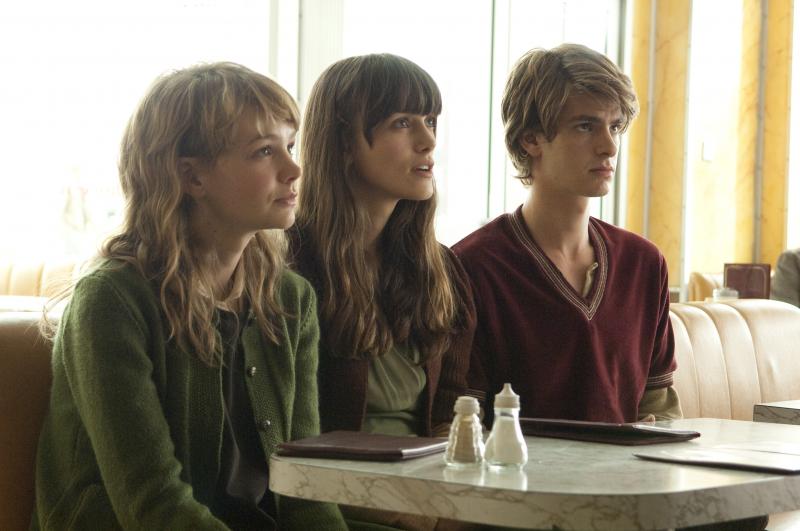
Corresponding to the novel, the film is structured in three parts. It follows Kathy (Carey Mulligan, An Education, 2009), Ruth (Keira Knightly, Pride & Prejudice, 2005) and Tommy (Andrew Garfield, The Social Network, 2010) through Hailsham in the 1960’s, young adulthood at the Cottages in the 1970’s, and lastly in the 1990’s where we see the final destination of their lives in completion. While the beginning part is the weakest, lacking the depth and details of the book, such a shortfall is compensated by the excellent performances of the three child actors as the young counterparts, Izzy Meikle-Small (Kathy), Charlie Rowe (Tommy) and Ella Purnell (Ruth). The congruence of young Kathy with her adult role played by Mulligan is particularly impressive.

As the story moves along, almost to midpoint, the unfurling of facts and feelings becomes more pronounced, calling forth some intricate and nuanced performance from Mulligan, Garfield, and Knightly. The three actors are the pillars of the production. While the original music by Rachel Portman (Academy Award Best Music, Emma, 1996) is affective and heart-wrenching, and the cinematography by Adam Kimmel (Capote, 2005) captivating, it is the performance of the threesome that makes the film so real and stirring.

Mulligan’s portrayal of Kathy and Garfield’s Tommy are particularly riveting. The hidden love Kathy has been holding for years is given a channel for expression only briefly at the end. All through Mulligan has carried her role with admirable restraint. Garfield’s portrayal of Tommy is achingly real, especially when he ultimately realizes the finality of his fate, the cry in the dark is haunting and powerful. And kudos to Knightly for accepting a role that puts her in a less than glamorous light. Her change at the end too is moving, giving depth to the exploration of what makes one human… other than love, there is also the courage to admit wrong, seek forgiveness, and the attempt to make amends.

Is it melodramatic or is it evoking deep emotions? Within context here, emotional sentiments or even a few tears at the end of the film might well be a healthy response, nothing to shy away from. Should the scenario arise some day in the future when we need to prove that we are human, and that we have a soul, what better ways to demonstrate but by our capacity to emote love, empathy, compassion, pathos, and the fear of facing such a scenario. May this all remain as science fiction for our enlightenment only.

~ ~ ~ 1/2 Ripples

***

To read other Book Into Film posts, CLICK HERE.

A Late Summer Hiatus

As the holidays draw to an end ever so quickly, and before I take off for a couple of weeks to recharge, it’s time to take stock and wrap up for the summer of 2010.

After watching 56 films in two months as a previewer for an upcoming international film festival, I don’t miss the cineplex for this summer’s offering. Yes, I’ve seen Inception.  And no, I didn’t dream that I saw it… although I remember waking up a couple of times. Anyway, its effect on me is quite similar to Avatar‘s, something I wouldn’t rave about except just say: ‘Been there, done that’.  The Girl With The Dragon Tattoo may well be the best summer movies in my opinion.

As for books, I’ve read a few, not a long list, but enough to keep me busy, relaxed, informed, and inspired. I’m glad I’ve discovered Tim Keller, pastor of the vibrant Redeemer Presbyterian Church of Manhattan.  His Reason For God has restored hope in me that it’s possible to embrace both faith and reason.  Seldom have I come across such an intellectual and sensible approach to the seeming dichotomy.

I must also mention Somewhere Inside: One Sister’s Captivity In North Korea and the Other’s Fight to Bring Her Home by Laura and Lisa Ling.  The book is a riveting account of journalist Laura Ling’s harrowing ordeal as a captive of the North Korean regime, and her remarkable release back to freedom together with her translator Euna Lee.  A testament of hope, resilience, the power of love, and the humanity we all share. An absorbing read, well told inside out.

Also, Bellezza’s Japanese Literature Challenge 4 has really done its job.  For it was a challenge indeed reading Kenzaburo Oe’s Rouse Up O Young Men of the New Age! Another more leisurely but no less intense work is Kazuo Ishiguro’s Never Let Me Go. I’ve purposely delayed posting about it until I’ve seen its movie adaptation coming out in September.  I’m looking forward to the film version, with Carey Mulligan as Kathy, Keira Knightly as Ruth, and Andrew Garfield (our new Spider-Man) as Tommy.  That would be for my commitment to C. B. James’s Read the Book/See the Movie Challenge over at Ready When You Are, C.B.

So now, my two weeks of late summer hiatus.  Just for fun, here’s Arti’s Cryptic Challenge… some hints as to where I’ll be in the next little while …  and most likely what you’ll see posted on Ripple Effects comes September.

1.  Don’t mind the gap:  risky when boarding, but good pointer for parenting.

2.  “I am not yet so much changed…”  Upon this re-visit, I don’t expect much change either, for it has kept quite the same for hundreds of years.

3.  From “Lost Generation” to “Beat Generation”, Beach to Whitman, it has much to offer other than curb appeal.

4.  And finally, this little clip on YouTube is my best prep:

Enjoy what’s left of your summer.  I’ll be happy to hear from you about your summer reads, movies, and wrap-up.  Feel free to leave your comments here and I’ll try to read and reply them whenever I find a free WiFi hot spot.

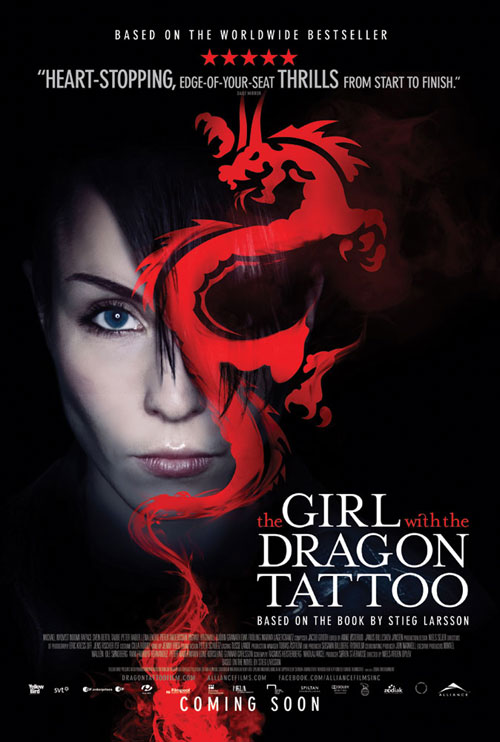
The Girl With The Dragon Tattoo: The Movie (2009)

Update Feb. 13: The Girl With the Dragon Tattoo just won BAFTA’s Best Film Not In The English Language.

Summertime… and the viewing is chilling.

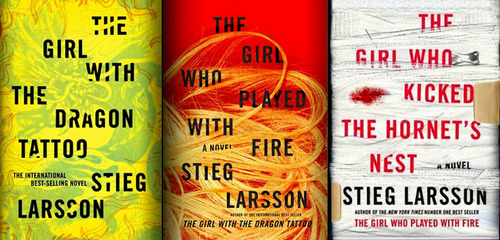
By now, we North Americans have caught the blazing heat that had swept other parts of the world a few years back, as we get the English translation of the Millennium Trilogy:  The Girl With The Dragon Tattoo, The Girl Who Played With Fire, and last of the series, The Girl Who Kicked The Hornets’ Nest.  All three books dominate the New York Times Best Seller Lists: When I last checked, the first two novels occupied the first and second places on the Paperback Trade and Mass-Market Lists, the newly published third title quickly claimed its second place on the Hardcover List.  The Trilogy has sold more than 27 million copies in 41 countries world wide.

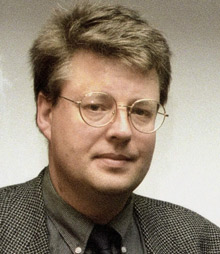
It’s just too sad that the Swedish author did not get a taste of his own success.  Stieg Larsson died in 2004 of a heart attack at 50.  All three books were published posthumously.  Before his fame as a writer and journalist, Larsson had championed against racism and right-wing extremism for decades.

Those who frequent Ripple Effects might know, I’m interested in the transforming of books into films.  There are many instances where I would read the book first before seeing the movie.  But here’s an exception.  I’m glad I went into the movie theatre knowing nothing about the story.  Because of that, I was held on the edge of my seat from beginning to end, my mind fully engaged, all 152 minutes of it.

The story begins with a high profile journalist with Stockholm’s Millennium Publication, Mikael Blomkvist (Michael Nyqvist), losing a libel suit brought on by a corrupt financial giant. Blomkvist is given half a year of freedom before serving a three-month jail term. Meanwhile, the reclusive industrial tycoon Henrik Vanger (Sven-Bertil Taube) approaches and hires the disgraced journalist to investigate the disappearance and likely murder of his beloved niece Harriet Vanger 40 years ago, a unique assignment that intrigues Blomkvist.  Initially, Vanger has recruited Lisbeth Salander (Noomi Rapace), a ‘researcher’ with a security firm, to do a background check on Blomkvist. Lisbeth is in fact an expert hacker. Believing Blomkvist to be set up in the libel suit, she continues to track him, and the two finally meet up and join hands in search of the truth behind the disappearance of Harriet Vanger… and a bit more.

This is one engrossing and highly suspenseful piece of filmmaking in the crime thriller genre.  First off, the cinematography and the overall visual tonality is reminiscent of film noir, setting the mood effectively.  As well, the many Vermeer moments wherein the playout of light and shadows reflect aptly the complexity of the characters.  The revealing of hidden facts and personal secrets drive the riveting momentum.  Pacing is suitably executed.  While it’s not your bullet-speed Bourne flick, it unfolds the story smoothly, allowing some real acting to take place.  There are effective action sequences and some poignant moments.  And yes, there are also scenes where the audience could well be aware that their emotions are being led towards an intended end.  As witness of a violent crime against the heroine, the audience is pulled to a cathartic revenge, and feels okay with it.  Herein lies the effectiveness of the film.  Less obscure is the original Swedish title: “Men Who Hate Women”.  So the warning is: graphic violence.  But it’s not gratuitous and I have to say, only reveals the reality of how low and depraved human can be.


Another measure of success is how quickly the film has elicited my empathy and even compassion for the female protagonist.  It can make an ear and nose-pierced, misanthropic, rage-wrapped goth to become the heroine within minutes into the film.  This idea is original, iconoclastic, and timely too.  It draws us from the surface of looks and attire into understanding one’s psyche, to see how past experiences mould a life.  There are layers of truths to be understood if one is willing to go past the facade.

Condensing 600 some pages (Paperback) into 152 minutes must be an arduous task.  A lot of details are bound to be put aside.  But with every adaptation, the movie ought to be viewed as a totally different medium, and not be judged by how literal the transformation is.  Turning words into visuals has always been the demanding job of the screenwriter but also the realization of a vision from the director.  As a movie viewer, I’ve appreciated the work as a congruent whole, very well edited and all loose ends tied, even opening a tiny portal for the sequels coming up.

Shot entirely on location in Sweden, the work is an artful piece of filmmaking.  The wintry Swedish landscape is a quiet visual relief for our hot summer months. The movie has garnered several noms and awards, most notably The Swedish Guldbagge Awards in Best Film for director Niels Arden Oplev and Best Actress for Noomi Rapace.  It was also honored with the Audience Award at the Palm Springs IFF.

.

.

But will the movie and its two sequels gather as much hype as the novels?  Here in English only North America, I’m afraid not, at least not with the Swedish versions. Here are the stats if you’re interested. Watching a movie with subtitles is much more common in other parts of the globe than here.  Thus prompts Hollywood to plan for an English version. Well, is it language or profit?

My recommendation is: go for the Swedish one.  See a film in its most authentic adaptation, Swedish setting, original language dialogues, and superb performance.  Don’t let Hollywood distract you from the real thing. There have been rumors of Carey Mulligan, Natalie Portman, and Kristen Stewart taking the role as Lisbeth Salander, and Daniel Craig, Johnny Depp, Brad Pitt, and George Clooney as Blomkvist.  Well, if they must make an English version, my picks for the leads are Ellen Page and Jeremy Renner.

But no matter what, the Swedish original is a hard act to follow.  It’s now on DVD and Blu-ray.  And if it’s still being shown in theatres in your area, nothing beats seeing a thriller on a sweltering summer day, or night, inside a cool, dark theatre.

~ ~ ~ 1/2 Ripples


To Kill A Mockingbird

Clint turns 80 today.  A book dedicated to him as well as a special DVD just out to celebrate his life-long achievement.  There’s no shortage of Father’s Day gift ideas.  I understand though the man himself does not want any celebration on his birthday.  So to make his day, I’m not going to say anything more about him.

But there’s another birthday, or anniversary rather, that should be mentioned.  To Kill A Mockingbird turns 50 this year. Another good choice for Father’s Day, or any day really, and not just for fathers.  In recent years, as I see current events unfold, I truly feel this will make a marvellous gift for Law School graduates, or any graduate for that matter.   In this tumultuous time we’re in, where honor, justice, and nobility of character seem to become obsolete as quickly as the latest techno gadget, we all need a guidepost, a moral compass, ever more so.

To commemorate the 50th anniversary of its publication, Harper Collins has published a special edition:

Harper Lee had based the story on her childhood experiences in her hometown Monroeville, Alabama.  Her understated storytelling of Atticus Finch, Scout and Jem of Maycomb had won readers’ hearts the world over.   Two children growing up learning the value of respect and justice, love and integrity from their father.  Theirs was a most trying of times when racism and the Depression joined hands to destroy any fragile decency still present in a poverty-stricken town in the deep south.

Strangely, the story of such a parochial setting had triggered universal resonance.  The novel has been translated into at least 40 languages, sold over 30 million copies.  It has gained the number one spot on the list of greatest novels of all time.  It is the choice of British librarians according to a poll conducted by the Museum, Libraries and Archives Council (MLA), in which librarians around UK were asked the question, “Which book should every adult read before they die?”  Just hope people don’t wait till then.

***

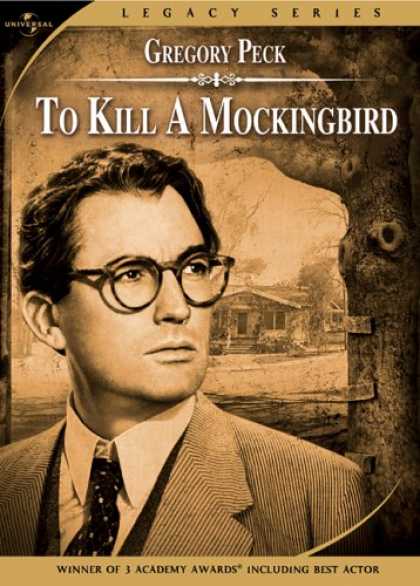
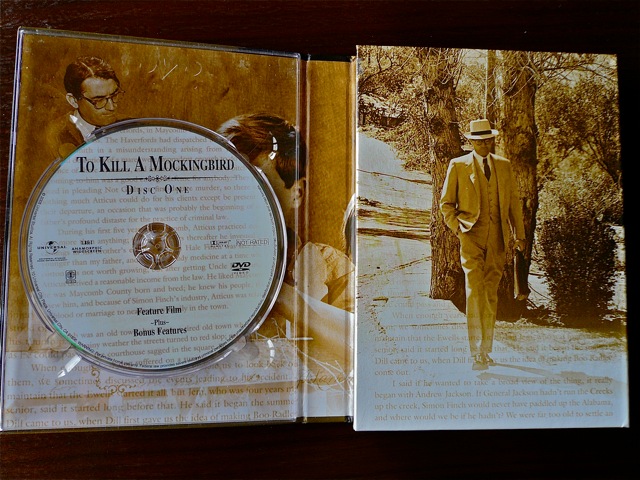
To Kill A Mockingbird DVD, Universal Legacy Series


To complement the book, I highly recommend the DVD set of the Oscar-winning movie (1962).  Make sure it’s the Universal Legacy Series (2005).  This is a two-disc collection with loads of memorable special features. Here’s a list:

  • Academy Award Best Actor Acceptance Speech — Gregory Peck
  • American Film Institute Life Achievement Award — Gregory Peck
  • Daughter Cecilia Park’s heartwarming tribute to her father
  • Scout Remembers — An interview with Mary Badham, who talks about her experiences working with Gregory Peck
  • Fearful Symmetry: The Making of To Kill A Mockingbird
  • The documentary A Conversation With Gregory Peck, produced by Cecilia Peck.  Scenes with Lauren Bacall, Martin Scorsese, President Bill Clinton and the Peck family.  Most moving is ordinary people sharing how the movie had impacted them, in their career choice, parenting and life.

“All the children of the whole world must have wished they could have Gregory Peck as their father.  He was ours, and that was our blessing.  He really was a lot like Atticus Finch… The last page of his film script of To Kill A Mockingbird, he had scrawled these four words at the bottom: Fairness, Courage, Stubbornness, Love. And they remind me so much of him…”  — Cecilia Peck’s tribute to his father

“It’s difficult to separate the man from the character.”  — Mary Badham (Scout) reminisces on her experience working with Gregory Peck

“Making millions is not the whole ballgame.  Pride of workmanship is worth more, artistry is worth more.  The human imagination is a priceless resource.  The public is ready for the best you can give them.  It just maybe that you can make a buck, and at the same time encourage, foster, and commission work of quality and originality.”  — From Gregory Peck’s acceptance speech for American Film Institute’s Life Achievement Award.

And if you think it’s all about Gregory Peck, well in a way it is.  I can’t think of anyone better to climb into the skin of Atticus and walk around in it.  The man is Atticus Finch, as his colleagues and family had testified. Gregory Peck received a well-deserved Best Actor Oscar for his role.  I must mention too that this is where Robert Duvall made his acting debut, without saying one single word, as Boo Radley.

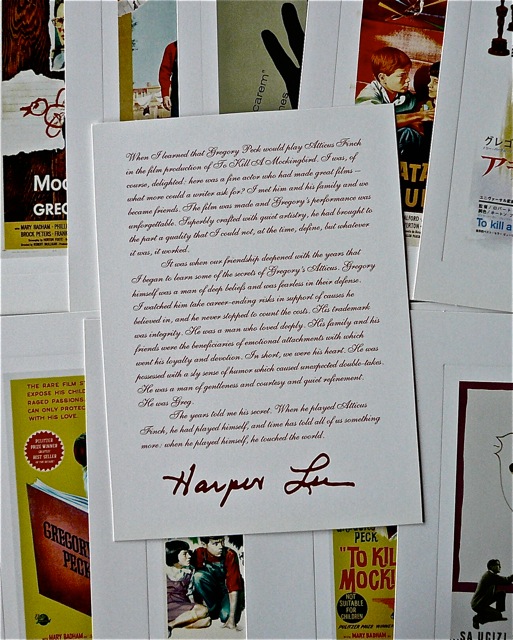
The other good reason for this Legacy Series is the 11 Exclusive Reproductions of Original Theatrical Posters. They are printed in a handsome set of cards, each a tribute from the country it comes from: Australia, Belgium, Italy, Japan, Argentina…

And last but never the least, a note from Harper Lee herself about the actor playing a character that was a cinematic reflection of her own father.

“When he played Atticus Finch, he had played himself, and time has told all of us something more:  when he played himself, he touched the world.”   —  Harper Lee

***

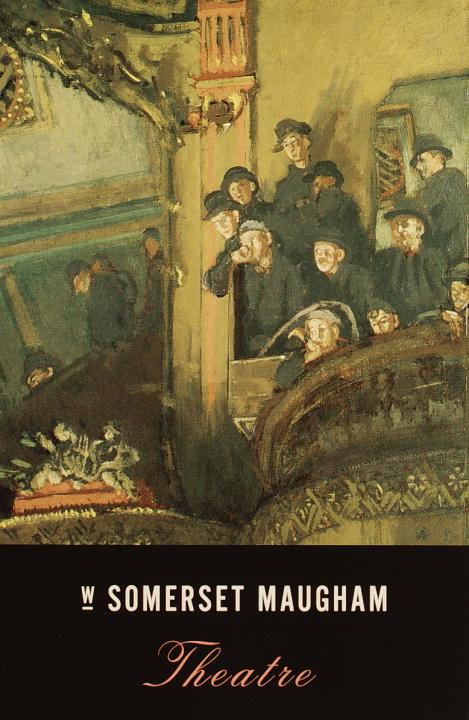
THEATRE by W. Somerset Maugham: In Search of Reality

It was pure serendipity. I thought I knew almost all of Maugham’s titles, but this one just escaped me.  I found it on the ‘New and Notable’ shelf in the public library. It’s a Vintage International edition paperback published in 2001. Not new but it looked untouched and inviting.

Two pages into the book I knew right away I had seen it before. Of course, that’s the movie Being Julia (2004). Annette Bening got a Best Actress Oscar nom for her portrayal of Julia Lambert, a famous actress on the London stage in the 1930’s. The movie is a colorful account of how a successful stage actress deals with her mid-life crisis. With fame, fortune, and achievement in bounty, what more could she ask for but… love and passion. And during the course, obstacles, jealousy, and betrayal are all overcome, and revenge carried out; on or off stage, no matter, it’s equally exciting for the glamourous Julia Lambert.

But not until I read this novel on which the movie was based did I realize that a most important passage had been left out. And oh what an omission! For the crux of the book rests on those few pages. And not only that, the screenwriter had chosen to alter a character to suit his fancy, rounding off the edges of conflicts and alleviating tensions in presenting a smooth and suave storyline.

In the movie, Julia’s son Roger is a young man fresh out of Eton and planning to attend Cambridge after the summer. That much is true to the book.  Roger is shown to be a devoted son, lovingly supportive of his mother in her pursuits in career and love life. But this is not the case in the novel.  Maugham has crafted Roger as a critical young man, offering the necessary tension to the story. In a crucial scene at the end of the book, he questions Julia’s behaviour and integrity. These challenges form the climatic confrontation between mother and son, projecting the meaning behind the very title of the novel.

Here is an excerpt from this scene that captures the essence of the whole book. Julia asks Roger:

“What is it you want?”
Once again he gave her his disconcerting stare.  It was hard to know if he was serious, for his eyes faintly shimmered with amusement.
“Reality.”
“What do you mean?”
“You see, I’ve lived all my life in an atmosphere of make-believe…. You never stop acting. It’s second nature to you. You act when there’s a party here. You act to the servants, you act to Father, you act to me. To me you act the part of the fond, indulgent, celebrated mother. You don’t exist, you’re only the innumerable parts you’ve played. I’ve often wondered if there was ever a you or if you were never anything more than a vehicle for all these other people that you’ve pretended to be.  When I’ve seen you go into an empty room I’ve sometimes wanted to open the door suddenly, but I’ve been afraid to in case I found nobody there.”

By turning Roger into a complacent and docile young man, the screenwriter had failed to present the necessary tension in the story. Further, by avoiding the character foil between the successful actress mother and her meaning-pursuing, idealistic son, the movie fails to deliver the essential subtext, despite an impressive performance by Annette Bening.

Further, the best is yet to come in the book… such is the ingenuity of W. Somerset Maugham.  After a superb, revengeful performance, overarching her rival, the young and beautiful Avice Crichton, and drawing everyone’s admiration back to herself, Julia celebrates on her own with a nice meal and mulls over a gratifying notion, on the very last page:

“Roger says we don’t exist. Why, it’s only we who do exist.  They are the shadows and we give them substance. We are the symbols of all this confused, aimless struggling that they call life, and it’s only the symbol which is real. They say acting is only make-believe. That make-believe is the only reality.”

This is ever so relevant for us today. With all the online personae we can create and project, all behind the guard of anonymity, Roger’s quest for what’s real remains a valid search.

Sherry Turkle, the acclaimed ‘anthropologist of cyberspace’, has observed the liminal reality in our postmodern world and stated her own quest:

“I’m interested in how the virtual impinges on what we’ve always called the real, and how the real impinges on the virtual.”

Let’s just hope that the advancement of technology would not get the better of us, blurring the lines of fact and fiction, offering shields for fraud and deceits. Behind the liminal existence, let’s hope too that we still care what’s real and what’s not, and that our humanity will still be valued and not be compromised or lost in the vast abyss of bits and bytes.

The upcoming Academy Awards too, is another platform to showcase such a duality. I always find the acceptance speeches of award winners intriguing: what’s genuine and what’s fake in their thank you’s. Are they presenting their real self or merely acting? Outside of their roles, which part of them is authentic? Or, do they ever get out of their roles?

It’s interesting too to explore the influence of movies nowadays. Again, the postmodern emphasis is on the narrative, multiples of them, and storytelling the vehicle of meaning. Does the notion of Maugham’s character Julia mirror our world… that movies have become the symbols of what we call life? That make-believe has sometimes been merged with reality? Can we still tell them apart? Or, should we even try? Considering the pervasive effects of pop culture in our life today, considering a single movie can command a worldwide box office sale of $2.4 billion, and counting… Maugham was prophetic indeed.

***

Emma (2009, TV): Episode 3

The final instalment of Emma has a major challenge, to reveal the hidden agendas, and to tie up all the loose ends in just under an hour. The hurried scenes leave me with a feeling of watching a trailer, a montage of excerpts loosely linking up the story.  This is especially so in the first half dealing with Jane Fairfax and Frank Churchill’s secret relationship.

If the story feels a bit fragmented in this last episode, the cinematography makes up for that shortfall.  The hour is saturated with stunning shots, magnificent scenic views and exquisite interior renditions.  The Box Hill picnic scene is a vivid example:

Ironically, the pivotal Box Hill scene was not shot in Box Hill, a busy tourist attraction in Surrey.  Instead, it was shot in Leith Hill, Mole Valley, another much quieter scenic point.  For an interesting comparison of the two hills, click here to go to ‘this is surrey today’.

The Box Hill picnic is a crucial turning point in the story.  Emma’s callous and sarcastic joke on Miss Bate and the subsequent scolding she receives from Mr. Knightly is nothing short of an epiphany in self-knowledge.  The genuine remorse she feels could well reflect her greatest strength.  I’m sure such quality of character is what seizes Mr. Knightly with tenderness, moving him to consider her “faultless in spite of all her faults.”

I have a feeling too that this is the very reason Austen finds her heroine likable.  Romola Garai has effectively portrayed a contrite and humbled Emma, while Jonny Lee Miller has delivered convincingly a silent lover with passion and principle.  My initial reservation about his role has definitely changed for the better in this final episode.

Fortunately as well, the endearing lines of Mr. Knightly to Emma, no, not the ‘badly done!’ admonition, but the heartfelt praise he spurts out in spontaneity, remains intact and without any modernized alteration from screenwriter Sandy Welch.  Of course it needs to be declared in its authentic whole… Miller has the best lines of the series:

“I cannot make speeches, Emma… If I loved you less, I might be able to talk about it more.  But you know what I am.  You hear nothing but truth from me.  I have blamed you, and lectured you, and you have borne it as no other woman in England would have borne it.”

As with all Austen’s novels, the ending comes with nuptial ties. But as Masterpiece Classic’s host Laura Linney points out at the opening, considering the social discriminations inflicted upon the woman in Jane Austen’s time, allowing no ownership of properties, no decent employment (even Jane Fairfax compares the governess position with slavery), and no respect or rights given to the single female of low means, it is only a justifiable reward for the author to end her story with loving marriages for her well-deserved protagonists.

Towards this end, the camera takes us to the magnificent view of Beachy Head in the last scene.  As Emma and Mr. Knightly stand on the edge of the cliff overlooking the boundless ocean, we see the series come to an idealistic end, maybe a broader stroke than that in Austen’s novel. But as some critics have noted, it is love that the author emphasizes rather than romance.  From that perspective, looking outward together to the ocean vast instead of gazing into each other’s eyes may well be an apt interpretation of Austen’s heart.

***

CLICK HERE to go to Episode 1

CLICK HERE to go to Episode 2

Arti’s reviews of Emma (2009), Episodes 1 to 3, have been compiled into one article and published in the Jane Austen Centre Online Magazine. CLICK HERE to read the many other interesting articles on Jane Austen and her time.

**Photo Sources: Box Hill Picnic bbc.com; Beachy Head, not a scene from the movie, taken from Wikimedia Commons.

Oscar Nominations 2010

February 2, 2010 was a big day for announcements.  We’d all been waiting for this special occasion… yes, groundhog day.  For us who live in the Calgary area, we welcomed the news as we began the day: our very own groundhog Balzac Billy did not see his own shadow.  A reward for us resilient folks: an early spring.

But even hours before Balzac Billy popped his head out of his burrow, another excitement stirred at 5:38 am PST.  At the Samuel Goldwyn Theater in Beverly Hills, CA, Academy President Tom Sherak and actress Anne Hathaway got up on the stage and announced this year’s Oscar Nominations to a house full of early risers.  What a way to start the day.   Click here to watch the announcement video.

[picapp align=”none” wrap=”false” link=”term=oscar+nominations&iid=7783783″ src=”4/b/0/8/Anne_Hathaway_and_a398.JPG?adImageId=9870627&imageId=7783783″ width=”275″ height=”300″ /]

.

The major change this year of course is the expansion of the Best Picture category from 5 to 10 selections.  I’ve pondered the pros and cons about this move.  While more films can be included so not to snub deserving ones, it also begs the question of what’s so deserving if the number of contenders are increased.

For the full list of nominations, CLICK HERE.  I won’t repeat them here but I’ll just highlight some items that pique my interest.

The Golden Globes and the SAG Awards remain the best predictors of the Oscars.  So, there are no surprises, just delights, for the three films I’ve reviewed here on Ripple Effects have all been nominated for Best Picture.

[picapp align=”none” wrap=”false” link=”term=oscar+nominations&iid=7783801″ src=”8/7/b/4/Up_in_the_bd47.JPG?adImageId=9870657&imageId=7783801″ width=”395″ height=”275″ /]

Up In The Air receives 6 noms.  Other than Best Picture,  Jason Reitman gets a nod for Best Director and Best Adapted Screenplay.  Clooney, Kendrick, and Farmiga all nominated in their respective acting category.

[picapp align=”none” wrap=”false” link=”term=oscar+nominations&iid=7784549″ src=”9/b/d/e/Carey_Mulligan_nominated_8cec.JPG?adImageId=9870639&imageId=7784549″ width=”395″ height=”270″ /]

An Education gets a Best Picture nod with Nick Hornby nominated for Best Adapted Screenplay, while Carey Mulligan, who plays 16 year-old Jenny, gets to compete with Meryl Streep, 16-time Oscar nominee, this time as Julia Child in Julie and Julia.

[picapp align=”none” wrap=”false” link=”term=oscar+nominations&iid=7784555″ src=”5/a/2/b/Meryl_Streep_nominated_5614.JPG?adImageId=9870681&imageId=7784555″ width=”395″ height=”275″ /]

.

I’m glad too that the Coen brothers’ A Serious Man gets a nod for a chance at the Best Picture Oscar Award as well as a nom for Best Original Screenplay.

Are these deserving smaller films getting the nods reaping the benefits of the expanded Best Picture category?  Or, is it just the other way round, that popular, big box office hits get a chance to be included because of their mass appeal?  It’s that same old art vs. popularity debate again… well, some other time.

Avatar and The Hurt Locker each receives 9 nominations. Both are contenders in the coveted Best Picture and Best Director categories.  Yes, James Cameron will be competing with his ex-wife Kathryn Bigelow for these two coveted prizes.  In all of the Academy Awards’ 82 years history, there have only been three female directors nominated, and none has won. Kathryn Bigelow is the fourth.  Will she make Oscar history this year by being the first woman Director taking home the statuette?  After all, it’s a decade past the twenty-first century now.

[picapp align=”none” wrap=”false” link=”term=avatar&iid=7789230″ src=”9/2/0/c/James_Cameron_nominated_7354.JPG?adImageId=9871271&imageId=7789230″ width=”160″ height=”235″ /]

[picapp align=”none” wrap=”false” link=”term=hurt+locker&iid=7764534″ src=”f/7/c/d/Kathryn_Bigelow_wins_6674.JPG?adImageId=9871306&imageId=7764534″ width=”210″ height=”235″ /]

.

Inglorious Basterds is another major contender with 8 nods.  Quentin Tarantino’s altered-history fantasy is ingloriously riveting.  Christoph Waltz, who brilliantly plays the cold, callous, and calculating Nazi Colonel Hans Landa, is likely to continue his winning streak following the GG and SAG.

Christopher Plummer gets a nom for his role as Tolstoy in the film The Last Station, a biopic about the last years of the great Russian author.  So, why is he nominated in the Best Supporting Actor category?  Who is he supporting?  Mrs. Tolstoy? … whose star Helen Mirren gets to be nominated for Best Actress, not supporting.

[picapp align=”none” wrap=”false” link=”term=oscar+nominations&iid=7788913″ src=”3/4/1/b/Christopher_Plummer_nominated_c758.JPG?adImageId=9871178&imageId=7788913″ width=”152″ height=”190″ /]

[picapp align=”none” wrap=”false” link=”term=helen+mirren+oscar&iid=7784548″ src=”3/b/8/5/Helen_Mirren_nominated_6e30.JPG?adImageId=9871651&imageId=7784548″ width=”215″ height=”160″ /]

.

It’s interesting to see the animated feature Up get to compete with the other nine feature films, aiming for the highest prize in the Best Picture category.  I believe only Beauty And The Beast had that honor in the past.  Animated features have taken on a brand new versatility in recent years, with all sorts of technical innovations creating fresh new visual effects.  But it’s always the story that is the winning factor.  Up deserves the nom.

[picapp align=”none” wrap=”false” link=”term=oscar+nominations&iid=7783800″ src=”4/d/4/2/Up_nominated_for_5299.JPG?adImageId=9870774&imageId=7783800″ width=”385″ height=”275″ /]

So hopefully March 7 will not only bring star-studded excitement but the warm and gentle breeze of spring for me as well.

**All photos from the copyright-free picapp.com**