‘Faces Places’ with Agnès Varda and JR

From high art in the gallery (my last post) to street art, here catching the last chance for a Paris in July entry, I’m presenting the fascinating documentary, a road movie of making art in the open milieu of villages and among the working populace. Faces Places (2017) is an account of the venerable auteur of the Nouvelle Vague (The French New Wave: Goddard, Truffaut…) Agnès Varda (1928-2019), then at 89, going on a road trip with photographer and artist JR to scout for ordinary people to photograph in various obscure locales in France.

the world's longest baguette .jpg

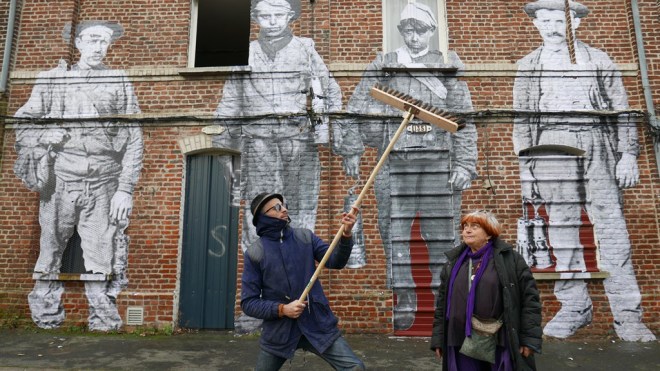
Their larger than life photo prints are then pasted onto buildings or open places for everyone to view, evoking the shared joy of living, working, and the collective memory of a meaningful past. Like this one with photos of pioneer miners pasted on a row of dilapidated homes slated for demolition in a miners’ community. The one remaining homeowner who refused to vacate her house was moved to tears upon seeing the completion of the project.

Miners from days past.jpg

Art undefined and unconfined, once pasted onto these surfaces, JR’s black-and-white photographic images convert the whole building or structure into an art form. The world is his canvas. Unlike Banksy, JR is transparent with his creative process, and lets the public view his work in progress. A TED Prize winner (2011), his large-scale, participatory art projects are installed all over the world, albeit sometimes illegally according to local laws, but the people welcomed him.

At age 89, Agnès Varda became the oldest nominee in Oscar history when Faces Places was nominated for Best Documentary for the 2018 Academy Awards. It’s now on DVD and Blu-ray. Her numerous older works may not be accessible for us so readily. Check your streaming or on demand services. I was able to watch two of her excellent films Vagabond (1985) and Cleo from 5 to 7 (1962, click on link to my review). Don’t miss this short clip on IMDb “Agnès Varda in Memoriam”.

The soul-stirring original music by Matthieu Chedid complement the meaningful duo collaboration. At the beginning, JR talks with Varda to organize the making of their joint project. We see them exchange the following dialogues:

AV:  What I like was meeting amazing people by chance.

JR:  So you want to carry on that way, with no plan or itinerary?

AV:  Yes. Chance has always been my best assistant.

JR:  Do you think chance will work for both of us?

AV:  Maybe.

From the film, we can see chance had worked for both of them marvellously.


AVJR-Chairs-on-the-beach-Normandy (2).jpg


~ ~ ~ ~ Ripples


***


Paris in July is hosted by Tamara at Thyme for Tea

PIJ2019 Tamara

Other Paris in July 2019 Posts on Ripples:

Pictures at an Exhibition 

‘Coco Before Chanel’ directed by Anne Fontaine

‘Gemma Bovery’ to cool your summer day

‘A Sunday in the Country’ is an Impressionist Cinematic Painting

‘A Sunday in the Country’ is an Impressionist Cinematic Painting

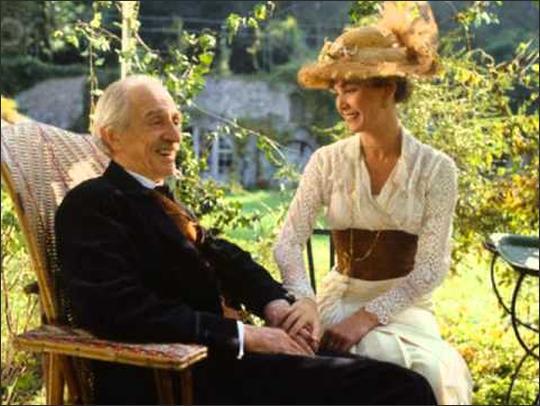
If the Impressionist painters were to make a movie, what would it be like? A Sunday in the Country (1984) could very well be an exemplar. French director Bertrand Tavernier used the camera as a paintbrush to tell his story, while the cast bring to life the human pathos that are deeper than a painting on the wall could convey. 

A Sunday in the Country - Un Dimanche à la Campagne (1984)

Monsieur Ladmiral is an elderly artist living in an idyllic country house on the outskirt of Paris. The setting is pre-WWI. M. Ladmiral is a widower, his daily routines assisted by a lived-in, indispensable housekeeper called Mercédès (Monique Chaumette). His home is cozy with classic charm, the adjacent studio, inspiring. The camera leads us to see every details of M. Ladmiral’s house and moves fluidly from far to close-in on the artist’s workplace, a quiet haven and a treasure trove of memories and life works. With his colours, Ladmiral attempts to capture traces of youth and life.

M. Ladmiral’s son Gonzague (Michel Aumont) and his wife Marie-Thérèse (Genevieve Mnich), together with their three children, come visit him from Paris every Sunday, but not frequent enough still. His two grandsons, Emile (Thomas Duvall) and Lucien (Quentin Ogler), add lively sparks to his serene environs, while little Mereille (Katia Wostrikoff) is simply adorable.

No matter how much Gonzague tries to give him, grandchildren and his family’s frequent visits, the son knows he’s a disappointment to his father. Deep in M. Ladmiral’s heart, he longs to see his daughter Irène (Sabine Azéma), who seldom visits. Irène is single, exuberant, fearlessly independent and cheerful, or at least, on the surface. She drives an automobile, a new invention. “Look at your sister Irene,” Ladmiral tells Gonzague. “She forges ahead.” Then after a beat, “you don’t.” Nice going, Dad.

The pace of the film is leisurely, taking its time for viewers to hear (or read the subtitle of) every single dialogue, capture every nuance, and observe every item in the mise en scène. Life is too precious to hurry by. As well, we get to appreciate the humour, but often as guise to underlying relational tensions.

Tavernier won Best Director at Cannes Film Festival in 1985 with A Sunday in the Country, as well as the César Award for his adapted screenplay. The film also saw Azéma who plays daughter Irene won the Best Actress César Award and Bruno de Keyzer for Best Cinematography.

The film is an adaptation from the French novel by Pierre Bost entitled “Monsieur Ladmiral va bientôt mourir”, translated in English: “Mr. Ladmiral will die soon”. Have to say, the movie title is much more appealing. One note though, be patient with the 1:40 min. of credits rolling at the beginning with just white words on black background without image. You’re looking into the mind of an old man. While the overall mood is warm and amusing, the undercurrents of  disappointment, mortality, and separation gently flow throughout the film.

On that Sunday as Gonzague and his family are visiting, Irene drops in unannounced in her automobile. Free-spirited Irene is a fresh breeze to the hot countryside, her automobile a progressive symbol for everyone to admire. She charms with her energetic presence and spontaneous delights. But as viewers, we are privy to her psyche and anxiety when she’s alone. Tavernier deals with the past and the present seamlessly, melding them as if showing us memories are natural extension of our present self, so’s our imagination. As she stands by the window looking out to the lawn, we see Irene’s flashback of her mother saying, “When will you stop asking so much of life, Irene?” 

Irene’s visit is short, albeit one that leaves a significant impact on her father. She takes him on a ride in her automobile to a guinguette for a drink and a dance, an episode that’s bound to be indelible in M. Ladmiral’s last memories. Guinguettes were open-air taverns in the outskirts of Paris where people would come on Sundays to have drinks and casual meals, listen to music, and dance. In the style of Renoir’s Bal du moulin de la GaletteTavernier paints a beautiful Impressionist movie moment in this scene:

hero_EB20030511REVIEWS08305110301AR

During the memorable father-daughter chat at the guinguette, M. Ladmiral talks about his own style, and admits that he’s a traditionalist unable to catch up with the changes other painters have brought about. Unable or unwilling, no matter, he’s at least honest to himself in painting the way he does, he tells Irene. In tearing eyes, daughter looks fondly at her father and asks him to dance with her.

Irene has to leave right after she drives her father home from the guinguette, upon receiving an upsetting telephone call. Later that evening, Gonzague and his family have to catch the late train back to Paris as well. After seeing them off, M. Ladmiral walks back home from the train station alone. For an old man, every goodbye could be the last.

But the final scene appears to turn the tide. M. Ladmiral goes into his studio, takes down the painting he’s been working on, a still-life subject he’s painted numerous times before and in a style he’s been following all his life. He replaces it with a blank canvas on the easel, sits down, and looks at it ponderously. Like his son’s, his life, too, has been a disappointment to himself. What M. Ladmiral is thinking staring into a blank canvas at that moment is up to anyone’s interpretation. What I see is a slight, nuanced smile on his face. Every blank canvas is a fresh start no matter how old you are.


~ ~ ~ ~ Ripples


***


This film review is a participation of the 6th Paris in July event at
Tamara’s Thyme for Tea. 

PIJ2019 Tamara

Related Posts on Ripple Effects:

Arles: In Search of Van Gogh

Séraphine and the wrought-iron chair

Inspired by Vermeer


The asset of ‘Yesterday’ is recalling Beatles memory

Ah… Summertime, and the viewing is breezy.

Even if you didn’t know the composer is George Gershwin, or Ella Fitzgerald’s voice doesn’t come to mind, you’d probably know I got the line from something bigger than it is, as the original song lyrics had made its way into our communal usage through the years… “Summertime, and the livin’ is easy.”

Here lies the very original story idea of the movie Yesterday: what if there’s no collective memory of The Beatles, except one person. And it happens that this guy is a struggling, busker kind of a singer songwriter on the brink of giving up his music and submitting to a career as a warehouse grocery stocker. Imagine, what would he do now?

Yesterday.jpg

Richard Curtis, whose expertise is writing rom coms, best known for Notting Hill, Love Actually, Bridget Jones and not the least, Mr. Bean, seems to have gone on a breezy trip imagining his newest work. Director Danny Boyle as well, reprises his rags-to-riches gist as in Slumdog Millionaire to create another fantasy. Yesterday looks to have the privilege of a dynamic duo of movie magic, and it seems they’d planned it as a summer joy ride.

To enjoy a fantasy, viewers have to drop their guards and suspend rationale. Stop trying to reason how a 12 seconds global blackout could wipe out the collective memory of The Beatles, both human and online memory that is, while one man, Jack Malik (Himesh Patel), being hit by a bus right at that moment, wakes up to find he has lost only his two front teeth but his memory is fully intact.

In his hospital bed, Jack says to his manager Ellie (the ubiquitous Lily James), who has had an unrequited crush on him since their junior high days, “will you still need me, will you still feed me when I’m 64?” Sure, but why 64? She asks. There’s the first clue.

Later when he gets out of the hospital, his close friends gift him a new guitar to replace the one that’s crushed by the bus. Keep on writing songs, they encourage him. So he sings his newest for them, it’s called “Yesterday”, and they’re almost moved to tears. Here’s the beginning of a world-wide sensation, Jack Malik, the one man show, creator of fresh, hit songs, and the rest is (new) history.

Now consider another premise, or maybe a philosophical construct: if a lesser known gallery painting is taken out of its frame and thrown on the sidewalk, will people have recognized it as a work of art? In parallel, if the collective memory of The Beatles had been wiped out and a Beatles song is sung by Jack Malik, a dowdy guy who doesn’t have the slightest sense of charisma, will it be a hit? Will it ever be turned into a classic? Well, too much thinking here. This is a rom com after all.

Curtis wants to humour us with quick, spontaneous laughs, and he delivers. Like showing us the Google search results for The Beatles when all such memory is lost, or when the less than attentive parents of Jack’s mistakenly remember the title of his new song as “Leave it be”. Or when Ed Sheeran, yes, the real Ed Sheeran, advises Jack on how to create a better song title, “Hey Jude” is a bit old-fashioned he tells him. “Hey Dude” sounds just right.

Kudos to the filmmakers, Jack’s Indian descent isn’t mentioned; he’s just another dude. It’s a kaleidoscope of humanity on our streets, no need to explain. As for the plagiarism issue, no worries, Boyle and Curtis deal with that at the end. So you can leave the theatre at peace with your conscience if you happen to really like the movie.

Jack’s friend and sidekick Rocky (Joel Fry) reminds us of Spike (Rhys Ifans) in Notting Hill, adding both sparks and silliness, especially in the weak, second part of the movie where it feels gas might have run out. As for Jack meeting a guru type of a guy called John in the last act feels an unnecessary add-on. Now Curtis really had run out of ideas.

On another note, I can’t seem to find much chemistry between James and Patel for them to a strike up an intimate relationship. Maybe they’re following to the dot the exact storyline, quiet, unrequited lover meets oblivious subject. Albeit I do see a chance there which unfortunately the director and writer had not pursued further.

The movie can be enriched if James is given more opportunity to perform. In Mamma Mia! Here We Go Again, as young Donna, James has shown herself to be a natural singer and dancer. There’s just one scene in Yesterday, maybe for a minute or less, where we see her character Ellie singing along with Jack in the recording studio. The story could be richer in content and more entertaining if James is given a chance to shine by accompanying Patel in some of his songs. After all, there were four harmonized voices that made up the Fab Four. Further, James’ participation in the music-making could beef up the story and open wider the road to romance as well.

Yesterday has an ingenious idea for a fantasy, Sheeran’s appearance as himself is marvellous. While the storyline turns weak and hard to sustain in the middle of the movie, the 15 Lennon-McCartney compositions save the production. Augmenting Patel’s singing with James’ collaboration would enhance the story and be more entertaining.

So for the overall production, I’ll give 2.5 Ripples, but I’ll still post this as a ‘Fresh’ on Rotten Tomatoes, for the originality of the concept as well as the memory of the Beatles numbers, especially for certain demographics among us.

~ ~ 1/2 Ripples

***

Related Ripple Review:

Nowhere Boy


‘Working Woman’ is yet another voice of the #MeToo Movement

Israeli director Michal Aviad’s “Working Woman” is a good reminder that even though the momentum of the #MeToo Movement might seem to have quieted down, there are still voices that need to be heard. Screened at international film festivals since last fall, the feature is now being released in selective theatres.

At the start of the movie, the roving camera follows Orna (Liron Ben-Shlush) as she walks briskly to a car her husband is waiting in. She has just come out of a job interview, exciting to be offered an opportunity to assist a real estate developer, Benny (Menashe Noy). There will be attractive financial rewards and career opportunities ahead.

As the husband parks the car on the road and we get to see the couple in their apartment in the next scene, a stationary camera captures all that is important, an establishing shot if you will. In one frame, we see the husband cooking, Orna clearing the table beside him, and not too far away but still within the frame, their children playing at a computer. We soon learn that the computer isn’t working properly, the kids want a new one, and Orna telling them not until the fridge has been paid off. Husband and wife then go on to talk about this new job she really wants to take, he not too sure about the irregular working hours.

In less than five minutes from the opening, we see Orna’s situation. A mother with young children to care for, a husband who is starting a new restaurant and a household that is cash-scrapped. Aviad’s camera work and succinct dialogues prime us with expectations.

Orna starts working as a personal assistant to real estate developer Benny on his flagship project, a skyscraper apartment by the seaside. He needs someone to organize his meetings, see the project through to completion and sell the luxury units. Being Benny’s protégé includes following him around, even waiting while he has a haircut. Orna has no experience in real estate but is a quick study; she has a knack for gaining trust from potential customers and the instinct for a fresh approach to getting things done.

A scene from WORKING WOMAN. A film by Michal Aviad. A Zeigeist Films release in association with Kino Lorber. Photo courtesy Zeigeist Films. 

Benny finds the ideal assistant in Orna. He soon promotes her to sales manager, noting her resourcefulness and creative thinking. His project by the seaside is now in good hands. But reaching that position and gaining her boss’s trust isn’t as smooth as Orna had first thought; it is becoming obvious that Benny appreciates not just her work skills but eyes her as a woman.

It first starts with commenting about her hair and telling her what to wear, then a kiss, for which he apologies. Other kinds of harassment follow, much like juvenile pranks. But a trip to Paris escalates his advances into a sexual assault. Orna’s pushback and outright ‘no’ means nothing to Benny. Aviad’s camera captures the scene matter-of-factly. The realism is disturbing to watch, not that Benny is violent but that it is obvious that the act is not consensual, his brute force the only means to subdue her in gratifying himself.

After coming back home from Paris, Orna is a different person. She is traumatized naturally, but when her suspecting mother asks what happened in Paris, she replies, “I made a mistake.”

That is a crucial statement. Such a mentality could well explain why she isn’t forthright with her husband, fearing his speculation on her part in the event, or maybe fearing his avenging Benny, making the matter worse. But we as viewers are witnesses to the scene. The ‘mistake’ definitely is not hers to shoulder.

Aviad’s storytelling is realistic and engrossing. Her handheld camera follows Orna like a shadow, the slightly roving movement accentuating the tension. Ben-Shlush’s acting is sensitive and nuanced. The screenplay spare and succinct. The 93-minute narrative feature is an effective and clear voice in stating a case of sexual harassment in the workplace, a powerful boss getting his way and taking advantage of a subordinate who needs her job for financial reason.

Fortunately, Aviad leads us towards a positive ending. We get to see Orna rise up from her challenging situation as she gains new strength to open for herself a way out.

Exclusive engagement of “Working Woman” will be screened at Landmark Lagoon Theatre in Minneapolis St. Paul beginning Friday, May 10th, 2019. Hebrew with English subtitles, 93 mins.

~ ~ ~ Ripples

***

‘Ramen Shop’ is a delicious tale of reconciliation

This is not your ordinary foodie flick, for it touches on a subject that is not likely to be found in a culinary film: WWII memory lodged in the mind of those who had lived through Japanese occupation, a generation of victims and witnesses of a horrific chapter in Asian history. That is the backstory. Acclaimed Singaporean director Eric Khoo offers us a slow cooked, savoury broth, using ingredients that are comforting and heartwarming to present a scenario of reconciliation.

Ramen-Shop-Still 1
A scene from Eric Khoo’s “Ramen Shop”, screened at SFFILM earlier this month, now in selective theatres. Courtesy of SFFILM.

Screened at the San Francisco International Film Festival earlier this month, Ramen Shop is now released in selective theatres. Unlike the ramen western Tampopo (1985), Khoo’s concoction is of a gentler nature, melodramatic moments that are quiet and tasteful, including a moving denouement. Ramen Shop also shows how ordinary folks live and cook, much less spectacular than what we have seen in Crazy Rich Asians (2018), but delicious in a down-to-earth way.

Young ramen chef Masato (Takumi Saitô) from Takasaki, Japan, goes on a root-searching quest to Singapore where his late mother Mei Lian (Jeanette Aw) came from. She died when Masato was still a child; the boy grew up missing his mother sorely, especially her Bak Kut Teh, Signapore’s signature Pork Bone Soup.

Masato’s father Kazuo (Tsuyoshi Ihara) is a notable chef and owner of a ramen shop. To those not familiar, this is a good alternative if you’re reluctant to befriend raw fish (sushi and sashimi). Ramen are thin noodles in a long-cooked broth, usually goes with slices of braised pork, half a soft-boiled soya egg, scallions, sea weeds and other veggies. A trendy eat nowadays so the movie is timely.

Since his wife’s death, Kazuo has been too grief-stricken to notice Masato shares the pain no less; instead, Kazuo practically ignores his son.

“Sometimes I wish I were a bowl of ramen. At least that way, he’d show more interest in me,” Masato laments.

After Kazuo’s sudden death, Masato decides to go on a personal quest to search for his mother’s Singaporean roots, to find his long-lost Uncle and through him, his Grandmother who had estranged him since his birth. Taking with him faded childhood photographs, his mother’s journal written in Chinese and sweet memories of his mother’s comforting Bak Kut Teh, Masato heads to Singapore. On screen, the childhood scenes are presented with a washed-out colour, blending into the present effectively as we follow Masato walk down memory lane to re-live his early experience with his parents.

Food blogger Miki (Seiko Matsuda) whom Masato has been following online now acts as his personal guide while in Singapore. A chance encounter leads him to reconnect with his uncle, his mother’s younger brother. Played by Mark Lee, Uncle Wee is an animated and humorous character. He welcomes Masato into his home where he lives with his wife and two daughters, Masato’s new-found cousins.

More importantly, Uncle teaches Masato how to make Bak Kut Teh, literally meaning Pork Bone Tea. It’s called ‘tea’ because after finishing the ingredient-rich and savoury noodle soup, people usually drink tea as a wrap to the satisfying meal.

Upon Masato’s urging, Uncle brings him to meet Grandmother (Beatrice Chien). Realizing Masato is her late daughter’s son, Grandma rejects him outright; acknowledging a half-Japanese grandson would be too painful for her as her husband died in Japanese hands during the war.

The animosity his Grandmother holds against him shatters Masato but does not deter him. In a museum visit, he learns about Singapore’s wartime history. Eventually, he figures out a way to show his sincerity: what better way to reach out to Grandma than a delicious bowl of Japanese and Singaporean fusion, thus creating ‘Ramen Teh’ to bring to Grandma. Blending the favourites of both countries of his parental heritage, ‘Ramen Teh’ becomes the broth of reconciliation and the name of his new ramen shop when Masato returns home to Japan.

If a bowl of fusion noodle soup can melt away bitterness and long-held grievances among peoples, the world would be a better place. We have Khoo’s imaginary tale to thank if we move even one step closer to that ideal.

~ ~ ~ Ripples


***


Urban Progress, The Wasteland and An Easter Thought

Many contemporary films from China showcased at Film Festivals in recent years tend to use the country’s fast-paced urban development as backdrop. This new wave of filmmakers situate their characters and tell their stories amidst dilapidated buildings marked for demolition, sometimes the whole community torn down to make way for new projects. In the name of progress, many are uprooted and displaced.

In Life After Life (2017), we see a village abandoned as its former residents have all moved to the city. In Dead Pigs (2018) we see the feisty owner of the last house in an urban community standing alone, refusing to sell to the developer. The acclaimed auteur Jia Zhangke’s Cannes winning A Touch of Sin (2013) follows desperate individuals wrestled down by the strong arms of economic progress and capitalistic greed. His latest “Ash is Purest White” (2018) may be of a crime genre but we see the protagonist being swept along the tumultuous torrents of technological change and urban development, seeking whatever humanness that remains.

The most haunting has to be the 2018 film by the talented, young director Hu Bo, An Elephant Sitting Still. Hu parallels the desolation of the urban environs with the inner world of his characters: Despondent youths in a school bound for demolition, not that they have bright futures even if the school remains; aimless adults desperately seeking connection but ending in betrayal and loss; a grandfather facing gloomy days ahead as he’s cut off from his son’s family… Hu’s accusation of his society was astute and unsparing.

At one point in the film, The Wasteland is alluded to, certainly not only referring to the physical environs. That it is mentioned as a deadpan jest to make fun only exposes the indifference of the speaker to its meaning. Tragically life imitates art, Hu took his own life during the film’s post-production. He was 29.

Eliot wrote The Wasteland in the aftermath of WWI, lamenting the desolation and that dry, cracked piece of soil deep in the human soul, derelict and barren in the midst of post-war development and the loss of spirituality.

“What are the roots that clutch, what branches grow
Out of this stony rubbish? Son of man,
You cannot say, or guess, for you know only
A heap of broken images, where the sun beats,
And the dead tree gives no shelter, the cricket no relief,
And the dry stone no sound of water. Only
There is shadow under this red rock,
(Come in under the shadow of this red rock),
And I will show you something different from either
Your shadow at morning striding behind you
Or your shadow at evening rising to meet you;
I will show you fear in a handful of dust.”

….

Cut to Easter. I’ve been pondering these seemingly unrelated ripples from films during this Easter weekend, at a place thousands of miles from home. Then came this Easter thought. When that stone was rolled away at the grave, the Son of God reversed the trajectory of the human race. With that ultimate miracle of the resurrection, He’d blown life into the dry stone that is the human heart, turned wasteland into fertile soil, opening up the way to save us from ourselves.

Herein lies hope.

***

San Francisco International Film Festival offers an eclectic selection

The San Francisco International Film Festival (SFFILM) will take place April 10-23, 2019. The longest running Film Festival in the United States, this is the 62nd edition of their annual celebration of films from all over the world.

SFFILM 2019 will showcase 163 works of various forms, from narrative features to documentaries, shorts to family-friendly animations, including 12 world premieres and 5 North American premieres. 52 countries are represented in 36 languages. Among SFFILM 2019 selections are 72 works directed or co-directed by women. This year’s Special Tribute will honor Laura Dern, Laura Linney, Claire Denis, and John C. Reilly.

The Special Interests Categories range from arts, design and architecture to social, legal, and environmental issues, to food, philosophy, crime, and science … just to name a few. Click Here to view their various Sections and Spotlights.

Here are two features I have previewed and highly recommend:

Toni Morrison: The Pieces I Am directed by Timothy Greenfield-Sanders (Marquee Presentations)

Toni-Morrison-2
Toni Morrison, subject of Timothy Greenfield-Sanders’s TONI MORRISON: THE PIECES I AM, playing at the 2019 San Francisco International Film Festival, April 10-23, 2019. Courtesy of SFFILM.

An inspiring biopic piecing together a multi-faceted life brimming with fearless convictions. At 87, Toni Morrison’s voice is intimate, her words far-reaching. Photos and footages tell not just the life story of a writer but that of America. She writes for all, transcending racial barriers, impacting readers globally. Angela Davis, Hilton Als, Fran Lebowitz, Oprah Winfrey and others lend their voices to present a portrait of the Nobel laureate with a gentle, personal touch.

**

Ramen Shop directed by Eric Khoo (Global Visions Program)


Ramen-Shop-Still 1
A scene from Eric Khoo’s RAMEN SHOP, playing at the 2019 San Francisco International Film Festival, April 10-23, 2019. Courtesy of SFFILM.


Acclaimed Singaporean director Eric Khoo’s latest feature is not your ordinary foodie flick. A young Japanese ramen chef goes on a root-searching journey to Singapore to find his mother’s family and seek reconciliation with his grandmother who has long estranged him. Painful WWII memory lodged indelibly in the older generation for Grandfather died in Japanese hands. A fusion of Japanese ramen and Singapore’s signature pork rib soup is the melting agent in Khoo’s moving concoction.


***

Toni Morrison: The Pieces I Am will be screened April 14th and 20th, Ramen Shop April 12th and 14th. For details of SFFILM 2019 programs, CLICK HERE .

38th Minneapolis St. Paul International Film Festival (MSPIFF)

The Film Society of Minneapolis St. Paul will be presenting the 38th annual MSPIFF April 4 – 20. Every year, MSPIFF showcases more than 250 film works of various forms coming from as many as 70 countries.

On their ‘About’ page, the MSP Society states:

“We promote the art of film as a medium that fosters cross-cultural understanding, education, entertainment, and exploration.”

The more I watch films from international film festivals, the more I appreciate this  statement. It’s unfortunate that nowadays the term ‘foreign’ carries an unfavorable stigma. This I’ve found from watching foreign films: listening to languages I don’t know means I need to adapt to reading subtitles, which in itself is a conscious act of trying to understand. Just that simple act of attempting to listen is of value. Of course, many works are from English-speaking countries, so it’s not all strenuous workout all the time. I can’t think of a better way to be transported to another place and time by a story, as my empathy is honed (subliminally) while I sit back and munch on popcorn.

Back to MSPIFF. Here are a few selections from the various programs with my succinct, capsule review:

The Accountant of Auschwitz by Matthew Shoychet (World Cinema Program)

mspiff38-accountant-of-auschwitz-still-1_thumb
‘The Accountant of Auschwitz’ Photo courtesy of MSPIFF

Canadian director Shoychet sets up an informative background leading to the trial and sentencing of German SS Officer Oskar Gröning, the man who tallied all the properties confiscated from the prisoners as they entered the Auschwitz death camp. Holocaust survivors recall their experiences, seeking justice and closure. However, bringing those responsible to account for the atrocity remains an elusive task. Only 49 Third Reich officials out of 6,500 had been brought to trial. Many got away with just 3 years in prison during the post-war period. Currently, time is running out for the victims. Major obstacles for the prosecution: the old age of those accused, continued evasion, and proof of complicity. Shoychet’s documentary is a poignant reminder that a tragic chapter in human history still remains unresolved.


An Elephant Sitting Still by Hu Bo (Asian Frontiers Program)

ElephantSittingStill
‘An Elephant Sitting Still’ Cast. Photo courtesy of MSPIFF

The 230-minute feature is an incisive depiction of the human desolation in an unnamed, northern Chinese city. Director Hu Bo’s cinematic capture of the inner void of his characters is intense and nuanced. Eliot’s “The Waste Land” is alluded to, that piece of cracked soil deep in the human soul. Hu’s tracking shots place viewers in the midst of relational conflicts, from bored high school students to aimless adults to the despondent elderly. Random strangers somehow connected casually in Hu’s astute screenplay. And the elephant among their midst remains invisible, sitting as a metaphor for the resignation of life as well as a fantasy of hope. This debut feature sadly speaks as a last testament of a lost talent: Hu took his own life during post-production of the film. He was 29.

The Third Wife by Ash Mayfair (Women & Film Program)

the-third-wife_gallery-2 (2)
‘The Third Wife’ Photo courtesy of MSPIFF

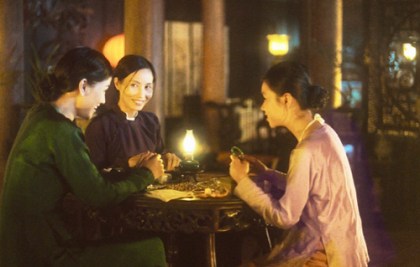
Inspired by true events in 19th century Vietnam, 14 year-old May is married into a rich landowner family. She is the third wife of the patriarch’s son. Her sole purpose is to produce a male descendent for him, as the first two wives have only daughters. A film with minimal dialogues, The Third Wife is a visual story. Its aesthetics and sensual, dream-like sequences wrap a harsh reality: the plight of women in a patriarchal society. Mayfair was born and raised in Vietnam, an Oxford and NYU Tisch School of the Arts graduate. This her debut feature is a quiet and potent voice in the #MeToo awakening.

***

For the full program of the 38th MSPIFF, CLICK HERE to their website.


‘Ash is Purest White’ delivers a dramatic punch

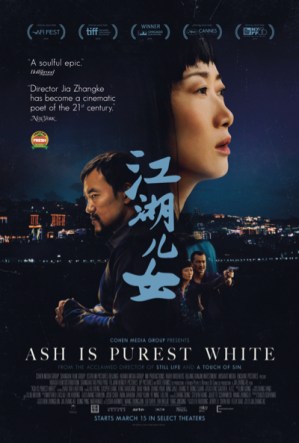
Ash is Purest White Poster (2)Premiered at Cannes Film Festival in May 2018, and since then showing in numerous international film festivals around the world, “Ash is Purest White” is now playing in selective cities in the U.S. If you live near Twin Cities, MN, it opens Friday, March 29th at Landmark’s Edina Cinema.

Ash is Purest White” is acclaimed director Jia Zhangke’s latest feature, a China and France co-production. It is like a fusion of Jia’s previous “A Touch of Sin” (2013) and “Mountains May Depart” (2015). The film is structured in three parts, packed with conflicts of loyalty and betrayal, love and loss. The fast changing physical and technological landscapes in China are the realistic backdrop of a story wrapped in the contradictions of choice and fate.

For non-Chinese language viewers, the English title could well be a mystery. What exactly is its meaning, and what kind of genre is it?  The film has an answer as the phrase is explicitly mentioned: Anything that burns at a high temperature is made pure, thus, volcanic ashes are purest white, an apt metaphor as the story unfolds. The Chinese title, however, is less philosophical.  江湖兒女  (“Jianghu er nü”) literally means “jianghu’s sons and daughters”, implying an action genre movie.

“Jianghu”, that undefinable term with no direct English translation, gives it away as it refers to the ancient wuxia (martial arts) world or the gangster realm in present day. In an early scene when the two main characters, mobster big brother Bin (Liao Fan) and his girlfriend Qiao (Zhao Tao) are out in the natural landscape with a volcano in the backdrop, Bin says he belongs in the jianghu underworld: “For people like us, it’s always kill or be killed.” Qiao quickly responds, “I’m not part of the jianghu. You’ve watched too many gangster movies.” Bin in turn takes out his gun, wraps Qiao’s hands to hold it up, shows her how to cock and fire. “See now you’re in the jianghu,” he says.

That is a pivotal scene as it foreshadows things to come. Qiao is pushed into jianghu as she later fires the gun to ward off a group of hooligans in order to save Bin. What more, to protect him, she admits to the police that the gun belongs to her. With that, she spends five years in prison. Jia has created in Qiao a reluctant heroine, capturing our attention with her loyalty and courage, two elements that are essential in jianghu.

“Ash is Purest White” is a mixed bag of crime thriller, melodrama, acerbic realism and humour; the story is an engaging vehicle taking us on Qiao’s personal journey. With this his latest film, Jia won Best Director at the Chicago International Film Festival and Zhao, his wife and muse, Best Actress. Most recently, he added one more accolade as the film garnered Best Screenplay at the 13th Asian Film Awards in Hong Kong on March 16th.

A story told in three acts, the feature is a dramatic depiction of Qiao’s change as she is swept through the currents of life, first as a young woman following Bin around as his girlfriend, a relationship that he is reluctant to confirm. Then comes the pivotal scene of fate sending her to the second act, incarcerated. Later when released, she becomes more street-smart––being cheated, she learns to cheat––all for finding Bin, to pick up where they have left off.

The last part is 18 years from the beginning, Qiao has established herself in Bin’s previous hood, but Bin is no longer the feared and respected big brother. Fate has led him onto a path towards oblivion. The final scene leaves us with a poignant realization, the currents of time may have altered physical landscapes, certain things do not change within the hidden vault of the heart.

(A full version of this review is posted on Asian American Press. Click here to read. )

~ ~ ~ Ripples


What ‘Greta’ could have been

Greta Poster

Greta has all the ingredients to be a much more elevated film. The stalker and prey duo played by veteran French actress Isabelle Huppert and the popular young star Chloë Grace Moretz make a perfect match, director Neil Jordan has top talents in his helm.

At first, looking at the cast and the director’s filmography, I was expecting a psychological thriller. Jordan had won an Oscar for writing the original screenplay of The Crying Game (1992) which he also directed. Later he brought us The End of the Affair (1999), a memorable adaptation of Graham Greene’s novel, again as writer/director. Greta is the Irish director’s most recent feature.

With the older woman stalking a young, innocent prey storyline, Greta could have developed into a deeper, character-focused movie, with more backstory, maybe even a poignant depiction of loss, loneliness, and obsession. Actually it would have been Huppert’s forte to do just that. As Greta Hideg, a widow living by herself in NYC with only her piano music as companion, the role sheds a little reminiscence of Huppert’s Cannes winning character in The Piano Teacher (2001) directed by Michael Haneke. But here she is simply a violent psychopath.

A young, new transplant to NYC, Frances (Moretz) finds the handbag that Greta has left in the subway train. With good intention and much naiveté, she locates Greta’s address and brings it all the way to her home. The rest of the story unfolds with expected development but unexpected, sudden loud sounds aim to scare and shock. Thanks to the ‘chemistry’ between the two stars and their engaging performance, the movie holds up for the first hour. A third character, the free-wheeling roommate Erica (Maika Monroe) is a balm to a distressed Frances, and I admit, to us viewers as well.

The first 60 minutes of the movie was well grounded for some deeper development of story and characterization. However, writer/director Jordan chose the path of the horror genre and its wares, lapsing the second part into unconvincing maneuvers. Huppert as a revenger in Elle is psychologically thrilling; Huppert as a psychopath goes bonkers in Greta is ludicrous. When you hear laughter in the dark theatre during a horror movie, you can almost gauge the effectiveness of the intention.

As for the prominent leitmotif, Franz Liszt’s Liebestraum (Love Dream), it just serves to stir up yearnings for something deeper and artistically satisfying, instead of, alas, leaving us with an illusive dream.

~ ~ Ripples

**


Other Isabelle Huppert’s films reviewed on Ripple Effects:

Things to Come

Claire’s Camera


***


The Favourite: How important is Historical Accuracy in a Period Movie?

Yorgos Lanthimos’ The Favourite is on my Top Ripples 2018 list. I added it in after I’d already posted my annual wrap. I judged it mainly on the basis of its aesthetics, film as an art form, the acting, cinematography, and overall styling.

I went into the theatre with no prior knowledge of the historical details. So, with no a priori burden as a fact-checker, I just let my curiosity lead me, and soon I was transported to a very different world in a very different time. The Favourite shows us Queen Anne’s court in early 18th C. England, where the Whigs fight against the Tories, where men wear wigs and stay indoor cheering on ducks racing or hurling fruits at a naked, good-humoured and heavy-set man (easy target) who finally slips on the fruity and juicy floor, while women play with guns and shoot pigeons outdoor, and pretty good aims they are too, both with the pigeons and in narrowly missing the human target, just as a warning.

the favourite

The film is all about the relational triangle between three women. The trio of actors are undoubtedly the distinguished assets of the production: Olivia Colman as Queen Anne, Rachel Weisz her intimate confidante Lady Sarah Churchill, and Emma Stone as Abigail, Sarah’s cousin and novice chambermaid, soon the new favourite of the Queen’s. Abigail is a quick study; in no time they are all drawn into a three-way tug-of-war. Although initially coerced by the leader of the Tories, Robert Harley (A wigged and made up Nicholas Hoult, long way from About A Boy, 2002), to spy on Anne and Sarah, who sides with the Whigs, Abigail later learns to use Harley’s influence as leverage to her advantage.

Against the historic backdrop of the war with France, the film is an intriguing look into a royal court and partisan politics, but the most meaty story is the power struggles among the three women, and how conflicting dynamics, sexual politics, emotional manipulation, jealousy, and treachery will ultimately consume all. If you’re on an existential quest for meaning, look elsewhere. This film is pure entertainment, irreverent, surreal, sumptuous in set design, costumes, make-up, and spot-on in editing and acting; but it’s not for the serious meaning seeker.

The Cinematography effectively augments the overall aesthetics. Director of photography (DP) Robbie Ryan used a fisheye lens and a roving camera to sweep wide-angled shots, giving us a lively, larger but distorted view, like looking into a fishbowl, which is totally compatible with the genre, for to say The Favourite is a comedy is an understatement. The film is more a farce, and at times outrageous to the point of gratuitous sensationalism. The effect is acerbic sarcasm.

But there are plenty pleasing things to look at as the camera captures the sumptuous set design. The fluid, almost 360º camerawork pans like an all knowing eye. That in itself is ironic, for hidden agendas are ubiquitous among the characters. Shot in 35 mm film, Ryan utilizes natural lighting, and in the dark, a single candle light, all work to serve up a classy, Rembrandt-like impression.

The music too, plays a prominent role in establishing the overall classical tone, Vivaldi, Bach, Handel… yet with a splash of contemporary touch as well, like, Elton John’s “Skyline Pigeon” on harpsichord, and piano. Incidentally, in a few scenes, a long-lasting single note or two – which I’m sure even Philip Glass would find too minimal – will repeat and repeat to pull the string of tension, keeping viewers edgy and uncomfortable. Considering Lanthimos’ previous Cannes winning films The Killing of a Sacred Deer (2017) and The Lobster (2013), The Favourite is relatively conventional in style as a period movie.

I have no favourite among the trio, all three deliver spot-on performance, lively in restraints or outbursts. Colman’s gout-stricken Queen Anne is ludicrous and simple minded, but only in appearance. In a candid moment in front of Abigail, she pours out her inner hurts, so much tragedy in her life: 17 pregnancies, none survived. The 17 rabbits she keeps in her bedchamber are symbols representing each one of her loss, twelve miscarriages and stillborn, five dead children. Doting on them is Anne’s way of dealing with her loss.

And kudos to Abigail who at one point has indeed shown genuine sympathy for the Queen’s plight. Anne is perceptive of this too, a point well earned in Abigail’s favour. Stone is well cast in her role, her initial naiveté shines through. She soon learns that is her best weaponry, and uses it well as she turns into a master of manipulation behind the youthful and innocent mask.

Weisz’s Sarah is cool, scheming, head-strong and controlling. She is the voice and brain of Queen Anne, and yet we can see too that there is a strain of care underlying the strong front. Love speaks the truth, she tells Anne at one point, and the Queen seems to accept Sarah’s opinion with docility – including comment such as “you look like a badger”, citing the smeared eyeshadow on her face – that is, until Abigail shows up.

A palace is a decadent place where power reigns supreme for whoever that happens to grab it for the moment. A mud bath for two could easily shift the dynamics of power balance. It’s intriguing and hard to discern if Anne’s fondness of lesbian pleasures is not so much a result of her innate senses but an intentional bait to control. Ultimately all three fall prey to uncensured misery. The closing shot shows there’s no winner, only the mashed up image of the two remaining in the Queen’s chamber, blurring and overlapping with the propagation of rabbits. And what are they, these rabbits, but symbols of death and remembrance of loss? Surely not a comedic ending.


~ ~ ~ Ripples

________________


After watching the film I went online to learn more about Queen Anne and the historic background of the movie. Here are some of my findings (Warning: Spoilers):

There were no rabbits – They are but director Lanthimos’ own creation. But does it matter that the real-life Queen Anne didn’t have a soft spot for bunnies? I feel they are quite effective here in the film, contrasting Anne’s soft heart and Abigail’s callous, sadistic dealing with those around her, notable is the scene where she steps on one almost crushing the poor creature flat on the floor. Quite like a movie adaptation of a book, a film is a totally different entity and art form for expression.

Abigail did not poison Sarah Churchill – I can understand, to advance the plot and consistent with Abigail’s callous scheming to get rid of obstacles in her way. However, maybe a slight apology to the real Abigail Hill in history for portraying her like a Lady Macbeth?

Queen Anne had a husband – Queen Anne married Prince George of Denmark in 1683.  She had been married for 19 years before she came to the throne and reigned for 12 years, 1702–1714. Prince George died six years into her reign in 1708. According to some historic records, their marriage was strong and she was devastated by his demise. Abigail arrived in Anne’s palace in 1704, married Samuel Masham in 1707, Sarah stripped from her royal position in 1711. There’s an overlap of several years with Anne’s husband still alive when Abigail came into Anne’s court.

There is no mention at all in the film about Anne’s husband Prince George. Anne was portrayed as a single woman with a lesbian lover, Sarah Churchill, then later shifted her favourite to Abigail. The main thrust of the film is built on a lesbian love triangle. Is that also within the creative license held by the filmmaker?

Sarah and Anne’s real relationship remains unclear – Historic records show Anne and Sarah were inseparable since childhood, thus fostering a long-time mutual devotion to each other. The two had exchanged letters with passionate descriptions. As for the new favourite, Abigail, there was rumour that a song was circulated by the Whigs suggested that Anne committed “dark deeds at night” with a “dirty chambermaid.”

Letters from Anne to Sarah still exist and it’s clear there was a deep love between them – until Anne shifted to a new favourite, and in the movie, all due to Abigail’s scheming.

In a BBC News article, Queen Anne biographer Anne Somerset and playwright Helen Edmundson, who wrote the 2015 play on the relationship between Anne and Sarah performed by the Royal Shakespeare Company, both agreed that “no one can now be entirely sure of the nature of the relationship between Anne and Sarah.” Further, “we should be wary of assuming that attitudes to sex, friendship and romance were the same as they are today.”

Such an ambiguity may just be too enticing a bait to pass by for a film director to tailor it for today’s audience. Does a period movie based on history need to be ‘faithful’ to it, or, the artist holds the creative license to imagine and create. Many period films do have discrepancies with historic facts. Perhaps, like adaptations from books, filmmakers can be revisionists as well?

***

Some links to historical background:

The woman behind Queen Anne’s reign, BBC News

Anne (1665 – 1714), BBC History

The True Story Behind The Favourite, TIME

Was Queen Anne Really Caught in a Lesbian Love Triangle? Fact Checking The Favourite, People

***

Related Post:

The King’s Speech: Fact and Fiction

Ripple Effects Turns a New Page in 2019

Ripple Effects has reached a new milestone. After almost twelve years in the blogosphere, Arti has finally fought off procrastination and taken up an upgraded version. From now on, there will be no ads even if you’re not a WordPress blogger visiting (let me know if you still see them). What more, there’s a new URL address to the Pond, aptly:

rippleeffects.reviews


But if you type in the old, longer one it will redirect you to the right place here at the Pond as well.

While birding is still my passion, I’ll be posting mostly film and book reviews on Ripple Effects. My avian friends will probably fly by during intermission.

Your two pebbles are welcome as before. Throw them in, stir up some ripples. As always, I hope you’ll find here a respite for quiet thoughts and prompting to some interesting viewing and reading. I await your visits.

***

Have you ever seen so many people lining up to go into a public library? It happened right here in my city, Calgary, Alberta, on November 1, 2018, when our New Central Library opened. 50,000 visitors in the first four days. Yes, there will be talks of books and movies here on Ripple Effects.

New Central Public Library, Calgary.jpg

The Calgary Central Library was one of Architectural Digest’s 12 most anticipated buildings opening in 2018. Check it out here.

***