Dances with Words

After listening to an audiobook, do you consider having read the book?

Why or why not?

I’ve been mulling over this question for some time now. I love reading, but I’m a slow reader. It’s always faster to listen to a book read to me than reading it myself. So you see the appeal there. And I can make good use of my time while driving.

But I always feel there’s a difference between listening and reading. All along, I don’t equate having listened to an audiobook with having read the printed pages. I’m beginning to find the word ‘finish’ most apt, since it can apply to both. Saying ‘I have finished a book’ can mean either.

Oral tradition of storytelling has long been around in human history, a way to preserve tales and legends that had not found a written form. But for those that do have a life in words, or, ‘texts’ in our eAge, why do I still hesitate to consider listening to them the same as reading the print version?

At long last, I think I’m beginning to get a hold of what could be the difference… and this may sound so common sense to you. But, it’s an Eureka moment for me.

Here it is: Reading a book is a first-hand encounter. I’m the sole interpreter of the text. Like partners in a dance, as a reader I respond and move with every single word in my own way.
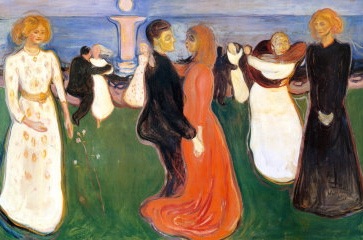
The Dance of Life by Edvard Munch (1900)

With audiobooks, I’m listening to a voice that has already interpreted the written codes. Every audio recording is a performance. And I mean it in a good sense. The reading I’m listening to has passed through an interpretive filter. That voice must have first read the words, internalized, and then delivered them with what the voice thought was the appropriate diction, pitch, accent, tempo, emotion…

When I’m reading a book, I’m dancing with the words as partners. When I’m listening to an audiobook, I’m watching a dance performance. I enjoy both. But the experiences are different… and there’s only one first-hand encounter that’s unique to me: my own.  But sometimes, I need to see how others dance too in order to appreciate the story or the characters more. We just may need dancing lessons every now and then.

I must give kudos to two audiobooks I finished recently. In both of them, the voice reading the text confirms how fascinating dances with words can be.

On Beauty by Zadie Smith, read by Peter Francis James:

I’m amazed how one reader can give life to characters of various cultural background in such a vivid manner. On Beauty explores in a nuanced and comical way, relationships and conflicts within a family, as well as between races, generations, and genders. It was shortlisted for a Booker (2005) and was the Orange Prize winner in 2006. Now imagine the myriad of characters.

The book describes two families intertwined in a cacophony of cultural dissonance, the fathers being academic rivals. In the Belsey family we have father Howard who is a white Englishman, his African American wife Kiki, their three youthful offspring who have grown up in America influenced by different subcultural vernaculars. Melting pot is a wrong term to describe them. It’s more like you’ve thrown classical, jazz, hip-hop, rap, all into the wok and stir fry.

Howard’s academic rival is Monty Kipps, who has brought his family from England to stay in America shortly as a visiting scholar teaching at the same college as Howard. The Kipps family members are all British citizens with Trinidadian heritage. Their two college age children have grown up in England.

The talented actor Peter Francis James has given a worthy portrayal of such a cultural mix of characters without turning them into caricatures, but has rendered them convincing and real. Zadie Smith’s nuanced dialogues and humor are well executed. It is a close encounter of dissonance in language, accents, values, and racial influences. What a dance performance this is. I have not read the book, but when I do read it, I’m sure I will not appreciate it as much if I haven’t heard the voices jumping up and down in my mind.

Gilead by Marilynne Robinson, read by Tim Jerome

Gilead was the 2005 Pulitzer Prize fiction winner. I read the book a few years back. Listening to the audio CD’s recently has not only brought back memory of my previous enjoyment, but insights that I’d missed my first time reading the book. All thanks to the calm, soothing, and gentle voice of Tim Jerome, portraying spot-on the ageing John Ames, Congregationalist minister of Gilead, Iowa.

Throughout the book, there’s only one character speaking, that of John Ames leaving a legacy to his very young son, telling him stories of his own grandfather and father, a family tradition of ministers. Jerome’s audio rendition of the book works in me like a devotional. His voice embodies grace and forgiveness. Listening to him can only augment my own reading experience, a performance to emulate for the dance of life.

***

What are some of your experiences of reading vs. listening to books? Which are your favorite audiobooks?

***

This is My Spring…

… and I’m fine with it.

I’ve seen lush green meadows, full bloom flowers, and fresh plump berries from many of your spring posts. I must share with you what I’m getting…

It’s a long process before green appears, but we’re used to that. Spring for us is a gestation of life, a long process. There can be false starts too, teasing us with more snow. It tests our patience.

First we wait for all the snow to melt:

The melting Bow River
Another view, another colour

A closer look only fascinates me more, the sight and sound of spring… a rythmic ploink… ploink.

Dripping ice water
Icy frame of a kaleidoscope

The slowness of spring allows me to cherish a while longer the sights of a season past:

Snow bank along the Bow
Remnants of a colourful fall

Meanwhile… the buds silently appear. No greens yet, but still a sure sign of spring. Brown tips burgeoning out everywhere, keen and strong:

Sure sign of spring

Before the greens, many colours have to parade by, nature’s processional. As a spectator, I can only applaud.

Spring will burst forth in all its glory…  in its time.

***
The Grey (2012): Of Wolves and Men

There are films that I expect to glean meaning from but leave me disappointed. And then there are those that do not appear to provoke thought at the outset and yet manage to do so, sending me out the theatre with gratified resonance. The Grey is one such film.

A plane carrying a group of Arctic oil-rig workers crash in the deep snow of the Alaskan wilderness. There are seven survivors. The task of leading them out of the crash site to seek safety falls on the shoulders of John Ottway (Liam Neeson). His job at the oil rig is security, a marksman protecting the workers from wild wolves. At the beginning of the film Ottway is shown to be suicidal, overwhelmed with grief from the recent passing of his wife. It is ironic to see at the end, he is propelled by courage to fight for his life.

In the cold expanse of Alaska, Ottway leads the surviving men to trudge through deep snow, trying to get to safety away from wolf territory. The men are pitted against each other, stranded at nature’s mercy, defenceless against a pack of carnivorous grey wolves. It’s a survival story, a suspense thriller that has me on the edge of my seat. But it goes further than that.

Director Joe Carnahan does not just show a group of roughnecks toughing it out in extreme condition, facing death at every turn. He brings to the forefront some existential queries, as one by one the men fall prey to the wild. Stripped to bare existence, how is man different from wolves? For what do we live? For what do we die? Such moments of ruminations are enhanced by Masanobu Takayanagi’s meditative cinematography.

As they leave the crash site, Ottway tells the survivors to collect all the wallets from the victims so they can contact their family, if they ever get back home. From the photos in their wallets, we get a glimpse of lives lived, and know that they have loved ones waiting. Following their treacherous path, we might sense that their outward skepticism masks a painful and silent hope for a transcending force, One who can save them from their fateful predicament.

The men don’t bond right away. The unruly, the scared acting tough. But extreme circumstances change them quickly. Sitting around a fire, they learn to cherish the memories they’ve had in their life, and begin to value each other. We know their fears. We listen to their stories. In one moving moment, Ottway shares a poem he remembers his Irish grandfather had written. Little does he know those words would become the fuel that catapults him to fight for his life at the end.

There’s something about Liam Neeson that stands out in a film. He embodies a kind of dignified charisma. But here in The Grey, it’s not just charisma, it is like poignant reality. The look on his face speaks volumes. In the film, he conjures up in his mind the wife he has loved and lost lying beside him. “Be brave,” he can hear her loving whisper. In real life, he just may be aching for the same, as his wife Natasha Richardson died after an accident in the snow three years ago.

Animal advocacy groups have voiced out their opposition to the portrayal of the Grey Wolves in the movie. Wolves are social animals, gentle and non-aggressive, they argue. The film gives them a bad rap. My thought is this: If a young human can go into his school and massacre his peers, and if humans can murder members of their own clans, why is it hard to imagine carnivorous wild wolves would prey and attack intruders in their territory? Showing that animals do act on their instinct is no disrespect.

After all, this is not a scientific study of wolf behavior. The film is less about wolves than men. The questions it poses cannot be answered by Science. And if you have to be accurate about all the facts, it’s not in Alaska where they shot the film, but here in Arti’s territory of Western Canada, Alberta and British Columbia to be exact. But what does it matter?

I will not give away spoiler about the ending, for it struck me most strongly and left me with deep resonance as I walked out of the theatre. It is poignant and powerful, although I did hear a gasp of ‘what?’ from someone in the dark theatre. If you go to see this movie, do sit through the credits, and stay there until the very end of the roll, you’ll see something more.

Yes, there is suspense and some action. But what’s more important is that there are quiet moments for ruminations. If you are comfortable with that, you would likely care to follow these men in their precarious strive for survival.

~ ~ ~ Ripples

***

A Change of Scenery

What a difference a few hours of air travel can do… this past week I’ve come out of hibernation above the 49th parallel and travelled to balmy San Diego. My world was transformed from snow-capped rockies to surf’s up ocean… and was rewarded with some spectacular sights.

Surf's Up
Birds of Paradise
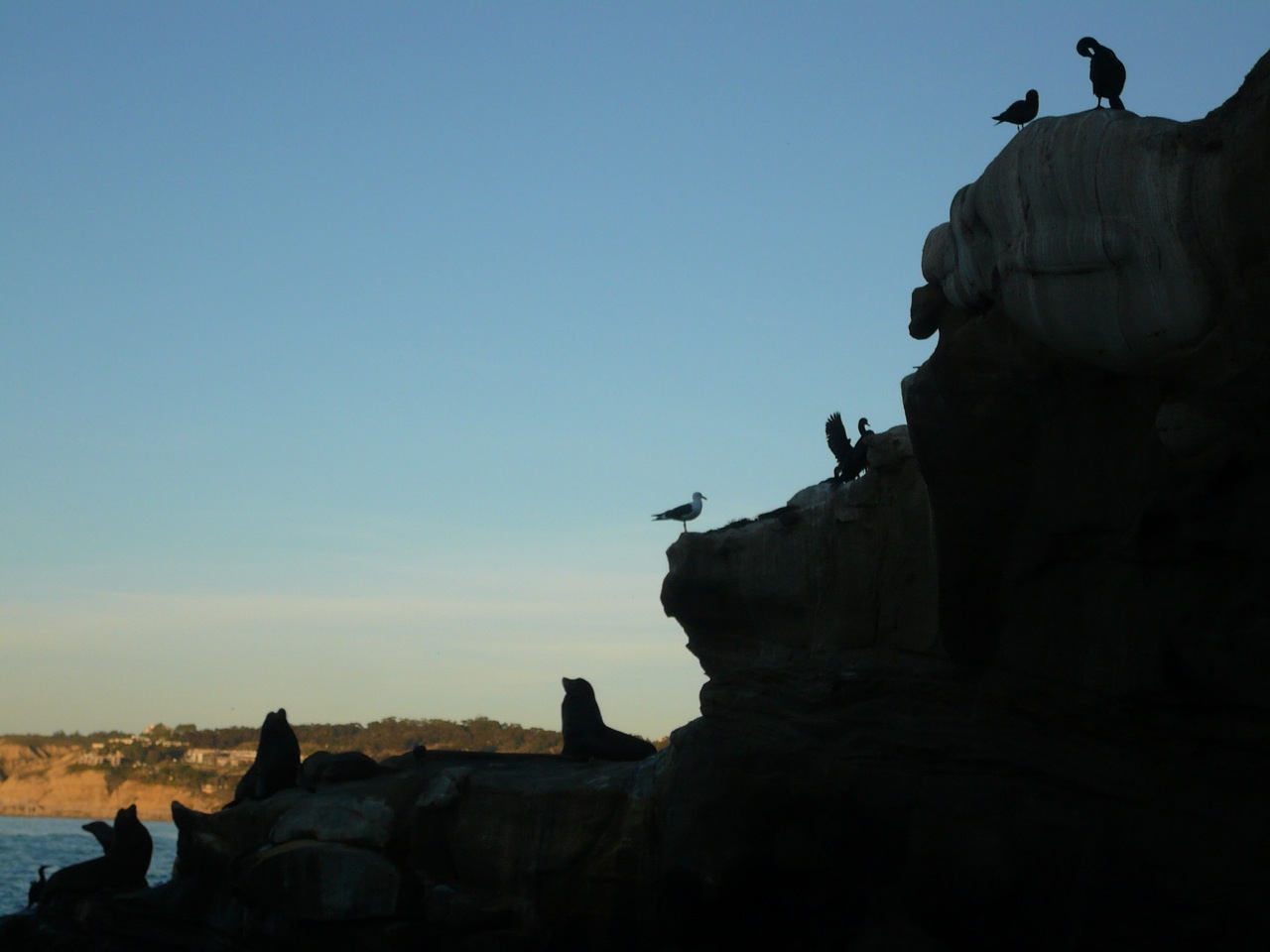
Birds and seals at La Jolla Cove
Palms in Sihouettes
Pacific Sunset

From the ocean to inland, with my Ohio cousin in Thelma and Louise style, we drove through the Mojave Desert, and arrived at Las Vagas. No, not for the slot machines, but was amused to see the town literally painted red celebrating the Chinese New Year: The Year of the Dragon. Here’s a fascinating masterpiece from Jean Philippe Patisserie: A life-size dragon, about 8 feet long and a cherry blossom tree all made of milk, dark, and white chocolate, lanterns of rolling fondants, pearls and flowers of sugar:

The next day, we took a bus tour into Arizona, a five hour drive to the South Rim of the Grand Canyon… a sight no dragon can match:

The Grand Canyon: view from the South Rim

Fred Harvey, a visionary immigrant from London, started the Fred Harvey Company there in the South Rim of the Grand Canyon. In the late 1800’s to the turn of the century, his company and the Santa Fe Railway changed the scene of hospitality by creating comfortable and reasonably priced tourist facilities and meals. Above all, he had the revolutionary spirit to hire a female architect Mary Colter to design the buildings at a time where the Southwest was dominated by macho inhabitants. Her buildings are all on the National Register of Historic Places today.

Mary Colter was an architectural pioneer. For forty years, she designed for the Fred Harvey Company. Her works blended with the natural environs and the native inhabitants of the Grand Canyon. Her materials were mostly wood and stone, her style rustic. Here’s the Bright Angel Lodge where Harvey offered many women employment opportunities. The waitresses in the dining room were known as Harvey Girls.

Bright Angel Lodge

Another Colter work: The Lookout Studio, which offers a breathtaking vantage point to the Grand Canyon.

Lookout Studio

I was pleasantly surprised to find this plaque at the entrance of the Lookout Studio:

The Grand Canyon Railway begins in Williams, Arizona, and for 60 miles, bring its passengers north through beautiful forest and mountain scenery to their destination at the Grand Canyon. The first passenger train arrived at the Canyon in 1901. During the 1960’s, travel was taken over by the automobile. But today, it has resurfaced as a vibrant mode of tourist attraction.

More sights to share… coming up.

***

Molly Fox’s Birthday by Deirdre Madden

This is my first selection for the 2012 Ireland Challenge at Books and Movies. Thanks to Litlove and Rebecca for the recommendation.

Molly Fox’s Birthday was on the long list of the 2009 Orange Prize. Despite the title and the look of the book cover, it’s not chic lit. It’s not about celebrating a birthday either.

The book is set on a single day, Molly Fox’s birthday, June 21st, the summer solstice. Molly Fox is a popular and gifted theatre actor. On that day, the narrator of the book is staying at Molly’s home in Dublin while Molly has gone on a trip to New York. Nothing much happens really on Molly’s birthday, a day that she doesn’t even celebrate.

The narrator is a playwright who has enjoyed acclaims at one time but is now going through a low period in her career. On this day, she is struggling with writer’s block. While she is staying in Molly’s home trying to start a new play, she is preoccupied with memories and pondering. She reminisces on her longtime friendship with Molly, who was initially propelled to fame when she performed  in the narrator’s debut play.

Gaiety Theatre, Dublin

Through her quiet recollections, the narrator describes how their lives intertwine with two other significant characters, Molly’s brother Fergus and their mutual friend Andrew, who is from Northern Ireland. The political events that happend during the past decades had shattered his family. A successful art historian living in London now,  Andrew is still haunted by disturbing memories. And Fergus is another personality which the narrator finds intriguing to discover slowly.

Sometimes it’s just a gut feeling that you like a book. As you’re reading, there’s a gentle push that prompts you forward, reinforcing your favor as you slowly go along… even though ‘nothing much happens’. To go beyond feeling is what I need to do now. Let me try to organise my thoughts:

First it’s the voice. Often that’s the first thing that draws me into the story. Throughout the book, the narrator is unnamed. Her voice is casual, understated, and her tone is occasionally self-deprecating: “… I was in the supporting role: ever the stooge…” For some reason, I’m instantly drawn to such remarks.

But the self-deprecation only hides a genuine search for self-worth, and a deep longing for what is true in relationships and in life. I admire her sincere quest for that which is authentic in herself and others. Like a close friend relating to you her deepest thoughts, you want to listen attentively.

Author Madden’s strategy of keeping the narrator anonymous is most apt, for we are led to discover her inner world, and appreciate the substance that makes up who she is. A name only identifies the surface, the content within is what makes it worthwhile for readers to know in a character.

Intriguingly, this is exactly what the narrator tries to do. As she struggles with writer’s block, she is also sorting out the blockages of veiled personas of those whom she thinks she has come to know, to find out what they are beneath the surface.

What appeals to me is the narrator’s insightful point of view disguised as casual remarks. Like how she recalls the first time she recognized Molly in a café, sitting nearby her and reading a book:

I did not approach Molly — what could I possibly have said? I really liked you in ‘The Importance of Being Ernest’. And what could she have replied? Why thank you very much. What would that have amounted to? Less than nothing. There are forms of communication that drive people apart, that do nothing other than confirm distance. But there are also instances when no connection seems to be made and yet something profound takes place, and this was just such a moment.

Café in Dublin

On Molly’s birthday, the narrator talks to three people who come by Molly’s home, Andrew, whom the narrative has not seen for a while, Molly’s brother Fergus and a well-wisher. From interactions with them, the narrator is surprised to learn that people’s outward image may well be a front hiding a very different self or intent.

From reading the quiet ruminations, I’m delighted to discover gems along the way. Like the rest of the narratives, it seems that the author has strewn them about casually. We’re free to notice and pick up. Here are a few of them:

From the narrator’s oldest brother Tom, a Catholic priest —

Eternity is a priest’s business. But we all live in time. And what I’m doing is trying to make people aware of how the two coexist… keeping that sense of eternity while being in time; and trying to live accordingly…

How the narrator describes Molly’s acting —

There was always something unmediated and supremely natural about her acting, it was the thing itself. Becoming, not pretending.

About the self on and off stage —

Is the self really such a fluid thing, something we invent as we go along, almost as a social reflex?… so much social interchange is inherently false, and real communication can only be achieved in ways that seem strange and artificial.

And this —

Sometimes, on stage, not showing something can be more powerful than showing it.

Seems like this might well be the style Madden follows in writing her book. Subtle prompting, slow revealing… and we’re led to surprising discovery alongside the narrator.

Molly Fox’s Birthday reminds me of Somerset Maugham’s novel Theatre. But this is quieter. And after I’ve finished I wonder… what have I missed now… for there are so many layers, I haven’t explored them all. First off, what’s the significance of a birthday on the summer solstice…

~ ~ ~  Ripples

***
Post of similar subject:

THEATRE by W. Somerset Maugham: In Search of Reality

***

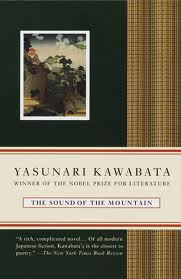
The Sound of the Mountain by Yasunari Kawabata

The Sound of the Mountain (山の音) is my book for Japanese Literature Challenge 5 at Dolce Bellezza, the only one this time and posting it before the Challenge ends this month. It is the first book I finished in 2012, at 1 a.m. January 1st. Truth is, I wanted to finish it by the end of last year, but couldn’t. I’ve been reading it for weeks in December. It’s a book that I had to read ever so slowly.

Yasunari Kawabata (川端 康成, 14 June 1899 – 16 April 1972) is the first of two Japanese Nobel laureates in literature, receiving the honor in 1968 (Kenzaburo Oe in 1994). So far I’ve only read two of Kawabata’s books, Snow Country and The Sound of the Mountain. But from this limited experience, I’ve found that reading Kawabata is like watching an Ozu film. The camera is set low and mostly stationary to depict quiet expressions and gestures. Viewers are engaged by the nuanced dialogues as the director explores in depth thematic materials rather than presents plot-driven sequences. Both masters deal with intimate relationships, their characterization sensitive , their imagery poetic.

Ogata Shingo is in his early sixties, beginning to show signs of old age. Ever introspective and sensitive, he can almost hear the beckoning of death as sound that comes from the mountain to the rear of his house in Kamakura. As he lies in bed at night, beside his oblivious, snoring wife Yasuko, he can distinctly hear that sound:

It was like wind, far away, but with a depth like a rumbling of the earth… The sound stopped, and he was suddenly afraid. A chill passed over him, as if he had been notified that death was approaching.

At most, Shingo feels a duty towards his wife Yasuko. His heart though is drawn to two women, one is his wife Yasuko’s older sister who passed away from an illness some time ago. Yet Shingo still cherishes memories of her. The other is his son Shuichi’s wife, his own daughter-in-law Kikuko, who lives in his house. Nurturing a crush on two women who are not his wife has troubled Shingo deeply.

But the guilt he wrestles with is only a part of the distress he faces so late in life. Shingo has to face the marital problems of both his son Shuichi’s and his daughter Fusako’s.  Shuichi, who lives with his wife Kikuko in the house of his parents, has been seeing another woman, Kinu. And Shingo’s daughter Fusako has recently returned to her parent’s home with her two young children after her husband has deserted them.  Despite their being adults now, Shingo feels responsible for the failure of his children’s marriage.

In a restrained bickering between father and son, Shingo is put on the spot:

I’ve been thinking a little,” muttered Shuichi. “About Father’s life.”
“About my life?”
“Oh, nothing very definite. But if I had to summarize my speculations, I suppose they would go something like this: has Father been a success or a failure?

…..

But whether or not a parent is a success would seem to have something to do with whether or not his children’s marriages are successful. There I haven’t done too well.

As I was reading this book, I thought of Ozu’s films. Like Ozu, Kawabata is bold to expose the breakdown of the traditional family and the threat to paternal authority in post WWII Japan. He depicts the shift from a parent-child emphasis to one between husband and wife. He is honest in revealing the common cracks of unfaithfulness which can destroy marriages. In the book, he openly describes the strain and alienation between generations and within a marriage.

Besides relationships, Shingo has to battle with something more inherent and spiritual. His son Shuichi neglects his wife Kikuko and often goes to his mistress, Kinu, who later becomes pregnant. Shingo not only takes upon himself to deal with Kinu, but is drawn into something even more difficult to confront, for in Shuichi, he sees himself:

Shingo was astonished at his son’s spiritual paralysis and decay, but it seemed to him that he was caught in the same filthy slough. Dark terror swept over him.

Shingo is a man afflicted on severals fronts, guilt, responsibility, spiritual decay. Author Kawabata instills relief for his protagonist as well as his readers by means of Nature.

Gingko Tree in Japan

Shingo is superbly in tune with the natural world, and in turn, nature is a mirror from which he sees himself clearly. The temperamental sky reflects his moods; the typhoon, his inner turmoil; stalks of bamboo broken off by the storm parallel the broken family relationships he lives with; the noise of locust wings spells restlessness; and yet the unseasonable buds on the great gingko tree splashes hope in a troubled time:

The gingko has a sort of strength that the cherry doesn’t,” he said. “I’ve been thinking the ones that live long are different from the others. It must take a great deal of strength for an old tree like that to put out leaves in the fall.

And thus comes the turning point in Shuichi and Kikuko’s marriage, though fragile, still a glimmer of hope, while Fasuko’s marriage comes to an abrupt end like an overnight storm. As for Shingo, we wish him well, like the unseasonable buds on the great gingko tree.

The Sound of the Mountain requires slow reading and quiet contemplation. Like a good film, I know I will go back to it as time goes by.

**

The Sound of the Mountain by Yasunari Kawabata, translated by Edward G. Seidensticker, published by Vintage International, NY., 1996, 276 pages.

Note: ‘gingko’ in this book is spelt differently from our common spelling nowadays ‘ginkgo’

Ginkgo Tree photo from Wikimedia Commons

***

Other related posts on Japanese Literature and Films:

Reading Snow Country in Snow Country

Rouse Up O Young Men of the New Age by Oe

Yasujiro Ozu and the Art of Aloneness 

Notes on the Synthesis of Film, Art… Life?

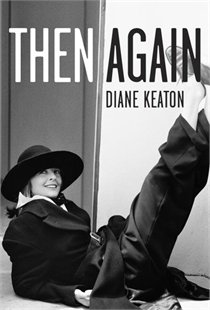
Then Again by Diane Keaton

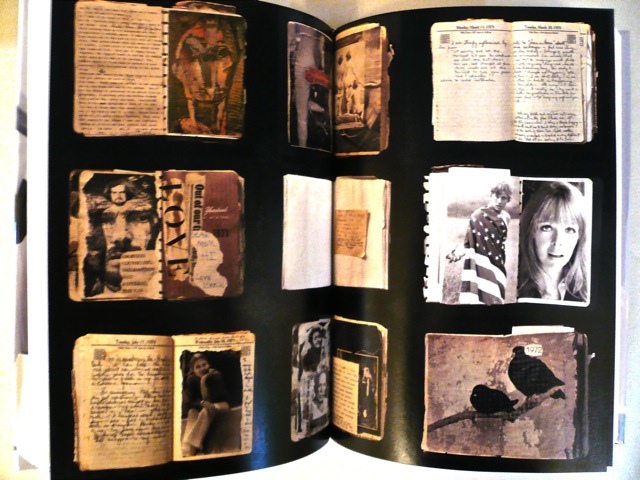
It’s interesting to read Diane Keaton’s memoir after Julian Barnes’ The Sense of an Ending. In contrast to Tony’s hazy past in Barnes’s novel, here we have memories strung together with clarity and adequate documentation. Take a look at these insert photos. I admit, they were the very reasons the second I opened the library copy that I decided I must get my own to keep.

Dorothy Keaton’s Journals

These are journals belonging to Diane’s mother Dorothy Keaton.  She first started with a series of letters she wrote from her California home to her eldest daughter Diane, who had moved to NYC at age 19. Letter writing developed into full volumes of family journals and scrapbooks. Further, she had kept detailed documentation of Diane’s career from 1969 to 1984. With the onset of Alzheimer’s, Dorothy still kept close contact with her daughter through letters and phone calls, leaving phone messages which showed the signs of a mind quickly sliding down the slope.

Stacks of memories

Diane has poignantly interwoven her own thoughts and memories with her mother Dorothy’s, a daughter’s attempt to capture life that was THEN in order to relive the moments AGAIN. Diane’s father Jack Hall died of cancer in 1990, only a few months after the diagnosis. Dorothy died of Alzheimer’s in 2008. This memoir is a joint endeavor of a daughter with her mother who has passed on, yet whose presence is strongly felt:

Now I’m alone, juggling with a memoir that’s also your memoir.

Family Scrapbook

Diane Hall grew up in California and had enjoyed a vibrant suburban family life before she moved to NYC to study at The Neighborhood Playhouse. She kept close contact with her family through letters. I admire her courage to reveal these correspondences, for through them, we see the private side of Diane Keaton, a persona with all the insecurities and non-glamorous aspects of a real life human being. After the Neighborhood Playhouse, she decided to change her name from Hall to Keaton. She got her first break in the musical Hair. This is her letter home:

Hi, Everyone,

Well, I’m in a hit, we opened the 29th… A real job, and on Broadway. Big stars have come to see it, like Warren Beatty (remember my crush on him from Splendore in the Grass) and Julie Christie, who is the most beautiful woman I’ve ever seen, and Liza Minnelli… Apparently Hair is the in thing to see. People stand in lines every day to get tickets.

Things are pretty much the same. I’m certainly the same. Will I ever change? I’m still the dumbest person alive. One apparently does not grow out of stupidity. Oh, also I’m on a diet…

And on that note, Diane goes on to reveal her past battle with bulimia in the next chapter, a piece of private history that has been kept secret until now.

From Hair, to Play It Again, Sam, and later from stage to screen. Thanks to Woody Allen, we have many fabulous movies but the most memorable probably is Annie Hall (1977), which brought Diane Keaton the Best Actress Oscar, and Woody Allen the Best Director and Best Writing Oscars. It also won Best Picture. Here’s Diane’s memory of the production:

Woody’s direction was the same. Loosen up the dialogue. Forget the marks. Move around like a real person. Don’t make too much of the words, and wear what you want to wear. Wear what you want to wear?  That was a first. So I did what Woody said: I wore what I wanted to wear…

And her choice of ‘costume’ became a classic:

And yes, there was a real life Grammy Hall. She was Jack Hall’s mother Mary Hall. She could have given Woody the idea of the movie character, for she was just as nasty. Regarding Diane winning the Oscar, this is Grammy Hall’s response when interviewed in the local paper:

People say I’m in the clouds, I ain’t in no clouds. I’ll tell you one thing about the Academy Awards. It’s something big for a small family. That Woody Allen must be awfully broadminded to think of all that crap he thinks of

As for Woody Allen, he didn’t even attend the Awards ceremony nor did he talk about it afterwards.

Diane is also candid about her ‘romantic failures’, beginning with Woody Allen, then Warren Beatty whom she co-starred in Reds, and Al Pacino as they worked together on Godfather II & III.

At age 50, Diane stepped out to make a most courageous move: she adopted a newborn baby girl, Dexter, and  five years later a baby boy, Duke. Her role as a single mother bringing up a daughter and a son is probably the most gratifying.

In between some serious skirmishes–like when he refuses to have his diaper changed, or when he starts crying because he’s been put down or Dexter has stolen his waffle, or when he bangs his head on the sidewalk… –in between these scuffles, there are moments that feel like an eternity of bliss.

The final pages of the memoir are the most moving for me. Diane Keaton as daughter who ultimately had to say farewell to both parents, writing at 63 and as mother to a 14 and 9 year-old, she could hear as if Dorothy is telling her: “Dear Diane, my firstborn, take a deep breath, be brave, and let go…”

Here’s her reply:

I’m trying, Mom, but it goes against every instinct I possess. I promise you one thing though. I promise to unleash Duke and Dexter from the stranglehold of my need before it’s too late. I promise to give them their freedom no matter how much I want them to hang on. I promise to let go of you too, the you I created for the benefit of me…

Through her memoir, moments Then are relived Again. It is also a catch and release, the challenging process of gathering and letting go.

~ ~ ~ ~ Ripples

***

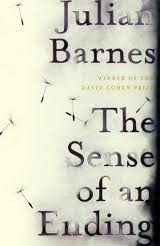
The Sense of an Ending by Julian Barnes

When we are young, we invent different futures for ourselves; when we are old, we invent different pasts for others.

How reliable is our memory? How accurate are our thoughts, analysis of situations, perception of people? Yet we live by them and interpret our experiences through their lenses.

The winner of the 2011 Man Booker Prize, Julian Barnes’ The Sense of an Ending plays with these subjective faculties and crafts a scenario that’s captivating and with a touch of surprise at the end. A man in his 60’s looks back at his life, focusing on what he can remember about his relationships and their aftermath.

In the first part of the book, we see three school buddies in the upper form, the narrator Tony Webster with his classmates Alex and Colin,  happy to befriend a newcomer, Adrian Finn. Obviously superior in brain, insight, and self-composure, Adrian soon becomes the model they look up to. Apart from the pretentiousness of youth in intellectual matters, Tony has to concede that Adrian is indeed  superior material. When asked by the teacher “What is history?”, while Tony gives the relatively pat answer “History is the lies of the victors”, Adrian articulates this thought:

History is that certainty produced at the point where the imperfections of memory meet the inadequacies of documentation.

With these words at the beginning pages of the book, Barnes has quietly laid the enquiry of his story.

Post-secondary life leads them to different paths. Adrian, not surprisingly, gets into Cambridge on scholarship, while Tony goes to Bristol to read history. There, he starts to go out with Veronica Ford. One weekend, Veronica brings him home to meet her family. In Tony’s memory, that is a humiliating episode. He leaves with bewilderment: Veronica’s aloofness, her father’s joking insults, her mother’s mysterious gesture, and her brother’s silent wink.

After that, Tony introduces Veronica to his friends. Naturally, she strikes up a good rapport with Adrian right away, with a common tie of Cambridge where her brother also attends. Later, Tony and Veronica break up.  Adrian soon starts to date Veronica. As usual, Tony seems resigned to his circumstances and  moves on with his own life, and assumedly, others too with theirs… until later he hears the shocking news about Adrian. Time flows by, Tony marries a less mysterious Margaret, has a daughter Susie, and years later, his marriage ends in divorce.

Tony is now retired in his 60’s, expecting a life that’s bland and uneventful. Retired life for him is a natural drift of time, flat and oblivious. But he’s roused by an unexpected letter from a solicitor one day, naming him to receive £500, a bequest in the will of someone he has only met once forty years ago, Veronica’s mother. What’s more intriguing is together with this money, he is to be left with Adrian’s diary.

Life to Tony now is a quest for finding out what had actually happened to these people. His investigation has cast fearful doubts on his own memory and sense of personal history. In his retirement, Tony is awakened to re-interpret his past.

… the history that happens underneath our noses ought to be the clearest, and yet it’s the most deliquescent.

It will take his whole remaining life to solve the mystery of how real his perceptions are, and what has taken place in the lives of those he once knew as close friends. Such queries only lead to a more taxing question: “Does he play a role in other people’s fate?”

In just 150 pages, Barnes has opened a floodgate of inquiries into our subjective mind, carrying us through with a tantalizing story, towards an ending that, I feel, is a tad bit sensational, however reserved the tone. Nonetheless, I come out of the reading experience marvelling at the power of the economy of words in the hands of a master storyteller.

~ ~ ~ 1/2 Ripples

The Sense of An Ending by Julian Barnes, published by Random House Canada, 2011, 150 pages.

***

Blue Nights by Joan Didion

I woke up at 1:30 am last night and couldn’t get back to sleep. Casually grabbed Joan Didion’s new book Blue Nights I got from the library and started reading, thinking I could read myself back to sleep. But I was kept awake the next few hours until I finished it. I simply could not put it down.

Blue nights are the span of time following the summer solstice when the twilights turn long and blue… and over the course of an hour or so, this blue deepens, becomes more intense even as if darkens and fades… Blue nights are the opposite of the dying of the brightness, but they are also its warning.

A poignant ‘sequel’ to The Year of Magical Thinking, which is about the death of Didion’s husband of 40 years, the writer/screenwriter John Gregory Dunne. That all happened in December 2003. John had a heart attack right in the living room of their home as Joan was preparing dinner in the kitchen. That was also a few days after their daughter Quintana Roo was hospitalized with septic shock and a coma.

Blue Nights is a memoir of Quintana, who died of her illness twenty months after her father’s passing. To say it’s a memoir is sanitizing it. In her sensitive and moving voice, Didion describes a searing separation. She recalls the memorable moments, and the mementos around her NYC apartment that prove so futile in evoking a life, a daughter adopted since birth.

Didion remembers the leis Quintana wore at her wedding in NYC’s St. John the Divine on July 26, 2003. Thus begins the book. The wedding reflected Quintana’s yearning for her childhood in Brentwood Park, California.  In the garden were stephanotis, lavender and mint. And it was stephanotis that she wore on her braid as she walked down the aisle.

All the deaths that Didion had encountered among friends and all the ICU visits of others seemed to foreshadow the ultimate fate of her own daughter, dead just 20 months after her wedding.

But nothing can prepare one for the death of one’s child. In fact, Didion painfully states that, time and time again in the book:

When we talk about mortality, we are talking about our children.

Deaths of friends since had only reinforced the looming weight of a blue night. In the spring of 2009, upon a short notice, one of those phone calls everyone dreads, Didion went to say farewell to Natasha Richardson in a NYC hospital, transported there from Montreal. It was only a minor fall on a bunny slope of a Quebec ski hill, but she succumbed to a brain injury soon after. Didion had known Natasha since she was a young teenager, daughter to Vanessa Redgrave and Tony Richardson, among Didion’s closest friends.

She is particularly disturbed by those who label her and her family ‘privileged’. As I read the book, I can see why she rejects such a term. Death befalls all, even the ‘privileged’, and spares no one with the subsequent pain. It is the starkest common denominator. And with both her husband and only daughter passing within months of each other… she has a reason to rage.  But the pathos lies in the muffled cries she lets out.

And to say one still has memories to cherish is the most ironic euphemism ever to console the grieving:

Memories are by definition of times past, things gone. Memories are the Westlake uniforms in the closet, the faded and cracked photographs…

Alas, Blue Nights is exactly that book, an attempt to capture memories before they slip away, and a grief made public so others can share and maybe by so doing, preserve a life.

This is not just a grief observed and incisively expressed, it is also an attempt at keeping the momentum to live. Writing down the pain and loss could well have a certain therapeutic effect as we see the slight humor sprinkled towards the last chapters in an intense and poignant recollection. And yet the end is still the loss, albeit now is shared and hopefully a suffering lightened, however minute the relief.

~ ~ ~ 1/2 Ripples

Blue Nights by Joan Didion, Alfred A. Knopf, NY, 2011, 188 pages.

***

Other related posts on Ripple Effects:

Natasha Richardson, Nell & the White Countess
Reading the Season: C. S. Lewis

Roger Ebert in Toronto: A Close Encounter

Thanks to the Toronto International Film Festival, I have the chance to encounter the legend. It’s only natural that wherever there are films, there are film critics. But I never would have thought that I would see Roger Ebert in person and shake hands with him.

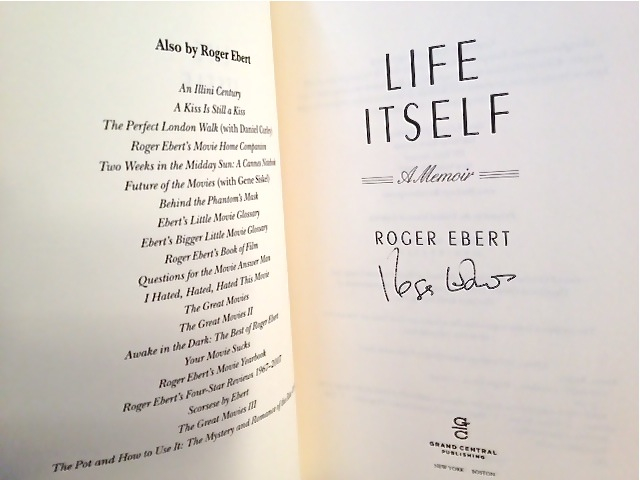
It was pure serendipity. While browsing in Indigo on Bay Street, I noticed a sign saying Roger Ebert would be in that store signing his memoir Life Itself a few days later. I’d followed his reviews since his “Siskel and Ebert” days, the two-thumbs-up duo. By the way, Ebert’s right thumb up had been trademarked. Reviewing films for the Chicago Sun-Times since 1967, Roger Ebert was the first film critic to win a Pulitzer Prize for criticism (1975), prolific all the way till his last two days.

Roger Ebert autograph Life Itself

This was not just about an autograph, or seeing a celebrity up close. It was about seeing a man who after torturous cancer treatments and surgeries for his thyroid, salivary gland and jaw, had lost a part of his face and the ability to talk and eat, and yet still maintained his humor and passions, who continued to press on to new ventures… this was about seeing life itself.

In the late afternoon on September 14, 2011, at the signing area in Indigo Books on Bay Street, people had been lining up for over an hour. I was one of them. At 7 pm, Roger came in walking slowly and with aid. He came on stage and faced the crowd. Together with his wife Chaz, they gave us a wave. Then he sat down and began signing. Photographs were allowed except for the rule of no posing. The Q & A session also began.

Chaz was his voice. She was personable and a film lover herself. She shared some of her views of the TIFF selections. As executive producer of “Ebert Presents at the Movies”, Chaz answered some questions without consulting Roger. But for most questions addressed to Roger, he would write on a small spiral notebook, handed it to Chaz to read out his answer.

Here are some of the notes I’d taken:

* Who influenced you the most?
He pointed to his wife standing behind him.

* Which decade is your favorite?
The 70’s… where you had The Godfather, Raging Bull…

* Buster Keaton or Charlie Chaplin?
Buster Keaton, albeit both are great.

* 3D?
Don’t ask. Story is number one.

* CGI (computer-generated imagery)?
Movies with CGI are soulless.

* All time best?
Citizen Kane.

* Favorite actor?
Robert Mitchum.

* Contemporary?
Al Pacino, Philip Seymour Hoffman, Tilda Swinton

* Favorite Canadian directors?
Atom Egoyan, David Cronenberg, Norman Jewison, Guy Maddin (thumb up)

* James Cameron?
Is James Cameron Canadian? Chaz asked in surprise.

* Favorite book?
A Fine Balance by Rohinton Mistry (Canadian! A voice came from the back)

* Any pressure from movie producers to write a good review?
No, he hasn’t been pressured. He was beyond reproach, Chaz answered.

* Any movies you haven’t seen?
The Sound of Music

* If there’s a movie made about you, who’d you want to play you?
Philip Seymour Hoffman. Chaz added, Oprah to play me. Diana Ross would be good too.

* Advice for potential film critics?
Do you want to get paid? Roger answered with a question.
Yes and no. The questioner covered all bases.
Start blogging. Roger replied.

* How does your life influence the way you review a film?
It generates every word.

Definitely more than just an autograph. What an encounter. What a night.

***

CLICK HERE to listen to an interview of Roger Ebert on CBC Radio during TIFF. Roger used a text-to-voice software as his speaking voice.

***

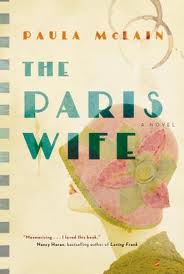
The Paris Wife by Paula McLain

Hemingway’s voice has been heard the world over. His persona and perspective reflected from his prolific writings. Now fifty years after his death, Paula McLain has gleaned through facts and whatever that’s true to create the novel The Paris Wife, revealing the point of view of Hadley Richardson, Hemingway’s first wife.

.
.

Hadley’s voice speaks from the shadow. It reflects the thoughts of one who had seen it all from the beginning. Within seven short years, she had witnessed the transformation of a disgruntled journalist into a promising, full-fledged novelist. And she was the one who, after only three months of marriage, sailed with Hemingway to Paris and began her fateful role of the ever supportive and loving companion. How we need to listen to her side of the story.

.

There are those who have read The Paris Wife and then want to read more of Hemingway’s works.  For me, after reading the book, I want to read more of Paula McLain’s.  It’s interesting that her MFA is in poetry, and that she has published two volumes of poetry collections before this novel. I wonder if it takes a poet to write prose like this, highly sensitive and nuanced, while surprisingly void of ornaments. I find the no-frills narrative style of McLain’s a bit like Hemingway’s, spare and direct, like his memoir A Moveable Feast. Consider something like this as Hadley recounted her earlier life:

And everything was very good and fine until it wasn’t.

What wasn’t fine is an understatement. It’s ironic that what happened to both Hadley and Ernest was quite similar. A domineering mother and a depressed father whose fate led to suicide by a self-inflicted gun shot wound. We know now that Hemingway himself could not escape such a fateful end himself.

But from the start, it was love at first sight for Hadley and Ernest as they met in a house party in Chicago, after Ernest returned home from the war. He was 21, she 29. A year after they met, on September 3, 1921, they were married.

Hadley’s voice captured me right away from the very beginning. I like her down-to-earth persona, her self-deprecating anecdotes as a simple American gal in Paris among the ‘lost generation’. I like it that she played Rachmaninoff and Chopin and not jazz-savvy. I like her ignorance in fashion and avoidance of the dazzling Parisian glitz and glamour:

 If the women in Paris were peacocks, I was a garden-variety hen.

It’s interesting too reading how other writers advise Ernest. They point to the bare essentials, as Hadley recalls Gertrude Stein saying:

Three sentences about the color of the sky. The sky is the sky and that’s all. Strong declarative sentences, that’s what you do best. Stick to that.”

As Stein spoke Ernest’s face fell for a moment, but then he recovered himself. She’d hit on something he’d recently begun to realize about directness, about stripping language all the way down. “… leave only what’s truly needed.” She’d said.

Or this from Ezra Pound:

Cut everything superfluous… Go in fear of abstractions. Don’t tell readers what to think. Let the action speak for itself.

Hadley was with him all the way. When she was later pregnant, Hadley felt the need to go for better birthing care in Canada to deliver her child. I was amazed to read about such a currently hot issue in their time. They sailed to Canada in September, 1923. One month later, Bumby was born.

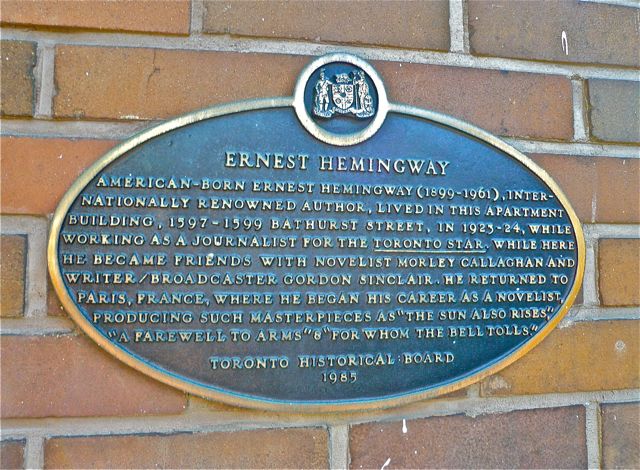
They lived on the fourth floor of an apartment on Bathurst Street. And since I’m in Toronto now as I write this review, I’m able to go over there and take these photos for my readers. Currently, the building at 1597-1599 Bathurst Street is a comfortable and elegant looking five-storey apartment aptly named The Hemingway.

A plaque is placed at the entrance to mark this historic site:

It reads:

Ernest Hemingway

American-born Ernest Hemingway (1899-1961), internationally renowned author, lived in this apartment building 1597-1599 Bathurst Street, in 1923-24, while working as a journalist for the Toronto Star, where he became friends with novelist Morley Callaghan and writer/broadcaster Gordon Sinclair. He returned to Paris, France, where he began his career as a novelist, producing such masterpiece as “The Sun Also Rises”, “A Farewell To Arms”, & “For Whom The Bell Tolls”

Toronto Historical Board
1985

Ernest had worked for the Toronto Star before, and had developed an amicable working relationship with his boss John Bone. But this time he encountered tumultuous problems with his new boss, causing him to shorten his stay. This is what I found a block away from The Hemingway apartment:

Four months after their son Bumby was born, in January, 1924, the Hemingways sailed back to Paris. Upon seeing Gertrude, Ernest said:

I know we meant to be gone a year, but four months is a year in Canada.

I just can’t help but smile upon reading this. Interpret whatever way you will.

Once back in Paris, Ernest discarded his journalist hat and went all out to pursue his dream of a published writer, encouraged by his mentor Gertrude Stein. He began to be noticed and gain publishing success. And with success came fame, and fame, a different circle of friends, richer, more glamorous and drunk. Within their group of acquaintance, people were falling for each other’s spouses, messy and totally lost.

Hadley began to fall out of it all. One time at a tense exchange among the group, she was so fed up that she had to excuse herself and left early with Don Stewart, their writer friend. And here’s the sentence that leaves such an impression on me:

“Before we’d even gotten to the door, the gap had closed around the table and you couldn’t even tell I’d been there.”

The American journalist for Vogue magazine Pauline Pfeiffer soon became Ernest’s new preoccupation. She had not only won his heart, but Hadley’s trust and friendship. But the balance was bound to tip. Hadley’s innocence was soon shattered by betrayal from both her friend and her husband; her naivety ebbed away as she watched helplessly the painful disintegration of her marriage and small family.

I’d chosen my role as supporter for Ernest, but lately the world had tipped, and my choices had vanished. When Ernest looked around lately, he saw a different kind of life and liked what he saw. The rich had better days and freer nights. They brought the sun with them and made the tides move. Pauline was a new model of woman and why couldn’t he have her…

When I think back on Hemingway’s memoir of those Paris years, A Moveable Feast, in which he writes about his early love with Hadley, I can’t help but feel for both of them. How can we command our own feelings, passion, love? The bull fighting scenes in Pamplona which mesmerized Ernest so had become such an apt metaphor… the bulls charging madly through the narrow streets towards the ring, aroused by a mere spot of red, driven by brute instincts and raw impulses, yet all come to the same gory end in the ring.

In the book, McLain has their writer friend Don Stewart declared:

I can take the bulls and the blood. It’s this human business that turns my stomach.

You might ask: “But is this all true?” After all, this is only a novel. From his notes on A Moveable Feast, Hemingway stated that all was fiction. Conversely, in McLain’s The Paris Wife, she has this quote from Hemingway:

 There’s no one thing that’s true. It’s all true.

Looks like it’s for us readers to pick and choose.

***

~ ~ ~ 1/2 Ripples

The Paris Wife by Paula McLain, published by Bond Street Books, Random House, 2011, 314 pages.

You might like to read my review of:

A Moveable Feast (Restored Edition) by Ernest Hemingway.

Midnight In Paris, a film by Woody Allen.

The Tree of Life by Terrence Malick

(It is impossible to review The Tree of Life without writing about what it is about, hence: Spoiler Alert for this post.)

“The Tree of Life” is the fifth feature film in the forty-year career of the reclusive director Terrence Malick. It received mixed reactions at the Cannes Film Festival in May this year. There were boos and applause. That it finally won the top prize at the festival, the prestigious Palme d’Or, indicates which side was gratified. But, it is a film that needs to be experienced personally before one takes side, and maybe seeing it more than once.

Watching the film is an experience in itself. It starts off with this quote from Job 38: 4 and 7:

Where were you when I laid the foundation of the earth? When the morning stars sang together
 and all the sons of God shouted for joy?

With this premise, the film pours forth mysterious yet majestic visual sequences depicting the cosmos, our molten earth, prehistoric era where dinosaurs roam, early life forms, the roaring ocean, blood streams, fetal heartbeats. The first part.

Upon such visuals we hear a voice over:

There are two ways through life — the way of nature and the way of grace. You have to choose which one you’ll follow. Grace doesn’t try to please itself. Accepts being slighted, forgotten, disliked. Accepts insults and injuries. Nature only wants to please itself. Get others to please it too. Likes to lord it over them. To have its own way…

From the macro scale of the universe we now focus on the micro, something with which we can identify, a family. We see it from the point of view of Jack O’Brien (Sean Penn). An architect now, Jack is haunted by memories of his past, in particular, the death of his younger brother at age 19. We see scenes of his parents receiving the bad news. We hear his yearning for the people he loves through his whisper in voice over: ”Brother, mother.” We are then privy to Jack’s childhood days in 1950’s Texas.

From the O’Brien family we see how grace and human nature play out. Jack’s childhood in Waco, Texas, begins in innocence. With a capable father (Brad Pitt) and an almost angelic mother (Jessica Chastain) who is loving, nurturing, grace manifest, young Jack’s (Hunter McCracken) early days are blissful. Two younger brothers later, the siblings form a close bond. But as the boys grow older, the father becomes stern and strict, callous with his sons, demanding total obedience, expecting love where the seeds of fear are sown. From this character, we see human nature manifest in its destructive, self-seeking mode.

Other incidents further shatter the once blissful young life. Jack goes to town with his mother and brothers, he sees a crippled man make his way awkwardly across the street. He also witnesses the unlawful being arrested. While at the swimming pool, he watches a boy drowned despite frantic rescue. We hear young Jack’s whisper in voice over: “Was he bad? Where were you? You let a boy die.” The problem of pain, suffering, and evil begin to churn in his mind. Direct questions to God, not unlike Job.

Watching his father’s harsh handling of his sons, young Jack slowly discovers that he himself too has the latent capacity to not just think, but to commit wrongs, “I do what I hate.” In a moving scene, after he has hurt his little brother, Jack becomes remorseful and asks for forgiveness. We see the power of love at work. We also see his innocence slowly taken over by conflicts in his heart, love and hate, good and evil… grace and nature.  The second part.

Jack’s father loses his job and the family has to leave town. The uprooting is the most painful the boys have experienced. Everything is lost, it seems, friends, the house, the neighborhood, memories, … But among the loss, we hear the graceful voice of Jack’s mother: “The only way to be happy is to love. Unless you love, your life will flash by… Do good, wonder, hope.” Yet poignantly, she experiences the most devastating blow later, the death of her own son. We hear her heartbreaking whisper in voice over: “Where were you? Did you know?” Again, reiterating the questions that were on Job’s mind.

But ultimately light takes over darkness. We are assured that all is not lost. We hear Jack’s yearning whisper, like a prayer: “Keep us, guide us, to the end of time.” In the eternal scheme of things, shown by the display of the magnificent cosmic visuals, we see all members of the O’Brien family reunite and bathed in a warm bright light. Jack once again embraces the ones he loves, his mother and his brothers. He also stands shoulder to shoulder with the one who has inflicted in him the mixed emotions of pain, anger and love, his father, now reconciled under the brilliant light.  The third part.

Yes, we have the big names. Sean Penn as adult Jack appears only sporadically. Brad Pitt nails his role as the stern and difficult father. The relatively new film actor Jessica Chastain is grace embodied. In an interview she recalls that director Terrence Malick had asked her to watch a lot of Lauren Bacall movies to prepare for her role. But the most impressive of all is Hunter McCracken playing young Jack. The casting is brilliant here. His mesmerizing portrayal of a conflicting boy incubating the later character of a tormented adult Penn is deeply moving, a reflection too of Malick’s sensitive direction. As with his other films, cinematography is superb. You’ll have plenty of time to savour the long sections of cosmic and natural wonders.

“The Tree of Life” is for the patient viewer. It is a slow movie, and rightly so. You have to take the two hours and eighteen minutes as a respite from your busy schedule, and experience the film as a quiet meditation on life, family, God, and relationship with Him. It is also a portrait of love, faith, doubts, and promise. It poses questions in whispers, and answers with majestic visuals in silence, and at times, in engulfing themes of torrential music. Smetana’s “The Moldau” still flows through my mind at 4:30 a.m.

Boos or applause, what does it matter? To quote Bresson: “All is grace.”

~ ~ ~ ~ Ripples

***


CLICK HERE to read my post on another Malick film, Days of Heaven (1978), which won an Oscar for Best Cinematography.