The Letters of Vincent van Gogh

While reading van Gogh’s letters is a fascinating journey into the mind of the artist, it is also poignantly heartbreaking. This is an abridged version of van Gogh’s letters, almost all written to his brother Theo from the various places he had stayed from 1872-1890, Holland, Belgium, England and France.

A few decades separate his life from Hemingway’s, but I think he too had his “moveable feast”.  To the painter, it’s not Paris, but the open country of southern France, in particular, Arles and St. Remy’s, Provence.
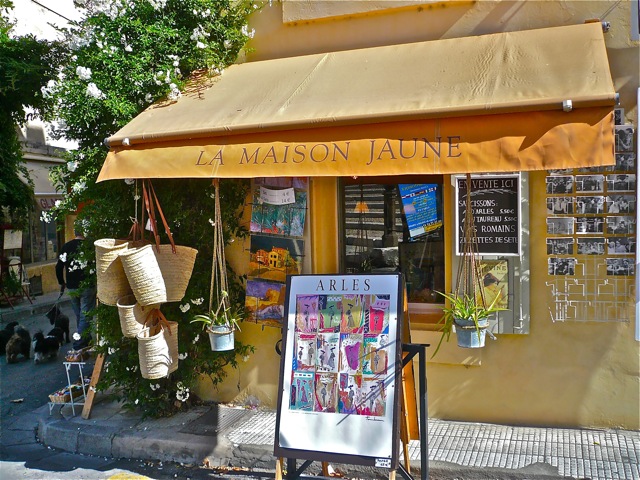
(A corner store in Arles, named after the famous ‘Yellow House’ Van Gogh once lived in)

Unlike Hemingway, van Gogh felt Paris only ‘distracts’. He wrote to his brother Theo after moving to Arles from Paris in February, 1888:

It seems to me almost impossible to be able to work in Paris, unless you have a refuge in which to recover and regain your peace of mind and self-composure. Without that, you’d be bound to get utterly numbed.

While Hemingway sought to “write one true sentence”, van Gogh yearned to reflect what was true through his paintings:

… giving a true impression of what I see. Not always literally exact, rather never exact, for one sees nature through one’s own temperament.

And colours were his tools. Van Gogh began to use a new palette that he did not see in his native Holland. Under the bright Provence sun, the artist excitedly indulged in a myriads of brilliant colours he had not experienced before…”There is that sulphur yellow everywhere the sun lights on.” He eagerly ushered in a new style.

Instead of trying to reproduce exactly what I have before my eyes, I use colour more arbitrarily so as to express myself forcibly… — To Theo from Arles, August 1888
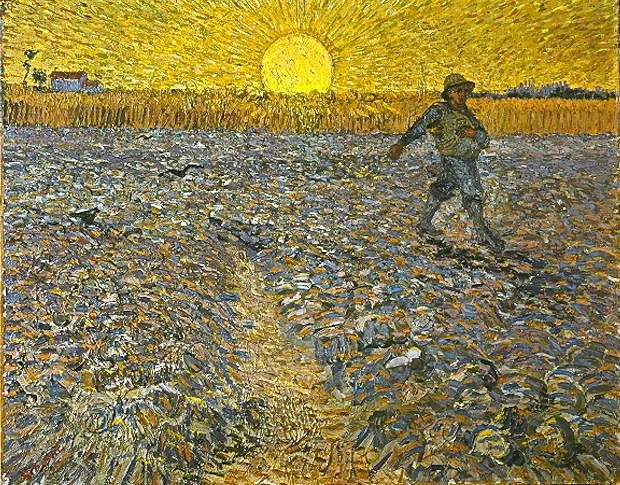
(The Sower)

I believe in the absolute necessity for a new art of colour, of design, and — of the artistic life.”

“But the painter of the future will be such a colourist as has never yet been [emphasis his].

Through the artist’s colourful lens, the view that van Gogh saw was one that I could never imagine. Here he described to his brother Theo a painting he’d finished, in a letter dated September, 1888:

 … the starry sky painted actually at night under a gas jet. The sky is greenish blue, the water royal blue, the ground mauve. The town is blue and violet, the gas is yellow and the reflections are russet gold down to greenish bronze. On the blue-green field of the sky the Great Bear sparkles green and rose, its discreet pallor contrasts with the brutal gold of the gas.

(Starry Night)

Many of the letters are descriptions like this to Theo in Paris. Reading them, I can sense the artist’s excitement and joy in capturing everything he saw in Arles:

At the moment I am working on some plum trees, yellowish white, with thousands of black branches. I am using a tremendous lot of colours and canvases…

… it will be to our advantage to make the most we can of the orchards in bloom. I am well started now, and I think I must have ten more, the same subject. You know, I am changeable in my work, and this craze for painting orchards will not last for ever. After this may be the arenas…

His letters alas are also pleas for funds, as he was “literally starving”. With the last fr.5 he had, he’d spend it on canvases. He lived in dire poverty most of his career, damaging his physical and mental health.

I can’t do without colours, and colours are expensive… I cannot get more on credit. And yet I love painting so…

Worse still, his letters are also accounts of anguish, depression, and “unbearable hallucinations.” He desperately sought cures, admitting himself into the asylum in St. Remy’s. Ironically, it was there that he experienced the most prolific period of his life.

                    (St. Paul’s Hospital at St. Remy’s)

Throughout van Gogh’s numerous letters, there are many beautiful lines, insight into love, art, books, and life. Here are a few:

  • “Since I really love there is more reality in my drawings.” — Autumn 1881
  • “I would not give a farthing for life, if there were not something infinite, something deep, something real.” — December 1881
  • “It is the painter’s duty to be entirely absorbed by nature and to use all his intelligence to express sentiment in his work so that it becomes intelligible to other people. To work for the market is in my opinion not exactly the right way…” — July 1882
  • “I assure you that some days at the hospital were very interesting, and perhaps it is from the sick that one learns how to live.”  — January 1889
  • “I took advantage of my outing to buy a  book… I have devoured two chapters of it… This is the first time for several months that I have had a book in my hand. That means a lot to me and does a good deal towards my cure.” — March 1889
  • “What I should very much like to have to read here now and then, would be a Shakespeare… What touches me, as in some novelists of our day, is that the voices of these people, which in Shakespeare’s case reach us from a distance of several centuries, do not seem unfamiliar to us. — From St. Remy’s Hospital, June 1889.

But tragically, van Gogh succumbed to his mental illness. In July, 1890 two months after moving back to Auvers, north of Paris, he went out to the open fields and shot himself. Two days later he died from his gunshot wound. He was 37.

The Letters of Vincent van Gogh to his Brother and Others. Introduction by his sister-in-law Johanna van Gogh-Bonger, abridged by Elfreda Powell, Published by Constable & Robinson Ltd., 2003, 324 pages.

***

The is my last post for the blogging event Paris in July hosted by Karen of BookBath, and Tamara of Thyme for Tea. My other post is “A Moveable Feast (Restored Edition) by Ernest Hemingway.”

To read my travel post from last August “Arles: In The Steps of Van Gogh” CLICK HERE.

Photos: Van Gogh’s paintings, from Wikimedia Commons, Public Domain. Arles and St. Remy’s by Arti of Ripple Effects, August, 2010.

To read all the 900 letters of van Gogh online, go to this excellent site of the Van Gogh Museum, Amsterdam.
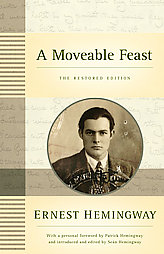
A Moveable Feast (Restored Edition) by Ernest Hemingway

Reading A Moveable Feast is like walking along the sea shore. On the fine sandy beach you see many attractive shells, but you don’t have a bucket with you. You pick the finest ones and put them in your pockets, until they’re full. But every step you take further, you see more that you want to keep. This post is too limited for me to display all the shells I’ve collected, but allow me to just pour them out from my pockets, without sorting, sand and all.

I first read about the term “Moveable Feast” while sitting in an Anglican church in Vancouver, flipping through the The Book of Common Prayer. After some googling later, I got the idea. A feast in the liturgical calendar that you commemorate no matter which date it falls on year after year. In the Foreword of this restored edition, Hemingway’s son Patrick (with second wife Pauline Pfeiffer) writes:

The complexity of a moveable feast lies in the calculation of the calendar date for Easter in a given year, from which it is simple enough then to assign a calendar date to each and every moveable feast for a given year. Palm Sunday is seven days before Easter.

A memorable experience that will follow you all the years of your life. You’ll cherish it whenever and wherever you are. Hemingway’s friend A. E. Hotchner suggested this title. Author of the biography Papa Hemingway, Hotchner recalls Hemingway once said to him:

If you are lucky enough to have lived in Paris as a young man, then wherever you go for the rest of your life, it stays with you, for Paris is a moveable feast.

Like Rick says to Ilsa in “Casablanca”: “We’ll always have Paris.” Same sentiment.

A Moveable Feast is Hemingway’s memoir written from notes he had forgotten in two steamer trunks stored at the Ritz Hotel in Paris since 1928. In 1956 he repossessed the treasure trove, upon the urging of the hotel management. The book details his experience while living in Paris from 1921 to 1926, when the author was in his early 20’s. The memoir was first published posthumously in 1964. The Paris Years was a period when Hemingway, just married Hadley Richardson, young and care-free, decided to give up journalism to strive at being a novelist.

He would write in a rented room or in a café over café crème,
meet Gertrude Stein for critique of his writing, go back home for lunch with wife Hadley, or have oysters and wine in a restaurant, socialize with Fitzgerald, Ezra Pound, and other expats, borrow piles of books from Sylvia Beach’s library in her bookshop Shakespeare and Company, visit Luxembourg gardens and museum…

Two people, then, could live comfortably and well in Europe on five dollars a day and could travel.

No wonder Gil in “Midnight in Paris” dreams of such a life.

What strikes me initially is Hemingway’s frankness, sometimes blatant description of his opinion about the people he met. Like the first time he saw the artist Wyndham Lewis through Ezra Pound:

I watched Lewis carefully without seeming to look at him, as you do when you are boxing, and I do not think I had ever seen a nastier-looking man… I tried to break his face down and describe it but I could only get the eyes. Under the black hat, when I had first seen them, the eyes had been those of an unsuccessful rapist.

According to grandson Sean Hemingway who edited and wrote the introduction of this restored edition, Hemingway developed his sharp eye and ear during these Paris years. Here’s an account of Scott Fitzgerald when Hemingway first met him in the Dingo bar:

Scott was a man then who looked like a boy with a face between handsome and pretty. He had very fair wavy hair, a high forehead, excited eyes and a delicate long-lipped Irish mouth that, on a girl, would have been the mouth of a beauty. His chin was well built and he had good ears and a handsome, almost beautiful, unmarked nose.

This is only a little excerpt in a two page description of Scott’s appearance. It’s sentences like these that stand out for me. They all point to the writer at work: observing.

I kept on looking at him closely and noticed…”

“I kept on observing Scott.

And putting down in words later:

I wasn’t learning very much from looking at him now except that he had well shaped, capable-looking hands, not too small, and when he sat on one of the bar stools I saw that he had very short legs. With normal legs he would have been perhaps two inches taller.

But it was Scott’s talents despite his eccentricities and alcoholism that formed the building blocks of their friendship.

When I had finished the book [The Great Gatsby] I knew that no matter what Scott did, nor how preposterously he behaved, I must know it was like a sickness and be of any help I could to him and try to be a good friend. …   If he could write a book as fine as The Great Gatsby I was sure that he could write an even better one. I did not know Zelda yet, and so I did not know the terrible odds that were against him.

It is perhaps with such candour and devotion in writing that he constantly sought to “write one true sentence.” Woody Allen has grasped the essence in this juicy line from “Midnight in Paris”:

No subject is terrible if the story is true, if the prose is clean and honest, and if it affirms courage and grace under pressure.

The restored edition brings back sections missing in the earlier 1964 publication which was edited by fourth and last wife Mary. According to Sean Hemingway, this restored work represents the content that Hemingway himself had intended the book to have, with the chapter “Nada y Pues Nada” (Nothing And Then Nothing) written three months before his suicide.

The second last chapter “The Pilot Fish and the Rich” shows he was remorseful over the breakdown of his first marriage to Hadley towards the end of his Paris days. A mutual friend they both knew, journalist Pauline Pfeiffer, came in between them. “You love them both now… Everything is split inside of you and you love two people now instead of one.”

But A Moveable Feast belongs to Earnest and Hadley and their young son Bumby.  “… this is how Paris was in the early days when we were very poor and very happy.” As a reader, I feel a sense of loss as I come to the end, for Earnest and Hadley were so much in love the first few years in Paris:

She: ‘And we’ll never love anyone else but each other.’

He: ‘No. Never.’

Their 2-room rental walk-up with no electricity and no hot water had been a haven of warm meals and intimate talks. It was the time when he was “a young man supporting a wife and child … learning to write prose.” Their short marriage lasted only six years. In 1927 Hemingway married Pauline, four months after divorcing Hadley.

The last section at the end of the book is entitled “Fragments”. These are “false starts”, beginning paragraphs of an introduction Hemingway tried to write for this book. Interestingly, every one of these attempts starts with: “This book is fiction.” Many include this sentence: “I have left out much and changed and eliminated and I hope Hadley understands.” In another fragment he wrote: “No one can write true fact in reminiscences…”

I’m baffled. But maybe unnecessarily. From our very subjective mind, our often hazy view of what did happen and what we wish to have happened and what could have happened, we conjure up a fusion. Should there be a clear line separating them? It’s because the demarkation of fact and fantasy is fluid that we can appreciate the arts, such as the film “Midnight in Paris.” The events that happen to Gil after midnight would remain fondly with him as reality, so real that they change his decision regarding his future. Facts or fiction… or fusion?

~ ~ ~ 1/2 Ripples

***

A Moveable Feast: The Restored Edition by Ernest Hemingway, published by Scribner, NY, 2009, 240 pages. Foreword by Patrick Hemingway, introduced and edited by Sean Hemingway.

This post is to participate in the Paris In July blogging event hosted by Karen of BookBath and Tamara of Thyme for Tea. You can also find another review of A Moveable Feast here at Dolce Bellezza.

To read my review of “Midnight In Paris”, CLICK HERE.

Photos: Paris, Shakespeare and Company, Writers’ portraits and The Library in Shakespeare and Company taken by Arti of Ripple Effects, Aug. 2010. All Rights Reserved.

Click on the following links for some insightful interviews:

National Post Interview with Sean Hemingway on the restored edition

Interview with Woody Allen on making “Midnight In Paris”

The Royal Visit: William and Kate in Alberta

The whirlwind visit by the Duke and Duchess of Cambridge William and Kate to Alberta has come and gone. I’m glad that they cared to visit Slave Lake where 40% of the town had been destroyed by wildfire in May, but has now come under another disaster, flooding.

Arti is also impressed by the royal couple’s secret hideout July 6 near Lake Louise. Well, maybe it’s not totally their choice, but kudos to whoever that was responsible for the arrangement, they opted for the historic and secluded Skoki Lodge:

Skoki Lodge

Rather than the grand and monumental Chateau Lake Louise facing the world famous Lake:

At first sight, the Chateau is more fitting for a royal than the little rustic log cabin that’s Skoki Lodge. But this may well be a statement clearly transmitted … William and Kate are as unassuming as their down-to-earth mountain abode.

A day after the royal couple has left Lake Louise by helicopter to the Calgary Stampede, Arti drove a couple of her own visitors to the Lake. We encountered strong winds and drizzles under an overcast sky. But I hope William and Kate had had a brighter view of this magnificent natural beauty, and saw the glacier that was shrouded in low mystic clouds when we were there:

.

As for their Calgary arrival for the Stampede, it’s quite a moving story. The bright yellow dress that Kate was wearing as she got off the helicopter could well be the most appropriate attire (rather than Western wear), for she represented a real-life princess Diamond Marshall had wished to meet in person. Six year-old Diamond has stage 4 cancer. Through the Make-A-Wish Foundation, she was chosen to present flowers to Kate. Here’s her letter written to the Duchess of Cambridge:

Diamond Marshall Diamond Marshall And The Death Of Cynicism: When The Duchess Of Cambridge Made A Wish Come True

Diamond Marshall1 Diamond Marshall And The Death Of Cynicism: When The Duchess Of Cambridge Made A Wish Come True

The most authentic moment, Diamond dashed out to hug Kate and presented to her a bouquet of flowers and her own hand-made friendship bracelet in a heart-shaped box. What did she think of the other half of the royal couple?  “He was a little bit handsome,” she said.

CLICK HERE to read the story of Diamond Marshall.

.

Kate and William did have their chance to don a white cowboy hat (Calgary’s honorable gift to distinguished guests). On July 7, Wednesday night, two members of Arti’s household had the invite to a reception organized by PM Stephen Harper. Arti’s own CS (turned CG in June) had the very close encounter of extending his long arm to shake both the hands of William and Kate. In the frenzy, CG’s iPhone photos were a bit blurry.  But here’s a sharper view of the two royals at the Calgary Stampede:

Kate and William will have their all dressed-up, glamorous red carpet reception with the celebs, the rich and famous of Los Angeles at their next stop after Calgary. But I’m sure only here in Alberta can they relax in a Rocky Mountain log cabin, dressed in jeans and plaid shirts, and where Kate can receive an impromptu hug from a six-year old cancer patient who dashes out to show her excitement, and where sincere authenticity can be freely expressed and cherished.

***

Key: CS=College Student, CG=College Grad

Photo Source: Skoki Lodge from Travel Alberta, Calgary Herald; Diamond Marshall & Kate Middleton, Todd Korol, AP; Kate and William at the Calgary Stampede, Reuters Phil Noble; Diamond Marshall’s letter from this site; Chateau Lake Louise and the fog-shrouded Lake Louise, Arti of Ripple Effects.

***

Urban Sanctuary

June has been a month of travelling for me. From the natural beauty of Vancouver to über busy and congested Metro Toronto, I’ve shifted gear and gone from park to overdrive in two short weeks. Quiet garden paths have been replaced by the 12-lane Highway 401, rain forest has turned into concrete jungle. And so I was pleasantly surprised by this serendipitous find right in the heart of downtown Toronto. Amidst the hustle and bustle, I found this sanctuary… literal and spiritual, the Trinity College Chapel on the campus of the University of Toronto:

Every step into the magnificent architecture instills awe and wonder, every artefact a symbol:

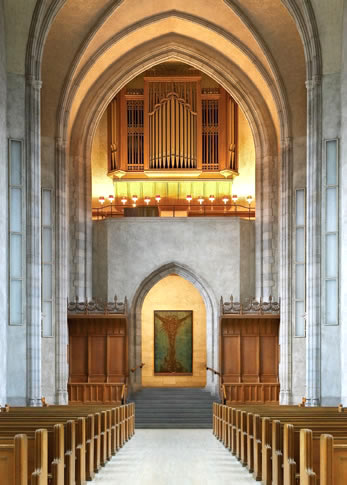
Looking back to the choir loft is another stunning view (this photo from Wikipedia):

The painting on the wall in the narthex, a crucifix, is entitled “Mediterranean Christ” by the artist Juan Sala Santonja:

***

Another joy of discovery is Grace Church On the Hill, Anglican. My expectation of my short sojourn in Toronto had never been stained glass or religious art. But here I was, beholding Biblical themes in beautiful stained glass:

This contemporary wall sculpture created by Catherine Widgery of Montreal juxtaposes well among the stained glass, for its message points to a similar theme:

Entitled “By Her Own Radiant Light”, John Milton’s verse is engraved on a brass plaque beside the installation:

By her own radiant light, though sun and moon

were in the flat sea sunk.

And Wisdom’s self

oft seeks to sweet retired solitude,

Where, with her best nurse

Contemplation,

She plumes her feathers,

and lets grow her wings.

The pamphlet beside the art installation conveys the meaning: As the Moon’s illumination is the reflection of the Sun, Christian disciples are reflectors of the Greater Light. The phases of the moon suggest an eternal cycle of life, death and rebirth. Loss returns to fullness; darkness becomes light. The fragments of reflected light on water form a triangle below the full moon. Each fragment of light is a single piece of metal, cut and assembled so as to suggest the light’s effect on the surface of the water. At the heart of the circle, the light reflected on the surface is brilliant and intense, and diminishes as it spreads farther from the source.

As someone who’s always drawn to ripples, I spotted this installation right away as I entered the  sanctuary. Reading Milton’s verse and the explanation of the art work helped me gain a deeper appreciation of the visual symbolism.

No rain forests and greenery, but I was drawn to explore another landscape, one where art and imagination formed a bridge towards the unseen and spiritual, no less powerful in bringing out the wonders of creation and the Creator, the Source of Light and Wisdom.

***

CLICK HERE to watch a video clip with visual artist Catherine Widgery

PHOTOS: All photos were taken by Arti of Ripple Effects except the one noted from Wikipedia. Arti’s photos taken in June, 2011. All Rights Reserved.

A Jane Austen Education by William Deresiewicz

I’ve been following William Deresiewicz’s articles in The American Scholar for a few years. His idea of solitude has inspired my posts “No Texting for Lent and the End of Solitude” and “Alone Again… Unnaturally.”

I’ve not seen any pictures of him, but know that he has taught English at Yale for ten years. So I’ve always thought him to be one calm, cool, and collected (older) academic. Well, I was totally surprised as I read his book A Jane Austen Education: How Six Novels Taught Me About Love, Friendship, and the Things That Really Matter. Expecting a book on literary criticism, and from the title, maybe a dash of personal anecdote, I found it to be much more than these.

It is all of the following: literary analysis, biography, memoir and even confessional. Introduced to Jane Austen by his professor in graduate school, Deresiewicz had encountered numerous ‘eureka moments’ of self-discovery from reading her six novels. He unabashedly discloses how his own life experiences, and often youthful foibles, parallel those of Austen’s characters from each book. For us who have savored Austen’s works, we already know how wise and perceptive she is. But Deresiewicz has gone much deeper by being so brave as to reveal his self-absorbed psyche of younger days, his romantic mishaps, true friends and those who appear to be, the painful conflicts between his parents, and his search for self apart from a domineering father, all in light of Austen’s colorful literary canvas.

So before the calm, cool and collected guy emerged, there was one rebel, alienated follower of the modernists. Seems like every guy who comes to Austen is being dragged along with much reluctance, “just thinking about her made me sleepy.” But his reading, studying and writing a dissertation chapter on Austen’s works totally reshaped his views, and life.

Here’s an outline of Deresiewicz’s journey of maturity, of finding true love, and most importantly, of becoming one who has the capacity to love, all due to Austen’s novels. Too good to be true, isn’t it? I admit at times I found there were too many coincidences and perfect parallels, a bit contrived. But as I read, I knew I must decide one way or the other. And I was persuaded to see it as audacious honesty. His self-deprecating and revealing account of his journey towards maturity and improvement is entertaining, bold even as he mentally draws the line between friends and ‘foes’, true and fake, albeit keeping them anonymous. I’m sure those he’d described would definitely recognize themselves in the book.

As with Austen’s opening lines in her novels, Deresiewicz’s opening line sets the stage of what’s to come:

I was twenty-six, and about as dumb, in all human things, as any twenty-six-year-old has a right to be, when I met the woman who would change my life.

That woman, of course, is Jane Austen. Here are some of the key lessons:

From Emma, he learns to put aside his academic snobbery, that there’s no one too lowly for him to know, nothing too trivial or common for him to pass by. For these are the very ingredients that make up life.

Not that I hadn’t always taken my plans and grand ambitions seriously–of course I had. What I hadn’t taken seriously were the little events, the little moments of feeling, that my life actually consisted of. I wasn’t Stephen Dedalus or Conrad’s Marlow, I was Emma. I was Jane Fairfax. I was Miss Bates. I wasn’t a rebel, I was a fool. I wasn’t floating in splendid isolation a million miles above the herd. I was part of the herd. I was a regular person, after all. Which means, I was a person.

From Pride and Prejudice, he learns to grow up.

For [Austen], growing up has nothing to do with knowledge or skills, because it has everything to do with character and conduct… Growing up means making mistakes… to learn to doubt ourselves…

By making mistakes, and recognizing her mistakes, and testing her impulses against the claims of logic, the heroine of Pride and Prejudice learned the most important lesson of all. She learned that she wasn’t the center of the universe.

From Northanger Abbey, he learns to learn, and by so doing, to teach.

The habit of learning: if Catherine could learn to love a hyacinth when she was seventeen… I could keep learning to love new things my whole life. Of course, it was my professor himself who had helped me learn to love Jane Austen in the first place, against expectations at least as stubborn as the ones that Catherine brought to Northanger Abbey. But I was starting to get it now: the wonderful thing about life, if you live it right, is that it keeps taking you by surprise.

From Mansfield Park, he learns to see it as a mirror of “the rich Manhattanites” circle he was trying to get in.

… the greed beneath the elegance, the cruelty behind the glow–and what I myself had been doing in it… If my friend was a social climber, then what the hell was I?… my attraction to that golden crowd, my ache to be accepted by them, what did it amount to if not the very same thing? Who was I becoming? Who had I already become?

… we also have an aristocracy in this country, and I was looking at it.

From Persuasion, and from his own experience, he learns to prove Nora Ephron wrong. Unlike her movie “When Harry Met Sally”, man and woman can be friends, without “the sex thing getting in the way.”

A man and a woman, even two young, available ones, could talk to each other, understand each other, sympathize with each other, be drawn to each other, even share their intimate thoughts and feelings with each other–as Anne and Benwick did–without having to be attracted to each other–as Anne and Benwick clearly weren’t. They could, in other words, be friends.

Anne and Harville shared a common footing in the conversation, debating each other with mutual respect and affection and esteem. Men and women can be equals, Austen was telling us, so men and women can be friends.

And finally, from Sense and Sensibility, he learns what it means to fall in love.

To Austen, love at first sight is a contradiction in terms… As dull as it sounded, I now saw, Elinor’s way of going about things is the right one: to see a great deal of a person, to study their sentiments, to hear their opinions. … And it is a person’s character, not their body, with which we fall in love.

Like all Austen’s novels, Deresiewicz’s book ends with a marriage, his own. But without first reading the six Austen novels, he would have been totally unprepared for such a relationship. “Love, for Austen, is not becoming forever young. It’s about becoming an adult.” The book is the best way to show his gratitude to the matchmaker.

~ ~ ~ Ripples

***

A Jane Austen Education: How Six Novels Taught Me About Love, Friendship, And The Things That Really Matter by William Deresiewicz, The Penguin Press, New York, 2011, 255 pages.

This article has been published in the Jane Austen Online Magazine. CLICK HERE to go there for more Regency and Austen reads.

CLICK HERE to William Deresiewicz’s website, and watch interviews of him with the editorial director of Penguin Classics, Elda Rotor.

Which Jane Austen Heroine Was Jane Most Like?

A while ago due to a glitch on my blog, I lost all the visual images on my side bar, including a poll. Accidentally I found it again today and glad to see the results are still there.

So here it is, for all you Janeites, book and literature lovers out there. If you haven’t voted, you can do that now. If you have voted before, and just might have changed your opinion, vote again. I’m sure Jane wouldn’t mind.

Life imitates art… art imitates life? Which of Jane Austen’s heroines do you think the author most resembled in terms of character?

.

You’re welcome to share with us why you vote that way.

Other related posts on Ripple Effects:

Jane Austen: Sense Or Sensibility?

What Was Jane Austen Really Like? Reading Tomalin and Shields

Art Imitates Life, Life Imitates Art, or

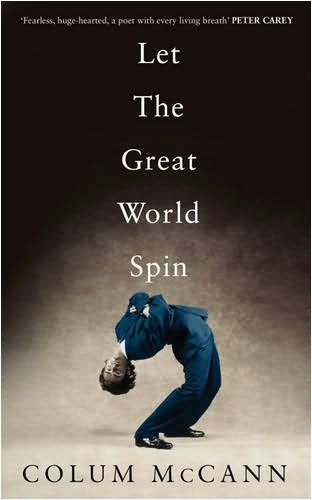
Let The Great World Spin: How not to judge a book by its cover

There was a lot of buzz when this book came out a couple of years ago but I’ve been avoiding it, albeit a bit curious to know what it’s about. My reason? I just didn’t like the cover, still don’t. This is what I see in our local bookstores:

But after two years, and knowing that it has won the National Book Award  (Fiction, 2009), I could not resist anymore. I read it recently and was pleasantly surprised by its structure and intricately woven content. Allow me to offer a glimpse into what’s inside the cover… for those who still have not ventured into it.

The book begins with the true event of the Man On Wire. On a fine August day in 1974, NYC, in the early morning hour, an extraordinary feat took place in front of unbelieving eyes on the streets in Manhattan. One hundred and ten stories above ground, between the newly built Twin Towers, a man was walking, dancing, even lying on a wire strung across the two buildings. Interestingly, the novel is not so much about this man with extraordinary courage and skills, his name not even mentioned until the “Author’s Note” just before the back cover. Instead, the book is about the ordinary humanity on the ground. On that day they are joined by amazement of one man walking precariously in midair, oblivious that it is a metaphor for some of them and their life down on the streets. Here are the stories of a few individuals on that otherwise very ordinary day:

Corrigan, a young priest from Dublin, lives in a rough and drug-infested neighborhood, fending for and befriending prostitutes and the poor. McCann’s characterization is complex and layered. On the surface, we see an altruistic worker, sacrificing his youth, health and even life for the lowly, abused, and despised:

“The comfort he got from the hard, cold truth–the filth, the war, the poverty–was that life could be capable of small beauties. He wasn’t interested in the glorious tales of the afterlife or the notions of a honey-soaked heaven… Rather he consoled himself with the fact that, in the real world, when he looked closely into the darkness he might find the presence of a light, damaged and bruised, but a little light all the same.”

As I read deeper, and with McCann’s captivating storytelling of Corrigan’s broken home while growing up in Dublin, and his strained relationship with his estranged father, I suspect that his transplanted life in NYC could well be a search for redemption, or maybe subconsciously, a defiance against a cruel world, an act just to spite his past.

We read too about a mother and daughter’s entanglement in the underworld of prostitution. We see the reality they have to deal with, as another generation of young daughters are growing up under their care. And yet, as if life has not dealt harshly enough, tragedy strikes. But McCann does not leave us in despair. Through the ingenious weaving of characters and circumstances, he skillfully lifts us out of a miry mess onto a higher plane.

We also read about a support group of mothers who have lost their sons in the Vietnam War.  McCann has sensitively shown us that, even sharing the same loss and grief, their common ground could easily be shaken by the nuances of class and race, as those magnified in the interactions between Claire, the wife of a judge living on Park Avenue and Gloria, a black woman from a housing project in the Bronx. And yet, we are gently led to experience the exhilarating triumph of how compassion can turn mere common ground into powerful bonds, changing grief into commitment and purpose.

Finally we are led one full circle back to the man on wire, and the judge who has to handle his case. Judge Soderberg himself is a father who has lost a son in Vietnam. Like the man on wire, his son had taken the risk to enlist by his own will, not as a fighting soldier but only to offer his computer expertise. No matter, risks are what the two face and one of them succumbs to it. As a judge, how is he going to rule this 25 year-old risking his life to do something he believes to be purposeful and rewarding?

The book ends in the modern day, when a younger generation witness an extreme act of malice done to the Twin Towers. But we also see a new generation raised by grace–fruits of the very individuals who were impacted on that fateful day when the man walked on wire a thousand feet in midair decades earlier. It’s about the choices we make, despite the miry mess we tread on the ground.

While McCann presents these characters and their stories as separate threads in different chapters, he eventually weave them together, tying all loose ends to make a beautiful human tapestry. Like the wire walker, their own lives are no less challenging. They too have to take risks to step out and deal with their circumstances. Theirs is a balancing act as well, in their choices to do the right thing, in their search for meaning, every step of the way.

McCann’s storytelling is visual, his descriptions stylish, many scenes made alive by real-life dialogues that one would expect in the filthy, dark corners of NYC. The book offers an experience quite like my reading of screenplays, but with its literary form, it is much more gratifying.  Also, I was not too surprised to find out that Colum McCann is not only a novelist but a screenwriter as well. Further search leads me to the info that “Let the Great World Spin” is now a film in development by producer J.J. Abram of “Star Trek”(2009) fame.  mmm… let’s just hope the movie adaptation won’t be a 3D spectacular, but a real, human experience as the novel has so sensitively portrayed.

~~~1/2 Ripples

Let the Great World Spin by Colum McCann, HarperCollins Publishers, 2009, 349 pages.

***

If I’d seen this cover in the store, I would have grabbed it at first sight:

CLICK HERE to Colum McCann’s beautifully-designed website, and an exploration of the cover art.

CLICK HERE to go to the artist Matteo Pericoli’s wonderful website which I highly recommend.

Of Words and Spring

April is the month of empty dreams
Half the days gone
waiting for words and spring
still frozen ground
and on the screen
a frigid page as white as snow.

Brown could be the color of hope
After the white
for all I know
green is too much to wish for
I’m contented to see a patch
of dry and withered brown.

The sun is a perpetual sign
that there’s still hope
But it’s no herald of the seasons
for its presence comforts all year long
warming my blank and barren state
as I await for words and spring.

But Easter is an apt reminder
that The Word had come
spoken clear to half-frozen ears
His body hung on a lifeless tree
Blood and water flowed
onto parched and dusty earth

So what if no words come to me
That dreaded writer’s block
reigning the winter of sterility
numbing senses,
snatching thoughts,
seizing any sign of spring.

It’s not about a post or a blog,
Or even buds and melting snow.
The Word had come
lived and loved among us,
broken, bled, died and rose,
melting frozen hearts to greet
a new Spring and eternal growth.

Poem and Photos by Arti of Ripple Effects, April 2011. All Rights Reserved.


Alone Together by Sherry Turkle, Part 2

Part 2 of Sherry Turkle’s book Alone Together presents the networked self. Turkle has been called ‘the anthropologist of cyberspace.’ Her book reads like an ethnography of our human society today. While in Part 1 (my previous post) she has shown how we are receptive to robotics to solve our problems, Part 2 paints a picture of how we have embraced digital technology to seek the connections that we crave. The social media phenom is no longer the exclusive description of the young. Turkle cites that “the fastest-growing demographic on Facebook is adults from thirty-five to forty-four.”

I’ve found some more recent data (August, 2010) indicating that social networking use among Internet users age 50 and above has increased from 22% to 42% in one year. Now, more than ever, the popularity of social networking has permeated into all strata of our demographics.

This latter part of Turkle’s book addresses some of the consequences.

The Tethered Self

First off, we’re always on, no down time. Especially those with a smart phone, it keeps us connected no matter where we are.  Turkle has provided us with numerous examples like Robin, 26, a copywriter in a demanding advertising agency:

If I’m not in touch, I feel almost dizzy. As though something is wrong, something terrible is wrong.

Check where you put your cell phone when you go out. In your pocket? Purse? Where you put it may well indicate how tethered and dependent you are.

Robin holds her BlackBerry; at meals, she sets it on the table near her, touching it frequently.

So you think you can place it out of reach. An art critic with a book deadline took drastic measures:

I went away to a cabin. And I left my cell phone in the car. In the trunk. My idea was that maybe I would check it once a day. I kept walking out of the house to open the trunk and check the phone. I felt like an addict…

As to the form of communication, emails have already become obsolete among those 25 and younger. They use emails only for more ‘formal’ purposes, like job hunting. Texting is more instant and casual.

Needless to say, the telephone has become archaic among the young:

 ‘So many people hate the telephone,’ says Elaine, seventeen… ‘It’s all texting and messaging.’

A sixteen year-old says:

When you text, you have more time to think about what you’re writing… On the telephone, too much might show.

Turkle notes that such a phenomenon may be more wide-spread than we think. She writes:

Teenagers flee the telephone. Perhaps more surprisingly, so do adults. They claim exhaustion and lack of time; always on call, with their time highly leveraged through multitasking, they avoid voice communication outside of a small circle because it demands their full attention when they don’t want to give it.

Not only that, the real security of non-face-to-face and voiceless communication is the safety it offers. Behind the screen, one can hide… “On the telephone, too much might show.”

Of course, we must not deny the benefits of technology, especially for parents with children. A cell phone is probably the best assurance parents can have. For those with college-age children, we too can constantly keep in contact through all sorts of features on our mobile devices. But beyond the effect of tethering, what have social media and our über connected society done to our values? Turkle notes:

These days, cultural norms are rapidly shifting. We used to equate growing up with the ability to function independently. These days always-on connection leads us to reconsider the virtues of a more collaborative self. All questions about autonomy look different if, on a daily basis, we are together even when we are alone. (p. 169)

Indeed, collaboration has become the virtue of our time… whether it is a school project, or a creative endeavor, or a business plan. But for one who prize independent thinking and solitary quietude, I can’t help but ponder the downside of perfunctory collaboration. It could be a good thing if it is collective wisdom at work. Nevertheless, what if it is mass sentiment, or, as the popular notion today, a view ‘gone viral’.  Our ‘likes’ and ‘dislikes’ seem to be influenced more and more by what others are saying. Is there a place for independent thinking? Can we still preserve some privacy of mind, carve out a solitude just reserved for our own thoughts and feelings, insulated from the madding crowd? Or, is such a piece of solitude even desirable anymore?

.

.

Avatars and Identities

But it may not be all about business, or connecting with real life friends and associates that technology has made possible. Cyberspace has allowed us to adopt a different identity, building another life altogether. Avatars and online games have made it possible for one to take on multiple roles, all of them just as real. Using their mobile devices, people transport themselves to different realities simultaneously as they are living their real life in the here and now.

And it is this part of the book that is most disturbing to me.

In one of Turkle’s studies, she follows Pete, 46, bringing his children to the playground one Sunday. Turkle observes adults there divide their attention between children and their mobile devices, at which I’m no longer surprised.  But here’s the twist to Pete’s case. With one hand, Pete pushes his six year-old on the swing, and with his other hand he uses his cell phone to step into his other identity, an Avatar called ‘Rolo’ in Second Life, a virtual place that is “not a game because there’s no winning, only living”.

Pete lives as ‘Rolo’ in Second Life. He is married to ‘Jade’, another Avatar, after an “elaborate Second Life ceremony more than a year before, surrounded by their virtual best friends.” Pete has an intimate relationship with Jade, whom he describes as “intelligent, passionate, and easy to talk to”, even though he knows very well that ‘Jade’ could be anyone, of any age and gender. Here’s what Pete says about his other married life:

Second Life gives me a better relationship than I have in real life. This is where I feel most myself. Jade accepts who I am. My relationship with Jade makes it possible for me to stay in my marriage, with my family.

Borders sure have blurred in our digital age. Is this considered a kind of extramarital affair? To Pete, this virtual marriage is an essential part of his life-mix, another of our postmodern notions. Life-mix is “the mash-up of what you have on- and off-line.”

So, it’s no longer “multi-tasking” any more, but “multi-lifing”. With all the avatars we can claim online, we can have multiple identities. I can’t help but ask: But which one is real? I also wonder how many are projecting their real-life identity and true self on Facebook, blogs or Twitter? But the ultimate questions probably would be: What is ‘real life’ anyway, or the ‘true self’? Does ‘authenticity’ still matter? Is it even definable?

Part 1 of Alone Together shows people’s positive reception of robots, those simulated human machines. Part 2 is in a similar vein, depicting a society that embraces simulated lives through avatars, and simulated relationships through virtual connections. We may be more connected ever, but we are isolated. Alone, but we are alone together.

In her concluding chapter, Turkle writes:

We brag about how many we have ‘friended’ on Facebook, yet Americans say they have fewer friends than before. When asked in whom they can confide and to whom they turn in an emergency, more and more say that their only resource is their family.

The ties we form through the Internet are not, in the end, the ties that bind. But they are the ties that preoccupy.

And I must mention this case. Turkle has a former colleague, Richard, who has been left severely disabled by an automobile accident. Confined to a wheelchair in his home. He has had his share of abusive carers…

Some… hurt you because they are unskilled, and some hurt you because they mean to. I had both. One of them, she pulled me by the hair. One dragged me by my tubes. A robot would never do that,” he says. And then he adds: “But you know, in the end, that person who dragged me by my tubes had a story. I could find out about it. She had a story.”

For Richard, being with a person, even an unpleasant, sadistic person, makes him feel that he is still alive… For him, dignity requires a feeling of authenticity, a sense of being connected to the human narrative. It helps sustain him. Although he would not want his life endangered, he prefers the sadist to the robot.

Richard might have pointed to what it means to be human. I wish I could quote more, but my post is too long.

Alone Together: Why We Expect More from Technology and Less from Each Other by Sherry Turkle. Basic Books, New York, 2011, 360 pages.

~~~ 1/2 Ripples

CLICK HERE to hear Sherry Turkle talk on reclaiming conversations.

CLICK HERE to an interview with Sherry Turkle

CLICK HERE to read my post “Alone Together by Sherry Turkle, Part 1

CLICK HERE to read my post “No Texting for Lent and The End of Solitude”

Both photos on this post are taken by Arti of Ripple Effects. Top: One of the Thousand Islands, Kingston, Ontario, Sept. 2007. Bottom: Authenticity & the Networked Self, March, 2011.  ALL RIGHTS RESERVED.

Alone Together by Sherry Turkle, Part 1

Sherry Turkle is the Abby Rockefeller Mauzé Professor of the Social Studies of Science and Technology at MIT, the founder and director of the MIT Initiative on Technology and Self, and a licensed clinical psychologist.

For thirty years, Turkle has been studying the social-psychological aspect of how technology has been changing us humans. The word ‘humans’ has to be emphasized because the first half of her book details her research on The Robotic Movement. Her findings show that we are more and more dependent on technological advancements, in particular, robotics, to solve some of our human problems such as loneliness, friendship, caring for each other, and ultimately, to love and be loved.

Part one of Turkle’s book chronicles how over the decades, the robotic technology has given us simulated pets from Tamagotchi to Furby, simulated real-life humans like My Real Baby, to sociable robots developed as companion and later carers of the elderly, to the latest stage of robots capable to commune with human, and where human and machine almost existing and interacting on an equal level.

I find myself grasping for the fine line of distinction: what is human? If a machine is programmed to emote and think, is it still a machine? If a machine is created to have a human face, is it more human and less machine? For those who think machines in the form of robots will never replace humans need to read some of Turkle’s research findings. Hopefully we have not passed the point of no return.

From her book, I’m surprised to find how readily people are willing to accept a robot as a friend, a confidant, a companion, a carer, and even an equal. The researchers observe people’s behavior and interactions with the various kinds of robots in real life situations and through interviews. Here are some of the responses, from children to adults:

I want a robot to be my friend… I want to tell my secrets.” (Fred, 8 )

“I could never get tired of Cog (robot)… It’s not like a toy because you can’t teach a toy; it’s like something that’s part of you, you know something you love, kind of like another person, like a baby. I want to be its friend, and the best part of being his friend would be to help it learn… In some ways Cog would be better than a person-friend because a robot would never try to hurt your feelings.” (Neela, 11)

“Kismet, I think we’ve got something going on here. You and me… you’re amazing.” (Rich, 26, talking to the sociable robot Kismet, after showing Kismet the watch his girlfriend gave him and seemingly received some response back from Kismet.)

“I like that you have brought the robot (Paro, a ‘carer’). She (speaker’s mother in a nursing home) puts it in her lap. She talks to it. It is much cleaner, less depressing. It makes it easier to walk out that door. (Tim, 53)

Turkle notes that the reason people are so receptive to robots is because they offer painless solutions to their human need for attention and connection, to be noticed and sought after. They can all be programmed to do these.  And for the elderly, a robotic carer can be clean, accurate, and avoid mistreatment and abuse.

Robotic carers have been placed in nursing homes with very positive results. And the simulated robot My Real Babies are most desirable among many elderlies. In one case Turkle has left a My Real Baby with Edna, 82, who lives in her own home. I almost shudder to read the following observation by Turkle’s research team, when Edna’s granddaughter Gail brings along her 2 year-old daughter Amy to visit:

Edna takes My Real Baby in her arms. When it starts to cry, Edna finds its bottle, smiles, and says she will feed it. Amy tries to get her great grandmother’s attention but is ignored…

Edna’s attention remains on My Real Baby. The atmosphere is quiet, even surreal: a great grandmother entranced by a robot baby, a neglected two-year-old, a shocked mother, and researchers nervously coughing in discomfort. (p. 117)

That we can with technology doesn’t automatically lead to that we should. But the issue is complex though. Does it matter that we are engaged with the inanimate and allow it to help us?  Should there be a line drawn as to what kinds of tasks we leave to machines, and what we should keep as humans? What is ‘humanness’ after all?

A class of grade five children once posed the question: “Don’t we have people for these jobs?” It is wise enough for these young minds. But, it gets complicated if the issue is: “What if a robot can do a better job?” Then what does that leave us?

It has been a long while since I last posted. For one thing I have been preoccupied with the caring for two elderly parents. Meanwhile, reading through Sherry Turkle’s book requires much more time for thinking and mulling over, definitely not for speed reading. Now that I’ve finished, I need to crystallize my thoughts to write sensibly before I post, as the book deserves. The slow blogger in action… and thanks for waiting. So here is the first part. The second part is even more relevant and timely for us, our networked self. CLICK HERE to go there.

***

CLICK HERE to Sherry Turkle’s Alone Together, Part 2.

Forget About Tiger Mothering, Try Inspirational Parenting

One of the most memorable lines in last week’s Academy Awards is Tom Hooper’s: “The moral of the story is: Listen to your mother.”

What more satisfaction can a mom get than to hear her son utter these words in front of a billion viewers worldwide.

Here’s the excerpt of his speech leading to this final conclusion:

“My mum was invited to a fringe theater play-reading of an unproduced, unrehearsed play called The King’s Speech in 2007She came home, rang me up and said, ‘Tom, I think I found your next film.’

I followed The New York Times reporter/blogger Melena Ryzik’s The Carpetbagger on Twitter through the Awards Season. Of all the Oscar interview write-ups I’ve read, and there are numerous, Ryzik’s “A Chat With The Mother Who Knows Best” has left the most lasting impression on me. And it was in that article that I found these two words, “inspirational parenting”. They were nothing short of an epiphany for me, striking a chord instantly.

Photo Credit: Matt Sayles/Associated Press

Ryzik talked to “The King’s Speech” director Tom Hooper’s mother after her son’s Oscar win, calling her “an exemplar of inspirational parenting”. Meredith Hooper is an academic and author of over 60 fiction and non-fiction works for children. Here are some excerpts from Ryzik’s article:

Did she realize she’d caused worldwide guilt among children for not listening to their mothers?

“I did not!” Ms. Hooper protested. “I didn’t say it. My advice is exactly the opposite — that we should all listen to our children.”

Now isn’t that the kind of talk that can make Amy Chua cringe? The kind of parenting style that prompted her to write about her own school of tough love parenting in her memoir Battle Hymn of the Tiger Mother, now 7 weeks so far on the NYT Bestsellers List. It’s all that debate about teacher-fronted or child-centred learning all over again.

I’ve left comments on others’ blogs about my view of this current hot topic of the “Tiger Mom”, but have not posted about it here on Ripple Effects. The main reason is that I have not read the book, so I should not say too much when I haven’t heard all that Amy Chua has to say, albeit I can understand her perspective since I share similar ethnic and cultural roots.

Nevertheless, I’d rather write about ‘inspirational parenting’. It just sounds… more uplifting. Just savor the two words… aren’t they sublime? I think I just might adopt the first word as a personal axiom, ‘inspirational’ anything… in speaking, thinking, writing, being… mmm, something to aspire to.

Ok, back to “The King’s Speech”. After seeing the play, Meredith Hooper saw a great potential for a film in this story so full of human interest, irony and humor. As an Australian herself, she was bemused by Logue’s task to teach an English royal to speak:

Logue came as an Australian, and taught the king to speak. How incredible! Because we colonials — it’s assumed that the English would teach us how to speak. So I loved this reversal of roles, that this Australian would arrive in England with his democratic attitude, and no assumptions about class and society and status, all of which I’ve experienced.

Now this just might work for parenting as well. A practice of role reversal could bring about more empathy for both parents and children. Only when we listen and try to understand can we begin to deepen a relationship. I know, only as a therapy session, for kids would be more than willing to take back their role after momentary reversal. Who would want a more arduous job than they need to?

A story, a film, real life, it all boils down to…

So here it was, this simple need to communicate, in a play or in a film. Brilliant! Because it’s all about communicating, every piece of dramatic writing is all about communicating, and this was about someone who couldn’t.”

It’s interesting that Tom did not take up his mother’s enthusiasm right away. Convinced of the latent power in the story, Meredith explained to her son how the elements of effective storytelling fall naturally in place. They shared ideas. It was five months later that the initial notion began to take shape as a film project.

I must add too that the inspirational parenting ends where the creative spark ignites. A wise mother knows when to stop and allow the seed to grow into a life of its own. That’s what Meredith Hooper did… and the rest is Oscar history.

***

Click Here to read Melena Ryzik’s NYT article “A Chat With The Mother Who Knows Best”.

Related Posts on Ripple Effects:

Oscar Winners 2011

The King’s Speech (2010): Movie Review

The King’s Speech: Fact And Fiction

Somewhere (2010)… or Nowhere

I collected a few thoughts on screenwriting, or fiction writing in general, from watching Sofia Coppola’s “Somewhere” (2010).

The film was winner of the Golden Lion at Venice Film Festival last year in the ‘Emerging Film’ category.  As daughter of Francis Ford Coppola, Sofia Coppola must have breathed films from birth.  She is also an Oscar winner for Best Original Screenplay with “Lost In Translation” (2003), which also brought her an Oscar nom in the Best Director and Best Picture categories.

While I had enjoyed her “Lost In Translation”, a sensitive, existential rendering framed in the context of cultural cacophonies, I sat through “Somewhere” feeling detached and unmoved. But I did make some mental notes on how to write better… especially when I compared it with another film depicting a similar theme, Mike Leigh’s “Another Year“.

I’ve appreciated the overriding intent of “Somewhere”, the portrayal of a pointless life in the midst of Hollywood stardom. Behind the façade of glamour is a sad man, failed in his marriage, aimless, smothered with ennui. The setting of the film is significant too. From the movie poster we see the iconic Hollywood hotel Chateau Marmont, a historic landmark that’s synonymous with fame and celebrity. That is where our protagonist, actor Johnny Marco lives, at the moment.


So here are some mental notes I made on writing while watching “Somewhere”:

1.  We all know it: Show, not tell. But too much showing can be force feeding.

Case in point: The film starts off with the sound of a car engine revving, then we see a black Ferrari come on screen from the left, circling round and go off screen.  We wait for it to come back, then go round and offscreen again. This goes on for, I forgot to count, maybe four times. Then it stops, and a man gets out.  We later find out he is the main character, Johnny Marco (Stephen Dorff).  Got it… his life is going in circles, heading nowhere.

But just to confirm that we are on the right track, we’re shown some more.  We see Johnny Marco so drunk he falls down the stairs and breaks his arm.  We see him lying in bed watching exotic dancers performing in front of him, only to fall asleep before they finish their routine. We are shown again another time, another pair of exotic dancers in his room, this time he gives a bored little clap. We see him womanizing, partying, driving his Ferrari aimlessly on the road. We see him being ushered to promo sessions and photo shoots, in unfeeling mode, and answer questions from the press.  And as if not enough pounding, we hear a reporter asking the explicit question, which by now has become so contrived: ‘Who is Johnny Marco?’

This is not just the first 30 minutes to set up the mood and character, this is throughout the film.  So I noted: once you’ve got your point across, move on.

2.  Stir up empathy, not inflict vicarious suffering.  You don’t have to drag your audience to the level of boredom to depict boredom. Like, we don’t have to be turned into stutterers before we can appreciate the struggles of a stammering king.  There is a scene where Johnny has to sit down and have his face plastered with goo to make a mold of an old man. We see him plastered bit by bit until his head is covered with goo.  The static camera then stays on this plastered head, as we wait with him for the goo to dry.  Lucky we are spared after a minute and a half.  I appreciate the long take if it conveys meaning in an aesthetically pleasing way, but here it is almost didactic in its expression of tedium and ennui.

3. Bring up a contrast. Yes, in this case, Johnny Marco’s 11-year-old daughter Cleo (Elle Fanning) is a perfect foil.  Staying with her father for a short while before going to summer camp, Cleo’s life is nothing short of wholesome. She is angelic in her innocence and beauty; in contrast to her Dad, she is happy and purposeful. She figure skates, plays tennis, swims, cooks, does Sudoku, plays Guitar Hero and Wii with youthful vitality.  Johnny is mesmerized. Despite a failed marriage, Cleo is the best thing that happens in his life… and in the film as well.

4. Put the character in the context of a story, even though it is just a character study or that it is static. For the viewers to appreciate the character on a deeper level, they must see the person in various predicaments, which are missing here.  Without a story as vehicle, we only see a two dimensional character.  I thought of Mary (Lesley Manville) in “Another Year”.  Very similar to Johnny here, Mary is a sad and utterly despondent character.  Also, like Johnny, she is going nowhere even at the end, where she is spiralling further down the hole of loneliness.  Not unlike Johnny here.  Yet I found “Another Year” appealing because the other significant characters continue to show us their life story. The foil there is Tom (Jim Broadbent) and Gerri (Ruth Sheen). Through the four seasons, we see how they treat each other and deal with life, and relationships are being depicted. It is still a character study with no major dramatic climax, yet the film can hold my interest because I am watching Mary through the frame of Tom and Gerri’s story.

5.  Throw in a dash of humor, even though especially when your character is in utter sadness.  Unlike “Lost In Translation”, “Somewhere” is almost devoid of humor. A laugh or two is probably the fastest way to dissolve the audience’s aloofness. Back to “Another Year”, Mary is not a lovable character. She is delusional, dependent, aimless and weak.  As audience, we are impatient with her unhappiness, because we feel she is solely responsible for her plight. But humor disarms our critical stance and gently prods us to sympathize her.  Her character does not change and become loveable at the end, but we learn to be more gracious and give her some allowance.  We find that it is not so static after all, for we the audience, unknowingly, have been changed.

~ ~ 1/2 Ripples

***

CLICK HERE to read my review of Another Year.

CLICK HERE to read my review of The King’s Speech.