Big Movies, small films

‘Big’ and ‘small’ are relative terms.

According to Box Office Mojo, the production budgets for this year’s Oscar Best Picture nominees are as follows (in million of dollars):

Toy Story 3:  200

Inception:  160

The Social Network:  40

True Grit:  38

The Fighter:  25

127 Hours:  18

The King’s Speech:  15

The Black Swan:   13

The Kids Are All Right:  4

Winter’s Bone:  2

Strange that we call some motion pictures ‘movies’, and others ‘films’.  Other than the generic meaning which is used interchangeably, they sometimes denote certain inherent differences. The money that goes into making them just might be a factor: The higher the cost, the more likely it’s a movie… the lower, a film.  A movie is likely a Hollywood studio production, with better-known stars, big budget marketing, and aims at popularity among a wider spectrum of viewers.  A film is more or less associated with indie, art-house, and caters to a much smaller range of audience.

Such was the dichotomy between last year’s Oscars’ David and Goliath scenario: Avatar and The Hurt Locker.  And I was glad to see the little guy win.

But this year is a bit different.  Many of the Best Picture nominees are small budget productions.  They draw big buzz because of the pictures themselves, the quality of their productions, their subject matter, and the characters that drive the story.  They all depict little persons achieving big, however reluctantly.

Here’s a small glimpse of what’s big in some of these stories:

127 Hours:  The real life, harrowing ordeal of Aron Ralston, who is caught in a small crack of a big boulder and how he used a penknife to cut his arm off to free himself.  James Franco nominated for Best Actor.

True Grit:  A small, 14 year-old girl by sheer guts and determination, ventures out in the big, wild West to seek justice for her father’s death. Newcomer Hailee Steinfeld nominated for Best Supporting Actress.

Winter’s Bone: A teenaged Ozark Mountain girl trying to keep her family intact in utter poverty, and save the shack they call home by finding her father who has fled bail for drug dealing, an act that threatens the big crystal meth economy of the area. 20 year-old Jennifer Lawrence nominated for Best Actress.

The Fighter:  A down and out boxer with a small name like Micky Ward from a dysfunctional home in a drug-infested neighbourhood bounces back to win the WBU champion.

The Social Network:  A college student called Mark Zuckerberg in his little dorm room launching a big business by changing the way people in the whole wide world connect and socialize. Jesse Eisenberg nominated for Best Actor.

The King’s Speech:  A big role of a king being filled by a small, shy man hampered by a debilitating stammer big as cancer.  It could be all psychological, sure, that’s why it’s insurmountable… and overcoming it takes big courage.  Colin Firth nominated for Best Actor.

A small person overcoming big obstacles one small step at a time always makes a good story. It is so with the little character, true also with the little film.

Reading Snow Country in Snow Country

The first ‘Snow Country’ in the title refers to the 1968 Japanese Nobel Laureate Yasunari Kawabata’s (川端 康成 1899-1972) seminal novel Snow Country (雪鄉); the second refers to Arti’s neck of the woods here north of the 49th parallel in mid December.

Written in the 1930’s through to the 1940’s, Snow Country was later translated into English and published in 1956.  It is probably Kawabata’s most well-known work.  Translator Edward G. Seidensticker had been credited for leading Kawabata’s work to the ultimate accolade, the Nobel Prize of Literature in 1968, a first for a Japanese writer.

The haiku-like simplicity so pervasive in the book is most apt for the Season. Firstly, its meditative descriptions and imagery offer a respite in the midst of our frantic pace.  And secondly, it points to certain relevance during this Christmas time, which I find surprising.

Translator Seidensticker writes in the introduction that the haiku is a juxtaposition of incongruous terms, such as motion and stillness. Within such contradictions sparks “a sudden awareness of beauty.”  Relax in the following poetic imageries:

They came out of the cedar grove, where the quiet seemed to fall in chilly drops.

or this:

[Her voice] seemed to come back like an echo of distilled love.

or this:

The field of white flowers on red stems was quietness itself.

Or savor the interplay of light and shadow, which evokes the poignancy of decayed beauty. This could well be the summing up of the human condition in Kawabata’s novel.

The sky was clouding over.  Mountains still in the sunlight stood out against shadowed mountains.  The play of light and shade changed from moment to moment, sketching a chilly landscape.  Presently the ski grounds too were in shadow.  Below the window Shimamura could see little needles of frost like ising-glass among the withered chrysanthemums, though water was still dripping from the snow on the roof.

The protagonist Shimamura, ‘who lived a life of idleness’ from inherited wealth, would leave his wife and children in Tokyo and go alone to the snow country every year, the mountain region of central Japan, to meet Komako, a young geisha at a hot spring village.  The love affair between the two is starkly off-balanced.  Despite her work in the pleasure quarters, entertaining parties of men, Komako is deeply devoted to Shimamura. Like her meager dwelling in the shabbiness of all, her room is spotlessly clean: “I want to be as clean and neat as the place will let me…”

Sadly, Komako realizes it is but a doomed unrequited love that she has invested in.  Shimamura too is aware of his own coldness.  Even though he is drawn back to Komako by making these trips to the snow country, he feels no obligation at all:

All of Komako came to him, but it seemed that nothing went out from him to her.

Of course, it could well be guilt and a sense of moral ground, albeit his loyalty to his wife and children rarely comes to mind.

Shimamura does not understand the purity Komako seeks in her love for him, and her desire not to be treated as a geisha.  And that is why his nonchalant statement hits Komako so hard. In the climatic scene of the story, he utters, though not without affection: “You are a good woman.”

Instead of taking his words as an endearment, Komako is deeply hurt. Despite having to work as a geisha due to her circumstance, thus selling herself as an outcast, she longs to be removed from her predicament and be transported to a new life. Shimamura’s repeated words “You are a good woman” fall upon her like the gavel of final judgement laden with biting sarcasm.

Kawabata’s characters cry out for redemption, to be delivered from their precarious state. Komako is seeking saving grace in Shimamura, and desperately hoping for a way out of the “indefinable air of loneliness” shrouding her.  But her search is in vain for the man is incapable of love:

He was conscious of an emptiness that made him see Komako’s life as beautiful but wasted, even though he himself was the object of her love; and yet the woman’s existence, her straining to live, came touching him like naked skin.  He pitied her, and he pitied himself.

Shimamura knows deep down that he needs cleansing as much as or even more than Komako.

The snow country of Japan is also the land of the Chijimi.  It is an old folk art of weaving where a certain kind of long grass is cut and treated, finally transformed into pure white thread.  The whole process of spinning, weaving, washing and bleaching is done in the snow.  As the saying goes, “There is Chijimi linen because there is snow.”  After the linen is made into kimonos, people still send them back to the mountain regions to have the maidens who made them rebleach them each year.  And this is where the universal appeal of snow as a metaphor for purity and cleansing so powerfully depicted by Kawabata, as Shimamura ponders:

The thought of the white linen, spread out on the deep snow, the cloth and the snow glowing scarlet in the rising sun, was enough to make him feel that the dirt of the summer had been washed away, even that he himself had been bleached clean.

When I came to this description towards the end of the book, a starkly similar image conjured up in my mind:

Though your sins are like scarlet, they shall be as white as snow; though they are red as crimson, they shall be like wool.”              —- Isaiah 1:18

And like the doomed ending of their love affair, death comes as a certainty to all, insects or humans alike.  Shimamura has observed how a moth “fell like a leaf from a tree… dragonflies bobbing about in countless swarms, like dandelion floss in the wind.”  The poetic descriptions do not make death any more appealing.  Kawabata uses insects as a metaphor for the frailty of life and the chilling finality awaiting:

Each day, as the autumn grew colder, insects died on the floor of his room.  Stiff-winged insects fell on their backs and were unable to get to their feet again.  A bee walked a little and collapsed, walked a little and collapsed.  It was a quiet death that came with the change of seasons.  Looking closely, however, Shimamura could see that the legs and feelers were trembling in the struggle to live.

It is pure serendipity that I picked up this book to read at this time of the year.  The Christmas story too has also cast a vivid interplay between darkness and light.  I was reminded of this reference:

The people walking in darkness have seen a great light; on those living in the land of the shadow of death a light has dawned.”            — Isaiah 9:2

There is reason to rejoice, for the Able Deliverer had come… He too had lived a life of paradoxes and contradictions: born to die, life through death, strength through weakness.  And beneath the surface of jollity of the Season and the superficial exchanges of good will, there lies deep and quiet, the source of joy and inner fulfillment, and Life’s ultimate triumph over death.

I heard a small voice echo as I treaded on the snowy path alone in my snow country.

It said: “For this reason I came.”

***

Snow Country by Yasunari Kawabata, translated by Edward G. Seidensticker. Published by Vintage International, 1996. 175 pages.

This concludes my final entry to meet Dolce Bellezza’s Japanese Literature Challenge 4 before the end of 2010.

My other JLC posts:

Never Let Me Go by Kazuo Ishiguro

Rouse Up O Young Men of the New Age! by Kenzaburo Oe

Reading the Season: Luci Shaw

Every year around this time, I try to stay afloat in the sea of chaos and consumerism.  My method of survival has been to seek a quiet haven where I can dwell upon the meaning of the Season.  I entitled my annual December post on this theme ‘Reading the Season’.

This year, watching the daring flash mob singing of Hallelujah Chorus in a shopping mall food court has jump started my quest for a spiritual respite.  In a time where the legitimate word is Jollity over Jesus, where Christ has been declared politically incorrect at Christmas, and where God is denounced together with Bigfoot and the tooth fairy in ads on buses, I want to mull on some subversive counter-reflections.

This time, I’ve steered my search towards poetry and found this collection edited by Luci Shaw.  It is the 1984 Regent College Publication of  A Widening Light: Poems of the Incarnation. (Click on link to read excerpts from Google Books.)


Luci Shaw has partnered with Madeleine L’Engle on her literary journey, including being her publisher, co-author, fellow poet and close writer-friend.  For years, I have enjoyed Luci Shaw’s poetry and her other works, and one time, had sat in her workshop learning the art and craft of journal writing.

A Widening Light is a collection of poetry by some of twentieth century prominent Christian writers and scholars, including C. S. Lewis, Eugene Peterson, Mark Noll, as well as lesser known but just as inspiring contributors.  My favourite in the collection are those from Madeleine L’Engle and Luci Shaw.

As a meager attempt to stoke the flame of faith and keep the Reason in the Season,  I’d like to share some excerpts from this collection here.

Made flesh
After the bright beam of hot annunciation
Fused heaven with dark earth
His searing sharply-focused light
Went out for a while
Eclipsed in amniotic gloom:
His cool immensity of splendor
His universal grace
Small-folded in a warm dim
Female space—
The Word stern-sentenced to be nine months dumb—
Infinity walled in a womb
Until the next enormity—the Mighty,
After submission to a woman’s pains
Helpless on a barn-bare floor
First-tasting bitter earth.

Now, I in him surrender
To the crush and cry of birth.
Because eternity
Was closeted in time
He is my open door
To forever.
From his imprisonment my freedoms grow,
Find wings.
Part of his body, I transcend this flesh.
From his sweet silence my mouth sings.
Out of his dark I glow.
My life, as his,
Slips through death’s mesh,
Time’s bars,
Joins hands with heaven,
Speaks with stars.

Luci Shaw


Some Christmas stars
Blazes the star behind the hill.
Snow stars glint from the wooden sill.
A spider spins her silver still

within Your darkened stable shed:
in asterisks her webs are spread
to ornament your manger bed.

Where does a spider find the skill
to sew a star?  Invisible,
obedient, she works Your will

with her swift silences of thread.
I weave star-poems in my head;
the spider, wordless, spins instead.

Luci Shaw


After annunciation

This is the irrational season
When love blooms bright and wild.
Had Mary been filled with reason
There’d been no room for the child.

Madeleine L’Engle

.

.

The risk of birth

This is no time for a child to be born.
With the earth betrayed by war and hate
And a nova lighting the sky to warn
That time runs out and the sun burns late.

That was no time for a child to be born.
In a land in the crushing grip of Rome;
Honour and truth were trampled by scorn—
Yet here did the Saviour make his home.

When is the time for love to be born?
The inn is full on the planet earth,
And by greed and pride the sky is torn—
Yet Love still takes the risk of birth.

Madeleine L’Engle


‘Reading The Season’ Posts over a Decade:

2020: Jack by Marilynne Robinson

2019: ‘A Hidden Life’ – A Film for the Season

2018: A Verse from Madeleine L’Engle’s The Irrational Season

2017: A Wrinkle in Time by Madeleine L’Engle

2016: Silence by Shusaku Endo

2015: The Book of Ruth

2014: Lila by Marilynne Robinson

2012: Surprised by Joy by C. S. Lewis

2011: Walking on Water by Madeleine L’Engle 

2010: A Widening Light by Luci Shaw

2009: The Irrational Season by Madeleine L’Engle

2008: The Bible and the New York Times by Fleming Rutledge 

2008: A Grief Observed by C. S. Lewis

***

Photos:  All photos in this post except “Water drops on spider web” are taken by Arti of Ripple Effects, All Rights Reserved.

‘Water drops on spider web’ is in the public domain, please refer to Wikimedia Commons for further  details.  CLICK HERE to go there.

Winter in November

Just a mere two weeks ago, I was taking an Autumn walk, where I enjoyed a feast of sight and sound.

But now, besieged by a snow storm two days ago, we have been made captives by the fierce side of nature.  We skid through icy roads and make it home only to perform our due diligence, the removal of mountains of snow on our driveway and sidewalk.

After two days, I am determined to break out of this physical and psychological confinement.  If we are to have winter in November, so be it.  Might as well embrace nature in all her facets.  Donning a toque, gloves, winter jacket and snow boots, I ventured out earlier today.  Here are some of the sights:

As I treaded through knee-deep snow, I came upon the place where I spotted my deer friend munching on his foliage just two short weeks earlier.  And even just a few days ago, I saw his clan scavenging the dry grass.  Where could they be hiding in this minus 15 C temperature?  What would they have for supper? Where and how do they sleep at night with the fierce wind blowing at even colder minus 20’s?

Just then the sun broke out through the overcast sky,  I seemed to hear my deer friend saying: Don’t worry about us.  We’ve gone through numerous winters, and still able to raise a clan.  As long as the sun comes out everyday…

Even the evergreens seemed to be waving at me, you mind your own slippery drive and cabin fever, we’ll be fine.


Yes, as long as the sun comes out everyday, we’ll soon see spring.

***

A Late Autumn Walk

What’s more pleasurable

than a late Autumn walk in the wild

Chopin as companion, ballade cinematic

Tonal colors streamed through earbuds

Sight and sound in perfect harmony


.

Stripped of adorning leaves,

the birches displayed their true essence.

Backbones strong against the wind,

Branches lifted to reach the remaining sun

Stoic elegance intertwined Romanze Larghetto


.

.

And then we met,

A surprise encounter, a momentary start,

Among the low bushes a deer, antlers majestic,

Eyes darted up from his quiet meal,

Weighing my next move.


I walked past without stopping.

It’s not polite to stare,

especially when someone’s eating.

His gaze held me a moment, then let me pass.

I sensed a mutual respect, nature shared.


And so we parted, unperturbed,

after just a split second of cautious exchange,

leaving each other feeding freely,

foliage in his mouth,

and Chopin in my ears.


***


This is what I was listening to… Chopin Piano Concerto No. 1, Second Movement, Romanze Larghetto.

The Hedgehog: Movie Review (Le Hérisson, 2009, DVD)

To read my book review of The Elegance of the Hedgehog, CLICK HERE.

I’m sure it must be a major challenge to turn Muriel Barbery’s The Elegance of the Hedgehog into a movie.  I admire director/screenwriter Mona Achache’s courage.  She has taken up a tall order to make her full feature directorial debut.  How do you deal with all the ubiquitous internal dialogues, philosophical ruminations, literary allusions, and turn the story that takes place inside a Paris apartment into a full length film, holding viewers’ attention for 100 minutes?  Overall, Achache has done well on a formidable task… including building the set, the whole luxury apartment façade from scratch, from the workable old-style elevator to the cast iron gate in the front entrance.

But, maybe that’s the easy part.

.

.

In the film, we look at things from 11 years-old Paloma’s point of view, for she is constantly video-taping the people and the happenings both in her own suite and those in her apartment building.  She intends to produce some sort of a visual philosophical treatise, her legacy, as she plans to take her own life on her 12th birthday.  This is a clever alteration, shooting video instead of writing a journal, for the visual effects.   We see a very intelligent girl (Garance le Guillermic), having concluded that life is utterly absurd, decides not to spend her life in a fishbowl as everyone else. With her artistic talents, Paloma has used her drawings as a kind of personal record-keeping; from her point of view, some delightful animations are added to enhance the appeal of the film. Paloma is an interesting and amiable character that ironically brightens up the film with some humorous deadpan takes.

The movie is an abridged and simplified version of the book, that is expected.  But while it has some stylish manoeuvring in presenting the story, I’m disappointed that the crux of the premise has not been focused upon. My major concern then, must turn to the other character.  The main speaker of the book is Madame Michel, Renée, the 54 year-old autodidact, the concierge of the luxury apartment.  Yes, we see her outward appearance following exactly what the book has described:

I am a widow, I am short, ugly, and plump… I live alone with my cat, a big, lazy tom… neither he nor I make any effort to take part in the social doings of our respective species.  Because I am rarely friendly–though always polite–I am not liked, but am tolerated nonetheless…

Well, maybe not the ‘ugly’ part.  But yes, we see the Hedgehog alright, but what about its elegance?

Josiane Balasko has put on a meticulous performance as Madame Michel, a bit too much even, for her grumpy persona has hidden all humor the character could have diffused, as the book has rendered.  But other than the faithful characterization on the surface, it is more important that the inner world, the clandestine and ignored persona of Renée be depicted.  What makes the book so appealing is Renée’s inner quest, not only for intellectual ideals (yes we see her reading and her secret library in the film), but her appreciation of art as a form of transcendence, her search for beauty in the mundane, her ability to seize the moment of permanence in the temporal, as Barbery has written: “pure beauty at the heart of ephemeral passion”.  It is such wisdom that Paloma finally realizes, and which changes her mind about suicide.  This crucial theme is not shown in the movie, and I count that as a major deficit, despite the conscientious effort in following the outward details of the book.

Director Achache, who has also written the screenplay, chooses to replace these gratifying thoughts with the cliché statement of  “It’s what you’re doing the moment you die that’s important.”  Well, ok… maybe she’d like to write a book with that premise, but I’m afraid it might not be the essence of the source material here.

Yes, we still have the new tenant Kakuro Ozu (Togo Igawa), who has wisely looked past the ordinary façade of a socially lower-ranked concierge, and chooses to embark on a romantic journey with his new-found friend.  And yes, we have the chance to see his newly renovated Japanese suite, even his Mozart-playing toilet, as well as an excerpt from the Japanese director Ozu‘s The Munekata Sisters. Achache has followed the particulars faithfully. I wish she had had explored the essence, transporting her viewers from the mundane to a transcendent plane, albeit just momentarily.

I must add though, the music has come through most effectively.  Thanks to Gabriel Yared, whatever that is missing has been displayed musically by the meditative tunes and the longing voice of the cello.  The Oscar winning composer has created such memorable scores for The English Patient (1996), which won him an Oscar, and nominations for Cold Mountain (2003), and The Talented Mr. Rippley (1999).  Here in The Hedgehog, his musical rendering is beauty itself.

The DVD is in French with English subtitles.  Special features include the making of and deleted scenes. Unfortunately, they are all in French with no subtitles.  While watching the luxury apartment building being set up from scratch is interesting,  without subtitles, the comments from the director and actors in the making of featurette cannot be appreciated as they should be.

~ ~ 1/2 Ripples

Revolutionary Road: Book and Movie

There’s a story that goes like this.  The Times once asked its readers to send in their answer to this question: “What is wrong with the world?”  The writer, scholar, and theologian G. K. Chesterton sent them this reply:

Dear Editors,

I am.

Sincerely,

G. K. Chesterton

**

Here’s a lighter version from Groucho Marx:

“I don’t want to belong to any club that would accept me as a member.”


**


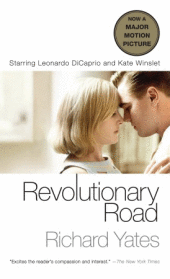
Revolutionary Road by Richard Yates (1961)

If only the Wheelers had had a conversation with Groucho Marx, maybe invited him to tea in their little white suburban house on Revolutionary Road, probably they could have avoided a tragedy.

In her mind, April Wheeler has dreamed of a club like this:

“I still had this idea that there was a whole world of marvelous golden people somewhere… people who knew everything instinctively, who made their lives work out the way they wanted without even trying, who never had to make the best of a bad job becasue it never occurred to them to do anything less than perfectly the first time.  Sort of heroic super-people, all of them beautiful and witty and calm and kind, and I always imagined that when I did find them I’d suddenly know that I belonged among them, that I was one of them, that I’d been meant to be one of them all along…”

The problem with the self.  What had taken G. K. Chesterton two words to identify, Richard Yates has shown with 463 pages (my pocket paperback).  No, I’m not complaining.  What has driven me to go on and finish the book, despite the ominous cloud hanging over its pages, is Yate’s marvellous prose leading me every step of the way, through every fight of the Wheelers’, every sardonic description of Frank’s New York office, their suburban social circle, and their self-delusion.  And even amidst the dark and grey overtone, the undercurrents of humor could sometimes make me laugh out loud (Having read the book, I’ll have to ask myself: am I being a snob for not using the acronym?)

Humor and irony are only ways of delivery, the message is still poignant.  I’ve enjoyed every visit John Givings goes to the Wheelers’ home during his half-day out of the insane asylum.  John’s mother Helen, the realtor who sells the Wheelers their house, only means good, bringing her son to meet some normal people to help improve his condition.  Yates is superb there in these scenes. As expected, the fool often comes out as the wise, the insane pointing out the truth. But you still want to go over the lines.

Knowing that Frank doesn’t like his job, John responds:

“Whaddya do it for then?   Okay; I know; it’s none of my business.  This is what old Helen calls Being Tactless, Dear. That’s my trouble, you see; always has been.  Forget I said it. You want to play house, you got to have a job.  You want to play very nice house, very sweet house, then you got to have a job you don’t like. Great… Anybody comes along and says ‘Whaddya do it for?’ you can be pretty sure he’s on a four-hour pass from the State funny-farm; all agreed.  Are we all agreed there, Helen?”

“Oh look, there is a rainbow,” Mrs. Givings said…

But of course the problem is complex.  While we are all free agents of our own actions, we are also products of our circumstances and our past. The setting of the 50’s is a time of suburbanization, post-war peace and affluence. But the story could take place anywhere, anytime. When offered a promotion at work, Frank chooses to stay rather than opting for a loftier dream.  Substitute now for the 50’s, who would notice?

Frank and April Wheelers and their two children are the perfect example of the young and wholesome family enjoying the good life, in appearance that is.  What’s troubling them is legitimate, of course. What’s the point of being a nut screw in the machine of Big Business and a willing hostage of conformity and suburban ennui?  April might be fulfilling a self-serving and snobbish desire to move the whole family to Paris, but she could be right that Frank needs to be given the chance to ‘find himself’.  What she fails to see though is that she’s the one who could benefit from such self-reflection even more.

John Givings has more pointed words for the Wheelers in his next visit, which ultimately leads to the collapse of everything.  Yates’ writing has taken me captive.  The last hundred pages of the book have me glued to the seat.  It was already dark outside, I was sitting on a couch reading, alone in the house.  The feeling I had while going through those last chapters was no different from my experience of watching The Silence of the Lambs some years earlier, also sitting alone one night in the same spot… although there’s no similarity between the content of the two.  Haunting, eerie, disturbing…. now this is with me having watched the movie before reading the book.

Revolutionary Road is my first Yates book.  While I’ve admired his writing, I’m not so sure I’ll seek out his other works…  You see, I’ve always thought The Silence of the Lambs is a first-rate movie, but I would not want to see it again and again.

Revolutionary Road by Richard Yates, First Vintage Contemporaries Mass Market Edition, January 2009, 463 pages.

***

Revolutionary Road: The Movie (2008, DVD)

Leonardo DiCaprio and Kate Winslet reunited since Titanic (1997) to play the Wheelers in Revolutionary Road.  On the outset, they are perfect for the roles: Frank the charmer, April the golden girl.  And to top it off, the movie is directed by Sam Mendes, who has brought us the Oscar Best Picture for 1999, American Beauty, another brilliant suburban commentary.

Supporting roles are well performed by Kathy Bates as the talkative realtor Mrs. Helen Givings.  And Michael Shannon deservedly got an Oscar nom for his portrayal of Mrs. Givings’ son John, the lucid lunatic on a day-pass out from the insane asylum.

But somehow I feel there’s a significant discrepancy in the characterization that has shifted the dynamics between Frank and April.  As a result, the movie offers an altered view.  April here is a victim of circumstance.  She is portrayed as the courageous one who sticks to her goal, even heroic as Mendes says in the Special Features.  No suggestion of smugness or self-delusion, but rather, she is clear as crystal about her situation. Winslet has such cinematic appeal that her April is a much more amiable character than the controlling and self-serving dreamer and schemer I see in the novel.  And here, Frank is the conforming realist, the bully that needs anger management, the one who lacks the guts to embrace change.

While the storyline and scenes are faithful to the source material, the altered characterization of April Wheeler has subtly changed the premise of the novel.  What we have here is simply a love relation gone wrong.  A tragic drama of incompatible expectations, the conflicts between the progressive, idealistic and unfulfilled suburban wife, and the temperamental, gutless husband who has given in too easily to ordinary life.  The complexities which Yates has so marvellously detailed are absent here:  Was there any love to begin with?  Are dreamers necessarily superior than realists?  And, on what do we base our choices and actions?

What initially sparks off the romance between Frank and April and which sustains their façade can be summed up in this sentence from the book, and which, of course, is absent in the film in any nuanced form:

“Sometimes there was a glint of humor in these embraces of the eye:  I’m showing off, they seem to say, but so are you, and I love you.”

All the more reason to read the source material after watching a movie.

DVD Special Features include commentary by director Sam Mendes and screenwriter Justin Haythe, and Lives of Quiet Desperation: The Making of Revolutionary Road.

****


Never Let Me Go: Book and Movie

(Update Oct. 5, 2017: Kazuo Ishiguro has just won the Nobel Prize for Literature)

I must first declare this Spoiler Alert: It is impossible to write about the book and the movie clearly without stating the crux of the story. It is this key ingredient in the plot that instills meaning to the novel and now the film. While Never Let Me Go is a story of slow revealing, author Kazuo Ishiguro, in a Time magazine interview, admits that:

” … in a funny sort of way, I almost wanted the mystery aspect to be taken away so that people could conentrate on other aspects of the book.”

So there, even the author himself condones spoilers, for he knows there are much more to be pondered upon once the veil is removed.

Never Let Me Go (2005): The Book

Born in Nagasaki, Japan, in 1954, Kazuo Ishiguro‘s family moved to England when he was six. He is one of the most acclaimed English language writers today, listed by The Times as one of the 50 greatest British writers since 1945. Never Let Me Go is Ishiguro’s fourth nomination short-listed for the Booker Prize, which he won in 1989 with The Remains of the Day.

Based on a scientific premise, Never Let Me Go is a beautiful love story told with aching poignancy. Children of the exclusive boarding school Hailsham are told they are special from a very young age. They are to keep their bodies healthy and strong for that’s the purpose of their lives. They are told and yet not told, for theirs is a vague notion of who they really are or what is in store for them in the future. Knowing no other worlds, the children grow up in the sheltered, fenced-in compound of Hailsham, accepting their predetermined fate with docility.

Scientific advancement has made it possible. The children of Hailsham are clones, copied from an original, raised to have their organs harvested once they reach the prime stage of adulthood. While sports keep their bodies strong, they are particularly encouraged to pursue art and poetry. A mysterious figure they called Madame comes by regularly to collect their art work to keep in her Gallery.

The story focuses on three students, Kathy, Ruth, and Tommy. Their friendship on the outset matches the idyllic backdrop of the school in the 1960’s English countryside. Kathy is kind, caring and gentle, always watching out for Tommy, who is inept and temperamental. Seeing the bond forming between the two, Ruth slyly moves in and silently snatches Tommy to her side.

After reaching their eighteenth year, the three are transferred to the Cottages to live. There are just two roads ahead of them, donation of their organs and after 3 or 4 times, meets completion, death. Or they could apply to become carers of donors, but only temporarily until they too must fulfill their purpose. Living with other grown-ups who fall into the same destiny, the undercurrents of their love triangle begin to expose. For the first time in their lives, they hear about ‘deferrals’. If genuine love is evident between a couple, they could apply to have their donations deferred for a few years. When you are in love, just another day is precious enough. But what is love, and how do you prove it? There might also be another way out, and art could be the key. Ishiguro has masterfully handled layers of thematic complexity in a shroud of suspense.

While the story is based on an imaginary scientific scenario, the book is not a debate on the medical ethics of cloning. The events that take place which ultimately lead to their determined end explore, ironically, what it means to be human. Using the intricate relationships of the threesome, Ishiguro goes deep into issues of love and loss, dreams and reality, wrongs and their amends, and the ultimate search for the source of being, the very purpose of existence.

Using a first person narrative from Kathy, now a carer at 31 looking back at her past experiences, Ishiguro presents his story with detailed internal depictions and nuanced dialogues. Kathy’s voice is innocent and gracious, and all the more moving when it comes to the end when the story is fully unfurled. The three friends have since parted after the Cottages, but now after years have gone by, they meet again as carer and donors. On the canvas of imminent destiny, against the overwhelming tone of grey, we see three brisk strokes of colours, three lives, however temporal, serving their purpose, and above all, having tasted what it means to be human.

~ ~ ~ 1/2 Ripples

Never Let Me Go (2010): The Movie

Update Dec. 6: Carey Mulligan won Best Actress for Never Let Me Go at the British Independent Film Awards last night. This is her second BIFA win after An Education.


Directed by Mark Romanek (One Hour Photo, 2002), screenplay by Alex Garland (28 Days Later, 2002), the film was screened at the 2010 Toronto International Film Festival in September, and chosen to open the 54th London Film Festival on October 13th.

The mood is nostalgic, shot in greyish greens and blues, effectively capturing the general atmosphere of the book. When the future looks dim, the best one can do is to look back and savour what has been. Screenwriter Alex Garland has done an admirable job in being loyal to the source material, visualizing the key events and pertinent scenes, bringing to life the haunting memories of Kathy’s, whose narratives are taken straight out of the book.

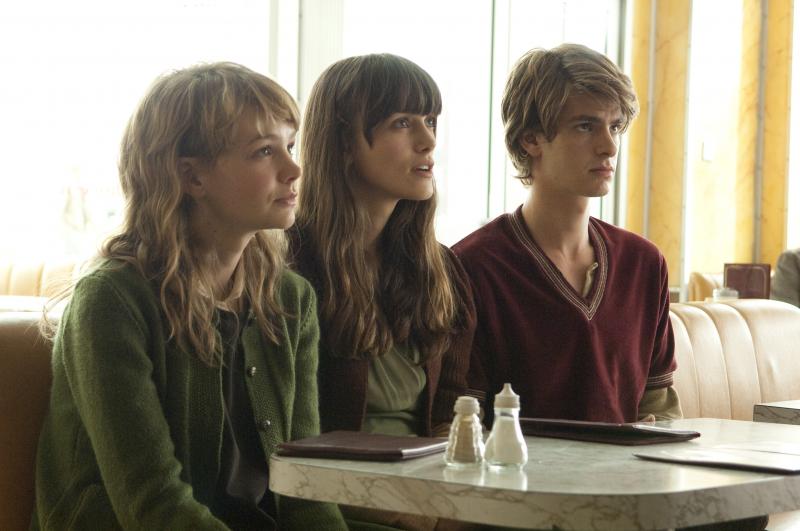
Corresponding to the novel, the film is structured in three parts. It follows Kathy (Carey Mulligan, An Education, 2009), Ruth (Keira Knightly, Pride & Prejudice, 2005) and Tommy (Andrew Garfield, The Social Network, 2010) through Hailsham in the 1960’s, young adulthood at the Cottages in the 1970’s, and lastly in the 1990’s where we see the final destination of their lives in completion. While the beginning part is the weakest, lacking the depth and details of the book, such a shortfall is compensated by the excellent performances of the three child actors as the young counterparts, Izzy Meikle-Small (Kathy), Charlie Rowe (Tommy) and Ella Purnell (Ruth). The congruence of young Kathy with her adult role played by Mulligan is particularly impressive.

As the story moves along, almost to midpoint, the unfurling of facts and feelings becomes more pronounced, calling forth some intricate and nuanced performance from Mulligan, Garfield, and Knightly. The three actors are the pillars of the production. While the original music by Rachel Portman (Academy Award Best Music, Emma, 1996) is affective and heart-wrenching, and the cinematography by Adam Kimmel (Capote, 2005) captivating, it is the performance of the threesome that makes the film so real and stirring.

Mulligan’s portrayal of Kathy and Garfield’s Tommy are particularly riveting. The hidden love Kathy has been holding for years is given a channel for expression only briefly at the end. All through Mulligan has carried her role with admirable restraint. Garfield’s portrayal of Tommy is achingly real, especially when he ultimately realizes the finality of his fate, the cry in the dark is haunting and powerful. And kudos to Knightly for accepting a role that puts her in a less than glamorous light. Her change at the end too is moving, giving depth to the exploration of what makes one human… other than love, there is also the courage to admit wrong, seek forgiveness, and the attempt to make amends.

Is it melodramatic or is it evoking deep emotions? Within context here, emotional sentiments or even a few tears at the end of the film might well be a healthy response, nothing to shy away from. Should the scenario arise some day in the future when we need to prove that we are human, and that we have a soul, what better ways to demonstrate but by our capacity to emote love, empathy, compassion, pathos, and the fear of facing such a scenario. May this all remain as science fiction for our enlightenment only.

~ ~ ~ 1/2 Ripples

***

To read other Book Into Film posts, CLICK HERE.

Another Year (2010)

Update Feb. 10: Leslie Manville just won British Actress of the Year at the London Film Critics’ Circle Awards.

Update Jan. 25: Mike Leigh is nominated for an Oscar for Original Screenplay.

Update Jan. 18: Another Year is nominated for a BAFTA for Outstanding British Film of the Year, and Leslie Manville for Best Supporting Actress.

“Ah, look at all the lonely people.”

— ‘Eleanor Rigby’

Every DayAnother Year, film titles like these evoke the oblivious passage of time, and the human experiences that float down the stream of life. The kind of films we would find in art-house cinemas, not your fast-paced action or effects-generated spectacle.  Another Year would gratify one’s need for slow ruminations and offer one time to savour the dynamics among characters.  The film was on my ‘must-see’ list at the Calgary International Film Festival 2010, which ended last weekend.  It had met all my expectations and offered more.

What’s more is the excellent performance from a high calibre cast of British actors.  Their nuanced portrayals of characters convey emotions unabashedly, but in a deep, restrained and unsentimental manner.  That is what makes Another Year so satisfying.  I enjoyed it much more than director Mike Leigh’s previous title, equally acclaimed Happy-Go-Lucky (2008), in which Poppy (Sally Hawkins) the happy gal is just a bit too loud and even obnoxious for me.  While here in Another Year, Tom and Gerri are the happy couple whose relationship is one of mature, quiet and gentle bliss, compassionate towards themselves and others.

Framed in the passing of the four seasons, the film explores the realities of life: ageing, loneliness, death, love, marriage, friendship… Yet the occasional animated and humorous renderings of the characters allow a lighter way of handling the subject matters.

Gerri (Ruth Sheen) and Tom (Jim Broadbent) are a happily married couple living in London.  In the midst of the bustling city, they have their own plot of land close by their home where they work hard to grow vegetables. They bring home fresh produce to cook healthy meals and entertain guests.  Their vegetable garden is an apt metaphor for the love they cultivate in their relationship despite the busyness of everyday life. Tom is a geologist and Gerri a counsellor in a medical office. If there’s any pun intended here with their names, it would be for the very opposite effect that they are a harmonious pair whose relationship has attracted those less happy to cling on for stability and support.

Their usual dinner guest is Gerri’s office administrator Mary (Lesley Manville).  A single, middle-aged woman, emotionally fragile, alcohol dependent, and desperately seeking love and companionship. Her male version is Tom’s long time friend Ken (Peter Wight), equally miserable. A heavy smoker and drinker, Ken’s physical health mirrors his emotional state.

But why Tom and Gerri gather such damaged and dependent friends the film does not explain.  What we do see is a most gracious couple extending their lives to them. Through their interactions, we see the contrast. While we admire the almost perfect marriage, we ache for the singles, sad and lonely… as we see them in this film.  I trust the director is making a specific rendering and not a generalization on singlehood.  The contented Poppy (Sally Hawkins) in Happy-Go-Lucky (2008) is the best spokesperson for the single league.

Tom and Gerri have an adult son Carl (Martin Savage) who frequently comes home to visit his parents from a nearby town by train. When I saw the shot of a commuter train going past on screen, it flashed upon my mind the image in Ozu’s works.  That is one of the Japanese director’s signature shots, a train passing through, and his favourite subjects also being family, marriage, nuanced interactions.  I thought, if Ozu were an Englishman living today, this would be the kind of films he would make.  And lo and behold, I found this tidbit of trivia on IMDb: One of Mike Leigh’s top 10 films of all time is Tokyo Story (1953).

If one is to find fault with Another Year, it could be the very fact that Tom and Gerri’s marriage is just too perfect. But with all the ubiquitous dysfunctional families we see represented in movies nowadays, Leigh might have opened a window to let in some much needed fresh air. Tom and Gerri make an ideal contrast to what we have so sadly gotten used to seeing in films.

There are excellent performances from the veteran actors, but one stands out. Lesley Manville’s animated portrayal of the vulnerable Mary deserves an Oscar nomination. The most impressive shot comes at the end. Without giving it away, let me just say the ending shot lingering on her face and the ultimate fade to black is poignant and most effective. Of course, it’s acceptable to applaud after a festival screening. And so we did, appreciatively, a much needed channel for a cathartic response.

~ ~ ~ 1/2 Ripples

Every Day (2010)

In the movie Shadowlands, there’s a line that goes like this: “We read to know we are not alone.”  I think it applies to watching movies as well.

I’m glad somebody thinks the every day family life worthy of movie material.  Nothing spectacular or heroic, nonetheless difficult and to some, a struggle.  This is especially true when it comes to the so called sandwich generation, adult children who needs to care for their elderly parents as well as their own children.  Caught in the middle, parents to both.  In the midst of daily challenges, there remains the key relationship, the meat in the sandwich if you will, that which is between husband and wife, and always, the bare essence of a person and his/her integrity.  Herein lies the ingredients of the story.

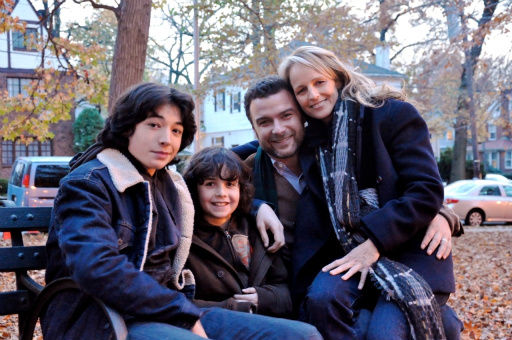
Screened at the Calgary International Film Festival last night, the indie dramedy stars Liev Schreiber and Helen Hunt as a NYC couple, Ned and Jeannie.  Their marriage faces a testing turn as Jeannie, driven by guilt and responsibility, brought her recently widowed father home to stay.  Ernie (Brian Dennehy) is not just any grumpy old man.  He is wheelchair confined, in ill health, and utterly bitter about everything and with everyone.  Jeannie is stressed out as she keeps pace just to live every single day.

Ned too has his share of problems at work.  As a scriptwriter for a seedy TV series, he has to meet the perverted demands of his boss Garrett (Eddie Izzard) to churn out scripts that are beneath his style.  To solve the problem he is assigned to work with a flirtatious colleague Robin (Carla Gugino) to rewrite something more daring and less boring.  Ned is tempted to do exactly that not only in his script.

And for their sons, they may look alright, but both yearn for direction and care just the same.  15 year-old Jonah (Ezra Miller) has just come out and is heading towards some risky friendship.  The younger one Ethan (Skyler Fortgang), though talented, has to deal with a defeating self-image. Amidst their own problems, Ned and Jeannie try to be good parents, loving yet setting limits, albeit finding a happy medium is hard to do.

Though not meant to be a serious film, it does touch on two thought-provoking questions implied by two unlikely characters.  From Robin the seducer:  Is a marriage finished when the ‘fun’ is over? Similarly from Ernie the bitter old man:  Should a life be ended when there is no happiness?

With subject matters as such, sitting through Every Day could be a gloomy ordeal.  But as a fusion of comedy and drama, it has come through to me as an enjoyable film. Written and directed by Richard Levine of the TV series “Nip/Tuck” fame, Every Day could seem episodic.  But the fast scene changes keeps the momentum going and the subplots clear.  Liev Schreiber is convincing as the family man in mid-life crisis.  Brian Dennehy is a veteran and spot on in his performance.  The boys are alright.  I have enjoyed Helen Hunt the most.  Her precarious roles of mother, wife, and daughter have resonated with me.  It has been three years since her directorial debut Then She Found Me.  I look forward to more of her works in the coming year.

Every Day premiered at the Tribeca Film Festival in NYC this April.  During the Q & A after the screening, Schreiber mentioned that the film is “a simple story and simple stories are often overlooked.”  Somebody has to make simple films like this, and somebody has to watch them.  I was one of the lucky ones last night at the CIFF.

~ ~ ~ Ripples

Photo Source: myveronanj.com

Arles: In The Steps of Van Gogh

Solution to Arti’s Cryptic Challenge #4: Arles

While Paris has her cultured beauty and sophistication, I’d appreciated the change of scenery and warmer weather as I headed south to Provence.  Three hours via the TGV took us to the historic City of Avignon, site of the Papal Palace before the Vatican. We stayed in Avignon for three days, taking daily excursions out to nearby towns.  Arles was a must-see on my list.

Van Gogh moved to Arles from Paris in 1888, seeking the tranquility that was so elusive to him in the big city.  In his letter to his brother Theo upon arrival to Arles, he wrote:

It seems to me almost impossible to be able to work in Paris, unless you have a refuge in which to recover and regain your peace of mind and self-composure. Without that, you’d be bound to get utterly numbed.”    — Tuesday, Feb. 21, 1888.

The fresher and more colourful palette is apparent during this most prolific period of the artist’s life.  Bright yellows, blues, shorter and swirling brush strokes established his signature style.  As for me, I was a bit disappointed to see the sunflowers have already withered in late August.  Fields of yellow were now massive brown.  They would be harvested at a later time for their oil, a good reminder that, for tourists, it’s the view, but for those living here, it’s their livelihood.  The lavenders on the Luberon mountains too had long passed the season.  Note to myself:  Early to Mid July is best if I ever come this way again.

But all was not lost.  I was gratified to follow some of Van Gogh’s footsteps as I explored the clearly posted Van Gogh sites in the town, the scenes and locales where the artist so vividly captured in his paintings.

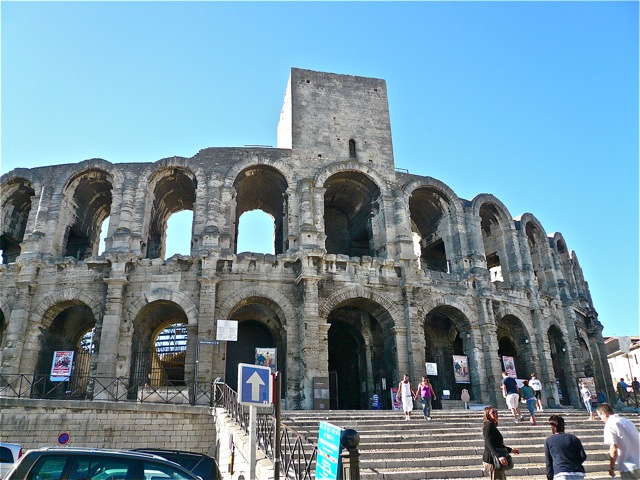
Arles is a Roman town.  What more prominent to reflect its past glory than the Roman Arena in the town centre.  Why all the arches?  The free flow of pedestrian traffic.  The full seating capacity, 20,000 people, could exit the Arena in 7 minutes.

.

Used by gladiators in ancient time, the Arena is still the venue for bullfights:

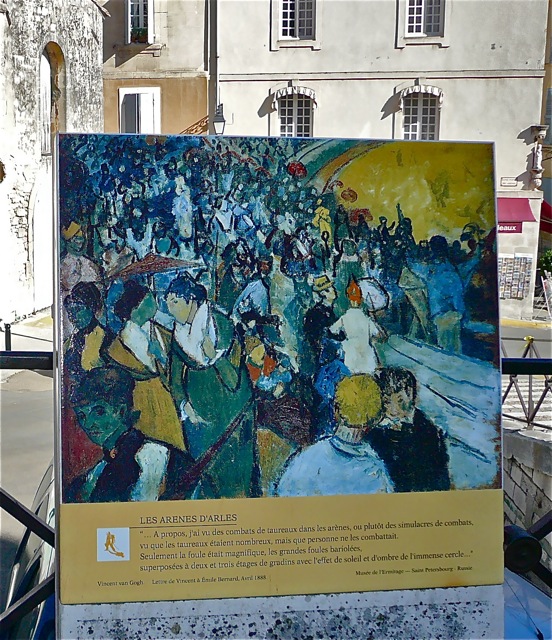
But Van Gogh’s interest was not so much on the violent action of bullfighting than on the people, as his painting Spectators In The Arena At Arles (December, 1888) clearly shows:

The Café Terrace on the Place du Forum was his hang-out, renamed Café Van Gogh now.  The yellow building upon the backdrop of the blue, starry night had deeply inspired the artist:

Café Terrace At Night (September, 1888):

Van Gogh had wanted to make Arles a hub for fellow artists.  Upon his urging, Gauguin came to join him in October, 1888.  The two painters frequented the Café Terrace many a night but only for two short months.  What happened on December 23rd was reported by the local paper the next day:

At 11:30 pm., Vincent Vaugogh [sic], painter from Holland, appeared at the brothel at no. 1, asked for Rachel, and gave her his cut-off earlobe, saying, ‘Treasure this precious object.’  Then he vanished.[1]

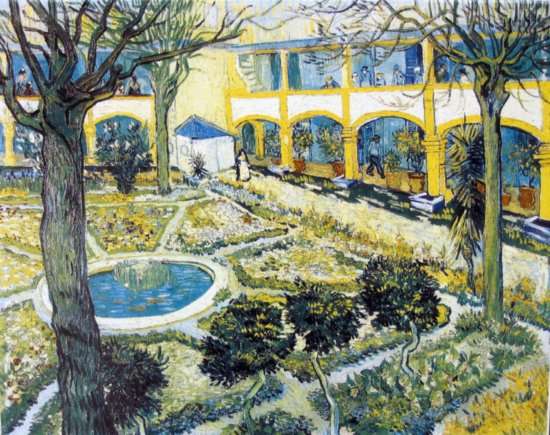
After this incident, Van Gogh was admitted to a local hospital, now the Espace Van Gogh in Arles, a cultural centre:

In January, 1889, Van Gogh returned home to the Yellow House, but for the next few months, suffered onslaughts of hallucinations and delusions. His view of his own condition nevertheless was lucid and even progressive for his time.  His letter to Theo is poignant, as he openly faced his predicament and earnestly sought a solution:

And for the time being I wish to remain confined, as much for my own tranquillity as for that of others.

What consoles me a little is that I’m beginning to consider madness as an illness like any other and accept the thing as it is, while during the actual crises it seemed to me that everything I was imagining was reality.”

— Sunday, April 21, 1889.

On May 8, 1889, he checked himself into the Saint Paul de Mausole, the mental hospital at St-Rémy-de-Provence.  Under the care of his doctor Théophile Peyron, the artist’s condition improved and he thrived in the idyllic environment there.  Art therapy had brought healing and prolific output.  Van Gogh stayed there for a year and created more than 150 paintings.

Dr. Théophile Peyron out at the front garden:

.

The olive grove outside St. Paul hospital:

.

To his brother Theo, he wrote on Sunday, May 11, 1890:

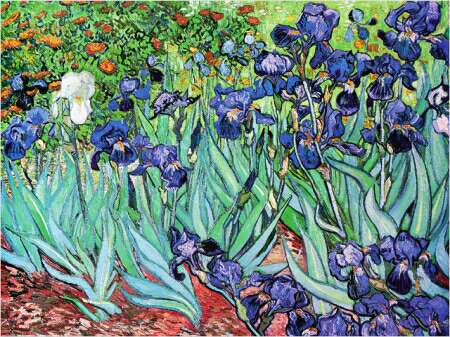
At the moment the improvement is continuing, the whole horrible crisis has disappeared like a thunderstorm, and I’m working here with calm, unremitting ardour to give a last stroke of the brush.  I’m working on a canvas of roses on bright green background and two canvases of large bouquets of violet Irises…

My Van Gogh trip ended at St. Rémy, and so be it.  I’ve seen the sites wherein the artist was at his most prolific.  I’ve seen the town and surroundings where he found inspiration.  I’ve seen his final solace where he attained some stability and painted with passion.  I’d like to keep these as memories of my travel to Provence.  I could hardly bear to think of his last days, discharged from St. Rémy just a few days after the above letter, headed north to Auvers-sur-Oise on the outskirt of Paris, and in just two short months, succumbed to the recurrence of his illness. He shot himself in the chest with a revolver on July 27, 1890, and died of his wound two days later.

Back to the thoughts I wrote about in my last post: How do we keep art from turning into a cliché?  I think it takes a certain awareness of the artist as a person, plus a measure of empathy and respect for the struggle to live and create… and realizing that the beautiful works are often triumphs in spite of life’s overwhelming adversities, rather than the natural products of bliss and fortune.

To wrap up my travel posts, and taking the risk of turning it into a cliché albeit my motive is pure, here’s the YouTube clip again, Don McLean’s tribute to Vincent:

Some Van Gogh links:

An excellent and comprehensive site for Van Gogh’s letters, 900 of them, poignant account of his life.

The Van Gogh Museum, Amsterdam

Van Gogh Gallery online

Wikipedia: Vincent Van Gogh

***

[1]  Rick Steves’ Provence and French Riviera 2010, published by Avalon Travel, p. 69.

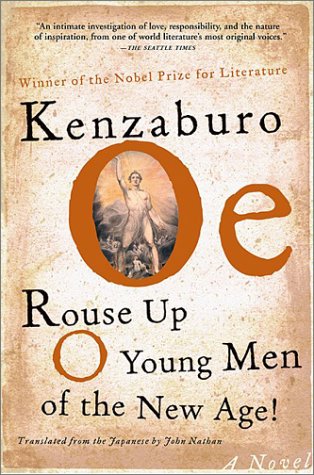
Rouse Up O Young Men of the New Age!

Thanks to Bellezza’s Japanese Literature Challenge 4, I have the chance to explore the intricate world of Kenzaburo Oe (pronounced ‘oh-ay’, 大江 健三郎 ), Japan’s second Nobel Laureate for Literature (1994), after Yasunari Kawabata (川端 康成) received the Prize in 1968.

Like his earlier work A Personal Matter*, Rouse Up O Young Men of the New Age! is an autobiographical novel dealing with the author’s experiences of raising a handicapped child.  A Personal Matter was written when Oe was young, describing an ordeal still raw from the initial shock of the birth of his brain-damaged child. Rouse Up was published in 1983, almost twenty years after A Personal Matter.

Rouse Up chronicles a more mature protagonist, the writer K, who has gone past the stage of denial and escape, to come to terms with the reality of fathering a handicapped child. Through the arduous journey, the writer has gained insights and pleasure from his relationship with his son Hikari, whom he nicknamed Eeyore in his novels.

Oe starts off the book with K’s plan to write a dictionary of terms for his now maturing son, to prepare him for his entry into the real, adult world.  This turns out to be a learning task in itself.  How do you explain to a brain-damaged person what the word ‘foot’ means?  Or ‘river’, ‘life’, or ‘death’?  He needs to deconstruct the realities of his everyday life before he can grasp the essence and meaning of his encounters.

It’s interesting to see how K get through to his son in defining ‘foot’. Eeyore understands it in relation to ‘gout’ from which his father once suffered. After the healing of the pain and swelling of the gout, it has turned into ‘a nice foot’.  So, the understanding of ‘foot’ comes in light of the pain it had experienced. K soon realizes that the definitions are more for himself as for Eeyore.

The author’s long journey of acceptance and self-discovery owes mostly to his love for the works of William Blake.  Rouse Up is a smorgasbord of selections if you are a Blake scholar. So admittedly, I have had a hard time ploughing through Oe’s use of parallels from Blake’s poetic and artistic symbolisms to reflect on his own predicament.  In certain parts, Oe’s writing is just as esoteric as Blake’s mythical depictions.  However, one thing is clear.  My enjoyment of this novel is no less, and the poignancy of a father-son relationship no weaker as I find my way through the Blake maze.  The book requires and deserves multiple reading.

Despite its complexity and denseness, the essence filters through Oe’s meticulous descriptions.  Further, John Nathan’s translation navigates effectively through Oe’s nuanced and sensitive narratives.  I’m just curious as to what the original Japanese version looks like since there are numerous references and quotes from Blake.  Are they in English or in Japanese translation?

Two lines from The Four Zoas seem to have outlined K’s personal journey:

“That Man should Labour & sorrow & learn & forget, & return
To the dark valley whence he came to begin his labours anew.”

It’s a perpetual striving, not unlike Sisyphus’s effort, and yet still leads from one path to the next, prompting a renewed acceptance and offering novel discoveries on the way.

Aside from the esoteric passages of Blake’s visions, some very simple lines shine through, and they are the ones that are most moving for me:

… healing the rift with my son, I became aware of his grief through the agency of a Blake poem, “On Another’s Sorrow,” which includes this stanza:

Can I see a falling tear,
And not feel my sorrows share,
Can a father see his child,
Weep, nor be with sorrow fill’d.

One of the “Songs of Innocence,” the poem concludes with the following verse:

O! he gives to us his joy,
That our grief he may destroy
Till our grief is fled & gone
He doth sit by us and moan.

In his attempt to know more about Eeyore, K explores the power of dreams and the imagination. Using Blake’s mythological poetry and artwork, he tries to understand Eeyore’s internal world. Both he and his wife know Eeyore does not dream, but that does not preclude he does not have imagination.

Subscribing to Blake’s conviction that: “The Imagination is not a State:  It is the Human Existence itself.”, K strives in earnest to cultivate Eeyore’s imagination. Eeyore has an almost instinctive response to bird calls, distinguishing them even before he adopts human language.  As he grows older, he is drawn towards the music of Bach and Mozart.  His imagination soon finds a channel of expression in composing, an amazing accomplishment nurtured by a highly supportive and loving family.  In real life, Oe’s son Hikari is a composer.

Adopting Blake’s vision, K sees a future for father and son together in a state of grace, from Blake’s Jerusalem:

“Jesus replied Fear not Albion unless I die thou canst not live
But if I die I shall arise again & thou with me
This is friendship & Brotherhood without it Man is Not

So Jesus spoke! The Covering Cherub coming on in darkness
Overshadowed them & Jesus and Thus do Men in Eternity
One for another to put off by forgiveness, every sin.”

From coming to terms with the tragic reality of fathering a brain-damaged child, to ultimately, almost symbiotically, sharing his life with his son, is a process not short of a personal epiphany.  At the end of the novel, Eyeore has grown to be a twenty-year-old man. While still having a limited mental capacity, Eeyore has his way of exuding his own humor, love and care for those around him.  The story is a poignant tapestry weaving real-life and the visionary, through which an imagined world of reality is beautifully conceived.

As for the source of the book title, it comes as a moving episode at the end of the book.  I should keep that for you to discover.  A heart-warming finish to a poignant chronicle.

John Nathan’s Afterword is an eloquent tribute to the father, son, and the nurturing family. It is also a helpful annotation of the novel.

Rouse Up O Young Men of the New Age! by Kenzaburo Oe, translated by John Nathan, published by Grove Press, NY, 2002.  259 pages.

***

* A touching review of A Personal Matter has been posted recently by Claire at Kiss A Cloud.  Also, Mel U’s A Reading Life has posted extensively on Oe and other Japanese writers.  Of course, there’s Bellezza at Dolce Bellezza, who has hosted Japanese Literature Challenge all these years, now in its fourth term.  I thank them all for their inspiration.