Pussywillows, Cattails, Soft Winds and Roses

Took a short trip to Ontario last week and came home overwhelmed with nostalgia.  It all started when I visited the town of Unionville and saw these, crowds and crowds of cattails growing profusely in the pond, the fields, by the footbridge:

.

For some inexplicable reasons, I’m much fond of cattails. The first time I learned about them was from listening to the song by Gordon Lightfoot… before I’d actually seen one.

Some time in the 70’s, for many afternoons I sat in the art room of a high school somewhere in Alberta, working on some art project, but mostly doing nothing at all while listening to Gordon Lightfoot.  Mr. Hannington held a laissez faire art class… we could do just about anything, or nothing.  Usually, there would only be three or four of us in the room.  We would just sit around, chat, daydream, and immerse in the voice of Gordon Lightfoot on the radio.

I didn’t turn out to be an artist, while one of us did.  But I’ve remained partial to cattails, mesmerized by the song and the singer.  Those Lightfoot afternoons in the art room emerged from the depth of hazy memories, the lyrics were the soft winds caressing naked limbs as I walked in this natural reserve in Unionville.

Pussywillows, cat-tails, soft winds and roses
Rainpools in the woodland, water to my knees
Shivering, quivering, the warm breath of spring
Pussywillows, cat-tails, soft winds and roses

Catbirds and cornfields, daydreams together
Riding on the roadside the dust gets in your eyes
Reveling, disheveling the summer nights can bring
Pussywillows, cat-tails, soft winds and roses

Slanted rays and colored days, stark blue horizons
Naked limbs and wheatbins, hazy afternoons
Voicing, rejoicing the wine cups do bring
Pussywillows, cat-tails, soft winds and roses

Harsh nights and candlelights, woodfires a blazin’
Soft lips and fingertips resting in my soul
Treasuring, remembering, the promise of spring
Pussywillows, cat-tails, soft winds and roses

(To my artist friend CD: Keep the fire burning.)

***

Summertime… and the reading is easy

.

Since my TBR booklist has evolved into one gigantic beast preying to devour my fragile conscience, I’m feeling the burden of possession with every single book I acquire, be it only $1.50 or even free.  While summer has officially slipped in, with all its alluring promises and freeing energy, I feel it’s time to confront the beast and with one resolve, slay it.

So, may I present herewith Arti’s Declaration of Independent Reading. It may not be self-evident to all that there exist certain unalienable rights for us book lovers yearning for emancipation.  Allow me to use the collective pronoun here as I feel I just might not be the only one.  Therefore, all ye under the bondage of your TBR beast, here are our claims:

  1. Nonobligatory reading.  Reading for the simple joy of the act, and not for any courses, profs, teachers, groups, bloggers or to appease that monstrous beast.  We might have book challenges to meet, but they are our own choosing.  Even if we have miles to go before we sleep, we go the miles to honor our own quest.

  2. We hold the right to buy and not read, just for the satisfaction of owning a title. We deserve to be recognized for our contribution to the economy and the publishing industry.  By our perpetual purchasing, we are supporting local and national businesses and the livelihood of many workers.

  3. Freedom to follow our hearts in our book selections, and not the New York Times bestseller lists, Amazon’s recommendations, or Oprah’s earnest plea.  No need to follow trends or don literary fashion.  No need to challenge those titles simply because we are told to read before we die.  Literary and the not-so-literary, classics or contemporary, all to our heart’s content.

  4. Smorgasbord Reading.  Our right to have more than one item on our plate, our right to read more than one book at a time.  Fiction, non-fiction, bios or poetry, whatever that suits our palate at the moment.

  5. Not to be discriminated against.   As bookaholics, we will resist any attempt to be added to the pathological list of substance abuse, addictions, or to be forcefully admitted into any 12-step programs or obsessive-compulsive behavior therapy.

  6. In the spirit of slow blogging, we hold the right to read slowly, to mull and chew, at our own pace without having to meet any quotas, numbers, or deadlines. Further, we have the right to reread a book or an author as many times as we want, and not be labelled as subversive, fanatics or cultic.

  7. We have the liberty to stop reading, throw a book out the window, or honestly declare our dislike, if that’s our view.  With this right, we keep our sanity intact, our discernment sharpened, our intelligence preserved.

***

There.  Now that’s off my chest, let me get back to my reading… or not.

oooh, summertime…

.

Photos by Arti of Ripple Effects, June, 2010.  ALL RIGHTS RESERVED.

***

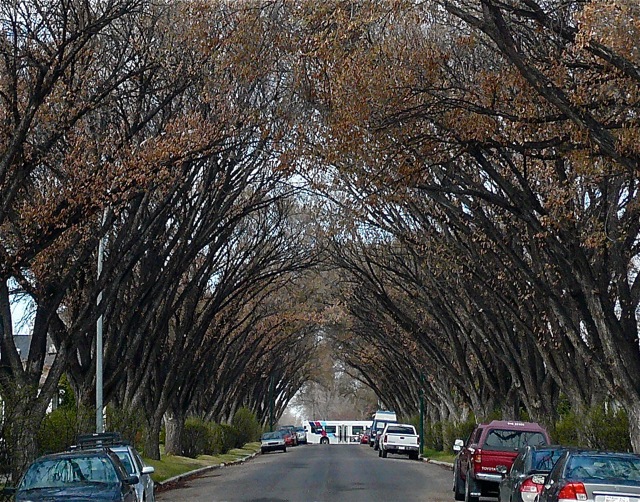
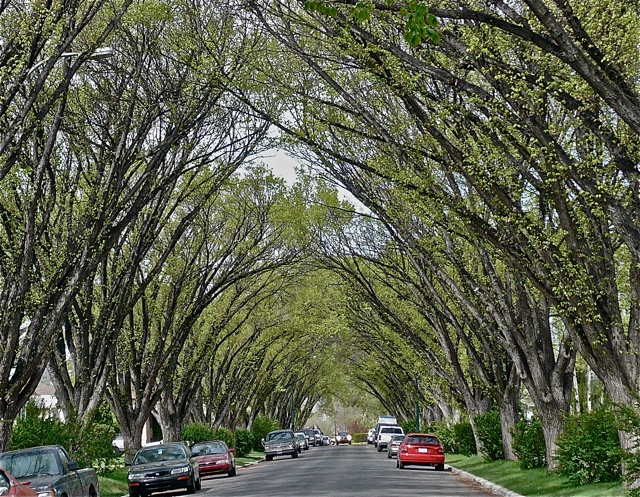
Greening of a Calgary Street

April 23

.

May 23

.

June 23

.

Waiting

He could have said
Let there be life
As in the beginning
But He made me wait.
For three months
I went back to the same spot
and watched
slowly
green bursting out from bare branches
fighting storms and snow
into full bloom.

.

I had waited before
Nine years, nine months
He could have said
Let there be…
But He had made me wait
and watch
slowly
like time-lapse photography
the gestation of a miracle.
He could have just said,
But He made me wait
and watch.

***

Pictures and poem by Arti of Ripple Effects, June 2010.  ALL RIGHTS RESERVED.

Book Sale 2010

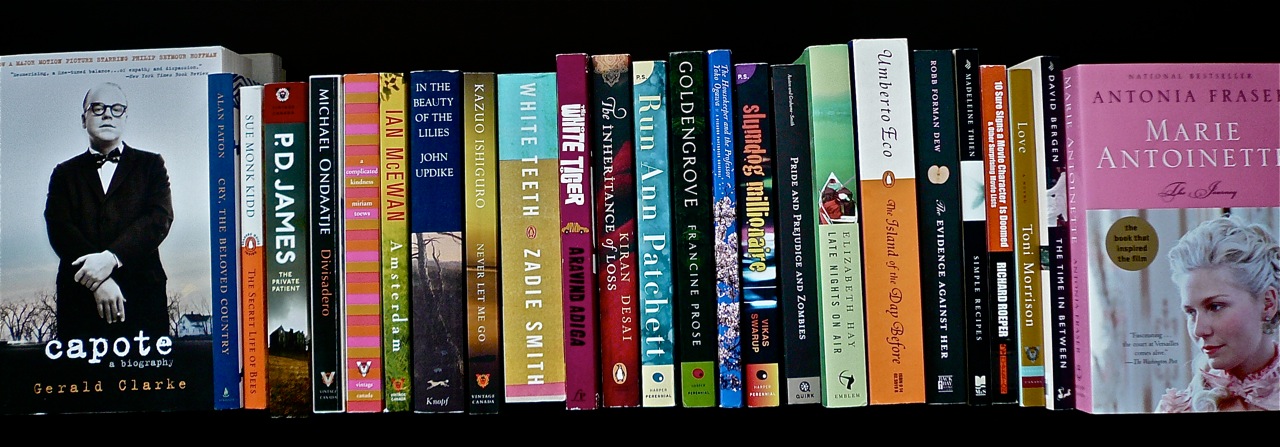
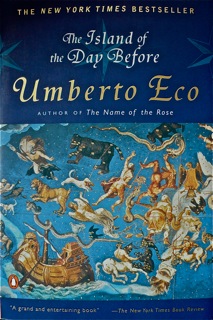
Went to the annual Book Sale at the Crossroads Market and hauled back my loot, officially kicking off Arti’s summer reading.  Although I must admit, I’ve many books on my TBR list.  They’re everywhere in my house, my bedside, on the couches, tables and chairs, and even on the floor.  Yet I would not miss the booksale at Crossroads.  The finds are just too good to pass.  My hours of scrutinizing always bring in great rewards.  Here’s a list of this year’s haul.  20 of them, almost all trade paperbacks, spine unbent, all new to like-new condition, at $1.50 each.  Here they are:

I’ve an eclectic selection here.  Here are the categories:

Biography

  • Capote: A Biography by Gerald Clarke  —  Book into film
  • Marie Antoinette by Antonia Fraser  — Book into film

Canadiana

  • The Time In Between by David Bergen —  2005 Giller Prize
  • Late Nights On Air by Elizabeth Hay  —   2007 Giller Prize
  • Divisadero by Michael Ondaatje  —  2007 Governor General’s Literary Award
  • A Complicated Kindness by Miriam Toews  —  2004 Governor General’s Literary Award

Contemporary Literature

  • The Island of the Day Before by Umberto Eco — International literary awards author
  • Love by Toni Morrison — Nobel Prize author
  • Run by Ann Patchett  —  PEN/Faulkner and Orange Prize author
  • Cry The Beloved Country by Alan Paton — contemporary classic
  • Goldengrove by Francine Prose — National Book Award finalist
  • White Teeth by Zadie Smith —  2000 Whitbread First Novel Award
  • In The Beauty Of The Lilies by John Updike — Pulitzer winning author
  • The Evidence Against Her by Robb Forman Dew — National Book Award author
  • The White Tiger by Aravind Adiga — 2008 Man Booker Prize
  • Amsterdam by Ian McEwan — 1998 Man Booker Prize
  • The Inheritance of Loss by Kiran Desai — 2006 Man Booker Prize
  • The Housekeeper and the Professor by Yoko Ogawa — Japanese literary awards author
  • Never Let Me Go by Kazuo Ishiguro — Man Booker Prize author
  • The Secret Life of Bees by Sue Monk Kidd  —  Book into film

Mystery and Thriller

  • The 39 Steps by John Buchan
  • The Scarecrow by Michael Connelly
  • The Private Patient by P. D. James
  • The Messenger by Daniel Silva

Short Stories

  • Telling Tales edited by Nadine Gordimer
  • Simple Recipes by Madeleine Thien
  • The Complete Short Stories of W. Somerset Maugham

Tools of the Trade

  • The Declaration of Independent Filmmaking by Mark Polish et al.
  • 10 Sure Signs A Movie Character Is Doomed & Other Surprising Movie Lists by Richard Roeper
  • Art History’s History by Vernon Hyde Minor
  • Notting Hill Screenplay by Richard Curtis
  • The Sense and Sensibility Screenplay & Diaries by Emma Thompson

Fads

  • Pride And Prejudice And Zombies by Jane Austen and Seth Grahame-Smith
  • Slumdog Millionaire by Vikas Swarup  — Book into film

Guilty pleasure?  Compulsive hoarding?  Not really.  First off, I’m supporting a well-meaning charity, Servants Anonymous.  Secondly, I’m doing something that’s uber important in this digitally-driven society.  I’m contributing to the preservation of the art of the printed book.  And who knows, someday, these copies might well become valuable antique items when the e-industry totally takes over.

A look at their covers would make you long to touch them, real paper, book art and design, authentic hard copies of the printed word.  A future rarity, and I’m sure, collector’s items.

Top 2 Over 90

.

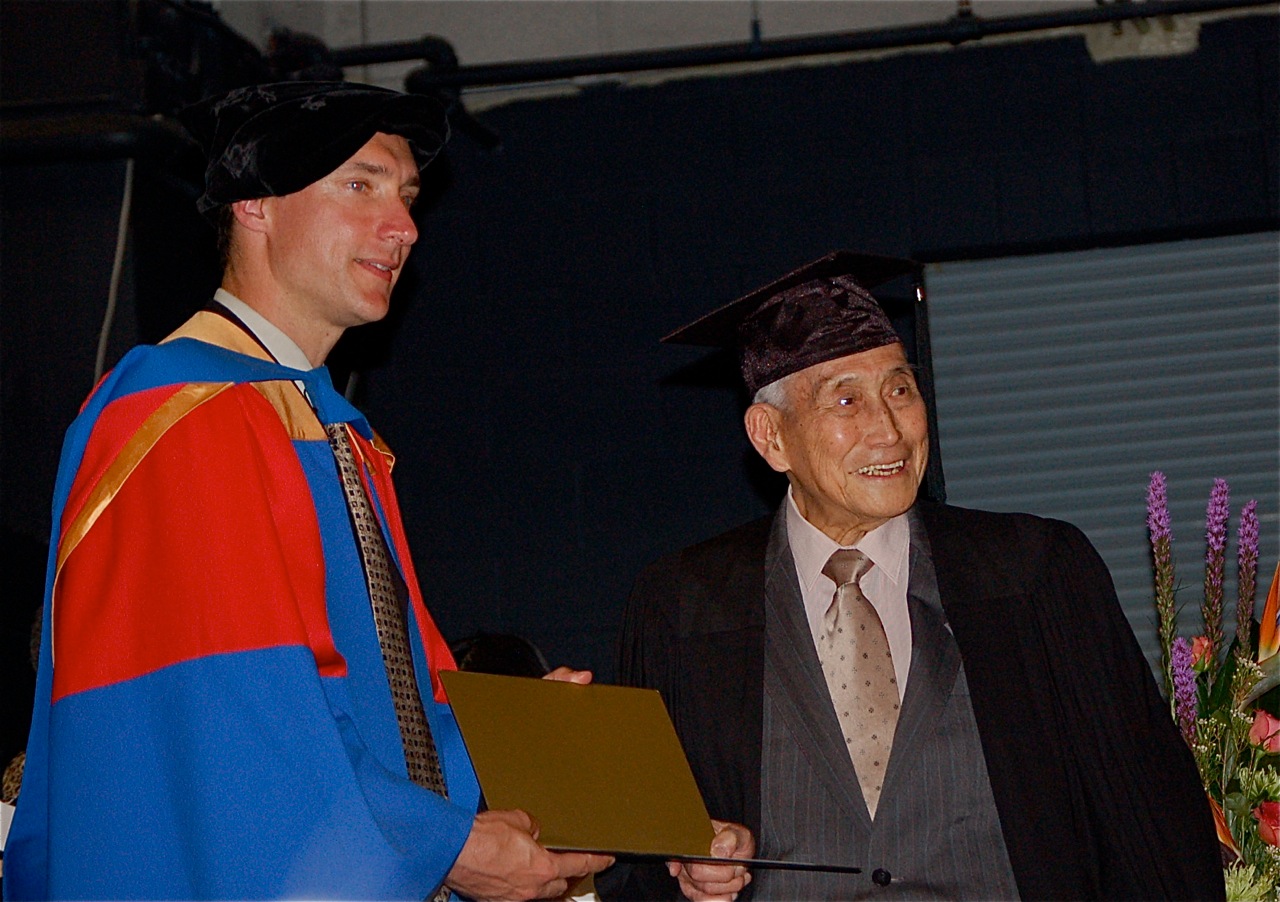
Turning 93 this October, my Dad is one of two recipients of the ‘Lifelong Learning Award’ presented to him by Dr. Scott McLean, Director of Continuing Education, University of Calgary.

In the past two years, he has taken courses from the Calgary Seniors College, co-organized by the U of C Continuing Education and the Evangelical Lutheran Church in Canada. Courses my Dad has taken include Computer, Chinese History, and Chinese Medicine.  Here’s a glimpse of yesterday’s Graduation and Award Ceremony.

No published work, no writing aspiration either.   Just a learner… for life.  Maybe that’s achievement enough.

***

Top 20 Under 40

The New Yorker has released the anticipated list of top 20 fiction writers under 40, kicking off their summer fiction issue. It’s been eleven years now since the last list.

I’ve no trouble with the number 20, but I admit the number 40 does pose a problem.  If these figures represent the ‘defining voices’ of contemporary fiction, the stars to watch, is there still a future for those who by chance happen to be on the other side of that magic number?

Why should age be a demarkation when it comes to creative writing?  And, why 40? Why not 32 or 46?  It sounds arbitrary doesn’t it.  I know, we’re a lists-obsessed people.  Even the New Yorker editors admit that.  It’s funny that they seem to justify their act by citing The Ten Commandments, the twelve disciples, the seven deadly sins, the Fantastic Four.  Wow, do we ever need to elevate literary stardom to epic proportion… we have fierce competitions in 3-D movies, ‘Dancing with the Stars” and interactive video games, just to name a few.

Writers on their previous list include Jonathan Franzen, Jhumpa Lahiri, Michael Chabon and David Foster Wallace.  So, it’s a highly anticipated star roster.   As well, other magazines have published similar recognition.  Granta has its “Top 21 Under 35” twice a few years ago.  Sounds like a well-established marketing strategy.

Fine.  That is certainly understandable in a time when so many alternatives are competing with reading a short story or a novel. But still, the number 40 troubles me.  My sympathy goes to those who are no less promising but alas, have shot further than the 40 mark.  Without being recognized as ‘young’ anymore, will they still have a future?  Further, is there hope for those who might choose to pursue a passion that comes late in life?  I can see the futility if that dream is to be a concert pianist if one hadn’t taken up the instrument by the ripe old age of 12.  But, what about writing?  Is starting at 40, or 50, or even 60 too late?  Is the term ‘late bloomer’ a misguided notion offering false hope?

**

Oh… the promise and glamour of youth.  And woe to us who are beyond rescue in a society that’s obsessed with popularity and rankings, youthful looks and prodigious fame.

To soothe the wounded spirit, and keep the creative fire burning, Ripple Effects would like to propose the following iconoclastic list in this day ruled by ageism:

  • Top 50 over 53:  To honor the best 50 unpublished writers over 53
  • Top 100 under 67:  To seek out the best 100 blog writers under 67 in lieu of being published in the real world.  Why 100?  I’m sure this is just a minuscule sample of the tens of thousands possible candidates out there in the blogosphere.
  • Top 15 over 74:  To encourage the best 15 yet-to-be literary stars over 74, just to give hope to those still pursuing their life-long dream.
  • Top 3 over 82:  To celebrate the late-bloomers who have finally made it, actually publishing their debut novel after 82.  Why 3?  That’s obvious.

Sour grape?  No, that would be immature.  Let’s just say, virtual tasting of the elusive grape.  Never underestimate the power of hope and the freedom of casting aside the burden of age.

.

You can still see the ripples at eventide.   — Arti

.

***

Photo taken by Arti at The Inside Passage to Alaska,  September, 2009.  ALL RIGHTS RESERVED.

That Was Then… This Is Now

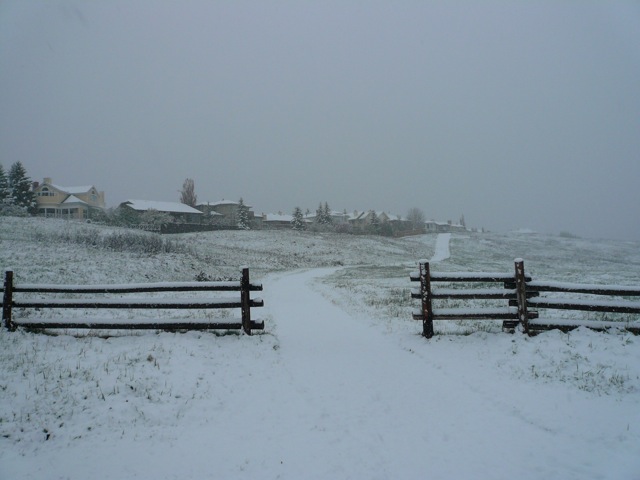
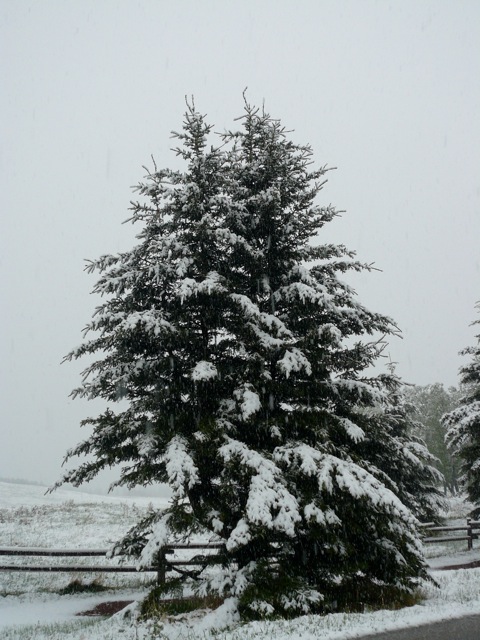
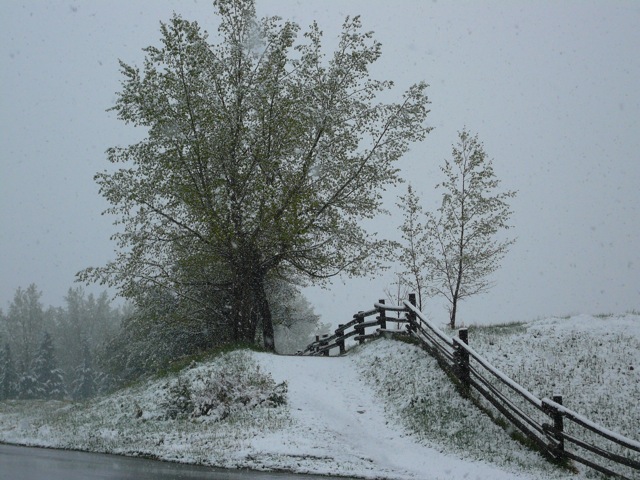
Just three days ago I was walking along The Bow River, enjoying the brilliant double-digit temperature.  Today is quite a different picture.  These are photos I took just a couple of hours ago, temperature hovering around 3 degrees C.  They were taken not too far from the deer sighting location on Mother’s Day. But today, May 27, three days after Victoria Day, the scene is another world.

As one who tries to preserve the most natural and authentic images, I’ve left the photos as they are, no adjustment, not even cropping here.  I like the blurry overtone, their lack of colors, for in reality, it was snowing heavily and the sky was grey.  I’d enjoyed this impromptu photo session.  I came home soaking wet.

But all this time I’ve been thinking about the oil spill down in the Mexican Gulf coast.  It’s one thing about snow in May for us, or even in July, or baseball-size hail in August, or the fierce blizzards in the winter, these we’ve learned to take as they come, knowing they’re ‘act of God’.

But, if something happens due to human errors or negligence, or which is preventable if more caution was paid, or less greed was involved, or political interests were laid aside, or more value placed on life, human or nature, then it’s a different matter.  Such are the times when we can’t be docilely yielding, as to a sovereign deity. Drastic measures are definitely needed in a time such as this.

No doubt, these pictures are thousands of miles from the Gulf coast, a huge gap in climate, a drastic difference in natural habitat.  Nonetheless, the air that once was in Chernobyl would ultimately reach us just the same as the tides from the tsunami of the Indian Ocean.  We’re shrouded by the same atmosphere; we’re linked by the same waters.  So, your pelican is also my pelican, likewise, my deer, your deer.

.

.

.

.

.

All photos taken by Arti of Ripple Effects, May 27, 2010.  ALL RIGHTS RESERVED.

****

A Victoria Day Walk

Today is Victoria Day, when we Canadians are indebted to Queen Victoria (1819-1901) for a nice, long weekend. For many, it marks the first camping trip of the year, a summer kick-off.  Ironically, it’s usually a weekend with overnight frost and even snow.   So the custom is, plant your garden only after Victoria Day.

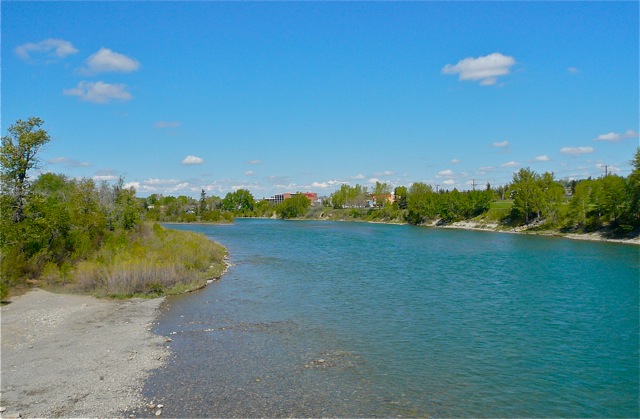
To commemorate, I should be watching The Young Victoria.  But, for all these years, I haven’t done anything Victorian on this day.  I guess they did take long walks.  So, I took a stroll along the Bow River.  Just as the day, this is a leisurely post.  Here are some sights I captured, yes again, with my pocket camera.  They’re a bit more cheery than the Mother’s Day outing of the deer family.  What a difference two weeks can make.

The Bow River:

A single flowering tree:

Holiday or not, this is life:

Making a splash is way more fun, especially if you can’t swim:

Spring, summer… green or white, we’ll take what comes:

Photos taken by Arti of Ripple Effects on Victoria Day, 2010.  All Rights Reserved.

***

Mother’s Day Picnic

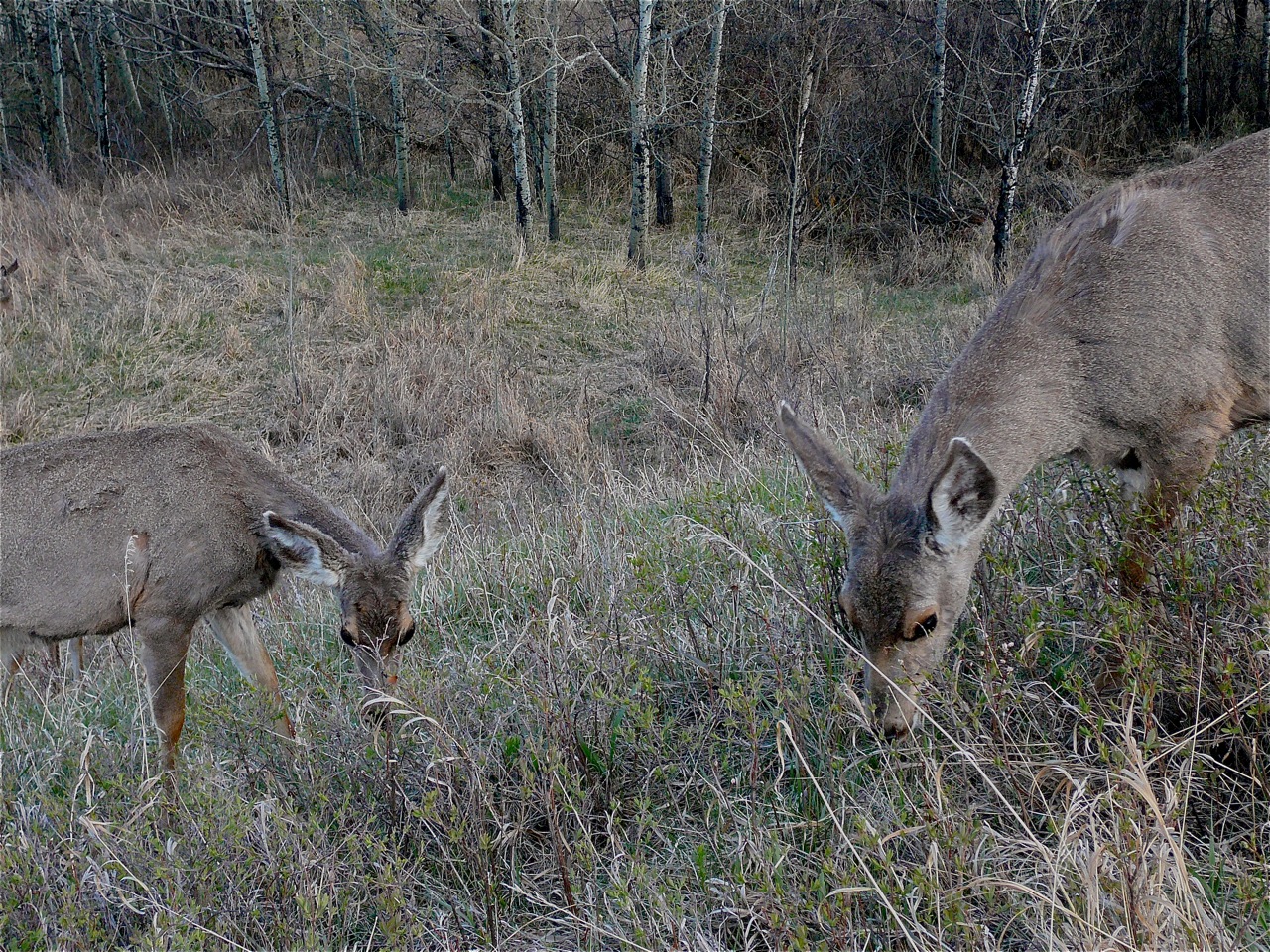
Here we are, our clan of extended family, out for a Mother’s Day picnic.  The weather’s just fine, though a bit chilly.  But for a May afternoon in Cowtown, we think it’s acceptable.

.

Well you got to eat out some time.  What better day than on Mother’s Day.  Why, our human neighbors have to cook… can smell their Bar-B-Q from far.  What a chore!   Wonder if it’s their Mom who has to clean up.  As for us, even though the grass is a bit dry, at least we don’t have to deal with all that trans fat and high sodium.

.

Wait, this is just too good to pass up.

.

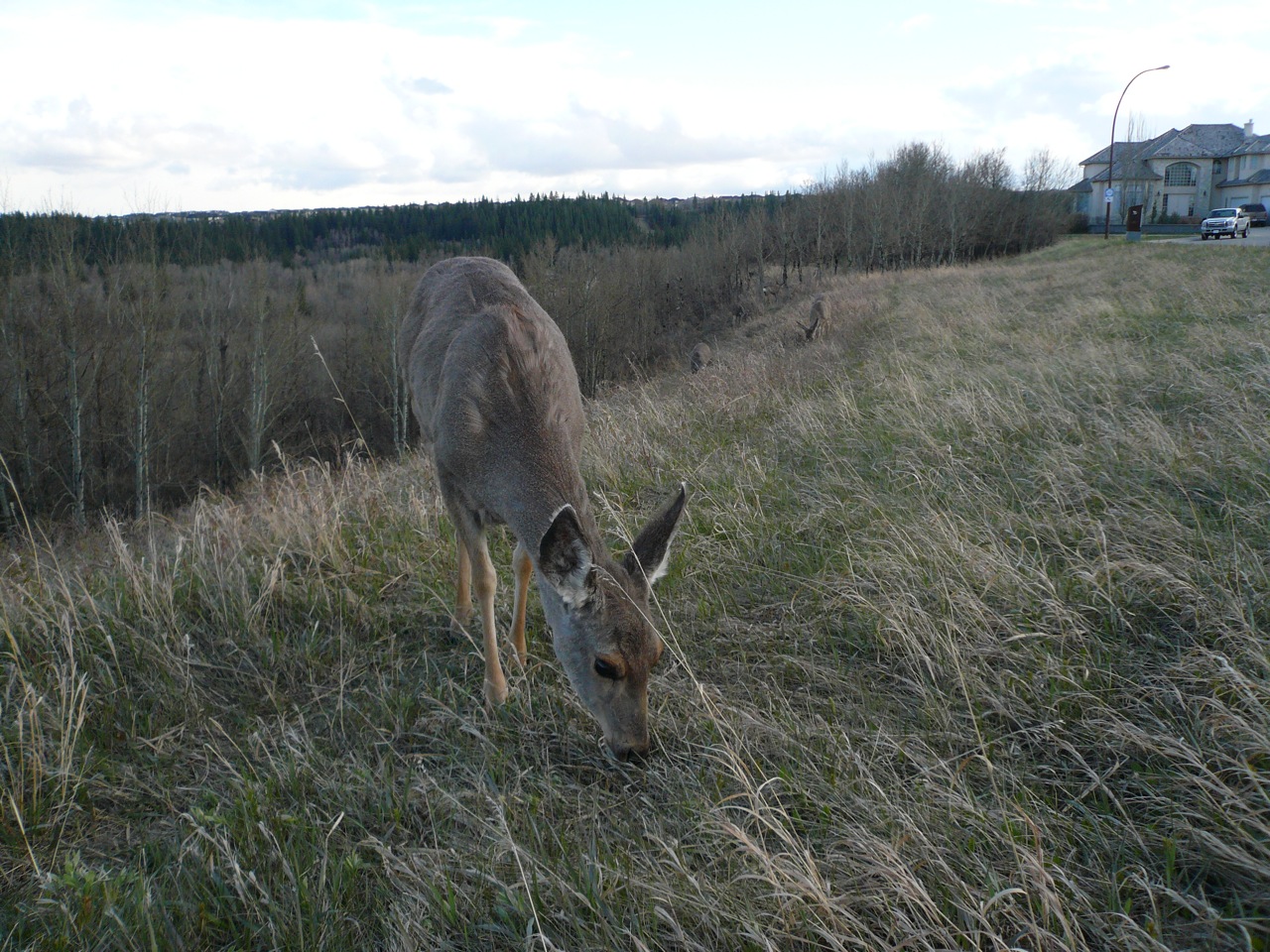
And an evening stroll after dinner.  Ahh… Mother knows best.

.

Hey, who’s that trying to take our pictures?  Haven’t you seen a deer family picnic before?  Oh right, not in your backyard… but, isn’t this our backyard?

*

A Note About the Photos:  Arti took them in her neck of the woods, the shared backyard with the Deer Family, on Mother’s Day, 2010.  All Rights Reserved.

***

Notes on the Synthesis of Film, Art… Life?

Recently I’ve just finished reading Paul Schrader’s Transcendental Style in Film: Ozu, Bresson, Dreyer (1972).  Yes, that’s before Schrader rose to prominence as a screenwriter and filmmaker. Is such a book a bit dated?  Considering the techno-reigning world we’re living in now, where speed is measured by nanoseconds, and where 3D and CGI have become the necessary features for movies to generate sales, I think we need to read this all the more.

The three directors in the book had produced some of the best movies of all time. Since I have not seen all the films Schrader discusses, I might not have grasped as fully his arguments and illustrations as they deserve. And I admit I do not embrace unquestionably all those that I do get. Nevertheless, there are many, many parts that I want to record down. I’d consider them crucial elements to mull over during the creative process in just about anything. I’ve listed some of these fine quotes in the following.

They all point to the axiom of ‘less is more’, the value of stillness and simplicity, the speechless sketch that speaks volumes, the importance of being over doing, the quality of sparseness over abundance, the bare essence of life.

Notes to myself: when watching, writing, reading, doing, or just plain walking down the mundane path of everyday, keep these points in mind.

  • Ozu’s camera is always at the level of a person seated in traditional fashion on the tatami, about three feet above the ground. “This traditional view is the view in repose, commanding a very limited field of vision. It is the attitude for watching, for listening, it is the position from which one sees the Noh… It is the aesthetic attitude; it is the passive attitude.”[1]
  • Ozu chose his actors not for their “star” quality or acting skill, but for their “essential” quality. “In casting it is not a matter of skilfulness or lack of skill an actor has. It is what he is…”
  • “Pictures with obvious plots bore me now,” Ozu told Richie. “Naturally, a film must have some kind of structure or else it is not a film, but I feel that a picture isn’t good if it has too much drama or action… I want to portray a man’s character by eliminating all the dramatic devices. I want to make people feel what life is like without delineating all the dramatic up’s and downs.”
    .
  • His films are characterized by “an abstentious rigor, a concern for brevity and economy, an aspiring to the ultimate in limitation.”
  • Given a selection of inflections, the choice is monotone; a choice of sounds, the choice is silence; a selection of actions, the choice is stillness–there is no question of “reality”. It is obvious why a transcendental artist in cinema (the “realistic” medium) would choose such a representation of life: it prepares reality for the intrusion of the Transcendent…
  • “The opening five shots of An Autumn Afternoon: The everyday celebrates the bare threshold of existence; it meticulously sets up the straw man of day-to-day reality.”
  • In films of transcendental style, irony is the temporary solution to living in a schizoid world. The principal characters take an attitude of detached awareness, find humor in the bad as well as the good, passing judgment on nothing.

***

.

  • Like Ozu, Bresson has an antipathy toward plot: “I try more and more in my films to suppress what people call plot. Plot is a novelist’s trick.”
  • As far as I can I eliminate anything which may distract from the interior drama. For me, the cinema is an exploration within. Within the mind, the cinema can do anything.”
  • On the surface there would seem little to link Ozu and Bresson… But their common desire to express the Transcendent on film made that link crucial… Transcendental style can express the endemic metaphors of each culture: it is like the mountain which is a mountain, doesn’t seem to be a mountain, then is a mountain again.
    .
  • The abundant means sustain the viewer’s (or reader’s or listener’s) physical existence, that is, they maintain his interest; the sparse means, meanwhile, elevate his soul.  The abundant means are sensual, emotional, humanistic, individualistic. They are characterized by realistic portraiture, three-dimensionality…
    .
  • The “religious” film, either of the “spectacular” or “inspirational” variety, provides the most common example of the overuse of the abundant artistic means… the abundant means are indeed tempting to a filmmaker, especially if he is bent on proselytizing. (Now… why am I thinking of Avatar?)
  • The transcendental style in films is unified with the transcendental style in any art, mosaics, painting, flower-arranging, tea ceremony, liturgy.  At this point the function of religious art is complete; it may now fade back into experience. The wind blows where it will;  it doesn’t matter once all is grace.

***

Transcendental Style In Film: Ozu, Bresson, Dreyer, published by University of California Press, 1972. 194 pages.

[1] Schrader quoting Donald Richie, “The Later Films of Yasujiro Ozu,” Film Quarterly, 13 (Fall 1959), p. 21.
The following three quotes are from the same source.

.

Some informative links:

Paul Schrader http://www.paulschrader.org/, http://www.imdb.com/name/nm0001707/

Donald Richie http://www.movingimagesource.us/dialogues/view/274

Yasujiru Ozu http://www.guardian.co.uk/film/2010/jan/09/yasujiro-ozu-ian-buruma, http://www.a2pcinema.com/ozu-san/home.htm

Robert Bresson http://www.mastersofcinema.org/bresson/, http://www.imdb.com/name/nm0000975/

Carl Theodor Dreyer http://archive.sensesofcinema.com/contents/directors/02/dreyer.html

David Bordwell http://www.davidbordwell.net/

***

Floating Weeds (1959)

‘Floating weeds, drifting down the leisurely river of our lives.’

.

.

April is national poetry month… and I’ve been thinking poetry these days.  So that’s why the very title of this DVD on the shelf of the indie video store attracted me right away.  I took it down soon as I saw it was directed by Ozu.  Ozu’s films are visual poetry, the title ‘Floating Weeds’ is an apt prelude.

Floating Weeds (浮草, Ukigusa, 1959) is a remake of Ozu’s 1934 silent film ‘A Story of Floating Weeds’.  The title comes from a favored Japanese metaphor as the above quote depicts.  In this newer version the director has added colors and sound, and given his story a blossoming rebirth. The colors are vibrant yet the cinematography is contemplative.  Unlike some art house films, and despite its title, ‘Floating Weeds’ is enlivened by humor, human interests, and augmented by actions.  Despite the pensive mood the title evokes, I found it to be more story-driven than many of his other works.  However, it is characters that ultimately carry the story, and Ozu’s brilliant direction that makes viewers care about them.

The story begins with a train dropping off a troupe of travelling players to perform in a small town.  The master of the company Komajuro takes the chance to visit his former lover and see his son Kiyoshi, now grown up to be a fine young man, aspiring to attend college in the big city.  But Komajuro has kept his real identity as Kiyoshi’s father from his son because he does not wish his low social status as a travelling actor, and the vulgar circle he associates with to tarnish Kiyoshi’s future.  The plot thickens as Komajuro’s current mistress Sumiko finds out about his secrets. Burnt with anger and jealousy, she plots a scheme to destroy Kiyoshi by bribing the young actress Kayo to seduce him.  The young man soon falls for the actress, but the scheme turns into a full-blown mutual love relation.  Sadly, a marriage with Kayo would mean the quashing of his aspiration for higher education, and possible social reverberations and disgrace.

At the mean time, the drama troupe hits a low with disappointing attendance. The company has to disband.  Komajuro facing failure on different fronts, has to make choices not only for himself, but the future of his son.  In the final shot, the train that once took the travelling players to town now carries them off as disbanded individuals facing uncertain future. Like floating weeds, they drift on in the stream of life. And for Komajuro, he leaves town with the slim hope that his son would fare better than he in the oblivious currents of time.

I’ve enjoyed the subtle style of Ozu.   Here is one of my favorite scenes in the film, and the dialogues are as contemporary as you can find in a 2010 movie.  Whether one sees it as insight or foresight (considering it was remade in 1959), both are gems one discovers while watching the story unfold as casually as a quiet flowing stream.

The scene is about Komajuro talking to his son Kiyoshi as he arrives to his former lover’s home. All the years, Kiyoshi has only known Komajuro as an uncle.  Although Komajuro is ecstatic to see his son all grown up with a bright future, he is also wary that his travelling drama troupe does not measure up to what he would wish for his son.  Here in this scene, father and son’s conversation seems to touch on another issue: art and popularity.  Through this most casual dialogue exchange, Ozu might have conveyed his own ambivalence on the subject more sharply than any wordy treatise.

Kiyoshi: I’ll go see your show.  What do you play?

Komajuro: Forget it.  It’s not meant for you.

Kiyoshi:  Who is it for?

Komajuro:  An audience.

Kiyoshi:  I’m an audience.

Komajuro:  I know.  It’s nothing high-class.  Forget about it.

Kiyoshi:  Why show such plays?  Show something better.

Komajuro:  But I can’t.

Kiyoshi:  Why?

Komajuro:  Audiences today won’t understand good plays.  So you can’t come to see it.

**

In his commentary on the 1934 silent movie, writer and film critic Donald Richie notes that Ozu’s films are full of ellipses. There are story sequences he left out for the audience to bridge.  As well, he handled the story with restraints.  Such a subtle way of presenting the material is a very modern style of storytelling.  That might explain why I would care for characters in a Japanese movie made half a century back, where I have to read subtitles, and watch in black and white, or even silent.  Herein lies the ingenuity and artistry of Ozu, that an audience so far removed in time, space, and culture, would find universality and common ground to be totally absorbed.

The Criterion Collection 2-DVD set includes both the 1934 silent movie and the 1959 color remake. The first features commentary by Donald Richie, the later version by Roger Ebert. According to IMDB, ‘Floating Weeds’ (1959) is on Ebert’s list of 10 best movies of all times.

~~~~ Ripples

CLICK HERE to my review of Ozu’s classic Tokyo Story.

***

The AGA Exhibits: Images In Sight And Sound

The AGA actually is a much smaller building than I expected.  But what’s appealing is the ubiquitous windows and glass allowing natural light to pour in, visually expanding the interior space.  The windows also make the surrounding downtown buildings visible from within, enhancing the sense of connection with the adjacent urban environs.  The exhibits are distributed among three floors of galleries.

Figures in Motion showcases 40 of Edgar Degas’ (1834-1917) bronze sculptures of dancers, bathers, and horses.  Juxtaposed in the exhibits are paintings, pastels, drawings, and prints of early photographs showing these figures in action.  The nuance of a single movement, as simple as the drying motion of bathers, can turn into a subject of grace and beauty under the sensitive eyes and expressive hands of the artist.
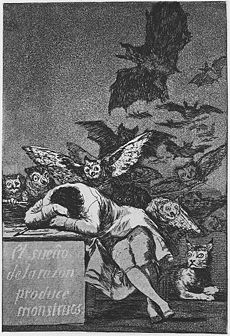
In contrast, Francisco Goya’s (1746-1828) etching prints suites Los Caprichos (1799) and The Disasters of War (1810-1820) are the realistic depiction of the ugliness and foibles of humanity.  A sharp social critic, his art mightier than the sword, Goya’s works expose unreservedly the horror of war and his critique of his time.

Up to the second floor I came face to face with the archetypal portraits by the renowned Canadian photographer Yousuf Karsh (1908-2002) in the exhibit Karsh: Image Maker.  We all must have seen some of his black and white portraits of famous people, somewhere.  The most well-known probably is Winston Churchill from whose mouth Karsh reportedly pulled out a cigar as he did his work.  Other famous portraits include that of Albert Einstein, Martin Luther King, Ernest Hemingway, Princess Elizabeth, Pablo Picasso, Andy Warhol, Alfred Hitchcock, Helen Keller, Grey Owl and numerous remarkable history makers.  I was totally absorbed as I walked by these meditative portraits of iconic personalities.

It seemed that the exhibits grew more interesting with every flight of stairs I stepped up.  The third floor offered an experience totally new to me.  As far as I can recall, this is the first sound installation mixed media art that I’ve encountered.  In a large, rectangular room occupying the whole floor, The Murder of Crows is installed.  Sound sculptors Janet Cardiff and George Miller have shown this work, their largest sound installation, in Australia, Germany and Brazil.  This is their North American premiere.

98 speakers are placed strategically and aesthetically in a large room, surrounding a table in the middle.  On the table is a megaphone.  Audience seats are grouped in the space encircled by the speakers.  The whole setting visually is a minimalist display.  The photo below is this installation in Berlin.  Even without the sound, the arrangement is an artistic presentation in itself.
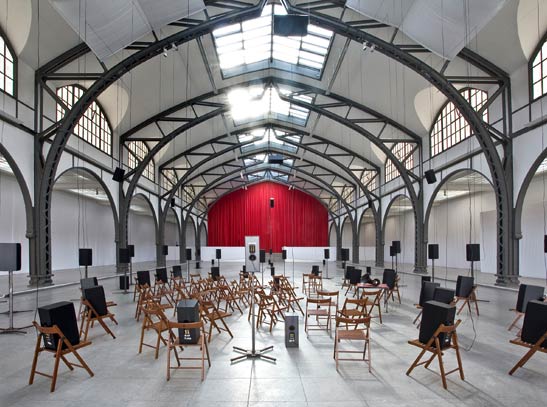
But what we had at the AGA was a windowless room with dim lighting.  The added effects were even more haunting and claustrophobic.

The 30 minutes sound presentation is a fusion of narrations, voices, footsteps, birds and bats, choral and orchestral music.  It evokes sequences of dreamscapes, and in part is an audio rendition of Goya’s etching The Sleep of Reason Produces Monsters in the Los Caprichos series (See image above).  The etching shows the artist himself asleep at his desk, with owls and bats hovering over him. The title divulges layers of meaning, prompting speculations of Goya’s actual thoughts.  The sleep of reason unleashes powerful imagination, even nightmares. Or, the erosion of reason led humanity into chaos and irrationality…

The phrase ‘the murder of crows’ refers to the collective gathering of the ominous birds, re-created here by the groupings of the 98 black speakers, some mounted on stands, some placed on chairs.  The very title and the effects made me feel like I was in the middle of the Hitchcock movie The Birds.  The sound was so riveting that I was glued to my seat in suspense… and the music from the massive choir and orchestra was both amazing and disturbing.  Click here to watch a 5-minute video clip of the sound installation. Click here to read an interview with Cardiff and Miller.

The AGA is not a big structure, but what is offered inside spans the artistic expressions separated by a chasm of time, form, and style.  From Goya’s disturbing etchings to the graceful renditions of Degas’ dancers, to the photographic images of iconic personalities captured by Karsh, and to end with the haunting sound installation The Murder of Crows, the exhibits were rains of pebbles into this quiet pond of thoughts… something I had not anticipated at the start of the trip.

Photography was not allowed in the galleries, so I cannot post any authentic visual experience here.  The above images are from the following sources:

Degas’ bronze sculpture Little Dancer and Karsh’s portrait of Albert Einstein from AGA website http://youraga.ca/current

Goya’s The Sleep of Reason Produces Monsters from Wikipedia Commons

The Murder of Crows sound installation from Cardiff and Miller’s website  http://www.cardiffmiller.com/artworks/inst/murder_of_crows.html

***