Bel Ami by Guy de Maupassant

Reading Maupassant reminds me why I love Jane Austen.

To be fair, I’ve only read one of the numerous short stories and one novel of Maupassant’s, but all of Austen’s six novels. So it just may not be apt for me to generalize the former. But focusing on just this book, Bel Ami, I can say here’s a protagonist whom I can never cheer for nor find amiable, to put it mildly…

Maupassant uses a scoundrel as the main character and have us follow his ascent, unscrupulous at every turn, as his ego and desires are being fed all the way to the end, and then some more. An antihero, the poster boy of realism in his depiction of late 19th C. Parisian high society?

Jane Austen has also written a protagonist she described as “A heroine whom no one but myself would like”. But comparing to Bel Ami‘s Georges Deroy, Emma Woodhouse is angelic. How do I even start to think of a parallel… imagine Wickham of Pride and Prejudice and Willoughby of Sense and Sensibility, combine them and magnify their nasty streak ten folds, then you’ll have Georges Deroy, nicknamed Bel Ami by the women in his life, ‘good friend’, a most pathetic irony.

The time is 1890’s Paris. Georges Duroy is a former soldier living in poverty. But call it luck or call it will, Duroy ends up a prominent figure in Parisian high society. This is how he does it.

Women. At one time, there are four significant females in Deroy’s life. These are upper crust, influential beauties. To Duroy, they are but rungs up the social ladder, each a conquest.

First is Madeleine Forestiers, the wife of his benefactor, editor friend whom he runs into coincidentally, and who saves him from poverty by bringing him in to work for the newspaper La Vie française.

The second one is Clotilde de Marelle, a married woman whom Duroy has made mistress. She aptly analyzes the Mars and Venus chasm of gender differences on that elusive notion called love. To Duroy, she says:

I know perfectly well that for you love is merely a sort of appetite whereas for me it would be more a sort of… communion of souls which doesn’t exist in a male religion. You understand the letter and I understand the spirit.

The third is the big boss of the newspaper Monsieur Walter’s wife Virgine, who has such a crush on Duroy that she loses her senses when he successfully schemes and manipulates her daughter Suzanne to elope with him.

George Wickham has plenty to learn from Georges Duroy because his subsequent wedding after the elopement is not a hush hush patch up, but a glamorous celeb nuptial, fully legit and the envy of all. By now, Duroy has climbed to be editor of La Vie française and made himself a Baron, changing his name to Du Roy for a more aristocratic sound. And we know full well that the conquest doesn’t stop there.

In one earlier incident, Duroy comes out of a gun duel unscathed, albeit a bit numbed. With his life spared, he could well have used such a near-death experience as a springboard to a new beginning and a turnaround of his ways. But his lucky escape has only fuelled his hubris and reaffirmed his self-importance. After the duel, he thinks himself invincible.

Is he immoral or amoral? I feel I have to choose the latter in order to find some amusement in following this unscrupulous character. Is it realism or sarcasm? I have to mix them both in order to seek some reading enjoyment. And with the English translation by the Cambridge scholar Douglas Parmée, there are the occasional descriptions that sounds… curt. But are they the original intent as realism dictates, or the collateral effects of translation? Can’t make up my mind on that one. Just an example:

The elder sister Rose was ugly, as flat as a pancake and insignificant, the sort of girl you never look at, speak to or talk about.

There, I find myself having to choose or debone or mix and stir in order to wash down better when reading Bel Ami. Under Maupassant’s pen of realism, Duroy is relentless all the way to the end. Just goes back to my love for Austen’s works… why, I can take in big gulps, devour and be totally satisfied. There are Wickham and Willoughby, but ultimately my yearning for some sort of poetic justice can be gratified. For my reading pleasure, I’ll take Jane’s idealism anytime.

***

Bel-Ami by Guy De Maupassant, translated by Douglas Parmée, Penguin Classics, movie tie-in edition, 2012, 394 pages.

As you can see from the book cover, Bel Ami has been adapted into film. To literature purists, I suggest you look for another edition. Whenever I read about Georges Duroy, which is on every page, Robert Pattinson’s face keeps haunting me, and images of Uma Thurman as Madeleine Forestier, Kristin Scott Thomas as Virginie keep conjuring up in my mind. Now I haven’t even watched the film… oh the suggestive power of a book cover.

This concludes my Paris in July entries for 2012. Thanks to Karen of BookBath and Tamara of Thyme for Tea for hosting.

To Paris again next year!

***

Midnight’s Children: Book Three

Click on the following links to the different sections of the book:
Midnight’s Children Book One
Midnight’s Children Book Two, Part A
Midnight’s Children Book Two, Part B

CLICK HERE to read my Movie Review of Midnight’s Children

***

Finally, we’ve come to the last section, the most eventful and catastrophic in our protagonist Saleem Sinai’s life. I must admit, my enthusiasm sagged a little at the end of Book Two, through no faults of Mr. Rushdie’s. Book Three sent me to some major Googling to be informed. After reading what I found on the Internet, I was fully awake.

The tumultuous waves of history swept Saleem along like an open dinghy. The 1965 Indo-Pakistani War over Kashmir ‘wiped out’ his family in a bomb blast. Saleem was ‘wiped clean’ with no memories of his own identity. He subsequently joined an intelligence gathering unit in the Pakistani military, his super sensitive nose being the major asset. In 1971, another war awaited him as he headed from West Pakistan into East to counter the revolutionary Mukti Bahini in their fight for an independent Bangladesh.

Perhaps fate had a gentler hand than humans. Saleem, now ‘buddha’ as he was ‘purified’ of all his past, got lost in the Sundarbans jungle. For seven months, he escaped the war between the two Pakistans. When he reemerged he witnessed atrocities done by his own Pakistan army he could not believe. Ten million refugees from East Pakistan walked across the border into India. As a result, the mightier Indian army led by Sam Manekshaw intervened and soon ended the war, with Pakistan’s Tiger Niazi surrendering with his 93,000 men. Buddha shed his uniform and became a deserter in Dacca, independent Bangladesh.

Tossed amidst the raging sea of national and personal upheavals, our protagonist, though a drop in a sea of six hundred millions, felt the burden of history and came to a self-realization. Rushdie’s description is powerful:

Who what am I? My answer: I am the sum total of everything that went before me, of all I have been seen done, of everything done-to-me… I repeat for the last time: to understand me, you’ll have to swallow a world.

With the Bangladesh Independence victory parade came a band of magicians from India, among them was Parvati-the-witch, one of the Midnight’s Children. Seeing Saleem again and calling his name out loud in excitement, Parvati cured his amnesia. She smuggled him in her basket back to India. Subsequently, Saleem stayed with Parvati and the magicians in the slum of Delhi. The silver spittoon he carries all these years is a perfect metaphor of his life… once born with a silver spoon in his mouth as a changeling, Saleem now comes back to where he would have been if he had not been switched at birth, the spittoon.

Saleem met his changeling rival, Major Shiva now. A loyal supporter of PM Indira Gandhi, Shiva had risen as Saleem fell. A national hero and a womanizer, Shiva went to the magician ghetto and took Parvita away. Months later she was sent back to the slum when he learned that she was pregnant. At the end, it was Saleem who married Parvita, knowing that she would give birth to Shiva’s son.

Baby Aadam Sinai was born at midnight, June 25, 1975, on the brink of Indira Gandhi’s Emergency measure in gripping absolute power, another fateful night of the nation’s history. But Saleem knows his son who is not his son will have a different path:

Aadam was a member of a second generation of magical children who would grow up far tougher than the first, not looking at their fate in prophecy or the stars, but forging it in the implacable furnaces of their wills.

With Shiva as the biological father, baby Aadam once again flowed back to the blood line of his grandfather Ahmed Sinai, the offspring of a changeling comes full circle back to his rightful lineage.

Indira Gandhi’s son Sanjay conducted an anti-poverty operation to eradicate the slums. Parvati was killed in the clean-up. After her death, Saleem had a chance to go back to his birth city Bombay with his son. There he reunited with Mary Pereira. She was now Mrs. Braganza, manager of a pickle factory. Her changeling crime forgiven, Saleem now worked in her factory, paralleled his work as a writer preserving history:

… in words and pickles, I have immortalized my memories, although distortions are inevitable in both methods. We must live, I’m afraid, with the shadows of imperfection.

Is an author liable for what he writes in a work of fiction? The line delineating reality and fiction in Midnight’s Children is often blurry. Do Saleem’s views parallel Rushdie’s? Like Saleem telling his life story to Padma, Rushdie in Midnight’s Children could well have gone all out to unleash his sentiments towards the historical progression and political turmoil of India, the Partition, Pakistan and later Bangladesh.

In Book Three, Rushdie was particularly critical of the suspension of civil rights, censorship of the press and arrests of subversive elements during the Emergency as Indira Gandhi seized absolute power. But it was for a more personal description, a single sentence about Indira in this section of the book that brought Rushdie a defamation suit in 1984 by Mrs. Gandhi when she was PM again. In context, the sentence is Saleem’s account, but has to be removed from publication after that year. Rushdie mentions it in his introduction to the 25th Anniversary edition.*  The author still has the last word.

Midnight’s Children is an epic chronicle that carries multi-layered meaning and parallels, a feast of stylistic literary offerings. As an outsider, I feel I have only scratched the surface. But with just this outer core, I’ve been much entertained and informed. I will be back for more.

***

A note of appreciation to Mrs. B of The Literary Stew who planted the seed of this read-along, and Bellezza of Dolce Bellezza who supported the start-up. My hearty thanks to all who have shown interest, participated at one time or another exchanging thoughts and insights in your reviews and comments, as well as those who are silent readers. All your contributions have made this four-month endeavour gratifying and worthwhile.

Review posts for Midnight’s Children Finale:

Janell of An Everyday Life

Gavin of Page247

To read my reviews of previous sections of Midnight’s Children, please click the links on the sidebar.

We must do this again some other time. Book suggestions?

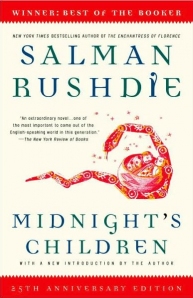
* Midnight’s Children by Salman Rushdie, 25th Anniversary Edition, Random House Trade Paperbacks, New York, 2006, 533 pages. (Book cover as image above)

***

Midnight’s Children is one of my most anticipated films for 2012. Here are the actors playing young (Darsheel Safary) and adult Saleem Sinai (Satya Bhabha):

Here’s @SalmanRushdie’s Tweet regarding the release dates of the film: ‘Canada, October 26th; UK, November 9th; USA, being finalized, should be around the same time.’

***

What Makes a Good Audiobook Narrator?

That’s the question for discussion today on Audiobook Week 2012 hosted by Devourer of Books.

I’ve just started listening to audiobooks regularly this year and already found a few excellent narrators:

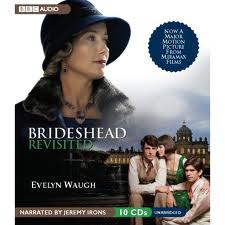
Jeremy Irons reading Brideshead Revisited by Evelyn Waugh — I’ve already mentioned how captivating his voice is on my review. Basically, it’s the aptness of the tone in fitting the mood and atmosphere of the book. Clarity is crucial as well. Often when just listening, I would easily get confused as to who’s talking. But Irons is most efficient in keeping his characters distinct. Finally, the dramatization of them is spot on. I can see them in my mind’s eyes. They are convincingly interpreted and portrayed, consistent with the characterization of the book.

Peter Francis James reading On Beauty by Zadie Smith — This is a challenging book to narrate because of its myriad of accents and racial mix. James has done an amazing job in voicing the characters in their cultural, gender, and age-related quirks and expressions. Here we have a fusion of British, British/American, African American, rapper American, and British/Trinidadian. All these just to depict two mixed-race families. Here, the criterion for excellent narration is efficiently met: Amidst the cacophony of voices, James has distinguished the characters with apt individualism, helping me to appreciate each character on its own.

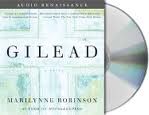
Tim Jerome reading Gilead by Marilynne Robinson — This 2005 Pulitzer Prize winning novel has only one character speaking throughout and that’s the ageing Reverend in Gilead, Iowa, John Ames. Suffering from illness but still lucid and wise, he leaves his memories to his very young son as a family legacy while he still has time. Tim Jerome’s voice exudes gentleness, compassion, forgiveness and wisdom, just like the character John Ames. Listening to the audio makes me feel like he’s casually and warmly chatting with me over coffee after a good meal. I don’t think I’ve heard another more gentle and loving voice, which is so appropriate with the characterization.

***

You can see I’ve mentioned the audiobook that I listened to with these narrators, as I haven’t heard their other works. So this leaves another question: Are they just as excellent in those other readings? That I’ll gladly explore.

***

Audiobook Review: Brideshead Revisited Read by Jeremy Irons

Don’t be misled by the cover design. This audiobook is not related to the 2008 movie adaptation. Rather, it’s an unabridged recording of Evelyn Waugh’s novel, engagingly read by Jeremy Irons, who plays the narrator Charles Ryder in the 1981 award-winning British TV series.

Jeremy Irons exemplifies what an ideal audio performance should be like. We look for the visuals in a movie; we are drawn to the voice in an audiobook.

For one who has had his share of youthful desires, tasted love and loss, and known the ambivalent effect family and religion can bring, now twenty years after, Charles Ryder is resigned to a numb and dreamless existence. Irons delivers such a tone perfectly… his deep, quiet and sombre voice an apt reflection of Ryder’s sentiments.

His voice dramatizes the various characters with clarity. As a listener, I can easily tell who’s talking, as simple as that. From the senior Lord Marchmain to 12 year-old Cordelia, from the stuttering Anthony Blanche to the constantly drunk Sebastian Flyte, Irons’ portrayal is natural and apt. Characterization is consistent in their manner of speech, quirks and eccentricities. Further, he has also effectively conveyed the subtext, the undercurrents in the dialogues, for example, the sardonic remarks Edward Ryder often hurls at his son.

On top of all these, Irons has presented Waugh’s beautiful language and descriptions with poetic eloquence. His articulation stops me time and again to rewind so I can listen and savor the language once more.

Here is the excerpt that seized me from the start and sent me to find the passage in the book to recap every word. This is in the Prologue when Charles unknowingly arrives Brideshead in his army duty twenty years later and asks his subordinate where they are. This is the moment when he is told the name of the place:

He told me and, on the instant, it was as though someone had switched off the wireless, and a voice that had been bawling in my ears, incessantly, fatuously, for days beyond number, had been suddenly cut short; an immense silence followed, empty at first, but gradually, as my outraged sense regained authority, full of a multitude of sweet and natural and long forgotten sounds: for he had spoken a name that was so familiar to me, a conjuror’s name of such ancient power, that, at its mere sound, the phantoms of those haunted late years began to take flight.

I know it’s a bit long, but I must include it here, for this is the passage that has drawn me to the written word, all because of the voice reading it. Can this be the measure of a good audiobook?

***

Brideshead Revisited by Evelyn Waugh read by Jeremy Irons, BBC Audiobooks America, 10 CD’s, 11 hrs 21 min, Unabridged. July 22, 2008.

~ ~ ~ ~ Ripples

***

Thanks to Devourer of Books for hosting Audioweek 2012.

Other related posts on Ripple Effects:

The Downton Ripples

Dances With Words

***

Listen Up: Audiobook Week 2012

June is Audiobook month, and today begins Audiobook Week 2012 (June 25-29), thanks to Devourer of Books for hosting. This is my first time participating.

Audiobooks are not new to me, albeit I’ve not been a regular listener. But 2012 is the year I rediscover the pleasure and benefits of them, and become a ‘chain user’. Mainly, it’s a time-saver for me. I listen to CD recordings of books while driving. That’s a great way to finish a book. Yes, after much pondering, I say ‘finish’ instead of ‘read’. The difference I’ve written in a previous post Dances With Words.

Yes, books on CD’s still, because there’s a large collection at our local public library. Audible.com, well, here’s a little story.

Have you ever been given a gift and then see it taken away as you open it? This is exactly my experience on this year’s Mother’s Day. My son gave me Colin Firth’s reading of Graham Greene’s The End of the Affair through Audible.com. Sweet… both the giver and the gift. We unwrapped the gift together, trying to download the recording, but was told its copyrights did not apply to Canada. So, we can’t listen to it above the 49th parallel. So much for free trade and open borders.

Anyway, I’m resigned to continue listening the old fashioned way… CD’s, while patiently waiting for Colin Firth’s reading to be transferred onto them.

The following are the audiobooks I’ve finished so far this year:

Reviews coming up. Happy listening everyone!

***

The Downton Ripples

Or, How I Overcome Downton Abbey Withdrawal Syndrome.

First, I bought the Blu-rays and rewatched both Season 1 and 2 several times. And then, I let my curiosity lead and follow mere intuition. Downton has prompted me to seek out books and films with setting in the early part of the 20th C.

I was most intrigued by the irreversible changes modernity has brought about, but on a more sombre note, I was moved to learn of the grave number of lives lost in a war I knew so little, WWI.

As heir to Downton Matthew Crawley has aptly noted while fighting in the trenches:

War has a way of distinguishing between the things that matter and the things that don’t.

The Great War did not end all wars as claimed, but had ended countless lives of a young generation, and altered numerous others. On the positive side, it had toppled society’s status quo and broken down previously impenetrable barriers, when men of different social classes fought side by side in the trenches, and where women played a substantial role in the war effort.

And then there are the stories of individuals and families… I’ve thoroughly enjoyed this reading and watching spree. But I have to stop somewhere and share with you what marvellous works you can follow while waiting for Downton Abbey Season 3 to arrive.

So, here’s Arti’s Annotated List of Downton Ripples:

Lady Almina and the Real Downton Abbey by Fiona Carnarvon — A springboard to all my WWI period exploration. What impressed me was that Highclere Castle itself was actually turned into a hospital during the War and many of its staff enlisted and some killed. I was moved by the number of casualties and the horrific conditions in the battlefields. My full review of the book is posted here. 

The World of Downton Abbey — by Jessica Fellowes, niece of write/creator of the series Julian Fellowes. A compendium to the production, the hardcover larger-sized book is filled with photos, background info and quotes from the actors. After skimming through the whole book, one item stands out: Mr. Bates’ fall. That’s when Mrs. O’Brien trips him and he falls flat on his face on the gravel. How did they shoot this? Any special effects? Well, unfortunately for Mr. Bates, none whatsoever.

This is what Bates, Brendan Coyle said:

I must have done it 18 times and by the end I was wounded! I wore knee pads and a torso shield, but when you fall you have to really commit to falling.

Ouch! Some method acting.

Lost Empires (1986)— 7 Episode mini-series based on J. B. Priestly’s novel set in 1913, a year before WWI broke out. Colin Firth is young Richard Herncastle. Lost both parents at 19, he follows his Uncle Nick on his travelling magic stage show, learning the ropes of the itinerant performer in the music hall circuit. A coming-of-age saga chronicling the loss of innocence in love and life. Some noted actors in the series include Sir Laurence Olivier and John Castle.

A Farewell to Arms (1929) — Hemingway’s WWI semi-autobiographical sketch of love and loss. I listened to the audiobook read by Mad Men’s John Slattery. In authentic Hemingway style, his narrative is matter-of-fact and stoic. After that I watched the 1932 movie adaptation with Gary Cooper and Helen Hayes. An adaptation that makes me wish Hemingway was the screenwriter and director.

Brideshead Revisited (1945)– Evelyn Waugh has used a huge and magnificent mansion owned by an aristocratic family to tell his story. Something like Downtown but in a much serious tone. Its subtitle “The Sacred and Profane Memories of Captain Charles Ryder” sets the stage for a tug of war between God and man. I listened to the audio book read by Jeremy Irons, who has turned Waugh’s narratives into pure poetry. Probably the best audiobook I’ve ever listened to.

I’m still watching the 11 Episode TV series (1981) with Jeremy Irons playing the main character of Charles Ryder. So far, I’ve enjoyed the detailed and slower-paced depiction of the work. The book really needs a whole series to tell its story.

I’ve also rewatched the 2008 movie adaptation. As much as I respect the actors in it, Emma Thompson, Matthew Goode, Michael Gambon… I think it has trivialized Waugh’s masterpiece. The adaptation has taken the crux of the matter out and replaces with photogenic visuals and a story converted for more popular appeal. But it could well send one back to the book for curiosity’s sake.

Easy Virtue (2008) — For something totally light and swift, I rewatched this movie based on a Noel Coward play. Filled with Coward’s own music and some Cole Porter, the film depicts how the changes of the times have brought to yet another aristocratic family.

Larita (Jessica Beale) is the first woman race car driver to cross the finish line in Monte Carlo. The year is 1930. An American, she marries on a whim John Whittaker (Ben Barnes), the son of an English aristocratic family… and quickly becomes enemy on the home front to matriarch Veronica Whittaker (Kristin Scott Thomas), and subversive ally to her husband, disillusioned WWI officer played by Colin Firth. If you’re interested, here’s my full review of the movie.

A Handful of Dust (1988) — After Brideshead Revisited I went on to watch another of Evelyn Waugh’s adaptation. Again, a large mansion… how many of these architectural heirlooms do they have in England? Anyway, the master of this house Tony Last (James Wilby) is too busy looking after his property that he loses his wife Brenda (Kristin Scott Thomas). Title comes from T.S. Eliot’s The Waste Land (1922)… that sent me into reading the poem again.

Goodbye To All That (1929) — Autobiography of Robert Graves, English poet and writer. I’m most impressed by the men of letters in that period, they enlisted readily. Robert Graves and Siegfried Sassoon were both involved in the most devastating battles in France. Both were seriously injured. Deep in the trenches they wrote poetry. Their views towards the war changed as time went by, but their experiences in the battlefields brought about poignant legacies as eye witnesses of a horrific war and its aftermath. Ironically, Graves handles his subject matter with some light-hearted reminiscence.

The Remains of the Day (1993) — Not quite the same period but a bit later in the brewing year before England’s engagement in WWII. I rewatched this film adaptation of Kazuo Ishiguro’s Booker Prize winning novel in full, sumptuous Merchant Ivory style. The film leads me to think of a few parallels… Darlington ~ Downton, Stevens ~ Carson, but I’m glad Carson has more heart. And in both Downton and Remains of the Day, a character named Richard Carlisle.

The list goes on with Passchendaele and Birdsong yet to read and watch. But I know when Season 3 of Downton commences, I’ll gladly return and transfix myself once again in the Crawley family.

What have you been doing since Downton Abbey?

***

You may also be interested in:

Quotable Quotes from Downton Abbey

Lady Almina and the Real Downton Abbey

Saturday Snapshot: Book Sale 2012

For Paris in Julyclick here to my home page. I’ll be starting to post the first week of July. 

Saturday Snapshot is hosted by At Home With Books.

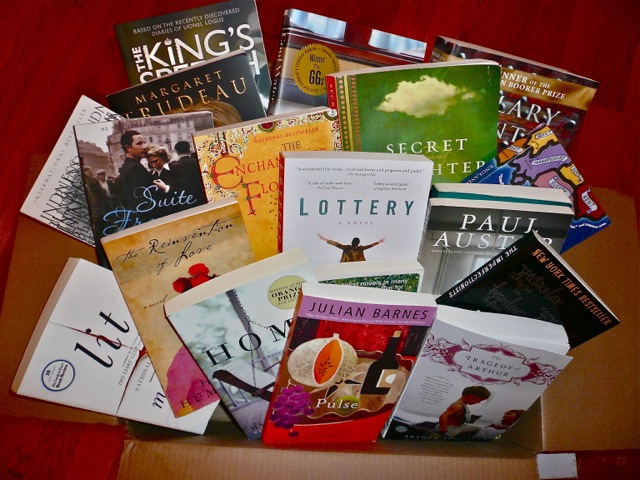
Every year the gigantic book sale organized by the Servants Anonymous Society in our City kicks off my summer reading stock-up. This weekend begins their tenth annual book sale at the Crossroads Market. Here’s a photo of the books I hauled back yesterday, all in like-new condition, all for $1.50 each since I’ve got 20 of them.

Many of the titles I’ve been watching out for some time. Some of them I came to know when I read their reviews on your blogs. Glad I can find them in the book sale and in such good condition. A few of the books look like they haven’t been opened.

Here’s the list in no particular order:

Travels In The Scriptorium by Paul Auster

England, England by Julian Barnes

Pulse, stories by Julian Barnes

Home by Marilynne Robinson

The Virgin Suicides by Jeffrey Eugenides

The Tragedy of Arthur by Arthur Phillips

Lit by Mary Karr

Suite Française by Irène Némirovsky

The Secret Daughter by Shilpi Somaya Gowda

Lottery by Patricia Wood

Blindness by José Saramago

The Reinvention of Love by Helen Humphreys

The Enchantress of Florence by Salman Rushdie

Wolf Hall by Hilary Mantel

The Mistress of Nothing by Kate Pullinger

Cool Water by Dianne Warren

The Imperfectionists by Tom Rachman

One Summer by David Baldacci

The King’s Speech by Mark Logue and Peter Conradi (biography of Lionel Logue)

Changing My Mind by Margaret Trudeau (autobiography)

**

Any of your favorites here? The Sale lasts for three weekends beginning June 8. If you were me, would you go back in the next two? Know my struggling sentiment?

**

Midnight’s Children Read-Along: Book Two (Part B)

CLICK HERE to read my Movie Review of Midnight’s Children

***

From the best exotic Marigold Hotel of today we go back to 1960’s India and Pakistan…

Here in this part, we see our protagonist Saleem Sinai’s changeling status finally revealed to his parents. The ‘Alpha and Omega’ chapter in our last section has let out Saleem’s blood type being neither A nor O, throwing question on his origin. Mary Pereira finally confesses to the crime of switching the two babies at birth.

This is where I find most true and moving. Saleem talking about his parents Ahmed and Amina:

Never once, to my knowledge, never once in all the time since Mary Pereira’s revelations, did they set out to look for the true son of their blood… maybe, despite everything, despite cucumber-nose stainface chinlessness horn-temples bandy-legs finger-loss monk’s-tonsure… my parents loved me. I withdrew from them into my secret world; fearing their hatred, I did not admit the possibility that their love was stronger than ugliness, stronger even than blood.

And from here, Saleem experiences two important moves of his life. One is being sent to temporarily live with his filmmaker uncle Hanif and his wife Pia Aziz, and has enjoyed a fun and pampered time in their home.

Later, in the sixteenth year of Saleem’s life and India’s independence, his father Ahmed makes the resolute decision: there is no future for them as a Muslim family in India. They are moving to Pakistan.

I’m afraid Mr. Rushdie begins to lose me here. As one not familiar with Indian/Pakistani political history, I can only follow his narratives on the surface regarding the war between the two countries. I must have lost the deeper meaning and parallels as he depicts the political turmoils there, or the Indo-Pakistani war of 1965.

While in Pakistan, Saleem’s sister Brass Monkey has changed her name to Jamila and turned into a singer of patriotic songs. Saleem is ambivalent about this… he is excited about Monkey finding her voice, but is apprehensive about her fanaticism. With his ultra sensitive Snotnose, Saleem can distinguish the different kinds of smells that pass through it, one of them being “the hard unchanging stink of my fellow-students’ closed minds.”

Despite being an outsider and not understanding the political parallels of the narratives, I can grasp Rushdie’s meaning about political ‘truths’ declared by the government. Saleem has gleaned some insights into his short life growing up in both India and Pakistan:

… and maybe this was the difference between my Indian childhood and Pakistani adolescence–that in the first I was beset by an infinity of alternative realities, while in the second I was adrift, disorientated, amid an equally infinite number of falsenesses, unrealities and lies.

And a little sardonic humour as he concludes:

A little bird whispers in my ear: “Be fair! Nobody, no country, has a monopoly of untruth.” I accept the criticism: I know, I know…

An outsider can still enjoy Rushdie’s stylish surprises.

It is also in this section that I’m a bit disappointed to read that along with the move to Pakistan, Saleem loses his supernatural power to tune into the minds of all other Midnight’s Children, thus terminating any more Conferences. I hope this is temporary though, for I relish the confrontations between Saleem and the others he calls to congregate in his mind, in particular, the opposing sides represented by Saleem and Shiva: idealism and pragmatism, thoughts and things.

I look forward to the last section, Book Three, and see how the story concludes. Hope you’re still with me…

***

CLICK HERE to BOOK THREE CONCLUSION

Do go visit other reviews in the Group Read:

Gavin of Page247

Janell of An Everyday Life

Jerika of averydisorientedreader

***

CLICK HERE to watch Salman Rushdie and Deepa Mehta talk about the film adaptation of Midnight’s Children at TIFF last year.

***

Midnight’s Children by Salman Rushdie, Book Two (Part A)

CLICK HERE to read my Movie Review of Midnight’s Children

***

While Part One of the book is a macro view of historical background and family genealogy dating back a few generations, Part Two is what we’re all waiting for, the emergence of Midnight’s Children, in particular, our young hero Saleem Sinai. This present section of our Read-Along is the first part of Book Two, ending with the chapter ‘Alpha And Omega’.

We see Saleem Sinai growing up from a protected infant doted on by mom Amina and maid Mary to a thinking, mature, yet mildly timid and clumsy ten year-old. He shares his childhood in the family with his sister Brass Monkey, one year younger, ‘untamed, unfeminine’. Faced with the ambivalence of sibling rivalry and camaraderie, he learns in time the axiom that blood is thicker than water.

By all standards, Saleem’s first ten years (so far) have been eventful. Not long after his birth, Ghandi is assassinated. Saleem’s father Ahmed’s assets are frozen but later rescinded by the court. He spies on his mother and follows her secretly as she meets her ex-husband, now the Communist Party leader.

Saleem’s great sense of imagination is nurtured by various cultural traditions, a generous share of fairy tales, super heroes and the cinema.

Hatim Tai and Batman, Superman and Sinbad helped to get me through the nearlynine years… I became Aladdin, voyaging in a fabulous cave… I imagined Ali Baba’s forty thieves hiding in the dusted urns… I turned into the genie of the lamp… I was mild-mannered Clark Kent protecting my secret identity…

Other memorable episodes include a first taste of unrequited love from his crush on Evie Burn. As for school, colonial traditions stay. Saleem goes to a Christian mission school where he gets his multi-cultural exposure. Some learning is hard, that’s expected. But he gets more than his fair share as he tastes the ultimate in corporal punishment and humiliation as a clump of his hair is pulled out by his Peruvian geography teacher. Later in the school dance, in front of his new crush Masha Moviac, he shows her he is a man after all as he knees his insulters. Mayhem ensues that ends with a mutilated finger in the emergency room.  I can see lots of movie moments, hilarious yet endearing.

But above all, growing up in Methwold’s Estate and his part of Bombay is a close encounter with multiplicity. And to a young boy tossed in the net of a myriad of interwoven cultural strands, Saleem is preoccupied with the search for an identity. Further, with his secret, supernatural gift of tuning into other people’s mind, he eagerly looks for a purpose and meaning to his life. And here is how Rushdie so brilliantly parallels Saleem’s birth to that of a nation.

On my tenth birthday, everyone at Methwold’s Estate tried hard to be cheerful, but beneath this thin veneer everyone was possessed by the same thought: “Ten years, my God! Where have they gone? What have we done?

Saleem holds a Midnight’s Children Conference right in his mind, he himself the self-imposed leader of the 581 surviving Midnight’s Children, all born with unusual gifts. His leadership is challenged by none other than his changeling, Shiva, born at the stroke of midnight with him. While Saleem ponders on the purpose and reason for his supernatural power, his counterpart Shiva, coming from the slums, opposes him with the facts of life:

Rich kid,” Shiva yelled, “you don’t know one damn thing! What purpose, man? What thing in the whole sister-sleeping world got reason, yara? For what reason you’re rich and I’m poor? Where’s the reason in starving, man? God knows how many millions of damn fools living in this country, man, and you think there’s a purpose! Man, I’ll tell you–you got to get what you can, do what you can with it, and then you got to die. That’s reason, rich boy. Everything else is only mother-sleeping wind!

Crisp and simple. Existential pondering a luxury to many… ?

How I look forward to the rest of the book, and the movie. BTW, it has been shown to selective previewers, who were told not to write any reviews as yet. They sure know how to build up expectations and curiosity.

***

CLICK HERE to BOOK TWO: Part B
CLICK HERE to BOOK THREE CONCLUSION

Read-Along Participants’ Posts for Book Two (Part A):

Bellezza at Dolce Bellezza 

Gavin of Page247

Janell of An Everyday Life

Jerika at averydisorientedreader

ds at third-storey window

If you’ve written a post on this section, do let us know in a comment. I’ll add your link on the list.

Next section: Book Two, Part B. From ‘The Kolynos Kid’ to the end of Book Two. Share your view May 31st. You still have time to catch up if you like to start the book now.

***

Everything In This Country Must by Colum McCann

This is my third installment for Ireland Reading Challenge at Books and Movies. And just recently, I’ve come across another interesting reading event, so I’m using this review as well to participate in the Irish Short Story Week Year Two at The Reading Life.

A book compiling two short stories and a novella, Everything in this Country Must reaffirms my admiration for Colum McCann’s spare and powerful writing.

McCann is the author of the 2009 National Book Award winner Let The Great World Spin. In my review of that book, I noted how he’d intricately woven together seemingly unrelated stories against the backdrop of the Twin Towers, crafting a moving tribute to NYC.

Before NYC, McCann had written about his home country Ireland. Everything In This Country Must (2000) is a poignant portrayal of how the political turmoils in Northern Ireland during the 80’s affect the three young protagonists in each of these stories. All the short pieces in the book are masterfully rendered, immediate, sharply focused, intense, minimal yet deeply charged. Above all, I’ve appreciated, as with Great World, McCann’s insightful metaphors.

***

Everything In This Country Must: Short Story

Nightfall, cold and raining. A man’s favorite work horse is near drowning with its forelegs caught in some rocks at the bottom of a flooding river. He gets his 15 year-old daughter to help him hold the horse’s head above water with a rope while he frantically dives into the water to get its legs out, but to no avail. He desperately needs help.

Soon enough, an army truck passes by. A few British soldiers quickly jump out to help. O what plight! The wrong people coming to the man’s aid. These soldiers remind him of the loss of his beloved. Despite his protest, they save the horse. The daughter now is torn between her gratitude towards the soldiers and her father’s anger.

Of course I will not tell you everything about this story. You must experience it yourself. Then you’ll be amazed how in just fourteen pages, McCann can depict a human flood of hatred and rage that can drown any living soul, and slap you with a haunting end that leaves you cold like night.

Wood: Short Story

With his father stricken ill in bed, a young boy helps his mother to secretly work in the family mill to earn some money, cutting logs and refining them to make poles which will then be used to hold political banners for the Protestant marches. The boy knows that his father, despite being Protestant, disapproves of these marches. That’s why he knows he has to do this stealthily, yes, to protect the pride of his father who now lays in bed unable to work, but maybe even more importantly, so not to betray his political stance. Mother and son toil in secret, turning raw wood into polished poles. The boy loves both parents, his loyalty a dilemma between reality and ideal.

And all this time the wind blows obliviously, swaying the oak trees behind the mill. “The trunks were big and solid and fat, but the branches were slapping around like people.”

Hunger Strike: Novella

Kevin is a new arrival to a Southern seaside town, living with his mother in a caravan by the shore. The move apparently is an attempt of his mother to get away from the political conflicts in the North. Kevin’s father had been killed in an accident some years ago. Currently his uncle, an IRA member imprisoned in Northern Ireland, is one of a group of inmates holding a hunger strike. Some have already died.

The uncle’s ordeal disturbs 13 year-old Kevin deeply. While his mother wants to give him a better life away from the turmoil, Kevin is emotionally entwined with his uncle’s struggle. The boy vicariously partakes in the hunger strike, counting the days, noting closely the deterioration of his uncle’s health, and even secretly dumps his own food away.

An older couple with a yellow kayak live close by. Kevin observes that they paddle in sync, they move and rest in perfect harmony. Their calm and quiet life is a huge contrast to his. Later, the couple befriend him. The old man teaches him how to paddle:

The blade should never go too deep into the water or else too much energy would be used. And there should never be too much of a splash when the paddle came out — it should look as if the sea had hardly been disturbed.

A hopeful new beginning for Kevin seems to ensue, but the situation continues to deteriorate in his hometown in the North, and with the plight of his uncle. The waves inside Kevin is just too rough for smooth and quiet paddling. A sea undisturbed belongs to the apathetic, and sometimes splashes are called for. McCann’s description of a tormented young life is both visual and haunting, and propels us to a poignant and heart-wrenching end.

~~~~ Ripples
(yes, exactly my point)

Everything in This Country Must by Colum McCann, A Novella And Two Stories, Picador U.S.A., 2000, 150 pages.

***

For my other Ireland Reading Challenge posts: 

Molly Fox’s Birthday by Deirdre Madden

The Importance of Being Earnest by Oscar Wilde

***

Dances with Words

After listening to an audiobook, do you consider having read the book?

Why or why not?

I’ve been mulling over this question for some time now. I love reading, but I’m a slow reader. It’s always faster to listen to a book read to me than reading it myself. So you see the appeal there. And I can make good use of my time while driving.

But I always feel there’s a difference between listening and reading. All along, I don’t equate having listened to an audiobook with having read the printed pages. I’m beginning to find the word ‘finish’ most apt, since it can apply to both. Saying ‘I have finished a book’ can mean either.

Oral tradition of storytelling has long been around in human history, a way to preserve tales and legends that had not found a written form. But for those that do have a life in words, or, ‘texts’ in our eAge, why do I still hesitate to consider listening to them the same as reading the print version?

At long last, I think I’m beginning to get a hold of what could be the difference… and this may sound so common sense to you. But, it’s an Eureka moment for me.

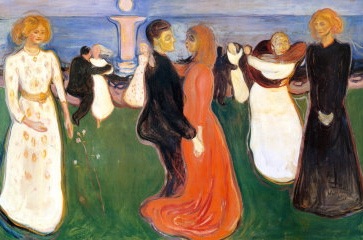
Here it is: Reading a book is a first-hand encounter. I’m the sole interpreter of the text. Like partners in a dance, as a reader I respond and move with every single word in my own way.

The Dance of Life by Edvard Munch (1900)

With audiobooks, I’m listening to a voice that has already interpreted the written codes. Every audio recording is a performance. And I mean it in a good sense. The reading I’m listening to has passed through an interpretive filter. That voice must have first read the words, internalized, and then delivered them with what the voice thought was the appropriate diction, pitch, accent, tempo, emotion…

When I’m reading a book, I’m dancing with the words as partners. When I’m listening to an audiobook, I’m watching a dance performance. I enjoy both. But the experiences are different… and there’s only one first-hand encounter that’s unique to me: my own.  But sometimes, I need to see how others dance too in order to appreciate the story or the characters more. We just may need dancing lessons every now and then.

I must give kudos to two audiobooks I finished recently. In both of them, the voice reading the text confirms how fascinating dances with words can be.

On Beauty by Zadie Smith, read by Peter Francis James:

I’m amazed how one reader can give life to characters of various cultural background in such a vivid manner. On Beauty explores in a nuanced and comical way, relationships and conflicts within a family, as well as between races, generations, and genders. It was shortlisted for a Booker (2005) and was the Orange Prize winner in 2006. Now imagine the myriad of characters.

The book describes two families intertwined in a cacophony of cultural dissonance, the fathers being academic rivals. In the Belsey family we have father Howard who is a white Englishman, his African American wife Kiki, their three youthful offspring who have grown up in America influenced by different subcultural vernaculars. Melting pot is a wrong term to describe them. It’s more like you’ve thrown classical, jazz, hip-hop, rap, all into the wok and stir fry.

Howard’s academic rival is Monty Kipps, who has brought his family from England to stay in America shortly as a visiting scholar teaching at the same college as Howard. The Kipps family members are all British citizens with Trinidadian heritage. Their two college age children have grown up in England.

The talented actor Peter Francis James has given a worthy portrayal of such a cultural mix of characters without turning them into caricatures, but has rendered them convincing and real. Zadie Smith’s nuanced dialogues and humor are well executed. It is a close encounter of dissonance in language, accents, values, and racial influences. What a dance performance this is. I have not read the book, but when I do read it, I’m sure I will not appreciate it as much if I haven’t heard the voices jumping up and down in my mind.

Gilead by Marilynne Robinson, read by Tim Jerome

Gilead was the 2005 Pulitzer Prize fiction winner. I read the book a few years back. Listening to the audio CD’s recently has not only brought back memory of my previous enjoyment, but insights that I’d missed my first time reading the book. All thanks to the calm, soothing, and gentle voice of Tim Jerome, portraying spot-on the ageing John Ames, Congregationalist minister of Gilead, Iowa.

Throughout the book, there’s only one character speaking, that of John Ames leaving a legacy to his very young son, telling him stories of his own grandfather and father, a family tradition of ministers. Jerome’s audio rendition of the book works in me like a devotional. His voice embodies grace and forgiveness. Listening to him can only augment my own reading experience, a performance to emulate for the dance of life.

***

What are some of your experiences of reading vs. listening to books? Which are your favorite audiobooks?

***

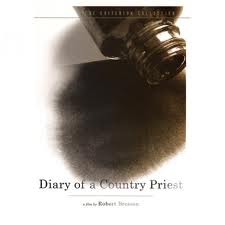
Diary of a Country Priest: Film Adaptation (1951)

For me, the cinema is an exploration within. — Robert Bresson (1903-1999)

Robert Bresson is one of the most influential figures in French cinema. The acclaimed New Wave director Jean-Luc Godard once noted: “Robert Bresson is French cinema, as Dostoevsky is the Russian novel and Mozart is German music.”

I know, Austrians would say Mozart was Austrian. But this just shows his influence can cross borders. Same with Bresson, who is acclaimed as one of the forefathers of the French New Wave, even though his style is not experimental. The iconic Swedish director Ingmar Bergman had specifically cited Diary of a Country Priest as influence for his Winter Light.

Before Bresson adapted Diary of a Country Priest, two previous screenplays were attempted by others but turned down by the author Georges Bernanos himself. Bresson’s film was made after Bernanos died. Bernanos had nothing to worry about with Bresson’s interpretation, for the film is an almost literal and a worthy cinematic translation. It won the Prix Louis Delluc in France (best film of the year) and several international film awards. Bresson was given the Career Golden Lion at the 1989 Venice Film Festival.

That Bresson, a professed agnostic, would choose to adapt a work by the Catholic writer Bernanos shows the moving power and the universal appeal of the book. The parish of Ambricourt is a microcosm of the human world. The seemingly placid village hides a spiritually barren landscape and a cocoon of depravity. The young priest, an unwelcome alien, is captured cinematically as small and vulnerable, an apt depiction of how he feels within:

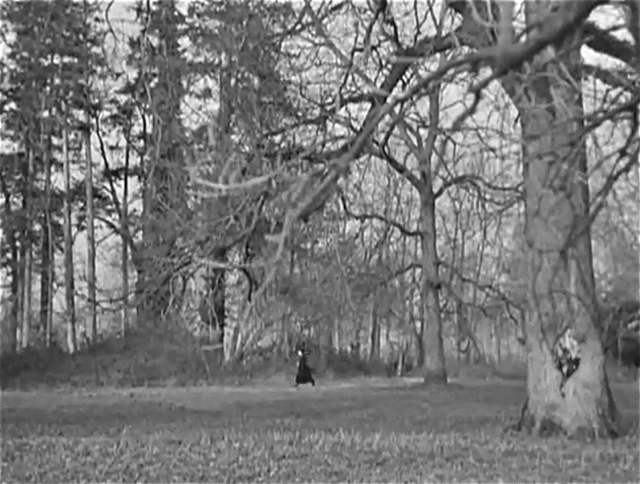
An outsider barred from a gated mansion of dark secrets, like here at the front gate of the Château.

The light comes into the world, but the darkness refuses it. On screen, we see the young priest often shut out of gates and windows. The glass pane allows him to be observed from the inside, yet he is very much on the outside isolated, the weight of the world heavy on his face.

Bresson’s style is minimal, you may find this film somewhat austere. But I’m gratified by such style, devoid of color and whatever additives we find in movies today. Instead, every frame conveys an aesthetic simplicity and thematic purpose.

To explore the drama within, Bresson chose ‘non-actors’. “As far as I can, I eliminate anything which may distract from interior drama,” Bresson was quoted saying, and distractions included ‘acting’. He selected his ‘models’ (as he called them, not ‘actors’) first for their voice. He particularly looked for inexperience. The young Curé of Ambricourt was Claude Laydu’s first film role. Others that Bresson used were often one-time actors just for the film he was making.

The Criterion Collection DVD has a most helpful commentary by film historian Peter Cowie. His insight is invaluable to the appreciation of Bresson’s adaptation. One of his remarks is the off-screen sounds we often hear in a scene. The most intense one would have to be the climatic spiritual battle between Mme la Comtesse and the young priest. Totally engulfed by grief, hatred and bitterness, and living in isolated misery all the years since her young son died, Mme la Comtesse finally releases her pain and receives blessings from the priest. And what sound do we hear off-screen the whole time they are engaged in this soul-piercing scene in the drawing room: the gardener’s raking of dead leaves.

Another source I’ve often sought out is the book written by Paul Schrader: Transcendental Style in Film: Ozu, Bresson, Dreyer. Yes, if I must choose a word to describe Bresson’s style, I would use Schrader’s term: transcendental. His minimal, aesthetically simple, ‘non-acting’ style raises the viewer to a meditative plane which is beyond the material, beyond all distractions. That’s the essence of cinema that I find so meaningful and gratifying.

And finally, despite succumbing to his illness, the young priest leaves a legacy that his superiors, the senior vicars, could not have: an embodiment of the suffering Christ and the redemptive power of grace. Despite his own frailty and ultimate death, the young country priest  triumphs through his faith, however feeble it may have seemed in his own eyes. It does not matter, for all is grace.

~ ~ ~ ~ Ripples

***
AND TO ALL, A HAPPY EASTER!
***
Other related posts on Ripple Effects:
.
.
.
.
***